• anna j. clutterbuck-cook
  • contact
  • curriculum vitae
  • find me elsewhere
  • marilyn ross memorial book prize

the feminist librarian

the feminist librarian

Tag Archives: education

librarianship =/= dick-waving contest

02 Thursday Sep 2010

Posted by Anna Clutterbuck-Cook in library life

≈ 3 Comments

Tags

economics, education, politics

Okay, so I gripped about this on Twitter, and then because that wasn’t enough thought about posting it on Tumblr. But then the draft of my tumblr post got way longer than I planned so now it’s going to be a bona fide blog post.

one armed man topples a bookcase (sketch)
by curablefury @ Flickr.com

AndyW @ LISNews appears to be surprised that an MLS degree does not exempt him from plebeian tasks such as checking out books to patrons and staffing the reference desk (instead of holding court in private with “people who have actual reference questions”).

On any given day, I can be standing at the circulation desk side-by-side with a support staff member doing the same thing that they are doing. So long as this arrangement exists, the perception that librarianship does not require an advanced degree will continue to taint the image of the profession.

One response to this state of affairs for any individual with critical thinking skills might be to ask “if the tasks of librarianship do not require an advanced degree, then why are we requiring advanced degrees of librarians”? This is, in fact, a question that has already been asked in comments to AndyW’s piece and no doubt will continue to be a subject of debate. (See, for example, my post from May on this very topic).

AndyW doesn’t ask this question, however. He’s pretty clear on the fact that he likes the status his library science degree grants him — or rather, he wishes that his library science degree would give him the sort of status he imagined it would grant him. (Aside from, presumably, his ability to apply for professional positions which are compensated financially above the paraprofessional and nonprofessional level). He wants the whiff of authority. The deference. The aura of mystery, perhaps? And rubbing elbows with the working, uneducated masses just isn’t cutting it.

It is a disservice to the education, to the degree, and to the profession when the bulk of a librarian’s daily tasks could be performed by someone with a GED. It does not take a master’s degree to place a hold on a book, clear a copier, push in chairs, tell people they are being loud, shelve items, or other similar tasks. When librarians are seen doing this and then told there is an advanced degree requirement, there is a reasoning dissonance that occurs in the outside observer.

Because, you see, it’s all about appearance. About the need to ensure that patrons who are using the library (in ever-increasing numbers) understand Andy’s credentials. What sets him apart. That, while he may be assisting his staff in a time of need, such tasks as reshelving or helping patrons find and check out the books they need to meet their information needs (or thirst for pleasure reading) are generally below him.

As a fellow librarian, may I suggest it would be a professional move to spend less time worrying that observers won’t be able to tell you apart from the paraprofessionals and “someone with a GED” (damn those lowly plebes and their ability to work with books!). To insist on the distinction, particularly in such dismissive terms, is insulting to your staff. Staff who presumably, though lacking credentials, are working in a library for a reason (and it’s probably not because it pays incredibly well). It is also insulting to your patrons: is assisting them — even if it’s simply to point them toward the bathroom or unjamb the photocopier — somehow beneath your dignity? Those “observers” whom you imagine are so obsessed with your credentials are probably, in the end, much more interested in whether their information needs are met promptly, knowledgeably and courteously than they are in whether the person meeting those needs has taken a class in Information Organization. As a commenter on the LISNews site suggested rather pointedly, “Staff who aren’t willing to chip in to do ALL the things to make the library a success aren’t professionals – they are just getting a paycheck.” To seek professional respect by denegrating the work of non- and paraprofessionals whose service unarguably enables a library to function is (to put it bluntly) the behavior of an asshole.

Librarianship is not some giant dick-waving (er, degree-waving) contest. An advanced degree is not a magic, respect-demanding bit of psychic paper. It is, arguably, an outdated method by which certain knowledge workers in the late-19th and early 20th century made the case for their work to be given social status. But that’s a blog post for another day.

In the meantime, I mostly want to say: Way to reinforce the kyriarchy, dude. In a totally uncool sort of way.

a few things on education

17 Tuesday Aug 2010

Posted by Anna Clutterbuck-Cook in linkspam

≈ Leave a comment

Tags

education

Rural school children, San Augustine County, Texas, April 1943
Library of Congress Photostream @ Flickr.com.

There’ve been a handful of stories coming across my feeds the past few weeks on the subject of education and culture; none of them have inspired me to a full-length blog post, but I wanted to share them with you anyway. So here’s a round-up of links with some snippets. Enjoy!

Idzie @ I’m Unschooled. Yes I Can Write | The Myth of “Social Awkwardness” Among Homeschoolers & Unschoolers.

I have seen absolutely no difference [generally] between homeschoolers, unschoolers, public schoolers, or private schoolers, EXCEPT that the unschoolers who do have to work harder with social stuff are generally far more confident, far more aware of their worth, whereas the schooled people are often made to think that they’re losers, that they’re uncool, so have serious feelings of worthlessness. Really? That’s what school has to offer kids that you’re so upset un/homeschoolers are missing out on: making anyone who doesn’t fit a very narrow definition of normal feel like they’re a failure??

eastsidekate @ Shakesville | College: The solution to everything.

Creating jobs is not about intelligence or education. It’s about having enough money to pay someone to do something. And :drumroll:…. having money is not exclusively a function of being educated, intelligent, good-smelling, or anything else, really. Of course, if we argue that wealth is solely a function of merit (as measured by education, which we assume is a function of intelligence), then yeah, it’s pretty much axiomatic that a more educated populace will create more jobs.

If we realize that some folks who have a lot of money and power to burn aren’t necessarily deserving of such, the wheels fall off in a hurry.

Richard Jeffrey Newman @ Alas, a Blog | The Politics of Education.

The content of education is always, always, political and there will always be someone somewhere who thinks her or his perspective has been left out of what children are taught, to their detriment as individuals and to the detriment of society as a whole. Independently of that, though, I am a big believer in trying to find as many ways as possible to include as many perspectives as possible in the classroom, not to make the point that they are all equally valid, but to make the point that the more informed we are about those perspectives, even the ones that have been shown to be invalid, the more responsible and accountable we are likely to be in our own perspectives.

Janine Giordano @ Religion in American Culture | Teaching Sexuality and Religion.

[The] student … complained to the Department Chair of Religious Studies that the professor was encouraging and expecting students to apply (Catholic) Natural Moral Law as their understanding of natural law. “I didn’t go to Notre Dame for a reason,” he signed. The professor’s email to his students, also apprehended by the local newspaper, did claim that “none of what I have said here depends upon religion,” alongside an unqualified encouragement to apply (Catholic) Natural Moral Law within their own adult thinking.

And, ’cause I’m starting to think about what the next scholastic endeavor will be after library school … sexademic @ The Sexademic | So You Want to Be a Sex Educator (“Sexademics do it theoretically”).

"a very disciplined adult is required for paddling to be effective" and other wtf observations

03 Tuesday Aug 2010

Posted by Anna Clutterbuck-Cook in think pieces

≈ Leave a comment

Tags

children, education, human rights

Last week, while looking for something completely different, Hanna stumbled upon this post on corporeal punishment in schools from Teaching Tolerance: A Project of the Southern Poverty Law Center. I realize the post was published in May so that the link is a bit stale, but the comment thread was just too good a MSTing opportunity to pass up. The original post is a call to stop the practice of paddling in schools, which is still legal in twenty states. “Physical punishment is banned in federal prisons and medical facilities. It’s long past time to extend the same protection to our children,” writes the SPLC blogger. All well and good.

It’s the comments that really take the cake in that a number of them refuse to see the problem with being physically violent toward children as a “corrective” measure. Here are a few choice selections

By the fourth comment in, we’ve already resorted to the classic “it worked for me so obviously that’s what’s best for everybody” argument:

When I was young we got paddled in school. I was smart enough to know right and wrong and never once got paddled. My mother taught me better. With that being said, the “emotional” problems I got were only that I needed to behave or I would get paddled. My school did not do it right infront of the class they would take them out into the hallway and do it, but everyone knew what was going on and feared it happening to them. I believe this should still be legal in ALL schools. I can guarantee that children would behave better and, in turn, learn more.

In case a behaviorist argument isn’t swaying the crowd, someone else chimes in to suggest that children are incapable of rational discussion, moral reasoning, or compassion. Oh, and have we mentioned that hitting kids doesn’t do them any harm?

Have you ever tried to reason with a child? They don’t understand the way an adult does. I’ve spanked my seven year old son about 4 times in his life and he’s doing just fine.

But maybe not all children respond the same to physical punishment — perhaps it works better on black children than on white children.

In some cultures little Sally may receive a paddling and her whole life is ruined to where Davonte receives a paddling and it corrects his behavior. What is normal for some may be abnormal to others.

Not everyone is okay with the normalization of violence, as this comment shows

When we physically punish our community’s children, we teach them that it’s okay to hit when we’re angry. It’s okay for a man to hit his wife, okay for a child to hit a peer, okay to kick a dog–okay to use violence instead of dialogue to solve our problems.

To which someone responds with a theory straight out of Dobson.

Ah, but that is why a very disciplined adult is required for paddling to be effective. There is a universe of difference between a visibly angry and aggressive adult taking an object and striking a student with it and a very calm and controlled adult reasonably informing the student that they have done such and such a wrong and that the punishment is a few moments of pain (and I emphasize, it must be a FEW MOMENTS; lingering pain and soreness teaches a child that a reasonable adult inflicts suffering as a form of discipline and that is NOT the proper message) and a slight dose of shame because while the punishment must not be physically very painful, being bent over and spanked like a little child causes shame and shame, used properly and constructively, induces a desire in the child to avoid being shamed and thus, avoid the activity which caused them to be spanked and shamed. This is how a mature well-meaning adult physically disciplines a child for the child’s betterment.

This idea of a dispassionate adult rendering judgment on a child brings us right back to the defining narrative of Evangelical Christianity, with its dispassionate God who causes us intense pain and threatens us with abandonment in the name of our eternal salvation.

Causing human beings shame does not make them better people. Instead, it destroys their sense of themselves and cripples their ability to make meaningful, responsive connections to others. Punitive measures rarely give anyone (child or adult) greater understanding as to why what they have done has caused harm; instead, punishment teaches them to do better next time … and not get caught! As another anti-paddling commenter observes

I think the first thing we need to think about is how kids learn. What are they learing from being spanked or paddled by an adult? That hitting another person is okay? Many pro-spankers feel that pain associated with a behavior will teach a child to not do that behavior again. While that might be true for infants and toddlers, it is not the case for older children. In addition to that, for the pain/behavior association to work, the spanking must be done immediately so that the association is made. I’m thinking this isn’t the case in these schools.

The next thing to think about is what this does for the teacher- do pro-spankers feel that it gives them some sort of power over the kids? It is my opinion that if spanking/paddling a child is the only way you can get respect from children or feel powerful, you might have to work on your teaching skills.

Not that all of the anti-paddlers get full marks for discussion either, considering how quickly the specter of pedophilia come up in relation to spanking

People with SPANKING FETISHES work in occupations that give them access to children like hospitals, schools, boy scouts, etc. and over 2,500 teachers were punished in a 5 year period since 2000 for inappropriate sexual relations with our nation’s school children, and women teachers are sexually preying on children at an increasingly alarming rate, which is why PHYSICAL/CORPORAL PUNISHMENT OF CHILDREN IN SCHOOLS MUST BE ABOLISHED IMMEDIATELY!

While I’d assume at least some of the people who get off on physically assaulting children get off sexually as well as just enjoying the power rush, I also think it’s pretty damn simplistic to assume that all physical contact = sex!

Sadly, the “debate” over whether or not physical violence against children is every okay is nothing new. Americans have been arguing over the place of physical punishment in school since at least the 1840s, when corporeal punishment came under fire from reformers who protested its use against sailors, prisoners, slaves and children. While in America, at least, the slavery issue became a moot point several decades later (although race, as evidenced above, has hardly vanished from the discussion), I’d venture to suggest that violence is still endemic in all of these spaces. And I, like the reformers, raise questions about its appropriateness in any of them.

Image: A Scary Vintage Postcard @ Flickr.com

to be subjective and scholarly

18 Friday Jun 2010

Posted by Anna Clutterbuck-Cook in think pieces

≈ 1 Comment

Tags

domesticity, education, thesis, work-life balance


Last Friday, I blogged about my frustration with finding balance between my academic research and writing, my wage-work, and my domestic life and loves. This Friday, I thought I would pick up where I left off, after a fashion, and write about the ways I try to balance the academic and the personal within my work as a scholar.

This post has gone through a number of different iterations in my head, but is taking this particular form because of a recent post by Kimberley @ 72-27 who this week wrote a long, reflective piece about her own return to academia and the limitations she sees in rigorous scholarship that neglects the relational in pursuit of the rational.

Before my current program, I came from a small school in Seattle that trained students to be therapists, and thus it placed primary value on inter-personal and intra-personal knowledge. My professors were psychoanalysts and therapists, and they asked their students to delve into the unconscious self and figure out what was there and why it was there. We did intense work understanding our own families of origin and personal narratives, and we received a great deal of feedback on how other people experienced us while in relationship with us. While the program lacked academic rigor in the traditional sense, it demanded a kind of inter-personal and intra-personal rigor that was invaluable.

While I love the rigor that is applied to critical thinking at Yale, I am left envisioning what Yale would be like if that same kind of rigor were applied to self- and inter-personal knowledge. For instance, in my U.S. religious history class, one of my professors shared with us that it took him quite a while in his career to realize that he hadn’t picked his research “objectively.” His research came out of deeply rooted questions based on very personal life experience. Yet, in his graduate training, he had not been encouraged to see the connections between his “objective” research and his own life story. This discussion in class came at the very end of the semester, and it was a relief to me. I had often felt as if historians maintained a pretense of objectivity. It was nice to finally hear that we can actually do better research if we are self-reflective in the process. Knowing ourselves better will also translate to being better collaborators.

Emphasis mine. You can read the whole post at 72-27.

How does this connect to my own work, beyond the skepticism toward an overly-depersonalized academia which I unabashedly share? To begin answering that question, I want to share another lengthy quotation — this time from an email I wrote earlier this spring. When I was at the Oregon Extension in March, doing research for my thesis Doug Frank — one of the faculty there, an historian and mentor of mine — asked me whether my project was a chronicling of “what happened” or whether I was making a specific argument. I stumbled through an immediate response that, from what I remember, emphasized that I was gathering the oral histories as a type of chronicling, but that my thesis would itself have a specific argument to make about the place of the Oregon Extension in American cultural, educational, and religious histories.

Of course me being me, I left the conversation unsatisfied with my response and the following day wrote Doug a long email trying to explain my motivations for this research. I won’t reproduce the email in full here, but I wanted to share two paragraphs that speak to the connections between my “objective” historical analysis of the Oregon Extension and my own life story.

On a more personal note, I will say that this project comes out of my own deep interest in history of non-mainstream education and my very personal quest to find a way to bring together my love of learning (the life of the mind) in some sort of structured environment with the quality of life I experienced as a child and young adult outside of institutional schooling. My original desire to attend the OE as a student (nearly a decade ago now!) was driven, in large part, by my desire to find a way to be a scholar without having to fit myself into the vision of education (the fear-based model you were talking about yesterday, which I believe is still deeply embedded in most schools) and of human nature that ran so counter to the understanding of human life that I had grown up with in my family (and elaborated on through my reading in theology, feminism, and educational theory). I am drawn to examples of intentional community and purposeful work life, in which folks have been able to step outside of the pressures of the mainstream and forge a life for themselves that isn’t grounded in being “anti” (that still retains some sort of relationship with the dominant culture) but nevertheless has some autonomy when it comes to priorities and values — the power to say “you have no power here” to things within the dominant culture which are inimical to human well-being.

When I went back to graduate school, I was taken aback by how much my soul rebelled against being back in an environment of institutional education, surrounded by folks who largely take those traditional frameworks for granted (at the very least) and often champion them (Boston’s educational culture is incredibly status-conscious). I don’t necessarily believe I made the wrong choice to return to school (the factors are myriad), but I do know that when it came time to choose a thesis topic, I intuitively knew I needed to spend my time with a topic that would help me retain critical distance on that culture, that vision of humanity, that understanding of the way human beings learn and what they need to thrive. And as of this writing, at least, I feel pretty proud of the way that this project has helped me to do just that, giving me a certain inner sense of distance from the expectations and values of the institutions within which I work as a student scholar, so that I am sharing these ideas with them (in a form they can accept for credit) but not writing my thesis for them.

As I wrote more concisely (though much more pedantically) in an early draft of my thesis introduction, “The scholarly task of historicizing the college classroom and the expectations of higher education were, in part, a method of coping with the alienation I often felt as a student whose experiences and vision of, not to mention goals for, learning were at odds with the majority of the people whom I encountered at school.”

In other words, this topic matters to me, in a visceral, immediate way. The project of make sense of the history of competing educational theories and practices is as much about finding a place for myself within that world as it is about situating the Oregon Extension within its unique historical context. I am invested in doing my part to enter these folks into the historical record because I believe deeply in the value of what they do. It is important to me that their own unique experiment in living be acknowledged at some level as part of the history of education in the twentieth century — a way of being that runs counter to the stories we tell ourselves about how life has to, or ought to, be.

And the world of academia is definitely divided as to whether this is or is not a good thing. Emotional proximity to one’s subject-matter is often viewed with deep suspicion, as it is seen to cloud the mind, bias the historian whose job (as Kimberley notes about) is ostensibly to be “objective” about her subject. Distance from one’s topic (in time as well as emotion) is supposed to provide you with the dispassionate objectivity to analyze and critique with greater clarity. Even if we recognize (as most scholars do today) that we are all inevitably subjective in our scholarship, the push has been to recognize and attempt to minimize or compensate for those biases, rather than to embrace and work with them as strengths.

I’m less certain that this is the only or the best approach to subjectivity within scholarship. Although I’m still searching for language to articulate it, I think that there are different qualities of emotional proximity or connectedness to one’s research subject that can — depending on how self-aware the researcher is and what their relationship to that connectedness is — help or hinder scholarly analysis.

I am taking a meditation class with Hanna this month (my first ever!) and have been introduced to the practice of metta meditation, in which the quality of loving-kindness toward beings is distinguished from feelings of acquisitive desire for those beings. I’ve been thinking this week about how the same distinction might be made concerning one’s affinity toward a research project: intense feelings of loving-kindness toward the subject and subjects — relatedness that is not conditional upon a particular outcome — could be separated from an emotional investment that was conditional, that required fidelity to a particular outcome, a particular historical narrative that fit pre-conceptions about what story these historical sources were going to tell.

Again, I’m not sure how practically this translates into a real-world relationship between the scholar and her sources, the scholar and her passionate involvement with the work of her subjects. But it is a beginning, a way to open (inside myself, at least) a conversation that values not only my intellectual work but also the personal, emotional, life-story reasons why the pursuit of this particular story is not only an academic exercise but also very much a matter of existential survival.

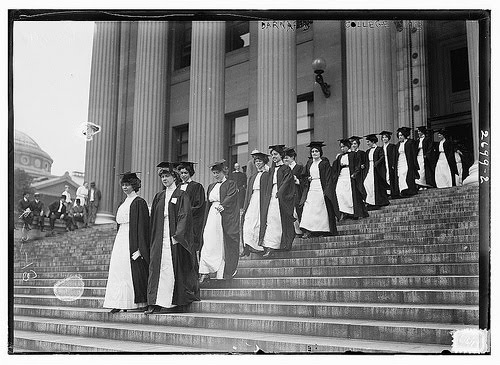
image credit: Barnard College, 1913 (LOC) made available by the Library of Congress @ Flickr.com.

PSA: Diplomas are Tools of Satan!!!

22 Saturday May 2010

Posted by Anna Clutterbuck-Cook in media

≈ Leave a comment

Tags

education, humor, photos

Via Hanna comes this awesome sign from the blog Engrish Funny.

Sign reading:

The text on the sign reads:

Diploma Is A Tool of Satan
Diplomas and academic status are Satan’s tools of oppression
To obtain them, students have come slaves to the education systems of the human kingdoms
We are honorable children of God
We need not subject ourselves to their system
….. being affirmed by God.

Thank you all for reading and enjoy your Saturday!

multimedia monday: clean living

10 Monday May 2010

Posted by Anna Clutterbuck-Cook in media

≈ Leave a comment

Tags

education, gender and sexuality, multimedia monday, web video

Two videos for you this morning that attempt to teach young people just how narrow a road they must walk in order to survive into adulthood.

First, a health education film for 1950s college students. While it ostensibly targets both men and women, notice how much more time they spend panning the camera up and down the coeds’ bodies, and how clearly the female students are positioned as primarily objects of the male gaze (forget about your homework, girls!). It’s also clear that although the women are supposed to be sexually alluring they are not under any circumstances supposed to cross the line into sexual availability (slut!) or actual sexual activity.

As my friend Rachel put it: “CREEPIEST. DAD. EVAR.”

Enjoy. And then go wash your eyeballs with carbolic soap.

alma mater update: in other unsurprising news…

08 Saturday May 2010

Posted by Anna Clutterbuck-Cook in think pieces

≈ 2 Comments

Tags

bigotry, education, gender and sexuality, hope college, human rights, michigan

Here’s the promised update re: Hope College and its Institutional Statement on Homosexuality, which I wrote about on Thursday.

The group Hope Is Ready, which has been one of those petitioning to have the statement withdrawn by the Board of Trustees, shared (through their Facebook page; apologies if this means you can’t follow the link) the following letter from Hope College President James Bultman yesterday afternoon.

May 7, 2010

Dear Members of Hope is Ready:

Thank you for your interest in Hope College and for the time and effort committed to sharing your concerns with the Board of Trustees. Your insights were helpful in our discussions. Those elected to hold the college in their trust have thoughtfully, thoroughly, and prayerfully considered your petition.

Relative to your petition, the Trustees have taken these actions:

1. The Board of Trustees denied your request to remove the 1995 Institutional Statement on Homosexuality

2. The Board of Trustees appointed a Trustee committee to expand the college’s 1995 position statement in the larger context of all human sexuality in such a way that the Hope community is called to a renewed encounter with the clear, demanding, and healing biblical witness regarding human sexuality.

The college’s current position on homosexuality is based on its interpretation of scripture. It is recognized that well-intentioned Christians may disagree on scriptural interpretation. Still, humbly and respectfully, the college aligns itself in its interpretation with is founding denomination, the Reformed Church in America, the orthodox Christian Church throughout the ages, and other Christian colleges and universities.

On behalf of the Hope College Board of Trustees, I thank you for your concern for the college we love and respectfully ask that you accept these decisions in the spirit with which they are rendered.

Cordially,

James E. Bultman
President

In short, it basically says nothing that hasn’t already been said, and the fact it was up on the web by 2:33pm yesterday afternoon makes it pretty clear that the Board of Trustees didn’t spend much time deliberating on their course of action.

Sad, despiriting, but unsurprising.

I’ll be thinking today about all those folks in the Hope College community — many of whom I’ve known my whole life — who do not think this way, and who work hard everyday to make sure the official college position is not the only one that gets heard.

I said in my letter to the Board, and I’m going to repeat it here: to tell any person that being sexual and making positive, fully consensual, sexually intimate connections with another human being is destructive to their spiritual well-being is an act of violence. To codify such a belief in an institutional statement makes it institutionalized bigotry, giving that belief the authority of college administration that has the power to materially effect the lives of students and employees.

I absolutely believe that such an act of violence runs counter to the Christian message that we are all called to increase joy, practice love, and work toward wholeness in the world. I don’t see how this decision by Hope’s Board of Trustees does any of that. So it sure as hell doesn’t seem very Christian to me.

*image credit: Hope College Voorhees Hall, made available through the public relations office website.

in which I write letters: dear alma mater

06 Thursday May 2010

Posted by Anna Clutterbuck-Cook in think pieces

≈ Leave a comment

Tags

education, hope college, i write letters, michigan, politics, sexuality

Today, the Board of Trustees at my alma mater (Hope College) convenes for its spring meeting. On the agenda is the Insitutional Statement on Homosexuality (PDF), written by the college president in 1995 and formally adopted by the board in 2001. The statement basically affirms the position of the Reformed Church in America which condemns homosexual “acts” while “affirming the responsibility of Christians to be fair to and accepting of persons with a homosexual orientation” (yeah, don’t ask; I’m not sure how they expect anyone to actually carry this off).

Anyway, the Hope LGBT Alumni Association called on folks to write the Board a personal letter opposing the statement and calling for its repeal. And because I enjoy writing letters and welcome any opportunity to get up on my soapbox and declaim on issues near and dear to my heart, I jumped at the chance.

And because it’s a shame to share self-righteousness with only the Board of Trustees when you can spread it around the internet, I’m posting it here. I’ll let y’all know what happens in the weeks to come!

Anna J. Cook (’05)
XX Xxxxxxxx Xx Xxx #
Allston, MA 02134

16 April 2010

Joel G. Bowens, Chairperson
Hope College Board of Trustees
c/o Office of the President
141 East 12th Street
Holland, MI 49422-9000

To the Board of Trustees:

I am a third generation alumna of Hope College, a 2005 graduate (summa cum laude) in History and Women’s Studies, and daughter of Mark Cook, Director of the Hope-Geneva Bookstore. I was born and grew up in Holland, only blocks away from the Hope campus, and there are many reasons I am proud to recognize Hope College as part of my heritage.

Since I am also a feminist and in a committed relationship with another woman, the college’s Institutional Statement on Homosexuality is not one of them.

As I know that the Board of Trustees plans to review the Institutional Statement on Homosexuality at its May meeting, I would like to take this opportunity to share with you some of my experiences at Hope College as a non-heterosexual student and as someone who believes non-straight sexuality is completely compatible ethical sexual practice.

I started taking classes in the fall of 1998 as a seventeen year old, eager to explore the brave new world of higher learning, creative writing, and political engagement. In the fall of 1998 Hope College hosted a Critical Issues Symposium on “Feminism and Faith” that was, for me, an initiation into a world of scholarship that spoke directly to my values: I was introduced to a community of scholars and theologians who believed deeply in equality, justice, and the glorious chaos of human existence. In the wake of the Symposium, throughout the 1998-1999 academic year, various speakers came to campus to talk about human sexuality. During that time I witnessed first-hand a great deal of hostility, both among students and on an institutional level, to those values of equality and justice and to the acceptance of human diversity.

I thought seriously after that first year about leaving Hope and transferring to a more welcoming campus. To be honest, despite generous tuition benefits, I would probably not have stayed if it had not been for the Women’s Studies faculty who gave me the space to explore the world of human sexuality and human rights without limiting the possibility of sexual morality to heterosexual relationships. I will be forever grateful for that space in which the faculty at Hope encouraged me to develop my scholarship and articulate my values. Yet it was always clear to me that those values were not in line with the beliefs held by those who formulated institutional policy. The stories I hear from family and friends still involved on campus indicate to me that this situation has not materially changed.

As the Board revisits its support of the Institutional Statement on Homosexuality, I urge you to consider the possibility that a same-sex sexual relationship offers us manifold opportunities to bring joy, love, and well-being into the world – as does any sexual relationship between two enthusiastically consenting individuals. I would encourage you to imagine that Hope College’s role as an institution of higher learning, in the context of the Christian faith, could be to encourage its students to explore their sexual values and ethical sexual practices regardless of the gender of those individuals engaged in any particular sexual activity. This, it seems to me, would be a much more life-affirming than to sit in judgment, suggesting that non-straight people who act on their sexual desires, regardless of ethical practices, are unchristian and therefore marginal members of the Hope College community.

I cannot hope that by writing this letter I will be able to persuade any of you, single-handedly, that non-straight sexual intimacy is no more or less sinful than heterosexual sex. Nor can I claim to understand the myriad pressures that are brought to bear on the Board of Trustees by certain stakeholders to reaffirm the condemnation of a certain proportion of its student, faculty, staff, and alumni population (not to mention their families and friends) for the nature of their love relationships and sexual practices.

Speaking for myself, however, I would like to make it clear to the Board that unless the atmosphere at Hope regarding human sexuality demonstrably improves, I will not support the college as an institution, financially or otherwise. I was clear about that upon graduation, and I am even clearer about that now. I will not support an institution that does not recognize the legitimacy of my primary relationship and continues to create a hostile environment for faculty, staff, and students who are not straight or do not believe that non-straight sexuality is immoral. This makes me sad, since some of the most dedicated faculty and highest-quality teaching I have ever encountered have been at Hope College. However, in the end I am unwilling to support the institutional marginalization of some in the Hope community just for whom they have fallen in love, or share sexual intimacy, with.

To tell any person that being sexual and making positive, fully consensual, sexually intimate connections with another human being is destructive to their spiritual well-being is, in my opinion, an act of violence. To codify such a belief as an institutional statement makes it even more destructive, as it is amplified by the position of authority a college administration holds over its students and employees. I believe such an act of violence runs counter to the Christian message of increasing joy, love, and wholeness in the world.

Ultimately, you may well choose to uphold the current institutional policy. However, it is my hope that before you do, you reckon with the pain and alienation you have caused (and will continue to cause) some within the Hope College community by doing so.

Respectfully submitted for your consideration,

Anna Jane Cook
Allston, MA

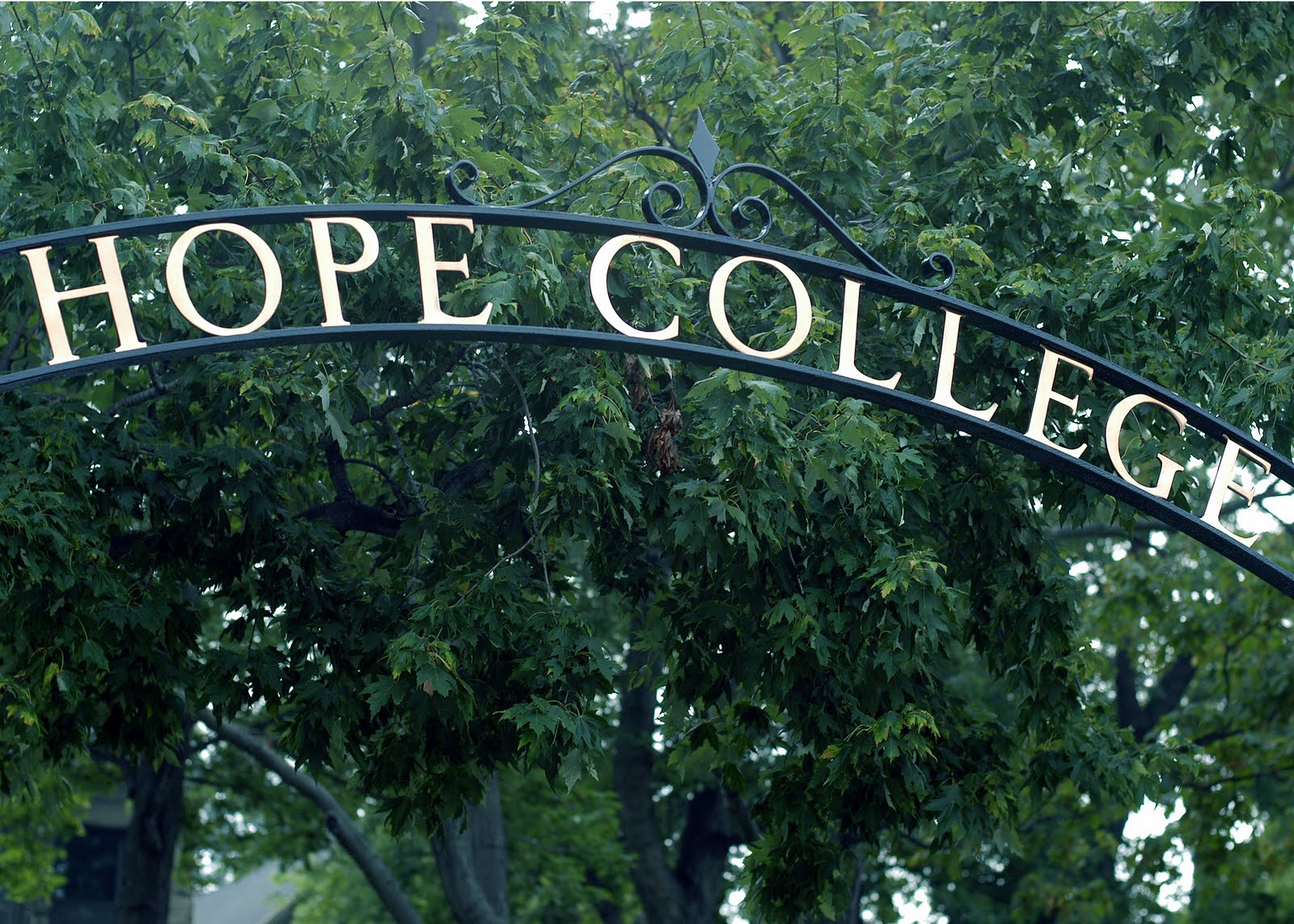
*image: Hope College Arch, made available through the public relations office website.

to be or not to be a "professional" (and does it matter?)

03 Monday May 2010

Posted by Anna Clutterbuck-Cook in library life

≈ 2 Comments

Tags

education, librarians

Blogger and librarian Ryan Deschamps @ The Other Librarian posted a thought-provoking piece last week, Ten Reasons Why ‘Professional Librarian’ is an Oxymoron. He introduces the list by writing

Before you comment, yes, this is an unbalanced look at professionalism. Yes, I am trolling a little bit – but with a heart that wants to lead discussion on the topic of library professionalism. Please do write a post about why these ten reason are bullocks.

On the other hand, I often see librarians and library school students that take professionalism as a given. I see this as unrealistic, especially in an era of rapid change . . . If librarians cannot personally address the following anti-professional assumptions as individuals, they cannot call themselves professional. What I am saying is that the MLIS or whatever equivalent a librarian has on their wall cannot count towards any status in society.

You can read the rest of the post at The Other Librarian.

I’ll be upfront about the fact that, while I am proud to call myself a librarian and to the work that I do in libraries and archive (and enrolled in my Master’s degree program in order to pursue work in this field that I love) I am not so hot about the idea of holding “status in society” as a “professional.” In fact, the idea that my MLS degree (when I complete my course this December) will signify some particular status in the world — one that sets me apart from my colleagues who do the same work but do not hold a library science degree — does not sit comfortably with me at all.

It wasn’t something that I thought about before starting graduate school: the fact that graduate school is, in large measure, about socializing workers into a particular professional identity. And to be quite honest, when it dawned upon me in the first few months of library school that this was part of the agenda, I kinda freaked out. The amount of angst among my fellow students and the faculty over defining and defending professional status makes me feel kinda claustrophobic. I hate drawing boundaries, boxing people in. Forget claiming “librarian” as a professional identity — try making the case for “archivist,” “records manager,” and other sub-fields being professional identities in their own right, distinct from the already-on-the-defensive identity of “librarian.” Sometimes I feel like folks spend more time worrying about their percieved status in society than they do just, you know, doing the job they feel called to do.

Being an historian, it’s really hard not to look at every identity or state of being in the world as contingent on specific historical forces having created it as such, for specific historically-relevant reasons that may or may not continue to have relevancy today. Take, for example, the concept of professionalism, and of workers belonging to particular professions for which they have recieved (in order to be deemed “professional”) advanced training, usually in an institution of higher education.

In our society, today, we consider “professional” jobs to be more credible — and able to command a higher level of income, at least in theory — than non-professional jobs. Believe me, as a pre-professional librarian (assuming librarianship is, indeed, considered a professional occupation) I am acutely aware of this. The thing is, we decided it should be this way. The notion of being a professional equaling status if actually a fairly recent development, starting in the late nineteenth century, back when people who were paid for the work that they did were considered of lesser status than, say, the “men of science,” the gentleman scholars whose accumulated wealth allowed them to pursue activities like history and scientific inquiry without worrying where the next meal was coming from. Slowly, claiming the identity of “professional X” became a way to claim a certain expertise, a certain skillset, that made you a credible source of information: even if you got paid for the work you did every day. (I’m totally over-simplifying, but you get the basic idea).

So (to return to Mr. Deschamps question), is “professional librarian” an oxymoron? His lists of reasons why they we (see? I work as a librarian in two separate libraries and still have to purposefully think in terms of a professional identity) are not certainly has merits. Though the arguments in favor are often equally compelling. My question is, do we really need to worry about fighting to preserve the status of “professional”? What are the benefits (and costs!) of understanding librarianship as a professional endeavor: when we are on the defensive, seeking to draw the boundaries between “librarian” and other identities and activities, what potentially valuable knowledge workers are we leaving out in the cold? What is the value of being exclusionary? If the work we do is valuable, it shouldn’t matter under what title (or identity, professional or non-) we do that work.

My thoughts on this are still muddled, often contradictory, and in constant flux and I plot my own trajectory moving forward (in work and in life). However, I do think it’s important not merely to examine the evidence for and against librarianship as a professional field, but also to ask why it matters that librarianship is considered a professional identity and whether those reasons (spoken and unspoken) are reasons we feel comfortable standing behind.

quick hit: a linguists delight

21 Wednesday Apr 2010

Posted by Anna Clutterbuck-Cook in Uncategorized

≈ 2 Comments

Tags

education, politics

CaitieCat @ Shakesville blogged last Friday about prescriptivism, classism, racism, otherwise known as three bad ideas that go poorly together. She writes

As many of you already know, I’m a linguist by training and vocation, as well as by avocation: I simply adore language and languages, always have. One of the first things one often hears when mentioning a background in linguistics is something along the lines of, “Don’t you just hate it when people say $EXPRESSION? Wouldn’t it be great if they had grammar?”

My answer is always, “Well, no, actually, I don’t just hate it; I find all forms of my native English delightful in the most literal sense, that is, they delight me. And further, every language and dialect has a grammar. If they didn’t, no one would understand anything anyone said, and they do, or they wouldn’t be talking that way.”

Because, like most linguists, I’m a fairly staunch descriptivist. In small words, what that means is that I believe language is what it is created to be, and that it changes, constantly, and that change in language is neither bad nor good: it simply is. As linguists, it’s not our job to tell people what is or is not “good $LANGUAGE_NAME”. It’s our job to study how and why language is what it is.

As a kid who struggled to see the point of standardized spelling (“but you know what I mean!” I would always point out stubbornly to my mother) I have always felt unjustly criticized by people schooled in more mainstream, socially acceptable American and/or British English for not using “correct” spelling and/or grammar. So I have to say, the five-year-old child in my soul was particularly delighted by this passage

When you deride someone else’s use of English for its “failure” to adhere to the “standard” variety, it’s not they who end up looking ignorant. Consider, next time, asking yourself about some “pet peeve” about a particular variety of English: Did the speaker achieve communication (the goal of language)? Were their goals achieved, in that you were able to understand what they said, their ideas successfully conveyed from their brain to yours? If so, then what grounds have you for complaint? [emphasis original]

Amen. And go check out the whole post over at Shakesville.

← Older posts
Newer posts →
"the past is a wild party; check your preconceptions at the door." ~ Emma Donoghue

Recent Posts

  • medical update 11.11.22
  • medical update 6.4.22
  • medical update 1.16.2022
  • medical update 10.13.2021
  • medical update 8.17.2021

Archives

Categories

Creative Commons License

This work by Anna J. Clutterbuck-Cook is licensed under a Creative Commons Attribution 3.0 Unported License

Meta

  • Create account
  • Log in
  • Entries feed
  • Comments feed
  • WordPress.com

Blog at WordPress.com.

  • Subscribe Subscribed
    • the feminist librarian
    • Join 37 other subscribers
    • Already have a WordPress.com account? Log in now.
    • the feminist librarian
    • Subscribe Subscribed
    • Sign up
    • Log in
    • Report this content
    • View site in Reader
    • Manage subscriptions
    • Collapse this bar