• anna j. clutterbuck-cook
  • contact
  • curriculum vitae
  • find me elsewhere
  • marilyn ross memorial book prize

the feminist librarian

the feminist librarian

Tag Archives: education

LIS488 Current Awareness: Helping new computer users

24 Wednesday Jun 2009

Posted by Anna Clutterbuck-Cook in library life

≈ Leave a comment

Tags

blogging, education, simmons

This is the second in a series of posts required for my summer session class, Technology for Information Professionals. For the first post see here.

Jessamyn West at librarian.net posted a short reflection on a New York Times blog post, Offer a Digital Helping Hand, about the frustration that many (most?) of the world’s population can feel about “undigital these days. There’s a grating discomfort that comes from being left out of everyone else’s secret language.” The original post, on the New York Times’ GadgetWise blog, was written as a plea to the digitally-savvy to offer a helping hand to those for whom the latest internet tool — such as Twitter — or the task of accessing email, or even as basic a computing function as manipulating a mouse, are foreign territory.

A couple of years ago, just before moving to Boston and starting my library science program at Simmons, I helped my grandmother set up an email account and learn the basics of using a computer. Before my grandfather died rather suddenly of cancer, he was the one in their household who took primary responsibility for using the computer and navigating the internet; after he died, my grandmother was faced with learning how to use the computer literally from the ground up. I put together a how-to guide that gave her step-by-step instructions for turning the computer on and accessing her email and programs like Word. It was a fascinating and humbling exercise for me to sit beside her and watch her learn how make sense of the hand-eye coordination required for operating a computer mouse, and to realize what steps I had inadvertently left out of my instructions. Steps that, to me, seemed so intuitive I had forgotten they were even a step in the process.

I try to keep this experience in mind when I help patrons at the Historical Society, only some of whom are familiar with the internet or have online access to tools such as our online catalog or website. I try to remember both the skills I cannot take for granted, and also the way in which learning basic computing skills has made a genuine difference in my grandmother’s ability to stay connected to her family and friends. As West points out in her post, it is important for those of us who use such technology regularly in our everyday to remember that the terminology, the skills, and the power of these new tools are not self-evident. It is even more important for those of us who work in library and library-like environments, where our core mission is making information available and accessible to all, to be aware of the differing level of technology and computing skills among our user groups.

"Did You Know?": Am I crazy or is this xenophobic?

13 Saturday Jun 2009

Posted by Anna Clutterbuck-Cook in think pieces

≈ 2 Comments

Tags

education, politics, simmons, web video

This web video pops up in my Simmons library science courses at least once a semester and, predictably, it turned up again today in the first session of my technology course.

Reactions in class were divided between, well, me and everyone else who spoke up.

Watching the video this time around, in the context of other reading I’ve been doing about conservative fears of a European “demographic winter” and non-Western population growth, I couldn’t shake the feeling that the way this data was presented had a certain element of xenophobia — specifically fear about the U.S. being overtaken intellectually and economically by Asian countries like India and China.

I was also struck by the way it frames achievement by conventional educational terms (for example, IQ scores and the concept of education as job training). The fear of non-American young people “out performing” American students has a long history in the American discourse about education (think of Cold War anxieties about Soviet students with higher test scores than American students). Watching the video in light of these two contexts (fearmongering demographic debates and anxiety about academic performance on the international stage) makes me distinctly uncomfortable about the way this data is presented and the way it is offered, for the most part uncritically, in our library science classes as a wake-up call for the future of information organization.

The other students in class seemed to think I was reading the film too negatively, and offered an alternative reading to the effect of, “look how much human potential we have in the world — let’s make the most of it!” Yet at the same time, they, too, were voicing competitive anxieties about how Americans can’t afford to rest easy in the assumption they have the technological advantage — an anxiety that I feel buys into an “us vs. them” framework that can slide into, well, xenophobia and isolationism. Particularly in a period of economic constraint.

Thoughts?

"What do you mean by counterculture?"

12 Friday Jun 2009

Posted by Anna Clutterbuck-Cook in my historian hat

≈ Leave a comment

Tags

education, history, thesis

One of the first tasks on my list at the end of the spring semester was to draft a proposal for an independent study in the fall that is designed to lay the groundwork for my history thesis (gulp!). The thesis is an oral history-based project documenting the early years of the Oregon Extension program, from 1975-1980, and placing the learning environment that faculty and students created there in a broader cultural context. One of my goals for this project is to incorporate some of my work into the writing I do for this blog, so that y’all can get a sense of what I do in my day job (or at least one of them) as an historian-in-training. With that in mind, here’s a blog post to get the ball rolling: a personal reflection on the language I use to describe what I research, and why I’ve settled on the terms I have.

Since starting graduate school, I’ve been asked far more often than I used to be to define my scholarly interests in ten-second, sound-bite terms (a task which, as those of you who know me well can attest, has never come easily to me). As an undergraduate, I always chafed against trying to encapsulate what I do as a thinker and writer in terms of a single academic discipline or area of interest. I am a historian by training, a feminist by political persuasion, with background in women’s studies, and a passion for thinking about how people make sense of the world. In the past, I have variously described this focus as an interest in intentional community, feminist activism, experiments in living, radical pedagogy, unschooling, radical, progressive, experimental education, and a number of other phrases.

More recently, when asked to give a short-hand version of my thesis research, I’ve been using the phrase “countercultural education” as the broad, umbrella term for where my academic interests lie. I used it just this week in an email to a researcher who contacted the Massachusetts Historical Society interested in the [[papers of nineteenth-century education reformer Horace Mann]]. The researcher wrote back and asked me, out of personal interest, to clarify what I meant when I used this term “countercultural.” Her question forced me to back up and reflect on why “counterculture” feels like the most appropriate, useful shorthand to me — and whether it serves me well in conversations with my colleagues, mentors, and friends.

What appeals to me about the term “counterculture” is that, in a single compound word, it identifies my interest in radical worldviews — worldviews that are fundamentally different from those espoused by the dominant educational culture — while also not limiting my focus to a single movement or ideological persuasion. Historian Ron Miller, in Free Schools, Free People: Education and Democracy After the 1960s, describes countercultural pedagogy as educational practices that seek to “educate children and young adults according to a set of attitudes, values, and beliefs in direct opposition to those of the predominant culture” (3). That’s a definition that goes beyond concepts of “left” or “right” political views, or particular historically-situated movements or schools of thought, like mid-twentieth-century home education, the early-twentieth-century progressive educators, or (to use Miller’s example) the short-lived free school movement of the 1960s.

While some of these historical movements represent countercultural values I strongly identify with on a personal and political level, my interest in educational practice goes beyond interest in a particular set of countercultural values. I am fascinated with the way in which education as an activity and the spaces in which educational activities take place are used as tools for training young people in different ways of being in the world, and in different ways of making sense of that world and their place within it. I am particularly interested in the instances in which the activities and spaces that individuals or groups of people find useful for this making-sense activity are different from the mainstream values and practices of their own context. What prompts them to seek alternatives? What methods do they choose? What vision for human growth and community do they see their educational practices resulting in, and why does that vision make sense to them? As I have written before, these critiques of mainstream culture can come from any point on the political spectrum, and the diversity of both educational practice and the expected results of those practices are dizzying in their variety.

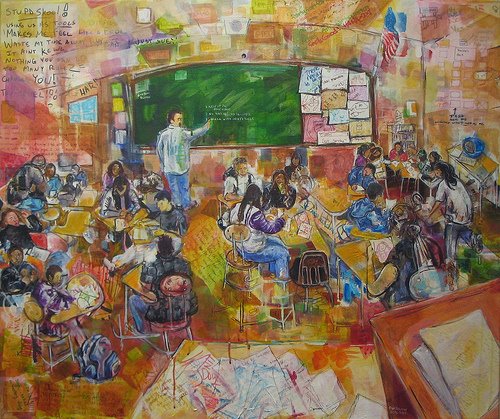
The one reservation I have with identifying my work as the study of “countercultural education” is that it defines my research subject in terms of what it is not: predominant educational norms. The trap of defining oneself (or one’s topic of research) as “not thing X,” and forgetting what the subject is standing for, rather than against, is one I do not wish to fall into. However, thinking of what I am embarking upon as one chapter in the history of countercultural education in American history is, for now, a useful starting point. A starting point out of which, I hope, I can begin to discern what it is the specific individuals I am studying valued and believed important to share with following generations.

*Photo of school children Library of Congress flickr stream.

In which I am completely baffled

01 Monday Jun 2009

Posted by Anna Clutterbuck-Cook in think pieces

≈ 1 Comment

Tags

children, education, gender and sexuality, politics

According to the New York Times, hugging is the new scourge of American teenage social conventions.

Now, okay, in my experience the NYT tends to blow its “life & style” reporting totally out of proportion: whether it’s women’s communities or sexuality, or the supposed life and times of the American Teenager, their discussion of current trends is heavily skewed toward creating a sensational story rather than accurately narrating peoples lives. I realize I should just expect this and blow it off, but sometimes it really gets under my skin, and this is one of those times.

I mean, last I checked, hugging — as long as it’s wanted, affectionate touch — was a relatively harmless way to spend one’s time. It’s usually indicative of positive, rather than negative, social interactions. But clearly, I was being naive.

A measure of how rapidly the ritual is spreading is that some students complain of peer pressure to hug to fit in. And schools from Hillsdale, N.J., to Bend, Ore., wary in a litigious era about sexual harassment or improper touching — or citing hallway clogging and late arrivals to class — have banned hugging or imposed a three-second rule.

Parents, who grew up in a generation more likely to use the handshake, the low-five or the high-five, are often baffled by the close physical contact. “It’s a wordless custom, from what I’ve observed,” wrote Beth J. Harpaz, the mother of two boys, 11 and 16, and a parenting columnist for The Associated Press, in a new book, “13 Is the New 18.”

“And there doesn’t seem to be any other overt way in which they acknowledge knowing each other,” she continued, describing the scene at her older son’s school in Manhattan. “No hi, no smile, no wave, no high-five — just the hug. Witnessing this interaction always makes me feel like I am a tourist in a country where I do not know the customs and cannot speak the language.”

. . .

Comforting as the hug may be, principals across the country have clamped down. “Touching and physical contact is very dangerous territory,” said Noreen Hajinlian, the principal of George G. White School, a junior high school in Hillsdale, N.J., who banned hugging two years ago. “It was needless hugging — they are in the hallways before they go to class. It wasn’t a greeting. It was happening all day.”

And just in case you thought (as I do, actually, despite protestations to the contrary) this was yet another instance of old fogies being unhealthily interested in, and hysterical about, the cultural expressions of youth,

There are, too, some young critics of hugging.

Amy Heaton, a freshman at Bethesda-Chevy Chase High School in Bethesda, Md., said casual social hugging seemed disingenuous to her. “Hugging is more common in my opinion in people who act like friends,” she said. “It’s like air-kissing. It’s really superficial.”

Read the entire article here.

There are many layers of wrong about the way this story is being narrated, one of which is the way it is being reported as a newsworthy phenomenon in the first place. Conventions of touch change over time and from culture to culture; as one letter to the editor pointed out, in Europe teenagers tend to show more casual physical affection with each other than American teenagers have, at least historically. People who work with immigrant and exchange students can tell you that young people who come to America from certain parts of the globe — Europe, Latin America — are surprised by what the perceive as the lack of physical affection between their American peers, while young people from other cultures — for example, Japan — have higher expectations of personal space, and find Americans to be physically intrusive.

While an international, historical perspective can understandably get lost in a fluffy news story, much more upsetting to me, in terms of media perceptions of young people, is the way adolescent physical contact is portrayed as problematic. There are three facets to this, all of which I find fascinating and extremely frustrating.

1. “Touching and physical contact is very dangerous territory.” I’m most floored by the way this article totally fails to meaningfully distinguish between erotic and non-erotic touch, and also by the way it implicitly equates erotic touch with “very dangerous territory.” This isn’t unexpected, given adult hysteria about teenage sexuality, but nevertheless it pisses me off. The students in this article, who have a complex understanding of different kinds of touch and what social and personal meanings they carry, come across as vastly more mature than the school officials who hint at promiscuity. Rather than respond by clamping down, I’d say this is a perfect opportunity to open conversations about how people can communicate about wanted and unwanted touch, and respect each others’ preferences for the same.

2. “If somebody were to not hug someone, to never hug anybody, people might be just a little wary of them and think they are weird or peculiar.” Closely related to the spectre of sexual harassment is the possibility of bullying (which is very real) that gets invoked as a reason to curtail physical contact. This is lazy thinking, lazy educating, and lazy supervising. If you’re worried about bullying, then get serious about reducing the abuse of power exercised by some students over others, and protecting the vulnerable students so that they don’t live their lives in fear. Imposing arbitrary limits on touch will not make the problem go away, it will just shift it elsewhere — possibly somewhere less visible than the school hallway.

3. “To maintain an atmosphere of academic seriousness.” This is the most laughably transparent exercise of adult power in the interest of social control. I realize I’m prone to seeing schools as sites of institutional power and violence but oh, please. Touch and positive relationships are antithetical to both intellectual endeavors and “seriousness”? Some of the adults in this story need to re-think their priorities a little. As one letter-writer suggests, “those principals need to lighten up and give kids a chance to work out for themselves what is “needless” and what is important.”

No one asked me what to make of this ‘trend’ but I’m going to offer my two cents anyway (isn’t that what blogs are for?): I think young folks today are pretty much the same creatures we human beings have always been. That is, creatures capable of inefficiency, frivolity, social ineptness, and cruelty — and also creatures who by and large crave meaningful relationships with one another that include physical affection. I’d argue that casual touch, both inside and outside spaces of education, is not a distraction from learning or a trivial meaningless fad — but rather a valuable pathway toward discovering what kinds of physical intimacy feel good and communicate effectively what we desire to communicate. Instead of cracking down on physical affection, help young people find language to effectively express their desires.

Quick Hit: Unschooling could save the world?

06 Wednesday May 2009

Posted by Anna Clutterbuck-Cook in linkspam

≈ Leave a comment

Tags

education


As I am in the midst of finishing a seminar paper on Carl Rogers’ 1969 book Freedom to Learn: A Vision of What Education Might Become, my friend Joseph forwarded me this link to Dave Pollard’s review of a new book, 101 Reasons Why I am an Unschooler, written by blogger P.S. Pirro (whose blog feeds are now definitely on my iGoogle page). Pollard begins his review by an account of his own experience with self-directed learning during his adolescence, and then writes of Pirro’s book:

PS presents 50 reasons why schooling is, in every imaginable way, bad for us and our society, and then 50 reasons why unschooling, which she defines as “learning without formal curriculum, timelines, grades or coercion; learning in freedom” is the natural way to learn. She argues that we are indoctrinated from the age of five to cede our time, our freedoms, and what we pay attention to, to the will of the State, so that we are ‘prepared’ for a work world of wage slavery and obedience to authority. We are deliberately not taught anything that would allow us to be self-sufficient in society. And in the factory environment of the school, where teachers need to ‘manage’ thirty students or more, ethics and the politics of power is left up, from our earliest and most vulnerable years, to the bullies and other young damaged psychopaths among our peers, to teach us in their grotesquely warped way. As PS explains, it is in every way a prison system.

Unschooling, by contrast, starts with the realization that you ‘own’ your time, and have the opportunity and responsibility to use it in ways that are meaningful and stimulating for you. When you have this opportunity, you just naturally learn a great deal, about things you care about, things that will inevitably be useful to you in making a life and a living. Your learning environment is the whole world, and you learn what and when you want, undirected by curricula, textbooks, alarm clocks and school bells. You develop deep peer relationships around areas of common interest, once you’re allowed to explore and discover what those areas of interest are. And the Internet and online gaming allow you to make those relationships anywhere in the world, to draw on the brightest experts on the planet, and to communicate powerfully with like-minded, curious people of every age, culture and ideology.

Many people argue that unschooling will only work for the very brightest and most self-disciplined children. On the contrary, I think we are all perfectly suited to unschooling until the school system begins to beat the love of learning, the ability to self-manage, curiosity, imagination and critical thinking out of us. By the time we have reached the third grade it becomes much more difficult, and my success in unschooling in twelfth grade was, I will agree, due to my above-average intelligence and initiative — most of my intellectually-crippled peers just couldn’t manage by that time without the strictures they’d become accustomed to. They had long ago lost the desire to learn, and to think for themselves.

I would quibble with his “my above-average intelligence and initiative” explanation for his unschooling success; the answer to why he thrived and others did not in a more unstructured learning environment was likely way more complicated than “I was smarter.” I don’t think anyone truly loses the desire or ability to learn and think in a self-directed fashion.

Rather, I would argue, it just takes some people longer than others to reclaim that desire — and they have to decide they want to reclaim it in the first place. Folks in the home education community have long recognized that there is a “deschooling” period for kids that often lasts in direct proportion to the amount of time they have been in institutional schools before they bounce back and learn to pay attention to their own desires again. This can take patience and often looks, according to conventional standards of educational achievement, like failure. However, I would urge all of us to consider the possibility that in fact it is not: that in fact, it is the beginning of a radical new definition of success.

The book is now on my summer reading list, a move I can now happily begin to justify as “thesis-related” instead of pure obsession. Then again, as unschoolers remind us, pure obsession is often the best justification.

Image (c) Todd Berman @ flickr.

Quick Hit: Children’s Issues are Feminist Issues

22 Wednesday Apr 2009

Posted by Anna Clutterbuck-Cook in linkspam

≈ Leave a comment

Tags

children, education, feminism, masculinity

Two links on bullying that came across my rss feeds lately remind me again about how integral children’s experience and childhood spaces are to the struggle against power-over hierarchical relationships (i.e. the kyriarchy.)

First, via Feministe and Feministing, stories of two boys who killed themselves as a result of bullying that hinged on homophobic and sexist taunts: Carl Joseph Walker-Hoover and Jaheem Herrera.

Partly in response to these stories, as well as her own experience, Antigone over at punkassblog declares “If We Have Kids, We’re Homeschooling“:

Based on the number of people that had to live through bullying, and the complete lack of any systematic effort to stop it, I’m calling bullshit, hard. Public school does not properly socialize anyone, it teaches children to become bullies, victims, or learn the nifty trick of “not my problem”. That is not a socialization I want to give my kids at all.

Home education isn’t the only possible solution to this type of situation (and indeed, will like not shield kids from bullying entirely — though it can serve as a life-saving buffer for some), but I think Antigone’s “I’m calling bullshit” is an important impulse. Systemic violence is not okay, regardless of where it happens and to whom it happens. Children — who spend much of their time segregated from the general population — often suffer from the same discrimination as marginalized adults (sexism, racism, classism, homophobia, ableism, etc.) while they are simultaneously less able to name and combat it — because they lack the (developmental and experiential) perspective of adults and the resources and agency of adults.

Many children must — through lack of individual choice or material options — return to these hostile situations day after day after day where oversight by adults is inadequate at best and indifferent at worst. This is not acceptable. And I see calling bullshit on the intensely hostile world in which our children (who will grow up to be caretakers of our world and of us in our elder-hood, whether or not we are parents ourselves!) as integral to the feminist project.

Booknotes: Quiverfull

22 Sunday Mar 2009

Posted by Anna Clutterbuck-Cook in book reviews

≈ 8 Comments

Tags

books, education, feminism, politics

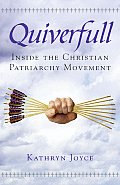
A couple of weeks ago, my own personal copy of Kathryn Joyce’s new book Quiverfull: Inside the Christian Patriarchy Movement arrived in the mail — just when I was looking for one more way to put off doing school-related reading over Simmons’ spring break. Joyce’s book documents the theology, politics and daily life of families (especially women and girls) who follow the loose collection of conservative ideas that fall under the umbrella of “quiverfull” thinking: a patriarchal family structure that demands wifely submission, opposition to all kinds of family planning, fears of a “demographic winter” for Western nations, home education, and often political alignment with the Christian reconstructionist agenda. Hanna flipped through my copy and asked me how it is I can read books like this and not feel my blood pressure skyrocket. Which challenged me to reflect a little on my addiction to reading books about the intersections of gender, sexuality, politics, home education, and the Christian right. This booknote, therefore, is less of a review and more a motley collection of observations inspired by Joyce’s journalism.

I think what I find most absorbing about the Christian right and the way they think about gender, sexuality, and education, is not their strangeness but their familiarity. And I’m not talking about familiarity due to close proximity (although growing up in a very religiously conservative area means I’ve been exposed to my fair share of right wing bigotry and fear-mongering). No: what I’m talking about is the fact that Christian right’s critique of the American mainstream begins with with many of the same critiques of modernity that leftists put forward. Many of the families profiled in Quiverfull are deeply ambivalent about modernity — about the rise of scientific rationalism at the expense of the irrational and sacred. They critique the way that a capitalist economic system, with its separation work and home spaces (and the resulting age-segregation of children and the elderly — nonworkers — from wage-earners).

As a result, they have created a vibrant counter-culture of their own that, as Joyce rightly points out, shares many of the same characteristics of the radical left. Home birth and midwifery activism among Quiverfull families, for example, “overlaps with back-to-the-land hippie counterculture in some ways. It’s a deliciously amusing irony to some Quiverfull moms, who stake out their territory of natural pregnancy in the odd company of feminist doulas and naturopaths opposed, as they are, to high rates of hospital cesarean sections” (164). Likewise, the modern home education movement, which began as a form of leftist activism (see: unschooling) has since become an overwhelmingly right-wing phenomenon. So much so that — although she makes passing mention of this history — Joyce is comfortable conflating “homeschool” with Christian conservatism throughout most of Quiverfull without specifying that she is, in fact, writing about a very particular subset of the home education population.

In fact, it is precisely the outward similarity of these profiles of radical right and radical left that I find both fascinating and deeply disturbing. For while on the surface quiverfull families and “back-to-the-land hippies” and feminists may make similar lifestyle choices, their reasons for doing so are often diametrically opposed. Whereas leftist, feminist advocates of low-intervention childbirth and home education ground their critique of modernity and counterculture activism in notions of gender equality, democratic social structures, and a commitment to individual human rights, those on the radical right pursue the same forms of activism but root them in notions of gender difference, social structures that unapologetically support the kyriarchy, and the subordination of individual persons to tyrannical group dynamics.

As most of you know, I grew up in a family that was part of the leftist home education tradition. My sibs mixed public schooling with home-based learning, and all of us have gone on to college-level institutional education (and beyond). At the same time, I am firmly committed to the continued legality, and minimal governmental oversight, of home education. In this, like the feminist doulas of Joyce’s book, I find myself in the uncomfortable company of groups such as the Home School Legal Defense Association. Because of this, I believe it is my responsibility to take a long, hard look at the beliefs and practices of those whose political and social agenda I (however occasionally) share — and whose right to continue living as they do I, however abstractly, defend.

Though there was nothing startlingly new to be found in the pages of Quiverfull if you’ve read other work in this area, Joyce does a thorough survey of the disparate strands of religious and political thinking that inform the movement, and remains sensitive to the nuances of class, race, gender, and theological difference that shape individual experience within it. I also enjoyed discovering that by cultivating close relationships with other women, I am apparently in danger of committing the sin of “spiritual masturbation” (which, sadly, is not nearly as kinky as it sounds).

Now it’s back to Carl Rogers’ Freedom to Learn (for my seminar paper in Intellectual History) . . . not to mention keeping an eye out for Jessica Valenti’s latest, The Purity Myth, and Michelle Goldberg’s sure-to-be-absorbing The Means of Reproduction.

Shameless Self-Promotion: Essays & Studies

16 Monday Mar 2009

Posted by Anna Clutterbuck-Cook in my historian hat

≈ 1 Comment

Tags

education, history, simmons

The Simmons College journal, Essays & Studies, has just published its Spring 2009 edition, in which I have an essay: ” ‘I have been more or less dissatisfied’: The Educational Project in the Oneida Community.” Also featured is my friend Rachel Searcy, also of the MA/MLS dual-degree program, with her paper ” ‘Seated at the Hearth-side’: The Prescriptive Tradition of Female Nationalist Involvement in Late 19th and Early 20th Century Ireland.”

Looking Back/Looking Forward: Teaching

11 Sunday Jan 2009

Posted by Anna Clutterbuck-Cook in my historian hat

≈ Leave a comment

Tags

education, history, simmons

As we enter 2009 — and before I get lost once again in the maze of a busy academic schedule — I thought I’d post a few items on the projects I completed this fall and the projects that are up for the spring semester.

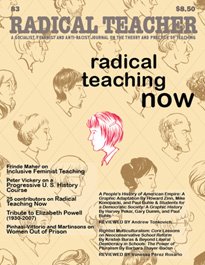
Teaching [will] need to be more boldly political than now, not less. And more seriously historical: things used to be different. They will be different again. — “Introduction Radical Teaching Now”, Radical Teacher #83

As with my internship at Northeastern (see below), I will be continuing my work as a teaching assistant for Professor Stephen Ortega in the Simmons history department this spring. Steve teaches Middle Eastern, Islamic and World history; I will be helping with the second half of the World Civilizations course we began in the fall. The autumn class ran from hunter-gatherer societies to the age of exploration (15th century), and this second semester we will pick up in the 1400s and continue on to the present day.

It was timely, therefore, to receive my most recent issue of Radical Teacher in the mail this past week, and find Peter Vickery’s essay “Progressive Pedagogy in the U.S. History Survey” inside. Vickery describes teaching a U.S. History survey course at a state college, to students for whom the class is a requirement, and many of whom are skeptical about the relevance of history — not to mention their own ability to actively participate in its creation. He writes:

In addition to skepticism, my students encounter an ongoing tension, namely the apparent contradiction between a key goal (finding out what actually happened and why) and a key lesson (history is constructed by historians). Far from being a source of despair or frustration, in my own mind the tension is integral to the joy of history. Learning and re-learning on the one hand the boundaries of possibility that inhere in the study and production of history and, on the other, the power of narrative, keeps history a stimulating field of endeavor.

Yet it can be difficult to convey the joy of that contradiction to students who are distracted and suspicious of the worth of such an open-ended quest. We’ll see what happens this spring!

Visual Argument for Home-based Education

21 Sunday Dec 2008

Posted by Anna Clutterbuck-Cook in think pieces

≈ Leave a comment

Tags

education, humor

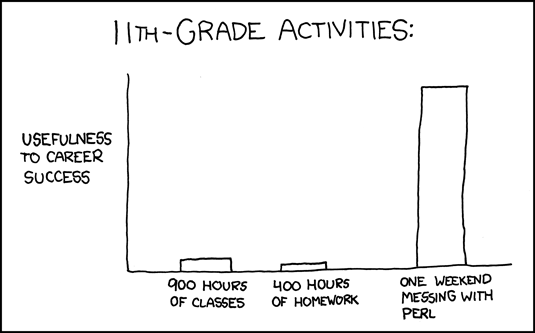
I doubt comic artist xkcd meant his latest cartoon to be a plug for nontraditional education, but that was my first thought when I saw this picture!

← Older posts
Newer posts →
"the past is a wild party; check your preconceptions at the door." ~ Emma Donoghue

Recent Posts

  • medical update 11.11.22
  • medical update 6.4.22
  • medical update 1.16.2022
  • medical update 10.13.2021
  • medical update 8.17.2021

Archives

Categories

Creative Commons License

This work by Anna J. Clutterbuck-Cook is licensed under a Creative Commons Attribution 3.0 Unported License

Meta

  • Create account
  • Log in
  • Entries feed
  • Comments feed
  • WordPress.com

Blog at WordPress.com.

  • Subscribe Subscribed
    • the feminist librarian
    • Join 37 other subscribers
    • Already have a WordPress.com account? Log in now.
    • the feminist librarian
    • Subscribe Subscribed
    • Sign up
    • Log in
    • Report this content
    • View site in Reader
    • Manage subscriptions
    • Collapse this bar