• anna j. clutterbuck-cook
  • contact
  • curriculum vitae
  • find me elsewhere
  • marilyn ross memorial book prize

the feminist librarian

the feminist librarian

Tag Archives: family scholars blog

BREAKING: new zealand lawmakers burst into song upon enacting marriage equality

17 Wednesday Apr 2013

Posted by Anna Clutterbuck-Cook in linkspam

≈ 4 Comments

Tags

family scholars blog, marriage equality, politics, web video

(thanks to Hanna for the link!)

 On Wednesday, local time, the New Zealand House of Commons Representatives passed a bill allowing same-sex marriage (they have had civil unions for same-sex couples since 2005).

Upon declaration of the passage of the bill, the chamber burst into song. Here is a video, which I think is adorable and absolutely made my day.

Congratulations New Zealanders of all sexual identities and relationship types!

cross-posted at the family scholars blog.

the feminist librarian’s bookshelf: five women’s lives

11 Thursday Apr 2013

Posted by Anna Clutterbuck-Cook in book reviews

≈ 2 Comments

Tags

family scholars blog, feminism, history, the personal is political

cross-posted from the family scholars blog.

March was women’s history month and this post was supposed to go up the week of March 25 … but the last couple of weeks have gotten away from me. So here is the second installment of The Feminist Librarian’s Bookshelf — the March edition in April!

The theme this time is women’s history and I chose to highlight five biographies or autobiographies by and about women whose lives and work have left an impression upon my own sense of “how to live?”

If I had to draw out some common themes from across these women’s lives I would say that some of the characteristics that unite this women are: leftist-radical politics, a vision for more equality and well-being (of many kinds)  in the world, and unconventional personal and family relationships.

Sylvia Pankhurst, 1909

Sylvia Pankhurst (1882-1960). Sylvia Pankhurst: A Crusading Life by Shirley Harrison (Aurum Press, 2003). An often-overlooked member of the notorious Pankhurst family, Sylvia Pankhurst was the second daughter of women’s rights activists Emmeline and Richard Pankhurst. Her elder sister Cristabel would become famous on both sides of the Atlantic for her political theater. Sylvia was deeply involved in her family’s feminist activism, but eventually loosened her ties with them as Britain’s entry into the First World War exacerbated their differences over tactics and priorities. Sylvia pursued her own work in London’s impoverished East End, publishing a journal called the Women’s Dreadnaught, providing affordable meals and health services as well as supporting efforts to organize labor unions. Further radicalized by the Great War, Sylvia became an increasingly outspoken peace activist and also a critic of British imperialism. In the 1930s she became involved in anti-colonization activism, principally in support of Ethiopian independence; she would eventually make her home in Ethiopia. 

Sylvia never married, though she sustained two long-term relationships: the first with Labour Party founder Keir Hardie (though there is no conclusive evidence the two had a physical relationship), and the second with Italian anarchist Silvio Corio. Sylvia and Silvio lived together for over thirty years (until his death) and Sylvia gave birth to their son, Richard, in 1927. Reportedly, it was Sylvia’s refusal to marry Silvio which caused the final rupture with her parents and elder sister Cristabel. I am fascinated by the way the story of this particular radical Pankhurst daughter is so often eclipsed by the high-profile lives of her mother and sister who were radical on the subject of suffrage but reactionary and chauvinistic in many other ways.

Dorothy Day (1897-1980). The Long Loneliness (Harper and Row, 1952). Catholic activist Dorothy Day began her career in political struggle as a journalist  in the Lower East Side of New York City where she covered labor and feminist activism for such eminent socialist newspapers as The Liberator and The Masses. During this period Day was in a serious relationship with fellow leftist Forster Batterham, though her increasing interest in Catholicism put a strain on their relationship and by the time Day gave birth to their daughter, Tamar, she and Batterham were no longer a couple. Several years after Tamar’s birth, in the depths of the Great Depression, Day met French emigre and eccentric intellectual Peter Maurin; the two formed a friendship which would become the foundation from which Dorothy Day pursued her social justice work. Together, they began publishing The Catholic Worker and eventually expanded their efforts to provide meals and shelter to the destitute in a communal setting.  The Catholic Worker Movement is still extant today, maintaining uneasy ties to the Catholic church.

Throughout the Second World War, Day and her fellow Workers maintained a commitment to pacifism, and following the war Day was arrested numerous times while on nonviolent protest against the Cold War and nuclear proliferation. They also became involved in the Civil Rights movement. There is a movement within the Catholic church to have Dorothy Day canonized as a saint, although throughout her life she resisted efforts to describe her work as somehow super-human, miraculous or otherwise noteworthy. I am a troubled admirer of Dorothy Day, whose complicated relationship with the feminist activism of her day makes her a difficult ally in many ways — even as she dedicated her life to lessening human suffering of many kinds.

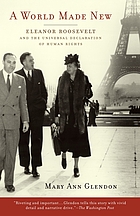
Eleanor Roosevelt (1884-1962 ). A World Made New: Eleanor Roosevelt and the Universal Declaration of Human Rights by Mary Ann Glendon (Random House, 2001). I have never been particularly interested in Eleanor Roosevelt as a public personage — though the two-volume biography by Blanche Weisen Cook is a tour de force — but a history professor at my undergraduate college once made me a gift of this slim historical study of Roosevelt’s role in the drafting of the Universal Declaration of Human Rights. It’s not a biography per se, but I include it here because I think it captures a unique historical moment in the twentieth century through the lens of one woman’s involvement. The UDHR was drafted by an international committee in the “pause” between World War Two and the height of the Cold War, and represents the hubris of the West (particularly the United States) in believing they could create a truly “new” internationalist, peaceful, humanitarian world — as well as the pragmatic reality of international politics which demanded compromise of that vision in order to produce anything of use.

Even if you are a skeptic of the United Nations, of internationalism, and/or not a fan of Eleanor Roosevelt, I think there is much to learn from this particular chapter in our political past.

Margaret Mead (1901-1978). Blackberry Winter: My Earlier Years  (William Morrow, 1972). I first encountered Mead’s story in college while working on an independent study on the first generations of women college graduates. Mead was the daughter of two academics — her father was a professor of economics and her mother a sociologist. Her childhood was spent in and out of formal schooling as her family moved around the country, and she spent a year at DePauw University in Indiana before transferring to Barnard College (then a young upstart of a women’s college in cosmopolitan New York). She went on from Barnard to study under anthropologists Franz Boaz and Ruth Benedict, earning her PhD from Columbia University in 1929. Mead is best known for her study of adolescent girls in Samoa, Coming of Age in Samoa (1928), although her anthropological curiosity ranged far and wide. While some of her frameworks for understanding feel outmoded today, she was instrumental in making the lives of women and children a legitimate field of study.

In Blackberry Winter Mead suggests a connection between her wide-ranging study of human cultures and her own exploration of relationships and family life, which took a decidedly unconventional path. Married while in graduate school (she refers in Winter to her “student marriage”), she and her first husband parted apparently amicable ways before she left for her fieldwork in Samoa. Her second marriage was equally short-lived and rocky by all accounts, ending in 1935. British anthropologist Gregory Bateson was her third husband, and the only spouse with whom she had children — a daughter, Mary, whom she gave birth to in 1939. Mead also had long-lasting, passionate relationships with Ruth Benedict and another anthropologist, Rhoda Metraux, although the extent to which either relationship was sexually intimate is up for debate.

Gerda Lerner and her husband Carl, 1966 (via)

Gerda Lerner (1920-2013). Fireweed: A Political Autobiography (Temple University, 2002). When historian Gerda Lerner passed away on January 2 of this year, her obituaries widely proclaimed her one of the founding mothers of the field of women’s and gender history. Without question, it is thanks to Lerner and her pioneering cohort of historians who insisted on gender as a valid category of analysis that I am able to do what it is that I do and be taken seriously as a scholar. Yet what I think is even more intriguing is the political and social milieu that such a scholar came out of — and it is this “pre-history,” if you will, that Fireweed sets out to tell.

Gerda Lerner (nee Kronstein) was born in Austria on the eve of the Second World War, was a student activist against the Nazi party (a form of political participation that landed her in jail when she was seventeen), and escaped to the United States as a refugee in 1939. She married the boyfriend with whom she had fled to America, but the marriage did not last by the mid-1940s she was married to Carl Lerner, a director in theater and later film, and an active Communist. Husband and wife shared a common political cause and throughout the 40s and 50s they worked side by side (with their children in tow) on behalf of labor, civil rights, peace, and against McCarthyism. Lerner did not return to school until she was in her 40s, earning her PhD from Columbia University in 1966 with a dissertation examining the work of Sara and Angelina Grimke, two white Southern women who had found it in themselves to agitate against slavery. Lerner was 46 years old.

I think what I find most compelling about Lerner’s biography is its testament to the human capacity for “second acts,” if you will — that a life so filled with political struggle and the daily grind of survival could change direction at the midpoint and channel that energy into scholarship that was, perhaps, quieter than high-stakes anti-Nazi activism or labor organizing (certainly involving less jail time!) but was just as revolutionary in its own way.

This list is obviously limited by my own inclinations and concerns. I am conscious that of these five women, all are white and middle class by upbringing and education if not by fiscal measures. Although only three of the five are American by birth, the other two are Western European. None lived the majority of their lives in a same-sex relationship, although at least two women (Mead and Roosevelt) appear to have “swung both ways,” holding passionate attachments to both women and men during their lives.

What biographies and autobiographies of and by women have you found meaningful in your own life? What women in history speak to you?

what matters in "gay marriage" – "gay" or "marriage"?

02 Tuesday Apr 2013

Posted by Anna Clutterbuck-Cook in think pieces

≈ 2 Comments

Tags

doma, family scholars blog, gender and sexuality, marriage equality, scotus junkie

cross-posted from the family scholars blog. 

I often joke with friends and family about how my wife and I are “gay married,” as if this is something different from being … “married.” Perhaps we same-sex couples do everything with our sexual orientation front and center? In that case, this past weekend I celebrated a gay birthday by going gayly out to dinner at a restaurant. I did some gay crocheting, took a gay nap, and wrote a few gay letters to friends.

https://i0.wp.com/24.media.tumblr.com/tumblr_lx4wi10i1b1qk6ktto1_500.jpg
(via)
This is, by and large, a lighthearted amusement. But the “joke” is also grounded in our bone-deep recognition that some people do view every aspect of our lives as unalterably tattooed by our sexual “perversions.” Our being gay — or practicing gay sex — is the attribute that marks us out for differential treatment. Some people would argue it requires differential treatment.

I thought of this other, less amusing use of the phrase “gay marriage” or “same-sex marriage” last Friday when I listened to an On Point news hour reviewing the Supreme Court oral arguments on DOMA and Proposition 8.  The host, Tom Ashbrook, spoke with two guests — law professors Suzanne Goldberg (pro-marriage equality) and Teresa Collett (anti-) — about the arguments. In discussing DOMA, Collett followed the lead of defense lawyer Paul Clement, representing BLAG, in arguing that what the DOMA law sought to achieve was not any sort of discrimination between gay and straight marriages, but rather to impose legal uniformity.

From the oral argument transcript (p. 62-63):

Mr. CLEMENT: … Ms. Windsor wants to point to the unfairness of the differential treatment of treating two New York married couples differently, and of course for purposes of New York law that’s exactly the right focus, but for purposes of Federal law it’s much more rational for Congress to — to say, and certainly a rational available choice, for Congress to say, we want to treat the same-sex couple in New York the same way as the committed same-sex couple in Oklahoma and treat them the same. Or even more to the point for purposes -­

JUSTICE SOTOMAYOR: But that’s begging the question, because you are treating the married couples differently.

I want to point out a couple of features of this exchange.

The first is that Clement (and Collett, on air) are attempting to erase the anti-gay sentiment that animated the passage of DOMA, something which Justice Kagan highlighted when she read aloud from the House Report during the argument (see p. 74 of the transcript). This “softer” argument makes the case that what the federal government really wanted was sameness — equality if you will! — so that despite marital diversity at the state level, the federal government would only recognize certain types of marriage as actually legal nationwide.

I find this in itself disturbing, in that it attempts to turn DOMA into something that’s almost supposed to benefit same-sex married couples rather than harming them — as if we’re supposed to be comforted, somehow, that our citizenship rights will be the same nationwide … by ensuring that no matter what level of relationship recognition our state of residence provides us, we’ll be firmly denied recognition at the federal level. Consistently.

Equality! Yay! …. oh, wait.

The second (and I think key) feature of this uniformity framing, and the exchange Clement had with Justice Sotomayor above, is that Clement is emphasizing the gay part of being “gay married” and Sotomayor is emphasizing the married part of being “gay married.”

Clement is arguing that regardless of whether a same-sex couple lives in Massachusetts (where we can legally marry), in Illinois (where they have civil unions) or in Michigan (where same-sex couples are denied any form of legal recognition), we will be met with federal uniformity … in that we won’t be recognized, regardless of our state-honored status.

Based on the fact that we’re gayly married, instead of straight married.

Sotomayor pushes back against this emphasis, asking instead “isn’t this treating the married couples differently”? Placing the emphasis on marriage, Sotomayor is correctly pointing out that we do not seek to treat all straight couples similarly, regardless of relationship status. We treat a cohabiting straight couple differently from a married straight couple differently from a divorced straight couple. One might ask, following Clement’s line of argument, why the federal government distinguishes between an unmarried cohabiting couple in Wyoming and a married couple in Maine — shouldn’t they be concerned about uniformity in the treatment of straight couples on a national level?

(As an aside, I actually think this is a legitimate line of questioning — the differential treatment of married and unmarried partnerships — but that is not, realistically speaking, the argument Clement was making. So it is the topic of another post.)

This is not to say that understanding LGBT* identities as political in nature, as social class identities, is never legitimate. Identity politics — coming together with a group of people based on some facet of your identity in order to effect political change — is, of course, sometimes a necessary thing. Often, such class consciousness is made necessary by the way we are targeted as a group by those who hold anti-gay beliefs or take anti-gay actions. I move through my life aware that my bisexuality and my lesbian relationship are key components of my self-conception — and also aspects of my self by which other people both understand and judge me.

I am proud of being both “gay” and “married.”

But I do think that when it comes to marriage law, it should be the married part of that equation that has bearing, not the gay. As someone who is legally married, under laws that pertain to marriage it should be that status which determines whether I am a person to whom the law applies or not.

politics, pornography, and combating queer isolation

28 Thursday Mar 2013

Posted by Anna Clutterbuck-Cook in think pieces

≈ Leave a comment

Tags

education, family scholars blog, gender and sexuality, politics, smut

cross-posted from the family scholars blog.

Conner Habib, an actor who performs in gay male pornographic films, was recently invited by a student group at Corning Community College (Corning, NY) to speak on sex and culture. When the college president found out that Habib, in addition to being a thoughtful and articulate human being, had appeared in erotic film, she took steps to cancel Habib’s talk and has apparently moved to further obstruct attempts to host the talk in a non-college-sponsored locale.

Habib has written an excellent piece about his own perspective on these events which can be read in full over at BuzzFeed. In the essay he reflects on the place pornographic materials have in mitigating the isolation sexual minorities can experience, particularly in rural areas. He writes:

Where I grew up, just outside of Allentown, PA, I watched, right through my adolescence into adulthood and early college years, while straight people paired off and experienced sex. They were able to engage with a basic aspect of human life that seemed unavailable and distant to me. Unlike today, there was no discussion about gay marriage, nor were there many gay characters on TV. But even if there had been, neither would have rounded out my experience as a man with homosexual feelings because so many of those feelings were — unsurprisingly for a young man — sexual. Gay sex was a lonely venture. It wasn’t easy to find, and was only mentioned in slurs and the butt of jokes. … Whether I bought it from the adult video store or, later, downloaded it, gay porn helped me encounter positive images of gay men enjoying the act of sex. Gay porn was a window into gay sexuality that was free of shame and guilt, and revealed a different world where sex wasn’t a lonely prospect, confined to the shadows or just my imagination.

Habib describes how, being a man of Arab descent, he receives fan mail from gay men in Middle Eastern countries who “[express] gratitude and relief for my having portrayed gay sex in a positive light on camera.”

Continue reading →

it’s not just about marriage law

16 Saturday Mar 2013

Posted by Anna Clutterbuck-Cook in think pieces

≈ Leave a comment

Tags

children, family scholars blog, gender and sexuality, michigan

cross-posted from the family scholars blog.


April DeBoer (second from left) sits with her adopted daughter Ryanne, 3,
and Jayne Rowse and her adopted sons Jacob, 3, and Nolan, 4,
at their home in Hazel Park, Mich., on Tuesday.

We’ve been talking a lot lately, at the Family Scholars Blog, about the upcoming DOMA/Prop 8 cases before the Supreme Court and debating the cases for and against marriage equality. Sometimes “gay marriage” can seem like the only or most important issue for LGBT folks. In fact, many of us have had the experience of talking with someone who assumes that once gay marriage is legal then anti-gay prejudice and marginalization will — poof! — be a thing of the past. We’ll be able to put down our “activist” hats and embrace our mainstream status.

But the marginalization of LGBT individuals and families goes a lot deeper than marriage law. One such example comes from my home state of Michigan, which has some of the most restrictive laws in the nation regarding recognition of same-sex relationships — including a ban on same-sex partners adopting together. While heterosexual couples and single people are welcomed as prospective adoptive parents, gay and lesbian couples are explicitly denied the ability to provide their children with two legal parents.

 A lesbian couple who are parenting three adopted children have sued the state for the right to co-adopt. From the NPR story on their case:

As foster parents, Rowse and DeBoer shared legal guardianship of Jacob. When they decided to adopt the boy, they faced the same decision they’d faced with the two other children: which of them would be the legal parent. They chose Rowse, who is also Nolan’s legal mother. That meant DeBoer actually lost legal rights she had as a foster parent.

“I lose the right to make medical decisions for my boys,” DeBoer says. “I can’t enroll my boys in school. I am on an emergency card at school — I am listed as just an emergency contact person. I am not a parent. I am nothing.”

You can read the whole story over at NPR.

There have been a number of people at the Family Scholars Blog who have expressed varying degrees of concern about the sanctioning of same-sex relationships through marriage because they feel this legitimizes gay and lesbian parents as procreative partners in some way.

What I think gets lost in such abstract discussions — about same-sex couples somehow, in future, creating new life together — is the fact that LGBT parents are already parenting without the full legal recognition that, in hundreds of little ways, ties parents to their children and ensures kids will have their parents or guardians present for them — advocating and decision-making as necessary — throughout their childhood. Statistically speaking, LGBT parents are also generally caring for their own biological children or adopting children who would otherwise spend their lives in the foster system. Parents (straight, gay, lesbian, or otherwise) who have used assisted reproductive strategies, too, are parenting children who — regardless of their origins — deserve the security of knowing they will have access to their parent-carers when they need them.

The argument that legalizing same-sex marriage gives social approval to all manner of assisted reproductive practices glosses over the fact that by supporting restrictive adoption laws, marriage laws, and other legal restrictions on the recognition of same-sex families, those who oppose recognition of same-sex relationships  are actively marginalizing existing children and their parents.  You aren’t stopping future families from being created; people of all sexual orientations have, and will continue, to create families irrespective of the law. Instead, you’re stopping already-established families from accessing the full range of social supports that, as a nation, we’ve decided interdependent couples and parents with dependent children need to thrive.

Maybe your concerns regarding reproductive ethics are strong enough that such a cost is worth it to you. But I don’t think it’s honest or responsible to simply ignore the human cost of such discriminatory practices.

fun with amicus briefs! [doma & the supremes]

11 Monday Mar 2013

Posted by Anna Clutterbuck-Cook in think pieces

≈ 2 Comments

Tags

children, doma, family scholars blog, gender and sexuality, marriage equality, politics, religion, scotus junkie

cross-posted from the family scholars blog.

http://lesbianweddings.tumblr.com/post/12741646344
(via)

Thanks to Amy’s recent post that linked to John Culhane’s piece on the importance of amicus briefs, I spent a nerdy afternoon this past weekend browsing through some of the many briefs submitted to the U.S. Supreme Court in relation to the two same-sex marriage cases that will be reviewed by the court this session. They are all available to read in PDF at the American Bar Association’s website; you can also find a list at the SCOTUSblog. I thought I’d share a few highlights with you. Of particular interest to the folks at Family Scholars might be the brief submitted jointly by the Family Equality Council, Colage, Our Family Coalition, Gay, Lesbian, and Straight Education Network, the Center on Children and Families,  the Child Rights Project, and Sarah Gogin. Together, they seek to represent the children raised by same-sex parents as well as young people who experience same-sex desire as they look toward a future forming adult relationships. They begin:

The voices of children raised by same-sex parents — those who live every day within the family structure at the heart of these lawsuits — are too often unheard in debates about same-sex couples and marriage. Their stories are too often missing from discussions of “traditional” families or “family values,” and their personal experience too often discounted as irrelegant. Although those who oppose marriage for same-sex couples frequently make assumptions about the quality of the children’s family lives, the children themselves are rarely asked to explain what they actually experience.

Throughout the brief, they foreground the voices of young people who are growing up with LGBT parents, and their list of “authorities” (the brief equivalent of a bibliography) offers a valuable starting point for thosee interested in learning more about the experience of people who have grown up within LGBT households. As the brief asserts,

Although the Proponents [of Proposition 8] claim an interest in stabilizing the American family structure, the elimination of marriage for same-sex couples in California and the refusal to recognize valid married couples on the federal level have the exact opposite effect. Placing an official stamp of governmental opprobrium on the relationships of same-sex parents instead serves to stigmatize and de-legitimize the relationships, and, as a result, the children themselves.

Not to mention, the children of our nation who will grow into adult same-sex desires and relationships:

By officially sanctioning their exclusion from marriage and placing existing marriages of same-sex couples in the singular position of being “not marriages” for federal law, these measures exacerbate feelings of hopelessness about the future and perpetual “different-ness” that many LGBT youth already feel and discourage them from aspiring to full participation in civic life.

As an historian, I was also pleased to see both the Organization of American Historians (OAH) and the American Historical Association  (AHA) had filed briefs discussing the history of marriage law in the United States. The AHA draws on the scholarship of its professional membership to make several key arguments: that the federal government has historically deferred to state law when determining marital status; that the meaning of marriage is not limited to procreation; that marriage practices have changed over time, and that this is a strength not a weakness of marriage as a social institution. From their summary of the arguments:

Control of marital status is reserved to the states in our federal system. Marriage has always been understood as a civil contract embodying a couple’s free consent to join in long-lasting intimate and economic union. In authorizing marriage, states turn a couple’s vows into a legal status, thus protecting the couple’s bond and aiming moreover to advance general social and economic welfare. Throughout U.S. history, states have valued marriage as a means to benefit society. Seeing multiple purposes in marriage, states have encouraged maritally-based households as advantages to public good, whether or not minor children are present, and without regard to biological relationships of descent. …For two centuries before 1996, state marital diversity reigned, along with serious inter-state contestation, without Congress stepping in to create marital “uniformity” for federal purposes. Congress never took a position on a marital eligibility question pre-emptively so as to discredit a policy choice that a state might make. Before DOMA, federal agencies assessed marriage validity by consulting the relevant state laws. In historical perspective, DOMA appears as an attempt by Congress to single out particular state-licensed marriages for disfavored treatment.

The OHA, in a brief filed with the American Studies Association, takes up a slightly different aspect of the case.  They outline the history of discrimination towards sexual minorities in the United States, and pointing toward legal precedent for taking history into account when assessing the full weight of discriminatory practice:

As professional organizations devoted to the study of American history and culture, amici are not before the Court to advocate a particular legal doctrine or standard. But they wish to advise the court that the historical record is clear. Gay men and lesbians in America have been subjected to generations of intense, irrational, and often violent discrimination, commencing as soon as they emerged as a group into American public consciousness and continuing today.

The NAACP Legal Defense & Educational Fund reminds the court of its historic role in guaranteeing equal protection rights to all citizens, asserting that “The role of the courts is to safeguard the rights of historically subordinated groups by applying heightened scrutiny to laws like DOMA, that disadvantage them as a class.”

And finally, it was also heartening to see a number of briefs from religious organizations supporting marriage equality, including one filed on behalf of a truly heartwarming number of faith traditions: the Bishops Of The Episcopal Church In The States Of California, Connecticut, Iowa, Maine, Maryland, Massachusetts, New Hampshire, New York, Vermont, and Washington and The District Of Columbia; The Jewish Theological Seminary Of America; Manhattan Conference Of The Metropolitan New York Synod Of The Evangelical Lutheran Church In America; The Rabbinical Assembly; The Reconstructionist Rabbinical Association; Reconstructionist Rabbinical College; Rabbi Akiva Herzfeld Of Shaarey Tphiloh; The Union For Reform Judaism; Unitarian Universalist Association; United Church Of Christ; The United Synagogue Of Conservative Judaism; Affirmation; Covenant Network Of Presbyterians; Friends For Lesbian, Gay, Bisexual, Transgender, And Queer Concerns; Methodist Federation For Social Action; More Light Presbyterians; Presbyterian Welcome; Reconciling Ministries Network; Reconciling Works: Lutherans For Full Participation; and Religious Institute, Inc. (yes really!). Their premise is:

Americans are a religious people, but diversely so. Religious adherents differ on contentious issues, and religious bodies have themselves evolved and disagreed over time — on marriage as well as other civil rights and social issues. In view of that history and the wide range of modern religious thought on same-sex unions, it would be a mistake to elevate any one view on marriage above all others as the “Christian” or “religious” view. Indeed, it would be constitutionally inappropriate, because civil marriage is a secular institution … and the Constitution bars the government from favoring certain religious views over others … Religious freedom means that all voices may contribute to our national conversation, but particular religious perspectives on marriage cannot be permitted to control civil recognition of marriage for all.

These highlights represent just a handful of the perspectives filed with the court, and I encourage all of you to go explore on your own — and share what briefs spoke to you, and why, in comments.

quick hit: american sociological association on same-sex parenting and child outcomes

01 Friday Mar 2013

Posted by Anna Clutterbuck-Cook in linkspam

≈ Leave a comment

Tags

children, family scholars blog, gender and sexuality, politics, scotus junkie, sociology

cross-posted at the family scholars blog.

via Religion Dispatches.

The American Sociological Association has filed an amicus brief in the Proposition 8 case pending before the U.S. Supreme Court strongly supporting marriage equality as a positive step for child well-being. They also offer an extensive critique of the Regnerus study used in other amicus briefs as support for upholding the ban on same-sex marriage.

You can read the entire 32-page brief here (PDF) and Peter Montgomery at Religion Dispatches, above, discusses the critique of the Regnerus study specifically, with lengthy excerpts.

Here, I thought I would share the succinct conclusion from the brief itself:

The social science consensus is both conclusive and clear: children fare just as well when they are raised by same-sex parents as when they are raised by opposite sex parents. This consensus holds true across a wide range of child outcome indicators and is supported by numerous nationally representative studies. Accordingly, assuming that either DOMA or Proposition 8 has any effect on whether children are raised by opposite-sex or same-sex parents, there is no basis to prefer opposite-sex parents over same-sex parents and neither DOMA nor Proposition 8 is justified. The research supports the conclusion that extension of marriage rights to same-sex couples has the potential to improve child wellbeing insofar as the institution of marriage may provide social and legal support to families and enhances family stability, key drivers of positive child outcomes. The Regnerus study and other studies relied on by BLAG, the Proposition 8 Proponents, and their amici provide no basis for their arguments, because they do not directly examine the wellbeing of children raised by same-sex parents These studies therefore do not undermine the consensus from the social science research and do not establish a “common sense” basis for DOMA or Proposition 8.

While I would be the first to agree that just because something is said by a professional organization that doesn’t make it true (exhibit A: the classification of homosexuality as a pathological disorder), it is true that professional consensus backed up by a body of literature that consistently demonstrates a set of outcomes requires an equally strong body of evidence to refute. And the anti-equality spokespeople are not offering up that body of evidence.

I encourage those interested to at least skim through the ASA brief.

the feminist librarian’s bookshelf: five adolescent love stories

01 Friday Mar 2013

Posted by Anna Clutterbuck-Cook in book reviews

≈ Leave a comment

Tags

family scholars blog, gender and sexuality

cross-posted at the family scholars blog.

As I promised in Tuesday’s introductory post, this month’s Bookshelf contains five novels about young adult love that shaped my understanding of romantic possibilities as a teenager. I’m sharing them here in the order in which I encountered them.

[warning: basic plot points will be discussed herein, for those who care about spoilers.]

Magorian, Michelle. Not a Swan (1991). Author Michelle Magorian is perhaps best known for Goodnight, Mr. Tom, a story about a boy abused by his mother who finds safety and love as a wartime evacuee placed with a widowed curmudgeon in rural England. I discovered Magorian’s other work thanks to my childhood public library, and my far-and-away favorite was Not a Swan (also known by its English title A Little Love Song). Swan tells the story of Rose, a WWII evacuee on the cusp of adulthood who dreams of becoming an author, and the mysterious woman who once lived in the house Rose and her sisters are sent to for safety on the English coast.

The novel packs in out-of-wedlock sex, class tensions, the prejudice against — and even incarceration of — unwed mothers, pregnancy, and childbirth. It also tackles the issues of sexual coercion and sexual awakening: our heroine is first pressured into sex by a young man about to go off to war — and then later enthusiastically chooses to become sexually active with another young veteran who supports her literary aspirations and social rebellion.

I read this novel for the first time at age twelve, and was electrified by the (relatively) explicit sex scenes, and Rose’s struggle to determine what kind of sexual intimacy she wanted, on her own terms, regardless of social approbation. My own takeaway from this novel was that sexual experiences are deeply shaped by the quality of relationship in which they happen, and that positive, joyful sexual intimacy is best forged by people who recognize one anothers’ full humanity and independent aspirations.
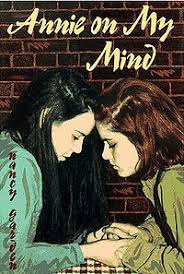
Garden, Nancy. Annie on My Mind (1982)In the early 1990s, when I was entering teenagerdom, this was the only novel in my public library’s Young Adult section featuring a lesbian love story. To this day I’m grateful to the librarian who purchased the tattered paperback copy for their collection, because — while dated in many ways — Annie was an incredibly positive introduction to queer fiction. It was, famously, one of the first gay YA novels to feature a hopeful, romantic ending. Liza and Annie, the star-crossed lovers, meet at the Metropolitan Museum of Art and develop a passionate friendship that deepens into a sexually-intimate romance when Liza agrees to house-sit for a beloved teacher. The teacher and her partner are themselves a (closeted) lesbian couple. When an anti-gay school administrator at Liza’s private school discovers the girls nearly in flagrante delicto at the teacher’s home (unbeknownst to the older lesbian couple, who are still away traveling) drama ensues.

While Liza and Annie face moral dilemmas around truth-telling and deception, their feelings for one another are never figured by the novel as perverse or wrong; instead, it is clearly the prejudice of others that precipitates the negative effects rippling outward from their involuntary uncloseting. Though the anti-gay prejudice depicted in Annie is, at times, easy to dismiss as outdated, the moral panic surrounding the girls’ relationship is still a live possibility for many queer teenagers (and adults!) today: teenage girls! sexual feelings! homosexuality! For that reason, Annie was a bittersweet read for me, serving as both a positive example of lesbian desire and a reminder of the discrimination that often constrains the lives of same-sex couples, even today.

Forester, E.M. A Room With a View (1908 ). I have often wondered if it was because of his life as a gay man — at a time when male homosexuality was still illegal in Britain — that E. M. Forester was able to write with such compassion and understanding about the circumscribed lives of women in middle- and upper-middle class Edwardian England. Room With a View is one of the earliest “adult” romance  novels I read, and remains in my top ten of the genre. Hardly sexually explicit, it still insists on a vision of marriage which involves the whole of both people: emotionally, intellectually, and physically. One reason for Lucy’s ultimate rejection of Cecil, the suitor to whom she is initially engaged, is that he sees her as a work of art (an object) — not a living, breathing, human being (a subject). George, the young man Lucy ends up choosing, gives every indication of appreciating her as a subject, a person in her own right — alive to the world, ready to encounter it alongside him, rather than decorate a drawing room. Particularly paired with Forester’s later work, A Passage to India, Room With a View has some very insightful things to say about both the possibilities of women’s agency, and the violence done to all concerned when women’s right to tell their own stories and make their own decisions are wrested from them by the machinery of Society.


Jordon, Sherryl. The Raging Quiet (1999). A quasi-historical fantasy novel set in Medieval Britain, The Raging Quiet revolves around questions of familial responsibility, marital fidelity, women’s self-determination, physical disability, and the potentially fatal cost of intolerance. Marnie is our headstrong heroine, coerced into marriage in order to save her family from eviction. Shortly after her marriage (and traumatic sexual initiation), her husband falls to his death and Marnie finds herself under a cloud of suspicion. Her friendship with the village “madman” does nothing to protect her reputation, and when that friendship deepens into love (and eventual sexual intimacy), Marnie finds herself on “trial” for witchcraft. I particularly loved (and still love) the village priest who — rather than being cast as a judgmental, doctrine-bound villain — finds himself befriending both Marnie and Raven (the “madman”), and ultimately blessing their union. Like Not a Swan, The Raging Quiet explores the journey of a young woman through coerced sexual activity through to self-understanding and subjective, chosen desire.

Waters, Sarah. Tipping the Velvet (1998) & Fingersmith (2002). While technically, I believe I read Sarah Waters’ novels the year I turned twenty-two, I was only midway through my undergraduate career and still floundering around trying to understand my sexual desires and possible identities. Tipping and Fingersmith are Victorian-esque thrillers with lesbian love stories at their core. They’re melodrama at its best, full to the brim with intrigue, double-crossing, mystery, cross-dressing, kink, revolutionary politics, pornography, wrongful incarceration, last-minute reveals — I could go on. Not necessarily my favorite lesbian romances today, I share Waters’ novels here because they were the first adult novels featuring same-sex romance that I dared to check out of the library and read — because they were mainstream enough that I didn’t feel that by reading them, I was declaring my own sexual identity one way or another. They were, paradoxically, safe novels to read. They helped me become aware of my own openness to same-sex desires by depicting explicit relational sex between women.

Fiction often encourages us to expand the realm of possibility, and for queer folks it is particularly powerful to have same-sex desires centered and normalized within fiction, when for so many years we’ve been pushed to the periphery as the “gay best friend,” or pathologized as doomed lovers, forced to pay for our “sins.” Tipping the Velvet encouraged me to ask myself where my desires yearned — a question that, in all honesty, it took nearly a decade of self-examination for me to meaningfully answer.

All five of these novels offered me the chance to reflect on the relationship between love and romance, love and sex, friendship and sex, sexuality and society, gender and sexual experience. While all of them could be derided as adolescent “love songs,” simplistic and idealistic marriage plots, I nevertheless believe all these authors have important things to say about the interaction of self and society within sexually-intimate relationships. As a teenager, I took away from all of these novels strong messages about the importance of paying attention to one’s internal moral compass, being attentive to one’s embodied desires, insisting on honesty and love over and above social custom — and even in the face of social persecution. I took away from these novels an openness to human sexual variety, and a belief in the right (and ability) of all people to form loving, consensual, and enthusiastically sexual relationships, and to stand by those relationships even when society said, “that’s wrong.”

I’d love to hear in comments if a) you’ve encountered any of these novels before, and if so what your experience with them was, and b) what novels helped shape your own youthful perceptions of sexually-intimate relationships. How do you feel you were served by the depiction of romance, love and sexuality in the literature of your youth?

so, that happened [a new guest blogging gig]

26 Tuesday Feb 2013

Posted by Anna Clutterbuck-Cook in admin

≈ 2 Comments

Tags

blogging, family scholars blog, feminism, gender and sexuality, religion

Ah, the strange and wondrous things that happen when you go traipsing around The Internet.

As you know, I’ve been hanging around the comment threads at Family Scholars Blog for awhile now. In part because I’m interested in how the other half lives thinks.  In part because I like to argue.

And in part because, in the very selfish, immature corner of my brain-heart-body it irks me that there are people out there who really think that I’m “depraved on account I’m deprived” (or some variation thereof). I’m fascinated and appalled that people feel so threatened by my existence as a (gay) married, sexually-active bisexual that they try to pass laws to erase my (gay) married existence, and — when that fails — simply say that my marriage isn’t real.

It’s fascinating, as I say, and appalling.

And not a little frightening. To know that my life excites such fear, angst, anger, and loathing.

I like to keep all that in sight, watchfully.

Well, then a couple of weeks ago they invited me to blog with them, as a regular guest blogger. 

And my first reaction was absolutely not, no. But I said I’d think about the offer. Talk to some people. Sleep on it.

What could I possibly bring to that site, as a guest blogger, that I wasn’t already bringing in comments? And, more importantly, why did they want me? I admitted to myself fears that I might simply be being recruited as a Poster Lesbian: “See? She plays well with others!” they might say, and when accused of anti-gay bias the group could point to my guest blogger bio: “See?! We even have a Queer Feminist Gay-Married Bisexual writing for us!”

Wouldn’t I be risking, on some level, being their Queer Cover? The sexual-identity equivalent of the Black Friend?

But then I started to think about what I might be able to offer in such a space, to those who were truly open to listening (and, yes, though I complain about those who revile and erase me more, the more contemplative conservatives exist).

And this is what I thought. That much of the conversation about queerness, feminism, and other lefty-liberal modes of being at the Family Scholars Blog (FSB) takes place without reference to — let alone centering of — actual queer / feminist / lefty-liberal voices or experiences. Even when those voices are referenced, it’s generally in the form of a sound bite we’re all supposed to know is ridiculous or wrong-headed (“pfft, look at those hysterical feminists with their foolish notions about gender equality — what do they know”).

Well, I’d like to talk about what it is we do know, and what life looks like from where we stand.

So I’ve accepted the FSB offer, and I’m going to start a monthly series there (cross-posted here), “The Feminist Librarian’s Bookshelf,” with 3-to-5 titles per post as suggested reading on a theme (“gender and neuroscience,” “teenagers and sexuality,” “queer families”). My hope is that I can offer a glimpse into the literature that informs those of us who take a quite different view than many, if not most, at the FSB, with regards to family life. I’m not particularly aiming to convert, although obviously it would be nice if some of my favorite authors resonated with readers here and there. My goal is to encourage people to “walk a mile in someone else’s shoes,” and think about what it might be like if you were to look at the world through the eyes of a lefty lesbian teenage, a liberal Latina mama, a feminist trans* woman, an asexual anarchist, a socialist living in poverty, or hippie home-educators.

There’s talk over at the FSB about civility of discourse, about meeting people halfway and compromising, about being willing to doubt (one’s own truths) and being open to having one’s mind changed.

I’m not sure how I feel about these values. I sometimes feel there is a type of privilege at work here, in which  unexamined certitude is disproportionately a problem of those whose worldviews and values are reflected back at them from mainstream culture. Those on the margins not only have the value of self-doubt shoved in their faces 24/7, they must learn to see the world through the eyes of the privileged and powerful in order to survive. Indeed: part of my fascination with the religious right comes from growing up a liberal-progressive (dare I say radical!) minority within a conservative Christian culture. I had to learn how Christian conservatives understood the world in order to survive. They didn’t have to learn anything about me, if they didn’t care to.

So I’ll be walking a mindful line over there, at FSB, between recognizing the true values of civil conversation, of lovingkindness and compassion, of being open to new experiences and viewpoints, of being open to the change those experiences and viewpoints will wreak within me — and at the same time holding my own, in part by example demonstrating that it is possible for a diversity of individuals with very different lives to co-exist in a democracy without the world imploding. We don’t all have to be alike, and that’s okay. We don’t all have to fear others who are different from us and/or those who choose a different way of life. Their different choices don’t, for the most part, constrain our own freedom of choice unduly.

You can read my self-introduction over a FSB and I’ll be cross-posting Thursday’s bookshelf post (five novels that influenced my adolescent perspective on love and romance) here.

Newer posts →
"the past is a wild party; check your preconceptions at the door." ~ Emma Donoghue

Recent Posts

  • medical update 11.11.22
  • medical update 6.4.22
  • medical update 1.16.2022
  • medical update 10.13.2021
  • medical update 8.17.2021

Archives

Categories

Creative Commons License

This work by Anna J. Clutterbuck-Cook is licensed under a Creative Commons Attribution 3.0 Unported License

Meta

  • Create account
  • Log in
  • Entries feed
  • Comments feed
  • WordPress.com

Create a free website or blog at WordPress.com.

  • Subscribe Subscribed
    • the feminist librarian
    • Join 37 other subscribers
    • Already have a WordPress.com account? Log in now.
    • the feminist librarian
    • Subscribe Subscribed
    • Sign up
    • Log in
    • Report this content
    • View site in Reader
    • Manage subscriptions
    • Collapse this bar