• anna j. clutterbuck-cook
  • contact
  • curriculum vitae
  • find me elsewhere
  • marilyn ross memorial book prize

the feminist librarian

the feminist librarian

Tag Archives: feminism

quick hit: asexuality awareness week (a retrospective)

27 Monday Sep 2010

Posted by Anna Clutterbuck-Cook in linkspam

≈ Leave a comment

Tags

blogging, feminism, gender and sexuality

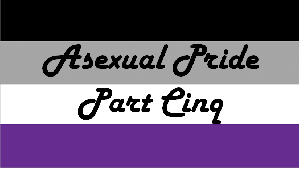
Last week, my friend Minerva over at Hypomnemata wrote a series of five delicious posts on the topic of asexuality, in honor of Asexuality Awareness Week. I wanted to give you all a taste in hope that you hop on over to check out the subject in full (along with lots of fun and informative graphics and videos!)

Asexual Awareness Week: Day 1 – What is Asexuality?

In honor of this, my first experience of this week as a completely out asexual, I’ll be posting every day on a topic relevant to asexuals and the asexual community. For this post, I’ll be focusing on the many definitions of asexuality as well as the subtle side and subgroups present within the community. Tomorrow I’ll be tackling the subject of attraction and asexuality, and you’ll just have to stay tuned to find out the rest.

Asexual Awareness Week: Day 2 – Asexual Attraction

The last sense of attraction that I’ll talk about here is a bit more personal and a bit more murky, which is why I left it for last. I’m definitely not sure how much of what I’m about to say is generalizable to the asexual community as a whole, so don’t assume so. There is a sense of attraction that I generally feel in addition to aesthetic and intellectual and emotional (personality) which I would have to admit is decidedly physical.

Asexual Awareness Week: Day 3 – Relationship vs. Friendship

Since I already established on Day 1 that asexuals experience love and can have a romantic or affectual orientation, I don’t think it’s unforeseen that some of us are going to want relationships. Personally, I’d be more than willing to give it the old college try. However, there’s an obvious question looming in the periphery of the discussion when talking about asexual relationships. How is it a relationship and not just a really close friendship?

Asexual Awareness Week: Day 4 – Asexuals and the LGBTQ Community

The question of the day: should asexuals be considered part of the LBGTQ community? Honestly, I never really thought this was an actual question to be asked in the past. It was only when I attended my first meeting of the Smith College LGBTQ group that I became aware of how narrow the definition of community can actually be. A brief synopsis of the experience follows: (N.B. I’m pretty sure the group has changed since my time. They’re probably all lovely ladies now, not that they weren’t then, just a little judgy.)

Asexual Awareness Week: Day 5 – Asexuality and Feminism

So what does all of this have to do with asexuality? If you would have asked me a year ago, I would have said nothing. I perceived no contradiction or problematic interaction between my feminism and my asexuality. I technically still don’t, by I’m not the only feminist or asexual on the block. The way I (inexpertly) see it, the problems between asexuality and feminism revolve around three main topics:

1.) Helping women to have positive images of their bodies and sexuality

2.) Helping women to take control over the expression of their sexuality

3.) Combating negative perceptions of feminism

Before I really start all of this talk about the quarrels between feminism and asexuality, I’d like to point out that there are some issues on which we agree well, like breaking down gender roles in relationships, or challenging gendered notions of intimacy. We’re not all judgy all the time.

Go forth and learn awesome new things! Happy Monday.

sunday smut: tumblr highlights (no. 3)

26 Sunday Sep 2010

Posted by Anna Clutterbuck-Cook in linkspam

≈ 2 Comments

Tags

blogging, feminism, sunday smut, tumblr

So I’m still getting used to using my tumblr account as a way to share links. It’s a really strange hybrid of Google Reader (through which I get aggregated blog stories from the various blogs I follow, can share and comment on them to friends who also use the Reader), Blogger (wherein, as now, I generate original content in the form of fully-developed blog posts) and Twitter (where thoughts, exchanges, and links are limited to 140 characters).

One of the oddest features of the tumblr interface is that when you post something to a tumblr blog, people who want to respond to what you share have only two options: to “like” the post or to “reblog” it, or quote the post in part or in full, with or without additional commentary. There is no comment feature, so conversations bounce back and forth between tumblr blogs in a very disconcerting way. At least, disconcerting for me.

An example from this past week.

Yesterday morning, I “reblogged” a post from a blogger named genderbitch about the birth rape language discussion/intra-feminist controversy and added some further thoughts of my own. genderbitch reblogged that post with comments/responses of her own, which in turn I wanted to respond to. And the only way I could respond was to reblog the post again. And again. And again. Until, I feel, the two of us got into an incredible tangle of mis-communication (about which there might be a more lengthy blog post coming next week … still not sure). This seems incredibly clunky. Tips from anyone with more tumblr experience than I are welcome … though perhaps the answer is just to limit my tumblr use to reblogging without my own added commentary!

And with that observation, here are a couple of my favorite tumblr stories from the week.

The Right to Bear

It’s not ‘babyish’ to find ways to self-soothe and to cultivate feelings of security: it’s human, and it’s smart. It’s not wrong to form attachments and dependencies and when it’s people and things that do not harm us, it’s actually desirable to do so. There is no prize for growing up the fastest, especially when growing up means shedding, or hiding, human vulnerabilities.

~Spilt Milk

Toward a Taxonomy of Homophobia

The problem, it seems to me, is that we need a more nuanced vocabulary for ‘homophobia’ (and likewise for transphobia). There is homophobia like that of Phelps, stemming from hate or deep fear, and directed with deliberate negative intent towards LGB people. There is homophobia like that of people who oppose, say, marriage equality or allowing gay men and lesbians to serve openly in the military, but who do so out of misunderstanding, not out of hate. They might vote against us, but only because they have never sat down to talk with any of us. There is homophobia like that of Rice, where LGBT-related language is used in an insensitive and thoughtless way, but is not directly aimed at LGB people.

~Dana Rudolph, Change.org’s Gay Rights Blog.

and Suffrage On Stage: Marie Jenney Howe Parodies the Opposition

My first argument against suffrage is that the women would not use it if they had it. You couldn’t drive them to the polls. My second argument is, if the women were enfranchised they would neglect their homes, desert their families, and spend all their time at the polls. You may tell me that the polls are only open once a year. But I know women. They are creatures of habit. If you let them go to the polls once a year, they will hang round the polls all the rest of the time.

~Mary Jenney Howe, “An Anti-Suffrage Monologue” (1913).

family leave: some reflections the workplace and relationship care

25 Saturday Sep 2010

Posted by Anna Clutterbuck-Cook in think pieces

≈ Leave a comment

Tags

children, feminism, work-life balance

Earlier this week I shared a personal essay on the feminist librarian reads by Nathan Hegedus, an American man living with his Swedish wife and two young children in Sweden. The essay describes the culture of parental leave and childcare in Sweden, his own changing relationship to the idea of family leave, and the way the Swedish economy has adapted to government-mandated leave time for parents with young children. While I don’t think top-down enforcement of new norms is always the best way to go, in this case the passing of legislation meant that the workplace was forced to adapt to the modern reality that workers do not exist in a vacuum, and that sometimes the needs of families require job flexibility. The fact that employers providing family leave time are actually following the law means that both employers and employees are supported in creating an environment in which workers are guaranteed leave (and their jobs upon return) and employers are encouraged to find solutions to the question of staffing while their regular employees are away caring for family members.

The working world has adjusted accordingly. Most companies seem to fill parental-leave vacancies with short-term contracts, and these seem to function as good tryouts for permanent employment. It all feels pretty organic in a globalized world of flat organizations and gender equality, of employees who are not locked into one assignment or skill set.

. . . If you had asked me in, say, 2001, if I would ever take a long paternity leave, I would have answered, “Yeah, sure,” because I was a liberal guy—but then ignored my own answer because I was also an ambitious, career-driven type. Then I married a Swede, and we moved to a small town outside New York City that was close to no family or friends. Out of necessity, and my wife’s Swedish expectations, I got deeply involved in our upcoming baby’s life, though probably still no more than many American dads-to-be. We had a rough ride. My wife had bad doctors and a bad back, and we lived in a house covered with lead paint and infested with bats, rats, and bedbugs. It all began to seem overwhelming. In the end, almost more than my wife, I pushed for the move to Sweden, to the promise of parental leave, shorter work days, five weeks of vacation, and unlimited paid sick days if your kid falls ill.

Still, the prospect of telling my boss I wanted to take paternity leave paralyzed me for weeks. Surely I would get fired for taking six months off. Or I would return to a job cleaning the bathrooms with pencil erasers. I think I chickened out completely and just sent an e-mail. But my supervisors took my leave as a matter of course. I have small children; hence, I was likely to take paternity leave of some sort.

While Hegedus is focused here on the needs of parents with young children, and the social change providing these parents with support has wrought in Sweden, I think it’s important to think about how the lessons learned in Sweden (and other countries with strong social welfare policy) can be applied beyond the realm of parenting and care of young children. The elder-care of parents, for example, which will become an increasing issue as the baby boomer generation ages and the social safety net enjoyed by many of their parents no longer exists. The care of spouses and partners with mental or physical health issues, for another, is important to recognize.

The needs of parents and dependent children are (superficially, I would argue) an “easy sell” in a culture that pretends to champion young people and their caregivers. Yet the creation of an economic culture that successfully supports the well-being of workers (and, thus, increases productivity and the potential for innovation) needs to include all of us, whether we have the responsibility to care for dependents or not. Advocating such comprehensive change in the way we think about “work” vs. “life” as a society also puts an end to the parents-vs-non-parents friction that develops, in feminist circles at least, when we begin to talk about support for working parents. Single people and people with no children often feel like this conversation privileges the “choice” of people with children by allowing them extra time away from work that, as persons who will never have children, they are not offered. As parenting is increasingly seen as a freely-chosen lifestyle (rightly or wrongly), parental leave becomes yet one more policy issue dividing caregivers of the young from others. 

Instead of running with this limited view of “parental leave,” we need to start talking more holistically about care and the needs of all human beings to give and recieve care, regardless of age, of physical or mental ability, or of their position within family systems. And we need to think about how that care can be incorporated into (and ultimately benefit, or at least not weaken) the modern work environment that dictates so much of the rhythm of our daily lives.

further thoughts: "birth rape" and feminist policing (the curvature)

21 Tuesday Sep 2010

Posted by Anna Clutterbuck-Cook in think pieces

≈ Leave a comment

Tags

children, feminism, gender and sexuality

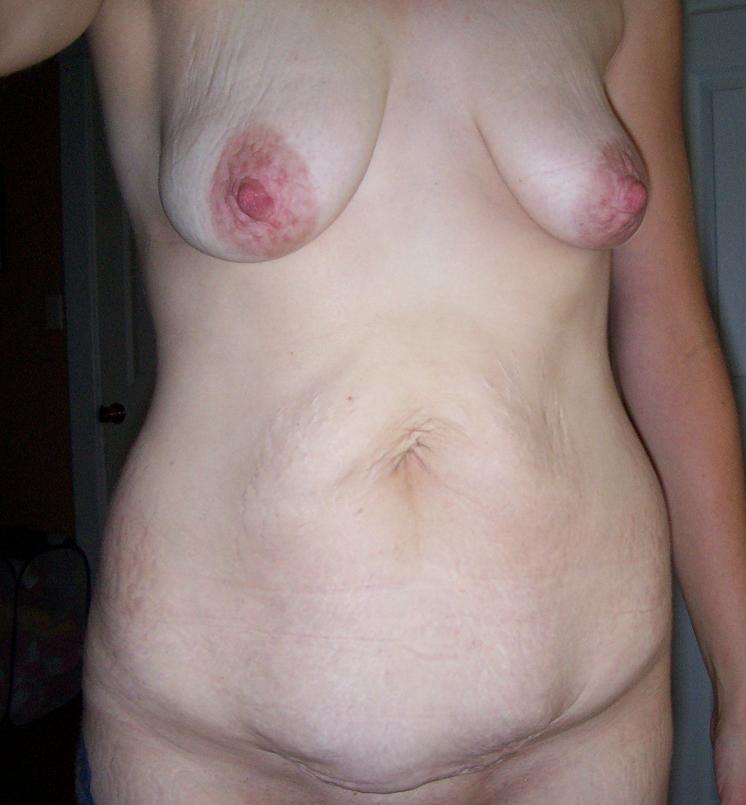
An anyonymous woman's postpartum body, posing nude. Image from The Shape of a Mother.Note/disclaimer: This post was written last Saturday, following which I had several really good conversations with friends about feminism, exclusion, inclusion, and language. To those of you who were involved: this post doesn’t reflect those conversations and how they have helped me think about some of these issues in new ways! Maybe I’ll write a “part two” one of these days, but for now I’m leaving this one as-is …

There’s a good conversation going on in comments over at The Curvature about the concept of “birth rape” and why some feminist activists are resistant to acknowledging the way violations of bodily integrity during pregnancy and birth are often experienced by women as a form of sexual violence.

Cara’s original post is a brilliant, articulate response to several previous posts from within the feminist blogosphere that expressed discomfort with the term “birth rape.” To which Cara responds,

Birth rape describes the experience of women and pregnant people of other genders having their bodies violated and penetrated without their consent in the process of giving birth, usually though not always through the forcible insertion of hands or medical tools into the vagina or anus without consent, and frequently with explicit non-consent. Victims are often physically held down, told to shut up, ignored when they scream or cry or plead, threatened, and/or called names as their bodies are violated. Just as survivors of other forms of rape, birth rape survivors experience physical and emotional trauma, often rising to the level of PTSD — only compounded by the general lack of recognition that birth rape is real, and the frequent guilt at having such trauma associated with their new child coming into the world.

In other words, birth rape is a term used to describe a specific form of rape that is committed in a birthing context, without the use of a penis.

. . . When women come forward and start saying “I was raped,” when they find the power to use that word to describe their own experiences and open up to share their trauma with the world, responding with “no you weren’t” — with whole blog posts about the subject, in fact — is about the worst possible way that a person can do feminism.

. . . Telling other survivors that their experiences of violation aren’t real enough, and just weren’t sexual enough of all things, to use our special fancy word is wrong. And if this is how the word “rape” is going to be used against other survivors of abuses of power and abuses of bodily autonomy and violations of self — as a weapon, like it is right now — then I don’t want it. If the word rape doesn’t include all of those victims of violence that it needs to include, we need a better word. If the word rape is so fragile that we must minimize the horrific experiences of some survivors, the violence they lived through, and the violations they felt in order to protect it, we need a better word. And when the major response to a somewhat mainstream conversation about birth rape is quibbles about words rather than compassion and organizing, we need a much, much better feminism to become the dominant one.

You can read the whole thing over at The Curvature. And I highly recommend that you do, since it’s passionate and just the sort of inclusive feminist thinking that brought me into activist feminism in the first place.

I asked in comments, “What on earth do we gain from telling them their experience doesn’t count?? I really don’t get the prickly reaction to this language.” To which commenter lauredhel responded

I think that to really understand the reaction, one needs to look at the broader picture of mother-exclusion in this particular brand of Feminism. Once you’ve had a kid, you’re ripe for the exclusions – it’s ok to keep you out of feminist organising because kids are all complicated and loud and annoying, it’s cool to dismiss you as ‘merely’ a ‘m(u)(o)mmy blogger’ and not politically relevant, it’s fine for you to be excluded from public spaces (with a hefty dose of Feminist shaming for your temerity in having a child-accompanied life outside the domestic and playgroup sphere), and you need to lie back and think of England when doctors are doing their thing, because it’s for your own good, dear, you made your motherbed, now lie in it and don’t get too uppity while the real feminists are talking. As soon as you make it clear that that fetus is staying put and coming out of you, you’re out of the club.

It’s not that I’ve never thought before about the way our culture devalues the bodily autonomy of pregnant women and denies the personhood of birthing mothers — but I think this conversation around the recognition of birth-related sexual violence is a striking example of the way in which certain contingents within feminist activism resist including women who are pregnant, birthing, and mothers within the movement — resist incorporating their particular concerns. Instead, they parrot back the misogyny of mainstream culture which simultaneously idealizes motherhood and hates on actual mothers and children. There are complicated reasons for this (as my friend Laura Cutter so eloquently pointed out in a guest post recently).

But the fact that it’s complicated is not license to just give up. Rather, I think the complexity of the issue invites us to examine the way in which feminists (no more or less than anyone else!) can sometimes use the language and concepts that have given them voice as tools to turn around and silence other people.

Which is, to put it simply, not cool.

When the strength of our self-identities and political activism lies in denying other folks a place at the table, it’s time to re-examine the way our actions reflect our core values. I became a vocal, self-identified feminist in order to advocate for a world where there is less policing of gender and sexuality, not more. I work every day to practice radical acceptance of the rich diversity of being-in-the-world practiced by those around me, and to protect the ability of all people to feel safe, at home, and loved in the bodies and lives that give them well-being. That, to me, is what feminism is about.

*Image credit: Bittersweet (Anonymous) from The Shape of a Mother.

"people are DESPERATE to be told what they’re like": discuss

16 Thursday Sep 2010

Posted by Anna Clutterbuck-Cook in think pieces

≈ 3 Comments

Tags

blogging, education, feminism, gender and sexuality

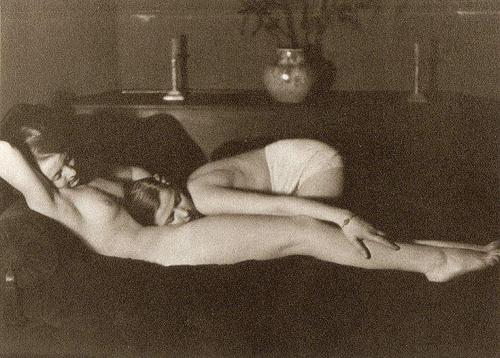
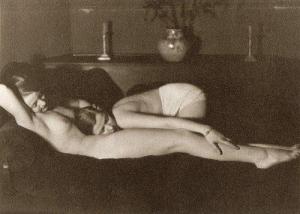
Vintage Erotic from Queerest of Them All @ Tumblr.com

Over the past couple of weeks, I’ve been having a slow conversation-in-comments with Emily Nagoski over at ::sex nerd:: about human sexuality, sex research, and the classification of human sexual experience in the two general categories of female-bodied and male-bodied individuals.

The original post Emily wrote is about the problem of asserting sameness across sex/gender identity when it comes to human sexuality. From her position as a sexuality educator, specifically working with undergraduate women at Smith College, Nagoski highlights the ways in which a narrative of sameness works culturally to erase the experience of people who have don’t have the “sexual hardware” of the default human (a man)

Treating women’s sexuality as though it’s “the same” as men’s, in the social world and in science, results in women feeling broken and ashamed.

As in: We should want sex as much as and in the same way that men do. We should be able to have orgasms the way men do – as quickly, in diverse situations, and through intercourse. Our sexual orientation should be the same. Our responsiveness should be the same. Our fantasies. Our porn. Our feelings about our bodies. I mean, where does it end? You might as well be saying women should have penises.

You can read the whole post over at Emily’s blog.

There are a lot of really awesome aspects to this argument, chief among them that asserting that different bodies respond differently to sexual stimulus is a great step away from the monoculture of “sexy” that our culture is currently saturated with. I also like the way it grounds physical sexual experience in the body, and encourages folks to learn about how their bodies work as a way of gaining a better understanding of their own sexuality.

It also pulls us away from the default understanding of sexual arousal as something that is primarily experienced by people with male bodies and hormonal profiles. It helps clear the ground for women to assert their sexuality without shame and without requiring them to mimic a type of sexuality they do not feel in order to be taken seriously as sexual subject.

From a personal perspective, I will say that one of the most valuable learning experiences in my early career as a sexual being was finding a second-hand copy of Shere Hite’s 1976 report of women’s sexuality in which she quotes long excerpts from questionnaires in which women describe in detail the diversity of their sexual desires, fantasies, physical arousal and relational experiences. Pages and pages and pages of women describing, in minute detail, how they masturbated, what sexual positions worked and didn’t work for them, what kind of touch they liked, whom they enjoyed making love with and how. Since the publication of Hite’s research, questions have been raised about the scientific rigor of her methodology — but to me the power of the book is not in its statistical validity, but in the individual voices that disseminate a type of information that is incredibly difficult, even in this era of the internet, to obtain: how actual people in the actual real world get off? what makes them horny? what fantasies do they carry in their innermost souls? what sensations push them over the edge? It seems so simple, banal almost, and yet there can be radical power in seeking the answer to those questions.

So what’s my problem with the emphasis on “difference”? It’s the fact that that human sexual difference is framed using a binary sex/gender system that simply doesn’t work for a lot of people. What about people with a “female” hormone profile who have penises? What about folks whose sexual arousal cycles seem to be spontaneous despite having a clit? And what about us cis-gendered women who, despite being accepted by the medical and social world as “female” and “feminine” just don’t see ourselves very well represented in the narratives of female sexuality that are out there? It feels to me like we’re rejecting one set of restrictive categories for another set of restrictive categories that just aren’t going to be very helpful to any of us in the long run.

We’re still going to end up feeling shamed, just for different reasons: maybe it’ll be okay not to be sexual in the same way as boys, but now we’ll feel the pressure to be sexy the same way as girls.

What gets lost is the question of how to be sexy like ourselves.

When I raised this issue in comments, Emily pointed out that scientifically-speaking, studying a species that reproduces sexually (as we do) means that it does make a certain amount of sense to examine the human population as one that is made up of two basic iterations (male and female). I get that talking scientific data is different from talking about cultural perceptions, but I also believe that the two interact in ways we often cannot even see. I also think that the language and results of scientific studies get misinterpreted by the media and the general public, and often translated into sound bites that end up supporting pre-existing notions of sex and gender difference: employed in making truth claims far beyond the scope of the original researchers’ work.

Emily also suggested that using the female/male categories as a launching-point to discuss sexual diversity is a useful educational tool.

You don’t want women to be told they’re like men, but you also don’t want them to be told they’re like women.

That’s fair enough, actually, since people just vary (though men vary around one standard and women vary, more widely, around a different one). But my experience has been that people WANT – no, they’re fuckin’ DESPERATE – to be told what they are like. They want a category. They can’t cope without one. And since we’re a sexually reproducing species with males and females, the man/woman split is a natural-seeming division. It’s a comfortable couch for radical information.

So here’s my question to y’all. Do you want a category?

I’m curious. Because, see, I really, really don’t want to be told what I’m like. I have what’s probably an unhealthy aversion to being categorized. Do I like to run into stories that mirror my experience? Yeah, sure! It was an incredible experience to read Lisa Diamond’s book on sexual fluidity and finally hear the women she interviewed putting into words thoughts and feelings and physical experiences I had known intimately but did not have the language to articulate. But for me, it is enough to know that there are other like-minded or like-experienced people out there in the world. As soon as those beings start being grouped and generalizations are made about them, I develop a twitch.

I’m curious what responses other people have to this discussion of difference and categories, the comfort of categories and the danger that categorization will lead to marginalization or erasure. What have your experiences around descriptions of “female” and “male” sexuality been? Are there particular categories that resonate particularly strongly with you, that have been of use to you in better knowing and expressing your sexuality? Have other people tried to categorize you in ways you feel are just plain wrong? What cultural and/or scientific narratives were at work creating and enforcing those categorizations?

$1 review: wise parenthood

31 Tuesday Aug 2010

Posted by Anna Clutterbuck-Cook in book reviews

≈ Leave a comment

Tags

children, feminism, gender and sexuality

$1 reviews are posts about books I find (or Hanna finds for me) on the $1 used book carts at the bookstores we visit around Boston.

Marie Stopes in her laboratory, 1904
Image made available through Wikimedia Commons

Last weekend, when my mother was here on a visit, Hanna and I took her to Brattle Book Store near the Boston Common to shop the glorious $1 and $3 book carts which they keep in the empty lot next door. There, much to my feminist sex geek delight, I found a copy of Marie Stopes’ 1918 classic Wise Parenthood (“The Treatise on Birth Control for Married People. A Practical Sequel to ‘Married Love'”) for a mere $1.00! By the time the twenty-first edition (my edition) appeared, the book had gone through sixty-eight printings and 626 thousand copies were in circulation.

Much to my everlasting sadness, I neglected to buy a copy of Married Love when I saw it at an antique mall last fall in Michigan — only going so far as to follow my mother around the shop reading hilarious passages aloud to her and giggling obnoxiously. So I have not read the the companion volume to Wise Parenthood. I thought I’d share this passage, however, since to at least it presages the current conversation about modern parenthood/reproduction as a conscious decision that a couple makes, as opposed to something that just “naturally” happens to opposite-sex couples when they enjoy an active sex life.

Nature herself provided that men and women should delight in meeting. Given a loving married pair in normal health, and unsophisticated in any way, there is seldom any lack of children around them after they have been wedded for some years. This is what is still described as the ‘natural’ condition of affairs, and in these days of sophistication in so-called ‘civilization,’ some reformers urge a return to Nature and an unregulated birth-rate.

If, however, the course of ‘nature’ is allowed to run unguided, babies come in general too quickly for the resources of most, and particularly of city-dwelling, families, and the parents as well as the children consequently suffer. Wide parents therefore guide nature, and control the conception of the desired children so as to space them in the way best adjusted to what health, wealth, and happiness they have to give. The object of this book is to tell prospective parents how best to do this, and to hand on to them in a concise form what help science can give on this vital subject.

Barrier methods, such as the sponge, rubber cervical caps, and condoms are covered, as are methods such as “coitus interruptus,” nursing after birth, and the “safe period” (the rhythm method). I like this objection Stopes raises to coitus interruptus:

The great majority of women whose husbands practise this method suffer very fundamentally as a result of the reiterated stirring-up of local nervous excitement which is deprived of its natural physiological resolution. Of the far-reaching effects on the woman’s entire organism of the lack of a proper [vaginal?] orgasm, which is generally the result of this method, this is not the place to speak … [however] the local support and nerve-soothing contact which are supplied mutually to both when the act is completed normally are destroyed.

She was also not a fan of “metal instruments” (a veiled reference to surgical abortion techniques?) and was firm in the advice that one should “NEVER PUT INTO THE VAGINA CHEMICALS YOU WOULD NOT PUT IN THE MOUTH.” which seems like fairly solid advice on the whole, particularly considered in the light of the era’s encouragement that women use such substances as lysol, carbolic acid as douching fluids.

Here’s hoping I can find a volume of Married Love on the $1 carts soon!

quick hit: indexed ftw

25 Wednesday Aug 2010

Posted by Anna Clutterbuck-Cook in linkspam

≈ Leave a comment

Tags

children, feminism, human rights, politics

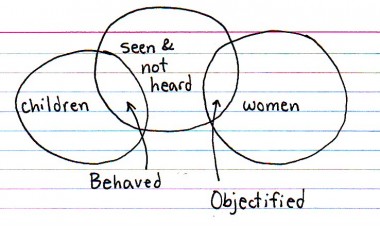
Via my friend Diana comes this great graphic commentary by indexed

Venn diagram showing overlapping circles labelled “children” (left), “seen and not heard” (middle), and “women” (right).

The overlaps read: childen + seen and not heard = behaved, and women + seen and not heard = objectified.

The title of the post at Indexed read don’t let anyone shut you up.

in love with new blogs: Blue Milk

19 Thursday Aug 2010

Posted by Anna Clutterbuck-Cook in linkspam

≈ 2 Comments

Tags

children, feminism, in love with new blogs


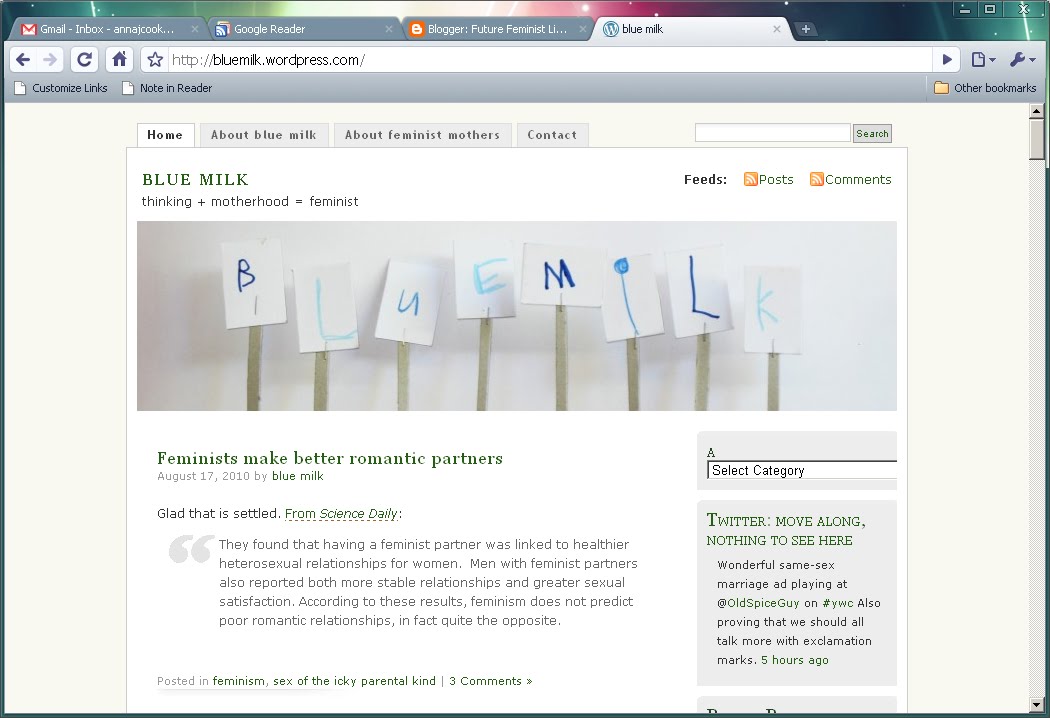
This week, I bring you blue milk, an Australian-based blog on things feminist and things parent+child related. As the blog tagline puts it: “thinking + motherhood = feminist.” We are also offered the following image of the blog author.


I discovered blue milk a few weeks ago, thanks to my friend and fellow blogger Molly @ first the egg. Why read it? Because it challenges the notion that involved parenting = “perfect” parenting, and that involved parenting (read: involved mothering) is somehow antithetical to feminist consciousness. Some examples.

From On the backs of other women.

I initially thought this little post was going to be about community. About how much I have come to cherish the school community particularly, that we are now a part of, and how some mothers at my daughter’s preschool have been saving my arse lately, over and over again, and for pretty much nothing in return. But the big fat gender factor tells me that this post isn’t actually about ‘community’.

Discounting the teachers at the Montessori preschool and the kids’ father, it takes the efforts of five other people caring for our two children to allow me to be at work three days a week. Pick-ups and drop-offs and naps and cuddles and dinners and baths. Only one of those five are paid for it, and all of them are women.

From Guest Post: Being a feminist and raising ‘a lad’ (from her “10 questions about feminist motherhood” series). Answers from Matari.

1. How would you describe your feminism in one sentence? When did you become a feminist? Was it before or after you became a mother?
I became a feminist at the age of 11 when I was abused by my stepfather. I learnt to call myself a feminist when I realised that as a woman, my abuse was nothing unusual and, in fact, represented the lack of power that women have in our society.

2. What has surprised you most about motherhood?
How attached I was to my son as soon as he was born – I almost expected to be able to fit him into my schedule and carry on as before. But no, that was not the case AT ALL – I instantly became responsible for a little life that, if was injured in any way, would affect me for the rest of my life.

3. How has your feminism changed over time? What is the impact of motherhood on your feminism?
My feminism became more entrenched, as – with every other event in my life,- I recognised that as a mother I would (again) be a marginalised woman, exacerbated by being a single parent.

From Why attachment parenting NEEDS feminism.

This is probably the right time to admit that not only am I an attachment parenting type – our children are co-sleepers, including the older one who is now five years old; I breastfeed the toddler; and we have more slings than vehicles in our house – but for the record, I am also a mother who works part of each week outside the home. I have been separating from our toddler since before he was a year old. And to be perfectly honest, Wootan’s advice doesn’t really rattle me. I have done my share of soul-searching over the last five years about being a working mother and I feel confident that our decisions have been good ones, and what’s more, that the children are ok too. But I know Wootan’s position will distress many other women in my position; I know a few years ago it would have thrown me for a loop. And while I am sure Wootan is a very caring doctor, anyone who makes a statement like that, about how women should live their lives, deserves a little scrutiny.

And for those of you who aren’t so interested in the politics of parenting, but possibly interested in the politics of parenthood (and non-parenthood) in our society, from The politics of nappy buckets.

But how insulting is the prioritising of working families to people without children? Don’t they consider themselves part of family too? Aren’t they contributing to the community? Don’t they have the right to some priority in policy planning and fiscal generosities? The term ‘working families’ creates an unnecessary division, an us and a them. It undermines the goodwill people without children might otherwise feel towards people with children. Sure, raising children contributes to a ‘social benefit’ that all of society enjoys, and its costly for the individuals raising those children, but telling everyone you’re prioritising ‘working families’ must surely niggle away at the cohesiveness of parents and non-parents. It also makes women feel like their only value is in childbearing. Although, ‘deliberately barren’ is such a ludicrous term, such an unfortunately revealing comment on the right-wing agenda that however hurtful it is to women it is also kind of soothing to see Heffernan and those like him exposed so badly.

Enjoy! And see you next week for another installment of in love with new blogs.

quick hit: defending one’s manhood

18 Wednesday Aug 2010

Posted by Anna Clutterbuck-Cook in linkspam

≈ Leave a comment

Tags

feminism, humor, masculinity

My colleague, Jeremy, receives the print edition of The Atlantic magazine and I happened to notice, yesterday, the following query and response on the back page of the most recent issue (September 2010), in Jeffrey Goldberg’s “What’s Your Problem?” column.

I’ve noticed that The Atlantic has become very anti-male lately. My proof lies in recent articles by Sandra Tsing Loh, Caitlin Flanagan, and of course Hanna Rosin, whose July/August cover story, “The End of Men,” argued that men will no longer be necessary as our economy changes. How do you protect your manhood while working at a magazine that is so hostile to men?

P. W., Chicago, Ill.

Dear P. W.,

I take active countermeasures to protect myself against the rampant feminization of The Atlantic. For instance, I eat only what I kill, except for sandwiches from Potbelly, which are killed by someone else. I also chop down the trees that provide the paper on which this magazine is printed, using only an extremely dull axe and my signature bad-ass attitude. Other prophylactic measures I employ include hiring Chuck Norris as a guest blogger, and then firing him, by fax, for being insufficiently manly; and using actual prophylaxis, in the form of a full-body condom I wear to protect myself from the effects of airborne estrogen. I also refuse to participate in the mandatory office-wide “All Guys Have to Wear Jimmy Choos on Fridays” morale-building exercise. And though I was ultimately forced to appear in The Atlantic’s staging of The Vagina Monologues, I purposefully delivered an indifferent performance as Eve Ensler’s labia.

As a feminist, I feel honor-bound to point out that Sandra Tsing Loh, Caitlin Flanagan, and Hanna Rosin are, in fact, often very anti-man (the scene from Parenthood where Dianne Wiest’s character says to her daughter, just as her young son walks into the room, “Men are such jerks!” comes to mind) they are often anti-woman as well. Or rather, they tend to subscribe to very gender-essentialist concepts of what it means to be a man or a woman, neither of which serve human beings all that well.

The idea that being anti-male, anti-manhood, and “hostile to men” are all roughly equivalent positions is a fallacy anyway. As a feminist, I’m fairly anti-“womanhood” (since womanhood, in our culture, is a very specific type of cultural performance) and yet hardly anti-women or hostile to women as human beings. Nor do I have a problem with female-bodied persons.

Which is all to say, I love the way Goldberg plays up all the stereotypes of masculinity in his response. Because really, it’s about the level of attention all of those articles — and the concern they seem to have sparked — deserve.

"both choices are radical": the decision not to parent

06 Friday Aug 2010

Posted by Anna Clutterbuck-Cook in Uncategorized

≈ 1 Comment

Tags

children, feminism, guest post

In response to my last post about the children-as-people thing, my awesome friend Laura Cutter sent me this thoughtful email, which I repost with her permission. I think it’s super-important to underscore the fact that arguing that children (and by extension, their caregivers) are marginalized in our society doesn’t mean that people (read: women) who are not parents (by accident or choice) don’t face enormous social censure.

No one’s interests are served, I’d argue, by turning this into a case of oppression olympics, trying to parse out whose pain is more exquisite than the next person’s. Instead, we need to place the blame where it belongs: fucked up cultural norms that demand one single best way for women and young people to be in the world and be in relationship with one another. The human species is just too awesomely diverse for us to waste our time on that sort of one-size-fits-all crap.

Without further editorializing, here’s Laura.

I really appreciate your post from today – I find it heartbreaking when various groups (who are themselves often marginalized) insist on further marginalization. In my more pessimistic moments, I wonder if our biological minds, which from very early evolution needed to separate, delineate, and categorize everything from people to plants in order to survive, are somehow on overdrive – pushing us apart. That being said. One of the things that really struck me about your post and the links you added was this:

Our generation is one that is rapidly moving towards a time where some of us are choosing to have children. That is right now, the present. But what everyone seems to be forgetting is that many of our ideas and experiences were not formed in this cultural moment. Just as some of us remember feeling marginalized as children, others of us remember being told constantly that we would and should expect to have a child/children. I remember feeling livid as my protestation that I never wanted children were brushed aside by adults who were certain that they understood me better than I did. I am very aware that my own community and intellectual life is quite rarified – it is for many of us. But the underlying assumption to many of these arguments seems to be that it is so acceptable not to have children that the women who now choose to have them are the new marginalized poster child (red is the new black?). Many of us still must validate, on a daily basis, our choice not to have children. We experience invasive, insulting, manipulative, and inappropriate responses from people who, in other circumstances, would never pass judgment on another person’s choice. This is my point: both choices are radical. Both choices carry tremendous cultural significance and personal meaning. In my world, it is still radical to choose not to become a parent, and I carry with me all the baggage of years spent being told that my choice was wrong. But I understand and respect that for many other women, the decision to choose parenting means other sacrifices, for which they, in turn, are judged.

* * *

I feel like it happens this way (as my friend Marie-Laure says, “tell me a story”): I have kids and you don’t. In you, I see all of the people who told me that having children was a waste of my talent, a second choice, a vote for the patriarchy. I also see all of the freedom and choices that you have in your life and think it’s a little unfair and that your life must be easier than mine. In me, you see everyone who told you that you were born to have children, that it is natural and beautiful, that you would never be complete without them, that you will change your mind. I also see all of the social acceptance and special treatment that you have in your life and think it’s a little unfair and that your life must be easier than mine. But of course, that’s not who you are and that’s not who I am, but when we (especially women), have these debates, we bring into them all of this damage and judgment and project on each other with our own insecurities. I do think this parent/not parent issue really is a false dichotomy and everybody knows that progress is never made when everyone is just in fighting.

← Older posts
Newer posts →
"the past is a wild party; check your preconceptions at the door." ~ Emma Donoghue

Recent Posts

  • medical update 11.11.22
  • medical update 6.4.22
  • medical update 1.16.2022
  • medical update 10.13.2021
  • medical update 8.17.2021

Archives

Categories

Creative Commons License

This work by Anna J. Clutterbuck-Cook is licensed under a Creative Commons Attribution 3.0 Unported License

Meta

  • Create account
  • Log in
  • Entries feed
  • Comments feed
  • WordPress.com

Blog at WordPress.com.

  • Subscribe Subscribed
    • the feminist librarian
    • Join 37 other subscribers
    • Already have a WordPress.com account? Log in now.
    • the feminist librarian
    • Subscribe Subscribed
    • Sign up
    • Log in
    • Report this content
    • View site in Reader
    • Manage subscriptions
    • Collapse this bar