• anna j. clutterbuck-cook
  • contact
  • curriculum vitae
  • find me elsewhere
  • marilyn ross memorial book prize

the feminist librarian

the feminist librarian

Tag Archives: feminism

“a rash and dreadful act for a woman”: the 1915 woman suffrage parade in Boston

01 Thursday Jul 2010

Posted by Anna Clutterbuck-Cook in my historian hat

≈ Leave a comment

Tags

feminism, history, MHS


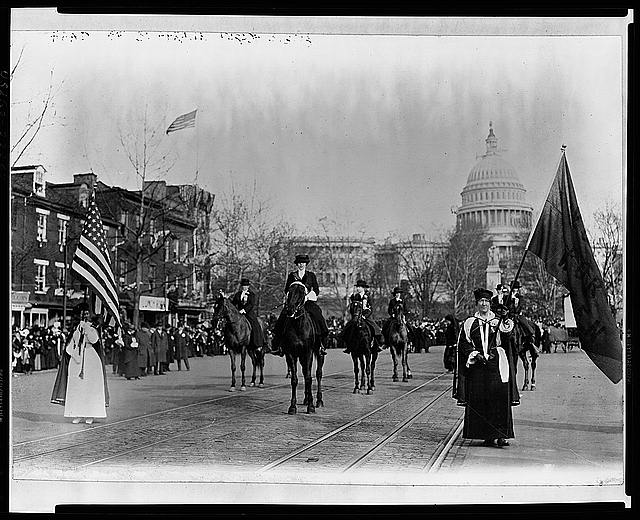
A couple of weeks ago I promised to share with all of you the July “object of the month” from the Massachusetts Historical Society, which I selected and wrote the text for. And today it goes live! The item, to refresh your memory, is a 1915 leaflet containing instructions to participants in the October 16 woman suffrage parade held here in Boston. To be entirely self-referential and quote from my own description,

In 1915, male voters in Massachusetts were asked to decide on an amendment to the Massachusetts Constitution that would strike the word “male” from the article that gave men the right to vote. In response to the upcoming vote, the Massachusetts Woman Suffrage Association organized a pro-suffrage parade on Saturday, 16 October 1915, involving some 15,000 marchers and 30 bands. The parade route began at the corner of Massachusetts Avenue and Beacon Street; marchers made their way past the Public Garden, Boston Common, and the State House before proceeding up Tremont Street and Saint James Avenue to Huntington. The parade ended at Mechanics Hall where a pro-suffrage rally was held.

You can see the digital version of the broadside and my accompanying text over at the Massachusetts Historical society website.

image credit: Suffrage parade, New York City, 6 May 1912, made available at Wikimedia Commons; image is in the public domain.

quick hit: more reasons to choose "queer"

24 Thursday Jun 2010

Posted by Anna Clutterbuck-Cook in linkspam

≈ Leave a comment

Tags

feminism, gender and sexuality

Miriam @ Feministing takes up the question of “queer” as an identifier in a post from last week, What’s the difference between lesbian and queer? and invites readers to share in comments what the word means for them and what words they use to speak about their identity.

From my perspective, there are two main reasons to use queer as an identifier. Queer is not as specific as words like lesbian or gay, and it does not explain exactly either your gender or the gender of your partner.

Lesbian implies pretty clearly that you are a woman who partners with other women. You might identify as genderqueer, trans or gender non-conforming, so that kind of specificity might not fit well. Or you might partner with people across the gender spectrum.

If someone partners with people across the gender spectrum, “bisexual” may not feel appropriate because it implies there are just two genders (bi meaning two). Additionally, if a person might not identify themselves with a binary gender (male or female) then a term like lesbian or gay might feel limiting.

Queer is an umbrella term, it really implies “not straight” more than it implies what exactly someone’s sexuality might be. It’s also a political term and many people use it as such, to imply a particular set of political beliefs alongside their orientation.

You can read the whole post at Feministing as well as the comment thread, which is where a lot of the conversation takes place.

from the archive: anti-suffrage activism in Massachusetts

16 Wednesday Jun 2010

Posted by Anna Clutterbuck-Cook in my historian hat

≈ Leave a comment

Tags

feminism, history, MHS


This week, I’ve been doing some background research on a pro-suffrage parade that the Massachusetts Woman Suffrage Association organized in Boston on October 15, 1915. Here at the Massachusetts Historical Society we hold a leaflet distributed to the marchers which will be our object of the month in July (you’ll see a link here when it goes up!)

While feminism continues to be a controversial political movement these days, only rarely do you hear people voice the now radical-seeming notion that the world would be a better place if women did not have the right to elective franchise. Less than one hundred years ago, however, exactly the opposite was true: women who sought the vote were understood to be the radical troublemakers whose quest for elective franchise would bring disaster: divorce rates would rise, domestic life would become a shambles, and the twin threats of Mormonism and Socialism would converge and destroy modern civilization [1].

As the Massachusetts pro-suffage activists geared up for their parade, the “antis” (as they were known) geared up for a counter-protest. As the Boston Daily Globe reported the day before the parade

In their great “victory” parade tomorrow the Woman Suffragists of Massachusetts, who expect to march with 15,000 in line and 30 bands, must pass on their line of march no less than 100 houses decorated with red roses, the symbol of the antisuffragists, and with banners appealing to the men of the State to vote against votes for women.

Hovering about the line of March, like flying cavalry seeking an opening for flank attack on an enemy column, will be many motor cars decorated with red roses, some of them as large as cabbage heads and mounted on long staffs for stems.

In many hotels maids and matrons will sell red roses and with each will give away a red card bearing an argument against Woman Suffrage.

On the streets some hundreds of boys will sell red roses and give with each a similar card.

Among the crowds that are expected to witness the parade will be many hundreds, and it is hoped by the “antisuffs” many thousands, wearing red roses.

…This is the answer of the No Votes for Women workers among the gentler sex in Massachusetts to the suffragist bid for the ballot through a great parade.

It will constitute the only organized demonstration of the antisuffragists against their sisters of the opposite camp. No effort will be made to interrupt the parade in the smallest degree or to embarrass the paraders by any attacks, direct or indirect, except that silent protect of the blushing roses that is worn on each antisuffrage bosom, be it male or female.[2]

I am struck by the tension in this journalist’s story between portraying the anti-suffrage activists as more demur and ladylike in their approach than “their sisters of the opposite camp” and the undercurrent of threat that surfaces in the martial imagery of the motorcars festooned with red roses “hovering about the line of March, like flying cavalry seeking an opening for flank attack on an enemy column.”[3] Note how the anti-suffrage activists are described as both male and female while the suffrage activists (which included men as well as women, notably a contingent of Harvard students) are described as “woman suffragists” and “sisters.” “Maids and matrons” as well as small boys are said to be distributing protest flowers, which evokes a sense of broad cross-class participation, and the number of 15,000 marchers is contrasted with what is hoped to be 100,000 protestors (the number of roses prepared for distribution).

The referendum on woman suffrage was defeated by a 2-1 margin statewide on November 2nd that year and pro-suffrage activists turned their attention to the nation-wide struggle for the Susan B. Anthony constitutional amendment (to become the 19th amendment to the U.S. Constitution in 1919). Massachusetts was the eighth state to ratify the amendment, the state house of representatives voting by an 185 to 47 margin in support of women’s right to vote.

More to come soon with the July object of the month!

FOOTNOTES

1. Massachusetts Anti-Suffrage Committee. The case against woman suffrage: the most important question on the ballot at the state election, November 2, 1915. Boston: The Committee, 1915.

2. “ANTIS PLAN SILENT DEMONSTRATION AT SUFFRAGE PARADE TOMORROW”
Boston Daily Globe (1872-1922); Oct 15, 1915;
ProQuest Historical Newspapers Boston Globe (1872 – 1927)
pg. 1

3. Hanna points out that this makes the anti-suffrage activists sound like the female mosquito women in China Mieville’s novel The Scar (New York: Ballantine Books, 2002) who descend upon male beings and suck them dry of their vital fluids. “”Like a woman bent double and then bent again against the grain of her bones, crooked and knotted into a stance subtly wrong. Her neck twisted too far and hard, her long bony shoulders thrown back, her flesh worm-white and her huge eyes open very wide, utterly emaciated, her breasts empty skin rags, her arms outstretched like twists of wire. Her legs judder insanely fast as she runs until she falls forward but does not hit the ground, continues towards them, just above the earth, her arms and legs dangling ungainly and predatory as…wings open on her back and take her weight, giant mosquito wings, nacreous paddles shudder into motion with that sudden vibrato whine, moving so fast they cannot be seen, and the terrible woman seems borne towards them below a patch of unclear air” (p. 269).

4. image credit: Head of suffrage parade, Washington, D.C.

why "gay" shouldn’t be the default term

08 Tuesday Jun 2010

Posted by Anna Clutterbuck-Cook in think pieces

≈ 4 Comments

Tags

feminism, gender and sexuality, politics


People of the non-straight variety are having some issues with the “alphabet soup” practice of labeling, as in “LGBT-friendly” or “LGBTQ activism.” In the most recent issue of Bitch magazine, R.F. McCann asks whether “lesbian” is going out of fashion

It makes sense that the straight public and mass media have latched onto “gay” as their go-to term; it’s short, largely inoffensive, and widely understood, making it ideal for headlines, soundbites, and voluble public discourse. While “homosexual” is overly formal (not to mention long) and “queer” strikes some as harsh, “gay” is perky, conveniently monosyllabic, purportedly gender-neutral, and certainly less racy-sounding than “lesbian,” with its silky “zzz” sound. But why exactly has the nonstraight population allowed “gay” to slide so comfortably into ubiquity? Surely the lesbian—scratch that—gay female community could put up a fight if it wanted to. But it doesn’t seem to want to. Are women bored with the word? Do they dislike it? Have labels simply become less relevant?

While McCann’s article is openly inquisitive, seeking to document trends in language usage John Aravosis @ AMERICAblog Gay is arguing for activists to resist inclusive acronyms such as LGBT in place of the “perky, conveniently monosyllabic” (as McCann writes) word “gay” (hat tip to Amanda Hess @ The Sexist). He writes in I’m not an ‘LGBT American’

I think LGBT is a cop out for straight people. Much easier for a politician to laud the LGBT community than the GAY community, because no one outside of the gay community knows what the LGBT community even is. I’ve seen signs at rallies proclaiming something or other about “LGBT”, and I’ll bet everyone at the rally who wasn’t gay was scratching their head. In an effort to be more inclusive, we’ve shoved ourselves back into a sort of linguistic closet.

If we’re all one community, then we don’t need to keep adding letters to divide us.

Hanna and I have this conversation occasionally. I tend to err on the side of inclusivity and trying to be as accurate as possible in naming people with the labels they wish to be named; she tends to err on the side of what’s easiest to communicate in terms of an activist message (even I can’t always remember what the Q in LGBTQ is supposed to mean…!) and also expresses frustration with the need to label ourselves in the first place.

I’m definitely with her on the “it’s clumsy to say” issue and have found myself defaulting more and more to big umbrella terms like “queer,” “non-straight” and “gender nonconforming” when talking about human rights and social justice issues that intersect with sexual orientation and gender identity. I’m also of the fluid, mix-it-up generation (as much as I resist formulaic talk of generations), and variously include myself in groups of folks who identify as “bisexual,” “lesbian,” “non-straight” and “queer,” without the sense that I’m betraying the sisterhood by acknowledging that I’m not exclusively drawn to women in my sexual desiring, or denying my solidarity with a marginalized group by switching up how I identify. (Though I realize this fluidity is easier for individuals than it is for, say, nonprofit organizations that need to choose what terms will end up in the incorporation papers, on their promotional materials and web presence).

Here’s the thing. The bone I have to pick with Aravosis.

Want to argue for inclusivity with a word that helps us avoid the alphabet soup? Totally cool by me. But the solution to the alphabet soup problem is not to revert back to the word “gay.” Gay stopped being the go-to term for a reason, in that it was challenged as being exclusionary by people who do not feel the word (with its strong associations with male-identified homosexuality) really included them. “Gay” sort of, sometimes can include lesbian women (see McCann’s article above), in the way that many male-gendered terms can include female members of the human race. But the same isn’t true for “lesbian” (we sometimes say “gay men and women” but never “lesbian women and men”). Bi folks, of course, have are not exclusively gay and trans folks can be straight or gay or bi (which, really, is true for so many of us as we move through our lives — but that’s another issue entirely).

Arguing that the defult one-word term should be “gay” makes you sound like you’re not aware of this history, and of the reasons the term caused unhappiness within the non-straight community in the first place. If you’re going to pick “gay” as the catch-all term, you need to make a good case for why that word should win out over “lesbian” or “queer” or any of the other identity-labels that make up the alphabet-soup we’re currently stuck with. Gay isn’t the obvious default option, or it shouldn’t be.

Now, of course, in the end, all of this quasi-academic debate might not matter as much as shifts in usage, as McCann points out. As I’ve written about before, the English language, despite the fear-mongering of the Right over political correctness, has no “language police,” and the evolution of language ultimately happens through what words people choose to speak every day and what they understand those words to mean. But that shouldn’t stop us from having these conversations, and thinking about the implications of one usage ultimately winning out over another.

What terms do you like and dislike when it comes to sex- and gender-based identities? Which do you wish we could jettison entirely and which do you have inordinate fondness for? What words have you used to identify yourself and your communities in the past, and have those words changed over time? Why or why not? Feel free to share in the comments!

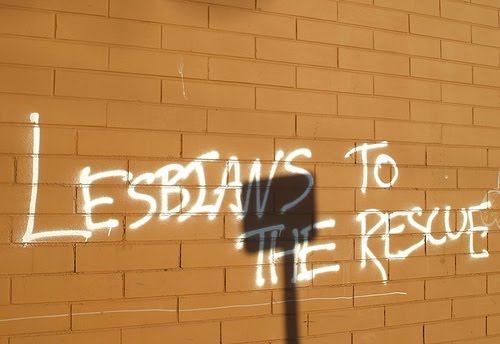
image credit: Lesbians to the Rescue by PinkMoose @ Flickr.com

in which I have some thoughts on men, pregnancy, and parenting

03 Thursday Jun 2010

Posted by Anna Clutterbuck-Cook in think pieces

≈ 4 Comments

Tags

children, feminism, gender and sexuality, masculinity

There have been a couple stories in the news lately revolving around men and procreation that have caught my eye in the last couple of weeks, and due to the phenomenon known as “needing something to post about today” I thought I’d throw them together in a post and share a few thoughts about them — or, more accurately, about the cultural narratives and expectations about men and manhood they represent.

The first is a post by Mary Elizabeth Williams @ Salon that provocatively asks whether “men have a right to choose an abortion,” or, more accurately how much right they have to decide when and how to become a parent. Although she links to a story by Stephanie Fairyington @ Elle in which a man named George Bruell tried to pressure his girlfriend to have an abortion after she unexpectedly got pregnant after the couple (he thought) had agreed they didn’t want to have children.

The Elle article contains a lot of crap from anti-feminist “men’s rights activists” whose entire goal seems to be the struggle to free men from relational responsibilities supposedly forced upon their freewheeling selves by scheming women and their dependent children. Although updated for the 21st century, this is a narrative surprisingly reminiscent of virulently misogynistic views of women and families found in 1950s and 60s-era diatribes by men who were as unhappy with the postwar mythology of the Father Knows Best lifestyle as feminists, but rather than blame institutionalized sexism they blamed women and women’s essentially domestic, acquisitive nature that required men to work long hours to support a suburban lifestyle.

Like these postwar misogynists, the “men’s rights activists” in this story are not interested in dismantling sexist structures that warp expectations of heterosexual relationships; they’re not interested in fighting for better reproductive justice for all — they already think women have all the power and they feel aggrieved. As Fairyington writes of Mel Feit, head of the National Center for Men,

Feit’s list of grievances range from sexist social standards — why should men still be expected to foot the bill on dates? Why is crying or showing weakness verboten for them? — to what he considers discrimination enforced by the state: men’s lack of reproductive rights combined with unfair child support laws. “Reproductive choice isn’t a fundamental right if it’s only limited to people who have internal reproductive systems,” Feit says. “If it only applies to women, it’s a limited right and that weakens it.” In his view, Planned Parenthood’s motto — “Every child a wanted child” — should apply to both people who make the baby.

Most of these arguments, taken individually, are issues feminist have championed for years. The insidious problem with these grievances is not that (most of them) are inaccurate but that they are not connected to any analysis of the cultural construction of gender or understanding of institutionalized sexism. Or an awareness of how — in our culture — gender operates dualistically and women are disproportionately vulnerable in a world where patriarchal structures are still the default. This doesn’t mean patriarchy doesn’t hurt men too — as feminists, male and female, remind us continually — but it does mean that deconstructing masculinity and the expectations of men and manhood must be done with an awareness of women’s position in the here-and-now-society. Men’s rights activists seem to imply that somehow women, as a group, are (for example) forcing them to pay for dates, whereas most feminists wound point to our cultural construction of manliness that associates male power and sexual appeal with economic power to such an extent that feminist calls for an end to gendered dating expectations are usually met with anxious speculation about how feminists are trying to emasculate men. Ditto on the issue of crying and/or showing weakness.

Women as a group, in other words, are not these guys’ biggest enemy. Their enemy is anyone (male or female) who supports oppositional, essentialist gender roles.

But back to the question of men, pregnancy and “choice.” Here’s what I have to say about men and the “right to choose.”

1) The final decision whether or not to have an abortion is always the pregnant woman’s. Like any medical procedure, it is the patient who needs to have the final say about what happens to her body. End of story. Obviously, this happens in the context of a medical profession in which doctors (ideally) advise patients about the full range of options available to them. Ideally a pregnant woman trying to decide whether to carry an unplanned or dangerous pregnancy to term would consult with her partner, family, friends, trusted religious adviser, therapist — whomever she needs to help her make the best decision given the choices available. But at the end of the day, it’s her body and therefore her decision to make. If the pregnant person is male-identified or in part male bodied, then the decision would be his. This isn’t a gender-bias, it’s a question of bodily integrity and who has a say about what happens or doesn’t happen to your body.

2) Apart from abortion, men have as many options for preventing parenthood as women. If you don’t want to get pregnant at a given time, with a given partner, take steps to prevent it. Men are not at the mercy of women in this arena. Here are some of the ways male-bodied persons can prevent pregnancy.

a) refrain from sexual activity that could result in pregnancy such as penetrative penis-in-vagina sex with women, or other types of sexual activity in which your sperm risks getting on or in a woman’s vagina. The plus side to this method of pregnancy prevention is that it might encourage you to realize how many other types of sexual activity are out there to enjoy, either on your own or with a partner. One totally risk-free option for anyone who’s bisexual is deciding you’re only going to have sex with other men — no chance of pregnancy there! Cunnilingus is another way to enjoy your partners body with no chance of sperm + egg = pregnancy. Look on this as a change to experiment and discover new forms of sexual pleasure.

b) use various types of birth control which hopefully you are already familiar with when it comes to prevention of sexually transmitted diseases. there’s sadly no birth control pill yet on the market for men, but in the meantime you have condoms which are pretty damn reliable when used correctly and consistently. If you’re sure you never want to have children, you can always decide to get a vasectomy which solves the accidental pregnancy problem in all but extremely rare cases and puts the choice of pregnancy prevention squarely in your hands.

c) this should go without saying but usually it doesn’t, so I’m going to say it: COMMUNICATION is incredibly important to a satisfying sex life, and that includes doing everything you can to make sure you and your partners are on the same page when it comes to babymaking. Obviously, in situations like Bruell’s story above, communication failed and people are now stuck with the messy real-life consequences. But good communication upfront can certainly prevent a great deal of messy post facto problems, just like securing enthusiastic consent to sexual activity helps prevent instances of sexual assault.

Finally, 3) While difficult, I do think it’s viable (and not anti-feminist or anti-child) to create a legal framework for men to surrender parental rights and responsibilities up-front if a sexual partner with whom they are no longer involved decides to carry a pregnancy to term. As feminists, we have argued that it is the best-case scenario for parents and children when all children are wanted — when parenthood is a role enthusiastically chosen and when children are cared for both by their primary caregivers and by society as a whole. Women who do not choose abortion have the option to surrender the child they birth either to an adoptive family or to the state system. This often isn’t an ideal situation for the child, but it is a legal framework that recognizes that mothers sometimes feel the task of parenting to be beyond them.

There’s a whole tangle of social and legal issues here relating to competing visions of a social welfare state and the responsibility of society as a whole to enable primary caregivers to parent — but for the moment, let’s assume the birth parent has chosen not to parent and wants to hand that responsibility over to someone else. Mothers who give birth can choose to surrender their parental rights and responsibilities legally, and I believe men should have similar legal options.

I just wish the men who are advocating for them wouldn’t ask for them in a way that is hostile to women’s basic right to bodily integrity and decisions surrounding their physical person. It shows a pretty stunning lack of awareness of reproductive rights and justice issues that Feit and company really ought to be engaged in, or at least aware of. Instead, they seem to have adopted the rhetoric of women’s rights in much the same way Sarah Palin has taken to using the language of feminism — to peddle a toxic tangle of misplaced misogynist resentment that lashes out at vulnerable targets rather than working to dismantle the sociocultural structures that constrain us all.

* * *

The second story comes from Amelia Hill @ The Guardian (hat tip to Hanna for the link). I knew we were in trouble from the opening sentence, “Expecting men to take an active role in their partner’s pregnancy and attend the birth of their children can deskill them as potential fathers and damage paternal bonding, an expert has claimed.” While I’m not an anti-intellectual, and I believe in the value of expertise (our highly complex modern world necessitates a certain amount of specialization), I’m always skeptical when an “expert” claims to have the final word on how a certain activity is going to affect complex human beings.

The disappointment and feeling of failure experienced by men expecting to have an intimate and proactive role as their baby gestates, only to find their function is largely one of passive support for their partner, can cause emotional shutdown, according to Dr Jonathan Ives, head of the Centre for Biomedical Ethics at the University of Birmingham.

“Having begun the fathering role already feeling a failure may destroy his confidence,” Ives said. “It can then be very difficult for him to regain faith in himself once the baby is born and move from that passive state to being a proactive father. His role in the family is no longer clear to him. He effectively becomes deskilled as a parent and this can lead to problems bonding with the child.”

Oh, I have so many issues with this way of understanding parenthood! “Support” for a pregnant partner is somehow the opposite of being “intimate” and active? Men are somehow incapable of grasping that their pre-natal and post-partum roles will, like women’s, be different? Men as a general rule have so little self-confidence that being asked to do something like being present and supporting during pregnancy might actually destroy their ability to parent? And I have to say I’m baffled by the assumption that this feeling of inadequacy is unique to fathers — it’s always been my understanding that most parents, regardless of gender, feel profoundly inadequate for the task at hand.

And this might actually be a good thing, as the article (thankfully!) goes on to point out.

Adrienne Burgess, head of research at the Fatherhood Institute, said: “That experience of helplessness that Ives is saying is so dangerous, is, in fact, the perfect preparation for fatherhood: there are times as a parent when you can’t do anything to help your baby, when it’s crying all night and can’t be soothed. Part of being a parent is being there for your partner and child without doing anything except providing love.”

I just really want to emphasize what Burgess says here, because I think it highlights the chasm that exists between the neotraditional conception of masculinity and fatherhood that relies on rigid separation of male and female duties and a conception of masculinity and fatherhood that, well, relies on the notion that men are human beings capable of a full range of human responses. In the neotraditional version of masculinity, men must be protected at all costs from being made to feel helpless, from being (in a word) emasculated. Helplessness sets them up for “failure” and failure is so shameful and world-ending that men must avoid it at all costs — up to and including the cost of not being present to their partner during pregnancy and at their child’s birth.

In the men-as-humans model that Burgess puts forward, however, helplessness is simply part of the human condition, a run-of-the-mill part of parenting and family life. That we’ve elevated the power of parents (fathers perhaps particularly?) to such Godlike heights that the notion that inability to change the course of events necessarily equals “failure” is stunning to me. To argue that men should be encouraged to avoid the parts of family life that entail helplessness is, in my mind, a wildly unhelpful (at best) perhaps even unethically negligent (at worst) recommendation. It is akin to arguing that if a friend or family member is diagnosed with incurable cancer you should just quit spending time with them because you can’t do anything to cure them.

More often than not, it’s our simple presence — loving, nonjudgmental, patient presence — in the lives of others that is what matters. This is a skill that all of us could do well to hone, whether we are parents or children, spouses or partners, friends or extended family members. It is a skill that should be genderless, and one which we would do well to encourage all soon-to-be parents to practice with one another and, once the child arrives — by birth or other means — with that child as well.

un-mother’s day: thoughts on a problematic holiday

18 Tuesday May 2010

Posted by Anna Clutterbuck-Cook in think pieces

≈ 3 Comments

Tags

children, feminism, holidays, politics

There’s a wonderful scene in the British sitcom My Family in which the parents (Ben and Susan) attempt to speak with the parents of a child who is bullying their son. The other parents are having none of it.

“Now we know you think of yourselves as good parents–“ one of them begins to say condescendingly to Ben and Susan.

Susan and Ben look at each other.

“No,” Ben hastily clarifies, “we don’t think of ourselves as good parents. We just think of ourselves as parents.”

It is in that spirit, I offer you the fabulous Anne Lamott @ Salon on why she hates mother’s day

I hate the way the holiday makes all non-mothers, and the daughters of dead mothers, and the mothers of dead or severely damaged children, feel the deepest kind of grief and failure. The non-mothers must sit in their churches, temples, mosques, recovery rooms and pretend to feel good about the day while they are excluded from a holiday that benefits no one but Hallmark and See’s. There is no refuge — not at the horse races, movies, malls, museums. Even the turn-off-your-cellphone announcer is going to open by saying, “Happy Mother’s Day!” You could always hide in a nice seedy bar, I suppose. Or an ER.

* * *

Don’t get me wrong: There were times I could have literally died of love for my son, and I’ve felt stoned on his rich, desperate love for me. But I bristle at the whispered lie that you can know this level of love and self-sacrifice only if you are a parent. We talk about “loving one’s child” as if a child were a mystical unicorn. Ninety-eight percent of American parents secretly feel that if you have not had and raised a child, your capacity for love is somehow diminished. Ninety-eight percent of American parents secretly believe that non-parents cannot possibly know what it is to love unconditionally, to be selfless, to put yourself at risk for the gravest loss. But in my experience, it’s parents who are prone to exhibit terrible self-satisfaction and selfishness, who can raise children as adjuncts, like rooms added on in a remodel. Their children’s value and achievements in the world are reflected glory, necessary for these parents’ self-esteem, and sometimes, for the family’s survival. This is how children’s souls are destroyed.

I encourage you to read the whole piece at Salon.

I’ve written a few blog posts lately about seeing children as people, rather than — as Anne Lamott puts it — “adjuncts” of parental or adult objectives. I believe, as Lamott writes here, that such objectification of young people is destructive to the soul.

But today I’d like to focus — as Lamott does here — on what harm the stories we tell ourselves about parents do to adults. And the particular effect they have on the way we (as a culture) percieve those of us who are (whether by accident or design) not-parents.

And I’ve chosen to use the phrase “not-parents” instead of “childless” or “childfree” deliberately, because I am starting to believe that this narrative of parents vs. not-parents has little to do with children and everything to do with adults. With our cultural assumptions about what it means to be a responsible grown-up human being in the world. I believe it has everything to do with the way adults past a certain age (roughly post-college) are read culturally by those around them, for signs of parent or not-parent status, and judged by a set of cultural assumptions about what it means to lack (or forego) experience of the parenting role.

The assumptions are not pretty.

I’ve become much more aware (often hyperaware) of these constant “non-parent = bad” messages since I’ve been partnered with someone who does not wish to parent. As a child, I wanted to be everyone’s mother: I parented pets, my siblings, my next-door neighbors. I had fantasies about adopting orphans from war-torn Sarajavo, birthing multiple babies I’d hoist on my back and carry with me as I explored the globe. I was an adventurer, a take-charge tomboy (although my parents never employed the word, and bless them didn’t blink when I announced plans to be a princess who was also a lumberjack in the local arts center play) while also being a caretaker and nurturer.

And I was absolutely rewarded, socially, for that behavior. Adults marveled at how “good” I was with children, and trusted me with the responsibility of looking after young ones. I fit the story, so I was slow to challenge it. Plus, my parents have never been pushy with any of us kids about getting married or becoming parents ourselves (thank you Mom and Dad!); I never felt any direct familial pressure to find a partner and somehow acquire offspring for them to grandparent, carry on the family line, or somehow fulfill my destiny as a female-bodied person. But, because I am capable with young people, because I am generally patient with those around me (often to a fault), I can fill that caretaker role people expect of women in the world — even women who are not obviously attached to the children who happen to be in their vicinity. And most of the time, at least on a casual basis, I’m willing.*

So I was sheltered, personally, from the stigma of being a Woman Who Didn’t Want To Be a Mother. But now I see (or at least try to see) the world through Hanna‘s eyes some of the time, and I’ve been thinking a lot more about our culture’s obsession not just with a certain image of young people as Children (to be feared or commodified), but of adults as Parents (who are either “good parents” or “bad parents,” not simply…parents).

Not-parents have no space in this world of Parents and Children. Or rather, their position in the world is analogous to that of the Old Maid in relation to Wife: “life: FAIL.”

I’m speaking here, I want to emphasize, in terms of cultural narratives, not actualities. There have been some amazing not-parents (both women and men) in my life. I will be forever grateful to them for modeling the possibility of having an adult life rich with relationships that does not depend on the role of full-time parent. This is about perceptions and stereotypes, which — although they do not dictate our material realities, do narrow the range of possible stories we have at our disposal when trying to explain our life choices, to ourselves and to others. As Anne Lamott writes: “Ninety-eight percent of American parents secretly feel that if you have not had and raised a child, your capacity for love is somehow diminished.”

I’d argue that many not-parents also believe this about themselves and other not-parents around them, in the same way that women are often each others’ harshest critics when it comes to complying with beauty standards or men punish each other for displays of emotions other than anger. In our culture, to be unaccessorized with children means one is broken in one of the most profound ways a human being can be broken: it means that one’s “capacity for love is somehow diminished.”

Just: NO.

I’m not okay with this story. I am not willing to accept a narrative of humanity that implies my partner — who does not want to be a full-time parent — is somehow broken, that she lacks compassion and the ability to love. It is, quite simply, not true. She has a HUGE heart for the world, sometimes so attuned to its sufferings that I am humbled by her capacity for empathy.

And I’m not okay with a cultural narrative that requires she perform extra cultural work to prove that — despite her decision not to parent — she is, in fact, not broken, not selfish or heartless, or incapable of loving.

These stories we tell each other, which privilege certain relationships and roles over other relationships and roles seems on the surface to be to the advantage of a certain group of people (in this case parents) over another (not-parents), but in the end it only serves to punish all of us for not living up to the ideal Good Parent in the collective imagination, rather than acknowledging that at the end of the day most of us are “just parents,” “just human,” and have at our disposal myriad opportunities to express love and care for others regardless of the kind of relationships with nurture.

Let’s celebrate those qualities, human qualities, that are not contingent on performing certain pre-determined roles (Good Mother, Good Father, Good Child) or being handed certain responsibilities, held to certain expectations, that go with those roles. Let’s instead celebrate the boundless capacity of all of us human beings to engage in loving, nurturing activities throughout our lives.

That’s a celebration I could get behind.

Anne Lamott said it first, and far more eloquently, here.

*As I said in my last post on bigotry towards children, I’m not, at the moment, planning to commit to the full-time parenting thing.

not-so-quick hit: bigotry towards children

04 Tuesday May 2010

Posted by Anna Clutterbuck-Cook in think pieces

≈ 7 Comments

Tags

bigotry, children, feminism

Via Molly @ first the egg comes a passionate articulation of the right of children to be treated as human beings, rather than as a subspecies to be “liked” or “not liked” en masse. Sybil Vane @ Bitch PhD writes

Now, maybe I meet someone who doesn’t necessarily dislike Little V in a personal way but who is “not really a kid person.” And here I mean not necessarily someone who doesn’t want to have kids or who doesn’t have any experience being around kids or someone who lives a lifestyle that doesn’t produce any exposure to kids. I mean someone who is expressive about a “I don’t really like kids” attitude or a “I hate going to restaurants or museums where kids are making noise” attitude or a “of course it’s fine for other people to have kids but I don’t want to be around them” attitude. This sort of thing is a deal-breaker for me. I’ve gotten pretty rigid about it in recent years as I become more assured in my certainty that it’s an anti-feminist attitude and you suck if you hold it. Kids are a vulnerable, disempowered, inevitable portion of the human community and you do not get to “not like” them or to wish that weren’t a part of your public space. Not allowed. I invite you to swap out “kids” for any other disempowered community in the above phrases (“women,” “schizophrenics,” “hispanics,” “the blind”) and notice what an asshole you sound like.

You can read the whole post over at BitchPhD.

I’ve blogged about this before (last year in what turned into a two-part post here and here and in passing on Saturday in my blog against disableism post).

The first time I wrote about it, I realized I was coming down hard on someone who sounded like an asshole in comments (they’d left a post on my blog calling young people “feral, shrieking little carpet apes”). But I was largely unprepared for the backlash I got on the post, where people resisted mightily the possibility that there might be parallels between dehumanizing children (based on age) and dehumanizing other segments of society based on other group characteristics (such as race, national origin, gender, etc.). People made all sorts of assumptions about my socioeconomic status, my personal background, my status as a parent, and suggested that being an advocate of children’s humanity is only the province of privileged, solipsistic white mothers with ivy league educations.

So let me be clear, here. I’m not a parent. At this point, it’s unlikely that I will ever be a parent. The reasons for this are personal, relational, ethical, sociopolitical and economic in nature — too complicated to delve into in this post. But the point is: not a parent. And to tell you the truth (contrary to popular opinion re: women and infants) I’m okay with that.

There was a time (I won’t lie) when my fondest dream (at age nine) was to set up an orphanage with my best friend and spend my days nurturing a vast brood of Anne Shirleys who otherwise would not have caring adults to call their own. But I’ve grown and changed, tried quasi-parenting for a while (I spent a year as a live-in childcare provider), and realized that is not where my primary interest lies.

There are even days when I’m not just “okay” but incredibly relieved by the idea that I will never — unforeseen crises not withstanding — be the 24/7 primary caregiver of a young person. Even with a willing and able partner, that job seems prohibitively daunting. Particularly in a culture where meaningful support for caregivers (of the elderly as well as the young) is so thin on the ground.

But the point is: none of these personal decisions or experiences absolve me from the responsibility of including children in the human community. They don’t absolve me from the responsibility of treating them with the same courtesy and respect with which I expect folks to treat me, and with which I treat adult members of the human community. As Molly writes @ first the egg

I actually am not “a kid person” in any normal sense of the term — I’m not that whipped up about children just because they’re children, I’m generally much more interested in a puppy or kitten…or adult person…or this here computer screen…than a baby I don’t know personally — but they’re people.

The awesome thing about this is, in my experience, that young people thrive on being taken seriously. On being treated with a straight-ass, no bullshit attitude. Speaking from my own remembered experience as a child, I had zero interest in being fawned and fussed over, having my personal space invaded by adults who thought of themselves as “liking children” and were subsequently pissed when I failed to delight in their cosseting.

I wanted to be taken seriously, to be leveled with, and to be given a seat at the table with all the adults around me who discussed interesting and complicated things, had wicked skills for creating things and exploring the world, and who might possibly share that experience with me.

It’s true that children, by virtue of their still-developing brains and bodies, do not always meet the requirements set forth by our culture’s model of ideal able-ness and imagined self-sufficiency . . . but then, as I pointed out last Saturday, neither do we. Children need help meeting their material needs, need spaces and resources to explore the world and gain material, cognitive, and emotional skills to become more independent. Not every adult is prepared to provide on-the-ground assistance to children in this way, just like not every adult provides eldercare around the clock. But as members of the human community, citizens of the world, we can recognize that all of us matter — and treat those whose paths we cross accordingly.

And the sooner, the more ardently, we can impress upon young people that they matter just as much as the next person, the more likely it is that those young people will grow into older people who — no matter how privileged, how able, they become — will remember that their able-ness is not what imbues them with worth: it is their membership in the human community. Just as that membership in the human community grants the person sitting next to them on the subway, or standing in line behind them at the coffee shop, or playing on the swings at the park, intrinsic worth.

And hopefully, just maybe, this belief in the worth of humanity will make the world a richer, more compassionate, less threatening, less defensive, more bountiful world to live in for us all.

*image credit: Christmas Day Morning by Carl Larsson @ the Carl Larsson Gallery.

reading and gender: a couple of links

26 Monday Apr 2010

Posted by Anna Clutterbuck-Cook in linkspam

≈ Leave a comment

Tags

books, feminism, masculinity

Thanks to Hanna, I have a couple of book-and-gender-related links to share with you this afternoon, despite the fact I haven’t spent much time on the internet in the last few days.

George @ Bookninja shares a recent variation on the narrative-that-won’t-die, the libelous fiction (pun intended) that men don’t read. While admittedly I am not male-bodied, male-identified or even very butch or masculinely inclined, I know guys. And the guys I know read. At least, the guys I know read or don’t read in equal proportion to the women I know who read or don’t read. Their maleness has nothing to do with their interest (or lack thereof) in the printed word.

As an historian, I find it fascinating that our current cultural narrative around books and reading (possibly even writing?) is that it is a feminine pursuit: back in the late 18th century, polemicists fretted about girls being exposed to works of literature, particularly fiction, as fiction was seen as inherently libidinous in nature and might lead them to masturbation (Thomas Laqueur, Solitary Sex). In the 19th century, people worried about the power of a gothic romance to encourage girls’ imprudent liaisons (recall Catherine in Jane Austen’s Northanger Abbey?) and later on feared that too much reading led to neglect of household chores (Lydia Maria Child). By the late 19th and early 20th century, mental exertion (particularly reading and writing) caused concern among advice-givers to both women and men: Charlotte Perkins Gilman was, famously, denied writing and reading as part of her treatment for postpartum depression; male academics and clergymen fretted that their chosen professions doomed them to a life of effeminacy and poor health (Gail Bederman, Manliness & Civilization).

So, somehow, by the twentieth century, “manliness” and the life of the mind had evolved — at least in the humanities (as opposed to the sciences) — into something that was both the province of women as well as a threat to the health of “civilized” human beings, regardless of gender.

And now, today, we have folks wringing their hands over a culture of masculinity that discourages being smart, articulate, literary (except, perhaps, if you can use language to bully others in the manner of public intellectuals like Christopher Hitchens and Richard Dawkins — thus proving your uber-manliness by the way in which you wield language as a weapon with which to take down your opponents*). Whole books are written about encouraging literacy and reading among boys, and websites devoted to the subject exist on the internet.

My point is that this story we tell ourselves, about how boys (and the men who these boys become) are not readers, or only readers of very specific genres — technical manuals, graphic novels, thrillers for example — is just that: a story. It’s fiction. Or at the very least, it’s a sociological truth that we’ve mostly created through our formulation of what’s “manly” in our culture, and reinforcing that every chance we get.**

So where does this association of genders (masculine and feminine) with certain types of literary behavior fit in with this second story Hanna found me from Sharon Bakar @ bibliobibuli on a new “women concept” bookstore that just opened in Malaysia? As Bakar observes

I don’t like the cliched assumptions that women should like certain things whether in terms of decor (usually frilly, flowery pink things) or in the choice of books. The concept of women’s bookshops is nothing new, but around the globe most have been independents which promoted feminist and/or lesbian thought.

I’m with Bakar on this one. Women’s bookstores historically (and here we’re talking 1970s-present) have been associated with the underground feminist/separatist culture that grew up around the surge in feminist activism and lesbian visibility in the mid-twentieth century across the globe (and particularly in the West). These cultural institutions obviously have a long and complicated history, given that they often promoted the work of activists and artists who had no outlet in the mainstream (in my mind a positive) while also, at times, fostering a separatist, essentialist feminism that perpetuates bigotry in various forms (in my mind an obvious negative). While safe(r) spaces for the marginalized folks are, I would argue, absolutely essential, it’s also important to keep alive the conversation about how (in creating those spaces) whom we are excluding and why. And for what purpose.

A “women’s concept store” that — according to the news item Bakar links to — highlights “chick lit” (itself a problematic category!) and wedding stationary is a far cry from that sort of separate space. Space that by its very existence challenged (and occasionally continues to challenge) our assumptions about sex, sexuality, and gender. Instead, this space seems more like the homosocial spaces of yore, which reinforce oppositional gender stereotypes. In this instance, possibly reinforcing the stereotype that bookshops are for women, while dudes go off and do, well, more manly things.

Presumably not-with-books.

*I make no claim that women do not, also, use words to bully: I think it happens all the time. However, I do think men are encouraged in our culture to equate being “smart” with taking down the competition in a way that women, possibly, are not.

**Again, this is a story about guys and reading, but we could just as easily write a story about women and the gendered way they are marketed certain types of literature and not others: I’m a fan of graphic novels, for example, despite the fact that graphic novels and comic books are often seen as the province of boys, and in need of a make-over in order to appeal to girls.

in words and pictures: asking trans folks questions

23 Friday Apr 2010

Posted by Anna Clutterbuck-Cook in Uncategorized

≈ 2 Comments

Tags

feminism, sexual identity

This new poster has been making the rounds on the blogs I read the last couple of weeks, and I actually think the title is somewhat misleading: it’s not so much about what specific words are verboten (for a glossary of terms surrounding transsexuality, check out the guide put together by the Gender Identity Project) but about why certain questions or turns of phrase are hurtful to trans people.


I appreciate that they include explanations along with each phrase, rather than just announcing “these words are transphobic!” When folks find themselves explaining over and over again that certain language is hurtful, the “why” often — understandably — gets lost in the shuffle. The “why” is often so obvious to those who are inside a given community that it can seem redundant to explain to those outside the loop why a question is hurtful. It can often be even more difficult to explain why it’s hurtful without making the person on the recieving end of the explanation feel defensive.

Obviously, it’s not the responsibility of those in the know to educate 24/7 about the things they’re knowledgeable about . . . which is why it’s handy to have infographics that do it for us!

via sexgenderbody and others.

"spoiler alerts for the real world"

17 Saturday Apr 2010

Posted by Anna Clutterbuck-Cook in think pieces

≈ Leave a comment

Tags

blogging, feminism

So this week in the feminist blogosphere there’s been a lot of discussion about the practice of using trigger warnings. Some bloggers, particularly in the feminist blogosphere, who write a post on something that might trigger symptoms for those with PTSD (such as graphic descriptions of violence or sexual assault) label said posts with a trigger warning so that their readers can make an informed decision about whether to continue reading the post, pass it by completely, or save it for another day. Amanda Hess @ The Sexist has a good round-up of links from around the blogosphere on the subject, as well as her own reflections on the usefulness of trigger warning tags.

Melissa McEwan @ Shakesville makes an eloquent case for trigger warnings and explains why she uses them on her own blog posts.

A trigger is something that evokes survived trauma or ongoing disorder. For example, a person who was raped may be “triggered,” i.e. reminded of hir rape, by a graphic description of sexual assault, and that reminder may, especially if the survivor has post-traumatic stress disorder, be accompanied by anxiety, manifesting as anything ranging from mild agitation to self-mutilation to a serious panic attack.

Those of us who write about triggering topics (sexual assault, violence, detainee torture, war crimes, disordered eating, suicide, etc.) provide trigger warnings with such content because we don’t want to inadvertently cause someone who’s, say, sitting at her desk at work, a full-blown panic attack because she happened to read a triggering post the content of which she was unprepared for.

Matched only by her follow up, On Triggers, Continued.

[Susannah] Breslin [blogging at True/Slant] accuses feminist writers of “handing out trigger warnings like party favors at a girl’s-only slumber party,” which is certainly designed primarily to insult writers like me, but doesn’t say much for what she thinks of feminist readers, either. I don’t view my readers as children at a party. I respect them as adults, with autonomy, agency, and the ability to consent—their own best decision-makers, their own best advocates, and their own best protectors.

Not that trigger warnings are universally employed by feminist bloggers. Amanda Hess (above) and the group blog Jezebel both thoughtfully articulate their reasons for not using such tags on their posts. However, it seems odd that someone would so virulently object to their application. As Hanna said when I described the practice to her, “so it’s like spoiler alerts for the real world!”* which I have to say I think is an awesome description. That’s exactly what they are. And I think they can be a really useful tool.

Apparently blogger Susannah Breslin, writing for the online news magazine True/Slant, doesn’t think so. She thinks trigger warnings are a symbol of everything that is wrong and wussy about modern feminism.

Just to be clear here, we aren’t talking “trigger” as in “you might be annoyed by the sentiments expressed in this post.” At that rate, everything would be slapped with a flashing warning light. No, we’re talking “trigger” as in involuntary physical reactions like panic attacks and flashbacks. Post-Traumatic Stress Disorder territory. As commenter Li writes over at Feministe

I really like the part where she [Susannah Breslin] suggests that her previous post “triggered” feminists into being offended, cos I personally know that when I am offended it is exactly the same as when I am triggered and go into major motor function failure.

I was in a severe car accident over ten years ago, and to this day I find certain sounds and settings (such as emergency rooms, ambulance sirens, panic in peoples’ voices) slightly triggering. I’ve never actually suffered hard-core flashbacks or other incapacitating physical symptoms, but I’ve had enough experience navigating those waters to imagine how much it would suck to walk through the world wary that something you read was going to cause “major motor function failure.”

I find it incredibly dispiriting — not to mention bewildering! — that anyone would choose that sort of personal pain (and the corresponding courtesy that some of us are attempting to show, by equipping visitors to our blogs with the tools to navigate this space) as the avenue through which to attack feminist bloggers. Isn’t being courteous to well-meaning visitors to our blogs basic politeness? I make the effort to label my photographs, for example, and clearly identify my links so that my blog posts are more reader-friendly to those who use accessibility software. I try to provide transcripts when available to video and audio content. I consider “trigger warning” tags for stories with especially graphic content (such as Amanda Hess’s excellent, detailed account of a sexual assault victim’s quest for medical care) to be similarly courteous, and do my best to indicate when links contain graphic content.

If that’s what it means to be a feminist — even if that’s all it meant (as Ms. Breslin alleges) — I’m proud to consider myself a feminist. Because hopefully by extending courtesy and care to other human beings who visit my space, I’m helping to make the world a little bit better for all of us.

*Used to alert readers of your blog when you’re going to talk about plot details of a movie, television show, etc., that they may or may not have seen. That way, if readers care about not having the plot “spoiled” by knowing the ending, they can avoid reading the rest of the post until they’ve actually seen the show in question.

← Older posts
Newer posts →
"the past is a wild party; check your preconceptions at the door." ~ Emma Donoghue

Recent Posts

  • medical update 11.11.22
  • medical update 6.4.22
  • medical update 1.16.2022
  • medical update 10.13.2021
  • medical update 8.17.2021

Archives

Categories

Creative Commons License

This work by Anna J. Clutterbuck-Cook is licensed under a Creative Commons Attribution 3.0 Unported License

Meta

  • Create account
  • Log in
  • Entries feed
  • Comments feed
  • WordPress.com

Blog at WordPress.com.

  • Subscribe Subscribed
    • the feminist librarian
    • Join 37 other subscribers
    • Already have a WordPress.com account? Log in now.
    • the feminist librarian
    • Subscribe Subscribed
    • Sign up
    • Log in
    • Report this content
    • View site in Reader
    • Manage subscriptions
    • Collapse this bar