• anna j. clutterbuck-cook
  • contact
  • curriculum vitae
  • find me elsewhere
  • marilyn ross memorial book prize

the feminist librarian

the feminist librarian

Tag Archives: feminism

Booknotes: Stuff I’ve Been Reading

15 Friday May 2009

Posted by Anna Clutterbuck-Cook in book reviews

≈ Leave a comment

Tags

feminism

Another Friday rolls around, and in another “queue clean-up” move, I thought I’d consolidate some recent booknotes in a single post, rather than try to come up with coherent posts on each one (although several of them do, genuinely, deserve more thoughtful commentary — perhaps I can revisit them at a later date).

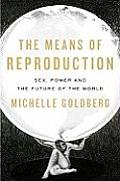
  • I’ll begin with Michelle Goldberg’s excellent The Means of Reproduction: Sex, Power and the Future of the World. Aside from the gorgeous cover art, I am completely in love with Goldberg’s ability to tell a compelling, humanized story about the global politics of feminism, reproductive rights and reproductive justice. She weaves together case studies of local, grassroots feminist activism (and anti-feminist activism) with the politics of national and international law, economics, and society. She argues that in our modern economy, globally, the ability of women to plan their families, and to make independent decisions about their health, education, and work lives radically improves the quality of life not only for the women themselves, but for their families and their societies. She suggests that the future of the world — economically, environmentally, politically — rests with the future of feminism as practiced by millions of on-the-ground individuals worldwide: “There is no force for good on the planet,” she writes, “as powerful as the liberation of women.”
  • This power to change the world is precisely what many interest groups (such as religious conservatives and those who benefit from highly patriarchal power structures) recognize and have rallied to combat, which is the story that Jennifer Butler tells in Born Again: The Christian Right Globalized. Born Again focuses specifically on the way in which the Christian right, traditionally wary of such international forums as the United Nations, has moved in the past couple of decades to influence policy on a global scale. Butler’s perspective is that of a progressive Christian activist who has spent years working in ecumenical organizations. Perhaps the most interesting piece of information I got out of Born Again was the fact that assertions of children’s rights in international forums are often vociferously opposed by a coalition of conservative “pro-family” activists who identify the enumeration of children’s rights, as distinct from family identity, a threat to the social structure and authority of families. Since they identify feminism as part of the same cluster of evils, once again my suspicion is confirmed that there’s a meaningful link between the argument that women are people and the argument that children, too, are human beings.
  • As I dive into the new Mary Russell/Sherlock Holmes mystery, The Language of Bees, as my post-semester pleasure reading, Hanna has encouraged me to try the Conan Doyle Sherlock Holmes again. I picked up “Study in Scarlet” a handful of years ago, thinking I’d start at the beginning, and was just not impressed. Reading about Holmes before he met Mary felt like reading about Peter Wimsey before Harriet Vane — somehow the story felt as though it lacked depth and weight. And I’m just not enough of a puzzle-solver to enjoy the nuts and bolts of the mystery itself. But I’ve been mixing Bees with stories from The Return of Sherlock Holmes, and find them on the whole charming. I particularly enjoyed the one involving a woman described as a “Solitary Cyclist”; it reminded me of a paper one of my undergraduate colleagues wrote on the history of bicycle advertisements targeting women (yes, I know, “history geek” is indeed tattooed in invisible ink on my forehead).
  • Bees I finished last night, and will refrain from commenting upon at length for fear of spoiling the plot for all those who have yet to read it (Hanna and Mom to name at least two). I will say that by chapter twelve Russell was out walking the downs and Holmes had disappeared on his latest hunt; life in Sussex seems comfortingly unchanged. That is: as full of violence, drama, disappearances, and potential murder as ever! And given the time, place, and subject matter, a great deal of real-life Bohemian personalities made cameos, so I recommend reading it with Among the Bohemians close to hand.
  • And finally, following Laurie King, I picked up once again the sumptuous edition of The Neverending Story that Hanna gifted me for my birthday, and in which I had become stuck about halfway through — academic reading always leaves me too distracted and analytical for the true enjoyment of being lost in a good book (both are pleasures, but require very different kinds of thinking, which I find difficult to switch between at a moment’s notice). It has been so long since I last read the novel that I honestly can’t recall if I ever gave it proper attention in the past — or only read bits — or only ever saw the film. It is a lovely paean to the power of fiction (aside from being a rolicking adventure yarn), and particularly the magic that books work in the lives of solitary children. Maureen Corrigan, in her memoir Leave Me Alone, I’m Reading, describes how reading, for her, has been both an escape from the world and her path into the world: it is that same journey that Bastian, the central character of this novel makes, with the help of bit of magic.

Now I’ll soon be heading home for the evening, where we plan to watch one of three movies Hanna has chosen for the weekend: Terminator, From Hell, and The History Boys (a delayed celebration of Alan Bennett’s 75th birthday on the 9th of this month). Happy weekending everyone!

"all of me, why not take all of me?"

01 Friday May 2009

Posted by Anna Clutterbuck-Cook in think pieces

≈ 3 Comments

Tags

feminism, masculinity, sexuality

Two further examples for the annals of “patriarchy hurts men, too.”

I’ll be honest. I became a card-carrying member of the feminist party (hehe) when I realized there were still people around who thought I should do and be certain things and not do or be certain other things on account of my being a girl. There’s nothing — bar threats to the health and wellbeing of my people — that makes me dig my heels in faster than someone telling me I “should” or “shouldn’t” in any way, shape, or form. At that point (late teens) I wasn’t thinking much about the way the guys I knew were also injured by the sexist “shoulds” and “shouldn’ts” that pervade our cultural milieu.

But it doesn’t take a degree in gender studies to realize that if women and girls are being told “be this,” then men and boys are being told “be that,” and that this sort of oppositional, essentialist conception of gender roles [1] sucks ass for everyone concerned. Not only do women and girls suffer from inequality based on sex and gender — guys struggle daily against the straight jacket conception of masculinity that limits their ability to be fully human actors in the world. One of the things I take great pleasure in as a feminist is that I have a usable worldview that not only allows but actually supports my desire to see men and boys as more than brainless sexbots driven by the desire to draw blood and get laid. Which, given the number of men and boys in my life (“hi guys! you’re awesome!”) really makes my life a helluva lot easier.

Not that I don’t believe that folks who don’t explicitly identify as “feminist” are incapable of seeing men as human beings. But I do believe that an ability to think critically about the messages that our various cultures send us about gender — and in this case, specifically what it means to be a guy — is an essential human skill. And one that does not come easily to folks who aren’t at least open to thinking about things from a feminist perspective.

See, when people don’t question the “common sense” notions of masculinity and femininity that dominate popular culture (not to mention being actively defended by conservative voices) then stupid shit like this happens:

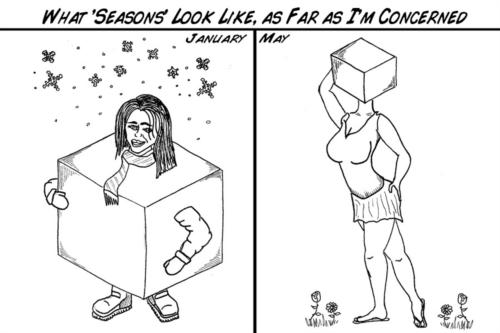
This editorial cartoon, drawn by Harvard Crimson cartoonist “Samual L. Clemens” was featured this week on the Crimson’s website (h/t to MK via twitter for the link). It employs, with no sense of critical self-awareness or commentary, the sort of ideas about women and their bodies that feminist activists have objected to since, well, forever. (Fun historical factoid: at the turn of the twentieth century, male patrons at the reading room of the British Museum protested the admittance of women scholars on the grounds that their female bodies were so distracting that male researchers wouldn’t be able to get any work done [2]) But I want to lay aside what this cartoon says about the worth of women in the cartoonist’s eyes (as MK pointed out, “It’s like wearing a big sign that says WOMEN: PLEASE AVOID ME AT ALL COSTS.”) and suggest we consider for a moment what this image says about the worth of men [3].

The take-away message of this cartoon about straight guys is that they are incapable of (and uninterested in) seeing the people to whom they are attracted sexually as whole persons. If a woman is bundled up in winter clothes, their bodies might as well not exist; if a woman is dressed in form-fitting, skin-baring clothes, then their head (read: personhood) disappears from view. This is a trope of male sexuality so prevalent that a lot of women have bought into this narrative of how men’s sexuality works, as evidenced by the calls for a “return to modesty” by a number of prominent women writers and activists [4]. In this view, dudes are incapable of integrating their physical, sexual desire for others into an understanding of other human beings as more than a useful means to the end of sexual gratification. I call bullshit. I call bullshit on the idea that men are incapable of caring about the women they are attracted to as whole persons: as incredibly sexy, active, physical presences and as human beings with thoughts, feelings, and distinct personalities. Regardless of the time of year, and regardless of what said object of desire is wearing at the moment she happens to cross their flightpath.

Mr. Clemens, do yourself a favor. Go out into the balmy spring day, enjoy people-watching, and enjoy every bit of the people you see: all the way from head to toe. And consider how awesome it might be if you could get to know them as actual human beings instead of just passing, headless bodies. See if practicing that sort of mindfulness doesn’t expand your horizons.  And maybe prompt you to question the messages you’ve been getting about your sexuality and gender. 

The other story that caught my eye this week and made me think, “gee, we live in a culture with absolutely respect for men and boys as human beings,” was the word spread around the blogosphere that the New York Times review of the recently-released summer comedy “17 Again” contained the following caution: “17 Again” is rated PG-13 (Parents strongly cautioned). Girls are particularly cautioned.

I have not seen the film, and it’s not the sort of movie I’m generally eager to see anyway, so the point I want to make has nothing to do with the actual content of the film. The point is: why “girls particularly”? Assuming there is something potentially objectionable in the movie, wouldn’t a parent have cause to be equally concerned about their sons as their daughters being exposed to it? If, indeed, the objectionable content has some sort of gender-related ickyness (say, sexual violence against women, or sexual humor, or nudity, or whatever else people think fragile girlminds are incapable to taking in without severe trauma) . . . shouldn’t we be equally concerned about exposing boys to such experiences?

As commenter SarahMC over at Pandagon pointed out, the implicit message of warning girls specifically against seeing the film is: “Girls should not be exposed to cinematic depictions of misogyny. Boys, however, get extra butter on their popcorn w/ every ticket purchased.”

This gender-specific warning, like the Crimson cartoon, not only turns on the paternalistic view of women and girls Jessica Valenti recently described in her latest book The Purity Myth — it, like the cartoon — uncritically accepts a caricature of masculinity that assumes men either enjoy, are oblivious to, or untouched by misogyny.

Not. true. Spread the word.

UPDATE: MK offers her own response to The Crimson.  

* * * Endnotes * * *

[1] oppositional, essentialist conceptions of gender mean, in plain English, that the categories of “male” and “female,” and the people who fall into these two categories are seen as 1) opposite from each other in temperament, social roles, etc., based on their gender and 2) that these states of being are natural due to our biological sex.
[2] Hoberman, Ruth. ‘Women in the British museum reading room during the late-nineteenth and early twentieth centuries: From quasi- to counterpublic.’
Feminist Studies, vol.28 no.3 (Fall 2002), 489-512.
[3] I am assuming, given the pseudonym, that the imagined perspective in the cartoon is supposed to be that of a dude.
[4] See, for starters, Wendy Shalit’s
A Return to Modesty and Girls Gone Mild,, Laura Sessions Stepp’s Unhooked: How Young Women Pursue Sex, Delay Love, and Lose at Both.

In which I declare my love for Dahlia Lithwick

28 Tuesday Apr 2009

Posted by Anna Clutterbuck-Cook in think pieces

≈ 1 Comment

Tags

children, feminism

The final weeks of the semester have officially made me incapable of composing even simple links lists, so the blog post ideas are piling up. But in an hour between classes in which to occupy myself catching up on my rss feeds, this post by fellow West Michigan feminist Rita tipped me off to Dahlia Lithwick’s recent column on Redding v. Safford Unified School District, Search Me: The Supreme Court is neither hot nor bothered about strip searches.

Now, I am an amateur SCOTUS junkie who also happens (ahem) to be a feminist interested in children’s rights, women’s sexuality and embodiment. So when the Supreme Court hears oral arguments on the legality of strip-searching a 13-year-old whose classmate had intimated she was in possession of (gasp!) ibuprofen, it’s like being handed an oreo cheesecake ice cream sundae. When Dahlia Lithwick weighs in with her very own account of the proceedings, it’s like adding fudge sauce, whipped cream, and graham cracker crumble to the top. To whit:

Editorialists and pundits have found much to hate in what happened to Savana Redding. Yet the court today finds much to admire. And even if you were never a 13-year-old girl yourself, if you have a daughter or niece, you might see the humiliation in pulling a middle-school honor student with no history of disciplinary problems out of class, based on an uncorroborated tip that she was handing out prescription ibuprofen. You might think it traumatic that she was forced to strip down to her underclothes and pull her bra and underwear out and shake them in front of two female school employees. No drugs were found. But even those justices lacking a daughter, a niece, or a uterus had access to an amicus brief in this case documenting the fact that student strip searches “can result in serious emotional damage” and that student victims of strip searches “often cannot concentrate in school, and, in many cases, transfer or even drop out.” Savana Redding, herself a data point, described the search as “the most humiliating experience” of her life. Then she dropped out of school. And five years later, at age 19, she gets to listen in on oral argument in Porky’s 3: The Supreme Court Says “Panties.”

. . .

Yet in recent years, the high court has slowly chipped away at the privacy rights of students—frequently based on the rationale that there were drugs!!! Somewhere in America!!! Drugs!!! Creating danger!!! (This led an annoyed Justice Ruth Bader Ginsburg to dissent in a recent case that the court was peddling “nightmarish images of out-of-control flatware, livestock run amok, and colliding tubas” to justify drug tests for any student with a pulse. )

Today’s argument features an astounding colloquy between Matthew Wright, the school district’s lawyer, and Justice Antonin Scalia, who cannot understand why “black marker pencils” are also considered contraband. “Well, for sniffing!” answers Wright. “They sniff them?” asks Scalia, delightedly. “Really?”

. . .

Nobody but Ginsburg seems to comprehend that the only locker rooms in which teenage girls strut around, bored but fabulous in their underwear, are to be found in porno movies. For the rest of us, the middle-school locker room was a place for hastily removing our bras without taking off our T-shirts.

Her penultimate observation? “Evidently teenage nakedness is only a problem when the children choose to be naked.”

Dahlia Lithwick, I am yours forever.

Seriously. Go enjoy the whole thing.

A few more links on bodies

22 Wednesday Apr 2009

Posted by Anna Clutterbuck-Cook in linkspam

≈ 3 Comments

Tags

feminism, gender and sexuality

A couple of weeks ago, I rounded up a few links on policing “imperfect” bodies (women’s bodies in particular). Here are a few more.

Watching the blogosphere coverage of Susan Boyle’s performance on the Britain’s Got Talent television show has been an a thought-provoking and often intensely discomforting experience (as was watching the video itself, though she does indeed have a gorgeous voice and sings with her whole body). Here are blog posts and threads I found particularly spot-on with regards to what’s off about the hype.

1) The Pursuit of Harpyness asks whether Susan Boyle’s performance at Britain’s Got Talent and the freak-show aspect of media coverage surrounding it is “Heartwarming or Heartbreaking?”

2) via radishette: What he said. Nailed it.

3) Courtney Martin writes: “I don’t think the majority of us are really willing to look at the ugly scripts in our heads, the fat discrimination, the self-hate (oh so relate to our merciless judgment of others),” that the popularity of the Susan Boyle video draws out.

And then: I’ve written a lot about how ageism hurts young people, and specifically about the American obsession with teen sexuality. Now here’s a story about Massachusetts attempting to legislate against elder expressions of sexuality. The legislation is ostensibly to protect elders and disabled individuals from exploitation (a laudable goal), but has been carelessly and broadly worded. Not cool adopted state.

*Image (c) ria hills @ flickr.

Quick Hit: Children’s Issues are Feminist Issues

22 Wednesday Apr 2009

Posted by Anna Clutterbuck-Cook in linkspam

≈ Leave a comment

Tags

children, education, feminism, masculinity

Two links on bullying that came across my rss feeds lately remind me again about how integral children’s experience and childhood spaces are to the struggle against power-over hierarchical relationships (i.e. the kyriarchy.)

First, via Feministe and Feministing, stories of two boys who killed themselves as a result of bullying that hinged on homophobic and sexist taunts: Carl Joseph Walker-Hoover and Jaheem Herrera.

Partly in response to these stories, as well as her own experience, Antigone over at punkassblog declares “If We Have Kids, We’re Homeschooling“:

Based on the number of people that had to live through bullying, and the complete lack of any systematic effort to stop it, I’m calling bullshit, hard. Public school does not properly socialize anyone, it teaches children to become bullies, victims, or learn the nifty trick of “not my problem”. That is not a socialization I want to give my kids at all.

Home education isn’t the only possible solution to this type of situation (and indeed, will like not shield kids from bullying entirely — though it can serve as a life-saving buffer for some), but I think Antigone’s “I’m calling bullshit” is an important impulse. Systemic violence is not okay, regardless of where it happens and to whom it happens. Children — who spend much of their time segregated from the general population — often suffer from the same discrimination as marginalized adults (sexism, racism, classism, homophobia, ableism, etc.) while they are simultaneously less able to name and combat it — because they lack the (developmental and experiential) perspective of adults and the resources and agency of adults.

Many children must — through lack of individual choice or material options — return to these hostile situations day after day after day where oversight by adults is inadequate at best and indifferent at worst. This is not acceptable. And I see calling bullshit on the intensely hostile world in which our children (who will grow up to be caretakers of our world and of us in our elder-hood, whether or not we are parents ourselves!) as integral to the feminist project.

Conversation in the Blogosphere

20 Monday Apr 2009

Posted by Anna Clutterbuck-Cook in think pieces

≈ Leave a comment

Tags

blogging, feminism, gender and sexuality

Many of you who read my blog don’t necessarily spend a lot of time in the “feminist blogosphere,” I know . . . so the heated, often polarized, conversations that have been happening in that virtual space over the last couple of weeks are possibly completely off your radar. But to me they have been important. They have encouraged me to be mindful about how I interact with others in virtual spaces — on this blog and in comment threads on other blogs. They have challenged me to think about how to be open to learning in a spirit of humility while also refusing to let others set the terms of my own participation in the world of feminist activism.

I’m still thinking about what all of these conversations mean to me in terms of this blog and in terms of my participation in online communities generally. And I don’t feel ready, quite yet, to offer my own composed thoughts on the subject. I thought, therefore, that I would round up a few posts that have spoken to me on the issue of interpersonal conversation and debate and share them with you:

Miriam Perez, at Radical Doula, writes about why she blogs and why she refuses to be bullied into silence in relation to this conversation about comment threads and transphobia at Feministing.

(For further background, you can see this earlier Feministing post for links).

Rachel, at the Feminist Agenda, muses about a dynamic I try to keep in mind when participating in the blogosphere, both as a way to check my own defensiveness and as a way of understanding others’.

On a related note, MK asks when is comment-thread engagement worth the fight?

Mandolin, over at Alas, a Blog, writes about disliking “competitive conversation.” As someone who likewise finds oppositional debate both exhausting and unproductive, I really appreciate the distinction she draws between collaborative discussion of divisive issues and debate that is polarized.

More to come (hopefully) as the semester winds down and I have more time to think about the nature of this particular virtual space in relation to activism, online communities, and my daily life.

File this one under "patriarchy* hurts men too."

13 Monday Apr 2009

Posted by Anna Clutterbuck-Cook in think pieces

≈ 1 Comment

Tags

children, feminism, masculinity

Stupid headlines like this irritate the hell out of me:

This was a story in the Boston Metro (free transit newspaper) today that Hanna and I noticed while riding the T out to Harvard Square. The entire text of the article reads as follows:

China’s budding gender gap — inspired by decades of one-child-per-family law, and the resulting rise in baby-girl abortions and infanticides — could develop into an increase in violent crimes, a new study reports.

With 32 million more young men than women, and the imbalance only growing, sociologists worry about a coming spike in crime, when men take out their frustrations on an increasingly wealthy population.

The report paints a grim picture for a modernizing China. “If you’ve got highly sexed young men, there is a concern that they will all get together and, with high levels of testosterone, there may be a real risk, that they will go out and commit crimes,” lecturer Therese Hesketh told the AP.

I was particularly charmed by the boxed quote attributed to “Researchers” (names please? the title of this report? anything that would reliably enable readers to fact-check the study**?) which read: “Nothing can be done now to prevent this.”

Because, you know, dudes are just violent animals without wives to keep them in check.

I dunno, people. I personally have faith that guys in China may find another, less violent, solution to the dearth of women.

*or “sexism” or “kyriarchy” if you prefer.  


**A little searching on the internet tracked the study I’m assuming they refer to back to the British Medical Journal. 

stuff i’ve been reading (on the ‘net)

09 Thursday Apr 2009

Posted by Anna Clutterbuck-Cook in linkspam

≈ 1 Comment

Tags

boston, feminism, gender and sexuality, history, humor

Here’s a haphazard collection of stuff I’ve been reading the last couple of weeks.

via MK: two hilarious comics about the experience of reading Twilight.

via Cynthia: a “funny futuredance” from the 1960s German science fiction film “Raumpatrouille Orion.”

via Jeremy: two posts about the ducknapping and recovery of Pack, one of the bronze ducklings in the Boston Public Garden.

Kittywampus blogs about feminism and the sexual revolution (via figleaf).

Figleaf also offers some reflections on how one simple question can make us stop and think about how “heterosexual” is the default assumption we make, as a culture, about peoples’ sexual orientation.

Cool sexuality education resource a conference-goer tipped me off about at WAM!

Miriam at Radical Doula on the creative potential of “crisis” and change.

Surgeon and journalist Atul Gawande on why solitary confinement should be considered torture — and one evidence-based practice proven to reduce prison violence: giving prisoners greater control over their lives.

A new way to think about the concept of “political correctness.”

Given my previously acknowledged love of dictionaries, I couldn’t let this one go by unlinked. (You can view this as my salute to IA, VT, and DC).

Jesse at Pandagon on one reason why we should think twice before judging the purchasing decisions of people in poverty.

Because I linked (in my WAM! post below) to a thread on feministing about gender-neutral restrooms and trans rights, I’m including three responses from MK, queenemily, and catspaw pointing out the problems with how that conversation went down.

And finally, the now-traditional Hanna-link! This has been a feminist-heavy link list (damn; guess the secret’s out), so here are two articles on Marx: a marxist analysis of Grand Theft Auto and a commentary pointing out that Marx was in many ways a product of the very economic structure he set out to critique.

Wednesday Reflections on WAM!2009

08 Wednesday Apr 2009

Posted by Anna Clutterbuck-Cook in think pieces

≈ 1 Comment

Tags

feminism, gender and sexuality, politics

A week (plus) after WAM!2009, I’m finally getting around to blogging a few reflections. This was my second year attending WAM! Last year I went as a volunteer; this time I paid my way and wandered around the Stata center free of responsibility. It’s an awesome conference for feminist people-spotting and in general spending time talking about all that stuff I spend my time thinking about virtually 24/7 (in some form or another) with people who are as obsessed as I am. Either we aren’t as crazy as we likely all feel most of the time, or there are a lot of us crazies wandering free on the streets — frankly, I’m not sure which is the more appealing option!

I’ve learned over the years that my stamina for conference sessions is limited: I reach “critical mass” when it comes to new and stimulating ideas fairly rapidly. So I limited my participation to two panel discussions and an informal lunch caucus — and came away with lots to think about!  

The panels I attended on Saturday were “In/Out of Focus, Broadening a Feminist Lens: Gender, Non-Conformity and the Media” and “Feminist Blogging: From Journalism to Activism in Election Years and Beyond.” Between the two panels, I joined an informal group of conference-goers at a lunch caucus to discuss “feminist sex ed.” This lunchtime event, which I only found out about on the day of the conference, was both inspiring and dispiriting. On the one hand, it’s awesome to hear from those in the diverse world of sexuality education (from schoolteachers to community organizers to college professors and sisters looking for resources to pass on to their younger siblings) about the work they are doing. On the other, it’s frustrating to hear how much misinformation, legal restriction, community fear, and lack of resources and time limit possibilities.

One of the things that really struck me in the lunch caucus was folks’ resistance to “co-ed” (non-gender-exclusive) sexuality education. As I have argued previously, the problem with sex-segregation in educational spaces is that young people who do not identify as male or female, or do not feel comfortable in environments in which everyone is presumed to be the “same” in some way based on sex/gender, are marginalized. I think it is particularly problematic in sexuality education, since the ostensible reason for separation is so that (hetero) girls and (hetero) boys won’t be subject to scrutiny and embarrassment in front of other-sex folks. But this presumption of increased safety and comfort in single-sex environments breaks down for anyone who is not straight or gender-conforming.

As Jessica Fields has documented in her book Risky Lessons, women and girls do face a disproportionate amount of misogynist harassment in sexuality education settings that often goes unchallenged. Yet I’m hesitant to accept that sex-segregation is the way to go in addressing this problem. If nothing else, because it reinforces the sexist idea that men and boys are naturally disrespectful, misogynist pigs for whom containment is the best strategy. A far healthier (and feminist!) approach, it seems to me, would be to tackle the problem of sexism and respect head-on. It should be our collective responsibility to make sex education spaces safe and affirming for every person — regardless of sex, gender, or sexual orientation.

This question of gender-segregated space and who is included was also a major topic of discussion in the first panel I attended “In/Out of Focus,” since the topic was gender-nonconformity. This was the panel I was most excited about attending at the outset, since the line-up included one of my favorite feminist authors and one of my favorite feminist bloggers. And it did not disappoint! 

What the reality of gender-nonconformity means for “women-only” spaces is far from settled, even in feminist spheres (as a recent thread on gender-neutral restrooms at Feministing amply illustrated).  I thought both the panel and the audience members who participated in conversation gave a lot of nuanced and valuable perspectives on how conversations about sex and gender in feminism can take place without fear or bigotry.  Miriam Perez (see “favorite feminist blogger” above) talked about the need to be mindful of whom we are including when we use words like “women” or “female,” and who we are excluding with that same language.  While no one is asking feminism to expunge the word “woman” from its reasons for being, it is also important to remember (as one of the panelists — Julia Serano? — pointed out) that “feminism and women are strongly related but not analogous.”  Even among a group of folks who identify in the feminine spectrum, it’s important to remember that not all of us have identical experiences of womanhood.  
The Q&A portion of this session was particularly strong, some of which Jill live-blogged over at Feministe.   You can also see live tweets from the session at Twitter #wam09gnc (oh, the crazy things one can do on the ‘net!). 
My final panel of the day, “Feminist Blogging,” introduced me to more new bloggers to add to my feminist-themed iGoogle pages (yes pages), and was a lively, reflective session on the lessons learned from the 2008 election about the interaction between the blogosphere and corporate media, between blogging and activism.  The conversaion also highlighted, for me, the way so many bloggers are able, through their blogs, to integrate their various life-works (parenting, employment, personal projects and passions, hobbies) in a web presence that somehow encompasses — or at least touches upon — all aspects of their personhood.  
The “Feminist Blogging” session helped me think, in a new way, about why keeping this blog has been so important to me over the last two years: As I make my way through graduate school, I often feel overwhelmed trying to find a path that will bring together the things that I care about into some sort of meaningful life and life’s work.  This blog is one of the few public spaces where I can mix and match freely, shuffling and re-shuffling the various bits until the balance feels right and the relationships between thoughts and experiences are clarified.  It’s an awesome privilege, and one which I am hopeful is mirroring the (albeit) messier “real world” version.

  
See the WAM!2009 conference site for a links list to further conference coverage.

Actual class: Scotland trusts its midwives

06 Monday Apr 2009

Posted by Anna Clutterbuck-Cook in think pieces

≈ Leave a comment

Tags

children, feminism

Via Molly at Citizens for Midwifery, an article about the Scottish government shifting primary responsibility for care surrounding pregnancy and childbirth from medical doctors to midwives.

← Older posts
Newer posts →
"the past is a wild party; check your preconceptions at the door." ~ Emma Donoghue

Recent Posts

  • medical update 11.11.22
  • medical update 6.4.22
  • medical update 1.16.2022
  • medical update 10.13.2021
  • medical update 8.17.2021

Archives

Categories

Creative Commons License

This work by Anna J. Clutterbuck-Cook is licensed under a Creative Commons Attribution 3.0 Unported License

Meta

  • Create account
  • Log in
  • Entries feed
  • Comments feed
  • WordPress.com

Create a free website or blog at WordPress.com.

  • Subscribe Subscribed
    • the feminist librarian
    • Join 37 other subscribers
    • Already have a WordPress.com account? Log in now.
    • the feminist librarian
    • Subscribe Subscribed
    • Sign up
    • Log in
    • Report this content
    • View site in Reader
    • Manage subscriptions
    • Collapse this bar