• anna j. clutterbuck-cook
  • contact
  • curriculum vitae
  • find me elsewhere
  • marilyn ross memorial book prize

the feminist librarian

the feminist librarian

Tag Archives: gender and sexuality

ficnotes: his awkward sod

22 Friday Jul 2011

Posted by Anna Clutterbuck-Cook in fandom

≈ Leave a comment

Tags

fanfic, gender and sexuality

These guys totally milk the fandom slash

It’s the return of the ficnote!

A week ago, I was at a house party with four other lovely ladies (five women + cat + peach basil ice cream: life is good!) where we spent a significant portion of the evening discussing the joys of fanfiction. And can I just say how wonderful it is to arrive at one’s thirtieth year and be reminded that growing up can be about owning one’s pleasures, not giving them up or shamefully hiding them because you believe others will think you foolish? I love being in the company of people who just enjoy being creative, and taking pleasure in others’ creativity, in such an omnivorous way. The beautiful thing about fan-created fiction and art is that it’s 99.999% amateur. People do it in their leisure time simply because they love it or because they have friends who beg for it.

Reading fan fiction, one of my favorite things is to see how people in such a diversity of situations and background interpret certain characters, pairings, or story lines, and how they engineer those elements to create stories where, more often than not, the main characters’ needs are being met in constructive ways. This spring, at one point, I observed that a certain fic involving Sherlock/John/Sarah was really a story about “a surfeit of needs being met.” While not every fic, obviously, is about successful relationships I actually think it’s fascinating to see how so much of fic is people working out what it takes to make a relationship successful … and the myriad answers to that question they come up with.

Enough nattering on: to the fic rec! This one is another I’ve nicked from Minerva @ Hypomnemata from a post she did on the fan fiction of Inspector Lewis. “Inspector Lewis” fanfic predominantly tackles the pairing of Detective Inspector Robert Lewis with his young second James Hathaway, a former candidate for the priesthood turned police detective. As the back story for Lewis involves a murdered wife and grown children, most fic authors have to negotiate in some way or another Lewis’s successful heterosexual relationship and (usually assumed) straight identity as the backdrop for his growing desire for Hathaway. Hathaway’s character, meanwhile, has a much more fluid sexual identity in the series, but is struggling with religious guilt over same-sex desires. There are also intimations of childhood sexual trauma in Hathaway’s past. Suffice to say, there’s a lot of really interesting stuff to work with — and a lot of potential for that fanfic staple hurt/comfort fic.  Sadly, I don’t think the majority of Lewis fic has plumbed the potential for Lewis’s self-examination as a middle-aged man with a hitherto straight identity who now finds himself in love with another man. Pairing Lewis’s positive (hetero)sexual experience with Hathaway’s more fraught sexual history could have some really interesting results … something that might eventually drive me to write a story arc of my own!

But in the meantime, I bring you a sweet little number that is one of my favorite pieces thus far discovered:

Title: His Awkward Sod
Author: Sarren
Pairing: Robert Lewis/James Hathaway
Author Rating: Explicit
Author Summary: “Lewis and Hathaway pretend to be a couple to catch a killer.”
Length: 1 part, 11,964 words
Available At: AO3.

Have fun, happy Friday, and you might be lucky enough to get another fic rec next week!

booknotes: queer (in)justice

30 Thursday Jun 2011

Posted by Anna Clutterbuck-Cook in book reviews

≈ Leave a comment

Tags

books, feminism, gender and sexuality, human rights, masculinity, politics

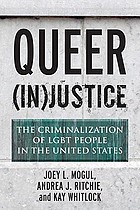
The third installment in Beacon Press’s Queer Action/Queer Ideas series, edited by Michael Bronski, Queer (In)justice: The Criminalization of LGBT People in the United States is co-authored by law professor Joey L. Mogul, police misconduct attorney Andrea J. Ritchie, and community organizer Kay Whitlock. Hanna saw it on the new book wall at the library and correctly ascertained it was the sort of title I’d be interested in. So she brought it home, I read it, and now I’m gonna blog about it.

Queer (In)justices is far more than an examination of the ways in which our legal system polices “deviant” gender and sexuality qua gender and sexuality. Yes, the authors look at the laws and policing practices related specifically to penalizing folks who engage in (publicly or privately) non-heteronormative sexual practices, or whose appearance suggests that they identify outside the gender/sex/sexuality binary. However, their analysis goes much deeper than these targeted laws. Instead, they argue that “the policing of sex and gender ‘deviance’ is central to notions of crime, and serves both as a tool of race-based law enforcement and as an independent basis for punishment” (xiii). In other words, notions about the relationship between non-normative sex and gender expression and criminality influence the way in which the legal system treats people perceived to be queer whether or not they are caught in the system specifically because of sex- or gender related policing. As they argue:

As queer identities substituted for individual perverse acts [in the late nineteenth century]  the process of criminalizing sexual and gender nonconformity was facilitated through the construction of ever-shifting and evolving archetypal narratives [of deviance]. Rooted in historical representations of Indigenous peoples, people of color, and poor people as intrinsically deviant, fueled and deployed by mass media and cultural institutions, these narratives now permeate virtually every aspect of the criminal legal system (19).

They make a compelling case for us to question the usefulness of narrowing our focus specifically on anti-gay laws, and on enacting new laws seeking to protect LGBT people from homophobia … particularly when the very law enforcement officials meant to ensure those laws are respected are among the primary culprits when it comes to bigotry and violence around sexual and gender nonconformity.  In chapters on gender and sex policing on the street, in the courtroom , in prison, and in uneven police responses to violence against LGBT people, we see how presumptions of criminality systematically influence how queer people are treated in the context of the legal system, whether they are perpetrators, victims, or both. They make the particularly important point that, regardless of what laws are officially on the books, “police and other law enforcement agents are given considerable latitude in deciding which laws to enforce, how to enforce them, and which people to target for law enforcement” (48).*

Being queer, or being perceived as queer can cause law enforcement officials to treat individuals as criminally guilty whether or not they actually are — and can bring harsher punishments (when compared to those perceived as straight and gender conforming) when those individuals are sentenced. Likewise, criminal behavior is often associated — implicitly or explicitly — with sexual depravity. Using examples that will be familiar to anti-sexual harassment or anti-sexual violence activists, Mogul, Ritchie, and Whitlock describe how individuals known or perceived to be queer are treated by law enforcement officials as if they are incapable of being victims of sexual violence. They describe victims of same-sex domestic violence who themselves were put in jail or ruled incapable of being abused because of their orientation or gender identity.

Ultimately, Queer (In)justice argues that LGBT activists must take a much more comprehensive approach to their agitation for change within the framework of law and law enforcement. While much of the mainstream LGBT work in this area in recent years has involved the quest to enact anti-discrimination and anti-hate crime legislation, and to grant same-sex couples the right to marry, Mogul, Ritchie, and Whitlock point out that a much broader cultural shift within law enforcement must take place in order for such changes in the law to have an on-the-ground effect. As they write, “The hate crime framework is … compromised by placing primary responsibility for preventing violence in the hands of a criminal legal system that is itself responsible for much LGBT violence” (129). We would do well, they seem to be pointing out, to pay closer attention to the experiences of those most vulnerable to police brutality, discrimination and abuse sanctioned by the legal system, and persecution based on presumptive criminality … not just because of their sexual identity, but because their mere presence as a non-conforming body evokes powerful notions of danger and violence whether or not these reactions are warranted in specific instances. Comprehensive reform is needed before the passage of laws will have real-world implications for the majority of the LGBT population.

Queer (In)justice is a must-read for anyone who wants to re-consider the current LGBT approach to legal reform.

*This point is exactly why I am uneasy with Jim Wallis’ argument that police force is preferable to military force. Wallis’ assumption that police only use force when it is necessary to enforce agreed-upon laws ignores all of the situations in which law enforcement officials abuse the power vested in them … something which, as a person who works in anti-poverty and anti-racism circles, Wallis ought to know full well.

booknotes: arms wide open

23 Thursday Jun 2011

Posted by Anna Clutterbuck-Cook in book reviews

≈ 2 Comments

Tags

children, feminism, gender and sexuality, history, memoir

There is a point toward the end of Patricia Harman’s Arms Wide Open: A Midwife’s Journey (Boston: Beacon Press, 2011) when author offers us another of the many particular birth scenes that punctuate the overarching narrative. It is the late 1970s and, after nearly a decade delivering babies as a lay midwife, Harman has entered medical school to become a Certified Nurse-Midwife. She describes the labors of a woman named Carla who will eventually deliver a son whom she names Joe. As the child is about to crown, the following scene takes place:

M.R. [Mary Rose, Harman’s mentor] lets go of my hands and reaches for a pair of scissors. At first I assume she’s getting ready to cut the cord, though the head’s not out yet, but she nudges me with her elbow and forces the scissors into my hand, then injects Xylocaine into our young patient’s perineum. Now I know what she wants me to do … cut an episiotomy.

So here I sit. The head of a dark-haired infant crowning before me. I know how to get this baby out without a laceration or episiotomy in two minutes, if Mary Rose and the enthusiastic nurse would leave me alone, but I am the student, enrolled to learn.

I take the scissors and cut, feel the skin crunch between the blades, see the blood ooze … and deliver the baby. It’s not a good feeling, but it’s done. The very pink body swivels out, Mary Rose cuts the cord, and the RN takes the tiny boy to the infant warmer.

“If the heart rate’s down, you have to cut an episiotomy right away,” Mary Rose whispers, “The OBs watch us, and if you hesitate, they’ll start coming in to every delivery to supervise.” She looks at the door. “We don’t want that” (246).

This scene is, I would argue, the hinge upon which this memoir turns. Arms Wide Open is a memoir in three parts. Part one (“Little Cabin in the North Woods, 1971-1972”) and part two (“Commune on the Ridge, 1977-1978”) are episodic accounts of Patricia Harman’s decade of experiments in communal, backwoods living. From an isolated cabin outside of Duluth, Minnesota to an intentional community in South Carolina, we follow Patricia Harman, her lover, her future husband, her sons, and a motley group of fellow-minded travelers through the ups and downs of community life. “Commune on the Ridge” ends with Patricia and her husband Tom’s joint decision to pursue medical degrees (he in women’s health, her as a midwife) — a decision which took them away from the commune and back into the mainstream frameworks of institutional education, hospital-based medicine, and city life. Part three (“Cedar House on Hope Lake, 2008-2009”) jumps ahead to the present, with reflections back upon some of Harman’s training and the years she and her husband worked together running a women’s health clinic. Each section is, in some ways, in dialogue with the other sections as the reader is invited to compare and contrast each location and living arrangement Patricia and her family create for themselves with their previous and future locations and arrangements.

The strength of Arms Wide Open is the immediacy of its narrative. In recreating her personal history, Harman has drawn heavily on journals she kept during the years she describes, and the resulting text bears the marks of that internal narrative: we experience the events in the book through Patsy’s senses, and what meaning is made of those events is made less through present-day commentary than with the voice of (possibly imagined) Harman’s younger self. Arms Wide Open is executed with loving care, and provides an unvarnished look at the struggles and disillusionment, as well as the joys of communal experimentation. For anyone interested in experiencing communal life vicariously through personal narrative, Arms Wide Open comes highly recommended.

It is this very sense of immediacy, however, that contributes to what I felt was one of the book’s central weaknesses: the lack of any larger framing narrative, any strong present-day voice that would exert autobiographical force upon these episodic scenes and encourage us to understand not only how Patsy-of-the-moment made sense of her life, but how Patricia Harman presently understands her past experience. I finished the book with lots of unanswered questions about how Patsy of the backwoods commune became Patricia the Certified Nurse Midwife working in a women’s clinic. It is possible that some of those questions may be answered in Harman’s first memoir, The Blue Cotton Gown (2008). At some point I may go back and read that volume. However, the point remains that readers coming to Arms Wide Open without the background of Cotton Gown are left wondering at the underlying values and choices that led Harman first in to, and then away from, the backwoods communal life. She hints around the edges about a background in New Left political action, anti-war protests, and even some jail time. The narrative implicitly endorses a very specific vision of responsible living on the earth, of childbirth and childcare, of gender and sexuality — yet the narrator never steps back from the moment to write in more overarching ways about how her politics and values have (or have not) changed over time.

I would have been very interested to know how she sees her present-day work connected (or not) to her earlier experiences, philosophically and practically. The final section, particularly, contains a lot of sadness and sense of displacement — while Harman and her husband seem to have found ways to live out their values in a more mainstream context, there is also a pervading wistfulness and at times outright pain at the way in which their lives have not played out as they hoped or expected. There is a sense that, having given up the communal way of life, Harman is not sure how to live out her most deeply-held values in a less unconventional context. Although she describes interacting with anti-war protestors and midwives who are a generation or two her junior, she seems profoundly isolated from the counter-cultures of the present day (of which, I would argue, there are plenty!). This loss of fellow travellers within the narrative speaks to me particularly, since I have spent many hours interviewing counter-culture-leaning folks from Harman’s generation about their past and present lives … and how they do and do not forge connections across age cohorts. In such an age-stratified society such a project can be difficult — even radical — but I would argue that to tie radicalism to a particular generation or stage in life is a deadly impulse if what we want to create is lasting social change.

On a similar note (although I imagine it is not her story to tell), I would also have been interested in her children’s reflections on the experience of early childhood in a communal household — and how they feel it shaped their own values and expectations as they grew into adulthood. From passing references toward the end, it sounded as though all three of Harman’s sons had chosen outwardly conventional life paths. Outward appearances can be deceptive (I could write my own biography to sound exceedingly conventional), but I would have liked further exploration into the whys and wherefores of Harman’s family as it came of age.

Ultimately, this is recommended reading for anyone who is interested in counterculture living, midwifry and childbirth, the historical period of the 1970s, and the art of memoir. If you’ve read The Blue Cotton Gown I’d be interested to hear your views on how the two books work together, and whether any of the silences I have mentioned above continue throughout.

ficnotes: shock and awe

16 Thursday Jun 2011

Posted by Anna Clutterbuck-Cook in fandom

≈ Leave a comment

Tags

fanfic, gender and sexuality

I’ve been reading more book-length nonfiction recently, in lieu of online fanfic … so after this installment of “ficnotes” I might let the series lay dormant for a while, until something truly spectacularly gorgeous and mind-blowing comes along. Or until the urge to blog about smut rises again (it often does, quite unpredictably!) … in the meantime, here’s this little beauty which Minerva shared via email a couple of weeks ago, on a morning when I really needed some fluff!

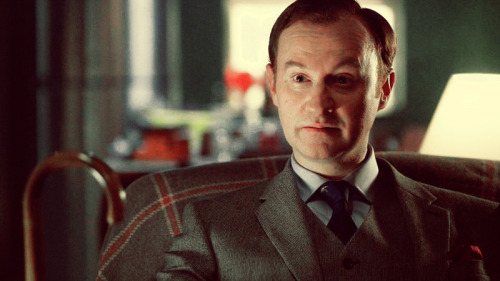
Mycroft Holmes via Fuck Yeah Mycroft Holmes!
(Tumblr can be a wonderful thing)

Title: Shock and Awe
Author: random_nexus
Pairing: Mycroft/Lestrade
Author Rating: NC-17
Author Summary: “Oddball style, Manly shmexins, Romance betwen blokes, the usual. Lestrade is falling for Mycroft, but doesn’t think it’s mutual. Hijinx ensue (also the usual).”
Length: 1 part, 1040 words
Available At: LiveJournal.

This is a quiet little fic that takes place in three brief acts: “Before,” “After,” and “Now.” What I like best about it is the author’s focus on the moments of touch, and the details one takes note of in a love — the interior language with which one describes the object of one’s affection. I’m working on a fic myself right now that involves those everyday intimacies shared between people who know they have license to touch — and some of the passages in these three scenes capture that sense of beingness.

ficnotes: lestrade/watson twofer

31 Tuesday May 2011

Posted by Anna Clutterbuck-Cook in fandom

≈ Leave a comment

Tags

fanfic, gender and sexuality

I recently discovered that one of my friends and fellow fic readers really ‘ships the (relatively rare) John Watson/G. Lestrade pairing in the Sherlock fandom. So I thought to kick off my return to ficnotes post post-thesis vacation, I’d share two sweet additions to this particular tradition within the overwhelming amount of content out there providing us with all the Sherlock slash we could possibly want.

I’m serious. If you find a gap, people, someone somewhere has thought of it … and if they haven’t I encourage you to go off and fill it yourself!

look, lestrade thinks you should.
screencap from ‘study in pink’ (1:1) by telestrkoza

Anyway. Here are this week’s selections.

First up, from the understated and reliably brilliant Miss Lucy Jane, a sweet and sexy one-shot (well, so far) about how Lestrade and Watson finally connect not only as pals but as something more.

Title: Those Boys with the Earthly Eyes
Author: Miss Lucy Jane
Pairing: John Watson/Lestrade
Author Rating: R
Author Summary: “Greg Lestrade kisses with his eyes open.”
Length: 1 part, 1700 words
Available At: MissLucyJane.com.

And as a teaser:

He didn’t know why it seemed like the right thing to do, but it did, and he didn’t know why John closed his eyes and turned his face into the cupped palm instead of laughing and stepping back, which was what Greg expected. He felt the prickle from John’s evening beard and even the brush of his eyelashes as he sighed, and from there it was the simplest thing in the world to slide his hand to the back of John’s skull and step closer, press against that solid body and drop a kiss on John’s hair.

When John tipped up his head his eyes were still closed, so Greg kept his open. Someone had to watch this, remember it.

The second comes from author Elfbert, and is unabashedly a PWP. Who among us hasn’t had the experience of being somewhere for professional development and just wishing we could be at home with our lover/partner/fuck buddy instead?

Title: Congress
Author: Elfbert
Pairing: John Watson/Lestrade
Author Rating: Explicit
Author Summary: “John is stuck at a medical conference. He’s missing Lestrade… (Prompt from the [Sherlock] kinkmeme).”
Length: 1 part, 2,562 words
Available At: AO3.

And as a teaser:

He swallowed the last of his pint, pocketed his phone, his fingers ghosting over the plastic key card in his pocket, just to be sure. The lift seemed to take forever as it took him up through the building, finally depositing him on his floor. He walked along the silent, deserted, corridor finally stopping outside his room, moving to slip the card into the lock.

He jumped as hands slid around his waist and someone pressed against him from behind. There was a familiar scent, and a second later rough stubble scratched against his neck, lips brushing against his ear. “Suggest you get yourself in that room and into bed right now,” Lestrade’s familiar husky voice said.

“What are you…How did you…how did you know my room number?” John couldn’t stop smiling, and tried to turn around, to see his lover.

“Amazing what a warrant card will get you,” Lestrade answered, not allowing John to do anything but walk forward, the door closing behind them with a firm click.

“That’s…” John let out a breath as hands roamed down his stomach and began working to undo his trousers. “That’s…not legal, surely,” he managed.

“No.” Lestrade slid his hand inside John’s trousers…

Can’t believe it’s the first of June tomorrow! Hope y’all are looking forward to a summer full of beach reading, fanfic included.

ficnotes: heart in the whole

14 Saturday May 2011

Posted by Anna Clutterbuck-Cook in fandom

≈ Leave a comment

Tags

fanfic, gender and sexuality

So here’s the post that Blogger lost, re-created in its entirety thanks to Google Reader (and I thought I was being anal for scraping the RSS feeds of my own blogs…) …

via questionsleftunanswered

So I was surprised a couple of weeks ago, looking over the ficnotes I’d written, to discover that I haven’t highlighted the delightful, delicious “Heart in the Whole” by Verityburns yet.  I linked to it in my massive round-up of favorite fics over at Harpyness but at that point it was still a work-in-progress. Guess I just forgot to highlight it as a finished (and glorious!) thing.

Title: Heart in the Whole
Author: Verityburns
Pairing: John Watson/Sherlock Holmes
Author Rating: NC-17
Author Summary: Events after “The Great Game” leave Sherlock dependent on his best friend and colleague. But John has a secret of his own… Hurt/Comfort / Romance / Little bit of an actual plot!
Length: 20 chapters
Available At: Verityburns’ LiveJournal. You can also access all of her fics and associated fan art through the index page.

UPDATE: The day after I posted this, Verity has released an audio version and “deleted” scene.

It’s not really giving anything away to say that this fic begins with a Sherlock who has suffered some severe injuries following the explosion at the pool (immediately following the cliffhanger ending of “The Great Game” episode in season one). Sherlock and John are not, at the beginning of this fic, a couple, although John is mooning over Sherlock in quite a severe sort of way. Home from the hospital, Sherlock is crabby and physically damaged and, most crucially, temporarily (possibly even permanently) blind due to his injuries.

What ensues is a saga that’s a scant one third mystery (tracking down Moriarty) and unabashedly two parts romance. John and Sherlock negotiate the new terms of their friendship, and the gradual recognition that they want something more intimately physical than either of them expected. This fic earns bonus points for the way it handles Sherlock’s exploration of sensual and sexual touch with John, in this particular rendering something that he is not entirely sure he wants (or if so, on what terms).

ficnotes: sensual ace

03 Tuesday May 2011

Posted by Anna Clutterbuck-Cook in fandom

≈ Leave a comment

Tags

fanfic, gender and sexuality

Last Saturday, Hanna, Minerva and I were talking about how difficult it is (the novels of Laurie King withstanding) to picture Sherlock Holmes as straight.

by berlynn_whol

M and H, who have far more by way of Holmes fan credibility than I do, maintain that Sherlock really only works as a character when depicted (in modern terms) somewhere long the homosexual-asexual axis. And even I know that, whether we’re talking Arthur Conan Doyle canon or the most recent Sherlock television series, the relationship at the center of the Holmes universe is Sherlock Holmes and John Watson. So whether we’re talking about homosocial friendship, homoerotic male friendship, homoromatic asexual sensuality, or whatever-the-hell we want to call it … it’s Holmes/Watson all the way.

Within the Sherlock Holmes fiction-writing fandom there’s quite a bit of imaginative speculation over how a John/Sherlock relationship might look if Sherlock were asexual and John were, well, anything from straight but prioritizing his friendship with Sherlock to bi to fluid to gay (rarely asexual himself).  Today I’m bringing you one such imagining: a story in which Sherlock might be sexually uninterested in John, but sensually starving for his attention.

Title: Sensual Ace
Author: cagedwriter61
Pairing: John Watson/Sherlock Holmes
Author Rating: PG-13
Author Summary: “In which John finds out the real reason Sherlock does cocaine and agrees to become a substitute.”
Length: 1 part, 2,403 words
Available At: LiveJournal.

Whether you find “asexy” Sherlock believable, or prefer to imagine that the physical contact in this story will eventually lead to more directly sexual things, I personally think this is a contribution to the body of fan-created literature that is one part heart-breaking, one part heart-warming, with a wee bit of humor thrown in for good measure.

ficnotes: impact

26 Tuesday Apr 2011

Posted by Anna Clutterbuck-Cook in fandom

≈ Leave a comment

Tags

fanfic, gender and sexuality

So it was brought to my attention on the thread of last week’s ficnote that people are actually taking my recommendations seriously. Well, goodness people! I’m flattered. Though it also makes the act of selecting and highlighting my favorite bits of fic a little nerve-wracking!

I feel a little like Gregory Lestrade (“Study in Pink,” Sherlock 2010) in this screen cap.

Not that I’m going to let this stop me!

So for this week’s ficnote, we have a three-part fic brought to my attention by Minerva, my goddess of “Mystrade” (or Mycroft/Lestrade) fanfiction. Which really is, as a body of fic, full of the adorable.

Title: Impact
Author: Elfbert
Pairing: Mycroft Holmes/Gregory Lestrade
Author Rating: NC-17
Author Summary: “Impact: The action of one object coming forcibly into contact with another.”
Length: 3 parts
Available At: LiveJournal and AO3.

This week’s fic is set prior to Lestrade’s interactions with Sherlock, which allows for Lestrade and Mycroft to meet on their own terms. Terms which involve Lestrade on a motorcycle being run over by Mycroft’s inattentive driver. And then taken back to Mycroft’s townhouse in order to clean up. Which is when Mycroft notices that D.I. Lestrade has nipple piercings.

Everything else is really just details. Although it’s worth mentioning a couple of things I think this fic does really sweetly and skillfully. One is that Elfbert doesn’t ignore the class difference between the two men, and gives them space within the fic to negotiate the inequality in financial resources without those inequalities automatically meaning that Mycroft is the one calling the shots. One of the ways she levels the playing field for the two characters is, actually, the other key bit of character development: Lestrade is Mycroft’s first date.

As in, ever.

Holmes stared at his ‘phone. It wasn’t often he didn’t know what to do. Usually he wasn’t even aware of any ‘wrong’ options – he was confident in himself, his decisions, his knowledge. But now … now he wished that dating (and exactly when it had turned into ‘dating’, rather than a formal business arrangement in his mind, he wasn’t quite sure) was simply a matter of asking your secretary to phone their secretary and put everything into place.

Not that Detective Sergeant Gregory Lestrade had a secretary, which was the first stumbling block.

Which allows, natch, for Greg to be the assertive, initiating partner … at least at first.

As always, have fun! That’s what fic is for. And if any of you all have fic you think I’d enjoy (self authored or otherwise), please do leave links in comments. I’m always looking for new stories and authors to add to my list of bookmarks.

ficnotes: the progress of sherlock holmes

19 Tuesday Apr 2011

Posted by Anna Clutterbuck-Cook in fandom

≈ 4 Comments

Tags

fanfic, gender and sexuality

via the culture concept circle

After last week’s brief vacation in Potterland, we’re returning to the equally delightful world of Sherlock (BBC) fanfiction. This week’s fic is a full twenty-five chapters long and deals with the complicated emotional currents eddying around the three main characters: Sherlock, John, and Mary Morstan. Sherlock is in love with John, but isn’t exactly sure what that means to him (or whether he’s capable of pursuing a romantic and/or sexual relationship). John is in love with Sherlock but doesn’t know how to deal with the fact this runs counter to his identity as a straight man (or also if a sexual relationship is what Sherlock wants). Mary marries John, but her motives for doing so are mixed at best and poisonously manipulative at worst.

Title: The Progress of Sherlock Holmes
Author: ivyblossom
Pairings: Sherlock Holmes/John Watson, John Watson/Mary Morstan
Author Rating: Explicit
Author Summary: “Sherlock is head over heels for John, but you wouldn’t know it by looking at him. First-person present-tense series of short scenes from Sherlock’s point of view, borrowing heavily from Arthur Conan Doyle’s stories.”
Length: 25 Chapters (61,999 words)
Available At: Archive Of Our Own in chaptered or series versions.

What I adored about this fic, aside from the loving attention to Sherlock’s inner voice (his attention to detail, his precise notation of observation and emotion), was that ivyblossom took three incredibly damaged characters, put them in a situation in which they manage to cause themselves and one another even further damage, and then wrote at least two of them out of that situation into a better place. With some really loving and lovingly detailed Sherlock/John slash along the way.

ficnotes: tissue of silver

12 Tuesday Apr 2011

Posted by Anna Clutterbuck-Cook in fandom

≈ 1 Comment

Tags

fanfic, gender and sexuality

It’s Tuesday, which means fic day!

by karli_meaghan

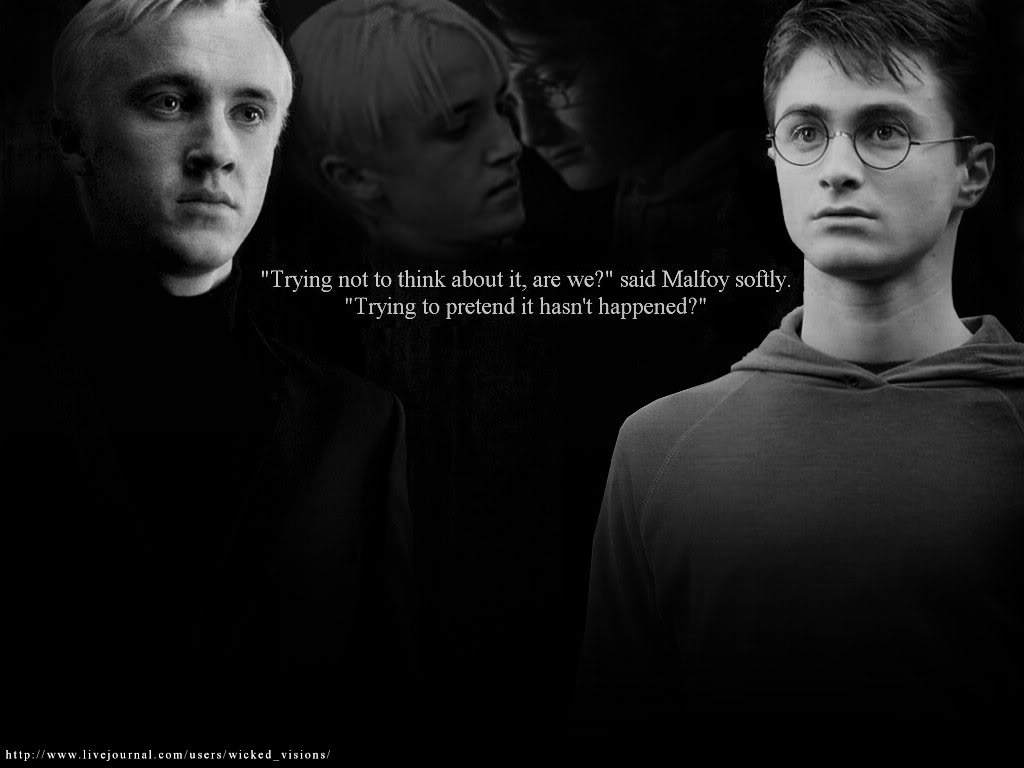
Harry Potter/Draco Malfoy slash is actually where I was (re)introduced to the world of fan-created fiction, when Hanna shared the saga of Underwater Light with me (now no longer available online, though you can read about it over at Fanlore.org). It was Underwater Light that convinced me that fan fiction was a genre worth paying attention to, not only as a “guilty pleasure” but as a literary endeavor that could actually sometimes be more skillful than the original creation to which it owed inspiration.

Tissue of Silver isn’t Underwater Light though its characterization of both Harry and Draco owe a lot to UL author Maya. However, it’s easily the most entertaining Harry/Draco fic I’ve read in a while. The downside is its lack of explicit sex (c’mon, you know that’s a huge reason we’re reading this stuff); the upside is the care with which author Fearless Diva constructs her post-series world, and the characters within it who have been given a depth that, really, Rowling never managed (I’m serious).

Title: Tissue of Silver
Author: Fearless Diva
Pairing: Harry Potter/Draco Malfoy
Author Rating: R “for coarse language, brief drug use, some sexual content, and consideration of issues of sexual consent.”
Author Summary: “A love story concerning possessed furniture, black silk pyjamas, courtroom drama, premonitions of doom, assassination attempts, Death Eater yoga, absinthe, bare feet and a sensible werewolf.”
Length: 576K (one long chapter)
Available At: Fearless Diva’s Harry Potter Fiction page (along with short pieces set in the same universe … “Famous for Their Discord” and “Voluptas” come highly recommended) and also recorded by FayJay (for the win!) at AudioFic.

I’m not going to say a whole lot more about this, so as not to spoiler things. The basic set-up is this: in a post-series, post-war world Draco Malfoy (who served as a spy for the anti-Death Eater side) is testifying at a series of Death Eater trials. He is also flamingly gay and very Peter Wimsey in his affected non-chalance. When threats are made against his life, (ostensibly)straight tabloid sensation Harry Potter (“Super Auror”) is assigned to keep him safe. Shenanigans ensue.

There are also letters to and from Draco to his godfather Severus Snape which are hilarious, and have I mentioned Remus and Sirius make cameo appearances as Harry’s godfather and godfather-in-law?

And obviously the Chair of Evil. Go forth and read.

← Older posts
Newer posts →
"the past is a wild party; check your preconceptions at the door." ~ Emma Donoghue

Recent Posts

  • medical update 11.11.22
  • medical update 6.4.22
  • medical update 1.16.2022
  • medical update 10.13.2021
  • medical update 8.17.2021

Archives

Categories

Creative Commons License

This work by Anna J. Clutterbuck-Cook is licensed under a Creative Commons Attribution 3.0 Unported License

Meta

  • Create account
  • Log in
  • Entries feed
  • Comments feed
  • WordPress.com

Blog at WordPress.com.

  • Subscribe Subscribed
    • the feminist librarian
    • Join 37 other subscribers
    • Already have a WordPress.com account? Log in now.
    • the feminist librarian
    • Subscribe Subscribed
    • Sign up
    • Log in
    • Report this content
    • View site in Reader
    • Manage subscriptions
    • Collapse this bar