• anna j. clutterbuck-cook
  • contact
  • curriculum vitae
  • find me elsewhere
  • marilyn ross memorial book prize

the feminist librarian

the feminist librarian

Tag Archives: gender and sexuality

booknotes: serving LGBTIQ library and archives users

07 Thursday Apr 2011

Posted by Anna Clutterbuck-Cook in book reviews

≈ Leave a comment

Tags

gender and sexuality, librarians, politics

The most recent batch of Early Reviewer titles offered at LibraryThing included this collection of essays for library and archives professionals: Serving LGBTIQ Library and Archives Users, edited by Ellen Greenblatt (Jefferson, N. C.: McFarland & Co., 2011). Being a librarian, I naturally put my name in for a copy and, lo!, I recieved it in the mail earlier this week.

Serving LGBTIQ… is a follow-up volume to Greenblatt’s Gay and Lesbian Library Services (1990), now twenty years out of date. As Greenblatt observes in her introduction to Serving LGBTIQ, a lot has shifted in the queer community and in the world of library and information science during the past two decades.

Most obviously, the scope of the book has broadened to include more letters in the alphabet soup of sexual identity and orientation. Linguistically speaking, I really, really wish they’d just gone with “queer.” The repeated use of “LGBTIQ” throughout the text was so clunky it made me want to scream … plus it just makes me think of the identities they’ve left out (neither asexuality or poly make it in) rather than reassuring me they’ve been all-inclusive.  At the same time, there does seem to have been honest effort put into the contents of the volume to provide a diverse range of topics — not simply essays about gay and lesbian folks under the guise of writing about non-straight communities in all their glorious iterations.

Another way in which the world of queer library services (indeed all library services) has irrevocably shifted since 1990 is the advent of the internet and the way in which online access to information and social networking has so rapidly saturated our culture. In 1990, few of us had heard of or made us of the World Wide Web; today most of my professional life is spent interacting in some fashion with the tools available to me via the internet (including the acquisition of this book and the blog post I’m currently writing about it). A significant number of essays in Serving LGBTIQ discuss the particular importance of internet access to queer folks as a source of information and as a space in which to connect with other queer people and explore their sexual desires. Given the popular concern about not only non-straight sexuality but also access to sexually explicit material online in general, a number of the essays stress the importance of ensuring that queer adults and teens (particularly) are not blocked from accessing needed information and social networking resources because of internet filters or other use policies.

I feel like I repeat this mantra a lot when it comes to anthologies, but it really is a truism: anthologies are almost by default uneven in nature. If you think this book might have something of use to you, I’d suggest at least browsing the table of contents before ordering … unless you happen to have a book budget and this particular text fits the bill of a professional purchase. This is a book geared distinctly toward practicing librarians (and, to a lesser extent, archivists), with an emphasis on praxis over analysis or theorizing. There are a lot of essays that trend toward case studies or profiles light on analysis, and pieces which read more like policy recommendations rather than in-depth examinations of the topic at hand. I actually found the profiles of various institutions (such as community-based archives), initiatives (oral history projects, web-based history projects) and political case studies (attempts to ban YA literature with queer themes) to be the most interesting part and potentially useful part of the volume. The recommendations for collection development, outreach initiatives, and other ways to be “queer friendly” felt fairly boiler plate to me. Maybe for folks who feel intimidated by the idea of reaching out to, or supporting, non-straight patrons, the practical advice in this volume could cut through a lot of the anxiety or fear. As it was, I’m not sure I learned a whole lot I don’t already know about the basics of being open and welcoming to all folks, regardless of orientation and self-presentation.

And ultimately, I suppose, the hope might be that guides like this will eventually become redundant or superfluous, as community spaces like libraries and archives move away from exclusionary practices (whether through intentional discrimination or simple thoughtlessness) and toward more democratic, inclusionary ones. It will be interesting to see what a volume of essays addressing these same (or similar) concerns will look like in 2031 – twenty years down the road.

ficnotes: transport

05 Tuesday Apr 2011

Posted by Anna Clutterbuck-Cook in fandom

≈ 1 Comment

Tags

fanfic, gender and sexuality

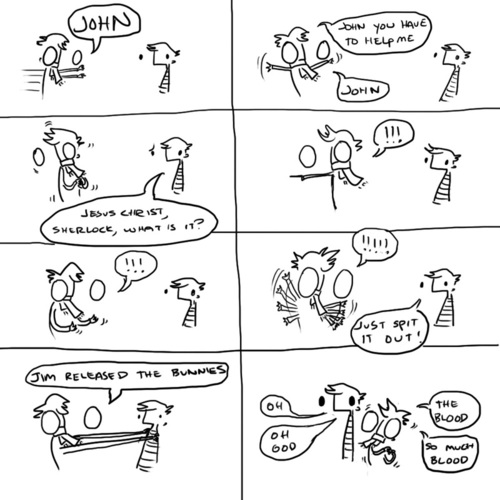
from the blind banker, capped by killcolor

I owe my friend Minerva @ Hypomnemata a big thank you for posting a link to this particular fic.

Title: Transport
Author: ThisPrettyWren
Pairing: Sherlock/John (Sherlock BBC)
Alerts: Bondage, Sensory Deprivation
Rating: NC-17
Length: circa. 10,500 words
Available At: ThisPrettyWren’s the unattended kettle and the epilogue can be found here.

Where to begin with this particular fic. The first thing you need to understand is that this is definitely a kink fic in which Sherlock’s chosen form of sexual outlet is bondage and sensory deprivation followed by anonymous sexual/sensual touch. At a sex club where John Watson occasionally provides his services as the doctor on call.

What I think this piece (amazingly enough the author’s first pass at writing explicit slash) does brilliantly is convey the way that, for Sherlock Holmes, lack of sensory input serves to increase his capacity for relating and communicating with others (read: John) in an intimate way. In a way that make shim feel cared for, connected and grounded. By engaging in activities that many of us would see at first glance as distancing, as dis-engagement, as a refusal to accept human-to-human intimacy with a known other being … Sherlock is actually able to experience intimacy on a profound level.  

Also: don’t miss the epilogue, wherein the author explores the way that this intimacy between John and Sherlock serves to help Sherlock function in the world outside of sex — how it helps him feel known in a way that keeps him present and focused where he might just fall to pieces otherwise.

Go enjoy!

in love with new blogs: born this way

24 Thursday Mar 2011

Posted by Anna Clutterbuck-Cook in linkspam

≈ 2 Comments

Tags

call to participate, children, gender and sexuality, in love with new blogs

Okay. I don’t know about you folks, but this week has really knocked me back a few paces in one way or another. Can’t believe it’s only Thursday. Looking forward to the weekend. But! In the meantime, what does one do to de-stress?

Well, there are lots of options, but the one I’m going to share here is my new favorite blog: Born This Way!

In its own words, Born This Way! is “A photo/essay project for gay adults (of all genders) to submit childhood pictures and stories (roughly ages 2 to 12), reflecting memories & early beginnings of their innate LGBTQ selves.”

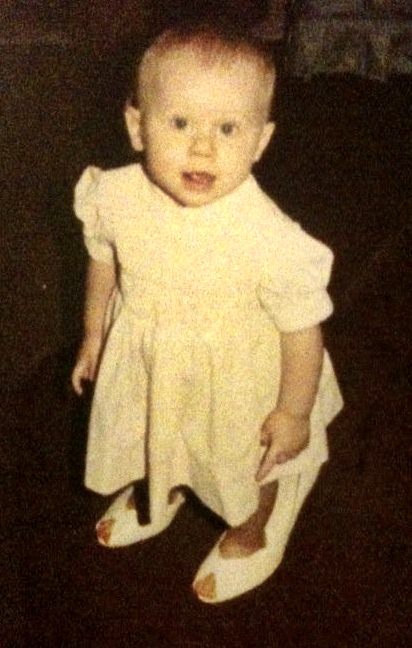
Heather, age 1

Quite simply: How could you not become addicted to a blog devoted to posting adorable pictures of queer folks when they were children, alongside stories of their early memories of growing up not-quite-straight? Sometimes the snippets of life are hard, sometimes they’re heartening. I know not everyone will agree with me, but I find every single one of the photographs completely compelling — no matter how awkward they might be, particularly when read alongside stories of childhood marginalization. I think the thing I love most about them is that, almost by default, every single child in these photographs has grown into a self-possessed adult who believes in themselves enough to submit their story to this blog. They are, by definition, all resilient survivors.

Here are a few of my favorite pictures and memories from the last couple of weeks’ worth of posts.


Heather, age 1 (Guam, USA)


“I first learned that openly admiring girls was ‘wrong’ when I was 4, and saw an episode of ‘Beverly Hills 90210.’ It was a beach scene, and the girls were in bikinis. Several times, I mentioned how pretty the girls were, and my aunt told my mom I was going to be gay. Oh, me and my mouth.”

Clarissa, age 4 (Bronx, NY)


Clarissa, age 4 (Bronx, NY)

 “I loved being a tomboy! I wanted to be tough and dirty, and would go to work with my dad the mechanic. I didn’t always wear coveralls, though. My mom found a way to get me to wear dresses by making them herself, patterning them after Lucy Van Pelt of the ‘Peanuts’ cartoon. I acknowledged Lucy’s toughness, and felt tough in those dresses, too!”

Isaac, age 4 (Lodi, WI)
“This is a picture of me dressing up in the pre-school that I attended. It was actually published in the local paper, for a feature story about the pre-school. I loved to put on that tutu and dance around the play area, and pretend to be a princess. I loved making the other students play princess with me, especially the boys.”

It’s interesting to me, reading these submissions, how often gender-atypical behavior (being a girl who resists dresses, a boy who likes makeup) gets identified by the author of the post as one of their earliest signs that they were “different” … even though gender-atypical behavior doesn’t actually correlate with a non-straight sexual orientation. I wonder if these narratives of being gender-atypical are a product of adults looking back into their own childhoods in search of confirmation that they were queer from their earliest memories — long before they would have had conscious feelings of adult sexual desire. I certainly know that since realizing (as an adult) my fluid sexuality, I’ve caught myself looking backwards into the past for signs of queerness in my childhood. Sometimes I question whether that’s the most accurate or valid approach to self-confirmation!

But that’s enough metaphysical speculation for today! If you yourself identify as queer and want to participate in the project, check out the submission guidelines page. It’s definitely on my own “to do” list once I have a little space to breathe around here. If/when I end up submitting something and if/when it gets published, watch for the link to appear right here at the feminist librarian.

booknotes: dare … to try bisexuality

10 Thursday Mar 2011

Posted by Anna Clutterbuck-Cook in book reviews

≈ 1 Comment

Tags

gender and sexuality

Once again, LibraryThing‘s Early Reviewer program has provided me with an advance review copy of something related to queer sexuality — although this time around the results were (intentionally or not) much more hilarious than Making it Legal. Dare … to try Bisexuality by Pierre Des Esseintes is a slim 100-page volume, originally published in French and one installment in a series of instructional books that include such titles as Dare … to Have Anal Sex and Dare … to Try Bondage. “Saucy sex advice from France!” announces the cover cheerfully.

You might ask why I requested a review copy of this book (and it would be a fair question). I had misgivings about it from the title alone: “try” a sexual orientation? Um … come again?  I mean, I’m definitely a believer in sexual fluidity, but that doesn’t imply that “bisexuality” is something one can take on and take off at whim, like a new sweater or experimental color of lipstick. Rather, it suggests that our sexual desires and affectional attractions are unpredictable, and that we should cultivate an openness to the possibility of change over time.  The title of this book suggested, on its face, a much more … gung ho! approach? And I was wary.

What I realized, once I’d cracked the spine, was that the title is, in part, suffering from cross-cultural meanings becoming lost in translation.  Whereas an American audience would read “bisexual” as an orientation, this French manual is clearly situating it as a lifestyle. What, in American terms, is probably more aptly described as being “polyamorous,” seeking out open or swinging relationships, or perhaps just slutting it up with partners of multiple sexes. Well, with both male and female partners. Maybe trans folks as well, but the text is unclear about that.

Actually, Des Esseintes is all over the frigging map when it comes to what, exactly, he means by “bisexuality.” Sometimes he seems to approach it as an orientation, sometimes he actually seems to be talking more about transsexuality (chapter one is titled “Bi: Between Two Sexualities or Both at Once?” and discusses the myth of Hermaphrodite). Most of the book treats bisexual behavior (i.e. individuals who seek out both same- and other-sex sexual partners) as something fun and optional. Something any person might try out as a possible approach to sexual relationships that could work for them. This is both highly amusing and highly irritating — throughout my reading I was distracted by trying to decide whether the man was being delibrately over-inclusive in his terms and examples, or whether this was just a case of sloppy thinking and/or sloppy translation. I still haven’t decided.

Overall, the book invokes pretty much every stereotype about bisexuality as well as relying heavily on false notions of gender difference. Take, for example, this passage in the chapter on women’s bisexual behavior:

At some point in their lives, some girls, whether or not they live with a man, need a kind of loving they can’t get from guys. All the women who opined to us about the differences between men and women in bed highlighted the tenderness and gentleness that women alone can deliver (53).

Note how this passage implies that people who feel bisexual desires “need” to act on those desires, because they won’t be totally satisfied with the sex that they’re going to get from a single partner (representing only one of the sexes they are attracted to).  Plus, “women alone,” apparently, are capable of delivering tenderness and gentleness in bed … an assertion that I’m pretty sure would astound a great number of women in relationships with men.  Des Esseintes goes on to suggest that lesbian lovers are all, by virtue of gender, noncompetitive cuddlefests … an assertion I think would come as a surprise to many lesbians who enjoy a little topping/bottoming action in the bedroom in addition to candles, massage oil, and snuggling.

The most positive thing I can say about this book, really, is that it is written in the spirit of informational neutrality. For all its stereotypical depictions of sexuality and sexual relationships, the book conveys basically responsible advice about sexual health (see “A note on taking precautions before blowing a stranger,” p. 33) and is blithely encouraging to its readers about giving “bisexuality” a go, on the chance it floats your boat. Chapter six (“Bi in Bed: Choreography”) offers step-by-step instructions — with illustrations! — for various three- and four-person positions for getting off. “You too!” the book seems to shout, “can recruit your friends and lovers to enjoy the pleasures of The Magic Square!”

Go forth and be amused.

ficnotes: imperfection

09 Wednesday Mar 2011

Posted by Anna Clutterbuck-Cook in fandom

≈ 2 Comments

Tags

fanfic, gender and sexuality

Ginny Weasley

Over the weekend, I participated in a telephone interview with a graduate student doing research on women’s experience with “sexually explicit materials” (i.e. pornography and erotica). And, what with one thing and another, we got discussing fanfiction and I observed to her — because this has been a topic of conversation among friends recently — how frustrating it is that so few fic authors write really good lesbian slash. I am definitely into lesbian erotica (coughcough), but most of the fanfiction I read tends to be about male characters. I love these stories, but it makes me sad sometimes that lesbian love stories are so thin on the ground in the fanfiction genre.

Maybe I’ve found my calling as a writer …?

But in the meantime, I thought I’d tip my hat to F/F slash with this sweet little one-shot Harry Potter fic by author FayJay (whose work I plan to feature in several other ficnotes in weeks to come).

Title: Imperfection
Author: FayJay
Pairing: Hermione/Ginny
Rating: PG-13 (my rating; author didn’t give one)
Length: 2121 words (one chapter)
Available At:
Archive of Our Own

This fic falls into the genre of same-sex flirtation that grows out of two girls discussing their sexual experience with boys, and how it … lacks something. Something they can’t quite put their fingers on (double entendre very much intended).

I’m going to continue my quest for better F/F fic in the months to come, so watch for future installments of ficnotes featuring (I hope!) awesome female characters in addition to the usual suspects.

ficnotes: my phone’s on vibrate for you

01 Tuesday Mar 2011

Posted by Anna Clutterbuck-Cook in fandom

≈ Leave a comment

Tags

british isles, fanfic, gender and sexuality, movies

Last week, I offered up one of my favorite one-shots by Miss Lucy Jane. This week, we’re returning to Miss Lucy Jane for a five-part work in progress that starts out as a lark and ends up … a bit more serious.

Title: My Phone’s On Vibrate For You
Author: Miss Lucy Jane
Pairing: John/Sherlock
Rating: NC-17
Length: currently five parts, work-in-progress
Available At:
MissLucyJane.com: Part 1, Part 2, Part 3, Part 4, Part 5 (navigation links on the right-hand side of each page).

Playing with Sherlock’s penchant for texting John instructions, this fic begins with flirtation via phone. Sherlock texts John all the time, for all sorts of reasons … which is why John isn’t quite sure what to make of the text that reads: “When you get home I want to blow you against the front door. SH.” Or the following one that reads: “And then I want you to fuck me on the stairs. I can’t wait long enough to get you into bed. SH.”

The relationship begins as a “fuck buddies” sort of arrangement, but it isn’t long before both men realize that it means a bit more than that.

(I don’t know what it says about me that I’m writing this fic up while listening to Martin Sheen giving John Spencer a history lesson about Galileo in West Wing 2.9. I’m torn between a) assuming that I’ve finally learned how to multi-task and b) that I find slash fic and American politics equally sexy. Feel free to weigh in.)

booknotes: making it legal

24 Thursday Feb 2011

Posted by Anna Clutterbuck-Cook in book reviews

≈ Leave a comment

Tags

books, gender and sexuality, human rights, politics

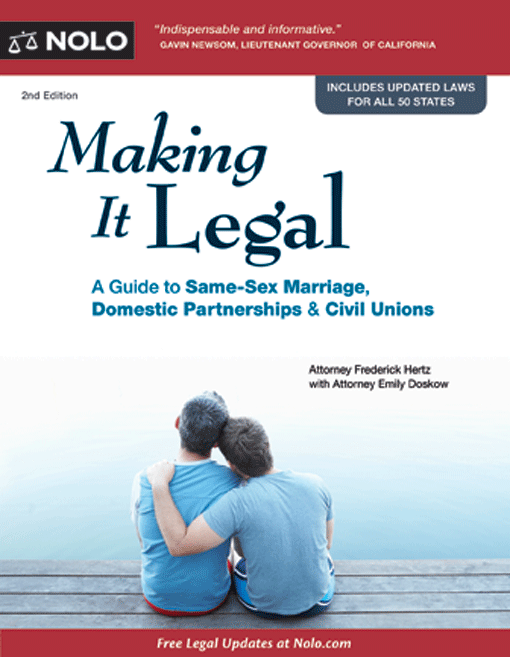
Through LibraryThing‘s Early Reviewer program I was sent an advance review copy of the second edition of NOLO’s Making It Legal: A Guide to Same-Sex Marriage, Domestic Partnerships & Civil Unions, by attorneys Frederick Hertz and Emily Doskow (Berkeley, CA: NOLO, 2009; 2011). The book aims to be a practical nuts-and-bolts guide for same-sex couples considering marriage. It offers a whirlwind tour of the history of same-sex marriage, the current international and domestic context for such marriages, and the nitty-gritty of marriage and divorce laws as they apply to all couples — as well as specific advice for same-sex couples who are considering forming legal relationships.

The authors go beyond describing legal rights and obligations and also discuss political activism and the emotional and sociocultural meaning — and potential downsides — of marriage commitments. Hertz, who appears to be the primary author of the text, describes himself as a cautious in his advice to couples seeking to enter marriage. “I’m often branded an antimarriage lawyer,” he ruefully admits, “because I tend to focus on the risks and downsides of this powerfully attractive institution.” He points out that “the legal structures of conventional marriage and the patchwork of nonrecognition by other jurisdictions create fairly serious legal problems for many couples, and it is just plain unwise for anyone to get married without understanding the potential risks and benefits” (3).

As someone in a lesbian relationship, and as someone who has actually discussed marriage with my partner, I found a lot of the practical legal information in this text helpful. Particularly useful are the state-by-state charts detailing what options, rights, and responsibilities same-sex couples have when entering into formal partnership agreements in different states. Hanna and I are fortunate enough to live in Massachusetts, one of the states that currently allows us to marry and enjoy all of the same state benefits as heterosexual married couples. However, these benefits do not extend to the federal level, nor would that marriage be considered valid in a number of other states (including my home state of Michigan) — that’s where the “nonrecognition” issue comes in. This means, practically, that same-sex marriage can be a bureaucratic headache. For example — since it’s that time of year — married same-sex couples in the state of Massachusetts file a joint tax return at the state level … but are single for the purposes of their federal tax returns. Which means creating a mock joint federal tax return and using those numbers for the state level returns. Even more tax paperwork — the joy!

And if we ever moved across state lines for work or family need (or hell, for the pleasure of it) then the state we moved to would get to determine whether we were married or not, based on their own local laws. Not to mention if we decided to move internationally.

I found Making It Legal at its most annoying when it shifted away from describing the practial ramifications of same-sex partnership options (both forming and dissolving those partnerships) and attempted to tackle the other aspects of marriage, such as “applying logic to picking a partner.” Wtf? Dude! You’re not a trained marriage counselor so back the fuck off!

On the whole, though, it was a highly readable guide to the legal landscape, and one which I definitely plan on consulting as Hanna and I move forward with the business of making our relationship into a long-term reality … however we decide to formally recognize it.

ficnotes: kissing john watson

23 Wednesday Feb 2011

Posted by Anna Clutterbuck-Cook in fandom

≈ Leave a comment

Tags

british isles, fanfic, gender and sexuality, movies

by daisukikawaii 

As predicted, things are a bit scattered this week and blogging time is thin on the ground. But somehow conversation at our apartment wound its way around to the joys of kissing yesterday evening, and that made me think of this little gem of a fic from the superlative Miss Lucy Jane.

Title: Kissing John Watson
Author: Miss Lucy Jane
Pairing: John/Sherlock
Rating: PG
Length: 1900 words (one chapter)
Available At:
MissLucyJane.com

Fic authors playing with the BBC Sherlock universe tackle Sherlock’s sexual history and inclinations in a number of different ways, each of which presents its own charms and dilemmas for a writer of smut. One of the most charming iterations is a Sherlock who has just discovered, through his relationship with John Watson, a whole new realm of sensual experience that provides him with an explosion of data. Sometimes this Sherlock is overwhelmed by the flood of new information, and sometimes — as in this fic — he embraces it with the enthusiasm of a child in a chocolate shop.

ficnotes: the paradox series

15 Tuesday Feb 2011

Posted by Anna Clutterbuck-Cook in fandom

≈ Leave a comment

Tags

fanfic, gender and sexuality

Bunnies: They Are Scary, by AngryBeige

So I’ve recently been getting back into reading fan fiction, something I wrote a bit about over at The Pursuit of Harpyness a few weeks ago. This has been prompted in part by the pleasure Hanna and I and our friend Minerva have been having reading through the copious amount of fic associated with the new BBC Sherlock series. Mostly “slash” fic (sexually explicit fan-created fiction pairing characters from a show or novel and riffing on that relationship), and mostly John Watson / Sherlock Holmes slash (though Minerva has a particular weakness for Lestrade/Mycroft … a pairing she has convinced us to reconsider!)
And because fic is what I’ve been reading, when I’m not reading blog posts, general nonfiction, or thesis-related stuff … I thought, why not write “notes” about it like I do about the novels I read? So here’s my first one: thoughts on The Paradox Series by Wordstrings (h/t to Minerva tipping me off to this particular fic’s existence!).

First, the “publication” details:

Title: The Paradox Series (see chapters below)
Author: Wordstrings
Pairing: John/Sherlock
Rating: NC-17 overall, though not all chapters are so sexually explicit.
Length: Work in Progress, currently comprised of the following stories:

  • An Act of Charity (one chapter)
  • The Paradox Suite (one chapter)
  • The Death and Resurrection of the English Language (two chapters)
  • Entirely Covered by Your Invisible Name (two chapters)
  • Wider Than a Mile (one chapter)
  • New Days to Throw Your Chains Away (two chapters)
  • A Thousand Threads of What-Might-Have-Beens (three chapters)

Available At: Wordstring’s LiveJournal (links to all chapters to-date, with author’s notes)
Alternate Forms: Some chapters are available in MP3 form at Audiofic (amazing!)

So why did I choose to start out my (hopefully series of) ficnotes with this particular set of stories? In short: because I think they’re genius. I realize is an entirely subjective opinion, so I’ll try to articulate some of the reasons why and then (obviously) it’ll be up to you to judge for yourselves.

A brief description. This series arc is written in alternating John and Sherlock point-of-view narratives, beginning with Sherlock’s account of their first kiss (“An Act of Charity”) and exploring their growing relationship through to “A Thousand Threads of What-Might-Have Beens” which is a three-part installment — again from Sherlock’s point of view — about what happens when John walks out on Sherlock after one of Sherlock’s experiements nearly ends in Sherlock’s own death.

The Sherlock in this fic is dark, chaotic, and struggling with mental health issues. I don’t know enough about mental health to identify what sort of “faulty wiring” he’s dealing with, but whatever it is it manifests in bouts of mania and depression, feelings of numbness and terror at the sheer overwhelming nature of the world, fixations, obsessive and repetitive actions, and a fairly extreme distance from empathic emotions. To be clear, he’s not incapable of empathy — it reads more as if he’s so overwhelmed by the prospect of caring for others with the intensity that he approaches all of his activities that he has just precluded this aspect of life.

Until John Watson arrives, of course. And refuses to leave. Refuses to be scared of Sherlock’s darkness. Is, in fact, exhilerated by and lovingly understanding of Sherlock’s darkness. While also acting as a grounding presence to help Sherlock discern “good” from “bit not good,” and “fine” from “not fine.”

John in this fic also embodies a fair bit of darkness. A figure of stability he might be, when compared to Sherlock’s careering mania or gigantic — sometimes drug-aided — mood swings. Yet he also thrives in the adrenaline-pumped atmosphere that exists around Sherlock Holmes. And as much as he pushes back against the detective’s more extreme impulses towards self-harm and harm to others (including, occasionally, to harm to John), he also thrills to it. As Sherlock observes more than once: They both love crime scenes.

The author has taken to prefacing each chapter of the fic with the following caution: “WARNING: this fic paints a picture of a relationship many reasonable people would find crosses the line into disturbingly possessive and/or flirting with actual abuse.  Also, if brief physical violence to a partner bothers you, skip this fic.  I’d never fault you for it in the slightest.”  So if that kind of thing is a trigger for you or just isn’t your cup of tea, you may want to skip this series. However, I’d argue that while John and Sherlock live on the edge and occasionally enjoy forcibily restraining one another or otherwise being fairly rough the actual quality of their relationship is deeply consensual and healing for them both. This could just be me. But. I want to throw that out there. Unless you know it’s not your thing, please don’t let the warning deter you.

Because Wordstrings has an achingly accomplished way with words, and if you let her she will weave her spell and draw you in and it will be brilliant.

Personally, I’m draw in by a few particular aspects of the way Wordstrings writes. The first is her ability with dialog and interior dialog. Her characters speak with very particular rhythms, and very human rhythms. Their sentences are fragments, faltering. Backing up and beginning again as the characters struggle to put language to their emotions and order to their thoughts. This is true for both John and Sherlock, though in utterly distinct voices.

The second thing I’m captivated by is the interiority of the narratives, the attention to detail. This makes me think that Wordstrings is (or has been) a poet, because her narrative prose has a lilt to it, a rhythm. And her language is very visual — it has texture and precision the way my poetry professor years ago in undergrad used to encourage us to write. This fic explores the world of the senses. Something that both makes sense in terms of the way Sherlock makes sense of the world (what else is he but a creature of his senses?) and is also incredibly sensual. Because it encourages us to move into a mode where we are conscious of sensory input.

Third, I am seduced by the depiction, in Paradox, of a relationship in which each partner puts an incredible amount of care and effort into understanding the person whom they love. Again: it’s the attention to detail. For Sherlock, this means cataloging John. He observes, notes, narrates, explicates John’s material and emotional landscape in a way that is often much more nuanced than John himself can manage (or cares to undertake). He documents. Which is —  in my opinion — an act of love.

Not all that might be needed, but certainly one act of caring: Attention.

John, for his part, attends to Sherlock by bridging what Sherlock assumed to be an unbridgeable gap. He is able to draw out from Sherlock, and help Sherlock make sense of, the contents of his highly disordered and frightening interior life. Sherlock is scared of himself: John faces that self without faltering. Flinching, perhaps. Failing, at times. But with the certainty that together they will perservere and communicate and connect.

Isn’t this, in the end, what we all hope for in love? Someone who will see us in all our messy humanity and — instead of rejecting us — embrace us unconditionally? Help us make better sense of ourselves, help us translate ourselves into better human beings, than we would be able to manage on our own?

And finally, let me give a shout-out to FayJay @ Audiofic who has been reading Wordstring’s installments aloud and uploading them as MP3 files. Fanfic read aloud. It’s a rather lovely thing to be able to listen to such poetic language while on my morning commute or buying groceries at Trader Joe’s.

call to participate: preliminary survey on women & erotica use

08 Tuesday Feb 2011

Posted by Anna Clutterbuck-Cook in linkspam

≈ Leave a comment

Tags

call to participate, feminism, gender and sexuality

via Charlie Glickman

Are You a Woman Who Views, Reads, or Listens to Pornography, Erotica, Romance Novels, and/or any other Sexually Explicit Materials?

If so, please share your experiences!

Complete a Short Survey (30 min or less) and Contribute to a Scholarly Understanding of Women’s Experiences with Sexually Explicit Materials

My name is Kari Hempel and I am a female psychology graduate student who is doing my dissertation research on women’s experiences with sexually explicit materials. For too long women’s real experiences with these materials have been ignored. My goal is not to judge anyone’s experiences, but to accumulate surveys from as many women as possible around the country about their positive, negative, and/or mixed experiences with sexually explicit materials, and to present the differences and commonalities in a scholarly, respectful fashion.

Your Participation is Completely Confidential

Any identifying information that is asked for in the completion of this study will be kept completely confidential and will be destroyed once the study is complete.

You Qualify for Participation If:

  • You are a woman (at least 18 years old)
  • You currently view, read, or listen to any written, audio, visual, or audio-visual material that is sexually explicit (including but not limited to films, magazines, novels, and audio-recordings)
  • You currently live in the United States

To Participate Go To:

https://www.surveymonkey.com/s/womens_experiences

If you have any questions or concerns, please call or email me. I am happy to address them!
Kari Hempel, MA
503-208-4083
karihempel@yahoo.com

I just completed the survey myself this morning. Some of the questions are worded oddly … but I always think that with multple-choice questions! And there’s the opportunity at the end to sign up if you’re interested in being interviewed by Ms. Hempel more extensively as part of her research project.

← Older posts
Newer posts →
"the past is a wild party; check your preconceptions at the door." ~ Emma Donoghue

Recent Posts

  • medical update 11.11.22
  • medical update 6.4.22
  • medical update 1.16.2022
  • medical update 10.13.2021
  • medical update 8.17.2021

Archives

Categories

Creative Commons License

This work by Anna J. Clutterbuck-Cook is licensed under a Creative Commons Attribution 3.0 Unported License

Meta

  • Create account
  • Log in
  • Entries feed
  • Comments feed
  • WordPress.com

Create a free website or blog at WordPress.com.

  • Subscribe Subscribed
    • the feminist librarian
    • Join 37 other subscribers
    • Already have a WordPress.com account? Log in now.
    • the feminist librarian
    • Subscribe Subscribed
    • Sign up
    • Log in
    • Report this content
    • View site in Reader
    • Manage subscriptions
    • Collapse this bar