• anna j. clutterbuck-cook
  • contact
  • curriculum vitae
  • find me elsewhere
  • marilyn ross memorial book prize

the feminist librarian

the feminist librarian

Tag Archives: history

Quick Hit: London Tube Map History

10 Thursday Dec 2009

Posted by Anna Clutterbuck-Cook in linkspam

≈ Leave a comment

Tags

history, photos, travel

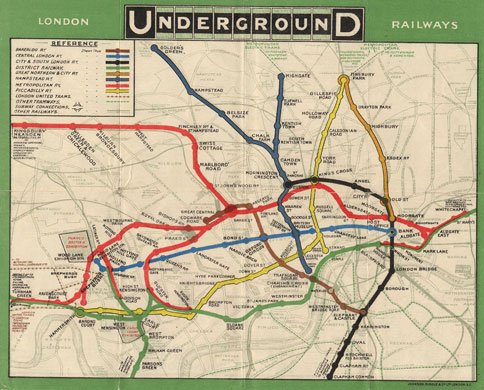
Last week I stumbled into a great slide show put together by the Guardian; a history of the iconic London tube map in pictures.

Tube maps have been part of London life since the birth of the Underground, and were initially as confusing as the city itself: a tangle of different lines woven around the curving River Thames. Enter Harry Beck, an LU engineer who in 1931 came up with the radical idea of presenting the ever-expanding network as a circuit diagram rather than a geographical map – so creating a modernist design icon that has never been bettered. But as the Oystercard zone expands, are its days numbered? Take a look back at the changing face of the tube over the last century.

Hop on over to the Guardian site to check it out.

Wintersession: Digital Memorial and Cultural Archives

08 Tuesday Dec 2009

Posted by Anna Clutterbuck-Cook in library life

≈ Leave a comment

Tags

history, librarians, simmons, thesis

On a quick personal and professional note (for all of you who read this blog to find out What Anna Get’s Up To When We Aren’t There To Keep An Eye On Her):

I’m excited to report that I’ve been accepted to participate in a wintersession course (beginning this evening) on Development of Digital Memorial and Cultural Archives, taught by Kevin Glick, Electronic Records Archivist from Yale University. The class is being offered as a joint project between Southern Connecticut State University and the group Voices of September 11, which curates the 9/11 Living Memorial digital archive to commemorate the lives and stories of September 11, 2001 and the February 26, 1993 World Trade Center bombing.

I’m really excited to be taking this class, since I am hoping to create a digital archive for the materials I collect as part of my oral history research. I am also looking forward to broadening my knowledge of New England a bit, since I have never been to Connecticut except passing through on the Amtrak on the way to New York City. Now I have a totally educational (read: legitimate) excuse to make the trip!

On the Syllabus: The Great Crusade and After

24 Tuesday Nov 2009

Posted by Anna Clutterbuck-Cook in my historian hat

≈ Leave a comment

Tags

feminism, history, simmons

A few weeks ago, I posted an excerpt from Charles and Mary Beard’s The Rise of American Civilization on the women’s struggle for suffrage and the passage of the 19th amendment. Below is another version of this same story, offered in the twelfth volume of A History of American Life, a formidable accounting of American history edited by Arthur M. Schlesinger. This volume, The Great Crusade and After, 1914-1928, was written by Preston William Slosson and first appeared in 1930. In the section “Woman Wins Equality,” Slosson writes of female suffrage

The Nineteenth Amendment which extended the political franchise to American women, already emancipated in everything save politics, followed about half a year after the Eighteenth, prohibiting the sale of alcoholic liquors. The twin amendments–twin victories for feminism some would say–had much in common. Both prohibition and woman suffrage had roots deep in American history and represented a final triumph obtained after almost a century of continuous agitation. Both were attempted in many places on a state-wide scale before they forced their way to the front as national issues. Both were first mooted by Puritan reformed in Northeastern states, when actually carried into effect by their radical sons who had moved to the Western plains and mountains, and opposed almost to the last ditch by their conservative grandsons who had stayed in the East. (157)

Several things strike me about this framing of the 19th Amendment. Much like the Beards, Slosson writes of suffrage as the culmination of a century-long struggle of women for “equality,” possibly going even further than the Beards by explicitly describing enfranchisement as the last barrier to women who were “already emancipated in everything save politics.” Pairing the 19th Amendment with Prohibition places women’s suffrage rights in the context of nineteenth-century social reform movements. He is not wrong in making the case that Prohibition was seen, in many circles, as a victory for women generally and feminist activists particularly, since the evils of liquor were often characterized by prohibition activists as adversely affecting women and children by encouraging men to spend wages on drink and neglect their families in favor of the homosocial (largely-male) world of pubs and clubs where alcohol was served.

A few pages later, Slosson goes on to describe how the suffrage campaign was ultimately won, highlighting what he sees as “the almost complete absence of ‘militancy'” in the American campaign as opposed to the British.

In England a fairly large radical wing of the suffrage movement had tried to badger the government of the day into action by such means as broken windows, interrupting public meetings, destroying mailboxes, and other ‘nuisance tactics.’ Nothing so extreme occurred in the United States, the nearest approach to it perhaps being the picketing of the White House with banners denouncing President Wilson (himself already a convert to the cause) for not putting more pressure on Congress . . . Even this very mild form of militancy was frowned upon by the majority of American suffragists, who used no method except political organization and open discussion. Their speedy success seems to have been due in part to the skill of their political managers, in part to the chivalric tradition in American life which made it difficult to refuse any really sustained demand by women . . . and in part as a tribute to the indispensable services of American women during the World War. (160)

It is notable here that Slosson fails to mention that even the “very mild” tactic of picketing the White House led to the imprisonment of a number of suffrage activists, hunger strikes, and force feedings (see for example Doris Stevens’ account Jailed for Freedom). I also think it’s fascinating to see how he opposes militancy with “political organization and open discussion” in a way that not only favors the latter, but also implies that it was more feminine (appealing to the “chivalric tradition in American life”). I think a number of women activists would at the time have taken umbrage at the notion that one hundred years of agitation equaled “speedy success.” Many of the women who were among the first generation of modern women’s rights activists were no longer alive when the 19th Amendment became federal law. For them, the success was far from speedy: it was, in essence, non-existent.

Quick Hit: Letters of the Presidents

12 Thursday Nov 2009

Posted by Anna Clutterbuck-Cook in library life

≈ Leave a comment

Tags

blogging, history, librarians, MHS

I have a brief post up on the Beehive describing a talk given my friend and colleague Tracy Potter and her intern, Sarah Desmond, at the MHS on their project documenting the letters written by U.S. Presidents in the Society’s collections. For those of you interested in political history, wander on over and check it out.

"eleventh hour of the eleventh day of the eleventh month"

11 Wednesday Nov 2009

Posted by Anna Clutterbuck-Cook in my historian hat

≈ Leave a comment

Tags

history, politics, travel

Today, November 11th, is Armistice Day, the day 91 years ago when the First World War officially came to an end. As an undergraduate when I spent an academic year at the University of Aberdeen in Scotland, I was struck by the omnipresence of the World Wars on the landscape and architecture in Britain. Public memorials proliferated: in churches, schools, high streets, shops, public parks, town squares, train stations . . . name a space and somewhere there will be some sort of memorial plaque or monument or dedication to the fallen. Perhaps it was because of my status as a foreigner (one sees more as a visitor than as a resident in any space), but I did come away with the feeling that Britons co-exist with their collective memories of war and loss in a way that Americans, so often, do not. We remember war, sure, but we are uncomfortable facing the reality of violence, preferring instead to depict war as a triumphant enterprise.


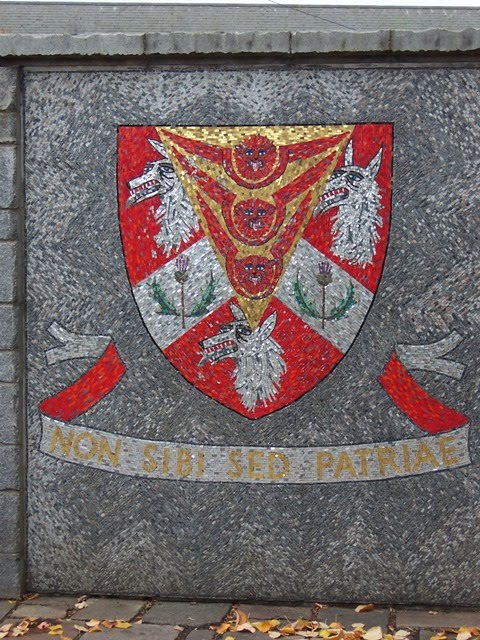
One of my favorite memorials from Aberdeen is this mosaic, funded by a woman who lost three sons during the Second World War, all pilots in the RAF. It is located on the King’s College campus in Old Aberdeen, and I used to walk passed it frequently on my way to and from classes, the library, and errands on High Street.

I don’t really have any Big Thoughts for today other than to encourage all of us to take a few minutes in the midst of whatever our regularly-scheduled plans are to reflect on how often humanity is, indeed, inhumane. And how we live with that reality every day — whether we choose to collectively memorialize it or not.

On the Syllabus: The Survival of a Counterculture

06 Friday Nov 2009

Posted by Anna Clutterbuck-Cook in book reviews

≈ 2 Comments

Tags

children, history, random kindness

The book I’ve been reading this week for my thesis research, The Survival of a Counterculture: Ideological Work and Everyday Life Among Rural Communards, by Bennet M. Berger (Berkeley: University of California Press, 1981) was a find on the Brookline Booksmith $1 cart by Hanna while I was on vacation visiting family (thank you H, for thinking of me!). Even though it was published the year I was born, and written by a sociologist rather than an historian, I am still finding a lot of really good observations and theoretical musings that help me clarify my thinking about the interaction of philosophy and practice in human communities.

Berger set out to study the place of children within “hippie” communes, and although his observations range far and wide in this particular book — not focusing on children to the exclusion of other aspects of commune life, he still spends a good deal of time describing adult interactions with young people. The following excerpt is from his third chapter, “Communal Children: Equalitarianism and the Decline of Age-grading.”

In treating the history of the concept of childhood, social scientists have emphasized the differences between [the pre-industrial] status of children . . . where they are regarded simply as small or inadequate versions of their parents, totally subject to traditional or otherwise arbitrary parental authority . . . [and on the other hand] the modern, industrial, middle-class view of children [in which] children are increasingly treated as members of a distinctive social category, their social participation . . . increasingly limited to age-homogeneous groups.

. . .

The prevalent view of children at The Ranch (and other communes like it) fits neither of these models exactly. Rather than being members of an autonomous category of “children” or being inadequate versions of their parents, legitimately subject to their arbitrary authority, children and young people (or “small persons,” as they are sometimes deliberately, perhaps preciously, called) are primarily regarded as “persons,” members of the communal family, just like anyone else — not necessarily less wise, perhaps less competent, but recognized primarily, as my colleague Bruce Hackett put it, “by lowering one’s line of vision rather than one’s level of discourse.”

Berger’s later descriptions of adult-child interactions at The Ranch illuminate and refine this general philosophical approach to understanding young people in the context of the communal structure — obviously there are nuances to each portion of this description (how is the “less competent” aspect dealt with? what does it mean for children to be seen as potential sources of wisdom?). But I was struck by the re-orientation necessarily in a community where this is the starting point for adult-child interaction, rather than one of the first two positions described (and in our modern American society, the modern, industrial, middle-class ideal dominates, whether or not it is upheld religiously in daily practice). What would it be like to interact with kids primarily “by lowering one’s line of vision rather than one’s level of discourse”?

On the Syllabus: The Rise of American Civilization

04 Wednesday Nov 2009

Posted by Anna Clutterbuck-Cook in book reviews

≈ Leave a comment

Tags

feminism, history, simmons

In my class on archives and collective memory this semester, our final project is a group presentation of one particular case study in how an event or person or activity survives in collective memories over time. My small group chose to focus on female suffrage and the passage of the 19th Amendment. For my portion of the presentation, I am looking at how the American suffragists situated themselves in the context of American history, and subsequently how they moved to consolidate the public memory of suffrage activism in the 1920s and early 1930s.

One of the examples I’ve looked at is the 1927 second volume of history of America, The Rise of American Civilization: The Industrial Era, written by the prolific husband and wife team Charles and Mary Ritter Beard. The Beards’ account of American history was a linear, progressive narrative (as the title suggests); it foregrounded the economic and political contributions of everyday people in contrast to histories that focused on political and social elites. Mary Beard had, herself, been active in the suffrage movement, although she later criticized mid-twentieth-century feminists for focusing too heavily on women’s oppression at the expense of female contributions to “civilization” over the long duree. In The Rise of American Civilization they had the following to say about the push for enfranchisement.

Amid the turbulence connected with this reconstruction in political machinery, woman suffrage was once more brought out of the parlor and the academy, reviving an agitation which, after giving great umbrage to the males of the fuming forties, had died down during the Civil War . . . With a relevancy that could hardly be denied the feminists now asked why the doctrine [of universal suffrage] did not apply to women, only to receive a curt answer from the politicians that sent them flying to the platform to make an appeal to the reasoning of the public at large (562).

This is followed by a description of the state-by-state campaign, the winning of the vote in Western states, and the political tactics of the National Woman Suffrage Association and the National Woman’s Party (go see Iron Jawed Angels). The three-page section ends on the following triumphal note:

In September, 1918, with a congressional election at hand, [President Wilson] went before a joint session of the Senate and the House in person to urge the passage of the national suffrage amendment, yellow with age, as a measure “vital to the winning of the [First World] war.” By June of the following year, the requisite two-thirds vote was assembled and the resolution was sent to the states for ratification. After three-fourths of the commonwealths had approved it, the Nineteenth Amendment was proclaimed in the summer of 1920 a part of the law of the land. The fruit of a hundred years of agitation and social development had finally been garnered.

For the Beards, female suffrage was a naturally-evolving extension of “social development,” a process that extended an ever-increasing body of rights and privileges to Americans. Their worldview seems flawed today, when we harbor deep skepticism about the progressive, linear nature of history and change over time, but I find it noteworthy that they chose to include female suffrage within that picture of social development, however antiquated it may be. I also think it is worth highlighting the Beards’ sense that the battle was won: “the fruit of a hundred years” was now ripe to be plucked by women who chose to exercise their elective franchise. There were activists at the time who challenged this narrow, single-issue concept of turn-of-the-twentieth-century feminist activism — the decision to turn the Nineteenth Amendment into a definitive end point was a deliberate one on the part of Charles and Mary Beard (and it fit well with Mary Beard’s very individualistic notions of women’s power and oppression).

It’s also worth pointing out that there are people today who would agree with the Beards that the right to vote wiped sexism away once and for all, sounding the death knell of feminism (those of use who’ve come after are, as folks so often feel free to inform us, just deluded in our belief that the need for feminist activism remains alive today, nearly a century later). Similarly, there are folks who persist in insinuating (if not outright arguing) that the world might be a better place if women still remained disenfranchised. The suffrage movement might well be the most iconic image of the modern feminist movement, but the ubiquity of its public historical memorializing has hardly brought us to consensus as to its meaning.

Quick Hit: "Sexual Warfare: Rape and the American Civil War"

20 Tuesday Oct 2009

Posted by Anna Clutterbuck-Cook in linkspam

≈ Leave a comment

Tags

blogging, feminism, history, MHS

Research fellow Crystal Feimster gave a brown bag lunch talk at the Massachusetts Historical Society on October 9 about sexual violence in the American Civil War; I did a write-up of the conversation at The Beehive so if you’re interested, hop on over to check it out.

On the Syllabus: ‘Birth of a Nation’

16 Friday Oct 2009

Posted by Anna Clutterbuck-Cook in media

≈ 1 Comment

Tags

history, movies, simmons

Last weekend, while I was in bed with a bad cold, I spent three and a half hours watching the 1915 silent film Birth of a Nation for my seminar on collective memory. So rather than something related to my thesis, this installment of “on the syllabus” brings you some thoughts on this landmark feature film and its infamous interpretation of the Civil War and Reconstruction eras.

First up, here’s the original 1915 trailer.

The fabulous Internet Archive has the entire feature available for streaming and download as part of its Feature Films collection (free of charge since the film is now in the public domain). For a short biography of D.W. Griffith, the director, see PBS’s American Masters profile.

There is a LOT going on in this movie, and I don’t have time to muse about all of it here in this one post. At the same time, it’s the amount of stuff going on in the film that I was most struck by on my first viewing, so I’m going to try and talk a little bit about that without talking a LOT about that fact (if that makes any sense outside of my own head).

The story follows two families, one Northern and one Southern, both white. The first act begins just prior to the outbreak of the war and ends with the assassination of Linooln, which is depicted as a great tragedy for Southern postwar recovery. The second act tells a story of postwar “degredation and ruin” of a people (white Southerners) at the hands of black and mixed-race activists who bring black voters to the polls and disenfranchise white voters. In response to this “anarchy of black rule,” a group of white men form the Ku Klux Klan in order to “save the south” and protect their “Aryan birthright.”

What was interesting to me, considering the film as a whole, was how tightly the depictions of race, gender, economic status, and regional identity were woven together in order to tell a story of Southern loss and redemption. While to our twenty-first century eyes the depictions of African-Americans are appalling, I think it’s important not to let the obvious wrongness of the Nation version of history preclude a more nuanced understanding of how race interacts with the other groups Griffith’s characters belong to. For example, slaves are clearly depicted as black, and freed slaves as by and large dangerous and disorderly — yet Southern blacks chastise Northern blacks and ‘mulattos’ for putting on “northern airs.” The regional differences in some cases trumping (or complicating) racial identities.

The sexual pairings of the story are similarly complicated by race and regional difference. White (obviously hetero) marriage is used throughout the story to symbolize white solidarity across regional lines, juxtaposed with the horror of miscegenation (strictly black men threatening white women with marriage proposals). In both cases, heterosexual marriage is seen as the bulwark of nationhood: the villain of the piece, a ‘mulatto’ named Silas Lynch, “drunk with wine and power” attempts to set up a black kingdom with himself as queen and a young white woman as his queen; the Ku Klux Klansmen eventually marry eachothers’ sisters and (literally) head off into the sunset for a seaside honeymoon in a united (white) American nation.

(On a somewhat related note: The two youngest sons of the families (north and south) die in each others’ arms on the battlefield, in a pose reminescent of two post-coital lovers sleeping. And thus the 1910s version of a thousand slash fic stories were born!)

We’re discussing the film in class this afternoon, and I’m definitely interested to see what others got out of it.

Quick Hit: MHS in the Boston Magazine

01 Thursday Oct 2009

Posted by Anna Clutterbuck-Cook in library life

≈ Leave a comment

Tags

boston, fun, history, MHS

Boston Magazine has published a short article on some of the bizarre items held at archives around Boston, including several from the Massachusetts Historical Society (such as the ring containing strands of John Quincy Adams’ hair, pictured on the right). You can check out all the images and descriptions on their website.

← Older posts
Newer posts →
"the past is a wild party; check your preconceptions at the door." ~ Emma Donoghue

Recent Posts

  • medical update 11.11.22
  • medical update 6.4.22
  • medical update 1.16.2022
  • medical update 10.13.2021
  • medical update 8.17.2021

Archives

Categories

Creative Commons License

This work by Anna J. Clutterbuck-Cook is licensed under a Creative Commons Attribution 3.0 Unported License

Meta

  • Create account
  • Log in
  • Entries feed
  • Comments feed
  • WordPress.com

Blog at WordPress.com.

  • Subscribe Subscribed
    • the feminist librarian
    • Join 37 other subscribers
    • Already have a WordPress.com account? Log in now.
    • the feminist librarian
    • Subscribe Subscribed
    • Sign up
    • Log in
    • Report this content
    • View site in Reader
    • Manage subscriptions
    • Collapse this bar