• anna j. clutterbuck-cook
  • contact
  • curriculum vitae
  • find me elsewhere
  • marilyn ross memorial book prize

the feminist librarian

the feminist librarian

Tag Archives: simmons

LIS488 Current Awareness: mixi and cultural identity

20 Saturday Jun 2009

Posted by Anna Clutterbuck-Cook in library life

≈ 1 Comment

Tags

blogging, politics, simmons

For my summer-session library science course, LIS488: Technology for Information Professionals we are required to contribute weekly “current awareness” posts to the course website sharing a news story in the technology world we feel has bearing on our in-class discussions, assignments, and the library and information science profession. I thought I would cross-post my entries here, just for kicks, so ya’ll can get a sense what this grad school thing is all about.

Week 1 – Insider/outsider dynamics in web 2.0 networking

This week, Latoya Peterson, at the blog Racialicious, posted her conference notes from a presentation about the Japanese social networking site mixi. The presentation explored the way the user interface on mixi reinforces concepts of racial and ethnic boundaries in Japan. Like Facebook, mixi’s user interface provides individuals with the opportunity to identify themselves through various tools. However, rather than free-form text boxes, the site provides a series of drop-down menus that limit user options to pre-determined identity categories. As Peterson writes:

Komaki’s conclusion is that mixi, through use of drop downs and choices, reinforces the ideas and boundaries of Japan, and shows a preference to those born within Japan proper. Many people who live in Japan and have done so for their entire lives have their “otherness” reinforced by mixi. In his paper (currently unpublished) Komaki explains how through the choices provided to users, mixi encourages assimilation and rewards users that “fit in” with the established idea of what Japan should be.

Komaki’s presentation reminds us that, while the social networking potential of internet technology — particularly “web 2.0” technology — contains the potential for greater democratization of knowledge creation and information sharing, the human beings who create and share this content bring with them all of the same prejudices of their non-virtual lives.

As a blogger, I have seen first-hand the way in which online social spaces simultaneously open up and constrain interactions and conversations around issues of identity, of belonging and exclusion, of who is an insider, who is an outsider, and how insiders/outsiders are identified and treated in virtual space.

On the one hand, anonymity can be a powerful resource online, where individuals are able to write posts and comment on political issues (for example) without the constraint of being judged by superficial identity markers such as skin color, age, or accent. They are able to connect with individuals who share their experiences or interests, try out new ideas, and speak up about their experiences in ways that could, previously, have jeopardized them socially and materially. Various platforms for researching and discussing human sexuality, for example, can be found online where teenagers can access it without the embarrassment of requesting assistance from an adult or being told their curiosity is inappropriate.

At the same time, there can be enormous pressure to self-identify in virtual communities by the usual social indicators; individual participants in online communities or online discussions are often challenged in their right to speak on certain topics or be vocal in certain online forums based on what is known (or, often, assumed) about their real-world identities. We are socialized to categorize people based on certain characteristics and when this information is lacking (such as on blog post comment threads in which people otherwise unknown to each other are interacting) folks often scramble to fill in the missing pieces of information either through making assumptions about the writer’s personal identity and history or through demanding that the writer’s identity be clarified before they are respected (if an insider) or dismissed (as an outsider) in the context of a given debate.

Those of us in the field of library and information science need to be wary of narratives that paint technology, particularly “web 2.0” social networking technology, as a panacea for fully-participatory, democratic knowledge-sharing. We must pay close attention to the ways in which new technologies re-inscribe existing inequalities and exclusionary patterns of social behavior into the very tools used to migrate human interaction from face-to-face encounters into virtual spaces.

"Did You Know?": Am I crazy or is this xenophobic?

13 Saturday Jun 2009

Posted by Anna Clutterbuck-Cook in think pieces

≈ 2 Comments

Tags

education, politics, simmons, web video

This web video pops up in my Simmons library science courses at least once a semester and, predictably, it turned up again today in the first session of my technology course.

Reactions in class were divided between, well, me and everyone else who spoke up.

Watching the video this time around, in the context of other reading I’ve been doing about conservative fears of a European “demographic winter” and non-Western population growth, I couldn’t shake the feeling that the way this data was presented had a certain element of xenophobia — specifically fear about the U.S. being overtaken intellectually and economically by Asian countries like India and China.

I was also struck by the way it frames achievement by conventional educational terms (for example, IQ scores and the concept of education as job training). The fear of non-American young people “out performing” American students has a long history in the American discourse about education (think of Cold War anxieties about Soviet students with higher test scores than American students). Watching the video in light of these two contexts (fearmongering demographic debates and anxiety about academic performance on the international stage) makes me distinctly uncomfortable about the way this data is presented and the way it is offered, for the most part uncritically, in our library science classes as a wake-up call for the future of information organization.

The other students in class seemed to think I was reading the film too negatively, and offered an alternative reading to the effect of, “look how much human potential we have in the world — let’s make the most of it!” Yet at the same time, they, too, were voicing competitive anxieties about how Americans can’t afford to rest easy in the assumption they have the technological advantage — an anxiety that I feel buys into an “us vs. them” framework that can slide into, well, xenophobia and isolationism. Particularly in a period of economic constraint.

Thoughts?

Student at Work: Intellectual History

04 Monday May 2009

Posted by Anna Clutterbuck-Cook in my historian hat

≈ Leave a comment

Tags

history, simmons

Occasionally here at the Future Feminist Librarian-Activist I try to give folks a sense of what kind of work I do in my academic and pre-professional life as opposed to my moonlighting life as a blogger and my leisure time. All semester long in my Intellectual History class, we have been writing reading responses to our weeks’ readings. This was my final response of the semester, which I enjoyed writing and thought I would share with you. I hints at some of the themes I’m currently developing in my final paper on holistic education, humanistic psychology during the 1960s and 1970s (more soon).

“The ‘I’ becomes part of a ‘we’ that, rather than erasing the sense of self, 

calls it fully into existence”: 
New Beings, New Ethics in a Postwar World [1]


Meditating on “the situation of history” in his 1950 essay of the same name, Fernand Braudel begins his analysis by referencing not only the most recent world war, but in broader terms the “events of the past forty years,” during which “experiences have been particularly harsh for all of us; they have thrown us violently back into our deepest selves, and thence into a consideration of the whole destiny of mankind.” [2] This relationship between the individual’s “deepest self” and “the whole destiny of mankind,” seems to be a common thread that preoccupies the authors we read for this week, though they are tackling such diverse problems as the future of historical study, the condition of women as a social class, and the ethics of existential philosophy. Each author – Braudel, Simone de Beauvoir, and Jean-Paul Sartre – begins with the specific and ends with the conclusion that the specific can only be understood in reference to the universal. Braudel’s vision of history in the longue durée is one in which true understanding can only come when one respects “the unity of history which is also the unity of life.” [3] Event-based history, or what he terms the “short time span” view of history, is too narrow a view: instead, “history is the total of all possible histories—an assemblage of professions and points of view, from yesterday, today, and tomorrow,” each individual point coming together as a whole, amorphous, possibly ungraspable vision of all time: past, present, and future.[4]

Similarly, Simone de Beauvoir, in her now-canonical work in feminist theory, The Second Sex (1949), begins with the singular: “A man would never get the notion of writing a book on the peculiar situation of the human male. But if I wish to define myself, I must first of all say: ‘I am a woman.’”[5] She is something specific: a woman. Yet her struggle with this situation comes from the fact that her singularity (her woman-ness) in some sense isolates her from identifying as part of the human species: Man, she writes, as the neutral sex, “thinks of his body as a direct and normal connection with the world, which he believes he apprehends objectively, whereas he regards the body of a woman as a hindrance, a prison, weighed down by everything peculiar to it.”[6] To de Beauvoir, her body – and the social narrative surrounding that body, the social narrative of “Other” as opposed to “human” – created a conflict between what she knows about herself, that she is “a free and autonomous being like all human creatures” and the way she is treated in society as not-human.[7] Opposed-to-human. “How can a human being in a woman’s situation attain fulfillment?” she asks.[8]

Finally, Jean-Paul Sarte, in Existentialism and Human Emotions, responds to the charge that existentialism is a despairing and hedonistic philosophy by arguing that in actuality, the recognition of human beings’ ultimate responsibility for their own (and collective) actions. Rather than an ethics of passive fatalism (as critics charged), existentialism, Sartre argues, is “an ethics of action and involvement” in life.[9] Although he argues against “human nature,” per se, Sartre affirms the essential commonality of the human condition: “the necessity for [man] to exist in the world, to be at work there, to be there in the midst of other people, and to be mortal there.”[10] Therefore, as human beings search for ethical responses to this human condition, they necessarily find that their lives are interconnected to the lives of others. “In wanting freedom,” Sartre writes, “we discover that it depends entirely on the freedom of others, and that the freedom of others depends on ours.”[11]

All of these narratives of the singular – whether it is a singular even in history or a singular being, or a singular class of being – affirm the existence of the individual event or person, but defy us to accurately understand it in the absence of the collective or the universal; in the absence of Braudel’s “total of all possible histories,” or Sartre’s image of an utterly self-responsible human being who nonetheless finds that her existence as an “I” depends entirely on the existence of “we” – on the existence of others. This vision of the individual in relation to society is radically different from the Enlightenment philosophers’ notion of the individual as the foundation of existence. Sartre criticizes the philosophy of Kant’s “I think therefore I am,” notion of human consciousness in isolation from any other “I,” suggesting instead that “we reach our own self in the presence of others, and the others are just as real to us as our own self.”[12] De Beauvoir’s analysis of gender as a social duality, something so fundamental that “the two sexes have never shared the world in equality,” places human relationships at the very root not just of Rousseau’s social contract (something into which fully-formed individuals enter), but at the root of being itself: man (de Beauvoir suggests) cannot understand himself to be without woman: “Otherness,” she writes, “is a fundamental category of human thought . . . no group ever sets itself up without at once setting up the Other over against itself.” Thus, human beings, as individuals, no longer enter into society as a matter of choice, of convenience, out of some sort of ulterior motive for individual gain. Rather, individuals require human relationships not to thrive, but to exist.

I am struck by the way historical period out of which these narratives of “I” and “we” emerged. Not only out of the extreme violence and chaos of two world wars, European imperialism and decolonization, the Great Depression, and bloody revolutions – but also out of the cultural and intellectual ferment of psychoanalysis and modernity, which we have been discussing over the past two weeks: the “Schorske decades”[14] and the years surrounding World War One, during which those who had believed in the liberal progressivism of Enlightenment political thought were beginning to question the efficacy of their method and the realistic nature of their utopian optimism. Last week, we discussed Freud’s essay “The Disillusionment of War,” in which he argues that “Peoples are more or less represented by the states which they form, and those states by the governments which rule them.”[15] I see echoes of this observation in all of the readings for today, particularly in de Beauvoir and Sartre, as they struggle to come to terms with a humanity far more complex and interconnected than Kant’s enlightened man. As we posed in class, it is possible to read Freud’s statement in two ways: first, that human beings are accurately represented by their governments, and second, that, regardless of accuracy, our governments (that is, the social organization in which we are embedded) become, in some measure, a representation of who we are – a “we” that may or may or may not, to borrow Carol Gilligan’s poetic phrase, “call [the I] fully into existence.” Sartre, arguing for human beings’ ultimate self-responsibility perhaps errs toward the first interpretation; de Beauvoir, wrestling with the limitations imposed upon her agency by the fact of her sex and gender identity, errs toward the latter. Braudel, with his ideal historian’s gaze, would likely say that the truth lies somewhere in a narrative which encompasses them both – and every other point between and beyond. “The total of all possible histories.”[16]

* * *Endnotes* * *

[1] Carol Gilligan, The Birth of Pleasure (New York: Knopf, 2002), 173.
[2] Fernand Braudel,
On History (Chicago: University of Chicago Press, 1980), 6.
[3] Braudel,
On History, 16.
[4] Braudel,
On History, 34.
[5] Simone de Beauvoir, in
Women, the Family, and Freedom: The Debate in Documents, edited by Susan Bell and Karen Offen (Stanford, CA: Stanford Univ. Press, 1983), 421.
[6] de Beauvoir,
Women, the Family, and Freedom, 422.
[7] de Beauvoir,
Women, the Family, and Freedom, 427.
[8] de Beauvoir,
Women, the Family, and Freedom, 427.
[9] Jean-Paul Sartre,
Existentialism and Human Emotions (New York: Philosophical Library, 1967), 36.
[10] Sartre,
Existentialism and Human Emotions, 38.
[11] Sartre,
Existentialism and Human Emotions, 46.
[12] Sartre,
Existentialism and Human Emotions, 37.
[13] de Beauvoir,
Women, the Family, and Freedom, 423.
[14] Carl E. Schorske,
Fin-de-Siecle Vienna: Politics and Culture (New York: Vintage, 1980).
[15] Sigmund Freud, “The Disillusionment of War,” 279.
[16] Braudel,
On History, 34.

Thursday video: digital emulation edition

01 Friday May 2009

Posted by Anna Clutterbuck-Cook in media

≈ Leave a comment

Tags

books, librarians, simmons, web video

In my archives class tonight (LIS440: Archival Access and Use) were were getting the cliff notes version of digital preservation, the future of archives. Because even though we will continue for the foreseeable future to have and acquire traditional materials in, say, paper form (or am I seriously the only person who still keeps my journal long-hand? writes actual pen-and-ink letters?), we’ll also get an increasing proportion of “born digital” materials — say drafts of a novel preserved in Word format, or an Excel file detailing travel expenses for a conference, or a computer program modeling data sets from a science experiment.

One of the concepts for preserving this data and making it available to researchers is “emulation.” Basically, it’s creating–using newer technology–a way of accessing older data that will re-create as closely as possible the original experience of accessing the data. For example, making it possible to run an old computer game (Donkey Kong anyone?) on newer technology, but maintaining the look and feel of the original game.

Our professor, Susan Pyzynski, showed us this digital archive, the agrippa files dedicated to Agrippa (a book of the dead), a sort of performance art collaboration created in 1992 by artist Dennis Ashbaugh, author William Gibson, and publisher Kevin Begos, Jr. It was a limited-edition book meant to be read for a limited time only before its text faded packaged with a diskette containing a digital file of a poem meant to be opened and read only once before it self-destructed.

the agrippa files managed to capture and emulate the experience of reading this poem, a process which they detail on the website and have made available through Google video with the permission of the original creators. Check out this experiment in 21st century archival access!

(note: if you actually care about reading the poem, you can find a higher-resolution Quicktime video on the agrippa file website)

Booknotes: Five Lectures in Psycho-Analysis

31 Tuesday Mar 2009

Posted by Anna Clutterbuck-Cook in book reviews

≈ 2 Comments

Tags

books, gender and sexuality, history, simmons

In the few weeks since discussing Darwin, my Intellectual History class has moved through Nietzsche and Fin-de-siecle Vienna and arrived at Sigmund Freud.

I imagine there are few Women’s/Gender Studies students in the country who have not encountered Freud in their intro-level classes: I remember the director of my women’s studies program back at Hope College — whose training was in the field of psychology — suggesting that maybe, possibly, my response to Freud’s theory of sexual development and penis envy was a little too categorically dismissive (if I remember right, my scathing response paper admitted to having thrown our textbook across the room). So I will admit upfront I came to Five Lectures in Psycho-analysis prepared for weary frustration at Freud’s legacy, even as I was interested to see what a fresh reading ten years (yes, ten years!) since that first encounter might bring.

Five Lectures is a slim volume in which Freud recreated from memory five lectures he delivered at Clark University, Worchester, Massachusetts, in 1909 while visiting at the request of the university president, G. Stanley Hall. This fact alone gives me the creeps, since G. Stanley Hall had some heavily social darwinist theories of child- and adolescent development. Five Lectures is an extemporaneous-feeling overview of Freud’s development as a psycho-analyst, his theories of dream interpretation and sexuality, and his beliefs about the role of psychoanalysis human development. Only one of the five lectures focuses specifically on sexuality, although his beliefs about human sexual development are integral to his view of human nature and growth.

While none of his basic views were startlingly new to me, I was struck as I read this chapter by two things: 1) how closely Freud’s description of childhood sexuality corresponds with current, twenty-first century progressive, feminist views of human sexuality, and 2) how strongly Freud seems to feel the need to contain, organize, and channel that sexuality within the circumscribed space of heterosexual intercourse for the purposes of reproduction.

Of childhood sexuality he writes:

A child’s sexual instinct turns out to be put together of a number of factors; it is capable of being divided into numerous components . . . independent of the reproductive function . . . it serves for the acquisition of pleasurable feeling, which, basing ourselves on analogies and connections, we bring together under the idea of sexual pleasure.

He describes masturbation, dominance/submission activities, the “desire for looking,” fantasy, sexual play and emotional bonds all under this broad umbrella. He also points out that “at this early period of childhood difference in sex plays no decisive part.” In sum, “widespread and copious” is the sexual life of children, loosely organized around the principle of pleasure (p. 46-48).

It is only after this rich description of sexuality, replete with possibility for variation, fluidity, and individuality which (crucially, in my opinion) places the recognition of pleasure at the heart of sexual feeling, that Freud retrenches. In the paragraph immediately following the descriptions above, he suggests that all of this abundant energy must, in order for “mature” adult sexuality to emerge, be “brought together and organized” into genitally-centered, reproductive activity (p. 48).

. . . Why? What is so terrifying to Freud (and any others who resist it) the first, “childhood,” model of sexual-sensual experience? This week in class, I’m looking forward to sitting down with this fear and trying to understand what, exactly, is so freaky about “widespread and copious” pleasure.

Shameless Self-Promotion: Essays & Studies

16 Monday Mar 2009

Posted by Anna Clutterbuck-Cook in my historian hat

≈ 1 Comment

Tags

education, history, simmons

The Simmons College journal, Essays & Studies, has just published its Spring 2009 edition, in which I have an essay: ” ‘I have been more or less dissatisfied’: The Educational Project in the Oneida Community.” Also featured is my friend Rachel Searcy, also of the MA/MLS dual-degree program, with her paper ” ‘Seated at the Hearth-side’: The Prescriptive Tradition of Female Nationalist Involvement in Late 19th and Early 20th Century Ireland.”

Booknotes: Autobiography of Charles Darwin

02 Monday Mar 2009

Posted by Anna Clutterbuck-Cook in book reviews

≈ Leave a comment

Tags

history, science, simmons

This is Darwin week in my intellectual history class; we’re reading selections from On the Origin of Species, Malthus’ Essay on the Principle of Population, and finally Charles Darwin’s charmingly personal Autobiography, which he wrote for his family toward the end of his life. I don’t have any Big Thoughts to share with you on Darwin’s story, but there were a couple of passages from his recollections that I thought I would quote here, to give you a sense of his autobiographical writing and sense of himself as a human being.

On his education: “During the three years I spent at Cambridge my time was wasted, as far as academical studies were concerned, as complete as at Edinburgh and at school . . . I got into a sporting set, including some dissipated low-minded young men. We often used to dine together in the evening, though these dinners often included men of a higher stamp, and we sometimes drank too much, with jolly singing and playing at cards afterwards. I know that I ought to feel ashamed of days and evenings thus spent, but as some of my friends were very pleasant and we were all in the highest spirits, I cannot help looking back on these times with much pleasure . . . But no pursuit at Cambridge was followed with nearly so much eagerness or gave me so much pleasure as collecting beetles. It was the mere passion for collecting, for I did not dissect them and rarely compared their external characters with published descriptions, but got them named anyhow” (50-53).

On society: “Few persons can have lived a more retired life than we [he and his wife] have done. Besides short visits to the houses of relations, and occasionally to the seaside or elsewhere, we have gone nowhere. During the first part of our residence we went a little into society, and received a few friends here; but my health almost always suffered from the excitement, violent shivering and vomiting attacks thus being brought on . . . I have [thus] lost the power of becoming deeply attached to anyone . . . As far as I can judge this grievous loss of feeling has gradually crept over me, from the expectation of much distress afterwards from exhaustion having become firmly associated in my mind from seeing and talking with anyone for an hour, except my wife and children” (95).

One final note: For those of you who didn’t see this link earlier on my post about Darwin and Lincoln’s joint birthday, check out the beautiful online exhibition about Darwin’s life and work at Chicago Field Museum.

Booknotes: Therese Philosophe

07 Saturday Feb 2009

Posted by Anna Clutterbuck-Cook in book reviews

≈ 5 Comments

Tags

feminism, gender and sexuality, history, simmons

Last Tuesday, in my intellectual history class (“The Modern Imaginary”), we discussed Therese Philosophe, a bawdy, “forbidden best-seller” of pre-revolutionary France. The novella is an erotic novel and philosophic treatise in which the titular character, a young woman named Therese, recounts her sexual and philosophic coming-of-age to her present lover, the unnamed Count. Not having previously read any one complete example of Enlightenment-era pornography, I had few pre-conceptions about the genre when I sat down to read Therese.

This is an anonymously-written work, published in 1740s, tentatively attributed to a marquis named Jean-Baptiste de Boyer and was a runaway best-seller, according to translator Robert Darnton. Yet even though the author is likely male, and his understanding of the pleasures of sexual activity is definitely phallo-centric, the novel presents us with a complex, possibly even (early) feminist, understanding of sexuality. The novel is told from the point of view of a woman who discovers that sexual fantasy and sexual activity (whether alone or with a partner) can be a “healthful” and deeply gratifying part of her life. Sexual activity is assumed to be pleasureable for both women and men, and there is little differentiation between how women and men experience that pleasure, at least physically. Women, as well as men, for example, are encouraged to masturbate. At the same time, the characters acknowledge the material vulnerability of women who engage in heterosexual activity: the fear of pregnancy and death in childbirth; potential loss of social standing which will threaten their ability to contract a financially stable marriage. Therese and her mentors negotiate with their sexual partners over what sexual activities are acceptable given these real-world constraints, and those conversations serve as both philosophical debates and integral to the erotic encounters themselves.

Some of the students in the class were skeptical that this text constituted “intellectual history,” and in addition there was a lot of resistance to reading the sexually-explicit passages as necessary or integral to the intellectual importance of the work. Their impulse was to argue that either the smut was a ploy to sell the philosophy, or the philosophy was an excuse to write the smut. Either way, they considered the sex was gratuitous to the historic or intellectual importance of the piece. I would actually argue the opposite. In Therese Philosophe, it’s not the sex or the philosophy that are the “real” reason for the novel’s existence — it’s the sex and the philosophy. Both are necessary to make the story work. More importantly, I would argue that it’s not just the philosophy that works better because of the sex, but the sex that works better because of the philosophy.

Reading this one example made me curious to sample more 18th-century erotica and see how gender and sexual negotiation are portrayed. Is Therese an exceptional voice? And is is possible to uncover why her story was so compelling to the readers who purchased it is such great numbers that it became a best-seller? I am also fascinated by the similarities, as well as the differences, I see between how human sexuality and sexual relations are portrayed in Therese and how they are written in modern-day erotica. Perhaps that project can be thesis number three or four . . . !

Cross-posted @ feministing community.

Looking Back/Looking Forward: Library Science

15 Thursday Jan 2009

Posted by Anna Clutterbuck-Cook in library life

≈ Leave a comment

Tags

children, gender and sexuality, librarians, simmons

As we enter 2009 — and before I get lost once again in the maze of a busy academic schedule — I thought I’d post a few items on the projects I completed this fall and the projects that are up for the spring semester.


Enrolled as a part-time student, I’m attempting to balance three different sets of course requirements: those for my history degree, those for my general library science degree, and those for my archives management focus within the library science program. This fall, I took a haitus from the archives management courses and took LIS 407 (Reference Services). I had the usual frustration with Reference that I have with all introductory-level survey courses: they try to do too much in too little time, and as a result skim the surface of a great deal of information that could potentially take a lifetime (or at least a career) to explore. That pedagogical frustration aside, it was a good class taught by a knowledgeable, enthusiastic professor (thanks Rex!). I particularly enjoyed putting my annotated bibliography together on the topic of providing children and young adults with reference services in the area of human sexuality. For the bibliography, I surveyed the library science literature for articles and books on the topic (slim pickings) as well as poking around the internet for useful resources. Below are the internet sources I ended up listing in the finished project.

Internet Resources

A number of organizations provide a wealth of resources on their websites for sexuality education that would be of use in a reference setting. Below I provide a sampling of organizational websites and selected page descriptions that highlight some of the resources available that may be of particular interest in a library reference setting:

1. Internet Public Library’s TeenSpace. The Internet Public Library (based out of the University of Michigan and Drexler University schools of information) has a portion of their website dedicated specifically to resources for adolescents, which includes resources related to sexuality. Two pages of particular note:

Frequently Asked (Embarrassing) Questions. On this page, a list of links are provided for issues such as dropping out of school, medical questions, mental health, and social issues (“what do I do if my friend says something racist?”) as well as sexuality information. Also linked to this page is:

Health & Sexuality Links. This is an annotated list of websites that cover a range of issues on the topics of health and sexuality. These links are further divided into sub-heading categories such as “LGBT” and “Abuse and Exploitation.”

2. Scarleteen: Sex Education for the Real World. The web-based iteration of Heather Corinna’s S.E.X., Scarleteen.com provides message boards, sexuality Q&A, writing by young people, and a variety of other interactive resources and informational content. One of the values of Scarleteen, I believe, is its holistic approach to sexual health and orientation, not assuming its readership is in any one place in the orientation spectrum and emphasizing mutuality and health rather than condemning particular sexual desires or practices.

For Parents. The “for parents” section that explains the philosophy of the site and suggests some further reading for adults who are seeking to support the young people in their lives.

Start Your Sexuality Canon. This bibliography is Scarleteen’s own bibliography of essential books on human sexuality, starting out with the famous Hite Report and making suggestions on topics of gender identity, media depictions of sexuality, as well as providing a list of basic sexual health handbooks.

3. SIECUS (Sexuality Information and Education Council of the United States). SIECUS was founded in 1964 by Dr. Mary Calderone, a former medical director for Planned Parenthood. Believing in the lifelong right of all human beings to comprehensive sexuality information, SIECUS provides a plethora of free web-based resources and publications. They are also an advocacy organization for greater access and outreach on issues of sexuality, and press releases on their website can be a useful way to stay informed about current controversies over providing sexuality information to the public. A few specific items of interest:

Bibliography – Books for Young People. This bibliography provides a short list of age-appropriate books for young people, sub-divided into age categories from pre-school to high school.

On the Right Track (PDF). This 78-page booklet makes suggestions specifically for adults who work in youth development organizations on how to integrate sexuality education into their work.

SexEdLibrary. SexEd Library is a database of lesson plans from various sources pulled together and vetted by SIECUS and made available online. Categories include things like “Relationships,” “Personal skills,” “Sexual Health,” and “Society & Culture.”

4. Young Adult Library Services Association (YALSA), hosted by ALA. For obvious reasons, YALSA’s website can be a useful place to research the intersection of sexuality information access and youth library services. They offer numerous booklists that often feature fiction and nonfiction books on themes of romance and sexuality, support a blog that reports on current issues and a host of other electronic resources for librarians. One example of the sort of resources available would be their “Healthy Relationships for Teens” booklist, which provides web-based and traditional resources on sexuality for young adults and the librarians who serve them.

5. Teenwire.com/Planned Parenthood. Teenwire is Planned Parenthood’s site geared specifically to a young adult audience. Much like Scarleteeen, Teenwire provides multiple avenues for accessing information on sexual health and relationships. There are topical sections, question & answer features, and information about sexual health services. Much of this information is also made available in Spanish.

Parents & Professionals. This portion of the site explains Planned Parenthood’s approach to adolescent sexual health and offers links to Planned Parenthood’s publications specifically for youth advocates.

Next semester, it’s back to the archives with LIS440: Archival Access and Use.

Looking Back/Looking Forward: History

13 Tuesday Jan 2009

Posted by Anna Clutterbuck-Cook in my historian hat

≈ Leave a comment

Tags

children, history, simmons

As we enter 2009 — and before I get lost once again in the maze of a busy academic schedule — I thought I’d post a few items on the projects I completed this fall and the projects that are up for the spring semester.

As I wrote at the beginning of last semester, this past fall I took a history seminar in the “American Renaissance,” the era of great political and social upheaval took place during the decades leading up to the Civil War. The paper that came out of that course was “Inspiring ‘Right Feelings’: Children and Childhood in Lydia Maria Child’s The Mother’s Book.” Child was an author and activist whose parenting manual, The Mother’s Book, published in 1831, incorporated many of the latest ideas about human nature, development, and education emerging from the Romantic movement and also the social justice movements she was involved in. I was principally interested in the way Child did, and did not, make connections between her political activism children’s rights. As I wrote in my introduction:

I am interested in the central role of education as a means of both self-improvement and social control plays in the parenting model Child puts forward. Belief in education as a means of self-improvement and liberation from dependence was a common thread in many antebellum reform movements. Access to education, and the role of education in ending the intellectual and material dependence of blacks and women, was, for example, a central tenet of both the women’s rights and abolitionist movements—both of which Lydia Maria Child ardently supported. Yet within The Mother’s Book Child shies away from any radical challenge to parental authority, proscribing children’s moral and intellectual independence by casting adults—particularly mothers—in the role of vigilant guardians of their children’s innate good nature.

While I hesitate to say, at this point, whether the specific topic of this paper will be relevant to my thesis, the themes of political activism, education, and the position of children and youth in American culture are definitely recurring themes in my research and writing.

Up for next semester: I’m not sure what it says about me that my heart thrilled when I got the book list for my spring course in intellectual history and saw that we would be reading complete works by Darwin, Nietzsche, Freud, and Foucault — as well as (I am sure) selections of many other influential thinkers from the 19th and 20th centuries. I’ve encountered all of these crazy guys before and always walked away with something fascinating to ponder . . . even if Nietzsche makes me want to slap him and Freud did cause me to throw a book across . Hanna thinks I’m touched in the head for enjoying Foucault, but I’ve had a fondness for the man ever since using Discipline and Punish for my very first history/philosophy paper on children’s rights.* And then there’s the way he throws around words like panopticon with wild abandon . . . Stay tuned for what project emerges in May!

*Fall 2001, at the Oregon Extension program: “The Radical Belief that Children Are People.” Did I mention something about a through-line in my research . . .?

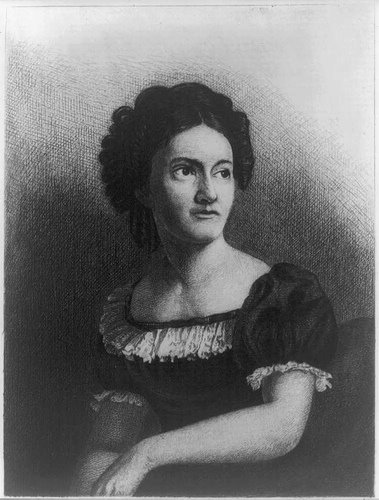
Image of Lydia Maria Child borrowed from Flickr.

← Older posts
Newer posts →
"the past is a wild party; check your preconceptions at the door." ~ Emma Donoghue

Recent Posts

  • medical update 11.11.22
  • medical update 6.4.22
  • medical update 1.16.2022
  • medical update 10.13.2021
  • medical update 8.17.2021

Archives

Categories

Creative Commons License

This work by Anna J. Clutterbuck-Cook is licensed under a Creative Commons Attribution 3.0 Unported License

Meta

  • Create account
  • Log in
  • Entries feed
  • Comments feed
  • WordPress.com

Create a free website or blog at WordPress.com.

  • Subscribe Subscribed
    • the feminist librarian
    • Join 37 other subscribers
    • Already have a WordPress.com account? Log in now.
    • the feminist librarian
    • Subscribe Subscribed
    • Sign up
    • Log in
    • Report this content
    • View site in Reader
    • Manage subscriptions
    • Collapse this bar