• anna j. clutterbuck-cook
  • contact
  • curriculum vitae
  • find me elsewhere
  • marilyn ross memorial book prize

the feminist librarian

the feminist librarian

Tag Archives: work-life balance

changes afoot in jobland (part two): on being employed

18 Saturday Dec 2010

Posted by Anna Clutterbuck-Cook in library life

≈ 2 Comments

Tags

domesticity, human rights, MHS, work-life balance

Massachusetts Historical Society
(December 2008)

This is the promised part two of my post on being hired as the Assistant Reference Librarian at the Massachusetts Historical Society.

Being hired for a modestly-renumerated full-time professional position straight out of graduate school during a recession (one in which there has been a much-reported-on “jobless” recovery no less), and being hired for that job while surrounded by many other fellow graduates and friends who are struggling on the hellish job market was a sobering experience.

Because that’s the sort of person I am. It’s incredibly, incredibly painful for me to accept opportunities that come my way when those opportunities are being offered conditionally. When those opportunities are offered supposedly on merit, due to some particular alchemy of my personal character or skills; when what I am being given — in short — is not being given to others.

I read somewhere recently that folks on the liberal end of the spectrum tend to have personalities that are “intolerant” of inequality. I laughed when I read that, ’cause I practically break out in hives when I feel like good things are being offered to folks based on some external (and, to my mind, inherently flawed) set of expectations concerning who is deserving and who is not.

We all deserve work that is challenging and rewarding. That exercises our abilities and builds new skills. And that provides materially for us and our families.

The fact that I, currently, have at least an approximation of that — and others, including others close to me — do not makes it really hard to meet the future with joyful expectation.I may have mentioned in my last post Brian Hawkins’ observation about being liberal in America: “Ring a bell and I’ll feel guilty for weeks!”

But guilt is unproductive (thank you Tim Wise), so I’ve been trying to focus instead on what it means to take responsibility for being employed in this particular time and place. And here is an (unfinished, ad hoc) compilation of initial observations.

  • Wage-work is not a privilege to be grateful for, but labor we offer in exchange for material gain. While being employable in today’s economy comes in part through social privilege (for more, see below), I think it’s dangerous to start acting as if wage-work ipso facto is a state for which we should be grateful.  Wage-work is something we do, not something that is given to us. Yet in a recession, it’s really easy to start saying to ourselves that we should be grateful to have a job — any job — and that those who employ us deserve our gratitude for hiring us. When we start to believe we should be grateful, we hurt not only ourselves, but also every person who feels pressured to accept and/or remain in wage-work in which they are exploited.
  • The process of being hired is not (solely) about personal qualifications. Most of us know that, despite idealistic talk about meritocracies, we live in a society in which structural inequalities exist and work (often invisibly) to position some of us to greater material advantage than others regardless of our individual abilities. Do I believe I’m qualified for the position I was hired into? Yes. Yet I am far from the only qualified person out there, and the fact I was hired hinged on a complex set of circumstances. I’ve had a lot of folks congratulate me on my new position with language that suggested I had “earned” the offer, that somehow through my efforts I have been rewarded with this position. I call bullshit on that because people who have valuable skills to offer the world remain un- or underemployed. Once we start talking about employment in the language of who deserves and does not deserve wage-work, whose efforts should or should not be rewarded, we’re supporting a way of understanding employment and economic security in terms of those who are “deserving” and those who are “undeserving.” I will not allow my personal circumstances to be employed in narratives that support that understanding.
  • All of my jobs have been “real” jobs. At least one person has suggested that now I have a “real” job … as opposed to the “fake” wage-work I’ve done since I was about nine and started working as a bagger at the college bookstore? As opposed to the “fantasy” wage-work of delivering newspapers? Working retail? Providing assistance to undergraduates as a teaching assistant? To faculty as a research assistant? As opposed to the reference and processing work I’ve done for the past three years as a library and archival assistant? I think the words were thoughtless rather than intentionally demeaning, but the net result was to imply that all of my colleagues who continue to work part-time, non-salaried, sans benefits, under-compensated positions are somehow not “real” workers. Whose labor does not count. In a capitalist economy that relies on such marginalized sources of labor, implying such work isn’t “real” is beyond insulting. And once again: not okay to be insulting to folks while invoking my name.

So my responsibilities (as I see them) as someone who has a reasonably well-respected and well-renumerated position:

  • To understand that I am granted social privilege by virtue of my position rather than through any personal awesomeness … and do what I can to identify and name that privilege, so that it is not invisible.
  • To respect, not look down upon, those folks who are un- or underemployed; to recognize that no individuals should be reduced to their employment status, and not assume that their employment status is a result of their own personal actions/worth (or lack thereof).
  • To advocate for decent working conditions for all, including myself. To remember that critically assessing my own position as a worker and advocating for change when I believe it is warranted can be part of pushing back against inhumane working conditions more generally.

This probably isn’t anything new for those who cut their political teeth in labor activism, or for those who have spent much more time than I have thinking in terms of class and economic disparity, but labor activism should not stop at the simplistic goal of employment. Rather, it needs to continue critically analyzing the place of wage-work in the economy, and the need for economic endeavors to (ultimately) cycle back to support the well-being of us all.

Put like that it sounds hopelessly idealistic. But I really, I only have this to say in response: Intellect and Romance Over Brute Force and Cynicism.

booknotes: beyond (straight and gay) marriage

15 Wednesday Dec 2010

Posted by Anna Clutterbuck-Cook in book reviews

≈ Leave a comment

Tags

children, feminism, gender and sexuality, human rights, work-life balance

This booknote is part two of Saturday’s booknote, which discussed a book called Red Families v. Blue Families. Click through to the first one if you want a bit of context for what I write below.

Red Families, by Naomi Cahn and June Carbone discussed the changing demographic landscape in America through the context of changes in family formation and related those changes to the legal and political landscape. They then laid out what they believed to be a way forward: a path which combines (or attempts to strike a balance between) the values of “red families” and “blue families.” See my review of that book to learn what I found unsatisfactory about their solutions.

Nancy Polikoff’s Beyond (Straight and Gay) Marriage: Valuing All Families Under the Law (Boston: Beacon Press, 2008) similarly tackles the question of the changing socioeconomic and cultural landscape of family formation in the United States and details the way in which our network of legal and social policy has failed to re-form in response, leaving us with laws and policies that fail to address the needs of all of the nation’s families.

The keyword here is “all.” The key phrase is “valuing all families.” Polikoff argues that by continuing to privilege married couples and their blood (and adopted) dependents/kin, the law discriminates against all family forms (straight as well as queer) which do not revolve around marriage. While she acknowledges the importances of marriage equality as a civil rights issue (all consenting adults should, by right, have access to marriage as a social institution), she points out that even if marriage were equally available to straight and same-sex couples, many types of families would continue to be excluded from accessing the economic and legal benefits currently provided to citizens exclusively or primarily through the apparatus of marriage. Polikoff argues for replacing the marriage-as-gateway model with a system that would

  1. Separate marriage from the myriad economic and legal benefits and rights to which it now controls access. Marriage would continue to be an option, one which — if chosen — would trigger a cascade of economic and legal benefits for the family members which the marriage recognizes (much like it does today). However it would cease to be the sole method for obtaining those economic and legal benefits. “Marriage is not a choice,” she writes, “if it’s the only way to achieve economic well-being and peace of mind” (133).
  2. Provide robust legal alternatives to marriage for all family forms, not just those organized around sexually-intimate couples. These alternatives would allow families to establish legally-recognized interdependent relationships that would give them access to the important resources and rights which our society currently only provides to married couples and their dependents.

Polikoff describes in detail the types of rights and benefits now associated exclusively with marriage. By my reading, these rights and benefits fall roughly into two categories.

  • Recognition of economic interdependency through tax benefits, social security benefits and access to health insurance and other work-related compensation benefits currently extended (with few exceptions) only to married couples and their dependents
  • Recognition of the unpaid care that families provide one another through nurturing dependents and intimate partners, providing material support when family members are ill or otherwise temporarily (or permanently) disabled, and the need to protect family members’ ability to provide that care when necessary — for example through family leave at a place of employment, or the ability to make healthcare decisions for an incapacitated family member.

When taken together, these two clusters of legal rights and benefits work to support family structures in the valuable work they do to counterbalance the vulnerability of individuals as they move through their lives: families act materially and emotively to protect members from potential suffering due to job loss, physical or mental ill-health, emotional loss, and ease the stress of major and minor life transitions.

To the extent that families provide these forms of care, it is in the interest of the state to support their activities because if families were not there to care for individuals, the economic and social burden would fall to the community as a whole (taxpayers) as represented by the state and social service agencies. Thus, it is not only a matter of social values, but also in the state’s economic and political interest to support (value) all family forms that fulfill these functions for their members, regardless of what shape these familie units take.

Which brings me back to the way in which Polikoff’s “valuing all families” approach ultimately serves us so much better than the policy solutions put forward by Cahn and Carbone in Red Families v. Blue Families.  Polikoff steps outside of the constraints imposed by assuming that families will form around a sexually-intimate dyad, including those pairings in her vision but not excluding all of those who do not fit within its bounds. She doesn’t enumerate the specific kinds of families that would count within this vision — leaving it up to us to imagine the myriad possibilities.

Which is precisely the point: when we stop playing gatekeeper — when we stop judging certain types of family formation over others — we can begin to truly value the work that family members do. We can begin to value (through law) the roles and actions rather than the naming who can and cannot fulfill those roles. Rather than seeking families with a “mother,” a “father” and “children,” for example, we can start thinking in terms of “adult interdependent relationships,” (with two or more individuals involved) in terms of “caregivers” (those caring for dependents) and “dependents” (children, those made temporarily dependent through illness or disability). And we can begin to formulate family policies that support the work that these relationships do in promoting health and wellness for all beings.

I’ll end this (somewhat rambling) review with a quotation from early in Beyond (Straight and Gay) Marriage. It is a definition of “family” written in 1973 by the American Home Economics Association.

1973.

By the American Home Economics Association.

I want you to think about these two things while you read the definition.

[A family is] two or more people who share resources, share responsibility for decisions, share values and goals, and have commitments to one another over time. The family is that climate that one “comes home to” and it is this network of sharing and commitments that most accurately describes the family unit, regardless of blood, legal ties, adoption or marriage (33).

I hope that this is the understanding of family that as a society we will eventually realize serves all of us best.

booknotes: red families v. blue families

11 Saturday Dec 2010

Posted by Anna Clutterbuck-Cook in book reviews

≈ Leave a comment

Tags

children, feminism, human rights, work-life balance

I read two books this past week on the intersection of family law, the conservative/liberal political divide, and quality of life in this country. One was the recently-released Red Families v. Blue Families: Legal Polarization and the Creation of Culture, co-authored by Naomi Cahn and June Carbone (New York: Oxford University Press, 2010).  The other was a slightly older, but no less relevent, book by Nancy D. Polikoff, Beyond (Straight and Gay) Marriage: Valuing All Families Under the Law (Boston: Beacon Press, 2008). Reading them in quick succession, I naturally saw connections between the two arguments as well as the relative strengths and weaknesses of each. I initially thought I’d do a joint review, but found I had too much to say (cough cough) … so here is part one, with a follow-up scheduled for next Wednesday.

For part two (Politkoff) click here.

Politkoff, Cahn and Carbone all begin with the same basic premise. That is the demographic fact that, over the past fifty years or so, the way Americans interdependent relationships has changed dramatically. The reasons for this can be attributed to a variety of socioeconomic and cultural factors, but no matter the reasons why it is happening, the end result is that the system of laws and public policies that in the past served to support those relationships are no longer effectively doing the job they were meant to do. 

Both books also come to an essentially liberal-moderate conclusion, with Polikoff trending in a slightly more liberal-radical direction and Cahn/Carbone attempting some sort of “middle” ground. Possibly because I am at heart a radical in my thinking (read: I’m most satisfied with solutions that get at the root of inequality, rather than attempt cosmetic changes to a broken system; I’m skeptical of compromise with folks who refuse to recognize a common humanity), I found Polikoff’s proposals much more compelling than those made by Cahn/Carbone, although I do think both books are worth reading — or at least skimming! — if you are involved on any level with activism or scholarship around the place of family and human relationships under the law.

I’ll begin with Red Families v. Blue Families. Authors Cahn and Carbone, both legal scholars, attempt to describe the reoganization of families structures in terms of the “red state” and “blue state” divide. That is, they connect conservative (red) political values with one set of beliefs and practices related to family formation and liberal (blue) political values with another set of beliefs and practices.  Using demographic statistics (such as number of births to teenage and unwed mothers, divorce rates, contraceptive use and abortion rates), they attempt to make connections between the types of family practices in conservative areas vs. liberal areas and the beliefs held in those areas concerning public policy and family law (i.e. divorce and custody law, access to birth control and abortion, marriage incentives and marriage equality).

The strength of this book is in the way Cahn and Carbone describe the socioeconomic pressures that have effected the rapid change in family-formation patterns. To oversimplify dramatically, the shift from an industrial economy to a social services and knowledge economy has increased the need for human capital (higher education, training, etc.) which the “blue” families have adapted to by delaying marriage and, in particular, child-bearing and rearing until after advanced education and establishing their careers. They “combine public tolerance with private discipline” when it comes to sexual activities, pushing (for example) to destigmatize sexually-active teenagers while ensuring access to contraception and counseling their own children to delay sexual activity. Meanwhile,  “red” families are materially challenged by the changing economy just as their blue counterparts. However, they have responded in moral rather than practical terms, redoubling their efforts to tie sexuality to marriage. This, the authors argue, often leaves them at an educational economic disadvantage (unless the wage-worker husband is in a high enough income bracket to support his family, a situation which is possible for fewer and fewer families nation-wide).

Red Families is at its strongest when showing the disconnect between conservative policy positions concerning issues like marriage, contraception and abortion and the damaging real-life effect of such policies when put into practice. In the chapters on abortion and contraception, for example, the authors show how conservative family policies usually work to disadvantage the economically marginal (teenagers, the poor, non-white families) by making the tools to manage their sexual health and childbearing unaffordable or otherwise inaccessible.  This is nothing new to those of us who follow the work of reproductive justice activists and feminist activists, but nevertheless I’m heartened to see it articulated in the context of a book on public policy. Likewise, the final chapter on “retooling the foundation” of our post-industrial economy to recognize the fact that workers are also family members is a useful starting point for thinking about how we might implement new (public and private) policies to support both types of families as they seek to integrate work and relationship obligations.

Yet ultimately, I found Cahn and Carbone’s argument about the geographic breakdown of family patterns overly simplistic and their solutions problematic.  Here are a few reasons:

1) As someone who grew up in a “red” area of the country (Michigan as a state swings Democrat in national elections, but the West Michigan county where I lived, and many of those around it, swing consistently Republican) I am troubled by the assertion that Americans are organizing themselves geographically along political lines, and that because of this a federated, localized approach to family policy is acceptable. Family law issues often intersect with human and civil rights issues, for example women’s access to reproductive health care and the right of queer couples to the same marriage rights as straight couples. These are basic citizenship rights not rights that should be determined by local norms. Beyond that basic philosophical issue, there are three practical issues with a localized approach:

  • When the approach is local, the most vulnerable will continue to suffer. Why? Because the economically and socially marginal are the least mobile citizens: the poor, the young, those without supportive family and friendship networks. In short, the folks who are already unable to access the resources available under the current system to establish economically secure families. They are the ones who won’t be able to relocate to a more queer-friendly region, won’t be able to cross state lines to secure an abortion or contraception, and will be the least likely to challenge discriminatory practices through the courts or political system.
  • Cahn and Cohen overemphasize regional homogeneity. If basic rights around family formation and support are determined locally, what happens to those who are in the political and social minority in any given region? To be sure, there are “blue” families in even the most crimson areas in this country. Not all of them can, want (or should have to) relocate to more colbolt areas in order to live the family lives of their choosing. This is the de facto situation for many of us now and it is not satisfactory.
  • This is an increasingly mobile population. Our economy increasingly depends on mobility, not to mention that our culture encourages travel and relocation over the course of our lives. If the rules governing family life become more regionalized over time, then the issues already faced by same-sex couples will extend to more and more families: what happens when certain relationships are recognized in one region and then a family moves (say due to a professional or educational opportunity) to a region where their family is no longer recognized or supported?

2) Cahn and Carbone fail to question the assumption that marriage between two adults as the basis for family formation is an ideal that should be encouraged. They see this as a point of common ground between “red” and “blue” families, an premise that I believe to be unhelpful in terms of constructing useful solutions that better the lives of all people, regardless of their desire to enter into marriage relationships as a gateway to family formation. (For more on this idea, see part two of this review.)

3) Following from this preference for marriage, Cahn and Carbone decidedly do not believe that all avenues toward family formation, or types of families formed, are equal. While willing to extend the practice of marriage to adult pairs, regardless of sex or gender, they ignore the needs of many families that do not fit this slightly-tweaked version of the old two-parents-plus-children family ideal. For example

  • Young parents. Following from their preference for “blue family” strategies, Cahn and Carbone are critical of those who choose to marry and have children at young ages. They see nothing wrong with discouraging teenagers and young adults from marrying and forming families. In support of this argument, they cite the statistical likelihood that such “young” marriages will fail and that children born within those families (or to young mothers) are more likely to be economically and educationally disadvantaged.  Alternatively, they could argue for greater social and cultural support for young people who choose to form families and bear children. The fact that they disparage those who do so is ageism and really set my teeth on edge.
  • Non-dyadic family units. Um, where are the poly relationships? The family groups not formed around sexual relationships and/or childrearing? I was really frustrated by the way Cahn and Carbone failed to address the needs of families that don’t fit into this model. I realize that these families are a political hot potato when it comes to seeking compromise across the political divide — poly relationships are routinely marginalized in arguments for gay marriage (how often have you heard “two consenting adults” as a catchphrase?) because, I assume, the left wants to dissassociate from discussions of polygamy. But this is not a valid excuse when we’re talking about the need to recognize the social value of all committed, consensual, mutually-sustaining relationships.
  • Following on from this last point, family formation =/= childrearing.  Belonging, as I do, to a family that will likely not include children, I was particularly aware of the way in which Cahn and Carbone repeatedly used phrases like “family formation” and “starting a family” to mean “having a baby” (either through adoption or birth).  This is an erasure of any family of two or more people that does not include, either by accident or design, providing for children. It’s terminology that’s simple to fix and the fact that the authors chose not to, or didn’t realize the implications of their wording, bothered me.

So what’s the work-around for these problems? Stay tuned for the next installment, where I’ll discuss the far more satisfactory Beyond (Straight and Gay) Marriage, in which author Nancy Polikoff descibes how our legal system could retool family law to accommodate the full range of interdependent relationships we form, decoupling marriage (which would remain a religious and cultural marker of commitment) from legal and economic rights.

changes afoot in jobland (part one): ms. assistant reference librarian

09 Thursday Dec 2010

Posted by Anna Clutterbuck-Cook in library life

≈ 6 Comments

Tags

MHS, work-life balance

Anna on her first day as a volunteer
circa Fall 1993

Long ago, when I was twelve — almost eighteen years to be exact! — I became the youngest volunteer docent (tour guide) at my hometown’s Cappon House Museum.

Yes, braces, bangs and all.

The Cappon House is the historic home of Holland, Michigan’s first mayor, Isaac Cappon, his first and second wives, and their sixteen children (when I was twelve I loved the bit about the children; today I still do, though for slightly different reasons — lessons in birth control anyone??).  Over the next few years I gave countless tours to senior citizens groups, schoolchildren, and tourists, eventually expanding my responsibilities to include duties at the Holland Museum as well.  By my mid teens I was torn between the childhood desire to become a bookshop owner and novelist or my newfound passion for the field of museum studies and history.

Luckily, I’ve found a way to combine these vocational yearnings of mine: reference librarianship in the world of rare books and manuscript collections.  Most of you are aware that since shortly after moving to Boston in August of 2007 I have worked as part of the Library Reader Services Staff of the Massachusetts Historical Society, an independent research library and (our docents like to inform our visitors) the oldest historical society in the Western Hemisphere, founded in 1791.

For the past three years I’ve worked part-time as a Library Assistant, though my pre-professional status has hardly kept my colleagues from embracing me as part of the team.They’ve been a wonderful group of folks to work with and have contributed to my education as a library student and historian as much as, if not more than, my formal studies.

As of January 1st, the departure of one of those colleagues for a new position at LibraryThing.com is leaving a full-time Assistant Reference Librarian position open which I have been invited to fill. I’m excited to be taking on new responsibilities as well as (hopefully) finding a bit of time to continue developing my knowledge of the collections through the lens of my own particular scholarly interests — watch for a new “object of the month” post in February on the intersection of antifeminism, the red scare, and religion during the 1920s.

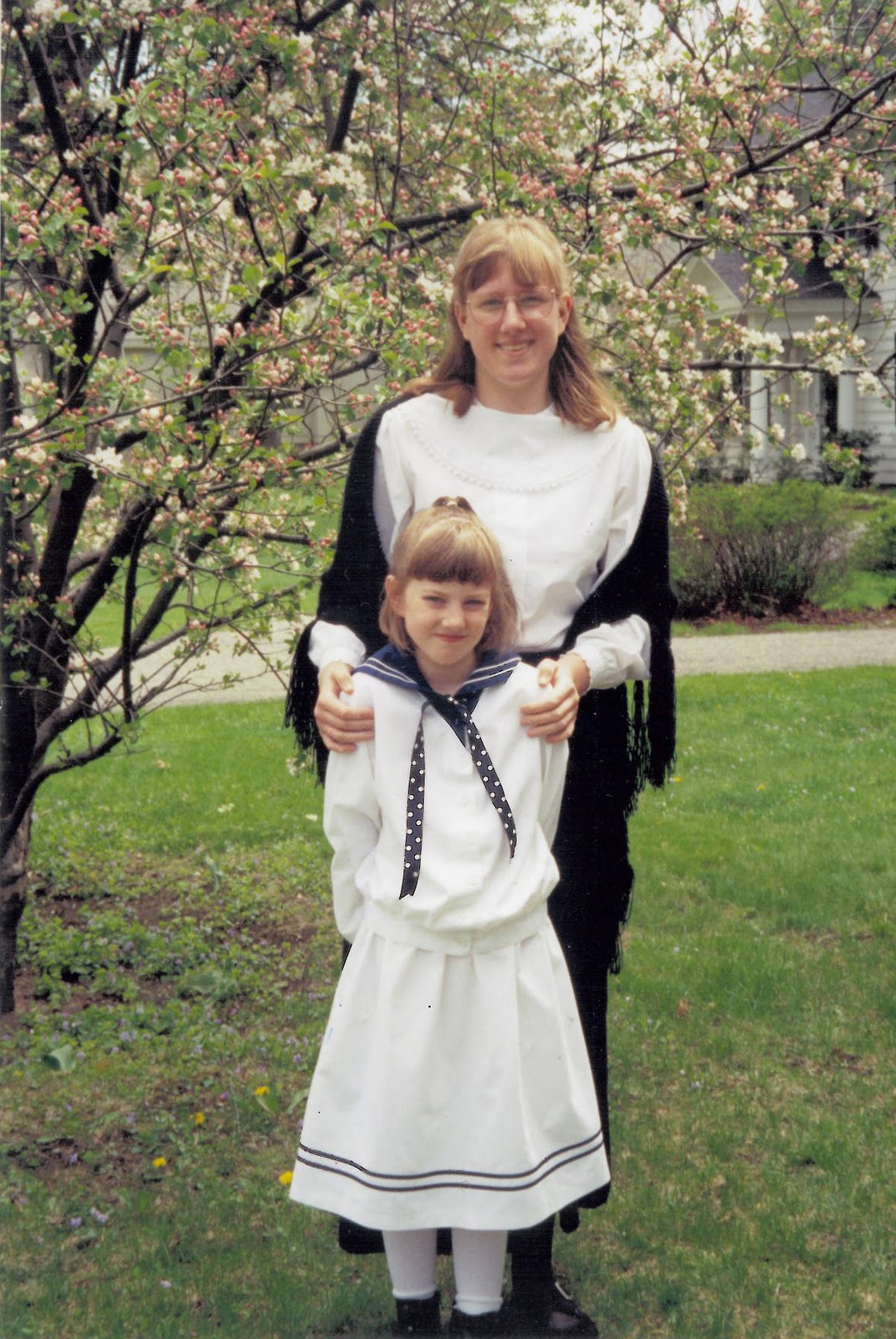
Anna and sister Maggie
circa Spring 1995

Running the risk of sounding like Brian Hawkins in Tales of the City (“Ring a bell and I’ll feel guilty for weeks!”), unexpectedly finding myself offered full-time employment in this economy — when I’d been steeling myself for a long, grueling job search this coming year — leaves me with complicated feelings.  I’m relieved about the financial security, obviously, and excited about the work I’ll be doing. At the same time, I’m acutely aware that many folks with similar resumes and educational background are not in such a privileged position, including many of my fellow graduates from the History/Archives program at Simmons. And I’m not comfortable assuming or accepting that the opportunity I’ve been offered is somehow a one-to-one correlation with my personal accomplishments and abilities. Not that I believe I’m unqualified for the job — I just know many people who are qualified for useful and interesting work are struggling to find it. So look for a “part two” to this blog post in the near future, with some musings about what it means (to me) to be hired during a recession.

In the meantime, long live librarians: the recognized and the unrecognized, the well-rewarded and the under- or unemployed. I am proud to count myself among your number.

"negotiation and compromise": reflections on my childhood outside of school

08 Wednesday Dec 2010

Posted by Anna Clutterbuck-Cook in life writing

≈ 5 Comments

Tags

children, domesticity, education, family, human rights, work-life balance

It seems fitting, in this last week of formal coursework in pursuit of my Master’s in Library Science, that I take some time out to reflect on a very different experience: that of growing up for the first seventeen years of my life outside of formal institutions of schooling. Those of you who follow my blog probably know that cultures of schooling, education, and learning are a topic of scholarly and personal concern to me. As I wrote on Saturday, Idzie @ I’m Unschooled. Yes I Can Write is running a series of interviews with grown unschoolers about their experience learning outside of school. I took some time out from wrapping up my coursework last week (read: spent time procrastinating like it was going out of style!) to respond to her questions. And yesterday Idzie published my responses.



Glen Nevis, West Highlands, Scotland (May 2004)

Since I thought many of my readers would be interested in my responses, I’m cross-posting what I wrote here. But if you enjoy what you read, do check out Idzie’s blog since she publishes lots of awesome stuff — and promises an ongoing series of similar interviews.

The Basics

When did you become an unschooler?
birth (1981) and/or first year I was school age (1987)

How long have you/did you unschool?
Difficult question! I still think of myself as practicing the values of unschooling, even though I have had interactions with formal education and its institutions. I did not attend grade or secondary school at all (though my siblings did to varying degrees). I began taking courses at the college where my father worked when I was seventeen and continued there part time through 2005; until 2002 I was not a degree-seeking student, though I did take the courses for credit. During the seven years I pursued undergraduate coursework, I did lots of other things too, like work and travel. Since completing my B.A. I’ve moved on to graduate school (more below). However, I still feel very much an unschooler at heart.

How old are you now?
29, nearly 30.

The Decision to Unschool

If your parents chose unschooling, do you know how/why they made that decision?
My mother was, I think, the initiator of home-based education, since she was the primary at-home parent and also very interested in child development and early childhood education. She always preferred non-interventionist approaches, and when it came time to think about schooling for us kids she felt we were doing really well in our current environment — and that the schooling opportunities in our area were too conventional for our family’s needs. My father was completely on board with it, even though he usually took a back seat with the home-life arranging, given he was the parent with a full-time job.

My parents are not categorically opposed to working with formal institutions of learning. My father works at Hope College (where I eventually attended classes) and my siblings both expressed a desire to do some measure of formal schooling during their teen years. My brother attended some courses at the local public school, although he never enrolled as a degree-seeking student, and my sister went full-time to public high school. But the focus throughout was what worked best for our family as a whole and for each of us kids individually.

The Best and Worst

What do you think the best thing about unschooling is?
Speaking from the point of view of a unschooled child (rather than an unschooling parent), I would say that the experience of unschooling helped me to remain confident in myself: confident that I had the ability to learn new ideas and skills when I need them, confident I could find meaningful ways to occupy myself without a strict schedule, confident that I could navigate the world and find help when I needed it from people with particular expertise, or whom I had caring relationships with.

The worldview of unschoolers draws (in my opinion) on a specific understanding of human nature that is at odds with the beliefs of the dominant culture. In order to really practice unschooling, you have to trust in the human being to be interested in the world, to seek situations (physical, social, intellectual) in which that being will thrive in community with other beings. You have to trust that the being themselves — not external authorities — are the best source of information about what the being needs to thrive. Not to say that external feedback and expertise isn’t helpful — it’s often crucial. But at the end of the day, the individual themselves is the best authority on, well, themselves. And on what they need to feel nourished.

In society as a whole, children aren’t trusted to have that kind of knowledge about themselves. In part because children do often think and communicate in different ways than adults, given their stage of development, so children’s self-knowledge is often difficult for adults to access. But it’s there if we know how and where to look! And unschooling teaches us to cultivate that awareness in ourselves and others.

What do you think the worst (or most difficult) thing about unschooling is?
The most stressful thing about practicing unschooling in our culture is that it really is fundamentally counter-cultural. It challenges many of the hidden assumptions of our society about human nature, the nature of children, the purpose of education, the meaning of the “good life,” and so forth. I, personally, think people who unschool are on a much healthier track (by and large) than people who do not, because of their values and their orientation toward the world and the rest of humanity. But there’s definitely a cultural dissonance between the life we wish to lead as unschoolers, and the world in which we have to carve a space for ourselves beyond our families. It requires constant negotiation and compromise.

Beyond High School

Did you decide to go/are you going to college or university? If so, could you talk a bit about that experience?
I did go to college, both undergraduate and (currently) a graduate program. It’s always difficult to talk “a bit” about the experience, since my interest as an historian in counter-cultural education means I spent a lot of my waking moments thinking about the culture of institutional schooling, of teaching and learning, and about how “education” is framed in our contemporary cultural debates.

Casting my mind back to age seventeen, when I enrolled in my first college course — a first-year writing course — I remember how thrilling it was to be engaged in writing and thinking about ideas. At that point I wanted to be a creative writer and developed an enormous crush on my professor, a poet and photographer who had that rare ability to read one’s writing and discern what you meant to say, even if your early drafts were hopelessly muddled. At the same time, I felt like a foreign exchange student, struggling to assimilate to the academic culture that was invisible to most of my classmates. I cold be exhausting and isolating. The fact I was a politically and culturally progressive-radical student on a campus dominated by politically and culturally conservative students didn’t help to bridge the gap between me and conventionally-schooled peers. Nor did the fact I was a part-time, commuter student on a campus dominated by full-time, resident students.

I did not struggle with the coursework much at all. In the early years, I took courses that interested me without a thought toward graduation. Later on, when I was fulfilling requirements, I did take classes that were in subjects not of my instinctive interest (I wept through a one-month class in statistics, for example) … but by conventional measures (i.e., grades) I succeeded in conventional education despite my lack of formal training up to that point. And undergraduate college unquestionably opened doors for me — intellectually, socially, geographically — that might have been more difficult to open otherwise. I had access to off-campus programs and study abroad opportunities; I had faculty-student research opportunities and professors who I connected with and library resources, etc. The same can be said, to some extent, for my graduate work. The classes themselves have often been frustrating, inefficient, etc. But given the organization of our culture’s learning resources at institutions of education, it’s difficult to piece together a similar experience without being an enrolled student.

Difficult, but not impossible.

I never completely made peace with the structured nature of academic semesters, graded projects, competitive learning, being judged by external rather than internal expectations. It stressed me out on a pretty deep level; makes me feel like I’m complicit in a system that rewards some at the expense of the rest. which is something I have problems with, even if (especially if??) I’m one of those who gets rewarded. It’s complicated. I’m definitely looking forward to being done with formal academics for a while after I complete my current program (a dual-degree in library science and history).

Money Earning and Work

Are you currently earning money in any way?
Yes.

What jobs/ways of earning money do you, and have you, had?
Oh, gosh. I’ve been earning money since I was about nine. I started working seasonally for my father at the college bookstore he manages for pocket money and stayed there on and off throughout college. I also worked at a local children’s bookstore and a branch of Barnes & Noble. I did childcare as a teenager and worked one year as a nanny. I’ve served as teaching and research assistants for a number of college faculty. I spent a semester working as an office assistant for a study abroad program. I’ve also done a number of work-for-food-and-lodging type situations, sometimes in combination with other paid work and sometimes for short stints alone … like the month I spent at a women’s land trust in Missouri the summer after graduating from college.

When I moved to Boston, I was hired as a library assistant at the Massachusetts Historical Society, an independent research library in Boston that holds rare books and manuscript materials. It’s a wonderful way of being connected to a scholarly community without being tied to a college or university setting. For the past three years, I’ve worked there part time along with other part-time employment (in the field) and internships. I was just recently offered a promotion to full-time with enough wages and benefits to support remaining in Boston for the next few years, as my partner and I would like to do. It pays modestly well, and is definitely the type of work I was hoping to find when I began graduate school in library science.

Have you found work that’s fulfilling and enjoyable?
I won’t pretend that my partner and I don’t struggle with the question of balancing the need to earn wages to support ourselves in the short and long term. My partner, who also learned outside of school for much of her life (until going to public high school) resists, as do I, a culture that equates paid employment with identity and fulfillment. On the one hand, I do believe in seeking out ways to earn a living doing what you love … but I also resist creating a situation in which my life is defined by the work I do, or dictated by it. So that’s an ongoing balancing act. Even without children to care for, I find myself more and more appalled at how little flexibility our modern workplaces have for the rhythms of personal and family life.

Have you found that unschooling has had an impact on how hard or easy it is to get jobs or earn money?
This is a tricky question. I was very privileged in that I had a chance to work in the “family business” as a child and teenager prior to getting other jobs. Not being in school meant, too, that I could work in positions that school schedules could not accommodate easily, and gain really good work experience even before I started college. I had extensive volunteer experience, too, that filled out my resume. Another privilege was the fact that my father’s job at the college meant I got tuition benefits and could take classes without applying for a degree. By the time I petitioned to be a degree-seeking student I had a strong enough academic record they waived the requirements of national test scores or a high school diploma (a stumbling block for some unschoolers seeking to enter higher education). I have not felt limited by my lack of formal schooling pre-college. I do wish, sometimes, I had been braver about seeking alternatives to college and post-graduate schooling. I was tired of the effort it takes to forge the nonconventional path. And there are days when I’m not proud of that.

Do you feel that unschooling has had an impact on what methods of earning money or jobs you’re drawn to?
In a word: yes. In a few more words, I would argue that the worldview lying behind (my understanding of) unschooling supports de-emphasizing wage-work as either the primary mode of self-identification or as a measure of self-worth. Since unschooling encourages self-reliance and independence, being able to support myself — or, now, to contribute to the financial security of my newly-formed family — is a part of how I measure my success. However, it is one small part of my self-evaluation, all of which comes down to challenging myself to live in accordance with my values. Which would take a lot more than this questionnaire to explicate in depth! But in short, they can be summed up with the belief that all that 1) all life is of value, and 2) all that is required of humanity is “to do justice, love kindness and walk humbly.” (The original quote comes from the Christian Old Testament, Micah 6:8, and reads “walk humbly with God,” but I prefer leaving the question of whom or what one walks with up to the listener!)

General

What impact do you feel unschooling has had on your life?
The experience of growing up outside of the mainstream educational system colors virtually everything I do and the way I understand the world. I think it particularly shapes how I understand myself in relation to the mainstream culture and ways of thinking and being in the world. My family didn’t opt out of the mainstream to the extent that some unschooling families do: we had a television, we lived in an urban environment, we had friends who were schooled and so forth. We weren’t insulated from the mainstream and from the outside — except for the fact that we didn’t attend school — our family didn’t look that radical. But we were pretty damn radical anyway! So what I learned, growing up, was that individuals and families have choices. We can stand apart from some of the mainstream “common sense” beliefs about how people should grow and learn, what it means to be a functioning adult, what it means to be a family — but we don’t have to seek “purity” in pursuit of that. We can pick and choose, appropriate, make our own meanings of things, piecing together a life out of what we find to be beautiful and useful. It’s sort of a steampunk ethos, I guess.

If you could go back in time, is there anything about your learning/educational journey that you’d change?
I really wish I had been able to find practical alternatives to graduate school that gave me the same opportunities in the library/scholarly fields I’m interested in. Unfortunately library and archives training in the US takes place in the context of higher education, and most living-wage positions with opportunities for professional growth require an MLS.

If you were to have children, would you choose to unschool them?
I just recently read a blog post by Molly @ first the egg called parenting as holding the space in which she talks about how she and her husband don’t practice according to any particular parenting philosophy but that she’s come to realize that the way they parent is akin to the way in which doulas are trained to “hold the space” for women in labor. She writes, “the basic idea is that a calm, focused, loving person can protect a space in which the laboring/birthing person can do what she needs to do.” I think this is a really nice one-line description of what parents can and should provide their children — regardless of whether the decide they want (or are practically able) to unschool their children.

My partner and I are pretty sure we are not going to be parents, for a complex constellation of reasons. I won’t speak for her in this instance, but in my case I don’t want to have children unless I am able to unschool them — in spirit if not by actually keeping them out of institutional education altogether. I don’t want to take on a responsibility that I don’t have the resources — emotional, logistical, financial — to really follow through on according to my values. And my values would demand giving that small person in my care as much calm, focused loving as I could — and trying to surround them with adults and other young people who could support me, my partner, and our child(ren) in that endeavor. And right now we aren’t in a place to do that.

Advice

What advice would you give to teens looking to leave high school? What advice would you give to someone looking to skip, or to drop out of, college or university?
Since I didn’t ever leave high school and eventually ended up completing university and going on to do post-graduate work, I’m not sure how much I can speak to this. However, I would say this: in my experience, it pays to reject either/or thinking and be creative about how you use your available resources.

What advice would you give to unschooling parents (or parents looking into unschooling)?
In addition to what I wrote above about “holding the space,” I think it’s important — with all childcare, but particularly with unschooling — to emphasize that the choices you make about family life effect outcomes. That may sound elementary, but I’ve seen a lot of nominally “unschooling” or homeschooling families where the parents really, really want their kids to look and act like, and hold the same values, as their conventionally-schooled peers. Or even worse, they expect them to be conventional-PLUS: they think that unschooling their kids are going to make them even more successful than their peers by all the mainstream cultural standards.

It’s not an impossible goal … and it’s not that I think having goals and accomplishing them is a bad thing. But the “conventional-plus” approach to unschooling is, to my mind, a really impoverished approach … because it leaves behind the really radical aspect of unschooling, which is to question the foundational values of American culture concerning human nature, what it means to be a successful human being, what you need to thrive in the world, and how human relationships facilitate that process. If I had to offer advice in a nutshell to unschooling parents, it would be: Expect different outcomes — and try not to be afraid of them. Be clear about what your own values for “the good life” are and share them with your children, and then let your kids develop their own values from that foundation.

Also, don’t encourage your kids to see mainstream culture or conventional schooling as evil. There are good people who teach in schools, there are good people who send their children there, and there are children who thrive despite the many problems of institutional schooling. I’ve seen too many unschooling families turn their personal and familial choices into an “us vs. them” negativity that doesn’t encourage building alliances, accessing resources, and remembering to seek out support and learning in even the most unexpected places. Encourage your kids to remain open-minded about the mainstream, even as you challenge them to engage with it critically.

Is there anything else you’d like to talk about or add?
I think I’ve already said way more than is reasonable in terms of a blog post, so I’ll leave it there. Thanks so much for the opportunity to share my thoughts on being a grown unschooler and I look forward to reading what others have to say in response to these questions!


family leave: some reflections the workplace and relationship care

25 Saturday Sep 2010

Posted by Anna Clutterbuck-Cook in think pieces

≈ Leave a comment

Tags

children, feminism, work-life balance

Earlier this week I shared a personal essay on the feminist librarian reads by Nathan Hegedus, an American man living with his Swedish wife and two young children in Sweden. The essay describes the culture of parental leave and childcare in Sweden, his own changing relationship to the idea of family leave, and the way the Swedish economy has adapted to government-mandated leave time for parents with young children. While I don’t think top-down enforcement of new norms is always the best way to go, in this case the passing of legislation meant that the workplace was forced to adapt to the modern reality that workers do not exist in a vacuum, and that sometimes the needs of families require job flexibility. The fact that employers providing family leave time are actually following the law means that both employers and employees are supported in creating an environment in which workers are guaranteed leave (and their jobs upon return) and employers are encouraged to find solutions to the question of staffing while their regular employees are away caring for family members.

The working world has adjusted accordingly. Most companies seem to fill parental-leave vacancies with short-term contracts, and these seem to function as good tryouts for permanent employment. It all feels pretty organic in a globalized world of flat organizations and gender equality, of employees who are not locked into one assignment or skill set.

. . . If you had asked me in, say, 2001, if I would ever take a long paternity leave, I would have answered, “Yeah, sure,” because I was a liberal guy—but then ignored my own answer because I was also an ambitious, career-driven type. Then I married a Swede, and we moved to a small town outside New York City that was close to no family or friends. Out of necessity, and my wife’s Swedish expectations, I got deeply involved in our upcoming baby’s life, though probably still no more than many American dads-to-be. We had a rough ride. My wife had bad doctors and a bad back, and we lived in a house covered with lead paint and infested with bats, rats, and bedbugs. It all began to seem overwhelming. In the end, almost more than my wife, I pushed for the move to Sweden, to the promise of parental leave, shorter work days, five weeks of vacation, and unlimited paid sick days if your kid falls ill.

Still, the prospect of telling my boss I wanted to take paternity leave paralyzed me for weeks. Surely I would get fired for taking six months off. Or I would return to a job cleaning the bathrooms with pencil erasers. I think I chickened out completely and just sent an e-mail. But my supervisors took my leave as a matter of course. I have small children; hence, I was likely to take paternity leave of some sort.

While Hegedus is focused here on the needs of parents with young children, and the social change providing these parents with support has wrought in Sweden, I think it’s important to think about how the lessons learned in Sweden (and other countries with strong social welfare policy) can be applied beyond the realm of parenting and care of young children. The elder-care of parents, for example, which will become an increasing issue as the baby boomer generation ages and the social safety net enjoyed by many of their parents no longer exists. The care of spouses and partners with mental or physical health issues, for another, is important to recognize.

The needs of parents and dependent children are (superficially, I would argue) an “easy sell” in a culture that pretends to champion young people and their caregivers. Yet the creation of an economic culture that successfully supports the well-being of workers (and, thus, increases productivity and the potential for innovation) needs to include all of us, whether we have the responsibility to care for dependents or not. Advocating such comprehensive change in the way we think about “work” vs. “life” as a society also puts an end to the parents-vs-non-parents friction that develops, in feminist circles at least, when we begin to talk about support for working parents. Single people and people with no children often feel like this conversation privileges the “choice” of people with children by allowing them extra time away from work that, as persons who will never have children, they are not offered. As parenting is increasingly seen as a freely-chosen lifestyle (rightly or wrongly), parental leave becomes yet one more policy issue dividing caregivers of the young from others. 

Instead of running with this limited view of “parental leave,” we need to start talking more holistically about care and the needs of all human beings to give and recieve care, regardless of age, of physical or mental ability, or of their position within family systems. And we need to think about how that care can be incorporated into (and ultimately benefit, or at least not weaken) the modern work environment that dictates so much of the rhythm of our daily lives.

quick hit: the myth of work vs. home life split

13 Tuesday Jul 2010

Posted by Anna Clutterbuck-Cook in linkspam

≈ Leave a comment

Tags

children, feminism, work-life balance

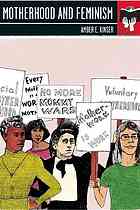
From Amanda Marcotte @ RhReality Check comes a wonderful interview with Amber Kinser, author of a new book, Motherhood and Feminism (Seal Press, 2010). The following passage, while focused specifically on mothers in the workplace, speaks to a lot of the issues I was blogging about in my recent post on feeling guilty for wanting a balanced life (starts at roughly minute 19:00).

There is an assumption in the workplace that if you’re a mother your primary loyalty is always going to be your family even during the workday and that that’s a problem. The assumption is, for men, your primary loyalty is always going to be at the workplace and that that’s not a problem. And if you’re single and you’re … childfree and female then we don’t have to worry that you’ll be called away, you know, to go pick up a child who’s sick from school or go take care of a disciplinary matter or go the Halloween parade at school.

So part of the problem [of discrimination against mothers in the workforce] is this mythical — and I talk about this in the book a good bit — this mythical split between public and private. The workforce still operates on the assumption that home life is separate from work life. It never has been, it isn’t now, and it never will be. And so part of the problem is the problematizing of people who are invested in their families. So that if someone has to go to the piano recital during the school day or someone has to go take care of a sick child this goes up against workplace policy and norms. And so what we do is penalize — largely the women, because they’re the ones who end up doing it — who do that. That’s where that motherhood penalty comes in — instead of shifting workplace norms so that they can accommodate the fact that public life and private life are not, you know, they’re just not distinguishable. Men are better positioned to be able to pretend like they’re separate than women are and so they benefit in the workplace.

The full interview can be heard as part of Amanda’s latest RhRealityCheck podcast, Pro-Choice, Feminist Support for Motherhood.

Kinser is emphasizing the parenting angle here, because that was the thrust of the conversation she and Amanda Marcotte were having. But I would extend her observations not only toward men who are attempting to parent more actively but also to individuals who are not parenting. Being invested in family life, or private life, is a choice all of us can make, regardless of whether we are parenting. Caring for, or enjoying time with, a partner or a parent, extended family members or close friends, are equally important and a necessary part of life. They should not be something we need to sideline or make invisible in order to be valuable workers, but of course in an economic system that is built to value only efficiency and workplace productivity, those values are difficult to “sell” as a benefit to one’s employer.

to be subjective and scholarly

18 Friday Jun 2010

Posted by Anna Clutterbuck-Cook in think pieces

≈ 1 Comment

Tags

domesticity, education, thesis, work-life balance


Last Friday, I blogged about my frustration with finding balance between my academic research and writing, my wage-work, and my domestic life and loves. This Friday, I thought I would pick up where I left off, after a fashion, and write about the ways I try to balance the academic and the personal within my work as a scholar.

This post has gone through a number of different iterations in my head, but is taking this particular form because of a recent post by Kimberley @ 72-27 who this week wrote a long, reflective piece about her own return to academia and the limitations she sees in rigorous scholarship that neglects the relational in pursuit of the rational.

Before my current program, I came from a small school in Seattle that trained students to be therapists, and thus it placed primary value on inter-personal and intra-personal knowledge. My professors were psychoanalysts and therapists, and they asked their students to delve into the unconscious self and figure out what was there and why it was there. We did intense work understanding our own families of origin and personal narratives, and we received a great deal of feedback on how other people experienced us while in relationship with us. While the program lacked academic rigor in the traditional sense, it demanded a kind of inter-personal and intra-personal rigor that was invaluable.

While I love the rigor that is applied to critical thinking at Yale, I am left envisioning what Yale would be like if that same kind of rigor were applied to self- and inter-personal knowledge. For instance, in my U.S. religious history class, one of my professors shared with us that it took him quite a while in his career to realize that he hadn’t picked his research “objectively.” His research came out of deeply rooted questions based on very personal life experience. Yet, in his graduate training, he had not been encouraged to see the connections between his “objective” research and his own life story. This discussion in class came at the very end of the semester, and it was a relief to me. I had often felt as if historians maintained a pretense of objectivity. It was nice to finally hear that we can actually do better research if we are self-reflective in the process. Knowing ourselves better will also translate to being better collaborators.

Emphasis mine. You can read the whole post at 72-27.

How does this connect to my own work, beyond the skepticism toward an overly-depersonalized academia which I unabashedly share? To begin answering that question, I want to share another lengthy quotation — this time from an email I wrote earlier this spring. When I was at the Oregon Extension in March, doing research for my thesis Doug Frank — one of the faculty there, an historian and mentor of mine — asked me whether my project was a chronicling of “what happened” or whether I was making a specific argument. I stumbled through an immediate response that, from what I remember, emphasized that I was gathering the oral histories as a type of chronicling, but that my thesis would itself have a specific argument to make about the place of the Oregon Extension in American cultural, educational, and religious histories.

Of course me being me, I left the conversation unsatisfied with my response and the following day wrote Doug a long email trying to explain my motivations for this research. I won’t reproduce the email in full here, but I wanted to share two paragraphs that speak to the connections between my “objective” historical analysis of the Oregon Extension and my own life story.

On a more personal note, I will say that this project comes out of my own deep interest in history of non-mainstream education and my very personal quest to find a way to bring together my love of learning (the life of the mind) in some sort of structured environment with the quality of life I experienced as a child and young adult outside of institutional schooling. My original desire to attend the OE as a student (nearly a decade ago now!) was driven, in large part, by my desire to find a way to be a scholar without having to fit myself into the vision of education (the fear-based model you were talking about yesterday, which I believe is still deeply embedded in most schools) and of human nature that ran so counter to the understanding of human life that I had grown up with in my family (and elaborated on through my reading in theology, feminism, and educational theory). I am drawn to examples of intentional community and purposeful work life, in which folks have been able to step outside of the pressures of the mainstream and forge a life for themselves that isn’t grounded in being “anti” (that still retains some sort of relationship with the dominant culture) but nevertheless has some autonomy when it comes to priorities and values — the power to say “you have no power here” to things within the dominant culture which are inimical to human well-being.

When I went back to graduate school, I was taken aback by how much my soul rebelled against being back in an environment of institutional education, surrounded by folks who largely take those traditional frameworks for granted (at the very least) and often champion them (Boston’s educational culture is incredibly status-conscious). I don’t necessarily believe I made the wrong choice to return to school (the factors are myriad), but I do know that when it came time to choose a thesis topic, I intuitively knew I needed to spend my time with a topic that would help me retain critical distance on that culture, that vision of humanity, that understanding of the way human beings learn and what they need to thrive. And as of this writing, at least, I feel pretty proud of the way that this project has helped me to do just that, giving me a certain inner sense of distance from the expectations and values of the institutions within which I work as a student scholar, so that I am sharing these ideas with them (in a form they can accept for credit) but not writing my thesis for them.

As I wrote more concisely (though much more pedantically) in an early draft of my thesis introduction, “The scholarly task of historicizing the college classroom and the expectations of higher education were, in part, a method of coping with the alienation I often felt as a student whose experiences and vision of, not to mention goals for, learning were at odds with the majority of the people whom I encountered at school.”

In other words, this topic matters to me, in a visceral, immediate way. The project of make sense of the history of competing educational theories and practices is as much about finding a place for myself within that world as it is about situating the Oregon Extension within its unique historical context. I am invested in doing my part to enter these folks into the historical record because I believe deeply in the value of what they do. It is important to me that their own unique experiment in living be acknowledged at some level as part of the history of education in the twentieth century — a way of being that runs counter to the stories we tell ourselves about how life has to, or ought to, be.

And the world of academia is definitely divided as to whether this is or is not a good thing. Emotional proximity to one’s subject-matter is often viewed with deep suspicion, as it is seen to cloud the mind, bias the historian whose job (as Kimberley notes about) is ostensibly to be “objective” about her subject. Distance from one’s topic (in time as well as emotion) is supposed to provide you with the dispassionate objectivity to analyze and critique with greater clarity. Even if we recognize (as most scholars do today) that we are all inevitably subjective in our scholarship, the push has been to recognize and attempt to minimize or compensate for those biases, rather than to embrace and work with them as strengths.

I’m less certain that this is the only or the best approach to subjectivity within scholarship. Although I’m still searching for language to articulate it, I think that there are different qualities of emotional proximity or connectedness to one’s research subject that can — depending on how self-aware the researcher is and what their relationship to that connectedness is — help or hinder scholarly analysis.

I am taking a meditation class with Hanna this month (my first ever!) and have been introduced to the practice of metta meditation, in which the quality of loving-kindness toward beings is distinguished from feelings of acquisitive desire for those beings. I’ve been thinking this week about how the same distinction might be made concerning one’s affinity toward a research project: intense feelings of loving-kindness toward the subject and subjects — relatedness that is not conditional upon a particular outcome — could be separated from an emotional investment that was conditional, that required fidelity to a particular outcome, a particular historical narrative that fit pre-conceptions about what story these historical sources were going to tell.

Again, I’m not sure how practically this translates into a real-world relationship between the scholar and her sources, the scholar and her passionate involvement with the work of her subjects. But it is a beginning, a way to open (inside myself, at least) a conversation that values not only my intellectual work but also the personal, emotional, life-story reasons why the pursuit of this particular story is not only an academic exercise but also very much a matter of existential survival.

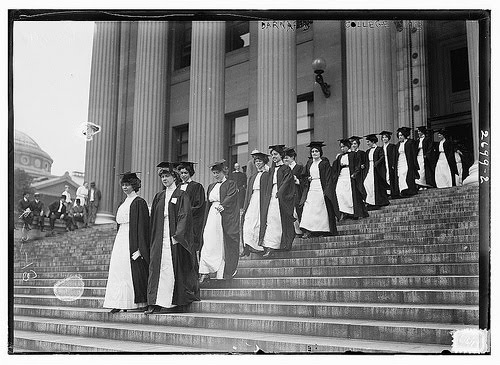
image credit: Barnard College, 1913 (LOC) made available by the Library of Congress @ Flickr.com.

feeling guilty for wanting a balanced life

11 Friday Jun 2010

Posted by Anna Clutterbuck-Cook in think pieces

≈ 1 Comment

Tags

domesticity, simmons, thesis, work-life balance

I’ve recently been making some decisions about how and when to complete my graduate education. Decisions which have left me feeling one part proud of myself for saying “nope, this isn’t working” and making the necessary changes and one part small and ashamed of being slow and for, well, wanting a balanced life. It is always humiliating (or at least I find it so) to find one’s self buying in, even a little bit, to the cultural pressures and voices in one’s head that pass judgment on the personal life decisions. Decisions that I know, in my gut, are right for me but nevertheless run counter to the mainstream expectations of how we ought to live our lives.

And yet, despite knowing I’m right, I do feel that pressure, and I do hear those voices. As I was trying to make a decision about whether or not to revise my planned thesis-writing deadlines to give myself more time for writing I was acutely aware of those dynamics. And the dynamics of justifying whatever decision I made both to myself and to others (my advisers, my family and colleagues, etc.). So I have a few observations that I’d like to share with you.

As I sit here spelling them out, they all seem rather obvious — but I think in part because of their very ubiquity they become invisible to us. So for that reason I’m going to the trouble of articulating them anyway.

The first observation is that it is really damn hard in our culture to feel comfortable making the argument that I am part of a family and that it is important for me to nurture the relationships that make up that family even while pursuing academic work and wage-work that I also care about. When justifying my thesis extension to my advisers, I emphasized my work schedule and the importance of having enough time for deliberation and revision while writing. I was up-front about the importance to me of having regular leisure time with Hanna during the week, but I was careful to name that desire as one of a number of factors, rather than foregrounding it as one of my primary concerns (which, in fact, it is). And part of me felt ashamed for naming it as a primary concern, even as I persisted in doing so.

A related reason that feels like an admission of failure is naming domestic responsibilities and the amount of time they take: quotidian tasks such as the morning and evening commute, physical exercise, dish-washing, laundry, grocery shopping, cooking, cleaning one’s kitchen and bathroom, attempting to impose some order on a very tiny apartment space in which two grown women, a cacophony of plants and myriad books are attempting to co-exist. As feminists have pointed out repeatedly for the past two hundred years (at least), domestic concerns are not taken care of by magic (sha-zing!), but rather through work, work that takes both time and energy on the part those whose duty it is to complete these tasks — whether those persons are paid domestic servants, unpaid spouses, or (in the case of those with neither the economic resources to outsource or a “separate spheres” arrangement with their partner) someone who comes home from work to a second shift.

Yet, as feminists have also pointed out, our society is still organized on the underlying assumption that these tasks will be completed on an invisible level, but people whose labor doesn’t officially count — or possibly in some gap in the space/time continuum. So it feels shameful to acknowledge openly that these tasks do take time, my time and Hanna’s time, and that these domestic responsibilities do not count as leisure activities. Rather, they too are un-fun duties that detract from rest and relaxation during the week.

Both of these facets of life — time to enjoy relationships and time for domestic tasks — fall under the broader umbrella of self-care, which is really the third life activity that is so very difficult to talk about, much less claim time for, in our culture (more about that in a forthcoming post next week). Despite all of the hue and cry that we are a narcissistic, self-obsessed culture very little in the structure of our society encourages care for, and love of, the self — something that is foundational to being effective in any other aspect of life. Yet it is something that is supposed to happen around the edges of our other obligations — shoved to the early mornings, late evenings, weekends, holidays. Rather than occupying its central place in the fabric of our daily lives.

My advisers were, I would like to be clear, not pressuring me to finish within the original time-frame, and were even supportive of my desire to have a life outside of school. But nonetheless, it was a difficult thing for me to ask for. One of them expressed confidence that I could finish writing in the time originally planned, and suggested that deadlines are important in curbing perfectionist tendencies. Which made the voices in my head start to wonder: was I really just panicking about writing a less-than-“perfect” thesis? Was requesting an extension just delaying the inevitable needlessly? But then I realized that these questions and doubts I was having focused the question back on the thesis itself, once again eliding the life I lead around the thesis project, and how that “extra-curricular” world has a place of equal importance in my life.

To be honest, when push comes to shove, it has a more important place in my life. By which I mean that caring for personal relationships and spending quality time with the people in my life will virtually always academic endeavors, unequivocally.

And that’s what I have the hardest time admitting to myself and the world: that people will always, always come before ideas in terms of my priorities. Why is admitting this so difficult?

In part, at least, it’s because I do, truly, feel passionate about ideas. As anyone who has lived in close proximity with me since I became verbal can attest: I am constantly thinking, processing, analyzing the world around me. It’s something I find endlessly enjoyable, satisfying, meaningful. My thesis, in this particular instance, is a self-chosen research project on a topic that’s been close to my heart for the past fifteen years; it has re-connected me to people for whom I care deeply, and whose own work in the world I admire. I will see this project through to the end, and I will be proud of having contributed my bit to the history of this particular time and place. I am good at what I do, and I believe in making use of my skills as a writer and thinker.

But as much as I love the world of ideas, I do not thrive in the world of academia, and I don’t think I quite understand — at least intuitively — what it takes to be the type of person for whom scholarship is their passion, their lifeblood. And often I feel incredibly guilty about acknowledging this, since I live and work in a world surrounded by such scholars.

It makes me feel, in some obscure hard-to-put-my-finger-on sense, like I’m letting them down. That I’m failing to live up to their hopeful expectations that I become a driven, passionate scholar like them.

Finally, I also think that, as a woman and a feminist, I find it particularly fraught to speak about those instances in which I choose to prioritize personal relationships over what amounts to my professional identity. Part of me struggles with the realization that, in doing so, I am conforming to cultural expectations of what women “naturally” prefer: we’re “naturally” more intuitive and relational, blah blah blah (“rubbish!” as Hanna would say). Another part of me is pissed that I feel ashamed of making those choices because I realize that, on some level, my feeling of shame means I have bought into the (profoundly anti-feminist) cultural idea that those “feminine” realms of being are somehow a lesser choice. And yet a third part of me is haunted by the women academics who have worked so hard to assert their right to be a part of the life of the mind, and I feel saddened by my acknowledgment that I have (more often than not) failed to feel at home in the space they were so triumphant, not so very long ago, to gain entrance to.

In the end, though, I don’t think this is an issue of gender (though it has aspects specific to cultural expectations of women and men) so much as it is an issue of “work” and how we understand what counts as work and what the place of work should be in our society and in our individual lives and self-identities. If anything, I suspect men still have a more difficult time in our culture claiming time for non-work activities, particularly activities that involve relational intimacy and home-making.

Most of all, I think this is an issue of re-claiming the right to make space for things that are not-work in our lives, and make the (radical?) assertion that often these things are more important to us than those things which count as work.

This has been a long, rambling blog post for which I have no tidy concluding remarks. So I thought I would end with some open-ended questions. I hope some of you will take the time to respond to in comments! What things do you find yourself struggling to justify making time for, and why? What do you do when your personal priorities are at odds with society’s priorities?

image credit: awkward by sketch | erase @ Flickr.com.

Newer posts →
"the past is a wild party; check your preconceptions at the door." ~ Emma Donoghue

Recent Posts

  • medical update 11.11.22
  • medical update 6.4.22
  • medical update 1.16.2022
  • medical update 10.13.2021
  • medical update 8.17.2021

Archives

Categories

Creative Commons License

This work by Anna J. Clutterbuck-Cook is licensed under a Creative Commons Attribution 3.0 Unported License

Meta

  • Create account
  • Log in
  • Entries feed
  • Comments feed
  • WordPress.com

Create a free website or blog at WordPress.com.

  • Subscribe Subscribed
    • the feminist librarian
    • Join 37 other subscribers
    • Already have a WordPress.com account? Log in now.
    • the feminist librarian
    • Subscribe Subscribed
    • Sign up
    • Log in
    • Report this content
    • View site in Reader
    • Manage subscriptions
    • Collapse this bar