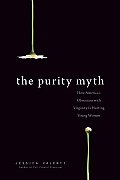
 Just finished Jessica Valenti’s latest book, The Purity Myth: How America’s Obsession with Virginity is Hurting Young Women. It’s a quick read (really! I wasn’t shirking those reading assignments for class in favor of feminist political analysis . . . again!), and give a nice overview of some of the current conservative and mainstream trends for policing women’s sexuality: specifically, the use of the elusive notion of girlhood “purity” and “virginity.” She ranges widely over a constellation of cultural narratives about sexuality that all have at their heart a fear of mature adult women’s sexual pleasure and sexual agency. Whether it’s conservative purity balls and father-daughter dates or the mainstreaming of misogynist pornography and ubiquitous slut-shaming and sexual violence that punish women, the agenda, Valenti argues, is the same: propping up an oppositional view of gender (“men” and “women” are mirror opposites of each other, and blurring of the categories ‘male’ and ‘female’ is dangerous to society), often at the expense of women and girls.
I particularly appreciate the way Valenti foregrounds the importance of valuing the ability of women and girls as moral actors, capable of making decisions about their own sexual lives — particularly when given access to a full range of resources (as opposed to a one-size-fits-all “just say no until marriage” toolkit, which spreads misinformation and ignores anyone who does not fall into a narrow heteronormative model of human sexuality). In the chapter on sexual education she writes:
I’m not going to reinforce the “they’re [teens] are going to do it anyway” argument. I believe it’s time to take a stance on sex education that isn’t so passive–young people deserve accurate and comprehensive sex education not just because they’re going to have sex, but because there’s nothing wrong with having sex. [emphasis hers] Allowing educators to equate sexuality with shame and disease is not the way to go; we are doing our children a great disservice. Not only are we lying to them, we’re also robbing them of the joy that a healthy sex life (as a teenager or in adulthood) can provide (120).
She goes on to describe the profound distrust of women that has been written into state and federal laws that regulate specifically women’s sexual descision-making, effectively giving us the legal status of “moral children” (189).
Valenti provides, in the final chapters, practical suggestions for shifting this discourse of fear and proscription to one of sexual agency. Perhaps because I have been thinking a lot, lately, about what it means to approach fellow human beings with intrinsic respect for their personhood, even when we profoundly disagree with their values and choices, I was particularly struck by the way she frames her vision with the concept of trust:
Trusting women means . . . trusting them to find their way. This isn’t to say, of course, that I think women’s sexual choices are intrinsically “empowered” or “feminist.” I just believe that in a world that values women so little, and so specifically for their sexuality, we should be giving them the benefit of the doubt. Because in this kind of hostile culture, trusting women is a radical act (198; emphasis mine).
While obviously fighting for a healthier sexual climate for women and girls does not end with trust, I don’t know if there could be a much better beginning.



 the feminist librarian