• anna j. clutterbuck-cook
  • contact
  • curriculum vitae
  • find me elsewhere
  • marilyn ross memorial book prize

the feminist librarian

the feminist librarian

Monthly Archives: March 2010

from the archives: "to lady patrons"

31 Wednesday Mar 2010

Posted by Anna Clutterbuck-Cook in my historian hat

≈ 4 Comments

Tags

archivists, boston, history, northeastern

Working on my digitization project yesterday, I came across this announcement printed in a theater program for a production of Shakespeare’s King Henry V performed at the Hollis St. Theatre here in Boston in April of 1901.

TO LADY PATRONS

The established rule at the Hollis St. Theatre, requiring ladies to remove their hats, bonnets, or other head-dress while witnessing the performance, applies to all parts of the auditorium, including the boxes and loges. It is essential to the comfort and convenience of all of our patrons in general that this rule be strictly enforced.

Ladies who are unwilling or unable to conform to the rule are earnestly requested to leave the Theatre without delay, and to recieve the price of their ticket at the box office.

I’m sure someone who knows a great deal more about theater history than I do could talk at more length about the shift in attitudes this represents in the cultural acceptance of women attending the theater and, bless me, being encouraged to sit in a public space with bare heads! I think my favorite bit is the “earnestly requested,” as it has such a polite imploring tone. Contrast that with the “turn off your cell phone” announcements today, which are so often couched in cajoling humor. Not that one method is better or worse, but I do think it says something about the audience that the managers of the theater expected their plea to be taken seriously.

requiem to a companion: "don’t make me go back. please. don’t make me go back."

30 Tuesday Mar 2010

Posted by Anna Clutterbuck-Cook in fandom

≈ 2 Comments

Tags

feminism, movies, whoniverse

Warning: SPOILERS.

This post is about the Dr. Who two-parter, “End of Time,” in which David Tennant finishes his tenure as the 10th Doctor. If you care about watching the episodes before reading what happens DO NOT READ FURTHER.

So I’m gonna be upfront here and say I’m a relative newcomer to the whole Dr. Who universe. For the perspective of a lifelong fan, I defer to Hanna’s own reactions to “End of Time,” “i don’t want to go,” posted over at …fly over me, evil angel…; I’m not gonna try to do the same level of analysis she does there — but there’s something (or, more specifically, someone) I really need to write about here.

And that’s Donna.

More specifically, it’s about how Donna needed to die.

Let me explain.

Donna is, hands-down, my favorite Dr. Who new-series companion. Not to diss Rose and Martha (both of whom I like for their own sakes), but from the minute Donna Noble appeared on the Tardis in “Runaway Bride” and slapped David Tennant’s Doctor upside the head for, well, being himself, I was sold. Donna is to the Doctor what you’d get if you crossed an exasperated big sister (“bite me, alien boy“) with an adoring niece who’s favorite Uncle had just given her the opportunity to walk away from her infantalized existence (trapped in dead-end temp jobs, dominated by her demanding, unhappy mother) and take on the universe.

After the Doctor rescues her from a wedding gone wrong in “The Runaway Bride,” Donna packs the boot of her car packed in readiness for interstellar space/time travel and seeks out the Doctor by following suspicious, potentially alien activity, in hopes that she can reinvent herself as his companion.

By mutual agreement, theirs is not a romantic or sexual relationship. Though there is, by the end of Donna’s tenure, a deep, deep love that would have been believable (at least in my mind) as sexual intimacy if the writers had chosen to take it in that direction. But they didn’t and it worked just as well (possibly better) without the simmering sexual tension that is at present an over-used trope in television serials. The relationship between Donna and the Doctor was on some level unequal (which is where the “cool uncle” part comes in; he’s a nine-hundred-year-old Time Lord, for goodness’ sake!) while also being entirely egalitarian (big sister who doesn’t take any crap from her little bro).

And I also think that, more than either of the companions immediately preceding her, Donna was unequivocal about the fact that joining the Doctor on the Tardis was her decision from the start. And one about which she had no second thoughts. Possibly this is because when we meet Donna she is older than both Martha and Rose, both more certain of who she is and wants to be in the world and also restless, full of unrealized potential. She’s ready for a challenge, and realizes it. Which is why she packs that suitcase and goes looking for her spaceman.

So on the one hand, it’s completely understandable, given this love between them, that the Doctor — faced with Donna’s imminent death as the result of a human-time lord meta-crisis (no, I’m not exactly sure either) which saved the universe from invasion by Daleks — makes a quite human mistake. Given the choice of either allowing Donna to die with dignity — in full knowledge of who she is and the choices she has made — or “saving” her by wiping her memory, the Doctor chooses to put her on the Time Lord equivalent of life support, a medically-induced coma, if you will. She becomes a shell of her former self, with no memory of the life she had in which she was a Self with agency: in which she acted in the world.

What the Doctor did to her, even in the name of salvaging her physical existence, was a violation. In writing this post I sat down and watched the scene in “Journey’s End” where the Doctor erases Donna’s memory. She tells him no. Repeatedly. “Don’t make me go back,” she pleads with him, “please, don’t make me go back.” And he does it anyway.

This is NOT OKAY. Understandable, maybe, in a broken, human, bad-decision-in-a-time-of-crisis sort of way. But NOT. OKAY.

So when it became clear that Donna re-appeared in the “End of Time” two-parter, both Hanna and I were hopeful that the writers had realized the error of their ways and were going to, finally, screw up the courage to do what they’d failed to do in the first instance, and that was let Donna die. After all: for all intents and purposes, she had died already — as both Donna’s grandfather and the Doctor acknowledge in the opening scenes of “End of Time.” As Hanna writes,

bernard cribbins does a(nother) great turn [in “End of Time”] as donna’s grandfather, really providing the companion for the show and doing a fantastic job at it, too, keen to see the doctor again, eager to help, but also desperate to understand why the doctor abandoned donna and why the doctor, seemingly so lonely and at loose ends, won’t just take donna back travelling with him.

Suffice to say, we were desperate to have Donna return to herself (please please please!) and die (in some sort of meta-crisis crisis that would have, in turn, caused the Doctor to regenerate, mayhap?) in what would have been restitution: the knowing death she was asking for at the end of “Journey’s End,” which the Doctor denied her.

But no.

What we had to watch was not-alive Donna getting married in what Hanna and I swear was the same fucking wedding dress the Doctor had rescued her from in “The Runaway Bride.” On the surface happy, but visibly confused, slightly vacant, entirely absent in a performance that must have been the devil for Catherine Tate to play.

Let me repeat. The “happy” ending is the one that puts our heroine back where she was on day one, with no memory of the life-changing experiences she’s had.

The attitude of the writers, it seems to me, is neatly summed up in this ninety-second recap of “the Donna Noble story”:

So . . . Donna gets to go “happily” back to her pre-Tardis existence after being the most important-fucking-woman in the universe with absolutely no memory of the experience . . . and the character we’re supposed to feel sorry for is the Doctor who (boo hoo) has to spend his Christmas alone?

Sorry. Not buying it.

Possibly I have a little issue with memory wipes.

Call me crazy.

I find myself wondering: Did no one on the writing team see this? Did no one realize that for those of us who care about Donna, the End of Time was basically two hours of watching our wonderful, vibrant, life-filled Donna Noble suffocate to death in the life she never wanted in the first place? That we could see that haunted, bewildered look in the back of her eyes in every frame? That having to sit through the “happy ending” that saw her married to a stranger while her grandfather looked sadly on and the Doctor blessed the union and walked away was roughly the equivalent of driving red hot nails through the center of our eyeballs?

While I don’t agree with everything author Philip Pullman writes, I’m a longtime fan of his Sally Lockhart novels, a young adult series in which one of the major characters dies in the second book. I once read an essay (I’m sorry I can’t track it down!) in which he reflected on the decision to kill the character. In earlier drafts, he acknowledged, he hadn’t had the guts to do it, merely causing the character disfigurement. But a friend told him the character had to die.

Because people die. Good people die. And if fiction doesn’t deal with the death of people who we wish didn’t die, it’s not true.

And you end up writing a poorer story.

You end up doing more violence to your characters than you would have if you’d let them be true to themselves — even to the death.

Donna should have died. And Doctor Who was less true, as a piece of fiction, because she lived.

It’s going to be a while before I’ll be able to think about forgiving that.

And I’ll sure as hell never be able to forget it.
sunday smut: links on sex and gender (no. 15)

28 Sunday Mar 2010

Posted by Anna Clutterbuck-Cook in linkspam

≈ Leave a comment

Tags

gender and sexuality, sunday smut

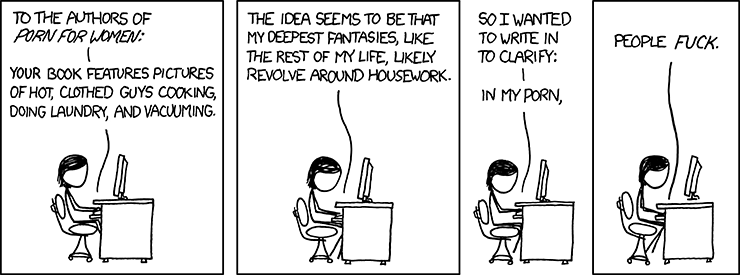
Because when you can start out a links list on sex and gender with an xkcd comic like this, why wouldn’t you?

Since this is the cleaning-up-my-feeds-from-Oregon edition, this is gonna just be authors, titles and selected quotes folks. I’m trying to get my blogging feet under me again (not to mention my work feet, in-school feet, and domestic-life feet), so posts might be a little more sluggish than usual in the coming weeks. Maybe even the next few months, depending on work schedules and how the writing of my thesis (eek!) goes, so bear with me. I promise I’ll try not to disappear entirely. But the one-a-day rate I’ve been posting this past six months will probably not be possible in the immediate future.

Amanda Hess @ The Sexist | Deconstructing Rape Myths: On Short Skirts (On Lesbians). “If she’s out in a same-sex couple that’s perceived as insufficiently feminine, she’ll get negative attention. If she’s out in a same-sex couple that’s perceived as fuckable by the standards of some heterosexual male passerby, she’ll get negative sexual attention.”

Amanda Marcotte @ Pandagon | Women chasing, men running. “suggesting that couples that are living together are generally stuck in the she’s chasing/he’s running mode doesn’t make a lot of sense to me.”

Amanda Hess @ The Sexist | College Sex Columnist on Masturbation, Money Shots, and Scandalized Grandmothers. “Over the past couple of months, Hill has heard from the haters (‘Can you tell me how talking about masturbating is ‘progress’ in female journalism?’), lovers (‘THIS ROCKS SO MUCH’), and one student who wrote in opposing Hill’s column because her grandmother read it one time and became overwhelmed by the column’s impolite subject matter. Seriously.

Thomas @ Yes Means Yes | Review: Guyland. “I don’t think Kimmel’s assertions about Guyland bear being generalized. But as long as I read them as critiques of a subculture, of Dude/Bro, I thought they were very good.”

Also by Thomas @ Yes Means Yes | Affirmative Consent as Legal Standard? “If two people lean in to kiss each other at the same time and stick their tongues in each other’s mouths, I think we can be pretty clear on consent.” (Long and complex, but worth reading if you care about how to support better legal and cultural expectations about consensual sex).

Natasha Curson @ The Guardian | Trans people still miss out on equality. “If you were to decide, for your own comfort and wellbeing, that you wanted to present at work as one gender two days a week, and another for the rest of the week, the law does not provide for you, and only the most enlightened of employers are likely to support you. But why shouldn’t someone be able to do that, if they feel comfortable enough with themselves to want to be visible?”

Susie Bright @ Susie Bright’s Journal | My Little Runaways – What You Won’t See in the Movie. “Let me make something clear that the movie only hints at: The Runaways band would not have happened, could not have been conceived, without the Underground Dyke Punk Groupie Slut culture that stretched from the San Fernando Valley to the bowels of Orange County.”

Greta Christina @ The Blowfish Blog | Some Evolving Thoughts About Weight and Sex. “A huge amount of my libido right now is focused on the changes my body is going through, and the ways it’s different from what it was before. Which is understandable: things that are in flux get more attention than things that are in relative stasis. But this has had the unfortunate effect of making me feel weirdly disconnected from my body and my sexuality of the past.”

Rebecca @ The Thang Blog | Talking to highschoolers (about being trans). “I did have one student ask, ‘So, if you did get…the surgery, and you like women…how would you have sex after?’ One of the other students waved her fingers in front of his face, which made me laugh.”

Roxann MtJoy @ Women’s Rights Blog | Panel Says Pregnant Women Don’t Have the Right to Refuse Surgery. “Personally, I would think that since a pregnant woman is still a human being, she should still have all of the rights of any other human being in this country. I would be wrong.”

Chloe @ Feministing | Pretty ugly: Can we please stop pretending that beautiful women aren’t beautiful? “So, what does it mean when even the ‘ugly’ women on our screens are conventionally beautiful? Firstly, it means that the bar for female beauty is being set higher than ever: if Tina Fey, Lea Michele and America Ferrera are ‘ugly,’ what hope is there for the rest of us? It also means that we’re being told one thing and sold another.”

Ashley Sayeau @ Salon | Help! My Daughter’s a Girly Girl. “I would never have imagined that I would essentially live in the Disney palace, forced by my daughter to talk in “a handsome voice” and mostly about getting married or mopping the kitchen. “Cinderella loves tidying up!” she frequently proclaims.”

Courtney E. Martin @ The American Prospect | A Manifesta Revisited. “They made it okay to be feminist and funny (this had always been the case, of course, but I’d been duped).”

Tracy Clark-Flory @ Salon | Sexual shame is so hot right now. “As I see it, young women have fully proved that we can have one-night stands, hear us roar — and maybe we’re beginning to also allow ourselves more nuanced feelings about our hookups.”

Marty Klein @ Sexual Intelligence | Court Finally Limits Persecution of Teen Sexuality. “These parents are heroes for insisting that the government doesn’t own their kids’ bodies or sexuality.”

Hadley Freeman @ The Guardian | Why everyone deserves to go to their high school prom. “When McMillen protested, saying “I won’t pretend ‘I’m not gay’ and brought in the lawyers, the school cancelled the prom. ‘Thanks for ruining my senior year,’ one classmate sneered.”

S @ The F-word | Painful Vagina? Your Poor Husband! “I am convinced that a young man of my age, complaining of serious sexual dysfunction and pain, would not have been treated in the same way. Firstly because in an otherwise healthy young male, loss of sexual function would rightly be seen as devastating (whereas for me it was treated as a mild difficulty), and furthermore because I do not think these doctors would assume a man was being ‘over-emotional’ or was suffering from a psychological problem rather than a physical one.”

G.L. Morrison @ SexIs | Labels and Street Signs: Navigating Gender & Orientation in the Global Village and Cyber-ghettos. “Should I define myself (gender and orientation) by what I am, what I am doing, who I am doing it with? If I were sleeping with multiple men or looking for male partners I would call myself bisexual (though I wouldn’t believe it) to protect other lesbians from the advances of men wanting to be ‘the next exception to the rule.'”

Amanda Hess @ The Sexist (can you tell she’s my new blog crush?) | Why Rape Isn’t One Big Misunderstanding. “Researchers then asked the men how they know when a woman is refusing sex. The men indicated that women also often rely on body language and euphemism to relay their lack of consent. Interestingly, even though the men professed to favoring the exact same tactics, they attributed these devices to the way that ‘women are.'”

Greta Christina @ The Blowfish Blog | Closeted Politicians and Bi Invisibility. “It’s occurring to me that it might make more sense to talk about right-wing homophobic politicians who are secretly having sex with same-sex partners . . . instead of talking about right-wing homophobic politicians who are secretly gay.”

Amanda Hess @ The Sexist (see?) | Fucking While Feminist, With Jaclyn Friedman. “A couple of guys were shocked that I like to play various games in bed, because I’m a feminist. That’s always really interesting to me. I’m always like, ‘Are you kidding me? The feminists I know are the craziest women in bed you can find!’ Those are the moments where I feel like a one-woman feminist PR machine.”

And before this post gets more unwieldy than it already is, I leave you with Shaker Maud @ Shakesville | On Being a Woman, Not a “Female.” “Referring to women as ‘females’ defines them solely in terms of gender, denying them any other attributes of personhood, and specifically denies them womanhood, marking that as a condition which is the speaker’s to confer or withhold based on their list of qualifications.”

quick hit: jo walton reviews ‘gaudy night’

27 Saturday Mar 2010

Posted by Anna Clutterbuck-Cook in linkspam

≈ Leave a comment

Tags

books, feminism

Thanks to Hanna who pointed me toward this lovely review of Dorothy Sayer’s Gaudy Night, posted by Jo Walton @ Tor.com. If you haven’t ready Gaudy Night and don’t wish to know certain key plot points, don’t click through. However, I encourage all those who have read and loved the Lord Peter/Harriet Vane novels to check out Walton’s astute analysis. I offer these two paragraphs up as a sampling.

This is a book about women — culprit, victims and the primary detective are women. Annie’s closest mirror is Mrs Goodwin, also a widow with a child away at school, who has trained as a secretary. We also see two old students, one whose marriage has ruined her mind, and one who has made a team with her husband and works with him. Then there’s the young don Miss Chilperic, who is engaged to be married, and will therefore leave the college. It was actually illegal for married women to teach in Britain before WWII. Sayers doesn’t say this because she assumes her readers will be utterly aware of it and can’t imagine things being any different, but if ever there was anything that should be footnoted for a modern audience, this is it.

The other academics might as well be nuns, they are devoted not just to scholarship but to virginity. This is said explicitly—and really in 1936 those were the choices. Marriage meant giving up the work, and not marrying, for women, meant maintaining virginity. This leads me to Harriet. Harriet lived with a man in Bloomsbury without marrying him, somebody else murdered him, and she was tried for the murder and acquitted because of Lord Peter (Strong Poison). Because of the notoriety of the trial, Harriet’s sexual status is known to everyone—and some people consider her utterly immoral because she had sex without marriage. This attitude—that people would care—is completely dated, gone like the dodo, and I have to work at understanding it. Harriet, in her thirties and unmarried would be presumed to be a virgin were it not that her cohabitation had been gossip in the newspapers after her lover’s death. Now the fact that she has had sexual experience is public knowledge, and affects people’s behaviour towards her.

As I said, you can check out the entire review on Tor.com.

thank you thursday: jet-lagged edition

25 Thursday Mar 2010

Posted by Anna Clutterbuck-Cook in a sense of place

≈ Leave a comment

Tags

boston, random kindness

The first summer I lived in Boston, a friend of mine (in town doing research at the Historical Society) took me out for lunch and left her wallet on the table when we left. Ten minutes later, when she realized it was gone and went back for it, someone had already taken it and disappeared. What followed were endless phone calls to put holds on credit cards, debit cards, renew IDs and replace other vital forms of information (library card anyone??). Not as catastrophic as it could have been in the identity theft department, but certainly a headache all around.

Color photograph of Boston T (electric train), Cleveland Circle line, crossing the Coolidge Corner intersection in Brookline, Mass. Photograph by Anna Cook, 2009.So this morning, when — tired and distracted by the back-from-research-trip “to do” list — I left my wallet at the Coolidge Corner post office on my way to work, and didn’t realize I had abandon it until about fifteen minutes (and a mile’s walk) later, I was prepared for the worst. I was already starting to make a mental list of the places I was going to have to phone as soon as possible to make sure our bank accounts weren’t drained through the ATM machine.

Which is why I would like to extend my fervent thanks to the anonymous, civic-minded soul who picked up my wallet from the post office counter and turned it in — every piece of money-generating plastic inside — and handed it in to the post office staff. So that when I turned up, sweaty and anxious from my one-mile trek back up the road, they could hand it back to me.

I don’t expect generosity from strangers, but it’s sure as hell a wonderful feeling to know there are people out there in the world who choose to be generous in their daily lives. Generous to someone they’ve never met, but whose life they’ve just made a hell of a lot less stressful than it could have been today. So whomever you are: Thanks.

Leaving PDX, headed home

22 Monday Mar 2010

Posted by Anna Clutterbuck-Cook in a sense of place

≈ Leave a comment

Tags

family, travel

Color photo of Renee, Brian and Anna on the window ledge of a bay window at Pittock Mansion museum, Portland, Oregon. Automatic timer photograph by Renee Hartig.
I’m headed out late tonight (my flight is scheduled to depart PDX at 11:59pm) on my return flight to Boston. Looking forward to seeing Hanna more than I can say! Being gone for two weeks was two weeks too many, despite the fact that I got TONS of thesis work done, loved re-connecting with folks in Lincoln, and seeing sibs (brother Brian and his girlfriend Renee pictured above with yours truly) and well as my grandparents who retired to Bend (in Central Oregon) during the 1980s. It’s thanks to them that I have pavlovian response to the smell of juniper and lava rock dust baked in the Oregon sun: vacation!

More to come in the next couple of weeks. Last night we saw Alice in Wonderland at the Living Room Theater here in Portland, about which I have a few thoughts (and suspicions it might be a pitch-perfect growing up tale — for girls and non-conforming teens of all stripes particularly); more after I see it a second time with Hanna next weekend. I’ve gotten some reading done, and hope to put together some booknotes posts on D’Arcy Fallon’s So Late, So Soon and Susan J. Douglas’ Enlightened Sexism. And I’m already pulling together links for next Sunday’s links list.

In the meantime, here’s a picture from sunny Portland. Sorry to say goodbye, but oh so glad to be headed back to the place I now call home. Been away too long.

researcher @ work: pictures from Oregon

13 Saturday Mar 2010

Posted by Anna Clutterbuck-Cook in my historian hat

≈ Leave a comment

Tags

photos, thesis, travel

It’s Friday afternoon at the end of week one and I’ve taken a break from the 1970s to drive three miles up the road to the Green Springs Inn, where the coffee is horrid and the marionberry pie is superb . . . and most importantly, where I can enjoy internet connectivity indoors instead of perched on a park bench in the snow outside the local one-room schoolhouse!

Here is one of the five cabins that house students during the fall, and visitors year round; this is the cabin I stayed in as a student (taken from the porch of the cabin I am renting on this trip); I was in the tiny room next to the woodshed that looks like a mudroom because it was until they modified it to house a fifth student! Everyone here is grateful for the snow because they’ve had such a dry winter thus far that there is talk of fire season starting in April — months ahead of the expected timetable.

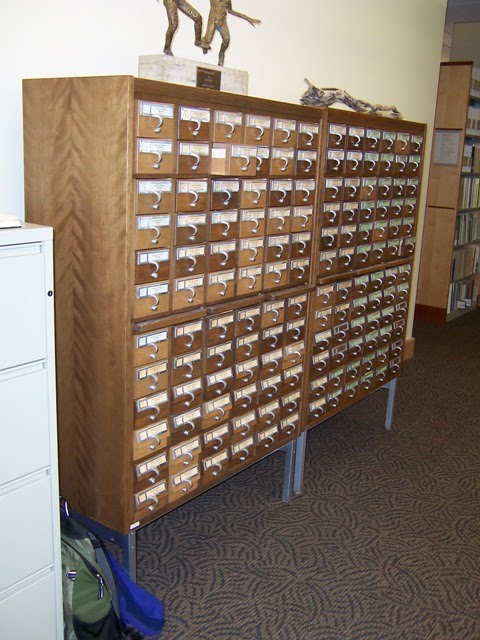
On Wednesday, I drove twenty-one miles down into the valley along Highway 66 (state highway, not the famous Route 66) to the town of Ashland, Oregon. How could you not love a town that proclaims “Libraries: The Heart of Our Community”? I was certainly smitten, which is why I stopped to take this photograph. I was on my way to the Ashland Public Library in any event, to see what they offer in terms of local history resources (not a lot in published form, it turns out). The reference desk was very courteous all the same, and the women staffing it were able to direct me to the Southern Oregon University’s Hannon Library, wherein is housed a a card catalog index of the Ashland Daily Tidings (the local newspaper). Yet another helpful reference librarian (yay reference librarians!) ushered me into a dark corner (metaphorically speaking) wherein was located this wonderful analog card catalog — yup, they really do still exist!

Sadly, the Daily Tidings (or whomever indexed it) did not see fit to print any stories about the Oregon Extension directly, but I did find a few stories from the late Sixties about the influx of hippies (yes, indexed under “hippies”) from the Bay Area. The locals seemed mostly perplexed rather than truly offended; they must have grown inured soon enough since by 1970 all references to hippies per se vanished. I plan to go back armed with the names of particular local communes and investigate some more tomorrow.

The folks here have been warmly welcoming and generous with their time and their records. My historians heart warms with a frisson of excitement at being able to go through “unprocessed” (in archives-speak) materials related to the early years of the OE, but it’s also a little terrifying to be entrusted with file boxes of other folks’ papers like this.

John Linton, one of the professors here (who arrived in 1981 and is thus, for now, outside the scope of my oral history project…in the future that may change!) has wandered by a couple of times and on his way past exhorts me to “do good work!” I’ll do my best, guys! You’re definitely giving me lots of great stuff to work with. Now I just have to live up to it!

On to week #2…

blog hiatus: off to Oregon

07 Sunday Mar 2010

Posted by Anna Clutterbuck-Cook in admin

≈ 1 Comment

Tags

blogging, thesis, travel

As this post goes up, I’ll be in the air somewhere between Boston’s Logan Airport and PDX. I’m headed out to the West Coast on a two-week research visit to the Oregon Extension, the off-campus study program that is the focus of my history thesis. I’ll be hunkered down with old curriculum notes from the 1970s and recording oral history interviews with the faculty who founded the program back in 1975 as well as several former students from the early years who work at the OE or live in the area. I am also lucky enough to be able to visit my brother and his girlfriend Renee, currently living in Portland, and my maternal grandparents who live in Bend. Since I’d like to take these two weeks to focus on my thesis research, I will be posting minimally or not at all (possibly some photos) until I return to Boston.

Please think warm thoughts toward Hanna, who is generously shouldering the burden of a solitary existance (hanna rightly points out that being alone is not a burden unless you’re actually lonely) taking responsibility for our household in Boston until I return. If you’re interested in keeping abreast of life in Boston, wander over to her blog at …fly over me, evil angel…

sunday smut: links on sex and gender (no. 14)

07 Sunday Mar 2010

Posted by Anna Clutterbuck-Cook in linkspam

≈ 1 Comment

Tags

gender and sexuality, sunday smut

This’ll be your last Sunday Smut list until I return from Oregon, so watch for no. 15 to appear on March 28th. In the interim, you’ll be on your own when it comes to the latest sex and gender related gossip in the blogosphere.

This week, to start us off, we have dueling videos: made-of-awesome and made-of-misogyny (not to mention misandry). On the pro-side we have a “That’s Gay!” segment posted by lisa @ Sociological Images that lampoons the discomfort surrounding Johnny Weir’s appearance at the Olympic games (“is Johnny Weir too gay for figureskating? . . . Wait. Is that even possible?”). On the con side, we have a PSA video produced by the socially conservative sexuality education organization SexReally posted by Jos @ Feministing (and just about every other feminist blog). It indulges in a whole host of harmful stereotypes, not the least of which is the idea that all men are sexual animals whom women must protect themselves from via safer sex practices.

Elsewhere, SKM @ Shakesville shares Johnny Weir’s response to critics (web video + partial transcript).

There’s been a lot of talk this week about the current state of sexism in popular culture, and how certain practices are being marketed to women as feminist when, possibly they aren’t all that different from traditional notions of how “nice girls” ought to feel and behave. Susan J. Douglas @ In These Times asks whether sexism is being sold to women as “empowerment”; Jessica Grose @ Slate’s DoubleX muses about cycles of slut shaming and the powerful cultural taboos over casual sex (Rachel @ The Feminist Agenda weighs in); Lucy Mangan @ The Guardian musters a quality rant on how Helen Fielding and her character Bridget Jones “destroyed my 20s”; and finally, Charlotte Raven @ The Guardian reviews several new books of feminism and culture, and suggests that it’s time for more women to become re-politicized about their position in society: “In the 50s, as now, the early gains of feminism had been squandered by a generation who thought it unglamorous and inhibiting.”

A new report shows that sexually-active Americans know alarmingly little about pregnancy prevention and how to protect themselves from sexually transmitted infections. Amie Newman @ RhReality Check reports the cold, hard facts, while Amanda Hess @ The Sexist offers us sex ed, Microsoft Paint edition.

Over @ The Lesbian Lifestyle, goldstardyke announced the winners of this years Lezzie Awards in blogging; of the blogs I follow, Feministing.com won in the category of Best Lesbian Feminist/Political Blog and Essin’ Em’s Sexuality Happens was a Runner Up in the category of Sex/Short Story/Erotica.

Congratulations are also due to Samhita @ Feministing, who has been chosen by the members of Feministing’s collective as the first to fill the rotating position of Executive Editor.

Cara @ The Curvature offers a powerful and scathing analysis of the recent report on sexual assault on college campuses and the continued failure of officials to respond meaningfully or create a climate in which victims of sexual violence are willing to come forward and report. Her argument is nuanced and worth digesting in full, but a few choice quotations (bold emphasis mine):

This idea that some rapes are Really Bad Rapes, and other rapes are Eh, Not That Big of a Deal Rapes, is incredibly damaging — especially when the only kinds of rapes that count as Really Bad Rapes are the kinds that are the least common — and also incredibly pervasive. Some rapes are more violent than others, but the bottom line is that rape is rape.

Saying that there are “middle” rape cases, that involve miscommunication and mutual intoxication, first of all, is patently false. Rape does not occur because of “miscommunication” — it just doesn’t. It occurs because of one party’s decision to ignore, disengage from, and/or reject communication. The idea that there are hoards of rapists out there “accidentally” raping is absurd on its face. But even if it was true, it results in a no less responsible rapist. If you don’t want to rape someone, you make sure that the other party is enthusiastically and meaningfully consenting. If you fail to do that and rape someone, there was no accident involved — just the likely and logical outcome of a conscious choice to disregard the bodily autonomy and safety of another person.

. . .

Here is where the overarching problem with schools’ disciplinary procedures, as well as the problem with how we as a society evaluate rape in general, comes to light. We spend more time looking at how the rapist thought about the event, rather than what the rapist actually did. We spend more time thinking about how the rapist might have meant things differently, rather than looking at the violence and oppression the rapist actually enacted. And we give more credence to the rapist’s intent than to the victim’s trauma and sense of violation.

And there can simply be no justice for rape victims when the first order of business is always to consider how the rapist feels.

Read the entire post at The Curvature.

Also (sadly) in the annals of rape culture Melissa McEwan @ Shakesville reports on a columnist who claims women joggers who desire solitary exercise are asking to be raped and murdered.

The Women’s Collections Roundtable of the Society of American Archivists reports that the awesome Women and Social Movements online collection is free for the month of March in celebration of women’s history month.

While Heather Corinna conducts a study on attitudes and experiences of casual sex, Sady and Amanda @ The Sexist ask is hook-up culture eating our brains?

Via SFSignal (thanks to Hanna for the tip), Lambda Literary announces a new webzine devoted to book reviews, author interviews and more.

And finally, a slightly dated (from last August) post from mlawski @ Overthinking It making the case that Strong Female Characters ™ are actually detrimental to the feminist cause. I should note that this post prompted a lively discussion in our household due to the classification of Leia in Star Wars as a modified Damsel in Distress ™. Hanna argues that mlawski is cherry-picking examples and thus destroying her case; I bow to Hanna’s mastery of the history of genre film in general and Star Wars in particular while maintaining that mlawski’s identification of a trend and its weaknessness is still valid. I leave it to my readers to decide for themselves.

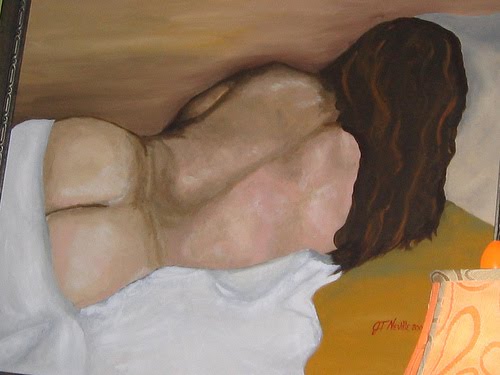
*image credit: painting of sleeping nude by afewfigsstudio @ Flickr.com

quick hit: Heather Corinna’s casual sex survey

06 Saturday Mar 2010

Posted by Anna Clutterbuck-Cook in linkspam

≈ 1 Comment

Tags

call to participate, feminism, gender and sexuality

via aag

The awesome sexuality educator and activist Heather Corinna, recently interviewed by Chloe @ Feministing, is conducting a survey on attitudes toward, and experiences of, casual sex. The survey is web-based, anonymous, and takes about 20-40 minutes to complete (depending on the speed of your computer and how much you want to write in the open-ended questions). Anyone over the age of sixteen who has ever had a sexual experience involving another person (so anything other than masturbation) is encouraged to respond.

http://www.surveymonkey.com/s/S97WR6H

Heather Corinna is trying to gather information on multigenerational attitudes toward casual (not in the context of a commited relationship) sex and how those who engage in casual sexual encounters feel about those experiences. The current media panic about young adult “hook up” culture focuses almost exclusively on heterosexual white women and assumes that casual sexual encounters are threatening to young women’s sexual pleasure and ability to form (if desired) more lasting relationships. Corinna hopes to provide a more nuanced perspective of the actual practice of casual sex without the burden of these moralistic assumptions. As Corinna herself writes:

There’s a lot of buzz right now about “hooking up,” the newest term for casual sex, though casual sex isn’t new at all — nor does it only belong to the current generation, despite often being presented that way. Unlike a lot of the buzz out there, I’m not interested in telling anyone how to have sex or in presenting any one kind of sex as the one ” best way.” I’m just looking for what’s real, both in sexual attitudes and personal experiences.

Rather, I’m doing this study to try and gather data on multigenerational experiences and attitudes with/about casual sex so as to discover and present a more diverse, realistic and non-prescriptive picture of people’s sex lives and ideas about sex. The data will ideally be used for publication, but your answers are completely anonymous and will only be used anonymously.

Since the study will be most informative if the respondants are drawn from a diversity of political, cultural, generational, etc., background, I encourage you to take the survey and pass it along to anyone you feel comfortable introducing the project to. Yes, this includes your socially conservative grandmother, your teenage brother, or your Church pastor.

← Older posts
"the past is a wild party; check your preconceptions at the door." ~ Emma Donoghue

Recent Posts

  • medical update 11.11.22
  • medical update 6.4.22
  • medical update 1.16.2022
  • medical update 10.13.2021
  • medical update 8.17.2021

Archives

Categories

Creative Commons License

This work by Anna J. Clutterbuck-Cook is licensed under a Creative Commons Attribution 3.0 Unported License

Meta

  • Create account
  • Log in
  • Entries feed
  • Comments feed
  • WordPress.com

Create a free website or blog at WordPress.com.

  • Subscribe Subscribed
    • the feminist librarian
    • Join 37 other subscribers
    • Already have a WordPress.com account? Log in now.
    • the feminist librarian
    • Subscribe Subscribed
    • Sign up
    • Log in
    • Report this content
    • View site in Reader
    • Manage subscriptions
    • Collapse this bar