• anna j. clutterbuck-cook
  • contact
  • curriculum vitae
  • find me elsewhere
  • marilyn ross memorial book prize

the feminist librarian

the feminist librarian

Author Archives: Anna Clutterbuck-Cook

a few links: lengthy quotation edition

31 Sunday May 2009

Posted by Anna Clutterbuck-Cook in linkspam

≈ Leave a comment

This Saturday, I bring you a few of the things from the week with some choice quotations rather than my own analysis, largely because I don’t have the brain capacity to provide any. Although there’s one story I’m so frustrated and weirded out by, I’m going to blog separately about it — so watch for that in the next couple of days.

First up, student barrister and mother Clare Gould, blogging at the f-word, a UK-based feminist blog, offers a witty and incisive critique of a popular series of British books that offer advice on how to raise boys.

Every newspaper and news bulletin is full of the problems that the parent of a boy will encounter. Raised suicide rates, drug abuse, criminality, sexual violence, poor exam results – it’s hardly surprising that parents want a magic pill. The problem was now personal to me. A few short months before, as I lay in the ultrasound suite in the hospital looking at my squirming baby son inside my belly, I found myself wondering how I would manage with what suddenly looked like a complex conundrum rather than a child.

. . .

Perhaps such myths and gender tales are comforting. Long engrained and part of the fabric of many’s parenting and upbringing, they are a comfortable rock in a changing world. They play to a fear that equality has gone ‘too far’. My feminist nature revolts however. I can’t find the science. I certainly can’t find the smoking gun. I can’t stomach the stereotypical assumptions. I can’t bear to see my children caged in gender stereotypes that limit both sexes as human beings. I want change but I also want something revolutionary. For once I would like to hear someone say the (apparently) unsayable – that perhaps at the root of it, men and women really aren’t all that different at all.

Then, on her weekly podcast over at RhRealityCheck, Amanda Marcotte interviews Aspen Baker, a “pro-voice” abortion activist, about her views on how to change the discourse surrounding women’s bodies and choices. I can’t quote the text extensively, because the audio has not been transcribed, but I will say I am continually fascinated by the way the contemporary pro-choice movement is percieved as resistence to women’s personal (and complicated) experiences of abortion when historically the campaign for meaningful access to abortion options has come directly out of women’s lived experience of reproductive decisions. While Baker’s work sounds spot-on in terms of giving women individual support, I think Amanda rightly pushes her to explain why she feels the need to separate herself from pro-choice activism.

And thirdly, the (disturbingly titled) Happy Days blog on the New York Times website, Simon Critchley offers a post on the usefulness of thinking that reminded me of Alain de Botton’s meditations on status anxiety.

An issue that came up in many of the comments was the relation between contemplation and action and the privilege that I seem to give to the former over the latter. Firstly, I would respond that contemplation is action (there is nothing passive about thinking) and action is sometimes contemplative (where I do not simply lose myself in thoughtless action, but think along with the act I undertake). But I concede that where Rousseau, Beckett or Melville might find this feeling for existence in bodily stillness, others might find it in vigorous physical activity. Nietzsche once said that all truly great thoughts are conceived while walking.

Hope you’re all having a restful weekend. The weather here in Boston the past couple of days has (despite dire predictions) been gorgeous.
Friday Photos: North End & Market

29 Friday May 2009

Posted by Anna Clutterbuck-Cook in Uncategorized

≈ Leave a comment

Tags

boston, photos

This morning, I rode the T into Boston with Hanna on her way to work, and went down to Government Center to shop at the weekend produce market and snag some coffee in the North End. It was a gloomy day, which actually made for some dramatic photos of the skyline. Check them out on the slideshow above (or full-screen at picasa, with captions).

Booknotes: Decline and Fall of the British Empire

27 Wednesday May 2009

Posted by Anna Clutterbuck-Cook in book reviews

≈ Leave a comment

Tags

feminism

The stuff you learn when you spend your weekends hanging out with another bookworm.

This isn’t strictly speaking a “booknote” in that I haven’t actually read the book in question. But this weekend, while I was reading Graceling, Hanna was reading (among other things), Piers Brendon’s Decline and Fall of the British Empire, 1781-1997. And along the way, via her viva voce renderings of the text, I learned a few valuable pieces of British Imperialism trivia.

  • While, from the standpoint of Western imperialism, I realize there are many things wrong with this concept, I was nevertheless quietly charmed by learning of the term sleeping dictionary which was slang for (according to the OED) “a foreign woman with whom a man has a sexual relationship and from whom he learns her language.” Perhaps it is my love of dictionaries that gives it an endearing feel; I also like the possibility, at least, that if a sexual relationship was sustained and mutual enough for one lover to learn the language of the other than it might in some ways defy the violence of imperial domination.
  • In a passage that begs for an illustration, Brendon writes that Warren Hastings, the Governor-General of India from 1773-1785, “was particularly indulgent towards his acquisitive and much-loved second wife Marian who dressed like ‘an Indian princess,’ braided her auburn ringlets with gems, and amused herself by throwing kittens into a bowl full of enormous pearls which slid under their paws when they tried to stand up” (36).
  • And finally, in a fashion moment one wishes the fug girls had been around to see, apparently British women of the late-nineteenth century could purchase bustles that, when sat upon, played “God Save the Queen” . . . a sort of patriotic whoopie cushion!

Long live the British Empire . . . at least in entertaining history books.

Booknotes: Graceling

25 Monday May 2009

Posted by Anna Clutterbuck-Cook in book reviews

≈ Leave a comment

Tags

genre fiction

Back in October, I had a very enthusiastic bookseller at Curious George Books in Harvard Square put a copy of Graceling, a debut fantasy novel by Kristin Cashore. She had seen me fondling a copy of Inkdeath and correctly presumed I’d be interested in expanding my young adult fantasy repertoire.

Of course, graduate school happened, and I never got around to reading it. Until this weekend, when I finally picked up a copy at the BPL and sat down to enjoy the luxury of reading a novel somewhere other than my morning commute.

It wasn’t a startlingly good read — I feel more deeply and instantly in love with, for example, Wicked Lovely and War for the Oaks than I did with Graceling — but I enjoyed it very much as a weekend read. In the spirit of Tamora Pierce’s Alanna adventures, Graceling is the story of a young noblewoman, Katsa, who is born “graced” with a particular talent and trained by her uncle, the king, as an assassin. When on a mission for her uncle, Katsa stumbles into another graceling, a young man named Po, from a rival kingdom, who challenges her re-imagine her future out from under the will of her tyrannical uncle. Soon, Po and Katsa are off on a quest to rescue one of Po’s relatives, a child named Bitterblue, from her father whose penchant for torture and particular grace for mind-manipulation makes him a formidable enemy. On the whole, Cashore maintains the delicate line of telling a story about a “strong female protagonist” without subsuming the story itself, and the particular characters she has created, beneath that aim. If you’re looking for fun fantasy reading for a summer afternoon, put this on your list — and enjoy the fact that the epilogue has “sequel” written all over it.

Quick Hit: Feminism, YA booklists, and troublesome authors

22 Friday May 2009

Posted by Anna Clutterbuck-Cook in linkspam

≈ Leave a comment

Tags

books, feminism

MK blogged about creating booklists for her school library, and how she ran into trouble when it came time to categorize Meg Cabot. I promised is she blogged it, I’d link it, so here’s the post. Check it out and leave her booklist category suggestions in the comments!

stuff and things to read

22 Friday May 2009

Posted by Anna Clutterbuck-Cook in linkspam

≈ 1 Comment

Tags

children, feminism

Been a slow couple of weeks for the blog; I’ve realizes that the energy of the semester bleeds over into my blog posts and then post-semester I somehow can’t gather the momentum to write original content very coherently for a while. But here are some ‘net links for stuff I’ve been reading in the meantime.

Once more, with feeling: the sexist world of Twilight from the pages of Ms. Magazine. (And ’cause I used the title, Hanna will now absolutely require me to watch the Buffy episode).

My friend mk, a fellow fledgling librarian, wrote a nice post over on the YALSA blog about the fuzzy line between business and pleasure reading for those of us in the words and ideas business.

If you know any women age 60-75 who might be interested in participating in a survey on women’s sexuality, point them toward this post on Our Bodies, Our Blog.

I’ve been thinking a lot about language and the way it creates insider/outsider groups, whether it’s the language of a particular academic discipline (say library science) or the language of a political movement (say feminism). I might be blogging my own thoughts later on, but in the meantime Questioning Transphobia (here followed by here) and canonball at Feministing Community have thoughtful posts on the subject.

When Hanna sent me the link to this article at the Guardian last week, I took one look at the headline and knew I didn’t have enough energy to enumerate its faults and logical fallacies as they should properly be enumerated: “Sex, drink and fashion. Is this the new face of American feminism?” Luckily, Jessica at Feministing offers a concise smackdown.

Meanwhile, as if blogging while at work weren’t proof enough of my adult-onset inability to pay meaningful attention to any one thing for long periods of time, Hanna has instructed me to bone up on my multitasking skills and forwarded this helpful article on the art as homework.

The latest addition to my expansive reading list (thanks to Hanna for the link) is The Philosophical Baby, by Alison Gopnik. From an interview with the author:

One of the ideas in the book is that children are like the R&D department of the human species. They’re the ones who are always learning about the world. But if you’re always learning, imagining, and finding out, you need a kind of freedom that you don’t have if you’re actually making things happen in the world. And when you’re making things happen, it helps if those actions are based on all of the things you have learned and imagined. The way that evolution seems to have solved this problem is by giving us this period of childhood where we don’t have to do anything, where we are completely useless. We’re free to explore the physical world, as well as possible worlds through imaginative play. And when we’re adults, we can use that information to actually change the world.

I suggested to Hanna that, actually, this sounded an awful lot like the two of us, and that perhaps one of the unheralded qualities of the graduate student mind was our ability to access the learning and imagining skills we used so tirelessly as small units.

Booknotes: Status Anxiety

21 Thursday May 2009

Posted by Anna Clutterbuck-Cook in book reviews

≈ Leave a comment

Tags

economics, psychology

In Hamburg in 1834, a handsome young army officer, Baron von Trautmansdorf, challenged a fellow officer, Baron von Ropp, to a duel over a poem that von Ropp had written and circulated among friends about von Trautmansdorf’s moustache, stating that it was thin and floppy and hinting that this might not be the only part of con Trautmansdorf’s physique imbued with such qualities. . . thw two men met in a field in a Hamburg suburb early on a March morning. Both were carrying swords, both were short of their thirtieth birthdays, both died in the ensuing fight (115).

“Dueling symbolizes,” writes Alain de Botton, in his work of popular philosophy, Status Anxiety, “a radical incapacity to believe that our status might be our business, something we decide and do not revise according to the shifting judgments of our audience. For the dueller, what other people think of him will be the only factor in settling what he may think of himself” (116). I have been meaning to read de Botton’s book since it first appeared in 2004 — and have had even less of an excuse since finding it on the $1 cart at the brookline booksmith this past fall. So this week, as a break from the dense fictional narrative of Anathem and the ethical psychology of Erich Fromm, I finally pulled it off the shelf and read it in an afternoon.

Like de Botton’s other books (such as The Art of Travel and The Consolations of Philosophy), Status Anxiety takes a human experience or feeling and draws on the writings of philosophers, intellectuals, and artists to explore how human beings in diverse times and places have responded. In this case, the topic de Botton tackles it the question of what we make of what other people think of us, and how we measure the success or failure of our lives by the opinions of others.

The first half of the book details the “causes” of status anxiety, the second half it’s “cures,” or antidotes that people in different times and places have found effective in combating the anxiety of not meeting the expectations of others: philosophy (big surprise), art, politics (more below), Christianity (which could be expanded to religious traditions more broadly), and “bohemia.” Although de Botton’s narrative is, per his usual style, more anecdotal than argumentative, he offers a lot of food for thought.

For example: political consciousness, de Botton argues, serves to denaturalize whatever framework a given time and place has decided to use when judging someone’s social status — and ultimately their success and failure as a human being. “What the political perspective seeks above all is an understanding of ideology, to reach a point where ideology is denaturalized and defused through analysis–so that we may exchange a puzzled, depressed response to it for a clear-eyed, genealogical grasp of its sources and effects” (222). What he calls “political consciousness” here I would argue is more accurately historical consciousness: the knowledge that that which appears “normal” in one time and place is, in fact, contextual — and thus, it can be changed.

Likewise, while resistance to status anxiety often turns on our ability to self-determine whether we are a success or failure, the extent to which this resistance works is often related to the strength of alternative communities and friendships with which we have allied ourselves–whether they are religious (Christian), political (feminist) or cultural (bohemian, artistic, etc.). In fact, reading the “solutions” half of Status Anxiety the book reminded me of a paper I wrote in undergrad on pacifism during the American Civil War. I was interested in how men who chose to resist enlistment in the military defended their decision to practice nonviolence — and particularly how they understood themselves in relation to the mainstream concepts of manhood and masculinity, which were so deeply connected to participation in the war. What I discovered was that the men who resisted were most likely to be part of religious sects that practiced nonviolence, and had developed an alternative vision of what manliness entailed — a vision of manhood that actually supported, rather than conflicted with, a pacifist life.

Despite the anecdotal feeling of the book, I found de Botton as charming and thought-provoking as ever. I think it is particularly useful, in a world that is currently so preoccupied with economic concerns, to remember that material worth, though undeniably important for well-being in some respects, is not in any way analogous to moral worth. And that, if we care about having a life worth living, being mindful of what kind of success we actually wish to aspire to, and why, is a deeply relevant line of inquiry.

Poll: How dorky?

19 Tuesday May 2009

Posted by Anna Clutterbuck-Cook in our family

≈ 3 Comments

Tags

domesticity, photos

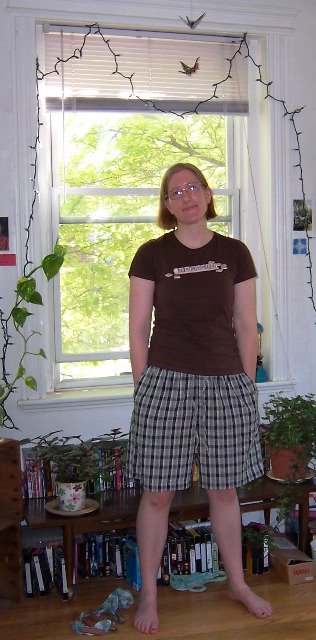
Hanna maintains these are the dorkiest pajama shorts in existence; I maintain they are comfy. Realize this is not a refutation of her basic point. Thoughts?

As a bonus (since Cynthia ‘specially requested ever so sweetly) you get to check out the new ‘do: got it cut in my (likely) fruitless quest to look like a certain psychic tarot card reader.

JT @ 26

19 Tuesday May 2009

Posted by Anna Clutterbuck-Cook in our family

≈ 1 Comment

Tags

domesticity, michigan

It was eleven years ago, around this time of year, that I exchanged the first letter with my friend Joseph as part of a long-distance writing group. Didn’t take us long to figure out that we’d stumbled into something worth hanging onto. Hundreds of letters (not to mention emails) later, we’re still hanging on and I’m grateful every day to have such a friend in my life.

Many happy returns of the day, J. Hope your spring garden is blooming enthusiastically and that you and Jason are throwing a big party in your new house. May there be lots of cake.

Sunday puppy blogging

17 Sunday May 2009

Posted by Anna Clutterbuck-Cook in our family

≈ 1 Comment

Tags

addie, family, michigan, photos

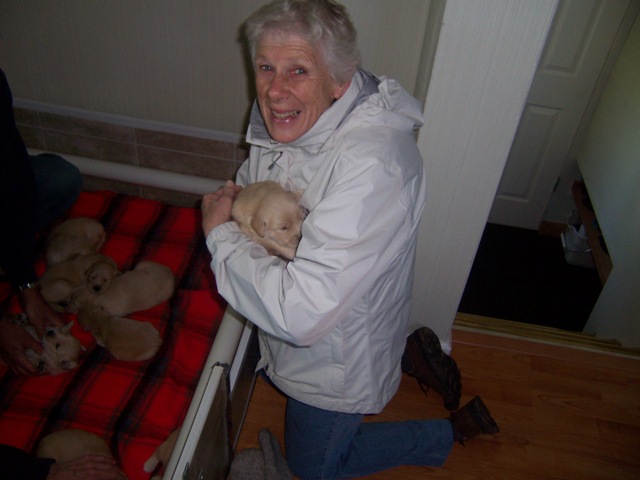
Yesterday, my folks went to visit Grandma’s puppy litter and sent some incredibly twee photos. These were my favorites.

Hope y’all are having a quiet, relaxing weekend!

← Older posts
Newer posts →
"the past is a wild party; check your preconceptions at the door." ~ Emma Donoghue

Recent Posts

  • medical update 11.11.22
  • medical update 6.4.22
  • medical update 1.16.2022
  • medical update 10.13.2021
  • medical update 8.17.2021

Archives

Categories

Creative Commons License

This work by Anna J. Clutterbuck-Cook is licensed under a Creative Commons Attribution 3.0 Unported License

Meta

  • Register
  • Log in
  • Entries feed
  • Comments feed
  • WordPress.com

Create a free website or blog at WordPress.com.

  • Follow Following
    • the feminist librarian
    • Join 36 other followers
    • Already have a WordPress.com account? Log in now.
    • the feminist librarian
    • Customize
    • Follow Following
    • Sign up
    • Log in
    • Report this content
    • View site in Reader
    • Manage subscriptions
    • Collapse this bar