• anna j. clutterbuck-cook
  • contact
  • curriculum vitae
  • find me elsewhere
  • marilyn ross memorial book prize

the feminist librarian

the feminist librarian

Author Archives: Anna Clutterbuck-Cook

prismatic scarf modification

29 Friday Nov 2019

Posted by Anna Clutterbuck-Cook in Am Sewing

≈ Leave a comment

Tags

knitting

Recently, I posted some pictures on Instagram of a two-color modification I made to The Prismatic Scarf pattern by Huan-Hua Chye on Ravelry. Several people were interested in how I worked it, so below is my attempt at step-by-step instructions. These will likely make the most sense if you are familiar with the original pattern (linked above).

This modification is worked so that the front and back look identical except that the colors are reversed. It requires working with two strands of yarn simultaneously, and I recommend high contrast colors in order to make the pattern pop. My sample was worked in two colors of Malabrigo Rios on #9 (U.S.) needles.

INSTRUCTIONS:

Cast on 36 stitches using one of the yarns (it doesn’t matter which). You can make the scarf wider or narrower by increasing the number of stitches cast on in multiples of 6.

Row 1: [establishing row]

In the cast-on color, K3, P3 (repeat to end. You should end on a K3.

Row 2: [1st pattern row]

1) Pick up contrast color and K3 using both colors. On each row moving forward, you will knit 3 stitches at the beginning and the end of the row using both strands. This carries the yarn forward and provides a border to help the scarf lay flat.

20191127_081332

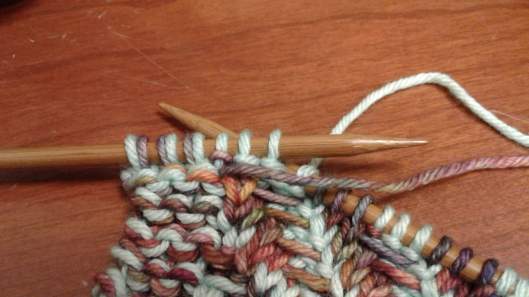
2) At the end of K3, separate the strands so one comes forward [color A] and one goes behind [color B]  (pictured above). Going forward across the row, you will keep these two strands from crossing until they meet up again for the final K3 of the row.

20191127_081421

3) P3 using the color you put behind the needles [color B]. Carry the color you put in front [color A] (pictured above). For this row, you will be following the establishing row in stockinette stitch fashion (purling in the back of the knit stitches, knitting in the back of the purl stitches). Row 3 will begin the staggered stitching so that the knit/carry pattern will travel across the scarf at a diagonal.

20191127_081516

4) K3 stitches using the color you carried across the front [color A]. Keep the purling color [color B] behind, taking care that the yarn strands do not cross.

5) Repeat the P3 with color B (carrying color A) / K3 with color A (carrying color B) pattern to the final three stitches. K3 to the end of the row using both colors.

Row 3: [2nd pattern row]

1) K3 using both colors.

2) Separate the colors so that color B is in front and color A is in back (the reverse of row 2).

3) On this row you will begin the stagger effect. With color B in front, P2 with color A.

4) Carry color B in front of the P2 stitches and K3 with color B. Continue to the last four stitches in the row.

5) K1 with color B then pick up color A and K3 with both colors to finish the row.

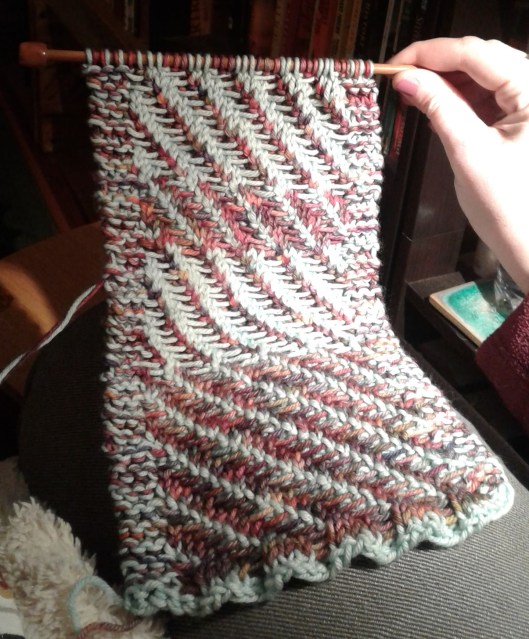
Continue alternating pattern row 1 and pattern row 2 shifting the K3/P3 pattern over by one stitch with each row. As you can see in the picture below, this means you will give your scarf the textured diagonal effect. When you are embarking on pattern row 1 the diagonal will climb from left to right, when embarking on pattern row 2 the diagonal will climb from right to left. 20191127_081553

You can play with the pattern further by changing up which color you treat as “color A” and “color B.” In the picture below you can see how I swapped the color A/B several times in this piece to get a striped effect. In the below example I also started with three rows of stacked (rather than staggered) rib to give the end of the piece a bit of a border.

20191127_184033.jpg

PATTERN DIAGRAM

Below is a super simplified diagram of five rows to demonstrate how the staggered effect works. This graph assumes only 9 pattern stitches (with 3 border stitches on each side).

KD = Knit with both strands
kA = Knit with color A (carry color B behind)
pB = Purl with color B (carry color A in front)
kB = Knit with color B (carry color A behind)
pA = Purl with color A (carry color B in front)

Pattern Row 1 [work L to R]: KD-KD-KD-pB-pB-pB-kA-kA-kA-pB-pB-pB-KD-KD-KD 

Pattern Row 2 [work R to L]: KD-KD-KD-pA-kB-kB-kB-pA-pA-pA-kB-kB-KD-KD-KD

Pattern Row 3 [work L to R]: KD-KD-KD–kA-kA–pB-pB-pB-kA-kA-kA-pB-KD-KD-KD

Pattern Row 4 [work R to L]: KD-KD-KD-pA-pA-pA–kB-kB-kB-pA-pA-pA-KD-KD-KD

Pattern Row 5 [work R to L]: KD-KD-KD–pB-kA-kA-kA–pB-pB-pB-kA-kA-KD-KD-KD


#comingoutday: the thread

12 Saturday Oct 2019

Posted by Anna Clutterbuck-Cook in life writing

≈ Leave a comment

Tags

sexual identity, sexuality

Yesterday (October 11) was #ComingOutDay and I shared some thoughts on Twitter. Here is that thread in blog post form, lightly edited to address a few typos. 

Twitter wants to make EXTRA ‘SPECIALLY SURE that I know it’s #ComingOutDay so I thought I would say a few words about what my coming out experience(s) have been like. I have spent a lot of time in the past couple of years reassuring newly-out queer adults  (💗🙌🌈💗) that our process of “coming out” can be both like and unlike the mainstream cultural narrative of coming out.

First I want to say: Coming out is sometimes unsafe. If it’s unsafe for you, I hope you care for yourself as you can in the moment. You still count, and you still matter. I hope in future it will become safer and more possible to come out to at least some people who love you.

Also: here’s a thread I wrote earlier in the year about how coming out can still be hard and scary for many of us. That doesn’t make you any less queer. That’s structual cisheterosexism still making our lives difficult.

So in this thread I thought I’d describe my coming out experience as a Midwestern queer kid during the 1980s-1990s. Keep in mind that I didn’t have an email address until I was seventeen. I had the public library and my parents’ bookshelves. The avenues for finding queer thought, queer options, queer community as a young person have changed radically since that era.

Some queer folks can look back into their childhood and find strong evidence for having been “born this way.” That’s a favored narrative for many reasons. But it isn’t a narrative that has been particularly useful to me. Sure, I was born “this way” in the sense that I was born me, and likely always had the capacity for same-sex as well as other-sex desires. But I also didn’t experience the gender policing many queer adults remember from childhood. I wasn’t made to feel non-normative in that way.

As a queer adult, looking back, I would say that my experience of passionate same-gender friendships might fit into a pre-history of queerness. I remember since early childhood imagining an adult life that involved establishing a home and family with another girl. Sometimes a boy. (And, you know, sometimes both.) But I didn’t have the language for same-sex desire/romance/relationship until I was about eleven and some girls at a sleepover were giggling about using the word “gay” in a Scrabble game. So I asked my mother for a definition — which she provided in very straightforward, not anti-gay, terms. It would be a few years later, in my early teens, when I began to observe that — unlike some of my friends — I didn’t feel romantic interest exclusively towards boys. Although the way I interpreted my feelings, at that point, was that I struggled to tell the difference between friendship and dating.

What does “coming out” look like for someone who hasn’t ever really been deliberately in the closet, but also hasn’t had the language to talk about who they are that resists presumptive (cis)heterosexuality? It’s a slow and halting process. As a teenager, I gathered more language. I read my mother’s edition of Our Bodies, Ourselves that had a whole chapter on lesbians! Our library had a copy of Annie On My Mind in the teen paperback rack (thank you librarians!). ElfQuest comics had gay and poly elves. 🤔

A piece of this story I often reflect on is that while I personally knew very, very few (out) queer people in our community, I knew a lot of single people — and single women specifically — who had created lives for themselves without following the dictates of the marriage plot (and/or parenting). One aspect of queer adulthood that I think we don’t talk often enough about is that our milestones and families often look and feel very different from the heteronormative imaginary. Sometimes they’re the same, or similar. And that’s okay too. But often they’re not! And for a child or young adult looking to grown-ups for possibilities … it felt in the early 90s (and I suspect often still feels today) like none of the life paths out there quite fit.

From 1997-2005, I was a commuter college student, living off-campus and working plus attending school part time. My campus was a hostile environment for queer people and feminists (I was vocally the latter, quietly the former). This is the period I think of as my “over-invested ally” period. I had no problem identifying as a lefty feminist, but I skirted the edges of campus queerdom because I lacked enough coherent evidence to identify as lesbian or bisexual (the options that felt available). I had no partnered sexual or romantic experience to point toward as evidence of my desires. It was all nebulous internal knowledge (knowledge I would tell any person today, who asked, is absolutely valid evidence … and anyway you don’t need a case file to identify as queer!). But at the time, it felt to me like you needed to prove the negative of being “not straight” (and I imagine many people feel a similar need to assemble their casefile for being “not cis”).

Me circa 1997-2007: It would be super awkward to go through the process of telling everyone you were queer and then have that be WRONG.

(Yes, 2019 me agrees with you that’s … not how this works.)

How does the concept of “coming out” (of hiding) fit into a story like this? The language and act of “coming out” can be found in the gay liberation moment of the early 1970s. It was originally a bold and brave call to political assembly. If you were a queer adult in the early 1970s you had lived through an era of intense persecution that had the goal of placing you outside the body politic. Claiming the public square was raucous street theater demanding that we be seen. This is also why Pride was, and continues to be, so important. Taking up space in public, being loud, being visible, is a political act:

We’re here. ✊

We’re queer. 🌈

I think a lot, though, about how those Big Coming Out acts we engage in as members of a queer body politic work in tandem with all the Little Comings Out we engage in as individual queer people. And how “coming out” is, maybe, in those quieter moments, more of a coming in — or settling in — to the self.

In order for me to make the shift (circa 2007-2009) from being an over-invested ally who understood herself to be “mostly straight” to being a queer bisexual I had to engage in so many small acts of letting that case file mentality go. I had to reject the straight-until-proven-queer framework that is cisheterosexist normativity at is most pernicious. I had to let go of the fear that unless I tried and failed at being straight I couldn’t properly prove I wasn’t.

I know this experience isn’t unique to bisexual folks. But I do think, perhaps, that understanding yourself to be queer involves less self-gaslighting doubt when you very obviously are not interested in people with whom you would appear to be in a heterosexual relationship. In a cisheteronormative world that prioritizes hetero desire, if you have some desires that seem to match up with that script, those desires can drown out the queer ones through cultural amplification. If my passionate friendships with men are read by the world around me as romantic, but my passionate friendships with women are read as platonic, it can be very hard to overrule social expectations and say: NO I LIKE THE LADIES IN A SEXY WAY TOO.

In the end, my Little Comings Out happened through so many moments like this:

*The day I referred to “my girlfriend” in front of a colleague.

*The day I said “we” meaning queer people.

*The day I said to my mother, “I’m falling in love.”

To me, being queer is both about the Big moments and the Little ones. It’s about finding your way through the cacophony of straightness to the right queer harmony that resonates with you. And it’s about acting in solidarity (whether visibly or not; visibility isn’t always safe) with others under the queer umbrella.

Coming out — in big ways, and little ways, helps us find one another, fight for one another, find language that helps us illuminate our souls.

Welcome home. 💗

Happy pride. 🌈

#IBWbio Update 2

02 Wednesday Oct 2019

Posted by Anna Clutterbuck-Cook in my historian hat

≈ Leave a comment

Ida B. Wells Book Project (6/7/2019)
Update 1 (8/14/2019).

A few things have happened since mid-August. The most important milestone was my October 1st deadline for getting a draft table of contents and sample chapter to my series editors. One of the new-to-me aspects of this type of manuscript development is that I am drafting a preliminary story arc for the work while simultaneously still doing research. Eek! Since I am one of those nonfiction writers who doesn’t really understand where I’m going and how I want to get there until I start writing, it was hard to pull together a table of contents even though I knew it was only preliminary.

The structure of the project, and the series it falls into, dictate some aspects of the outline. For example, the main body of the work must be roughly chronological and provide a strong, coherent narrative of the subject’s life and work. How to organize a coherent narrative that accurately captures complexity of a human life is, of course, the challenge left to me to resolve. I have a lot of question marks still, at this stage, but know that I want to provide the target audience of this work with enough contextual information to understand Wells’ story embedded within the collective experience of black women in America between the Civil War and the Great Depression. I cannot assume that a reader who picks up this book has a working understanding of chattel slavery, of what Reconstruction did and did not entail, what we mean when we talk about a  “lynch mob.” Or what it meant for black women to assert their woman-ness within a white supremacist context that — until Ida’s toddlerhood — had refused to accept Black women as women. If experiences in the undergraduate classroom are any guide, we cannot even assume an adolescent reader will accept that structural racism exists. So there will be a lot of scaffolding to construct around the core narrative of Ida’s life experience in order for readers to grapple with the particular part Ida had to play.

The other element of this book that I put some thought into was a list of “sidebar” topics. Again dictated by the structure of the series, the segments will appear alongside the main narrative and I could have gone in a number of directions with them. I went through several iterations of lists before settling on a set of concepts, people, and individuals that I hope will extend the reach of Wells’ story back into the 18th century and forward into the 20th/21st century. While I originally thought to include people and concepts from her own lifetime as well, those individuals and ideas are better treated, narratively, in a way that folds them into the main narrative. By using the sidebars to highlight the work of women like Elizabeth Freeman and Harriet Jacobs  who came before and the Combahee River Collective, SisterSong Women of Color Reproductive Justice Collective, and the co-founders of Black Lives Matter who came after we can see Black women intellectuals and activists moving forward in struggle across generations. That’s where I am at the moment on the sidebar question!

My major reading in September was Eric Foner’s Reconstruction: America’s Unfinished Revolution, 1863-1877 (1988). The political and social particulars of Reconstruction was a gap in my historical knowledge from both undergraduate and graduate school — in part because I focused on the 20th century, but also because this is a period that many curricula fail to do justice. Though thirty years old, Foner’s text remains a standard-setting one and I appreciated how willing he was to use the words “white supremacy” to describe the post-Civil War politics that led to extreme violence against freed and free Blacks and those Whites who resisted a white supremacist hegemony. This text gave me some of my own much-needed scaffolding for my understanding of what labor looked like in the South, what land ownership and occupation meant, what various levels of government (local, regional, state, federal) meant in terms of day-to-day realities — particularly for those who had been emancipated and were building futures for themselves, their children, their communities.

Diana Ramey Barry’s The Price for Their Pound of Flesh: The Value of the Enslaved, from Womb to Grave, in the Building of a Nation (2017) has also been an important and wrenching read as I reach back into the stories of Ida’s parents. Ida’s mother, historians have pieced together, was born in 1844 to enslaved parents in Virginia and sold at the age of 7 or 8 years of age on the auction block. Using Barry’s data as a guide, Elizabeth (Lizzie) Wells would have commanded a price of around $236 (or $6,940 in 2014 dollars). She would never reunite with her parents or any but the two sisters with which she had been sold. Ida’s father James (Jim) Wells, meanwhile — while never separated from his mother Peggy and his half siblings through auction — experienced another form of trauma produced by the chattel slavery system: He was the son of his owner, Morgan Wells. While never beaten by his father, and apprenticed as a carpenter to Lizzie’s owner — a valuable trade he was later able to use to support the Wells family after emancipation — Jim was never allowed to forget his enslaved status. In her autobiography, Crusade for Justice (1970), Ida recalls her father refusing to consider introducing his children to his late father’s widow because “Miss Polly” had stripped and whipped his mother, Peggy, the day after Morgan Wells died — an overt show of the power a White widow had over the Black woman with whom her husband had had his only child.

I’ll be taking a bit of a breather in October — yay vacation! But next up on my reading list is a book by Mary Niall Mitchell that will dig deeper into this theme of parenting in the post-Civil War era: Raising Freedom’s Child: Black Children and Visions of the Future After Slavery (2008). It’s also time to round out my reading of other major biographical treatments of Wells with To Keep the Waters Troubled by Linda O. McMurry (1999), Ida B. Wells-Barnett and American Reform, 1880-1930 by Patricia Schechter (2001), They Say: Ida B. Wells and the Reconstruction of Race by James West Davidson (2007), and To Tell the Truth Freely: The Life of Ida B. Wells by Mia Bay (2009), as well as The Memphis Diary of Ida B. Wells (1995).

Stay tuned!


#IBWbio Update 1

14 Wednesday Aug 2019

Posted by Anna Clutterbuck-Cook in my historian hat

≈ 1 Comment

I’ve decided to blog a little bit about this Ida B. Wells biography project, for some accountability and sense of progress over time as I move through the 18-month process of producing a 100,000-word manuscript.

In the two months since my first post, I’ve been slowly shifting gears from wrapping up old projects to starting this new endeavor. One of the strangest things about a project like this, I’m already finding, is the comparatively slow-motion nature of the beast. Rather than diving in and working intensively full-time (in terms of both physical time and brain time/energy) on this one project I am carrying this work alongside many other responsibilities and pleasures. That is a new pace of scholarship for me since I have not done a project of this size since graduate school. And I’m hoping that the discipline of writing occasional updates will help me understand this slow-motion labor as building toward the final manuscript over the long haul.

Since June:

1) I received confirmation of my contract and the first $100.00 of my advance. Per my commitment to anti-racist actions as a part of this work, I donated $33.00 to the African American Intellectual History Society (go check them out!) and used the rest to purchase books by Black women scholars relevant to my research:

Beyond Respectibility: The Intellectual Thought of Race Women
by Brittney Cooper (U. Illinois, 2017)

IDA: A Sword Among Lions
by Paula J. Giddings (Amistad, 2008)

Southern Horrors: Women and the Politics of Rape and Lynching
by Crystal Feimster (Harvard Univ. Press, 2009)

Southern Horrors and Other Writings: The Anti-Lynching Campaign of Ida B. Wells
by Ida B. Wells (Bedford/St. Martin’s, 1996)

2) I spent July working my way through the Giddings biography, which is 800 dense pages of distilled biographical research. A scholar of African American history, Giddings was first introducted to me in college, when I was assigned excerpts from her landmark When and Where I Enter (1984). IDA does an excellent job of embedding Wells in, and interpreting her work through, the networks of Black intellectuals and activists she learned from, worked alongside, and often fought with between the 1870s through to her death in 1931. As I had hoped it would do, Giddings’ work provided an excellent foundation upon which I can begin to sketch out the key events, ideas, and figures that must appear in the much briefer treatment of Wells’ life that I will be writing. It was also just a pleasure to read as a biography, gracefully and insistently centering the voices and experiences of Black women — and one Black woman in particular — in narrating the history of anti-racist activism between the end of the Civil War through to the Great Depression.

3) During the first half of August I read Brittney Cooper’s Beyond Respectibility which doesn’t focus directly on Wells (although it does discuss her in relation to her contemporaries) but instead does critical theoretical work centering Black women’s knowledge production from the 1890s – 1970s. It has given me some extremely useful scaffolding for thinking about how Wells’ work incorporates her embodiment as a Black woman, and about how Black women activists and scholars (and scholar-activists) have situated Wells in a long genealogy of race women.

4) I also read Eric Weber’s dissertation “National Crimes and Southern Horrors: Trans-Atlantic Conversations about Race, Empire and Civilization, 1880-1900” (Duke University, 2011) which situates Wells — among other Southern journalists and newspaper editors — in an international (particularly Anglo-American) context. (Full disclosure Eric is a friend of mine.) This analysis of Wells’ participation in discussions about imperialism, racism, and civilization is particularly helpful in thinking about how Wells used her two lecture tours in England to enlist English activists in drawing (undersirable to white Southerners) international attention to White supremacist violence in the south.

5) I’m slowly building a list of the relevant scholarship I will need to digest as I write the full manuscript over the coming year (123 journal articles and 30 books so far).

6) I have a shitty first draft list of topics that might work for the “sidebar” sections, 200-word treatments of key concepts, events, people, legislation, etc. My goal with these sections is to draw connections between Wells and (particularly) other Black women’s activism before, during, and after her life. I want the high school and undergraduate students who are the anticipated audience for this biography to understand Wells not as an Important Black Woman in isolation but as one person who fought alongside others in the struggle for liberation. And hopefully, they’ll be curious enough to go do further research on one or more of those topics when the time comes for a National History Day project or a term paper!

Until the next update…

#CraftingDemocracy: Persistent Stitches I

10 Saturday Aug 2019

Posted by Anna Clutterbuck-Cook in handwork

≈ Leave a comment

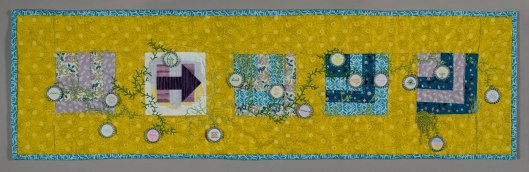
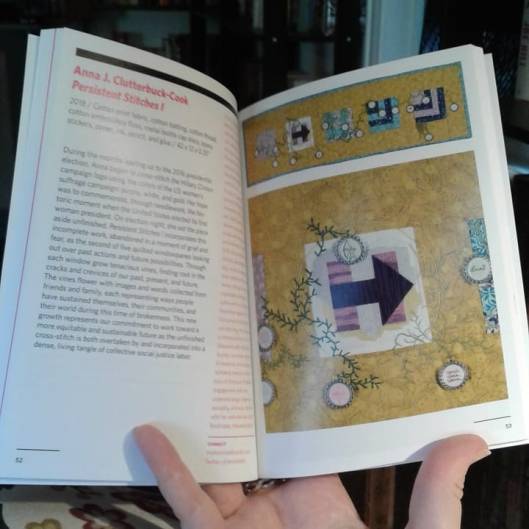
FinalQuilt_workOn August 1st the craftivism exhibition Crafting Democracy: Fiber Arts and Activism opened at the Central Library in Rochester, New York. My quilted hanging Persistent Stitches I (above) is one of the artworks included in the show — my first juried exhibition, in which I am delighted to join — as a fellow exhibitor — my quilting teacher Kate Herron Gendreau along with many other craftivists. Below is my artist statement which is featured in the exhibition catalog.


Persistent Stitches I

Ancestors all behind
And before me every child
I bring the power of a long unbroken line…

~ Zo Tobi, “Blessed Unrest” (2013)

In the final months of the 2016 presidential election campaign, I began to cross stitch the Hillary Clinton campaign logo, with the arrow crossing an H, in hopes of commemorating the historic moment when the United States elected its first woman president. I chose the version of the logo centered within a heart, and stitched the piece in the colors of the U.S. woman suffrage campaign: purple, white, and gold. On the evening of election day, I sat down to watch the election returns while working on the cross stitch piece. When it became clear that the electoral college would swing in favor of Donald Trump, I went to bed for a sleepless night thinking of the terrifying future the 2016 election had delivered us. In the dates that followed, I didn’t have the heart to pick up the Hillary campaign cross stitch to complete it. Eventually, I set it aside with the vague notion of reworking it into a larger piece documenting “the resistance” as it evolved. 

Persistent Stitches I takes that 2016 cross stitch as a building block for this quilted hanging. In the quilt, the incomplete campaign logo becomes the second of five squares in quilt that represent windows looking into past actions and future possibilities. Growing out of each window are tenacious vines, finding root in the cracks and crevices of these past, present, and future events. When the piece is finished, the embroidered vines will flower with images and words collected from friends and family members representing the ways in which they have sustained themselves, their communities, and their world in a time of brokenness with a commitment to taking action toward a more equitable and sustainable future. In this piece, the unfinished Hillary campaign symbol is both overtaken by and incorporated into a dense, living tangle of past, present, and future social justice labor. 

Dimensions: 43” x 13.5”
Materials: Cotton fabric, cotton batting, embroidery floss. 

68359878_10157631988559515_2158380100289036288_n

Ida B. Wells Book Project

07 Friday Jun 2019

Posted by Anna Clutterbuck-Cook in library life, my historian hat

≈ Leave a comment

Cover_Southern_horrors

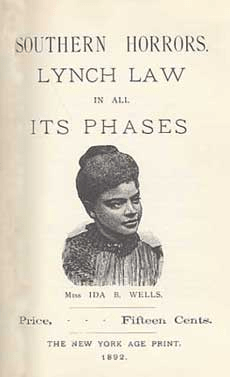
Ida B. Wells, Southern Horrors: Lynch Law in All Its Phases, book cover, 1892.

Now that I’ve actually signed the contract (ohmygodohmygodohmygod), a bit of news from my historian/writer’s life!

I was recently approached by an editor — someone with whom I’ve previously worked on an encyclopedia of women in American history — and invited to join a group of authors writing biographies for an ABC-CLIO series called Women Making History aimed at a high school and undergraduate audience. After some discussion and negotiation I have accepted the invitation; over the next eighteen months I will be working on a biography of journalist and activist Ida B. Well (1862-1931)! I am grateful to Dr. Peg Lamphier and her co-editor Dr. Rosanne Welch, as well as Dr. Kim Kennedy White at ABC-CLIO, for the opportunity to tackle this new type of history writing-for-hire. I have enjoyed shorter projects of this nature and recently declined a much larger reference book project that — while interesting to me! — seemed well beyond my bandwidth to tackle alongside my other commitments. This biography project feels like a good length, with a tight enough focus, to be a challenge … but not an overwhelming one. I look forward to strengthening my research and history writing muscles over the next year and a half.

The book will be — by series design — a synthesis biography, grounded in the research and analysis of specialist historians, rather than a work based on my own archival research. I have a strong background in 19th and 20th century American history, with an emphasis on gender and sexuality, but I am not an expert on African American history or the life of Ida B. Wells. To complete this project, I will rely on the scholarship of the many historians and activists who have ensured Wells’ life and work are not forgotten, and who have placed her story in rich historical, cultural, and political context.

As a white historian approached to write a book about a black intellectual and activist, I took some time to consider under what terms it would be appropriate to accept this job. As with all of my other work-adjacent projects, I confirmed with the series editors that the authors working on this series are not all white — making sure the project met my inclusion rider prerequisite. It does. Now that I have accepted the project, I want to commit publicly to two additional anti-racist actions:

  1. First, I commit to practicing citational justice, ensuring that the majority of works cited in the book are by scholars of color, and particularly by black women. This also means I will place a priority on purchasing works by black women as I build my research library for the manuscript. If you are interested in the intersection of social justice and citational practice, check out the Cite Black Women Collective, whose five guiding principles inform this commitment. Also this post, “Making Feminist Points” by Sarah Ahmed, and this piece on “The Politics of Citation” by Kecia Ali.
  2. Second, in the interest of transparency about the financial benefits of this project: I have agreed to an advance of $850.00 and 8% royalties. I will be donating one third of the advance ($285) and 50% of any subsequent royalties (hey, a girl can dream!) to the African American Intellectual History Society (AAIHS) to support the work of scholars whose research and writing make work-for-hire writing projects like this possible.

My goal through these actions is to materially redistribute the financial benefits of the work I will be doing in a way that directly supports scholarship by and about black women. I’m making these commitments public not for cookies but because transparency is an important part of accountability. I also believe it’s important to break the white silence around how we benefit from structural racism, and have matter-of-fact discussions about ways to actively resist white supremacy in our daily lives.

I look forward to digging into the scholarship around Wells’ life, and to creating a new pathway into that scholarship through a biography that will be put in the hands of young people. If all goes well, the book will be out in 2021. In the meantime, if you are interested in learning more about Ida B. Wells, I would encourage you to start where I have begun my own reading: borrow a copy of Paula J. Giddings biography Ida: A Sword Among the Lions (Amistad, 2008) from your nearest library.


Queer Lives, Queer Loves: Library Journal Presentation

10 Friday May 2019

Posted by Anna Clutterbuck-Cook in library life

≈ Leave a comment

This past Tuesday, 7 May 2019, I gave a presentation to students in a Library Journal professional development course “Evaluating, Auditing, and Diversifying Your Collections.” I was asked to present on the topic of tropes and stereotypes of LGBTQ+ people in media. Below are images of my PowerPoint slides and some of the key talking points of my (unscripted) presentation. A number of people on Twitter requested access to the talk so this is my attempt to make the content available in a more permanent, open access format.

Queer Lives, Queer Loves_ Moving from Tropes and Stereotypes toward LGBTQ+ Representation

A text-only version of the slide deck (PDF) may be downloaded here.
A full-color, image slide deck (PDF) may be downloaded here.

Queer Lives, Queer Loves_ Moving from Tropes and Stereotypes toward LGBTQ+ Representation (2)

I began by situating myself in relation to this topic as someone who is privileged in some ways while marginalized in others. I also have training and scholarly interests relevant to this work. I also acknowledged this was the first time I had presented on this particular set of ideas and welcomed feedback from the course participants (I welcome feedback from readers here as well!)

Queer Lives, Queer Loves_ Moving from Tropes and Stereotypes toward LGBTQ+ Representation (3)

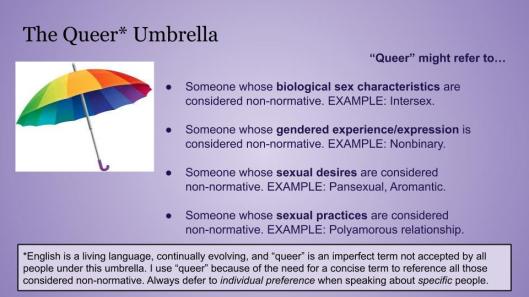
I took a moment to talk about my decision to use the word “queer” as an umbrella term for people who are non-normative in the areas of sex, gender, and sexuality. It was important to me that students understand that inclusive collection development in this area means not just materials on gay and lesbian vs. straight people but a diverse web of identities. I explained that a person who is queer may fit in one or more of these non-normative communities — for example, a person may be trans AND bisexual AND kinky. Or nonbinary AND aromantic AND practice BDSM.

Queer Lives, Queer Loves_ Moving from Tropes and Stereotypes toward LGBTQ+ Representation (4)

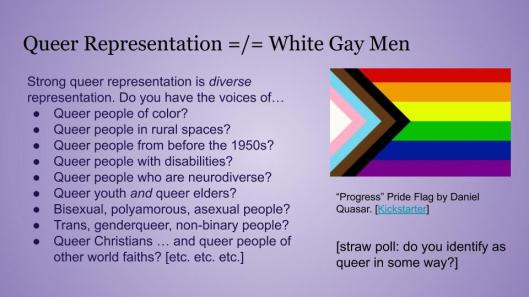
I put my key takeaway in slide four: A collection that predominently represents the lives and stories of white, gay men is not a truly inclusive collection of queer fiction or nonfiction. It is important for libraries that are interested in building a robust collection of queer media to think about internal diversity as well. Think critically and intersectionally about who is (and is not) being represented and whose needs are (and are not) being met by your resources. What gaps do you need to fill? Are there resources to fill those gaps?

We also had an in-class poll to learn what % of student in the course considered themselves queer in some way. The results were about 15% queer / 85% not queer which actually surprised me (I had — clearly lazily! — assumed LGBTQ+ people might be over-represented in a course of this kind. I was speaking to a straighter audience than I had anticipated.)

Queer Lives, Queer Loves_ Moving from Tropes and Stereotypes toward LGBTQ+ Representation (5)

I touched briefly on sexually explicit media because access to SEM in libraries is controversial and regulated — and those regulations disproportionately impact queer people’s access to information and stories by and about queer people. Queer content is often classified as more sexually explicit by default (for example, queer romance getting classified as erotica in content systems even if it is not as explicit as the straight romance that would be classified in the same way). This impacts the visibility of queer content continually, and library staff need to be aware of this dynamic as they assist their users. 

Queer Lives, Queer Loves_ Moving from Tropes and Stereotypes toward LGBTQ+ Representation (6)

The discourse of “own voices” is one that many participants in this course come into the class supporting. I think it is a good tool in the toolbox of collection development, since it asks people selecting resources to think critically about who has the power to tell stories — who is being paid to publish a book, create a documentary, conduct research within a marginalized community. However, I also wanted our students to understand that “own voices” is not always a simple check-box category — particularly when we begin to think of multiple, overlapping communities of marginalization. My favored definition of “own voices” is the one shown here, from Blue Crow Publishing. But even using that group-level test of ownership, not all works fit neatly in or out.

Queer Lives, Queer Loves_ Moving from Tropes and Stereotypes toward LGBTQ+ Representation (7)

Using the Blue Crow Publishing definition above, paired with “queer” as the group identity, many of these examples are “own voices” (I count examples 1, 2, 3, 4, and possibly 5 and 7 as well). The students were polled on these examples and only examples 1 and 3 were voted most definitively as “own voices”.

It’s complicated.

Queer Lives, Queer Loves_ Moving from Tropes and Stereotypes toward LGBTQ+ Representation (8)

We moved on to tropes and stereotypes. My central point in this part of the presentation was to explain how stories about queer experience, from the late-nineteenth century through to the early twenty-first century, have been shaped by cultural and legal regimes that required stories about queer people to end tragically. Depicting queer life as inherently criminal, closeted, sick, sad, and dead functioned to keep queer people marginalized and straight people aware of the importance of not deviating from heteronormative life scripts. Nonfiction and fiction alike treated queerness as a way of life to avoid and fear.

Queer Lives, Queer Loves_ Moving from Tropes and Stereotypes toward LGBTQ+ Representation (9)

This resulted in a media landscape in which people are taught to believe that queer survival and queer joy are ahistorical and inauthentic representation of queer experience. I quoted a letter-writer to the  Romance Writers Association magazine who complained that queer historicals mis-represent LGBTQ+ people: “Give the [queer] characters their dignity … teach what life was like for noncisgendered people … the obstacles were life-threatening.” The expectation that a queer life is inevitably a sad and dangerous one (except maybe in the very recent past and present) works to deny the validity of stories that deviate from a cisheteronormative script designed to police and marginalize queer people.

Queer Lives, Queer Loves_ Moving from Tropes and Stereotypes toward LGBTQ+ Representation (10)

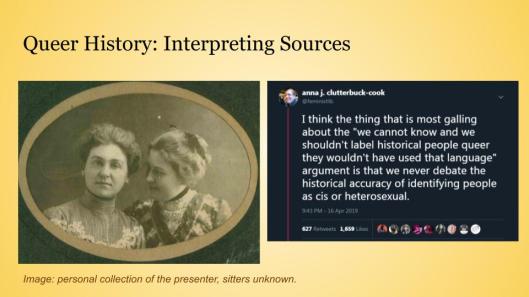
In a landscape of narratives in which this cycle of marginalization — where cultural narratives systematically render queer joy unimaginable — continues, it’s critically important to understand how those cultural narratives bias the public against the queer historical imaginary and queer history. Evidence of queer life in the past is systematically held to a higher (impossibly higher) standard of proof than evidence of a straight past, which is presumed to be reality.

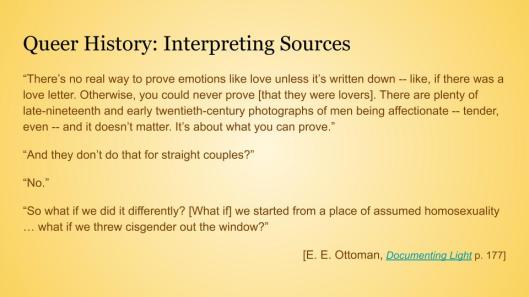
Queer Lives, Queer Loves_ Moving from Tropes and Stereotypes toward LGBTQ+ Representation (11)

I invited the students to consider this passage from a queer romance novel where two queer people, a trans man and his nonbinary lover, discuss this double standered for queer historical interpretation and what would happen if people turned the question around and in the place of presumed cisgender and heterosexual identity historians worked from a place of “assumed homosexuality [and] threw cisgender out the window?” What might history and historical practice look like then?


Queer Lives, Queer Loves_ Moving from Tropes and Stereotypes toward LGBTQ+ Representation (12)
Queer Lives, Queer Loves_ Moving from Tropes and Stereotypes toward LGBTQ+ Representation (13)

In the final series of slides, I planned to present on my process as a reviewer of queer content, posing a series of questions that I ask fiction and nonfiction works and offering some illustrative examples of works I think do relatively poorly or relatively well on matters of queer representation.


Queer Lives, Queer Loves_ Moving from Tropes and Stereotypes toward LGBTQ+ Representation (15)
Queer Lives, Queer Loves_ Moving from Tropes and Stereotypes toward LGBTQ+ Representation (16)

Because I ran out of time in the 30 minute presentation timeslot (my own fault!) I was unable to discuss these examples in live time, but did put together a document with a slightly expanded list of critical questions to ask and six examples (three problematic, three solid).

Queer Lives, Queer Loves_ Moving from Tropes and Stereotypes toward LGBTQ+ Representation (14)

You can access the PDF handout I created for the five slides above here.
You can access the PDF of the “further resources” I created here.

Queer Lives, Queer Loves_ Moving from Tropes and Stereotypes toward LGBTQ+ Representation (17)


student debt: the thread

13 Wednesday Mar 2019

Posted by Anna Clutterbuck-Cook in library life, life writing

≈ Leave a comment

A lightly edited Twitter thread I wrote today prompted by this Tweet that crossed my timeline: 

Seriously: Akers is suggesting that people who plan to pursue a path to Public Service Loan Forgiveness will overborrow on loans to “support their lifestyles!” Not a reality based statement. #RealCollege

— Dr. Sara Goldrick-Rab (@saragoldrickrab) March 13, 2019

I mostly don’t read or talk about student loans and the PSLF program because it’s a shortcut to panicked paralysis but today let me share my story about debt, grad school, and public service.

My family circumstances made it possible for me to graduate with my B.A. only $5k in debt. I went to a school where my father worked on staff, so I got tuition remission and I lived at home to keep expenses down. So I began the grad school search and application process not very deep in a hole. Between graduating college (May 2005) and beginning grad school (August 2007) I worked at part-time jobs that paid hourly wages of between $7.50-$10.00/hour. I had been working part-time for a decade or more at that point and in that context a $10.00 wage seemed grand! One of my jobs even gave me the option to open a 401(k) to which I began to slowly contribute. I had low expenses because I didn’t have kids, wasn’t maintaining a house or a car, and I was able to live with my parents. I started paying down that $5k of student debt. I put some savings away for a computer to get me through grad school and a cushion to get me through a cross-country move.  I was able to arrange a transfer with one of my part-time jobs (Barnes & Noble) from West Michigan to Boston so that I arrived with a job waiting (even if it only paid $9/hour). Most people don’t have the family support and resources to do this kind of planning when they’re making below living wage.

I was warned by faculty mentors and career services people at my undergrad, when applying for grad school, that student loans were likely inevitable. I was looking at M.A./M.L.S. programs and was told the funding goes primarily to PhD students. I didn’t want to enter a PhD program. But I did need an advanced degree if I wanted to pursue work in the library science field, and I wanted to continue my history scholarship as well both because I loved historical research and writing and also because it would help me on the job market. I chose a private school (Simmons College, now Simmons University) for my grad program for personal and pedagogical rather financial reasons. I wanted to get out of Michigan for a while, and the program offered an integrated archives-history track with small cohorts that sounded like a good fit.

In retrospect I didn’t have much experience cost comparing. I had never shopped for an undergrad college — I had gone where tuition was free, because that seemed like an offer I’d be foolish to refuse. So I was naive. But I had also grown up in a context that predisposed me to pick based on the program first, and cost second. I had been encouraged by all of the adults in my life to evaluate learning experiences first on the basis of whether they supported the personal goal of making a meaningful life and contributing to the collective good and then, second — after deciding whether the learning on offer was a good match — think about whether it was practically feasible. I actually still believe that is a valuable approach. But it is an approach that exists uncomfortably alongside the skyrocketing expense of higher education. “Is this practically feasible?” is a different starting place from, “What is the smartest financial decision?”

When I got the financial aid package there was some merit based scholarship money … and a projected ~$60k in student loans for the four years of the program. Scary numbers I had no basis for evaluating. (Another reminder that I was a white, middle class young adult who was a third generation college graduate with PhDs in my extended family. Many people go through this with way less cultural competency in the higher education marketplace. And I was still struggling to interpret my options.) So. I get the aid package and am at sea trying to evaluate it. My father has a colleague who does financial advising and he offers to go over the numbers with me for free (again, something most people do not have in their lives). I put together a spreadsheet of projected income and expenses. The financial advisor is impressed I can spreadsheet! He looks over my numbers and the takeaways from our conversation are these:

  • Educational debt is an investment. While I’m not being encouraged to sign for loans willy-nilly, the loans on offer are all government loans with non-predatory interest rates and flexible options for repayment based on circumstances. Taking out loans to pursue professional training is not considered a poor financial strategy.
  • The first year of grad school will likely be most expensive, as I transition to a new city, look for work, look for an apartment, find roommates to cost-share with, etc. I can borrow a bit more in year one and likely bring borrowing down in subsequent years as my expenses go down and my earning goes up.
  • The best practice was not to take out more in loans than I could expect to earn as an annual salary once I had completed my degree. If I kept that equation in mind, it would help keep my monthly payments after graduation to something my earning power could realistically absorb.

I took his advice, bit the bullet, and decided to accept the offer of admittance. It was scary, but I felt I had done my due diligence and no one had raised red flags so I pressed forward. And his advice, as far as it went, was pretty decent. I’m glad I stuck to federal loans, and during graduate school I was able to reduce the amount I accepted in loans each year. I worked multiple jobs (that paid $12 and even $14/hour!), accepted stipended teaching and research assistantships, and shared a 500sqft apartment and living expenses with another graduate student (reader, I married her). Living in Boston is fucking expensive. In my hometown, the apartment that I had shared with a roommate in college cost $500/month. We each paid $250. I knew Boston would be expensive but there’s a difference between knowing on paper a major metropolitan area is more expensive than your hometown and writing a rent check for $1250 every month (today that rent check is $1900). But Boston was where my graduate program was, and it is/was where my job (and my wife’s job) opportunities were — and still are. There was no way, during graduate school, we could pay living expenses working jobs that paid $12-$14/hour, even with both of us working. So loans were a necessity part of making ends meet while we were balancing school, work, and life.

As I have written about before, the reality of taking on so much debt — I had never even had to pay interest on my credit card balance, which I paid in full every month! — was physically toxic to my system. I was so frightened of, and humiliated by, the fact of having student loan debt I woke up nauseated every day for the better part of that first year. I felt like I should have been clever enough to find a different way. It felt like irresponsibility to incur debt at all.

While I was in graduate school, the 2008 financial crash happened. NO ONE was hiring. We all felt lucky not to be let go (if we weren’t let go). It was around this time that one of my colleagues made me aware of the Public Service Loan Forgiveness (PSLF) program. This was before anyone, anywhere had been making payments for the necessary ten years to apply for forgiveness. The criteria seemed opaque but we puzzled through the fine print and concluded our non-profit cultural institution was likely a qualifying employer. THANK GOD there might be light at the end of the tunnel. A safety net by which the chronically low-paying jobs in our field (libraries, archives, and museums) were recognized as a public good and the financial burden we were all carrying in order to do that service work might be lifted.

Notice I say “might.” We were all wary of the PSLF program because it seemed too public-spirited to be true in the age of government austerity. It was way too uncertain a possiblity, way too far in the future, to make any major decision life based upon a “might.” Certainly not as we were watching colleagues be let go, watching the job ads slow to a trickle, watching the housing crisis unfold nationwide.

Just as I was going on the full-time, post-grad school job market in earnest, I was offered a promotion to full-time at my current workplace. The starting salary was $34k/year. So while my student loans (approaching $60k by graduation) met the guideline for not exceeding the “typical” Boston salary in the library sector ($62k) the job — full time! with benefits! in a shitty economy! — on offer was only half that. So the realities of the  situation were this: I could accept a full-time job with colleagues I felt good working with, doing work I felt good about, in a shitty job market and enroll in an income-based student loan repayment plan OR I could keep looking for a job, perhaps even in other sectors I wasn’t trained for, that would allow me to pay off my student loans in the “standard” ten years. Don’t forget that I had/have a partner who also has student loan debt we are jointly responsible for, who was simultaneously making these same calculations around accepting contingent, part-time work or … remaining on the brutal job market.

Remember that my wife and I both work in an entire industry — non-profit, cultural heritage work — where staff are chronically underpaid, especially in relation to our training and the financial investment they were encouraged to put into that education, and all told (and tell eachother) we should be grateful for work we love. Are we foolish to accept and repeat this story? Maybe. But the story is told around us and dictates the conditions of our work in material ways not entirely in our individual control. When an entire sector is organized around the economy of workers expected to be grateful and do more with less, if we push back individually the headwind is strong. We are negotiating on very uneven terms with employers who know they can ask for more, with less, because everyone does.

So. Have I somehow been encouraged to maintain my “lifestyle” of working at a non-profit cultural heritage institution that is in basic alignment with my values because of the possibility that someday, maybe, the federal government would forgive my student loan debt? The structural forces that shaped my graduate school path and the debt that followed from that are — no offense to the federal government — much larger than the vague possibility of potentially qualifying for a debt forgiveness program could have much impact on. The ship of student loan debt, and the job market we graduated into, had sailed long before the PSLF became a thing that might apply to us a decade in the future.

Ideally — ideally — I would argue that a) the costs of education should be socialized so students aren’t taking on astronomical amounts of personal debt to equip themselves for their jobs and b) the wages paid to entry-level workers in any industry — but perhaps particularly the non-profit / public service worlds — should align with the expenses incurred to train plus the money required to be financially secure. Until that happens, the PSLF program is hardly precipitating the problem of overwhelming student debt. It’s a stop-gap measure to make sure those serving the public for low wages don’t sink beneath the weight of educational debt or evacuate the field entirely because it becomes financially unsustainable. I think it is an entirely appropriate role for government to encourage workers to accept and remain in jobs that service the collective well-being of humanity and to step in and provide a safety net that offsets the financial risk we are currently asked to shoulder.

I have been on income-based repayment for my ~$60k + interest student loan debt since August 2011. I’ve had my employer certified as PSLF-eligible. I’m not holding my breath but I have no other choice because we cannot pay rent and pay standard monthly payments on our debt. This is a systemic problem that requires a systemic solution, and PSLF is one piece of the front line, emergency-response puzzle.

Republicans want 100% of the financial risk of EVERYTHING to be on the individual (student, employee, retiree, sick person, etc. … ). In contrast, I believe — not just because I am one of those touched by the potential of PSLF — that it is a good moral and utilitarian use of government to mitigate the financial burden of education and training in our present reality. If you agree with me, let your representative and senators know! The PSLF is worth fighting for, for all of us, as the first step in reshaping how we fund higher education in the United States. And I’ll be writing my representative Ayanna Pressley, and my senators Elizabeth Warren and Ed Markey, this week to tell them so.
own your smut: on sexually explicit media and language

07 Thursday Mar 2019

Posted by Anna Clutterbuck-Cook in fandom, think pieces

≈ 1 Comment

A few days ago this Tweet, from a romance author, was retweeted into my timeline:

Can we please burn with fire the notion that erotic romance authors write ‘porn’.
It is especially galling when romance authors who write chaste or mild heat books say this. Please don’t. It’s rude, fucking insulting and 100% wrong.

— Nicola Davidson (@NicolaMDavidson) March 5, 2019

I was struck by the intensity of this writer’s response (burn with fire … fucking insulting) to having her sexually explicit stories characterized as porn. As of this writing  her Tweet has been retweeted 135 times and liked 909 times. So Davidson is clearly not alone in this sentiment.

I’ve been writing and publishing sexually explicit fanfic for eight years and reading sexually explicit stories for over two decades. For at least a dozen years, I have consciously chosen to characterize what I read and write as “porn” and “smut” as a deliberate intervention targeting what I see as the harmful distinction between “erotica” (highbrow, legitimate, artful) and “porn” (crass, illegitimate, gratuitous). Obscene and pornographic works — broadly described as works created with a primary goal of sexually arousing one’s audience — have historically been dismissed and derided because of their capacity to engage our bodies in a pleasureable way. Suspect on its own, this capacity to arouse has typically required an external justification — literary merit or educational purpose — to earn widespread (though far from universal!) approval or simply the right to exist and circulate in carefully circumscribed spaces. 

Pornography is so universally understood as creative endeavor of unseemly excess that we use it as an adjective to describe objectional leveraging of emotional response in contexts that have nothing to do with sex: trauma porn, ruin porn, disaster porn. We might be moved by these things, the phrases imply, with their juxtaposed language of depicted pleasure and real-world pain … but we will likely come away feeling gross and guilty for having enjoyed the experience. I believe this is an impoverished view of human sexual pleasure and an impoverished understanding of the way sexually explicit fictions (a.k.a. porn!) can bring us joy. 

So I responded to Davidson pushing back against her framing:

As a writer of sexually explicit stories, I use erotica and porn interchangeably for my own work and the stories I read. I use “porn” very deliberately to resist reflexively anti-porn attitudes. I’d be interested in knowing why you feel the characterization is insulting/rude?

— anna j. clutterbuck-cook (@feministlib) March 5, 2019

Davidson never responded to my question but other writers did. “Porn is about sex. That’s the foundation. There can be a larger story but it’s not necessary,” one writer argued, distinguishing this type of storytelling from her own erotic romantic narratives where sex is “an integral part” of a happily-ever-after plot. “It really hurts,” Davidson wrote in response to another commenter, when fellow romance writers “start flinging the term around. You expect erotic romance = porn from ignorant media or fundamentalists or whatever. But other romance authors?” “Erotic Romance stimulates the mind and ones imagination where as Porn doesnt,” chimed in another author. “Smut [and porn] has no literary quality to it. It’s gratuitous,” wrote another. “And also burn the idea that F/F romance is also ‘porn’ – have had this said to me more times than I care to eye roll,” wrote another.

It became clear, as I watched this Twitter thread unfold, that many people in romancelandia have very strong and negative feelings about their work being characterized as pornography. Part of this, I gather from the thread, is coming in reaction to romance writers who write less-sexually-explicit, fade-to-black, “chaste” romance trash-talking writers who choose to tell stories with more — and more detailed — sex scenes. I get it. I get the frustration over being slut-shamed. There is misogynistic policing going on here, with good-girl romance writers distancing themselves from the jezebels who are brazen enough to write sex scenes (“Chaucer! Rabelais! Balzac!“)

The problem is, responding to the charge that you’re writing porn by splitting hairs, hiding behind ideas about genre conventions or format (image versus text), and arguing that porn is “about sex” not a “larger story” (so … sex can’t be a larger story?) accepts the framing you’ve been given by your accusers. 

“Oh, but we don’t write sex like THOSE people over THERE …” is not a good look.

If we lived in a world where pornography and erotica and romance were located in roughly the same place on the respectibility continuum — where “erotica” didn’t have a history of being wielded as the highbrow alternative to lowbrow “porn”; where “romance” wasn’t struggling against the misogynistic forces that dismiss the entire genre as trivial and trashy because women — maybe … maybe … in that world we could have a valuable discussion about whether differences of genre and convention exist between romantic, erotic, and pornographic styles of sexual storytelling. But in the world we live in, staking your claim to the erotic while taking umbridge at the suggestion your work is pornographic supports a hierarchy of sexually explicit stories. It supports a hierarchy where stories labeled “porn” are dismissed and devalued in order to give you artistic high ground to stand on.

And I am not comfortable with throwing porn under the bus for the sake of respectibility. Because I think that throwing pornography under the bus means we accept the premise that stories grounded in — sometimes consisting entirely of! — human sexual expression are not really stories at all. It means we accept that writing and reading stories to turn people the fuck on — engage their embodied, sexual response as well as their hearts and minds — is categorically different (and more suspect) than engaging them as readers of fiction that elicits other types of physical and emotional reactions.

If it makes us uncomfortable to have our sexually explicit works described as “porn” or “smut” I really think the onus is on us to sit with that discomfort — maybe even to lean into that headwind — and get comfortable with that characterization even if it doesn’t feel 100% accurate in a fine-tuning subgenre sense. Because the alternative only fuels the politically powerful machinary of anti-sex sentiment entrenched in American culture, and that machinary demonizes and marginalizes — directly and materially harms — many of our most vulnerable.

If the price of defusing the charge behind the “insult” of labeling someone a pornographer is getting a little over-generous with our definitional boundaries, I say that’s an entirely acceptable price to pay.

Book Review: Algorithms of Oppression

23 Wednesday Jan 2019

Posted by Anna Clutterbuck-Cook in book reviews, library life

≈ Leave a comment

Since we’re talking about the racism built into algorithms this morning, I thought I could share this review I wrote for the NEA Newsletter (January 2019). The published review had to be revised down to 500 words; this is the extended version. 

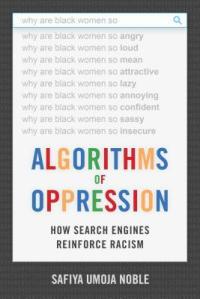
34762552Noble, Safiya Umoja. Algorithms of Oppression: How Search Engines Reinforce Racism (New York University Press, 2018).

In this accessible and deeply-researched volume, critical information studies scholar Safiya Noble (University of California, Los Angeles; co-editor of The Intersectional Internet) uses the Google search engine as case study to document and theorize the ways in which racism and sexism are embedded within the structures of information harvest and delivery by for-profit companies on the World Wide Web. Noble considers the mechanisms through which results are delivered to those who use Google search, foregrounds the power relationships that shape the nature and hierarchy of those results, and challenges readers to denaturalize the process of “Googling it” when we have a question in need of a ready and reliable answer. As a sociologist and a critical library and information science scholar, Noble weaves together a librarian’s understanding of how cataloging, classification, and research tools operate with a critical Black feminist understanding of the interlocking systems of oppression from within which these technological systems of information organization and retrieval were designed. Often assumed by both developers and the general public to be value-neutral, the typically invisible (and often proprietary) algorithms by which human beings create and access content online are inescapably shaped by these logics of oppression — logics often deemed normal, normative and therefore “neutral” to those who benefit from them, even when they are anything but.

To make her case that we are living with a hegemonic culture of “algorithmic oppression” (4), Noble walks readers through a series of examples that follow out from a catalytic moment early in her graduate school career. She describes in chapter one putting the search string “black girls” into Google search in an effort to find activities for a group of preteen girls only to be inundated with a list of racist and hypersexualized results:

The best information, as listed by rank in the search results, was certainly not the best for me, or for the children I love. For whom, then, was this the best information and who decides? What were the profit and other motives driving this information to the top of the results? How had the notion of neutrality in information ranking and retrieval … remained so unexamined and without public critique? (18)

This first chapter walks readers through the basic concepts of algorithmic search and what can (and cannot) be gleaned about Google’s development of PageRank, its proprietary algorithmic product, from early concept documents. Based on the idea, borrowed from academia, that the most influential literature is also the most often cited, PageRank began with the assumption that a link to a web page was analogous to a citation, and that the web pages with the most links were therefore the most influential and therefore best (itself an assumption about power and authority that must be critically examined). While the algorithm itself may be proprietary, the fact that we cannot analyze the mechanism of Google search at the code level does not prevent us from observing — as Noble does — that Google’s algorithms produce search results that are anything but impartial. Not only does PageRank encourage searchers to engage with advertiser content — advertisers are, after all, Google’s primary clients — but also reproduce and amplify harmful beliefs.

Chapter two delves into specific examples of such searches, and casts a skeptical glance at the efforts of Google executives to distance their company from these harms. Searches including the word “Jew,” for example, produce a high proportion of anti-Semitic content (42); image searches for “doctor” return pictures of mostly white men, while image searches for “unprofessional hairstyles for work” produce pictures of black women (83). Whether or not Google software developers set out to create an algorithm that generates and amplifies the misogynoir[1] of our culture is beside the point. “Intent is not particularly important,” Noble reminds us (90). Whether or not a white person means to be racist (or a developer means to practice misogyny) is a question that may be unanswerable. Rather, as critical information workers and consumers, we must ask — regardless of intent — who is harmed by the images and ideas circulated through Google search interactions.

Having considered the technological processes and biased, arguably harmful results of the Google search product, Noble moves on in chapters three and four to consider other ways in which Google’s dominance in our online lives operates to further marginalize the already marginalized. As in the offline world, without purposeful and ongoing efforts to combat structural oppression in online spaces, inequality persists. Chapter three explores how the Internet, as a space governed by commercial interests rather than as a noncommercial public good, can cultivate and exacerbate harmful and false ideas. When the goal is to generate clicks for advertisers, there is little incentive for search products to “intercede in the framing of the question itself,” and challenge the searcher to critically examine their own desires or beliefs (116). Chapter four raises questions of data privacy and the right to be forgotten by an Internet that never forgets, particularly as increased visibility may deepen the vulnerability of already-vulnerable populations.[2]

algoirthms thread snipAfter reading the book and turning in my review, I had some further thoughts about the way sexually-explicit materials were handled within the text. A thread sharing those thoughts may be found on my Twitter timeline here. 

The final two chapters of Algorithms, along with a brief epilogue that considers the harrowing challenge of our current political moment, turn from the structural problem of algorithmic oppression toward potential solutions. One key intervention is to increase critical awareness of our digital ecosystem’s biases, a project that librarians and other information workers could be particularly well-positioned to undertake. Noble also champions a “public search engine alternative” to the current commercial options (152), a government-funded check on Google’s troubling power within and over almost every aspect of our interconnected lives and livelihoods. Even if that remedy seems politically unrealistic in the near future, it may be a public works project worth fighting for.

By focusing on the ubiquitous tool of Google search, Algorithms gives those just beginning to think critically about our Internet-centric information ecosystem concrete and replicable examples of algorithmic oppression in action. For those already steeped in the rapidly-growing literature of critical librarian and information studies, Algorithms will be a valuable addition to our corpus of texts that blend theory and practice, both documenting the problematic nature of where we are and the possibility of where we might arrive in future if we fight, collectively, to make it so.


[1] “Misogynoir” is a term coined by Moya Bailey to describe the particular misogyny that Black women experience, a misogyny inextricable from the racism they experience under white supremacy. See Moya Bailey, “They Aren’t Talking About Me,” Crunk Feminist Collective, 14 March 2010. http://www.crunkfeministcollective.com/2010/03/14/they-arent-talking-about-me/.

[2] The “right to be forgotten” is also a concept generating renewed interest in archives and cultural heritage study and practice; see for example Ashley Nicole Vavra, “The Right to Be Forgotten: An Archival Perspective.” The American Archivist vol. 81, no. 1 (Spring/Summer 2018): 100-111. https://doi.org/10.17723/0360-9081-81.1.100.

← Older posts
Newer posts →
"the past is a wild party; check your preconceptions at the door." ~ Emma Donoghue

Recent Posts

  • medical update 11.11.22
  • medical update 6.4.22
  • medical update 1.16.2022
  • medical update 10.13.2021
  • medical update 8.17.2021

Archives

Categories

Creative Commons License

This work by Anna J. Clutterbuck-Cook is licensed under a Creative Commons Attribution 3.0 Unported License

Meta

  • Create account
  • Log in
  • Entries feed
  • Comments feed
  • WordPress.com

Create a free website or blog at WordPress.com.

  • Subscribe Subscribed
    • the feminist librarian
    • Join 37 other subscribers
    • Already have a WordPress.com account? Log in now.
    • the feminist librarian
    • Subscribe Subscribed
    • Sign up
    • Log in
    • Report this content
    • View site in Reader
    • Manage subscriptions
    • Collapse this bar
 

Loading Comments...