• anna j. clutterbuck-cook
  • contact
  • curriculum vitae
  • find me elsewhere
  • marilyn ross memorial book prize

the feminist librarian

the feminist librarian

Author Archives: Anna Clutterbuck-Cook

from the neighborhood: cats are busybodies

13 Wednesday Jun 2012

Posted by Anna Clutterbuck-Cook in our family

≈ Leave a comment

Tags

cat blogging, from the neighborhood, photos

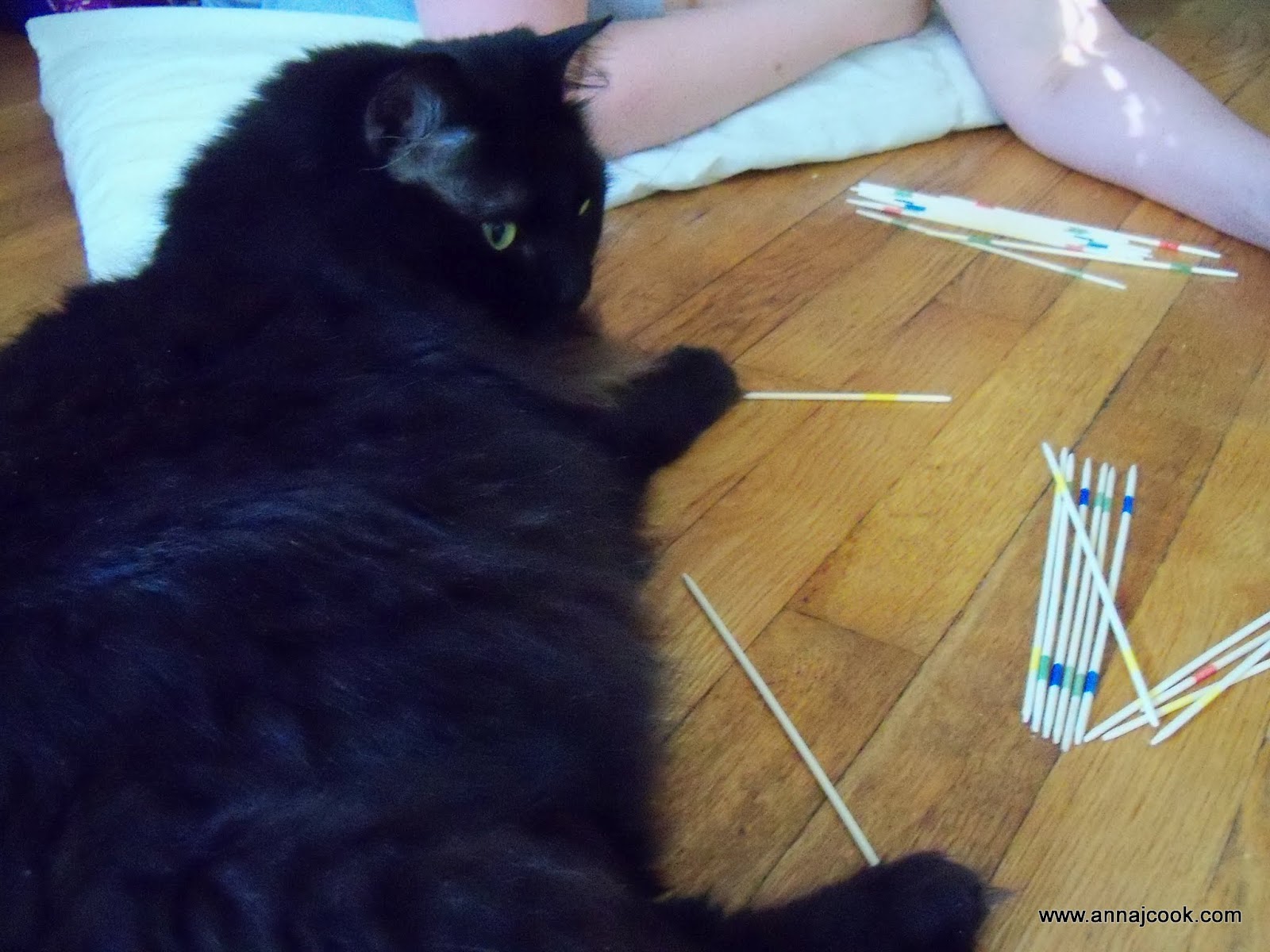
This past weekend, I happened to have the camera out and the cat was being photogenic.
Geraldine loves the open windows of our apartment
although sometimes she prefers watching us to watching the street
and sometimes more than watch (needless to say Gerry won)
although sometimes her tail got in the way
and obviously no responsible cat would let her humans go without a
cat-shaped paperweight for long!
hope y’a’ll are well

‘the act of marriage’ live-blog: ch. 13 (time-out for evangelism)

12 Tuesday Jun 2012

Posted by Anna Clutterbuck-Cook in book reviews

≈ Leave a comment

Tags

gender and sexuality, live-blogging, religion, wedding

See also: intro, ch 1, ch 2-3, ch 4-5, ch 6-7, ch 8-10, ch 11, ch 12.

Welcome back! Now for the chapter you’ve all been waiting for … the obligatory time-out for evangelism! Some of you may have been assuming that since the entire thrust of The Act of Marriage narrative is that a) the readers of the book are overwhelmingly Christians and b) being Christian means you’re gonna have awesome God-boosted sexytimes, that the text needs no explicit shout-out to repent and be saved. After all, you’d be preaching to the choir, and for anyone who doesn’t already know the words to the hymn you’ve got the best sales pitch ever: BETTER ORGASMS.

Oh, but you would be so wrong. Because Christians can never be saved enough. This was a major theme of the fundamentalist evangelicalism I encountered during my thesis research: individuals who had repented and been “saved” face continual pressure to recommit to Christ out of fear that their born-again experience was somehow less-than (think Jesus Camp). Putting the fear of God into those already in the fold is part-and-parcel of any proselytizing among fundamentalist evangelicals. And given that Tim LaHaye is, first and foremost, a minister, means that this remains a key aspect of his modus operandi:

Unless [the] God-shaped vacuum [in every person] is filled by a personal relationship with God, man is condemned throughout his lifetime to an endless treadmill of activity in an attempt to fill it (219).

This chapter is full of infographics arguing that people without Christ in their lives will be full of guilt, fear, purposelessness, emptiness, confusion, and misery.* In contrast:

When Christ controls one’s life, that person seeks to do those things and think those thoughts that please the Lord, who in turn will grant that person an abundance of the joy, love, and peace which guarantees the happiness every human being desires … When [Christ] directs a person’s nature, that person’s clean thought patterns will produce good feelings and in turn turn engender the physical responses that everyone wants (230). 

As Hanna points out, this makes Jesus sound like the worst micro-managing boss ever. It also makes Jesus sound like a drug you might find in the stash of your buddy who sells pot out of his back garden.

Which, I suppose, if praying is what does it for you — why not?**

There’s a couple of things going on here I want to comment on, before we move onto the final, Q & A chapter next week (the final chapter! can you believe we’ve made it through the whole book?!).

I think it’s really intriguing — and particularly evident in this chapter, since this is the chapter that’s basically selling Christ as an awesome trip — that the LaHayes feel the need to sell Christianity as the path to the good life and that the “good life” doesn’t just mean the absence of hellfire and brimstone (the afterlife is, actually, noteably absent throughout The Act). The argument to being/becoming Christian isn’t “if you don’t accept God you will BURN IN HELL,” though I’m sure most of their target audience received that message loud and clear in other places. No, the message in The Act is be/become Christian and you will have “good feelings” and “the physical responses that everyone wants” (read: ORGASM).

Jesus: A Really Good Fuck. Maybe the brides of Christ were onto something?

No only will Jesus/God give you a really good time in bed, but he’ll also give you and your partner together a super-awesome roll in the hay, which makes Jesus/God sound like something between a sex therapist and a congenial fuck buddy:

When Sara accepted Christ as her Lord and Savior in my office that day, she cancelled their divorce proceedings and went home to become a loving, submissive, gracious wife … within ten weeks [her husband] Sam also came to the saving knowledge of Christ, and they have enjoyed a compatible relationship for many years (232).

This sells Christ not as “Lord and Savior” in the Biblical sense — though obviously that is the ultimate end goal, saving souls — but rather as a means to an end: a “compatible relationship” between husband and wife (and perhaps every-other-Thursday also the Son of God?). Such a pitch effectively twines together a prosperity gospel ethos with a reconfiguration of sexuality as something with positive spiritual possibility, even outside of the context of procreation. And both of these themes became absolutely central to late-twentieth-century American evangelical culture. Sexual conservatives, to this day, will argue (either in psuedo-scientific or blatantly theological terms) that Christians who remain chaste until marriage and lead a Christ-centered sexual life thereafter will experience the best most satisfying sex there is.

Maybe they do? Who am I to judge. But I’ve been disqualified from that particular club since age eleven, when I met my friend J’s offer (made in the backyard tree house, if I remember aright)  to help me “accept Christ into your heart” with a blank stare, so.

And then there’s the whole premarital lesbian (albeit monogamous) slut thing. I’m pretty sure I get demerits for that.

IN SUM: Adequate Lady-Spouse Metric

-50 –> not accepting Christ into my heart at age eleven (or at any age thereafter)
-50 –> believing the spiritual vacuum can be filled with other-than-Christ shaped religion
-20 –> engaging in premarital
-20 –> lesbian sexytimes
-20 –> and not regretting it
-30 –> and not turning to drugs and/or alcohol as a result

Chapter 13: -190 points

Chapter 12: -29.5
Chapter 11: -35
Chapters 8-10: 0 (n/a)
Chapters 6-7: -62
Chapters 4-5: +30
Chapters 2-3: -33
Chapter 1: -50

Cumulative ALSM Score: -369.5


*Before you ask no, there is no data to back this up — it’s simply assumed to be self-evident FACT.

**Hanna also pointed out, because she’s smart like that (I’m not really just marrying her for the lovely ass), that spiritual/religious/metaphysical life is an important part of meaning-making for most people — even if it’s important because you’ve consciously chosen not to prioritize it. I don’t think the LaHayes are terribly mis-guided to encourage people to consider their spiritual centering … I only think they’re wrong to argue that only Jesus and/or the evangelical Christian god will suffice.

from the neighborhood: fun with friends, bonus cat photo!

08 Friday Jun 2012

Posted by Anna Clutterbuck-Cook in our family

≈ 1 Comment

Tags

cat blogging, friends, photos

Yesterday, Diana sent us this photograph of Geraldine on Diana’s carry-on suitcase. Gerry did reconnaissance as soon as Diana and Collin arrived, decided that was going to be her bed of choice for the weekend, and spent 90% of her time there while we were home (the other 10% was begging for tuna, per usual). The cat-shaped dent in the suitcase top suggested she spent 100% of her time napping there when we were out on the town.

photo by Diana Wakimoto (June 2012)

Hope everyone has a brilliant weekend, and see you next week for more fun with The Act of Marriage, actual wedding thoughts and plans, and more.

from the neighborhood: fun with friends, part 2

07 Thursday Jun 2012

Posted by Anna Clutterbuck-Cook in a sense of place

≈ Leave a comment

Tags

art, boston, family, friends, from the neighborhood, photos

After Friday, it rained almost continuously the whole weekend Diana and Collin were here. On Monday, before they left for the airport, we took refuge at the Boston Public Library (between Pavement Coffeehouse and Berkeley Perk Cafe).

center courtyard in the rain, from the 3rd floor gallery
The main branch of the BPL regularly hosts exhibitions, and when we were there they had — among other offerings — a wonderful print exhibition called reThink INK: 25 Years at Mixit Print Studio. Here are some of the photographs I took while we wandered around:
an installation featuring bees
one for the ghoulish sensibilities
I love the gender ambiguity of these figures
and these panels featuring labyrinths

 There were a lot of prints incorporating maps, architectural elements, and text. We also noticed a theme of arctic exploration. The photograph below is of an interactive piece featuring the upturned hull of a boat to which visitors are invited to tie slips of paper articulating wishes and dreams (our favorite: “I dream of Cthulhu” and also “I want a pig.” There were also a wonderfully wide variety of languages represented.

ship of wishes and dreams
in the third floor gallery, there were lots of birds
including these haunting owls
If you’re in the Boston area and are interested in print-making, I encourage you to check it out! The exhibition runs through 31 July 2012 at the Copley Square (main) branch of the Boston Public Library.

from the neighborhood: fun with friends, part 1

05 Tuesday Jun 2012

Posted by Anna Clutterbuck-Cook in a sense of place

≈ Leave a comment

Tags

boston, family, friends, from the neighborhood, photos

We had a lovely weekend with friends Diana and Collin, and were very sorry to see them go yesterday afternoon (if only someone would invent reliable teleportation!). It was, in fact, a lovely weekend despite nearly continuous rain and a trip to the emergency room on Saturday (to verify a strained muscle was, in fact, strained and not something worse — it isn’t, whew). We had lots of coffee and tea and good food, good conversation, and vacation-type movies (Fast Five, and the Doctor Who Christmas special!). I’m letting myself take the rest of the week off from blogging-blogging, but here are a few photographs from our Boston perambulations.

sailboats on Jamaica Pond

Our one nice day (weather-wise) was Friday, and Diana, Collin, and I took a long walk up to Jamaica Plain and had lunch at Centre Street Cafe while Hanna was in Newport, RI, for a meeting.

judgy cat is judgy

All things considered, Geraldine was accepting of the two interlopers — it helped that Auntie Diana brought her favorite dried fish flakes all the way from California! She was very distressed keeping track of four people instead of just two for four whole days and crashed last night (she didn’t even get me up to feed her at 3am!)

I spy with my little eye … 

On Sunday, we took the bus over to Harvard Square to meet up with friends Minerva and Nancy for lunch, and between coffee at Crema Cafe and meeting up with the rest of the gang, we hung out in the Harvard Co-op (where else to spend a rainy morning but in a book shop?!). I was so excited to see Swallows and Amazons on the Staff Recommends shelf — someone raised their kid right!

Steampunk sighting FTW!

… And my favorite sighting of the day goes to this man from Cambridge Historical Tours, who was waiting for a tour group at the Harvard Square T stop and checking his smartphone. He was totally rocking the coat, hat, and goggles.

On Thursday, I’ll post some pictures from our visit to the Boston Public Library’s current exhibition on print-making! Hope y’all are having a good week thus far.

friends in town – on vacation until 6/11

01 Friday Jun 2012

Posted by Anna Clutterbuck-Cook in a sense of place

≈ Leave a comment

Tags

boston, friends, from the neighborhood, outdoors, photos

Our good friend Diana is coming into town today with her paramour, so I’m giving myself permission not to keep up with blog posts and whatnot over the weekend and into next week. Look for a resumption of activities the week of June 11 (can you believe we’re already heading toward mid June??). In the meantime, I give you pictures of flowers!

flowering tree on the Charles River esplanade
a gift from Minerva (photograph by Hanna)

Have a lovely first week of June, and see you back here in ten days.

‘the act of marriage’: ch 12 ( d) none of the above)

31 Thursday May 2012

Posted by Anna Clutterbuck-Cook in book reviews

≈ Leave a comment

Tags

gender and sexuality, live-blogging, moral panic, religion

See also: intro, ch 1, ch 2-3, ch 4-5, ch 6-7, ch 8-10, ch 11.


Finally! The chapter you’ve all been waiting for (I know!): the Christian sex survey. Convinced through anecdotal evidence and a belief that believers must do it better, the LaHayes set out to gather empirical data to support their thesis.

Why do Christians do it better? I mean, we all know why feminists do it better: the less hamstrung by notions of oppositional, binary gender roles, the more real people can be. And the more real we can be with our partners — the less compelled we feel to follow a specific script for sex — the better off we’re gonna be. Less shame, more gain. But why would being a member of one religious community — particularly one which, historically-speaking, has a rocky relationship with human sexuality — lead one to better sex?

Well, the short answer is because folks like the LaHayes believe that being a Christian makes everything better. It’s sort of an exercise in circular thinking: Why does Christianity make things better? Because life is better when you’re a Christian.

The slightly longer answer is that they believe that they believe “a Christian’s relationship with God produces a greater capacity for expressing and receiving love than is possible for the non-Christian” (195). They argue that Christians, with their greater capacity for love, do not have “an obsession with sex, they do not need dirty stories*, pornography, or artificial stimuli to motivate them toward each other” (195). Basically: God gives you the capacity to love; everyone else is faking it.

To assess the state of Christian marital relations, the LaHayes asked participants in their Family Life Seminars (sexuality education for Christian adults) to fill out and return written surveys on their sexual experiences — think The Hite Report for Christian couples. They amassed 3, 377 responses (from 1,705 women and 1,672 men) and chapter twelve offers us a look at the results. In comparing their own results to that of a contemporary Redbook survey of 100,000 women they conclude that “Christians do enjoy the sublimities of the act of marriage more than others in our culture” (197).

I can’t reproduce the survey results in full, here, but a quick word about demographics and then some of the questions and responses. The couples they surveyed (and yes, they were all married) were the average age of mid-to-late thirties, had been married 7-15 years, and had 2-3 children. forty percent of the women and sixty percent of the men were graduates of four-year colleges, and nearly forty percent of the men had attended graduate school (I suspect a high proportion of seminarians). Forty percent of the wives worked part- or full-time outside the home and over sixty percent of the men were working in “professional or managerial” positions. In short, these are middle to upper-middle-class families. The survey doesn’t ask about race, but I’d say it’s safe to assume a majority white demographic.

The majority of couples married after a courtship lasting 6-12 months, but fifteen percent courted for 3-5 years before marriage. Reading was the main source of sexuality education before marriage, and while the majority approached marriage with “anticipation” of sexual activity, roughly twenty percent of both men and women were “apprehensive” about sex as they headed toward tying the knot. About a third of respondents (slightly lower for women, slightly higher for men) had engaged in “occasional” premarital intercourse, though the LaHayes are quick to point out that these numbers could include people who had “not yet received Christ as their Lord and Savior” (200). Almost forty percent of couples used birth control pills as their preferred form of contraception. While only about one quarter of wives reported having reached orgasm on their first night of lovemaking, seventy-seven percent indicated that they “regularly or always” experienced orgasm making love at the time they filled out the survey.

A few example questions, and the responses:

14. Impression of parents’ sex life:

Fulfilling… 36% (wives’ response) 36% (husbands’ response)
Casual… 28% / 34%
Cold… 28% / 20%
Other… 8% / 10%

36. Minutes from beginning of foreplay to orgasm:

Less than 10… 6% / 7%
10-20 minutes … 51% / 55%
20-30 minutes … 31% / 26%
30 or more … 12% / 12%

40. How often do you have intercourse per week:

0-2 times … 61% / 61%
3-6 times … 36% / 37%
7-9 times … 3% / 1%

41. How often do you desire intercourse per week:

0-2 times … 48% / 27 %
3-6 times … 49% / 62%
7-9 times … 3% / 11%

The rest of the chapter is taken up by graphs comparing the sexual satisfaction of Christian couples (as reported in the survey) with the sexual satisfaction of the respondents to the Redbook survey. The LaHayes do point out that there is no way of knowing what percentage of those who responded to Redbook were also Christians**, but persist anyway in arguing that Christians do it better.

Wearing my historian’s hat, I find it particularly fascinating to see certain themes emerging in these chapters which today sit front and center in the Christian arguments against non-marital sexual activities. For example, the argument that non-marital sex before marriage will be destructive to the marriage relationship: “Our survey indicates quite clearly that premarital sex is not necessary and, according to statistics, may hinder sexual adjustment” (210). They also devote a section to the notion that the practice of oral sex is on the rise, “thanks to amoral sexual education, pornography, modern sex literature, and the moral breakdown of our times” (212). While the LaHayes are not particularly censorious of oral stimulation, they take pains to encourage their readers to ensure that penis-in-vagina intercourse remains the central sexual act in their relationship. All things considered, you could set this chapter up alongside the data presented in the reactionary Premarital Sex in America and — substituting anal for oral — you’d have roughly the same arguments being made, fifty years apart.

IN SUM: Adequate Lady-Spouse Metric

It was a little difficult to come up with a way of grading myself on this chapter. So what I did was this: I completed the questionnaire myself, and then gave myself two points for every instance where my answers matched the top answer for the wives, one point if it was the second-place answer, and half a point for third-place or below.

Chapter 12:
1st place answers: 24 questions = 48/48 points
2nd place answers: 11 questions = 11/22 points
3rd or below: 11 questions = 5.5/22 points

TOTAL POINTS: 64.5/94 points = -29.5

Chapter 11: -35
Chapters 8-10: 0 (n/a)
Chapters 6-7: -62
Chapters 4-5: +30
Chapters 2-3: -33
Chapter 1: -50

Cumulative ALSM Score: -179.5


*So sad! No smutty fic!

**Note that “Christian” to folks like the LaHayes doesn’t mean “anyone who attends a Christian church and/or reads the Bible as a sacred text,” but rather anyone who has had a born-again experience and/or accepted Jesus as their Lord and Savior.

household economies [wedding post the second]

29 Tuesday May 2012

Posted by Anna Clutterbuck-Cook in our family

≈ 7 Comments

Tags

domesticity, feminism, hanna, wedding

UPDATE: Molly’s comment on this post made me realize I should make a point of saying that this post is about my own personal experiences and desires regarding shared finances, not meant to be a general statement about what “should” happen for couples, or what is morally “right” for all households, etc. Material security is a very, very personal thing. So all of the thoughts below are about me/mine — not meant as a judgment of anyone else’s life.

One of the first things Hanna and I did after we became a couple was go out and open a joint checking account.

Well, okay, it wasn’t one of the first things — but it was within a couple of months. And even though we’d been living together and sharing household expenses for a year and a half at that point, the shared account somehow seemed more possible, more right, to establish once we were in a sexually-intimate relationship.

Yeah, I know it doesn’t make any rational sense when I put it like that. But at the time, that’s how it felt. We were a couple, my logic went, and couples share material resources without keeping score. And the best, most efficient, way of doing that was an account to which we both had equal access.

And it’s worked for us since then. So much so that, as we move toward our wedding in the fall, Hanna raised the question of consolidating finances further — perhaps pooling our (frighteningly modest) savings, and more actively planning for a future down-payment or international travel. I agreed this sounded like a good move.

money love by cembas @ flickr.com

I got thinking about this last week when blogger blue milk put up a post about money and relationships, riffing on a New York Times piece on money-sharing in marriage. The comments on the blue milk post reveal a diversity of arrangements, and — to my mind — a surprising number of long-term couples whose financial resources are still fairly separate, or at least kept distinct.

It’s not that I haven’t known other options are out there for household finances, besides the single-financial-profile Hanna and I seem to be trending toward, but it’s fascinating to me how many people (women particularly?) feel strongly about maintaining their financial independence even within stable, long-term relationships.

Generally-speaking, there seems to be a lot of angst and anxiety these days about establishing household economies. Which (me being me) makes me reflect on why I don’t feel that level of angst and anxiety incorporating another person’s financial expectations and spending habits into my life (and trusting another person with my own income). Was it weird, at first? A little. It’s impossible to keep as tight a grip on the pulse of household spending when there are two of us — unless either of us were willing to spend a lot more time tracking trends (we aren’t). And I had to get used to Hanna making decisions with “my” money that I wouldn’t necessarily make vis a vis discretionary spending … but then again, she’s had to do the same. For the past three years, my paychecks have been automatically deposited into an account that Hanna has full access to, and that’s never really bothered me.

So the question becomes: Why? Why don’t I worry? 

I think it has something to do with how material resources and respect for individual decision-making and personal property (the things of our lives) were handled in my family of origin.

I grew up in a family where there was one main source of income: my father’s salary. My mother had done wage-work before we were born, and has picked up work-for-hire since we grew up and moved on, but didn’t work for pay while we were growing up. Yet regardless of the source of income, financial resources were consolidated: there was one checking account out of which bills were paid and daily expenses withdrawn. It had both my parents’ names on it. Their financial assets were theirs never “his” and “hers.”

Us kids all got spending money when we were small, and were taken to the bank to open savings accounts once we were earning pocket money (and later more significant income). So as kids, we had money that was separate from the family economy. We were also, correspondingly, expected to take responsibility for our own discretionary spending as we were able.

And I think almost more important than the specific, technical, details concerning the flow of cash, is the fact that we had confidence in one another to be financially responsible. My parents have confidence in each other as financial decision-makers, and helped us kids gain a basic understanding of our own finances so that as we moved from familial inter-dependence into adult fiscal independence (contrary to mythology, a gradual and far-from-decisive process) we were able to communicate about economic needs and desires without moral judgment. Resources were finite, true, but decisions about how to work within those material realities was always pursued collaboratively

Perhaps because of this model, I felt little discomfort in pooling our financial resources. 

Neither Hanna nor I enjoy book-keeping. So it’s way easier to have a single account for joint spending (virtually all our spending now) than it is to keep track of who’s paying what bills, buying what groceries, or who should be responsible for paying the tab for the rental car. Or, as I’ve seen some couples do, pay one another back via the monthly rent check or something similar.

OH MY GOD THAT WOULD DRIVE ME INSANE. Actually, it drove me a little bananas when we were doing that, or trying to, for the first year and a half of our relationship. The endless “Who’s turn is it to …” and “How much do I owe …” and “If I pay for, then you can get …” At which point pooling finances seemed like a simple expedient to cut out all the white noise of negotiation and haggling.

Would I worry more about protecting my financial independence if I were in a heterosexual relationship? To some extent, perhaps. Like with marriage itself, I worry less about falling into heteronormative sand traps because our relationship is by definition already non-normative. I don’t have the fear, for example, that my husband will just fall into handling the finances because social expectation and pressure encourages him to do so. In a relationship with two women, there is no “obvious” partner to coordinate the household economy. Rather than having social forces relentlessly pushing us toward integration, we have to move forward with deliberate insistence that, yes, this is what we wish to do. This is how we wish to live.

Which is not to suggest that hetero couples aren’t making deliberate decisions. Just that the social pressure to fit heteronormative marriage ideals (male breadwinner, female home-maker) isn’t applied so heavily when it comes to people who aren’t in hetero relationships. We have to argue for the chance to engage in activities straight couples are pressured to do. So the experience of choice and agency is qualitatively different there.

Is part of my ease due to the fact that I am (though by a thin margin at this point) the primary wage-earner in our household? I don’t have a complete answer to this. When I wrote in comments at blue milk about the fact that I don’t resent the inequality in wage-earning because things even out overall in terms of domestic responsibilities, another commenter got on my case about the “regressive” nature of such an arrangement. She assumed that I was somehow implying that my wage-work was more valuable than Hanna’s, when in fact I’d been trying to argue that wage- and non-wage work that contributes to the running of our household counts equally as far as I’m concerned, and as I said in my response to the critique:

With two (or more) adults in a family, you spread both wage-earning and other responsibilities around according to who is available to do what, who has what skills, and what feels fair to all people concerned. Too often, mainstream media reduces equality (and power) in household relationships to income and ignores all of the other aspects of running a household to which everyone in a family contributes.

To my mind, part of being in a marriage (or non-marital long-term relationship) is the luxury of not keeping financial score, as it were. Obviously you still keep your fingers on the pulse of basic fairness, in the sense that you speak up if it starts feeling like you always end up stopping for groceries or your partner always gets to pick the Friday-night movie. But I felt very strongly, going into our relationship, that I wanted our household to be ours not “hers” and “hers” in a nit-picky material way.

We share books, clothes, food, bath and body products, we co-care for Geraldine. Psychologically and emotionally, I didn’t want to get into a situation where I started resenting that Hanna’s physical therapy bills were a significant monthly expense, or to start stressing about whether her decision to prioritize buying a new season of Supernatural was less justified than my decision to pre-order the latest Diana Gabaldon in hardcover.

Do I catch myself doing it sometimes? Sure. I’m as fallible as the next person. But I want to work toward a place where mutual confidence and trust is so normal that it’s unremarkable — dare I say nigh invisible?

‘the act of marriage’: ch. 11 (aka "children fulfill the psychic design of your mind")

25 Friday May 2012

Posted by Anna Clutterbuck-Cook in book reviews

≈ 5 Comments

Tags

books, gender and sexuality, live-blogging, religion

See also: intro, ch 1, ch 2-3, ch 4-5, ch 6-7, ch 8-10.

If I had to pick the number-one aspect of The Act of Marriage that situated it in the 1970s, it would be the LaHaye’s attitude toward birth control and abortion. Namely, that they’re not categorically opposed to either. Let me reiterate: The best-selling protestant Christian evangelical sex manual of the 1970s was not anti-abortion or anti-birth control, even hormonal birth control (aka “The Pill”) which today has so many fundies up in arms.

Tomorrow, I’m going to be posting, verbatim, the passage in which The Act of Marriage takes up the question of abortion. I think it deserves its own post because there’s so much interesting stuff going on vis a vis contemporary abortion politics within it. But for now, we’re going to take a brief look at chapter eleven, “Sane Family Planning,” which deals exclusively with pre-conception solutions for controlling pregnancy while sexually active.

“Almost all Christians today seem to believe in limiting the size of their families” (185)

The LaHayes start out with the observation that, given the number of years the average woman is fertile, the vast majority of Christian couples are self-evidently practicing some sort of family planning strategy. And they do not disapprove — nor do they believe God disapproves. The distinction they make is not between contraception vs. no contraception, but rather between parenting and not-parenting. “Christian couples should, if at all possible, have children, they assert” (183). Intention here matters. If one is delaying childbearing, or spacing out children, or deciding that [ideal number] of children is the limit of persons your family resources can provide for, then this is an acceptable (“sane”?) orientation toward parenting.

What’s not acceptable? Deciding that your ideal number of children = 0.* Because “the chief enemy of personal happiness is self-interest” (185) I’ve honestly never understood how realizing you don’t have the resources (material, emotional, or otherwise) to be a good-enough parent is the selfish route while having little ones because they are “a tangible expression of your [marital love]” or because “children fulfill the psychic design of your mind” (I shit you not!) is the unselfish way to go (183-85). But apparently that’s the truth of things, and who am I to argue with God?**

I lose MAJOR lady-spouse points for this (I figure double ’cause I’m getting hitched to someone who’s completely comfortable with the non-parenting state of affairs. More so than I am, actually. So, you know, clearly I went the way of satanic and self-centered temptation there.

What can I say. She has a really great ass.

IN SUM: Adequate Lady-Spouse Metric Returns!

-20 –> for coming to the conclusion that the answer to the question “how many children does God want me to have?” is “Zero” and
-20 –> for getting myself hitched to a partner who believes this even more strongly than I
-20 –> plus the whole “two eggs can’t make a baby” thing, which is surely a strike against us
+15 –> still, I do agree that human being are a pretty awesome “gift of eternal creativity”
+10 –> and that even couples wanting to create babies should have access to family planning tools

Chapter 11: -35

Chapters 8-10: 0 (n/a)
Chapters 6-7: -62
Chapters 4-5: +30
Chapters 2-3: -33
Chapter 1: -50

Cumulative ALSM Score: -150


* Maths people! What would the equation for that look like … “solve for X if  x > 1”?

**See also.

@feministlib: joining the twitter bandwagon

24 Thursday May 2012

Posted by Anna Clutterbuck-Cook in admin

≈ 2 Comments

Tags

blogging, writing

So I’ve been on Twitter for a couple of years now, but in a very private-personal way. I keep my Twitter account locked down to followers who are close friends and family.

In my headspace, Twitter and email are the two online spaces where I don’t have to worry about presenting myself as I want the world as a whole to see me. I’m not a very private person — and as readers of this blog are aware, there are few topics strictly off-limits. But in spaces where the whole world (potentially) has access, I do try to turn on the Articulation Meter and the Civility Filter rather than hanging out in the Accusing Parlor or the Angry Dome.

I use Tumblr to share links of note (and pictures because what’s Tumblr without pretty things?) but when it comes to sharing my own writing on the interwebs, or quick action alerts, etc., I increasingly find myself wishing I could just make a single tweet or two “public” without losing the privacy of my locked account.

You see where this is going, don’t you?

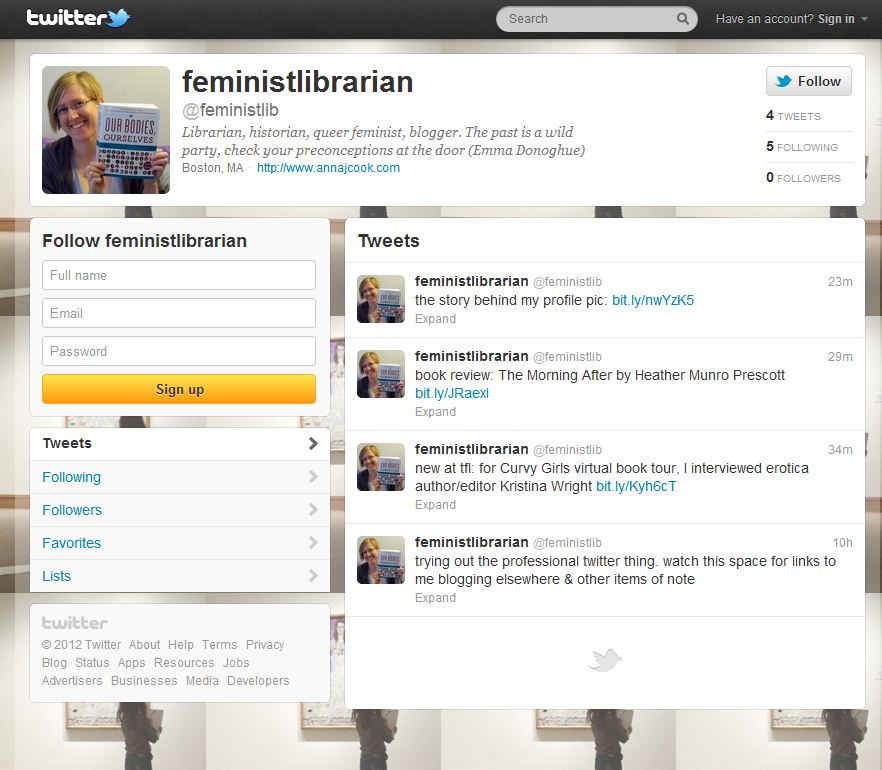
You can now find the feminist librarian on Twitter: @feministlib.

My plan is to use @feministlib primarily to share links to stuff I’ve been writing in various online spaces. I’m also going to sync it to my (heretofore moribund) Facebook status updates, so for folks whose social networking drug of choice is the Book of Faces (as my friend M. calls it), you’ll be able to find me there.

My Facebook account is closed to non-friends, but I’ll pretty much “friend” anyone who isn’t obviously schilling and/or trolling. I use my metered-filtered voice there and everything!

← Older posts
Newer posts →
"the past is a wild party; check your preconceptions at the door." ~ Emma Donoghue

Recent Posts

  • medical update 11.11.22
  • medical update 6.4.22
  • medical update 1.16.2022
  • medical update 10.13.2021
  • medical update 8.17.2021

Archives

Categories

Creative Commons License

This work by Anna J. Clutterbuck-Cook is licensed under a Creative Commons Attribution 3.0 Unported License

Meta

  • Register
  • Log in
  • Entries feed
  • Comments feed
  • WordPress.com

Blog at WordPress.com.

  • Follow Following
    • the feminist librarian
    • Join 36 other followers
    • Already have a WordPress.com account? Log in now.
    • the feminist librarian
    • Customize
    • Follow Following
    • Sign up
    • Log in
    • Report this content
    • View site in Reader
    • Manage subscriptions
    • Collapse this bar