• anna j. clutterbuck-cook
  • contact
  • curriculum vitae
  • find me elsewhere
  • marilyn ross memorial book prize

the feminist librarian

the feminist librarian

Author Archives: Anna Clutterbuck-Cook

thought for the day: why are we still framing the conversation this way?

15 Sunday Apr 2012

Posted by Anna Clutterbuck-Cook in think pieces

≈ 4 Comments

Tags

friends, gender and sexuality, random ranting

So I was going through my Google Reader feeds just now, from the last couple of days, and a lot of people seem to be talking about the possibility of male-female friendship like it’s suddenly 1989 again and we’ve decided that When Harry Met Sally is once more culturally relevant.

The question being, as always, “Can men and women be friends or does sex/sexuality inevitably get in the way?”

Here’s my thing about that question. Two things, actually. The question “Can men and women be friends?” assumes a) hetero-universality and b) that the possibility of sexual desire precludes a relationship that doesn’t involve sexual activity.

Speaking as someone who experiences the possibility of sexual attraction across genders, if I ruled out friendship sans sex with anyone who I could envision sexual intimacy with, then wow I’d be shit out of luck when it came to friendship. Because, surprise! The type of people I tend to get along with as friends are also the type of people I’d be most likely to be open to sexual intimacy with.

Obviously, it’s a moot point since I’m in a committed, monogamous relationship with Hanna. So sex with anyone else simply isn’t on the table any longer. But the same could be said of any person in a committed relationship — are you supposed to cut yourself off from friendship with any person you’d theoretically be willing to have sex with, simply because the possibility of sex and friendship don’t mix? That isn’t practical and doesn’t even make sense?

And think about what it’s saying about peoples’ ability to keep it in their pants and, you know, practice fidelity to the ground-rules of their primary relationships! That somehow the very presence of sexual attraction makes rational thought and decision-making evaporate? That you experience the possibility of sexual attraction and whist! — all prior commitments and promises out the window! Erm … really?

I get why, in our aggressively gendered, heteronormative culture it feels like “common sense” to assume homosociality and heterosexuality naturally go hand in hand. That your friendships will be primarily with people of your own gender (to whom you’re not sexually attracted in any way) and that your sexual intimacy will happen with a person or persons of another gender (the gender toward which you experience sexual attraction). But that formulae simply doesn’t work for people who are gay or swing both ways. As someone who experiences desire toward people with female bodies, I nevertheless have friends with female bodies with whom I manage not to have sex.

I’ve also managed to be naked in a locker room, in communal showers, skinny dipping, and co-sleeping with female-bodied people without engaging in sexual intimacy. Given cultural taboos, I haven’t done the same with male-bodied persons, but I’d wager the experience would be similar. That is, it’s not about the shape of the body in question or the gender identity of the person embodied, but about the context of our relationship and what we’ve mutually decided it contains. If sex isn’t part of our intimacy, we somehow (!) manage to not go there.

Granted, I’m not one of those people who experiences sex-exclusive attractions. Maybe if I only found women or men attractive, it would be easier for me to form platonic friendships with people of the gender which I wasn’t sexually interested in, and save the gender I was for flirting and sexytimes? But I can’t help feeling like the assumption that it’s an either/or (friendship OR sex) proposition hurts even the people who experience those more exclusive desires.

Thus ends my thought for the day.

"have a moment for gay rights?"

12 Thursday Apr 2012

Posted by Anna Clutterbuck-Cook in think pieces

≈ Leave a comment

Tags

being the change, boston, gender and sexuality, human rights, politics

via ACLU

Last week outside Trader Joe’s I was accosted by charity muggers from the ACLU. 

This happens regularly in Coolidge Corner and I generally ignore them across the board. I make it a rule not to support any organization via street harassment, even if they’re a group with a mission I support. (And yes, I have, in fact, been a card-carrying member of the ACLU when personal finances allow).

But anyway. Last Wednesday was the day the federal appeals court in Boston heard oral arguments against the Defense of Marriage Act (DOMA). And the chipper young woman in the ACLU vest was asking passers-by if they had “a moment for gay rights?” so I thought perhaps they had some sort of petition to sign vis a vis the whole DOMA-is-stupid-not-to-mention-unconstitutional thing. So after the internal debate while grocery shopping (“you should just suck it up, self, and be a good citizen and a social person for once”) I actually stopped on my way out of the store and volunteered to hear what she was about.

“So do you have a petition you want me to sign or something?” I asked.

She seemed surprised I was even stopping, but gathered herself together and launched into what the ACLU was about, as an organization, and specifically some of the things they were doing to support queer folks who’d been discriminated against because of their sexuality. It turned out she didn’t have any sort of petition to sign, but was just trawling for donations.

“I’m asking people to make a donation of $29 dollars today for each of the twenty-nine states where it’s legal to discriminate against someone due to their sexual orientation!” she wrapped up with a note of breathless relief in her voice that I’d actually let her finish a thought.

“Well, I don’t give out my financial information on the street,” I tried to break it to her gently, “But I’ll definitely keep you guys in mind.”

“But you’re behind what we stand for, right?” She asked, anxiously.

“Um –sure!” I said, shook her hand politely, and headed off down the street.

It took me most of the walk home to realize what was the most frustrating and surreal part of the interaction. It was that the young woman in question was pitching her persuasive skills at someone she presumed to be straight. Did I stand for “gay rights”? Well, yeah, actually, I’m pretty into having equal civil rights. The whole reason I’d stopped to speak with her in the first place was that I’d been thinking about DOMA that day. Because the fate of the Defense of Marriage Act has a direct effect on my life. Because Hanna and I are talking about getting married and even though we can do that perfectly legally here in the state of Massachusetts, as far as the federal government is concerned (taxes, social security benefits, etc.) we won’t be a family unit.

So I’m not behind the idea of “gay rights” as this abstract great-good-thing that all card-carrying members of the ACLU should, you know, be in support of because it’s the right thing to do. (Though I’m behind it for that reason too). I’m actually in support of it because it’s about my equality of personhood before the law.


I’m not pissed at the young woman I spoke with (well, not much). She’s getting paid probably minimum wage (if she’s getting paid at all) to stand on the pavement and harass people at rush hour for what is probably an incredibly, incredibly low rate of return. And I’m sure whatever job training she received was cursory at best.

But I do find it note-worthy that the ACLU spiel is constructed in such a way that assumes the person to whom the spiel is pitched is outside the group of interest. I think I would have been less irritated by the encounter if I’d been told, “Here’s what we’re doing to support your right to equal protection under the law, regardless of sexual orientation or gender identity.” If you’re standing on a street corner flagging people down, you can’t actually tell whether they’re gay or lesbian, bi or poly, trans, genderqueer, or otherwise. Whether their sexual practices put them at risk of arrest, whether they’re afraid to us public restrooms, or whether they’ve got two partners waiting at home, only one of whom they could legally marry — even in the state of Massachusetts.

So a tip to all you charity muggers out there? Keep in mind when you ask the question, “Are you for gay rights?” The chances are at least one in ten (more of you count family members of queer folks who identify as straight) that the person you’re talking to isn’t a supporter of gay rights ’cause it’s a trendy liberal cause, but because it actually has an effect on their quality of life.

I’d say, just assume everyone’s queer until proven otherwise. It might actually up your success rate.

Cross-posted at The Pursuit of Harpyness.

booknotes: not in this family

10 Tuesday Apr 2012

Posted by Anna Clutterbuck-Cook in book reviews

≈ Leave a comment

Tags

gender and sexuality, history

So I’ve got a backlog of books to review here, which I’m going to try and get to over the next month or so. But I thought I’d begin tackling them this week with the most recently-read: a history of the relationships between queer children and their parents in North America, 1945-1990. In Not in This Family: Gays and the Meaning of Kinship in Postwar North America (University of Pennsylvania, 2010), historian Heather Murray explores the way in which parents and children navigated — personally, politically, culturally — the subject of homosexuality in the children’s lives between the end of World War II and the latter days of the twentieth century.

Murray begins in the 1950s by examining the relationships between homosexual adults and their ageing parents, as seen through existing correspondence and children’s memories. She suggests that queer individuals who had come of age during the 1920s and 30s shared with their parents an assumption that familial relationships would not include candid discussion of sexuality, be it straight or non-straight. When one daughter profiled attempts to broach the subject with her mother, her mother’s response expresses discomfort with discussing sexuality at all, and appears genuinely confused by her daughter’s insistence that her mother acknowledge that the younger woman’s close female friendships include sexual intimacy.

From that point forward, Murray traces the expectations and real-life experiences of parents and children navigating various levels of openness regarding the child’s sexuality. For readers familiar with the history of gay liberation, lesbian-feminism, and AIDS activism, this book will provide a fascinating perspective on familiar events, seen through the lens of parent-child interactions. I particularly enjoyed the chapter on lesbian-feminism, which explored the ways in which mothers and daughters struggled to communicate across a chasm of politics and understandings of identity and performance. One mother-daughter pair Murray examines corresponded back and forth about the daughter’s newly-proclaimed lesbian identity, with the mother focusing on what she feels is her daughter’s rejection of her female self. Wrapped up in discussions of lesbian sexuality was the (to many mothers apparently more urgent) question of gender presentation. One exchange between lesbian journalist Penny House and her mother highlights this mis-communication between the generations:

For [Mrs. House], appearance was certainly not a simple matter of vanity or an instance of the oppression of women; rather it was an obligation, or as Alice Munro put it, a kind of housekeeping. This interpretation was at odds with her daughter’s view of beautifying as social brainwashing. Her daughter even chastised her mother for “self-devaluatory notions” by wearing makeup to cover up her wrinkles (94).

Both mother and daughter read each other’s actions as self-rejecting: the daughter valuing her mother’s wrinkles as authentic markers of beauty and age, while the mother understood bodily “housekeeping” as a signifier of personal respect and valuation. In such exchanges, explicitly sexual attraction, desires, and behaviors are a secondary concern, playing only a supporting role as further evidence of a child’s gender-nonconformity.

The primary sources Murray employs in Not in This Family are an impressive range of personal papers (diaries, correspondence), gay and lesbian newspapers, queer-authored fiction and poetry, published memoirs, literature from organizations like PFLAG, editorial cartoons, television shows, and other artifacts of popular culture. As an archivist, it’s particularly exciting for me to see twentieth-century materials not only made accessible but actually utilized by historians of the period to contribute to our understanding of not only the public face of gay liberation and activism, but also the quality of relationship and personal meaning-making that happened in more private, inter-personal settings. Among people who weren’t necessarily a central part of “the Movement.”

While Murray’s narrative ends in the early 1990s, the question of parent-child relationships and how they intersect with the lived (and particularly sexual) lives of the children has not gone away. Reading Not in This Family I couldn’t help thinking about my own familial relationships and how they do or do not reflect the trends Murray outlines. There was never really a “coming out” moment for me, with my family, since I’d been open about my thoughts on sexual identity and desire throughout adolescence. Thus my parents were up to speed, so to speak, when I connected with Hanna. My siblings (both in other-sex relationships) and I have a similar quality of relationship with our parents regarding relationships and sexuality — that is, my queerness doesn’t trigger particular anxieties or reticence in my family of origin. We’re all six of us understood and honored as couples. But I’d suggest that my experience is an outlier. Queer kids still fear their parents’ reactions, and gender non-conformity continues to incite panic among parents and the wider society.

What we have ended up with, in the early twenty-first century is a culture that places a premium on “coming out” to one’s parents (and society more broadly), as a central marker of queer adulthood. Whether or not that current emphasis is warranted, Heather Murray shows that it is historical contextual — that what queer children and their parents expect from each other in relation to sexuality and identity varies over time. All in all Not in This Family is highly recommended both for historians of sexuality and for those with a more casual interest in the politics of queerness as it related to kinship cultures.

me –> writing elsewhere: springtime for harpies! edition

08 Sunday Apr 2012

Posted by Anna Clutterbuck-Cook in linkspam

≈ Leave a comment

Tags

blogging, harpyness, the corner of your eye

Blackthorn Fairy*

Here’s what I’ve been “writing elsewhere” since the 5th of February. Yep. It’s really been that long!

At the corner of your eye:

  • I wrote a joint review of In Search of Gay America (1989) and Art and Sex in Greenwich Village (2007).
  • I reviewed Seanan McGuire’s new Discount Armageddon (2012). 
  • I shared a list of books read, not yet reviewed (sensing a theme at all?).
  • I posted the second episode of Ivor the Engine (1958), a children’s television show from England. Oliver Postgate wins the things.
  • I reviewed six books at once in a pre-vacation round-up on subjects ranging from last year’s best sex writing to the nature of identity in the twenty-first century.
  • I shared a list of ten books purchased but not yet read (randomly chosen from the many titles on our shelves!).
  • I reviewed The Hound of Conscience (1981), a history of English conscientious objectors of the First World War.
  • Also Bachelors and Bunnies (2011), a history of gender relations as articulated in the pages of Playboy through the 1970s.
At The Pursuit of Harpyness (excluding cross-posts):
  • I linked to my friend Natalie’s interview about Clover Adams at LibraryThing.
  • Tuesday Teasers #6 (3 Apr 12).
  • I mused about getting angry on behalf of the people we love.
  • Following a conversation with author Rachel Hills, I asked what makes sex “good”?
  • I shared the digital components to Chicago History Museum’s “Out in Chicago” exhibition.
  • I bitched about the breathless coverage of the new erotic novel Fifty Shades of Gray. (Seriously? We have to learn all over again for the first time women do enjoy sex/porn/reading?)
  • I noted an interesting article in the most recent Bitch magazine about what gay men can gain from feminist thought and activism.
  • I investigated sexual flavor strips so you don’t have to, and asked what we gain and lose from having such a product marketed to us.
  • Tuesday Teasers #5 (14 Feb 12). 
  • I reviewed Samhita Mukhopadhyay’s Outdated (2012).

Hope y’all are enjoying a long and fruitful spring. Can’t believe we’re heading back into baseball season already here in Boston … that time of year when you have to calculate the options for your commute home based on the relative number of Red Sox fans crawling around the neighborhood!


*Before you ask, yes. I was completely besotted with Cicely Mary Barker’s flower fairies as a wee one. In my defenseI think I assumed they all behaved a bit like Tiki from The Fairy Rebel.

thoughts on reading and shame

05 Thursday Apr 2012

Posted by Anna Clutterbuck-Cook in think pieces

≈ 4 Comments

Tags

random ranting, why be judgy?

via the Londonist

Yesterday, I was standing in a coffee shop near work waiting for my morning latte and reading Shaping Our Mothers’ World: American Women’s Magazines by Nancy Walker (University of Mississippi, 2000).

“Oh! Are you working toward your PhD too?” came the excited voice of a colleague, also waiting in line.

“Oh — no,” I responded, startled. “I mean, I have my Master’s in History, but — no, I’m just reading this. It’s in my time period but — no, I’m just reading it for fun. Because.”

“It’s so nice to see people reading books like that for pleasure,” she continued. “So often when I’m on the T or standing in line I see people reading romance novels or stuff like that.”

“Well, those can be fun too!” I blinked, thinking, Well, I did spend three hours last night reading fan fiction erotica …

“Yes, well,” she retracted slightly, “I personally like to read detective fiction, that’s my habit.”

I mumbled something encouraging about supporting reading generally, and ducked away to grab my bagel sandwich.

Then later in the day, this post by friend Shoshana @ Walk the Ridgepole caught my eye:

About half the adult customers buying The Hunger Games are still acting embarrassed about reading a YA novel. I’ve seen virtually none of that shamefacedness from the customers clamoring for Fifty Shades of Grey. Not that the latter group (which I’m sure overlaps with the first) should necessarily be embarrassed; from what I know about it, I think I’d have some issues with the dynamics of Fifty Shades, but to each his/her own. Still, it’s odd to realize our culture has reached a point where reading about sex in public is largely okay, but reading a novel (in this case, a critically acclaimed novel) originally marketed toward teens is still something to be ashamed of.

You can read the whole thing here.

Why do we ascribe moral weight to the act of reading? As a librarian, I know, I’m supposed to champion reading per se as though it can make you a better person. And while I believe that participating in artistic and cultural activities can deepen our experience and promote well-being, I don’t actually believe that reading in and of itself is somehow morally superior to having lunch with a friend, playing World of Warcraft, sketching in the park, or blogging.

On the other hand, I do believe the act of reading — when done for the pleasure of it — should be celebrated as one of the joys in life. We don’t need to justify reading by reading only “worthwhile,” morally-upstanding texts. Reading just is.

Yet the act of reading — something that in the past was vilified as a suspect, erotic activity (especially for women) — has been turned into a virtue in our modern-day educational realm. And I think that’s where we run into trouble. Okay, yes, we’re a print-based society and literacy is highly correlated with social and economic efficacy. But I hate how we’ve not only deified the act of reading, but further turned reading into a hierarchical activity in which some kinds of reading are more virtuous or worthy than others.

“Adult” novels are more virtuous than “young adult” or “kiddie lit” — at last if you’re a grown-up human being. Similarly, we have so-called “genre” fiction (shameful) and “literary” fiction (laudable), “real” fiction (legit) and fan fiction (not, in fact, “actual”). And swaths of fiction — for example romance novels — that are coded as guilty pleasures, something we all indulge in but speak about like a group of self-loathing women gathered around a pan of brownies. Why is it such a shocking or shameful thing to read romance novels, fan fiction, mystery novels, denigrated-category-of-choice for pleasure?

I’m not arguing, here, that doing something “for pleasure” of “for fun” means we aren’t allowed to critique a specific example or trend in the written word and its effect on the well-being of ourselves and society. My point is that — assuming our reading habits aren’t actively harming others and/or we’re involved in ongoing analysis of the messages said literature is conveying — we should never have to apologize for reading in genre X, on topic Y, or literary medium Z. I don’t want my nonfiction reading to somehow grant me an aura of respectability over the person three up from me in line at the coffee shop who’s tossed Best Lesbian Erotica 2012 in her purse this morning (full disclosure: sometimes, I am that person) or even, let it be said, the young man across from me on the T who’s engrossed in Eclipse (yes, male-identified folk do read Stephanie Meyer). Critique specific content all you like, but no literary form exists that deserves wholesale derision as being lesser than.

I just want my reading to be, and for all of us to acknowledge the written word, fictional and non-, genre or not, amateur or professional, for the pleasure it is.

from the neighborhood: baby pictures

03 Tuesday Apr 2012

Posted by Anna Clutterbuck-Cook in our family

≈ 1 Comment

Tags

from the neighborhood, photos

It was my birthday last friday, and my parents sent me some fun artifacts from my infancy:

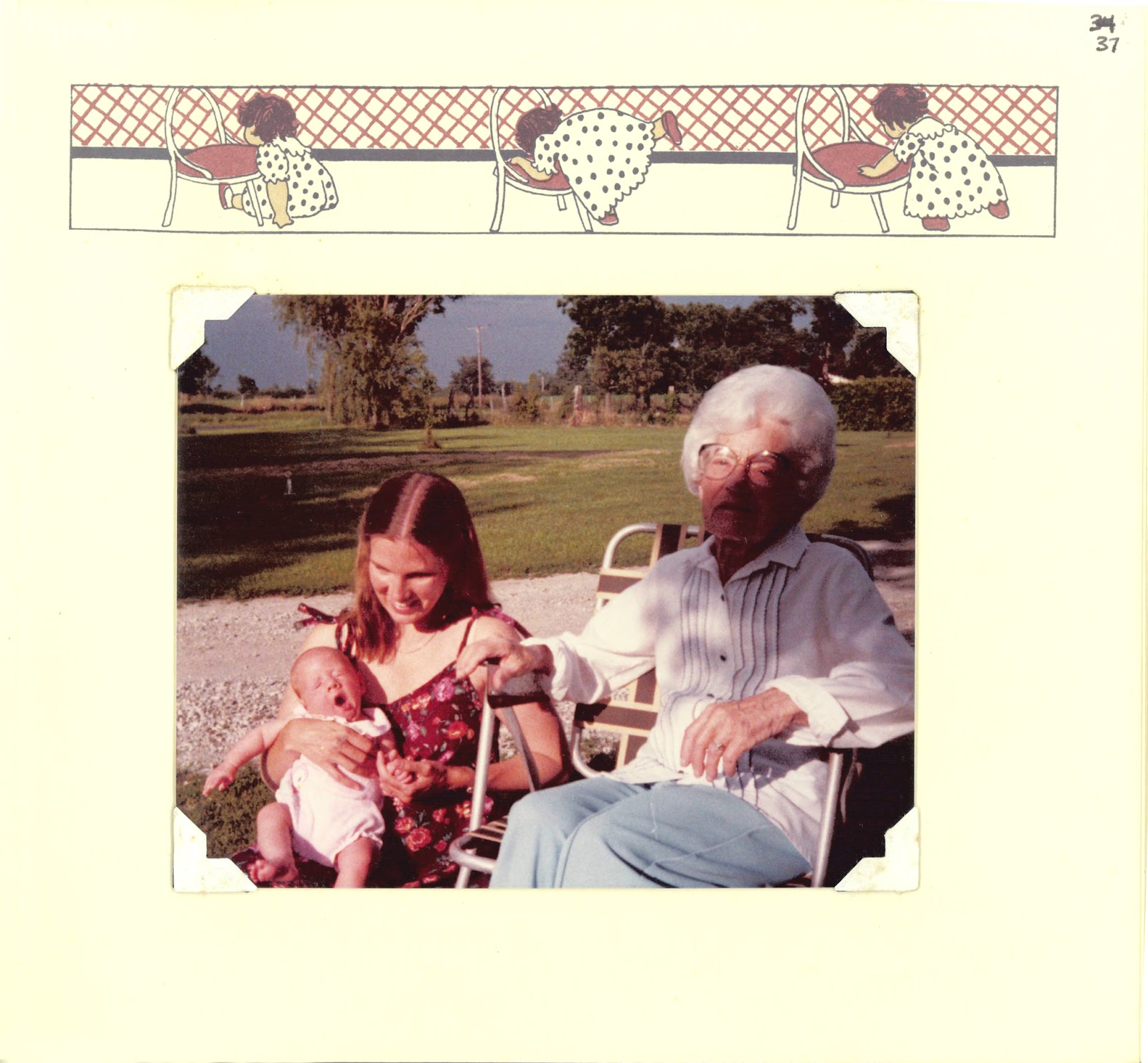
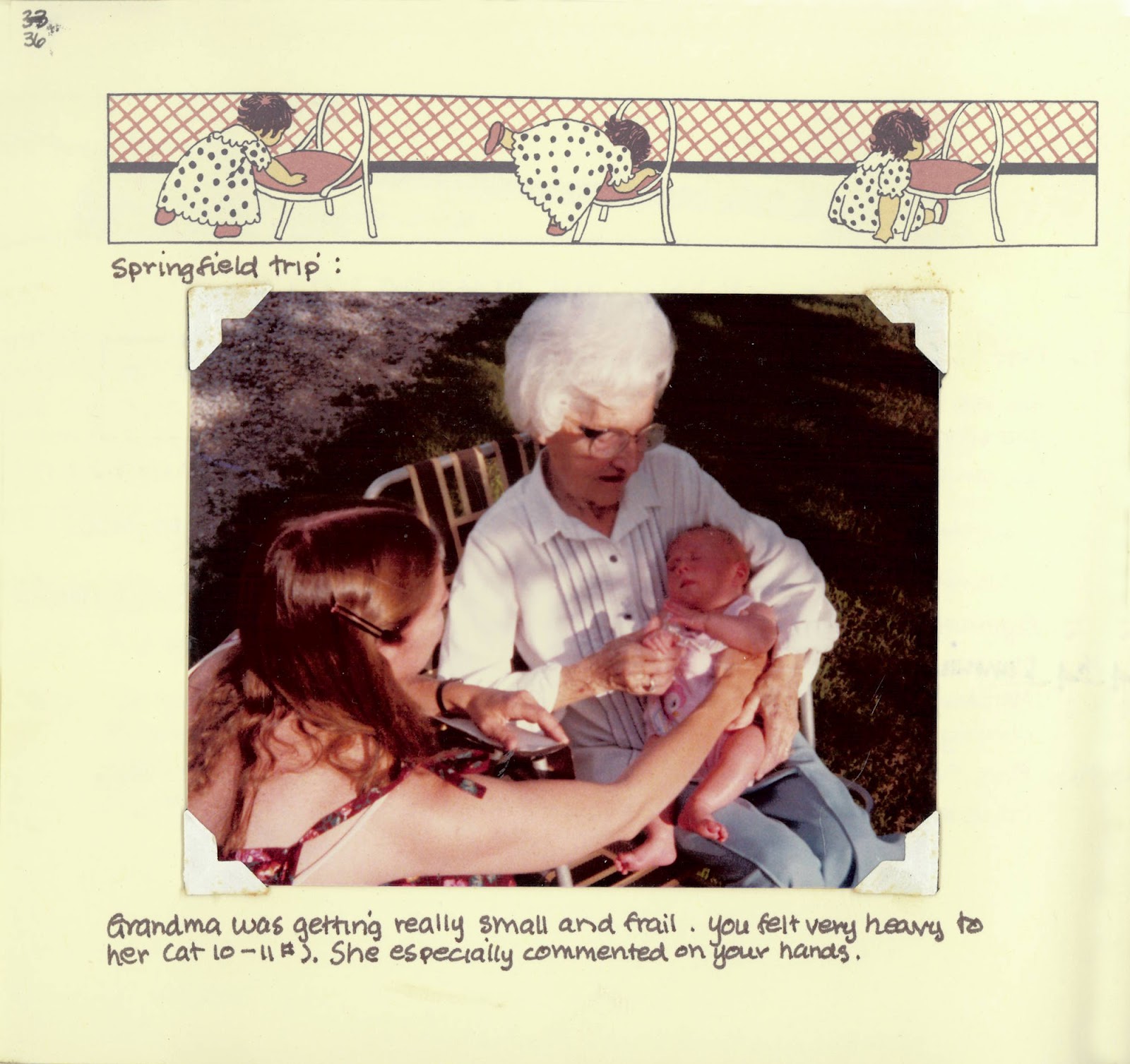
The summer after I was born, my parents took me to visit my great-grandmother Margery. She was in her nineties when this picture was taken; my mom is the one in the red sun-dress. I’m obviously the one looking really bored by the visit.

My mother notes below this photograph that I was ten or eleven pounds at this point (about the size of a large house cat). Since I was born about five weeks before my anticipated due date at about five pounds in size, this is double my birth weight. Since I had trouble nursing and keeping food down in the first few months, I bet my parents were pleased I’d started to grow at a healthy pace!

Although my early and precipitous birth meant my mother was admitted to the hospital, my parents had planned for a home birth. This is the map that my dad drew for the attending midwives so that they would be able to find our house without getting lost when the time came.

things for my thirties [happy birthday to me!]

30 Friday Mar 2012

Posted by Anna Clutterbuck-Cook in life writing

≈ 6 Comments

Tags

holidays, thirty at thirty, work-life balance, writing

So today is my 31st birthday. And to be honest, I’m quite psyched. Because I’m pretty much the age now that I’ve felt, on the inside, most of my life. And I wake up most days feeling like “fuck yeah my life!”

Which is a good, good place to be and something I will try never, ever to take for granted.

A couple of observations for today.

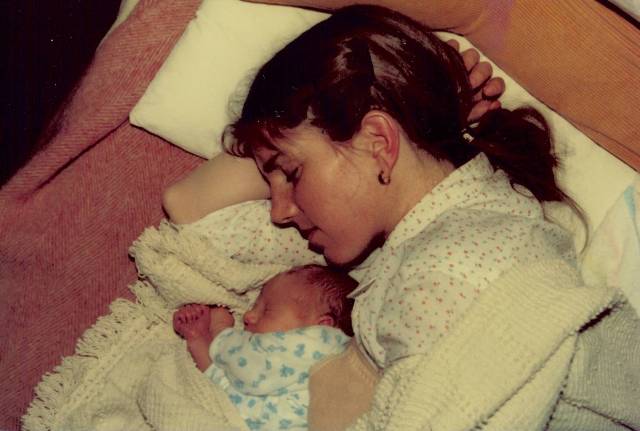
baby Anna and mother Janet, early April 1981

1. Five days after my mother turned thirty-one, she gave birth to me. So I feel like, on some level, this is the point at which my own life narrative and my mother’s life narrative diverge. Which is super-overly-simplistic, really, given that before she was thirty-one my mother did lots of other things I also haven’t done (e.g. date people, get married, get divorced, go to college for architecture, work as a waitress, and go snorkeling in the Cayman Islands). But — all judgyness about parenting/not parenting aside ’cause we don’t really do that in my family — there’s no way to get around the fact that spending your thirties as the full-time parent of three children under the age of ten is going to make for a significantly different kind of decade than the one I have stretching out before me.

Which feels a little weird. Like an opportunity, but weird. One of those moments, as a kid, when you realize your parents — however great they’ve been as models — can only model so far, and so much, before you’re on your own, inventing a life.

2. Not-library things I want to do in my thirties. So I’ve got the next decade before me, an open book. And Hanna and I are settling into life together. Which is really something rich and strange and rather unexpected (I had this notion in my head, for a long time, that I’d probably end up a spinster — in the nicest possible way! I was kinda looking forward to it. But, you know, then Hanna came along and how could I not?). So I have the luxury of thinking about what I’d like to do with myself, other than my professional and partnership activities. Here’s what I’ve come up with:

  • Travel to England, Scotland, Wales, Ireland. I mean, duh. Travel is definitely near the top of my list of things to do with discretionary income (after “buy books” and “eat good food”). 
  • Write and publish erotica. Turns out, at least in the estimation of a few friends (of a range of sexual persuasions) that I have a talent for the stuff. Who knew! But I enjoy writing it and they enjoy reading it, so it seems like it might be fun to try my hand quasi-professionally there. 
  • Find ways to be with young people and age-diverse families. So I’m not going to have children of my own, it looks like. And I’m 95% cool with that. But I’d like to use part of my time this next decade thinking about how my household of two-adults-plus-cat can be hooked into wider networks of caring that encompass families with more age diversity. None of our intimate friends or family have chosen to incorporate children into their lives yet; I’m kinda hoping a few of them do so that we have the opportunity to be kick-ass aunties.
  • Choose and/or create a home. Okay, well, yes. We obviously already have a home together, Hanna and Geraldine and I. But it’s an apartment that started out as a student space, a temporary space, and something not actually selected by both of us, as a couple. It would be nice if, in the next decade, we actually found a home-space through more deliberate selection according to our needs and desires as a family.
  • Research and writing. I have yet to publish that first scholarly monograph. Now with a thesis under my belt, I feel I can move on to other projects — so hello life-long learning! I’m really looking forward to nosing around and finding my niche as a thinker and writer. Not having this be my day job is, in some ways, even more of a blessing since it means I have free reign to explore ideas as I see fit. That was one of my goals of library school: to situate myself as an intellectual in spaces that honored intellectual endeavors, without being required to “publish or perish.” And since I’ve arrived, I’d like to make the most of it.
Happy birthday to me, and welcome to this most fine of decades. Go forth and be joyful.

quick hit: queer community archives in california since 1950

29 Thursday Mar 2012

Posted by Anna Clutterbuck-Cook in my historian hat

≈ Leave a comment

Tags

friends, gender and sexuality, history, librarians, oral history

more about Diana

On March 19th our good friend (and Hanna’s former roomie) Diana Kiyo Wakimoto became the first PhD candidate in the Queensland University of Technology and San Jose State University’s joint  Gateway PhD Program to reach the point of making a final seminar presentation before revisions and submission of dissertation research. Congratulations Diana!

Her topic, queer community archives in California since 1950, makes her research a valuable contribution to the fields of library science/archives, queer history, and queer activism. And of obvious interest to the folks who read a blog titled “the feminist librarian.” Happily, she’s made her final presentation slides and the text of her talk available over at her blog, The Waki Librarian. In her own words:

For many decades, the records that have been forgotten are those of the queer communities, which were not collected by institutional archives. In response to this neglect, community groups created their own archives to collect and preserve their records (Barriault, 2009a; Flinn & Stevens, 2009; Fullwood, 2009). Without the activism shown by the pioneers who created these personal collections and community archives, much of the record of the queer community organizations, movements, and individuals would have been lost. Multiple queer community archives have been created in California to combat the historical neglect and silencing of queer voices in institutional archives. My thesis focuses on the little studied area of the histories of these queer community archives in California and their relationships to institutional archives. 

… As archivists continue to debate the role of the archivist as a professional, this study lends support to the scholars and practitioners who see the archivist as an activist and a non-neutral player in the construction of history and community identities. It bears repeating that without the activists and archivists within the queer communities who saved records and completed oral history projects, much of the record of the communities’ histories would have been lost. Therefore activism is important to saving records of the past and the archives profession must act to ensure a diversity of voices are found in the archives. We could learn much from the community archivists and volunteers about connecting with community members and creating archives and spaces that reflect community needs and interests.

Congratulations, Diana, and I can’t wait to read the final dissertation in full! 

I (heart) dahlia lithwick (again) + rant re: healthcare oral arguments

28 Wednesday Mar 2012

Posted by Anna Clutterbuck-Cook in media

≈ Leave a comment

Tags

human rights, politics, random ranting, the body

via @eskenosen

On the way to work this morning, Hanna and I were discussing how utterly nonsensical and frustrating the anti-healthcare folks are. First they didn’t want government-supported, single-payer healthcare. So the Obama administration patched together something using private insurers. And now they’re pissed about that. Dahlia Lithwick, as usual, highlights the inanity:

It’s always a bit strange to hear people with government-funded single-payer health plans describe the need for other Americans to be free from health insurance. But after the aggressive battery of questions from the court’s conservatives this morning, it’s clear that we can only be truly free when the young are released from the obligation to subsidize the old and the ailing. Justice Samuel Alito appears to be particularly concerned about the young, healthy person who “on average consumes about $854 in health services each year” being saddled with helping pay for the sick or infirm—even though, one day that will describe all of us. Or as Justice Antonin Scalia later puts it: “These people are not stupid. They’re going to buy insurance later. They’re young and need the money now.” (Does this mean that if you are young and you pay for insurance, Scalia finds you “stupid”?)

Read the whole thing over at Slate. Emphasis mine.

Apart from everything else that’s angry-making about the healthcare “debate,” I’m particularly appalled by the endemic ageism and ableism embedded in these arguments about how we shouldn’t have to pay for what other people need. As if those “others” (the sick, the infirm) aren’t actually us. And will never be us. Or, once we become the other we’ll be left out in the cold to cope with our ill-health all on our own.

Say what?

The argument that young people don’t need healthcare services implies that youth per se = healthy. This is an idealization of youth that runs rampant in our culture, and it’s poisoning our collective consciousness by encouraging us to imagine that to be young is in itself a protection against ill-health. This is nonsense. I know plenty of young people, myself and my partner included, who need not only preventative care (so we hopefully won’t need more expensive care later), but also actual expensive care. Being young doesn’t protect you from physical infirmity, both organic and accidental. Young people get cancer. Young people have thyroid disorders. Young people get infections. Young people break bones, are involved in traffic accidents, must cope with sports injuries. Young people need dental work done, require eye care, need regular reproductive health check-ups (I just made my annual pelvic exam appointment last week).

This Friday I’ll be celebrating my 31st birthday. I know very few of my peers who haven’t already, in their relatively youthful lives, had need of medical services for all of these things. And who haven’t avoided desperately-needed medical care because they were temporarily un- or under-insured and couldn’t afford to pay out of pocket for that care.

As Lithwick points out, even if we experience a relatively healthful youth, we will all one day age and become infirm of body. There is a stunning arrogance and lack of self-awareness to the suggestion that those “others” who get sick and need medical care are the ones who much bear the burden of procuring those services. Seriously: Do certain Supreme Court Justices / conservative lawmakers actually believe they will never become ill/sustain an injury/need end-of-life care?

Once again, I am reminded of historian Gerda Lerner’s observation that “All of us, ultimately, will join one of the most despised and abused groups in our society–the old and the sick.”

There’s a conversation to be had about the financial burden of healthcare services, and whether the cost should be as high as it is. But that conversation should be separate from the conversation about individual healthcare needs, because when it comes to health, like our environment, we’re all in this together. There is no way to escape sickness, there is no way to prevent death. We will all experience physical suffering. We will all need medical care. And there is absolutely no way to reliably predict who will need what services and when.

It frightens me that the supposedly wise persons on the Supreme Court seem to have forgotten their own mortality.

booknotes: straight

27 Tuesday Mar 2012

Posted by Anna Clutterbuck-Cook in book reviews

≈ 3 Comments

Tags

books, gender and sexuality, history, science, the body

Until I fell in love with my partner, Hanna, I generally conceptualized myself as “mostly straight.” This was because, despite the passionate friendships I formed with female friends and the way lesbian sexual fantasies made me go all squishy with excitement, I didn’t feel I was queer enough to be considered authentically out of bounds of straightness. And I passively imagined that, given the statistical odds, chances were I’d fall in love with a person who was a cisgendered man (although I wouldn’t have used the term “cisgendered” back then).

Then Hanna came along, and I realized I was falling for her, and then we were together, a couple in the world, and I had to develop a whole new vocabulary for talking about myself: “mostly straight” no longer felt accurate. But was I lesbian? bisexual? fluid? queer? Should I articulate my sexuality in terms of my kinky fantasies? The gender identity and sexual orientation of my partner? The aggregate attractions I’ve felt but never acted upon for people across the gender and sexuality spectrum? If I’m a person who’s felt squishy feelings for people who identify as male, female, trans, gay, bi, straight, and numerous combinations of the above … how meaningful is it to try and identify something inherently personal (one’s subjective sense of self) in terms of the objects of my affection (which are multivarient, ever-changing). In a strange way, the language I choose to speak of myself has an effect on the identities of anyone I’ve ever felt the thrill of sexual excitement over.

It’s a social dilemma that, three years later, I’ve yet to resolve. These days, when filling out forms I go for the string-of-words approach. The form asks Sexual Orientation? I respond: “lesbian/bisexual/fluid” or the like. Check boxes be damned. In a pinch, “bisexual” is probably the best catch-all (I register attraction to people of multiple gender expressions and sex identities). In biomedical terms, “lesbian” is probably the most accurate in that I’m in a monogamous relationship with a cisgendered woman — so our medical needs will be those of women who have sex exclusively with women. But that isn’t all of who I am — or who my partner is, for that matter, since she identifies as bisexual. “Fluid” helps capture some of the contextual nature of my sexual desires, and my sense of personal change over time. But will provide little information to my primary care provider that “lesbian” doesn’t already communicate — with much less room for confusion.

When blogging or speaking informally, I’ll use lesbian, dyke, bi, gay, queer, fluid, or sometimes opt for phrasing that’s less about who I am and more about what I do: “As someone in a lesbian relationship…,” “As someone who’s partnered with another woman …”

Hanne Blank, in her recently-published (long anticipated!) Straight: The Surprisingly Short History of Heterosexuality (Beacon Press, 2012) recounts similar dilemmas of self-identification as the partner of a male-identified person whose markers of sex and gender are, nonetheless, all over the biological map due to having been born with XXY chromosomes. The author of Virgin: An Untouched History returns to historical and cultural notions of human sexuality in an effort to illuminate what we mean when we talk about “heterosexual” or “straight” identity. As with “virgin,” the answer turns out to be murky at best. The concept of an individual whose identity or nature was built, at least in part, around an exclusive attraction to “opposite”-sexed partners and activities, only came into being in relation to the study of non-normative or “deviant” sexual behavior during the late-nineteenth and early twentieth centuries. Even after the term came into common usage, virtually no research has been done — scientific or otherwise — on heterosexual sexuality. We don’t know how the bodies of heterosexuals differ from those of non-heterosexuals, for example. Research on homosexuality suggests there is no marker of sexual orientation on the body, but no one has ever asked the question “How are heterosexual bodies composed?” Scientists studying non-heterosexuality always assume they know the normal against which they are measuring the non-normal. Yet this assumption is never spelled out, and its markers are never articulated. As Blank writes:

Scientists often look for evidence of non-heterosexuality, what we consider the exception to the rule, while assuming that the heterosexual rule itself requires no evidence. Scientifically speaking, this is precisely backwards. In science, it should technically not be possible to even begin considering whether there might be exceptions to a rule until you have proven that the rule exists (42-43).

The reason why we’ve never inquired into the existence of heterosexuality is that, culturally speaking, it is a category of being that has become commonsensical, so self-evident in our minds that we measure every other sexuality in relation to it. There is power in a category so constructed as simultaneously normative and empty of actual definition. Blank compares heterosexuality to the concept of being not a person of color or not a slut. “Nameless and characterless, the space we can loosely categorize as ‘normal’ is almost completely undefined,” she writes (32):

This is why ‘slut’ and ‘prude, ‘pervert’ and ‘deviant’ all work so well as insults and as ways to police the boundaries of sex doxa [an anthropological term meaning “what everyone knows to be true”]. The labels are effortless to deploy, and hard, even impossible, to defend against … The opposite of ‘slut’ is someone who has not been labeled a slut, someone who has never been charged with violating doxa (32).

If there is a weakness in Straight it is the emphasis on marriage and reproduction as signs of heterosexual identity. I understand why Blank draws upon these cultural examples of heterosexual life — both marriage and parenting are more social activities than, typically, sexual behavior. People are far more likely to record instances of the former rather than the latter. So from an historical perspective, research on heterosexuality will end up documenting those outward signs with much more confidence than it will what people actually did with their bits (and how they felt about doing it). Unless people talk about their sexual self-identities, it’s hard to do more than catalog instances in which sexual acts were recorded — and those acts were usually the ones considered deviant, exceptional, worthy or note or censure.

Still, other books have been written in recent years on the history of marriage, and I felt myself starting to skim in hopes of more discussion of sexological research and taxonomy, a more inventive backward reading from those instances of “deviance” toward what people considered not-deviant. Some of that does appear in the pages of Straight, but I found myself wishing Blank’s editor had pushed her to include less of the well-trodden history of marital practice and more of the specifically sexual practices that fell within the bounds of the acceptable. She does argue, at one point, that “penis-in-vagina intercourse is the only source of sexual pleasure that has never, so far as we can tell from the historical record, has never been challenged … the fortunes of all other sex acts and all other sources of sexual pleasure, have varied widely” (124). I would have liked to see that assertion expanded on, to have these boundaries of sexual activity discussed in relation to the notion of sexual identity in historical understanding. In the 1890s, for example, would a husband and wife who practiced cunnilingus and fellatio with one another been categorized as “normal-sexual” in the eyes of the early sexologists? Blank leaves much of that open to further discussion — which may, I admit, have been her intent.

In the end, Blank has written yet another accessible survey of a sexual concept we think we all know and instead, it turns out, we know little about. I hope the liveliness of her prose and the concrete examples she provides of individuals who defy our binary sex, gender, and sexual categories (man/woman, gay/straight, cis/trans) will encourage people who may not have thought human sexuality in such complex terms to revisit their assumptions and look at their own identities and behaviors with new, and perhaps more forgiving and expansive, eyes.

← Older posts
Newer posts →
"the past is a wild party; check your preconceptions at the door." ~ Emma Donoghue

Recent Posts

  • medical update 11.11.22
  • medical update 6.4.22
  • medical update 1.16.2022
  • medical update 10.13.2021
  • medical update 8.17.2021

Archives

Categories

Creative Commons License

This work by Anna J. Clutterbuck-Cook is licensed under a Creative Commons Attribution 3.0 Unported License

Meta

  • Create account
  • Log in
  • Entries feed
  • Comments feed
  • WordPress.com

Create a free website or blog at WordPress.com.

  • Subscribe Subscribed
    • the feminist librarian
    • Join 37 other subscribers
    • Already have a WordPress.com account? Log in now.
    • the feminist librarian
    • Subscribe Subscribed
    • Sign up
    • Log in
    • Report this content
    • View site in Reader
    • Manage subscriptions
    • Collapse this bar