• anna j. clutterbuck-cook
  • contact
  • curriculum vitae
  • find me elsewhere
  • marilyn ross memorial book prize

the feminist librarian

the feminist librarian

Author Archives: Anna Clutterbuck-Cook

whither the f/f romance?

17 Saturday Feb 2018

Posted by Anna Clutterbuck-Cook in fandom, think pieces

≈ Leave a comment

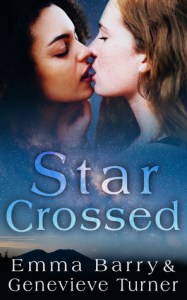
StarCrossedTest1It’s Femslash February and I’ve been writing Jean/Hilda and Sam/Susan all month which has returned me to the perennial question of why there is not more romances (fanfic or profic) in the world featuring a central relationship between two female-identified persons. There are a lot of women writing professionally published romance and romance-centered fanfiction, and there are a lot of queer women writing it. Published romance featuring m/m relationships is a booming category (I read and enjoy a lot of it!) and “slash” is so synonymous in the fandom hivemind with male/male pairings that “femslash” carries the mark of difference: this isn’t regular slash (featuring men sexing) but femslash (featuring ladysex).

(Image: Cover of Star Crossed by Emma Barry & Genevieve Turner. The cover art features an black woman and a white woman kissing superimposed on a night sky.)

Women — especially queer women — writing romance know full well that women can fall in love with, and have smoking hot sex with other women. Many of us have done so! But “the market isn’t there” for f/f stories the way it is for m/m or f/m (or even f/m/m). Last night I read an interview with romance writer Cat Sebastian where she and the interviewer, Kelly Faircloth, have the following exchange about why we aren’t drowing in historical femslash a la the classic Sarah Waters’ novels Tipping the Velvet and Fingersmith:

There’s such a large audience of women for romance featuring two men. What do you think it is that readers see in that?

I don’t know, and I think about this all the time! First of all, I don’t know that there is an answer that we can access. This is just me guessing. I do wonder if it’s something about seeing a man through the male gaze. Maybe we are used to seeing women through the male gaze. Maybe the experience of seeing men as beings who are desired by other men is freeing, or novel, or attractive in some other way as readers. I feel like that could be it, and that might explain why F/F doesn’t seem to have taken root, which is a huge source of frustration for me. I don’t understand—where are all my lesbian historical novels? Give them to me! There aren’t nearly enough of them out there, and everybody who’s written one assured me that the reason is because there’s just not a huge audience, and they like to eat food and make money, which is totally respectable. Maybe it’s because in a novel with two women as protagonists, maybe as readers, we don’t know how to look at them without the male gaze. I have no idea, and it’s been so long since I have been in a women’s studies class, but I do feel like that’s got to be part if it.

I don’t know! I would like for somebody to write a dissertation on that.

I also don’t understand. Like, Fingersmith is one of the best books ever.

Exactly. One of the best books ever. I feel like romance needs to jealousy claim Sarah Waters as one of our own, because Fingersmith and Tipping the Velvet are models we could use.

Also, if you look at how people could hide queer relationships around existing structures—two women could live together really easily in the 19th century.

Yes! And forever. It’s never been hard to hide a lesbian relationship. And I don’t know if that’s because we expect women to live together, or we expect single women to team up, or if it’s just because no one’s thinking there’s anything sexual behind it, so they can do whatever they want. Even if they’re married to other people, they can do whatever they want, and no one looks twice.

As Cat observes, there’s a widespread agreement that “there’s just not a huge audience,” and yet there are also perennial discussions by the (mostly female/nonbinary and many queer) people who read/write romance and read/write romantic fanfic about how we all wish there were more. I actually began writing fanfic and publishing it on Ao3 in 2011 specifically because I was frustrated by the lack of f/f representation in erotic fanworks. Writing m/m came later, although these days I have about an equal number of m/m, f/f, m/f and more complex (e.g. m/m/f or f/f + m/f + m/m) relationships represented in my overall body of work. I have felt the pull first-hand, as both a (queer cis woman) writer and a reader, toward m/m story arcs and pondered how to square the desire to read, write, and imagine those relationships with my real-life f/f marriage and my feminist values which call upon me to center marginalized voices in narrative storytelling.

So here’s my attempt to share my working theory for why f/f romance isn’t an exploding subgenre, and why Femslash February is a thing because the rest of the year femslash is such a rare flower in the ecosphere of fandom. This is in no way meant to be a definitive articulation of why f/f is so difficult to locate in our bodies of literature, and if anyone who reads this has additional insight I welcome your thoughts below or on Twitter (@feministlib).

Reason 1: Men are protagonists.

It’s widely recognized across genres that in the stories available to us in Western literature, (white) male characters are understood to be capable of carrying a “universal” narrative while female protagonists are not. Women and girls, queer or not, learn from a very young age to identify and empathize with male characters in stories across multiple formats (television, film, literature). Men and boys are presumed to need characters like themselves to remain interested in the media before them. I don’t believe this is innately true about men and boys — because I believe that women, men, and nonbinary persons share a common humanity that allows us to empathize and be interested in the humanity of one another across categories of gender, race, sexual orientation, and other differences. However, I do believe that it is a groomed preference: That women (and people from other marginalized identities) are expected, and therefore learn, to identify with characters across identity categories while men are not, and therefore do not — unless they are purposeful about cultivating that ability. It’s not a muscle they are challenged to use — while women are challenged to use it continually.

Therefore, it makes sense that even in a genre dominated by female creators, we drift toward narrative scripts that privilege male subjectivity. That means stories that include male protagonists, either in m/f or m/m relationships, feel more natural to create and consume because we are used to male agency.

This default of the male protagonist can be amplified in fanworks particularly because fanworks play with existing media that is — because patriarchy — skewed heavily toward (white) male protagonists.  While fanworks creators have done incredible work queering those canonical protagonists — including, at times, imagining them as genderfluid or trans, or genderswapping one or both characters in what would canonically be an m/m relationship — it remains a factor that canonical main characters are overwhelmingly presented as cis, straight, and male.

Reason 2: Sex Needs Dicks.

Our cultural scripts for sex are overwhelmingly heteronormative and require the presence of a penis for “sex” to have taken place. I would argue that m/m narratives, rightly or wrongly, are easier to translate in the context of these narratives because putting a penis into an orifice counts as sex in our brains in a way that sex only with clitorises does not. We also expect men to be sexually-desiring beings, and physically sexual, in a way we do not expect of women. (Again, even queer women are vulnerable to these sexual scripts because we grow up in heteronormative culture too.) In the context of the romance genre, there is typically a romantic and sexual script that intensifies over the course of the novel and culiminates — for f/m couples — with penis-in-vagina intercourse as an expression of consumated love and/or marriage. This script can be hijacked for use with m/m protagonists because you can build the sexual intimacy from handjobs to blowjobs to anal sex with kissing thrown in somewhere along the intimacy ladder depending on whether you assume that kissing is the entry point for sexual contact or a feminine-coded expression of love (meaning it falls probably somewhere after blowjobs).

What do you do with two women? We don’t have a widespread, culturally legible or adaptive script for that. Which leads to jokes like this:

Heres+a+helpful+graph+_a8fb5dfbfc60275175878a56cdeaa830

(Image: Imagined graph of Hetero Sex vs. Lesbian Sex. The hetero sex graph is a four-minute timeline featuring a male orgasm, an optional female orgasm, then sleep. The lesbian sex graph is a five-hour timeline featuring a rainbow tangle of sexual activity and multiple orgasms. I don’t have an image credit for this, so if you know who to credit please let me know!)

Despite the fact that f/f couples report higher rates of orgasm and higher levels of sexual satisfaction than women who have sex with men, we don’t know how to turn our queer sexual pleasure into a linear narrative (possibly because of that “time travel” squiggle around hour three…). In a genre that relies to some extent on a predictable, comfortable formula that promises readers the emotional satisfaction of increasing emotional and sexual intimacy that culminates in the formation of a committed, found-family relationship, those squiggles don’t provide clear guidence for how to move your two female protagonists from first blush to final orgasm and/or family formation.

Reason 3: Challenging Toxic Masculinity

In a world where toxic masculinity runs rampant, f/m and m/m romance (fanfic or professionally published) is a space where feminist-minded women and nonbinary folks can explore what the world might be like if men, too, were allowed to be vulnerable and desired. In romance literature and fanfic romance, male partners feel a full range of emotions related to forming human relationships: desire, pleasure, anxiety, hurt, anger, fear, pride, caring … the list could go on and on. In order for a romance plot to work, the male protagonist(s) must be a character the reader can identify with as a human being whose humanity could be made more whole in relationship with his partner — and often in relationship with extended and found family too. Romance novels assert that men can be desiring and desired, and that their sexuality is not irrevocably shaped by expectations of dominance or violence. I think this reason is part of what Cat Sebastian was getting at in the interview excerpt above, where she observed that “seeing men as beings who are desired by other men is freeing.”

As Emma Lindsay observed a year ago, dating men can make women feel like shit in part because “society labels men creepy when they are open about their sexual feelings.” Yet in order for f/m or m/m romance narratives to work, male characters must be open about their sexual feelings. A three hundred page novel centered around a man and a woman, or a man and another man, falling in love and becoming sexually intimate requires interiority and emotional labor from both protagonists in order to give the readers stake in the happily-ever-after outcome. We need to care that they care. We need to be shown that they care. Or the emotional payoff of reading the novel simply isn’t there. And because of this genre requirement, we get three-dimensional human characters who wrestle with their humanity, wrestle with their desires, and wrestle with the cultural scripts they have been handed and emerge better human beings.

This is cathartic and hopeful reading, and writing, for people who yearn for a less toxic, less patriarchal world. And it’s an act of revisioning that f/f romances don’t tackle in such a direct way (although they also must reckon with toxic masculinity, as I point out below).

Reason 4: The Shadow of Male Violence

carol-film-still-640x450

(Image: Still from the film Carol in which Carol and Therese are interrupted at breakfast by a private investigator posing as a salesman.)

For a number of reasons this year I’ve been thinking a lot about the spectre of male violence that haunts romance between women. I’m not sure if this is so much a reason that f/f stories are not created as it is an illustration of how deeply our patriarchal  narratives of romance and sex require a male presence — so much so that when we try to write them out of the narrative they become violent. In the 2015 film Carol — an adaptation of the classic lesbian pulp The Price of Salt — the two women whose romance is the central narrative, Carol and Therese, escape Carol’s estranged husband and Therese’s (nominal) boyfriend by embarking upon a roadtrip from New York to Chicago. Carol’s husband, furious at his wife’s request for a divorce — and eager to collect evidence of her perversity as leverage in the custody dispute over their young daughter — sends a private investigator to tail them. In a striking violation of the couple’s private intimacies, he ultimately ends up making an audio recording of the couple’s first sexual encounter together.

There is something heady (for me, as a cis, bisexual woman) in the realization that you can opt out of the social expectation that you give a damn what men think of you: your body, your words, your desires, your life choices, your past, or your future. Men are powerful in our patriarchal society — granted, it is power that comes with caveats regarding race, class, sexual orientation, and all the rest — and girls grow up into women understanding that they will be scrutinized by men and that this scrutiny will matter. If you are a woman who desires men (and I have been that woman, in the past) the reality of navigating patriarchal power within the intimacies of your most intense and enduring adult relationship(s) can feel like an exhausting prospect. For women who also or instead desire women, it can be liberatory to realize that the male gaze no longer matters to you. It might constrain your choices in the wider world, but it is unable to touch you in the bedroom.

As I say, I experienced this as liberatory. Yet it is also dangerous. Since I have been paying attention to this spectre of male violence in the context of f/f romance I have seen it everywhere: In Cat Sebastian’s The Soldier’s Scoundrel the sister of one of the male protagonists, Charlotte, is trapped in an abusive marriage and escapes only when her lover, Anne, murders her husband. In Jordan Hawk’s Undertow a spurned male suitor not only attempts to murder Maggie’s ketoi lover Persephone but attempts genocide against Persephone’s entire species. Women are vulnerable under patriarchy whether or not they choose to have sex with men, and men who feel entitled to female attention can turn violent when they realize they have been written out of the plot. That’s an exhausting truth we live with daily, and it can be hard to read and write it in our escapist literature as well.

Reason 5: Follow the Money

Of course, at the end of the day, women — queer women, especially — do write and read f/f romance, and yearn for more. But as with any other lack of diversity in publishing, authors need editors and publishers convinced of a book’s marketability before they will give meaningful support to a project. This is why, I would argue, that we see f/f relationships written in to more and more m/m and f/m romance series as novellas or as secondary couples. Queer women — including myself — who write m/m relationships as the primary story arc will populate their world with secondary queer characters that feel authentic to our experiences. The m/m or f/m romance carries the narrative for all of the reasons outlined above, while the women-loving-women do so on the sidelines — often with the full support of their gay male or otherwise socially subversive protagonists.

Hopefully, in the not-to-distant future, we’ll see those relationships rotated with increasing regularity from the sidelines to center court. More and more frequently we are seeing f/f novels integrated into romance series with m/f and m/m pairings: Her Ebony by Maggie Chase (2017); Star Crossed by Emma Barry & Genevieve Turner (2017); and the forthcoming Last Couple in Hell by K. J. Charles (March 2018!) which I am dying to get my hands on.

Earlier this month I set up a Good Reads shelf on which I am collecting all of the f/f historical romances I come across. If you have a favorite f/f historical — or come across one in your reading life — please share! I dearly hope that one day there will be too many f/f romance novels published for me to keep up with the flood.

a year of critical reflection and study

21 Saturday Oct 2017

Posted by Anna Clutterbuck-Cook in library life, my historian hat

≈ Leave a comment

This year (2017) marked the tenth anniversary of my entry into the library science / archives field as a graduate student and worker. It also coincided with the end of my three-year term as Inclusion and Diversity Coordinator for our regional professional association, New England Archivists, and the inception of the loose affiliation of resistance archivists we have come to call the Concerned Archivists Alliance.

While I have neither the opportunity nor inclination to return to formal graduate study, I have decided to make 2018 a year of study and reflection as I think about the core values that inform my work as a librarian through the lens of scholarly and activist literatures that critically consider how library and archival spaces are shaping and shaped by social (in)justice.

I am grateful, as I prepare to undertake this year of work, that many scholars have made syllabi and other tools for this exploration readily available to those outside the academy.

LAST UPDATED 4/25/2018

My core resources will be:

I am excited to be enrolled in the Library Juice Academy course Exploring and Applying Critical Theory: An Introduction for Librarians taught by Jessica Critten (April 2018).

#critlib readings and discussion.

Design for Diversity’s Foundational Readings and ongoing engagement with their work.

Adrienne Keene’s Introduction to Critical Race Theory syllabus (Fall 2017).

Raul Pacheco-Vega’s “How to undertake a literature review.”

Laura Saunders‘ Radical Librarianship: Radical Theory & Praxis syllabus (Spring 2016).

LIVING BIBLIOGRAPHY:

In addition, this post will become a living bibliography of the additional books, articles, and online resources that have informed this critical reflection already (*) or that are on my “to read” list for 2018:

*Adler, Melissa. Cruising in the Library: Perversities in the Organization of Knowledge (Fordham, 2017).

Ahmed, Sara. Living a Feminist Life (Duke Univ. Press, 2017).

*Ahmed, Sara. On Being Included: Racism and Diversity in Institutional Life (Duke Univ. Press, 2012).

*Beilin, Ian. “Student Success and the Neoliberal Academic Library.” Canadian Journal of Academic Librarianship 1:1 (2016): 10-23.

Bly, Lyz and Kelly Wooten. Make Your Own History: Documenting Feminist and Queer Activism in the 21st Century (Litwin Books, 2012).

Bradbury, Alexandra, Mark Brenner, and Jane Slaughter. Secrets of a Successful Organizer (Labor Education and Research Project, 2016).

Brilmyer, Gracen. “Archival assemblages: applying disability studies’ political/relational model to archival description.” Archival Science (2018): 1-24.

*Bourg, Chris. “Debating y/our humanity, or Are Libraries Neutral?” (11 February 2018).

Caldera, Mary and Kathryn M. Neal. Through the Archival Looking Glass: A Reader on Diversity and Inclusion (SAA, 2014).

Cottom, Tracy McMillan. Lower Ed: The Troubling Rise of For-Profit Colleges in the New Economy (The New Press, 2017).

*de jesus, nina. “Locating the Library in Institutional Oppression.” In the Library with a Lead Pipe (24 September 2014).

*Delgado, Richard and Jean Stefancic. Critical Race Theory: An Introduction (New York Univ. Press, 2001).

*DiAngelo, Robin. White Fragility: Why It’s So Hard for White People to Talk About Race (Beacon Press, 2018).

*Drabinski, Emily. “Toward a Kairos of Library Instruction.” Brooklyn Library Faculty Publications, Paper 16 (2014).

*Drabinski, Emily. “Are libraries neutral?” (12 February 2018).

*Drake, Jarrett M. “I’m Leaving the Archival Profession: It’s Better This Way” (Medium, 26 June 2017).

*Galvan, Angela. “Soliciting Performance, Hiding Bias: Whiteness and Librarianship.” In the Library with a Lead Pipe (3 June 2015).

*Geismer, Lily. Don’t Blame Us: Suburban Liberals and the Transformation of the Democratic Party (Princeton Univ. Press, 2014).

*Hathcock, April. “White Librarianship in Blackface: Diversity Initiatives in LIS.” In the Library with a Lead Pipe (7 October 2015).

Lankes, R. David. The New Librarianship Field Guide (MIT Press, 2016).

Lew, Shirley and Baharak Yousefi, eds. Feminists Among Us: Resistance and Advocacy in Library Leadership (Library Juice Press, 2017).

McAlevey, Jane F. No Shortcuts: Organizing for Power in the New Gilded Age (Oxford U. P., 2016).

Michaels, Walter Benn. The Trouble with Diversity: How We Learned to Love Identity and Ignore Inequality (Metropolitan Books, 2007).

Mehra, Bharat and Kevin Rioux, eds. Progressive Community Action: Critical Theory and Social Justice in Library and Information Science (Library Juice Press, 2016).

Nicholson, Karen P. and Maura Seale, eds. The Politics of Theory and the Practice of Critical Librarianship (Library Juice Press, 2018).

Noble, Safiya Umoha. Algorithms of Oppression: How Search Engines Reinforce Racism (NYU Press, 2018).

Oluo, Ijeoma. So You Want to Talk About Race (Seal Press, 2018).

Picca, Leslie and Joe Feagin. Two-Faced Racism: Whites in the Backstage and Frontstage (Routledge, 2007).

Popowich, Sam. ” ‘Ruthless Criticism of All that Exists’: Marxism, Technology, and Library Work,” The Politics of Theory and the Practice of Critical Librarianship, Karen P. Nicholson and Maura Seale, eds. (Library Juice Press, 2018).

Punzalan, Ricardo and Michelle Caswell, “Critical Directions for Archival Approaches to Social Justice,” The Library Quarterly: Information, Community, Policy vol. 86, no. 1 (January 2016).

Rinn, Meghan R. “Nineteenth-Century Depictions of Disabilities and Modern Metadata: A Consideration of Material in the P. T. Barnum Digital Collection,” Journal of Contemporary Archival Studies vol. 5 (2018).

Samek, Toni. Intellectual Freedom and Social Responsibility in American Librarianship, 1967-1974 (McFarland, 2001).

*Seale, Maura. “Enlightenment, Neoliberalism, and Information Literacy.” Canadian Journal of Academic Librarianship 1:1 (2016): 80-91.

Schlesselman-Tarango, Gina, ed. Topographies of Whiteness: Mapping Whiteness in Library and Information Science (Library Juice Press, 2017).

Schomberg, Jessica. “Disability at Work: Libraries, Built to Exclude,” The Politics of Theory and the Practice of Critical Librarianship, Karen P. Nicholson and Maura Seale, eds. (Library Juice Press, 2018): 111-123.

*Shirazi, Roxanne. “Reproducing the Academy: Librarians and the Question of Service in the Digital Humanities” (15 July 2014).

Sullivan, Susanne. Good White People: The Problem with White Middle Class Anti-racism (SUNY Press, 2014).

Tewell, Eamon. “Putting Critical Information Literacy into Context: How and Why Librarians Adopt Critical Practices in Their Teaching.” In the Library with a Lead Pipe (12 October 2016).

*Tyson, Amy.  The Wages of History: Emotional Labor on Public History’s Front Lines (Univ. of Mass. Press, 2013).

*Wakimoto, Diana, Christine Bruce, and Helen Partridge. “Archivist as Activist: Lessons from Three Queer Community Archives in California,” Archival Science 13, 4 (December 2013): 293-316.

Ward, Jane. Respectably Queer: Diversity Culture in LGBT Activist Organizations (Vanderbilt Univ. Press, 2008).


archivists in interesting times

24 Tuesday Jan 2017

Posted by Anna Clutterbuck-Cook in library life

≈ Leave a comment

On January 15th, archivists Jeremy Brett, Katharina Hering, Hanna and myself, released A Statement to the Archival Community regarding the election of Donald Trump. The statement reads, in part:

We are a diverse group of archivists who are deeply concerned with the current state of American politics based on the election of Donald Trump and the subsequent legitimization of his advisers’ and surrogates’ damaging views and policies.

The Core Values and Code of Ethics established by the Society of American Archivists note that “underlying all the professional activities of archivists is their responsibility to a variety of groups in society and to the public good… the archival record is part of the cultural heritage of all members of society.” The Core Values also note that, by “documenting institutional functions, activities and decision-making, archivists provide an important means of ensuring accountability.” As professionals committed to these values and as custodians of society’s historical records, we have a responsibility to ensure that what we do, and how we do it, benefits society as a whole, while holding public officials and agencies accountable. Therefore it is incumbent upon us to speak out when the public good is jeopardized by political action. […]

  • We will not be intimidated, but will continue to provide equitable access to information.
  • We will not be prejudiced, but will continue to serve all our communities to the fullest extent of our abilities.
  • We will remain committed to protecting the fundamental right of people to know what their government is doing and why.
  • We will not act out of fear of elements of the incoming administration, but will continue to preserve the documentary record that holds our leaders accountable to law and justice.

[…] We pledge to remain vigilant in this moment of rapid change, seeking opportunities to put our skills and resources as archivists and information specialists to work as part of the resistance.

To date, the Statement has been signed by 515 colleagues in addition to the four original authors. Our website is currently a bit bare bones, but has links to resources for further action and we are in discussion about how to hold one another accountable and provide a platform for archivist activists to “put our skills and resources to work as part of the resistance.”

Wherever you are, and whatever your skills and resources, I hope you too will join the struggle in your own communities.

well here we are

01 Sunday Jan 2017

Posted by Anna Clutterbuck-Cook in admin

≈ Leave a comment

A year ago, I decided to take a year-long hiatus from blogging. And I … haven’t missed it. Which honestly kind of surprised me, since I’ve been a compulsive writer, diarist, correspondent in one form of another since I was six years old.

But in 2016 I … stopped. And I haven’t missed it.

And I’m learning to be okay with that.

Mostly.

As I look out toward the landscape of 2017, a landscape of uncertainty for us in so many ways, I know that I want to stay connected to my network of family and friends. And I know that right now in my life, words about my own experiences and thoughts have come more sparingly than they used to. During this past year I’ve found even personal correspondence difficult to craft.

So, inspired by a few friends who have done the same, I am going to experiment with TinyLetter and commit to writing a monthly newsletter about what’s happening in our lives here in Boston over the course of the year ahead.

I’ll be sending newsletters out around the 15th of each month, with reflections on what our family has been doing at work and at play, politically and personally. There will probably be talk of books, history, cats, quilting, and my latest foray into local community: the Unitarian Universalist church.

If any of this sounds interesting to you, please sign up to receive these monthly missives in your Inbox below.

I am thankful for your presence in our lives.

the feminist librarian: a newsletter

http://tinyletter.com/feministlib/

me, writing elsewhere … see you in 2017?

29 Tuesday Dec 2015

Posted by Anna Clutterbuck-Cook in life writing, Uncategorized

≈ Leave a comment

Tags

blogging, blogging elsewhere, work-life balance

IMG_20151229_144039During the past month, I’ve been doing a lot of thinking about what I want to do more and less of in 2016.

I’m not a fan of New Year’s resolutions, as they seem driven largely by the twin engines of American consumerism and self-improvement driven by toxic guilt. Perhaps, too, there is something about January in the upper Midwest (or New England) that seems a poor time to harden one’s resolve to do much more than curl up under a blanket with a cat, a glass of merlot, and a good book.

Still, I’ve been thinking about more and less. The things I do which bring me energy and joy and the things I’ve done in the past year which bring me largely exhaustion and stress. And, in between those two poles, the things which must be done (to put a roof over our heads, to put food on the table) and the things which fill time but don’t necessarily nourish the soul (my soul; at this moment).

CXWQbx0WkAEfyyM

This afternoon, I put together a list of things which I hope to (will strive to) do more of this coming year. This list included things like quilting, reading romance novels, writing romance fanfic, cuddling with my wife, and walking around Boston.

Blogging wasn’t on that list, nor was nonfiction/personal writing of any kind. Which surprised me, a little. Since early adolescence I’ve been a prolific writer of the personal, since starting college a reliable producer of the research essay, history thesis, book review, and since 2007 a regular blogger at what would become over time the feminist librarian.

But lately, as they say, I just haven’t been feeling it.

So in 2016 I’ll be hitting PAUSE.

I’m going to see what a year of not-blogging feels like.

In 2017 I might be back…or I might be elsewhere. Meanwhile, of course, the Internet is a vast and many-textured space where computers talk to one another and human beings use computers to talk to one another. And I will continue to talk with other human beings there, in many locations other than this blog.

You’ll find me on Twitter sharing selfies and providing almost continual stream-of-consciousness thoughts, feelings, and photos.

You’ll find me on Archive of Our Own writing smutty fanfic.

You’ll find me on GoodReads leaving off-the-cuff book reviews.

You’ll find me at MedHum Fiction | Daily Dose and Library Journal writing more substantive reviews.

You’ll find my online reading list at Tumblr.

And this may date me? But I still enjoy corresponding with pen-pals. So you can always find me by email at feministlibrarian [at] gmail [dot] com.

I hope all of you have a lovely, rejuvenating 2016 and I look forward to seeing where the year takes us. May it be a better place by fits and starts than where we are as we begin.

to drive the cold winter away

23 Wednesday Dec 2015

Posted by Anna Clutterbuck-Cook in our family

≈ 2 Comments

Tags

holidays

It might be forecast to reach seventy degrees tomorrow here in Boston, but nevertheless it will still be Christmas Eve and our household is ready for a week’s quiet vacation here at home with the cats. Plans include the carol service broadcast from King’s, reading, quilting, Murdoch Mysteries, writing drabbles for our TwelvetideDrabbles2015 challenge, and doing our holiday shopping, wrapping, and mailing of Christmas parcels.

Our hallway is slowly filling with Holiday greetings… pic.twitter.com/iX6FcZpR42

— AnnaClutterbuck-Cook (@feministlib) December 20, 2015

It’s been lovely to get cards from you all, adding to the festive decorations in all hallway (above batting level for curious kittens).

A better picture of @StillLifeFarm handiwork on its way home. pic.twitter.com/AYzlidXCPj

— AnnaClutterbuck-Cook (@feministlib) December 12, 2015

This year, we’ve branched out into a balsam, juniper, and winterberry “swag” from Stillman’s, our CSA farm, and it’s making the apartment smell like Christmas (at least we hope so; both of us have been stuffy with colds since we brought it home!).

Advent calendar at the Clutterbuck-Cooks, day twenty-three pic.twitter.com/3R7vd0g4bQ

— AnnaClutterbuck-Cook (@feministlib) December 23, 2015

And the advent calendar has been steadily counting down the days. Today was our last day of work for 2015 and we’re looking forward to closing out the old and welcoming in the new as the days slowly, imperceptibly, begin to grow longer.

May all of you have a safe and restorative holiday season. See you in 2016.

thirteen books

25 Wednesday Nov 2015

Posted by Anna Clutterbuck-Cook in book reviews

≈ Leave a comment

Tags

books

Bookshop in Old Aberdeen (2003)

Bookshop in Old Aberdeen, Scotland (2003)

According to GoodReads, I have thirteen books to read before the end of the year in order to make my (entirely self-imposed) goal of 104 books read in 2015. Below are the titles on my bookshelf that I plan (hope) to get to before the year is out.

Sexology and Translation: Cultural and Scientific Encounters Across the Modern World
edited by Heike Bauer

Born Bad: Original Sin and the Making of the Western World
by James Boyce

The Diabolical Miss Hyde (Electric Empire #1)
by Viola Carr

The Devious Miss Jekyll (Electric Empire #2)
by Viola Carr

Welcome to Night Vale
by Jeffrey Cranor and Joseph Fink

Progressive Evangelicals and the Pursuit of Social Justice
by Brantley W. Gasaway

Riotous Flesh: Women, Physiology, and the Solitary Vice in Nineteenth-Century America
by April Haynes

Queer London: Perils and Pleasures in the Sexual Metropolis, 1918-1957
by Matthew Houlbrook

Archives of Desire: The Queer Historical Work of New England Regionalism
J. Semaine Lockwood

Reflections (Indexing #2)
by Seanan McGuire

After the Wrath of God: AIDS, Sexuality, and American Religion
by Anthony Petro

The Shepherd’s Crown (Tiffany Aching #5)
by Terry Pratchett

Respectably Queer: Diversity Culture in LGBT Activist Organizations
by Jane Ward

What have you been / will you be reading in the final months of 2015?

movienotes: sense8

09 Monday Nov 2015

Posted by Anna Clutterbuck-Cook in media

≈ Leave a comment

Tags

gender and sexuality, television

sense8-12

This past weekend I finished watching the first season of Sense8 on Netflix and thought I’d share a few thoughts about what I enjoyed about it. And I did enjoy it overall. It’s not perfect in my mind (hell, point me to the cultural product that is?) but I really enjoyed getting to know the eight central characters as individual people over the course of the series, and the secondary cast as well.

For those who are unfamiliar with the premise of the show, it’s a psychological thriller / science fiction drama that is a kissing cousin of Orphan Black. As with Orphan Black we have a physiologically unique (evolved?) subset of human beings (or other species?) who have unique abilities and a shadowy group of powerful scientists with a vested interest in eradicating them. Sense8 posits a world in which groups of eight individuals are telepathically connected around the globe, sharing one anothers’ senses and being able to project into one anothers’ mental and actual spaces. They are able to share emotions, skills, memories, and real-time sensory experience. Sense8 follows one particular group of these individuals as they awaken to their connection, learn about and from one another, and strategize to escape the clutches of the Evil Scientists(tm) who seek to neutralize their powers.

A lot has been said about the global scope of this series, with its human diversity of many kinds (racial, gender, sexual, socioeconomic background and so forth). And that’s definitely there, much more so than many other mainstream shows. I was wary that “HEY LOOK WE HAVE DIVERSITY” would be where the series stopped, and was relieved that this type of tokenism didn’t ultimately overwhelm the individuality of the characters. Instead, identity-based diversity becomes the rich earth from which subtle individual difference grows, individuality that is informed by the characters’ divergent life experiences.  In some of the early episodes I felt like characters were being introduced with stereotyped shorthand, but they pushed through those narratives and came into their own complexity over time.

While on its face an action drama, in which the characters must successfully evade a powerful threat (as well as wrestle with some more personal demons, and localized aggressors), I would argue that Sense8 is in fact a romance. Relationship is at the heart of Sense8‘s power, and questions of connection and empathy, disconnection and loss permeate the season’s twelve episodes from beginning to end. Sure, our intrepid band of telepaths must battle opponents who seek to do them harm. But that story has been told a thousand and one times (probably more), a standard trope of the genre. It is in the relationship realm that Sense8‘s unique contribution comes into its own.

I really appreciated how the senseates’ connection to one another was not exclusive of other deep, deep emotional bonds. Wolfgang has a best friend whom he seeks to protect with his life; Will struggles to maintain a relationship with his father; Capheus feels keenly the absence of his sister (given up for adoption) and cares tenderly and fiercely for his HIV+ mother. The few scenes between multiply-traumatized Riley and her musician father are so heartbreakingly loving. And there are relationship struggles as well: Kala trying to decide whether to follow through with marriage to a man she is uncertain she loves, Sun sacrifices herself to protect the honor of her father and brother only to have second thoughts from jail.

Two senseates, San Franciscan hacker Nomi and Mexican telenovella star Lito, are in queer relationships with non-sensates, and those relationships are not treated as second-fiddle to the senseate connection. Nomi and Amanita are gloriously sensual and committed as a couple, their sexual desire for one another often fueling arousal among the other senseates without regard to orientation. Deeply-closeted Lito endangers his relationship with Hernando and Daniela, and ultimately must decide whether his love for them is stronger than his fear of being outed.

Interestingly, elder (and somewhat tedious) sensates appear to our intrepid band at various points throughout the season and almost always insist that self-sacrifice and disconnection (suicide, avoidance of others in the group) are the key to survival. Yet over and over again the Sense8 group chooses to reach out and support one another, and to refuse self-sacrifice if there is any chance at another way. The elders imply or outright insist that relationships make one vulnerable; Will and Riley, for example, are discouraged from pursuing a sexual relationship with one another because the older sensates feel it’s almost incestuous. Will and Riley (and the rest of their group) disagree, and it is ultimately Riley and Will’s fierce determination to remain in one anothers’ lives that routes the enemy at the end of season one. Working cooperatively (with one another and trusted humans) ends up strengthening rather than weakening their team.

The relationship-centric nature of this series, set within a rich tapestry of diverse cultural backgrounds and personal experiences that inform the characters’ morality and desires, was really good television and I feel like I’ll be mulling over the people it introduced me to for many a day to come.

p.s. in #fanfic are characters the defining source?

06 Friday Nov 2015

Posted by Anna Clutterbuck-Cook in fandom

≈ Leave a comment

Tags

comment post, fanfic, writing

This is an addendum to last night’s post fueled by the conversation I had with Hanna on our walk to work (which, more often than not, constitutes gossip about fanfic).

One of the defining features of fanfic as a genre, for me, is that it is character-driven.  Fic, the way I read and write it, is primarily about individual characters and their relationships (erotic or platonic) with other characters. It’s not about establishing the rules of the universe or about the suspense of the plot. It’s about asking “What would these individuals do if they were presented with X situation?” either in canon, in the canon ‘verse, or in a completely different setting (an alternate universe or AU).

I would actually argue that most if not all characters are independent of the authors who write about them. I struggle with the idea of characters as the intellectual property of an originating author. I feel like characters develop independent lives, such that they are bigger than one single author’s interpretation of those characters. We collectively narrate pieces of their existence. They become more real, in cultural terms, the more people tell stories about them in different iterations.

So this is another reason why I can come to fanfic that considers characters that I never met before in the source material. The fanwork becomes, for me, that first encounter, that source material. In some cases, I end up reading backwards to the “original” source material because I’m interested in that dialog between fic and canon. Other times, all I care about is the intra-fanwork conversation, the characters as collectively presented in the body of writing considered to be fannish vs. canon (however we define that). It’s about falling in love with the characters, for me, and becoming invested in the characters. And I can get to know those characters through a million shards of fic almost more intimately than I can get to know them through the singular voice of a specific published author or the narrative constraints of a television series or film.  Continue reading →

reading and writing #fanfic as a non-fan? some thoughts

05 Thursday Nov 2015

Posted by Anna Clutterbuck-Cook in fandom

≈ Leave a comment

Tags

comment post, fanfic, writing

http://www.deviantart.com/art/Team-free-will-354911394

Team Free Will by Jasric.
Possibly my favorite piece of 
Supernatural fan art ever produced.

This blog post is written in direct response to the latest episode of the Fansplaining podcast, “One True Fandom” (episode eight), the transcript of which I read this afternoon. I had some thoughts about the conversation which I shared briefly on Twitter and wanted to expand them into a post.

Here’s what I wrote on Twitter:

I write #fanfic for stuff I can easily riff off, and for stuff that irritates me because I think it could be better … @fansplaining

— AnnaClutterbuck-Cook (@feministlib) November 5, 2015

stuff I’m in love with it usually feels like it has too strong a presence of its own for me to transform through my own voice @fansplaining

— AnnaClutterbuck-Cook (@feministlib) November 5, 2015

reading transcript of the last @fansplaining episode is making me think anew about how I mostly don’t write #fanfic for stuff I’m a FAN of?

— AnnaClutterbuck-Cook (@feministlib) November 5, 2015

Expanded thoughts…

  • I was introduced to fanfiction as a genre — a genre that resonated with my own “homegrown” approach to fictional narratives (more below) — rather than coming to it through a particular fannish community. My now-wife was the one who introduced me to the language and conventions of fic, specifically slash, because she thought I would be interested in slash fiction as a form or cultural critique and also countercultural / queer erotica. I mean, it was also a wildly successful form of nerd-flirting. But I think my introduction to the activity of fanfiction as an idea rather than as a form of participation in a specific fandom continues to shape my relationship to the practice — and to fandom culture more generally.
  • I love fanfiction as a genre in part because it’s a language to describe how I have approached fictional narratives throughout my life. Some of my earliest memories from childhood involve spinning out narrative “what if…” tales about my favorite fictional characters. Oftentimes with rampant self-insertion. As a teenager, one of my favorite category of narrative was retellings of folk- and fairytales, or mythologies from various cultures. I collected, and wrote, multiple versions of certain tales, reworking, updating, critiquing classic interpretations. Think Beauty and Rose Daughter by Robin McKinley, Tam Lin by Pamela Dean, Wicked by Gregory Maguire. When I was fourteen I wrote a 200-page adaptation of the Cinderella tale on a DOS word processing program. So when I was in my late twenties and someone said “here is this thing called fanfiction and this is how it works…” I was like Oh, yes. That. Why didn’t anyone tell me about this earlier?!
  • I read fanfiction for canon narratives with which I have zero or passing familiarity. Gundam Wing. Teen Wolf. Daredevil. I’ve never seen them. Hawaii 5-0. One episode, only well after I read widely in the Steve/Danny pairing. To me, fanfiction is both critique of (or elaboration on) the specific source material and also a broader response to popular culture. It offers up new ways of seeing what are, often, very tired stories. And stories that I as a queer, feminist-minded woman struggle to relate to. Fanfiction is a restful genre for me in many ways. I know I can come to it for queer intervention. For feminist intervention. Increasingly for intersectionality in its exploration of issues like racial inequality and dis/ability. While there are published authors whose work share these features with fic, as a genre fic has delivered most reliably in these ways. So my ability to access, and take pleasure in reading, fic is only loosely related to specific canonical ‘verses.

Continue reading →

← Older posts
Newer posts →
"the past is a wild party; check your preconceptions at the door." ~ Emma Donoghue

Recent Posts

  • medical update 11.11.22
  • medical update 6.4.22
  • medical update 1.16.2022
  • medical update 10.13.2021
  • medical update 8.17.2021

Archives

Categories

Creative Commons License

This work by Anna J. Clutterbuck-Cook is licensed under a Creative Commons Attribution 3.0 Unported License

Meta

  • Create account
  • Log in
  • Entries feed
  • Comments feed
  • WordPress.com

Blog at WordPress.com.

  • Subscribe Subscribed
    • the feminist librarian
    • Join 37 other subscribers
    • Already have a WordPress.com account? Log in now.
    • the feminist librarian
    • Subscribe Subscribed
    • Sign up
    • Log in
    • Report this content
    • View site in Reader
    • Manage subscriptions
    • Collapse this bar
 

Loading Comments...