• anna j. clutterbuck-cook
  • contact
  • curriculum vitae
  • find me elsewhere
  • marilyn ross memorial book prize

the feminist librarian

the feminist librarian

Author Archives: Anna Clutterbuck-Cook

quick hit: SCOTUS on young peoples’ free speech rights

28 Tuesday Jun 2011

Posted by Anna Clutterbuck-Cook in linkspam

≈ 2 Comments

Tags

children, human rights, politics

I’m in Michigan for a whirlwind visit to attend my brother and sister-in-law’s wedding celebration. I thought I might have fun photos to share with you today, but not yet. Instead, I’ll post this story that I heard on National Public Radio this afternoon.

The Supreme Court on Monday struck down a California law banning the sale of violent video games to children, saying it ran afoul of the First Amendment right to free speech.

In one of the most closely watched cases this term, in a 7-to-2 vote, the justices said governments did not have the authority to “restrict the ideas to which children may be exposed.”

I was struck, when I heard the story on All Things Considered, that the issue was being framed as a free-speech issue. That is, that children have a constitutional right to information…even if its information we find disturbing and wish to protect them from on a legal level.

This may be the first (and only!!) time I find myself agreeing with Antonin Scalia:

Writing for the majority, Justice Antonin Scalia said the country has no tradition of restricting depictions of violence for children. He said California’s law did not meet a high legal bar to infringe on the First Amendment or the rights of parents to determine what’s best for their children.

Note that parents still have the authority to determine what their children can and cannot access; it’s just that the government cannot legislate one particular type of parental values for all children.

The article goes on to note:

Although regulating children’s access to depictions of sex has long been established, Scalia said there was no such tradition in the United States in relation to violence. He pointed to violence in the original depiction of many popular children’s fairy tales like Hansel and Gretel, Cinderella and Snow White.

“Certainly the books we give children to read — or read to them when they are younger — contain no shortage of gore,” Scalia added.

Read the whole thing over at NPR.

While I agree with Scalia that as a society we routinely expose children to a high level of violent stories and imagery (not to mention leaving them vulnerable to actual physical and emotional violence), I think it’s interesting that the question of restricting access to sexual materials was left unquestioned. If children have a constitutional right to play first-person shooters, don’t they also have a constitutional right to see images of people making love, if that is what they wish to do? (Most young children are probably more interested in violence than sex … but for the sake of legal consistency they should be allowed either).

I have a lot of questions about the nuances of this ruling, and no time in the next 48 hours to do any background reading. But I’ll let you know if there are further developments!

booknotes: arms wide open

23 Thursday Jun 2011

Posted by Anna Clutterbuck-Cook in book reviews

≈ 2 Comments

Tags

children, feminism, gender and sexuality, history, memoir

There is a point toward the end of Patricia Harman’s Arms Wide Open: A Midwife’s Journey (Boston: Beacon Press, 2011) when author offers us another of the many particular birth scenes that punctuate the overarching narrative. It is the late 1970s and, after nearly a decade delivering babies as a lay midwife, Harman has entered medical school to become a Certified Nurse-Midwife. She describes the labors of a woman named Carla who will eventually deliver a son whom she names Joe. As the child is about to crown, the following scene takes place:

M.R. [Mary Rose, Harman’s mentor] lets go of my hands and reaches for a pair of scissors. At first I assume she’s getting ready to cut the cord, though the head’s not out yet, but she nudges me with her elbow and forces the scissors into my hand, then injects Xylocaine into our young patient’s perineum. Now I know what she wants me to do … cut an episiotomy.

So here I sit. The head of a dark-haired infant crowning before me. I know how to get this baby out without a laceration or episiotomy in two minutes, if Mary Rose and the enthusiastic nurse would leave me alone, but I am the student, enrolled to learn.

I take the scissors and cut, feel the skin crunch between the blades, see the blood ooze … and deliver the baby. It’s not a good feeling, but it’s done. The very pink body swivels out, Mary Rose cuts the cord, and the RN takes the tiny boy to the infant warmer.

“If the heart rate’s down, you have to cut an episiotomy right away,” Mary Rose whispers, “The OBs watch us, and if you hesitate, they’ll start coming in to every delivery to supervise.” She looks at the door. “We don’t want that” (246).

This scene is, I would argue, the hinge upon which this memoir turns. Arms Wide Open is a memoir in three parts. Part one (“Little Cabin in the North Woods, 1971-1972”) and part two (“Commune on the Ridge, 1977-1978”) are episodic accounts of Patricia Harman’s decade of experiments in communal, backwoods living. From an isolated cabin outside of Duluth, Minnesota to an intentional community in South Carolina, we follow Patricia Harman, her lover, her future husband, her sons, and a motley group of fellow-minded travelers through the ups and downs of community life. “Commune on the Ridge” ends with Patricia and her husband Tom’s joint decision to pursue medical degrees (he in women’s health, her as a midwife) — a decision which took them away from the commune and back into the mainstream frameworks of institutional education, hospital-based medicine, and city life. Part three (“Cedar House on Hope Lake, 2008-2009”) jumps ahead to the present, with reflections back upon some of Harman’s training and the years she and her husband worked together running a women’s health clinic. Each section is, in some ways, in dialogue with the other sections as the reader is invited to compare and contrast each location and living arrangement Patricia and her family create for themselves with their previous and future locations and arrangements.

The strength of Arms Wide Open is the immediacy of its narrative. In recreating her personal history, Harman has drawn heavily on journals she kept during the years she describes, and the resulting text bears the marks of that internal narrative: we experience the events in the book through Patsy’s senses, and what meaning is made of those events is made less through present-day commentary than with the voice of (possibly imagined) Harman’s younger self. Arms Wide Open is executed with loving care, and provides an unvarnished look at the struggles and disillusionment, as well as the joys of communal experimentation. For anyone interested in experiencing communal life vicariously through personal narrative, Arms Wide Open comes highly recommended.

It is this very sense of immediacy, however, that contributes to what I felt was one of the book’s central weaknesses: the lack of any larger framing narrative, any strong present-day voice that would exert autobiographical force upon these episodic scenes and encourage us to understand not only how Patsy-of-the-moment made sense of her life, but how Patricia Harman presently understands her past experience. I finished the book with lots of unanswered questions about how Patsy of the backwoods commune became Patricia the Certified Nurse Midwife working in a women’s clinic. It is possible that some of those questions may be answered in Harman’s first memoir, The Blue Cotton Gown (2008). At some point I may go back and read that volume. However, the point remains that readers coming to Arms Wide Open without the background of Cotton Gown are left wondering at the underlying values and choices that led Harman first in to, and then away from, the backwoods communal life. She hints around the edges about a background in New Left political action, anti-war protests, and even some jail time. The narrative implicitly endorses a very specific vision of responsible living on the earth, of childbirth and childcare, of gender and sexuality — yet the narrator never steps back from the moment to write in more overarching ways about how her politics and values have (or have not) changed over time.

I would have been very interested to know how she sees her present-day work connected (or not) to her earlier experiences, philosophically and practically. The final section, particularly, contains a lot of sadness and sense of displacement — while Harman and her husband seem to have found ways to live out their values in a more mainstream context, there is also a pervading wistfulness and at times outright pain at the way in which their lives have not played out as they hoped or expected. There is a sense that, having given up the communal way of life, Harman is not sure how to live out her most deeply-held values in a less unconventional context. Although she describes interacting with anti-war protestors and midwives who are a generation or two her junior, she seems profoundly isolated from the counter-cultures of the present day (of which, I would argue, there are plenty!). This loss of fellow travellers within the narrative speaks to me particularly, since I have spent many hours interviewing counter-culture-leaning folks from Harman’s generation about their past and present lives … and how they do and do not forge connections across age cohorts. In such an age-stratified society such a project can be difficult — even radical — but I would argue that to tie radicalism to a particular generation or stage in life is a deadly impulse if what we want to create is lasting social change.

On a similar note (although I imagine it is not her story to tell), I would also have been interested in her children’s reflections on the experience of early childhood in a communal household — and how they feel it shaped their own values and expectations as they grew into adulthood. From passing references toward the end, it sounded as though all three of Harman’s sons had chosen outwardly conventional life paths. Outward appearances can be deceptive (I could write my own biography to sound exceedingly conventional), but I would have liked further exploration into the whys and wherefores of Harman’s family as it came of age.

Ultimately, this is recommended reading for anyone who is interested in counterculture living, midwifry and childbirth, the historical period of the 1970s, and the art of memoir. If you’ve read The Blue Cotton Gown I’d be interested to hear your views on how the two books work together, and whether any of the silences I have mentioned above continue throughout.

from the neighborhood: chihuly at the mfa

21 Tuesday Jun 2011

Posted by Anna Clutterbuck-Cook in a sense of place

≈ Leave a comment

Tags

art, boston, from the neighborhood, photos

Cross-posted at …fly over me, evil angel….

Now that I’m finished with graduate school, I have my weekends back (hooray!) and Hanna and I have been trying to re-learn what it means to spend leisure time together … time not compressed by the anxieties and demands of trying to complete academic work on top of a 35-hour work week and, you know, the daily tasks of living.

Walking home through Fenway Victory Gardens
Photograph by Hanna

I seriously don’t understand how couples who have full-time jobs manage to care for children. Is there time travel involved? Because caring for our family as just two adults is difficult enough.

Anyway. Back to basics. How do you enjoy a weekend that’s truly a weekend … as in: time off from one’s regular mode of employment?

I thought it might be fun to spend a few months playing quasi-tourist in our own city. Particularly since, as an employee of the Massachusetts Historical Society, I have free admission to lots of cultural sites in the region. (Free entertainment always being preferable when you’ve got student loans to pay off!) Over the past four years, I haven’t found a lot of time to make use of this benefit, but I’ve decided that this should change. Therefore: watch for more “from the neighborhood” posts in the coming months, as Hanna and I explore new parts of our own backyard.

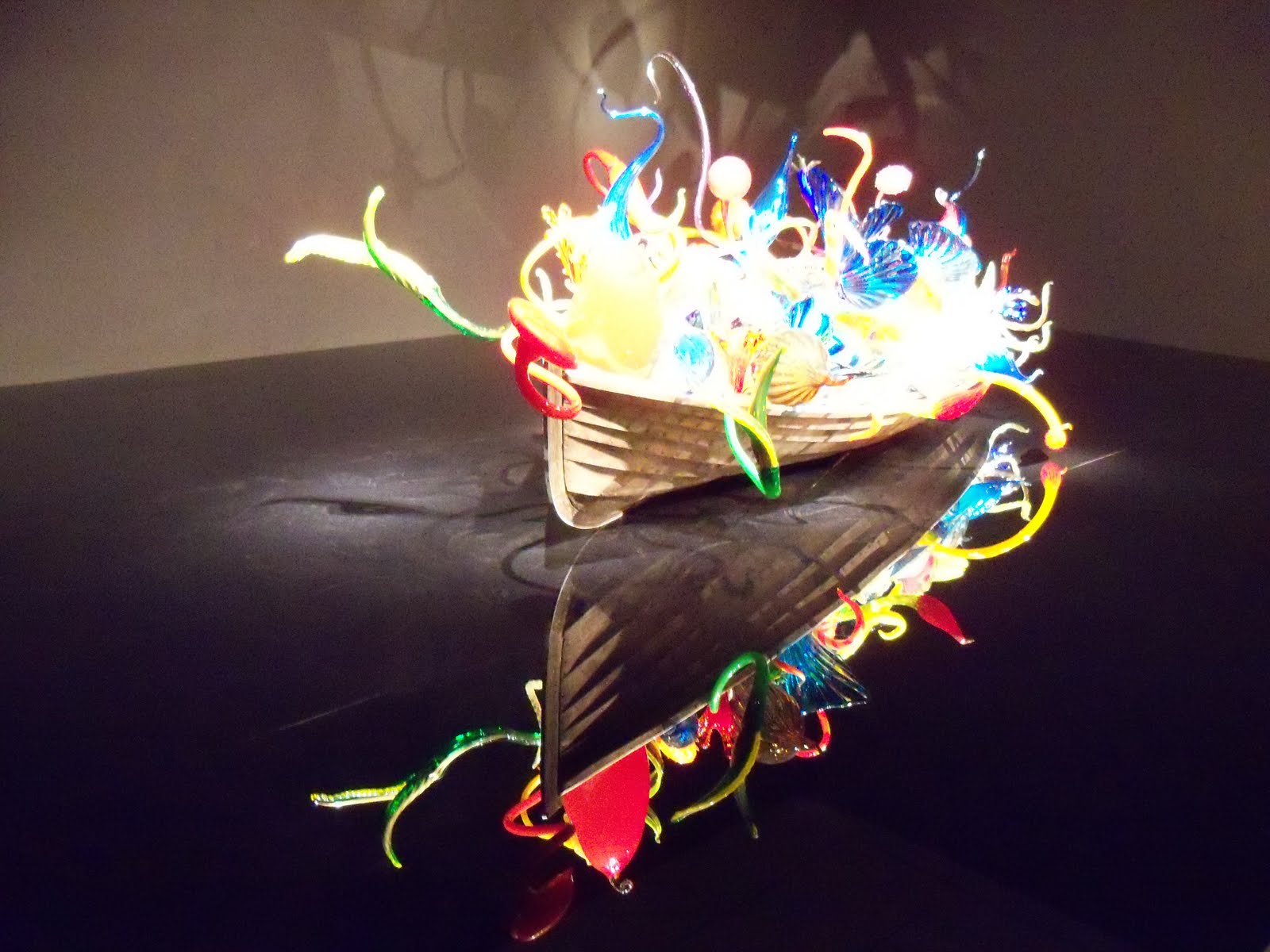
Our first stop, this weekend, was the Museum of Fine Arts, just up the road from the MHS. The MFA is currently hosting an ehibit of work by glass artist Dale Chihuly. I’f you’ve never seen Chihuly’s work, I highly recommend checking out the photos and video clips on his website — the installations are breathtaking. I first saw his work at the Frederick Meijer Gardens in Grand Rapids, Michigan about a decade ago and can’t think of anything that’s more soul-enriching than sitting in one of his galleries and soaking in the color. Here are some photographs we took at the exhibition here in Boston.

So much of his work looks like ocean life of some kind
The camera washed out the color on this one, but I love the reflection.
See a better image at Chihuly’s homepage.
See what I mean about the tide pool effect?

Hanna and I agree he should design
sets for Tim Burton…
Chandelier detail
Shadow pictures especially for my mother, who is
currently working on a photography series like this.
Chandelier (by Hanna)
Hard to tell here, but these are massive.
I love seeing his work in organic settings;
sadly, the MFA space had few outdoor installations.
Purple reeds (by Hanna)

All in all, it was an amazing way to spend our Saturday morning. Not sure what we have planned for our next outing, but rest assured I’ll take the camera and report back!

harpy fortnight: officially summer edition

19 Sunday Jun 2011

Posted by Anna Clutterbuck-Cook in linkspam

≈ Leave a comment

Tags

harpyness

Titania With Her Fairies
Arthur Rackham

Over at The Pursuit of Harpyness we’ve been winding up for the summer months (can you believe summer doesn’t officially start until Tuesday?). During the passed two weeks, I’ve posted the following:

  • The first two installments of my series live-blogging Jessica Yee’s anthology Feminism For Real (2011). I’m blogging a chapter per week for the next 22 weeks — or nearly six months! I’m hoping I don’t run out of things to say … but so far the variety of the contributions is keeping me going. You can read Part One: Invite & Introduction and Part Two: Resistance to Indigenous Feminism thus far.
  • There was a Friday Fun Thread asking folks to name their favorite summer movies. The comment thread’s still open if you care to leave suggestions!
  • A book review of the anthology Best Sex Writing 2010 appeared last week (I swear I’m not turning into an all-books-all-the-time blogger, but recently I’ve been doing lots of off-line reading!)
  • My first contribution to our Poetry Saturdays series, with a Billy Collins poem brought to my attention by my friend Lola @  Oh no, my sainted aunt!

As a bonus, let me direct you also to a recipe for vegan Chocolate-Almond-Hazlenut Thumbprint Cookies Hanna and I posted over at our friend Lyn’s recipe-and-food blog. Trust me. For. The. Win.

As always, check out what the rest of the Harpies have to say by browsing through the archive of The Pursuit of Harpyness.

ficnotes: shock and awe

16 Thursday Jun 2011

Posted by Anna Clutterbuck-Cook in fandom

≈ Leave a comment

Tags

fanfic, gender and sexuality

I’ve been reading more book-length nonfiction recently, in lieu of online fanfic … so after this installment of “ficnotes” I might let the series lay dormant for a while, until something truly spectacularly gorgeous and mind-blowing comes along. Or until the urge to blog about smut rises again (it often does, quite unpredictably!) … in the meantime, here’s this little beauty which Minerva shared via email a couple of weeks ago, on a morning when I really needed some fluff!

Mycroft Holmes via Fuck Yeah Mycroft Holmes!
(Tumblr can be a wonderful thing)

Title: Shock and Awe
Author: random_nexus
Pairing: Mycroft/Lestrade
Author Rating: NC-17
Author Summary: “Oddball style, Manly shmexins, Romance betwen blokes, the usual. Lestrade is falling for Mycroft, but doesn’t think it’s mutual. Hijinx ensue (also the usual).”
Length: 1 part, 1040 words
Available At: LiveJournal.

This is a quiet little fic that takes place in three brief acts: “Before,” “After,” and “Now.” What I like best about it is the author’s focus on the moments of touch, and the details one takes note of in a love — the interior language with which one describes the object of one’s affection. I’m working on a fic myself right now that involves those everyday intimacies shared between people who know they have license to touch — and some of the passages in these three scenes capture that sense of beingness.

$1 reviews: god’s politics

14 Tuesday Jun 2011

Posted by Anna Clutterbuck-Cook in book reviews

≈ Leave a comment

Tags

politics, religion

Now that my reading is no longer dictated by my thesis research I find that … well, I read more or less the same mix of stuff that I read while I was writing. Including the scary books about religion and politics. While Hanna’s parents were here a couple of weekends ago and we went shopping at the Brookline Booksmith, I picked up a copy of Jim Wallis’ God’s Politics: Why the Right Gets it Wrong and the Left Doesn’t Get It  (New York: Harper, 2005). Jim Wallis is one of the founders of Sojourners, an evangelical social justice organization that grew out of anti-war activism during the 1970s. To this day, Sojourners is active in anti-war, anti-racism, and anti-poverty work. They have tried to exist, as the subtitle of Walli’s book suggests, as a third way in the American religio-political landscape: progressive on some social justice matters while also remaining very conservative in some issues I would argue are also social justice questions — but which Wallis sees as divisive “culture war” issues (i.e. gay marriage and abortion). Recently, Sojourners came under fire from some more queer-inclusive religious groups for rejecting an ad submitted to its magazine from an LGBTQ Christian organization. Given the recent buzz, when I saw a copy of God’s Politics at the store I decided it was time for a re-read.

I vaguely remember reading the book when it came out right after the 2004 election. Mostly, I remember feeling fairly certain that Wallis didn’t “get it” when it came to characterizing leftist politics … since most of his criticisms of leftist activists (people he often characterizes as “secular fundamentalists”) bore little resemblance to the people who I understood as left-liberal. I can’t say that my overall impression, upon re-reading God’s Politics six years later, has changed. I still feel the book is condescending towards those whose politics fall to the left of Wallis’ (I’ll return to this below) and I think that he’s trying a little too hard to have his cake and eat it too.

Take, for example, the “culture war” issues he tries to dismiss as meaningful political topics. He wants to claim that evangelical Christians can stand at once for the full human rights of queer folks while continuing to exclude gay people from full participation in church life. He argues that they can be “pro-life” but also feminist, while defining “pro-life” in a way that actually makes him politically pro-choice. While I agree with Wallis that it is possible to be personally against abortion, and to work to reduce the need for abortion, without robbing women of the ability to make necessary decisions for themselves and their families, I find it offensive that he makes what is essentially a reproductive justice argument and yet re-frames it as something that is distinct from (and superior to) the arguments of feminist activists. While I’m not against trying to re-claim “pro-life” as a more comprehensive idea — anti-death penalty, anti-war, reproductive justice — for Wallis to act as if by using the term he can change its political meaning overnight is naive at best and disingenuous at worst.

I also grew very tired of his use of language like “moral” and “values” as if religious folks have a monopoly on morality and ethics. Assuming as he does that religious folks are better at thinking and acting “morally” than their secular peers, I feel that he is blind to non-religious possibilities for some of the problems he diagnoses in American society. His reflexive support for normative family structures, and his assertion that children thrive best in two-parent (by implication heterosexual) families, for example, fails to ask deeper questions about how we might re-form our understanding of family to meet the needs of all people, regardless of their marital status, age, sexual orientation, or other social ties. In his efforts to appease the Christian right, I can’t help feeling that he missed an opportunity to imagine new ways of caring for one another that actually fit quite well into Biblical visions of community as well as dovetailing with very left-radical notions of how non-traditional families might be recognized and honored.

He also loses me when he writes about the degradation of modern culture and the need to re-affirm the value of nuclear family life in language full to bursting with nostalgia for the 1950s that never was. While he never overtly calls for a return to “father knows best,” his recourse to the politics of disgust over hypersexualized television commercials and the comic book violence of Van Helsing (really? that’s the movie you found worthy of condemnation??) amounts to a recoil from modern popular culture that suggests he would be more comfortable if such things would just disappear. I’m always confused by this argument, since surely if you don’t like the violence of Van Helsing or the ideas about human nature found in reality television shows you can turn the television off. Or you can engage in deconstruction and analysis of the show’s messages.  (Perhaps he should read Jennifer Pozner’s Reality Bites Back?) In these moments of recoil and the impulse to make the icky thing just go away I feel Wallis betrays his mid-century evangelical youth, when even films like “The Sound of Music” were Godless indulgences.

Wallis’s strength lies, unsurprisingly, in the sections where he writes about nonviolence and economic justice. I was particularly struck by his insistence on positive alternatives to war as the only effective way of breaking down the notion that violence will somehow bring about a more peaceful world. “If nonviolence is to have any credibility, it must answer the question that violence purports to answer, but in a better way” (160). I was not particularly satisfied with Wallis’ nonviolent solutions (he distinguishes “military” from “police” enforcement without recognizing that in many parts of the world, “police” are justifiably seen as perpetrators of, not protectors from, violence) but I appreciate that he realizes that simple opposition to violence is not an effective political position. I also think he is on much firmer theological ground when arguing that the God of the New Testament (and Jesus) have an inherently anti-war message, and that the Bible calls on us to care for the most vulnerable members of the human community.  In some ways, I wish that he had stuck to these two messages rather than trying to forge a “middle way” between social justice and cultural conservatism — since I think his capitulation to cultural conservative ultimately undermines his claims for the latter.

from the archive: round-up of beehive posts

08 Wednesday Jun 2011

Posted by Anna Clutterbuck-Cook in linkspam

≈ Leave a comment

Tags

history, librarians, MHS

Seth Eastman on Dighton Rock
Courtesy of the Massachusetts Historical Society

Putting up the Picture of Jesus web video on Monday made me realize it’s been a while since I posted links to The Beehive, the official blog of the MHS, where I post occasionally on our shenanigans there as independent research library librarians. So here goes:

  • While on vacation (I know, I know! my boss chided me for it) I wrote a short post about the renewed interest in Harvard University’s first Native American graduates.
  • I highlighted a 1910 police commissioner’s report on Boston’s “houses of ill fame” (i.e. brothels) as part of our “from the reading room” series.
  • I spoke with a dedicated researcher who has been in virtually every day from 9-5 for the past two months reading through John Quincy Adams’ papers on microfilm.
  • And as promised in the last link round-up, a write-up of Brian Gratton’s brown-bag lunch talk on immigration restriction discourse, 1890s-1920s.

While not written by me, I’d like to share a post written by Laura Prieto, my thesis adviser and current research fellow at the MHS on some of the gems she has found during her time in the reading room: Research Fellow Finds More Than She is Looking for in Sarah Louisa Guild’s Diary.

And finally, Digital Projects Coordinator Nancy Heywood offers an historical perspective on tornadoes in Massachusetts, in light of last week’s storm system which brought with it funnel clouds and caused four deaths across the state: Tornado Strikes Worcester County in 1953.

Follow The Beehive directly if you’re interested in more frequent updates on the goings-on of a bustling library and archive. School may be out for the summer, meaning a break for students and teachers alike, but that usually signals the beginning of our busy season as vacationing genealogists, academics, research fellows, and casual visitors, descend to get the type of history fix that just isn’t available via Masterpiece Classics!

quick hit: I’m live-blogging ‘feminism for real’

07 Tuesday Jun 2011

Posted by Anna Clutterbuck-Cook in book reviews

≈ Leave a comment

Tags

blogging, feminism, harpyness, live-blogging

This morning over at The Pursuit of Harpyness, I started a series of 22 “live blogging” posts on Jessica Yee’s new anthology Feminism For Real: Deconstructing the Academic Industrial Complex of Feminism (2011). I’ll be posting my reading notes for each chapter on Tuesday mornings for the next few months.

Please do join us!

multimedia monday: photograph of jesus

06 Monday Jun 2011

Posted by Anna Clutterbuck-Cook in media

≈ Leave a comment

Tags

history, MHS, multimedia monday, web video

It’s been awhile since I posted a multimedia Monday post. This one is courtesy of my friend Heather, who is a former colleague at the MHS and now works in documentary film-making. While at the MHS, she worked on processing image permission requests (a job I now handle), so when she saw this film she figured it had my name all over it. I particularly love the stop-motion animation approach the film-maker used.


Photograph of Jesus by Laurie Hill in association with the Getty Images Short & Sweet Film Challenge from Hulton Archive on Vimeo.

I can’t say I’ve received a request for a photograph of Jesus … yet. But I’ve only been working on image permissions for five months, so I figure it’s only a matter of time.

You can read more about the context in which the film was made on Vimeo.

harpy fortnight: being out, being home, being wrong

05 Sunday Jun 2011

Posted by Anna Clutterbuck-Cook in linkspam

≈ Leave a comment

Tags

harpyness

Sandra (Rachel Griffiths) in Blow Dry (2001)

It’s been more than a fortnight since I last did a round-up of posts from Harpyness, but I gave myself permission not to post there during our vacation, so there isn’t actually that much of a backlog!

Incidentally, if you haven’t seen Blow Dry (2001) it’s totally time you did. Stop reading this post right now and go order it on Netflix. Then come back and start again.

So, what have I been writing about over at Harpyness?

  • Most recently, I published a post in response to sex columnist Jeannie Greeley’s admission that she and her family are keeping her same-sex relationships a secret from her grandparents and her siblings’ children. In Full Disclosure I talk a little bit about my own decisions vis a vis being open about my relationship with Hanna, and why I think hiding loving relationships from kids (or elders!) for fear that they “won’t understand” is belittling for all concerned.
  • On Taking My Partner Home is a meditation on what it was like to bring Hanna back to my childhood home for the first time, after being with her for three years — and living in Boston for going on four. While she and my parents have met previously, it was a whole new level of satisfaction to introduce her to the people and places where I grew up.
  • On May 19, I hosted a two-part “virtual tour” for the book  Hey Shorty! A Guide to Combating Sexual Harassment and Violence in Public Schools and On The Streets (New York: Feminist Press, 2010), authored by staff and youth interns from the organization Girls for Gender Equality, based in Brooklyn, New York. Part One was a review of the book. Part Two was an interview with two of the authors.
  • I offered a Friday Fun Thread asking “who are your automatic buys?” as in: which authors, musicians, film-makers do you trust so wholly that you will purchase their latest sight-unseen? There were a delightful variety of responses in comments.
  • Earlier in May, the MBTA (Boston’s local mass transit network) featured ads by FamilyRadio, the religious organization that predicted the Rapture would fall on May 21. Some folks protested the willingness of the MBTA to sell ad space to people who bigoted against queer folks. I wrote a post about why it’s important to treat all advertisers equally, even if you disagree with what they are selling. There was a lively debate in comments about what constituted hate speech and protected speech in this context.
  • And just in case any of you missed it, I re-posted the wonderful short film Validation. Even if you’ve already seen it, it’s never to early to watch it again!

Obviously I’m not the only one who’s been blogging at Harpyness. Other writers have contributed posts on the topic of Mother’s Day,  the movie Bridesmaids, Madame Ophelia DeVore-Mitchell, Dominique Strauss-Kahn, on the latest publicized case of parents trying to raise a child without assigning the child’s gender, the anniversary of Dr. Tiller’s murder, the threat of romance novels, and  we featured a guest post by writer Oh Hells Nah on sex work.

Hop on over to The Pursuit of Harpyness for all this and more!

← Older posts
Newer posts →
"the past is a wild party; check your preconceptions at the door." ~ Emma Donoghue

Recent Posts

  • medical update 11.11.22
  • medical update 6.4.22
  • medical update 1.16.2022
  • medical update 10.13.2021
  • medical update 8.17.2021

Archives

Categories

Creative Commons License

This work by Anna J. Clutterbuck-Cook is licensed under a Creative Commons Attribution 3.0 Unported License

Meta

  • Create account
  • Log in
  • Entries feed
  • Comments feed
  • WordPress.com

Blog at WordPress.com.

  • Subscribe Subscribed
    • the feminist librarian
    • Join 37 other subscribers
    • Already have a WordPress.com account? Log in now.
    • the feminist librarian
    • Subscribe Subscribed
    • Sign up
    • Log in
    • Report this content
    • View site in Reader
    • Manage subscriptions
    • Collapse this bar