• anna j. clutterbuck-cook
  • contact
  • curriculum vitae
  • find me elsewhere
  • marilyn ross memorial book prize

the feminist librarian

the feminist librarian

Author Archives: Anna Clutterbuck-Cook

harpy week: sex and identity, sex and the law, and asexual sensuality

06 Sunday Feb 2011

Posted by Anna Clutterbuck-Cook in linkspam

≈ 1 Comment

Tags

harpyness

This week at The Pursuit of Harpyness marked the start of my second month of group blogging. Not sure if these weekly round-ups are of any use to y’all … feedback is welcome!

I don’t want to be redundant if anyone who cares is just following the Harpy blog. But I also don’t want to leave folks out who want to keep up with what I’m writing, but don’t necessarily want to follow a group blog. So please do let me know if you have strong feelings one way or another!

  • Harpy reader Jess left a comment on my post from a few weeks back about sexual fluidity asking folks who identify as sex- or gender-exclusive in their sexual desires to talk a bit about what that feels like. I turned her question into a new post which generated a really interesting discussion in comments.
  • On Wednesday, I posted a review of From the Closet to the Courtroom, a book on LGBT rights and the law. I’m planning on making Wednesday a regular book review day for the forseeable future, as I’ve been reading a number of books that I think will be of interest to the gender/sexuality crowd.
  • And Thursday, I gave a signal boost to my friend Minerva who wrote an eloquent blog post about language and identity and how she understands sensuality in the context of her asexual identity.

The other Harpy writers were busy also, posting about separate sleeping arrangement for married couples (another really interesting comment thread) and the Republican’s attempt to legally narrow the definition of “rape” within the context of healthcare reform. Hop on over the The Pursuit of Harpyness and check out (or even become part of!) the conversations.

from the archives: reflections on month-the-first

03 Thursday Feb 2011

Posted by Anna Clutterbuck-Cook in library life

≈ 1 Comment

Tags

history, MHS

I’ve been in my new position at the Massachusetts Historical Society for about a month now, and things are still a mix of old and new. In part because I’m still part of the library staff, and the substantial (and most important!) part of my job hasn’t changed: I spend my days helping patrons find the stuff that will help meet, in the jargon of the library science world, their “information needs.” You can read about some of the folks we’ve had in this month over at The Beehive (the MHS blog):

Local Researcher Uses MHS to Populate Wikipedia Pages | 2011-01-28

Our Youngest Researcher | 2011-01-14

Alexander Kluger Presents at Brown Bag Lunch | 2011-01-13

Welcome Short-term Fellow Mary Kelley | 2011-01-12

In addition to my regular duties, I am now the coordinator of the image permissions requests that (surprisingly often!) come in from researchers who are seeking to reproduce photographs, artifacts, documents, maps, etc., in their soon-to-be-published books, articles, online websites, and exhibitions. Soon, I’ll be taking on the the citation permissions as well (when folks write simply to quote an unpublished document rather than visually reproduce it).

For the month February, we’re looking forward to welcoming two new staff members onto the library team, part-time library assistants who will be taking on the responsibilities I held as a part-timer myself. We’re looking forward to being fully-staffed again after six weeks of being down two staff members. More to come as the adventure continues!

a year of feminist classics, month two: the subjection of women

01 Tuesday Feb 2011

Posted by Anna Clutterbuck-Cook in book reviews

≈ Leave a comment

Tags

blogging, feminism

unknown woman reading
from the National Media Museum

The Year of Feminist Classics challenge was off to a good start last month with Mary Wollstonecraft’s A Vindication of the Rights of Woman (1792). Check out the project blog for good conversation, contextual information, and links to participants’ own blog posts on the text and the experience of reading.
This month, the group is moving on to read another classic English-language text, this the 19th century essay on “The Subjection of Woman” (1869) published by philosopher John Stuart Mill and likely written in cooperation with his wife, Harriet Taylor Mill. As with Vindication, this work is out of copyright and can be found in multiple formats online.

Internet Archive (various formats to read online and download)

Project Gutenberg (various formats to read online and download)

LibriVox (MP3 audio download)

Please join in with the conversation if you are interested and have time to read even an excerpt of the work. And looking ahead to March, the readers will be moving into new territory with Henrik Ibsen’s A Doll’s House.

live-blogging "downton abbey" (episode no. 4)

31 Monday Jan 2011

Posted by Anna Clutterbuck-Cook in media

≈ 1 Comment

Tags

blogging, british isles, live-blogging, movies

So here we are at the last live-blog for “Downton Abbey,” Season One. You can read the snark (you know you want to!) in full over at …fly over me, evil angel….

9.16: [Sybil] A: Someone’s got something up her sleeve! M: Someone’s not going to a charity. [Lady and Maggie Smith] M: This is that scene! A: The voice cracks… [as Maggie Smith rationalizes house geography] H: It’s the delivery… M: It’s fantastic… A: I could watch that scene over and over for hours. M: She’s all about practicalities. A: Well, it’s about image, right? Whatever you do is okay so long as society doesn’t find out. M: I wonder if Grandma’s going to back Mary so much now.

9.18: [Anna and Bates, ‘I’m not sure the world is listening.’] A: Good point. [William and Daisy] A: That’s…a stunned look. M: I’m surprised people can’t read Daisy like a book!

I have to say I’m sort of … disappointed in the series as a whole, although invite me back for the visual pleasure any time! And the acting is solid-to-stunning throughout the cast. No; my disappointment comes from what they didn’t do with the script. At least in this first season. At its heart, “Downton Abbey” seems to be really invested in the Edwardian aristocrac, and portraying the intact stratified class system as ultimately a good thing. People within the story flirt with challenging it, but they’re always won over in the end to this way of life: the lord, the estate, the upstairs/downstairs social organization. None of the women seem to see how to break free of the life-paths they’ve been set. Very few servants are asking if that’s the life they want … and when they do, they’re inevitably brought back into the fold.

It’s not that I expected this film to be about socialist revolutionaries. But given that there were radicals in England at the time — often asking very trenchant questions about the “common sense” assumptions concerning class and gender — it rings a little false to have those social critiques all but absent in the world of DA. Particularly since it’s a show that keeps hammering home in the introductions that it’s all about “change.”

I’ll be interested to see what they do with Season 2.

harpy week: of labor, tears, and joy

30 Sunday Jan 2011

Posted by Anna Clutterbuck-Cook in linkspam

≈ Leave a comment

Tags

harpyness

This week saw three new posts up at The Pursuit of Harpyness, all of which in some way connected to others whom I blog with and know on a personal level.

  • On Monday, I put up a post about work and identity that drew heavily on the reflections of my friend The Archivist who blogs over at Oh My Sainted Aunt. I asked folks to discuss in comments how their work fits into their identity, and how they feel about that relationship between who they are and what they do. Some really interesting themes emerged related to professionalization, career changes, and unemployment.
  • On Wednesday, thanks to a YouTube video Hanna found on Tumblr, I put up a post about movies and television shows that make us weep. My picks? “The West Wing,” Iron Jawed Angels, and A Single Man (even though I haven’t actually worked up the courage to see it). There was an overwhelming response in comments from people who shared their own top tear-jerkers, for reasons both happy and sad.
  • And on Friday, I contributed my first “Friday Fun Thread” to the blog with a post about the joys of fan-authored fiction (or “fanfic”), which friend Minerva has hooked Hanna and I back into after a bit of an hiatus by sifting through the burgeoning Sherlock fic out there on the internets and sending us the cream of the crop. Go forth and read the post for lots of linky goodness.

There were some fantastic offerings this week from other bloggers at Harpyness, including a guest post by regular reader Endora about the problem of gender essentialist thinking, a post by Marie Anelle on “martyr mom syndrome,” instructions for how to be a bitch on JDate by BeckySharper, and thoughts from foureleven about the questions she most often gets (and has come to dread) as a newlywed. Click on through to enjoy them all!

booknotes: the sixties

27 Thursday Jan 2011

Posted by Anna Clutterbuck-Cook in book reviews

≈ 1 Comment

Tags

british isles, education, feminism, history

Jenny Diski’s slim contribution to the series BIG IDEAS // small books (Macmillan Press) is a historically-minded memoir of The Sixties, that period of social foment between, as she dates it, the mid-1960s and mid-1970s. Between “the rise of popular culture” and “all the open-ended possibilities … began to narrow” (3). Diski is English, so her Sixties were the British Sixties, kicking off with the Beatles and the fashions of Swinging Sixties London (picture Emma Peel in the Avengers) and ending with the rise of Tory, Thatcher-ite politics. In six brief chapters, she surveys consumer culture, drug culture, sexual liberation, and movements for social change: principally the feminist movement and the free school movement.

I’m not particularly sure what Diski was going for in this book. Granted I read it very quickly in a single sitting one night when I couldn’t fall asleep. But still. On the one hand, it attempts to survey cultural trends in an overview sort of fashion, to speak for more than just herself — she uses “we” throughout to speak of her cohort of youthful enthusiasts. Yet at the same time, Diski’s experience is a very personal one. An unhappy adolescent, she was kicked out of school for using ether in her early teens and soon thereafter left her parents’ care for good. She was heavily involved in the drug scene in London, checked herself in and out of mental health institutions throughout the 60s and 70s, had a lot of very unhappy sex, was involved in starting an alternative school, went back to rehab … despite the way her words cue nostalgia and a continued commitement to the values of her youth, the book manages to convey very little sense constructive joy.

Diski seems to have settled on wistful nostalgia lost opportunity — though opportunity for what exactly remains fairly nebulous — woven together a rather pessimistic interpretation of these countercultures as ultimately paving the way for the conservative revolution. Rather than interpreting the rise of neoliberal conservatism (Reagan on this side of the pond, Thatcher on that) as a backlash against the chaos of the Sixties, Diski sees it as a natural outgrowth: hard-right concepts of privitization and individualism dovetailing neatly with left-wing desires for decentralization and exploration of the self. “I’d resist the claim that the Sixties generation were responsible for the Tatcher years, as I would resist the notion that the Jewish community in Germany were responsible for the advent of the Nazis,” she writes (should her argument automatically lose according to Godwin’s law?). “But sometimes I can’t help but see how unwittingly we might have been sweeping the path in readiness for the radical Right, preparing, with the best of good intentions, the road to hell for paving” (110).

While as an historian of this period I am inclined to agree that the argument has merit — the radical Right employed and benefited from the theoretical frameworks developed on the radical Left much more than either side likely wants to admit — I am unsure what Diski wants us to do with this observation. She implies, though never develops the argument fully, that the desire for democratization, decentralization, diversity, and exploration of the self-in-relation-to-others somehow fits in with the far Right agenda. And that therefore the very foundations of the Sixties counterculture are suspect, tainted.

I’d argue this is a confusion of external appearances with deeper values. It is akin, in my book, to arguing that because the Religious Right has utilized Christian scriptures for power-hungry, poisonous ends, that the Bible is worthless as a spiritual text, and all Christians are somehow in (perhaps unwitting, yet still substantive) collusion with those forces inimical to life. I realize there are a lot of folks — particularly on the secular left these days — who do indeed argue the very perspective. Perhaps Diski is one of them, although I know nothing about her personal religious values. I find such wholesale dismissal of complex philosophies and traditions to be disheartening; imaginative “third way” options are often sacrificed as a result.

Which is kind of what I felt when I read Diski’s chapter on free schools. She focuses specifically — aside from recounting her own experience helping to found and run an experimental community school — on the pedagogical writings of Ivan Illich. Illich is known best for his influential critique of institutional schools, Deschooling Society (1971), which argued that institutional schools — designed to support the modern corporate and state interests — are antithetical to authentic learning. Illich argued that a much more human-centered, constructive approach to teaching and learning would be to establish community-based learning centers that would serve as a general clearing house for those with skills willing to teach and those with the desire to learn. As the title of his book indicates, Illich was interested in a whole-sale revisioning of society, as a re-tooling of learning would entail a re-tooling of the rest of the economic and socio-political culture in order to accommodate peoples’ freedom as individuals to learn according to their own design. Diski classifies him as a libertarian, which is perhaps fair, but also suggests that he would have found a home in Margaret Thatcher’s government, as one of her “theoretical advisors” (110).  While I don’t know enough about Illich’s overall political views to argue what he would or would not have done if given the chance.  However, as a radical Catholic priest who — as far as I’ve been given to understand — was deeply suspicious of institutions across the board — it is difficult to see him participating at such a high level in government. Let alone a government that was so heavily invested in maintaining the power of big business, the military, and so forth.

As Diski herself writes, the point was “to dispense completely with structure, to undercut the authority of hierarchy and the hierarchy of authority” (110). This, for some reason, appears to have surprised Diski when she revisited Illich in preparation for writing this book. She is appalled at the idea that no centralized system would be in place to advocate for certain bodies of knowledge, and sees in such a centralized, non-authoritarian vision the spectre of violent anarchy and increasing inequality. Of privatized interests and a voracious economic dominance. In short, Diski is conflating a vision of human liberation from cultural conformity, institutional tyranny, and systems of oppression, with a right-wing political liberatarianism that ignores (of, often, actively supports) the way in which power is used and abused by human beings to marginalize and control the vulnerable. She does not acknowledge the sister-discourse within the educational alternatives movement concerning common responsibility, reciprocity, social justice, and peace.

Which is, in the end, where I feel her analysis of “the Sixties” as a period of cultural and political foment falters. To say that the upheaval of the postwar era lay the foundations for the rise of conservatism in the late 1970s is a valid argument, but her failure to explore fully the way in which left-leaning calls for personal liberation were twinned (in both philosophy and practice) with collective responsibility for the well-being of humanity and the planet as an ecological whole. It is also to ignore the individuals and groups that have continued to advocate this vision, even as the conservative agenda has come do dominate mainstream discourse. Perhaps in a lengthier work Diski could have convinced me, but given that she offered her thesis with such brevity, I found myself still unconvinced.

how to evaluate our elders: some preliminary thoughts as an historian

25 Tuesday Jan 2011

Posted by Anna Clutterbuck-Cook in my historian hat

≈ 1 Comment

Tags

bigotry, feminism, gender and sexuality, history

Gloria Steinem and two other editors of Ms. Magazine
ca. 1970s

As an historian, I spend a not-inconsiderable amount of time thinking about how we (in the present) evaulate the actions and words of our elders. Whether the person in question is still alive, or whether they have been dead for generations, individual words and actions are inescapably bound by the historic time and place in which they happened. We are creatures of history, not outside of it. Which is not to say that human beings of the past should not be held accountable for the damage they have often — so very often — wrought. Acknowledging, for example, that the majority of citizens in the Colonies did not believe women should have the vote, or that slaves were entitled to be counted as citizens (or even, radical idea, freed from bondage) does not preclude us from judging disenfranchisement and slavery as morally wrong. Understanding that a certain belief was simply “common sense” at the time does not exculpate those who accepted that “common sense” understanding from the responsibility of answering for the pain said belief caused others.

But given that, how, exactly, are we to judge the beliefs and actions of the past? By what criteria do we evaluate historically-situated words and deeds?

These questions often come up in my fields of historical interest, since I focus on the history of feminist activism, the history of countercultures, and the history of sexual identities and sexual practice. All of these areas of human activity regularly challenge us to define “right” and “wrong,” think about issues of human rights and social justice, and to understand the personal consequences of bigotry and prejudice.

I was thinking about these questions last week because Cara of The Curvature wrote a post over at her Tumblr blog about Gloria Steinem and transphobia. Cara recently picked up a copy Steinem’s anthology of writings, Outrageous Acts and Everyday Rebellions (1995) and in her post is specifically responding to an essay on “transsexualism” (originally written in 1977) in which Steinem writes in extremely negative terms about transsexual identity in general and gender confirmation surgery in particular. She portrays trans women as men masquarading falsely as women, and supports policies — popular at the time — excluding trans women from “women only” spaces. In her post, Cara called the Steinem out for her bigotry.

When I left a comment querying about the historical context of the original piece and saying that I hoped Steinem had since changed her views on the subject (feminist and even mainstream understanding of trans* issues has altered significantly since 1977 and even 1995), Cara wrote in response:

Of course, 15-16 years have passed since [the anthology], so it is possible that her views have changed since then, and one would hope that they have. But at the same time, I really don’t think that her views changing really count for much? I mean, admittedly as a cis person my thoughts on the matter don’t really count for all that much, either, but. I’d say she not only owes an apology, but a lot of work to address the harm that those views have done to the trans community over the decades, including the harm that the feminist movement has specifically done to trans people, especially trans women. Like, you know, this. Which has resulted in deaths. Or cis feminists keeping trans women out of domestic violence shelters and rape crisis centers, which has caused deaths. Etc. Clearly, she was not only complicit in that, but an active promoter of it.

I should admit up-front that I haven’t read this particular essay of Steinem’s in years — if, indeed, I’ve read it at all.  As a teenager, I know I owned a copy of Outrageous Acts and read much of its contents. If I did read “Transsexualism” as a sixteen-year-old, I likely would have passively accepted Steinem’s characterization of gender confirmation surgery as “mutiliation.” It took me into my mid-twenties (helped by lots of reading and some trans-identified friends) for me to revisit my adolescent judgement that surgical body alterations were inherently physically and psychologically damaging. And I’m sure the fact that the 1970s-era feminist writings I read as a teenager (and throughout much of college) did little to challenge my prejudice and encourage me to critically examine my judgmental views. The transphobia within the feminist movement then and now is not okay and absolutely should be called out at every opportunity.

Yet while I agree with the fact that Steinem’s past views did, indeed, contribute to a hostile climate for trans* folks that continues to this day, I’m troubled by the idea that someone’s ability to change over time into a less bigoted person doesn’t “really count for much.”  Since I don’t know the specifics in this particular case, I won’t venture to comment on Steinem’s current beliefs concerning trans identities. Perhaps she continues to believe what she wrote in 1977 and it is for precisely this reason that she included the piece in her 1995 anthology. The thing is, this post isn’t really about Steinem’s transphobia, past or present, anyway. Instead, I am using it as a single example of the kind of dilemma that confronts those of us in social justice activism daily: How to make sense of, and judge, the quality and importance of change over time.

At the time Steinem wrote her 1977 essay, many (likely most) women who identified as feminists were not welcoming of trans women. Trans identity was misunderstood, feared, vilified; trans women were judged and found wanting as women.  Many feminists as well as non-feminists in the mid-twentieth century viewed sex and gender identity as innate, as fixed, and binary (you were either female or male, with no middle ground). Folks who transitioned from their assigned sex/gender identity to the sex/gender identity which they felt comfortable with were understood to be changing their sex, rather than confirmed outwardly the identity that they had had all along. There are still people who think this way, although during the past fifty years many people have challenged the correctness and helpfulness of those ideas — particularly for the trans* folks whose lives are most directly affected by such rigid and binary modes of thought. We now have new ways of understanding trans identities, and yet Steinem’s words from 1977 remain in stasis, on the printed page. So the question becomes: what do we do with them now? In the present?

As an historian and a feminist, here are some of the questions this particular case study (if you will) raises in my mind, in no particular order:

  • What is the responsibility of an author like Steinem to annotate her earlier writings (say, in an anthology such as Outrageous Acts) to distance her present self from her past views?
  • If Steinem did choose to annotate her earlier writings, what sort of annotation would be effective? Should she refuse to republish the piece? Write a critical introduction? Place it in historical context?
  • What would it mean to place the piece in historical context … do we need to understand it in the context of feminist writing? medical theories? queer activism? mainstream understandings of sex and gender identity? Steinem’s other work? What, in other words, are the relevent bodies of literature that contextualize this piece?
  • Does context matter from an ethical standpoint and if so, how?
  • Who is responsible for making that judgment call — feminists? trans folks? human rights activists? historians?
  • If Steinem’s views were not atypical for the time, at the time, what sort of responsibility does she bear today as an individual for holding them? (Clearly she does — we all have choices — but what sort of responsibility?) How do we understand a single voice in relation to a larger, collective, discourse?
  • Is it responsible for us, as critics, to take her work and judge it in isolation from her contemporaries?
  • If Steinem does bear individual responsibility, what would it look like for her to own up to that responsibility? (Cara suggests some avenues in her response above; there are likely many other approaches)
  • Does her position as a high-profile feminist activist alter the level of her responsibility for holding even typical views concerning gender identity?

This is just the list I put together on my commute home last week; I’m sure there are other questions to be asked.

This is the sort of challenge that ensures historians (as well as activists) will never be without work to do!

live-blogging "downton abbey" (episode no. 3)

24 Monday Jan 2011

Posted by Anna Clutterbuck-Cook in media

≈ 1 Comment

Tags

blogging, british isles, humor, live-blogging, movies

It’s a busy day at work today, folks, and I don’t have time for an elaborate introduction / cross-post. Though I will say two things: 1) every line out of Maggie Smith’s mouth continues to be pure gold and 2) if Bates the valet and Anna the housemaid fail to have some sexytimes — or at least implied sexytimes — by the end of the series, there will be serious dedespondency in our household. You can read our third live-blog of “Downton Abbey” over at …fly over me, evil angel… and catch up with installments one and two there as well. Spoilers after the jump. You have been warned.

harpy week: sex, love and politics

23 Sunday Jan 2011

Posted by Anna Clutterbuck-Cook in linkspam

≈ Leave a comment

Tags

feminism, harpyness

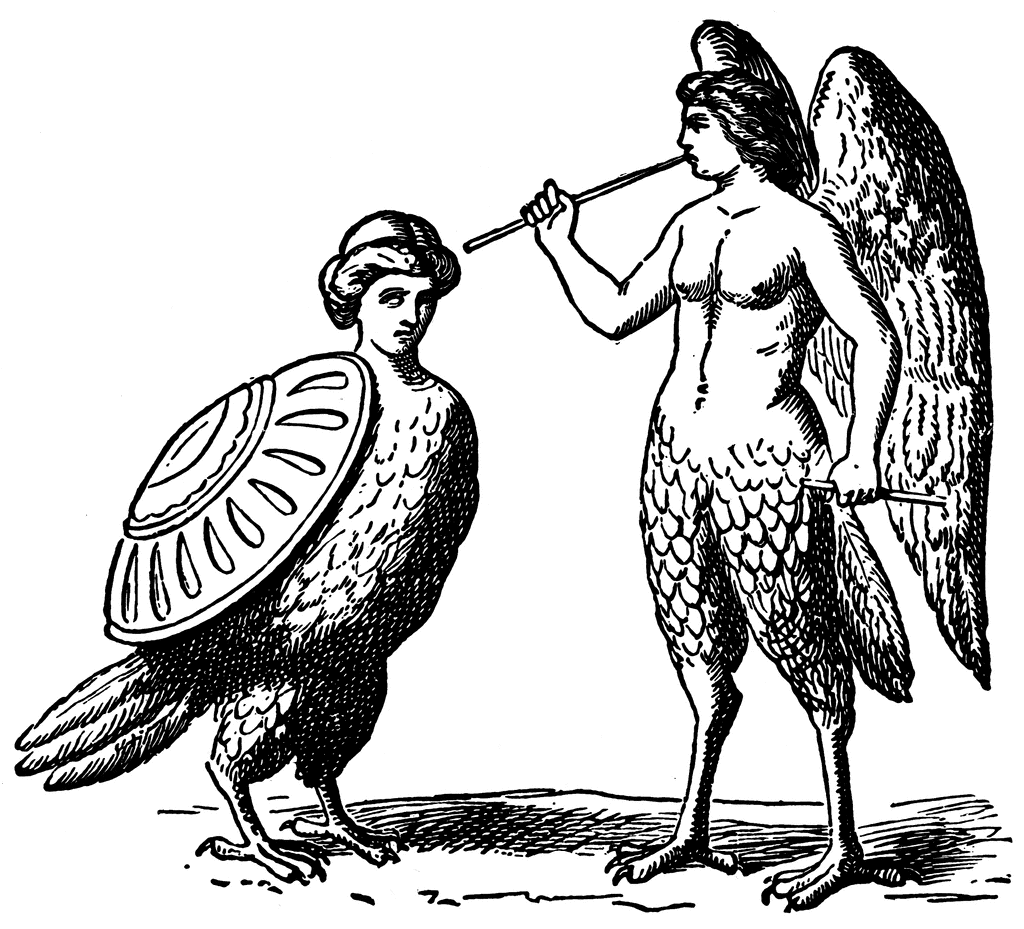
Bulfinch’s The Age of Fable

This week over at The Pursuit of Harpyness we had some exciting times with SQL queries (they apparently don’t mix with feminist blogging very well!), but despite some site down-time still managed to post some awesome things and provoke some good discussions.

  • On Monday, I posted a review of a new anthology of essays by women who had fallen in love with other women after a history of identifying as straight (and living heterosexual lives): Dear John, I Love Jane.
  • On Wednesday, I wrote a post about the attempts on the Religious Right to spin recent gains in LGBT civil and human rights as a loss of rights for Christians. Folks in comments shared personal anecdotes about people who had tried to argue this position. I’m eternally baffled by the way in which conservatives view the democratizing of rights as an infringement on their way of life. Newsflash: not everyone in the world is the same as you, get the fuck over it!
  • On Thursday, I indulged my ranty impulses in response to a recent op-ed column over at The Guardian in which columnist Maura Kelly dredged up the bullshit argument that women who have sex too freely will end up sad and sorry spinsters. (Watch for a Harpy Seminar on this topic next week!)

In addition, Marie Anelle wrote a great post on the negativity some feminists will express toward children and women who parent and PhDork wrote a post on the gendering of infants.

blog for choice: on the privilege of having real choices

21 Friday Jan 2011

Posted by Anna Clutterbuck-Cook in think pieces

≈ Leave a comment

Tags

blog for choice, feminism, human rights, politics, religion

Today is Blog for Choice Day 2011 in which folks around the blogosphere take a moment to write about abortion access and reproductive justice. You can read my previous contributions for 2008 (the radical idea that I am a person) and 2010 (the radical act of trusting others) by clicking through. This year’s prompt was: “Given the anti-choice gains in the states and Congress, are you concerned about choice in 2011?”

It’s a tricky word: “choice.”

I believe that human beings always have choices, and thus we must always make choices. Most of the time, we make those choices, decisions, based on complex internal and external equations of risk vs. benefit, right vs. wrong — equations we often aren’t fully aware of laying out and solving before we say: “this. this is my choice.”

Yet we move through the world making choices. Some small (what to wear to work today; what to have for breakfast) and some large (whether to speak up when a colleague bullies you; whether or not to carry an unplanned pregnancy to term).

Philosophically and ethically speaking, I’m a big supporter of the concept of “choice” and the recognition that people are moral agents constantly making moral choices. Even in situations where there seem to be few or no options — or no good options — left. As I wrote last year, one of the most radical acts we can choose to perform on this earth is the act of trusting other human beings (even those we do not know and have no control or influence over) to make decisions about what is right (and moral) for them.

Yet the language of “choice” can also be used as a weapon, as a judgment. “Whatever; that’s their choice”; “They’ve made their bed, let them lie in it.” With increasing frequency, I hear the language and concept of “choice” being used in ways that punish those with the least agency, the fewest options, and those who are facing the highest cost for exercising their decision-making abilities. I see people being punished for brazenly acting as though they had moral agency, as if they expected the people around them to trust them to make moral choices for themselves and their families.

You see, while everyone has the ability to exercise their freedom of choice, only some people are considered worthy enough to actually exercise that ability without being judged. Rich, white, straight folks to be exact. People with enough material autonomy to act independently (and thus privately), without needing to rely on extensive formal and informal support networks to actually access the resources they need to follow through on the moral decisions they have made.

You need help and support to follow through on your choices? You need some public assistance to raise the child you decided to give birth to? You need your health insurance to cover that abortion you decided was best for your family? You need affordable daycare? A job with flexibility in order to balance the demands of care-giving and career?

Fuck you: Having kids was just a “lifestyle choice” … why should we as a society help you out?

Fuck you: You “chose” to have sex when you know the only completely reliable method of birth control is abstinence. If you can’t afford to pay out of pocket for an abortion? Tough.

As I said, it’s a tricky word: “choice.”

The pro-choice movement has been advocating for decades now that we recognize women as moral decision-makers when it comes to their reproductive health and choices. This is all well and good, but I think it’s important to realize that those who are anti-choice, anti-abortion, anti-reproductive justice are perfectly willing to recognize that women can make choices.  Anti-choice politicians and activists just want to make sure that we lack the ability to follow through on those choices in a meaningful way.

So you bet I’m “concerned about choice” this year, as I am every year. I’m concerned at the way our culture and our political system seem unable (or more likely, I suspect, unwilling) to take a long, hard look at the way in which we collectively constrain access to meaningful choices for the majority of the population. Particularly the way we target already-vulnerable populations and strip away their ability to be moral decision-makers who can actually act on their decisions in ways that promote well-being. Children and adolescents, people of color, people living below the poverty line or on severely limited incomes, immigrants, people without health insurance, folks without job security, folks in non-hetero-normative families. As a nation, we should be making it possible for all of these folks to make — and follow through on — moral choices for themselves and their families.

Instead, we seem hell-bent on stripping those abilities away even further. And I see the rhetoric of “choice” in some ways aiding and abetting that evisceration. Because, after all, if someone is “free” to “choose” … then what do they need from us?

It’s the responsibility of those of us who are pro-choice on abortion and reproductive health to articulate what people do need to follow through on their choices. Because if we don’t, we might have a “choice” … but not much of a chance to act on it.

← Older posts
Newer posts →
"the past is a wild party; check your preconceptions at the door." ~ Emma Donoghue

Recent Posts

  • medical update 11.11.22
  • medical update 6.4.22
  • medical update 1.16.2022
  • medical update 10.13.2021
  • medical update 8.17.2021

Archives

Categories

Creative Commons License

This work by Anna J. Clutterbuck-Cook is licensed under a Creative Commons Attribution 3.0 Unported License

Meta

  • Register
  • Log in
  • Entries feed
  • Comments feed
  • WordPress.com

Create a free website or blog at WordPress.com.

  • Follow Following
    • the feminist librarian
    • Join 36 other followers
    • Already have a WordPress.com account? Log in now.
    • the feminist librarian
    • Customize
    • Follow Following
    • Sign up
    • Log in
    • Report this content
    • View site in Reader
    • Manage subscriptions
    • Collapse this bar