• anna j. clutterbuck-cook
  • contact
  • curriculum vitae
  • find me elsewhere
  • marilyn ross memorial book prize

the feminist librarian

the feminist librarian

Author Archives: Anna Clutterbuck-Cook

sunday smut: links list on sex and gender (no. 31)

01 Sunday Aug 2010

Posted by Anna Clutterbuck-Cook in linkspam

≈ 1 Comment

Tags

gender and sexuality, sunday smut

Sorry for the sporadic posting this week folks; my life was unexpectedly hectic. Hopefully a return to normal (such as it is) next week! In the meantime, here are a few quick links I had a chance to note.

My hometown (Holland, Mich.) once again made the news (or at least one of my favorite blogs, Pam’s House Blend) in an unflattering way when the Family Research Council decided to publish a full-page anti-gay advert in the town newspaper, the Holland Sentinel. Thankfully, the newspaper has also created a dedicated webpage for the letters it got in response. I haven’t had a chance to read more than the headlines, but if they are anything to go by the response has been overwhelmingly negative.

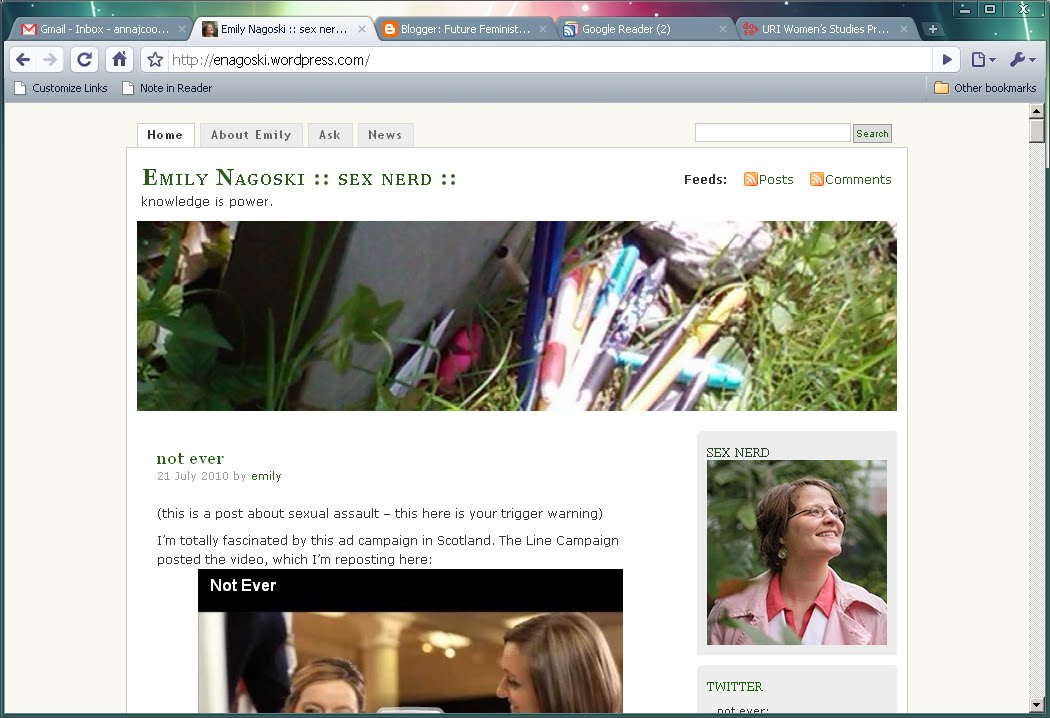
Emily Nagoski @ ::sex nerd:: mused about the intersection of feminism and sexology and the “nerd voice” as identified and described by Sara Vowell in her essay of the same name.

Thomas @ Yes Means Yes talked about the two ways to disrupt the power of shaming labels (in this case “slut”): attacking the existence of the label and embracing it.

lis @ Sociological Images resposted the “findings” of a researcher who analyzed the messaging habits of those seeking women and men on the dating site OKCupid and … regurgitated some pretty simplistic (and damaging) stereotypes about bisexuality in his analysis. Commenters on this thread were pretty universal in decrying the shoddy research for what it was, so the comment thread is well worth reading.

In other flawed-yet-fascinating research results, Lisa Wade @ Jezebel shares the results of a poll conducted through a Christian website asking men what types of clothing and behaviors were considered “immodest” for women. Basically, to be modest apparently requires 24/7 policing of one’s appearance and physical movements. Finally: the answer to why I became a feminist — being a non-feminist was just too much effort!

Adrienne @ From Austin to A&M on the perils of being a feminist romance reader, and suggestions for where to go as a feminist for your romance fix (hint: paranormal romance features heavily).

Greta Christina has a piece up over at Alternet about five stupid, unfair and sexist things expected of men. File this one in your “the patriarchy hurts men too” (even though, I know, I know, it isn’t the patriarchy but the kyriarchy anyhow).

B @ Feminist Review reports on a new book coming out of the UK called Reclaiming the F-Word: The New Feminist Movement. Sounds like an interesting perspective from across the pond.

Molly @ first the egg asks for suggestions of your favorite feminist young adult books. Hop on over and share!

Cass @ Bonjour, Cass! has suggestions for non-fiction reading on trans issues. Looking for a refresher (or just some geeky summer reading? Check out the post!

Other folks looking to get themselves educated are medical students, who feel woefully ill-equipped to provide sexual health services to their patients, according to a new study. Kate Drummond @ Surge Desk has more.

s.e. smith @ FWD/Forward takes on uninformed advice from a different angle, this time a problematic response to a Miss Conduct etiquette column about touch, boundaries, and social spaces.

Last week, Dan Savage @ the New York Times observed that the new indie film, “The Kids Are All Right,” featuring a lesbian couple with two teenage children might not be the great progressive breakthrough it’s being touted as in many reviews. (Spoilers ahead in both links if you care!)

I realize this is the worst sort of film criticism (“Why did the filmmakers tell the story they told instead of the story they didn’t?”), but I couldn’t help feeling a little let down. There is, I think, just as much dramatic potential — just as many opportunities for crisis and conflict — in a story about two women who successfully incorporate the father of their children into their lives and into their family.

But maybe I have a bias.

Tonight we’re taking our son to the airport to pick up his mom, the woman who chose us, in an open adoption nearly 13 years ago, to raise her child. We didn’t have to slam a door in her face to become a family or to protect our family. We couldn’t have become a family without her.

Miriam @ Feministing also offers her own observations.

And finally, Abie Kopf @ Gay Rights Blog dissects the import of the wily quotation marks of homophobes.

Or should I say “wily” quotation marks?

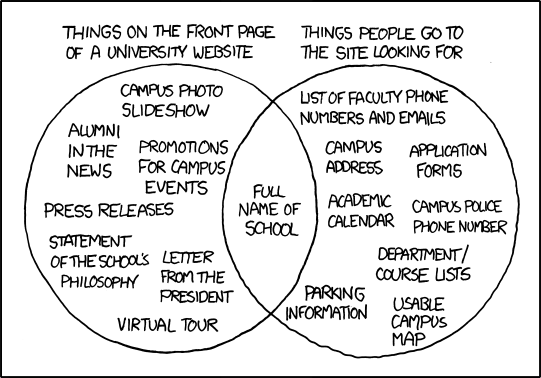
comic of the week

31 Saturday Jul 2010

Posted by Anna Clutterbuck-Cook in library life

≈ Leave a comment

Tags

humor

From the always-on-pitch xkcd.


Presented without further comment.

a few thoughts about "children-are-people" conversations

28 Wednesday Jul 2010

Posted by Anna Clutterbuck-Cook in think pieces

≈ 2 Comments

Tags

children, feminism, human rights


It seems I can’t help myself.

maia @ Feministe wrote a post yesterday about the freedom people in American culture feel to act on their prejudices against young people.

there is this weird thing in western culture, especially n american culture, where people/adults seem to believe that they have a right to discriminate against children.

recently, i was hanging out at a bar, when a friend called and invited me to come hang out for a few drinks and chill time as the sun came up. cool. then, i heard a bit of whispers in the background and the question posed to me: is aza with you?
ummm…what? why? does that matter? …

im not a feminist ( yeah, i said it…shrug). but i dont understand people who claim to be feminist on one hand, and on the other hand think that children should be designated to certain public and private spaces, not mixing in ‘normal’ public areas, such as restaurants, stores, airplanes, etc. cause in us culture, when you create little reservations for children, you are really creating little reservations for mothers. it is the mother who will be sent away to take care of the child. and how is that supporting all women and girls?

The post, as has become predictable in these situations, attracted the good, the bad, and the ugly as far as commenting goes, weighing in with a comment thread that (as of this writing) clocks in at just under 550 separate posts. As Brandann Hill-Mann @ Women’s Rights Blog points out,

There is a conversation that needs to happen, where we discuss how children are part of our society, how they have a right to exist, to take up space. How we are here to protect them and teach them to exist in the adult world because they don’t yet understand how to navigate our world alone. But we can’t really have that conversation, because every time we do, someone has to assert that children just should not be in certain places because children infringe on their rights, ignoring the rights children should have, but don’t.

To demonstrate this, take a look at the wonderful post written by maia at Feministe about how to support parents in public spaces, and the 400+ (at the time of this writing) comments in it that have burst forth with numerous remarks about how children are unholy terrors in restaurants and ruining things for everyone else.

I’ve written about these issues on this blog repeatedly and at first I thought I would just pass this one by — I tried to ignore the comment threads and forget all the crap people were yelling at each other about children (notice how children themselves rarely get to participate in conversations about what would improve their lives or the lives of those around them??). But riding home on the T this afternoon I couldn’t get the hate out of my head, so I’m going to blog a few observations. Maybe that’ll help.

1) The specter of the “entitled” parent needs serious unpacking. I’ll admit right upfront that I’ve used this specter myself. “Oh no,” I’ll reassure someone, “Of course I’m not talking about those parents when I’m talking about children’s rights. I’m talking about the considerate ones. The ones who never get in your way and whose children are always quiet and polite. The ones who never inconvenience us.” The thing is, just like feminism is for bitches, children’s rights are for kids. All kids. Not just for kids whom we think are “acceptable” (as defined by us). As a feminist, I see how people who don’t follow the expected rules for their class of person are considered to be acting “entitled.” Women who expect to be taken seriously — or just take up the same amount of space on a bus. Black men who refuse to back down about something and get handcuffed. A trans woman who requests bathroom privileges and is labeled a troublemaker. “Entitled” behavior is often in the eyes of the beholder — and people who assert their basic human rights in the face of discrimination are often judged by others as acting entitled.

I’m not saying people don’t behave like assholes — we all do, sooner or later. I’m just saying that to fall back on the “entitled yuppie mothers” stereotype to defend your distaste for families in public places is too easy. “Entitlement” needs to be problematized, dissected, looked at with a critical gaze. Next time you think someone is acting out of a sense of “entitlement” think about why, exactly, their behavior seems out of line. My bet is that at least seven times out of ten it’s going to be behavior you’d tolerate (or at least not let color your feelings about a whole class of people) if it was done by someone whom you weren’t pre-disposed to suspect of ruining your day.

2) Where do we get off judging the parenting decisions of others? A few weeks ago, Jessica Valenti blogged about how as a pregnant woman she is suddenly subjected to a much more intense level of scrutiny and intervention than as a non-pregnant person. This scrunity follows parents (especially mothers) into parenthood. Parents and non-parents alike in our culture feel free to offer their own expert opinions on every aspect of parents’ interactions with their children and the way that parents and children interact with the wider world. While, obviously, everyone is entitled to think what they want in their own head (I’ve totally been there — I get as pissed at what I think of as “bad” parenting as the next person), but I’m continually amazed at how presumptuous folks are about airing that critique in public forums. Two things alarm me about this

a) What makes you think you, personally, are in a position to act as judge? I’ll admit upfront that I’m particularly sensitive to the policing of other peoples’ parenting because I come from a family in which my parents made some pretty non-conventional parenting decisions — decisions that, according to a great many people, were seen as borderline abusive. When I was a child, kids were taken away from parents who tried to home-educate them, particularly if those parents were not simply replicating school-at-home lessons. All through my childhood, I experienced the suspicion and policing of adults who did not trust me, my siblings, or my parents, simply because we didn’t follow the conventional rules. When my mother tried to act as a liaison to facilitate our interaction with suspicious adults, she was branded a trouble-maker, a controlling mother. Things were written in our medical records, warning future medical staff to watch out for my mom.

This is all to say, I’ve known first-hand how the judging process works. It makes the judgers feel powerful and the judged feel small. And it has nothing to do with the actual well-being of actual children, since most judgments are made by people who have firm convictions about what is “right” and “wrong” when it comes to raising children — all children — with little or no flexibility of thought when it comes to individual families and individual children.

Next time you see a parenting decision you disagree with, I’d encourage you to imagine at least for a moment (even if you later reject the notion) that this decision was the right decision for this parent with this child.

Which leads me to the second half of this “judge not lest ye be judged” observation: the trump card of the judgers. The “what about the children who are being mistreated!” argument. See, I think a lot of the time this is

b) Self-interest disguised as concern for children. Judging parents in public spaces does not help truly vulnerable children. When parents sense they are being critiqued by others around them, they’re likely — especially if they are already abusing their children — to take the shame they feel out on their children. So by shaming the parent you’re making it worse. Do not intervene in situations where you feel a child is actually being maltreated unless you have the ability to follow up and ensure that that child is actually going to be protected going into the future. I’m assuming most feminists (who are well-versed in issues of domestic violence) understand this principle. Which is why I also sense that a lot of the concern expressed about children (“but what about the bad parents! should they get away with it?”) is actually, again, about our own subjective irritation at people who are different than us.

While I sympathize — who doesn’t feel irritable on occasion? — it’s just not the fucking responsibility of all people at all times to cater to our own individual desires for how the world should be regulated.

3) Feminism is for children as well as for bitches. It was, in part, my experience being policed as a child that facilitated my openness to feminist activism and feminist theory, especially the notion that oppression is intersectional and systemic. That the only way to true change is radical change — change that dismantles the system predicated on power that is power-over (the kyriarchy) and replaces it with with power-with. Power-with being the sort of power that recognizes the authority of experience and skill without creating a world divided between the haves and the have-nots. As Hanna so often reminds me, to depose one privileged group and replace it with another, to critique one set of cultural norms that advantage group A and advocate replacing them with a set of cultural values that advantage group B or C does not change the basic pattern: we’re still stuck in a world with winners and losers. With people who are scrabbling desperately to acquire and hold onto resources and acknowledgement that is (so the kyriarchy tells us) in limited supply. I’m not buying it. I’m not buying that there’s not enough love and care and resources in the world to take care of all people, no matter how broken, no matter how small. But in order to make sure that everyone’s needs are being met, we need to quit playing the winner-loser game. We need to quit turning around once we’ve established our right to exist and shove the next person waiting in line. Instead, as self-proclaimed feminists we should be welcoming them in.

Which is why it’s so hard for me to defend certain parts of the feminist movement (like, say the feminists who claim that ageist prejudice against children doesn’t exist … echoing the those who laugh off feminist concerns about sexism as so second wave already!) Sadie Stein @ Jezebel mocks maia’s post and suggests, in a parting shot, that “ageism” only counts if its legal discrimination, not just social prejudice. If you replaced “ageism” with “sexism” do you honestly think that many feminists would agree with her? Yet her scoffing resistance to understanding children as a vulnerable, disenfranchised group in our society is all too common in the feminist blogosphere.

My advice on how to change all this? (Since I know you’re dying to have unsolicited advice from your friendly future-feminist librarian …)

4) Don’t demand perfection, but do challenge yourself to think twice. We all make snap judgments based on our prejudices and stereotypes about types of people. We all feel intense reactionary hate at the person who takes the last seat on the subway when we want to rest our aching feet, or the parent whose child is fretful and screaming in the checkout line on that afternoon when a migraine is building behind your right eye. I’m not a fan of self-judging, self-guilting, self-blaming, and relentless self-policing. Punishing yourself for being human isn’t going to make the world a better place to live in; it’s just going to make you unhappy, your loved ones miserable, and probably not make those parents and young people you’ve been critiquing a helluva lot happier (unless they’re the nasty sort of people who get off on revenge — in which case perhaps I should exempt them from my ‘all humans deserve respect mantra’?!)

Instead of punishing yourself, acknowledge the feeling. Acknowledge the thought. Let it know it’s been recognized and heard, and that it represents some portion of your self that is trying to care for you in the best way it knows how — however flawed that attempt might be. Accept the feeling into yourself, but don’t let it consume you.

And then move on. Let the feeling go.

Or, if you’re feeling so inclined, consider where it’s coming from, and why you feel so desperately like your own sanity is in the hands of all these other people in the world who, like you, might just be having a rough day.

The best way to dismantle the kyriarcy is by recognizing and taking pleasure in the uniqueness of all beings, one being at a time. Including yourself.

So go forth. Care for yourself. And think twice before judging those around you. Perhaps particularly those who are further out on the margins that you yourself are. Perhaps, if you stopped pushing them away quite so hard, you’d discover that you actually had a lot more in common than you thought at first glance.

Peace, and good night.

quick hit: call for orgasm essays

28 Wednesday Jul 2010

Posted by Anna Clutterbuck-Cook in linkspam

≈ Leave a comment

Tags

call to participate, gender and sexuality

Via the Good Vibes blog.

From sexuality educator and columnist Midori.

I am collecting women’s accounts of the physical experience their orgasms. I’m really hoping that some of you can help me out with this. Feel free to pass it on to any women or lists with women who might be interested.

Details –

I am seeking first person descriptions from women about their orgasms.

Who: You are a woman, 18 years or older, who have experienced one or more variety of orgasms. (Transwomen! I want your unique perspectives too!)

What: Essay of clear and detailed description of your orgasm, from start to finish, focusing on the physical experience, expressed in your own words. When does it start? What’s the hint of it? Where does it start? How does it move through your body? What sort of sensations? Imagine trying to illustrate your orgasm to a person who’s never had it.

If you have more than one type of orgasm, each variety would be written in a separate essay piece. (The get-to-sleep quickie, the deep one, the surprise one, the long building one, solo-sex one, when getting oral sex, etc…)

How Long? As long as it takes for you to describe it. It may be a couple of paragraphs or couple of pages.

Credit line: How would you like your essay to be credited? You’ll have one or two lines.

Editing: At most I will edit for grammar, spelling and simple readability. I want to keep it as true to your original narrative and tone as possible.

When: No later than end of August

Send to midori AT fhp-inc DOT com

Please make sure that there’s an e mail I can reliable reach you at. I may have some questions around editing or some other detail.

I’m happy to answer any questions on this.

Thank you!

Midori

booknotes: her husband was a woman!

27 Tuesday Jul 2010

Posted by Anna Clutterbuck-Cook in book reviews

≈ Leave a comment

Tags

feminism, gender and sexuality

Cover art for Her Husband was a WomanA few weeks ago, when I was in Maine for the weekend I found time to read Alison Oram’s slim little volume on gender crossing in mid-twentieth century England (1920-1960s, roughly), as reported in the popular press. Her Husband Was a Woman!: Women’s gender crossing in modern British pop culture (New York: Routledge, 2007) explores how gender identity and sexual orientation was understood — or at least reported — in tabloid newspapers, and how it changed over time from the dawn of the twentieth century to the postwar era.

While clearly a scholarly monograph with a very narrow focus, Oram’s book does a nice job of historicizing how we understand the relationship between gender crossing behavior and sexual identity. She is careful not to read backward onto women in earlier eras categories of identity that did not exist (transgender, for example) or were understood differently then. At the same time, she describes how those categories emerged and how they, in turn, influenced how gender crossing was reported in the press and understood by the individuals featured in the stories.

She draws mostly on stories of women we would today likely understand as transgender or butch lesbian: women who were read as men in their society (through the clothes they wore and the social roles they fulfilled) and were partnered with women. Some women began crossing as a way of escaping the constraints of femininity (to see better-paying employment, for example) and found it suited them. Others seem to have been drawn for more nebulous reasons to identify as men.

Oram compares the stories of these on-the-street gender crossers with women who performed in drag on stage, in situations where the audience knew the actor was female but bought into the male persona on stage. These performers, who were well-known and adored throughout the late 19th century and into the 20th provided a framework for tabloid journalists to understand gender crossing as something that was not necessarily tied (as it would later become) to lesbianism — even though many of the real-life gender crossers were in same-sex relationships.

According to Oram, the early tabloid reports focused on the performance aspect of gender crossing, marveling (in a positive sense) at the women’s ability to succeed in moving about the world as a man. As the twentieth century wore on, and scientific models of gender and sexuality were more widely discussed, medical language about sex changes and lesbianism began to creep into the reports. Gender crossing became more closely linked to same-sex relationships (which in turn were suspect) and the theatrical element of women’s drag performances faded.

The book is a quick read, which I highly recommend to anyone with a particular interest in how cultural interpretations of gender expression and sexual identity have changed over time.

shameless friend promotion monday

26 Monday Jul 2010

Posted by Anna Clutterbuck-Cook in Uncategorized

≈ 2 Comments

Tags

blogging, family, michigan

My friend Joseph, who blogs over at Greensparrow Gardens, was on the NPR show Splendid Table this weekend, talking about his new tomato hybrid (final segment). Annie Lamott once said in a talk I attended that in her family, making it onto National Public Radio was the sign that someone had Made It as a writer, artist, thinker, etc. And I’ve always thought that was a pretty good litmus test (as frightfully liberal bourgeois as that might make me sound!). So congrats, Joseph, and hope this is only the first of many appearances. My vote? Shoot for This American Life or Fresh Air next!

sunday smut: links on sex and gender (no. 30)

25 Sunday Jul 2010

Posted by Anna Clutterbuck-Cook in linkspam

≈ Leave a comment

Tags

gender and sexuality, sunday smut

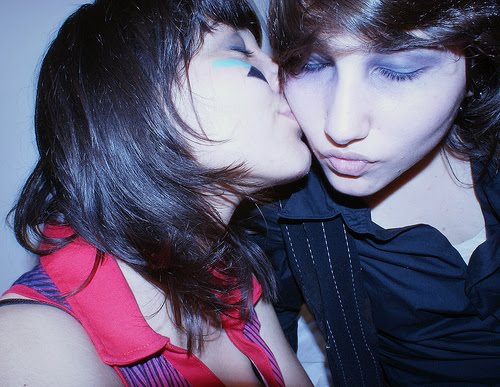
bisou! by madefortvmovies @ Flickr.com

Welcome! This week in sex and gender …

New Blog: Anarcha-feminism: it’s about as scary as it sounds. Complete with rainbows and happy trees and coloring outside the lines!

Michaela Borg @ Ms. Blogs | Shoulder to Shoulder: UK Suffrage Postcards! The images are definitely worth the click-through if you’re into vintage postcards + feminism … I mean, really, what’s not to like??

Anna North @ Jezebel | Terrifying weight-loss ad will make you lose sleep. Video and commentary. “First of all, it’s obviously not true that fat people can’t tie their own shoes or lead exciting lives. But what kind of exciting life is depicted here anyway? Trench warfare? A firing squad? A bleeding knife? These are the worst reasons to lose weight we’ve ever heard (and we’ve heard some bad ones).”

Jacelyn Friedman @ Feministe & Yes Means Yes | On Sex and Compromise (Feministe) and On Sex and Compromise (Yes Means Yes). Cross-posted discussion about the ethics of sexual negotiation in relationships vis a vis the concept of “enthusiastic consent” as the ethical standard for relational sex. I share both posts because the comment threads on both are crucial to fleshing out the conversation as it evolved.

Minerva @ Hypomnemata | Armed and Alarmed [No Sex as Weapon]. My friend Minerva challenges Jacelyn’s reading of sexual negotiation and compromise from her perspective as someone with an asexual orientation.

Vexing @ Feministing Community | “I wouldn’t fuck a trans person.” On why saying this is transphobic. Full stop.

Richard Florida @ The Daily Beast | America’s Top 20 Gayest Cities (in pictures!). Shared mostly because my brother and his girlfriend (Portland, OR, #8), my sister and her boyfriend (Austin, TX, #7) and Hanna and I (Boston metro, MA, #4) all make the list. Coincidence? Likely not! Also, I find it fascinating that Florida is “surprised” that Columbus, Ohio, made the list (#16). If you’re from the Midwest and in the queer community this really wouldn’t come as a surprise at all!

Thomas @ Yes Means Yes | The Slut-Shaming Kind of Feminist. Really not much of a feminist at all.

Courtney @ From Austin to A&M | ForeverGeek does it again! On (once again) why personal experience — while legitimate — is not a replacement for analysis of larger patterns. “How has this adult geek woman never considered, when she writes for a blog where she is a token lady, that she is in a male-dominated culture? Seriously.”

Tracy Clark-Flory @ Salon | Transgender widow put on trial. Nikki Araguz is being sued by her husband’s family, following is death while on duty as a firefighter in Texas. The husband’s family claim the marriage was invalid due to Nikki’s trans status. Autumn Sandeen @ Pam’s House Blend has more.

Charlie Glickman @ Adult Sexuality Education | Shame as a Public Health Issue. He’s talking specifically about trans/queer youth and safer-sex practices, but I’d say shame itself is a public health concern, given the detrimental effect self-hatred and shame have on quality of life and the ability for someone to feel worthy of sexual pleasure.

And finally, Hanna @ …fly over me, evil angel… | friday fun times. Hanna has a round-up of the photographs from Comic Con of geeks counter-protesting the Westboro Baptist Church haters, who came to rain on the Comic Con parade. When in doubt, fight hatred with laughter. Humor always wins (or at the very least, has a good time!). Just sayin’.

quick hit: "oh, inversion. how I shake my fist at you"!

24 Saturday Jul 2010

Posted by Anna Clutterbuck-Cook in linkspam

≈ Leave a comment

Tags

books, feminism, gender and sexuality, masculinity

Danika @ The Lesbrary has a fun post up sharing notes from a conversation between herself and a friend Cass about Radclyffe Hall’s The Well of Loneliness (1928).

C[ass]: The term ‘homosexuality,’ while in use in 1928, didn’t yet have its modern definition or its now understood division from gender. Inversion, on the other hand, completly tied sexual orientation to one’s gender and gender expression. A person labelled female at birth could not, by defition, be an invert without displaying masculine traits and masculine leanings. Therefore, in order to be a novel ABOUT inversion, Stephen has to be masculine. If we are using our modern lens here, then we can agree that, despite her masculinity, Stephen is not automatically male. The fact that her parents gave her a traditionally male name is out of her control. Lots of girls who continue to identify as women like to dress in pants rather than dresses because they are easier to walk and play in. Looking “like a man” or being masculine doesn’t make a person a man.

The conversation with her father is trickier, but if she has a crush on a girl, and thinks that only men and women can have relationships together, it’s logical that she would want to be a man in order to be happily in love with a woman.

D[anika]: True, but coming from a modern perspective, that assumes that you are by default the gender you were assigned at birth and only the opposite if there is overwhelming evidence. We don’t have overwhelming evidence that Stephen would identify as a man, but we have a lot less evidence than there is for Stephen identifying as a woman. She can’t stand to even be around women, except the ones she falls in love with.

That makes sense, but it isn’t just around having a partner that Stephen is frustrated at being labelled a girl. In fact, as some point she said “Being a girl ruins everything” (not an exact quote)

C: […] [H]er gender and gender expression can be on the trans-masculine spectrum without her necessarily being trans. In 1928(ish), being a girl DID ruin everything!

I think you are the gender you understand yourself to be, but sadly I can’t ask Stephen. 😉

Check out the whole thing at The Lesbrary (and if you enjoy part one, then check out part two posted by Cass @ Bounjour, Cass!).

friday fun: homophobes not welcome!

23 Friday Jul 2010

Posted by Anna Clutterbuck-Cook in our family

≈ Leave a comment

Tags

feminism, gender and sexuality, humor

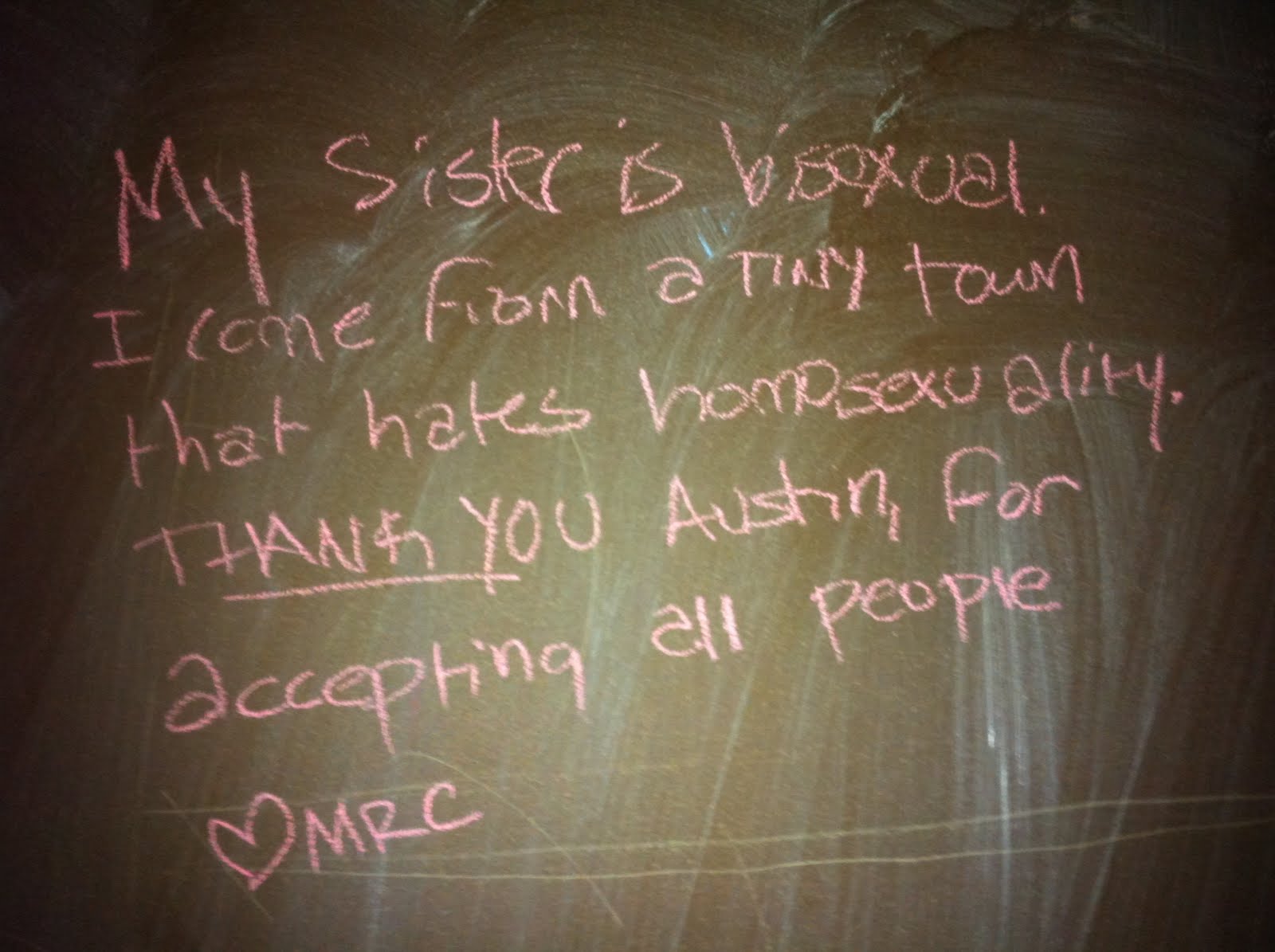
As previously mentioned, my sister and her boyfriend just moved to Austin, Texas and by all accounts it is an awesome place. Here’s something that makes it a little more awesome. I’ll let my sister tell the story.

I wrote this in a bathroom at a cafe a week ago on a chalkboard (meant for customer use).

blackboard reads: My sister is bisexual. I come from a tiny town that hates homosexuality. THANK YOU, Austin for accepting all people [heart] MRC.

Today, I went back. Under is someone wrote, “well, we don’t really support homophobes, so you’re welcome.”

I thought that was a grand response.

Happy Friday everyone. Spread the love :).

in love with new blogs: Emily Nagoski :: sex nerd ::

22 Thursday Jul 2010

Posted by Anna Clutterbuck-Cook in linkspam

≈ Leave a comment

Tags

blogging, feminism, gender and sexuality, in love with new blogs

I’m really bad about updating my blogroll regularly, but I do have this exponentially growing list of blogs I follow on Google Reader. So I thought I might do a weekly (posted on Thursday) series for a while called “in love with new blogs” in which I highlight some of the bloggers and blogs I think y’all might be interested in.

And I’m going to start with one I recently discovered (or possibly re-discovered; it looks familiar so I know I’ve come across it before but why oh why did I not subscribe to its RSS feed then?? because this blog is awesome!): Emily Nagoski ::sex nerd::

Emily Nagoski is a health educator who lives in Northampton, Massachusetts and works at Smith College. In her own words

In 2006, she completed a Ph.D. in Health Behavior with a concentration in Human Sexuality. She also holds a MS in Counseling Psychology and a BA in Psychology with minors in Cognitive Science and Philosophy. She’s worked for well over a decade in the field of sexuality education and has grown into an impassioned advocate for social justice through sexual fulfillment. Politically progressive and unapologetically atheistic, Emily has strong opinions and a big vocabulary, and she’s determined to use both to make the world a better place for human sexual expression.

And maybe in another ten years I will have a job (somewhat) like hers! ‘Cause damn, that sounds like fun.

Emily Nagoski ::sex nerd:: offers one post a day, roughly speaking, on the subject of human sexuality. Combination sex column, opinion column and ideas-in-progress space, this looks to be a great (and often funny!) resource for sexuality information.

A few recent posts to give you a flavor of her style.

differential desire.

So look, I’m going to say this thing, and you’re going to listen and believe me because… I don’t know, why would you believe me if you haven’t believed it from anyone else? Because I’m clever and have a PhD and things? No, you’ll believe me because it’s just true. Because in the patient corners of your heart, you’ve ALWAYS known it’s true. It’s this:

You’re not broken. You are whole. And there is hope.

You might be stuck. You might be exhausted. You might be depressed, anxious, worn out by the demands your caring makes on you, and in desperate, dire need of renewal. You might be tired of feeling like you need to defend yourself. You might wish that, just for a little while, someone else would defend you and protect you so that you could lower your guard and just be. Just for a while.

Those are circumstances, they’re not YOU. YOU are okay. You are whole. There exists inside you a sexuality that protects you by withdrawing until times are propitious.

I completely get how terribly frustrating it can be that your partner’s body feels like times are propitious right now, while your body is still wary. And it’s even worse because the more ready your partner’s body seems, the more wary your body becomes. It is The Suck, Like Woah, for both of you.

But it’s in there, your sexuality. It’s part of you, as much as your skin and your heartbeat and your vocabulary. It’s there. It’s waiting. You’re okay. Just because you’ve had no call to use the word “calefacient” or “perfervid” lately doesn’t mean it’s not longer available to you. Should the opportunity arise, there it will be, ready, waiting. Like the fire brigade. Like a best friend.

There’s a bunch of stuff you can try to create propitious circumstances.

read the rest here.

what I got wrong about LUGs.

Now imagine you’re a person who’s always identified as straight and then you come to college and you meet this amazing person who happens to be the same gender and you just fall head over heels, even though you never even imagined being in a same-sex relationship before… are your feelings less genuine simply because they might not have occurred in a less inclusive environment?

Should you choose NOT to get into a relationship this person you’re attracted to, on the grounds that you might not be attracted to that person under other circumstances?

Is the only REAL love a love that would thrive even in a hostile, hateful landscape? Only if you can love through being egged and threatened on the street is your love real?

That’s not the standard we set for straight relationships or relationships that look heteronormative.

I can totally see where the resentment would come from, and yet… I can’t bring myself to judge a person’s individual, internal, emotional experience on the basis of its political import. How could *I* know whether or not someone really loves someone else? Can I tell from the outside whether she’s a “real lesbian” or “just experimenting?” If it not my relationship, is it any of my business?

read the rest here.

how to fall in love (if you’re fictional).

With so many barriers lowered these days, it’s hard to generate compelling and original reasons for your hero and heroine NOT to get together. I think sci fi romance, vamp stories, werewolf stories, shapeshifter stories are so popular because you can invent all kinds of rules about how risky it is for a human to mate with a whatever or who knows. And historicals, where you can use the rules of society that USED to keep people apart but don’t anymore.

Dorothy Sayers needed three novels – two of them VERY long – to disentangle her hero and heroine from their stigma. He saved her life; it’s a problem. 5 years later he allowed her to risk it, thus giving her life back to her. Her “Greater Than Themselves”? Detection, murder investigations and, under that, the truth at all costs. Her big “They Know” scene takes place in a punt on the Isis in Oxford, where they both went to school and which represents intellectual refuge from the discord and bitterness of the human world.

Me, I like writing Reunited Lovers stories because the stigma is built in: one of them done the other one wrong, enough that they split up. How are they ever going to fix it? But whatever brought them together in the first place makes a perfect Greater Than Themselves.

So now you know the trick to falling in love if you’re fictional.

read the rest here. I say she made extra bonus points there for the Dorothy Sayers reference.

Sometimes, she’s a little women’s sexuality is different and more complicated than men’s! for my taste, but I think the overall advice she gives about being open to more fluid, expansive definitions of sexuality and sexual activity is good so I’m willing to at least go along for the ride and keep reading.

← Older posts
Newer posts →
"the past is a wild party; check your preconceptions at the door." ~ Emma Donoghue

Recent Posts

  • medical update 11.11.22
  • medical update 6.4.22
  • medical update 1.16.2022
  • medical update 10.13.2021
  • medical update 8.17.2021

Archives

Categories

Creative Commons License

This work by Anna J. Clutterbuck-Cook is licensed under a Creative Commons Attribution 3.0 Unported License

Meta

  • Create account
  • Log in
  • Entries feed
  • Comments feed
  • WordPress.com

Blog at WordPress.com.

  • Subscribe Subscribed
    • the feminist librarian
    • Join 37 other subscribers
    • Already have a WordPress.com account? Log in now.
    • the feminist librarian
    • Subscribe Subscribed
    • Sign up
    • Log in
    • Report this content
    • View site in Reader
    • Manage subscriptions
    • Collapse this bar