• anna j. clutterbuck-cook
  • contact
  • curriculum vitae
  • find me elsewhere
  • marilyn ross memorial book prize

the feminist librarian

the feminist librarian

Category Archives: life writing

30 @ 30: reading [#10]

28 Wednesday Sep 2011

Posted by Anna Clutterbuck-Cook in life writing

≈ 1 Comment

Tags

books, thirty at thirty

I was going to follow up last week’s “work and vocation” post with a “work and money” post … because I feel like I still have some things to say about work and class-based experiences of work and vocation, and what it means to have income and economic agency … but all that’s going to take a bit more brainpower to formulate than I have at the minute. So we’re taking a time-out this week with a lighter topic: reading!


It probably hasn’t escaped you that I’m fond of reading. What with being a librarian and all. Reading, even more than writing, is probably in my blood given that I’m the daughter of two English majors and grew up in a home that — I’m speaking literally here — had books in every room.
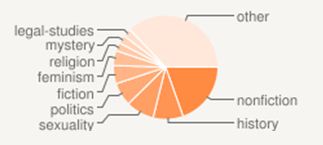
But what I’ve read has, for obvious and not-so-obvious reasons, changed over the years. The part of me that’s prone to list-making and historical chronicaling (in my parents’ attic, I have lists of “books read” stretching back into my early adolescence) enjoys taking note of trends over time and speculating about what this means about the sort of person I currently am, used to be, and will become.


books read so far in 2011 (goodreads)

This year, for example — as evidenced by my GoodReads list, at right — I’ve been reading a lot of nonfiction in the areas of history, sexuality, and politics (big surprise, I know). The two years before that, unsurprisingly, were even heavier in history given all the background research I was doing for my thesis. Still, I read lots more non-fiction these days, even sans graduate school, then I did as a child and into my teens. Oh, I still read fiction — mostly genre stuff (fantasy, science fiction, mystery) and fan fiction, truth be told — but to be honest? I never made the leap from middle grade/young adult fiction to adult literature.

Like, okay, yes. I can get sucked into a modern novel but it usually has to have some sort of supernatural or historical element — if you can squeeze in some of both, I’m totally there. Think Camille DeAngelis’ Mary, Modern, a modern-day Frankenstein in which a geneticist clones her grandmother in the basement and it all goes wrong. Or Martin Cruz Smith’s Rose, a historical novel/mystery/romance in which an American explorer down on his luck gets hired to investigate the disappearance of a vicar in Wigan, Yorkshire. Or Audrey Niffenegger’s now-famous The Time-Traveler’s Wife, which not only involved time travel by the landscape of my childhood — how could I escape getting sucked into that? And well-written sexytimes will never go amiss.

I’d say, on the whole, that these recent titles are a fairly accurate representation of the type books that I read these days:
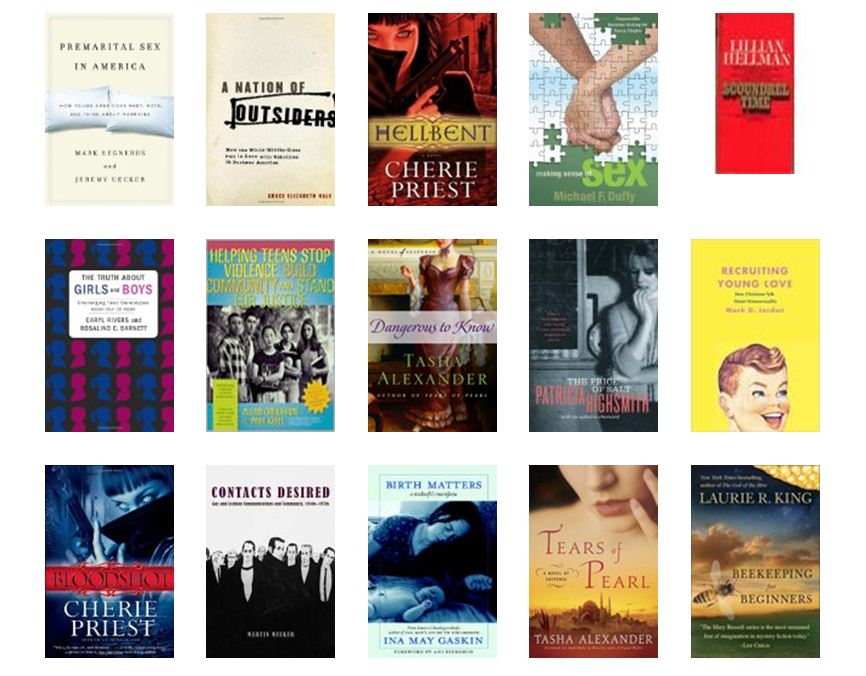

last fifteen titles read (goodreads)

I actually learned to read “late,” according to a lot of school-based expectations. I was about six years old, between six and seven. I wasn’t much into practicing at reading (practicing at anything, really) and found
those beginning-to-read books mostly boring, unless I happened to like them for the story rather than the repetitive words. I must have been rehearsing on some level, though, because what I remember is the day I pulled The Best Christmas Pageant Ever off the shelf and discovered the words on the page made sense.

That obviously wasn’t the beginning of my love affair with reading, given that my parents read to us regularly and continued to do so long after we could read for ourselves — family bedtime stories didn’t stop until I was into my teens. But being able to read on my own meant more books. I used to go to the library, check out a stack of novels — I’m talking 10, 12, 15 books at a time — and read through them in an afternoon.

Ah, happy memories.

I have to say being able to read like that was a big incentive not to go to school, like, ever. Because going to school would have meant not being able to spend the day reading. And seriously: who would want that sort of fate!

Of course, as a college student and graduate student reading (and writing) were a major part of what I did, what I was expected to do, in school — so the conflict sort of faded away. Though there were always types of reading that waxed and waned during term-time. New fiction, for example, rarely got a look-in while my stand-by favorites became battered from the constant emergency comfort reading.

I was introduced to the world of advance review copies as a teenager when I worked at a children’s bookstore. We used to circulate the ARCs among the staff and eventually got to take them home once they’d outlived their usefulness. Again at Barnes & Noble free pre-pub copies were a regular and delicious perk of being on staff. I love the element of surprise in advance review copies: they’re unknown quantities, particularly if by unknown authors, which hold the promise of being brilliant gems as well as dreadful mistakes.

One of the best things about being a librarian (and, really, a blogger) is that they give you books for free. In the past five years I’ve been offered advance copies and electronic galleys of really interesting stuff that I might otherwise never have read — in part because I offer to review stuff on the internets, and in part because I am a librarian which is a professional credential that opens doors.

It’s like crack for bibliophiles: come work for us and we will give you free books to read!

Um, sure! Where do I sign!

Georges Island (Boston Harbor), 2007
When I learned to read, reading was still something you did offline. In that, there actually wasn’t an online — or at least, not an online for people like me (and probably you). I didn’t have a personal email address until … 1997ish? College. I was in college before the internet was a reality in my life. Which I’m sure to some of you makes me seem like an infant just out of diapers and to some of you makes me seem ancient.
Anyways. The point being, this reading-shit-online is still a new development for me. I’m still getting used to counting the reading I do online as reading, in fact, despite the reality that maybe 50% at least of the reading I do during the course of any day is now online or in electronic form: e-books, PDFs, etc. We pre-‘net generation types are used to thinking about reading in terms of books finished, or pages read. According to GoodReads I’ve read (for example) 59 books and 16,710 pages so far this year. But that doesn’t include all the fan fiction I read, or the blog posts I take in, or the journal articles I read for work and pleasure.
I downloaded a PDF file of one of my favorite fan works a few weeks ago and the PDF was over 200 pages long. That’s a respectable novella-length story. Just sayin’.
For those of us interested in chronicling our reading habits, how do we document that sort of thing? How do we leave a record of online materials read and digested — how do we leave traces of our textual influences? It’s an ongoing question.
Hanna and I argue about whether things like fan fiction actually “count” as “reading” (of the legitimate vs. non-legitimate variety). If you read this blog regularly you probably know where I come down on the issue of categorizing things as “legit” or not. It’s a friendly debate (although she absolutely draws the line at audiofic, since apparently fic-on-tape is the final straw!) and an apparently insoluable one, for now.
I’m not sure if all this online reading has altered the way I read. I find it more difficult to get lost in a book these days — the sort of uninterrupted reading sessions I had as a child and adolescent which involved resurfacing at 3am bleary-eyed and a little bit nauseated from the virtigo. I remember distinctly half a dozen specific books over which I made the concious decision to read until they were finished, even if it meant falling asleep at 5am. Because the story simply couldn’t wait.
I don’t do that so much anymore, but I don’t know how much of that is the (supposedly) shortened attention span created by extensive internet connectivity and how much is the training I had as a college student — that dual-consciousness of both reading a book and analyzing it. It’s hard for me to turn that part of my brain off now, even when I’m reading a ripping yarn. I don’t think it necessarily detracts from the experience of the story, though it does mean I need to be sure to keep multiple books on hand for when distraction rears its head and I need to switch genres for a bit.
All things considered, I’m more inclined to blame it on school and work (both of which demand constantly-divided attention) than the medium of the internet per se. If blame even needs to be considered as an option, seeing as I’m still reading and enjoying it — which frankly is all that matters to me.

four years ago today: "I’m gloating to you because I wouldn’t gloat to anyone else."

26 Monday Sep 2011

Posted by Anna Clutterbuck-Cook in life writing

≈ Leave a comment

Tags

DCR, four years ago today, simmons

From: Anna
To: Janet, Mark
Date: Thu, Sep 27, 2007 at 11:43 PM
Subject: Welcome home!

Hi Mom and Dad,

Well, I’m hoping that you’re both so preoccupied with besting each other at cribbage that you won’t bother to check email until you get home [from vacation] this weekend.  I’m trusting that Brian and Toby [the cat] didn’t murder one another in your absence . . .

Whew, it’s hot and humid here!  We are having Indian Summer with a vengeance and the dorms are insufferable.  I still haven’t caved and bought a fan, which means I get by with cold showers and sleeping naked on top of the sheets.  It’s working in the short term, but if this lasts through the weekend, money may have to be found, regardless of future job prospects, for a small fan. 

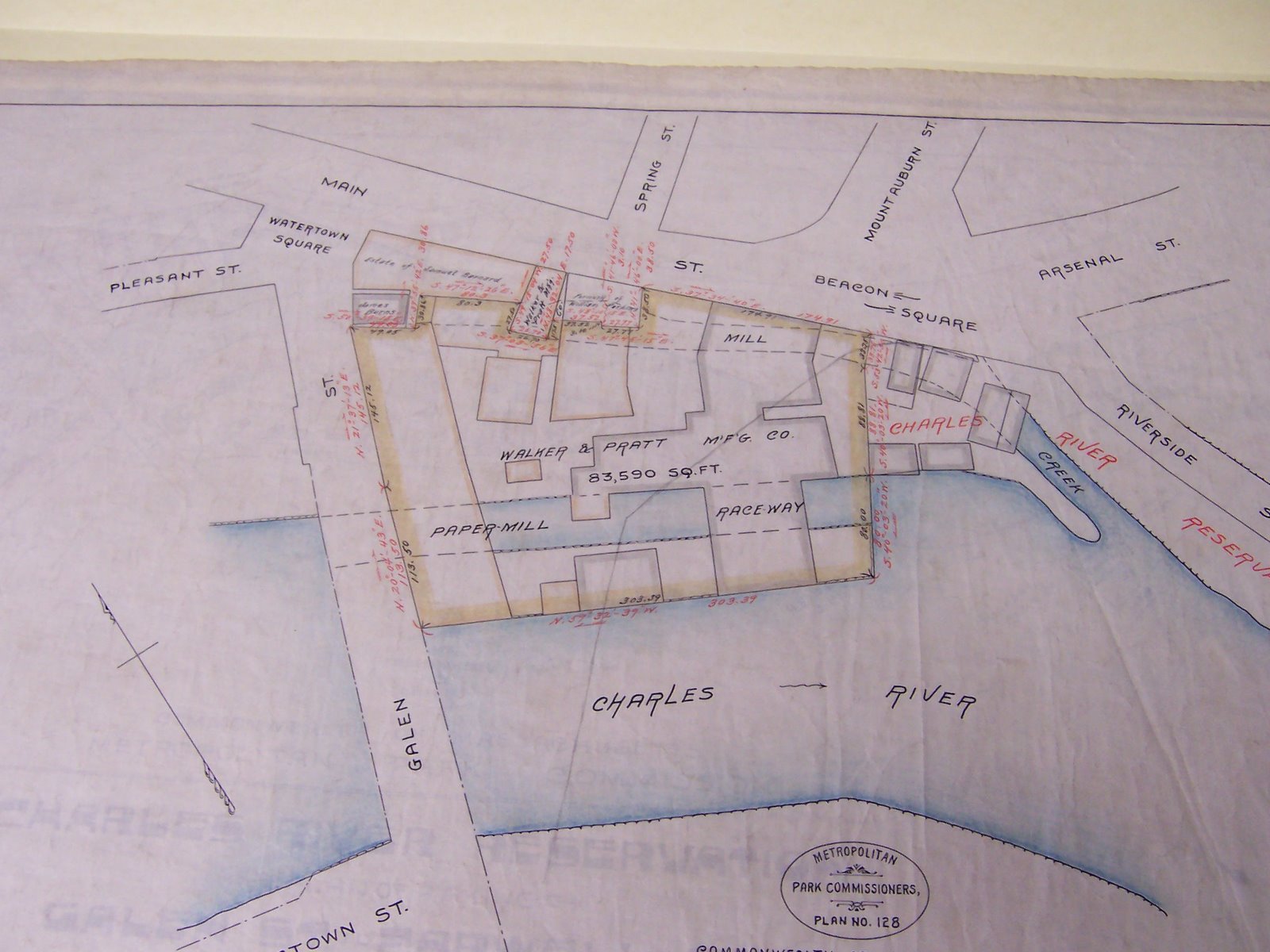
I had my first [Department of Conservation and Recreation] internship session today . . . what fun!  B, my supervisor, is a Simmons grad whose specialty is digitization of visual records (photos, art, etc.). Until last year, she worked at Harvard on a number of different projects. Now she’s the plans archivist for the DCR’s Office of Cultural Resources (or OCR, god do people love their acronyms!).  They have a giant basement with all those cabinets with the big file drawers for maps and plans.  I’m working with a subset of the collection of land plans that the DCR inherited from one of its predecessor departments, the Municipal Parks Commission (you guessed it: MPC).  I am starting with the earliest plans, which date back into the 1890s, and many of which come from the Olmsted firm.  The plans are deteriorating and Judy would like to apply for a grant to have conservation work done on them — which can cost as much as $500/sheet.  Like buying reproduction wallpaper for the Cappon House.  So my job is to organize the plans and enter data on each plan into an Excel file (which I will design as I go along) that will serve as an index of what they have for people who need to use the information currently, as well as provide information for writing the grant proposal.


MPC plan detail (Sept 2007)

The maps are very cool!  And it’s easy to get sucked into wanted to know the whole story about them.  Already, I’m thinking about side-research projects into the history of public parkland, landscape architecture, not to mention the history of the maps themselves and the conventions they follow.  The little directional markers alone are beautiful.  (I will try to stay in everyone’s good graces so that, when you guys come out here, Dad, I can take you down for a private tour!  Provided you don’t need a homeland security background check 🙂 . . .)

section of the Charles River Reservation plans (Sept 2007)

I helped lead discussion on postmodernism and history today.  I felt it went so-so, though Laura (prof) was encouraging overall.  People struggled with the readings.  But we did manage to have a discussion, so that in itself felt like a success :).  I got my second response paper back (with my second “check-plus,” which is the highest of her pass-fail marks) . . . I’m gloating to you because I wouldn’t gloat to anyone else: she made it a point to say in class that she’s being stingy with the marks because it’s her job to teach us something in the class, and we have to start somewhere . . . so that if we found ourselves in possession of one of the few check-plusses she handed out, we have something to feel proud about.  (A +! +! +! +! . . .)  She put it nicer than I just did, but you get the point.  I had to be careful not to laugh.  Seriously, though, she wrote “absolutely elegant — you express your sophisticated level of thinking beautifully.” Aww . . . crush just got a little bigger :). 

I’m gingerly making inroads on the friendship front with several colleagues in that class.  Lola (not to be confused with Laura the prof) was my discussion co-leader and we had a lively meeting Monday night to come up with our questions.  She’s a graduate of Smith College, in history, worked as the curator of a small house museum for several years, is now back in school.  Her adviser at Smith was Helen Lefkowitz Horowitz who is like my women’s history idol . . . one of the people who I was soooo disappointed doesn’t teach at a graduate institution.  I very immodestly squealed (yes, I did: “Ohmigod! You had  Helen Lefkowitz Horowitz as your thesis advisor???!!!”) when she mentioned it in passing.  And I’m persisting in making contact with G, although I’m not exactly sure what footing the friendship will take at this point (still trying to figure out: interested in guys? girls? both? neither?).  He’s got a cultural studies/gender studies background and is really interested in themes of resistance and social change.  I sent him a rather long email this evening continuing our classroom conversation of this afternoon, and fingers crossed it won’t scare him away!

I also have a group of students that I’m doing a hands-on archive project with in Archives class (we take a practice collection and have to “arrange and describe” it, and produce a “finding aid,” which is like a detailed catalog entry — as I explained to one girl, think of it as the cross between a card catalog record and an index or detailed table of contents – -that researchers use to figure out what an archives holdings are and whether they would be useful).  I think it’s going to be a fun project — we’re organizing the papers of a woman who was in the army as a dietitian during WWII and an alum of Simmons.

I started preliminary research on my chosen topic for my archives paper, a short paper due in late October about an issue in archival theory/practice.  I chose the interaction between feminist theory/methods and archival practice.  I went to the librarian and she was very nice but suggested I had picked perhaps too narrow a topic, on which there really wasn’t anything written yet.  I said, “Well, I guess I’ve found my niche and it’s not even the end of my first month here!”  Unfortunately, I won’t be able to, you know, write a body of theory and publish it in peer-reviewed journals in time to write a paper for class in which I referred to my own scholarly research :).  So I am left piecing together stuff in innovative ways (what’s new?) . . . N (librarian) was a little bit nudging me to consider re-orienting my topic slightly, but I wasn’t giving in.  I mean, it’s only a 5-7 page paper for gods’ sake, I think I can manage to write a literature review of what’s out there in that length of text without exhausting my argument.

For my history paper (roughly the same size), I’m supposed to take a primary document to analyze; I chose something from the Oneida Community which touches on gender and education and communitarian values . . . so there’s plenty to sink my teeth into.  I was tempted by a more contemporary memoir on 1980s feminism that I stumbled into on one of the databases, but it felt a little like cheating (too recent) so I let it pass.

[You can read the paper that resulted here at Simmons’ Essays and Studies literary journal]

I did, however, sign up for a series of lectures/discussions hosted by the Massachusetts Historical Society and the Schlesinger Library called the Boston Series on Women and Gender in History: four times over the semester they get together and discuss a paper (as yet unpublished) with the author and a “commentator” over dinner.  $20 for the whole series!  It would have been obscene to pass it up, especially since the topics are all awesome.  Unfortunately, the first two conflict with my History class, but I’m going to try and squirm out of one class, since the topic is gender in the Vietnam era and I just can’t miss it. 

view from Spectacle Island (Sept 2007)

Well, I really ought to get to bed. Early day at work tomorrow . . . and then a packed weekend of reading, so that I can frivol on Sunday — fingers crossed I have time to visit the Harbor Islands, and then I’m, watching The History Boys over a bottle of wine with Hanna [yes, this was more me-style flirtation] — and then my [job] interview with the MHS on Monday!  Send lots and lots of good karma waves in my direction.  Natalie [a friend and former MHS research fellow] is in town and she is going to put in a good word as well (she assures me this is kosher). 

Lots of love . . .
Anna

30 @ 30: work and vocation [#9]

21 Wednesday Sep 2011

Posted by Anna Clutterbuck-Cook in life writing

≈ Leave a comment

Tags

blogging, librarians, MHS, thirty at thirty, work-life balance

If I had wanted to be a librarian all my life, I suppose this could have been a much shorter blog post (and maybe I’d have been able to finish it for last Wednesday)! But actually, the decision to become a professional librarian came relatively late in my exploration of possible vocations. Looking back, that fact seems sort of inexplicable. After all, I grew up living a scant 1.5 blocks from the local public library and applied for my first library card the moment I could sign print my name. I even volunteered there as a child, honing my alphabetization skills by re-shelving the chapter books in the middle-grade fiction section one afternoon a week. It was a great way to discover new authors.

via

Still, “librarian” didn’t make the cut as consistently as a number of other options on the what-do-you-want-to-be-when-you-grow-up? list. As I was just relating to a friend recently, when I was a wee child under the age of ten my most ardent desire was to become an actress in musical theater — my very first vinyl record was the Broadway cast recording of Annie Get Your Gun and you bet your bottom dollar I knew every word.

I also considered “lighthouse keeper” after seeing Pete’s Dragon at an impressionable age.

As I’ve written about previously, I always felt comfortable caring for young people and for a long time assumed that parenting and perhaps some sort of professional social work occupation were in my future. When I hit puberty and became fascinated with pregnancy and childbirth, I considered midwifery (and later doula training) as a possible option. I still think about this — the doula/midwifery thing — as a possible second career, though right now our family can’t really handle my taking on one more new thing.

Perhaps the most abiding vocational dream I had growing up was a vision of becoming a writer of fiction. I figured I might combine this with being a bookshop owner — preferably a picturesque bookshop by the seaside, complete with the bookshop cat(s) or dog(s), and a small apartment above the shop in which to live.

me (circa 1993)

After I started volunteering at the local history museum as an adolescent, the bookseller/author dream was joined by the possibility of becoming a museum curator, or perhaps working at a living history site somewhere (the romance of this only increased by Nancy Bond’s novel Another Shore in which the protagonist is sucked back in time through working at a living history village). This was how I ended up taking History classes in addition to English and Women’s Studies classes in college — and ultimately discovering my love of research and scholarly writing — and how I ended up being encouraged to consider graduate school as an option.

For someone who’d waffled about even attending undergraduate classes, graduate school was an idea that I was both flattered by (I had an incredible group of faculty mentors) and resistant to.

Which is actually how I ended up in library school. Mostly because I really didn’t want to apply for PhD programs. I knew I didn’t want to teach and by the time I graduated from college in 2005 I was fairly sure I didn’t want to get into the business of independent book selling — I just don’t have the business head for it. A year and a half in corporate book selling at Barnes & Noble was enough to tell me I’d go mad in that environment. I was good at the customer service side of things, but hated the corporate pressure to compete internally over sales and memberships and all that crap. Just — no. I couldn’t be bothered. Which would have meant not moving beyond part-time sales clerk, no matter how well I knew the stock.

Librarianship (alongside continuing my studies in history) seemed like a good way to compromise on all of these competing interests without closing any doors for good on my research or feminist interests. And if my present-day occupation(s) — including this blog — are anything to go by, I’d say the gamble has by-and-large paid off when it comes to quality of life and work-life balance. I have a job that I find intellectually stimulating and socially responsible. I realize that one (a satisfying, respectably-compensated job) doesn’t automatically follow from the other (an MLS degree), but putting one foot in front of the other in that general direction brought me to Boston and eventually brought me here.

But what does it mean, to me specifically, to be at this point where I have a professional job? What do my career choices (at this point in my life) say about how I think about the labor we perform? And what we are called to contribute to the world? I don’t have any pat answers to those big meta questions. But I do have a few observations.

I grew up in a home where what people did as paid employment didn’t define them. My mother worked in preschool education and went to college for English and Architecture before leaving the workforce to pursue full-time parenting. My father took his (still current) position as a bookstore manager before completing his BA and has remained in that job throughout his career. While he actively pursues professional development and has re-invented the role of the bookstore (and bookstore manager) several times over, it has never been who he is any more than being a full-time parent has been who my mother is. I could also introduce them, variously, as “cyclist,” “cartographer,” “calligrapher,” “fiber artist,” “writer,” etc. While we children were encouraged to follow our passions and do what we love, we were also not required to turn those loves into money-making work.

I believe in professional standards and ethics, but resist the hierarchy of professionalization. I’ve written about the issue of professionalization and one-ups-manship before on this blog (see here and here) and in a slightly different context over at Harpyness (see here). What it boils down to is that I value people’s knowledge and skill set, not their credentials — and I don’t trust the credentialing system to always give me accurate information about an individual’s abilities. I imagine this comes from being homeschooled. And to be frank, it also comes from having been through graduate school and seeing first-hand the work my fellow students were doing. Schooling doesn’t always equal expertise.

“Work” is not always synonymous with “vocation.” My job is to be a reference librarian. While I see that job as part of my vocation, it does not encompass it. I’m not precisely certain, at this juncture of my life, what my vocation is … but I believe I could pursue it in a number of different guises, librarian and blogger being only two of a myriad options.What’s my vocation? I was lying awake at 4am this morning trying to think about what aspects of my work I think of myself as being called to do in some sort of “I must do this or fail to thrive” sense. Writing and thinking about ideas certainly falls into that category. Cultivating and nurturing intimate relationships (sexual and non-sexual). Being conscious about the way my life choices effect others is another part of my answer to the question “how to live?” But none of this requires a particular type of job in order to pursue.

“Work” is also not separate from “life,” any more than “school” and “life” are mutually exclusive. Growing up outside of school, I find, has had an enduring effect on how I consider the dividing line between what I understand to be “work” and everything else. I don’t think that “work” and “play” have to be (or ideally should be) mutually exclusive categories. Nor do I think that “life” is something we should picture as being put on hold when we go to work. I realize that for the majority of paid employees, that is the reality — they aren’t allowed to be themselves in the workplace. But even when we work in shitty workplaces, that too is part of our lives rather than being something that puts our lives on hold.

While I do hold certain expectations that personal drama be kept from bleeding over into our workplace lives, I also don’t believe there are hard and fast rules about this. Sometimes shit happens, and sometimes it happens while we’re at work. While there are aspects of my non-work life I don’t feel interested in sharing with my colleagues (or really anyone outside my intimate circle), I also appreciate a workplace that recognizes I am a human being with a full life and interests that may fall outside of the scope of my job description.

At the same time, I don’t want work to be my life. I don’t want to be defined by my profession, and I don’t want my life to be dictated by it either. I’m lucky enough to have a boss that chastises me for checking my email at home (even if she does it herself), and who insists that I work my 35 hours/week and only that with rare exceptions (which are always acknowledged as exceptions). I appreciate that I can walk away from work at the end of the day and it doesn’t follow me home. I’m also grateful that there are times when my work is so interesting that I kinda wish I could take it home. But for the most part, I don’t. Because I want to make sure I leave room for my other (my vocational?) priorities.

So where am I headed from here? My bare minimum expectation for “success” as a worker is to have a job where I’m respected as a human being and as a laborer, a job that’s intellectually stimulating, fairly autonomously-directed (i.e. I have freedom to do my work independently), and a job that pays for good quality of life. I have that right now, which is a position of social privilege in these economic times. There are junctures when I wish we were a little more financially stable, or when I wish we had more discretionary income with which to travel or give gifts (see the upcoming installment “money”), but for now I am content.

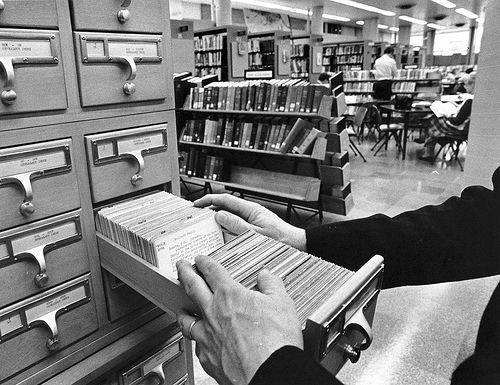
Did I imagine this sort of work life when I was a child? Probably not (mostly because the internets were a thing of the future; I learned to use libraries when card catalogs were still, actually, card catalogs).

via

But I don’t think my child-self would be disappointed with where I’ve ended up thus far. Which I feel is about the highest form of praise I could ask for.

four years ago today: "I’ll have to re-think this being-your-friend thing"

12 Monday Sep 2011

Posted by Anna Clutterbuck-Cook in life writing

≈ 2 Comments

Tags

four years ago today, hanna, simmons, work-life balance

Hanna’s comment, when I asked her to look this conversation over and approve it for posting, was: “good god, you are a clunky flirt … just…wow … it’s amazing.” The only thing I can offer by way of defending myself is to point out that at that point I hadn’t yet consciously realized I was interested in flirting, or even at all capable of it! As before, third party names have been omitted and clarifying editions are in brackets. All other text is original to the conversation.


dorm room beds aren’t the best for cuddling
(September 2007)

Online Chat with Hanna Date: 2007/9/12
1:13 PM
me: the internship site [for choosing archives internships] is up and running!
Hanna: oh, thank goodness!
anything you can’t live without? 😉
1:14 PM
me: um . . . nothing quite THAT inticing
My top three choices so far are:
Hanna: drumroll
1:15 PM
me: 1) BPL [Boston Public Library], a photo project with the Leslie Jones collection, “part of a pre-digitization phase.”
Hanna: awww…the bpl….
me: 2) Mass. Dept of Conservation and Recreation, organizing and indexing plans and maps, including some Olmstead stuff [this was the one I was eventually offered, and accepted]
Hanna: nice,nice.
1:16 PM
me: and 3) the New England Conservatory of Music, a personal collection of one Victoria Glaser, now 94, whose collection they would like to make accessible for research
Hanna: oooh, nice. all good choices!
me: I also looked at the Boston Athenaeum, just because the space is so worthy of drooling over
1:17 PM
[me:] but the whole concept of a subscription library . . .
so hoity-toity
Hanna: yeah, S (who used to work here) went on and on and on about how much she loved the athenaeum and her internship there. she said they had the best pencils ever.
1:18 PM
me: haha
well, that $220/year membership fee has to pay for something!
the thing I wasn’t so sure about with their internship (aside from the elitism)
was that they weren’t so specific about what projects were available
1:19 PM
[me:] so you’re just picking the site, not the project
Hanna: right, right — warning there, though. when i signed up for my 438 internship the project i got at the site was totally different from the one they advertised.
i don’t know what would have happened if i’d raised a stink about it.
me: ah
good heads up
1:20 PM
[me:] so S liked the athenaeum?
(aside from the pencils?)
Hanna: oh, yeah, she loved it.
apparently it’s a gorgeous space and i guess some of their collections are to die for.
me: have you ever talked to anyone who’s worked at the BPL?
1:21 PM
Hanna: thinking
no, i don’t think so.
1:22 PM
[Hanna:] i know one of the girls in my management class this summer was just going to start working there when the class ended, but we didn’t stay in touch after the semester was over.
me: oh well
1:23 PM
Hanna: 😦 sorry.
me: 🙂
don’t worry about it
just thought, you know, if you had any insider info . . .
Hanna: 😉 only that they can’t hire anyone who doesn’t live in bosto.
n
1:24 PM
me: ah . . . well, that’s good to know for future reference!
Hanna: yup, pretty much!
did you see the collection at harvard that’s olmstead’s stuff?
1:25 PM
me: no . . . hmm
I kinda skipped over the Harvard entries, since V made it sound like those were really popular
Hanna: mmm, true. but if you don’t ask, you don’t get! 😉
1:26 PM
me: yeah, but I have this pathological aversion to taking choices away from other people 🙂
I always want to take the choice that no one else is interested in, so I don’t spoil anyone’s plans
1:27 PM
Hanna: well…yes, so, okay philosophically i have to say that is highly altruistic of you.
and therefore i cannot disapprove.
me: 😛
Hanna: or even argue really.
me: I’m not saying it’s a GOOD thing
Hanna: 🙂
me: I mean, for me personally
1:28 PM
Hanna: no, i know. and in this case it might be a bit of overkill, really. it is just an internship after all. it isn’t like you’re doing something really serious like taking the last m&m or something.
me: haha
(looking at the Harvard internships)


the Plans Library at the Dept. of Conservation and Recreation
(October 2007)

 1:29 PM
[me:] they have a lot of cool ones related to horticulture this semester, don’t they?
Hanna: yeah — the glass flowers collection one might be cool. have you seen that museum yet?
me: noooo . . .
must plan to go someday [I still haven’t been!]
1:30 PM
Hanna: on a sunday — if i remember right, mass residents get in free before noon — or after noon — or something like that. it’s on their website.
me: again, good to know!
now you have confused my choices 😉
1:31 PM
Hanna: whoops!
but i added something to your field trip list so that’s got to be a good thing.
me: yeah, I’ll have to re-think this being -your-friend thing
🙂
(field trip list–always a plus!)
1:32 PM
Hanna: see? there you go. the one balances out the other. 😉
1:33 PM
i’d also like to know how this internship out in northampton counts as being on mass transit.
are they confusing the t with greyhound?
me: good question
1:34 PM
[me:] some of the ones on the list looked a little sketchy, access-wise to me!
I mean, yeah, if you had 3 hours to commute!
Hanna: yeah! my 438 class had internships on offer that were up in southern nh and maine.
1:35 PM
me: okay, those may be great sites, but how many of us have the time and/or resources to go out there?
Hanna: exactly.
1:36 PM
[Hanna:] and they were very cool internships, but i don’t know if anyone took them in the end.
me: how sad 😦
1:37 PM
Hanna: i know we had a couple of distance commuter students, but i think they wanted to go to repositories in boston because of subject interests.
1:38 PM
me: so what are you thinking of?
1:39 PM
Hanna: there’s one at bc that just says ‘a chance to do higher level processing and finding aids’ and i just really want to get into the bc repository because they’re supposed to have a good irish collection… [she did, and they do]
…and then the one at harvard about making a kind of harvard cliff’s notes study guide because it might be fun to work at the harvard repository…
me: yep, yep
cliffs notes?
(which one is it?)
Hanna: hang on —
1:40 PM
“…[to] create a guide to biographical and genealogical resources about people associated with Harvard…”
and then the one at tufts in their digital collection because i nearly applied for a job there.
1:41 PM
me: the H one sounds like it could be rather OED [Oxford English Dictionary] in length!
well, all good options, yes?
1:42 PM
Hanna: yeah, i think so. and they’re all on mass transit in places i know and open m-to-f since i can only work on the fridays.
me: 🙂
yeah, that’s sort of how I sorted them as well
1:43 PM
Hanna: i hate the time crunch thing. i was working out my scheduling last night and nearly gave myself a panic attack.
me: yeah
if I end up working at NEU, my schedule is going to be pretty colorful this semester!
Hanna: 🙂
1:44 PM
me: plus, I’m still in the mode of catching up from all the transitions
so I feel like sleeping about 10hrs/night
I know it won’t last, but it makes me feel very . . . unproductive
1:45 PM
Hanna: i know how you feel.
it’s also because it’s turning chilly and dark earlier and so on…
me: yeah 🙂
that was my problem in Aberdeen
3pm?
getting dark?
time for bed!
in the summer
I never had to go to sleep 🙂
Hanna: 🙂
1:46 PM
[Hanna:] i just have an awful time getting up in the morning. it’s dark and chilly — this is what my feather comforter was designed for, people! why am i leaving it?
me: yeah, while I’ve never been a sleep-in-until-noon sort of person,
1:47 PM
[me:] I never have been able to happily get up before it’s light out
Hanna: oh, no.
1:48 PM
[Hanna:] when it’s light, i can get up — but getting up before the sun does not work for me.
me: exactly
which presents problems for those of us
living so far north of the equator
or wherever would mean
we wouldn’t ever have to get up
before it was light out 🙂

Sunrise across the Fens (September 2007)

1:49 PM
[me:] well, speaking of productivity . . .
Hanna: oh, overrated.
me: I think I’m going to sign off and go out for a walk before I face classes this afternoon
Hanna:  hehe — oh, okay, in that case, not overrated. i hear it’s gorgeous out!
1:50 PM
me: it is!
Hanna: oh, bah. well, go on then — you enjoy that beautiful weather! 😛
me: mm
I’ll try to send you some karmic sunshine, or whatever
1:51 PM
Hanna: hehe. thanks! and do enjoy the walk — boston’s really lovely in the fall.
me: bye
Hanna: wave

30 @ 30: school [#8]

07 Wednesday Sep 2011

Posted by Anna Clutterbuck-Cook in life writing

≈ 4 Comments

Tags

children, education, family, thirty at thirty, work-life balance

When it comes to school, I did things somewhat backward. In that, as a child, I didn’t go to school … and then, as a grown-up, I spent about twelve years (give or take) in institutions of higher education. As a student.

As regular readers of this blog know, my siblings and I were home educated from birth to college (in my case) and high school (in my siblings’ cases, part-time and full-time respectively). You can read more coherently about that experience, from my perspective in an interview I gave last December. I’ll try not to repeat myself here.

What I’m going to talk about in this post, specifically, is what “school” meant to me as a child, and then what it was like to be a student as a teenager and young adult — when I hadn’t grown up learning to conceive of myself in that way. And then what it was like to graduate from college, be a not-student briefly, and then return to student life as a graduate student (briefly: fucking hard).

So to begin: When I was a child, I thought not attending school was normal. Well, no. It’s not that simple. I understood — from the questions I got from grown-ups, from the stream of children walking to the neighborhood schools (Catholic and public), from the basic fact that children in books almost unerringly attended school — that school was something many children did. But when my mother asked me, once, when I was about five how many children I thought homeschooled I told her after a moment’s reflection that “about half” seemed a likely number.

This probably, in all fairness, reflected the statistics in our immediate circle of acquaintances. But obviously was not reliable data for the population more generally.

School, to me as a child, was something that other children did. And I honestly never thought about it much as an activity I could, should — or might want to  — engage in. It sounded boring, and required getting up early leaving all the projects I had going at home in order to do other projects. That seemed inconvenient at best, and threatening at worst. I remember being pissy about the crossing guards who were stationed at the street corners in my neighborhood before and after school, and for the children going home at lunch — I used to defy their instructions on principle because I wanted them to understand they couldn’t control me because I wasn’t one of “their” kids.

I was a pain like that, growing up.

I liked being the one in charge.

So school, until I was seventeen, was this thing I didn’t do. Couldn’t possibly fit into my busy schedule, which included stuff like volunteering at the local history museum and working part-time at a children’s bookstore, writing novels and traveling with family. At the time my schooled friends were taking the SATs and applying to colleges, I was seriously on the fence about even going to college at all. I was thinking about alternatives like full-time employment and apprenticeships. But thanks to my dad’s job I was able to enroll in a first-year writing course without matriculating, and since my career options at the time included “novelist” as well as “bookshop owner” and “museum curator,” I figured that was a good a place as any to try this school business and see if there was anything to it.

I fell instantly and utterly in love. With the class, with creative writing, with my professor, with the campus events we were required to attend as part of our coursework (film series, symposia, guest speakers), with being part of a larger conversation. I loved the routine of getting up on those autumn mornings, going for a run, getting ready for work, and then walking the six blocks to campus for my 8am class before turning up for my shift at the store. Yes, I struggled over assignments. Yes, I was terrified of failing at this school thing. Yes, I inevitably came across as weird and probably more than a little threatening to my fellow first-years who turned up in their pyjama pants, bleary-eyed from late night socializing or early-morning athletics training.

But that first year of college (I took first-year college writing in the fall of 1998; Christian feminism and creative nonfiction in the spring of 1999) was also utterly exhausting. The 1998-1999 school year was a politically charged year on campus, about which I’ve written before.  I found the semester schedule a roller coaster ride of intensity and deadlines and never-enough-time-for-a-job-well-done. I couldn’t imagine how students were able to complete the work for four or five courses at a time, when the hours it took for me to complete the reading and writing for one or two courses felt like a full-time job. I hated having work graded (and actually requested that faculty refrain from marking my work with a letter grade during those early years). I hated the apathy and/or competitiveness of my peers.

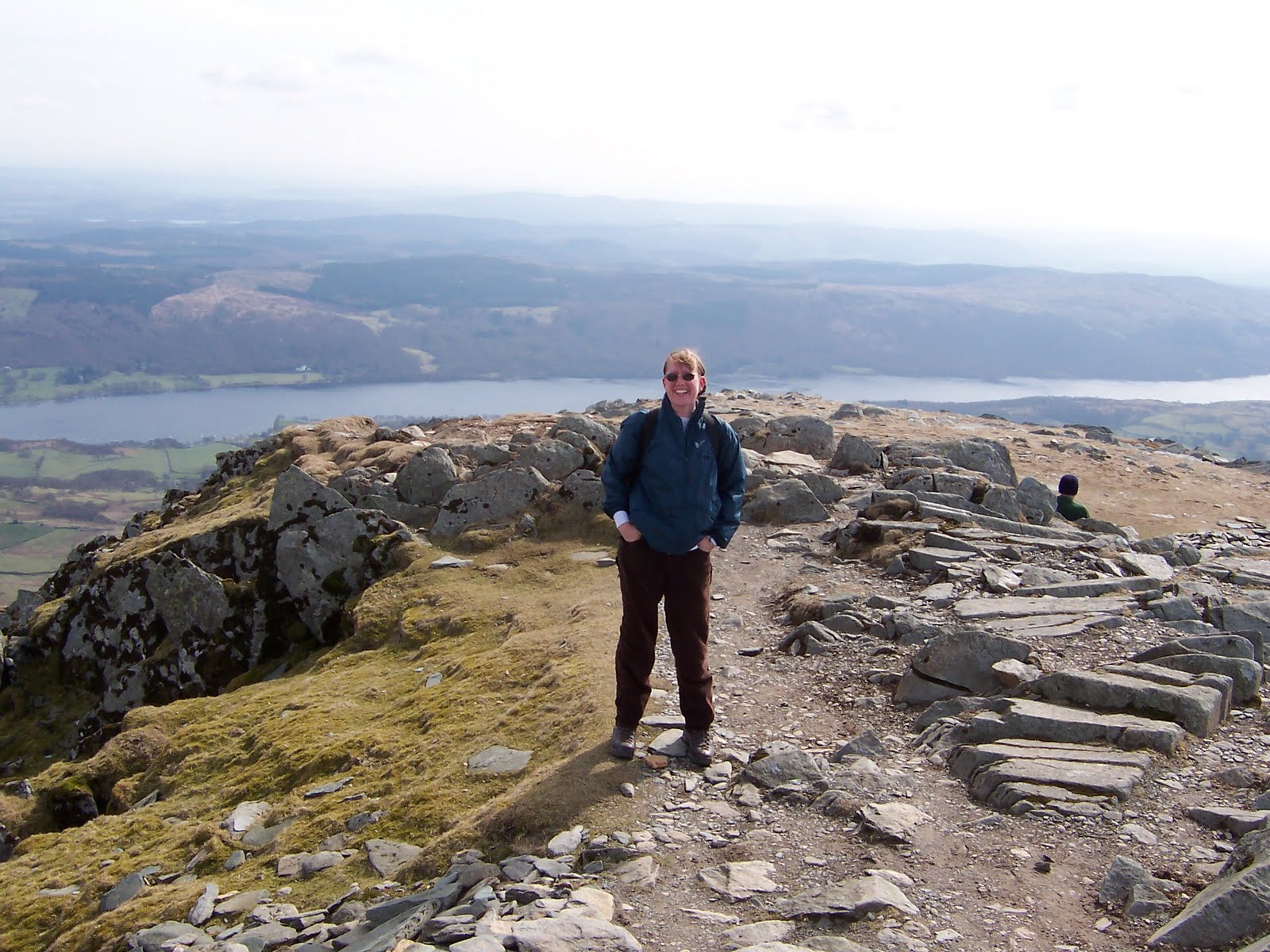
College did get me to places like this
(Coniston Water, Cumbria, England, 30 March 2004)

I went back. For seven years, I went back. But while there were things I loved about college I can’t say I ever found the point of equilibrium between these two poles of ecstasy and despair. I threatened to drop out of school literally every semester I attended. All through undergrad, and then again in graduate school. It was always a deliberate decision to walk back in the door the following term.

It’s hard to talk about why the experience was so difficult for me. Yes, it got better. And yes, there were always reasons to stay: amazingly dedicated, energetic, and insightful professors; articulate, thoughtful, and generous fellow students; resources to pursue the ideas that galvanized me; opportunities to travel, to present papers, and connect with fellow scholars and like-minded folks. When I talk about the poisoned feeling in my bloodstream whenever I’m in institutional spaces of education, I know it hurts a lot of people near and dear to me, who are doing good work in those spaces, and who have found a home there — for better or worse. I’ve learned over the years to make it as personal an observation as I can, though obviously my critique of institutional schooling is broader than a simple “I don’t thrive there.” I think many people don’t thrive there, and yes, I have a problem with that. But many people do … so I don’t know what to do with that.

When I returned to grad school in 2007, after two years of incredibly freeing non-school life, I was taken aback by how much I resented the return to academia — even as I was excited about launching my library science career. My emotional, mental and physical health had almost immediately improved when I graduated from college in 2005: I’d started sleeping better, eating better, feeling more energetic and experiencing a stronger libido; my mood felt more stable and positive, even in the face of uncertain job prospects.  And my first year in graduate school (combined, to be fair, with a cross-country move) brought on nausea, shortness of breath, weight loss, and other symptoms of fairly extreme anxiety.  As early as the road trip out to Boston, I was already writing in my journal about the misgivings I had about returning to school and the feelings of claustrophobia and regression they engendered. I felt like I was returning to being a teenager again, somehow erasing the experiences of the intervening decade.

It was not a good feeling.

This was hands-down the best part of graduate school,
apart from meeting Hanna there.

I got through it. I’m not sure, yet, whether to look upon graduate school as an improvement on undergrad or vice versa. Without the economic luxury of being a full-time student (as I had been in undergrad), I was forced (and intentionally chose) to maintain a life outside of school that was ultimately much more meaningful than what happened inside the walls of Simmons, both professionally and personally. I will be forever grateful to the Simmons dual-degree program for making the space I needed to begin my research on the Oregon Extension; at the same time, the project itself was borne out of the way in which my psyche responds to institutional education — as a coping mechanism to help me exist in a hostile environment. But I left graduate school no more enamored with the structures of school than I had been in college. And while the sea-change in well-being post-graduate school hasn’t been as marked as it was after I finished my BA, I have noticed a definite turn for the better when it comes to my own emotional and mental stability, my energy level, and the juggling act of work-life balance that follows us everywhere. As the students flood back into Boston this fall and classes begin again, I am unambivalently thankful not to be in their midst. Even as I make plans to pick up my research and writing once more.

For the first seventeen years of my life, school was simply something that didn’t apply to me. For the past thirteen years, it’s been an inescapable part of where I wanted to go and how I had to get there. Now, I have the chance to exist on the outside again. I think, though, the scars will linger. And I mean that in a positive as well as negative way: scars as markers of how experience changes us. It will color how I study and think about education and learning, about schooling and unschooling. It will inform how I think about the ways in which we, as a culture, choose to organize human life and make sense of our existence.

Many people in my life maintain, with great personal conviction, that I will make my way back to the classroom again — either as a student or as a faculty member. I myself am far from sure. For the first seventeen years of my life, I explored the world without the framework of school. I’m kinda looking forward to getting back into that rhythm, seeing how the old clothes fit.

four years ago today: "first class, etc."

05 Monday Sep 2011

Posted by Anna Clutterbuck-Cook in life writing

≈ Leave a comment

Tags

boston, family, four years ago today, hanna, simmons

So in an exercise of sheer archivist-historian self-indulgence, I’ve decided to offer an occasional series this fall that features emails written by 2007 me about my first few months in Boston (and first semester in graduate school). I’m going to kick the series off with an email I sent out to my family on 5 September 2007, on the first day of the fall semester. It features bookstores, libraries, Hanna, classes, and more! I’ve added a few clarifying notes, deleted some individual’s names, and included links to relevent posts from back then. Other than that, it’s a gen-u-ine primary historical source!

From: Anna
To: Brian, Janet, Maggie, Mark, and Joseph
Date: Wed, Sep 5, 2007 at 9:53 PM
Subject: First class, etc.

Hiya all,

Dad wrote earlier and thanked me for keeping y’all “in the loop” about what’s going on in my new life here in Boston. Ha! That’s a losing battle :). Things are happening so swiftly right now, I’m pretty sure I can’t keep up with them myself, let alone keep everyone else up to speed . . .

But here are a few developments in the last 24 hours.

(No, you don’t all have to read ALL of it, if that’s what you’re thinking B & M . . .)

This morning I spent a couple of hours on the phone with Q, the computer magician at Lean Logistics [a company I was working for remotely], setting up the Virtual Private Network (VPN) connection with Lean Logistics. In order to do this, he set up a WebEx conference connection which (get this!) allowed me to give him a remote view of my desktop and control of the mouse on my computer! So I had the very surreal experience of watching my mouse float around doing things while Q talked in my ear, muttering to himself about what he was doing. It was quite cool, actually. And the most important thing is that it worked! So I am now back on board with the whole data entry thing, and fingers crossed it will turn out to be worth the fuss.

On the other job front, I took the Green “D” line downtown to the Prudential Center today and met R [a department manager at Barnes & Noble, where I had transferred from my previous position in Holland, Mich.]. The store is a very strange, warren-like layout, with the children’s department situated back of beyond . . . but she assured me she tries to schedule at least two people in the department at a time. The schedule sheets and “dailies” of staff assignments are intimidatingly large! She said they have about 120 people on staff (though of course not all in the store at one time). I will be starting work a week from Friday, with a 7:00am-11:00am “zoning” shift, which means shelving and so on in the early morning. The next two weeks I have no closing shifts, thankfully, so that I can get a feel for the public transit routes without worrying about returning to the dorm at midnight. There seem to be no truly straightforward ways directly from the Prudential Center to the residential campus. There is a [subway] station incorporated into the center which stops fairly near the [Simmons] teaching campus, but several blocks away from the residential campus. The alternative is to walk a few blocks from Prudential and then take the subway line that stops right next to the dorm. I will have to ask around about what’s advisable. My impulse would be to refuse to be intimidated, but I also don’t want to take foolish risks.

When I was down at the Prudential Center, I took a very pleasurable detour to the Boston Public Library and signed up for my very own library card. It made me positively giddy and possessive feeling . . . like Eva [a child my mother cared for] signing up for her first library card (well, maybe not THAT giddy). You’ve all seen pictures of the BPL before, but here’s a picture of me with my new card standing on the steps in front of the statue of Our Lady of the Libraries (or whichever muse she’s supposed to be) on Copley Square.

Boston Public Library, Copley Square (September 2007)

Meanwhile, just to add spice to my work life, my friend Hanna — a GSLIS student with whom I’ve been corresponding this past year & just met at the History reception last night — emailed me this morning to say that the archives at Northeastern University, where she works, will be starting a year-long grant project October 1st, for which they need a part-time (10-13 hours/weekly) assistant. They are digitizing records from Freedom House, a civil rights organization from the 1950s that worked to integrate (and keep integrated) neighborhoods in Boston. She is urging me to apply for the job, and her supervisor said I should put in my resume ASAP — so I don’t have a lot of time to decide. At first I was like, “gawd this is too much!” But the more I think about it, the better it sounds . . . it pays $15/hour and it looks like Barnes & Noble won’t be offering me more than around 10 hours a week, which means I lose the permanent part-time status. Without that, there really isn’t much incentive to keep the job for the long haul (aside from the employee discount & pleasure of being around, um, books, which doesn’t seem to be a problem for me!). So, I’m going to apply for the job, and if I get it probably a) restrict my hours at B&N and b) quit after Christmas. [I didn’t get hired by Northeastern at this interview, but went on to work for them first as an intern and then as a part-time archives assistant a few years later.]

My final stop of the day was the Introduction to Archives class. This is the first of the three Archives core classes, so most of the students in the class are starting their AM (archives management) focus. This can happen either after they’ve already been library science students, or (as in my case) if they come in knowing what they want to focus in, and perhaps even dual-degreeing (can that be a verb?). I don’t know if I’m unusual, but I’d say that I’m less committed to archives as a specific type of library science than I am to doing both history and library science . . . if that makes sense? I get the impression that students dual-degree because the history will be useful in their archives career, or they got into archives through their history undergrad. I wouldn’t say I thought “archives!” when I imagined becoming a librarian, though there are certainly lots of things to recommend it. I mean, it doesn’t take much to get me all enthusiastic about public history, collective memory, material culture, the democratization of access, and so on. But there are moments (like every other one) where I could just as easily become a Public Librarian in some place like . . . oh, Leland? Or drive a bookmobile through the Lake District?

That having been said, I’m sort of on syllabus high right now, which comes before syllabus shock (that sets in after all three courses have had their first days, and I start accumulating project deadlines). Next week, I’ll get to choose my top three choices for the 60-hour internship out of over 100 options Simmons lines up for us. Fingers crossed it’s something with women’s or social justice history, or education . . . it’s Boston, I’m sure I can manage something! Or perhaps something off-beat will catch my eye that I never even thought of.

And the professor, V, seems nice (if a little prone to rambling . . . really, how many profs have you met who DON’T have that tendency?) She’s enthusiastic, available, and her basic message was: plan ahead, keep me informed, and don’t panic.

Well, I should wrap this email up and hunt down my resume for a little polishing (I’m going to put off writing the cover letter until I’ve had a sobering night’s sleep behind me).

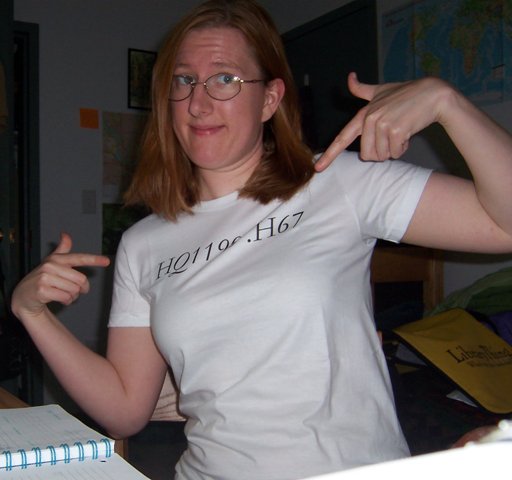
Tomorrow I get my first History Methods class — hooray! — in the afternoon. I think that’s the one that has everyone shaking in their boots (“so much reading!” is what I keep hearing . . . um, and this is a problem to us library students HOW??). That and this job application are the last big things on my list this week. Other than that, I’m going to try and finish my online technology tutorial, open my bank account, and pick up my ZipCar card and paperwork at the main office downtown. And Saturday, Hanna is taking me out to all the best used bookstores, or to a museum, and her favorite coffee shop . . . or something frivolous, geeky and fun. I finally ordered my “Feminism is for Everyone!” library call number shirt (HQ1190.H67) and am hoping I have it in time to wear on our outing.


I did wear this shirt on our Saturday outing;
To this day, Hanna remains particularly fond of it.

 Love to you all,
Anna

30 @ 30: urban living [#7]

31 Wednesday Aug 2011

Posted by Anna Clutterbuck-Cook in life writing

≈ 2 Comments

Tags

boston, maine, michigan, thirty at thirty, travel

Four years ago today, I hit the road in a rental car full of earthly possessions to drive from Holland (Mich.) to Boston (Mass.) and begin my life as a graduate student and city dweller. Starting next week, I’m tentatively planning a whole series of posts using emails and photographs from the fall of 2007, to reflect back on that transition and what that first semester at Simmons (and my first few months in Boston) were like.

In this installment of 30@30, though, I want to talk about being a city dweller more generally, and my experience of visiting and living in cities as a young person and as an adult. I want to reflect on my perceptions of urban environments and the pros and cons of living in cities versus smaller towns versus more rural spaces (all three of which I’ve experienced, to a greater or lesser extent). Becoming an urbanite has been a struggle for me, and there’s a part of me that will never quite feel at home in the city — possibly the part of me that did feel at home, during my teens, in the wilderness of Michigan’s upper peninsula or in the foothills of the Southern Oregon Cascades. (My adolescent dream of becoming a backwoods guide will be featured in an upcoming 30@30 post on camping.) At the same time, I was born and grew up in a city of not immoderate size: around 35K in the city limits, according to the 2000 census, with roughly twice that number in the surrounding metro area. I lived two blocks from the library, less than a mile from the college where my father worked, and about the same distance from the downtown that — by the time I was a teenager and these things were relevant — boasted half a dozen places for decent coffee and two well-stocked bookstores. All the necessary amenities of life.

lemonjello’s coffee shop (Holland, Mich.)
photograph by Hanna

Still, there were ways in which Holland was distinctly different from a major metropolitan area like Chicago or Boston. There was really no public transit system to speak of, meaning you pretty much needed a car to get around in a serious way — sure, I had a bike and everything, but stuff like grocery shopping for a family of five can’t really be done on a bicycle or on foot. Most of the neighborhoods I knew as a child consisted of single-family homes, duplexes, and — closer to the college — student dorms. Apartments and condos existed, but not on the scale of a place like Boston.

My hands-down favorite thing about Chicago, the first few times I visited as a child, were the escalators at the hotel and the subway. Yes, I was easy to please.

As regular readers of this blog have probably gathered (if they didn’t already know) I mostly lived in Holland until 2007, and the elsewhere places I lived were mostly more rural, not less: Lincoln, Oregon; Hawk Hill, Missouri; Crawfordsville, Indiana. Cities were places I visited for a day or two (Chicago, Seattle) or a week (San Francisco) or at most, a month (Victoria, B.C.). I associated cities with vacations and travel, with the chance to try out new cuisines, shop used bookstores, visit museums, attend the theatre. Chicago, the city we most frequently visited when I was young, was the land of the Field Museum, the Chicago Theatre, the elaborate Christmas windows along Michigan Avenue, and the fresh roasted candied almonds from street vendors. It was a magical place, one that offered a departure from normal routine.

My first foray into city life was during my year abroad in Aberdeen, Scotland (2003-2004). Aberdeen is only the twenty-fifth most populous city in the UK, coming in between Salford (near Manchester) and Dudley (in the Midlands). In 2008 it reported a population of just over 210K. True, I was living in student housing during that time, and not working since I was studying full-time and had no work visa. So life in Aberdeen was quite different from navigating urban living as a renter and young professional. But there were experiences I had there, and skills I learned, that are not entirely un-applicable to life in Boston. I learned, for example, that even in cities green spaces can be found — though sometimes it takes diligence and a willingness to use multiple forms of public transportation. I learned how different (and often faster!) navigating a city by foot can be from navigating by car or bus. I learned that, even as a student, it pays to be connected to city life outside the university — whether it’s by attending concerts and plays, becoming a subscriber at the local public library, or spending time at coffee shops not exclusively frequented by students. I learned how to read a bus timetable and how to pay for a cab. I learned to be sensible but also not to live in fear of the city streets at night simply because I was alone and female.

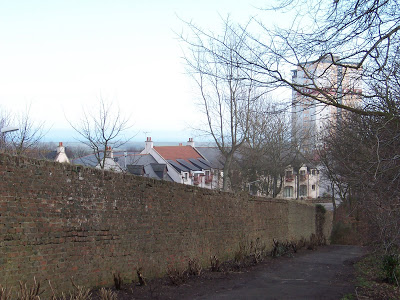
Seaton Park, Old Aberdeen (March 2004)
The North Sea is on the horizon.

One of the hardest lessons I learned was that some cities are just too large to know completely. There were parts of Aberdeen I simply never went to during my ten months there. There are parts of Boston I have never yet visited in the four years I’ve been here. It’s unsettling. I don’t like it. It makes me feel a bit blind — like those dreams where your vision refuses to come into focus.

I came back to the States from my year abroad certain I didn’t want to live in a city the rest of my life. Yet the rub is, of course, that most schools big enough to host graduate programs, most cities large enough to host a healthy number of libraries, most areas with a high probability of meeting someone youngish and also single who shares your interests — most of these things require a fairly dense population. So I ended up in Boston.

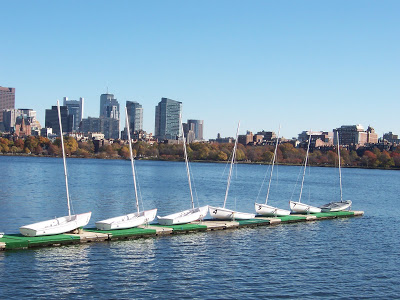
Boston skyline (November 2007)

These days I’ve made my peace with the city (see 2008, 2009, and 2010), though I can honestly say I’m not thrilled with the prospect of living here the rest of my life. Check back again in another four years and that answer might have changed.  There are days when I would rather be anywhere but here, days when I feel so claustrophobic I don’t think I’ll be able to stand it, days when I hate with a white-hot passion the freakin’ logistics of city life. There are also days when I realize how much I’ve made certain parts of Boston “home” — and that if it ever came to the point where Hanna and I were seriously considering a relocation, I would develop a hard-core case of pre-emptive nostalgia for the places we would be leaving behind.

A few weeks ago, when the T was delayed and then Red Sox fans and commuters were so packed into the subway cars that I waited over an hour for a train before just giving up and walking home in the rain, I was feeling pissy enough to come up with what I now think of as my “urban angst” list: the top five reasons why I hate city life. I’ll share them with you in a moment. The thing is, that when I had calmed down and considered the list I realized that my top five reasons why I enjoy living in Boston are actually the flip-side of the top five rather-be-anywhere-but-here items. I’m not sure what to make of that, other than simply to observe that like so many things in life, it only gets more complicated the more you think about it.


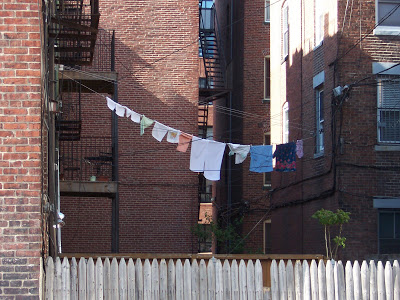
Laundry drying in the North End, Boston (May 2009)

 My urban angst list is as follows:

  • The Commute. Before Boston, I never lived more than, say, a twenty minute drive at most from where I worked or went to school. Usually it was closer to a five-minute drive, and a walk of a mile or two. These days, I live about two miles from work but the commute from door to door takes anywhere from twenty minutes (on a good day, when we walk straight onto a train) to an hour plus. I resent that I don’t have the option of skipping this part of my day. And it can make me feel trapped when the only way to get out of town is to take the train (or multiple trains) to get anywhere rural or green. Or to rent a car, which is then another additional expense.
  • Errands. Errands have never been more complicated. We have a plethora of options when it comes to buying groceries and other necessities and yes, most of them are thankfully on the walk from work to home or in the vicinity. But there’s this thing you don’t think about when you’re used to running errands in a car, and that’s how much shit you can reasonably juggle with two hands and a shoulder bag. There are weeks when I feel like my life outside of work is almost entirely dictated by the errands we need to run and the logistics of getting there and back. Rachel @ Women’s Health News has written a brilliant post on this subject recently, reflecting on the difficulty of buying groceries without a car.
  • Weather. Before moving to Boston, I had never really thought about how much more the weather matters in a big city. This might seem counter-intuitive, but when you don’t have a car and you’re either walking or taking public transit to get around you need to dress for the weather with much more care than I ever needed to back in Michigan. And you need to go out prepared for the weather to change by the end of the day, because there’s no option for running home at lunch to grab an extra sweater or your umbrella. The heat is also more intense here, and when you walk two miles to work on a humid summer day that means taking an extra change of clothes and some heavy-duty deodorant with you.
  • Apartment Living. Cities are expensive, and while Hanna and I have decent landlords, relatively quiet neighbors right now (knock on wood), and a lovely tree-shaded living room, our apartment is tiny compared to what I’m used to. Tiny and expensive. I’ll just come right out and say we pay $1250/month for our one-bedroom place, which is about par for the course in the area where we live. Hanna wishes we could have chickens, or at least room for compost. I wish we had a kitchen that more than one person could work in comfortably. And it would be nice to have storage space for things like suitcases and maybe a bike. The smallness of the space also makes entertaining more than one friend at a time difficult, which means get-togethers usually require meeting in some third space — something that inevitably costs more than hosting folks at home. I miss the days when I could have friends over to cook a meal, eat dinner at an actual table, and watch Masterpiece Theater in a room that had chairs for everyone.
  • The Illusion of Cultural Smorgasbord. Cities are full of amazing things to see and do: museums, lectures, theatre, concerts, author talks, walking tours, festivals, food and wine tasting, film series, the list could go on and on. There are specialty food shops to die for, and restaurants for every taste and occasion. The thing is, arts and culture stuff is (once again) expensive. And not only expensive, but often happens at times and/or in places that make it prohibitive to get to. Maybe there’s a lecture on women’s history that starts at 5:15pm which is technically after I get out of work, but it’s across town and there’s no way I’ll reach it unless I take a taxi for $40.00 which I simply don’t have. Those sorts of calculations. We’re no longer students, which means we aren’t eligible for any standard discounts for things like theatre or concerts, most of which are priced right out of our range. As someone who works at a non-profit cultural institution myself, I don’t necessarily think these things are overpriced — but the reality is that the cost of most of them is beyond what we can afford. So there are great things to do and see in Boston, but as people who are busy living here, there’s only so much we get to take advantage of.

My flip-side list:

  • My Job. If there’s a reason I want to stay in Boston, right now, beyond the fact that Hanna is happy here, it’s that I love my job. And a place like the MHS can really only thrive in a densely-populated urban environment, with a steady flow of graduate students and faculty, and moneyed families willing to support cultural institutions at a level of giving that most of us simply cannot afford (see “The Illusion of Cultural Smorgasbord”). As a librarian who wants to work in an independent research library or archive (i.e. not a public library and not an academic library) I only have so many options, and most of them are in urban areas — the Newberry Library in Chicago, for example, or one of the handful of LGBT archives like the Herstory Archive in New York City.
  • Public Transit. As much as depending on public transit can feel limiting (see “Commute”), I’m really glad to live in a city that offers a decent amount of service, and to live in an area where I can access it easily — both buses and subways — to get to the places I most need to go. I would not want to own or secure a car in Boston, and I’m glad Hanna and I don’t have to worry about things like car payments, insurance, and upkeep on one or two vehicles. It’s also great to live in an area that supports programs like Zipcar (car sharing) and Hubway (bicycle sharing).
  • Walking the City. The logistics of errands drive me crazy, but I do love the fact that we live in a city where walking is a feasible, even pleasant, option for many of our travels. And as much as I miss the five-minute drive to work in the morning, I enjoy being able to get in my daily exercise along with my commute, rather than having to get up at 5am to go jogging before I make my way to the train or get into the car.
  • Food Choices. If we ever more to a less urban area, I’m going to miss the plethora of options we currently have for grocery shopping and dining out. As expensive as it can sometimes be, it’s also wonderful to be able to look at pretty much any recipe and know that somewhere in Boston there’s a store that will offer the ingredients you need to make it. Part of getting to know — and feeling at home in — the city is knowing where you, personally, like to go for your favorite olives (J. Pace & Sons) or the best vanilla beans (Polcari’s). Which bakeries offer the second-day bags of bagels at $2/bag (Kupel’s), which coffee shop offers your favorite French Roast (Boston Common Coffee Co.), and the place to get baked raisin donuts on Saturday mornings (Clear Flour Bakery).
  • $1 Carts. So a lot of things are more expensive in the city — from apartments to your morning latte — but some are cheaper. Mainly I’m thinking of used books, and the fact that Boston has a strong enough used book market to support a dangerous number of used book stores many of which feature substantial $1 sections with rapid turn-over and a fairly good selection. Sure you have to be willing to browse often and buy on impulse, but who doesn’t want to do that where books are concerned!

With that, I think I’ve taken up more than enough of your time this week. I don’t have anything cogent to say about being an urbanite. It’s still a work in progress. We’ll see where the next five, ten, fifteen years takes us.

30 @ 30: desire [#6]

24 Wednesday Aug 2011

Posted by Anna Clutterbuck-Cook in life writing

≈ 3 Comments

Tags

gender and sexuality, hanna, thirty at thirty

It took me about six months to realize I desired Hanna.

And another three months after that to put that desire into words for her.

Another year and a half to act on it in more … shall we say tangible ways.


image credit

 It’s just that complicated and fragile a thing: desire. Overwhelming, scary, beautiful, thrilling, awe-inspiring. Sometimes elusive; sometimes that thing in the room that takes up all the oxygen. 

With Hanna, I desire her — notice her with physical pleasure — constantly, like a gravitational pull. Sure, I can ignore it, but it’s always there — a hum in the background of everyday life. I thought it might (was scared it might) fade with time, but over three years into our relationship it’s as strong as ever. And as distracting as it can sometimes be, I’m glad for that.

Glad, obviously, because it’s Hanna and I want to desire her always. But also glad because, for so long, I wasn’t sure I’d ever know what this particular kind of desire felt like.

* * *

Not that I didn’t crave touch as a child. I was something a touch junkie, in fact. My mother had to explain to my seven-year-old self that family friends probably didn’t want me to spontaneously start grooming them without, you know, asking first.

I also wasn’t without romantic attractions and longings for intimate relationships. I can remember as early as five or six spinning out fantasy stories involving characters who played the roll of a lover (though obviously I didn’t have the technical aspects down at the time). I’ve written already about my desire for family relationships that included sexual intimacy on some level. So it’s not like I’ve come from a place where I knew I rejected desire to a place where I feel like I can’t live without it.

But this? The physical sensation of being pulled into orbit around another person? That took a long time, and to some extent I feel like it was hard-won. Though I’m still not sure whether winning it was a case of recognizing something that had been there all along or cultivating something that had not yet been nurtured into being.

image credit

I had feelings of desire as a teenager, but they were diffuse and unspecific. Restless arousal that operated separately from my romantic attractions which were intense and present in my life. At the time I thought (not wholly incorrectly) that they were a form of sexual attraction, nascent desire that — if acted upon — would blossom into something more. But I somehow couldn’t connect those emotional attachments to the physical sensations — sensations that never seemed connect to particular people (let alone the particular people I was interested in romantically).

Part of the equation was likely the medication I was on for my hyperactive thyroid condition. I took a regular doze of Tapazol from age fourteen through twenty-four to regulate my thyroid and pituitary glands, both of which are involved in the production of hormones that on some level interact with human sexuality. No one ever asked me about sexual function during that time — either because they assumed I simply wasn’t doing it (well, I wasn’t but I’m offended by the assumption all the same!) or because they assumed I’d be embarrassed to discuss the issue with them.

When I underwent radioactive iodine treatment in 2005 for the problem and shifted from having a hyperactive to a hypoactive (well, technically non-functioning) thyroid. This was right around the time I finished my seven-year stint in undergrad, so maybe it was the relief of not being in school anymore — yes, with me it really is a noticeable upswing in mood — but that was when I started getting it. Like, what people meant when they talked about physical sexual attraction. What they meant when they talked about desiring someone not just in the “let’s be besties forever and adopt lots of kids!” way but in an actual “I’m so horny now I want you to take me into the storage closet and fuck me” way.

Okay, well … maybe not the storage closet. They’re usually dank and there might be spiders.

But you get the idea.

I suddenly understood — as an awkward twenty-four-year-old — why most adults seemed a wee bit concerned about the cognitive functioning of their teenage children. If this was what adolescence felt like to most people no wonder my friends seemed a little bit odd at times!

I also suddenly understood a whole new level of loneliness. I’d been pretty able to deal with solitude when it came to the lack of a romantic relationship. After all, I had a tight network of family and close friends with whom I was intensely emotionally connected. Back before physical desire became an issue that was — while distantly not my ideal — pretty damn satisfactory.

But you don’t get skin-to-skin time with family members or close platonic friends in our culture unless you’re under the age of about three. And that’s not even touching the sexytime issue which, suddenly, was an issue in this immediate and pressing way. Yeah, okay, yes. I had the solitary sex thing figured out in pretty short order. But that doesn’t address the issue of needing another warm body or bodies in your physical space.

I got it, for the first time, my friends who were in quasi-awe of my ability to be content without a relationship. I mean, I knew I could deal and I even knew I could be content. But that didn’t erase the craving for touch.

It’s a startling, sobering, and also exhilarating reminder that we are, irrevocably, embodied creatures.

* * *

I purposefully titled this post “desire” not “sexuality.” And I’ve avoided talking here about identity, orientation, or the question of how my attractions have (or have not) changed over time. I’ve got another post percolating in my head about why I find the concept of sexual orientation to be limiting on a personal as well as political level — and when I get around to writing that post, I’ll be sure to share it here.

What my desiring body has taught me is that paying attention to desire is ultimately much more important (to me) than wrestling with questions of sexual identity. I find it more meaningful and descriptive to think about those moments of intersection in my life of romantic attraction with physical desire (of which I have had … not many, but a significant handful) and the ways in which I have chosen to act on those desires, and why.

And I’m grateful to have that specific kind of physicality in my own personal tool-kit for interacting with other human beings (and, yes, with myself).

I’m also grateful to have someone in my life who’s willing (enthusiastically so!) to help me, as much as possible, experience the skin-to-skin time I desire.

30 @ 30: d’être et d’écrire* [#5]

20 Saturday Aug 2011

Posted by Anna Clutterbuck-Cook in life writing

≈ 1 Comment

Tags

blogging, thirty at thirty, writing

why did I find this appealing?

*to be and to write

There was a time when getting me to write — at all — was like pulling teeth. Seriously. In the dusty recesses of my memory are recollections of a period when my mother resorted to talking to me with a Raggedy Ann puppet in order to make short writing projects palatable (for obvious reasons I remained dubious).

I don’t remember very clearly why writing seemed like a stupid waste of time. I think it felt laborious, communication was uncertain (I was not a fan of standardized spelling), and why write something down if I knew it already and could talk so much more quickly? This was seriously something my mother and I used to fight about when I was small. I could be stubborn, and was disinclined to acquiesce to her requests, even when she (or Raggedy Ann) asked so very patiently. I had better things to do with my time than put pen to paper and form words. 
I can’t really say when this changed, in all honesty. I remember that my first acts of fan fiction creation were verbal, not written — when the latest issue of the Pleasant Company Catalog (the precursor to the American Girl franchise) arrived in the mail I would curl up with the glossy pages and narrate stories about the the lives and relationships of the dolls therein. Yes: I would literally tell myself stories, out loud. 

When I was six, I received my first diary. I still have it stored away in a box in Michigan. The first entry begins: “To dae I stayed in bed to late…” and then describes how I walked to the library and what I did there. A few entries later my little sister is born. “We have a new baby,” I report. “She poops in the bathtub.” There are illustrations. This less than auspicious beginning led to what would eventually become a nearly twenty-five year habit, thought entries remained erratic and highly uninformative until I hit adolescence, at which point journaling became a multi-layered activity: one part journalism, one part self-reflection, one part fiction, always with a high level of adolescent drama.


Journaling (October 2007)
 I kept a journal obsessively for over twenty years, which amounted to over 100 volumes and approximately 19,200 pages worth of jotting. Journaling kept me grounded and it was what helped siphon off some of the constant verbiage that rattles around in my brain (these were the days before blogging). In addition to keeping a diary and writing novels — which my adolescent years also saw their fair share of those — I also had several pen-friends (yes, actual pen-friends, to which I wrote actual hand-written letters). I deluged them with correspondence: letters made up of as many as twenty-five or thirty leaves of lined notepaper, filled on both sides. 

There are probably several posts worth of story I could tell about my evolving relationship with the written word during the seven years I was in college and the four years I spent in graduate school. College was what turned me on to the power of nonfiction writing, specifically creative nonfiction and research papers. Given my habits as a diarist and my fondness for epistolary writing, it’s not a big surprise to me, looking back, that I took to personal essays with boundless enthusiasm. I also grew to love — though not without tears! — the way in which research and analysis helped me to organize my often chaotic thought process in a way that people outside my own head not only seemed to (wonder of wonders!) understand but also to appreciate.


My brain while writing a research paper
Email and blogging have replaced correspondence and journaling these days, something that I’m not entirely at peace with. Actually, my abandonment of daily journaling coincides almost exactly with the beginning of my relationship with Hanna — a fact that causes Hanna some amount of anxiety. I’ve been thinking about the evidence, though, more or less since I realized a pattern was emerging and here is what I’ve come to think: that writing, all along, has been a means of conversation for me. That was, after all, the reason my haggard mother pushed my first journal into my six-year-old hands: with a new baby on the way she realized there was no way she would be able to keep up with the conversations her eldest daughter wanted to have. Constantly. Ceaselessly.

Journaling, correspondence, fanfiction, memoir, blogging, email, academic research and writing — all of these are ways through which I connect to ideas and the trans-historical, geographically disparate set of people who think and discuss them. Journaling was what I did when I was living a largely solitary life; now I have someone to share life with, discuss ideas and events with (except when she cries “enough!” which she occasionally does). Between blogging (and comment threads), email, and a primary relationship it’s simply difficult to find the time or the motivation to replicate my thoughts in a private space where no one else will read them.*

Perhaps the title of this post should be, more accurately, de s’entretenir et d’être (to converse and to be).

*Story: A few years ago a researcher at the MHS practically had a heart attack from joy when she saw me writing in my journal at the front desk. She pleaded with me to ensure that my diaries would someday reside in an archive where they might be accessible to future generations of researchers like herself. I didn’t mention to her how many volumes there were, but I do actually intend to donate my extant diaries and correspondence to an archive somewhere, someday. As a researcher who depends on those types of “everyday” sources for my own work I figure I owe it to my successors!

30 @ 30: (not) being a parent [#4]

10 Wednesday Aug 2011

Posted by Anna Clutterbuck-Cook in life writing

≈ 1 Comment

Tags

children, thirty at thirty

I’ve had a hard time finding my way into this post, and while the reasons are several I’m going to use my allotted space this week to talk about one in particular: the odd and unexpectedly liminal space I find myself in these days regarding parenting and childcare. I want to talk about my own feelings about childcare and potential parenting as they’ve evolved over the years, and I want to talk about the network of relationships and examples that have created the context in which those feelings have evolved. I’m specifically thinking here about my own desires and abilities to conceive, give birth to and/or adopt and raise children as a primary caregiver. I’ve already written lots in this space about the importance of incorporating children into the human family and how I think our culture falls down in this regard (see here, here, here, here, here, here, here, here, here, and here … I really gotta make a separate index page for these things). Today, I’d like to talk in more personal terms about what the decision to parent or not parent means in my own life right now.

I grew up in an environment that revolved around the daily experience of being a child. There are a lot of different ways being child-centric can manifest itself (for more on my own particular version go here). I would say that, from a child’s perspective, my family life normalized the primacy of caring for young people as a central task of being human, and also modeled that care-taking as an activity that was integrated into the “real” world — as opposed to being something one did either as a school teacher or (necessarily) as a “stay at home mom.” Yes, my mother was the parent dedicated to arranging our home life, but my parents didn’t back this decision up with ideology concerning gender. This meant that I grew up believing that: 1) caring for children was an important and legitimate adult responsibility 2) it was work that required full-time attention from someone or someone(s) to do well, and 3) this important responsibility was not “naturally” women’s job, but rather something that one did out of a sense of vocation. And because it was simply what family members did: look out for one anothers’ needs.

At age three, I thought I’d grow up to be Nora (Helen Reddy)
from Pete’s Dragon. Lighthouse keeper and adoptive parent
— what could possibly be better? 

In the manner of most children (at least I assume this is so?), I imagined that growing up to be an adult meant more or less growing up to take on the sort of responsibilities my parents and the other adults around me had. And that meant, in part, the responsibility of being a parent. I was an oldest child (and daughter) who positioned myself in my pre-adolescent and early adolescent years as someone who both liked parenting and was good at it. Younger children seemed comfortable with me. I was comfortable with them. As a girlchild I obviously got tons of positive social reinforcement for this behavior. (To be fair, my brother was also a nurturer, did childcare as a teenager, and today teaches middle school … so this wasn’t a completely gendered phenomenon. But I’m willing to bet I was meeting gendered expectations on some level.) Childcare also, actually, gave me an easy “out” when it came to socializing with my peers — something I felt generally awkward about. With the exception of spending time with close friends, as a child and adolescent I was pretty much constantly on the lookout for opportunities to ditch my age-mates in order to hang out with grown-ups (I wanted to be one) and smaller children (caring for them gave me an adult-like excuse to avoid my peers).  Caring for children was a legitimate role. And I did genuinely like the wee ones I was responsible for.

When I was five I wanted to be Maria from The Sound of Music.
If you’re going to adopt, why stop at just one?

In that context, to the extent I imagined being an adult, I imagined being a parent. My best friend (coughcough childhood crush coughcough) and I had a long-standing fantasy about adopting lots of orphans and raising them together. As I went through puberty I developed a massive obsession with the physiology and sociology of pregnancy and childbirth (thank you Our Bodies, Ourselves and the other literature of the women’s health movement!). I had very concrete ideas about what sort of pregnancy and birth experience I wanted when it came to having kids — however, whenever that happened. As the realm of possibilities for family creation expanded, my sense of how I might parent (and with whom) shifted, but I never entirely dropped the idea of being a parent someday. During my teen years and early twenties I learned some things about myself, including the fact that I wasn’t really interested in parenting in the context of a dyadic relationship in which I would be the full-time hands-on caregiver. At the same time, I remained committed to the sort of out-of-the-mainstream parenting that had been my own childhood experience. The only way I could see that sort of parenting happening in conjunction with my personality would be to have co-parenting with probably more than one other person, either in a co-housing or communal setting, in a committed poly marriage, or some other heretofore unspecified situation.

Because such a situation was so difficult to imagine establishing successfully, I started re-evaluating my assumption that being an adult me would involve parenting. I was lucky enough to have family members who didn’t pressure me to settle into a heteronormative family and start popping out babies, and also lucky enough to be surrounded not only by folks who had parenting radically (the homeschooling/unschooling community) but also by some really kick-ass single and non-parenting adults — notably single and non-parenting women — whom I could look to as models for what it would mean to be a not-parent.  My father’s sister, for example, is now married with an adult stepson, but spent the majority of my childhood as a single female academic pursuing her PhD in theology and an MS in Social Work. A close family friend who was likewise single for years used to have dinner with our family regularly and provide childcare when my parents needed a break; being without children himself did not seem to impede his ability to be close with us or with his nieces and nephews. In college of the six female professors who I’d identify as the most influential in my academic career, three were single when they had me as a student and four were not parenting. All four of those women were living examples of how to be a whole person and build relationship networks without a marriage or children.

I took some flak from a couples’ counselor a year or so ago for starting to answer her question about whether I did or did not want children (Hanna’s immediate answer: “No”) by providing all of this background. Hanna pointed out to me later that the therapist — being unfamiliar with how my mind worked — probably thought I was evading her query. I wasn’t, but I honestly didn’t know how to answer her in any other (more succinct) way. Because my current location on the parenting continuum is a result of all these experiences, and that location is situational. Unlike people who experience bodily knowledge about their desire to parent or not parent, I am comfortable in the in-between space of offering my skills as a caregiver where and when I am called upon to do so.

Gwen Cooper and Baby Cooper (Torchwood).
This is how I picture Hanna’s parenting would be (sans pink).
For the fucking win.

This frightens Hanna sometimes, the fact that my resistance to being a parent isn’t as complete as hers. We’re still working out how to negotiate that. While I don’t need (and for a number of reasons don’t actively want) to be a parent or primary caregiver, I also don’t experience the passionate rejection of that role that Hanna and some of our close friends articulate. I want to stay open to our lives and desires changing. Not because I think being a parent (or more specifically a mother) is something we need to lead fulfilling lives as women, or to have coherent and meaningful identities. But because I, personally, have a very difficult time taking any possibility off the table permanently. Closing and locking doors frightens me, makes me feel claustrophobic.

I also want to stay open to the accidental parenting. Obviously, the chances of this happening given our collective anatomical make-up are incredibly slim, but I still want to stay alive to the possibility that at some point in the future we may be called upon to parent in some way: the children of friends or relatives, for example, in need of a temporary home. Gods forefend anything so traumatic happening to the people we love — but I live with the knowledge that shit sometimes does hit the fan, and I want to be there for the vulnerable survivors if it does.

All of this leaves me in what feels like a bit of a no man’s land when it comes to the current state of our cultural assumptions about parenting. In a landscape where children and families are simultaneously idolized and marginalized, and where single and non-parenting adults (particularly women) feel vilified for their decision not to parent, the pressure to “choose sides” is intense and I find it hard not to feel rendered invisible as a non-parent who is neither proudly childless by choice nor mourning her infertility and/or circumstances unconducive to parenting. I feel bi-lingual, in a sense, able to speak the language of parenting and of not-parenting with equal willingness and ease. I can see my future life unfolding in multiple directions, and I’m okay with that. Most of the time. But certainty about uncertainty (e.g. openness-to-change) is sometimes a more difficult position to articulate or defend than is certainty about certainty. Which is perhaps why it’s taken me two weeks and this meandering blog post to do so — and why our couples’ therapist thought I was evading the question.

I’m going to pick up the theme of openness-to-change in next week’s post on “desire.” In the meantime, this is what I got. I hope it at least approximates what I set out to offer.

← Older posts
Newer posts →
"the past is a wild party; check your preconceptions at the door." ~ Emma Donoghue

Recent Posts

  • medical update 11.11.22
  • medical update 6.4.22
  • medical update 1.16.2022
  • medical update 10.13.2021
  • medical update 8.17.2021

Archives

Categories

Creative Commons License

This work by Anna J. Clutterbuck-Cook is licensed under a Creative Commons Attribution 3.0 Unported License

Meta

  • Create account
  • Log in
  • Entries feed
  • Comments feed
  • WordPress.com

Blog at WordPress.com.

  • Subscribe Subscribed
    • the feminist librarian
    • Join 37 other subscribers
    • Already have a WordPress.com account? Log in now.
    • the feminist librarian
    • Subscribe Subscribed
    • Sign up
    • Log in
    • Report this content
    • View site in Reader
    • Manage subscriptions
    • Collapse this bar