• anna j. clutterbuck-cook
  • contact
  • curriculum vitae
  • find me elsewhere
  • marilyn ross memorial book prize

the feminist librarian

the feminist librarian

Category Archives: think pieces

to be subjective and scholarly

18 Friday Jun 2010

Posted by Anna Clutterbuck-Cook in think pieces

≈ 1 Comment

Tags

domesticity, education, thesis, work-life balance


Last Friday, I blogged about my frustration with finding balance between my academic research and writing, my wage-work, and my domestic life and loves. This Friday, I thought I would pick up where I left off, after a fashion, and write about the ways I try to balance the academic and the personal within my work as a scholar.

This post has gone through a number of different iterations in my head, but is taking this particular form because of a recent post by Kimberley @ 72-27 who this week wrote a long, reflective piece about her own return to academia and the limitations she sees in rigorous scholarship that neglects the relational in pursuit of the rational.

Before my current program, I came from a small school in Seattle that trained students to be therapists, and thus it placed primary value on inter-personal and intra-personal knowledge. My professors were psychoanalysts and therapists, and they asked their students to delve into the unconscious self and figure out what was there and why it was there. We did intense work understanding our own families of origin and personal narratives, and we received a great deal of feedback on how other people experienced us while in relationship with us. While the program lacked academic rigor in the traditional sense, it demanded a kind of inter-personal and intra-personal rigor that was invaluable.

While I love the rigor that is applied to critical thinking at Yale, I am left envisioning what Yale would be like if that same kind of rigor were applied to self- and inter-personal knowledge. For instance, in my U.S. religious history class, one of my professors shared with us that it took him quite a while in his career to realize that he hadn’t picked his research “objectively.” His research came out of deeply rooted questions based on very personal life experience. Yet, in his graduate training, he had not been encouraged to see the connections between his “objective” research and his own life story. This discussion in class came at the very end of the semester, and it was a relief to me. I had often felt as if historians maintained a pretense of objectivity. It was nice to finally hear that we can actually do better research if we are self-reflective in the process. Knowing ourselves better will also translate to being better collaborators.

Emphasis mine. You can read the whole post at 72-27.

How does this connect to my own work, beyond the skepticism toward an overly-depersonalized academia which I unabashedly share? To begin answering that question, I want to share another lengthy quotation — this time from an email I wrote earlier this spring. When I was at the Oregon Extension in March, doing research for my thesis Doug Frank — one of the faculty there, an historian and mentor of mine — asked me whether my project was a chronicling of “what happened” or whether I was making a specific argument. I stumbled through an immediate response that, from what I remember, emphasized that I was gathering the oral histories as a type of chronicling, but that my thesis would itself have a specific argument to make about the place of the Oregon Extension in American cultural, educational, and religious histories.

Of course me being me, I left the conversation unsatisfied with my response and the following day wrote Doug a long email trying to explain my motivations for this research. I won’t reproduce the email in full here, but I wanted to share two paragraphs that speak to the connections between my “objective” historical analysis of the Oregon Extension and my own life story.

On a more personal note, I will say that this project comes out of my own deep interest in history of non-mainstream education and my very personal quest to find a way to bring together my love of learning (the life of the mind) in some sort of structured environment with the quality of life I experienced as a child and young adult outside of institutional schooling. My original desire to attend the OE as a student (nearly a decade ago now!) was driven, in large part, by my desire to find a way to be a scholar without having to fit myself into the vision of education (the fear-based model you were talking about yesterday, which I believe is still deeply embedded in most schools) and of human nature that ran so counter to the understanding of human life that I had grown up with in my family (and elaborated on through my reading in theology, feminism, and educational theory). I am drawn to examples of intentional community and purposeful work life, in which folks have been able to step outside of the pressures of the mainstream and forge a life for themselves that isn’t grounded in being “anti” (that still retains some sort of relationship with the dominant culture) but nevertheless has some autonomy when it comes to priorities and values — the power to say “you have no power here” to things within the dominant culture which are inimical to human well-being.

When I went back to graduate school, I was taken aback by how much my soul rebelled against being back in an environment of institutional education, surrounded by folks who largely take those traditional frameworks for granted (at the very least) and often champion them (Boston’s educational culture is incredibly status-conscious). I don’t necessarily believe I made the wrong choice to return to school (the factors are myriad), but I do know that when it came time to choose a thesis topic, I intuitively knew I needed to spend my time with a topic that would help me retain critical distance on that culture, that vision of humanity, that understanding of the way human beings learn and what they need to thrive. And as of this writing, at least, I feel pretty proud of the way that this project has helped me to do just that, giving me a certain inner sense of distance from the expectations and values of the institutions within which I work as a student scholar, so that I am sharing these ideas with them (in a form they can accept for credit) but not writing my thesis for them.

As I wrote more concisely (though much more pedantically) in an early draft of my thesis introduction, “The scholarly task of historicizing the college classroom and the expectations of higher education were, in part, a method of coping with the alienation I often felt as a student whose experiences and vision of, not to mention goals for, learning were at odds with the majority of the people whom I encountered at school.”

In other words, this topic matters to me, in a visceral, immediate way. The project of make sense of the history of competing educational theories and practices is as much about finding a place for myself within that world as it is about situating the Oregon Extension within its unique historical context. I am invested in doing my part to enter these folks into the historical record because I believe deeply in the value of what they do. It is important to me that their own unique experiment in living be acknowledged at some level as part of the history of education in the twentieth century — a way of being that runs counter to the stories we tell ourselves about how life has to, or ought to, be.

And the world of academia is definitely divided as to whether this is or is not a good thing. Emotional proximity to one’s subject-matter is often viewed with deep suspicion, as it is seen to cloud the mind, bias the historian whose job (as Kimberley notes about) is ostensibly to be “objective” about her subject. Distance from one’s topic (in time as well as emotion) is supposed to provide you with the dispassionate objectivity to analyze and critique with greater clarity. Even if we recognize (as most scholars do today) that we are all inevitably subjective in our scholarship, the push has been to recognize and attempt to minimize or compensate for those biases, rather than to embrace and work with them as strengths.

I’m less certain that this is the only or the best approach to subjectivity within scholarship. Although I’m still searching for language to articulate it, I think that there are different qualities of emotional proximity or connectedness to one’s research subject that can — depending on how self-aware the researcher is and what their relationship to that connectedness is — help or hinder scholarly analysis.

I am taking a meditation class with Hanna this month (my first ever!) and have been introduced to the practice of metta meditation, in which the quality of loving-kindness toward beings is distinguished from feelings of acquisitive desire for those beings. I’ve been thinking this week about how the same distinction might be made concerning one’s affinity toward a research project: intense feelings of loving-kindness toward the subject and subjects — relatedness that is not conditional upon a particular outcome — could be separated from an emotional investment that was conditional, that required fidelity to a particular outcome, a particular historical narrative that fit pre-conceptions about what story these historical sources were going to tell.

Again, I’m not sure how practically this translates into a real-world relationship between the scholar and her sources, the scholar and her passionate involvement with the work of her subjects. But it is a beginning, a way to open (inside myself, at least) a conversation that values not only my intellectual work but also the personal, emotional, life-story reasons why the pursuit of this particular story is not only an academic exercise but also very much a matter of existential survival.

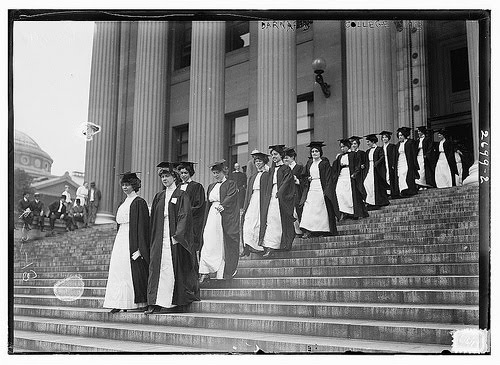
image credit: Barnard College, 1913 (LOC) made available by the Library of Congress @ Flickr.com.

feeling guilty for wanting a balanced life

11 Friday Jun 2010

Posted by Anna Clutterbuck-Cook in think pieces

≈ 1 Comment

Tags

domesticity, simmons, thesis, work-life balance

I’ve recently been making some decisions about how and when to complete my graduate education. Decisions which have left me feeling one part proud of myself for saying “nope, this isn’t working” and making the necessary changes and one part small and ashamed of being slow and for, well, wanting a balanced life. It is always humiliating (or at least I find it so) to find one’s self buying in, even a little bit, to the cultural pressures and voices in one’s head that pass judgment on the personal life decisions. Decisions that I know, in my gut, are right for me but nevertheless run counter to the mainstream expectations of how we ought to live our lives.

And yet, despite knowing I’m right, I do feel that pressure, and I do hear those voices. As I was trying to make a decision about whether or not to revise my planned thesis-writing deadlines to give myself more time for writing I was acutely aware of those dynamics. And the dynamics of justifying whatever decision I made both to myself and to others (my advisers, my family and colleagues, etc.). So I have a few observations that I’d like to share with you.

As I sit here spelling them out, they all seem rather obvious — but I think in part because of their very ubiquity they become invisible to us. So for that reason I’m going to the trouble of articulating them anyway.

The first observation is that it is really damn hard in our culture to feel comfortable making the argument that I am part of a family and that it is important for me to nurture the relationships that make up that family even while pursuing academic work and wage-work that I also care about. When justifying my thesis extension to my advisers, I emphasized my work schedule and the importance of having enough time for deliberation and revision while writing. I was up-front about the importance to me of having regular leisure time with Hanna during the week, but I was careful to name that desire as one of a number of factors, rather than foregrounding it as one of my primary concerns (which, in fact, it is). And part of me felt ashamed for naming it as a primary concern, even as I persisted in doing so.

A related reason that feels like an admission of failure is naming domestic responsibilities and the amount of time they take: quotidian tasks such as the morning and evening commute, physical exercise, dish-washing, laundry, grocery shopping, cooking, cleaning one’s kitchen and bathroom, attempting to impose some order on a very tiny apartment space in which two grown women, a cacophony of plants and myriad books are attempting to co-exist. As feminists have pointed out repeatedly for the past two hundred years (at least), domestic concerns are not taken care of by magic (sha-zing!), but rather through work, work that takes both time and energy on the part those whose duty it is to complete these tasks — whether those persons are paid domestic servants, unpaid spouses, or (in the case of those with neither the economic resources to outsource or a “separate spheres” arrangement with their partner) someone who comes home from work to a second shift.

Yet, as feminists have also pointed out, our society is still organized on the underlying assumption that these tasks will be completed on an invisible level, but people whose labor doesn’t officially count — or possibly in some gap in the space/time continuum. So it feels shameful to acknowledge openly that these tasks do take time, my time and Hanna’s time, and that these domestic responsibilities do not count as leisure activities. Rather, they too are un-fun duties that detract from rest and relaxation during the week.

Both of these facets of life — time to enjoy relationships and time for domestic tasks — fall under the broader umbrella of self-care, which is really the third life activity that is so very difficult to talk about, much less claim time for, in our culture (more about that in a forthcoming post next week). Despite all of the hue and cry that we are a narcissistic, self-obsessed culture very little in the structure of our society encourages care for, and love of, the self — something that is foundational to being effective in any other aspect of life. Yet it is something that is supposed to happen around the edges of our other obligations — shoved to the early mornings, late evenings, weekends, holidays. Rather than occupying its central place in the fabric of our daily lives.

My advisers were, I would like to be clear, not pressuring me to finish within the original time-frame, and were even supportive of my desire to have a life outside of school. But nonetheless, it was a difficult thing for me to ask for. One of them expressed confidence that I could finish writing in the time originally planned, and suggested that deadlines are important in curbing perfectionist tendencies. Which made the voices in my head start to wonder: was I really just panicking about writing a less-than-“perfect” thesis? Was requesting an extension just delaying the inevitable needlessly? But then I realized that these questions and doubts I was having focused the question back on the thesis itself, once again eliding the life I lead around the thesis project, and how that “extra-curricular” world has a place of equal importance in my life.

To be honest, when push comes to shove, it has a more important place in my life. By which I mean that caring for personal relationships and spending quality time with the people in my life will virtually always academic endeavors, unequivocally.

And that’s what I have the hardest time admitting to myself and the world: that people will always, always come before ideas in terms of my priorities. Why is admitting this so difficult?

In part, at least, it’s because I do, truly, feel passionate about ideas. As anyone who has lived in close proximity with me since I became verbal can attest: I am constantly thinking, processing, analyzing the world around me. It’s something I find endlessly enjoyable, satisfying, meaningful. My thesis, in this particular instance, is a self-chosen research project on a topic that’s been close to my heart for the past fifteen years; it has re-connected me to people for whom I care deeply, and whose own work in the world I admire. I will see this project through to the end, and I will be proud of having contributed my bit to the history of this particular time and place. I am good at what I do, and I believe in making use of my skills as a writer and thinker.

But as much as I love the world of ideas, I do not thrive in the world of academia, and I don’t think I quite understand — at least intuitively — what it takes to be the type of person for whom scholarship is their passion, their lifeblood. And often I feel incredibly guilty about acknowledging this, since I live and work in a world surrounded by such scholars.

It makes me feel, in some obscure hard-to-put-my-finger-on sense, like I’m letting them down. That I’m failing to live up to their hopeful expectations that I become a driven, passionate scholar like them.

Finally, I also think that, as a woman and a feminist, I find it particularly fraught to speak about those instances in which I choose to prioritize personal relationships over what amounts to my professional identity. Part of me struggles with the realization that, in doing so, I am conforming to cultural expectations of what women “naturally” prefer: we’re “naturally” more intuitive and relational, blah blah blah (“rubbish!” as Hanna would say). Another part of me is pissed that I feel ashamed of making those choices because I realize that, on some level, my feeling of shame means I have bought into the (profoundly anti-feminist) cultural idea that those “feminine” realms of being are somehow a lesser choice. And yet a third part of me is haunted by the women academics who have worked so hard to assert their right to be a part of the life of the mind, and I feel saddened by my acknowledgment that I have (more often than not) failed to feel at home in the space they were so triumphant, not so very long ago, to gain entrance to.

In the end, though, I don’t think this is an issue of gender (though it has aspects specific to cultural expectations of women and men) so much as it is an issue of “work” and how we understand what counts as work and what the place of work should be in our society and in our individual lives and self-identities. If anything, I suspect men still have a more difficult time in our culture claiming time for non-work activities, particularly activities that involve relational intimacy and home-making.

Most of all, I think this is an issue of re-claiming the right to make space for things that are not-work in our lives, and make the (radical?) assertion that often these things are more important to us than those things which count as work.

This has been a long, rambling blog post for which I have no tidy concluding remarks. So I thought I would end with some open-ended questions. I hope some of you will take the time to respond to in comments! What things do you find yourself struggling to justify making time for, and why? What do you do when your personal priorities are at odds with society’s priorities?

image credit: awkward by sketch | erase @ Flickr.com.

why "gay" shouldn’t be the default term

08 Tuesday Jun 2010

Posted by Anna Clutterbuck-Cook in think pieces

≈ 4 Comments

Tags

feminism, gender and sexuality, politics


People of the non-straight variety are having some issues with the “alphabet soup” practice of labeling, as in “LGBT-friendly” or “LGBTQ activism.” In the most recent issue of Bitch magazine, R.F. McCann asks whether “lesbian” is going out of fashion

It makes sense that the straight public and mass media have latched onto “gay” as their go-to term; it’s short, largely inoffensive, and widely understood, making it ideal for headlines, soundbites, and voluble public discourse. While “homosexual” is overly formal (not to mention long) and “queer” strikes some as harsh, “gay” is perky, conveniently monosyllabic, purportedly gender-neutral, and certainly less racy-sounding than “lesbian,” with its silky “zzz” sound. But why exactly has the nonstraight population allowed “gay” to slide so comfortably into ubiquity? Surely the lesbian—scratch that—gay female community could put up a fight if it wanted to. But it doesn’t seem to want to. Are women bored with the word? Do they dislike it? Have labels simply become less relevant?

While McCann’s article is openly inquisitive, seeking to document trends in language usage John Aravosis @ AMERICAblog Gay is arguing for activists to resist inclusive acronyms such as LGBT in place of the “perky, conveniently monosyllabic” (as McCann writes) word “gay” (hat tip to Amanda Hess @ The Sexist). He writes in I’m not an ‘LGBT American’

I think LGBT is a cop out for straight people. Much easier for a politician to laud the LGBT community than the GAY community, because no one outside of the gay community knows what the LGBT community even is. I’ve seen signs at rallies proclaiming something or other about “LGBT”, and I’ll bet everyone at the rally who wasn’t gay was scratching their head. In an effort to be more inclusive, we’ve shoved ourselves back into a sort of linguistic closet.

If we’re all one community, then we don’t need to keep adding letters to divide us.

Hanna and I have this conversation occasionally. I tend to err on the side of inclusivity and trying to be as accurate as possible in naming people with the labels they wish to be named; she tends to err on the side of what’s easiest to communicate in terms of an activist message (even I can’t always remember what the Q in LGBTQ is supposed to mean…!) and also expresses frustration with the need to label ourselves in the first place.

I’m definitely with her on the “it’s clumsy to say” issue and have found myself defaulting more and more to big umbrella terms like “queer,” “non-straight” and “gender nonconforming” when talking about human rights and social justice issues that intersect with sexual orientation and gender identity. I’m also of the fluid, mix-it-up generation (as much as I resist formulaic talk of generations), and variously include myself in groups of folks who identify as “bisexual,” “lesbian,” “non-straight” and “queer,” without the sense that I’m betraying the sisterhood by acknowledging that I’m not exclusively drawn to women in my sexual desiring, or denying my solidarity with a marginalized group by switching up how I identify. (Though I realize this fluidity is easier for individuals than it is for, say, nonprofit organizations that need to choose what terms will end up in the incorporation papers, on their promotional materials and web presence).

Here’s the thing. The bone I have to pick with Aravosis.

Want to argue for inclusivity with a word that helps us avoid the alphabet soup? Totally cool by me. But the solution to the alphabet soup problem is not to revert back to the word “gay.” Gay stopped being the go-to term for a reason, in that it was challenged as being exclusionary by people who do not feel the word (with its strong associations with male-identified homosexuality) really included them. “Gay” sort of, sometimes can include lesbian women (see McCann’s article above), in the way that many male-gendered terms can include female members of the human race. But the same isn’t true for “lesbian” (we sometimes say “gay men and women” but never “lesbian women and men”). Bi folks, of course, have are not exclusively gay and trans folks can be straight or gay or bi (which, really, is true for so many of us as we move through our lives — but that’s another issue entirely).

Arguing that the defult one-word term should be “gay” makes you sound like you’re not aware of this history, and of the reasons the term caused unhappiness within the non-straight community in the first place. If you’re going to pick “gay” as the catch-all term, you need to make a good case for why that word should win out over “lesbian” or “queer” or any of the other identity-labels that make up the alphabet-soup we’re currently stuck with. Gay isn’t the obvious default option, or it shouldn’t be.

Now, of course, in the end, all of this quasi-academic debate might not matter as much as shifts in usage, as McCann points out. As I’ve written about before, the English language, despite the fear-mongering of the Right over political correctness, has no “language police,” and the evolution of language ultimately happens through what words people choose to speak every day and what they understand those words to mean. But that shouldn’t stop us from having these conversations, and thinking about the implications of one usage ultimately winning out over another.

What terms do you like and dislike when it comes to sex- and gender-based identities? Which do you wish we could jettison entirely and which do you have inordinate fondness for? What words have you used to identify yourself and your communities in the past, and have those words changed over time? Why or why not? Feel free to share in the comments!

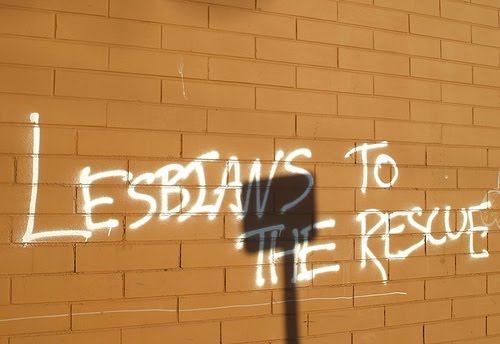
image credit: Lesbians to the Rescue by PinkMoose @ Flickr.com

in which I have some thoughts on men, pregnancy, and parenting

03 Thursday Jun 2010

Posted by Anna Clutterbuck-Cook in think pieces

≈ 4 Comments

Tags

children, feminism, gender and sexuality, masculinity

There have been a couple stories in the news lately revolving around men and procreation that have caught my eye in the last couple of weeks, and due to the phenomenon known as “needing something to post about today” I thought I’d throw them together in a post and share a few thoughts about them — or, more accurately, about the cultural narratives and expectations about men and manhood they represent.

The first is a post by Mary Elizabeth Williams @ Salon that provocatively asks whether “men have a right to choose an abortion,” or, more accurately how much right they have to decide when and how to become a parent. Although she links to a story by Stephanie Fairyington @ Elle in which a man named George Bruell tried to pressure his girlfriend to have an abortion after she unexpectedly got pregnant after the couple (he thought) had agreed they didn’t want to have children.

The Elle article contains a lot of crap from anti-feminist “men’s rights activists” whose entire goal seems to be the struggle to free men from relational responsibilities supposedly forced upon their freewheeling selves by scheming women and their dependent children. Although updated for the 21st century, this is a narrative surprisingly reminiscent of virulently misogynistic views of women and families found in 1950s and 60s-era diatribes by men who were as unhappy with the postwar mythology of the Father Knows Best lifestyle as feminists, but rather than blame institutionalized sexism they blamed women and women’s essentially domestic, acquisitive nature that required men to work long hours to support a suburban lifestyle.

Like these postwar misogynists, the “men’s rights activists” in this story are not interested in dismantling sexist structures that warp expectations of heterosexual relationships; they’re not interested in fighting for better reproductive justice for all — they already think women have all the power and they feel aggrieved. As Fairyington writes of Mel Feit, head of the National Center for Men,

Feit’s list of grievances range from sexist social standards — why should men still be expected to foot the bill on dates? Why is crying or showing weakness verboten for them? — to what he considers discrimination enforced by the state: men’s lack of reproductive rights combined with unfair child support laws. “Reproductive choice isn’t a fundamental right if it’s only limited to people who have internal reproductive systems,” Feit says. “If it only applies to women, it’s a limited right and that weakens it.” In his view, Planned Parenthood’s motto — “Every child a wanted child” — should apply to both people who make the baby.

Most of these arguments, taken individually, are issues feminist have championed for years. The insidious problem with these grievances is not that (most of them) are inaccurate but that they are not connected to any analysis of the cultural construction of gender or understanding of institutionalized sexism. Or an awareness of how — in our culture — gender operates dualistically and women are disproportionately vulnerable in a world where patriarchal structures are still the default. This doesn’t mean patriarchy doesn’t hurt men too — as feminists, male and female, remind us continually — but it does mean that deconstructing masculinity and the expectations of men and manhood must be done with an awareness of women’s position in the here-and-now-society. Men’s rights activists seem to imply that somehow women, as a group, are (for example) forcing them to pay for dates, whereas most feminists wound point to our cultural construction of manliness that associates male power and sexual appeal with economic power to such an extent that feminist calls for an end to gendered dating expectations are usually met with anxious speculation about how feminists are trying to emasculate men. Ditto on the issue of crying and/or showing weakness.

Women as a group, in other words, are not these guys’ biggest enemy. Their enemy is anyone (male or female) who supports oppositional, essentialist gender roles.

But back to the question of men, pregnancy and “choice.” Here’s what I have to say about men and the “right to choose.”

1) The final decision whether or not to have an abortion is always the pregnant woman’s. Like any medical procedure, it is the patient who needs to have the final say about what happens to her body. End of story. Obviously, this happens in the context of a medical profession in which doctors (ideally) advise patients about the full range of options available to them. Ideally a pregnant woman trying to decide whether to carry an unplanned or dangerous pregnancy to term would consult with her partner, family, friends, trusted religious adviser, therapist — whomever she needs to help her make the best decision given the choices available. But at the end of the day, it’s her body and therefore her decision to make. If the pregnant person is male-identified or in part male bodied, then the decision would be his. This isn’t a gender-bias, it’s a question of bodily integrity and who has a say about what happens or doesn’t happen to your body.

2) Apart from abortion, men have as many options for preventing parenthood as women. If you don’t want to get pregnant at a given time, with a given partner, take steps to prevent it. Men are not at the mercy of women in this arena. Here are some of the ways male-bodied persons can prevent pregnancy.

a) refrain from sexual activity that could result in pregnancy such as penetrative penis-in-vagina sex with women, or other types of sexual activity in which your sperm risks getting on or in a woman’s vagina. The plus side to this method of pregnancy prevention is that it might encourage you to realize how many other types of sexual activity are out there to enjoy, either on your own or with a partner. One totally risk-free option for anyone who’s bisexual is deciding you’re only going to have sex with other men — no chance of pregnancy there! Cunnilingus is another way to enjoy your partners body with no chance of sperm + egg = pregnancy. Look on this as a change to experiment and discover new forms of sexual pleasure.

b) use various types of birth control which hopefully you are already familiar with when it comes to prevention of sexually transmitted diseases. there’s sadly no birth control pill yet on the market for men, but in the meantime you have condoms which are pretty damn reliable when used correctly and consistently. If you’re sure you never want to have children, you can always decide to get a vasectomy which solves the accidental pregnancy problem in all but extremely rare cases and puts the choice of pregnancy prevention squarely in your hands.

c) this should go without saying but usually it doesn’t, so I’m going to say it: COMMUNICATION is incredibly important to a satisfying sex life, and that includes doing everything you can to make sure you and your partners are on the same page when it comes to babymaking. Obviously, in situations like Bruell’s story above, communication failed and people are now stuck with the messy real-life consequences. But good communication upfront can certainly prevent a great deal of messy post facto problems, just like securing enthusiastic consent to sexual activity helps prevent instances of sexual assault.

Finally, 3) While difficult, I do think it’s viable (and not anti-feminist or anti-child) to create a legal framework for men to surrender parental rights and responsibilities up-front if a sexual partner with whom they are no longer involved decides to carry a pregnancy to term. As feminists, we have argued that it is the best-case scenario for parents and children when all children are wanted — when parenthood is a role enthusiastically chosen and when children are cared for both by their primary caregivers and by society as a whole. Women who do not choose abortion have the option to surrender the child they birth either to an adoptive family or to the state system. This often isn’t an ideal situation for the child, but it is a legal framework that recognizes that mothers sometimes feel the task of parenting to be beyond them.

There’s a whole tangle of social and legal issues here relating to competing visions of a social welfare state and the responsibility of society as a whole to enable primary caregivers to parent — but for the moment, let’s assume the birth parent has chosen not to parent and wants to hand that responsibility over to someone else. Mothers who give birth can choose to surrender their parental rights and responsibilities legally, and I believe men should have similar legal options.

I just wish the men who are advocating for them wouldn’t ask for them in a way that is hostile to women’s basic right to bodily integrity and decisions surrounding their physical person. It shows a pretty stunning lack of awareness of reproductive rights and justice issues that Feit and company really ought to be engaged in, or at least aware of. Instead, they seem to have adopted the rhetoric of women’s rights in much the same way Sarah Palin has taken to using the language of feminism — to peddle a toxic tangle of misplaced misogynist resentment that lashes out at vulnerable targets rather than working to dismantle the sociocultural structures that constrain us all.

* * *

The second story comes from Amelia Hill @ The Guardian (hat tip to Hanna for the link). I knew we were in trouble from the opening sentence, “Expecting men to take an active role in their partner’s pregnancy and attend the birth of their children can deskill them as potential fathers and damage paternal bonding, an expert has claimed.” While I’m not an anti-intellectual, and I believe in the value of expertise (our highly complex modern world necessitates a certain amount of specialization), I’m always skeptical when an “expert” claims to have the final word on how a certain activity is going to affect complex human beings.

The disappointment and feeling of failure experienced by men expecting to have an intimate and proactive role as their baby gestates, only to find their function is largely one of passive support for their partner, can cause emotional shutdown, according to Dr Jonathan Ives, head of the Centre for Biomedical Ethics at the University of Birmingham.

“Having begun the fathering role already feeling a failure may destroy his confidence,” Ives said. “It can then be very difficult for him to regain faith in himself once the baby is born and move from that passive state to being a proactive father. His role in the family is no longer clear to him. He effectively becomes deskilled as a parent and this can lead to problems bonding with the child.”

Oh, I have so many issues with this way of understanding parenthood! “Support” for a pregnant partner is somehow the opposite of being “intimate” and active? Men are somehow incapable of grasping that their pre-natal and post-partum roles will, like women’s, be different? Men as a general rule have so little self-confidence that being asked to do something like being present and supporting during pregnancy might actually destroy their ability to parent? And I have to say I’m baffled by the assumption that this feeling of inadequacy is unique to fathers — it’s always been my understanding that most parents, regardless of gender, feel profoundly inadequate for the task at hand.

And this might actually be a good thing, as the article (thankfully!) goes on to point out.

Adrienne Burgess, head of research at the Fatherhood Institute, said: “That experience of helplessness that Ives is saying is so dangerous, is, in fact, the perfect preparation for fatherhood: there are times as a parent when you can’t do anything to help your baby, when it’s crying all night and can’t be soothed. Part of being a parent is being there for your partner and child without doing anything except providing love.”

I just really want to emphasize what Burgess says here, because I think it highlights the chasm that exists between the neotraditional conception of masculinity and fatherhood that relies on rigid separation of male and female duties and a conception of masculinity and fatherhood that, well, relies on the notion that men are human beings capable of a full range of human responses. In the neotraditional version of masculinity, men must be protected at all costs from being made to feel helpless, from being (in a word) emasculated. Helplessness sets them up for “failure” and failure is so shameful and world-ending that men must avoid it at all costs — up to and including the cost of not being present to their partner during pregnancy and at their child’s birth.

In the men-as-humans model that Burgess puts forward, however, helplessness is simply part of the human condition, a run-of-the-mill part of parenting and family life. That we’ve elevated the power of parents (fathers perhaps particularly?) to such Godlike heights that the notion that inability to change the course of events necessarily equals “failure” is stunning to me. To argue that men should be encouraged to avoid the parts of family life that entail helplessness is, in my mind, a wildly unhelpful (at best) perhaps even unethically negligent (at worst) recommendation. It is akin to arguing that if a friend or family member is diagnosed with incurable cancer you should just quit spending time with them because you can’t do anything to cure them.

More often than not, it’s our simple presence — loving, nonjudgmental, patient presence — in the lives of others that is what matters. This is a skill that all of us could do well to hone, whether we are parents or children, spouses or partners, friends or extended family members. It is a skill that should be genderless, and one which we would do well to encourage all soon-to-be parents to practice with one another and, once the child arrives — by birth or other means — with that child as well.

arbiters of the appropriate? more on kids and public space

20 Thursday May 2010

Posted by Anna Clutterbuck-Cook in think pieces

≈ 3 Comments

Tags

bigotry, children, politics

Irrational Point @ Modus dopens has a great addition to the conversation about why saying you “hate children” is problematic, and why debates about children in public spaces so often miss the mark (on both sides of the chasm!).

She makes a list of thirteen ways she sees people talking about children and/or parents in public spaces that she believes are discriminatory. They’re all worth reading and thinking about as we move through the world (and the internets), but I wanted to highlight a couple of particular ones.

People who think that all fussing, “noisy,” or “socially inappropriate” behaviour is misbehaviour get very little sympathy from me. Children may fuss because they are legitimately upset or uncomfortable. It’s not, like, totally unheard of for adults to raise their voices when they are upset either. Children may be a bit noisy because they have little concept of the noise they make (something which applies to many adults too). Children may display “socially inappropriate” behaviour just because, well they haven’t learned all that stuff yet, what with being little kids and all. Some adults haven’t learned them either.

I think this is particularly important to remember for two reasons.

One is that any one person’s idea of “socially inappropriate,” stopping short of one person attacking another (physically, materially or emotionally) is very subjective. We all have our own options about what kind of behavior crosses the line of what’s public and private. Sure, we can make our opinions known (i.e. “people who talk on their cell phone in the subway drive me crazy!”), and sure we can have conversations about how to share public spaces with others…but assuming we have the right to be the arbiters of what is or is not “appropriate” in public is a huge presumption. IP goes on

Statements of the form “x shouldn’t go out in public if y” make me distinctly uncomfortable because they assume that public spaces somehow belong to the speaker or the speaker’s Kind of People, and they get to decide who uses the public space. No deal. Public spaces get to be used by everybody — the clue is in the word “public.”

Many of the folks who assert their “right” (or at least desire) to be segregated from young people in public spaces are the same folks who speak out stridently against segregation according to race, gender, able-bodiedness and many other ways in which human beings discriminate against each other. I really do hope that we can start moving toward a better understanding of how these debates about where children do and do not belong — and how they should be “controlled” or “behave” when they are there — employ narratives of exclusion (exclusion, I would argue, often based on similar fears of the Other and the desire for social control) strikingly similar to narratives used to justify excluding women from male spaces, men from female spaces, people of color from white spaces and so on.

Which brings me to the second point I want to highlight. Beyond the dangers inherent in trying to arbitrate who does and does not belong in public spaces (you want only people over twenty-one at your wedding? your prerogative), the “I don’t want children in X space” argument is a form of Othering. It moves us away from focusing on a particular human being in a particular situation (whose actions may be an understandable response to situation Y) and instead draws upon our assumptions about children and about how “they” behave in public. The child sobbing in the cart behind you at the grocery store becomes The Child — representing all children, everywhere — who (in our minds) is incapable, simply because they are Child, of behaving “appropriately” (see point one) in public.

As IP points out in comments, musing about the importance of designated quiet spaces (on commuter trains, for example)

When I’ve worked with disabled kids, having a space that’s set aside as a “quiet room” can sometimes be really important. Kids can get too stressed out if there’s lots of noisy shouting and playing, just like adults can. So it’s not like the desire for some quite time is unique to adults, nor is quiet behaviour unique to adults.

The important thing, I think, is not to have entire classes of spaces (eg, restaurants) defined as “quiet” or “for grown-ups”, because that rules out too many people, and isn’t consistent (adults do talk, and laugh and play music in restaurants. Why shouldn’t kids?)

We hear a child screaming and instead of imagining that the child — as one particular human being — may have a good reason for being upset (don’t we all have bad days??) we ascribe the behavior to individual child as a group character trait. We stereotype. And in stereotyping, we lose site of the individual person. We dehumanize. We want this class of thing (Child), which we imagine incapable of any other type of behavior, out of our space where it is disrupting our lives.

And because of this animosity and impulse toward dehumanization on a cultural scale* the child (and by extension, the parents in many cases) cease being able to move through the world as human beings — who have good moments and not-so-good moments, highs and lows — and start bearing the burden of Ambassador for One’s Kind. It’s like being the one guy in a women’s studies class, whom everyone turns to (completely unfairly) for the Male Perspective. Or being the one woman of color. The one queer.

Hey, I’m glad that some people are able and willing to take on this role — and possibly by being a good ambassador help people think twice about their own prejudices and preconceptions. But I don’t think it’s the responsibility of all children and parents to be constantly, 24/7, model citizens.

As IP writes, “People who say ‘I don’t have to want kids…’ are right. You don’t have to want kids. And accommodating kids ain’t the same as saying you have to want to have kids.” Too often, it seems like, this conversation about children in public spaces turns into a mudslinging match over whether or not people who do not wish to be parents or caregivers are lesser human beings, less capable of love and compassion (see my post on the problem with Mother’s Day). People on both “sides” of this supposed dichotomy (“kids are angels” vs. “kids are demons”) fall into this trap. And in my opinion it detracts from the larger human rights issue, which is that children aren’t angels or demons, but simply people with the right to exist in public spaces just like the rest of us.

Sadly, as people have been pointing out in comments over at Modus dopens, all too often these conversations end up devolving into a scrabble for what are (rightly or wrongly) perceived to be precious and limited resources: a quiet park bench, a space on the bus, the attention of a sale’s clerk, right of way on the pavement. As ommenter Ariane writes

I think so much of this subject gets so wound up in the fact that pretty much everyone has been treated very shabbily by someone from a different “camp” at some point. There isn’t a parent who hasn’t been berated unreasonably, there isn’t a person who hasn’t found some other person’s child unbelievably difficult to tolerate, there isn’t a disabled person who hasn’t been treated abysmally, there isn’t a childfree woman who hasn’t been damned for not mothering. It’s so hurtful, it’s really hard not to resent other groups for not copping what you cop, or to remember that they are copping their own tailored abuse.

When we advocates of children’s human rights speak about the importance of treating children as people, often what is heard by skeptical listeners is the message that children and children’s needs are more important than adults (read: more important than them). What skeptics hear instead of “children are people with human rights” is, “children are extra special people who have the right to be the center of attention always and never be asked to treat others with care and compassion.”

I’ve been thinking a lot lately about what to do about this mis-communication. And, to be honest, I’m really not sure there are quick solutions…other than continuing to point out that seeing children as people means being equally critical of both characterizations: the angel-child as well as the demon-child. In my world, there are no “good children” or “bad children”…just “children.”

And, too, I think it’s really, really important to emphasize that the goal is to find a way of sharing our public spaces in a way that enables everyone, as much as possible, to enjoy them, utilize them, move through them — whatever our individual goals are. This is not about taking space away; it should not be about denigrating one set of peoples’ needs in order to elevate another set of people to a position of privilege. The goal is to create a world in which all of us have less occasion to scrabble, feel desperate, freak out, or live in anticipation of being found socially “inappropriate” by another human being.

Some related links:

Irrational Point @ Modus dopens | The whole “I hate kids” thing.

Sybil @ BitchPhD | So, Ok.

Jill @ Feministe | On Hating Kids.

For my own previous posts on this topic, see:

not-so-quick hit: bigotry towards children | 4 may 2010

teaching moment: children are people too | 12 december 2008

children are people: take two | 17 december 2008

and, on a related note, today, I am able | 1 may 2010

*Again: this is not only (or even primarily) about individuals behaving intolerantly toward young people in public, this is about how we as a society talk about children’s presence in public spaces — and how that talk informs how we, as individuals, respond to actual sightings of said children in said public spaces.

*image credit: mum tries to escape – ELLE # 3, Mar 2010 by pixel endo @ Flickr.com.

un-mother’s day: thoughts on a problematic holiday

18 Tuesday May 2010

Posted by Anna Clutterbuck-Cook in think pieces

≈ 3 Comments

Tags

children, feminism, holidays, politics

There’s a wonderful scene in the British sitcom My Family in which the parents (Ben and Susan) attempt to speak with the parents of a child who is bullying their son. The other parents are having none of it.

“Now we know you think of yourselves as good parents–“ one of them begins to say condescendingly to Ben and Susan.

Susan and Ben look at each other.

“No,” Ben hastily clarifies, “we don’t think of ourselves as good parents. We just think of ourselves as parents.”

It is in that spirit, I offer you the fabulous Anne Lamott @ Salon on why she hates mother’s day

I hate the way the holiday makes all non-mothers, and the daughters of dead mothers, and the mothers of dead or severely damaged children, feel the deepest kind of grief and failure. The non-mothers must sit in their churches, temples, mosques, recovery rooms and pretend to feel good about the day while they are excluded from a holiday that benefits no one but Hallmark and See’s. There is no refuge — not at the horse races, movies, malls, museums. Even the turn-off-your-cellphone announcer is going to open by saying, “Happy Mother’s Day!” You could always hide in a nice seedy bar, I suppose. Or an ER.

* * *

Don’t get me wrong: There were times I could have literally died of love for my son, and I’ve felt stoned on his rich, desperate love for me. But I bristle at the whispered lie that you can know this level of love and self-sacrifice only if you are a parent. We talk about “loving one’s child” as if a child were a mystical unicorn. Ninety-eight percent of American parents secretly feel that if you have not had and raised a child, your capacity for love is somehow diminished. Ninety-eight percent of American parents secretly believe that non-parents cannot possibly know what it is to love unconditionally, to be selfless, to put yourself at risk for the gravest loss. But in my experience, it’s parents who are prone to exhibit terrible self-satisfaction and selfishness, who can raise children as adjuncts, like rooms added on in a remodel. Their children’s value and achievements in the world are reflected glory, necessary for these parents’ self-esteem, and sometimes, for the family’s survival. This is how children’s souls are destroyed.

I encourage you to read the whole piece at Salon.

I’ve written a few blog posts lately about seeing children as people, rather than — as Anne Lamott puts it — “adjuncts” of parental or adult objectives. I believe, as Lamott writes here, that such objectification of young people is destructive to the soul.

But today I’d like to focus — as Lamott does here — on what harm the stories we tell ourselves about parents do to adults. And the particular effect they have on the way we (as a culture) percieve those of us who are (whether by accident or design) not-parents.

And I’ve chosen to use the phrase “not-parents” instead of “childless” or “childfree” deliberately, because I am starting to believe that this narrative of parents vs. not-parents has little to do with children and everything to do with adults. With our cultural assumptions about what it means to be a responsible grown-up human being in the world. I believe it has everything to do with the way adults past a certain age (roughly post-college) are read culturally by those around them, for signs of parent or not-parent status, and judged by a set of cultural assumptions about what it means to lack (or forego) experience of the parenting role.

The assumptions are not pretty.

I’ve become much more aware (often hyperaware) of these constant “non-parent = bad” messages since I’ve been partnered with someone who does not wish to parent. As a child, I wanted to be everyone’s mother: I parented pets, my siblings, my next-door neighbors. I had fantasies about adopting orphans from war-torn Sarajavo, birthing multiple babies I’d hoist on my back and carry with me as I explored the globe. I was an adventurer, a take-charge tomboy (although my parents never employed the word, and bless them didn’t blink when I announced plans to be a princess who was also a lumberjack in the local arts center play) while also being a caretaker and nurturer.

And I was absolutely rewarded, socially, for that behavior. Adults marveled at how “good” I was with children, and trusted me with the responsibility of looking after young ones. I fit the story, so I was slow to challenge it. Plus, my parents have never been pushy with any of us kids about getting married or becoming parents ourselves (thank you Mom and Dad!); I never felt any direct familial pressure to find a partner and somehow acquire offspring for them to grandparent, carry on the family line, or somehow fulfill my destiny as a female-bodied person. But, because I am capable with young people, because I am generally patient with those around me (often to a fault), I can fill that caretaker role people expect of women in the world — even women who are not obviously attached to the children who happen to be in their vicinity. And most of the time, at least on a casual basis, I’m willing.*

So I was sheltered, personally, from the stigma of being a Woman Who Didn’t Want To Be a Mother. But now I see (or at least try to see) the world through Hanna‘s eyes some of the time, and I’ve been thinking a lot more about our culture’s obsession not just with a certain image of young people as Children (to be feared or commodified), but of adults as Parents (who are either “good parents” or “bad parents,” not simply…parents).

Not-parents have no space in this world of Parents and Children. Or rather, their position in the world is analogous to that of the Old Maid in relation to Wife: “life: FAIL.”

I’m speaking here, I want to emphasize, in terms of cultural narratives, not actualities. There have been some amazing not-parents (both women and men) in my life. I will be forever grateful to them for modeling the possibility of having an adult life rich with relationships that does not depend on the role of full-time parent. This is about perceptions and stereotypes, which — although they do not dictate our material realities, do narrow the range of possible stories we have at our disposal when trying to explain our life choices, to ourselves and to others. As Anne Lamott writes: “Ninety-eight percent of American parents secretly feel that if you have not had and raised a child, your capacity for love is somehow diminished.”

I’d argue that many not-parents also believe this about themselves and other not-parents around them, in the same way that women are often each others’ harshest critics when it comes to complying with beauty standards or men punish each other for displays of emotions other than anger. In our culture, to be unaccessorized with children means one is broken in one of the most profound ways a human being can be broken: it means that one’s “capacity for love is somehow diminished.”

Just: NO.

I’m not okay with this story. I am not willing to accept a narrative of humanity that implies my partner — who does not want to be a full-time parent — is somehow broken, that she lacks compassion and the ability to love. It is, quite simply, not true. She has a HUGE heart for the world, sometimes so attuned to its sufferings that I am humbled by her capacity for empathy.

And I’m not okay with a cultural narrative that requires she perform extra cultural work to prove that — despite her decision not to parent — she is, in fact, not broken, not selfish or heartless, or incapable of loving.

These stories we tell each other, which privilege certain relationships and roles over other relationships and roles seems on the surface to be to the advantage of a certain group of people (in this case parents) over another (not-parents), but in the end it only serves to punish all of us for not living up to the ideal Good Parent in the collective imagination, rather than acknowledging that at the end of the day most of us are “just parents,” “just human,” and have at our disposal myriad opportunities to express love and care for others regardless of the kind of relationships with nurture.

Let’s celebrate those qualities, human qualities, that are not contingent on performing certain pre-determined roles (Good Mother, Good Father, Good Child) or being handed certain responsibilities, held to certain expectations, that go with those roles. Let’s instead celebrate the boundless capacity of all of us human beings to engage in loving, nurturing activities throughout our lives.

That’s a celebration I could get behind.

Anne Lamott said it first, and far more eloquently, here.

*As I said in my last post on bigotry towards children, I’m not, at the moment, planning to commit to the full-time parenting thing.

are we talking "acting" or "passing"? (and why it matters)

15 Saturday May 2010

Posted by Anna Clutterbuck-Cook in think pieces

≈ 2 Comments

Tags

arts and culture, gender and sexuality, politics

A lot has been written in the last week or so criticizing an opinion piece by Ramin Setoodeh published in Newsweek in which he appeared to claim that gay actors are unsuccessful at playing straight (see Jos @ Feministing for more details).

Yesterday, upset that “the internet” is dumping hate on him, Setoodeh published a response to these responses, claiming that the critiques of his original article are off base

But what all this scrutiny seemed to miss was my essay’s point: if an actor of the stature of George Clooney came out of the closet today, would we still accept him as a heterosexual leading man? It’s hard to say, because no actor like that exists. I meant to open a debate — why is that? And what does it say about our notions about sexuality? For all the talk about progress in the gay community in Hollywood, has enough really changed? The answer seems obvious to me: no, it has not.

Here’s the thing. The way Setoodeh frames the question the second time around, he makes it clear that the question is about how society at large responds to knowledge of a queer actor’s sexual orientation. If a successful actor, known for playing straight romantic leads, suddenly came out as gay (that is, in real life not interested romantically in women), how would the hitherto rapt audience respond?

Setoodeh claims they wouldn’t respond well. And if that was truly the gist of his argument, I’d be totally on board: we do, as a culture, respond uncomfortably to people playing characters whose sexual orientations don’t match their own. How much, and how consistently, we respond negatively to gay actors playing straight is another question. As others have already pointed out, he cherry-picks his examples and shoehorns them into the argument he wishes to make. He also blithely skims over the question of straight actors playing gay characters, suggesting they don’t catch flack for accepting such roles. While it’s possible that actors who are straight have more room to maneuver, I’d question whether someone James Franco (who played Sean Penn’s lover in Milk) never faced questions about his own sexuality. He was definitely questioned closely by Terry Gross about how he was able to play a character whose sexual orientation did not match his own. People speculate, and given the homophobia in our culture, those speculations are often mean-spirited.

The bigger problem, though, is that that wasn’t his original argument (or at least not all of it). Setoodeh’s original essay targeted actor Sean Hayes in his stage performance as a straight male lead in Promises, Promises, arguing that Hayes was unconvincing as a straight character because, according to Setoodeh, he’s just so flamingly gay.

But frankly, it’s weird seeing Hayes play straight. He comes off as wooden and insincere, like he’s trying to hide something, which of course he is. Even the play’s most hilarious scene, when Chuck tries to pick up a drunk woman at a bar, devolves into unintentional camp. Is it funny because of all the ’60s-era one-liners, or because the woman is so drunk (and clueless) that she agrees to go home with a guy we all know is gay?

What strikes me about the difference between these two arguments is where the burden of responsibility is placed. In the first piece (above), Setoodeh is critiquing Hayes for failing as an actor to play straight, suggesting that in order to play a character Hayes has to “hide something” (his sexual orientation), as if this is somehow categorically different from the task that faces all actors: to embody a character on stage whom they, as human beings, are not in real life.

I understand this impulse to a certain extent. We generally place the burden of embodying a role on actors, stage and screen. After all, that’s their job: to play a part. We go to the theater expecting the cast and crew to create an atmosphere in which we can suspend our disbelief — in which we can put aside our knowledge that these are human beings on a stage telling us a story — and experience that story through a collaborative leap of the imagination.

But the suggestion that Setoodeh is uncomfortable with Hayes performance because he feels he’s being lied to is where this actors-bearing-responsibility things breaks down for me.

If our knowledge of an actor’s personal life (say, their sexual orientation) changes the way we — as audience members — interpret their performance, doesn’t that shift the burden of responsibility back to us? If the onscreen chemistry between George Clooney (to use Setoodeh’s example) and his leading ladies changes in our minds once we imagine he’s gay (incidentally: why is bisexuality never a part of these conversations? hello??) then the problem is not with the actor (whom, until we believed he was not-straight seemed to have all the chemistry in the world) but in our heads.

I’d suggest, here, that Setoodeh might learn something from the discussion within the trans community about the problematic framework of “passing,” which places the burden of performing gender identity and/or sexual orientation on the individual rather than on the audience (society) which interprets appearance and behavior according to all kinds of social cues that are completely outside the control of the individual. See, for example, Bear Bergman’s essay “Passing The Word” in The Nearest Exit May Be Behind You.

When we continue [in the trans community] to use the word pass, we continue to hamper ourselves by endlessly repeating a narrative of deception, not to mention the legacy of racism, the cultural arrogance, and the spectacular level of objectification it brings with it….I would rather move the burden back where it belongs, to the observer, the person whose cultural lens and personal locations on so many aces are in so many ways the day-to-day deciders of how a person is read….passing is fleeting, tricksy, temporary. But what it takes or means to read depends, rightly and righteously, entirely on who’s doing it (112).

I’m sure there are “bad” actors out there — actors who, regardless of sexual orientation, struggle to set aside themselves in order to embody a character who is not them. I’m a terrible dissembler: it’s one of the reasons I write nonfiction instead of fiction and gave up my childhood dream to be in musical theatre. I realized I had no interest in being anyone other than myself, and in fact felt profoundly uncomfortable whenever I tried to slip out of my skin and into someone else’s. But Setoodeh isn’t dismissing Hayes because he thinks the guy is a bad actor. In his initial piece, he is quite clearly suggesting Hayes isn’t successful because he’s gay.

This, for me, is where his where his credibility as a cultural critic breaks down. Want to critique an actor you think is doing a shitty job? Sure: your prerogative as a consumer of theatrical performances. Want to speculate on how our cultural narratives about human sexuality impede our ability to suspend disbelief about actors playing characters whose sexuality differs from theirs? I’m with you all the way. Suggest that actors (particularly non-straight actors) are incapable of playing characters with an orientation not their own? So…what: hetero actors can only play hetero parts, gay and lesbian actors can only play queers, and those of us who are bi are really (taking this argument to its logical conclusion) the only people capable of auditioning for any role going?

I just can’t buy it. It’s a huge fucking red light that suggests to me the issue is not the actor’s abilities, but rather with the audience member who is unable to let go of their discomfort at seeing someone not-straight play someone who is. Which, as Setoodeh points out in his second piece, has everything to do with “our notions about sexuality,” our way of reading the actor we know to be gay, rather than with that person’s skill as an actor to embody the character they have chosen to play on the stage.

*image credit: Ianto and Jack, Torchwood, Season Two, still from To The Last Man, snagged from Moansters Incorporated.

"it’s Michigan": some thoughts on regionalism

13 Thursday May 2010

Posted by Anna Clutterbuck-Cook in think pieces

≈ 5 Comments

Tags

bigotry, michigan, politics

So I’ll start out this post by saying up front that there are myriad personal and political reasons why I moved out of West Michigan. I spent the first twenty-six years of my life (with a few brief gaps) living in or near Holland, in Ottawa County, one of the most politically conservative counties in the nation. While my liberal (dare I say radical?) parents did what they could to connect us with other like-minded families and groups, both local and far-flung, it was clear we were out of step politically, culturally, religiously with the majority of our fellow residents. At of this writing, I’m living in Boston, my brother in Portland, Oregon and my sister leaves Holland in a few weeks’ time for Austin, Texas. We’ve all felt the need to get the hell out of Dodge, so to speak. At least for a while. And our parents have understood, completely, our reasons why.

But, in part because I lived for so long in the area, I resist writing Holland off as a town full of Euro-American Calvinists, insular and disengaged from the political and sociocultural issues of our era. I became who I am not only despite, or in opposition to, the people around me as I grew into my twenties: I became who I am, as well, thanks to the encouragement and example of many, many mentors. Some of whom were Hollanders born and bred, some of whom had moved to West Michigan from other parts of the country (or, in some cases, the globe). These people are part of Holland, too, and far from being glad I got the hell away I’m often acutely saddened that I left them behind.

I’ve been thinking about all this again in the past week for a couple of reasons. One is the conversations that have taken place in the wake of last Friday’s decision by the Hope College Board of Trustees not to rescind the College’s 1995 stance against homosexuality. There is, justifiably, a lot of anger about the College’s decision, and a lot of the national net-based coverage (and associated comment threads) have characterized the decision as one that is right-wing religious wingnuttery (agreed!) that is more or less what one could have expected from small-minded, religiously conservative small-town Midwesterners hmm . . . possibly not-so-agreed).

“It’s Michigan,” wrote one ex-Michigander in a comment at Change.org. “Those Neaderthals up there HATE gay people.”

This view of West Michigan was shared, after a fashion, by Jill @ I Blame The Patriarchy who recently traveled to Holland and Saugatuck (twelve miles south of Holland) to visit relatives. A trip which she documented in her customary snarky fashion last Monday.

Back in Holland Michigan, at one of the 358 or 359 Tulip Time parades down the main drag, I made a few observations.

1. I espied a float, sponsored by the Turning Pointe School of Dance and Borculo Wrecker Service, toting the Holland Area Mothers of Multiples. Nothing warms a spinster aunt’s heart like the spectacle of white women dressing up like LDS wives and getting acclaimed for their feats of reproduction.

2. No persons of color attended the event.

3. White people in Holland, Michigan, when feeling festive, eat things called ‘elephant ears’: absurd globs of fried dough the size of hubcaps.

Again, don’t get me wrong: having lived through Tulip Time as a local for twenty-six years, I have no illusions about its “wholesomeness” quotient. The whole thing was invented during the 1920s as a municiple beautification project that had less to do with historic ties to the Netherlands than it had to do with ethnic stereotypes about the Dutch drawn from the Old Dutch cleanser girl ads of the era (Jill, this might make the whole “street scrubbing” phenomenon a little clearer!) As Jill rightly observes, Tulip time is terrifying! Though I’d argue more in a Waiting For Guffman way, rather than in a Stepford Wives kinda way. As my mother summed it up in a recent email: “Tulip Time pretty much a pain.”

So in many ways, I agree with these observations. That is, most stereotypes have within them an element of truth. Holland and Hope are not exempt from any of the “isms” that plague the rest of the nation: racism, sexism, homophobia, class divides, political divides, etc. Holland has a significant Latina/Latino and Asian-American population, as well as other non-Dutch, non-Euro-American populations whose presence is often ignored or sidelined when it comes to community celebrations. Particularly when it comes to Tulip Time.

The problem with these narratives of insularity and exclusion, however, is that too often they rely on the larger story we tell ourselves (on both the right and the left) about Middle America. Since moving to Boston I’ve become more aware of the way in which “the Midwest,” as a region, occupies the space of the Other in the minds of many folks who live in big cities in the East and West. This is by no means universal (I don’t want to perpetuate the same Othering here I’m trying to call out in this post!) but it can be frustrating to hear one’s home town or region, with all of its multi-layered, globally-interconnected politics, be dismissed as full of bigoted, white fundamentalist Republicans.

This ignores the presence of bigoted, white fundamentalist Republicans in America’s coastal urban centers and likewise erases the presence of non-whites, non-Christians, liberals and queers from anywhere except cosmopolitan cities.

Racism happens in Holland, Michigan. Every day. It also happens on the streets of Boston. Homophobia happens here (in Boston) as well as there (in Holland). Neither coastal, urban America nor cities in the Midwest have a monopoly on progressive politics or small-mindedness and bigotry. Geography doesn’t determine personal or community values. We do.

I suspect that a lot of the knee-jerk ridicule of “small town America” (although Holland is hardly a small town) rings true to a lot of folks precisely because they’ve escaped, escaping, or ardently wish to escape, from their own places of origin. The Midwest of our minds is Anywhere, USA: the deadend, insular place where motivated people escape from to the urban centers, full of the chaotic possibilities of freedom and self re-invention.

The urban/rural cultural narrative works both ways, depending on which side of the argument you’re on (folks can argue for the superior conservative morality of rural and Midwestern spaces or for the superior cosmopolitan morality of urban, Coastal spaces) and both are reductive. Both erase anyone living in those spaces who do not fit the stereotypical image of the region.

This also lets both groups off the hook, allowing folks who argue both sides of the coin to claim they’re spaces are more inclusive, more diverse (if you’re on the liberal side of the argument) or more Christian, more harmonious (if you’re on the conservative side). It allows us to assume there is a simple “geographic cure” for what ails us, socially and politically as well as personally, rather than challenging us to dig in and do the hard work of being the change we want to see in the world no matter where in this country we happen to live.

I fail at this constantly. I roll my eyes at West Michigan and say things like, “What did you expect? It’s Michigan.” I left Holland because I got tired of running up against the same (seemingly immobile) ideological walls. I was tired of having to start (or end) every discussion of values with the Bible as lingua franca. I was tired, I was lonely. So I left.

But I want to be careful to remember (this post is a reminder to myself as much as anyone else) that that shift of mine was not, geographically speaking at least, a move to somewhere better. It is only somewhere different.

*image credit: 8th Street by eridony @ Flickr.com.

the politics of (another kind of) choice

12 Wednesday May 2010

Posted by Anna Clutterbuck-Cook in think pieces

≈ 7 Comments

Tags

gender and sexuality, politics

As a follow up to my letter to the Hope College Board of Trustees last week, I thought I would share a great article on queer politics found via the Bookforum (h/t to Hanna). Stephanie Fairyington @ Utne Reader offers a passionate, personal plea for queer activists to re-discover the language of choosing non-straight relationships and identities, in her essay The Gay Option.

Until homosexuality is cast and understood as a valid choice, rather than a biological affliction, we will never rise above our current status. We will remain Mother Nature’s mistake, tolerable (to some) because our condition is her fault, not ours.

By choice, I don’t mean that one can choose one’s sexual propensities any more than one can choose one’s personality. What I mean is that it’s a choice to act on every desire we have, and that acting on our same-sex attractions is just as valid as pursuing a passion for the Christian faith or Judaism or any other spiritual, intellectual, emotional, or physical craving that does not infringe on the rights of others. And it should be respected as such.

Fairyington acknowledges the enormous political advantages of framing non-straight sexuality as natural, rather than nurtured, proclivity — and she doesn’t reject the possibility (confirmed by her own personal experience) that one’s sexual orientation is something one is born with, and is immutable.

At the same time, she challenges us to recognize that this political strategy — which has made real gains for the human rights and legal protections of non-straight, non-gender conforming folks — is a claim to rights that relies upon queer sexuality being a biological trait does not require those with anti-gay sentiments to re-examine their understanding of homosexuality as a physical or emotional deformity: rather, it is a framework perfectly adaptable to their claims to success in ex-gay therapies or a quest for “the gay gene” which could somehow be manipulated to alter someone’s sexual desires.

The typical conservative assault on homosexuality casts it as a sinful choice that can be unchosen through a commitment to God and reparative therapy. And the left usually slams into this simplistic polemic by taking up the opposite stance: Homosexuality is not a choice, and because we can’t help it, it’s not sinful.

By affirming that homosexual practice and identity are a choice, we can attach an addendum—it’s a good choice—and open the possibility of a more nuanced argument, one that dismantles the logic of the very premise that whom we choose to love marks us as sinful and immoral and interrogates the assumption that heterosexuality is somehow better for the individual and society as a whole.

I grew up in a very conservative community (although my family and immediate circle of friends were by-and-large liberals), and I’m aware of how powerful the biology-based identity argument is when it comes to challenging folks’ assumptions about homosexuality = sin. Because arguing that someone is “born that way” draws parallels to skin color and biological sex — it seems like an easy hook. But likewise, I’ve also seen how the biological argument so often misses the point that the anti-homosexuality crowd is making. In short, the point that Fairyington makes above: that we selectively choose to act on our desires, and that those choices have moral and ethical implications. We may have thoughts of violent revenge, but choose to practice nonviolence. We may have thoughts of panicked self-defense, but choose to practice compassion.

If queer activists rely solely on the “it’s biology” argument, we miss the opportunity to make a moral and ethical case for same-sex relationships, and the capacity of those relationships to add to the sum total of joy and well-being in the world. This is a message much more radical, when you stop to think about it, than scientific debates over the origins of human sexual orientation. Those scientific explorations are stimulating from an intellectual perspective, but will not satisfy our desire as human beings to discern right from wrong. A scientific answer to the question of where same-sex desire originates may inform, but cannot dictate, what we do with those desires.

I think we would do well, as Fairyington proposes, to speak more often and with great passion about the ethical, life-giving nature of our relationship choices. We would do well to speak about following our passions for the sexual relationships that best nourish us and our loved ones. To speak about the way in which feeling at home in our skins when we move through the world grows our capacity for compassion for others (because we no longer have to work so hard to protect ourselves). To speak about the glorious, chaotic uniqueness of every human life, and how all of those lives (ours included) can honor [chosen diety or spiritual path here] through all manner of consensual sexual activities and relationships.

This in no way contradicts the notion that sexual orientation (be it hetero, homo, bi, or otherwise inclined) is biological in nature — but it does not rely on it either. Using both together, mixing and matching as reflects our own personal experiences, will hopefully broaden our options for political debate and give us a much stronger, multi-faceted place at the table.

alma mater update: in other unsurprising news…

08 Saturday May 2010

Posted by Anna Clutterbuck-Cook in think pieces

≈ 2 Comments

Tags

bigotry, education, gender and sexuality, hope college, human rights, michigan

Here’s the promised update re: Hope College and its Institutional Statement on Homosexuality, which I wrote about on Thursday.

The group Hope Is Ready, which has been one of those petitioning to have the statement withdrawn by the Board of Trustees, shared (through their Facebook page; apologies if this means you can’t follow the link) the following letter from Hope College President James Bultman yesterday afternoon.

May 7, 2010

Dear Members of Hope is Ready:

Thank you for your interest in Hope College and for the time and effort committed to sharing your concerns with the Board of Trustees. Your insights were helpful in our discussions. Those elected to hold the college in their trust have thoughtfully, thoroughly, and prayerfully considered your petition.

Relative to your petition, the Trustees have taken these actions:

1. The Board of Trustees denied your request to remove the 1995 Institutional Statement on Homosexuality

2. The Board of Trustees appointed a Trustee committee to expand the college’s 1995 position statement in the larger context of all human sexuality in such a way that the Hope community is called to a renewed encounter with the clear, demanding, and healing biblical witness regarding human sexuality.

The college’s current position on homosexuality is based on its interpretation of scripture. It is recognized that well-intentioned Christians may disagree on scriptural interpretation. Still, humbly and respectfully, the college aligns itself in its interpretation with is founding denomination, the Reformed Church in America, the orthodox Christian Church throughout the ages, and other Christian colleges and universities.

On behalf of the Hope College Board of Trustees, I thank you for your concern for the college we love and respectfully ask that you accept these decisions in the spirit with which they are rendered.

Cordially,

James E. Bultman
President

In short, it basically says nothing that hasn’t already been said, and the fact it was up on the web by 2:33pm yesterday afternoon makes it pretty clear that the Board of Trustees didn’t spend much time deliberating on their course of action.

Sad, despiriting, but unsurprising.

I’ll be thinking today about all those folks in the Hope College community — many of whom I’ve known my whole life — who do not think this way, and who work hard everyday to make sure the official college position is not the only one that gets heard.

I said in my letter to the Board, and I’m going to repeat it here: to tell any person that being sexual and making positive, fully consensual, sexually intimate connections with another human being is destructive to their spiritual well-being is an act of violence. To codify such a belief in an institutional statement makes it institutionalized bigotry, giving that belief the authority of college administration that has the power to materially effect the lives of students and employees.

I absolutely believe that such an act of violence runs counter to the Christian message that we are all called to increase joy, practice love, and work toward wholeness in the world. I don’t see how this decision by Hope’s Board of Trustees does any of that. So it sure as hell doesn’t seem very Christian to me.

*image credit: Hope College Voorhees Hall, made available through the public relations office website.

← Older posts
Newer posts →
"the past is a wild party; check your preconceptions at the door." ~ Emma Donoghue

Recent Posts

  • medical update 11.11.22
  • medical update 6.4.22
  • medical update 1.16.2022
  • medical update 10.13.2021
  • medical update 8.17.2021

Archives

Categories

Creative Commons License

This work by Anna J. Clutterbuck-Cook is licensed under a Creative Commons Attribution 3.0 Unported License

Meta

  • Create account
  • Log in
  • Entries feed
  • Comments feed
  • WordPress.com

Create a free website or blog at WordPress.com.

  • Subscribe Subscribed
    • the feminist librarian
    • Join 37 other subscribers
    • Already have a WordPress.com account? Log in now.
    • the feminist librarian
    • Subscribe Subscribed
    • Sign up
    • Log in
    • Report this content
    • View site in Reader
    • Manage subscriptions
    • Collapse this bar