• anna j. clutterbuck-cook
  • contact
  • curriculum vitae
  • find me elsewhere
  • marilyn ross memorial book prize

the feminist librarian

the feminist librarian

Category Archives: think pieces

mary daly: a shortish post and links

09 Saturday Jan 2010

Posted by Anna Clutterbuck-Cook in think pieces

≈ Leave a comment

Tags

feminism, gender and sexuality

You’ve probably heard or read by now that radical feminist theologian Mary Daly died this past week at the age of eighty-one.

Reflections on her life and work abound on my RSS feeds. See Feministe, Feministing, Feminist Law Professors, figleaf, Hippyish, Questioning Transphobia, Shakesville, and Women’s Space for a sample of the range of responses that are being generated out there on the interwebs.

I first came across Daly in a class on Christian feminism in which we were assigned part of her seminal (pun intended) work, Beyond God the Father, one of the first texts in modern feminist theology to systematically condemn the patriarchal underpinnings of Christian thought and practice. About ten years ago (my how time flies!) I drew on some of her later writing for undergraduate paper on the important work of feminists who assert different starting points, different roots (hence the term “radical”) than those provided by mainstream culture. Whether we agree or disagree with Daly’s conclusions, I believe her impulse to jettison that which she found harmful to women’s health and well-being is a useful example. Particularly for feminists who come from a religious background (which I sort of did and didn’t — my family wasn’t religious, but the community and college I lived and learned in was, so my experience of anti-feminism often came through the lens of religious belief), Daly’s early work can really resonate. Sady @ Tiger Beatdown (via Questioning Transphobia) has written a beautiful and astute analysis of Daly’s effect in her life from this perspective — one that also wrestles with the perennial issue of how to come to terms with the unsavory opinions of a person who, at one time, inspired you to positive, transformative action.

Unless a published retraction of her transphobia and other acts of privilege manages to surface, absolution will not come to the legacy of Mary Daly. None of this means that she was not important, or that she didn’t have anything to say: she was, she did, and it is a damn shame that her work is currently so obscure. She was important to me: I probably wouldn’t be a feminist without her influence. But I probably wouldn’t have been such a bad feminist without her influence, either. Like many people before her, she’s left the world as a human being, and remains with us now only as a legacy. It’s an important legacy – because of its accomplishment, because of its uniqueness, because of its tremendous potential to harm – that we cannot, and should not, ignore.

I never read — let alone made sense of — enough of Daly’s later work to reflect meaningfully here on the racism and transphobia expressed in her writing that justifiably angers so many folks. What is will say is that Daly’s writing (even I remember this) was incredibly solipsistic: she seems to have become increasingly enamored with the world of her own imagination, in which she alone battled the powers of patriarchal darkness beset on all sides by enemies. For people who struggle all their life as outsiders of one sort of another, injured deeply by their fellow human-beings, I feel that this is an all-too-common human failing, however inexcusable it may be in the final analysis. While Daly herself bore responsibility in the end for her own actions, we also, collectively, bear some measure responsibility for sustaining a world in which a tenured professor felt so threatened that she stopped listening to her critics — even when they had important perspectives to offer.

I thus have fond memories of her work and what it meant to me, even as I stand critically wary of her later myopia, self-aggrandizement and posturing. Jill @ Feministe comes closest to giving voice to my own response to Daly’s life and work when she writes “She was a foremother, but one who eventually revealed herself unprepared to embrace all of her children (especially the ones who failed to look or think like her). . . May she rest easy, and may the rest of us learn from her good works and leave her bad ones to dust.”

holland, hope, and homosexuality: some reflections

30 Wednesday Dec 2009

Posted by Anna Clutterbuck-Cook in think pieces

≈ Leave a comment

Tags

gender and sexuality, hope college, michigan, politics

Just before Christmas my friend Rachel sent me a recent column by screenwriter Dustin Lance Black about his experience filming in Holland, Michigan (my hometown) and being invited to speak at Hope College (my alma mater). As I wrote here in October, Black was extended and invitation to speak at the college and then the invitation was withdrawn by the administration. Later arrangements were made for Black to speak at an off-campus venue.

Black’s column, reflecting on his experience in Holland and at Hope is clearly written in a well-meaning spirit of reconciliation in a situation where hurt feelings abounded. It is also written from the personal perspective of an outsider who visited Holland for a short period of time to do a specific project and became tangled up in one chapter of the ongoing saga that is West Michigan’s religious, social and political conservatism. More specifically, he walked into a situation colored indelibly by Hope College’s struggle to decide where it stands in relation to the Reformed Church in America, a denomination currently divided (as most mainline Christian denominations are) in regards to their official stance and everyday practice concerning sexual orientation.

Unfortunately, I think Black, with the myopia of a visitor — misses the mark when it comes to understanding the particular context for — and history of — his own slice of experience in West Michigan and with Hope College. He characterizes Holland (a metropolitan area of roughly 95,000) as a “small Midwestern town” and describes his encounters with the local populace as if his presence was somehow a catalyst for the city and college to wrestle with issues of sexual orientation that they had heretofore complacently ignored. “I don’t think the town was homophobic,” he writes, “I think they had simply never discussed gay rights openly before, and here I was, an interloper, threatening to thrust this hot-button issue into their community.”

Well . . . yes and no. Clearly, I have my moments of profound antagonism toward the conservatism of place and people that characterizes the West Michigan region. There are reasons I felt it necessary to become a self-identified feminist, reasons that I decided to move elsewhere for graduate school, and reasons I will think long and hard before supporting my alma mater financially or otherwise. There have been times when I experienced the majority culture of West Michigan like a physical weight on my chest, an asthma attack waiting to happen.

Yet on the other hand, I think it’s important — and I speak here as a feminist, as someone who’s bisexual and in a same-sex relationship, and as a Midwesterner — to resist the easy dichotomy of “Midwest” versus “coast,” and “small town” versus “urban” that become stand-ins for talking about political and social conservatism and liberalism. West Michigan was where I became the person I am today partly in spite of yet just as much because of the people around me: West Michigan’s politics and majority culture are conservative, but that conservatism does not thrive in a vacuum free of liberal, leftist pushback. West Michigan conservatism is perennially contested by those who disagree with the premises of a conservative Church and Republican party politics. (Consider, for example, that my senior project in the Women’s Studies program at Hope was a multi-year group research project on a predominantly lesbian, feminist organization and community that thrived in West Michigan during the 1970s and early 1980s.) I would argue that Black served less as a catalyst for new awakening and more as the latest spark to reignite the antagonism between these two indigenous forces: dominant culture and counter-culture.

Those outsider-sparks can serve as personal awakenings, sure: it was a similar series of events in 1998 that were my own adult initiation into the world of feminist and LGBT politics — but I think the important thing to remember is that even if the immediate impetus for such community reflection comes from outside, myriad resources with which to challenge the conservative status quo are rooted deep in local, Midwestern soil.

I grew up a crazy-ass liberal in what (as Black points out) is the most Republican-leaning county in Michigan — yet I found a tenacious network of like-minded folks within that community who have helped me to grow, often to thrive, and always to explore a world beyond the boundaries of fear-driven, narrow-minded conservatism. And many of those people hail from (and continue to live in more or less uneasy relationship with) the very groups of folks that Black imagines to be so well-meaning yet clueless about queer politics. Among the folks who helped me grow into the woman I am today are Holland natives, Hope College faculty and staff, and deeply religious folks whose Christianity informs their political liberalism.

And those folks deserve to reside in the “small Midwestern town” of our collective imagination just as much as (if not more than) those who resort to fear and exclusion.

this may be the only appropriate response

12 Saturday Dec 2009

Posted by Anna Clutterbuck-Cook in think pieces

≈ 3 Comments

Tags

gender and sexuality

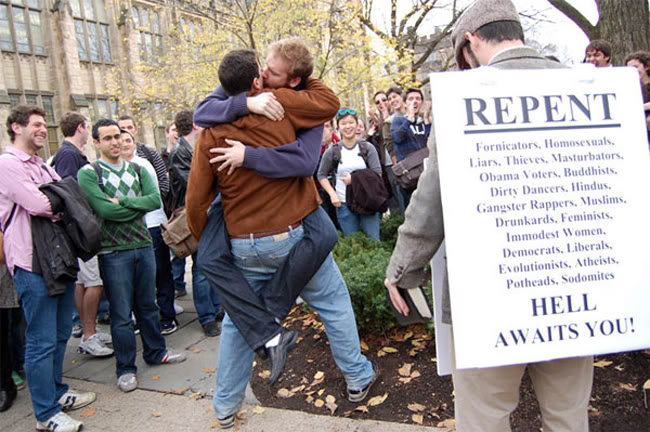
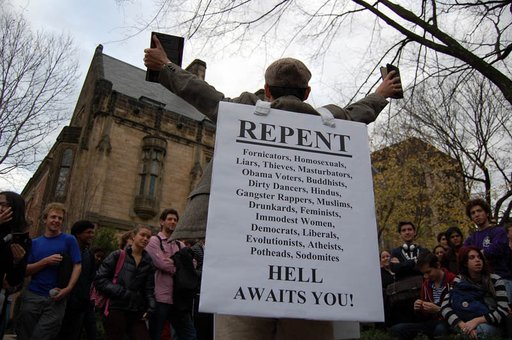
Just before I got in the car on Tuesday to drive down to my digital archives class in New Haven, this story from the Yale Daily News came across my feeds via Melissa McEwan @ Shakesville. A young evangelical street preacher, Jesse Morrell, has been preaching repentance on and around Yale’s campus wearing a sandwich board that delineates twenty activities he considers sinful: fornicating, homosexuality, lying, stealing, masturbating, voting for Obama, practicing Buddhism, dirty dancing (does anyone know what this entails, exactly?), practicing Hinduism, singing “gangster rap,” practicing Islam, drinking, being a feminist, being an immodest woman, being a Democrat, being a liberal, believing in evolution, not believing in God, smoking pot, and having anal sex.

Holy shit is that a lot of thoroughly enjoyable activities to avoid!


Hanna did the math and pointed out that we’re guilty of at least fourteen out of twenty already, so probably at this point our eternal salvation — at least in this guy’s heaven — is a long-lost cause. (Sounds like a boring place anyway — I mean, no immodest women or questioning the existence of God? what would we do for fun??) Those devils in hell had better be ready! Do you think we should shoot for a perfect score?

At least two of the bystanders thought such a plan might be worthwhile, and wasted no time in checking off at least one item on the list.


I think this might just be my favorite protest action of the week. It seems like the only appropriate response, really, to hellfire and brimstone preaching: the assertion of passion, pleasure, and the human capacity for finding joy in physical intimacy. It absolutely gets the point across by refusing to enter into the terms of the debate and, through action, offering an alternative vision of the world.

Now let’s see . . . I’d better get busy practicing my dirty dancing moves!

wrong wrong wrong wrong wrong

03 Thursday Dec 2009

Posted by Anna Clutterbuck-Cook in think pieces

≈ Leave a comment

Tags

education, feminism, gender and sexuality, the body

This story is a little old (Inside Higher Ed carried the story on 20 November), but I can’t stop thinking about the levels of wrong involved, so I’m hauling it out in order to be pissed about them, and to enumerate them in public. Nothing like a blog to get things off your chest!

First up, here’s the low-down on what happened, according to Inside Higher Ed:

More than two dozen seniors at Lincoln University, in Oxford, Pa., are in danger of not being able to graduate this spring — not because they’re under disciplinary probation or haven’t fulfilled the requirements of their majors, but because they were obese as freshmen.

All had body mass index (BMI) scores above 30 — the U.S. Department of Health and Human Services’ threshold for obesity — when they arrived on campus in the fall of 2006, but none have taken college-sanctioned steps to show they’ve lost weight or at least tried. They’re in the historically black university’s first graduating class required to either have a BMI below 30 or to take “Fitness for Life,” a one semester class that mixes exercise, nutritional instruction and discussion of the risks of obesity.

Now, there is a long tradition of colleges having physical health and well-being requirements as part of students’ general course of study — my undergraduate college, for one, had such a requirement (more on this below). While I have opinions about what definition of “health and well-being” a given school promotes, I see nothing egregious about encouraging students to be physically active and health-conscious, and giving them the information they need to make decisions about self-care and health care (for example: a component on patient advocacy might not go amiss!)

Singling individual students out, based solely on their body mass index (BMI) is something wholly different and wholly fucked up. As Kate Harding over at Salon wrote in You Must be Thin to Graduate

Like most such debates, [the Lincoln University story is] being framed quite simplistically — as a matter of public health vs. individual freedoms — with a number of important questions going unasked. Such as: Does BMI actually give a clear indication of an individual’s fitness level? No, for a number of reasons — e.g., BMI is only meant to give a general idea of weight distribution across a population; a large amount of muscle mass can make a person with relatively little body fat technically obese (Lincoln also uses waist measurements in an effort to weed these people out); and above all, fitness and fatness are not mutually exclusive.

On that last point, consider that Lincoln students are given the option of testing out of the class. If a number of students with BMIs over 30 can demonstrate a level of fitness that would make the course redundant, that should tell you right there that targeting fat people for remedial phys ed is discriminatory bullshit. If Lincoln wants to make a certain fitness level a general requirement for graduation, then blatant ableism aside, I guess that’s its prerogative. But why not test people irrespective of weight, and offer the course to those who are demonstrably unfit, rather than starting with the deeply flawed assumption that fat people are ignorant about physical activity, while everyone who falls below the obesity threshold is already sufficiently active?

I would add to what Harding says here (which I think is pretty much right on target) by pointing out that not only is this policy targeting people seen by our culture as overweight, it is ignoring people whose health is in jeopardy because of disordered eating or other health issues that put them below a body weight that would help them optimally flourish. Not to mention people who look and weigh a “normal” weight according to our culturally-conditioned filters, but who may be struggling with life-threatening conditions, either diagnosed or un-. Or whose quality of life is chronically undercut by a disordered relationship with food, exercise, and/or their own physical embodiment. (I speak from the perspective of someone for whom what I ate on a given day often during undergrad often had more bearing on my mood than any academic performance).

A fellow Women’s Studies major in my undergraduate program did her senior-year project on our own health class requirement (one that was expected of all students, regardless of physical health or body type), showing how obsessed the supposedly holistic curriculum was with thinness, and how it often exacerbated the disordered eating and exercise patterns of students already prone to obsessive or self-destructive behaviors. While modifications were made in the course curriculum to include resources on eating disorders and the dangers of being undernourished, when I took the class as a senior in 2005 the in-class message was blatantly and repeatedly the following:

1) As a college student you are surrounded by opportunities and pressures to make bad decisions about what to eat, with “bad decisions” primarily meaning “deciding to eat fatty foods.

2) As a college student, you are also surrounded by opportunities and pressures not to exercise, and therefore,

3) Between the lack of exercise and the fatty foods, unless you maintain constant vigilance you will become fat and unhealthy.

4) Oh, and by the way it’s also not good to be too skinny and if you think you might have an eating disorder contact the counseling center.

I have a beloved sister and several close friends with diagnosed eating disorders. Most of the women I know (myself included) have chronic — though less-than-clinically-critical — disordered relationships with food and our bodies. I can name half a dozen women who put off, or simply refuse to meet with, health professionals because they know that the first thing the doctor will see — regardless of their overall health — is how much they weigh. All health recommendations will be filtered through the doctor’s personal perception of whether the woman (or man) standing in front of him (or her) meets our cultural standard of “thin.” (Yes, I mean “cultural standard” not “science-based”; go read Courtney Martin’s Perfect Girls, Starving Daughters.)

Beyond arguments about the relationship between physical health and body weight, I think it’s critically important to highlight, bold, capitalize and underline the following: WEIGHT IS NOT A SIGN OF MORAL AND PROFESSIONAL FITNESS. People who suffer from physical or mental illness and disability are fully capable of completing programs of higher education and finding work in which they excel. To screen college students by weight and place an extra academic burden upon students deemed physically unfit is NOT OKAY.

To reiterate what Harding said in her piece at Salon, this should not be framed as a a case of individual rights versus collective well-being: neither is being furthered here by this policy. Helping young people to grow into compassionate, self-aware individuals who will (hopefully) have the generosity of spirit to make the world a better place should never, at any time, involve publicly punishing them for their physical appearance, health, or athletic capacity. Goodness knows, if they fail to meet the narrow standards of physical perfection demanded by our culture students already know before they hit college exactly, precisely, where they have failed at unattainable goal of effortless perfection. The last thing in the world they need is one more voice — this time with the weight of institutional authority — telling them they are less-than-worthy. Ceasing to harass them achieves the double goal of protecting individual rights to personal privacy while simultaneously making the case for a vision of the common good that encompasses all of our imperfect humanity, not just those who magically mystically meet the current physical ideal.

putting the breaks on school insanity?

18 Wednesday Nov 2009

Posted by Anna Clutterbuck-Cook in think pieces

≈ Leave a comment

Tags

children, education

From The Guardian comes a story about Canadian parents who hammered out a legal agreement with their children’s school district that guarantees that their children will not be sent home with additional work at the end of the day (or at least that that work will not affect their performance evaluations).

Usually it is the children, not the parents, who are loath to spend their evenings practising spelling and learning times tables. But a Canadian couple have just won a legal battle to exempt their offspring from homework after successfully arguing there is no clear evidence it improves academic performance

After waging a long war with their eldest son, Jay, now 18, over his homework, they decided to do things differently with their youngest two, Spencer, 11, and Brittany, 10. And being lawyers, they decided to make it official.

It took two years to negotiate the Milleys’ Differentiated Homework Plan, which ensures their youngest two children will never have to do homework again at their current school. The two-page plan, signed by the children, parents and teachers, stipulates that “homework will not be used as a form of evaluation for the children”. In return, the pupils promise to get their work done in class, to come to school prepared, and to revise for tests. They must also read daily and practise their musical instruments at home.

The tone of the Guardian article seems to me very much along the lines of, “can you believe the crazy things over-involved parents will do on behalf of their kids?” Framing the parent’s struggle with the school system in the context of their training as lawyers and the fact that this case went to court makes it seem like an extreme reaction to something that most people who have gone to school, or send their children there, take for granted: assignments which must be completed after the school day is officially over. Part of me wants to agree that turning this into a legal battle was extreme, and that if you’re going to send your children to a school for their education, then on some level you should play by the school’s rules. None of the other children at the school, presumably, will have similar protection against being penalized for not completing homework assignments. That doesn’t seem fair.

On the other hand, the Milleys are challenging the authority of schools to have the final say in what is good for their children, and that (I would argue) is valuable not just for their own children, but for other families whose children are negatively affected by institutional schooling practices. Not every family has the flexibility, financial ability, or desire to pull their children out of public schools, yet this shouldn’t mean that they have to give up their role as parents in the cooperative (ideally) enterprise of raising small persons.

And the Milley’s arguments are not off-the-wall concepts. As they themselves noted in their negotiations with the school, the neutral and at times negative effects of burdening children, especially very young children, with homework assignments has been documented. In a 2007 article for Principal educator Alfie Kohn makes the case for “rethinking homework”:

1. The negative effects of homework are well known. They include children’s frustration and exhaustion, lack of time for other activities, and possible loss of interest in learning. Many parents lament the impact of homework on their relationship with their children; they may also resent having to play the role of enforcer and worry that they will be criticized either for not being involved enough with the homework or for becoming too involved.

2. The positive effects of homework are largely mythical In preparation for a book on the topic, I’ve spent a lot of time sifting through the research. The results are nothing short of stunning. For starters, there is absolutely no evidence of any academic benefit from assigning homework in elementary or middle school. For younger students, in fact, there isn’t even a correlation between whether children do homework (or how much they do) and any meaningful measure of achievement. At the high school level, the correlation is weak and tends to disappear when more sophisticated statistical measures are applied. Meanwhile, no study has ever substantiated the belief that homework builds character or teaches good study habits.

3. More homework is being piled on children despite the absence of its value. Over the last quarter-century the burden has increased most for the youngest children, for whom the evidence of positive effects isn’t just dubious; it’s nonexistent.

It’s not as though most teachers decide now and then that a certain lesson really ought to continue after school is over because meaningful learning is so likely to result from such an assignment that it warrants the intrusion on family time. Homework in most schools isn’t limited to those occasions when it seems appropriate and important. Rather, the point of departure seems to be: “We’ve decided ahead of time that children will have to do something every night (or several times a week). Later on we’ll figure out what to make them do.”

The rest of Kohn’s article offers alternatives to homework and a bibliography of further reading on the subject.

While it’s disappointing that, in this particular case, the Milley family had to put the breaks on after-school schoolwork for their family alone, through a “differentiated homework plan,” perhaps their example will begin a school-wide (or broader!) conversation about why we so rarely question the value of “homework,” instead holding it up as an inherent good and a fact of life for schooled youth.

sexuality education: asking the wrong questions?

13 Friday Nov 2009

Posted by Anna Clutterbuck-Cook in think pieces

≈ 1 Comment

Tags

education, gender and sexuality

Christopher White, over at the National Sexuality Resource Center, has a thoughtful piece up about the way we assess whether sexuality education is effective here in the United States.

I spend a great amount of time talking to educators, researchers, students, friends, family members, and many others about why I think it is important that we reframe the ways that we think about sexuality education and sexuality research, shifting away from a model that focuses on disease and prengancy prevention that I believe pathologizes sexuality and sexual behavior in a way that is harmful and confusing. One of the responses I constantly receive regards the evidence of such an approach and whether or not it will continue to work; and to be honest, this is a part of the conversation where I tend to flounder a bit. “Chapter Nine” [in When Sex Goes to School by Kristin Luker] allowed me to understand why I have such a hard time answering this question, and I disagree with Dr. Luker about whether or not this is the right question. The problem is not whether or not it works but how we (and I mean everyone from researchers to students to politicians to parents to teachers) decide whether or not it works.

I encourage you to check the whole thing out.

I’ve been thinking a lot lately about the ways we do and do not speak about sexuality in our culture — who does the speaking, who does the listening, in what contexts, and with whom. This is largely because I really like talking and thinking about sex — hell, I’m a talker and a thinker, and when it comes to things I take pleasure in, I enjoy talking and thinking even more than usual! — but talk about sexuality that respects personal privacy and social convention (or at least disrespects social convention with knowing intent) is an extremely difficult balancing act!

More on this, possibly, to come, particularly as it pertains to my future in the library/archives profession. But in the meantime, I’m not sure I have much more to say as a direct response to the piece, other than that I basically agree with him: when we focus so completely on disease and pregnancy prevention, and on the negatives of young people being sexually active (thus the equation of “successful” sex education with delayed commencement of sexual activity), we lose out.

We lose out on the chance to have much more holistic conversations about the pleasure our sexuality can bring to ourselves and relationships, and how that pleasure can be meaningfully integrated into the rest of our lives in a whole range of contexts. And I personally feel like our culture is that much more impoverished because of our unwillingness to have those conversations — in school and out of it, with young people, middlers, and elders alike.

not cool, alma mater: a bit of a rant

30 Friday Oct 2009

Posted by Anna Clutterbuck-Cook in think pieces

≈ Leave a comment

Tags

education, family, feminism, gender and sexuality, hope college, michigan

My alma mater, Hope College, has been making minor waves in the news recently due to the administration’s unwillingness to approve an invitation by students to screenwriter Dustin Lance Black (who won an Oscar last year for Milk) to join in a roundtable discussion on human sexuality. Since Hope is a college with strong ties to the Reformed Church in America (RCA), and the denomination — like most Christian denominations — is currently split over the issue of homosexuality, this not really a surprise to anyone who knows the campus: the invitation was bound to be controversial.

Since the late 1990s (as I was starting to take classes on campus as a teenager), sexuality and gender in the context of Christianity have been a flash point at Hope, much like they are in the wider culture. During the 1998-1999 academic year, when I was taking first-year courses in English and Religion, the campus was rocked by explosive debates over feminism, sexuality, and the place of Christianity in higher education. My own adult political awareness — the decision to identify myself politically as a feminist, and my engagement with the politics of human sexuality — has its roots in that formative adolescent experience. Thankfully, as a seventeen-year-old, I saw faculty, staff (including my own father) and students speak out forcefully against bigotry at the same time that I was witnessing the intolerance that characterizes certain conservative Christian worldviews.

The exhilaration and pain I experienced that school year of 1998-99 profoundly shaped my relationship with Hope: from that point forward, I knew that however supportive and intellectually challenging my professors were (you were awesome, folks!), Hope College as an institution was not interested in championing an open and affirming vision of Christianity or of a broader human community. Because of that, the school has never truly earned my trust or my allegiance. In conversations I’ve had this week with my sister (a current student) and some of her friends, I can see a similar trajectory in the growth of a whole new generation of students.

I know first-hand how painful and personal the politics of these denominational and institutional conflicts can be, and I recognize the powerful sway of conservative donors and the strength of religious convictions — even when I believe those convictions to be theologically misguided and inhumane. It’s complicated, and I’m usually the first to admit that. But damn, Hope. You guys gotta learn. And you really need to quit hiding behind the waffling of the church and the fear of losing donors. ‘Cause you’re sure as hell losing future donors now. Not to mention doing a patently crap job of modeling civil discourse and educated, educative discussion.

How old are we — two? Is it impossible to imagine students having thoughtful conversations about issues they have deep personal convictions or questions about? If they can’t have those conversations on a fucking college campus where can they have them, exactly? Can we please exhibit some mature behavior here and demonstrate that thoughtful people can disagree without chewing each others’ arms off? And can we please, please pause for a moment to consider what sort of message non-conversation is sending? Possibly (shock! horror!) recognize that certain members of the Hope College community, past and present, have felt “hurt and marginalized” by the institutional reluctance to have open conversation? Not talking does not make the scary bad feelings go away. It just puts them (all too often) on the shoulders of people with less political and financial clout. Which is not an unexpected tactic, but still deserves to be called out and identified as the sort of immature abuse of institutional power it is.

I’ve been thinking a lot this week about the folks I know who continue to work and learn in that sort of environment, and I’m sending good vibes their way. I learned ten years ago that I, personally, have limited energy for front-line action in these sorts of political and educational battles. But I deeply respect the people — including many friends and family — who have the guts to keep on speaking up day after day after day in less-than-perfect situations, doing their best to make the next day a little bit better. So thank you all for being there for me, when I was a student, and to all of you — faculty, staff, and students alike — who are continuing to make Hope a place where marginalized folks who are there can, despite the odds, find emotional and intellectual support, and forge a worthwhile learning experience for themselves.

To the folks who didn’t, and aren’t, I realize this probably means little to you, but you are on my shit list and I will see to it in my own behind-the-scenes way that you have as little power to fuck with peoples’ well-being as possible. End of story.

blogging climate change

15 Thursday Oct 2009

Posted by Anna Clutterbuck-Cook in think pieces

≈ Leave a comment

Tags

blogging, politics, travel

Hanna and Diana alerted me yesterday that today is Blog Action Day 2009, and this year’s theme is climate change. So I’ve had about twenty-four hours to think about what I wanted to say in my contribution (oh help!).

Riding to work on the T (Boston subway) this morning, I decided the theme of this post would be transportation, specifically the need for transportation infrastructure that supports access for all of us to forms of transporation that are efficient, environmentally-friendly, and affordable.

Since I was old enough to understand about global warming and other environental issues, they have always been something I have felt largely terrified and helpless about. I feel helpless because ecological disasters seem so huge, so, well, global and beyond the capacity of individual actions to effect necessary change. In the American economy, at least, it seems like environmentally friendly, “green,” options have increasingly moved away from city-wide recycling programs or buying recycled paper products to activities that require a substantial discretionary budget: top-of-the-line hybrid cars (my family has never been able to afford a new vehicle), locally-grown fruits and vegetables (eating a balanced diet on our budget means buying cheap), alternative-energy electricity and heat (we take what our apartment building provides) and carbon offset credits (I’m just grateful I can afford to visit my parents once a year). We desperately need large-scale structural changes at the national and international level that provide all of us — urban or rural, poor or middle-class — with green transportation options that support our working and family lives. “Local” is wonderful, unless the folks you care about are spread across the country or across the globe. Walking to work is great if you can afford to live in the neighborhood where your job is located; public mass transit is also a great alternative to driving if you live in an area where the mass transit is reliable, frequent, and fast. Combatting global warming will only be effective if every single human being on the planet is able to live their lives in an environmentally sustainable way, and convincing individual people that environmentally sustainable lives are possible means making sure that “green” options are accessible to all.

I never could bring myself to watch Al Gore’s now-iconic An Inconvenient Truth, but a couple of years ago I watched a close cousin, the 2006 documentary Who Killed The Electric Car?. I’m going to close this post with a trailer from the film, which I thought provided a brilliant analysis of the tangled interests and complicated social factors that so often frustrate our attempts at environmentally-friendly innovation. The movie points fingers but stops short of demonizing one single interest group (eg. oil companies, car companies, politicians, the American public). It also manages to tell a story of failure (the electric cars in the film were, indeed, “killed”) while still offering the possibility of hope for future change.

Let us all, collectively, live up to our best possible selves as we move forward into an uncertain future.

Quick Hit: ‘Time poverty’

06 Monday Jul 2009

Posted by Anna Clutterbuck-Cook in think pieces

≈ Leave a comment

Tags

boston, domesticity, politics

Following a luxurious three-day weekend away from work and school, it seems appropriate to post this link from AlterNet, “Slow Down: How Our Fast-Paced World Is Making Us Sick,” in which Linda Buzzell argues that ‘time poverty’ is endemic in contemporary culture:

Time poverty is now a recognized psychological and social stressor. In a speeded-up, highly complex society, there just isn’t enough time for everything: our demanding jobs, our interlocking bureaucratic responsibilities (taxes, insurance, legal issues), our loved one, kids, our community (including the rest of nature), plus commuting and keeping up with traditional media and endless 24/7 online communications. Constantly rushing to keep up as we inevitably fall further behind, we find ourselves destroying not only our own health, but our habitat and the habitat of the people, plants and animals with whom we share the planet.

Juggling two part-time jobs, a library science class, thesis preparation, and home life this summer has given me a lot of opportunity to think about the importance of fighting against the relentless pressure to be “productive” by external standards, and to fill my life with activities our culture assigns value to — rather than the activities that I actually find pleasurable, nourishing and productive in a deep life-affirming sense of creating a life worth living.

I don’t necessarily buy into the idea that those activities necessarily take place out-of-doors, away from technology, but I also recognize the importance of remembering that information technology is a resource not an entity demanding my constant attention or embodying some inherent moral value (positive or negative). I’ve realized over the last two years in graduate school that as someone going into library & information services, information overwhelm and the pressure to be plugged into sources of information 24/7 is going to be a constant pressure in my working life, and it will be important to establish boundaries — to make sure there are places in my life where that tidal wave of sensory input is not allowed to intrude — times and spaces where I have time for reflection, reconnection, and restoration.

Teens, schools, and power relations

25 Thursday Jun 2009

Posted by Anna Clutterbuck-Cook in think pieces

≈ 3 Comments

Tags

children, education, politics

Two recent stories out of the UK on young people in school environments have got me thinking (once again) about the way in which educational spaces are often much less spaces for genuine learning than they are spaces in which unequal power relationships between young people (students) and adult people (administrators and teachers) play out in mutually destructive ways.

First, a short piece from the “odd news” section of the UK-based website digitalspy on a school in somerset that banned snogging (kissing) on school grounds. Students who are caught “in the act” will be suspended from school. While the short piece at digitalspy gives no reason for the ban, a local Somerset paper reports the impetus behind the ban was a full-frontal snog witnessed by the headmaster. This type of reaction to students public displays of affection is reminiscent of the recent New York Times’ breathless report on the hugging “trend” in American schools. While there may be legitimate reasons for asking students to refrain from heavy or prolonged making-out on school grounds, an all-out ban seems like overkill destined to provide one more reason for students to (perhaps legitimately in this case!) believe adults are completely barmy.

In a more serious and lengthy report yesterday morning on the BBC news hour, I heard a story about online “cyber-bullying” of teachers by their pupils:

Teachers have always had to put up with personal jibes from kids.

Until very recently, however, malicious gossip and snide remarks have mostly been confined to the corridors or lunch queues.

But now with the explosion of websites like ratemyteachers.co.uk and bebo.com, teachers are suddenly finding themselves mocked in cyberspace, resulting in plunging morale and even threats to quit the profession.

. . .

Ms Wallis [a senior teacher from Cornwall] claims that the site is seriously damaging trust between students and teaching staff.

“When you’re facing a class five times a day, with 30 children at a time, and you don’t know who has actually written these things, you become far more guarded in everything you do.

“And the bottom line is you lose all trust in the students you’ve got sitting in front of you.”

What struck me about the report was the way students were portrayed as the bullies with the power to destroy teachers’ emotional well-being and reputation. Obviously mean-spirited gossip is hurtful, and adults are not invulnerable to personal slurs just because they originate from people younger than themselves. Bullying is not confined to childhood spaces, and can cross generational boundaries. Yet the journalists covering this story seemed oblivious of the complex power dynamics at play in an educational institution — power dynamics that privilege adult authority, embodied by teachers and administrators, over the authority of young people. Teachers in a classroom exercise the right to pass judgment on students in contexts that have real-life consequences for a child’s future (this is especially true in a school system, such as in the UK, with national curriculum and testing standards). And while some of the “rating” comments are cruel, the reasons for poor ratings are not necessarily just kids having a bit of fun at the teacher’s expense. As one student interviewed reflected,

“I know one teacher who I think is really rude,” says a 15-year-old boy at Haydon School in Pinner, north west London. “But there’s no-one who can tell him that so, in a way, if they look at the site, it’s good because they can change their attitude.”

In a school environment that operates on a top-down, hierarchical model, students may have no (or very few) opportunities to make their voices heard — or more importantly feel they are taken seriously when they do speak up — without fear of retribution . . . except anonymously, online. Another student interviewed said she didn’t feel bad about the negative comments she had posted online. “I rated my worst teachers,” she told the BBC, “I said they were rubbish and didn’t teach me anything.” The fact that children have found alternate ways to communicate with the world about their academic experiences is not necessarily “bullying” — it may simply be providing us with a more balanced picture of what young peoples’ lived experiences in school are actually like. I doubt it will lead to any serious soul-searching on the part of those invested in an hierarchical academic system, but it will certainly be interesting to see how the struggle plays out.

← Older posts
Newer posts →
"the past is a wild party; check your preconceptions at the door." ~ Emma Donoghue

Recent Posts

  • medical update 11.11.22
  • medical update 6.4.22
  • medical update 1.16.2022
  • medical update 10.13.2021
  • medical update 8.17.2021

Archives

Categories

Creative Commons License

This work by Anna J. Clutterbuck-Cook is licensed under a Creative Commons Attribution 3.0 Unported License

Meta

  • Create account
  • Log in
  • Entries feed
  • Comments feed
  • WordPress.com

Blog at WordPress.com.

  • Subscribe Subscribed
    • the feminist librarian
    • Join 37 other subscribers
    • Already have a WordPress.com account? Log in now.
    • the feminist librarian
    • Subscribe Subscribed
    • Sign up
    • Log in
    • Report this content
    • View site in Reader
    • Manage subscriptions
    • Collapse this bar