• anna j. clutterbuck-cook
  • contact
  • curriculum vitae
  • find me elsewhere
  • marilyn ross memorial book prize

the feminist librarian

the feminist librarian

Category Archives: think pieces

the logic of children & other thoughts on learning

17 Wednesday Feb 2010

Posted by Anna Clutterbuck-Cook in think pieces

≈ 2 Comments

Tags

children, education, michigan

My mother, now that we kids are all long out of the house (my youngest sister is a senior in college this spring), works as a childcare provider for a family in the neighborhood. Both parents are teachers in the public schools, and this past weekend my mother sent this great anecdote that I thought I would share with y’all.

K [the mother] told me a hilarious story about science lessons in her kindergarten. They had apparently finished a mandated unit on the concept of “force.” And there was a test at the end. One of the questions asked them what would they use to get a ball to move, the answer being “force,” but overwhelmingly the kids said she would need a dog. I love it. Interestingly, K was discouraged by this. But I said, just refuse the grounds of the test. They can’t identify something as vague as “force,” even if they can talk about it. The demand is inappropriate. Nothing is wrong with exposing them to the vocabulary, but expecting them to manipulate so abstractly is maybe useless to them.

I actually think the kids provided a perfectly logical response to the question posed, given their experience in the world (and, I would bet, the illustrations in the teaching packet used). So they actually have the answer correct: want the ball to move? You need something to move it! It’s not going to leap into action on its own (that is, it requires outside “force” to give it momentum). What have you seen make a ball move? A dog playing fetch!

This story reminded me of a story in New York Magazine that I saw while browsing at the newsstand in Trident Booksellers, “Junior Meritocracy,” by Jennifer Senior, which explores the (apparently highly competitive?) world of kindergarten entrance exams. The article is interesting (though, if you’re a test-skeptic like me, somewhat stressful to read) and I recommend clicking through. In a nutshell, Senior describes the culture of competitive kindergarten and then talks to sociologists who point out what (to me, anyway) seems like the obvious:

“People have the idea that with these tests you can cancel out socioeconomic background and get to some real thing in the kid,” agrees Nicholas Lemann, dean of the journalism school at Columbia and author of The Big Test, a history of the SAT. “That’s a chimera. If you’re a 4-year-old performing well on these tests, it’s either because you have fabulous genetic material or because you have cultural advantages. But either way, the point is: You’re doing better because of your parents.”

Rather than promoting a meritocracy, in other words, these tests instead retard one. They reflect the world as it’s already stratified—and then perpetuate that same stratification.

Since getting involved in the debate at Yes Means Yes over the culture of home education last week, I’ve been thinking a lot about the powerful assumption made by Americans (and Americans of the liberal persuasion particularly, I venture to suggest) that education (specifically universal public education) is the solution to all of the inequality that exists in our country. This was certainly the point of view Gregory Butler (commenter “Movies, Reviewed”) put forward over at Yes Means Yes: that mandatory public schooling would guarantee universal cultural harmony . . . or at the very least, protect us from the stress of living in a society in which not everyone shares identical values. The idea that education (in the specific package of schooling) is the key to life success has the status of common sense: we seldom question this notion, and therefore scramble — like these parents of prospective kindergarten students — to give children the advantage of what is seen as the best schooling (whatever we feel that to be).

I’m skeptical. While I value learning deeply, I am also wary of buying into the notion that schools are the best educative space in which to invest as a solution to the inequities that (yes, absolutely) exist in our culture. If nothing else, I am mindful of the legacy of turn-of-the-twentieth-century progressive educators like Jane Addams and John Dewey who (while, don’t get me wrong, put forward many wonderful ideas about how to reshape learning environments to better suit the children who inhabited them) held up public schooling as a way to Americanize the influx of immigrants who were seen as jeopardizing America’s social stability and national character.

Possibly more thoughts to come on this. Meanwhile, rest easy in the knowledge that when faced with the task of how to move a ball, you know what to do: go find the nearest golden retriever!

*image credit: Dienstelle 75 @ New York Magazine.

language and authority: take two

11 Thursday Feb 2010

Posted by Anna Clutterbuck-Cook in think pieces

≈ Leave a comment

Tags

feminism, gender and sexuality, politics, web video

First, because Hanna (rightly) chided me for not including it the first time around, I bring you a clip from Doctor Who in which the Doctor (Christopher Eccleston) staunchly defends his non-BBC accent in the face of companion Rose’s skepticism. You can carry Leeds on your lips and still save the universe: take that language snobs! (Apologies: neither Hanna nor I could find an embeddable clip of the exact bit we wanted — maybe someday we’ll learn how to rip this stuff properly!)

And on a more serious note, the passionate and articulate Sady @ Tiger Beatdown writes at length on the power of words and the importance of context in “Inappropriate Language: Some Notes on Words and Context.” I cannot quote the whole piece here, but strongly urge you to click over to her blog and read the whole thing, since I admire the way she argues for a more complex understanding of how context shapes the meaning of certain terms, while not dismissing the idea that words have the power to harm — and that some epithets simply should not be used at all. While being funny to boot! I offer the following illustrative passage:

But language is also complicated. The reason a lot of people (thoughtful people, anyway) object to language debates is that they seem to oversimplify or misunderstand how language works. I’m sympathetic to that argument, to some degree. It’s undeniably true that words get re-purposed all the time – “gay” itself being a really prime example. But it takes a long time, or a major paradigm shift, or both, for semantic shifts on that level to occur. You need what would appear to be centuries of “gay” picking up steam as a euphemism for “slutty,” you need people slyly re-purposing the word for their own particular variety of socially-unapproved sexiness so that they can hint at their sexuality without getting in trouble, you need that usage in turn to pick up steam, and you need Stonewall, and you need the decision to go with “gay,” this by now much-evolved bit of sound and code, as an alternative to other labels that are openly pejorative, either because they used to be clinical diagnoses of mental illness or because they are just plain slurs. And then – and then! – this word “gay” becomes a pejorative itself, based on the new meaning.

It takes a while, is my point, for the phrase “my, don’t you look gay in your new ensemble” to go from “you look like you are ready for a party” to “you seriously look like you are ready to put out at that party” to “we are surrounded by a room full of people at this party, and thus cannot acknowledge the way you like to put out, but I happen to be down with putting out that way my very own self” to “I hate your t-shirt, but am for some reason talking fancy.” The meanings overlap in a lot of different ways throughout the history, and it gets tricky, but the overall shift in meaning is clear – we can’t get back to the first stop from the current one. There’s no return, “gay” as “totally and asexually ready for a festive occasion” is just done.

So go forth, read, talk (in whatever accent and using whatever words you feel are appropriate to your own context) and think.

*image credit: Xeyra @ Livejournal.

in which I write comments on others’ blogs

05 Friday Feb 2010

Posted by Anna Clutterbuck-Cook in think pieces

≈ 2 Comments

Tags

children, education, politics

I’ve cut back on the amount of commenting I do on blog threads lately, mostly because I just don’t have the time to commit to serious reading and response and follow-up. But earlier this week I clicked on over to the interesting (read: heated) discussion going down at the blog Yes Means Yes on a thread written by Thomas about “Public School, Homeschool, Parents and Gender Roles.” The whole thread is a fun/irritating read (if you dislike generalizations, be warned); after reading through it I felt compelled to offer the following personal perspective (here slightly edited for clarity).

Movie, Reviewed asked: “I’ve heard accounts of homeschool kids having problems relating to their peers precisely because they didn’t have the social experience of school and were therefore isolated from the mainstream of American youth culture.

I’d be interested to hear from folks who were homeschooled about their experiences with that.”

My response:

I was home educated from birth on (and, as an older child, chose to continue learning at home until college) and while I can’t begin to tackle all of the stereotypes and generalizations Movie, Reviewed is making about a very heterogeneous subculture, I can speak about my own personal experience making social connections beyond my family.

I have always been a very intense one-to-one relationship sort of person. From a very young age I preferred time spent with one or two other people to large groups of folks, which I found overwhelming. I don’t believe this is because of my home education, but rather a personality thing that my home education allowed me to build on as a strength, rather than getting me stereotyped as “antisocial.” Throughout my life, I have been able to choose and invest in friendships with a diverse bunch of folks irregardless of age; I have always been confused by the emphasis in our society on fitting in with one’s age-peers; I prefer spending time with people at all different stages of life since in my experience it leads to much more diverse conversations and opportunities to see things from new perspectives.

My girlfriend and I have conversations about the relationship of homeschooled kids to mainstream youth culture. She learned at home until high school and then went to a public school in 9th grade. Somehow, we still manage to communicate successfully and have a meaningful relationship. True, she has certain cultural references from her youth that I don’t have (just as I have cultural references from mine she doesn’t). Much like if I had grown up in a different country, I have a different body of knowledge than she does that, in the end, just means we have a more diversified pool of experience to draw upon. I don’t feel that it means I have somehow lost out in some vital, debilitating way to “mainstream” adolescent experience.

I would make two further, relatively brief, observations.

The first is that unless you choose as a parent to remove your children from the society of others altogether and isolate them in a remote geographic location with no internet or media connections, there is little danger of them not imbibing some measure of dominant cultural understanding. By definition, dominant cultures demand some level of understanding even from those who are forced (or choose) to live on their margins. So I feel that the panic about home-educated kids not experiencing mainstream culture is at least overblown if not totally disconnected from the reality of a highly inter-connected world.

The second point I would make is to question the assumption that “relating” in the sense of “agreeing with” or “having the same experiences as” one’s peers is a worthy goal to have for one’s children. Many home educators choose to allow their kids to learn outside of the institution of school precisely because they are wary of the values that are imbued in institutional education, or wary of the lessons their children might learn about power and worth from the hidden curriculum of school spaces (for example from bullies whose manipulative behavior goes unseen and unchecked). Home education is often consciously, unabashedly counter-culture in its aims (although, as I suggested at the beginning of my comment, the direction of that counter-culture impulse is far from uniform). So to reiterate: Movie, Reviewed’s concern over home-educated children not meshing well with their schooled peers seems to assume that it is in the best interest of the home-educated kids to alter their behavior in the directed of the schooled kids; I would turn the question back around and ask why the change in behavior shouldn’t come from the other direction.

Stepping back even further from Movie, Reviewed’s framework, I would suggest that “relating” to others in the world is less about uniform experience and behavior than it is about the process of developing skills for encountering others different from ourselves. Skills such as listening, curiosity, empathy, patience, self-awareness, self-confidence, and humility. Taken together, these can help us learn from those whose background and life experiences are vastly different from our own. In that alternate frame of reference, the particular site in which those skills are learned (at home, in a school) are largely irrelevant: home-based education has potential to equip young people to venture out into the world curious about the diversity they will find there.

In my own experience, not being confined to a classroom for X number of hours a day socializing mostly with people of my same age actually broadened, rather than narrowed, the realm of my social relations. In contrast to my schooled friends, I spent much more time interacting with people who were younger and older than I, and who spent their days doing different things than I did. I don’t feel impoverished because of that, nor do I feel unequipped to navigate the realm of the “grown-up” world: it is the world in which I have lived my whole life.

I realize home education per se will not magically make this sort of openness to experience and social interaction happen . . . but I also think it is dangerous to assume that schools, public or private, will either. Neither are a panacea for addressing the inequalities of our society or the impoverishing social isolation that many people feel. I think the answers to those issues need to happen on a deep cultural level rather than putting our faith in one particular institutional framework (public schooling, after all, is a relatively recent invention!).

the books kids read: should we grown-ups care?

04 Thursday Feb 2010

Posted by Anna Clutterbuck-Cook in book reviews, think pieces

≈ Leave a comment

Tags

books, children

So I was poking around on the backlog of feeds today looking for something to write a quick post about and realized that in the last week, there have been two stories related to the idea of what children are/should be reading and who should (or should not) be writing for them in The Guardian this week. And since I rarely lack things to say about either books or “small units” (as Hanna calls them), I figured I’d put in my two cents.


Amelia Hill’s story, “Kids learn to love living on the edge,” charts the trans-Atlantic publishing success of a book called Fifty Dangerous Things (You Should Let Your Children Do). One of the book’s co-authors, Gever Tulley, defends the work this way:

Of course, we must protect children from danger – that’s the promise we make to them as a society. But when that protection becomes over-protection, we fail as a society, because children don’t learn how to judge risk for themselves. So we must help them understand the difference between that which is unknown – or unfamiliar – and that which is truly dangerous.

Meanwhile, Imogen Williams maintains that “adult” authors should refrain from writing books for children. “There really is a Great Divide between writing for adults and for children, and it’s a rare writer who can skim effortlessly back and forth between the two,” she passionately argues, pleading with authors to pick an age bracket and stay with it.

What I find noteworthy about both of these stories is the assumption on the part of the authors (and, presumably, the majority of the audience they are writing for) that a) adults have some measure of responsibility in policing the reading choices of the young, and b) that the books that will appeal one age group will not appeal to another.

While I am not opposed to the idea that parents attend to their children’s reading interest because, well, they’re interested in their children (I pay attention to what Hanna reads ’cause I’m interested in what she’s thinking about and more often than not something she picks up will end up on my own “to read” list) I’m opposed to any sort of censorship of children’s reading choices whether explicit or implicit: kids should have the right to pick up (and, it should be noted, put down again any book they take a fancy to (or lose interest in).

And as to the question of whether authors who are good at writing books that supposedly appeal to one age group over another, I’d like to be the first to raise my hand and suggest that some of the best genre literature I’ve read in recent years was marketed at a young adult audience. I remember, too, as a child, my aunt plumbing my brain on her semi-annual visits for book recommendations, as she liked to keep a stack of “children’s” books by the bathtub for leisure reading. The idea that there is some age-based dividing line between books for young people and books for older people is a cultural construction rather than an immutable fact. Some plots may appeal to us more or less depending on our own immediate circumstances, and what speaks to us may change over time. But any one book will speak to those for whom the story appeals, regardless of the age of the protagonist, the complexity of the language, or the number of illustrations.

The immortal Arthur Ransome, journalist, bohemian, novelist, fisherman, resisted the idea that he was a children’s author, despite the fact that his phenomenally popular Swallows and Amazons series has delighted young fans worldwide since they first appeared in the 1920s. He always maintained that although he wrote about children, he wrote — first and foremost — for himself: he wrote about the things that interested him, and gave him pleasure. “I was enjoying the writing of this book more than I have ever enjoyed writing any other book in my life” he once remembered about the experience of writing the first Swallows and Amazons novel. “And I think I can put my finger on the thing in it which gave me so much pleasure. It was just this, the way in which the children in it have no firm dividing line between make-believe and reality, but slip in and out of one and the other again and again.” Still, he maintained, this was not a quality limited to children as, “I rather fancy, we rather all of us do in grown-up life.”*

So go forth and read (or write) what you enjoy reading (and writing). I’d suggest the world might be that much better if we quit worrying so much about what other people choose to read and write.

That’s my thought for the day.

*Citation: Peter Hunt, Arthur Ransome (Boston: G.K. Hall, 1991): 149-50.

honestly not sure what to think

03 Wednesday Feb 2010

Posted by Anna Clutterbuck-Cook in think pieces

≈ Leave a comment

Tags

children, education, politics

So I saw this story come across my feeds last week, about a German family who’ve won the right to stay in the United States because of their decision to home educate their children.

A US judge has granted ­political asylum to a German family who said they had fled the country to avoid persecution for home schooling their children.

In the first reported case of its kind, Tennessee immigration judge Lawrence Burman ruled that the family of seven have a legitimate fear of prosecution for their beliefs. Germany requires parents to enroll their children in school in most cases and has levied fines against those who ­educate their children at home.

So on the one hand, let me make it clear that I’m absolutely behind the idea that parents have the human right to determine the education of their children (see Article 26.3 of the Universal Declaration of Human Rights). As long as the kids aren’t being abused — and I don’t believe the act of home educating alone constitutes abuse — than the reasons the parents choose to home educate are none of my beeswax. And I believe it’s wrong that school-based education is mandatory anywhere in the world.

However, I admit that my first reaction to this story was: aren’t there other people with more pressing need to escape human rights violations than a family from Europe who want to keep their children out of school? According to the Guardian story, there were over 40,000 applications for political asylum to the U.S. in 2008 and only one in four were granted. Surely some of those who were denied asylum were escaping horrors far worse than compulsory school-based education (and this is coming from someone with a confirmed allergy to institutional schooling).

The other thing that bugs me is the fact that the German family is identified in the story as Christians being “persecuted for their beliefs,” and were defended in court by a lawyer from the Home School Legal Defense Association, a conservative Christian organization. The founder of the HSLDA is also the founder of Patrick Henry College, a politically-conservative institution explicitly catering to Christian home-schooled teenagers who are interested in a career in politics. Patrick Henry College sent an unprecedented number of interns to the White House during the Bush administration, and involvement with a particular administration does not mean blanket approval of all of said administrations policies, I do not believe that the folks who support the HSLDA and Patrick Henry College are, say, big supporters of easing immigration restrictions generally. Would the HSLDA have been so quick to offer legal support to a Japanese family who practiced Shinto, or a Mexican family who Catholic, or a Scottish family who wanted to free range parent without reference to religion? I guess I’m just wondering how much this case of asylum is about education and how much it’s about the resonance of this particular family’s story with the story of many Euro-Americans (as well as the founding mythos of our nation as one established by Europeans fleeing religious persecution in their native land).

"i have scars on my hands from touching certain people."

02 Tuesday Feb 2010

Posted by Anna Clutterbuck-Cook in think pieces

≈ Leave a comment

Tags

books

Author J.D. Salinger died last week at the age of 91. An iconic American author best-known for his mid-century coming-of-age novel Catcher in the Rye, he seems from numerous reports to have been a troubled, unhappy soul. I have never systematically read his work, although I read the novella Franny and Zooey once for a college course, dipped into Catcher and also encountered a short story or two.

However, I once had a professor give a talk about . . . well, I forget exactly what it was about other than that during the lecture she spoke with tears in her eyes about her mother, who had recently died of cancer, and toward the end quoted the following passage from “Seymour, An Introduction,” from the collection Raise High the Roof Beam, Carpenter. The narrative voice in the passage is Seymour Glass, a recurring character in a number of Salinger short stories who ends up committing suicide.

If or when I do start going to an analyst, I hope to God he has the foresight to let a dermatologist sit in on the consultation. A hand specialist. I have scars on my hands from touching certain people. Once, in the park, when Franny was still in the carriage, I put my hand on the downy pate of her head and left it there too long. Another time, at Loew’s Seventy-Second Street, with Zooey during a spooky movie. He was about six or seven, and he went under the seat to avoid watching a scary scene. I put my hand on his head. Certain heads, certain colors and textures of human hair leave permanent marks on me. Other things, too. Charlotte once ran away from me, outside the studio, and I grabbed her dress to stop her, to keep her near me. A yellow cotton dress which I loved because it was too long for her. I still have a lemon-yellow mark on the palm of my right hand. Oh, God, if I’m anything by a clinical name, I’m kind of paranoiac in reverse. I suspect people of plotting to make me happy (88).

It is a passage that is so powerful to me in its use of physical senses and the material world to convey the deep intangible “scars” (good and bad) that connections to other human beings inevitably leave on our souls, and I have never been able to forget it.

I really don’t have anything further to say, other than that I struggle with the complicated reality that someone who was deeply damaged (and damaged many people) could also write something so heart-stoppingly painful, life-affirming, and true. I hope in death Salinger finds whatever peace he hoped for after life.

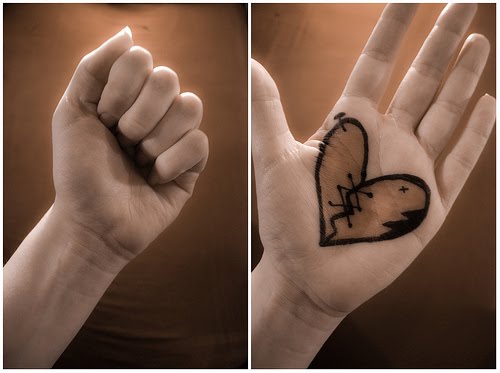
*image credit: Holding your scarred heart in my hand by Angela Mary Butler @ Flickr.com.

Blog for Choice: The Radical Act of Trusting Others

22 Friday Jan 2010

Posted by Anna Clutterbuck-Cook in think pieces

≈ 4 Comments

Tags

blog for choice, feminism, gender and sexuality, politics

Today is Blog for Choice Day 2010, coordinated by NARAL Pro-Choice America. I somehow missed the 2009 action day, but you can read my 2008 Blog for Choice post, The Radical Idea that I am a Person, in the blog archive.


So when I told Hanna that this year’s theme for Blog for Choice Day was “trust women,” her first response was “Are you fucking kidding me?! What a ridiculous statement! Jeeze — ask anyone who’s gone through a dyke break-up. Never trust women! Especially when they have the ability to make vital documents, irreplaceable vhs tapes, and cookbooks disappear!”

Which made me stop and think about what the theme implies. Because, to be honest, my own first response to the exhortation to “trust women” was not unlike Hanna’s: what do you mean “trust women”? Just . . . because? Because they’re women? Why should I? ‘Cause women are only human after all: some trustworthy, some profoundly not. Which, to me, is both [the most obvious and the most radical claim of feminism]: that women are only human. And human beings run the gamut from completely trustworthy to completely untrustworthy and every point between. Ergo women, as individuals, are only as worthy of trust as our individual past and present actions warrant.

So why, then, is it important for pro-choice activists to make the case for trusting women? And what, exactly, does it mean to “trust women” in the specific context of reproductive rights?

I would argue that it is precisely because women — particularly pregnant women — as a class are not really seen as fully human that the idea of trusting them with moral and medical decision-making continues to be such a radical notion. Setting aside for a minute the question of abortion per se, within the past week I have seen multiple stories about pregnant women’s right to bodily integrity and ability to consent to medical procedures challenged or violated with the support of the state. There was the story of Samantha Burton whose doctor got a court order to confine her in a hospital bed against her will when she disagreed with him about how best to proceed with her pregnancy care. A woman in Australia was visited by police when she resisted having her labor induced with the controversial drug pitocin. There have been a number of stories concerning the physical restraint of birthing women in prisons, who are often not able to labor in optimal positions because they’re shackled to their beds. As I’ve written previously, women shouldn’t have to give up their basic rights to bodily integrity and medical decision-making when they become pregnant, but the legal and cultural climate in the United States is such these days that many of us fear that’s precisely what will happen.

So when we chellenge folks to “trust women,” in part we’re demanding to merely be treated with the amount of trust that adult citizens in America have a right to expect: a legal and social framework that “trusts” individuals with decisions regarding their own personal physical well-being and medical decision-making. That trusts us to make informed decisions. Yet over and over again, anti-choice activists have made it clear that they don’t trust women. They fight to pass legislation that mandates physicians lie to us about our bodies, they harass us at clinics that provide health services and attempt to mislead us by dressing as clinic workers. If we trust women with the power to make decisions about their own well-being, these anti-choice activists seem to imply, the world will disintegrate before our very eyes.

Which brings me to the other implication of choosing to “trust women” with their reproductive agency. And I use the phrase “choosing to trust women” deliberately. Trusting other people with the agency to live their own lives is not necessarily something that comes easily to us: as human beings we often thrive on feeling in control of our environment (and by extension the people around us). Control can make us feel safe. But life simply doesn’t work like that: we could drive ourselves mad attempting to control the lives and decisions of others — and in the end, it would not make our lives richer or safer.

Choosing to “trust women,” then, is choosing to “trust others”: letting go of the burden of decisions that are not ours to make, and allowing those whose lives they directly affect (and who are best positioned to understand the ramifications of a given choice) to bear that responsibility. Because that’s what being human requires: rights and responsibilities.

Last sunday I shared a link to a beautiful essay from The Guardian by a vicar, David Bryant, who had recently counseled a woman trying to decide whether or not to seek an abortion. His essay is worth reading in full, but I would like to quote here the final two paragraphs,

One of the blessings of our humanity is that we have a conscience. To opt out of using such a priceless gift is irresponsible. Of course there are immense dangers here. We may make ill-guided decisions. Our thinking may be warped and skewed. On occasion we will follow a course of action so crass or unsociable that it brings us up before the magistrate. But if we allow the church, the nanny state, the media or popular opinion to become our conscience, we lose our moral integrity.

I had no easy answers for the woman. All I could offer was compassion in her grief and sympathy for the agony of choice that lay ahead. We fixed a meeting for the following day, but I never saw her again. True, I had been non-directive, but I could be none other. “I am responsible for my very desire of fleeing responsibilities,” said Jean-Paul Sartre. I believe he was right. That is why I could not decide the fate of the foetus for her.

What I appreciate so much about Bryant’s argument is that he refuses to retreat to the (legitimate, but limited) language of legal rights, instead challenging us to see that trusting women with the responsibility of making deeply challenging moral decisions is not only a legal imperative but a moral (dare I say “religious”?) one.

So when a pro-choice activist says to you “trust women,” pause for a moment and hear it for the truly radical challenge it is: a call to let go of the all-too-human impulse to control, and to allow some of the burden of responsibility to be lifted from your shoulders and taken on by someone else — someone whom you might not know enough to personally trust, but whom you must share this earth with, and who may well surprise you with her ability to make the decision that is, in the end, the most life-giving for us all.

After all: in the end, what other choice do we have?

*image credit: amor! by slickerdrip @ flickr.com.

bullying = "childish"?: some reflections

21 Thursday Jan 2010

Posted by Anna Clutterbuck-Cook in think pieces

≈ Leave a comment

Tags

children, education, politics

Last week, Hanna found this story from the UK-based Independent on bullying at Universities and sent it to me (on the premise that I’m always interested in the education beat; see yesterday’s rant about “liberal” academies) and, indeed, I was interested and started drafting a post about the problem of bullying and what folks who report on and attempt to combat bullying might learn from feminists who talk about “rape culture.”

That’s still a post I might write, since I think the analogy — while imperfect — helps to illuminate the way in which bullying is a systemic problem, one that continues because it’s actually supported by a culture that condones and rewards bullying behavior.

But in the meantime, I kept coming back to the original Independent article because I was bothered by the way the problem of bullying was framed.

We all know bullying occurs in children’s playgrounds, inside and outside of secondary schools and sometimes even in the adult workplace, but what about University?

This supposed sanctuary of like minded scholars has become just another place in which people compete with each other for respect and social order, and bullying has followed with it.

A psychologist specialising in bullying, harassment and inter-personal relationships, Dr. Pauline Rennie-Peyton, recognises the possibility of being bullied in all stages of life, and confirms University is no exception.

“If people are taken out of their element, they become children,” she says.

“The problem with Universities and Colleges is that if we’re not careful, students there also become children. Just because bullying in Universities is not talked about, it doesn’t mean it is not happening. I have students [come to me] and they have to deal with racism, sexual and even intellectual jealousy.”

I think they get it right emphasizing that bullying behavior happens in many social environments and at all stages of life. What bothers me is the equation of bullying with a return to childhood. “If people are taken out of their element, they become children,” Dr. Rennie-Peyton says. And bullying is the natural result? Something just didn’t sit right with me there, and it kept getting in the way of the whole “rape culture” argument I was trying to make.

Luckily, a few days after the post had stalled, Idzie @ I’m Unschooled. Yes, I Can Write came to my rescue with a well-timed blog post on being “childish.”

When people use that word, when they say “childish”, what they mean is that anything a child comes up with, any thought, opinion, emotion, is absolutely worthless and discard-able. To be a child is to have nothing of worth to show for yourself. It’s an expression of ageism at it’s very worst!

So when someone tells me that I’m being childish, they’re not only insulting children everywhere, they’re also telling me that my opinions are worthless. That they’re short-sighted, uninformed, unimportant, and simply not worth paying any attention to.

So here’s what I want to say (for now) about bullying, about bullying being framed as a child-like behavior, and about the idea that “becoming children” being a bad thing.

We choose, as a culture, to de-value being child-like, and to denigrate those who we believe are being “childish” (that is “short-sighted, uninformed, unimportant, and simply not worth paying any attention to”). It’s certainly true that children can exhibit all of these behaviors — just like any human being. All of us are, at times, short-sighted and uninformed. We all walk into situations where we feel out of our element. Yet these human qualities become strongly associated — through language like “childish” — with childhood. And because they are qualities our culture looks down upon (and experiences that make us feel uncomfortable: most people don’t like to feel out of their element) children themselves become targets of suspicion, ill-temper, and blame simply for being young.

(The flip-side of the bundle of negative connotations associated with “childish” is, of course, that infants and children are also the venerated objects of adoration by our culture: the near-universal signifier of all things cute and precious, when in fact they are simply human. It’s the childhood version of the virgin/whore dichotomy: children are either angelic objects to be cherished and protected or unruly demons to be feared and controlled — neither approach considers children as human beings worthy of our individual respect as fellow-persons).

Bullying isn’t something that naturally occurs in childhood — it happens because young people learn that they can get what they want by manipulating power relationships. And that shrewd manipulation of power relations wins them respect and authority — not just among their peers but among adults as well. Bullying is successful because our culture as a whole — not just some segregated “childish” culture — rewards bullying. We reward people who abuse their authority, and anyone who professes shock that bullying exists in grown-up spaces like university or work environments has really been deluding themselves.

This doesn’t mean I don’t think bullying is simply “human nature” and that speaking up or acting to prevent is will be ineffectual. After all, human beings do horrible things to each other that it is clearly in our “nature” to do (that is, we’re capable of doing them), but which it is also in our “nature” to resist and condemn. People of all ages are capable of small-minded, vicious, and even evil acts; we are also all capable of empathy, compassion, love, and healing. Let’s quit dividing the full range of human capacity up into artificial categories by age, just as we’ve started resisting the divisions of “masculine” and “feminine” attributes that pigeonhole multi-dimensional people into cramped boxes of gender-based expectations.

The limits of the "liberal" academy?

20 Wednesday Jan 2010

Posted by Anna Clutterbuck-Cook in think pieces

≈ 1 Comment

Tags

education, politics

It’s that time of year when all things academical start to grate on my nerves. So when lisa @ Sociological Images put up a post earlier today about a recent study by researchers Neil Gross and Ethan Fosse that seems to confirm the “professors skew liberal” stereotype, I grumbled my way over to check it out.

As studies go, it’s making the relatively modest claim that about 43% of professors self-identify as “liberal,” only 9% as “conservative,” while the remaining are dumped in the “moderate” pot. As Lisa writes:

The study measured a number of reasons why college professors may be more liberal. Among others, they argued that already liberal people may be drawn to academia because they perceive that academics are liberal. That is, just as women are drawn to teaching and men to construction work because these jobs are gendered, academia is a politically-typed job that draws people who identify as liberal already.

They also speculate that the relative low pay, given the high educational attainment that the profession requires and high status that it brings, may lead professors to lean towards democratic principles of economic redistribution.

What caught my eye here was the emphasis on “democratic principles of economic redistribution.” While I’m not arguing this isn’t a laudable democratic concern, I notice that what is left out of the definition is any interest in deeper challenges to cultures of hierarchical authority (that is: a broader interest in small-d “democracy”). In fact, the argument seems to be that academics are pissed that “the high educational attainment that the profession requires and high status that it brings” result in professional academics who — far from being invested in anti-hierarchical, democratic politics, are instead simply pissed off that their “high status” profession isn’t rewarded financially.

Not that there isn’t a reason to be pissed off about a system that requires a relatively high initial financial investment (re: student loans) when compared to future income. I just think that to equate that economic frustration with a more general “liberal” outlook on life points toward a very narrow definition of what liberal politics is about. In fact, it suggests that people who are upset about the so-called “liberal” academy should be far less threatened by academics than they profess to be: according to this study, anyway, even those 43% of faculty who self-identify as liberal may be less interested in questioning the hierarchical structure of society than they are about gaining access to it’s upper economic echelons. In other words, they just want a bigger piece of the pie.

What this study tells me, actually, rather than confirming the “liberal” stereotype, is that if I want radical questioning of hierarchical power relations — particularly as they relate to knowledge, education, and worth — I’m probably going to have to look somewhere other than academe. (Or at least not expect to be welcomed with open arms when I keep asking “what legitimizes your authority?”) Folks who are invested in the high social status their chosen profession brings them aren’t going to be too excited about questioning whether that status has any deeper meaning or legitimacy.

You can read more about the study at Inside Higher Ed and find a PDF of Gross and Fosse’s working paper, which I look forward to reading when I have the chance, at Neil Gross’s web page.

guest post: holland, hope & homosexuality

13 Wednesday Jan 2010

Posted by Anna Clutterbuck-Cook in think pieces

≈ Leave a comment

Tags

gender and sexuality, guest post, michigan

A couple of weeks ago I wrote a response to Dustin Lance Black’s op-ed, describing his experience this past fall in my home town of Holland, Michigan. I also invited one of my sister’s friends, Arin Fisher — a Hope College senior in creative writing (poetry) and self-described “closet pamphleteer” who was involved trying to bring Black to campus to write a guest post about his own experience of how Holland and Hope College deal with homosexuality. Without further ado, here’s Arin.

I’m a gay cliché, especially recently. I’m now the gay who quotes Harvey Milk, gestures always with endearing melodrama, and isn’t afraid to wear ivory post-Labor Day. As you may assume, my behavior is a red-flag to hicks everywhere, especially at home in Indian River, that I’m a goddam homsexshul. I make trite jokes about the gay agenda and how, due to mail-error, the conservos always receive my copies. Fuck me.

But I wasn’t always so gay. I was the kid whose first very secret crush committed suicide, who went on short term mission trips with Global Expeditions, whose reorientation therapy failed (whose therapist’s son was gay, too, and who taught me a few of the tricks I now know), and who applied to all the conservative colleges in Michigan, including Hillsdale, and was accepted with enormous scholarships because of my promise in right-wing politics. But I chose Hope for the mentors who, like me, struggled to come to terms with their sexuality and who married women and led what many believed to be perfectly normal straight lives.

Freshman year I followed my RA, Erin, to a Gay Straight Forum meeting at a wee white house just off-campus, but then I passed the house, peaking as covertly as possible through cracks in the lacy curtains before looping back toward my dorm, spooked by the perceived threat of association and other threatening receptions from the gay people in the house. I thought quietly [righteously] that had I gone there to listen to the conversations, they’d know that I’m queer. Gawd.

Growing up in northern Michigan, I was skilled — I skirted every gay man I encountered. Those gays whose friendship I began to value, I diligently offended. All those whom I crushed on, I cut out of my life because I was Christian, and you know the story. I elegantly employed these hard-learned skills. I learned that to avoid other gay men, I must avoid situations where gay men would be present. All to say: I’m unaware of any concerted effort to dialog about sexuality apart from the Mel White battle in the late 90s as I spent a majority of the past three years praying the gay away.*

You might aim blame at me for Lance’s misinformation. I briefed him from my experience which was teleologically sub-gay until fall 2008. Now that I’m more on the front-lines in terms of having “friendly” conversations with the Dean of the Chapel and “friendly” discussions with the Dean of the Students and organizing 501c3 LGBT groups, I’m doing more research, both personal and academic, in hopes of self-informing enough to competently reflect informed LGBT students to the higher-ups at Hope and in the community. I’m happy that I’ve been able to contribute a little to the conversation, if not always in the most informed way, at least in a way that adds Dustin Lance Black and my supreme penchant for melodrama to the coveted repertoire of Hope’s self-consciousness of diversity.

~Arin Fisher.

*Editor’s footnote: “the Mel White battle” Arin refers to is the period I described briefly in an earlier post. Former Christian right activist turned gay Christian author Mel White was invited by a coalition of campus groups to speak at Hope in response to another guest speaker, Mario Bergner, a conservative ex-gay therapist, brought in by the campus ministry as part of a chapel series on Christian love.

← Older posts
Newer posts →
"the past is a wild party; check your preconceptions at the door." ~ Emma Donoghue

Recent Posts

  • medical update 11.11.22
  • medical update 6.4.22
  • medical update 1.16.2022
  • medical update 10.13.2021
  • medical update 8.17.2021

Archives

Categories

Creative Commons License

This work by Anna J. Clutterbuck-Cook is licensed under a Creative Commons Attribution 3.0 Unported License

Meta

  • Register
  • Log in
  • Entries feed
  • Comments feed
  • WordPress.com

Create a free website or blog at WordPress.com.

  • Follow Following
    • the feminist librarian
    • Join 36 other followers
    • Already have a WordPress.com account? Log in now.
    • the feminist librarian
    • Customize
    • Follow Following
    • Sign up
    • Log in
    • Report this content
    • View site in Reader
    • Manage subscriptions
    • Collapse this bar