• anna j. clutterbuck-cook
  • contact
  • curriculum vitae
  • find me elsewhere
  • marilyn ross memorial book prize

the feminist librarian

the feminist librarian

Category Archives: think pieces

fun with amicus briefs! [doma & the supremes]

11 Monday Mar 2013

Posted by Anna Clutterbuck-Cook in think pieces

≈ 2 Comments

Tags

children, doma, family scholars blog, gender and sexuality, marriage equality, politics, religion, scotus junkie

cross-posted from the family scholars blog.

http://lesbianweddings.tumblr.com/post/12741646344
(via)

Thanks to Amy’s recent post that linked to John Culhane’s piece on the importance of amicus briefs, I spent a nerdy afternoon this past weekend browsing through some of the many briefs submitted to the U.S. Supreme Court in relation to the two same-sex marriage cases that will be reviewed by the court this session. They are all available to read in PDF at the American Bar Association’s website; you can also find a list at the SCOTUSblog. I thought I’d share a few highlights with you. Of particular interest to the folks at Family Scholars might be the brief submitted jointly by the Family Equality Council, Colage, Our Family Coalition, Gay, Lesbian, and Straight Education Network, the Center on Children and Families,  the Child Rights Project, and Sarah Gogin. Together, they seek to represent the children raised by same-sex parents as well as young people who experience same-sex desire as they look toward a future forming adult relationships. They begin:

The voices of children raised by same-sex parents — those who live every day within the family structure at the heart of these lawsuits — are too often unheard in debates about same-sex couples and marriage. Their stories are too often missing from discussions of “traditional” families or “family values,” and their personal experience too often discounted as irrelegant. Although those who oppose marriage for same-sex couples frequently make assumptions about the quality of the children’s family lives, the children themselves are rarely asked to explain what they actually experience.

Throughout the brief, they foreground the voices of young people who are growing up with LGBT parents, and their list of “authorities” (the brief equivalent of a bibliography) offers a valuable starting point for thosee interested in learning more about the experience of people who have grown up within LGBT households. As the brief asserts,

Although the Proponents [of Proposition 8] claim an interest in stabilizing the American family structure, the elimination of marriage for same-sex couples in California and the refusal to recognize valid married couples on the federal level have the exact opposite effect. Placing an official stamp of governmental opprobrium on the relationships of same-sex parents instead serves to stigmatize and de-legitimize the relationships, and, as a result, the children themselves.

Not to mention, the children of our nation who will grow into adult same-sex desires and relationships:

By officially sanctioning their exclusion from marriage and placing existing marriages of same-sex couples in the singular position of being “not marriages” for federal law, these measures exacerbate feelings of hopelessness about the future and perpetual “different-ness” that many LGBT youth already feel and discourage them from aspiring to full participation in civic life.

As an historian, I was also pleased to see both the Organization of American Historians (OAH) and the American Historical Association  (AHA) had filed briefs discussing the history of marriage law in the United States. The AHA draws on the scholarship of its professional membership to make several key arguments: that the federal government has historically deferred to state law when determining marital status; that the meaning of marriage is not limited to procreation; that marriage practices have changed over time, and that this is a strength not a weakness of marriage as a social institution. From their summary of the arguments:

Control of marital status is reserved to the states in our federal system. Marriage has always been understood as a civil contract embodying a couple’s free consent to join in long-lasting intimate and economic union. In authorizing marriage, states turn a couple’s vows into a legal status, thus protecting the couple’s bond and aiming moreover to advance general social and economic welfare. Throughout U.S. history, states have valued marriage as a means to benefit society. Seeing multiple purposes in marriage, states have encouraged maritally-based households as advantages to public good, whether or not minor children are present, and without regard to biological relationships of descent. …For two centuries before 1996, state marital diversity reigned, along with serious inter-state contestation, without Congress stepping in to create marital “uniformity” for federal purposes. Congress never took a position on a marital eligibility question pre-emptively so as to discredit a policy choice that a state might make. Before DOMA, federal agencies assessed marriage validity by consulting the relevant state laws. In historical perspective, DOMA appears as an attempt by Congress to single out particular state-licensed marriages for disfavored treatment.

The OHA, in a brief filed with the American Studies Association, takes up a slightly different aspect of the case.  They outline the history of discrimination towards sexual minorities in the United States, and pointing toward legal precedent for taking history into account when assessing the full weight of discriminatory practice:

As professional organizations devoted to the study of American history and culture, amici are not before the Court to advocate a particular legal doctrine or standard. But they wish to advise the court that the historical record is clear. Gay men and lesbians in America have been subjected to generations of intense, irrational, and often violent discrimination, commencing as soon as they emerged as a group into American public consciousness and continuing today.

The NAACP Legal Defense & Educational Fund reminds the court of its historic role in guaranteeing equal protection rights to all citizens, asserting that “The role of the courts is to safeguard the rights of historically subordinated groups by applying heightened scrutiny to laws like DOMA, that disadvantage them as a class.”

And finally, it was also heartening to see a number of briefs from religious organizations supporting marriage equality, including one filed on behalf of a truly heartwarming number of faith traditions: the Bishops Of The Episcopal Church In The States Of California, Connecticut, Iowa, Maine, Maryland, Massachusetts, New Hampshire, New York, Vermont, and Washington and The District Of Columbia; The Jewish Theological Seminary Of America; Manhattan Conference Of The Metropolitan New York Synod Of The Evangelical Lutheran Church In America; The Rabbinical Assembly; The Reconstructionist Rabbinical Association; Reconstructionist Rabbinical College; Rabbi Akiva Herzfeld Of Shaarey Tphiloh; The Union For Reform Judaism; Unitarian Universalist Association; United Church Of Christ; The United Synagogue Of Conservative Judaism; Affirmation; Covenant Network Of Presbyterians; Friends For Lesbian, Gay, Bisexual, Transgender, And Queer Concerns; Methodist Federation For Social Action; More Light Presbyterians; Presbyterian Welcome; Reconciling Ministries Network; Reconciling Works: Lutherans For Full Participation; and Religious Institute, Inc. (yes really!). Their premise is:

Americans are a religious people, but diversely so. Religious adherents differ on contentious issues, and religious bodies have themselves evolved and disagreed over time — on marriage as well as other civil rights and social issues. In view of that history and the wide range of modern religious thought on same-sex unions, it would be a mistake to elevate any one view on marriage above all others as the “Christian” or “religious” view. Indeed, it would be constitutionally inappropriate, because civil marriage is a secular institution … and the Constitution bars the government from favoring certain religious views over others … Religious freedom means that all voices may contribute to our national conversation, but particular religious perspectives on marriage cannot be permitted to control civil recognition of marriage for all.

These highlights represent just a handful of the perspectives filed with the court, and I encourage all of you to go explore on your own — and share what briefs spoke to you, and why, in comments.


"the immediate problem … of how to represent women’s desire visually" [more questions about porn]

21 Thursday Feb 2013

Posted by Anna Clutterbuck-Cook in think pieces

≈ 2 Comments

Tags

gender and sexuality, smut

So I’m working my way through some of the classics of scholarly treatments of film pornography, most recently Linda Williams’ Hard Core: Power, Pleasure, and the ‘Frenzy of the Visible’ (University of California Press, 1989). It’s a book that in many respects has aged well, despite its heavy reliance on both Marxist and Freudian frameworks for discussing “fetishism,” commodification, sexual pleasure, and power dynamics. Williams pushes back fairly forcefully against anti-porn feminism, and — while at times too quick to concede that such-and-such plot or scene is misogynist — insists on complicating the assumption that mainstream, heterosexual “hard core” porn is de facto male-centric and anti-female pleasure.

However. 

(You knew there was one.)

However, she keeps circling around this notion that one of the traps of cinematic pornography is that they have to depict pleasure on the screen (no argument there), and that male pleasure is easy to depict — via penetration (“the meat shot”) and/or ejaculation (“the money shot”) — while female pleasure is difficult (impossible even?) to successfully show on film. At one point toward the end of the book she writes that feminist pornographers, however much they may desire to revise the genre, are still confronted with “the immediate problem … of how to represent women’s desire visually.”

I guess I just don’t get the problem here.

Like … turn on the camera. Train said camera on a masturbating woman who, let’s imagine, gets off on the idea of the camera’s “gaze” as she’s climbing toward orgasm. Maybe, if you wanna get fancy you could use multiple cameras so as to ensure you get some close-ups of her face, or the curve of her spine as she arches, or the cant of her hips as she pushes her fingers into herself…

It’s just … not. That. Difficult.

I read my wife’s desire and pleasure visually on a fairly regular basis and — while, granted, we augment the visual with verbal cues and shared history — my visual processing in this regard has a pretty damn high success rate in that my visual perceptions of her enjoyment has a high degree of correlation with her own reports of what gets her off, when.

You read a body in ecstasy just like you read a body in anger or pain: through minute facial expressions, gestures, the set of the shoulders, the angle of limbs. You read a person’s willingness for partnered sex through all of the ways they physically express connectedness (or lack thereof) to the other person(s) en scene.

We don’t panic (film people, correct me if I’m wrong here!) over OMG how are we ever going to represent anger visually in this film!?

Why oh why is sex supposedly so freakin’ different — women’s sexuality specifically in this instance — that it’s a “problem” to capture on film?

(via, very nsfw)

(I’d argue male sexuality, also, is far from “simple” to represent through the visual tropes of erection, penetration, and ejaculation, but that’s maybe a post in its own right.)

What I suspect is that this assumption that women’s desire and sexual pleasure is a problem, cinematically speaking, comes from the pervasive belief in contemporary culture that women’s sexuality is mysterious and difficult to understand (while men’s is basically self-evident; again, an assumption that deserves unpacking). If women’s sexuality is this crazy mysterious thing that we don’t understand and that men find epically confusing, how are we ever supposed to imagine it visually on screen? A mystery is, by definition, something which can never be fully revealed unless it is solved.

Which is why, as Williams suggests, women’s sexuality in modern hard core porn, is often “solved” through gimmicks that render it somehow more visible, or displace it by letting male pleasure cues stand in for everyone’s sexual satisfaction in the scene.

I’m not as convinced as Williams is that all mainstream pornography is stymied by visualizing women’s pleasure. I think, at times, that Williams is too quick to assume — at least in this early work — that proof of desire requires, for example, genitals which can demonstrate arousal and climax on-screen.

And I’m pretty sure there are a lot of pornographers, feminist, female, and otherwise, who’d be surprised to learn that women were such difficult creatures to capture on screen. I wonder: would that make us some sort of weird supernatural being of sex? Try to capture visual evidence of our pleasure and we’d vanish from the silver nitrate on the film (or the binary of the pixels on the image card)?

to want them, to be them, or both? [perspectives in porn]

12 Tuesday Feb 2013

Posted by Anna Clutterbuck-Cook in think pieces

≈ Leave a comment

Tags

gender and sexuality, random ranting, smut

So last week I reviewed an anthology of essays on pornography, and kind of in passing I asked why we generally assume that people watch porn because they want to fantasize about having sex with the people the camera’s gaze is trained on. That is, in porn marketed to men who like having sex with women, female actors take center stage and male performers are assumed to be exchangeable stand-ins for the Everyman Viewer. Women are cast with an eye toward what body types producers imagine their Everymen want to fantasize about exchanging bodily fluids with.

I don’t understand where this narrative assumption comes from.

Is that actually how the majority of people watch porn?

Because that’s certainly one perspective to take when consuming erotic material: the “would I wantonly ravish this person?” perspective. However the viewer/reader assesses the sexual attractiveness of a given performer/character (visual presentation, sexual style, aspects of character, voice, etc.), that question certainly informs how you enter into the fantasy of the pornographic scenario. If the answer to the above question is yes! it becomes easier to understand the motivations of the ravishers as depicted in said piece of smut. It’s easier to get drawn into the story, just as it’s easier to get drawn into any work of fiction when you care about the character’s well-being, or want to know what happens next.

I get that. There’s a reason I’m drawn to some relationships in fan fiction and not others; some character dynamics just don’t do it for me. Others do.

But I find this an unsatisfying and incomplete assessment of how people (read: “men” in most discussions about pornographic film) interact with porn. Why? Because it’s not the only way I — as a consumer/creator — interact with sexually-explicit material. And it’s not the only way people interact with fiction generally. We know this. And yet, somehow, when the question of sexually-explicit material is on the table all of our wisdom about the viewer/reader and their complex interactions with what they watch and read flies right out the window.

To whit, when it comes to porn, despite the fact I’m a voyeur by definition (reading/watching the characters/performers interact in sexual ways without literally being involved with them) my pleasure is often less contingent on the question “would I wantonly ravish this person?” than it is on the question “if someone ravished me in this fashion, how might it feel?” Or, “is this dynamic between them an arousing one? how is it making the actors/characters feel? why is it making them feel that way? The sexual activity depicted doesn’t have to be something I’d definitely find pleasurable in real life, but a successful pornographic or erotic narrative will encourage an imaginative connection, prompting me to explore how such an activity could be pleasurable to the performers/characters in question.

Like any good work of fiction, pornography and erotica asks us to put ourselves in someone else’s shoes (or, you know, lacey knickers). And learn something meaningful or moving while we’re there.

So all of this leads me back to the question: Rather than assuming people sexually objectify the performers in porn, why don’t we wonder to what extent they’re identifying with them? After all, we’re human beings watching (or reading about) human bodies experiencing sexual pleasure. Doesn’t it make sense that we’d — at least to some extent — imagine ourselves into their situation as much as we might imagine being the person sexually stimulating them?

I look at this image and I feel the water washing across my skin (via)

I haven’t watched much moving-image porn, so perhaps the descriptions I’ve read of pornographic films are giving me the wrong impression here? But when I read synopses of films, I’m definitely aroused most often by imagining myself in the role of the performers whose pleasure is visible on screen. Like, if the film is going to show me a woman giving a man (or woman) a blow job, and it’s the giver’s body and facial expressions and responses we’re seeing, isn’t that the person we’d be likely to identify with — not the disembodied dick (or clit) that appears as a prop on the screen?

And no, I don’t think the answer can be as simple as “but dudes can’t/won’t imagine themselves into the position of a female performer because their bodies are different!” because I read plenty of erotic material in which the only bodies involved are male bodies and I definitely successfully identify with those characters. So I think we’re too quick to assume that anatomical body difference is a barrier to imaginative involvement.

Maybe it’s partly a (socialized or innate) gender thing? Recent studies have suggested that men and women generally interact with porn in different ways, with men being less flexible in what types of erotic imagery arouse them (women appear to be catholic in their tastes: it doesn’t generally matter whose bodies are depicted, or even that they be human bodies — if sexytimes be happening, our pleasure centers light up). But I’m tired of the simplistic assumption, without research to back it up, that men only interact with porn in a way that interprets the (female) actors depicted on screen as objects rather than subjects. At the very least, I’d imagine it’s likely viewers of pornography — just like readers of fiction or viewers of any other genre of film — switch imaginative perspectives, so that response to a question about who is being observed and who is being identified with would change over the course of the viewing/reading experience in complicated, unstable ways.

I’m continuing to think about this question while reading Laura Kipnis’ Bound and Gagged (1997) and Linda Williams Hard Core (1989) this month. They’re both fascinating studies which have much to recommended them, though some of the debates they engage with are certainly dated. Still, on the watch for questions of perspective both authors seem only to nod in passing to the idea that male viewers might be watching the bodies in screen in less-than-straightforward ways. Williams, for example, seems to assume that heterosexual male arousal in reaction to viewing an aroused male body would be an experience of homosexual desire, rather than, you know, a response to the arousal of a body the viewer could imagine being. So it’s clear that even the leading thinkers in this field have taken this question somewhat as read.

What are your experiences with sexually-explicit material? To what extent do you find yourself wanting to be and/or wanting to have the individuals depicted or described? How does the voyeurism of engaging with other peoples’ (fictional or performed) sexual intimacy pull you in as an observer-participant? Do you tend to identify with all of the characters in a scene, or specific characters? To what extent does body type and physical sex contribute to your choice of character with whom to identify?

I’d love to hear your thoughts; if you want to share anonymously the form should allow for that — and I’ll try to monitor the thread carefully so that anon comments don’t end up in the trash if they are actually legitimate contributions (95% of my “anon” comments are just straightforward spam).

comment post: unfinished thoughts on non-consensual sexualization

07 Thursday Feb 2013

Posted by Anna Clutterbuck-Cook in think pieces

≈ 4 Comments

Tags

being the change, bigotry, comment post, feminism, gender and sexuality, moral panic

Regular readers of this blog may remember that over the past year or so I’ve been haunting the conservative Family Scholars Blog hosted by the Institute for American Values (IAV) think tank founded by David Blankenhorn, sometime high-profile opponent of same-sex marriage. In part, I follow the blog because my smart and funny friend Fannie is one of their guest bloggers. I am also deeply interested in the worldview of people whose understanding of how the world works, and what values will increase the well-being of humanity, are so different from my own.

Last week, I found myself sucked into a comment thread at the FSB wrestling with the subject of what I’ll call “non-consensual sexualization.” My working definition of non-consensual sexualization is public expressions which frame another person’s appearance, presence, or actions in a sexual light without their participation or consent. You might also call this plain old “sexual objectification.” I’m using my phrase here because I think it’s important to highlight the non-consensual part of what’s going on here. Continue reading →

comment post: pressure to self-disclose in the classroom

31 Thursday Jan 2013

Posted by Anna Clutterbuck-Cook in think pieces

≈ 7 Comments

Tags

being the change, comment post, education, gender and sexuality

unidentified classroom, possibly in Georgia (Library of Congress)

I subscribe to a number of listservs through H-Net, an online hub for humanities scholars. This past week, on  H-HistSex, the list for History of Sexuality, there’s been a discussion about class exercises for the first day of class in a gender/sexuality course. I can’t link to the conversation “thread” as a stable link, but you can find all of the relevant emails in the January 2013 log with the subject heading Re: Exercise for first day of class in gender/sex course. The resulting conversation was one that I thought some people who read this blog might be interested in. So I’m sharing a few excerpts here (all publicly accessible through the message log above) and wrapping up the post with my own comment which I sent out this afternoon to the group.

Several faculty contributed ideas about “getting to know you” activities that included some sort of topical self-disclosure and/or exercise designed to prompt personal reflection about sexuality and gender. For example:

I teach an introductory class … and it’s often fun to make them stand up and ask them to sit if the statement you make applies to them . . . to see who is the last one standing. You can use all kinds of “gender” statements like “I’ve dressed as the ‘opposite’ sex” or “I’ve seen a drag show.” They seem to like this exercise.

And:

I have found that simple writing a three paragraph first person narrative as an opposite gender as useful exercises. Students have responded initially as very difficult to do. But in the end they find it increased awareness of gender issues.

Or:

Think of a pivotal experience that made you aware of the construction of gender in your own life.  Use details to describe a specific incident or two.  It could be either a positive (empowering) incident, or negative (discriminatory, hurtful) incident…Not only does it get them thinking of the issues we’ll be covering, but it has turned out to be a wonderful “getting to know you” kind of exercise.

To which some people pushed back, suggesting that such activities can be experienced as threatening or alienating to some students:

You don’t want to instantly lose shy, introverted students who have not faced explicit or alternate understandings of sex and gender. Some students do NOT want to talk in front of large groups.  Further, there might be students from very conservative backgrounds who will be lost if they are pushed too quickly.

Or, as another contributor pointed out:

We might want to reconsider activities that require students to self-expose by standing or moving or agreeing/admitting to statements. This can be very problematic for any students who are/identify/gravitate toward the non-normative (i.e., trans- and genderqueer students, students who may be questioning their gender and/or sexual orientations, as well as for students who are disabled). There requires a lot of imposed confession of students. Ditto the activity that requires students to write as the “opposite” gender — what do I write about if I am identifying as trans or gender queer?

What I think is most interesting is the resistance that these cautions provoked among some other contributors. One person wrote:

If students aren’t exposed to this theorization of the personal and personal theorization in our classrooms with forthcoming discussion leaders that role model critical thinking then where exactly will they be exposed to it? A puritanical fear of sharing about gender and sex and sexuality seems to me counter-productive to the very purpose of feminism and women’s/gender/sexuality studies.

That was the contribution that finally prompted me to enter into the discussion myself, from the perspective of someone who has been in the study, not instructor position, as well as someone who has thought deeply and observed closely the power dynamics in the classroom. Here is my full comment [with a few clarifications added in brackets]:

In response to the observation “A puritanical fear of sharing about gender and sex and sexuality seems to me counter-productive to the very purpose of feminism and women’s/gender/sexuality studies,” I would just like to offer a couple of thoughts.

I am a former women’s studies student (B.A., self-designed major) and have experience in graduate school in gender studies classrooms as well, although my advanced degrees are in History and Archives Management. I believe in the power of self-disclosure in the classroom, but I also think that it is important that student[s] feel INVITED rather than REQUIRED to share aspects of their life story, particularly in a classroom setting where there is a power dynamic (all classroom settings) and before trust between students and between each student and the faculty member has been established (e.g. on the first day of class). I have been in situations where there was pressure to share aspects of my life story that I didn’t feel comfortable sharing, and later felt a (low-grade, admittedly) kind of violation [as a result]. I have also been in class with students who do NOT experience schools as safe spaces, OR who experience schools as safe spaces precisely because they don’t require that level of self-disclosure (which the students associate with bullying, etc.).

So while sharing personal experience can be very powerful in the right setting, it can also feel violating and can cause students to turn away from the very type of gender theorizing we hope to encourage them to pursue. Perhaps if such exercises are done early on in class (or, indeed, at any point during the semester), the sharing of reflections by the student could be optional? (And I mean truly optional, with no pressure from the professor to disclose what they don’t feel comfortable disclosing.) Obviously, the professor can do everything possible to model an open and non-judgmental space, but it is impossible to know what baggage every student may carry into the classroom — particularly around experiences of sex and gender which are so deeply personal (and often private, even if not shameful) experiences.

I think the success of such sharing turns on consent. Think, for example, of the psychological difference between choosing to self-disclose one’s sexual orientation or gender identity and being “outed” by someone when you weren’t ready or didn’t feel safe doing so.

I am all for open discussion about gender and sexuality, but I think every student is in a different place in terms of their willingness and ability to speak in deeply personal terms about what those things mean to them. The option for speaking about those ideas with a little more distance and self-protection, particularly at first, seems respectful of that variation among learners.

I had at least one participant email me off-list to thank me for speaking up. I think the entire exchange is a really important example of how mindful we all need to be about the situation nature of self-disclosure and the way that power dynamics can make something that sounds liberating (and might even be liberating for some people in the space) coercive, an abuse of professorial power.

Yes, as the faculty member responsible for teaching the class, you can ask your students to do difficult intellectual and even emotionally-stretching tasks. In a class on sexuality and gender a responsible professor will likely push most of their students to the edge (or beyond) of their comfort zone at some point during the semester. However, there is a difference between requiring students to think critically about gender and sexuality and demand that they share aspects of their identity or experiences in a room full of quasi-strangers, at least some of whom are likely to hold negative beliefs — or at least misconceptions about — those qualities. I would not have felt safe, for example, speaking about my emerging bisexual desires in the women’e studies classes I took as an undergraduate because of remarks other students had made about bisexual promiscuity. I would have not felt safe talking about my interest in pornography or BDSM role-play around some of my women’s studies faculty. In graduate school, I had a trans friend who came out (voice shaking) in order to combat some of the stereotypes being tossed around in class, and felt conflicted about that self-disclosure after the fact. I had friends from working-class backgrounds who struggled with feelings of difference; simply saying as an introductory exercise that they came from a household below the poverty line wouldn’t have made them feel any more like they belonged in the classroom space.

There are ways to allow for self-disclosure without demanding it — mostly by modeling acceptance as a mentor and encouraging students to examine their pre-conceptions about others. When you speak up as a faculty member and challenge a student’s sloppy thinking you’re sending a message to that quiet student in the back room that they can also raise challenges to similar statements, without prefacing those arguments with a litany of self-identity qualifications. And I’d argue that this ultimately makes the classroom a safer space for everyone within it to listen, to speak, and stand a chance of being heard.

in praise of pen-friends [a year-end post]

22 Saturday Dec 2012

Posted by Anna Clutterbuck-Cook in think pieces

≈ 2 Comments

Tags

blogging, friends, thankfulness, writing

As the year 2012 draws to a close, I’ve found myself thinking about the value of my long-distance friendships.

Such relationships have been a fixture of my life, beginning when I initiated my first “pen pal” correspondence at the age of three.* This was in 1984 and while computers were a thing in the world, Internet access for the commonfolk was not. (Actual paper and writing implements were used, and my personal papers will hopefully make some future historians weep with joy in that several major life relationships are documented almost entirely in analog.)

(via)

This year has seen the deepening of some long-distance relationships I’ve developed through blogging, and the initiation of a few more, and thus I’m prompted to once again give thanks for these friends with whom I experience mutual support and intellectual stimulation — despite the fact that we rarely (in some cases have never yet) meet face to face.

I’m a person with limited in-person social energy — at the end of the workday I generally want to come home to my wife and my two cats and curl up on the couch with a book, a cup of hot cocoa, my laptop, my handwork, whatever, and just be.

We get home around six and retire to bed around nine. Weekends are for chores, recuperation and for being together as a family. There’s not a lot of time for social activity in our lives right now — it was a major achievement this fall that we managed to see two of our friends on Thanksgiving, and finally have breakfast with a friend and mentor with which we’d been trying to schedule a date for three months.

But conversation doesn’t take it out of me the way getting together in person does. So email conversations are a brilliant way for me to bridge the gap between my limited energy for social interactions and my boundless energy for relational connection, for intellectual and emotional engagement and sustenance.

Sometimes, these relationships have been long-distance by necessity: I was politically and culturally isolated in my conservative hometown and finding kindred spirits genuinely took a lot of patience and a search without geographical boundaries. Yes, I had (still have) a handful of friends who happened to live in geographical proximity — but that was the exception rather than the rule.

And while we generally privilege those next-door-neighbor relationships in our culture over long-distance/virtual ones, I’ve often found those long-distance connections just as (and at times more) meaningful than the “people in my neighborhood” ones.

So thank you, Elise and Joseph and Molly and Anne and Stephanie and Fannie for your willingness to put energy into creating and sustaining a friendship with me across the miles and time zones. It takes mindfulness to be present with a person when they are not there before you in your day-to-day life of hectic, well, living, and I’m grateful that all of you have, over the years, been willing to commit to connecting with me.

I look forward to years of friendship to come.

*to be fair, at three years old my fellow correspondent and I mostly exchanged drawings and dictated random text to our parents to forward on. But that relationship developed into a sustaining friendship that lasted well into my teens, and we remain in occasional contact today.

baby steps by my alma mater

17 Monday Dec 2012

Posted by Anna Clutterbuck-Cook in think pieces

≈ Leave a comment

Tags

being the change, gender and sexuality, hope college, michigan, wedding

I’ve been critical of my alma mater, Hope College, here on this blog in the past — particularly when it comes to the institutional refusal to affirm the queer faculty and students on its campus. I stand firm on my pledge not to support the college financially until such time as its anti-gay policy changes.

However, I do also believe in giving shout-outs to those at the college who aren’t letting the official policy stand in the way of affirming the humanity and equality of those of us in the Hope College diaspora who happen to be queer.

In that spirit …

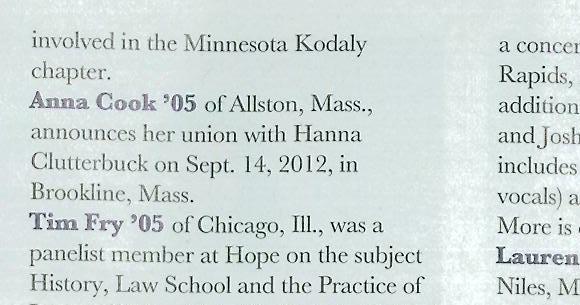
When Hanna and I sent out our wedding announcements in late September, I sent one to the Hope College alumni office; friends and family members were betting on whether or not the announcement would run in the alumni magazine’s list of news from graduates (births, deaths, marriages, advanced degrees, and so forth) that fill the back of each issue.

They had about even odds for and against running the notice at all.

But I got the latest issue of News From Hope College this weekend and there we were on page 27.

Of course, as there is a “Marriages” section of the News, the announcement would have more appropriately gone there since, you know, we got married.

But I imagine someone had to fight to put our “union” in the magazine at all, and I’m all for recognizing baby steps when they’re taken in the right direction.

So thank you, Hope College alumni office — you exceeded my fairly jaded expectations. You’re not going to single-handedly woo me back into the fold, but I do appreciate the acknowledgement that Hope alumni are here (and queer) right in the pages of the News from Hope.

real-life adventures in class, gender, race, and sexuality

01 Saturday Dec 2012

Posted by Anna Clutterbuck-Cook in think pieces

≈ 2 Comments

Tags

being the change, boston, gender and sexuality, MHS, politics, racialization, the personal is political

Last night I was working an event at the MHS that involved spending one portion of my evening standing out on the sidewalk, a few blocks away from the building, holding an electric lantern to light the way for guests moving from one location to another. I was one of about seven lantern-bearers spread out across a quarter-mile path from Point A to Point B.

Standing in one spot for 45 minutes, not soliciting nor waiting for public transit, and holding a lantern, certainly attracts attention in the city. Maybe a dozen individuals and/or groups of people stopped to ask me politely what I was doing, particularly if their path had taken them past one or more of the other lantern-bearers in the chain.

I happened to be standing at a station on a fairly busy stretch of sidewalk near a bus shelter, but on a bridge crossing over the Massachusetts Pike. It was long after dark, about eight o’clock, and my back was against the high fence that stops people from committing suicide off the bridge. I could see my fellow lantern-bearers down the way in both direction, each across an intersection though in plain sight.

(via)

A (likely homeless) man with a shopping cart containing his belongings came up the sidewalk. I nodded to him and he took this as an invitation to stop and talk with me. Continue reading →

giving thanks today for …

22 Thursday Nov 2012

Posted by Anna Clutterbuck-Cook in think pieces

≈ 1 Comment

Tags

family, friends, holidays

  • My wife, Hanna.
  • Our cats, Geraldine and Teazle.
  • Our families and friends.
  • The internet that lets us all stay connected.
  • Work I enjoy and
  • Colleagues I am proud to work with.
  • Robust health insurance and
  • Obamacare (babysteps everyone, babysteps!).
  • Writing and reading fan fiction,
  • My fellow writers at #firstthedraft,
  • And the people who encourage me to continue my history work outside of academe.
  • Starting to feel that Boston is home.
  • Bootstrap compost,
  • Maple syrup pie, 
  • Kona coffee from the Drowsy Parrot, 
  • And Stillman’s Farm summer and winter CSA.

please exercise your right to vote

06 Tuesday Nov 2012

Posted by Anna Clutterbuck-Cook in think pieces

≈ 1 Comment

Tags

being the change, boston, feminism, politics

Ohio, 1912 (via)

Hanna and I went up to our local polling station around 7:15am this morning to cast our ballots. The lines were long, but moving quickly and we were in and out of the school cafeteria in about 30 minutes. Everyone was polite and efficient, and for some reason the signs offering translation services (Vietnamese, Russian, Spanish, and more) made me tear up. As brokenly human as our election process is, I’m grateful to have been born in a generation where my right to participate is taken for granted, rather than something I need to fight for. Queer folks who are same-sex marriage supporters have to experience their civil rights up for a vote, and often see those rights rejected by their fellow citizens … but at least we get to cast a vote for our own equal rights. Women during the suffrage campaigns could only batter on the door in righteous anger (or speak words of forceful persuasion) in a long, slow struggle to be let in. I am grateful that so many of them did.

Please vote today. Even if you’re voting for the other guy I sincerely want you to make your preference known. I know there are flaws in the system, and I have friends who are cynical about the process and abstain on principal – and I understand their reasons and respect that it’s their right to do so. But I’m going to encourage you to make your voice heard in a different way today: by making an affirmative decision about which direction you would like our nation — and each state within it — to move. If you don’t cast a ballot in the first place, if there are disputes over voter fraud or recounts there won’t be a ballot from you to re-count.

(via)

Regular readers of this blog will be unsurprised to know I voted a Democratic ticket. At four this morning, when the cats woke me up to demand breakfast, I lay in the dark and enumerated the reasons why — given the two-party system — Democratic candidates are really the only option for leftist me:

1. The social safety net. Welfare and “entitlements” may have become dirty words in contemporary American politics, but my vision for what government is good for actually starts (and largely ends) with provision of basic care for its citizenry, particularly the most vulnerable. I have friends currently surviving in part thanks to government support — food stamps, WIC, unemployment insurance, government-subsidized student loans, social security benefits. Both Hanna and I have benefited from state-subsidized health care and federal student loan programs (say what you will about the cost of higher education, federal loans made our advanced degrees and subsequent financial stability possible at a relatively sustainable price). In our elder years, we will hopefully benefit from whatever iteration of social security is available. As global climate change becomes a reality, disaster relief will be the difference between utter devastation and recovery and resilience for more and more of us. My ethics demand that I support a government that will continue to provide these to the best of its ability, and actively work to bring material security to us when we need it most.

2. Reproductive justice and bodily autonomy. I’m a person with female anatomy; my body these days is the subject of intense debate and scrutiny in the political realm, particularly due to its capacity to sustain a pregnancy. Despite the fact that I do not plan to procreate, I am still deeply affected by a world which sees persons with uteri as individuals whose bodily autonomy is not secure and subject to the political agendas of others. Self-interest demands, therefore, that I vote for politicians who — at least at the party level — recognize my humanity as a complex reality, not just something that exists in the absence of others’ trumping interests.

3. Civil rights and social justice for queer folk. Democratic politicians are not consistently supportive of equal civil rights for queer folks — and not all Republicans are anti-gay. But taken in aggregate, the Democratic party is the only viable political party that is actually making moves toward supporting my rights as a citizen with same-sex desires to not be discriminated against in law because of those desires.

Here in Massachusetts we also had the opportunity to vote on legalization of medical marijuana and physician-assisted suicide. I voted in favor of both. I have known enough people facing difficult end-of-life decisions, including my late grandfather who died in 2007 of aggressive lung cancer, to know that we should all have the right to choose when and how to die, when the opportunity to choose is available to us. Although my grandfather’s condition deteriorated too rapidly for him to reach the point where assisted suicide was actively on the table, he had that conversation with my family and the hospice care folks who helped our family through the process of his death. And when it comes to marijuana, I don’t actually think it should be criminalized at all but will take what I can get in terms of de-criminalization. Hopefully, as medical use becomes more widespread and aboveground the stigma against responsible use will lessen and regulation will move out of the criminal justice system and perhaps into the public health realm.

This is what same-sex marriage looks like

Same-sex marriage is on the ballot in four states today: Maine, Maryland, Minnesota and Washington. E.J. Graff has been writing about the history and prospect of each measure over at The American Prospect, and I encourage you to check out her thoughtful state-by-state analysis. I know two families in Minnesota whose wee ones (ages four and six) are passionately supportive of the same-sex marriage campaigns and I’ll be thinking of them today. I want them both to know – Noah and Lilly I’m talking to you! — that regardless of the political outcome, they’re growing into fine people who are being the change we want in the world. Even if our guys don’t win this time around, that you care about fairness and kindness matters and will still make a difference, now and every day we move forward together.

← Older posts
Newer posts →
"the past is a wild party; check your preconceptions at the door." ~ Emma Donoghue

Recent Posts

  • medical update 11.11.22
  • medical update 6.4.22
  • medical update 1.16.2022
  • medical update 10.13.2021
  • medical update 8.17.2021

Archives

Categories

Creative Commons License

This work by Anna J. Clutterbuck-Cook is licensed under a Creative Commons Attribution 3.0 Unported License

Meta

  • Create account
  • Log in
  • Entries feed
  • Comments feed
  • WordPress.com

Blog at WordPress.com.

  • Subscribe Subscribed
    • the feminist librarian
    • Join 37 other subscribers
    • Already have a WordPress.com account? Log in now.
    • the feminist librarian
    • Subscribe Subscribed
    • Sign up
    • Log in
    • Report this content
    • View site in Reader
    • Manage subscriptions
    • Collapse this bar