• anna j. clutterbuck-cook
  • contact
  • curriculum vitae
  • find me elsewhere
  • marilyn ross memorial book prize

the feminist librarian

the feminist librarian

Tag Archives: domesticity

"oh I need a vacation!"

09 Friday Jul 2010

Posted by Anna Clutterbuck-Cook in our family

≈ Leave a comment

Tags

blogging, domesticity, family, maine, travel

Hanna and I are headed north this weekend to visit her parents in central Maine and celebrate Hanna’s birthday (yay! birthday cake!). Linda and Kevin live an hour north of Augusta is a beautiful cabin they’ve built themselves. We will be enjoying an internet-less weekend and I am thus taking a few days off from blogging. The sunday smut list will be back next week.

In the meantime, enjoy this song from the musical Pump Boys and Dinettes which I adored as a child and used to sing a top volume in public places, much to the chagrin of my parents.

it’s 100 degrees in Boston today

06 Tuesday Jul 2010

Posted by Anna Clutterbuck-Cook in a sense of place

≈ Leave a comment

Tags

boston, domesticity, family

Visual via @MartinClinton for @BostonTweet on YFrog

Hanna and I have been debating all summer about whether or not to get an air conditioner for our bedroom. When the temps get above ninety and the humidity is high, the city holds the heat like nobody’s business and it’s so, so hard to sleep.

We’d just turned down the offer of a free a/c unit from my colleague and friend, Heather, in favor of fans and cold cloths — but this past weekend has done us in. And we’re going to borrow Heather’s window unit after work tonight, in hopes of actually being able to get a good night’s sleep.

Long-term, though, we have pretty serious concerns about the environmental effect of conventional air conditioning. I’ve been hunting around the web today, looking for some eco-friendly ways to get our bedroom down to sleep-friendly temps and humidity. I found a good essay on Green Living Tips that talks about some of the better options, but sadly a lot of the best include structural changes to buildings that, living in an rented apartment, we don’t have control over. I was also disappointed to see that Evaporative Air Conditioners are, apparently, super-effective in arid desert environments but counter-productive in humid places like Boston (built on marshland!)

Bah.

So maybe the long-term solution is to move to Central Oregon after all, where we could enjoy the benefits of that High Desert air!

Any of you had experience looking for more eco-friendly air cooling options?

"time trickles down, and i’m breathing for two"

29 Tuesday Jun 2010

Posted by Anna Clutterbuck-Cook in our family

≈ 4 Comments

Tags

domesticity, hanna, holidays

So Hanna and I — like lots of couples, I imagine — don’t (yet) have any sort of definitive anniversary date on which to celebrate the miraculous grace of being together. Depending on which version of the story gets told (aren’t there always competing narratives?) we’ve been together anywhere from one to three years, give or take.

The awesome thing about this, Hanna informs me, is that it means we get to pick at least two dates on which to take special note of this thing we have going together. And — according to my version of the story at least! — today is one of them. So hooray! Let’s celebrate!

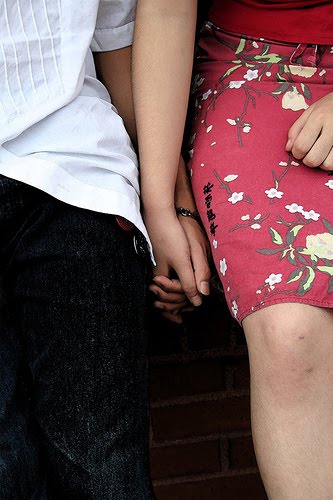
Thing is, neither of us is all that good a celebrating milestones like this, so rather than do anything super-duper splashy I thought I’d make a list. I’m good at lists! Hanna is also good at lists. We enjoy making lists together, in fact. So here’s my list for today, which is a list of all the beautiful, funny, wicked, delicious, true things in the world I would not know about (or know far less about) if Hanna hadn’t walked into my life.

Allston, Mass., which we now call home.
Boston Common Coffee Co., the first place we ever had coffee together (we talked for six hours — I really ought to have known then).
Catherine Tate, aka Donna Noble.
Dear Agony (Breaking Benjamin).
Walking on the Charles River Esplanade (much more fun with two).
FIFA World Cup Football (and why the UK England lost even though it was a tie).
The importance of having green things in one’s home.
Holding hands (way more intoxicating than I could have imagined).
Ice cream that comes in monthly flavors!
Joe Hill.
Kisses (also Kiss Kiss Bang Bang).
Let the Right One In.
Metta meditation.
The Ninth Doctor.
The Ood.
The Peabody-Essex Museum.
Quotations (and Quality snark) for every occasion.
Irish republican nationalism.
The Super 88, where we had dinner the night I decided to move in.
Terry Eagleton who introduced us to the ever-useful term “Ditchkins.”
Underwater Light (best Harry Potter fanfic ever, sadly no longer available on the internets).
Vampires who do not sparkle
Waving not drowning.
Always vote X saxon if you know what’s best for you.
Yoga practice.
Zombies (along with Christopher Eccleston, who might be scarier than zombies).

Thank you, love, for all of this. And let’s keep making lists together for years to come.

image credit: lesbian romance by made underground @ Flickr.com

new spectacles + good vibes (both kinds!)

19 Saturday Jun 2010

Posted by Anna Clutterbuck-Cook in our family

≈ Leave a comment

Tags

boston, domesticity, random kindness

It’s been awhile since I posted something that was just about life in Boston, so here on this hot, humid Saturday — as Hanna and I watch Denmark vs. Cameron at the World Cup — I thought I’d share pictures of my new library lady spectacles. They’re my first new pair in over five years, and I feel like the world just got a little bit clearer! Hopefully, they’ll help with the headaches and eyestrain as well.

Hop over to Twitpic if you want a larger version of the photo (I’m on Hanna’s laptop at the minute and too lazy to edit the .jpg without my usual software).

Hanna says they are very 1950s and reminiscent of the ladies in Farside; perhaps this will help with my fearsome feminist library lady persona? Time will tell!

In other low-key weekend news, we happen to live about a ten minute walk from the only Good Vibrations store on the East Coast and I enjoy stopping in occasionally — mostly to window shop as most high-quality sex toys are simply beyond my modest discretionary budget. So I paid them a visit this morning on my way to the grocery store and while I was browsing a fellow customer came up after making her purchase and offered me a $10-off coupon she’d just received that she said she would never had a chance to use (I assume the was in the Boston area on holiday). I have no idea what her name was or what prompted her to pass the card along to me — but thank you mystery woman for that anonymous treat! I already have a few ideas for how to make use of the gift :).

to be subjective and scholarly

18 Friday Jun 2010

Posted by Anna Clutterbuck-Cook in think pieces

≈ 1 Comment

Tags

domesticity, education, thesis, work-life balance


Last Friday, I blogged about my frustration with finding balance between my academic research and writing, my wage-work, and my domestic life and loves. This Friday, I thought I would pick up where I left off, after a fashion, and write about the ways I try to balance the academic and the personal within my work as a scholar.

This post has gone through a number of different iterations in my head, but is taking this particular form because of a recent post by Kimberley @ 72-27 who this week wrote a long, reflective piece about her own return to academia and the limitations she sees in rigorous scholarship that neglects the relational in pursuit of the rational.

Before my current program, I came from a small school in Seattle that trained students to be therapists, and thus it placed primary value on inter-personal and intra-personal knowledge. My professors were psychoanalysts and therapists, and they asked their students to delve into the unconscious self and figure out what was there and why it was there. We did intense work understanding our own families of origin and personal narratives, and we received a great deal of feedback on how other people experienced us while in relationship with us. While the program lacked academic rigor in the traditional sense, it demanded a kind of inter-personal and intra-personal rigor that was invaluable.

While I love the rigor that is applied to critical thinking at Yale, I am left envisioning what Yale would be like if that same kind of rigor were applied to self- and inter-personal knowledge. For instance, in my U.S. religious history class, one of my professors shared with us that it took him quite a while in his career to realize that he hadn’t picked his research “objectively.” His research came out of deeply rooted questions based on very personal life experience. Yet, in his graduate training, he had not been encouraged to see the connections between his “objective” research and his own life story. This discussion in class came at the very end of the semester, and it was a relief to me. I had often felt as if historians maintained a pretense of objectivity. It was nice to finally hear that we can actually do better research if we are self-reflective in the process. Knowing ourselves better will also translate to being better collaborators.

Emphasis mine. You can read the whole post at 72-27.

How does this connect to my own work, beyond the skepticism toward an overly-depersonalized academia which I unabashedly share? To begin answering that question, I want to share another lengthy quotation — this time from an email I wrote earlier this spring. When I was at the Oregon Extension in March, doing research for my thesis Doug Frank — one of the faculty there, an historian and mentor of mine — asked me whether my project was a chronicling of “what happened” or whether I was making a specific argument. I stumbled through an immediate response that, from what I remember, emphasized that I was gathering the oral histories as a type of chronicling, but that my thesis would itself have a specific argument to make about the place of the Oregon Extension in American cultural, educational, and religious histories.

Of course me being me, I left the conversation unsatisfied with my response and the following day wrote Doug a long email trying to explain my motivations for this research. I won’t reproduce the email in full here, but I wanted to share two paragraphs that speak to the connections between my “objective” historical analysis of the Oregon Extension and my own life story.

On a more personal note, I will say that this project comes out of my own deep interest in history of non-mainstream education and my very personal quest to find a way to bring together my love of learning (the life of the mind) in some sort of structured environment with the quality of life I experienced as a child and young adult outside of institutional schooling. My original desire to attend the OE as a student (nearly a decade ago now!) was driven, in large part, by my desire to find a way to be a scholar without having to fit myself into the vision of education (the fear-based model you were talking about yesterday, which I believe is still deeply embedded in most schools) and of human nature that ran so counter to the understanding of human life that I had grown up with in my family (and elaborated on through my reading in theology, feminism, and educational theory). I am drawn to examples of intentional community and purposeful work life, in which folks have been able to step outside of the pressures of the mainstream and forge a life for themselves that isn’t grounded in being “anti” (that still retains some sort of relationship with the dominant culture) but nevertheless has some autonomy when it comes to priorities and values — the power to say “you have no power here” to things within the dominant culture which are inimical to human well-being.

When I went back to graduate school, I was taken aback by how much my soul rebelled against being back in an environment of institutional education, surrounded by folks who largely take those traditional frameworks for granted (at the very least) and often champion them (Boston’s educational culture is incredibly status-conscious). I don’t necessarily believe I made the wrong choice to return to school (the factors are myriad), but I do know that when it came time to choose a thesis topic, I intuitively knew I needed to spend my time with a topic that would help me retain critical distance on that culture, that vision of humanity, that understanding of the way human beings learn and what they need to thrive. And as of this writing, at least, I feel pretty proud of the way that this project has helped me to do just that, giving me a certain inner sense of distance from the expectations and values of the institutions within which I work as a student scholar, so that I am sharing these ideas with them (in a form they can accept for credit) but not writing my thesis for them.

As I wrote more concisely (though much more pedantically) in an early draft of my thesis introduction, “The scholarly task of historicizing the college classroom and the expectations of higher education were, in part, a method of coping with the alienation I often felt as a student whose experiences and vision of, not to mention goals for, learning were at odds with the majority of the people whom I encountered at school.”

In other words, this topic matters to me, in a visceral, immediate way. The project of make sense of the history of competing educational theories and practices is as much about finding a place for myself within that world as it is about situating the Oregon Extension within its unique historical context. I am invested in doing my part to enter these folks into the historical record because I believe deeply in the value of what they do. It is important to me that their own unique experiment in living be acknowledged at some level as part of the history of education in the twentieth century — a way of being that runs counter to the stories we tell ourselves about how life has to, or ought to, be.

And the world of academia is definitely divided as to whether this is or is not a good thing. Emotional proximity to one’s subject-matter is often viewed with deep suspicion, as it is seen to cloud the mind, bias the historian whose job (as Kimberley notes about) is ostensibly to be “objective” about her subject. Distance from one’s topic (in time as well as emotion) is supposed to provide you with the dispassionate objectivity to analyze and critique with greater clarity. Even if we recognize (as most scholars do today) that we are all inevitably subjective in our scholarship, the push has been to recognize and attempt to minimize or compensate for those biases, rather than to embrace and work with them as strengths.

I’m less certain that this is the only or the best approach to subjectivity within scholarship. Although I’m still searching for language to articulate it, I think that there are different qualities of emotional proximity or connectedness to one’s research subject that can — depending on how self-aware the researcher is and what their relationship to that connectedness is — help or hinder scholarly analysis.

I am taking a meditation class with Hanna this month (my first ever!) and have been introduced to the practice of metta meditation, in which the quality of loving-kindness toward beings is distinguished from feelings of acquisitive desire for those beings. I’ve been thinking this week about how the same distinction might be made concerning one’s affinity toward a research project: intense feelings of loving-kindness toward the subject and subjects — relatedness that is not conditional upon a particular outcome — could be separated from an emotional investment that was conditional, that required fidelity to a particular outcome, a particular historical narrative that fit pre-conceptions about what story these historical sources were going to tell.

Again, I’m not sure how practically this translates into a real-world relationship between the scholar and her sources, the scholar and her passionate involvement with the work of her subjects. But it is a beginning, a way to open (inside myself, at least) a conversation that values not only my intellectual work but also the personal, emotional, life-story reasons why the pursuit of this particular story is not only an academic exercise but also very much a matter of existential survival.

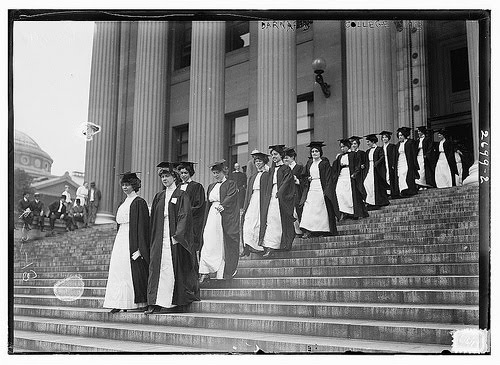
image credit: Barnard College, 1913 (LOC) made available by the Library of Congress @ Flickr.com.

feeling guilty for wanting a balanced life

11 Friday Jun 2010

Posted by Anna Clutterbuck-Cook in think pieces

≈ 1 Comment

Tags

domesticity, simmons, thesis, work-life balance

I’ve recently been making some decisions about how and when to complete my graduate education. Decisions which have left me feeling one part proud of myself for saying “nope, this isn’t working” and making the necessary changes and one part small and ashamed of being slow and for, well, wanting a balanced life. It is always humiliating (or at least I find it so) to find one’s self buying in, even a little bit, to the cultural pressures and voices in one’s head that pass judgment on the personal life decisions. Decisions that I know, in my gut, are right for me but nevertheless run counter to the mainstream expectations of how we ought to live our lives.

And yet, despite knowing I’m right, I do feel that pressure, and I do hear those voices. As I was trying to make a decision about whether or not to revise my planned thesis-writing deadlines to give myself more time for writing I was acutely aware of those dynamics. And the dynamics of justifying whatever decision I made both to myself and to others (my advisers, my family and colleagues, etc.). So I have a few observations that I’d like to share with you.

As I sit here spelling them out, they all seem rather obvious — but I think in part because of their very ubiquity they become invisible to us. So for that reason I’m going to the trouble of articulating them anyway.

The first observation is that it is really damn hard in our culture to feel comfortable making the argument that I am part of a family and that it is important for me to nurture the relationships that make up that family even while pursuing academic work and wage-work that I also care about. When justifying my thesis extension to my advisers, I emphasized my work schedule and the importance of having enough time for deliberation and revision while writing. I was up-front about the importance to me of having regular leisure time with Hanna during the week, but I was careful to name that desire as one of a number of factors, rather than foregrounding it as one of my primary concerns (which, in fact, it is). And part of me felt ashamed for naming it as a primary concern, even as I persisted in doing so.

A related reason that feels like an admission of failure is naming domestic responsibilities and the amount of time they take: quotidian tasks such as the morning and evening commute, physical exercise, dish-washing, laundry, grocery shopping, cooking, cleaning one’s kitchen and bathroom, attempting to impose some order on a very tiny apartment space in which two grown women, a cacophony of plants and myriad books are attempting to co-exist. As feminists have pointed out repeatedly for the past two hundred years (at least), domestic concerns are not taken care of by magic (sha-zing!), but rather through work, work that takes both time and energy on the part those whose duty it is to complete these tasks — whether those persons are paid domestic servants, unpaid spouses, or (in the case of those with neither the economic resources to outsource or a “separate spheres” arrangement with their partner) someone who comes home from work to a second shift.

Yet, as feminists have also pointed out, our society is still organized on the underlying assumption that these tasks will be completed on an invisible level, but people whose labor doesn’t officially count — or possibly in some gap in the space/time continuum. So it feels shameful to acknowledge openly that these tasks do take time, my time and Hanna’s time, and that these domestic responsibilities do not count as leisure activities. Rather, they too are un-fun duties that detract from rest and relaxation during the week.

Both of these facets of life — time to enjoy relationships and time for domestic tasks — fall under the broader umbrella of self-care, which is really the third life activity that is so very difficult to talk about, much less claim time for, in our culture (more about that in a forthcoming post next week). Despite all of the hue and cry that we are a narcissistic, self-obsessed culture very little in the structure of our society encourages care for, and love of, the self — something that is foundational to being effective in any other aspect of life. Yet it is something that is supposed to happen around the edges of our other obligations — shoved to the early mornings, late evenings, weekends, holidays. Rather than occupying its central place in the fabric of our daily lives.

My advisers were, I would like to be clear, not pressuring me to finish within the original time-frame, and were even supportive of my desire to have a life outside of school. But nonetheless, it was a difficult thing for me to ask for. One of them expressed confidence that I could finish writing in the time originally planned, and suggested that deadlines are important in curbing perfectionist tendencies. Which made the voices in my head start to wonder: was I really just panicking about writing a less-than-“perfect” thesis? Was requesting an extension just delaying the inevitable needlessly? But then I realized that these questions and doubts I was having focused the question back on the thesis itself, once again eliding the life I lead around the thesis project, and how that “extra-curricular” world has a place of equal importance in my life.

To be honest, when push comes to shove, it has a more important place in my life. By which I mean that caring for personal relationships and spending quality time with the people in my life will virtually always academic endeavors, unequivocally.

And that’s what I have the hardest time admitting to myself and the world: that people will always, always come before ideas in terms of my priorities. Why is admitting this so difficult?

In part, at least, it’s because I do, truly, feel passionate about ideas. As anyone who has lived in close proximity with me since I became verbal can attest: I am constantly thinking, processing, analyzing the world around me. It’s something I find endlessly enjoyable, satisfying, meaningful. My thesis, in this particular instance, is a self-chosen research project on a topic that’s been close to my heart for the past fifteen years; it has re-connected me to people for whom I care deeply, and whose own work in the world I admire. I will see this project through to the end, and I will be proud of having contributed my bit to the history of this particular time and place. I am good at what I do, and I believe in making use of my skills as a writer and thinker.

But as much as I love the world of ideas, I do not thrive in the world of academia, and I don’t think I quite understand — at least intuitively — what it takes to be the type of person for whom scholarship is their passion, their lifeblood. And often I feel incredibly guilty about acknowledging this, since I live and work in a world surrounded by such scholars.

It makes me feel, in some obscure hard-to-put-my-finger-on sense, like I’m letting them down. That I’m failing to live up to their hopeful expectations that I become a driven, passionate scholar like them.

Finally, I also think that, as a woman and a feminist, I find it particularly fraught to speak about those instances in which I choose to prioritize personal relationships over what amounts to my professional identity. Part of me struggles with the realization that, in doing so, I am conforming to cultural expectations of what women “naturally” prefer: we’re “naturally” more intuitive and relational, blah blah blah (“rubbish!” as Hanna would say). Another part of me is pissed that I feel ashamed of making those choices because I realize that, on some level, my feeling of shame means I have bought into the (profoundly anti-feminist) cultural idea that those “feminine” realms of being are somehow a lesser choice. And yet a third part of me is haunted by the women academics who have worked so hard to assert their right to be a part of the life of the mind, and I feel saddened by my acknowledgment that I have (more often than not) failed to feel at home in the space they were so triumphant, not so very long ago, to gain entrance to.

In the end, though, I don’t think this is an issue of gender (though it has aspects specific to cultural expectations of women and men) so much as it is an issue of “work” and how we understand what counts as work and what the place of work should be in our society and in our individual lives and self-identities. If anything, I suspect men still have a more difficult time in our culture claiming time for non-work activities, particularly activities that involve relational intimacy and home-making.

Most of all, I think this is an issue of re-claiming the right to make space for things that are not-work in our lives, and make the (radical?) assertion that often these things are more important to us than those things which count as work.

This has been a long, rambling blog post for which I have no tidy concluding remarks. So I thought I would end with some open-ended questions. I hope some of you will take the time to respond to in comments! What things do you find yourself struggling to justify making time for, and why? What do you do when your personal priorities are at odds with society’s priorities?

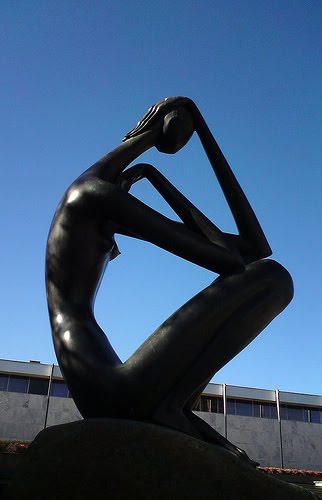
image credit: awkward by sketch | erase @ Flickr.com.

future feminist teatime, otherwise known as "i’m really not as scary as i pretend to be!"

04 Friday Jun 2010

Posted by Anna Clutterbuck-Cook in our family

≈ 5 Comments

Tags

blogging, domesticity, fun

Welcome!

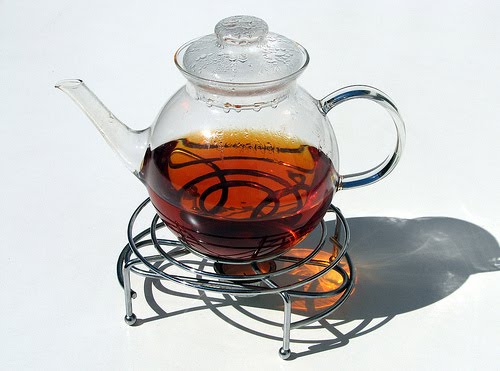
I’ve been getting an uptick in comments lately, and an increasing number of visits to the blog. So I thought it was time to put out the welcome mat, set out the pot of tea, and invite y’all who are lurkers and occasional commenters (yep, you!) to say “hi” and introduce me to your lovely selves.

I’ve just updated this blog (if you haven’t noticed) so that it now includes a page about me and my comment policy, such as it is. Not that I’ve been having recent issues, but I’d been dragging my feet for a while getting one together and I figured it was time.

So that’s me. Now it’s your turn! Please leave a comment — as long or short as you wish — telling me a little about yourself. Be sure to leave a link to your own blog, website, or other online presence if you keep one, and I’ll make sure to stop on by.

Peace,
Anna

image credit: teatime by benefit of hindsight @ Flickr.com

from the neighborhood: sunday in Lunenberg

17 Monday May 2010

Posted by Anna Clutterbuck-Cook in our family

≈ 2 Comments

Tags

domesticity, from the neighborhood, photos

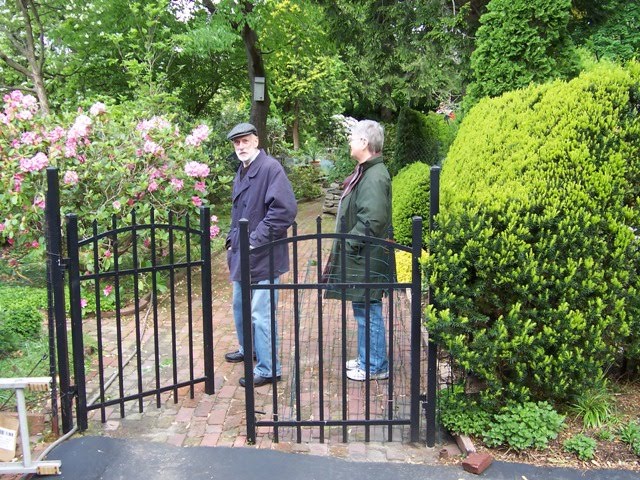
On Mother’s Day, Hanna and I took the train up to Lowell where we met her parents and went visiting in Lunenberg, to the home of a family friend whom Hanna has known all her life.

Estelle served us blueberry muffins and tea and showed us around her gorgeous garden, just beginning to bloom for the summer.

It was a freezing day, despite the sunshine, and I had to borrow one of Linda’s coats to stay warm.

We were sent away with armfuls (literally!) of flowers to leave at Hanna’s grandparents’ graves.

from the neighborhood: pancake day

05 Wednesday May 2010

Posted by Anna Clutterbuck-Cook in our family

≈ Leave a comment

Tags

domesticity, from the neighborhood, photos

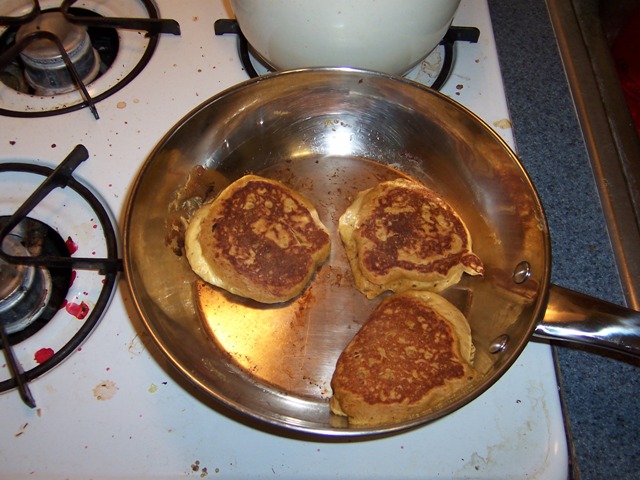
I piled a bunch of angst up in the early part of the week, and I thought y’all might be able to use a little break from my soapboxing. So here’s a picture of delicious corn molasses pancakes I made this morning. (Seriously: what could possibly be more anti-angst than pancakes??)

Wednesday is my thesis-writing day and so before Hanna and I take our morning constitutional and I drop her off at work before returning to craft eloquent sentences and pretentious footnotes, I get up and make pancakes. These particular pancakes are a recent find @ Joy the Baker and are awesome. Frankly, we can’t get enough of them.

from the neighborhood: i get birthday presents!

29 Thursday Apr 2010

Posted by Anna Clutterbuck-Cook in our family

≈ Leave a comment

Tags

domesticity, hanna, holidays, photos

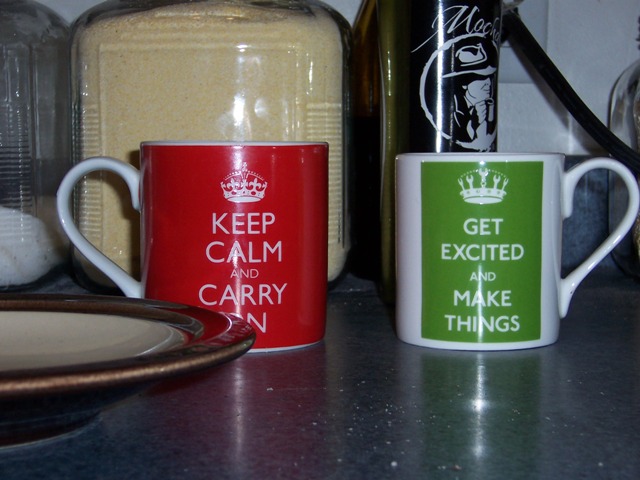
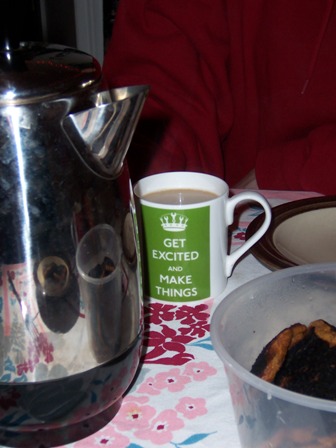
My 29th birthday (as many of you know) was at the end of March, and Hanna found this awesome coffee mug for me, all the way from McLaggan Smith Mugs in Jamestown Alexandra Scotland. It finally arrived yesterday, after a slight delay due to volcanic eruptions in Iceland

Regular readers of this blog may have realized that I am a longtime champion of nonstandard spelling, something which caused a great deal of tension between my mother and I during my early years (believe it or not, she had to work strenuously to convince me that writing was a worthwhile pursuit). “Excited” was one of the words she requested, eventually, that I learn how to spell the conventional way because I used it so often and she was getting tired of the variations on spelling I came up with.

The graphic is a riff on a 1939 British war propaganda poster that encouraged British citizens to “keep calm and carry on” in the face of German aggression. In recent years, lots of variations have cropped up, including Hanna’s favorite: “now panic and freak out” (featuring the royal crown, only turned upside down).

This morning I christened the mug with its first cup of coffee, made in our brand new percolator (Kenya AA from the Boston Common Coffee Co., also known affectionately as the Beanstock).

← Older posts
Newer posts →
"the past is a wild party; check your preconceptions at the door." ~ Emma Donoghue

Recent Posts

  • medical update 11.11.22
  • medical update 6.4.22
  • medical update 1.16.2022
  • medical update 10.13.2021
  • medical update 8.17.2021

Archives

Categories

Creative Commons License

This work by Anna J. Clutterbuck-Cook is licensed under a Creative Commons Attribution 3.0 Unported License

Meta

  • Create account
  • Log in
  • Entries feed
  • Comments feed
  • WordPress.com

Blog at WordPress.com.

  • Subscribe Subscribed
    • the feminist librarian
    • Join 37 other subscribers
    • Already have a WordPress.com account? Log in now.
    • the feminist librarian
    • Subscribe Subscribed
    • Sign up
    • Log in
    • Report this content
    • View site in Reader
    • Manage subscriptions
    • Collapse this bar