• anna j. clutterbuck-cook
  • contact
  • curriculum vitae
  • find me elsewhere
  • marilyn ross memorial book prize

the feminist librarian

the feminist librarian

Tag Archives: education

booknotes: the self-organized revolution

10 Thursday Feb 2011

Posted by Anna Clutterbuck-Cook in book reviews

≈ 2 Comments

Tags

children, education, human rights, politics

The other day, while I was tracking down an errant citation for my thesis I happened to stumble upon the fact that an historian of education (and education alternatives activist) whom I greatly admire had put out a collection of essays on education activism in 2008 that I had somehow missed. So needless to say I ordered a copy. In The Self-Organizing Revolution: Common Principles of the Education Alternatives Movement (Brandon, VT: Holistic Education Press, 2008), author Ron Miller considers a variety of “education alternatives” (home-based education, Waldorf and Montessori schools, free schools, etc.) and suggests that although they have historically been resistent to collectively identifying as a movement in fact practitioners and advocates do have a common set of core principles.

The principles Miller identifies are:

  • Respect for every person, including children (human rights)
  • Balance (openness rather than fixed ideology)
  • Decentralization of authority (human scale democracy)
  • Non-interference between political, cultural, and economic spheres of society
  • A holistic or integrative perspective

To me, it is interesting to think about how these five principles or perspectives on humanity, social organization, and human growth, articulate a particular subculture that stretches across different educational counter-cultures (i.e. the home education movement) but doesn’t wholly define any one of them. There are home educators out there who in no way subscribe to this vision of how education could or should be. There are public school teachers who struggle within the confines of institutional education to live out a form of education that fits this paradigm. I appreciate how Miller is trying to build bridges between segments of a very heterogeneous bunch of folks (what was that about herding cats again?)

I’m particularly pleased to see the way he foregrounds the issue of human rights and children’s rights. “Rather than treating individuals as a means to some culturally determined end (such as national pride or global economic dominance),” he writes, “this perspective insists that every human being is an end in oneself” (48). Decentralization of authority and the principle of noninterference follow from this first principle: in order to ensure that the needs of individuals are not subsumed by the interests of the state or the interests of corporations, education must be dis-entangled from government and for-profit enterprise.

This is not to say Miller believes that the government should not play any role in ensuring that all individuals have access to educational opportunities. Only that he does not believe the government should dictate what should be in the curriculum and how it should be taught. I am not particularly persuaded by his vision of voluntary community-run charities to fund educational programs. But I see in it the seeds of a new way of thinking about funding education: A future system that operated more like the National Endowment for the Humanities, perhaps, than like No Child Left Behind.

This is definitely a book written for movement “insiders” — folks who already have at least some working knowledge of pedagogical theories and practices, the major thinkers in counter-cultural education, and the recent history of educational alternatives. If you weren’t familiar with the work of people like John Holt or know at least a thumbnail version of the history of Montessori education the book might feel pretty shallow and cursory to you. Even I would have appreciated a bit more fleshing out of Miller’s vision of what a human-right-centered education would look like. Other historian-activists such as Joel Spring (Wheels in the Head) and Clive Harber (Schooling as Violence) have written a much greater length about possible models for an alterntiave to the national-military-industrial model we’re currently stuck with and flailing to sustain.

You can read selections of Miller’s work — including some of the essays that make up this book — online at Paths of Learning.

booknotes: the sixties

27 Thursday Jan 2011

Posted by Anna Clutterbuck-Cook in book reviews

≈ 1 Comment

Tags

british isles, education, feminism, history

Jenny Diski’s slim contribution to the series BIG IDEAS // small books (Macmillan Press) is a historically-minded memoir of The Sixties, that period of social foment between, as she dates it, the mid-1960s and mid-1970s. Between “the rise of popular culture” and “all the open-ended possibilities … began to narrow” (3). Diski is English, so her Sixties were the British Sixties, kicking off with the Beatles and the fashions of Swinging Sixties London (picture Emma Peel in the Avengers) and ending with the rise of Tory, Thatcher-ite politics. In six brief chapters, she surveys consumer culture, drug culture, sexual liberation, and movements for social change: principally the feminist movement and the free school movement.

I’m not particularly sure what Diski was going for in this book. Granted I read it very quickly in a single sitting one night when I couldn’t fall asleep. But still. On the one hand, it attempts to survey cultural trends in an overview sort of fashion, to speak for more than just herself — she uses “we” throughout to speak of her cohort of youthful enthusiasts. Yet at the same time, Diski’s experience is a very personal one. An unhappy adolescent, she was kicked out of school for using ether in her early teens and soon thereafter left her parents’ care for good. She was heavily involved in the drug scene in London, checked herself in and out of mental health institutions throughout the 60s and 70s, had a lot of very unhappy sex, was involved in starting an alternative school, went back to rehab … despite the way her words cue nostalgia and a continued commitement to the values of her youth, the book manages to convey very little sense constructive joy.

Diski seems to have settled on wistful nostalgia lost opportunity — though opportunity for what exactly remains fairly nebulous — woven together a rather pessimistic interpretation of these countercultures as ultimately paving the way for the conservative revolution. Rather than interpreting the rise of neoliberal conservatism (Reagan on this side of the pond, Thatcher on that) as a backlash against the chaos of the Sixties, Diski sees it as a natural outgrowth: hard-right concepts of privitization and individualism dovetailing neatly with left-wing desires for decentralization and exploration of the self. “I’d resist the claim that the Sixties generation were responsible for the Tatcher years, as I would resist the notion that the Jewish community in Germany were responsible for the advent of the Nazis,” she writes (should her argument automatically lose according to Godwin’s law?). “But sometimes I can’t help but see how unwittingly we might have been sweeping the path in readiness for the radical Right, preparing, with the best of good intentions, the road to hell for paving” (110).

While as an historian of this period I am inclined to agree that the argument has merit — the radical Right employed and benefited from the theoretical frameworks developed on the radical Left much more than either side likely wants to admit — I am unsure what Diski wants us to do with this observation. She implies, though never develops the argument fully, that the desire for democratization, decentralization, diversity, and exploration of the self-in-relation-to-others somehow fits in with the far Right agenda. And that therefore the very foundations of the Sixties counterculture are suspect, tainted.

I’d argue this is a confusion of external appearances with deeper values. It is akin, in my book, to arguing that because the Religious Right has utilized Christian scriptures for power-hungry, poisonous ends, that the Bible is worthless as a spiritual text, and all Christians are somehow in (perhaps unwitting, yet still substantive) collusion with those forces inimical to life. I realize there are a lot of folks — particularly on the secular left these days — who do indeed argue the very perspective. Perhaps Diski is one of them, although I know nothing about her personal religious values. I find such wholesale dismissal of complex philosophies and traditions to be disheartening; imaginative “third way” options are often sacrificed as a result.

Which is kind of what I felt when I read Diski’s chapter on free schools. She focuses specifically — aside from recounting her own experience helping to found and run an experimental community school — on the pedagogical writings of Ivan Illich. Illich is known best for his influential critique of institutional schools, Deschooling Society (1971), which argued that institutional schools — designed to support the modern corporate and state interests — are antithetical to authentic learning. Illich argued that a much more human-centered, constructive approach to teaching and learning would be to establish community-based learning centers that would serve as a general clearing house for those with skills willing to teach and those with the desire to learn. As the title of his book indicates, Illich was interested in a whole-sale revisioning of society, as a re-tooling of learning would entail a re-tooling of the rest of the economic and socio-political culture in order to accommodate peoples’ freedom as individuals to learn according to their own design. Diski classifies him as a libertarian, which is perhaps fair, but also suggests that he would have found a home in Margaret Thatcher’s government, as one of her “theoretical advisors” (110).  While I don’t know enough about Illich’s overall political views to argue what he would or would not have done if given the chance.  However, as a radical Catholic priest who — as far as I’ve been given to understand — was deeply suspicious of institutions across the board — it is difficult to see him participating at such a high level in government. Let alone a government that was so heavily invested in maintaining the power of big business, the military, and so forth.

As Diski herself writes, the point was “to dispense completely with structure, to undercut the authority of hierarchy and the hierarchy of authority” (110). This, for some reason, appears to have surprised Diski when she revisited Illich in preparation for writing this book. She is appalled at the idea that no centralized system would be in place to advocate for certain bodies of knowledge, and sees in such a centralized, non-authoritarian vision the spectre of violent anarchy and increasing inequality. Of privatized interests and a voracious economic dominance. In short, Diski is conflating a vision of human liberation from cultural conformity, institutional tyranny, and systems of oppression, with a right-wing political liberatarianism that ignores (of, often, actively supports) the way in which power is used and abused by human beings to marginalize and control the vulnerable. She does not acknowledge the sister-discourse within the educational alternatives movement concerning common responsibility, reciprocity, social justice, and peace.

Which is, in the end, where I feel her analysis of “the Sixties” as a period of cultural and political foment falters. To say that the upheaval of the postwar era lay the foundations for the rise of conservatism in the late 1970s is a valid argument, but her failure to explore fully the way in which left-leaning calls for personal liberation were twinned (in both philosophy and practice) with collective responsibility for the well-being of humanity and the planet as an ecological whole. It is also to ignore the individuals and groups that have continued to advocate this vision, even as the conservative agenda has come do dominate mainstream discourse. Perhaps in a lengthier work Diski could have convinced me, but given that she offered her thesis with such brevity, I found myself still unconvinced.

a word about words, unschooling edition

09 Thursday Dec 2010

Posted by Anna Clutterbuck-Cook in think pieces

≈ Leave a comment

Tags

blogging, education

After a discussion with Hanna last night about unschooling vs. homeschooling vs. home-based education (as vocabulary choices and as philosophies), I wanted to clarify a couple of things re: word choice in my blog posts about nontraditional learning.

We were talking about the language I used in my recently-published interview as a “grown unschooler.”

In my life, I tend to use all three of these terms (and variations thereof) to talk about myself and my life experience. As a child, I used “homeschooling” because that was predominantly what my parents used. As a teenager I discovered “unschooling” as a term to differentiate more child-directed forms of homeschooling from those which sought to replicate school-at-home (this usage dates back to the 1970s), and found it more usefully described my particular experience of homeschooling — particularly as a way to distinguish myself from the majority of homeschooled teenagers in my area who were politically, socially, and pedagogically conservative.

More recently, since I’ve been doing scholarly reading and writing on the subject of education, learning, schooling, and pedagogy, I’ve become more varied and more deliberate in my choice of words to describe learning and teaching experiences. In my academic writing, I tend to use the word “school” to mean formal, institution-based educational experiences specifically — while “education” means learning and teaching experiences in a broader sense. Learning, of course, can take place even when deliberately-planned educative environments and/or experiences are absent. But home-based education is, usually, planned. Even if to the extent that parents have chosen to allow their children to grow outside of the default option which, in our culture, is formal schooling (public or private).

“Unschooling.” It’s an unsatisfactory word to me for a couple of reasons. One is the prefix “un” which right away gets us into negative territory. Instead of being for something (home-based education; learner-directed education) we’re defining ourselves against something (institutional school). The second, related, issue is that it still frames learning as something to do with school — even if set up as school’s opposite.

In fact, I think — and I imagine most self-identified unschoolers would agree — that learning and education are much, much bigger than mere school or its opposite. Learning can take place in, but is not bound by, formal schooling or deliberate educational activities. So these days, I try to move away from “school” terms as much as possible when I describe my own learning background pre-college.

At the same time, I continue to use all of these words, depending on the audience, the context, and the topic. I’m happy to accept the label “unschooler” when it allows me to talk about my experience outside of school; I’ll use “homeschool” or “home-based education” when that seems like the most useful choice. At the end of the day, I believe words are what we make of them — words are tools — and the more and the more varied the words we have at our disposal to describe our experience (and, most importantly, the more willing we are to be flexible in our language use) the better-equipped I think we are to articulate our being-in-the-world in all its myriad permutations.

"negotiation and compromise": reflections on my childhood outside of school

08 Wednesday Dec 2010

Posted by Anna Clutterbuck-Cook in life writing

≈ 5 Comments

Tags

children, domesticity, education, family, human rights, work-life balance

It seems fitting, in this last week of formal coursework in pursuit of my Master’s in Library Science, that I take some time out to reflect on a very different experience: that of growing up for the first seventeen years of my life outside of formal institutions of schooling. Those of you who follow my blog probably know that cultures of schooling, education, and learning are a topic of scholarly and personal concern to me. As I wrote on Saturday, Idzie @ I’m Unschooled. Yes I Can Write is running a series of interviews with grown unschoolers about their experience learning outside of school. I took some time out from wrapping up my coursework last week (read: spent time procrastinating like it was going out of style!) to respond to her questions. And yesterday Idzie published my responses.



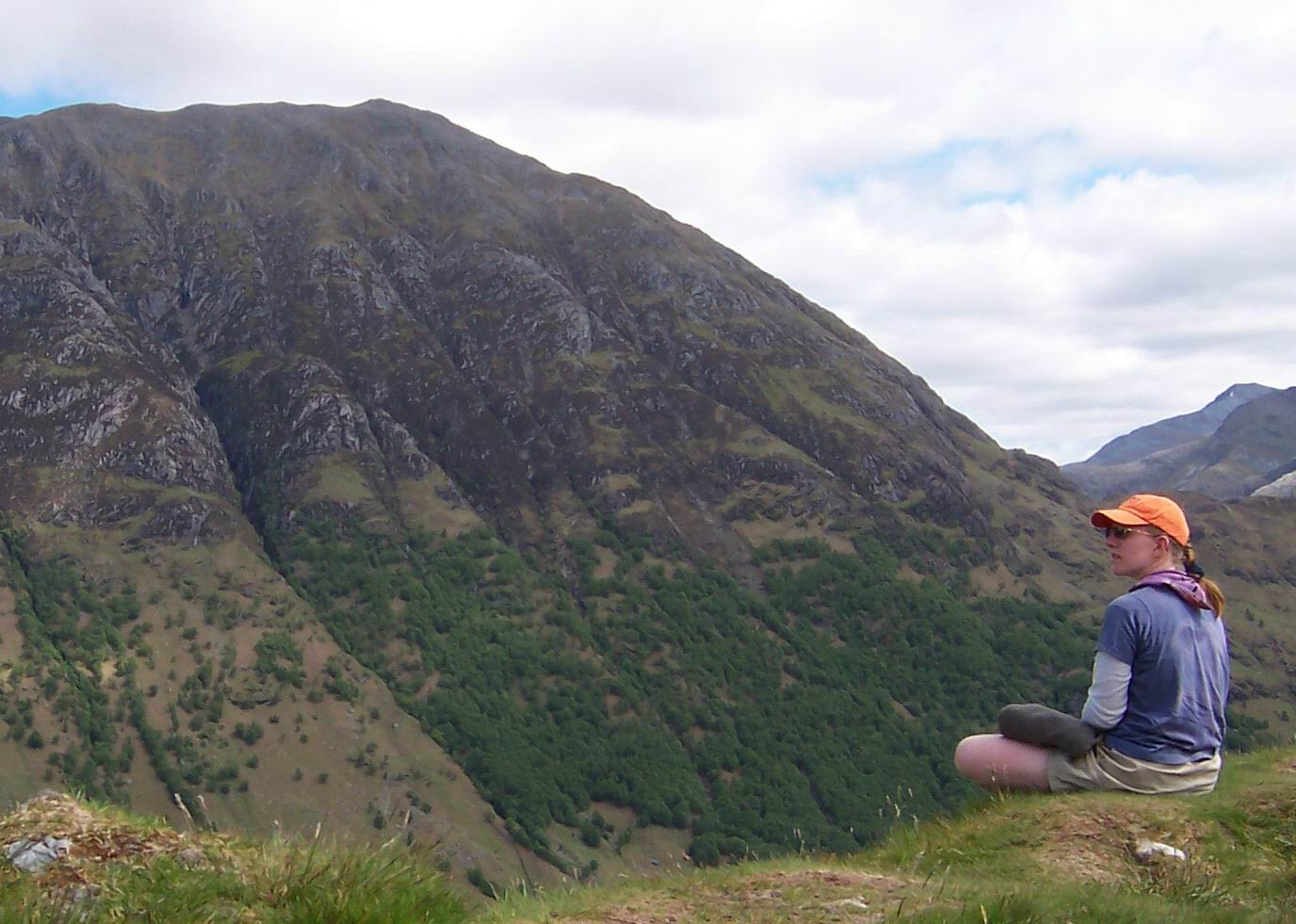
Glen Nevis, West Highlands, Scotland (May 2004)

Since I thought many of my readers would be interested in my responses, I’m cross-posting what I wrote here. But if you enjoy what you read, do check out Idzie’s blog since she publishes lots of awesome stuff — and promises an ongoing series of similar interviews.

The Basics

When did you become an unschooler?
birth (1981) and/or first year I was school age (1987)

How long have you/did you unschool?
Difficult question! I still think of myself as practicing the values of unschooling, even though I have had interactions with formal education and its institutions. I did not attend grade or secondary school at all (though my siblings did to varying degrees). I began taking courses at the college where my father worked when I was seventeen and continued there part time through 2005; until 2002 I was not a degree-seeking student, though I did take the courses for credit. During the seven years I pursued undergraduate coursework, I did lots of other things too, like work and travel. Since completing my B.A. I’ve moved on to graduate school (more below). However, I still feel very much an unschooler at heart.

How old are you now?
29, nearly 30.

The Decision to Unschool

If your parents chose unschooling, do you know how/why they made that decision?
My mother was, I think, the initiator of home-based education, since she was the primary at-home parent and also very interested in child development and early childhood education. She always preferred non-interventionist approaches, and when it came time to think about schooling for us kids she felt we were doing really well in our current environment — and that the schooling opportunities in our area were too conventional for our family’s needs. My father was completely on board with it, even though he usually took a back seat with the home-life arranging, given he was the parent with a full-time job.

My parents are not categorically opposed to working with formal institutions of learning. My father works at Hope College (where I eventually attended classes) and my siblings both expressed a desire to do some measure of formal schooling during their teen years. My brother attended some courses at the local public school, although he never enrolled as a degree-seeking student, and my sister went full-time to public high school. But the focus throughout was what worked best for our family as a whole and for each of us kids individually.

The Best and Worst

What do you think the best thing about unschooling is?
Speaking from the point of view of a unschooled child (rather than an unschooling parent), I would say that the experience of unschooling helped me to remain confident in myself: confident that I had the ability to learn new ideas and skills when I need them, confident I could find meaningful ways to occupy myself without a strict schedule, confident that I could navigate the world and find help when I needed it from people with particular expertise, or whom I had caring relationships with.

The worldview of unschoolers draws (in my opinion) on a specific understanding of human nature that is at odds with the beliefs of the dominant culture. In order to really practice unschooling, you have to trust in the human being to be interested in the world, to seek situations (physical, social, intellectual) in which that being will thrive in community with other beings. You have to trust that the being themselves — not external authorities — are the best source of information about what the being needs to thrive. Not to say that external feedback and expertise isn’t helpful — it’s often crucial. But at the end of the day, the individual themselves is the best authority on, well, themselves. And on what they need to feel nourished.

In society as a whole, children aren’t trusted to have that kind of knowledge about themselves. In part because children do often think and communicate in different ways than adults, given their stage of development, so children’s self-knowledge is often difficult for adults to access. But it’s there if we know how and where to look! And unschooling teaches us to cultivate that awareness in ourselves and others.

What do you think the worst (or most difficult) thing about unschooling is?
The most stressful thing about practicing unschooling in our culture is that it really is fundamentally counter-cultural. It challenges many of the hidden assumptions of our society about human nature, the nature of children, the purpose of education, the meaning of the “good life,” and so forth. I, personally, think people who unschool are on a much healthier track (by and large) than people who do not, because of their values and their orientation toward the world and the rest of humanity. But there’s definitely a cultural dissonance between the life we wish to lead as unschoolers, and the world in which we have to carve a space for ourselves beyond our families. It requires constant negotiation and compromise.

Beyond High School

Did you decide to go/are you going to college or university? If so, could you talk a bit about that experience?
I did go to college, both undergraduate and (currently) a graduate program. It’s always difficult to talk “a bit” about the experience, since my interest as an historian in counter-cultural education means I spent a lot of my waking moments thinking about the culture of institutional schooling, of teaching and learning, and about how “education” is framed in our contemporary cultural debates.

Casting my mind back to age seventeen, when I enrolled in my first college course — a first-year writing course — I remember how thrilling it was to be engaged in writing and thinking about ideas. At that point I wanted to be a creative writer and developed an enormous crush on my professor, a poet and photographer who had that rare ability to read one’s writing and discern what you meant to say, even if your early drafts were hopelessly muddled. At the same time, I felt like a foreign exchange student, struggling to assimilate to the academic culture that was invisible to most of my classmates. I cold be exhausting and isolating. The fact I was a politically and culturally progressive-radical student on a campus dominated by politically and culturally conservative students didn’t help to bridge the gap between me and conventionally-schooled peers. Nor did the fact I was a part-time, commuter student on a campus dominated by full-time, resident students.

I did not struggle with the coursework much at all. In the early years, I took courses that interested me without a thought toward graduation. Later on, when I was fulfilling requirements, I did take classes that were in subjects not of my instinctive interest (I wept through a one-month class in statistics, for example) … but by conventional measures (i.e., grades) I succeeded in conventional education despite my lack of formal training up to that point. And undergraduate college unquestionably opened doors for me — intellectually, socially, geographically — that might have been more difficult to open otherwise. I had access to off-campus programs and study abroad opportunities; I had faculty-student research opportunities and professors who I connected with and library resources, etc. The same can be said, to some extent, for my graduate work. The classes themselves have often been frustrating, inefficient, etc. But given the organization of our culture’s learning resources at institutions of education, it’s difficult to piece together a similar experience without being an enrolled student.

Difficult, but not impossible.

I never completely made peace with the structured nature of academic semesters, graded projects, competitive learning, being judged by external rather than internal expectations. It stressed me out on a pretty deep level; makes me feel like I’m complicit in a system that rewards some at the expense of the rest. which is something I have problems with, even if (especially if??) I’m one of those who gets rewarded. It’s complicated. I’m definitely looking forward to being done with formal academics for a while after I complete my current program (a dual-degree in library science and history).

Money Earning and Work

Are you currently earning money in any way?
Yes.

What jobs/ways of earning money do you, and have you, had?
Oh, gosh. I’ve been earning money since I was about nine. I started working seasonally for my father at the college bookstore he manages for pocket money and stayed there on and off throughout college. I also worked at a local children’s bookstore and a branch of Barnes & Noble. I did childcare as a teenager and worked one year as a nanny. I’ve served as teaching and research assistants for a number of college faculty. I spent a semester working as an office assistant for a study abroad program. I’ve also done a number of work-for-food-and-lodging type situations, sometimes in combination with other paid work and sometimes for short stints alone … like the month I spent at a women’s land trust in Missouri the summer after graduating from college.

When I moved to Boston, I was hired as a library assistant at the Massachusetts Historical Society, an independent research library in Boston that holds rare books and manuscript materials. It’s a wonderful way of being connected to a scholarly community without being tied to a college or university setting. For the past three years, I’ve worked there part time along with other part-time employment (in the field) and internships. I was just recently offered a promotion to full-time with enough wages and benefits to support remaining in Boston for the next few years, as my partner and I would like to do. It pays modestly well, and is definitely the type of work I was hoping to find when I began graduate school in library science.

Have you found work that’s fulfilling and enjoyable?
I won’t pretend that my partner and I don’t struggle with the question of balancing the need to earn wages to support ourselves in the short and long term. My partner, who also learned outside of school for much of her life (until going to public high school) resists, as do I, a culture that equates paid employment with identity and fulfillment. On the one hand, I do believe in seeking out ways to earn a living doing what you love … but I also resist creating a situation in which my life is defined by the work I do, or dictated by it. So that’s an ongoing balancing act. Even without children to care for, I find myself more and more appalled at how little flexibility our modern workplaces have for the rhythms of personal and family life.

Have you found that unschooling has had an impact on how hard or easy it is to get jobs or earn money?
This is a tricky question. I was very privileged in that I had a chance to work in the “family business” as a child and teenager prior to getting other jobs. Not being in school meant, too, that I could work in positions that school schedules could not accommodate easily, and gain really good work experience even before I started college. I had extensive volunteer experience, too, that filled out my resume. Another privilege was the fact that my father’s job at the college meant I got tuition benefits and could take classes without applying for a degree. By the time I petitioned to be a degree-seeking student I had a strong enough academic record they waived the requirements of national test scores or a high school diploma (a stumbling block for some unschoolers seeking to enter higher education). I have not felt limited by my lack of formal schooling pre-college. I do wish, sometimes, I had been braver about seeking alternatives to college and post-graduate schooling. I was tired of the effort it takes to forge the nonconventional path. And there are days when I’m not proud of that.

Do you feel that unschooling has had an impact on what methods of earning money or jobs you’re drawn to?
In a word: yes. In a few more words, I would argue that the worldview lying behind (my understanding of) unschooling supports de-emphasizing wage-work as either the primary mode of self-identification or as a measure of self-worth. Since unschooling encourages self-reliance and independence, being able to support myself — or, now, to contribute to the financial security of my newly-formed family — is a part of how I measure my success. However, it is one small part of my self-evaluation, all of which comes down to challenging myself to live in accordance with my values. Which would take a lot more than this questionnaire to explicate in depth! But in short, they can be summed up with the belief that all that 1) all life is of value, and 2) all that is required of humanity is “to do justice, love kindness and walk humbly.” (The original quote comes from the Christian Old Testament, Micah 6:8, and reads “walk humbly with God,” but I prefer leaving the question of whom or what one walks with up to the listener!)

General

What impact do you feel unschooling has had on your life?
The experience of growing up outside of the mainstream educational system colors virtually everything I do and the way I understand the world. I think it particularly shapes how I understand myself in relation to the mainstream culture and ways of thinking and being in the world. My family didn’t opt out of the mainstream to the extent that some unschooling families do: we had a television, we lived in an urban environment, we had friends who were schooled and so forth. We weren’t insulated from the mainstream and from the outside — except for the fact that we didn’t attend school — our family didn’t look that radical. But we were pretty damn radical anyway! So what I learned, growing up, was that individuals and families have choices. We can stand apart from some of the mainstream “common sense” beliefs about how people should grow and learn, what it means to be a functioning adult, what it means to be a family — but we don’t have to seek “purity” in pursuit of that. We can pick and choose, appropriate, make our own meanings of things, piecing together a life out of what we find to be beautiful and useful. It’s sort of a steampunk ethos, I guess.

If you could go back in time, is there anything about your learning/educational journey that you’d change?
I really wish I had been able to find practical alternatives to graduate school that gave me the same opportunities in the library/scholarly fields I’m interested in. Unfortunately library and archives training in the US takes place in the context of higher education, and most living-wage positions with opportunities for professional growth require an MLS.

If you were to have children, would you choose to unschool them?
I just recently read a blog post by Molly @ first the egg called parenting as holding the space in which she talks about how she and her husband don’t practice according to any particular parenting philosophy but that she’s come to realize that the way they parent is akin to the way in which doulas are trained to “hold the space” for women in labor. She writes, “the basic idea is that a calm, focused, loving person can protect a space in which the laboring/birthing person can do what she needs to do.” I think this is a really nice one-line description of what parents can and should provide their children — regardless of whether the decide they want (or are practically able) to unschool their children.

My partner and I are pretty sure we are not going to be parents, for a complex constellation of reasons. I won’t speak for her in this instance, but in my case I don’t want to have children unless I am able to unschool them — in spirit if not by actually keeping them out of institutional education altogether. I don’t want to take on a responsibility that I don’t have the resources — emotional, logistical, financial — to really follow through on according to my values. And my values would demand giving that small person in my care as much calm, focused loving as I could — and trying to surround them with adults and other young people who could support me, my partner, and our child(ren) in that endeavor. And right now we aren’t in a place to do that.

Advice

What advice would you give to teens looking to leave high school? What advice would you give to someone looking to skip, or to drop out of, college or university?
Since I didn’t ever leave high school and eventually ended up completing university and going on to do post-graduate work, I’m not sure how much I can speak to this. However, I would say this: in my experience, it pays to reject either/or thinking and be creative about how you use your available resources.

What advice would you give to unschooling parents (or parents looking into unschooling)?
In addition to what I wrote above about “holding the space,” I think it’s important — with all childcare, but particularly with unschooling — to emphasize that the choices you make about family life effect outcomes. That may sound elementary, but I’ve seen a lot of nominally “unschooling” or homeschooling families where the parents really, really want their kids to look and act like, and hold the same values, as their conventionally-schooled peers. Or even worse, they expect them to be conventional-PLUS: they think that unschooling their kids are going to make them even more successful than their peers by all the mainstream cultural standards.

It’s not an impossible goal … and it’s not that I think having goals and accomplishing them is a bad thing. But the “conventional-plus” approach to unschooling is, to my mind, a really impoverished approach … because it leaves behind the really radical aspect of unschooling, which is to question the foundational values of American culture concerning human nature, what it means to be a successful human being, what you need to thrive in the world, and how human relationships facilitate that process. If I had to offer advice in a nutshell to unschooling parents, it would be: Expect different outcomes — and try not to be afraid of them. Be clear about what your own values for “the good life” are and share them with your children, and then let your kids develop their own values from that foundation.

Also, don’t encourage your kids to see mainstream culture or conventional schooling as evil. There are good people who teach in schools, there are good people who send their children there, and there are children who thrive despite the many problems of institutional schooling. I’ve seen too many unschooling families turn their personal and familial choices into an “us vs. them” negativity that doesn’t encourage building alliances, accessing resources, and remembering to seek out support and learning in even the most unexpected places. Encourage your kids to remain open-minded about the mainstream, even as you challenge them to engage with it critically.

Is there anything else you’d like to talk about or add?
I think I’ve already said way more than is reasonable in terms of a blog post, so I’ll leave it there. Thanks so much for the opportunity to share my thoughts on being a grown unschooler and I look forward to reading what others have to say in response to these questions!

quick hit: interviews with grown unschoolers

04 Saturday Dec 2010

Posted by Anna Clutterbuck-Cook in linkspam

≈ 3 Comments

Tags

call to participate, children, education

Blogger Idzie @ I’m Unschooled. Yes, I Can Write is running a new (and hopefully ongoing) series of interviews with grown unschoolers. I sent her my responses on Saturday and look for a post later this week sharing what I wrote (and cross-linking with her blog).  In the meantime, here’s the first of the published interviews with one Hanna Thompson, as Idzie writes, is a “world traveler and aspiring medical doctor.”A few excerpts:

Have you found that unschooling has had an impact on how hard or easy it is to get jobs or earn money?
It’s much easier being unschooled to find a job than if I was attending school. One reason is that with unschooling you actually have time to have a job, and I’ve found that my interpersonal skills which I attribute to unschooling, have made me very marketable in the jobs that I’m working.

What impact do you feel unschooling has had on your life?
My unschooling experience has taught me to follow my passion without restraint. The freedom of this type of education has given me the time to explore interests and form concrete ideas about what I want to achieve.

What advice would you give to unschooling parents (or parents looking into unschooling)?
Unschooling is about helping your child grow and expand their horizons, institutionalized schooling is about prolonging childhood indefinitely, so be your child’s facilitator, get involved with them, find opportunities for them, and let them pursue their own. Just let them grow.

You can check out the whole response at Idzie’s blog and look for more installments in the future.

Also, if any of you reading this are or have been unschoolers, do participate in the series! You can find the original call for responses and the blank questionnaire by clicking through.

tuesday morning economics: academia edition

02 Tuesday Nov 2010

Posted by Anna Clutterbuck-Cook in think pieces

≈ 2 Comments

Tags

economics, education, politics

Somewhere in me, I have a post percolating about the way my personal perspective on, and awareness of, economic issues has been subject to a steep learning curve in the last three years since I started graduate school.

In sum, while I had a fairly firm grasp on personal finance and budgeting when I entered graduate school, taking out the student loans necessary for my education, the high cost of living in the Boston metropolitan area, and the experience of bringing my material life together with that of another person for the first time raised new anxieties and questions. Additionally, attending graduate school for a professional degree — not to mention doing so in the context of a recession — means being caught up in a series of explicitly economic propositions. For the first time in my life, I have formed a relationship with education that is, in part, about economics. (More on why this is a new dynamic for me will have to wait for that later post).

I don’t have time, right now, to write at length about these personal experiences. But I do want to draw your attention to a fascinating series of posts over at (once again) Tenured Radical and Historiann about the politics and economics of academic employment.

  • Tenured Radical: Department of Economics: Observations on the Lack of Raises and Thinking Out Of the Box.
  • Historiann: Sister, Can You Spare a Dime?
  • Tenured Radical: Department of Economics II: Organize, Goddamnnit!
  • Historiann: So You Want to Get a PhD in the Humanities?
  • Tenured Radical: Department of Economics III: The Latest on Salaries and Benefits.

With good (read: lively!) comment threads on all of them for further reading. While the discussion here is primarily focused on faculty (teaching and research) positions, the economic climate of higher education inescapably touches those of us in the library field, particularly those who work at said institutions of higher education (not to mention that there are library positions with faculty status and tenure track).  In a more abstract sense, this conversation about the economics of education is a conversation about how to make a living doing intellectual work in fields that are not widely respected by the corporate sector (i.e. history! women’s and gender studies!) and are often seen as peripheral to education of “real” worth (see the catch-22? “real worth” here = financially lucrative; the market is seen as the neutral, unbiased arbiter of social as well as economic value).

So there’s your difficult-yet-worthwhile reading assignment of the week … I promise more pictures of cats and other miscellaneous fluff on Wednesday!

perhaps we overthought this?: preliminary reflections on higher ed, queer folks, my alma mater

02 Saturday Oct 2010

Posted by Anna Clutterbuck-Cook in think pieces

≈ Leave a comment

Tags

education, gender and sexuality, hope college

So I just finished reading the executive summary (PDF) of Campus Pride’s 2010 report on the status of higher education for lesbian, gay, bisexual and transgender people. I’m hoping to get my hands on the full report, but I can’t afford to purchase it for the $25.00 cover price at the moment, and it’s proving a little tricky to inter-library loan. So for the moment, the executive summary’s all I have to work with. Along with this really interesting interview on NPR with lead author Sue Rankin, which is what tuned me into the report in the first place (audio + transcript available at NPR).

This report has been getting a lot of media attention following the suicide of Rutger’s student, Tyler Clementi, who was apparently the subject of bullying and harassment by fellow students in part because of his same-sex relationships. It is surprising to many people — across the political spectrum I gather — that college campuses in general might be hostile places for non-straight and gender-non-conforming. On NPR Sue Rankin herself put it this way when interviewed by Morning Edition’s Ari Shapiro (emphasis mine):

Prof. RANKIN: One of the major findings that was surprising to me, actually -after 33 years of doing this – that one-third of the students, faculty and staff that participated indicated they had seriously considered leaving the institution.

SHAPIRO: Is that a result of bullying or just a place where they don’t necessarily feel comfortable being themselves? How does that play out?

Prof. RANKIN: We identify it as being climate. And climate includes things like discrimination and harassment. We asked not only what they experienced but how they experienced it. An interesting piece that complements, I guess, this particular unfortunate event at Rutgers, is that a lot of this is now happening in cyberspace, which may lead to the possibility of them being outed and then harassed in some way.

SHAPIRO: What are the other consequences of this kind of bullying?

Prof. RANKIN: We find that there are higher depression rates among LGBT students who don’t have support on their college campuses.

SHAPIRO: You say LGBT – Lesbian, gay, bisexual, transgender.

Prof. RANKIN: Yes. We find that students who are out in high school are actually returning to a more closeted space when they come to college. They have to…

SHAPIRO: Really?

Prof. RANKIN: …yeah – reopen those doors for themselves, because they’re afraid of what may happen if they have a roommate who is not supportive. So the importance of having visible resources on a college campus to assist students, I think, is tantamount. And right now only 7 percent of our institutions offer that.

SHAPIRO: Only seven percent of colleges have resources for lesbian and gay students?
Prof. RANKIN: That’s correct.

You can read the rest of Rankin’s interview at NPR.

Since I haven’t yet read the full report, I will simply offer a couple of tentative observations based on the executive summary.

The first is that, as regular readers of my blog will know, I have first-hand experience with campus climates that are hostile to queer students. Many of the folks who are active in trying to change the climate on Hope’s campus, as well as more distant observers of the anti-queer bigotry there have operated under the assumption that much of the hostility stems from the religious beliefs of influential members of the community and the Reformed Church of America (RCA), the denomination out of which the college originated and still maintains close ties. While the expression of and explicit justification for anti-gay sentiment on campus at Hope is unquestionably religious in its nature, this report is a caution not to treat Hope College as some sort of ultra-conservative outlier, completely out of touch with the mainstream world of higher education.  On the contrary, it appears from the personal stories and statistics in the report that Hope College’s struggles with harassment, bullying and other subtle forms of hostility and non-support for non-straight, gender-nonconforming folks is (sadly) much more mainstream that it would be nice to believe.

The second is the emphasis the report places on both the intersectionality of marginalization (non-straight, gender-nonconforming students who were not white, for example, experienced greater degrees of harassment and reported overall higher levels of negative experience than their white counterparts) and the importance of not becoming wedded to rigid identity categories when researching, reporting, and attempting to mitigate the negative campus climate for queer folks.  As the authors write in their executive summary when suggesting future “best practices”:

In the demographic section of the monograph we discuss the power of language in the LGBTQQ community and, therefore, encourage the use of language that extends beyond the binaries in all of the recommended potential best practices. As reflected in the results [of the survey], many participants did not fit the socially-constructed definitions of gender identity, sexual identity, and gender expression. Their comments suggested they are either pathologized or forced to develop a “different” sense of identity. In shaping our outlook, language instills and reinforces cultural values, thereby helping to maintain social hierarchies. While definitions facilitate discussion and the sharing of information, terminology remains subject to both cultural contexts and individual interpretation. As a result, the terminology that people use to describe themselves and their communities is often not universally accepted by everyone within these communities. Therefore, our overall recommendation is that we value the voices of those within our campus communities and use language that reflects their unique experience (p. 15 of the summary).

As a feminist activist and scholar of feminist and sexuality activism, I deal with the thorny question of identity language all the time. It is easy enough to respect the identity language people choose for themselves (just ask and honor their preferences!); it is much more complicated when one is trying to understand how collective identities emerge and transform over time.  One of the questions I ask myself often is whether collective identities always, by definition, end up excluding and/or marginalizing people. That is, can they only exist by virtue of defining themselves against other collective identities?  Hanna often argues this position, and I am hard-pressed — when looking at identity communities in practice — to disagree with her.  Human groups too often base their collective self-understanding on exclusion. 

I don’t, however, believe this is necessary for forming a meaningful sense of self-in-relation-to-others, and I see the way forward (towards creating a less hostile climate for non-conforming folks) as being a path towards community identity that is based on inclusion and the honoring of individual experience and voices, rather than exclusion and the silencing of individual self-understanding.  I’ll be interested to see, when/if I get my hands on the full report, where CampusPride’s researchers go with this issue of language, identity, and community.

alma mater musings: individuals + institutions

18 Saturday Sep 2010

Posted by Anna Clutterbuck-Cook in life writing

≈ 3 Comments

Tags

education, gender and sexuality, hope college, religion

This past week, I had an exchange with one of my faculty mentors from undergrad who is currently collecting stories from queer students and allies about their experiences at Hope College (for previous posts on this topic go here). A group of faculty are hoping to collate these narratives and take them to the Board of Trustees on October 10th as part of a presentation on the hostile climate for non-straight folks at Hope College, in hopes that personal stories will help reshape the discussion around homosexuality on campus.

At first, I didn’t really think I had much to say beyond what I already put into my letter to the Board of Trustees. But since writing that letter in April I’ve been doing a lot of thinking about Christian higher education and about the intersection of organized religion, personal faith and values, and formal learning. This is going to be a rambling sort of post, but I wanted to share some of my in-process musings. I welcome responses and further thoughts in comments!

One of the things I think we often overlook when we view institutions like Hope College or Calvin College or even Patrick Henry College from the outside is that even the most close-minded institutions can be sites where individuals learn, grow, and can even become subversive. Sometimes, that subversive impulse is born of resistence to the oppressive nature of the institution and the subculture within which that institution is situated. But I don’t believe that’s the whole story. Often, some parts of the institution or the subculture themselves enable that growth and change within individuals who care to take advantage of it.

To take an obvious example, young people who grow up within the Christian subculture learn at a very early age what it means to move between cultures: their own and the dominant American culture. They learn the positive aspects of being bicultural, of having a critical perspective on mainstream values and beliefs, of being an outsider who belongs to an identity community. They know how to speak what my mother used to call “God talk” and they know how to edit those references out of their vocabulary when they know such language won’t help their cause. All of these skills and experiences are transferable to other sub- and counter-cultural experiences — including the experience of belonging to feminist or queer identity groups. To many of us, feminism and a more open concept of sexuality are, in fact, extensions of the values we saw modeled within some Christian communities. I know that, when I first discovered feminist theology as a first-year college student the possibility that Christianity could be reconciled with the values I held as a feminist brought me closer to religious faith than anything before or since. I came closer that year to joining a church than I had in all my years of teenage involvement with organized religion.

The fact that the values of feminist theology were viewed with skepticism by some and outrage by others within the college community was incredibly alienating to me (as a seventeen-year-old) … and yet at the same time, it was Hope College that had, however imperfectly, exposed me to those ideas in the first place. I was instinctively feminist before going to college — in my auto-didactic way I knew my feminist history — but it was at this religiously and politically conservative institution that I actually found the thinkers and activists of who helped me clarify those instincts and turn them into both meaningful scholarship and daily action. I was being marginalized by some people within the school for ideas and values I had been invited to explore by others at the same institution. Complicated? Complicated.

As I wrote in response to my friend’s email,

It was through Hope College that I was able to explore political feminism, feminist theology, non-straight sexuality, and connect with folks like Linda and Denslow [members of Aradia]; to ground myself in a network of intergenerational feminists who experience sexuality in myriad ways. It was an integral part of my growing into myself and arriving in a place where — when I decided to explore my own sexual desires and seek out sexual relationships — I was open to being with those human beings who turned me on, regardless of gender. Hope as an academic institution (and more precisely the faculty I worked with there) gave me a place to develop the intellectual and political framework to articulate myself and from that position of strength enter into a relationship that (ironically!) Hope College officially does not condone. It is sad, to me, that I can’t really celebrate that learning experience with Hope as an institution because it is a type of learning that isn’t valued — it doesn’t fit within the narratives of alumni achievement. The most valuable gifts that my Hope College education gave me are the things the college likes to keep at arms length. And I feel like that’s their loss.

And then in a follow-up email,

My experience at Hope has given me a uniquely personal perspective on the way individuals negotiate their personal life stories within religious and educational institutions … The fact that students and faculty at a socially and religiously conservative institution like Hope can manipulate the learning experiences in liberatory ways contradicts (in my opinion) the mainstream narrative that tends to downplay individual agency within religious/educational institutions and focus on the official message or the stories told by people with structural/social power and authority (usually not where the most interesting stuff is happening!). The complexity of the real lived experience is a difficult one to get across to people who haven’t grown up in that environment or been required to develop those skills for subversion.

[Since graduating from Hope, I have become more] aware of the complex sociocultural and structural reasons students choose to attend the institutions they attend (church connections, family relationships, friendships, finances, geography, etc.) and how so often those initial choices they make cannot begin to reflect the people they become during their tenure as students. It seems to me (idealist that I am!) that it is the responsibility of a college like Hope to acknowledge that even students who may come to the college as religiously conservative straight folks could discover their sexual fluidity or finally come to terms with their orientation during their time at Hope. And I think Hope College would benefit (as both an institution and as a community of individuals) from being the sort of environment where that personal journey was embraced as a mark of individual strength, openness to change, opportunity for developing personal ethics around sexuality and political identity. Right now, the institutional position seems primarily to be one of fear, which in turn communicates to students that exploration, questioning, and change are threatening to both personal and social well-being. Hardly an attitude conducive to meaningful learning!

I am reminded of a post by Sharkfu at Feministing on the complicated balancing act of being involved in religious institutions with which you do not wholly agree. Such relationships can often be a constant re-negotiation, an assessment of whether the benefit of being involved with the institution outweighs the cost of membership (both to the self and to society). From the outside, it is all too easy to condemn people who stay affiliated with such institutions, since it is difficult to see the complexity of the relationship that person has had with that community, with that space, with those ideas, over time. And I would like to emphasize once again: I don’t mean this in a purely negative way. Yes, sometimes being part of a subculture can cloud your perspective, isolate you from ideas and people that might otherwise give you a more meaningful life. But sometimes, those same subcultures can be the doorway (however inadvertently) into those very same ideas, into those very same communities, that “officially” the subculture/institution/community is attempting to police, control, or even eradicate.

In other words: while the social structure and official position of Hope College as an institution is homophobic, judgmental, and I would even say violent and anti-Christian … for an individual person? The space created by that structure existing, and the opportunities (intellectual and otherwise) that reside in that space, could well be the doorway they needed in order to discover a much more exhilarating, loving, hopeful, potential-filled sort of world.

Such liberating potential doesn’t in any way erase or mitigate the violence wrought by the official position of the college on human sexuality any more than the existence of pro-queer Catholic groups, liberation theology, and Catholic reproductive justice advocates erases or mitigates the homophobia and sexism of the institutional Catholic church. It doesn’t absolve the individuals supportive of the official position from their participation in that act of violence. It does, however, suggest that such violence is also tangled up with much more nuanced interpersonal relationships. That an official institutional stance — once you zoom it at a higher resolution — is riddled with tiny fissures. Fissures that represent opportunities for people to grow and change, and become themselves far beyond the wildest imaginings of the college administration.

Right now, it seems like the college officials fear that wildness — I do hope they come to embrace it for the hope and joy it can represent. Best wishes to all the folks at Hope College who are trying to help them see that possibility.

*Image credit: Nykerk Hall, Hope College, Holland, Michigan. Image from Hope College Public Relations (they keep this up and eventually I’m going to run out of scenic campus shots and have to start in on the student facebook photos ;)!).

"people are DESPERATE to be told what they’re like": discuss

16 Thursday Sep 2010

Posted by Anna Clutterbuck-Cook in think pieces

≈ 3 Comments

Tags

blogging, education, feminism, gender and sexuality

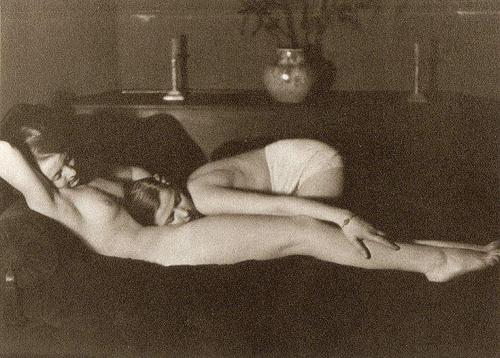
Vintage Erotic from Queerest of Them All @ Tumblr.com

Over the past couple of weeks, I’ve been having a slow conversation-in-comments with Emily Nagoski over at ::sex nerd:: about human sexuality, sex research, and the classification of human sexual experience in the two general categories of female-bodied and male-bodied individuals.

The original post Emily wrote is about the problem of asserting sameness across sex/gender identity when it comes to human sexuality. From her position as a sexuality educator, specifically working with undergraduate women at Smith College, Nagoski highlights the ways in which a narrative of sameness works culturally to erase the experience of people who have don’t have the “sexual hardware” of the default human (a man)

Treating women’s sexuality as though it’s “the same” as men’s, in the social world and in science, results in women feeling broken and ashamed.

As in: We should want sex as much as and in the same way that men do. We should be able to have orgasms the way men do – as quickly, in diverse situations, and through intercourse. Our sexual orientation should be the same. Our responsiveness should be the same. Our fantasies. Our porn. Our feelings about our bodies. I mean, where does it end? You might as well be saying women should have penises.

You can read the whole post over at Emily’s blog.

There are a lot of really awesome aspects to this argument, chief among them that asserting that different bodies respond differently to sexual stimulus is a great step away from the monoculture of “sexy” that our culture is currently saturated with. I also like the way it grounds physical sexual experience in the body, and encourages folks to learn about how their bodies work as a way of gaining a better understanding of their own sexuality.

It also pulls us away from the default understanding of sexual arousal as something that is primarily experienced by people with male bodies and hormonal profiles. It helps clear the ground for women to assert their sexuality without shame and without requiring them to mimic a type of sexuality they do not feel in order to be taken seriously as sexual subject.

From a personal perspective, I will say that one of the most valuable learning experiences in my early career as a sexual being was finding a second-hand copy of Shere Hite’s 1976 report of women’s sexuality in which she quotes long excerpts from questionnaires in which women describe in detail the diversity of their sexual desires, fantasies, physical arousal and relational experiences. Pages and pages and pages of women describing, in minute detail, how they masturbated, what sexual positions worked and didn’t work for them, what kind of touch they liked, whom they enjoyed making love with and how. Since the publication of Hite’s research, questions have been raised about the scientific rigor of her methodology — but to me the power of the book is not in its statistical validity, but in the individual voices that disseminate a type of information that is incredibly difficult, even in this era of the internet, to obtain: how actual people in the actual real world get off? what makes them horny? what fantasies do they carry in their innermost souls? what sensations push them over the edge? It seems so simple, banal almost, and yet there can be radical power in seeking the answer to those questions.

So what’s my problem with the emphasis on “difference”? It’s the fact that that human sexual difference is framed using a binary sex/gender system that simply doesn’t work for a lot of people. What about people with a “female” hormone profile who have penises? What about folks whose sexual arousal cycles seem to be spontaneous despite having a clit? And what about us cis-gendered women who, despite being accepted by the medical and social world as “female” and “feminine” just don’t see ourselves very well represented in the narratives of female sexuality that are out there? It feels to me like we’re rejecting one set of restrictive categories for another set of restrictive categories that just aren’t going to be very helpful to any of us in the long run.

We’re still going to end up feeling shamed, just for different reasons: maybe it’ll be okay not to be sexual in the same way as boys, but now we’ll feel the pressure to be sexy the same way as girls.

What gets lost is the question of how to be sexy like ourselves.

When I raised this issue in comments, Emily pointed out that scientifically-speaking, studying a species that reproduces sexually (as we do) means that it does make a certain amount of sense to examine the human population as one that is made up of two basic iterations (male and female). I get that talking scientific data is different from talking about cultural perceptions, but I also believe that the two interact in ways we often cannot even see. I also think that the language and results of scientific studies get misinterpreted by the media and the general public, and often translated into sound bites that end up supporting pre-existing notions of sex and gender difference: employed in making truth claims far beyond the scope of the original researchers’ work.

Emily also suggested that using the female/male categories as a launching-point to discuss sexual diversity is a useful educational tool.

You don’t want women to be told they’re like men, but you also don’t want them to be told they’re like women.

That’s fair enough, actually, since people just vary (though men vary around one standard and women vary, more widely, around a different one). But my experience has been that people WANT – no, they’re fuckin’ DESPERATE – to be told what they are like. They want a category. They can’t cope without one. And since we’re a sexually reproducing species with males and females, the man/woman split is a natural-seeming division. It’s a comfortable couch for radical information.

So here’s my question to y’all. Do you want a category?

I’m curious. Because, see, I really, really don’t want to be told what I’m like. I have what’s probably an unhealthy aversion to being categorized. Do I like to run into stories that mirror my experience? Yeah, sure! It was an incredible experience to read Lisa Diamond’s book on sexual fluidity and finally hear the women she interviewed putting into words thoughts and feelings and physical experiences I had known intimately but did not have the language to articulate. But for me, it is enough to know that there are other like-minded or like-experienced people out there in the world. As soon as those beings start being grouped and generalizations are made about them, I develop a twitch.

I’m curious what responses other people have to this discussion of difference and categories, the comfort of categories and the danger that categorization will lead to marginalization or erasure. What have your experiences around descriptions of “female” and “male” sexuality been? Are there particular categories that resonate particularly strongly with you, that have been of use to you in better knowing and expressing your sexuality? Have other people tried to categorize you in ways you feel are just plain wrong? What cultural and/or scientific narratives were at work creating and enforcing those categorizations?

work+school+life: launching year four

09 Thursday Sep 2010

Posted by Anna Clutterbuck-Cook in a sense of place

≈ Leave a comment

Tags

domesticity, education, family, history, librarians, simmons

The Leonard P. Zakim Bunker Hill Memorial Bridge (Boston, MA), by garreyf.
Made available at Flickr.com.

It’s the week after Labor Day and thus that time of year again … to look back and look forward and wonder when that third year (that seemed so speedy-fast and incredibly filled with eventfulness at the same time) slid by and to wonder what the year ahead is going to bring.

Hard to believe this is the third anniversary, already, of my move to Boston. (See my post from the end of year one and from year two here). With the hectic nature of the last two weeks (punctuated by several severe migraine-grade headaches), I can’t say that I’ve had a lot of time to reflect meaningfully on the question of whether I feel more authentically “Bostonian” now than I did at this point last year, when I was still very much on the fence. But here I still am, and here Hanna and I are likely to stay for at least the medium term (job opportunities willing!). I admit, in my heart of hearts, to longing for the Pacific Northwest now and again, since it has always felt like something of my second home — and both of us have close friends and family ties there. But the possibility of such a cross-country move is in the distant world of future possibilities, alongside Hanna’s equally important lifelong desire to live, for at least a time, in England. For now, our life is here.

And a jam-packed-full life it is at the minute!

Hanna, who graduated with her MA (History) and MS (Library Science) last December, is working as a processing archivist at the Countway Medical Library at Harvard and as an archives assistant at Northeastern (a position I now share with her). She’s working on studying for her GRE, with plans to pursue her PhD in Irish History, and in her spare time can be found blogging both at …fly over me, evil angel… and her recently-created companion tumblr feed, evil angel. I suggest to any of you reading this that you check out both if what you’re looking for are all the most entertaining links on current events in Britain/Ireland, in the world of books, libraries and archives, and genre fiction/film. As she regularly points out, Hanna’s RSS feeds are way more diverse than mine, and I always end up learning the most random and interesting things!

I’m in my final semester of work for my Library Science degree, and taking two classes: one on archives management and the other on the curation of digital materials. While both classes promise to be useful for my future work as a librarian, I’m definitely ready to be finished with formal schooling. Being a student makes me claustrophobic, prone to migraines, and depressed; it also tends to sap the pleasure out of the pursuit of learning, which I adore, and on the whole seems to be an unhealthy sort of thing for me to engage in. A bad match, personality-wise, I’ve discovered. Ironically even more so when the learning is intended to be of professional use rather than something I do because I find it intrinsically valuable (as with my history research).

To celebrate the completion of my degree, I am making plans to get my first tattoo. While I have yet to settle on a design, we discovered a kick-ass artist at Chameleon when Hanna got own inaugural tattoo (a Dr. Who question mark) over the summer, a joint birthday present from me and our friend Diana. I have two or three conceptual ideas in the pipeline right now, although I think for numero uno it might be one of the boats from Swallows and Amazons. My friend Ashley counsels that tattoos should be symbolic enough to be re-interpreted over time, wise words that make me hesitate to use something so pictoral. But I’m sitting with the image for the next few months to see how it feels, and then we’ll go from there! (If it all goes well, I’ll have to start thinking about what to get when I turn in the final draft of my thesis!)

Speaking of my thesis, the draft is away in the hands of my readers and will likely not be completed until next spring, although final deadlines are still in high-level negotiations. There are some arguments for finishing it this fall, but for quality-of-life reasons, and for quality-of-thesis reasons the handwriting is on my own personal wall that this isn’t going to happen. I don’t want to be miserable and over-extended for four months, which in turn will make my girlfriend feel miserable and over-extended as she tries to mop up my tears, soothe my migraines, and manage all of the things I simply won’t have time for. So we’re shooting for May, 2011 presently. Which is actually the term I originally projected I’d graduate (I’m making progress: it took my seven years for the B.A., so four years for the double Masters’ degrees ain’t shabby!)

Meanwhile, I’m working at my beloved Massachusetts Historical Society (from whence I am writing this) and also at Northeastern, as previously mentioned, where I tag-team a position as archives assistant with Hanna. My latest project is 20.65 cubic feet of records from Northeastern University’s cooperative education program, dating from the mid-1970s to the present. Lots of folders of interdepartmental memos and committee meeting minutes, not to mention all the internal dramas to which any organization is prone. I should also (fingers crossed!) finally be wrapping up, this October, the Marjorie Bouve scrapbook digitization project. We still don’t have a firm idea for how to display the images and information for users, but as soon as we have anything up and running I’ll be sure to link it here.

That’s all going to keep me more than busy enough, although I’m definitely looking forward to an October visit from my parents, over the Columbus Day weekend, and to some new blogging projects (i.e. the continuation of reading the (lesbian) classics with Danika the Lesbrarian; my copy of Beth Goobie’s Hello Groin arrived in the post just this morning!). Meanwhile, I’m looking forward to staying in touch with y’all via the usual modes, posting here when I can, and tumblr when I can’t.

And maybe, some time later in the fall or early next spring, you’ll see that we’ve finally taken the plunge and adopted a cat like we keep talking about doing. If we do, you’ll be some of the first people to know (’cause who can resist cute cat photos; I know I can’t!)

Best wishes for a lovely early autumn to you all, wherever you may be, and you’ll be hearing from me soon enough.

Peace,
Anna

← Older posts
Newer posts →
"the past is a wild party; check your preconceptions at the door." ~ Emma Donoghue

Recent Posts

  • medical update 11.11.22
  • medical update 6.4.22
  • medical update 1.16.2022
  • medical update 10.13.2021
  • medical update 8.17.2021

Archives

Categories

Creative Commons License

This work by Anna J. Clutterbuck-Cook is licensed under a Creative Commons Attribution 3.0 Unported License

Meta

  • Create account
  • Log in
  • Entries feed
  • Comments feed
  • WordPress.com

Create a free website or blog at WordPress.com.

  • Subscribe Subscribed
    • the feminist librarian
    • Join 37 other subscribers
    • Already have a WordPress.com account? Log in now.
    • the feminist librarian
    • Subscribe Subscribed
    • Sign up
    • Log in
    • Report this content
    • View site in Reader
    • Manage subscriptions
    • Collapse this bar