• anna j. clutterbuck-cook
  • contact
  • curriculum vitae
  • find me elsewhere
  • marilyn ross memorial book prize

the feminist librarian

the feminist librarian

Tag Archives: gender and sexuality

sunday smut: links on sex and gender (no. 23)

23 Sunday May 2010

Posted by Anna Clutterbuck-Cook in linkspam

≈ 1 Comment

Tags

gender and sexuality, sunday smut

First up, several posts this week on Sarah Palin’s increased us of the F-word (“feminist,” sadly, not “fuck”)

Tracy Clark-Flory @ Salon tackles the debate ’round the blogosphere about whether Palin deserves to self-identify as such (or whether anyone has the right to judge her worthy or unworthy of it).

Brittany Shoot @ Women’s Rights Blog asks whether “conservative feminist” is an oxymoron, while Michael Tomaskey @ The Guardian describes the use of Susan B. Anthony as a conservative, anti-choice feminist icon.

And via my friend and fellow dual-degree student Colleen comes Janine Giordano @ Religion in American History on the competing collective memories and historical interpretations of Susan B. Anthony’s legacy. “We’re not used to sharing the narrative authority of the history of feminism, or interpretation of the historical record, with ‘conservative feminists.’ But I say we should be happy — in a way — that social history has finally begun to empower social movements outside of the academy.”

It’s not just a question of people arguing over who can or cannot claim the identity “feminist” (my two-second opinion: you get to claim whatever identity you want, but by the same token, I get to say why I do or don’t believe you fit the description). There are, of course, many women (not just Phyllis Schlafly!) who fight tooth and nail to undo the political and cultural work of feminist activists — often in the name of their own enlightened status. Amanda Marcotte @ Pandagon points to the example of columnist Maureen Dowd, who was recently full of faux concern about Supreme Court nominee Elena Kagan’s state of singledom.

Her disingenuous final paragraph really puts the cherry on the mean girl sundae:

Why is there this underlying assumption that Kagan has missed the boat?

I don’t know. It probably has something to do with you perpetuating the narrative. If you don’t like the story of how women can conquer mountains but are nothing without a man, then stop telling that story.

Similarly, Andi Zeisler @ Bitch Blogs nominates writer Caitlin Flanagan for the first ever Bitch Douchebag Decree “All-Star” award, writing

If there’s one thing Flanagan can really type some words on, besides how she hates feminism and how her mommy abandoned her, it’s teen girls and blowjobs. She’s heard a lot of stuff about how teens these days are having hookups and orgies and rainbow parties all over the place. But since Flanagan is perpetually arrested in a time of crinolines and sock hops, when all teens were apparently eunuchs, the idea that girls might actually enjoy exploring their sexuality is both logistically inconvenient and philosophically abhorrent to her.

A nun in Arizona was excommunicated from the Catholic church after making a decision at a Catholic-run hospital that a woman could recieve a life-saving abortion. Nuns can be so frickin’ awesome! The Catholic church hierarchy can be so, so not. Jill @ Feministe meditates on the inhumanity of that decision while David J. Nolan @ RhRealityCheck explains why the decision was actually not in accordance with canon law.

Alexa Kolbi-Molinas (Staff Attorney, ACLU) @ Feministing Community highlights the secular legal issues involved in the case, given that hospitals (religiously-affiliated or not) are required by law in the United States to provide life-saving care.

Not that Arizona isn’t already on a right bender, now that everyone who looks foreign in origin (read: not white) is required to carry identification papers and ethnic studies have been banned. Miriam @ Feministing has more, as does Brittnay Shoot @ Women’s Rights Blog who asks, “when they get rid of ethnic studies is women’s studies next?“

Amanda Marcotte @ Pandagon reports, however, that the future might be brighter than it looks at the moment: young white people care less frightened of immigration than their elders.

People are often spend a whole lot of time and energy criticizing other folks’ sex lives. Thomas Rogers @ Salon writes about Czech twins who are lovers and controversial porn stars, asking what about “twincest” pushes peoples’ buttons and why they can’t stop watching anyway. From Greta Christina @ The Blowfish Blog asks “is it possible to critique rough-sex porn without marginalizing kink?” and Charlie @ Charlie Glickman challenges the sex-positive community to think about the difference between shame, arrogance, and pride.

Young people (girls in particular) are certainly not exempt when it comes to the sex-obsessed gaze of society, and Amanda Hess @ The Sexist muses about the recent outcry over a viral internet video featuring young girls dancing in sexually suggestive ways. She discusses a similar theme when it comes to media coverage of Miss USA pagent winner Rima Fakih.

Sarah Menkedick @ Women’s Rights Blog points out how the Miss USA pagent coverage ties sexism and racism together in a neat package consisting of “a little racism, a little islamophobia, a little hating on immigrants, a little hypocritical outrage at beauty pageant participants who’ve gotten a bit too sexy.” In other words, Miss USA, in a nutshell.

Melissa McEwan @ The Guardian calls out the policing of women’s sexual selves in a slightly different vein, writing about the media coverage of recent allegations by Charlotte Lewis that she, too, was sexually assaulted by director Roman Polanski.

Harris’s concentrated effort to undermine Lewis’s credibility by casting doubt on her character, motives, and integrity is a textbook example of the sort of hostile reception any survivor of sexual assault can expect to receive when coming forward about the crime, no less when the accuser must point a finger at a famous man with powerful friends.

There are those who question why Lewis waited to come forward for so long. Reading Harris’s attack on behalf of his friend Polanski, is it really any wonder why?

The UK is debating whether or not to protect the identity of those accused of sexual assault (victims are already protected by anonymity laws in Britain). Cara @ The Curvature argues that this further perpetuates the myth that false accusations of rape are statistically more likely than false accusations in any other type of crime, and Cruella @ Cruella-blog gives one example of how reporting allegations in the media helped uncover at least on serial rapist’s activities when other victims came forward.

Someone who has been disproportionately in the public eye lately has been, of course, Supreme Court nominee Elena Kagan. My legal junkie crush Dahlia Lithwick @ Slate suggests that the anxious questions being asked about Kagan say more about the fears we have for ourselves than they do about her ability to perform the role of Justice. (Bonus points if you can name the movie the quote she uses as a headline is from).

Brittany Shoot @ Women’s Rights Blog (she either had a busy week or we have super-similar taste in news stories!) brings up another issue with the Kagan coverage: Elena Kagan is Childfree. Get Over It.

And finally, for your feel-good story of the week: Jesus Would Have Gone to Gay Weddings. Michael A. Jones @ The Gay Right’s Blog reports on a group of Catholic priests who are making waves by arguing that Jesus wasn’t a screaming homophobe afterall. That in fact, you know, he might have been cool with the whole same-sex marriage thing. As long as he was put in charge of the wine.

*image credit: Modern Painting of Kiss by Beyond Dreaming @ Flickr.com

sunday smut: links on sex and gender (no. 22)

16 Sunday May 2010

Posted by Anna Clutterbuck-Cook in linkspam

≈ Leave a comment

Tags

gender and sexuality, sunday smut

Elle @ Sex and the Ivy | Slate: Why is a former sex blogger “rethinking virginity”? ” ‘Rethinking Virginity’ does NOT mean ‘reconsidering virginity’. Not. At. All. I was/am not preaching sexual abstinence (or ANYTHING for that matter). Just, no. Off the bat, let’s get that straight.”

Tracy Clark-Flory @ Salon | Everyone’s an expert in girls’ sex lives. “What’s often lost in the never-ending stream of stories about the latest trend in female sexual culture is the nuance and diversity of individual experience; young women are treated as symbols of the culture at large and spokespeople for their entire generation.”

Amanda Marcotte @ Pandagon | False dichotomies. “The person pushing [the hook-up vs. relationship dichotomy] is trying to imply to women that there is no such thing as a man who can love a woman with sexual experience — and that this can never change, so you have to live with it. Both assertions are wrong.”

Anna North @ Jezebel | Hookups, sex ed, and sparklevamps: Freaking out about teens. “So what’s the solution for these frustrated, allegedly relationship-designed girls? Certainly not actually talking to them. Flanagan scorns the authors of a book on a teen sex party who “centered their attention almost entirely on the perspectives of the students, as though by plumbing the narcissistic reaches of the pubescent mind, one might discover anything beyond the faintest echo of the larger forces that shape adolescent behavior.” Instead, she recommends Testimony, a novel about teen sex by 63-year-old Anita Shreve (“a bona fide grown-up”). “I would encourage every parent of a teenage girl to give her a copy of Testimony,” Flanagan writes — because there’s nothing teenagers like better than older people telling them how they feel.”

Sady Doyle @ The Atlantic | The secret inner life of Laura Bush. “She supports gay marriage; her husband advocated a constitutional amendment banning it. She supports the right to legal abortion; her husband cut off funding to international women’s health clinics that provided it, and appeared to be seriously set on overturning Roe v. Wade. These are human rights issues. And for eight years, she stood more or less silently and idly by….of the many points feminism has made, over the years, one of the more important is that it is inadvisable, and often disastrous, to conceal your own values for the sake of a husband.”

Stephenie Mencimer @ Mother Jones | Why do so many people think Elena Kagan is gay? “You could make a better case that Kagan is simply a celibate workaholic, given the paucity of information that’s leaked out about her personal life thus far…But really, what powerful woman in Washington hasn’t been accused of being a lesbian?”

Anne Bauer @ Salon | My escape from marriage retreat hell. “After a few searches and one furtive cellphone call to a number that only rings, I turn back to John. He’s sitting on the mammoth bed staring out the window, his eyes wide and glassy. ‘There’s no answer,’ I say. ‘I don’t know if they’ll be open at 6. And I don’t dare call the front desk to ask.’ ”

Rachel Hills @ Musings of an Inappropriate Woman | We are all bad feminists, really. “But just because we’re able to make those critiques and ask those questions doesn’t mean we’re not also products of that world…individual women – even feminist women – might continue to engage in behaviours that are oppressive to themselves (or, more problematically, to others), even if on an intellectual level we understand the ways in which our behaviours and desires might have been socially conditioned.”

Greta Christina @ The Blowfish Blog | Why does porn matter? “I think that porn can, and often does, accomplish everything that telling my fantasy accomplished in that consciousness- raising group so many years ago. (Which was, in its own way, a form of porn.) …I think that porn can normalize sex. It can make sex seem more familiar, and less scary. It can remind people that sex is a natural desire, one that all or most of us share. It can remind us that, no matter what our sexual thoughts and desires are, chances are someone else is having them, too.”

Daniel Vivacqua @ Gay Rights Blog (Change.org) | Kristin Chenoweth Defends Straight-for-pay Actors. “Thank you, Miss Chenoweth, for sticking up for us, for being a vocally progressive representative of Christianity, for discouraging closed-mindedness, and for closing by asking Newsweek to publish pieces about, ‘acceptance, love, unity and singing and dancing for all!’ “

Amen. That is all.

*image credit: Hygiene of intimate places, Exklusiv # 80, Sep 2009 by pixel endo @ Flickr.com.

are we talking "acting" or "passing"? (and why it matters)

15 Saturday May 2010

Posted by Anna Clutterbuck-Cook in think pieces

≈ 2 Comments

Tags

arts and culture, gender and sexuality, politics

A lot has been written in the last week or so criticizing an opinion piece by Ramin Setoodeh published in Newsweek in which he appeared to claim that gay actors are unsuccessful at playing straight (see Jos @ Feministing for more details).

Yesterday, upset that “the internet” is dumping hate on him, Setoodeh published a response to these responses, claiming that the critiques of his original article are off base

But what all this scrutiny seemed to miss was my essay’s point: if an actor of the stature of George Clooney came out of the closet today, would we still accept him as a heterosexual leading man? It’s hard to say, because no actor like that exists. I meant to open a debate — why is that? And what does it say about our notions about sexuality? For all the talk about progress in the gay community in Hollywood, has enough really changed? The answer seems obvious to me: no, it has not.

Here’s the thing. The way Setoodeh frames the question the second time around, he makes it clear that the question is about how society at large responds to knowledge of a queer actor’s sexual orientation. If a successful actor, known for playing straight romantic leads, suddenly came out as gay (that is, in real life not interested romantically in women), how would the hitherto rapt audience respond?

Setoodeh claims they wouldn’t respond well. And if that was truly the gist of his argument, I’d be totally on board: we do, as a culture, respond uncomfortably to people playing characters whose sexual orientations don’t match their own. How much, and how consistently, we respond negatively to gay actors playing straight is another question. As others have already pointed out, he cherry-picks his examples and shoehorns them into the argument he wishes to make. He also blithely skims over the question of straight actors playing gay characters, suggesting they don’t catch flack for accepting such roles. While it’s possible that actors who are straight have more room to maneuver, I’d question whether someone James Franco (who played Sean Penn’s lover in Milk) never faced questions about his own sexuality. He was definitely questioned closely by Terry Gross about how he was able to play a character whose sexual orientation did not match his own. People speculate, and given the homophobia in our culture, those speculations are often mean-spirited.

The bigger problem, though, is that that wasn’t his original argument (or at least not all of it). Setoodeh’s original essay targeted actor Sean Hayes in his stage performance as a straight male lead in Promises, Promises, arguing that Hayes was unconvincing as a straight character because, according to Setoodeh, he’s just so flamingly gay.

But frankly, it’s weird seeing Hayes play straight. He comes off as wooden and insincere, like he’s trying to hide something, which of course he is. Even the play’s most hilarious scene, when Chuck tries to pick up a drunk woman at a bar, devolves into unintentional camp. Is it funny because of all the ’60s-era one-liners, or because the woman is so drunk (and clueless) that she agrees to go home with a guy we all know is gay?

What strikes me about the difference between these two arguments is where the burden of responsibility is placed. In the first piece (above), Setoodeh is critiquing Hayes for failing as an actor to play straight, suggesting that in order to play a character Hayes has to “hide something” (his sexual orientation), as if this is somehow categorically different from the task that faces all actors: to embody a character on stage whom they, as human beings, are not in real life.

I understand this impulse to a certain extent. We generally place the burden of embodying a role on actors, stage and screen. After all, that’s their job: to play a part. We go to the theater expecting the cast and crew to create an atmosphere in which we can suspend our disbelief — in which we can put aside our knowledge that these are human beings on a stage telling us a story — and experience that story through a collaborative leap of the imagination.

But the suggestion that Setoodeh is uncomfortable with Hayes performance because he feels he’s being lied to is where this actors-bearing-responsibility things breaks down for me.

If our knowledge of an actor’s personal life (say, their sexual orientation) changes the way we — as audience members — interpret their performance, doesn’t that shift the burden of responsibility back to us? If the onscreen chemistry between George Clooney (to use Setoodeh’s example) and his leading ladies changes in our minds once we imagine he’s gay (incidentally: why is bisexuality never a part of these conversations? hello??) then the problem is not with the actor (whom, until we believed he was not-straight seemed to have all the chemistry in the world) but in our heads.

I’d suggest, here, that Setoodeh might learn something from the discussion within the trans community about the problematic framework of “passing,” which places the burden of performing gender identity and/or sexual orientation on the individual rather than on the audience (society) which interprets appearance and behavior according to all kinds of social cues that are completely outside the control of the individual. See, for example, Bear Bergman’s essay “Passing The Word” in The Nearest Exit May Be Behind You.

When we continue [in the trans community] to use the word pass, we continue to hamper ourselves by endlessly repeating a narrative of deception, not to mention the legacy of racism, the cultural arrogance, and the spectacular level of objectification it brings with it….I would rather move the burden back where it belongs, to the observer, the person whose cultural lens and personal locations on so many aces are in so many ways the day-to-day deciders of how a person is read….passing is fleeting, tricksy, temporary. But what it takes or means to read depends, rightly and righteously, entirely on who’s doing it (112).

I’m sure there are “bad” actors out there — actors who, regardless of sexual orientation, struggle to set aside themselves in order to embody a character who is not them. I’m a terrible dissembler: it’s one of the reasons I write nonfiction instead of fiction and gave up my childhood dream to be in musical theatre. I realized I had no interest in being anyone other than myself, and in fact felt profoundly uncomfortable whenever I tried to slip out of my skin and into someone else’s. But Setoodeh isn’t dismissing Hayes because he thinks the guy is a bad actor. In his initial piece, he is quite clearly suggesting Hayes isn’t successful because he’s gay.

This, for me, is where his where his credibility as a cultural critic breaks down. Want to critique an actor you think is doing a shitty job? Sure: your prerogative as a consumer of theatrical performances. Want to speculate on how our cultural narratives about human sexuality impede our ability to suspend disbelief about actors playing characters whose sexuality differs from theirs? I’m with you all the way. Suggest that actors (particularly non-straight actors) are incapable of playing characters with an orientation not their own? So…what: hetero actors can only play hetero parts, gay and lesbian actors can only play queers, and those of us who are bi are really (taking this argument to its logical conclusion) the only people capable of auditioning for any role going?

I just can’t buy it. It’s a huge fucking red light that suggests to me the issue is not the actor’s abilities, but rather with the audience member who is unable to let go of their discomfort at seeing someone not-straight play someone who is. Which, as Setoodeh points out in his second piece, has everything to do with “our notions about sexuality,” our way of reading the actor we know to be gay, rather than with that person’s skill as an actor to embody the character they have chosen to play on the stage.

*image credit: Ianto and Jack, Torchwood, Season Two, still from To The Last Man, snagged from Moansters Incorporated.

the politics of (another kind of) choice

12 Wednesday May 2010

Posted by Anna Clutterbuck-Cook in think pieces

≈ 7 Comments

Tags

gender and sexuality, politics

As a follow up to my letter to the Hope College Board of Trustees last week, I thought I would share a great article on queer politics found via the Bookforum (h/t to Hanna). Stephanie Fairyington @ Utne Reader offers a passionate, personal plea for queer activists to re-discover the language of choosing non-straight relationships and identities, in her essay The Gay Option.

Until homosexuality is cast and understood as a valid choice, rather than a biological affliction, we will never rise above our current status. We will remain Mother Nature’s mistake, tolerable (to some) because our condition is her fault, not ours.

By choice, I don’t mean that one can choose one’s sexual propensities any more than one can choose one’s personality. What I mean is that it’s a choice to act on every desire we have, and that acting on our same-sex attractions is just as valid as pursuing a passion for the Christian faith or Judaism or any other spiritual, intellectual, emotional, or physical craving that does not infringe on the rights of others. And it should be respected as such.

Fairyington acknowledges the enormous political advantages of framing non-straight sexuality as natural, rather than nurtured, proclivity — and she doesn’t reject the possibility (confirmed by her own personal experience) that one’s sexual orientation is something one is born with, and is immutable.

At the same time, she challenges us to recognize that this political strategy — which has made real gains for the human rights and legal protections of non-straight, non-gender conforming folks — is a claim to rights that relies upon queer sexuality being a biological trait does not require those with anti-gay sentiments to re-examine their understanding of homosexuality as a physical or emotional deformity: rather, it is a framework perfectly adaptable to their claims to success in ex-gay therapies or a quest for “the gay gene” which could somehow be manipulated to alter someone’s sexual desires.

The typical conservative assault on homosexuality casts it as a sinful choice that can be unchosen through a commitment to God and reparative therapy. And the left usually slams into this simplistic polemic by taking up the opposite stance: Homosexuality is not a choice, and because we can’t help it, it’s not sinful.

By affirming that homosexual practice and identity are a choice, we can attach an addendum—it’s a good choice—and open the possibility of a more nuanced argument, one that dismantles the logic of the very premise that whom we choose to love marks us as sinful and immoral and interrogates the assumption that heterosexuality is somehow better for the individual and society as a whole.

I grew up in a very conservative community (although my family and immediate circle of friends were by-and-large liberals), and I’m aware of how powerful the biology-based identity argument is when it comes to challenging folks’ assumptions about homosexuality = sin. Because arguing that someone is “born that way” draws parallels to skin color and biological sex — it seems like an easy hook. But likewise, I’ve also seen how the biological argument so often misses the point that the anti-homosexuality crowd is making. In short, the point that Fairyington makes above: that we selectively choose to act on our desires, and that those choices have moral and ethical implications. We may have thoughts of violent revenge, but choose to practice nonviolence. We may have thoughts of panicked self-defense, but choose to practice compassion.

If queer activists rely solely on the “it’s biology” argument, we miss the opportunity to make a moral and ethical case for same-sex relationships, and the capacity of those relationships to add to the sum total of joy and well-being in the world. This is a message much more radical, when you stop to think about it, than scientific debates over the origins of human sexual orientation. Those scientific explorations are stimulating from an intellectual perspective, but will not satisfy our desire as human beings to discern right from wrong. A scientific answer to the question of where same-sex desire originates may inform, but cannot dictate, what we do with those desires.

I think we would do well, as Fairyington proposes, to speak more often and with great passion about the ethical, life-giving nature of our relationship choices. We would do well to speak about following our passions for the sexual relationships that best nourish us and our loved ones. To speak about the way in which feeling at home in our skins when we move through the world grows our capacity for compassion for others (because we no longer have to work so hard to protect ourselves). To speak about the glorious, chaotic uniqueness of every human life, and how all of those lives (ours included) can honor [chosen diety or spiritual path here] through all manner of consensual sexual activities and relationships.

This in no way contradicts the notion that sexual orientation (be it hetero, homo, bi, or otherwise inclined) is biological in nature — but it does not rely on it either. Using both together, mixing and matching as reflects our own personal experiences, will hopefully broaden our options for political debate and give us a much stronger, multi-faceted place at the table.

multimedia monday: clean living

10 Monday May 2010

Posted by Anna Clutterbuck-Cook in media

≈ Leave a comment

Tags

education, gender and sexuality, multimedia monday, web video

Two videos for you this morning that attempt to teach young people just how narrow a road they must walk in order to survive into adulthood.

First, a health education film for 1950s college students. While it ostensibly targets both men and women, notice how much more time they spend panning the camera up and down the coeds’ bodies, and how clearly the female students are positioned as primarily objects of the male gaze (forget about your homework, girls!). It’s also clear that although the women are supposed to be sexually alluring they are not under any circumstances supposed to cross the line into sexual availability (slut!) or actual sexual activity.

As my friend Rachel put it: “CREEPIEST. DAD. EVAR.”

Enjoy. And then go wash your eyeballs with carbolic soap.

sunday smut: links on sex and gender (no. 21)

09 Sunday May 2010

Posted by Anna Clutterbuck-Cook in linkspam

≈ Leave a comment

Tags

gender and sexuality, sunday smut

Thursday, May 6th, was International No Diet Day, but as gwen @ Sociological Images reports, some news outlets seem to have missed the point. ” Perhaps illustrating the article with an image of a slender body indicating a significant amount of weight loss wasn’t the best choice?”

Lena Chen, also known as Elle @ Sex and the Ivy graduates this month from Harvard (congrats!), and as part of her senior thesis on evolution of the virginity ideal, she held a one-day conference on Rethinking Virginity. You can find a round-up of related blog posts and media coverage at Sex and the Ivy. If rethinking virginity is your thing, I totally recommend clicking through and checking some of the posts out. For a nice thumbnail recap, check out Feministing’s list of ten virginity myths that were discussed (and debunked) at the conference.

On the not-so-positive side of things, Femocracy @ Feministing Community muses about why media stories about rape so often get it wrong, while Jacelyn Friedman @ Salon analyzes how CNN took her anti-slut-shaming talking points and made her sound like a prude. “The woman on the television screen looked and sounded a whole lot like me — in fact, she was me — but she appeared to be saying things that…I would never say. This is what it’s like to see yourself quoted out of context and turned into a sock puppet on national TV.” Friedman was allowed to follow up with a counterpoint which you can read on the CNN blog.

Mary Elizabeth Williams @ Salon also muses upon the perilous balance teenage girls (in particular) must strike in our culture between youthful testing of boundaries and behavior that will earn them the status of social pariah in Miley Cyrus: Not a girl, not yet a Britney. “Very few people ever transition seamlessly from cute teen to mature adult – whether they’re an ordinary girl or Disney’s biggest princess. Cyrus, like anyone who’s ever been 17, has a right to stumble and look silly. But if you’re going to tell the world you can’t be tamed, maybe you should consider doing it in a way that doesn’t look so painfully contrived.” Sady & Amanda @ The Sexist discuss.

In other awkward bids for attention, Andy Wright @ AlterNet reports on the six strangest things men have done in the quest for the perfect penis.

lisa @ Sociological Images offers us an intriguing set of graphs showing trends in the social acceptability of homosexuality and prostitution in selected Western nations and offers five possible explanations for the disparity between the two (homosexuality steadily more acceptable, prostitution not so much).

Not all Christian fundies are opposed to sex, they just want to make sure it’s God-approved sex. Sadly, it is often difficult to find those God-approved sex toys without being subjected to icky non-Christian depictions of sex. Never fear! As Cath Elliot @ The Guardian reports, these Christian sex enthusiast can now shop at Christian Love Toys, an online sex you store for those with vanilla tastes.

Tracy Clark-Flory @ Salon, however, reports on the limits of Christian sex. “Sex addiction” has, of course, been a topic du jour for Christian conservatives long and long. At Dirty Girl Ministries, however, they tailor the message specifically for “impure” women: “On the Dirty Girls Ministries message board, visitors swap tips for keeping on the straight and narrow — for example, wearing a rubber band around your wrist and snapping it every time an impure thought crosses your mind.”

Let’s just not hope that particular Dirty Girl isn’t into a little pain with her pleasure.

And finally, via Hanna, comes this lovely blog post on How to Be Attractive (“First, remove some of the mirrors in your house.”)

*image credit: “Siege” by Clayton Cubitt. Hat tip to Hanna this week for finding the image for this post, via Warran Ellis’ blog.

alma mater update: in other unsurprising news…

08 Saturday May 2010

Posted by Anna Clutterbuck-Cook in think pieces

≈ 2 Comments

Tags

bigotry, education, gender and sexuality, hope college, human rights, michigan

Here’s the promised update re: Hope College and its Institutional Statement on Homosexuality, which I wrote about on Thursday.

The group Hope Is Ready, which has been one of those petitioning to have the statement withdrawn by the Board of Trustees, shared (through their Facebook page; apologies if this means you can’t follow the link) the following letter from Hope College President James Bultman yesterday afternoon.

May 7, 2010

Dear Members of Hope is Ready:

Thank you for your interest in Hope College and for the time and effort committed to sharing your concerns with the Board of Trustees. Your insights were helpful in our discussions. Those elected to hold the college in their trust have thoughtfully, thoroughly, and prayerfully considered your petition.

Relative to your petition, the Trustees have taken these actions:

1. The Board of Trustees denied your request to remove the 1995 Institutional Statement on Homosexuality

2. The Board of Trustees appointed a Trustee committee to expand the college’s 1995 position statement in the larger context of all human sexuality in such a way that the Hope community is called to a renewed encounter with the clear, demanding, and healing biblical witness regarding human sexuality.

The college’s current position on homosexuality is based on its interpretation of scripture. It is recognized that well-intentioned Christians may disagree on scriptural interpretation. Still, humbly and respectfully, the college aligns itself in its interpretation with is founding denomination, the Reformed Church in America, the orthodox Christian Church throughout the ages, and other Christian colleges and universities.

On behalf of the Hope College Board of Trustees, I thank you for your concern for the college we love and respectfully ask that you accept these decisions in the spirit with which they are rendered.

Cordially,

James E. Bultman
President

In short, it basically says nothing that hasn’t already been said, and the fact it was up on the web by 2:33pm yesterday afternoon makes it pretty clear that the Board of Trustees didn’t spend much time deliberating on their course of action.

Sad, despiriting, but unsurprising.

I’ll be thinking today about all those folks in the Hope College community — many of whom I’ve known my whole life — who do not think this way, and who work hard everyday to make sure the official college position is not the only one that gets heard.

I said in my letter to the Board, and I’m going to repeat it here: to tell any person that being sexual and making positive, fully consensual, sexually intimate connections with another human being is destructive to their spiritual well-being is an act of violence. To codify such a belief in an institutional statement makes it institutionalized bigotry, giving that belief the authority of college administration that has the power to materially effect the lives of students and employees.

I absolutely believe that such an act of violence runs counter to the Christian message that we are all called to increase joy, practice love, and work toward wholeness in the world. I don’t see how this decision by Hope’s Board of Trustees does any of that. So it sure as hell doesn’t seem very Christian to me.

*image credit: Hope College Voorhees Hall, made available through the public relations office website.

sunday smut: links on sex and gender (no. 20)

02 Sunday May 2010

Posted by Anna Clutterbuck-Cook in linkspam

≈ 1 Comment

Tags

gender and sexuality, sunday smut

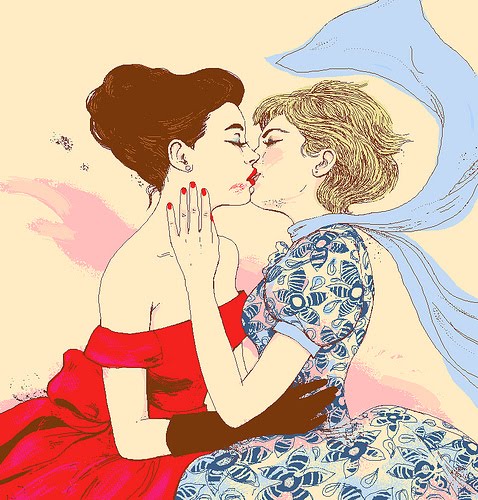
Incidentally, I am totally in love with this illustration (above) . . . I keep searching for nice pictures of women lovers on Flickr and this is the first time a search has actually yielded something I liked well enough to put on the Sunday Smut list. It’s an illustration for an article on lesbians in the Polish magazine Wysokie Obcasy (“High Heels”) which to my mind makes it even more awesome.

Speaking of women getting a little personal, there was a lot of angst this week about women showing emotion publically. Deborah Orr & Anne Perkins @ The Guardian both take women to task for such “feminine” displays of emotion as crying and giggling and sharing personal stories. Orr writes scathlingly of actress Gwyneth Paltrow’s recent disclosure that sometimes she cries at work while Anne Perkins derides female politicians for sharing personal anecdotes and giggling, suggesting “let’s keep the personal out of politics.” Aside from the obvious sexist double standard of equating femaleness with excessive emotion (who decides what’s excessive anyway??) I find it particularly offensive that Perkins co-opts the personal-political dyad of the feminist movement, in effect calling in coded language for the rejection of feminist sensibilities in political spaces. The suggestion that things associated with women are “unserious” is really irresponsible. And stupid to boot. Like me, Whitney Teal @ Women’s Rights Blog objected to this sudden hate on emotion, asking is crying at work so wrong? And in an article on “the art of confession,” Emily Gould @ New York Magazine points out that personal confessions are recieved differently by the public, depending on whether the confessor is male or female

If a woman writes about herself, she’s a narcissist. If a man does the same, he’s describing the human condition. But people seem to evaluate your work based on how much they relate to it, so it’s like, well, who’s the narcissist?

Jill @ Feminist deconstructs the cultural narratives surrounding the publication of Harvard Law School student Stephanie Grace’s racist email, pointing out that

Why should you be able not only to have the freedom to raise whatever issue you want, but also have the privilege to do so without offending anyone? That simply is not how the world works — ideas, as they say, have consequences, and part of the consequences of raising controversial (or idiotic) arguments is that people will become annoyed, angry or offended. I don’t think that people have a right to not be offended, but you also definitely do not have a right to demand that other people accept without emotion whatever ridiculous or hateful argument you make.

I think this story ties in with the story I wrote about earlier this week involving the desire of homophobic petition signers to keep their identity secret for fear they would have to have “uncomfortable conversations” with people who did not share their views. Freedom of speech does not mean you have the right to speak up without anyone disagreeing with you, people! Just like protection from violence and harassment does not equal never having to have a tense conversation about politics. Grow up already, people!*

So possibly, the Washington Times should not be surprised when people get a little, well, emotional in response to an editorial (yes, as in written-by-and-endorsed-by-the-Times) titled “Discrimination Is Necessary: Subjecting Kids to Weirdos Undermines Decency” (I mean, really, can you get any more appallingly bigoted? in a major print publication? wtf?) Via CaitieCat @ Shakeville comes an open letter in response to the editoral which I highly recommend reading: “Let’s talk about the consequences of teaching children that cruelty is acceptable as long as the victim is ‘not normal.'” Another open letter on the subject of transphobia at the national level comes from Autumn Sandeen @ Pandagon who writes about her experience in the hands of law enforcement after being arrested for protesting DADT outside the White House.

Also on the subject of transphobia, and its intersections with other types of bigotry, Kate Borstein @ Out reflects on the outrage over a recently-released film titled Ticked-Off Trannies With Knives, while intersectionality of another sort is the subject of a thoughtful, open-ended discussion between Latoya and Thea @ Racialicious. Not being a fan of any sort of oppression olympics (people who claim “my pain is more exquisite than your pain!” as a way of shutting someone up), I highly recommend the piece, even though it doesn’t offer simple solutions.

Women and breasts were also a popular topic this week, perhaps a side effect of the much-discussed “boobquake” protest? The protest’s originator, Jennifer McCreight @ The Guardian entertained us with what she learned from her quasi-scientific experiment; Amanda Hess @ The Sexist interviewed blogger C.l. Minou (The Second Awakening) about breast augmentation and feminine beauty standards while Rebecca @ The Thang Blog shares a conversation she had with her dad (a civil rights lawyer) about the possibility of getting herself arrested while going topless in public.

Two adoption-related blog posts this week, one from Harriet Jacobs @ Fugitivus, speaking out passionately in defense of her belief that adoption is always the second-best option, and Jill @ Feministe writes in defense of single fathers’ parental rights.

In other “think of the children!” news, Sinclair @Sugarbutch Chronicles shares some thoughts on why sex education is still a radical, controversial act and Margaret Eby @ Salon suggest that, despite hysteria in certain quarters preteen girls are not yet harlots. (Sad! Because “harlot” is an underutilized word).

Hanna Seligson @ The Wall Street Journal reports on the emerging ritual of pre-planned marriage proposals, where couples stage a proposal as if it were a surprise, even though they have had extensive discussions beforehand. I’m gonna admit right up front I don’t understand this: if you want to have an engagement party, awesome! But why stage this fake surprise where the man — and in hetero couples it always seems to be the man — “pops the question” to the woman, and she feigns surprise? Seligson has some intriguing theories, even though I’m not sure I agree with her in the final analysis.

And finally, congrats to Feministing’s founder Jessica and her partner Andrew who are expecting their first child on election day this November. I hope for you a nice, long bubble of privacy as you adjust to being a new iteration of your family together.

*Hanna points out that it is unclear whether the email (and original remarks) were intended to be between friends or sent out to a more public audience — say a study group — and how they ended up being made public. Jill’s point, however, is that having become public for whatever reason, the email is a legitimate subject of debate, as is Ms. Grace’s reasoning re: race and its implications for her legal work.

*image credit: kiss – illustration for an article about sex, Wysokie Obcasy #20 (523) 16 May 2009 made available by pixel endo @ Flickr.com.

"i think i might be gay…now what do I do?"

29 Thursday Apr 2010

Posted by Anna Clutterbuck-Cook in my historian hat

≈ 1 Comment

Tags

gender and sexuality, history, northeastern

At one of my places of work, Northeastern University Archives & Special Collections, I’m in the early stages of processing the papers of Keri Lynn Duran (1962-1995), an AIDS activist and educator. On Tuesday, I came across two pamphlets from the mid-90s titled “I think I might be gay…now what do I do?: A Pamphlet for Young Men” and the corresponding “I think I might be lesbian…now what do I do?” (you can see updated versions of these — lesbian and gay — online at Advocates for Youth).

My reading of these was quite possibly colored by the fact I’d spent the afternoon reading literature on AIDS prevention and clinical drug trials . . . but I was struck by the muted tone of the pamphlets. They were in no way irresponsible or shaming: the text was affirming of non-straight sexuality, encouraged young people not to be pressured into settling on a single sexual identity, acknowledged the homophobia they may encounter, and provided additional resources.

But what I felt was missing was, you know, joy.

I’m far from the first person to suggest that our cultural attitudes toward the sexuality of children and young adults yo-yos back and forth from the clinical to the hysterical, from “just the facts” to “omg! think of the children!” without a lot of room left for pleasure. For embracing human sexual intimacy as one of the great joys in life. (See, for example, Jessica Fields, Judith Levine and Heather Corinna for starters.) And I understand the urge — particularly in the age of lethal sexually-transmitted diseases — to take a public health approach and deluge young people entering sexual maturity with the information to protect themselves from these infections (as well as from unintended pregnancy, physical and emotional abuse, etc.). But in dumping all of this cautionary information on top of them, while freaking out every two seconds about their sex lives (it constantly amazes me how much adults in the media enjoy speculating about the sex lives of youngsters), we somehow forget to talk about how freakin’ awesome sex is.

And I’m not talking about how “hot” or “sexy” sex is — as in “girls gone wild,” performative sex. I’m talking about, you know, why all of us everyday folks (the people who don’t look like the models in Vogue or GQ) enjoy sexual intimacy with our partners. We don’t talk about why sexual intimacy is, at the end of the day, worth pursuing if engaging in sexual activity truly entails all the risks we tell young people it entails: a broken heart, a viral infection, an unplanned pregnancy, possible death.

I believe this is because our culture views young people as sexually insatiable. We assume they’re perpetually horny. And we assume that, being horny, surrounded by other equally-horny teenagers, they automatically (magically?) know how to access all of the enthusiastic, joyful, athletic (dare we say “innovative, bordering on the avant garde”?) sex they want whenever and with whomever. We somehow (I guess?) imagine that young people have access to the language to talk about their desires, their loves, what turns them on, who turns them on, how to act on those feelings even though I doubt that picture of adolescence is one most people remember from their own teenage years.

Or possibly we don’t invoke pleasure, joy, and desire in these conversations because we often still struggle to articulate them for ourselves — let alone feel confident enough to speak of them to young people with less experience and even more questions than ourselves.

This silence makes me sad. Growing up, it seems to me, is scary enough without adults constantly taking it upon themselves to remind young people just how scary it is. Again, these pamphlets were providing encouraging information to young people they assumed were already struggling. And none of their advice seems, to me, particularly misplaced. They’re not wrong in what they do provide. But . . .

I just wish the answer to “now what do I do?” (for all teens, regardless of orientation) could be a little less like a public service announcement and a little more, well, more confident in teens ability to grow into their adult sexuality with grace — stumbling along the way, to be sure (we’re all human, after all, teenagers too) — but with generosity, tenderness, energy, creativity, passion, resilience, intelligence, and joy. Backed up by the message that we’re available in the background to listen, converse, support, and provide information and resources whenever they might need them.

But really, we shouldn’t forget to mention the joy.

on anonymity and political speech

28 Wednesday Apr 2010

Posted by Anna Clutterbuck-Cook in think pieces

≈ 3 Comments

Tags

gender and sexuality, politics, web audio, web video

Walking home this morning from dropping Hanna off at work, I happened to hear Nina Totenberg’s story on today’s oral arguments at the U.S. Supreme Court over whether the constitutional right to privacy protects petition signers from having their names made public.

Transcript available at NPR.

While the case before the court involves an anti-gay petition to repeal a same-sex “everything-but-marriage” law in the state of Washington, the issue before the court is not so much about homophobia, per se as it is about the right to anonymity in political speech: does someone who signs a petition for issue X have the right to keep that act private? In the Washington case, when advocates of the everything-but-marriage law requested to review the petitions in order to check for fraud, the petitioners claimed that the right to privacy protected them from having to make the lists public. They argue that privacy is necessary in order to protect petition signers from harassment by their opponents.

So here’s the thing. I realize that, in this country, we have a right to privacy when it comes to actual votes: I often talk openly about whom I am going to or did vote for, or where I stand on certain issues. But it is my right as a citizen not to be forced to show my hand if I choose not to. However, a petition is something different. I’ve signed a few petitions in my life: usually I’ve done so outside my hometown library, or via websites, or at the grocery store. I’m asked to include my name and address on the understanding that those who tally signatures have to determine — at least in the case of alleged fraud — that I am who I say I am. There’s no implied or expected right to privacy here. I’m putting my name on a form in broad daylight, right below the last person who signed the damn paper and right above the line where the next person will sign theirs. It seems really disingenuous to come up post facto with the argument that signers have a right to anonymity which they were never promised in the first place. You can’t sign a petition “X”.

Unless, of course, that’s your legal name.

What truly bothered me about the pro-privacy advocates in this story is their argument that acts of political speech need to be protected by anonymity so that people who speak up for a certain position can be shielded from having “uncomfortable conversations” with those who disagree with them.

“Uncomfortable conversations”?

Really?

We’re at a point where people who are against same-sex marriage want the right to defend their (in my opinion bigoted) point of view by protesting via a petition drive, but also want the right to remain anonymous so that they don’t have to have “uncomfortable conversations”?

Grow the fuck up already. Part of being a human being in this chaotic, messy, every-changing world of ours is, you know, sometimes interacting with people who hold different opinions from you. And possibly having conversation in which those different opinions come to light. Conversations that turn out to be awkward, stressful, painful, sometimes alienating.

Welcome to the world.

There’s tons of ways to deal with this diversity of opinion. Learn to be confident in your own opinion. Learn to be comfortable speaking up for yourself while also being a good listener. Find like-minded supporters. Possibly (god forbid!) re-evaluate your position in light of new interactions and learn something.

But if you’re going to sign a fucking petition asking voters to revoke the human rights of a certain proportion of the population, then I say you’d fucking well better be able to articulate your reasons. And be willing to do so in public. In the NPR piece, Washington State Attorney General Rob McKenna defends disclosure laws on these grounds (though with less swearing).

McKenna replies that only one blogger said he wanted to encourage uncomfortable conversations. And he adds, “I don’t think that encouraging uncomfortable conversations amounts to the kind of harassment or potential intimidation that would warrant keeping these petitions out of public view,” he says.

“In fact, in a democracy, there are supposed to be conversations which are occurring about difficult or contentious political issues,” McKenna says — even if those conversations are uncomfortable.

Yes, it’s important that you be protected from stalking behavior, from verbal abuse over the telephone or from (I’m speculating scenarios here) people who come to your place of business and interrupt your work to abuse you verbally or threaten physical violence. But this sort of behavior is already illegal. What’s not illegal (thankfully!) is the right of person X to criticize (privately or publicly) person Z for an action or opinion of Z’s that X finds misguided, hateful, or otherwise wrongheaded.

There are obviously more or less effective ways of having that conversation. I’m personally a fan of ill doctrine’s approach.

What I am not a fan of is people who try to reinforce systems of oppression and exclusion through law and then argue they have a right to do so without taking flack for it, and without being held accountable. Once you start trying to force everyone around you to accept your version of morality, you lose your right to privacy on that particular issue. If you wanted to keep that opinion private, you should have kept it to yourself.

← Older posts
Newer posts →
"the past is a wild party; check your preconceptions at the door." ~ Emma Donoghue

Recent Posts

  • medical update 11.11.22
  • medical update 6.4.22
  • medical update 1.16.2022
  • medical update 10.13.2021
  • medical update 8.17.2021

Archives

Categories

Creative Commons License

This work by Anna J. Clutterbuck-Cook is licensed under a Creative Commons Attribution 3.0 Unported License

Meta

  • Create account
  • Log in
  • Entries feed
  • Comments feed
  • WordPress.com

Blog at WordPress.com.

  • Subscribe Subscribed
    • the feminist librarian
    • Join 37 other subscribers
    • Already have a WordPress.com account? Log in now.
    • the feminist librarian
    • Subscribe Subscribed
    • Sign up
    • Log in
    • Report this content
    • View site in Reader
    • Manage subscriptions
    • Collapse this bar