• anna j. clutterbuck-cook
  • contact
  • curriculum vitae
  • find me elsewhere
  • marilyn ross memorial book prize

the feminist librarian

the feminist librarian

Tag Archives: gender and sexuality

in which I write letters: NPR, I’m disappointed in you

24 Saturday Aug 2013

Posted by Anna Clutterbuck-Cook in think pieces

≈ Leave a comment

Tags

being the change, bigotry, feminism, gender and sexuality, npr

To: abross@npr.org
From: feministlibrarian@gmail.com
Re: Chelsea Manning

Dear Ms. Bross,

I am contacting you as a lifetime listener and longtime supporter of National Public Radio. As a teenager I began contributing to Michigan Radio as soon as I began to earn my own paycheck; my wife and I are currently sustaining members of WBUR and WGBH in Boston. I usually look to National Public Radio for thoughtful and respectful in-depth reporting that is conscious of the full humanity and agency of the individuals whom its reporters speak to and about.

Your decision to ignore Chelsea Manning’s explicit request that we honor her gender identity and use her chosen name as well as conventional female pronouns is an unethical one. It is a decision that robs her of what little agency she has left as she enters a military prison — the right to personhood, and the ability to articulate who she is. Surely Pfc. Manning is the one individual in the world who can know more intimately than any of us who she is. For NPR to contradict her own explicit self-definition is a profound act of arrogance and erasure.

I hope the coming days see reversal of your initial decision, and an apology to Manning and all of the trans people out there who have had to live through yet another round of media mis-steps around a high-profile individual who happens to be transgender. I was truly sorry to see NPR complicit in this perpetuation of trans-bigotry and ignorance.

In hopes of a better, more inclusive tomorrow,
Anna J. Clutterbuck-Cook
Allston, MA

h/t to @SexOutLoudRadio for the email

"homosexual marriage?" (1953) & "the gay guide to wedded bliss" (2013)

26 Sunday May 2013

Posted by Anna Clutterbuck-Cook in think pieces

≈ 1 Comment

Tags

books, gender and sexuality, marriage equality, politics

(via)

This weekend, I’m reading several chapters of Tracy Baim’s Gay Press, Gay Power: The Growth of LGBT Community Newspapers in America (Prairie Ave. Productions/Windy City Media, 2012) for the New England Archivists LGBTQ Issues Roundtable quarterly discussion group (say that five times fast). One of the best things about the book is that between each chapter comes a long section of press clippings illustrating some of the publications, articles, and events they discuss in the text. Paging through one such section I noticed the cover pictured above.

Many opponents of same-sex marriage talk as if the quest for marriage equality is some latter-day issue invented around 1995 by activist judges. Even some queer rights activists assume that the push for marriage rights either came out of the AIDS crisis of the eighties (which certainly gave it a boost), and/or is a domestication of the movement — something palatable for mainstream America to swallow (also a partial truth). In light of those attitudes, I think it’s interesting to see that as early as 1953 — sixty years ago — the LGBT community was exploring the question of same-sex marriage.

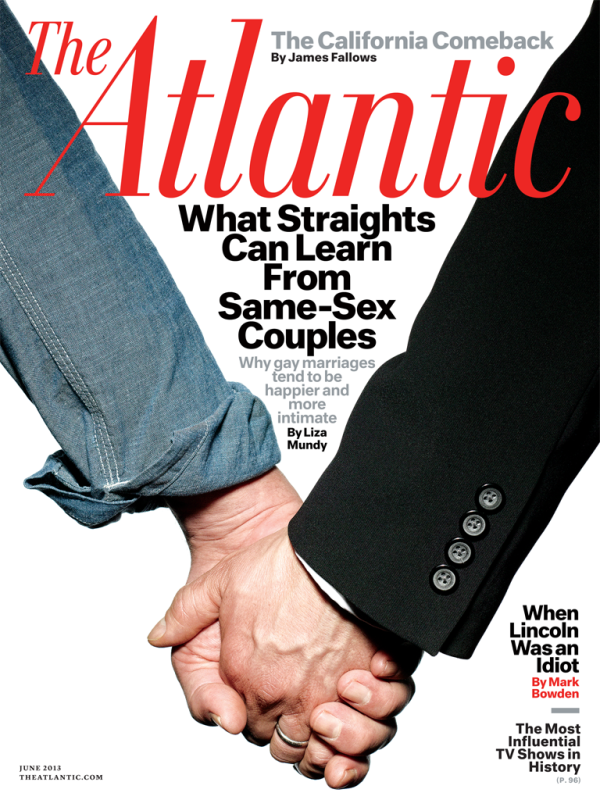
Relatedly, anyone else notice the cover story in the latest issue of The Atlantic?

In “The Gay Guide to Wedded Bliss,” Liza Mundy asks, “What can gay and lesbian couples teach straight ones about living in harmony?” and “What if same-sex marriage does change marriage, but primarily for the better?” She points out (as many feminists and queer folks have been doing for, um, decades):

Same-sex spouses, who cannot divide their labor based on preexisting gender norms, must approach marriage differently than their heterosexual peers. From sex to fighting, from child-rearing to chores, they must hammer out every last detail of domestic life without falling back on assumptions about who will do what. In this regard, they provide an example that can be enlightening to all couples. Critics warn of an institution rendered “genderless.” But if a genderless marriage is a marriage in which the wife is not automatically expected to be responsible for school forms and child care and dinner preparation and birthday parties and midnight feedings and holiday shopping, I think it’s fair to say that many heterosexual women would cry “Bring it on!”

I have to say, painting a picture of same-sex couples “hammering out” our domestic lives makes it sound like we’re drawing up intensive prenups and chore charts. Perhaps some people do (and if it helps you, go for it)! In my experience, it’s more just the freedom from falling into cultural patterns of “wives cook, husbands wash up” (my grandparents’ pattern), or “husbands wash the car and mow the lawn, wives do laundry and remember family birthdays.” In our case, we’re also aided by the fact that both sets of (hetero) parents were mindfully and/or of necessity non-traditional in their spousal roles — something that I think is often overlooked when people ask why some relationships are more egalitarian than others: parental modeling! (Perhaps because, sadly, it’s still a rarity.)

I have grumbles about The Atlantic penning this article as if it’s a possibility that’s just occurred to them — what queer folk might have something to offer the wider world! And I’m also slightly irritated (paradoxically, it seems) for the framing of marriage equality as a “control group” for heterosexual marriage. Um — don’t we get to simply exist without being one half of a scientific experiment.

Also, what’s up with the sudden resurgence in mainstream articles hauling up the myth of “lesbian bed death” from the murky depths? First last week’s woefully glossy and irritating NYT magazine article on female arousal, and now this, where a researcher suggests that the “lesbians [in her study] may have had so much intimacy already that they didn’t need sex to get it.”

… O_O

That suggestion implies a) that women use sex to gain intimacy or they don’t need it and therefore, b) there may be such a thing as “so much intimacy” that you kill your sex life.

O_O …

This is just such a limited understanding of the role of sex in human life that I can’t even.

But I’m also struck by the fact that a publication as culturally staid, if not hard-core conservative, as The Atlantic, has published such an article — a mere sixty years after the August 1953 issue of ONE Magazine was held for three weeks by the post office while they tried to determine whether it was violating U.S. obscenity laws.

Anyway. Have you read the Atlantic piece? If so, what did you think of it?

booknotes: hard to get

30 Tuesday Apr 2013

Posted by Anna Clutterbuck-Cook in book reviews

≈ Leave a comment

Tags

family scholars blog, feminism, gender and sexuality

note: this post was originally written to be cross-posted at the family scholars blog. since I drafted it, the family scholars blog has gone abruptly on hiatus, so this review will only appear here at the feminist librarian.

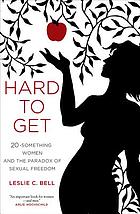
Several weeks ago, when I reviewed Donna Freitas’ book, The End of Sex, I linked out to an interview with Leslie C. Bell, author of the newly-released study Hard to Get: Twenty-Something Women and the Paradox of Sexual Freedom (University of California Press, 2013). Like Freitas, Bell studies the sexual habits of humans. A sociologist and psychoanalyst,  Bell became interested in modern relationship dynamics while working with clients in private practice in the Bay Area. Driven by a desire to better serve the women she counseled, Bell set out to explore how today’s twenty-something women navigate sexual relationships — from casual sexual encounters to long-term partnerships. Through extensive and multiple qualitative interviews with a diverse group of women*, Bell sought to understand how and why women made the choices they did about forming, maintaining, and ending sexual relationships.

Hard to Get is, overall, diagnostic rather than prescriptive. It seeks to identify the interviewees common struggles and strategies for addressing those struggles — both strategies that increase her subjects’ well-being and strategies that seem ultimately counterproductive. She sorts her interviewees by three relationship strategy types: the “sexual woman,” who has prioritized sexual self-knowledge and pleasure, but resisted forming interpersonal attachments; the “relational woman,” who seeks to maintain her intimate relationships, at times even at the expense of her sexual satisfaction; and finally “the desiring woman,” who has (sometimes after one of the first two strategies failed) arrived in a place where she feels able to be an independent, sexually-assertive being and capable of intimate relationships without loss of individual identity or desires. 
One of the most interesting aspects of Hard to Get is that Bell’s “desiring women” are, for the most part, women with queer sexual histories or identities.  She suggests, in her concluding chapter, that part of the reason queer women in her sample expressed a greater sense of well-being and relationship satisfaction was that their intimate relationships were less freighted with gender-based assumptions about what each partner wanted or needed. She makes a passionate plea for straight couples, as well, to pull away from gender-based assumptions about what “women” and “men” want in a partner, and instead approach one another as individual humans.
I actually noticed another commonality among the “desiring women” that had little to do with their adult sexual identities: many of them came from homes in which parents and/or step-parents modeled a great deal of gender independence — that is, the ability to draw on human capacities, whether “feminine” or “masculine,” which best served them in the situation to hand. Single fathers, for example, who knew their way around the kitchen and nurtured their daughters, and mothers who worked in gender-atypical employment. I suspect that this modeling, perhaps even more than the individuals sexual flexibility, might account for the “desiring” women’s resilience and adaptability — their willingness to meet a relationship partner on individual, rather than rigidly gendered, terms. 
One of my fears about this book was (and remains) that it perpetuates the pervasive and sexist assumption that relationship creation and maintenance is “women’s work,” that women suffer disproportionately in the absence of relationships, and that we should focus on women when asking questions about relationship success and failure. 
On the one hand, I can’t fault Bell for choosing to focus her energies on women; we all have to create boundaries around our research topics in order to say anything meaningful about the data we collect. I think she does an excellent job of centering women without blaming or victimizing them. Bell’s subjects actively create and narrate their own lives, even maintaining agency in situations where their choices are severely constrained (such as when they experience sexual assault). This saves the volume from being yet another hand-wringing polemic about “girls these days.” Indeed, I really appreciated Hard to Get‘s feminist sensibility. Bell identifies as a feminist in her introduction, and refuses — unlike many others who have explores this subject — to play the “let’s blame feminism!” game even when she is looking at the ways changing gender role expectations and sexual opportunities create new challenges. 
On the other hand, time and time again these women seem very much alone in their quest for mutuality. The men (in the lives of those who make connections with men) don’t appear to be aware of their partner’s struggles, engaged in finding solutions, or even. At the end of Hard to Get we aren’t left a whole lot wiser about where these women, at least the hetero-minded among them, might find men with whom they could successfully connect. I find myself wondering, once again, about the emotional and relational lives of men — and how their experiences fit within this puzzle. As long as straight men remain (by their own volition and/or by neglect) outside of the relationship discussions, it seems doubtful that much progress will be made resolving hetero relationship struggles.
In my last book review, folks at FSB appreciated my question, “Who would I recommend this book to?” So here is my response for Hard to Get: Bell’s study should be required reading for anyone who has a scholarly or personal interest in how modern Americans are forming sexually-intimate relationships (and how we might do so more successfully). Bell’s urge for us to move forward instead of backward in search of solutions to our relationship struggles is an important counterpoint to more conservative voices. Even if you end up disagreeing with her conclusions, her participants offer us valuable insights into how adult (not college-age) women think and feel about, and how they do, sexual relational intimacy.


*While all from roughly the same age cohort, and largely professional-class women in the Bay Area when they are interviewed by Bell, the participants are about half white and half non-white, half straight and half non-straight, and grew up in a range of different geographical and socioeconomic circumstances. This mix was a deliberate decision on Bell’s part and, I think, strengthens her study immeasurably.

booknotes: does jesus really love me?

23 Tuesday Apr 2013

Posted by Anna Clutterbuck-Cook in book reviews

≈ Leave a comment

Tags

family scholars blog, gender and sexuality, religion, the personal is political


cross-posted from the family scholars blog.

On Friday, while stuck at home due to the “shelter in place” orders here in Boston, I read Jeff Chu’s recent book Does Jesus Really Love Me?: A Gay Christian’s Pilgrimage in Search of God in America (Harper, 2013).

Part memoir, part ethnography, part journalistic endeavor, Does Jesus…? is more impressionistic than it is polemical or scholarly. Chu offers a series of portraits, featuring both people (pastors, congregants, ex-Christians, agnostics) and institutions (from the Metropolitan Community Church, overwhelmingly queer in membership, to the Westboro Baptist Church). Across sections titled “Doubting,” “Struggling,” “Reconciling,” and “Hoping,” Chu offers us a tour around America and the religious and sexual-identity spectrum  as well, introducing us to individuals and congregations wrestling with the relationship between faith and queer sexuality. Chu himself has settled into a life of being gay and Christian, he nevertheless draws empathic (if at times slightly baffled) portraits of LGBT individuals who have forged other paths: queer folks who have been driven from the church or simply drifted away, a gay man who has chosen to remain celibate, a straight woman and gay man in a “mixed orientation” marriage. While he features a few high-profile individuals (Ted Haggard, Fred Phelps, Mary Glasspool), more of the voices in Does Jesus…? are unknowns: the Bible teacher fired from his job for a same-sex affair, the closeted young adult wrestling with if, when, and how to come out to his parents and community, the Christian musician who describes with charming self-deprecation her first gig at a lesbian bar.

I found myself thinking, as I read, a very librarian question: to whom might I recommend this book? One of the pastors Chu interviews offers the following observation: she sees anti-gay Christians and affirming/welcoming Christians trying to have two very different conversations in their discussions around homosexuality. The anti-gay contingent, she maintains, is focused on scriptural authority. The affirming group is focused on stories — on personal testimony. If this is true (though I’m not ready to buy the theory wholesale), then Chu’s book will not have much success in convincing those who believe Christianity demands abstaining from same-sex sexual activity. It is not a work of exegesis, of Biblical interpretation. It is not making a theological argument. Rather, Does Jesus…? is offering us a chance to reconsider our simplistic notions of what “Christian” and “gay,” and the assumption that there is but one type of relationship between the two: a repressive or alienated one.

This is an approach that I think might resonate more strongly with the “personal testimony” contingent. With LGBT folks who are, themselves, wondering, “Does Jesus really love me?” Or with queer activists asking how to engage American believers in the LGBT push for equality and acceptance. Or with unchurched/secular-identified queer folks and allies who see the church as bolstering anti-gay sentiment and are baffled why queer Christians seek to remain in the fold.

For example, as a queer woman who grew up in a conservative Christian community (in a region settled by the Reformed Church in America, Chu’s present denomination!) and attended a college with deep RCA roots, one of the chapters which spoke most directly to my own experience was the chapter about Harding University.  Or, more specifically, Harding University’s student-published Queer Press zine, created and distributed by queer students and alumni primarily to reach out to other (largely closeted) students on the conservative Christian campus. Not only did the creators face a backlash from the administration, they also discovered that their sectarian struggle didn’t always translate very well before a secular audience:

[Secular] bloggers would praise the zine but add, “Why would you go to a school that doesn’t accept you for who you are?” or “Why not just leave?” These questions reflect a different type of thoughtlessness. For one thing, Harding students are just like millions of others who depend financially on Mom and Dad [to attend college]. Then there’s the fact that, again like millions of others everywhere, these students are in a season of fragility and flux. They’re still wrestling with their identities, their faith, and their homosexuality, which may not even be acknowledge before college. As one puts it to me, “It’s not like someone woke up one morning and said, I’m gay but I’m to go there and make my life suck.”

When queer students and allies at my alma mater were making a concerted effort to get the Board of Trustees to revisit their official anti-gay stance, some high-profile queer-friendly blogs got wind of the struggle and there was a lot of puzzlement over why these students had enrolled in, or remained at, such a hostile institution. Setting aside the reality that secular institutions are not always bastions of acceptance themselves, it seems important for non-Christian LGBT activists and allies to remember that “Christian” is often as deeply-held an identity as “lesbian,” “bi,” or “gay.” To ask a queer person raised Christian why they don’t just quit their faith is profoundly lacking in compassion or understanding for the complexity of the human soul.*

Overall, I highly recommend Does Jesus..? to anyone interested in reflecting on the human face of the culture war (for lack of a better term) over sexual diversity in American Christianity. It might also, given its episodic nature, make for really good Sunday School or Church reading group material.

Related: For those unable to put their hands on a copy of the book, Chu was a guest on the Diane Rehm Show back in March, and it was an excellent conversation. You can listen to the audio or read a full transcript of the interview (your support for NPR at work!) courtesy of WAMU.


*On a side note, I know many feminists who’ve encountered similar disbelief that they choose to reconcile their religiosity and their feminism — often, in fact, grounding their feminist values in their faith. It’s fascinating to me that so many people on both sides (the religious side or the queer/feminist side) view these aspects of self as oil-and-water opposites.

movienotes: footloose and flashdance

16 Tuesday Apr 2013

Posted by Anna Clutterbuck-Cook in media

≈ 2 Comments

Tags

friends, gender and sexuality, movies, politics

This weekend, Hanna and I had a 1980s dance (movie) party with friends A’Llyn, Nathan, and their 1-year-old sprog who — if his living room moves were any indication — is going to grow up to be the next generation’s Ren McCormack. We watched Footloose (1984), which has stood up surprisingly well, and Flashdance (1983), which has very much not — although maybe I shouldn’t talk since I never saw it in the actual 1980s and this was my first viewing. But those in the audience who had seen it as children confirmed that from an adult perspective it was even creepier than they remembered!

A few observations about first Footloose and then Flashdance. Spoilers below, fairly obviously, if you care.

Footloose I first saw at some point in my pre-adolescent period. The two things I remembered most vividly were John Lithgow’s performance as the small-town pastor (whom child-me loved to hate) and the scene where Lori Singer, playing the preacher’s daughter, climbs between her friend’s car and her boyfriend’s truck while they’re driving down a two-lane highway. It’s a scene meant to impress upon us that Ariel (Singer) is a thrill-seeking teenager, but mostly just terrifies me every time I have to watch it! Still, as I said above Footloose still has charm and, think time around, I was struck by a few things I hadn’t noticed, or experienced differently, as a child.

  • John Lithgow’s pastor, Rev. Moore is less fire-and-brimstone than he is sad as a character. In fact, we took to referring to him as “sad John Lithgow” every time he showed up in a scene. The film-makers couldn’t seem to decide whether they wanted to make him a petty tyrant or a fearful father … and ended up trying to go for both with only middling success.
  • Kevin Bacon’s Ren is, like, the most polite Big City Rebel ever. Seriously. He wears a suit and tie to school on his first day, and when he decides to enlist the high school seniors to defy the town prohibition against dancing he … wears the suit and tie to a town council meeting and reads a speech in defense of their case. He refuses to smoke pot, even when a local bad boy foists a joint on him, and chills with his little cousins. 
  • Domestic and intimate partner violence get a look-in, although not much of a mention. On the one hand, we have John Lithgow’s character smacking his daughter across the cheek for talking back to him (probably part of what cemented him in my childhood head as an Evil Character). On the other, we have Ariel’s truck-driving boyfriend who beats her up when she breaks up with him. She takes a pipe out of the back of his truck and smashes his windshield and headlights. He gives her a bloody nose and a black eye. The situation is clearly being set up as the negative contrast to Ariel’s eventual relationship with Ren, but it’s also treated like a weird side-point that’s never substantively addressed.
  • The teenagers get a surprising amount of support from the surrounding adults — for a town where supposedly dancing is Of The Evil. Ren’s mother is fired from her job at one point because her son is causing trouble, and the relatives they’re staying with get momentarily judgy. But, like, the mill owner Ren works for after school offers his building for the dance, and Mrs. Moore sticks up for her daughter and the other students at a couple of key points. 
  • Reverand Moore draws the line a burning books from the library, which is sweet but also makes his prohibition against dancing as a sin nonsensical. He’s set up at the beginning of the film as the Big Baddie, only to emerge toward the end as one of the primary advocates for the teens. It’s disconcerting.
  • And Ren McCormack has more chemistry with his new BFF, Willard, than he ever has with Ariel. The scenes where Ren is teaching Willard to dance have more spark in them than any other scene in the film, frankly, and I’m started to find that there is no fan fiction fleshing this romance out on AO3. Fan writers, you’ve let me down!

So overall, Footloose is dated and cheesy — but aged surprisingly well.

The same can most decidedly not be said for Flashdance, which sadly starts out with the promising fact that its female lead, Jennifer Beals plays a welder named Alex Owens who — in addition to holding down a solid, skilled (and I’d bet unionized) working-class job — dreams of successfully applying to the Pittsburgh Conservatory of Dance. Even the fact that Alex moonlights as an “exotic dancer” (but OMG not a stripper!!) wouldn’t on the face of it be enough to kill the film — this could have been one of your predictable “triumph over obstacles”-cum-marriage-plot movies, wherein the girl wins the guy and the chance to study ballet at the school of her dreams.

But.

BUT.

  • There’s this small problem with the love interest being her boss at the building site where she’s working. And, like, a major stalker with the world’s creepiest vibe ever. Starting with the fact that he approaches her at work the day after having seen her dance at the dive bar where she works. So, you know, his interest in her as a person has this double creeptastic factor of “I’ve seen you dance practically naked and I thought that was hot, wanna date?” blended with, “I’m your boss and I’ve just disclosed to you, on the job where I’m supervising you, that I showed up to watch you dance practically naked and I thought that was hot and want to date you.”
  • Ms. Owens (yay feminism!) tells him quite firmly no, she doesn’t date the boss. So he follows her home from the site at night in his car, while she’s riding her bike, and propositions her again. When she insists she doesn’t date the boss he fires her so they can do on a date together the following night.
  • Although she blows him off, she apparently thinks better of it ’cause the following night they’re on a date!
  • And on that “first date” there’s this truly excitingly horrible you-can’t-look-away-from-it scene wherein Alex takes Mr. Manager back to her (loft porn!) apartment for pizza and walks back into the living area in a black negligee and grey warm-up sweater (see DVD cover photo) and proceeds to take her bra off from under her sweatshirt. Our entire audience sort of couldn’t believe it was happening. Not that slutting it up for your partner isn’t fun sometimes, but this was a first date with a stalker boss and the whole thing felt way too close to a professional strip tease. (Needless to say, they proceed to have sex.)
  • Long story short, she continues to perform sexually for him (and I’m framing it like this deliberately — all of their private interludes are echoes of her on-stage performances) and lo and behold he has connections at the Conservatory. So he makes a few calls and she gets an audition!
  • Although Alex protests, nominally, over the wheeling and dealing, in the end she goes to the audition anyway and presumably wins a spot in the Conservatory. We never actually get to find out, since the closing shots are of her making out with her sugar daddy.
I think what was so frustratingly, jaw-droppingly bad about Flashdance was that with a few tweaks it could have been a charming, though obviously cliched, romantic comedy. Make the love interest someone other than her boss. Make him someone who didn’t proposition her after seeing her perform. Make it clearer what dancing means to her, and dis-entangle the patronage from the romantic relationship. Could her boss at the construction site see her perform and, oh, incidentally, know someone who knows someone … without sex being used as such overt currency? So it was like two degrees away from being a movie that was meh but not actually cringe-inducing, and ended up just being bad. No cookies, people. No cookies.
Next time around, I think we’re gonna go with Alien and Terminator.

what matters in "gay marriage" – "gay" or "marriage"?

02 Tuesday Apr 2013

Posted by Anna Clutterbuck-Cook in think pieces

≈ 2 Comments

Tags

doma, family scholars blog, gender and sexuality, marriage equality, scotus junkie

cross-posted from the family scholars blog. 

I often joke with friends and family about how my wife and I are “gay married,” as if this is something different from being … “married.” Perhaps we same-sex couples do everything with our sexual orientation front and center? In that case, this past weekend I celebrated a gay birthday by going gayly out to dinner at a restaurant. I did some gay crocheting, took a gay nap, and wrote a few gay letters to friends.

https://i0.wp.com/24.media.tumblr.com/tumblr_lx4wi10i1b1qk6ktto1_500.jpg
(via)
This is, by and large, a lighthearted amusement. But the “joke” is also grounded in our bone-deep recognition that some people do view every aspect of our lives as unalterably tattooed by our sexual “perversions.” Our being gay — or practicing gay sex — is the attribute that marks us out for differential treatment. Some people would argue it requires differential treatment.

I thought of this other, less amusing use of the phrase “gay marriage” or “same-sex marriage” last Friday when I listened to an On Point news hour reviewing the Supreme Court oral arguments on DOMA and Proposition 8.  The host, Tom Ashbrook, spoke with two guests — law professors Suzanne Goldberg (pro-marriage equality) and Teresa Collett (anti-) — about the arguments. In discussing DOMA, Collett followed the lead of defense lawyer Paul Clement, representing BLAG, in arguing that what the DOMA law sought to achieve was not any sort of discrimination between gay and straight marriages, but rather to impose legal uniformity.

From the oral argument transcript (p. 62-63):

Mr. CLEMENT: … Ms. Windsor wants to point to the unfairness of the differential treatment of treating two New York married couples differently, and of course for purposes of New York law that’s exactly the right focus, but for purposes of Federal law it’s much more rational for Congress to — to say, and certainly a rational available choice, for Congress to say, we want to treat the same-sex couple in New York the same way as the committed same-sex couple in Oklahoma and treat them the same. Or even more to the point for purposes -­

JUSTICE SOTOMAYOR: But that’s begging the question, because you are treating the married couples differently.

I want to point out a couple of features of this exchange.

The first is that Clement (and Collett, on air) are attempting to erase the anti-gay sentiment that animated the passage of DOMA, something which Justice Kagan highlighted when she read aloud from the House Report during the argument (see p. 74 of the transcript). This “softer” argument makes the case that what the federal government really wanted was sameness — equality if you will! — so that despite marital diversity at the state level, the federal government would only recognize certain types of marriage as actually legal nationwide.

I find this in itself disturbing, in that it attempts to turn DOMA into something that’s almost supposed to benefit same-sex married couples rather than harming them — as if we’re supposed to be comforted, somehow, that our citizenship rights will be the same nationwide … by ensuring that no matter what level of relationship recognition our state of residence provides us, we’ll be firmly denied recognition at the federal level. Consistently.

Equality! Yay! …. oh, wait.

The second (and I think key) feature of this uniformity framing, and the exchange Clement had with Justice Sotomayor above, is that Clement is emphasizing the gay part of being “gay married” and Sotomayor is emphasizing the married part of being “gay married.”

Clement is arguing that regardless of whether a same-sex couple lives in Massachusetts (where we can legally marry), in Illinois (where they have civil unions) or in Michigan (where same-sex couples are denied any form of legal recognition), we will be met with federal uniformity … in that we won’t be recognized, regardless of our state-honored status.

Based on the fact that we’re gayly married, instead of straight married.

Sotomayor pushes back against this emphasis, asking instead “isn’t this treating the married couples differently”? Placing the emphasis on marriage, Sotomayor is correctly pointing out that we do not seek to treat all straight couples similarly, regardless of relationship status. We treat a cohabiting straight couple differently from a married straight couple differently from a divorced straight couple. One might ask, following Clement’s line of argument, why the federal government distinguishes between an unmarried cohabiting couple in Wyoming and a married couple in Maine — shouldn’t they be concerned about uniformity in the treatment of straight couples on a national level?

(As an aside, I actually think this is a legitimate line of questioning — the differential treatment of married and unmarried partnerships — but that is not, realistically speaking, the argument Clement was making. So it is the topic of another post.)

This is not to say that understanding LGBT* identities as political in nature, as social class identities, is never legitimate. Identity politics — coming together with a group of people based on some facet of your identity in order to effect political change — is, of course, sometimes a necessary thing. Often, such class consciousness is made necessary by the way we are targeted as a group by those who hold anti-gay beliefs or take anti-gay actions. I move through my life aware that my bisexuality and my lesbian relationship are key components of my self-conception — and also aspects of my self by which other people both understand and judge me.

I am proud of being both “gay” and “married.”

But I do think that when it comes to marriage law, it should be the married part of that equation that has bearing, not the gay. As someone who is legally married, under laws that pertain to marriage it should be that status which determines whether I am a person to whom the law applies or not.

thirty two [happy birthday to me + some photos]

30 Saturday Mar 2013

Posted by Anna Clutterbuck-Cook in life writing

≈ 3 Comments

Tags

domesticity, gender and sexuality, holidays, photos

Today’s my thirty-second birthday, in the event you didn’t already know that via all the over-helpful social media reminders!

Hanna bought me this lovely ceramic indoor water fountain as a present.

Ever since I was a small girlchild I have loved the sound of running water and used to fantasize about living in a house with a river running through its center. Short of that, I wanted to live in a cottage by the sea, on a river, or by the lake, where the sound of waves and rapids could be heard through the open windows.

Neither of these things is practical right now, but the fountain is a lovely “plan B.”

(photos by Hanna)

Making room for the fountain, despite its modest size, precipitated a major reorganization of the living room – a way of making the apartment few new and springy even though we’ve lived here nearly five years (and Hanna even longer).

We moved the couch from the inside wall out to a spot beneath our bay windows (the element that really “makes” our living room as a space). This shift necessitated consolidation of some bookshelves into a book wall … bonus points if you spot the TARDIS shrine!

We’re enjoying natural light that now falls on the couch, making for good reading into the evening without having to turn lights on.

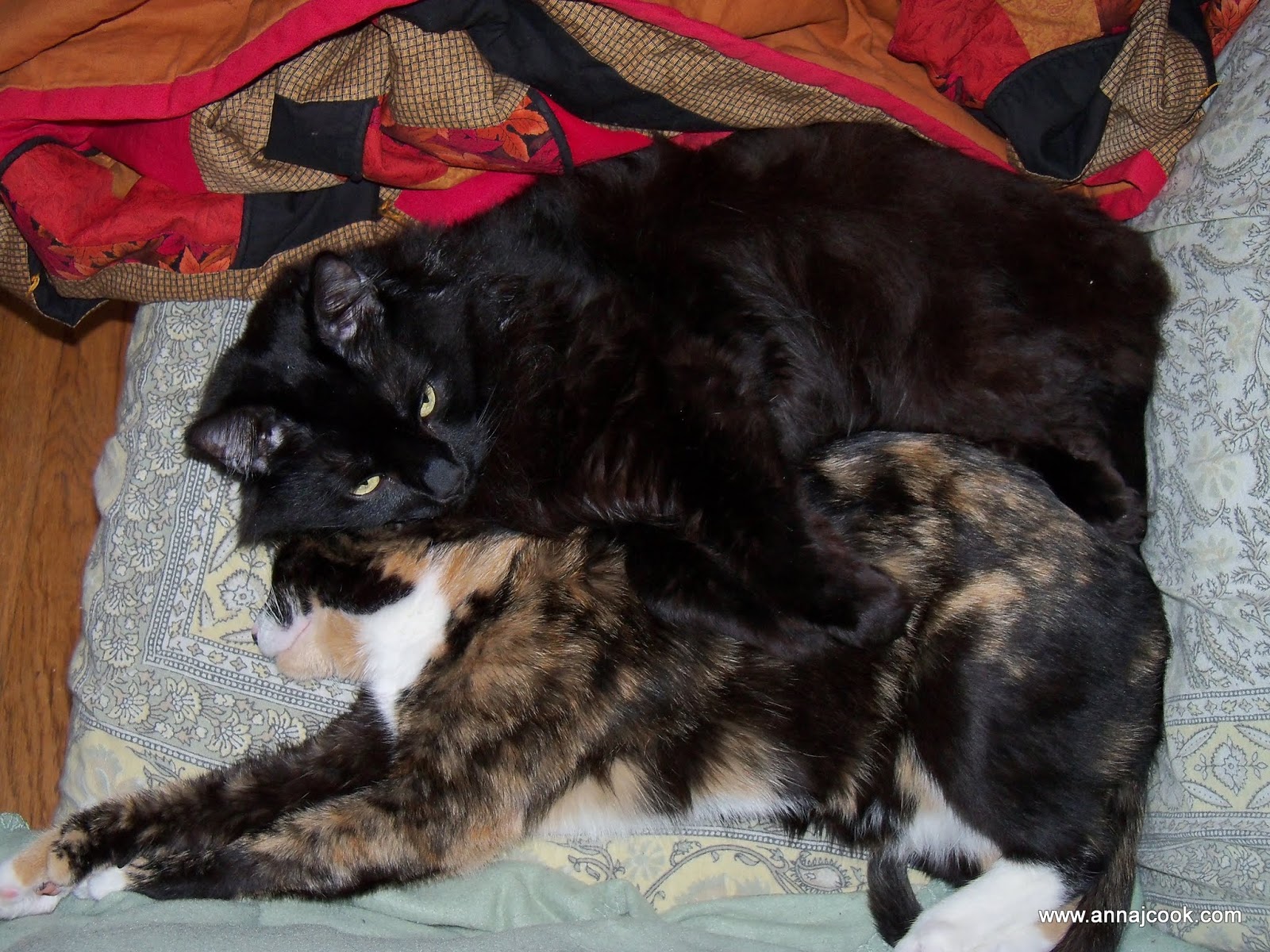
The cats continue to be unimpressed by us, though we have clearly been setting a poor example in the lewd cuddling department…

Or a good example, depending on which way you think the bread is best buttered.

Enjoy your Easter weekend, folks — spring is slowly arriving!

politics, pornography, and combating queer isolation

28 Thursday Mar 2013

Posted by Anna Clutterbuck-Cook in think pieces

≈ Leave a comment

Tags

education, family scholars blog, gender and sexuality, politics, smut

cross-posted from the family scholars blog.

Conner Habib, an actor who performs in gay male pornographic films, was recently invited by a student group at Corning Community College (Corning, NY) to speak on sex and culture. When the college president found out that Habib, in addition to being a thoughtful and articulate human being, had appeared in erotic film, she took steps to cancel Habib’s talk and has apparently moved to further obstruct attempts to host the talk in a non-college-sponsored locale.

Habib has written an excellent piece about his own perspective on these events which can be read in full over at BuzzFeed. In the essay he reflects on the place pornographic materials have in mitigating the isolation sexual minorities can experience, particularly in rural areas. He writes:

Where I grew up, just outside of Allentown, PA, I watched, right through my adolescence into adulthood and early college years, while straight people paired off and experienced sex. They were able to engage with a basic aspect of human life that seemed unavailable and distant to me. Unlike today, there was no discussion about gay marriage, nor were there many gay characters on TV. But even if there had been, neither would have rounded out my experience as a man with homosexual feelings because so many of those feelings were — unsurprisingly for a young man — sexual. Gay sex was a lonely venture. It wasn’t easy to find, and was only mentioned in slurs and the butt of jokes. … Whether I bought it from the adult video store or, later, downloaded it, gay porn helped me encounter positive images of gay men enjoying the act of sex. Gay porn was a window into gay sexuality that was free of shame and guilt, and revealed a different world where sex wasn’t a lonely prospect, confined to the shadows or just my imagination.

Habib describes how, being a man of Arab descent, he receives fan mail from gay men in Middle Eastern countries who “[express] gratitude and relief for my having portrayed gay sex in a positive light on camera.”

Continue reading →

comment post: friendships, "crushes," and heteronormativity

26 Tuesday Mar 2013

Posted by Anna Clutterbuck-Cook in think pieces

≈ 2 Comments

Tags

comment post, gender and sexuality

About a year ago, I had the pleasure of being interviewed by London-based journalist Rachel Hills for her forthcoming book, The Sex Myth (Simon & Schuster, 2014). Last week, she was in touch with some of us to ask a follow-up question about “boy talk.” For those of us who grew into our sexuality desiring women, or who didn’t identify as female, Rachel wanted to know what such “boy talk” girl bonding rituals felt like to us.

Here are the thoughts I sent in response.


when you do a Google image search for “sleepover”
you get a bajillion images like this (via)

What an interesting question you pose, Rachel!

I have several distinct-yet-inter-related thoughts and memories:

First, I did not attend gradeschool (I homeschooled until college). Because of this, I don’t recall a lot of intense pressure to perform gender in the “boyfriend”/”crush” way in my pre-adolescent years. I remember pressure from my childhood friends to pick a “best friend” among them, and feeling confused about how to handle that without hurt feelings. I remember lots of gender play in terms of dressing up and playing princess and “runaway princess” (which usually involved setting up house together, as sister-princesses, in the “woods”).

It’s true that, apart from my younger brother and his little group of male friends, I didn’t have male friends who survived much into gradeschool. When I was very young, I remember playing with the children in my mother’s circle of friends irrespective of gender, but when those children started attending school the boys were definitely under pressure NOT to be friends with girls (and vice versa, I imagine), so we drifted apart. The boys I knew in the neighborhood were more casual acquaintances, and even then they tended to be identified as my brother’s friends, even if we all played together outside.

Second, I remember being intensely embarrassed and upset when older people (babysitters, adult friends of the family) framed my relationships, celebrity interests, etc., as (sexualized) “crushes.” I vividly remember in the 9-10-11-year-old period specific instances of being teased — I’m sure in a well-meaning way! — about my passion for the tennis player Andre Agassi whom I idolized when, for a brief while, I was into tennis. Perhaps some of the intensity I felt about him WAS pre-pubescent romantic interest, but I really hated the teasing because I was confused by my own feelings, didn’t identify them as romantic or sexual, and didn’t like the feeling that other people were assigning terms to my feelings that I didn’t agree to. It also felt like very private feelings were then being hauled into public in ways that were potentially embarrassing.

So during that period, the framework of “the crush” actually served the opposite purpose from bonding with my peers or same-gender compatriots: it made me feel uncomfortably singled out and limited in my passions. It served to make it clear that I needed to police my feelings (and the expression of those feelings), particularly about boys and men, if I didn’t want to come under unwanted scrutiny.

As I’m typing this, I’m thinking about the way in which my passions for same-gender friendships were NOT similarly sexualized or policed by others, and the freedom that allowed me to develop emotional intimacy with my close female friends during pre- and early adolescence.

Third, I definitely remember the way in which my teenage friendships with other girls organized themselves around “boy talk.” Our “boy talk” manifested in two distinct ways (as I recall), one of which I felt comfortable engaging in and the other of which I didn’t. I do remember enjoying “boy talk” that circled around fictional characters in films and books. My girlfriends and I would read novels and portion out who had the “rights” to certain dashing heroes (or anti-heroes). We gossiped about what was happening between our favorite (hetero) couples in these fictional narratives and celebrated the successful marriage plots for the characters we felt were deserving and well-suited to one another. All of this I very much enjoyed.

What I felt more uncomfortable about, and artificially performative of, as time went on, was the more personal boy-crazy talk about crushes within my friendship circle. It felt awkwardly forced — particularly for the friends (and we were a shy group of girls) who never acted on their supposed crushes by initiating a relationship with the person in question. It very much felt like an activity engaged in to earn points with other girls. You talked about who you had a crush on because it was what everyone was supposed to do.
I remember really hating the awkwardness of this period (adolescence), and the way in which girls and boys were relentlessly sorted into same-gender groups, and their mixed interactions chaperoned with the expectation on all sides that such mixed-gender interactions (whether single-y or in groups) were going to be fraught with sexual tension. I didn’t like the way you suddenly were supposed to be aware of your bodily boundaries, who was touching whom, and how things that seemed nice (and possibly proto-sexual) were suddenly inappropriate. Like, I remember once being on a camping trip and helping a boy wash his hair in the river. We were both wearing bathing suits and I didn’t touch anything other than his head, to help with the shampoo, and it was really nice to be enjoying ourselves. But afterwards, there was this clear message from some of the camp counselors (and later, parents) that this interaction was somehow fraught and potentially worrisome in a way that it would never have worried anyone if I’d helped a same-gender friend wash her hair.

Thoughout my adolescence, I kept asking people what was difference about sexual attraction versus intense, passionate friendship and they kept telling me that I’d understand when I had the experience. What I eventually figured out (embarrassingly enough, not until my mid-twenties!) was that the reason I couldn’t decipher the difference was that I in fact had the potential for sexual desire for both men and women. My attraction to women had been burbling along all throughout my childhood and adolescence and had simply been allowed to run its course through passionate friendships — without all of the constraints imposed upon interactions with boys.

The one passionately intimate friendship I developed with a boy in my adolescence was with a young man who eventually came out as gay. We’re still very close friends, but it’s definitely illustrative to look at the way he and I navigated our friendship in the context of heteronormative culture. While my passionate same-gender friendships were just as intense and intimate as my relationship with this boy (part of the patchwork of clues that finally led me to understand my bisexuality / sexual fluidity), those girls and I never problematized our relationship — and neither did our families or wider circle of friends. In contrast, this male friend and I were both very aware of the emotional intensity of our relationship, and about the expectation that we needed to police the boundaries of that passionate relationship in order to respect one anothers’ (emerging) sexual identities and to manage the expectations of our respective social circles. Our letters (for much of our relationship during that period we were long-distance correspondents) are full of discussion about the nature of our relationship, whether or not we felt a sexual relationship was in the cards, why or why not, how we might piece together a continued friendship even if one of us was sexually attracted to the other and the other did not reciprocate. We looked for models in history and literature for passionate, non-sexually-active, cross-gender relationships like ours. All of this activity was never explicitly prompted by our peers or the adults around us, but was definitely something we felt we needed to do. While no analogous process ever took place between me and the young women I was close to, despite the fact that I would (looking back now) argue the emotional intensity of female-female relationships were commensurate to what I felt with this male friend.

My point in recounting this story is that as a woman who grew up queer in heteronormative culture, I still felt pressure to sexualize cross-gender relationships and the absence of pressure to sexualize same-gender relationships. This meant that I was often bewildered and frustrated by the way cross-gender relationships that did NOT feel particularly sexual to me were nonetheless inscribed with those feelings from the outside, and simultaneously it delayed my recognition of the sexual potential within same-gender relationships because no one in the culture around me was encouraging me to think in those terms. While I’m glad for the protected, private space that gave me to explore my same-sex desires without the social scrutiny I would have endured for cross-gender desires (if/when they became socially visible), heteronormativity also meant I had a lack of language to speak about those desires even when I had begun to acknowledge them.

Whew! More thoughts than I anticipated when I started this reply … I’ll leave it there. Good luck with the final week of revisions, and thank you so much for staying in touch! I’m looking forward to reading and reviewing the final work.

Best,
Anna

booknotes: from the courtroom to the altar

21 Thursday Mar 2013

Posted by Anna Clutterbuck-Cook in book reviews

≈ Leave a comment

Tags

gender and sexuality, history, marriage equality, politics, scotus junkie

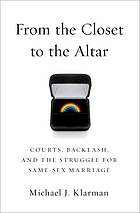
I have book review out in the most recent issue of NEHA News (Spring 2013, vol. 39), the bi-annual newsletter of the New England Historical Association. This time, the title is Michael J. Klarman’s From the Closet to the Altar: Courts, Backlash, and the Struggle for Same-Sex Marriage (New York: Oxford University Press, 2012). You can read the full review in the PDF version of the newsletter, but here’s a snippet to whet your appetite:

In his most recent work, legal historian Michael J. Klarman (Harvard Law School) turns his attention from the role of the courts in ending racial segregation (From Jim Crow to Civil Rights: Brown v. Board and the Civil Rights Movement) to the history of gay rights activism — specifically the legal struggle around same-sex marriage. Klarman explores how gay marriage emerged as a key marker for both pro- and anti-gay sentiment, and assesses “the costs and benefits of gay marriage litigation” as a path toward greater social justice. As a scholar of Constitutional history, Klarman is particularly keen to understand the role of judicial opinion and court action in changing public sentiment (and, conversely, the role of public sentiment
or action in changing judicial reasoning or decisions). 

You can read the whole thing thanks to NEHA’s willingness to make their newsletter available online for free!

← Older posts
Newer posts →
"the past is a wild party; check your preconceptions at the door." ~ Emma Donoghue

Recent Posts

  • medical update 11.11.22
  • medical update 6.4.22
  • medical update 1.16.2022
  • medical update 10.13.2021
  • medical update 8.17.2021

Archives

Categories

Creative Commons License

This work by Anna J. Clutterbuck-Cook is licensed under a Creative Commons Attribution 3.0 Unported License

Meta

  • Create account
  • Log in
  • Entries feed
  • Comments feed
  • WordPress.com

Blog at WordPress.com.

  • Subscribe Subscribed
    • the feminist librarian
    • Join 37 other subscribers
    • Already have a WordPress.com account? Log in now.
    • the feminist librarian
    • Subscribe Subscribed
    • Sign up
    • Log in
    • Report this content
    • View site in Reader
    • Manage subscriptions
    • Collapse this bar