• anna j. clutterbuck-cook
  • contact
  • curriculum vitae
  • find me elsewhere
  • marilyn ross memorial book prize

the feminist librarian

the feminist librarian

Tag Archives: history

stuff that may be keeping me from blogging (as much) this summer

21 Friday Jun 2013

Posted by Anna Clutterbuck-Cook in life writing

≈ Leave a comment

Tags

being the change, blogging, domesticity, history, work-life balance

During the past few weeks, I’ve been reading stories on the internets about which I have Thoughts and Feels, but for which I have very little (if any) time or energy to blog about. Non-internet stuff has been happening, in that way that takes attention and emotional-mental-logistical energy. In that way that takes up all the brainspace and physical time/space otherwise filled up with typing words that become blog posts.

canoes on the Charles River lagoons, 2008

So blogging might be a little slower around here than it has been in the past few months. Here’s a run-down of some of the things I’ll be doing when not seen in this space:

  • I’ve been getting back into some personal (not-for-work) history research in the cracks between my other obligations. I’m on what we call in the business a “fishing expedition” looking for a project that will yield something interesting and original on the crossroads of gender, sexuality, and religion within the Christian left during the 1950s-1980s (focusing on the early 1970s). My starting point is the Methodist Student Movement publication motive magazine (1941-1972), outspoken on issues such as poverty, civil rights, and cold war politics, the staff of motive experienced a decline in denominational support when they published an issue on women’s liberation in 1969 through to the final two issues, published independent of the church, on gay men’s liberation and lesbian/feminism. My current line of questioning circles around why Christian theology provided a robust vocabulary for speaking about some leftist issues — but seems to have failed its young activists on feminist and queer issues. I’m keeping busy reading motive, some personal papers of its editors, and surveying the secondary literature … a few hours a week, stolen when I can.
  • Against my better (or perhaps simply more self-centered) judgement, I’ve been Getting Involved at work with some advocacy issues related to organizational transparency and employee benefits restructuring. As a small non-profit cultural institution (we employ a staff of about fifty) we’re facing some post-2008 financial fallout that requires reduction in benefits. Questions about how decisions have been (and will be) made, and how employees will (or will not) be involved in the process are a live concern. I’ve been tapped to be part of a staff advisory group, and volunteered to be on a retirement planning committee. If any of you have reading suggestions for good books or articles about worker advocacy in the non-profit, non-unionized workplace I’m happily taking suggestions!
  • General workplace busyness during the summer season, which is when many of our fellowship recipients make time to visit the library to conduct their research, and casual visitors in Boston on holiday make an appearance.
  • For the past two months, Hanna has been working her way through an allergy identification diet which has demanded particular attention to cooking and a lot of learning-on-the-fly about alternate ingredients. So far, the likely suspect is gluten intolerance, which will require a reorganization of the kitchen, our shopping & cooking patterns, and all that jazz. Do you know how hard it is to find non-preachy gluten-free cookery books?
  • I’ve been trying to spend more time reading offline and doing other non-internet activities, particularly on the weekend. Some of those things I’ve blogged about in my book review posts. I’m also enjoying such things as The London Review of Books, The Lesbian Connection, Bitch magazine, and back issues of our various professional journal subscriptions (The American Historical Review and Library Journal and Oral History Review and so forth). 
  • Biking means less time to read offline while commuting. As whingey as this sounds, biking more to and from work reduces my leisure reading time by as much as five hours per week — a not insubstantial amount!
  • I’ve been seeing a wonderful uptick in personal emails over the past few months, as long-distance friendships have evolved from blog-based to email-based exchanges. This is a positive development, in my personal opinion, but also means that much of my writing and discretionary intellectual energy gets pulled in the direction of one-to-one conversations rather than blog posts sent out into the aether.
  • And yep, I’m still fiction (and fan-fiction writing)! For example, the piece of erotica I submitted last weekend, and the series I’m adding to on a weekly basis over at AO3.

And finally, as a reminder, you can generally see/catch me on Twitter (@feministlib) if you’re curious about what I’ve been reading and thinking about in 140 characters per notion. Also, emails (feministlibrarian [at] gmail [dot] com) will usually rouse me (see second-to-last-bullet-point above) since I love correspondence.

In the meantime — hope y’all are doing well and have kick-ass summer plans. I’m sure we’ll see one another around!

"not specially interesting to the eye": trollope on boston

15 Saturday Jun 2013

Posted by Anna Clutterbuck-Cook in a sense of place

≈ Leave a comment

Tags

books, boston, history

Boston from Georges Island, 2007

Hanna and I picked up a copy of Trollope the Traveller: Selections from Anthony Trollope’s Travel Writings edited by Graham Handley (Ivan R. Dee, 1993) on the $1 cart at the Brookline Booksmith this morning. While we were reading in the park, Hanna found and read aloud the following from Trollope’s 1862 two-volume travelogue North America, describing his travels across the continent in 1861. The eminent Victorian author had this to say about Boston:

Boston is not in itself a fine city, but it is a very pleasant city. They say that the harbour is very grand and very beautiful. It certainly is not so fine as that of Portland [, Maine] in a nautical point of view, and as certainly it is not as beautiful. It is the entrance from the sea into Boston of which people say so much; but I did not think it quite worthy of all I had heard. In such matters, however, much depends on the peculiar light in which the scenery is seen. And evening light is generally the best for all landscapes; and I did not see the entrance to Boston harbour by an evening light. It was not the beauty of the harbour of which I thought the most; but of the tea that had been sunk there, and of all that came of that successful speculation. Few towns now standing have a right to be more proud of their antecedents than Boston.

But as I have said, [Boston] is not specially interesting to the eye — what new town, or even what simply adult town, can be so? There is an Athenaeum, and a State Hall, and a fashionable street — Beacon Street, very like Picadilly as it runs along the Green Park, — and there is the Green Park opposite to this Picadilly, called Boston Common. Beacon Street and Boston Common are very pleasant. Excellent houses there are, and large churches, and enormous hotels; but of such things are these a man can write nothing that is worth the reading. The traveller who desires to tell his experience of North America must write of people rather than things.

I love how dismissive he is of the city “pish tosh,” you can hear him grumbling, “hardly worth writing home about!”

Lagoon on the Charles River Esplanade, looking toward Boston, 2007

marriage equality and female suffrage: step by step change

15 Wednesday May 2013

Posted by Anna Clutterbuck-Cook in my historian hat

≈ Leave a comment

Tags

history, marriage equality, politics

So I haven’t written anything about the recent state-level victories in the push for equal marriage rights for same-sex couples. But congratulations Rhode Island, Delaware, and Minnesota! We have friends in all three states who are feeling better about their country now, because their state legislatures have chosen to be more welcoming in the face of family diversity and human sexual diversity. I can only hope this trend continues.

And of course we’re all waiting on tenterhooks for the DOMA ruling to be handed down by the end of the term.

As a historian, I’ve been watching the concurrent process of state-level victories and the DOMA challenge mindful of the way past struggles over the expansion of citizenship and constitutional protections have similarly progressed in fits and starts across our federated landscape.

Consider these two infographics:

(via)
(via)


I don’t have any Big Important Thoughts about this process at the moment, except to say that I think people who argue we should leave the process to the states ignore the important role that our national government plays protecting the rights of minority populations … and that people who are eagerly pushing for a national right to same-sex marriage sometimes ignore the symbiotic relationship between state and federal rights campaigns.

When this is all over, there will be a PhD dissertation in a comparative treatment of the woman suffrage and marriage equality campaigns (victories?!).

Addendum: It occurred to me, on my morning commute, that another parallel between the woman suffrage campaign and the marriage equality campaign is that both are specific issue campaigns that brought a diverse coalition of people with wide-ranging agendas together on one thing they could agree to push for. They are also both comparatively narrow victories that leave some folks unprotected (African-American women in the South; trans folks in many states) and run the risk of making it seem like all inequalities for a certain class of people have been swept away in a single moment.

The 19th Amendment, as we know nearly a century later, did not erase sexism and misogyny from our national landscape; marriage equality will not erase heterocentrism and anti-gay discrimination (as E.J. Graff points out in the link above). We would do well to remember that, even as we move forward in celebration.

the feminist librarian’s bookshelf: five women’s lives

11 Thursday Apr 2013

Posted by Anna Clutterbuck-Cook in book reviews

≈ 2 Comments

Tags

family scholars blog, feminism, history, the personal is political

cross-posted from the family scholars blog.

March was women’s history month and this post was supposed to go up the week of March 25 … but the last couple of weeks have gotten away from me. So here is the second installment of The Feminist Librarian’s Bookshelf — the March edition in April!

The theme this time is women’s history and I chose to highlight five biographies or autobiographies by and about women whose lives and work have left an impression upon my own sense of “how to live?”

If I had to draw out some common themes from across these women’s lives I would say that some of the characteristics that unite this women are: leftist-radical politics, a vision for more equality and well-being (of many kinds)  in the world, and unconventional personal and family relationships.

Sylvia Pankhurst, 1909

Sylvia Pankhurst (1882-1960). Sylvia Pankhurst: A Crusading Life by Shirley Harrison (Aurum Press, 2003). An often-overlooked member of the notorious Pankhurst family, Sylvia Pankhurst was the second daughter of women’s rights activists Emmeline and Richard Pankhurst. Her elder sister Cristabel would become famous on both sides of the Atlantic for her political theater. Sylvia was deeply involved in her family’s feminist activism, but eventually loosened her ties with them as Britain’s entry into the First World War exacerbated their differences over tactics and priorities. Sylvia pursued her own work in London’s impoverished East End, publishing a journal called the Women’s Dreadnaught, providing affordable meals and health services as well as supporting efforts to organize labor unions. Further radicalized by the Great War, Sylvia became an increasingly outspoken peace activist and also a critic of British imperialism. In the 1930s she became involved in anti-colonization activism, principally in support of Ethiopian independence; she would eventually make her home in Ethiopia. 

Sylvia never married, though she sustained two long-term relationships: the first with Labour Party founder Keir Hardie (though there is no conclusive evidence the two had a physical relationship), and the second with Italian anarchist Silvio Corio. Sylvia and Silvio lived together for over thirty years (until his death) and Sylvia gave birth to their son, Richard, in 1927. Reportedly, it was Sylvia’s refusal to marry Silvio which caused the final rupture with her parents and elder sister Cristabel. I am fascinated by the way the story of this particular radical Pankhurst daughter is so often eclipsed by the high-profile lives of her mother and sister who were radical on the subject of suffrage but reactionary and chauvinistic in many other ways.

Dorothy Day (1897-1980). The Long Loneliness (Harper and Row, 1952). Catholic activist Dorothy Day began her career in political struggle as a journalist  in the Lower East Side of New York City where she covered labor and feminist activism for such eminent socialist newspapers as The Liberator and The Masses. During this period Day was in a serious relationship with fellow leftist Forster Batterham, though her increasing interest in Catholicism put a strain on their relationship and by the time Day gave birth to their daughter, Tamar, she and Batterham were no longer a couple. Several years after Tamar’s birth, in the depths of the Great Depression, Day met French emigre and eccentric intellectual Peter Maurin; the two formed a friendship which would become the foundation from which Dorothy Day pursued her social justice work. Together, they began publishing The Catholic Worker and eventually expanded their efforts to provide meals and shelter to the destitute in a communal setting.  The Catholic Worker Movement is still extant today, maintaining uneasy ties to the Catholic church.

Throughout the Second World War, Day and her fellow Workers maintained a commitment to pacifism, and following the war Day was arrested numerous times while on nonviolent protest against the Cold War and nuclear proliferation. They also became involved in the Civil Rights movement. There is a movement within the Catholic church to have Dorothy Day canonized as a saint, although throughout her life she resisted efforts to describe her work as somehow super-human, miraculous or otherwise noteworthy. I am a troubled admirer of Dorothy Day, whose complicated relationship with the feminist activism of her day makes her a difficult ally in many ways — even as she dedicated her life to lessening human suffering of many kinds.

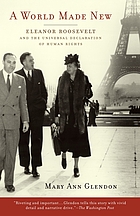
Eleanor Roosevelt (1884-1962 ). A World Made New: Eleanor Roosevelt and the Universal Declaration of Human Rights by Mary Ann Glendon (Random House, 2001). I have never been particularly interested in Eleanor Roosevelt as a public personage — though the two-volume biography by Blanche Weisen Cook is a tour de force — but a history professor at my undergraduate college once made me a gift of this slim historical study of Roosevelt’s role in the drafting of the Universal Declaration of Human Rights. It’s not a biography per se, but I include it here because I think it captures a unique historical moment in the twentieth century through the lens of one woman’s involvement. The UDHR was drafted by an international committee in the “pause” between World War Two and the height of the Cold War, and represents the hubris of the West (particularly the United States) in believing they could create a truly “new” internationalist, peaceful, humanitarian world — as well as the pragmatic reality of international politics which demanded compromise of that vision in order to produce anything of use.

Even if you are a skeptic of the United Nations, of internationalism, and/or not a fan of Eleanor Roosevelt, I think there is much to learn from this particular chapter in our political past.

Margaret Mead (1901-1978). Blackberry Winter: My Earlier Years  (William Morrow, 1972). I first encountered Mead’s story in college while working on an independent study on the first generations of women college graduates. Mead was the daughter of two academics — her father was a professor of economics and her mother a sociologist. Her childhood was spent in and out of formal schooling as her family moved around the country, and she spent a year at DePauw University in Indiana before transferring to Barnard College (then a young upstart of a women’s college in cosmopolitan New York). She went on from Barnard to study under anthropologists Franz Boaz and Ruth Benedict, earning her PhD from Columbia University in 1929. Mead is best known for her study of adolescent girls in Samoa, Coming of Age in Samoa (1928), although her anthropological curiosity ranged far and wide. While some of her frameworks for understanding feel outmoded today, she was instrumental in making the lives of women and children a legitimate field of study.

In Blackberry Winter Mead suggests a connection between her wide-ranging study of human cultures and her own exploration of relationships and family life, which took a decidedly unconventional path. Married while in graduate school (she refers in Winter to her “student marriage”), she and her first husband parted apparently amicable ways before she left for her fieldwork in Samoa. Her second marriage was equally short-lived and rocky by all accounts, ending in 1935. British anthropologist Gregory Bateson was her third husband, and the only spouse with whom she had children — a daughter, Mary, whom she gave birth to in 1939. Mead also had long-lasting, passionate relationships with Ruth Benedict and another anthropologist, Rhoda Metraux, although the extent to which either relationship was sexually intimate is up for debate.

Gerda Lerner and her husband Carl, 1966 (via)

Gerda Lerner (1920-2013). Fireweed: A Political Autobiography (Temple University, 2002). When historian Gerda Lerner passed away on January 2 of this year, her obituaries widely proclaimed her one of the founding mothers of the field of women’s and gender history. Without question, it is thanks to Lerner and her pioneering cohort of historians who insisted on gender as a valid category of analysis that I am able to do what it is that I do and be taken seriously as a scholar. Yet what I think is even more intriguing is the political and social milieu that such a scholar came out of — and it is this “pre-history,” if you will, that Fireweed sets out to tell.

Gerda Lerner (nee Kronstein) was born in Austria on the eve of the Second World War, was a student activist against the Nazi party (a form of political participation that landed her in jail when she was seventeen), and escaped to the United States as a refugee in 1939. She married the boyfriend with whom she had fled to America, but the marriage did not last by the mid-1940s she was married to Carl Lerner, a director in theater and later film, and an active Communist. Husband and wife shared a common political cause and throughout the 40s and 50s they worked side by side (with their children in tow) on behalf of labor, civil rights, peace, and against McCarthyism. Lerner did not return to school until she was in her 40s, earning her PhD from Columbia University in 1966 with a dissertation examining the work of Sara and Angelina Grimke, two white Southern women who had found it in themselves to agitate against slavery. Lerner was 46 years old.

I think what I find most compelling about Lerner’s biography is its testament to the human capacity for “second acts,” if you will — that a life so filled with political struggle and the daily grind of survival could change direction at the midpoint and channel that energy into scholarship that was, perhaps, quieter than high-stakes anti-Nazi activism or labor organizing (certainly involving less jail time!) but was just as revolutionary in its own way.

This list is obviously limited by my own inclinations and concerns. I am conscious that of these five women, all are white and middle class by upbringing and education if not by fiscal measures. Although only three of the five are American by birth, the other two are Western European. None lived the majority of their lives in a same-sex relationship, although at least two women (Mead and Roosevelt) appear to have “swung both ways,” holding passionate attachments to both women and men during their lives.

What biographies and autobiographies of and by women have you found meaningful in your own life? What women in history speak to you?

quick hit: "in loving memory of her little girl: past, present, and place in the gladys potter garden"

21 Thursday Mar 2013

Posted by Anna Clutterbuck-Cook in linkspam

≈ Leave a comment

Tags

children, friends, history

(via)

My former professor, mentor, and friend Laura Prieto has recently published an essay in the digital humanities project Subjecting History titled “In Loving Memory of Her Little Girl: Past, Present, and Place in the Gladys Potter Garden.” The piece explores how a memorial garden in Laura’s neighborhood came to be, and what it has meant over time:

Surely I cannot be the only person who has noticed the pair of stone plaques outside one of the heavy wrought iron gates. The inscription on the left side reads: “The Gladys Potter Garden. Dec 4, 1883 – Nov 16, 1891.” Its companion plaque on the right is much more weathered and thus harder to read. But if one squints a bit, one can make out the explanation: “This garden was given by a mother in loving memory of her little girl, who loved this spot and who loved to walk here with her father when it was part of an attractive ravine. MCMXX” [1920].

I am a historian. I am a mother. The inscription knocks the breath out of me. Among so many boys and girls who have played here, there was Gladys Potter, and she died at my own son’s age. I know how frequently parents have suffered the deaths of their children throughout history. I can prepare myself for these awful object lessons in a cemetery (where I’ve also been known to walk and explore the past). But I do not expect this sharp announcement of grief, this intimate and generous act of mourning, to arrest me at the gates of my children’s playground.

Hanna and I first heard this piece when Laura read an early version of it as her presidential address before the New England Historical Association several years ago. We are so happy to see it find a home!

Please go enjoy the essay in full at the Subjecting History interface. The digital volume is currently open for comment and will eventually, with revisions guided by that commentary, be published as a physical print volume. The scholars who are participating hope for broad public involvement — go help them hone their work!

booknotes: from the courtroom to the altar

21 Thursday Mar 2013

Posted by Anna Clutterbuck-Cook in book reviews

≈ Leave a comment

Tags

gender and sexuality, history, marriage equality, politics, scotus junkie

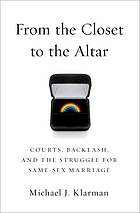
I have book review out in the most recent issue of NEHA News (Spring 2013, vol. 39), the bi-annual newsletter of the New England Historical Association. This time, the title is Michael J. Klarman’s From the Closet to the Altar: Courts, Backlash, and the Struggle for Same-Sex Marriage (New York: Oxford University Press, 2012). You can read the full review in the PDF version of the newsletter, but here’s a snippet to whet your appetite:

In his most recent work, legal historian Michael J. Klarman (Harvard Law School) turns his attention from the role of the courts in ending racial segregation (From Jim Crow to Civil Rights: Brown v. Board and the Civil Rights Movement) to the history of gay rights activism — specifically the legal struggle around same-sex marriage. Klarman explores how gay marriage emerged as a key marker for both pro- and anti-gay sentiment, and assesses “the costs and benefits of gay marriage litigation” as a path toward greater social justice. As a scholar of Constitutional history, Klarman is particularly keen to understand the role of judicial opinion and court action in changing public sentiment (and, conversely, the role of public sentiment
or action in changing judicial reasoning or decisions). 

You can read the whole thing thanks to NEHA’s willingness to make their newsletter available online for free!

booknotes: histories and cultures of sexuality

05 Tuesday Feb 2013

Posted by Anna Clutterbuck-Cook in book reviews

≈ Leave a comment

Tags

children, feminism, gender and sexuality, history, smut

As promised, here is my round-up of recently-read titles having to do with various aspects of human sexuality, politics and culture.

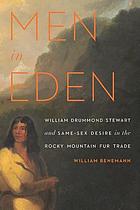
Men in Eden: William Drummond Stewart and Same-Sex Desire in the Rocky Mountain Fur Trade by William Benemann (University of Nebraska Press, 2012). Let’s begin with the book Hanna referred to as the book about “mountain men humping!” Benemann takes as his subject a 19th century Scottish aristocrat, William Drummond Stuart, and through Stuart’s colorful life explores the contours of same-sex desire on the borderlands of “civilized” society. Stewart, a younger son who later in life inherited the family title from his older brother, came of age during the Napoleonic wars and served in the 15th King’s Hussars where he rose to the rank of Captain. After retiring from the army, Stewart traveled widely in the Middle East and North America — and in North America found the homosociality of the American West particularly amenable. Throughout his life, Stewart’s most enduring relationships were with men, including one French-Cree trader who he traveled extensively with and even took with him back to Scotland after assuming responsibility for the family’s estate; the couple lived for a time in one of the secluded lodges on the land, where Stewart kept all the material evidence of his travels abroad. According to Benemann, previous treatments of Stewart have gone out of their way to ignore the evidence of same-sex relationships in the Scotsman’s life. Benemann’s work is a thoughtful and nuanced challenge to this previous “closeting” of Stewart’s sexual self, taking those same-sex relationships for granted as a meaningful part of Stewart’s experience. Anyone with an interest in nineteenth-century Anglo-American sexuality and gender should definitely add this one to their reading list.

Documenting Intimate Matters: Primary Sources for a History of Sexuality in America edited by Thomas A. Foster (University of Chicago Press, 2013). Published as a companion volume to John D’Emilio and Estelle Freedman’s seminal Intimate Matters (1988), this new primary source reader offers a thoughtful compilation of lightly annotated documents related to various aspects of sexuality in American culture from the colonial era to the present. A brief 225 pages, featuring selections from about seventy sources, this reader is best seen as a jumping-off point for further discussion and exploration rather than a source for full-text transcriptions. Each of the five chronologically-arranged sections are introduced with a brief preface on the sexual issues of the period in question, and each document likewise features a thoughtful introduction. While necessarily incomplete, given its length, Documenting Intimate Matters is admirably diverse in its socio-cultural and geographic scope as well as the genres of (textual) documents found therein. Some of my favorite include newspaper announcements from the 1780s-90s placed by men whose wives had deserted them to inform creditors the husbands would no longer take responsibility for their (ex?) wives debts; the angry diary entries of Frederick Ryman (1884)*, whose sentiments about women would not be out of place on anti-feminist blogs of today; and Susan Fitzmaurice’s 2002 reflections on the struggles of raising a child with Downs Syndrome in away that prepares them for a sexually active, sexually pleasurable, and sexually responsible adulthood. An excellent anthology for use in introductory classes.

*Full disclosure: Ryman’s diaries reside at the Massachusetts Historical Society.

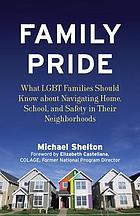
Family Pride: What LGBT Families Should Know about Navigating Home, School, and Safety in Their Neighborhood by Michael Shelton (Beacon Press, 2013). The latest addition to Beacon Press’s “queer ideas/queer actions” series, Shelton’s Family Pride is an accessible and nuanced snapshot of life in America for queer parents with children as we enter the 2010s. Centering the lived experiences of both LGBT parents and their children — through in-depth interviews Shelton conducted, as well as the growing body of relevant research literature — Shelton’s book should be on the bookshelf of every “family values” advocate (members of the Institute for American Values I’m looking at you!) as well as in the library of every queer activist and/or LGBT organization. While the title makes it sound like Family Pride is a handbook for queer families, in reality the volume is more of a status-quo assessment with some recommendations (from Shelton’s perspective as a therapist who has worked with queer families) for what queer families need in order to thrive. He does an excellent job of incorporating (I’d even argue prioritizing) the experiences of families who don’t often make “gay family” headlines: queer parents in straight marriages, parents who are in the closet, non-white families, families living with financial insecurity, families with uncertain immigration status, parents in prison or with a history of interaction with the law that makes calling the police for help an unthinkable solution to anti-gay speech or acts. My only quibble with Shelton’s framing is that he never explicitly defines an “LGBT family” as a unit made up of parents-plus-children in which at least one parent is queer — yet that is clearly his operational definition. I would have appreciated either a more explicit acknowledgement that this book focuses on parenting-while-gay OR an effort to include the voices of queer families that do not include children. We are, most assuredly, families too.

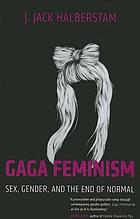
Gaga Feminism: Sex, Gender, and the End of Normal by J. Jack Halberstam (Beacon Press, 2012). While in Austin, I snagged a copy of yet another volume in the “queer actions/queer ideas” series — Halberstam’s meditation on the playful, anarchic queer feminism burbling up through the actions and expressions within youth culture. Taking pop culture references from Sponge Bob to Lady Gaga, Halberstam argues for the liberatory playfulness of more fluid sex and gender identities that — rather than requiring taxonomical fixity — provide a sandbox full of tools and opportunities for self-expression. I’m an easy sell on this score: while I am at times skeptical about the power of pop culture expression to effect political change, neither am I threatened by sex and gender anarchy. I am comfortable in my own gender (fairly conventional, by 21st century standards — though I’d likely have been a shockingly difficult daughter in many an earlier time and/or place) and sexuality (fluidly bisexual, married, monogamous). And I see no reason not to afford others the opportunity

Hard to Swallow: Hard Core Pornography on Screen edited by Claire Hines and Darren Kerr (Columbia University/Wallflower Press, 2012). This excellent anthology explores the pornographic genre of “hard core” films from a variety of perspectives: through the lens of history, film studies, sexual politics, and more. The majority of contributions focus on the United States and Britain (the editors are lecturers at Southampton Solent University, UK), and despite the negative connotations of “hard to swallow” virtually all of the authors take for granted that pornographic film as a genre deserves serious consideration. Pornography, it is assumed throughout, is simply explicit representation of human sexual activities; the messages of that representation can be positive or negative, depending upon execution and interpretation. My favorite pieces include: Linda Williams’  ‘”White Slavery,’ Or the Ethnography of ‘Sexworkers’: Women in Stag Films in the Kinsey Archive”; “The Progressive Potential of Behind the Green Door” by Darren Kerr; “Reel Intercourse: Doing Sex on Camera” by Clarissa Smith,” and “Interrogating Lesbian Pornography: Gender, Sexual Iconography, and Spectatoring,” by Rebecca Beirne. At their best, these essays go beyond commonplace assumptions about pornography as inherently degrading, as without cultural merit, as a male-only pursuit. Williams’ piece examines the subjectivity of women in early twentieth century stag films, wondering what light surviving films might shed on performers’ agency. Kerr, in “The Progressive Potential…” revisits a film that has been understood as misogynist and asks us to think, again, about the centrality of female sexual pleasure in the narrative. Clarissa Smith pushes back against the notion that performers in porn “just have sex on camera,” suggesting that engaging an audience in erotic fantasy is, in fact, a difficult role for which real skills are required (can we all say “duh?”). And finally, Beirne’s contribution explores the nuances of voyeurism, performance, and sexual subjectivity in the work of lesbian pornographers.

The entire anthology was absolutely worth reading, though I had quibbles with various assumptions along the way: one author, for example, claimed in passing that “the consumption of pornography … is an essentially private past time, indulged in as an accompaniment or prelude to masturbation.” Yes … but also, no. Reading/viewing erotica can happen in many contexts, only some of which are solitary, and doesn’t necessarily lead to masturbation for all consumers, every time. Likewise, the uncomplicated statement that pornography “began as a male-only pursuit,” even if the author acknowledges that “that male-ness has been diluted in recent years,” is to ignore the long history of female pornographers and women who have enjoyed erotic material. Women + sexual agency is not, contrary to popular opinion, a twenty-first century phenomenon.

I continue to be fascinated, too, by the assumption (apparently played out in the majority of pornographic film) that straight men don’t like to see male bodies centered in porn: from the descriptions of works and from the analysis of the authors it certainly sounds like in mainstream “hard core” (explicit) pornography, it’s women’s bodies on display for a presumed male audience. Granted I’m queer, so. But in general, what I find visually arousing is the depiction of people having sex. People having sex in ways I can then fantasize about enjoying like they’re enjoying it. Watching a woman orgasm on screen is hot (to me) because ohgodohgod I know what that feels like, and if I were in her situation I’d be coming too. So I’m curious what’s happening for men who watch porn in which the role of the male actor is basically a two-step process. Step one: Get it up. Step two: Ejaculate on screen. Like, isn’t that kinda disappointingly … thin on material that encourages imaginative projection of yourself into the scene? It’s just this thing I keep thinking about, as I’m reading these pieces that assume because women’s bodies are the bodies depicted, therefore the audience is supposed to imagine having sex with them (therefore be someone who likes having sex with women) rather than imagine being them (a person, male or female, experiencing sexual pleasure). How would we analyze pornography differently if we assumed the viewer’s involvement with those on-screen was a process of empathetic identification rather than (positive or negative) objectification?

Lots to think about … and I’m footnote mining Hard to Swallow for oft-cited authors and works so I’ve already got several other books on pornography on order at the library and look forward to reviewing them here!

booknotes: urban histories

29 Tuesday Jan 2013

Posted by Anna Clutterbuck-Cook in book reviews

≈ Leave a comment

Tags

boston, history

Looking at my reading selections for the past couple of months, I can sort them into two basic piles: books having to do with gender/sexuality/feminism (what else is new?) and books on urban history. The urban history kick is a relatively new thing for me, prompted by a) an ongoing side research project that requires background knowledge about Boston circa the 1910s, b) the aggressive gentrification of our neighborhood — fingers crossed we’re not priced out! — and c) happening upon a cultural history of “main street” on the new books wall at our local public library (see below). I’m going to do a collective review of the gender/sexuality/feminism books next week — once I finish my advance review copy of this promising anthology on hard core porn — but first, here are my thoughts on a few urban history titles.

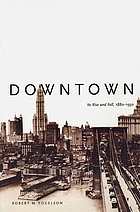
Fogelson, Robert. Downtown: Its Rise and Fall, 1880-1950 (Yale U. P., 2001) and Bourgeois Nightmares: Suburbia, 1870-1930 (Yale U.P., 2005). More or less by accident — Downtown was what our local library had on the shelf! — I stumbled upon preeminent historian of urban America Robert Fogelson’s work when I went in search of Boston and Brookline histories back in December. In Downtown Fogelson explores the development of the central business district in American cities — thanks to the layout of New York City colloquially known as “downtown” regardless of geographic orientation — and traces its fate through the first half of the twentieth century as it moved from the business district to the central business district to simply one of many business districts. He touches on a number of key cities, although New York, Boston, Chicago, and Los Angeles are recurring examples. I particularly enjoyed the attention to the perennial question of public transit and the changes wrought by the rise of the automobile. Fogelson pays particular attention to the interplay between city planners and businessmen (the urban elite) and the populace at large — the way in which those with power seek to create and control a certain type of urban environment on the one hand, while unanticipated and often anarchic-feeling forces bring changes economic and cultural to the urban landscape.

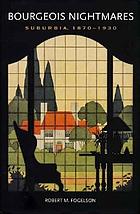
It’s the desire for stasis that is, in fact, at the heart of the second Fogelson book I read: Bourgeois Nightmares. The title, a play on Robert Fishman’s Bourgeois Utopias (1987), explores the dark side of America’s suburban sprawl between 1870-1930. Fogelson begins his narrative by suggesting that the central desire which drove the American upper-, upper-middle- and middle-classes to suburban subdivisions around the turn of the twentieth century was the desire for stability. In order to sell land in these new neighborhoods, subdividers had to sell the promise of that stability — the promise that one’s land would never fall in value, that one’s neighborhood would remain pleasant, that one’s neighbors would always be desirable. The mechanism by which they enforced stability was through the creation of restrictive covenants: contractual limitations on how landowners could use and dispose of the land which they purchased. Most notoriously, restrictions were used to exclude non-white (and sometimes non-Christian and even non-Protestant) residents from the suburban development. They were also used to police the aesthetics of place: fences, landscaping, architectural design, the domestic animals one could own, the signs one could put up, and the business one could do from one’s property. Fogelson convincingly argues that restrictive covenants were a successful marketing tool despite the limitations they placed on property rights because they reassured the “bourgeois” classes that they were protected not only from outsider undesirables but also from the potentially-appalling behavior of their peer neighbors.

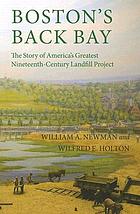
Holton, Wilfred and William A. Newman. Boston’s Back Bay: The Story of America’s Greatest Nineteenth-Century Landfill Project (Northeastern U.P., 2006). The Massachusetts Historical Society moved into the back bay in the 1890s, as the back bay landfill project was nearing its close. The land on which the MHS stands, at the corner of Boylston Street and The Fenway, teeters on the edge of landfill and what used to be known as Gravelly Point. Originally, the Back Bay served as both a source of hydro power and also Boston’s sewer — where the citizens of Boston sent their waste in hopes that the tide would wash it out to sea (a hit-or-miss proposition, particularly after the bay was sectioned by dams and railway bridges in the early 1800s. Between the 1820s and the 1890s the Commonwealth of Massachsuetts undertook the massive land-creation project of filling in the bay and what seems like the daunting task of selling the recently-noxious area as a posh neighborhood of expensive townhouses and cultural institutions. Holton and Newman are primarily interested in the engineering innovations that made filling in the Back Bay tidal flat possible and the construction of buildings feasible. Honestly, there’s only so much detail about railway lines, gravel pits, and building foundations I can sustain interest for, although descriptions of the changing landscape and the generous inclusion of maps to chart the progress of land-creation were both welcome. I would have appreciated more cultural and social history. Given the Back Bay’s numerous drawbacks as land for residential construction — including a high water table that caused sewers to back up twice daily and fill basements with toxic and foul-smelling substances! — the successful selling of the neighborhood as a desirable location for the Boston elites is a story that begs to be told in more depth. Still, I do feel I now have a better grasp on the whys and hows of the Back Bay landfill project. Now on to Nancy Seashole’s Gaining Ground: A History of Landmaking in Boston (MIT Press, 2003).

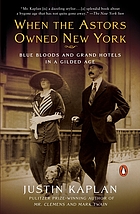
Kaplan, Justin. When the Astors Owned New York: Blue Bloods and Grand Hotels in the Gilded Age (Viking, 2006). One feature of American downtown life in the Gilded Age was the luxury hotel. Using the real estate giants William Waldorf Astor and his cousin John Jacob Astor as his biographical through-line, Justin Kaplan offers a lively tour of the rise of the modern-day hotel during the late nineteenth-century. What I found most fascinating about the book — apart from the salacious details of intra-familial rivalry — was the cultural history of a type of institution (the luxury hotel) that today we take more or less for granted as an essential feature in any city. Yet the first establishment that approximated what we think of as a hotel, The Tremont here in Boston, opened in 1829. It was the first lodging-house to become a destination per se rather than just a place for businessmen and travelers to find a bed and a meal in transit from one location to the next. Its indoor bathrooms, particularly, became so popular that upperclass families in the nearby Beacon Hill neighborhood sometimes made there way to the hotel for their weekly bath. The Astor family built on these innovations with alacrity and by the end of the 1800s their hotels in New York City were the subject of songs, the hub of high society, where people went to see and be seen. While Kaplan’s narrative is short on footnotes, it is grounded in the historical record and is not overly ambitious in its claims. An entertaining and informative read.

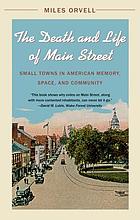
Orvell, Miles. The Death and Life of Main Street: Small Towns in American Memory, Space and Community (University of North Carolina Press, 2012). Orvell’s work is a cultural history of “main street” in America — both how it actually functioned in the social and economic landscape and also what it signified in the American mind. Examining literary and cinematic portrayals as well as the politics of creating, destroying, and rehabilitating “main street” as a social space throughout the 19th and 20th centuries, Orvell points to the ongoing tension in the American cultural landscape between “main street” as a site for wholesome enjoyment and small-town safety and main street as a site for small-mindedness and community policing. The idyllic nature of small-town / “main street” America, in other words, very often depends on the erasure of people whose presence is disruptive to “niceness”: educated women with uppity notions about gender equality, labor organizers, and — over and over again — those whose skin color, ethnicity, and religion fail to conform with a WASP-y vision of true American-ness. From 19th-century paeons to the “vanishing” New England village square to late-20th century Disney-sponsored planned communities, The Death and Life of Main Street offers a highly readable, well-researched window into one particular facet of the (real and mythical) American landscape.

Next on the urban history reading list is Stephen Puleo’s A City So Grand: The Rise of an American Metropolis, Boston 1850-1900 (Beacon Press, 2010). I’ll be sure to let you know how it goes! But next week we’ll be taking a turn to a mix of books both historical and cultural that touch on human sexuality and the politics thereof.

movienotes: les miserables

22 Tuesday Jan 2013

Posted by Anna Clutterbuck-Cook in media

≈ 2 Comments

Tags

fanfic, feminism, history, movies, politics

I have some book reviews I need to write for books I’ve read this month, and a third “why I write fic” post in the queue, but I just got back from a weekend with my sister in the beautiful Austin, Texas, and my brain can’t seem to form coherent-yet-complex thoughts. So instead, I’m going to offer up a few observations about the film version of Les Miserables that I saw in the theater the weekend before last.

Javert (Crowe) and Valjean (Jackman)

I saw the musical once before, live, when I was in London in January of 2004. My principle memories at the time involve enjoying the music (I’m a life-long musical theatre fan, so a good musical will always win me over in the end), being distracted by the book I’d picked up that day and brought with me to read during intermission (The Time-Traveler’s Wife), and my surprise at the fact that the emotional-relational through-line for the story is not the second act marriage-plot between Marius and Cosette but the connection forged between Jean Valjean and Inspector Javert. It is their dance of power, desperation, obsession, compassion, forgiveness, and despair that drive the plot from start to finish. Hugo’s novel is that 19th century classic the Social Problems Novel and, and is — I’m sure I am far from the first to remark upon this! — a queer choice for musical theatre.

Fantine (Hathaway) selling her hair.

A few thoughts in no particular order:

  • Women, work and society. The film version of Les Mis had some really interesting (largely visual) observations to make about women and work. There’s Fantine, Anne Hathaway’s character, who is working in a factory to pay for her daughter’s care. Rumored to be a slut, and punished by the foreman for being a single mother, she’s cast onto the streets and sells her hair, teeth, and sex before succumbing to consumption. Her daughter, Cosette, has been boarded out as a laborer herself, working for a couple running an inn (the buffoonish and cruel Thenardiers). While Cosette is rescued by Valjean and ascends to the middle class through marriage (one could argue a certain kind of “wage work” in its own right, certainly an economic decision), her age-mate Eponine Thenardier — abused by her parents and pining after Cosette’s lover — cross-dresses as a boy to join the revolution and ultimately dies on the barricade. On the periphery of the story drift prostitutes, beggars, and female religious who serve as nurses and also offer refuge for Jean Valjean at various points throughout the story. When the student revolutionaries are shot by French soldiers, the uprising put down, it is women who are left to scrub down the blood-filled streets. Overall, Les Mis hammers home in multiple ways the limited options for the vast majority of women in 19th century France. True, there were limited options for most people living in France at that time — but this film adaptation does a good job of highlighting the way women’s sex/gender limited them in particular ways.
  • Futility of revolutionary action? Throughout, the film/musical has a deeply ambivalent relationship to the politics of its student revolutionaries. Marius’s boyfriend Enjolras is a charismatic and idealistic young Parisian student who, with a group of peers, orchestrates a violent rebellion (based on a real historical incident) that ultimately fails and leaves everyone — save Marius, rescued by Jean Valjean for his adopted daughter’s sake — dead. In Hugo’s world, the violence of the state (personified by Javert; more below) is responsible for the wretchedness of virtually every character in the story, but political action is depicted as ultimately futile and deadly. Yet the film ends with a triumphant reprise of the rebels call to arms, with Fantine, Valjean, and all of the dead students waving tricolor flags high above the Parisian skyline. Have they … won? And if so, how? Is the film meant to suggest revolutionary action is ever-needed? If the next generation (Marius and Cosette) have retreated into bourgeois respectability — Marius’ father welcomes them in with open arms and throws a lavish party for their wedding — should this be considered a win? For whom? I have read some reviews that suggest Hugo’s narrative points toward interpersonal love triumphing over political action (again, more below) but if that is the thrust of the plot it is an unsatisfying one: many people, even many “deserving” poor, die or are left in desperate poverty despite benevolence (and occasionally actual care) extended to them by others. If I had to guess, I’d hazard that Hugo might imagine that all attempts to improve the human condition on a large scale are doomed to failure, and that one-to-one interactions are our only — and ultimately futile — recourse.
  • Letting go of the next generation. As I wrote above, my first impressions of Les Mis is that it is a story about parents and letting go. Fantine, first, must let go of Cosette in order to provide for her (by going to work and leaving her with the innkeepers), and then ultimately must let her go when she dies and entrusts her to Valjean, a man she barely knows. She cannot know what her daughter’s future holds — for good or ill — and yet must depart. And then in the second act Valjean must let go of Cosette when she falls in love with Marius. While at first this loss is painful to him, and he tries to leave  the country with Cosette in tow, when he intercepts a letter from Marius to Cosette he regrets his actions and rescues Marius from the barricades. After the two children are engaged to be married, Valjean — his duty to his daughter complete, now she is in another man’s care — he departs to a monastery to die. We also have, of course, all of the children who die: Eponine and the students, including a young street urchin named Gavroche who is the first casualty of the day. The adults may believe these young peoples’ actions are foolish and futile, dangerous even, but the young people ultimately must forge their own paths.
  • The central romance in the story is between Valjean and Javert. So, okay, you don’t have to read their relationship as one long exercise in Unresolved Sexual Tension – but I certainly found it much more satisfying than the Marius/Cosette situation, let me tell you. Inspector Javert spends decades in pursuit of Valjean, obsessed with the man and fascinated/repulsed by the notion that the “criminal” Valjean (imprisoned for stealing a loaf of bread) could ever be anything other than a criminal. Valjean, whose religious conversion shortly after he is paroled helps him rebuild his life, tries to model a more nuanced morality for Javert (while, you know, evading re-arrest!) — and in the penultimate scene he succeeds. Given the opportunity to kill or capture Valjean, whom he has tracked into the Parisian sewers, Javert lets Valjean go. And is so shattered by his decision to let the rule of law go in the interest of human compassion that he commits suicide.
  • Oh, and the acting. I was really impressed with everyone in this cast, all of whom seemed to really be throwing themselves into their work both musically and acting-wise. At times, Hugh Jackman and Russell Crowe really seemed to be struggling with the score which surprised me — since I know Jackman, at least, is a strong singer. But I think that might have been a function of recording the songs live on-set rather than in a recording studio before or after the shoot. And Helena Bonham Carter and Sacha Baron Cohen as the odious Thenardiers were delightfully campy, offering some of the only comic relief around — and even then, theirs is a story that has a pretty tragic side if you linger more than a moment or two). 
And that’s all I got, folks. If you’re musical theater fans or fans of the Victorian “social problem” novel, I’d highly recommend seeing the film — preferably in the theatre since it truly is a spectacle of a movie musical. I know some people were really frustrated by the filming — the tendency to frame actors in the corner of the screen, or incompletely, but I actually like that technique for the way it makes you notice the composition of the shot, makes you realize a visual image is being constructed for you, rather than allowing you to feel you’re simply immersed in the action. Artifice, in this instance I would argue, works well with the musical genre.

booknotes: what is marriage for?

08 Tuesday Jan 2013

Posted by Anna Clutterbuck-Cook in book reviews

≈ Leave a comment

Tags

gender and sexuality, history, politics, sociology

Last week, I reviewed Public Vows which explored the history of American custom and law surrounding marriage. This week, I have some reflections on journalist E. J. Graff’s book on roughly the same subject: What is Marriage For?: The Strange Social History of Our Most Intimate Institution (Beacon Press, 1999).

While Cott is an academic historian, Graff is a journalist — and the differences in these two books reflects that to a great extent. This is not to say one is better than the other: Nancy Cott’s work is a carefully-delineated study of American marriage from the Revolution to the late twentieth century while Graff’s is a more wide-ranging exploration of what marriage has been and meant in the West over the past two millennia. Both work in their own ways to point out that the present-day arguments about the demise of “marriage culture” and/or the end of civilization as we know it because of [insert marriage change of your choice] is actually nothing new. Reactionaries have been raising a hue and cry in every era about the passing of one concept of marriage in favor of another, and our current notion of what “traditional” marriage looks like (what Cott referred to as Christian monogamy grounded in affection and entered by mutual consent) is actually a fairly new — Graff would even say radical — departure from the marriage norms of our forebears.

While for Cott the question of same-sex marriage is almost a coda to the main body of her argument — which centers around non-white peoples’ and women’s citizenship rights and how they interact with marriage law — same-sex relationships are the raison d’etre of Graff’s work. After marrying her partner, Madeline, in 1992, Graff began to explore the slippery history of “marriage” and its meaning, with the goal of answering the question of whether same-sex couples can or do reasonably occupy the same space as other-sex couples in the present-day landscape of marriage beliefs, law, and practice. It will perhaps come as no surprise that Graff’s answer is, again and again, that yes same-sex couples fit quite abley into our current notion of what a marriage is and does:

There remains an uneasy tension between, on the one hand, marriage as a way to resist consumer capitalism’s pressure on the individual soul — and, on the other, to fulfill consumer capitalism’s ideology of individual love and commitment. But [today’s reactionaries] wrongly choose those who love among the same sex as their scapegoats. The move toward same-sex marriage is the consequence, not the cause, of many other changes in Western life — changes like legalized contraception, already inscribed in Western laws. A pluralistic democracy cannot fairly bar as pariahs people who fully fit its ideology of the meaning of sex within marriage (87). 

There were a few details in analysis upon which Graff and I disagree, such as her argument that the logic that allows for same-sex relationships (modern notions of love and personal choice) does not allow for polygyny, since the reasons for polygyny have traditionally been about political alliances and patriarchal kinship consolidation. While true insofar as it goes, her conclusion that therefore same-sex relationship recognition is in NO WAY related to recognition of more-than-two marriage models seems to ignore the way in which modern polyamory also draws on notions of love and personal choice. But that’s overall a small quibble with what is an entertaining and well-researched exploration into the slippery meaning of something we think we all “know” when we see (or enter into) it.

← Older posts
Newer posts →
"the past is a wild party; check your preconceptions at the door." ~ Emma Donoghue

Recent Posts

  • medical update 11.11.22
  • medical update 6.4.22
  • medical update 1.16.2022
  • medical update 10.13.2021
  • medical update 8.17.2021

Archives

Categories

Creative Commons License

This work by Anna J. Clutterbuck-Cook is licensed under a Creative Commons Attribution 3.0 Unported License

Meta

  • Create account
  • Log in
  • Entries feed
  • Comments feed
  • WordPress.com

Blog at WordPress.com.

  • Subscribe Subscribed
    • the feminist librarian
    • Join 37 other subscribers
    • Already have a WordPress.com account? Log in now.
    • the feminist librarian
    • Subscribe Subscribed
    • Sign up
    • Log in
    • Report this content
    • View site in Reader
    • Manage subscriptions
    • Collapse this bar