• anna j. clutterbuck-cook
  • contact
  • curriculum vitae
  • find me elsewhere
  • marilyn ross memorial book prize

the feminist librarian

the feminist librarian

Tag Archives: human rights

multimedia monday: "doesn’t this mean we join the league of ordinary nations?"

13 Monday Dec 2010

Posted by Anna Clutterbuck-Cook in media

≈ Leave a comment

Tags

human rights, politics, web video

Yesterday, as post-semester reading, I picked up Mark Kurlansky’s brief little monograph Nonviolence: Twenty-Five Lessons from the History of a Dangerous Idea (yes, I know, I’m a political nerd … what can I say?). I’ve had the book lying around since 2008 but what with one thing and another never got around to reading much passed the introduction, which was written by the His Holiness the Dalai Lama.

A booknote is forthcoming tomorrow on Nonviolence itself, but for now — as a sort of audio-visual introduction to the topic — I wanted to share two clips from my Favorite Television Show of All Time, The West Wing, episode 3.23, “Posse Comitatus.” Because as I was reading Nonviolence — particularly the portions describing the way in which violence consolidates and corrupts nation-states — this episode was what I kept thinking of as a pitch-perfect illustration of that corruption in action.

For those of you who don’t know the series, “Posse Comitatus” is the final episode in Season 3, and one in which the President Jed Bartlet (played by Martin Sheen) makes a decision to use his power as the U.S. President to do something illegal on an international scale: assassinate (and cover up the assassination) a defense minister/war criminal from a fictional Middle Eastern nation called Qumar. In the scene below, Bartlet has waited until the final possible moment to make the decision. His hawkish Chief of Staff, Leo McGarry (played by John Spencer), wants him to authorize the assassination, arguing that the defense minister will never come to trial and if he is not killed now, he will only cause more suffering. Bartlet is reluctant, arguing that if they resort to covert violence, “doesn’t this mean we join the league of ordinary nations?”

Note: This clip is actually much longer than that conversation, which begins about 4:15 in. If you want to relive the trauma of watching Mark Harmon be gunned down and C. J. get pulled out of the theater in order to be given the news, then by all means watch from the beginning. It’s a beautiful piece of television.

So let that set the stage for tomorrow’s review of Nonviolence: Twenty-Five Lessons from the History of a Dangerous Idea.

booknotes: red families v. blue families

11 Saturday Dec 2010

Posted by Anna Clutterbuck-Cook in book reviews

≈ Leave a comment

Tags

children, feminism, human rights, work-life balance

I read two books this past week on the intersection of family law, the conservative/liberal political divide, and quality of life in this country. One was the recently-released Red Families v. Blue Families: Legal Polarization and the Creation of Culture, co-authored by Naomi Cahn and June Carbone (New York: Oxford University Press, 2010).  The other was a slightly older, but no less relevent, book by Nancy D. Polikoff, Beyond (Straight and Gay) Marriage: Valuing All Families Under the Law (Boston: Beacon Press, 2008). Reading them in quick succession, I naturally saw connections between the two arguments as well as the relative strengths and weaknesses of each. I initially thought I’d do a joint review, but found I had too much to say (cough cough) … so here is part one, with a follow-up scheduled for next Wednesday.

For part two (Politkoff) click here.

Politkoff, Cahn and Carbone all begin with the same basic premise. That is the demographic fact that, over the past fifty years or so, the way Americans interdependent relationships has changed dramatically. The reasons for this can be attributed to a variety of socioeconomic and cultural factors, but no matter the reasons why it is happening, the end result is that the system of laws and public policies that in the past served to support those relationships are no longer effectively doing the job they were meant to do. 

Both books also come to an essentially liberal-moderate conclusion, with Polikoff trending in a slightly more liberal-radical direction and Cahn/Carbone attempting some sort of “middle” ground. Possibly because I am at heart a radical in my thinking (read: I’m most satisfied with solutions that get at the root of inequality, rather than attempt cosmetic changes to a broken system; I’m skeptical of compromise with folks who refuse to recognize a common humanity), I found Polikoff’s proposals much more compelling than those made by Cahn/Carbone, although I do think both books are worth reading — or at least skimming! — if you are involved on any level with activism or scholarship around the place of family and human relationships under the law.

I’ll begin with Red Families v. Blue Families. Authors Cahn and Carbone, both legal scholars, attempt to describe the reoganization of families structures in terms of the “red state” and “blue state” divide. That is, they connect conservative (red) political values with one set of beliefs and practices related to family formation and liberal (blue) political values with another set of beliefs and practices.  Using demographic statistics (such as number of births to teenage and unwed mothers, divorce rates, contraceptive use and abortion rates), they attempt to make connections between the types of family practices in conservative areas vs. liberal areas and the beliefs held in those areas concerning public policy and family law (i.e. divorce and custody law, access to birth control and abortion, marriage incentives and marriage equality).

The strength of this book is in the way Cahn and Carbone describe the socioeconomic pressures that have effected the rapid change in family-formation patterns. To oversimplify dramatically, the shift from an industrial economy to a social services and knowledge economy has increased the need for human capital (higher education, training, etc.) which the “blue” families have adapted to by delaying marriage and, in particular, child-bearing and rearing until after advanced education and establishing their careers. They “combine public tolerance with private discipline” when it comes to sexual activities, pushing (for example) to destigmatize sexually-active teenagers while ensuring access to contraception and counseling their own children to delay sexual activity. Meanwhile,  “red” families are materially challenged by the changing economy just as their blue counterparts. However, they have responded in moral rather than practical terms, redoubling their efforts to tie sexuality to marriage. This, the authors argue, often leaves them at an educational economic disadvantage (unless the wage-worker husband is in a high enough income bracket to support his family, a situation which is possible for fewer and fewer families nation-wide).

Red Families is at its strongest when showing the disconnect between conservative policy positions concerning issues like marriage, contraception and abortion and the damaging real-life effect of such policies when put into practice. In the chapters on abortion and contraception, for example, the authors show how conservative family policies usually work to disadvantage the economically marginal (teenagers, the poor, non-white families) by making the tools to manage their sexual health and childbearing unaffordable or otherwise inaccessible.  This is nothing new to those of us who follow the work of reproductive justice activists and feminist activists, but nevertheless I’m heartened to see it articulated in the context of a book on public policy. Likewise, the final chapter on “retooling the foundation” of our post-industrial economy to recognize the fact that workers are also family members is a useful starting point for thinking about how we might implement new (public and private) policies to support both types of families as they seek to integrate work and relationship obligations.

Yet ultimately, I found Cahn and Carbone’s argument about the geographic breakdown of family patterns overly simplistic and their solutions problematic.  Here are a few reasons:

1) As someone who grew up in a “red” area of the country (Michigan as a state swings Democrat in national elections, but the West Michigan county where I lived, and many of those around it, swing consistently Republican) I am troubled by the assertion that Americans are organizing themselves geographically along political lines, and that because of this a federated, localized approach to family policy is acceptable. Family law issues often intersect with human and civil rights issues, for example women’s access to reproductive health care and the right of queer couples to the same marriage rights as straight couples. These are basic citizenship rights not rights that should be determined by local norms. Beyond that basic philosophical issue, there are three practical issues with a localized approach:

  • When the approach is local, the most vulnerable will continue to suffer. Why? Because the economically and socially marginal are the least mobile citizens: the poor, the young, those without supportive family and friendship networks. In short, the folks who are already unable to access the resources available under the current system to establish economically secure families. They are the ones who won’t be able to relocate to a more queer-friendly region, won’t be able to cross state lines to secure an abortion or contraception, and will be the least likely to challenge discriminatory practices through the courts or political system.
  • Cahn and Cohen overemphasize regional homogeneity. If basic rights around family formation and support are determined locally, what happens to those who are in the political and social minority in any given region? To be sure, there are “blue” families in even the most crimson areas in this country. Not all of them can, want (or should have to) relocate to more colbolt areas in order to live the family lives of their choosing. This is the de facto situation for many of us now and it is not satisfactory.
  • This is an increasingly mobile population. Our economy increasingly depends on mobility, not to mention that our culture encourages travel and relocation over the course of our lives. If the rules governing family life become more regionalized over time, then the issues already faced by same-sex couples will extend to more and more families: what happens when certain relationships are recognized in one region and then a family moves (say due to a professional or educational opportunity) to a region where their family is no longer recognized or supported?

2) Cahn and Carbone fail to question the assumption that marriage between two adults as the basis for family formation is an ideal that should be encouraged. They see this as a point of common ground between “red” and “blue” families, an premise that I believe to be unhelpful in terms of constructing useful solutions that better the lives of all people, regardless of their desire to enter into marriage relationships as a gateway to family formation. (For more on this idea, see part two of this review.)

3) Following from this preference for marriage, Cahn and Carbone decidedly do not believe that all avenues toward family formation, or types of families formed, are equal. While willing to extend the practice of marriage to adult pairs, regardless of sex or gender, they ignore the needs of many families that do not fit this slightly-tweaked version of the old two-parents-plus-children family ideal. For example

  • Young parents. Following from their preference for “blue family” strategies, Cahn and Carbone are critical of those who choose to marry and have children at young ages. They see nothing wrong with discouraging teenagers and young adults from marrying and forming families. In support of this argument, they cite the statistical likelihood that such “young” marriages will fail and that children born within those families (or to young mothers) are more likely to be economically and educationally disadvantaged.  Alternatively, they could argue for greater social and cultural support for young people who choose to form families and bear children. The fact that they disparage those who do so is ageism and really set my teeth on edge.
  • Non-dyadic family units. Um, where are the poly relationships? The family groups not formed around sexual relationships and/or childrearing? I was really frustrated by the way Cahn and Carbone failed to address the needs of families that don’t fit into this model. I realize that these families are a political hot potato when it comes to seeking compromise across the political divide — poly relationships are routinely marginalized in arguments for gay marriage (how often have you heard “two consenting adults” as a catchphrase?) because, I assume, the left wants to dissassociate from discussions of polygamy. But this is not a valid excuse when we’re talking about the need to recognize the social value of all committed, consensual, mutually-sustaining relationships.
  • Following on from this last point, family formation =/= childrearing.  Belonging, as I do, to a family that will likely not include children, I was particularly aware of the way in which Cahn and Carbone repeatedly used phrases like “family formation” and “starting a family” to mean “having a baby” (either through adoption or birth).  This is an erasure of any family of two or more people that does not include, either by accident or design, providing for children. It’s terminology that’s simple to fix and the fact that the authors chose not to, or didn’t realize the implications of their wording, bothered me.

So what’s the work-around for these problems? Stay tuned for the next installment, where I’ll discuss the far more satisfactory Beyond (Straight and Gay) Marriage, in which author Nancy Polikoff descibes how our legal system could retool family law to accommodate the full range of interdependent relationships we form, decoupling marriage (which would remain a religious and cultural marker of commitment) from legal and economic rights.

"negotiation and compromise": reflections on my childhood outside of school

08 Wednesday Dec 2010

Posted by Anna Clutterbuck-Cook in life writing

≈ 5 Comments

Tags

children, domesticity, education, family, human rights, work-life balance

It seems fitting, in this last week of formal coursework in pursuit of my Master’s in Library Science, that I take some time out to reflect on a very different experience: that of growing up for the first seventeen years of my life outside of formal institutions of schooling. Those of you who follow my blog probably know that cultures of schooling, education, and learning are a topic of scholarly and personal concern to me. As I wrote on Saturday, Idzie @ I’m Unschooled. Yes I Can Write is running a series of interviews with grown unschoolers about their experience learning outside of school. I took some time out from wrapping up my coursework last week (read: spent time procrastinating like it was going out of style!) to respond to her questions. And yesterday Idzie published my responses.



Glen Nevis, West Highlands, Scotland (May 2004)

Since I thought many of my readers would be interested in my responses, I’m cross-posting what I wrote here. But if you enjoy what you read, do check out Idzie’s blog since she publishes lots of awesome stuff — and promises an ongoing series of similar interviews.

The Basics

When did you become an unschooler?
birth (1981) and/or first year I was school age (1987)

How long have you/did you unschool?
Difficult question! I still think of myself as practicing the values of unschooling, even though I have had interactions with formal education and its institutions. I did not attend grade or secondary school at all (though my siblings did to varying degrees). I began taking courses at the college where my father worked when I was seventeen and continued there part time through 2005; until 2002 I was not a degree-seeking student, though I did take the courses for credit. During the seven years I pursued undergraduate coursework, I did lots of other things too, like work and travel. Since completing my B.A. I’ve moved on to graduate school (more below). However, I still feel very much an unschooler at heart.

How old are you now?
29, nearly 30.

The Decision to Unschool

If your parents chose unschooling, do you know how/why they made that decision?
My mother was, I think, the initiator of home-based education, since she was the primary at-home parent and also very interested in child development and early childhood education. She always preferred non-interventionist approaches, and when it came time to think about schooling for us kids she felt we were doing really well in our current environment — and that the schooling opportunities in our area were too conventional for our family’s needs. My father was completely on board with it, even though he usually took a back seat with the home-life arranging, given he was the parent with a full-time job.

My parents are not categorically opposed to working with formal institutions of learning. My father works at Hope College (where I eventually attended classes) and my siblings both expressed a desire to do some measure of formal schooling during their teen years. My brother attended some courses at the local public school, although he never enrolled as a degree-seeking student, and my sister went full-time to public high school. But the focus throughout was what worked best for our family as a whole and for each of us kids individually.

The Best and Worst

What do you think the best thing about unschooling is?
Speaking from the point of view of a unschooled child (rather than an unschooling parent), I would say that the experience of unschooling helped me to remain confident in myself: confident that I had the ability to learn new ideas and skills when I need them, confident I could find meaningful ways to occupy myself without a strict schedule, confident that I could navigate the world and find help when I needed it from people with particular expertise, or whom I had caring relationships with.

The worldview of unschoolers draws (in my opinion) on a specific understanding of human nature that is at odds with the beliefs of the dominant culture. In order to really practice unschooling, you have to trust in the human being to be interested in the world, to seek situations (physical, social, intellectual) in which that being will thrive in community with other beings. You have to trust that the being themselves — not external authorities — are the best source of information about what the being needs to thrive. Not to say that external feedback and expertise isn’t helpful — it’s often crucial. But at the end of the day, the individual themselves is the best authority on, well, themselves. And on what they need to feel nourished.

In society as a whole, children aren’t trusted to have that kind of knowledge about themselves. In part because children do often think and communicate in different ways than adults, given their stage of development, so children’s self-knowledge is often difficult for adults to access. But it’s there if we know how and where to look! And unschooling teaches us to cultivate that awareness in ourselves and others.

What do you think the worst (or most difficult) thing about unschooling is?
The most stressful thing about practicing unschooling in our culture is that it really is fundamentally counter-cultural. It challenges many of the hidden assumptions of our society about human nature, the nature of children, the purpose of education, the meaning of the “good life,” and so forth. I, personally, think people who unschool are on a much healthier track (by and large) than people who do not, because of their values and their orientation toward the world and the rest of humanity. But there’s definitely a cultural dissonance between the life we wish to lead as unschoolers, and the world in which we have to carve a space for ourselves beyond our families. It requires constant negotiation and compromise.

Beyond High School

Did you decide to go/are you going to college or university? If so, could you talk a bit about that experience?
I did go to college, both undergraduate and (currently) a graduate program. It’s always difficult to talk “a bit” about the experience, since my interest as an historian in counter-cultural education means I spent a lot of my waking moments thinking about the culture of institutional schooling, of teaching and learning, and about how “education” is framed in our contemporary cultural debates.

Casting my mind back to age seventeen, when I enrolled in my first college course — a first-year writing course — I remember how thrilling it was to be engaged in writing and thinking about ideas. At that point I wanted to be a creative writer and developed an enormous crush on my professor, a poet and photographer who had that rare ability to read one’s writing and discern what you meant to say, even if your early drafts were hopelessly muddled. At the same time, I felt like a foreign exchange student, struggling to assimilate to the academic culture that was invisible to most of my classmates. I cold be exhausting and isolating. The fact I was a politically and culturally progressive-radical student on a campus dominated by politically and culturally conservative students didn’t help to bridge the gap between me and conventionally-schooled peers. Nor did the fact I was a part-time, commuter student on a campus dominated by full-time, resident students.

I did not struggle with the coursework much at all. In the early years, I took courses that interested me without a thought toward graduation. Later on, when I was fulfilling requirements, I did take classes that were in subjects not of my instinctive interest (I wept through a one-month class in statistics, for example) … but by conventional measures (i.e., grades) I succeeded in conventional education despite my lack of formal training up to that point. And undergraduate college unquestionably opened doors for me — intellectually, socially, geographically — that might have been more difficult to open otherwise. I had access to off-campus programs and study abroad opportunities; I had faculty-student research opportunities and professors who I connected with and library resources, etc. The same can be said, to some extent, for my graduate work. The classes themselves have often been frustrating, inefficient, etc. But given the organization of our culture’s learning resources at institutions of education, it’s difficult to piece together a similar experience without being an enrolled student.

Difficult, but not impossible.

I never completely made peace with the structured nature of academic semesters, graded projects, competitive learning, being judged by external rather than internal expectations. It stressed me out on a pretty deep level; makes me feel like I’m complicit in a system that rewards some at the expense of the rest. which is something I have problems with, even if (especially if??) I’m one of those who gets rewarded. It’s complicated. I’m definitely looking forward to being done with formal academics for a while after I complete my current program (a dual-degree in library science and history).

Money Earning and Work

Are you currently earning money in any way?
Yes.

What jobs/ways of earning money do you, and have you, had?
Oh, gosh. I’ve been earning money since I was about nine. I started working seasonally for my father at the college bookstore he manages for pocket money and stayed there on and off throughout college. I also worked at a local children’s bookstore and a branch of Barnes & Noble. I did childcare as a teenager and worked one year as a nanny. I’ve served as teaching and research assistants for a number of college faculty. I spent a semester working as an office assistant for a study abroad program. I’ve also done a number of work-for-food-and-lodging type situations, sometimes in combination with other paid work and sometimes for short stints alone … like the month I spent at a women’s land trust in Missouri the summer after graduating from college.

When I moved to Boston, I was hired as a library assistant at the Massachusetts Historical Society, an independent research library in Boston that holds rare books and manuscript materials. It’s a wonderful way of being connected to a scholarly community without being tied to a college or university setting. For the past three years, I’ve worked there part time along with other part-time employment (in the field) and internships. I was just recently offered a promotion to full-time with enough wages and benefits to support remaining in Boston for the next few years, as my partner and I would like to do. It pays modestly well, and is definitely the type of work I was hoping to find when I began graduate school in library science.

Have you found work that’s fulfilling and enjoyable?
I won’t pretend that my partner and I don’t struggle with the question of balancing the need to earn wages to support ourselves in the short and long term. My partner, who also learned outside of school for much of her life (until going to public high school) resists, as do I, a culture that equates paid employment with identity and fulfillment. On the one hand, I do believe in seeking out ways to earn a living doing what you love … but I also resist creating a situation in which my life is defined by the work I do, or dictated by it. So that’s an ongoing balancing act. Even without children to care for, I find myself more and more appalled at how little flexibility our modern workplaces have for the rhythms of personal and family life.

Have you found that unschooling has had an impact on how hard or easy it is to get jobs or earn money?
This is a tricky question. I was very privileged in that I had a chance to work in the “family business” as a child and teenager prior to getting other jobs. Not being in school meant, too, that I could work in positions that school schedules could not accommodate easily, and gain really good work experience even before I started college. I had extensive volunteer experience, too, that filled out my resume. Another privilege was the fact that my father’s job at the college meant I got tuition benefits and could take classes without applying for a degree. By the time I petitioned to be a degree-seeking student I had a strong enough academic record they waived the requirements of national test scores or a high school diploma (a stumbling block for some unschoolers seeking to enter higher education). I have not felt limited by my lack of formal schooling pre-college. I do wish, sometimes, I had been braver about seeking alternatives to college and post-graduate schooling. I was tired of the effort it takes to forge the nonconventional path. And there are days when I’m not proud of that.

Do you feel that unschooling has had an impact on what methods of earning money or jobs you’re drawn to?
In a word: yes. In a few more words, I would argue that the worldview lying behind (my understanding of) unschooling supports de-emphasizing wage-work as either the primary mode of self-identification or as a measure of self-worth. Since unschooling encourages self-reliance and independence, being able to support myself — or, now, to contribute to the financial security of my newly-formed family — is a part of how I measure my success. However, it is one small part of my self-evaluation, all of which comes down to challenging myself to live in accordance with my values. Which would take a lot more than this questionnaire to explicate in depth! But in short, they can be summed up with the belief that all that 1) all life is of value, and 2) all that is required of humanity is “to do justice, love kindness and walk humbly.” (The original quote comes from the Christian Old Testament, Micah 6:8, and reads “walk humbly with God,” but I prefer leaving the question of whom or what one walks with up to the listener!)

General

What impact do you feel unschooling has had on your life?
The experience of growing up outside of the mainstream educational system colors virtually everything I do and the way I understand the world. I think it particularly shapes how I understand myself in relation to the mainstream culture and ways of thinking and being in the world. My family didn’t opt out of the mainstream to the extent that some unschooling families do: we had a television, we lived in an urban environment, we had friends who were schooled and so forth. We weren’t insulated from the mainstream and from the outside — except for the fact that we didn’t attend school — our family didn’t look that radical. But we were pretty damn radical anyway! So what I learned, growing up, was that individuals and families have choices. We can stand apart from some of the mainstream “common sense” beliefs about how people should grow and learn, what it means to be a functioning adult, what it means to be a family — but we don’t have to seek “purity” in pursuit of that. We can pick and choose, appropriate, make our own meanings of things, piecing together a life out of what we find to be beautiful and useful. It’s sort of a steampunk ethos, I guess.

If you could go back in time, is there anything about your learning/educational journey that you’d change?
I really wish I had been able to find practical alternatives to graduate school that gave me the same opportunities in the library/scholarly fields I’m interested in. Unfortunately library and archives training in the US takes place in the context of higher education, and most living-wage positions with opportunities for professional growth require an MLS.

If you were to have children, would you choose to unschool them?
I just recently read a blog post by Molly @ first the egg called parenting as holding the space in which she talks about how she and her husband don’t practice according to any particular parenting philosophy but that she’s come to realize that the way they parent is akin to the way in which doulas are trained to “hold the space” for women in labor. She writes, “the basic idea is that a calm, focused, loving person can protect a space in which the laboring/birthing person can do what she needs to do.” I think this is a really nice one-line description of what parents can and should provide their children — regardless of whether the decide they want (or are practically able) to unschool their children.

My partner and I are pretty sure we are not going to be parents, for a complex constellation of reasons. I won’t speak for her in this instance, but in my case I don’t want to have children unless I am able to unschool them — in spirit if not by actually keeping them out of institutional education altogether. I don’t want to take on a responsibility that I don’t have the resources — emotional, logistical, financial — to really follow through on according to my values. And my values would demand giving that small person in my care as much calm, focused loving as I could — and trying to surround them with adults and other young people who could support me, my partner, and our child(ren) in that endeavor. And right now we aren’t in a place to do that.

Advice

What advice would you give to teens looking to leave high school? What advice would you give to someone looking to skip, or to drop out of, college or university?
Since I didn’t ever leave high school and eventually ended up completing university and going on to do post-graduate work, I’m not sure how much I can speak to this. However, I would say this: in my experience, it pays to reject either/or thinking and be creative about how you use your available resources.

What advice would you give to unschooling parents (or parents looking into unschooling)?
In addition to what I wrote above about “holding the space,” I think it’s important — with all childcare, but particularly with unschooling — to emphasize that the choices you make about family life effect outcomes. That may sound elementary, but I’ve seen a lot of nominally “unschooling” or homeschooling families where the parents really, really want their kids to look and act like, and hold the same values, as their conventionally-schooled peers. Or even worse, they expect them to be conventional-PLUS: they think that unschooling their kids are going to make them even more successful than their peers by all the mainstream cultural standards.

It’s not an impossible goal … and it’s not that I think having goals and accomplishing them is a bad thing. But the “conventional-plus” approach to unschooling is, to my mind, a really impoverished approach … because it leaves behind the really radical aspect of unschooling, which is to question the foundational values of American culture concerning human nature, what it means to be a successful human being, what you need to thrive in the world, and how human relationships facilitate that process. If I had to offer advice in a nutshell to unschooling parents, it would be: Expect different outcomes — and try not to be afraid of them. Be clear about what your own values for “the good life” are and share them with your children, and then let your kids develop their own values from that foundation.

Also, don’t encourage your kids to see mainstream culture or conventional schooling as evil. There are good people who teach in schools, there are good people who send their children there, and there are children who thrive despite the many problems of institutional schooling. I’ve seen too many unschooling families turn their personal and familial choices into an “us vs. them” negativity that doesn’t encourage building alliances, accessing resources, and remembering to seek out support and learning in even the most unexpected places. Encourage your kids to remain open-minded about the mainstream, even as you challenge them to engage with it critically.

Is there anything else you’d like to talk about or add?
I think I’ve already said way more than is reasonable in terms of a blog post, so I’ll leave it there. Thanks so much for the opportunity to share my thoughts on being a grown unschooler and I look forward to reading what others have to say in response to these questions!

trans day of remembrance

20 Saturday Nov 2010

Posted by Anna Clutterbuck-Cook in think pieces

≈ Leave a comment

Tags

bigotry, gender and sexuality, human rights

Today is the 12th Annual International Transgender Day of Remembrance, on which folks around the world take time to remember those who have died as a result of anti-transgender hatred or prejudice.

For most of this week, I didn’t think I had anything to offer for today — at least here on this blog. Being involved in feminist politics, and caring about intersectionality, I’ve become increasingly more aware of trans issues over the past decade or so.  Particularly in the last few years, I’ve come to know as personal friends a couple of people who self-identify as trans in one way or another.  And — in the way of such things — as the issue became more concrete (in the shape of people whom I crossed paths with in daily life) in my life, the once-abstract theoretical and political issues began to matter in a way they had not before. But I don’t have anything very profound or original to offer when it comes to memorializing the dead.

But I’ve been thinking a lot lately about gender, sex, and body policing, and I realized this week that that sort of community policing has a lot to do with anti-transgender hatred and prejudice, and the violence that hatred and prejudice can beget. So today, for Transgender Remembrance Day, I want to write about the importance of understanding about how personal opinions about other peoples’ bodies, when expressed in the world (and enforced through a variety of sociocultural mechanisms) aren’t just assholery, insecurity, or stupidity. Well, yeah, they are. They’re the opinions of stupid, insecure assholes. But in the past, much more than now, I think I believed it was in the power of people to just blow off stupid, ill-informed opinions. Sure, they hurt. Sure, they should not have been said. But you can’t control what other people think or say (still true) so … in the past I’ve focused on how to make those asshole opinions matter less to the individuals who were being bullied, harassed, ridiculed.

And all of that is as good as far as it goes.

But recently, I’ve been thinking way more about the collective power of body policing, and how combating it on an individual level just isn’t enough.  We need to connect the dots as much as possible between everyday, individual acts of body policing (passing judgment on whether someone picked out the right shirt, whether they should lose a few pounds, whether they “pass” as their chosen gender, whether X act is appropriate for their gender identity) and a culture that normalizes that pressure to conform to such an extent that folks who are prone to violence feel justified in exerting physical and emotional force in order to exact “correct” behavior from their victims.

We all make snap judgments about our fellow human beings. We’re socialized to do so: it’s part of the process of making sense of an otherwise untenably chaotic world. And I’m sure a certain amount of that categorization activity is necessary for us to function successfully as organisms in our environment.

But today, I’d like to point out that not all interpersonal judgments are necessary for our (physical and social) survival. Assessing whether someone’s likely to be an abuser? Probably a good skill to have. Passing judgment on whether or not someone made “good” or “bad” decisions about how to dress this morning? Whether their food or exercise choices are healthy? Questioning their self-identified gender or sexual orientation? Making them feel somehow dirty or wrong for being who they are in the world … when who they are is hurting exactly no one?

It’s just not cool. And it helps to perpetuate a culture in which we make it our business to police the gender and sexual identity of those around us, according to our own personal understanding of what boundaries should and shouldn’t be crossed. And that includes the personal understanding of those of us who think queerness is cool and the gender binary is passe AND those who think that any deviation from gender essentialist, heteronormative world is a fucking nightmare. And will resort to violence in order to protect themselves, and those around them, from it.

So next time you find yourself judging someone else’s identity or self-expression? Take a deep breath and think twice. I’d like to believe each time we do that, we make the world a little less violent than it otherwise would have been.

And maybe, collectively, we can stop so many people from dying just because someone stupid found their existence offensive.

"genitals as signifiers": when birth is a "social emergency"

07 Thursday Oct 2010

Posted by Anna Clutterbuck-Cook in think pieces

≈ 6 Comments

Tags

books, children, human rights, sexual identity, sexuality

Yesterday I started reading Katrina Karkazis’ book Fixing Sex: Intersex, Medical Authority, and Lived Experience (2008).  Based on ethnographic research and review of the existing literature, Fixing Sex traces the twentieth-century medical treatment of individuals whom the medical profession identifies as “intersex.” Part one of the book discusses the understanding of, and treatment for, intersex conditions in the past — with a focus on the late twentieth century — and Part Two explores the decision-making process for children who are born with what doctors feel are sex and/or gender atypical bodies. Since Karkazis draws heavily on interviews she conducted with the parents of diagnosed children and adults who had been treated for various conditions, I’m excited about getting into this second half of her study, which I have just started this afternoon.

What I really wanted to share with you in this post, though, is several paragraphs from the first chapter of Part Two in which Karkazis describes the way myriad ways in which children born with no immediately apparent sex identity are experienced as a matter of “social urgency” by their parents and the medical community. I realize it’s kinda academic and somewhat heavy on the specialized terminology. But I think she’s packing some pretty important stuff into these paragraphs (pp. 95-97). Reading this narrative, I just felt an overwhelming sadness in my chest for these tiny persons whose very being is somehow construed as problematic — who cannot be incorporated into the human community, it seems — because they lack a clear “girl” or “boy” box in which to be situated.

No sooner than a baby is born its sex is announced by the attending clinician, based on an inspection and understanding of the external genitalia as either male or female. The process of sex identification at birth is one in which genitals are granted the power of synecdochic representation. Genitals, and the sex designation to which they give rise, create gender expectations for almost every aspect of an individual’s life. Not only are they usually the sole factor of sex determination but they are also assumed to correspond with fully and uniformly differentiated internal sex organs and are further charged with the task of signifying and predicting gender (whether identity, role, or behavior) and even sexuality. Put another way, if a baby is labeled “female” at birth, it is assumed that that person will grow up to understand herself as a woman, to dress and act like a woman, and to desire and have sex with men. Because this is the usual course of events, it is assumed natural. At birth genitals are thus viewed as symbolically and literally revealing the truth of gender.

At no time are the connections between genitals and gender more evident than when the genitalia of an infant either do not signal or else missignal sex. In these instances, atypical or, in clinical terms, ambiguous genitals are seen not as the representation of sex, but as the signal of a misinterpretation of sex. Without legible genitals, and thus without an evident or stable sex, an infant with “ambiguous” genitals flutters not simply between sexes but between genders and sexualities: such infants are neither readily male nor female, neither masculine nor feminine, and consequently neither readily homosexual nor heterosexual. So-called ambiguity is posited as the ground of sexual and gendered difference: a prediscursive, precultural dimension of bodiliness rather than an effect of a social system that requires a binary and incommensurate set of two sexes.

In other words, the body is seen as problematic and wrong because it fails to match our expected (and culturally-created) binary categories, rather than such a situation causing us to reconsider our categories that fail to take into account the existence of bodies that do not readily fit into them.

Bodies with atypical or conflicting biological markers are troublesome because they disturb the social body; they also disrupt the process of determining an infant’s place in the world. Gender-atypical genitals (and bodies) create anxieties about the borders of properly gendered subjects and a desire to reaffirm those borders. In a culture that requires clear gender division — a culture in which, to paraphrase Michel Foucault, we truly need a true sex — gender-atypical bodies threaten an entire system of laws, rights, responsibilities, and privileges built on the notions of discrete and binary gender.

As a result, clinicians often rush to stabilize the sex of infants with intersex diagnoses. The urgency of this undertaking, to which parents no doubt contribute, all too often overrides the joy of the birth, as an infant may be whisked away for medical tests before the parents have had any chance to bond with their baby. Parents may be discouraged from naming their baby before a gender assignment is made. To avoid using gendered pronouns, clinical caregivers may refer to the newborn as “the baby.” Because the announcement of sex is usually considered a prerequisite to naming a child, which is in turn a prerequisite to filing a legal notice of the birth, there is a sense in which biology determines — or confuses — a newborn’s entire social and legal identity. Physically alive but denied a sex and a name, the infant has no social existence. Personhood depends on gender assignment.

This might seem like a somewhat silly comparison, but for some reason scenario — in addition to making me almost physically ill at the thought of newborns being kept from their parents and made to undergo invasive tests — reminds me of our new kitty, whom we adopted last weekend from a foster home. We know the cat is female from the rescue organization, but we have not yet settled on a name. This hasn’t stopped us from lavishing love and attention upon our kitty, showering her with endearments and otherwise trying to let her know in no uncertain terms that she is now part of our family.  While I understand that, in our culture, most names are imbued with gender, terms of endearment (“sweetheart,” “love,” “darling”) are pretty universal — and with a preverbal infant it’s the tone not the words that matter anyway. It’s the sound of a familiar voice and the warmth it conveys that matter. The fact that the adults in this scenario seem to have lost sight of this due to being wrapped up in their own cultural anxieties makes me sick to my stomach.

Monica Cole, whose daughter has CAH, describes living with this uncertainty after the birth of her baby: “The doctor said we needed an ultrasound to determine our baby’s internal sex organs, and a genetic test, which could take a week. Well, how could we not know the gender of our baby for a week? I had a hard time not being able to say ‘he’ or ‘she’ and ‘baby’ was so distant. The hospital had only blue-striped or pink-striped baby hats, and the nurse asked which we would like to use. I picked a blue hat and decided to use a male pronoun. The nurses followed our lead of what pronoun to use, but they also placed both an ‘I’m a boy’ and ‘I’m a girl’ cards on the baby tub.

“How could we not know the gender of our baby for a week?” Cole’s question is posed as if the answer is self-evident: it was impossible for her, and the hospital staff that surrounded their family, to allow the child to exist without categorizing it. The trappings of the hospital stay (the birth announcements, the labeling of the baby “tub,” the hats — all of these were predicated on a gender binary; there was no third — let alone forth, fifth, sixth — option).

The birth of a baby with an intersex diagnosis is thus considered a social emergency in which medical experts are called on to intervene. The entire process could be understood as what the anthropologist Victor Turner has called a “social drama” with four stages: breach, crisis, redressive action, and reintegration. The breach or schism in the social order caused by the birth of a baby with atypical genitals (and this no obvious gender assignment) produces a crisis that must be addressed because it threatens social norms. The redressive action is the culturally defined process through which gender is assigned. Although not all parties may agree about the correct gender assignment for a particular infant all agree that the resolution of indeterminate sex is necessary [emphasis mine], and thus some accept a particular decision as final simply to bring about closure. Reintegration eliminates the original breach that precipitated the crisis. Treatment decisions remove biological or phenotypic atypicality, recreated a particular gendered world.

As this chapter and the next will reveal, clinicians and parents typically share the same goal, though their opinions on how to attain it may be diametrically opposed: to use the best medical technologies available to adapt the infant to life within the binary gender model; living as much as possible as a “normal” male or female.

It’s not that I didn’t understand that gender anxiety exists, or that the desire to sort individuals into a binary gender system is extremely compelling in our culture. I am not particularly surprised by this description of events. This does not mean that it fails to distress me. What appalled me about this passage was the degree to which none of the adults in this situation seem capable to stepping back and letting the situation be a non-emergency. In most of these instances, a healthy child has been born. This child is not in pain; this child is not suffering from something that could threaten their existence. There is no need for immediate medical intervention in order for this infant human being to survive. So can’t we all celebrate this new life? Can’t we welcome this tiny new person into the human family? Does a person really require a gender identity in order to be welcomed and cherished and loved for who they are?

As evidenced by Karkazis’ account, it appears that they do. And that, in turn, seems like a pretty sick commentary on the relative importance of human beings vs. categories in our culture.

What I can’t help thinking as I read Fixing Sex is what sort of birth experience these children would have if, instead of a general consensus that they must be made to conform these children were simply welcomed? What if, instead of confirming the parents’ likely anxieties about the sex atypical nature of their child, clinicians were able to calm parents down and encourage them to get to know their child as an individual rather than as a “he” or a “she”? I can’t help thinking that this would be a phenomenal place of strength out of which a child would have the best possible opportunity to thrive and become themselves in the world, rather than being taught — physically, emotionally, and socially — from the first moments of birth that conformity is a priority, regardless of the cost.

booknotes: brain storm

06 Wednesday Oct 2010

Posted by Anna Clutterbuck-Cook in book reviews

≈ 1 Comment

Tags

feminism, human rights, science

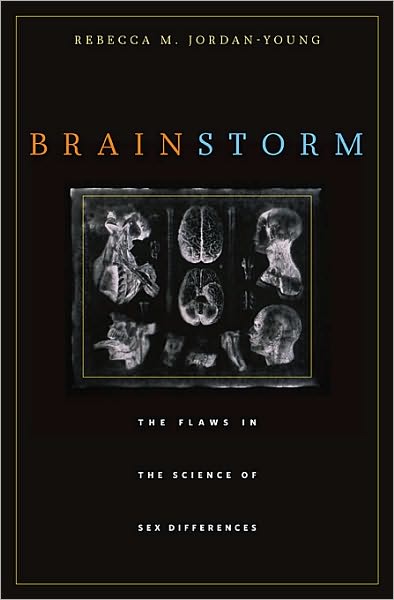
This past week I devoured a book Hanna found for me on the new books wall at the library: Brain Storm: The Flaws in the Science of Sex Differences, by Rebecca Jordan-Young, a sociomedical scientist currently teaching at Barnard College. The book is a systematic survey and assessment of the quality of the scientific research that has been used over the past fifty years in support of the theory that male and female brains are innately different because of different patterns of hormone exposure during gestation.

While the research in this area is inconsistent at best, and methodologically flawed at worse, the idea of sex-typed “brain organization” which pre-disposes men and women to gendered “masculine” and “feminine” behaviors has become widely popularized common sense knowledge, justifying everything from the intrusive medical treatment and scrutiny of gender- and sex-variant people to the dismissal of concerns about social structures that may support gender inequality (if men are “naturally” more interested in careers, and women are “naturally” more interested in caring for children, then no amount of social policy — the argument goes — will alter this predisposition).

Jordan-Young’s goal in Brain Storm is not to argue against the scientific exploration of sex and gender development, but rather to suggest that the science we currently rely upon to support the assertions of sex difference are problematic.  She argues that an “epistemology of ignorance” characterizes the work of scientists who do research on brain organization. That is, these scientists purposefully ignore (because they assume it is irrelevant) any potential sociocultural explanations for the gendered behavior of their subjects, attributing the differences they do discover on atypical, early hormone exposure rather than on the complicated interaction between “nature” and culture. They assume this sociocultural evidence is irrelevant because they expect to find sex-typed differences, and expect those differences to be explained by early physiological sex-differentiation. They have closed the door on alternate (and ultimately, at least according to the strength of available evidence, more compelling) explanations.

This book is far too dense to adequately condense its major ideas into one short booknote; I encourage all of you interested in this area of research to read the whole book, since Jordan-Young’s explanations of how these scientific studies have been generated are really useful as a window into understanding how to better interpret research findings. Regardless of your philosophical position on the physiological origins of sex and gender variety, Brain Storm will help you become a better consumer of the evidence out there that is currently used to support that network of ideas.

To give you a flavor for the type of material covered in Brain Storm, here are a few excerpts.

From “Chapter Six: Masculine and Feminine Sexuality”, which explores how researchers have defined “masculine” and “feminine” sexuality in their research and findings.  Jordan-Young points out that during the 1950s-1970s, when brain organization theory was taking hold in the scientific community, immense changes took place in the cultural perception of what “masculine” and “feminine” sexuality looked like, and how it “naturally” expressed itself.  The scientific literature, however, largely ignores these historical shifts, treating these categories as uncomplicated notions that do not need to be explicitly defined.

Surprisingly, against this backdrop of change [the sexual revolution], most brain organization researchers have used the common term feminine sexuality through more than four decades as though it is absolutely self-evident and unproblematic. But the ground has been shifting under their feet. While ideas and practices associated with “normal” sexuality changed in the broader world during those decades, the transformation of masculine and feminine sexuality was just as dramatic [yet unacknowledged] in the studies that are intended to determine how male and female sexual natures develop.

In brief, from the late 1960s until around 1980, brain organization researchers relied on a model of human sexuality that sharply divided masculine and feminine sexual natures … Things began to change in the early 1980s. In the most general way, scientists continued to assert that early exposure to “masculinizing” hormones make sexual development either more masculine or less feminine, and their preoccupation with sexual orientation intensified. But a closer look at the specific behaviors coded as masculine or feminine in the later studies shows some surprising and very important differences from the first period. In particular, masturbation, genital arousal, and sex with multiple partners came to be understood as “commonsense” features of feminine sexuality, even though these had earlier been read as clear signs of masculinization (pp. 113-114).

In “Chapter Seven: Sexual Orienteering,” Jordan-Young tackles the jaw-droppingly simplistic approach brain organization researchers continue to take toward sexual orientation, despite increasing acknowledgment across a wide range of scholarly fields that sexual identity and orientation highly subjective, often subject to change over time, and are inextricably wrapped up in both “nature” and culture.

To Dr. A and Dr. N, who are among the mos influential scientists in the world studying biological influence on human sexuality, subjects who gave equivocal or contradictory answers to questions about sexual orientation are either being obstructive or confused. Ironically, Dr. A’s admonition to “listen to the subject” ends up being qualified by “if they’re consistent.” Dr. A doesn’t consider the possibility that subjects’ hedging and ambiguity reflect meaningful complexity — that the phenomenon of sexual orientation is complex and sometimes ambiguous. Instead, he thinks of sexual orientation as a simple categorical trait — the objections of modern intellectuals and old cranks like Alfred Kinsey not withstanding, you can sort people into discrete types. In this view, subjects who don’t fit the profile are simply lying, or perhaps more charitably, self-deluded.

While other scientists vigorously debate what sexual orientation is and how best to measure it, brain organization researchers almost never address the fundamental questions involved. The majority of studies linking early hormone exposures with human sexuality have focused primarily or exclusively on sexual orientation — yet most brain organization studies that are “about” sexual orientation have not defined sexual orientation at all, or have used vague and contradictory definitions that often do not agree with the measures scientists have used (p. 145-146).

It was particularly revelatory for me to realize the (obvious once you’re looking for it) point that the most basic ways of sorting groups of people according to orientation can matter, both when it comes to grouping people for the purposes of research and for the purposes of understanding populations in more cultural/social frameworks.

For example, does your definition group people according to the gender of the people whom they are attracted to (men or women)? Or does your definition arrange people according to whether their attractions are same-sex or opposite sex? Both of these definitions, obviously, beg the question of what to do with people who do not fit a binary schema — but for the moment let’s pause here.

If you arrange people on a heterosexual/homosexual schema, you’re grouping them by same-sex vs. other-sex attractions. That is, gay and lesbian people will be in one group, straight women and men in the other. And research designed to explain these categories would look for sameness within the groups and difference between them. You would presume that straight men and women had certain markers of sameness, while queer folks had similar profiles.

Most brain organization research uses the heterosexual/homosexual schema when it comes to structuring their research populations (i.e. they have a “straight” population and a “gay/lesbian” population, and yet their research questions and theories actually follow the people-attracted-to-men vs. people-attracted-to-women model. They assume that individuals who are attracted to men (gay men, straight women) will have markers of sameness, and individuals who are attracted to women (straight men, lesbians) will have markers of sameness — and that these two groups, when compared, will show patterns of difference.

The distinctions seem slight at first, but actually matter a great deal when it comes to structuring a research study or understanding how we make sense of the world, about what we expect of certain groups of people, and what assumptions those expectations rest upon.

The most painful sections of the book to read, at least for me, were the sections that dealt directly with research around intersex conditions, most prominently girls and women with CAH (congenital adrenal hyperplasia). Since brain organization researchers are interested in the effect of hormones on brain development, they have obviously sought out populations known to have had atypical hormone exposure. They then study these individuals for “signs” of sex/gender/sexuality atypicality — “atypical” usually meaning, as the above excerpts show, “contrary to researchers’ culturally-shaped assumptions about gendered behavior.” In “Chapter Nine: Taking Context Seriously,” Jordan-Young uses the example of CAH studies to show how the tunnel vision approach of brain organization researchers has led them to ignore powerful evidence that sociocultural context matters when it comes to sex and gender identity. Not necessarily to the exclusion of hormonal or other “natural” influences, but in ways that simply should not be ignored by scientists who are attempting to test their hypothesis.

No brain organization research, for example, takes into account the fact that the sexual feelings and activities, the self-identity of their CAH subjects is inevitably influenced by the fact that these girls and women are subject to intense scrutiny and intervention — both social and medical — from birth into adulthood. They are expected to behave atypically, and monitored rigorously and anxiously by parents and medical professionals in hopes they will be “normal.” Their bodies are often treated to invasive “normalizing” surgeries and examined regularly. They are asked to perform certain sexual acts, such as masturbation, under supervision, and until very recently little or no thought was given to the actual quality of their sexual experiences and feelings about their own bodies and sexuality — all that mattered was intervening in their lives in the hope that they could be shepherded toward “normal” sex/gender/sexual identities (read: straight person presenting and identifying as female).

To me, this sort of anxiety surrounding gender identity and sexual orientation, as well as the simplistic notion that male/female heterosexual = best possible outcome for all people is just incredibly sad. It’s a very sad testament to the lack of imagination among medical professionals and the general populace that human variation is not only okay, but might actually be the best possible outcome.

I don’t really have any concluding thoughts about this book other than that it’s definitely a keeper, and I urge you all to at least be aware of its existence in the world, should you find yourself in need of a comprehensive survey of brain organization research. It also has an extensive bibliography that can point you in all sorts of branching directions … next up on my list, for example, is Katrina Karkazis’ 2008 book Fixing Sex: Intersex, Medical Authority, and Lived Experience.

Happy reading!

sex work vs. trafficking: npr points out the difference

26 Thursday Aug 2010

Posted by Anna Clutterbuck-Cook in media

≈ 1 Comment

Tags

gender and sexuality, human rights, politics

On my commute home yesterday, I happened to catch this story on NPR’s All Things Considered about a letter signed by 17 Sate Attorneys General asking Craigslist to remove its “adult services” section because they believe it helps foster illegal sex work and child trafficking.

A full transcript is provided on the NPR website. What caught my attention was this exchange between Melissa Block, the reporter, and Chris Koster, State Attorney General of Missouri (one of the AGs who signed the letter). Block is trying to nail Koster down on exactly what he find objectionable about adult women voluntarily offering “adult services” online.

BLOCK: I did try to look through some of them today, locally here, and I would assume that some of those ads, at least, would be placed by adult women who are not victims, who, this is their line of work, and they want to promote their services. Am I wrong about that?

Mr. KOSTER: Well, in Missouri, if you and I are on the same page on what you just said, in Missouri, that’s called prostitution. And that’s exactly what we are complaining and have been complaining to Craigslist for quite some time over, that some of these ads are very specific. They are clearly for sex, and Craig Newmark is providing a bulletin board for conduct that frequently violates the laws of the 50 states.

BLOCK: I take your point about these ads promoting prostitution, which is illegal. Wouldn’t that be a little bit different, though, from saying that women are being victimized? One does not necessarily imply the other, I think.

I want to say kudos to NPR and to Melissa Block in particular for pointing out that objecting to something because it is illegal is different from objecting to something because it is “victimizing” the women (or children) involved, and that there is no simple way to tell if the (adult) individuals who post on Craigslist are being exploited or not. The AG blusters on, saying

That’s right. I mean, every single ad that we see on this site, on this link, is not creating a victim. But there are far too many that do, and if you go through any town in America, certainly any town of any size, you’re going to see a large number of ads that would certainly appear as advertisements for prostitution.

Again implying that prostitution = victimization. Unfortunately, a four-and-a-half minute story is not enough to disabuse any listener who agrees with Kloster of this notion, but hopefully Block’s assertion that not all sex work is, de facto exploitation will in some small way help to shift the national conversation away from the sex work = exploitation model and allow us to ask more nuanced questions about how to incorporate, within a decriminalized sex work industry, checks and balances that would help stop human trafficking and exploitation without depriving sex workers of their livelihood.

quick hit: indexed ftw

25 Wednesday Aug 2010

Posted by Anna Clutterbuck-Cook in linkspam

≈ Leave a comment

Tags

children, feminism, human rights, politics

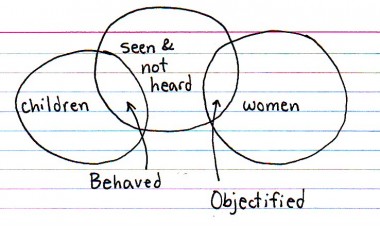
Via my friend Diana comes this great graphic commentary by indexed

Venn diagram showing overlapping circles labelled “children” (left), “seen and not heard” (middle), and “women” (right).

The overlaps read: childen + seen and not heard = behaved, and women + seen and not heard = objectified.

The title of the post at Indexed read don’t let anyone shut you up.

monday morning madness: fluid sexuality and marriage equality

16 Monday Aug 2010

Posted by Anna Clutterbuck-Cook in think pieces

≈ 3 Comments

Tags

bigotry, gender and sexuality, human rights, politics

So after a weekend away from my RSS feeds, I finally got around, this morning, to reading conservative columnist Ross Douthat’s second column on why same-sex couples should be excluded from the institution of marriage. Adam Serwer @ The American Prospect offers his take which covers a lot of the bases. And Douthat’s justifications are so convoluted that I’m not going to try and untangle them here.

But as a queer woman in a lesbian relationship, there were a couple of … let’s call them interesting assumptions Douthat makes about fertility, gender, and marriage relationships that I’d like to briefly respond to.

Douthat realizes that he can’t credibly make the claim that marriage should be limited to couples capable of biological reproduction. As Judge Walker observed in the Prop 8 ruling (and as many other advocates of marriage equality have pointed out), being straight doesn’t equal being capable of, or interested in, bearing and raising children. We don’t ask straight couples to undergo fertility testing in advance of issuing marriage licenses. And we don’t enforce any sort of mandate that married couples produce genetically-related offspring.

So there’s that argument off the table.

But Douthat wants to make that argument anyway. So what he does is suggest that it’s not the physical act of bearing and raising biological children that makes hetero marriage particularly worthy of state sanction: instead, it’s the cultural experience of being heterosexual.

The interplay of fertility, reproductive impulses and gender differences in heterosexual relationships is, for want of a better word, “thick.” All straight relationships are intimately affected by this interplay in ways that gay relationships are not. (And I do mean all straight relationships. Because they’ve grown up and fallen in love as heterosexuals, the infertile straight couple will experience their inability to have children very differently than a same-sex couple does. Similarly, even two eighty-nine-year-old straights, falling in love in the nursing home, will be following relational patterns — and carrying baggage, no doubt, after eighty-nine years of heterosexual life! — laid down by the male-female reproductive difference.) This interplay’s existence is what makes it possible to generalize about the particular challenges of heterosexual relationships, and their particular promise as well. And the fact that this interplay determines how and when and whether the vast majority of new human beings come into the world is what makes it possible to argue — not necessarily convincingly, but at least plausibly! — that both state and society have a stronger interest in the mating rituals of heterosexuals than in those of gays and lesbians.

So it’s not about the capacity to reproduce, it’s about “fall[ing] in love as heterosexuals,” and “carrying baggage … after eighty-nine years of heterosexual life” based on “male-female reproductive difference.”

Obviously, there’s levels of wrong going on here, but the points I want to make are these.

1) As a queer woman, I am affected by the sex and gender norms of our (predominantly) heterosexual society. I was born into a world that expects certain things of girls and certain things of boys. In childhood, we aren’t categorized according to sexual orientation (since children are assumed to be nonsexual, or only latently sexual, beings — a topic for a whole different post) but by gender. Girls who aren’t exclusively straight in their sexual attractions nevertheless find themselves on the recieving end of powerful normalizing pressures concerning what girls/women should do, be, want, etc. This includes the pressure to parent. I think, perhaps, Douthat as a straight man might be underestimating the way in which this pressure affects women, particularly, regardless of their sexual orientations. It’s a gender thing, not a sexual orientation thing.

2) Douthat’s understanding of heterosexual vs. homosexual pairings ignores the experience of everyone else. What about equality for folks who experience sexual fluidity, whose attractions change over the course of their lifetimes? What about trans folks whose experience of society’s gender expectations shifts over the course of their lifetimes? For many of us, the idea that one would experience eighty-nine years of either “heterosexual life” or “lesbian life” (check the box that applies to you) is meaningless. We approach our relationships (no matter the gender of the person we’re relating to) as ourselves, as persons whose sum total of experience doesn’t fit neatly into one category or the other. Douthat’s assumptions concerning the differences between straight folks and queer folks is based on the belief that one’s sexual attractions are either always same-sex or always other-sex, and that these attractions are stable throughout life. This is simply not the case for many people (again, particularly women, which once more leads me to wonder how much Douthat is speaking out of his own personal biases rather than any actual research and reflection).

Thus, Douthat’s distinction between the nature of “thick” heterosexual relationships and (“thin”?) queer ones completely falls apart based upon the lived experience of real human beings.

Finally, I want to tackle Douthat’s parting shot: that omg gay marriage will lead to polygamy:

The claim that gay wedlock will lead inexorably to polygamous marriages or incestuous marriages has never been all that credible, because there just isn’t a plausible constituency in the United States (Europe might be another matter) that’s going to start claiming those rights in the way gays are on the verge of claiming the right to marry one another. But it’s still striking how easily the logic of gay marriage can be extended to encompass all kinds of relationships that we definitely don’t want to call marriages.

I am clearly not the constituency Douthat is writing for in his column, because the question I have for him is: “relationships that we definitely don’t want to call marriage”? Who is this “we” you refer to? Please don’t include me in this claim! ‘Cause I refuse, as a queer woman in favor of marriage equality, to scapegoat polyamorous relationships. I don’t need to make poly relationships the Other (or incestuous relationships for that matter) in order to prove that same-sex monogamous couplings should be sanctioned by civil marriage. I’m for consensual, adult relationship commitments being recognized as marriages. Full stop. If that marriage includes more than two adults, then those adults should all be able to enter into the contract of marriage and have that marriage be recognized by our legal system and honored by society. And if that’s what the case for marriage equality portends, I think we should be proud of that inclusivity.

Fear mongering is just not cool, man.

This time around, even more than in his first post-Prop 8 column, Douthat seems to be transparently arguing that heterosexuals are just better, or deserve to be treated with greater respect, than non-heterosexuals. The whole column is a barely-concealed bid to privilege heterosexual marriages simply on the basis of their being heterosexual.

Bigotry: not so cool either.

grown-ups can say "no" too: on consent, touch, and children in public spaces

12 Thursday Aug 2010

Posted by Anna Clutterbuck-Cook in think pieces

≈ 1 Comment

Tags

children, human rights, politics

group hug by celinecelines @ Flickr.com

This post is inspired by a really interesting post/comment thread at The Pursuit of Harpyness about children in public spaces (once again!) and how our behavior toward them and their parents relates to social norms and expectations.

First, some background to the point/observation I want to make.
One of the commenters wrote
, about what was so frustrating about children in public spaces for them,

To give a concrete example, one norm that I find children violate way more than adults has to do with personal space. I really, really don’t like being touched by strangers. Brushing past someone and so on is fine but someone coming up to me and deliberately touching me without my permission is completely not okay with me and generally speaking that syncs with cultural norms so I don’t have to enforce it too much — with *adults*. Children touch people all the time and if I’m in a public space and someone else’s kid starts climbing on me or messing with my things, that’s not okay and it’s ultimately the fault of the parent or caretaker. I don’t feel I should have to explain to a child why they shouldn’t be pulling on my hair. That’s not my job. They need to stop and if their parent won’t stop them, I will, and that’s that.

To which I responded

I do think it’s important to think about how to explain to children that it’s important to ask before touching. Americans are generally schooled to be touch-averse (and above and beyond cultural norms there are people who are personally touch-averse for a variety of reasons) and for children living in American society, it’s important for them to learn that this is a social norm.

Followed by spark, who observed that

I understand that society has evolved so that it’s inappropriate to tell a stranger’s child to stop pulling your hair (baraqiel’s example), but it shouldn’t be. It takes a village etc.

To which I responded

I completely agree with you that it should be acceptable for any person to tell another person (in this case a child) “please stop touching me, it’s making me uncomfortable.” We teach children that they have a right to decline touch that makes them feel uncomfortable and I think it’s perfectly okay for an adult to speak up for themselves in exactly the same way. I see that as showing the child that they (the child) also has permission to determine who touches them and how.

This exchange got me thinking about parents and children — and about women and children especially. About how women are socialized in so many ways to feel that they don’t have the right to bodily autonomy in interpersonal relationships. Especially interpersonal relationships that involve sexual intimacy (rape culture anyone?) and in relationships that involve children. Their own children or anyone else’s. Women — and I realize I’m generalizing here, but the point I’m making is about cultural norms — often feel like the don’t have a right to say no: no to getting pregnant, no to staying pregnant, no to giving birth, no to parenting, no to care-taking. Over and over and over again in our society, women especially are told that these roles are their biological and social destiny.

Consider the example that the commenter, baraqiel, gives: a child coming up to you and somehow invading what you feel is your personal space. And the fact that, somehow, baraqiel feels unable (or at least likely to be socially sanctioned) to tell the child “hey, please don’t touch me.”

We, as a society, try hard (at least in theory!) to teach children that it’s important for them to reject “bad touch,” that they have a right to bodily autonomy and that they can assert that right in public spaces. Negotiating touch is an important skill for all of us to learn, since it’s not an issue that goes away when you become an adult. Young people are far from the only offenders when it comes to different levels of desire for and toleration of interpersonal touch. A society-wide conversation should and could be happening around what it means to physically interact with others, to give and receive informed consent for touch in a variety of everyday situations.

Yet despite this robust discourse (within feminist circles at least) about the importance of consent when it comes to touch, it seems that adults feel powerless to say “no” to children in public spaces. Or defensive and resentful when they are in a position of having to say no. Even when the thing to which they are saying “no” is something which, if done by another adult, they would quite readily say “no” to (i.e. another adult touching their hair uninvited, for example). So the question is: why? Why does it feel so impossible to make a request that a child stop doing something that is freaking you out, invading your space, making you feel uncomfortable in your skin? Why does it seem like the only possible responses are complete inaction or extreme action (i.e. removal of the child from the area completely)?

The more I think about this, the more I see it as an unfortunate, radical extension of the privitization/segregation of children/childhood. The idea that the only “appropriate” adults to interact with a young person in any direct, meaningful way, is the parent or a designated parent-substitute (i.e. teacher, childcare provider). In a pinch. Although even they are often suspect. Children are, in the “normal” course of things, supposed to reside in private, segregated spaces such as homes and schools — not out in the world of every day society. Children, thus, are treated as an Other who because of their segregation need interpretation and mediation — instead of just being in the world, they must be monitored, translated for, guarded, controlled. They have been removed from the human community and set apart — and their introduction into human society is an event, rather than the normal course of business.

As a child not in school during school hours (I did not attend any institution of education until college) I experienced first-hand how upsetting it was to adults that children might move about the world more freely, yet responsibly. You got noticed. And because you were noticed, you were under heightened scrutiny; an oddity.

And because you’re anomalous, you’re treated as an unknown, as Other. Something to be both highly protected/revered and highly suspected/contained. Never just: yourself.

And thus, adults, interacting with these Others somehow feel disempowered: unable to say “no” and also unwilling to say “yes.” (Because who wants to say “yes” when you feel like you’re being coerced, when “yes” is the only option?)

It seems to me like we need a new approach to understanding children in society, a new approach to interacting with these growing, learning beings that fully acknowledges not only their personhood but also our own: that does not require that we interact with them only as two-dimensional caregivers (selflessly giving of ourselves with no ability to set personal boundaries) or keep our distance.

Which really just brings me back to the radical idea that, rather than treating children as a separate species, we treat them as indiividuals who — like many adults! — have specific emotional, physical, or mental needs, but who belong to the human community and can be asked to respect the boundaries of others.

Remember: When you tell a child “that doesn’t feel good to me, please stop” you’re showing them that part of being human is having the ability to set boundaries, to protect yourself. And by expecting them to respect that request teaches them that this is a request you can make that other people have the ability to listen to and respond to that request without the world falling apart. To know that this is an exchange you can have with strangers on the bus, or a grown up at the grocery store (someone who can be polite, yet firm about their needs) is going to help grown them into persons who will, in turn, be able to respect such requests in the future, and make similar requests for themselves.

Giving them the knowledge that they have that agency — the agency to respond to the needs of others with care, and to have their needs met with equal respect — is a powerful feminist act.

← Older posts
Newer posts →
"the past is a wild party; check your preconceptions at the door." ~ Emma Donoghue

Recent Posts

  • medical update 11.11.22
  • medical update 6.4.22
  • medical update 1.16.2022
  • medical update 10.13.2021
  • medical update 8.17.2021

Archives

Categories

Creative Commons License

This work by Anna J. Clutterbuck-Cook is licensed under a Creative Commons Attribution 3.0 Unported License

Meta

  • Create account
  • Log in
  • Entries feed
  • Comments feed
  • WordPress.com

Blog at WordPress.com.

  • Subscribe Subscribed
    • the feminist librarian
    • Join 37 other subscribers
    • Already have a WordPress.com account? Log in now.
    • the feminist librarian
    • Subscribe Subscribed
    • Sign up
    • Log in
    • Report this content
    • View site in Reader
    • Manage subscriptions
    • Collapse this bar