• anna j. clutterbuck-cook
  • contact
  • curriculum vitae
  • find me elsewhere
  • marilyn ross memorial book prize

the feminist librarian

the feminist librarian

Tag Archives: librarians

Thursday video: digital emulation edition

01 Friday May 2009

Posted by Anna Clutterbuck-Cook in media

≈ Leave a comment

Tags

books, librarians, simmons, web video

In my archives class tonight (LIS440: Archival Access and Use) were were getting the cliff notes version of digital preservation, the future of archives. Because even though we will continue for the foreseeable future to have and acquire traditional materials in, say, paper form (or am I seriously the only person who still keeps my journal long-hand? writes actual pen-and-ink letters?), we’ll also get an increasing proportion of “born digital” materials — say drafts of a novel preserved in Word format, or an Excel file detailing travel expenses for a conference, or a computer program modeling data sets from a science experiment.

One of the concepts for preserving this data and making it available to researchers is “emulation.” Basically, it’s creating–using newer technology–a way of accessing older data that will re-create as closely as possible the original experience of accessing the data. For example, making it possible to run an old computer game (Donkey Kong anyone?) on newer technology, but maintaining the look and feel of the original game.

Our professor, Susan Pyzynski, showed us this digital archive, the agrippa files dedicated to Agrippa (a book of the dead), a sort of performance art collaboration created in 1992 by artist Dennis Ashbaugh, author William Gibson, and publisher Kevin Begos, Jr. It was a limited-edition book meant to be read for a limited time only before its text faded packaged with a diskette containing a digital file of a poem meant to be opened and read only once before it self-destructed.

the agrippa files managed to capture and emulate the experience of reading this poem, a process which they detail on the website and have made available through Google video with the permission of the original creators. Check out this experiment in 21st century archival access!

(note: if you actually care about reading the poem, you can find a higher-resolution Quicktime video on the agrippa file website)

Librarians in film

18 Sunday Jan 2009

Posted by Anna Clutterbuck-Cook in library life

≈ Leave a comment

Tags

books, librarians, movies

It’s probably not entirely ethical to link to your roommate’s blog on a regular basis, but since I’m being held partially responsible for the existence of this post, I thought I would highlight it. Go check out the annotated list of ten librarians in film that Hanna put together for me.

Image from imdb.

Looking Back/Looking Forward: Library Science

15 Thursday Jan 2009

Posted by Anna Clutterbuck-Cook in library life

≈ Leave a comment

Tags

children, gender and sexuality, librarians, simmons

As we enter 2009 — and before I get lost once again in the maze of a busy academic schedule — I thought I’d post a few items on the projects I completed this fall and the projects that are up for the spring semester.
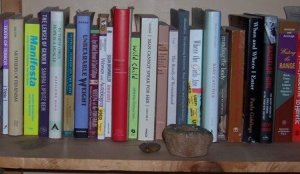

Enrolled as a part-time student, I’m attempting to balance three different sets of course requirements: those for my history degree, those for my general library science degree, and those for my archives management focus within the library science program. This fall, I took a haitus from the archives management courses and took LIS 407 (Reference Services). I had the usual frustration with Reference that I have with all introductory-level survey courses: they try to do too much in too little time, and as a result skim the surface of a great deal of information that could potentially take a lifetime (or at least a career) to explore. That pedagogical frustration aside, it was a good class taught by a knowledgeable, enthusiastic professor (thanks Rex!). I particularly enjoyed putting my annotated bibliography together on the topic of providing children and young adults with reference services in the area of human sexuality. For the bibliography, I surveyed the library science literature for articles and books on the topic (slim pickings) as well as poking around the internet for useful resources. Below are the internet sources I ended up listing in the finished project.

Internet Resources

A number of organizations provide a wealth of resources on their websites for sexuality education that would be of use in a reference setting. Below I provide a sampling of organizational websites and selected page descriptions that highlight some of the resources available that may be of particular interest in a library reference setting:

1. Internet Public Library’s TeenSpace. The Internet Public Library (based out of the University of Michigan and Drexler University schools of information) has a portion of their website dedicated specifically to resources for adolescents, which includes resources related to sexuality. Two pages of particular note:

Frequently Asked (Embarrassing) Questions. On this page, a list of links are provided for issues such as dropping out of school, medical questions, mental health, and social issues (“what do I do if my friend says something racist?”) as well as sexuality information. Also linked to this page is:

Health & Sexuality Links. This is an annotated list of websites that cover a range of issues on the topics of health and sexuality. These links are further divided into sub-heading categories such as “LGBT” and “Abuse and Exploitation.”

2. Scarleteen: Sex Education for the Real World. The web-based iteration of Heather Corinna’s S.E.X., Scarleteen.com provides message boards, sexuality Q&A, writing by young people, and a variety of other interactive resources and informational content. One of the values of Scarleteen, I believe, is its holistic approach to sexual health and orientation, not assuming its readership is in any one place in the orientation spectrum and emphasizing mutuality and health rather than condemning particular sexual desires or practices.

For Parents. The “for parents” section that explains the philosophy of the site and suggests some further reading for adults who are seeking to support the young people in their lives.

Start Your Sexuality Canon. This bibliography is Scarleteen’s own bibliography of essential books on human sexuality, starting out with the famous Hite Report and making suggestions on topics of gender identity, media depictions of sexuality, as well as providing a list of basic sexual health handbooks.

3. SIECUS (Sexuality Information and Education Council of the United States). SIECUS was founded in 1964 by Dr. Mary Calderone, a former medical director for Planned Parenthood. Believing in the lifelong right of all human beings to comprehensive sexuality information, SIECUS provides a plethora of free web-based resources and publications. They are also an advocacy organization for greater access and outreach on issues of sexuality, and press releases on their website can be a useful way to stay informed about current controversies over providing sexuality information to the public. A few specific items of interest:

Bibliography – Books for Young People. This bibliography provides a short list of age-appropriate books for young people, sub-divided into age categories from pre-school to high school.

On the Right Track (PDF). This 78-page booklet makes suggestions specifically for adults who work in youth development organizations on how to integrate sexuality education into their work.

SexEdLibrary. SexEd Library is a database of lesson plans from various sources pulled together and vetted by SIECUS and made available online. Categories include things like “Relationships,” “Personal skills,” “Sexual Health,” and “Society & Culture.”

4. Young Adult Library Services Association (YALSA), hosted by ALA. For obvious reasons, YALSA’s website can be a useful place to research the intersection of sexuality information access and youth library services. They offer numerous booklists that often feature fiction and nonfiction books on themes of romance and sexuality, support a blog that reports on current issues and a host of other electronic resources for librarians. One example of the sort of resources available would be their “Healthy Relationships for Teens” booklist, which provides web-based and traditional resources on sexuality for young adults and the librarians who serve them.

5. Teenwire.com/Planned Parenthood. Teenwire is Planned Parenthood’s site geared specifically to a young adult audience. Much like Scarleteeen, Teenwire provides multiple avenues for accessing information on sexual health and relationships. There are topical sections, question & answer features, and information about sexual health services. Much of this information is also made available in Spanish.

Parents & Professionals. This portion of the site explains Planned Parenthood’s approach to adolescent sexual health and offers links to Planned Parenthood’s publications specifically for youth advocates.

Next semester, it’s back to the archives with LIS440: Archival Access and Use.

My grandmother’s library in the news!

10 Saturday Jan 2009

Posted by Anna Clutterbuck-Cook in our family

≈ Leave a comment

Tags

family, librarians

via Hanna.

When my maternal grandparents retired to Bend, Oregon in the early 1980s, my grandmother, Marilyn, became a volunteer at the Deschutes Public Library. The library has a program to circulate books through the mail to house-bound and far-flung rural patrons, and for years Grandma was responsible for corresponding with, and selecting books for her own particular group of patrons.

Well, the library’s just made news with rising circulation and patronage numbers, according to the Bend Bulletin:

People are flocking to Deschutes County libraries, and officials say the slumping economy may be bringing them business. From July through November, patrons checked out about 10 percent more books and other items compared with the same period last year.

. . . State Librarian Jim Scheppke said circulation increased by 2.5 percent between the budget cycle that ended in June and the previous budget cycle, and the state set a circulation record of 51.7 million items. Scheppke was impressed by the circulation growth described in Deschutes County.

“The Deschutes numbers sound pretty amazing,” Scheppke said. “It is something we’re hearing in all the public libraries right now. We’ve known ever since the Great Depression in the 1930s that library use pretty much tracks the economy. In bad times, library use has always gone up.”

Of course, there are a lot of obviously negative implications of a recession, but I can’t think of any scenario where increase use of libraries is a bad thing!

Ahem!

06 Sunday Jan 2008

Posted by Anna Clutterbuck-Cook in library life

≈ Leave a comment

Tags

boston, humor, librarians

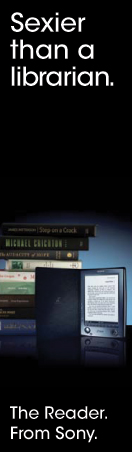
There’s an ad campaign up around Boston right now for Sony’s new electronic “book” device, extolling its virtues over the traditional printed word. Here is my personal favorite:

Like many great ideas, I suspect this particular ad campaign has one (or more) librarians behind it, since early versions of the ad simply read:


One can only imagine that members of my future profession had, shall we say, some constructive criticism for Sony’s PR firm. I believe version 2.0 is greatly improved (though it still doesn’t convince me that anything is sexier than a book).

Banned Books Week: Unshelved Style

29 Saturday Sep 2007

Posted by Anna Clutterbuck-Cook in media

≈ 1 Comment

Tags

books, librarians


click on the image for more legible view

Unshelved is a daily web comic by Bill Barnes and Gene Ambaum about the employees and patrons of a public library. Today’s strip (above) celebrates the beginning of Banned Book Week (Sept 29-Oct 6). I’m sure that any of you who have occasion to interact with the public vis a vis books (booksellers as well as librarians!) will get a chuckle out of it, like I did.

Hmm . . . I’m not sure I have any controversial reading planned for this week. I will be doing some studying about the Oneida community though–probably group marriage would qualify as controversial in some circles. And I bet I could come up with a way to make the history of public parks in Boston into a controversy as well. Let’s see . . .

". . .but the people working there are fairly nice."

15 Saturday Sep 2007

Posted by Anna Clutterbuck-Cook in library life

≈ Leave a comment

Tags

archivists, feminism, history, librarians, simmons


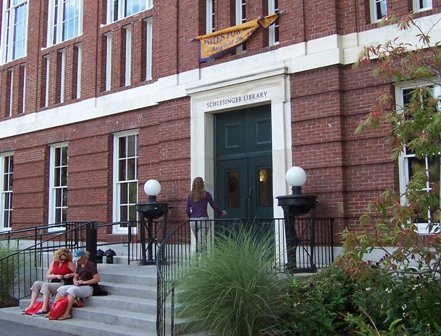
Today, I took a field trip to Cambridge to visit the Schlesinger Library at the Radcliffe Institute, one of the largest repositories of archival material on women’s history in the United States. The impetus for the visit was an assignment for my Archives class, in which I had to visit an archive and describe the experience. However, I admit that enjoyed the very personal pleasure–perhaps more aptly described as “reverential awe”– of simply by being in the same space where so much of the history (or herstory as many feminists would insist!) I care about is preserved, and the historical work I value done.

(Note: In the photograph above, the banner above the library’s main entrance reads “Votes for Women!” in the suffragist colors of violet and gold).

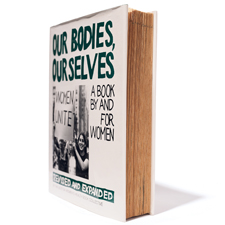
Aside from the pilgrimage aspect of the visit, I actually chose the Schlesinger because they are the repository for the Boston Women’s Health Book Collective records. (The BWHBC is the collective that wrote–and continue to update–the classic book Our Bodies, Ourselves, and are feminist advocates on a variety of women’s health issues worldwide). Our Bodies, Ourselves was one of my earliest, most comprehensive, and unabashedly feminist forms of sexual education and it remains near and dear to my heart (as well as close at hand on my reference shelf). I was interested in seeing some of their earliest manuscripts and gleaning what I could about the collective consciousness-raising process that had led them to publish the first edition of Our Bodies, Ourselves–then called Women and Their Bodies: A Course–which sold for 75 cents in 1970, and was intended as a working study guide for women’s health workshops.

The original publication was fun to browse through, permeated as it was with the language and political ethos of the women’s liberation movement which had given it birth. The first chapter of the 1970 edition, for example, is titled “Women, Medicine, and Capitalism”; a later chapter on abortion describes the hurdles unmarried women face when seeking birth control. A footnote highlights a single clinic in Boston where women–regardless of marital status–can obtain birth control no questions asked. The authors of the chapter observe: “this program is financed by the federal government, but the people working there are fairly nice.”

The most fascinating folder of material I read through was a collection of newspaper clippings and letters detailing the backlash to Our Bodies, Ourselves in the late 70s and early 80s when, apparently, it was being used quite widely in high schools as part of the health curriculum! In this age of abstinence-only education, it’s amazing to me that OBOS ever made it into high school libraries, let alone the curriculum. One teacher from Pennsylvania wrote the collective and described in detail how her students (ages 14-18) had used the book as part of a human sexuality class, including their sophisticated interactions with a pro-life activist who insisted on coming to the class and speaking on abortion. Another letter, written to a high school librarian in 1978, was from a pediatric doctor with teenage daughters who lauded the librarian for her defense of the book and observed:

Young people are far better served by the combination of access to all valid knowledge, even if at variance with parental thought, and the opportunity to discuss this openly with concerned and mature adults.

On the other side of the controversy, of course, were outraged parents and organizations such as the Moral Majority, which sent leaflets to its members detailing (in their minds) unacceptable sexual and political content of the book. One man was quoted in a 1981 newspaper clipping: “I am challenging [defenders] of this book to walk into church and read material out of Women, Our Bodies, Ourselves [sic]”–clearly expecting his audience to be shocked by the idea (though I rather like the image myself).

While this particular trip to the archives was a self-contained event for the purpose of a class assignment, I chose the content with an eye to my interest in feminist activism around sex and sexuality education, and who knows–these records may continue to play a role in my graduate education as I begin the task of designing the project for my history thesis.

Fashion for Library Geeks!

09 Sunday Sep 2007

Posted by Anna Clutterbuck-Cook in life writing

≈ Leave a comment

Tags

books, librarians


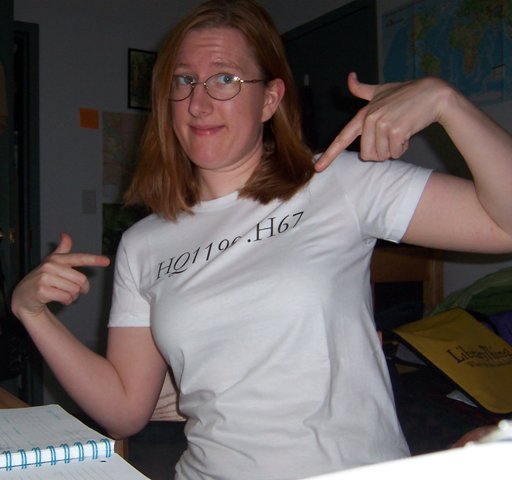
Here’s what TO wear if you’re a bibliophile, regardless of whether you’ve been locked out of your dorm room on a Sunday morning (ahem . . .).

Last spring, I was shopping online for something at CafePress when I stumbled upon an ingenious little mug with the legend:

641.3373

What could it mean?

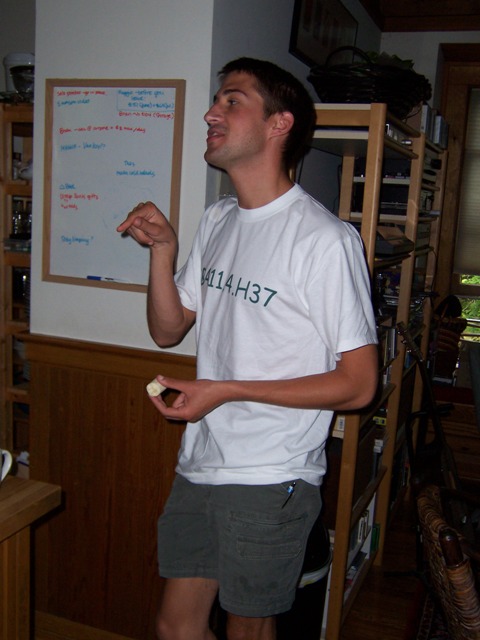
After a little research via the world wide web, I discovered that (naturally) it was the Dewey Decimal classification for “coffee.” How brilliant! How could anyone resist improvising on this idea, and making all sorts of things (say, T-shirts) that bore cryptic slogans to be decoded with the aid of a library catalog!

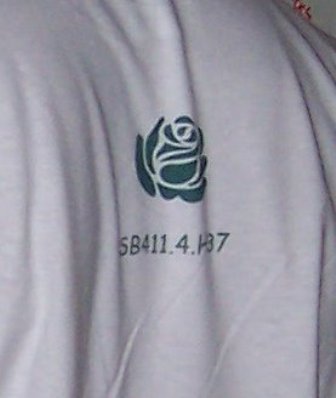
My friend Joseph was, for his birthday, the recipient of my first creation: SB441.4.H37 (the Library of Congress call number for the book Makers of Heavenly Roses, by Jack L. Harkness).

More recently, I printed up one for myself: HQ1190.H67 (the Library of Congress call number for bell hook’s Feminism is for Everybody: Passionate Politics).

Obviously, I encourage all of you to take up the challenge and make yourself enigmatic shirts with messages of your own choosing. The site at which you can design one-of-a-kind shirts is called CustomInk, and even if you don’t get anything printed, it’s great fun to play around.

Two movies

03 Monday Sep 2007

Posted by Anna Clutterbuck-Cook in media

≈ Leave a comment

Tags

fun, librarians, movies


Yesterday, I watched the 1957 Hepburn-Tracy film Desk Set, in which Katherine Hepburn plays the head reference librarian at a media corporation and Spencer Tracy plays the computer engineer whose machine, Emmerick, threatens to make her job obsolete. Of course there’s romance involved–with the right man (Tracy) and the wrong one (the junior executive who expects her to drop her career and move to California when he gets a promotion). It’s a charming film, though like with so many other Hollywood romances, you wonder how someone as utterly with it as Hepburn could possibly have been dating the wrong guy in the first instance, from which relationship doom Tracy subsequently rescues her?

While you’re hunting down Desk Set (available through Netflix!), also check out Next Stop Wonderland, since it’s set in Boston and features some of the very spots I have been (or soon will be). It’s a slow-moving love story about a biologist-plumber and a recently-single nurse whose meddlesome mother places a personals ad for her in the newspaper. There is also a side-story involving a fish-napped puffer fish from the Boston aquarium. Kenneth Turan wrote a nice review in Never Coming to a Theater Near You, which is how I originally found it.

Radical Librarians

15 Sunday Jul 2007

Posted by Anna Clutterbuck-Cook in library life

≈ Leave a comment

Tags

feminism, history, librarians


In my application to Simmons last year, I wrote that “as a scholar at heart, I am also committed to working for social change,” and that a degree in library science would enable me to “translate my knowledge of radical pedagogy and feminism into hands-on activism.” Becoming a librarian and historian will, I firmly believe, “make it possible for me to bring together all my commitments–to education, feminism, and history–in a vocation that is both intellectually rigorous and politically engaged.”

This is a vocation I came to through my life-long need to be surrounded by the printed word (physically as well as intellectually), and the realization that I was happier in libraries and bookstores than almost anywhere else in the world. Maureen Corrigan wrote in her memoir Leave Me Alone, I’m Reading that “like so many bookworms, I was timid and introspective, and yet reading, my earliest refuge from the unknown world, made me want to venture out into it, instead of sticking with my own kind” (xxiii). No one I know would call me “timid,” but I do have a tendency to be introspective, absorbed in my interior life. Books are an integral part of this interior landscape of mine. Yet like Maureen Corrigan, I find they fuel my curiosity, empathy, and determination to be a part of the living, breathing exterior world. The library seems the perfect solution, a balance between the privacy of books and the engagement of political activism.

Turns out (at least according to the New York Times) I’m riding the wave of a generational trend. In July 8th issue of the newspaper, they ran an article called A Hipper Crowd of Hushers that breaks the “news” that we bibliophiles have known for a damn long time: librarians are an awesome people.

(P.S. Thanks to the several friends who brought this article to my attention!)

← Older posts
Newer posts →
"the past is a wild party; check your preconceptions at the door." ~ Emma Donoghue

Recent Posts

  • medical update 11.11.22
  • medical update 6.4.22
  • medical update 1.16.2022
  • medical update 10.13.2021
  • medical update 8.17.2021

Archives

Categories

Creative Commons License

This work by Anna J. Clutterbuck-Cook is licensed under a Creative Commons Attribution 3.0 Unported License

Meta

  • Create account
  • Log in
  • Entries feed
  • Comments feed
  • WordPress.com

Blog at WordPress.com.

  • Subscribe Subscribed
    • the feminist librarian
    • Join 37 other subscribers
    • Already have a WordPress.com account? Log in now.
    • the feminist librarian
    • Subscribe Subscribed
    • Sign up
    • Log in
    • Report this content
    • View site in Reader
    • Manage subscriptions
    • Collapse this bar