Via my sister Maggie.
at the end of SOPA blackout day, I leave you with this
19 Thursday Jan 2012
Posted in media

19 Thursday Jan 2012
Posted in media
Via my sister Maggie.
12 Thursday Jan 2012
Posted in book reviews
It’s that time again! Time for another round-up of books I’ve been reading that for some reason or another haven’t made it into a post-length book review. Most of these, let me be clear, deserve a full-length review. Many of them are well-researched, well-argued, or otherwise lovely reads. I just don’t have the temporal time/space to write them all up. So here’s everything that’s fallen through the cracks in the past few months.

Corey Robin | Fear: The History of a Political Idea (Oxford U.P., 2004) and The Reactionary Mind: Conservatism from Edmund Burke to Sarah Palin (Oxford U.P., 2011). I first heard of Corey Robin thanks to an episode of Amanda Marcotte’s RhRealityCheck podcast in which she interviewed Robin about The Reactionary Mind. I was impressed with what he had to say about gender and power, so I hunted up his books and got reading. Fear was the volume that came in first at the library. It’s dense political history and theory, examining the theorizing and deployment of fear in the political realm from the Thomas More to Hannah Arendt and into the twenty-first century. Robin’s core argument is that politicians (left and right) have positioned fear as an external threat to civil society and democracy and therefore obscured the way in which fear is deployed within our society to keep power hierarchies in place (e.g. in the workplace, in race and gender relations, through law enforcement, etc.). The Reactionary Mind is a collection of essays — many which began as book reviews in publications like The Nation and The London Review of Books — that explore specific reactionary thinkers. I’d recommend dipping into Robin’s work with Reactionary and then moving on to Fear if you’re really intrigued, since Reactionary is certainly the easier (though no less insightful) read. My favorite essay in Reactionary might just have been the one on Antonin Scalia in which he observes:
Scalia’s mission, by contrast, is to make everything come out wrong. A Scalia opinion, to borrow a phrase from Margaret Talbot, writing in the New Yorker, is ‘the jurisprudential equivalent of smashing a guitar on stage’. Scalia may have once declared the rule of law to be the law of rules – leading some to mistake him for a traditional conservative – but where others look for stabilising checks or reassuring supports, Scalia looks for exhilarating impediments and vertiginous barriers. Rules and laws make life harder, and harder is everything.
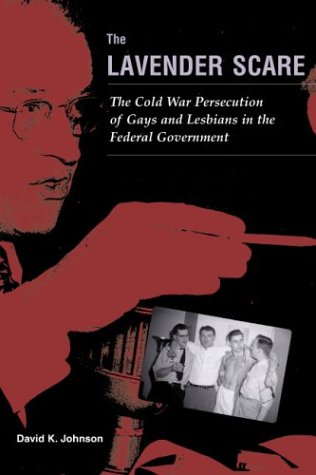
David K. Johnson | The Lavender Scare: Cold War Persecution of Gays and Lesbians in the Federal Government (Univ. of Chicago Press, 2004). Following footnotes from Corey Tobin’s Reactionary Mind, I stumbled across this detailed and well-constructed history of the McCarthy era purge of non-straight civil servants. Johnson’s book documents the way in which fears about national loyalty and psychological fitness blended together in the Cold War era and led to a mass expulsion of queer folks from the government (often destroying careers, precipitating family fissures, and causing psychological and emotional trauma on the way by). What surprised me was the relatively relaxed attitude Johnson describes toward sexual deviance immediately prior to the 1950s, when few feared loss of their job or social ostracism for homosexual identity or behavior.

Paul Russell | The Unreal Life of Sergey Nobokov (Cleis Press, 2011). Cleis Press sent me a review copy of this densely atmospheric historical novel, which attempts to reconstruct the life of Sergey Nobokov, the obscure younger brother of novelist Vladimir Nabokov of Lolita fame. I admit a certain amount of dubiousness when confronted with a historical novel that attempts to piece together the life of an actual historic person — particularly when the person in question was homosexual. The temptation for presentism (reading our own expectations onto the past) is always a danger, and often intensifies when we’re talking about the act of “recovering” queer history. The novel is also forbidding in that one anticipates, from the opening pages, Nabokov’s inevitable death at the hands of the Gestapo. To be honest, I’ve rather bogged in the middle (though I mean to go back!) just because midwinter is not really the time to be reading about the inevitable demise of a forgotten gay man under the Nazi regime.

Patricia Faith Appelbaum | Kingdom to Commune: Protestant Pacifist Culture Between World War I and the Vietnam Era (Univ. of North Carolina Press, 2009). Hanna found this one for me at the Harvard Book Store off Harvard Square. It’s a meticulously researched study of pacifism during the first half of the twentieth century, focusing — as the title suggests — on the influence of mainline protestant culture on the ways in which pacifism was articulated and enacted by women and men across the United States (and to some extent internationally as well). I’m only up to roughly the start of the Second World War thus far, but am finding it very readable history. I’m particularly interested in her focus on material and “folk” culture as a way of practicing and passing along traditions of Protestant pacifism, even in more secular pacifist communities and activism.

Joseph Cummings | Ten Tea Parties: Patriotic Protests That Time Forgot (Quirk Books, 2012). This early reviewer book from LibraryThing that is a lesson in “read more than the title when requesting your advance review copies.” I thought the book was going to be about ten unique protests that time forget; instead, it was about ten pre-revolutionary protests about tea and import taxes. Which, okay, if your thing this might be fun. Cumm ings has an engaging narrative voice and it looks like he’s done a credible amount of background research. His scant two-page bibliography is made up of secondary resources, however, and the lack of even end note citations is frustrating to those of us who like our quotations sourced!

Jeffrey Weeks | Making Sexual History (Blackwell, 2000). Following citations from Gayle Rubin’s Deviations, I tracked down this retrospective anthology of British historian and theorist of sexual politics Jeffrey Weeks’ essays on historical conceptions of human sexuality. This is a lively and articulate — if somewhat theoretically dense — collection which provides a solid picture of the work of historians of sexuality since the 1960s, and also reflects back on the work of sexologists from the 19th and early 20th centuries, and the long legacy of their contributions to research and cultural perceptions of human sexuality and how it is organized. Weeks was one of the pioneering scholars to retrieve the study of sex from the realm of nature/biology (where it was assumed to be ahistorical) and asserted the importance of understanding how human sexuality itself — not just our understanding of it — is shaped by culture.

Christopher Turner | Adventures in the Orgasmatron: How the Sexual Revolution Came to America (Farrar, Straus & Giroux, 2011). I was only able to get through about half of this ambitious history of psychoanalyist Wilhelm Reich’s work on human sexuality before the library demanded it back. However, the half that I did read was a thoroughly researched examination of Reich’s approach to psychoanalysis — one which placed orgasm at the center of both psychological and political health. Since Reich had only just arrived in America when I had to interrupt my reading, I remain dubious concerning the title’s claim (that Reich precipitated the sexual revolution in the U.S.). Nevertheless, Reich’s insistence that sexual pleasure was healthy and to be encouraged — and his placement of pleasure close to the heart of humanity’s essential character — becomes central to a number of post-WWII psychoanalytic and cultural currents that I am interested in (he was connected to, among others, A.S. Neill, Fritz Perls, and Erich Fromm).

Rachel Maines | The Technology of Orgasm: “Hysteria,” the Vibrator, and Women’s Sexual Satisfaction (Johns Hopkins, 1998). Um … are you sensing a pattern in my recent reading yet? Pursuing research for an MHS “object of the month” essay, I checked out this slim volume on the medical treatment of women’s sexuality through electromechanical technology. It appears to be the only book-length work on this subject to-date, and although I found some of her arguments about male physicians and their power to be slightly simplistic, on the whole she avoids turning this into a narrative of male physicians vs. female patients, or husbands vs. wives, and instead offers a nuanced argument about the displacement of female sexual pleasure from marital intimacy to the doctor’s office due to what she terms the “androcentric model” of sex that insisted intercourse to male orgasm was sex, and women’s needs (clitoral stimulation anyone?) outside of those activities were excessive and therefore a medical issue for which one sought treatment from the professionals.
10 Tuesday Jan 2012
Posted in book reviews
Tags
children, feminism, gender and sexuality, moral panic, politics, reading lesbian classics, sociology, the body
 |
| find table of contents here |
For the past couple of months I’ve been making my way through Deviations: A Gayle Rubin Reader (Duke University Press, 2011), an anthology of writings by anthropologist and feminist theorist Gayle S. Rubin whom I’m ashamed to admit I didn’t actually know anything about before I stumbled upon the advance review galleys of this book. Rubin is a cultural anthropologist whose research delves into the history and culture of urban sexual subcultures, particularly BDSM communities. As a newly-out lesbian in the 1970s in Ann Arbor, Michigan, she designed her own Women’s Studies major at the University of Michigan and became active in the Women’s Movement and also the Gay Liberation Movement. In the late 70s and early 80s — in part because of her academic research into BDSM — she drew the ire of anti-porn feminist activists for her insistence that (wait for it) not all pornographic materials are inherently degrading to women. Yeah, I know. The more I read about it, the more it seems like the early 80s must have been a really weird time to be a self-identified feminist. Not to mention one who was also a lesbian and open about her s/M desires and practices.
Deviations is arranged in chronological order, beginning with Rubin’s first attempt to construct a theory of gender relations rooted in anthropological methodology — “The Traffic in Women: Notes on the ‘Political Economy’ of Sex,” written and revised between the late 60s and early 70s and first published in 1975. It is very much an artifact of its time and to be honest I bogged in this piece for the better part of a month after joyfully burning my way through the eminently readable introduction. Perhaps recognizing the opacity of “Traffic,” Rubin includes a piece reflecting back on the writing and reception of the original piece and includes it in the anthology — something she does several times throughout the book to great effect. After “Traffic” and its contextual essay comes a much more accessible piece on the English author Renee Vivien, originally written as an introduction and afterward to a new edition of Vivien’s A Woman Appeared Before Me, which is a fictionalized account of her tumultuous relationship with fellow author and outspoken lesbian-feminist Natalie Barney.
By the late 70s, Rubin was deep into the ethnographic research for her dissertation on the gay male leather bars of San Francisco, for which she received her PhD in 1994 from the University of Michigan. The majority of pieces in Deviations, therefore, wrestle not with the politics of gender or specifically lesbian-feminist history, but the politics of sexual practices, sexual subcultures, and the relationship between feminist theory and practice and human sexuality. As someone who is, like Rubin, committed to understanding the world through both a feminist and queer lens, I really appreciate her determination to remain engaged in feminist thinking and activism even as she was reviled by certain segments of the feminist movement for her “deviations” in sexual practice, and her openness to thinking about sexual subcultures that — for many in our culture, even many self-identified feminists — elicit feelings of disgust and generate sex panics. While the “porn wars” of the 1980s are largely a thing of the past, feminists continue to find sexuality, sexual desires, sexual practices, and sexual fantasy (whether private or shared via erotica/porn of whatever medium) incredibly difficult to speak about. Rubin calls upon us to think with greater clarity about the politics of sex, and how we police other peoples’ sexual activities, many of them consensual, simply because we find them distasteful.
Particularly controversial, I imagine, are Rubin’s writings on cross-generational sexual activities and children’s sexuality. Coming out of the BDSM framework, Rubin foregrounds the basic ethic of consent and argues that children have just as much right to consent to sexual activities as adults. Furthermore, within the framework of 1980s anti-pornography legislation, she emphasizes the difference between fantasy/desire and reality/action (that is: depiction of non-consensual sex in the context of a fantasy does not equal non-consensual sex and shouldn’t be treated in the same fashion). This leads her to speak up in defense of adults who express sexual desire for young people (but don’t act on that desire), and also to suggest that not all instances of underage/overage sexual intimacy should be treated as sexual abuse or assault. Read in tandem with Rubin’s insistence that we take children seriously as human beings with the right to sexual knowledge, this advocacy is clearly not a call to minimize the trauma of sexual violence (at whatever age) or a glossing over of age-related power dynamics. “The notion that sex per se is harmful to the young has been chiseled into extensive social and legal structures,” she writes, “designed to insulate minors from sexual knowledge and experience” (159). Like Judith Levine in Harmful to Minors (2002), Rubin argues that our cultural insistence on keeping young people separated from sexuality and sensuality — with a vigilance that often spills over into panic and hysteria — does little to protect them from sexual violence and exploitation while cutting them off from the means to conduct their own (safe, consensual) sexual explorations or name and resist the violence and exploitation that may come their way. Sexting panics anyone? The Purity Myth?
Overall, I highly recommend Deviations to anyone interested in the development of feminist and sexual political theory and practice over the last forty years — if nothing else, Rubin’s bibliography has already given me a handful of other thinkers whose books and articles I wish to pursue.
Cross-posted at the corner of your eye and The Pursuit of Harpyness.
18 Sunday Dec 2011
Posted in library life
Tags
 |
| via |
Depending on your level of involvement in things internet-political and techy, you may or may not be aware of the Stop Online Privacy Act (SOPA) now making its way through congress. Introduced by representative Lamar Smith (R-TX), this bill mandates widespread monitoring of internet activity and has the potential to cause the internets as we know them to be fundamentally altered as blogs and other social networking sites are shut down for supposed acts “piracy.” You can read more about the act at the Organization for Transformative Works, TechCrunch, and the American Library Association. The letter Hanna and I sent to our representatives is heavily cribbed from the ALA talking points.
08 Thursday Dec 2011
Posted in book reviews

In many ways, Jeanne Córdova’s memoir, When We Were Outlaws: A Memoir of Love and Revolution (Midway, Fla.: Spinster’s Ink, 2011), couldn’t be more different than the last memoir of the 70s I reviewed here at the feminist librarian: Patricia Harmon’s Arms Wide Open. Harmon’s memoir told the tale of a self-trained hippie midwife who moved with sons and male lovers through several different rural communes before entering medical school for formal nurse-midwifery training. Jeanne Córdova, by contrast, spent the 1970s in the Los Angeles area free-lancing as a journalist and activist in what were then referred to as the women’s and gay liberation movements. A self-identified butch, she came of age as part of the lesbian bar culture of the 50s and 60s, then discovered gay liberation and feminism in 70s. Córdova was the founding editor of The Lesbian Tide newsmagazine and the human rights editor of the L.A. Free Press, interviewing radicals on both the left and the right on the run from the law. As she observes in her introduction, “this memoir visits many outlaws, some freedom fighters, and a few who would be called terrorists … I needed to know and sort out these outlaws in my mind in order to discover the perimeters of my own moral compass … Outlaws takes place at the intersection of shadow and shade that differentiate between persona and principle” (vii).
Yet I found myself, while reading Outlaws, thinking often of Harmon’s memoir and the parallels between both works in scope and tone. And in the relationship (in text, at least) between the authors and their own personal and political pasts. Like Arms Wide Open, When We Were Outlaws seeks to tell a specific slice of the authors life, rather than starting with childhood and moving through the years in an orderly progression. Both authors chose, as their time-frame, the turbulent years of the 1970s when the heady, optimistic social change movements of the late 1960s led to more complicated lived realities for those who championed leftist causes and a counterculture way of life. Córdova focuses on her life and work between 1974-1975, with some flashbacks and flash forwards to help us make sense of the dense web of associations — political and personal — that characterized that time, both for Córdova specifically and her fellow activists in what was then called “the Movement” more broadly. Like Arms, Outlaws gives us an in-the-moment perspective on the life of someone struggling to live out her political convictions in her personal life. For Jeanne Córdova this means an up-close, and in many ways unshrinking, view of her involvement with lesbian separatist politics in relation to the gay liberation movement more broadly. It also means intimate portraits of her trial-and-error practice of open relationships, as she paints a portrait of her involvement with two women — the long-term relationship in which she and her partner have negotiated non-monogamy, and the quickening of an intense love affair with a fellow activist that threatens the stability of her more permanent ties.
It has become a commonplace, since almost before they began, to identify the leftist social movements of the 60s and 70s as enthusiasms of youth, as romantic idealism (or destructive self-absorption, depending on your political persuasion) that necessarily gave way to realistic politicking and material concerns. In some ways this is true. Many of the individuals who populate When We Were Outlaws are young adults in or just out of undergraduate or graduate school programs, young professionals or struggling under-employed twentysomethings. They don’t (yet) have dependents to care for, and are geographically mobile, often living on the economic edge. They’re at the point in their lives where they’re developing a sense of what kind of life they want for themselves and those they care about — what kind of work they find meaningful, what values they hold dear, what kind of relationships they want to build and maintain. Often, their answers (however tentative) to these questions are at odds with the answers their parents or the activists of the previous generations gave.
Yet despite the youth (and youthful perspective) of its protagonist, I would argue that Outlaws pushes us to re-examine our assumptions that the moral dilemmas and vision for a better future that Córdova and her cohort were immersed in are solely the province of the young — impetuosity that will necessarily give way as one grows into more seasoned adulthood. One of the most interesting narrative threads in Outlaws traces the relationship between Córdova and her political mentor/substitute parental figure Morris Kight. Kight was a mover and shaker in L.A. gay political activism, someone with whom Córdova worked closely and fell out publicly over the place of women in the gay liberation movement. Their differences aren’t so much conservative elders vs. radical youth but something more complicated — a difference in experience, of power, of privilege. In the very personal (yet also political) struggle between Kight and Córdova we can see all the complications inherent in working for social justice, complications that don’t get, well, less complicated — or less relevant — as we grow older.
Córdova reflects back on her younger self with a sometimes-critical, yet always compassionate eye. While the narrative style is “novelized memoir” (to use the author’s own choice of phrase), one nevertheless gets the sense that the author both knows well her protagonist’s faults and cares very deeply for her younger self, no matter how flawed her present self may find that person of the past. “I was not born knowing how to love,” is how she open’s her introduction. “It came to me late in life” (vii). In the pages of Outlaws we see her be cruel to lovers, ideologically ruthless, politically short-sighted, and cripplingly addicted to booze and prescription drugs. At the same time, we see a heart-breakingly young woman who’s been physically evicted from her childhood home (for bringing home a lover), is living with serious and intermittently-treated depression, experiences chronic under-employment, and who nonetheless is working hard to build a meaningful life for herself and a better future for us all. Whether you agree with the young Córdova’s means and visionary ends doesn’t necessarily detract from the import of such a closely-rendered self-portrait.
I suspect we’re only in the early years of a richly textured new wave of 70s-era autobiography which will shed new light on the particularity of growing into adulthood during a period when even the most fundamental of questions concerning how we organize our personal and political lives seemed to be in real, material flux. I am also happy (quite selfishly, I admit!) about the way these personal perspectives will provide unique, and accessible, primary source material for historians of the period, even while many historical sources remain in private hands (and therefore often invisible-to-researchers). Córdova’s memoir would provide a rich jumping-off point in a course that sought to explore this era in all its rich historical realities — and I hope it prompts many readers to re-examine what they think they know about the political contours of the decade.
This review was made possible by the generousity of Lynn Ballen at Spinster’s Ink who provided me with an advance review copy of the book. The book is available now for purchase online or at your brick-and-mortar bookstore of choice. You can read more about the memoir and its author at www.jeannecordova.com.
08 Monday Aug 2011
Posted in media
The new House and Human Services classification of birth control as preventative medicine has the crazies at Fox News up in arms. Why? Stephen Colbert is on hand to explain: “If we give your daughters and granddaughters access to birth control they will instantly turn into wanton harlots with an insatiable sexual appetite!”
| The Colbert Report | Mon – Thurs 11:30pm / 10:30c | |||
| Women’s Health-Nazi Plan | ||||
|
||||
Via Feministing, RhRealityCheck and many others.
05 Friday Aug 2011
Posted in book reviews

My latest early reviewer book from LibraryThing was the 20th anniversary edition of Allan Creighton and Paul Kivel’s Helping Teens Stop Violence, Build Community, and Stand for Justice (Alameda, CA: Hunter House, 2011). The authors have worked together in the field of violence prevention and social justice activism since the mid-1970s. This book is a workbook for adults seeking to work with young people, specifically teenagers, to identify and combat the various types of institutional and cultural injustice they encounter in their lives. “Professional literature about adolescents, social-service priorities, and funding trends all [emphasize] programs that [build] self-esteem,” the authors observe. “Many youth workers convey to young people that if they just had higher self-esteem, they could overcome any obstacle and succeed at anything they set out to do,” ignoring the institutionalized, systemic injustices young people as well as adults face in securing life necessities and building a satisfying life for themselves and their families (60). We do a grave disservice to youth, the authors argue, by implying that if they are struggling it is largely because of personal failure when, in fact, the problem is an imbalance of power:
Our problem [when we were young people ourselves] was not based on low self-esteem or any of the other psychologically defined problems. Rather, we had no real power over our lives. Without power to protect ourselves, we were constantly restricted, disrespected, and abused by adults. Everywhere we went, adults had the authority to decide how we should dress, where we could be, and who we could be with. They decided our future through daily decisions including discipline, records, diagnoses, arrests, report cards, evaluations, and allowences, or just by ignoring, interrupting, or neglecting us.(60-61)
The imbalance, of course, is not just one of age but also intersects with many other inequalities from which adults also suffer: poverty, sexism, racism, religious bigotry, discrimination based on disability and sexual orientation or gender identity … the list is a long and familiar one. Creighton and Kivel call on adult allies to work with youth in identifying these power imbalances and combat them. Those who benefit from inequality seek to divide the attention and alliances of those who are struggling to get by under oppressive systems. By forging networks of support among ourselves at the bottom of the inequality pyramid, the authors suggest, we can more effectively enact lasting social change as well as survive in present day far-less-than-optimal conditions.
Since the book is designed primarily as a workbook for group trainings, those who are reading Helping Teens Stop Violence outside of that context may find themselves skimming a bit and taking note of various exercises for later usefulness, rather than reading in a straightforward manner. I found myself skipping around quite a bit, once I’d read the introduction and gathered the gist of the authors’ perspective and approach. Some general impressions:
Helping Teens Stop Violence will obviously be most useful to those who have immediate practical application for its suggested exercises and the resources listed in the back of the book (though I found their resource lists a rather odd mix, with curious gaps — particularly when it comes to the available literature on violence in education and violence against youth). However, it’s a worthwhile read for anyone who is interested in the practical aspects of social justice work at the grassroots level, and who is interested in thinking a bit more deeply about the way in which our culture has institutionalized ageism and systematically disenfranchises young people and children.
30 Thursday Jun 2011
Posted in book reviews
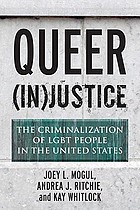
The third installment in Beacon Press’s Queer Action/Queer Ideas series, edited by Michael Bronski, Queer (In)justice: The Criminalization of LGBT People in the United States is co-authored by law professor Joey L. Mogul, police misconduct attorney Andrea J. Ritchie, and community organizer Kay Whitlock. Hanna saw it on the new book wall at the library and correctly ascertained it was the sort of title I’d be interested in. So she brought it home, I read it, and now I’m gonna blog about it.
Queer (In)justices is far more than an examination of the ways in which our legal system polices “deviant” gender and sexuality qua gender and sexuality. Yes, the authors look at the laws and policing practices related specifically to penalizing folks who engage in (publicly or privately) non-heteronormative sexual practices, or whose appearance suggests that they identify outside the gender/sex/sexuality binary. However, their analysis goes much deeper than these targeted laws. Instead, they argue that “the policing of sex and gender ‘deviance’ is central to notions of crime, and serves both as a tool of race-based law enforcement and as an independent basis for punishment” (xiii). In other words, notions about the relationship between non-normative sex and gender expression and criminality influence the way in which the legal system treats people perceived to be queer whether or not they are caught in the system specifically because of sex- or gender related policing. As they argue:
As queer identities substituted for individual perverse acts [in the late nineteenth century] the process of criminalizing sexual and gender nonconformity was facilitated through the construction of ever-shifting and evolving archetypal narratives [of deviance]. Rooted in historical representations of Indigenous peoples, people of color, and poor people as intrinsically deviant, fueled and deployed by mass media and cultural institutions, these narratives now permeate virtually every aspect of the criminal legal system (19).
They make a compelling case for us to question the usefulness of narrowing our focus specifically on anti-gay laws, and on enacting new laws seeking to protect LGBT people from homophobia … particularly when the very law enforcement officials meant to ensure those laws are respected are among the primary culprits when it comes to bigotry and violence around sexual and gender nonconformity. In chapters on gender and sex policing on the street, in the courtroom , in prison, and in uneven police responses to violence against LGBT people, we see how presumptions of criminality systematically influence how queer people are treated in the context of the legal system, whether they are perpetrators, victims, or both. They make the particularly important point that, regardless of what laws are officially on the books, “police and other law enforcement agents are given considerable latitude in deciding which laws to enforce, how to enforce them, and which people to target for law enforcement” (48).*
Being queer, or being perceived as queer can cause law enforcement officials to treat individuals as criminally guilty whether or not they actually are — and can bring harsher punishments (when compared to those perceived as straight and gender conforming) when those individuals are sentenced. Likewise, criminal behavior is often associated — implicitly or explicitly — with sexual depravity. Using examples that will be familiar to anti-sexual harassment or anti-sexual violence activists, Mogul, Ritchie, and Whitlock describe how individuals known or perceived to be queer are treated by law enforcement officials as if they are incapable of being victims of sexual violence. They describe victims of same-sex domestic violence who themselves were put in jail or ruled incapable of being abused because of their orientation or gender identity.
Ultimately, Queer (In)justice argues that LGBT activists must take a much more comprehensive approach to their agitation for change within the framework of law and law enforcement. While much of the mainstream LGBT work in this area in recent years has involved the quest to enact anti-discrimination and anti-hate crime legislation, and to grant same-sex couples the right to marry, Mogul, Ritchie, and Whitlock point out that a much broader cultural shift within law enforcement must take place in order for such changes in the law to have an on-the-ground effect. As they write, “The hate crime framework is … compromised by placing primary responsibility for preventing violence in the hands of a criminal legal system that is itself responsible for much LGBT violence” (129). We would do well, they seem to be pointing out, to pay closer attention to the experiences of those most vulnerable to police brutality, discrimination and abuse sanctioned by the legal system, and persecution based on presumptive criminality … not just because of their sexual identity, but because their mere presence as a non-conforming body evokes powerful notions of danger and violence whether or not these reactions are warranted in specific instances. Comprehensive reform is needed before the passage of laws will have real-world implications for the majority of the LGBT population.
Queer (In)justice is a must-read for anyone who wants to re-consider the current LGBT approach to legal reform.
*This point is exactly why I am uneasy with Jim Wallis’ argument that police force is preferable to military force. Wallis’ assumption that police only use force when it is necessary to enforce agreed-upon laws ignores all of the situations in which law enforcement officials abuse the power vested in them … something which, as a person who works in anti-poverty and anti-racism circles, Wallis ought to know full well.
28 Tuesday Jun 2011
Posted in linkspam
Tags

I’m in Michigan for a whirlwind visit to attend my brother and sister-in-law’s wedding celebration. I thought I might have fun photos to share with you today, but not yet. Instead, I’ll post this story that I heard on National Public Radio this afternoon.
The Supreme Court on Monday struck down a California law banning the sale of violent video games to children, saying it ran afoul of the First Amendment right to free speech.
In one of the most closely watched cases this term, in a 7-to-2 vote, the justices said governments did not have the authority to “restrict the ideas to which children may be exposed.”
I was struck, when I heard the story on All Things Considered, that the issue was being framed as a free-speech issue. That is, that children have a constitutional right to information…even if its information we find disturbing and wish to protect them from on a legal level.
This may be the first (and only!!) time I find myself agreeing with Antonin Scalia:
Writing for the majority, Justice Antonin Scalia said the country has no tradition of restricting depictions of violence for children. He said California’s law did not meet a high legal bar to infringe on the First Amendment or the rights of parents to determine what’s best for their children.
Note that parents still have the authority to determine what their children can and cannot access; it’s just that the government cannot legislate one particular type of parental values for all children.
The article goes on to note:
Although regulating children’s access to depictions of sex has long been established, Scalia said there was no such tradition in the United States in relation to violence. He pointed to violence in the original depiction of many popular children’s fairy tales like Hansel and Gretel, Cinderella and Snow White.
“Certainly the books we give children to read — or read to them when they are younger — contain no shortage of gore,” Scalia added.
Read the whole thing over at NPR.
While I agree with Scalia that as a society we routinely expose children to a high level of violent stories and imagery (not to mention leaving them vulnerable to actual physical and emotional violence), I think it’s interesting that the question of restricting access to sexual materials was left unquestioned. If children have a constitutional right to play first-person shooters, don’t they also have a constitutional right to see images of people making love, if that is what they wish to do? (Most young children are probably more interested in violence than sex … but for the sake of legal consistency they should be allowed either).
I have a lot of questions about the nuances of this ruling, and no time in the next 48 hours to do any background reading. But I’ll let you know if there are further developments!
14 Tuesday Jun 2011
Posted in book reviews

Now that my reading is no longer dictated by my thesis research I find that … well, I read more or less the same mix of stuff that I read while I was writing. Including the scary books about religion and politics. While Hanna’s parents were here a couple of weekends ago and we went shopping at the Brookline Booksmith, I picked up a copy of Jim Wallis’ God’s Politics: Why the Right Gets it Wrong and the Left Doesn’t Get It (New York: Harper, 2005). Jim Wallis is one of the founders of Sojourners, an evangelical social justice organization that grew out of anti-war activism during the 1970s. To this day, Sojourners is active in anti-war, anti-racism, and anti-poverty work. They have tried to exist, as the subtitle of Walli’s book suggests, as a third way in the American religio-political landscape: progressive on some social justice matters while also remaining very conservative in some issues I would argue are also social justice questions — but which Wallis sees as divisive “culture war” issues (i.e. gay marriage and abortion). Recently, Sojourners came under fire from some more queer-inclusive religious groups for rejecting an ad submitted to its magazine from an LGBTQ Christian organization. Given the recent buzz, when I saw a copy of God’s Politics at the store I decided it was time for a re-read.
I vaguely remember reading the book when it came out right after the 2004 election. Mostly, I remember feeling fairly certain that Wallis didn’t “get it” when it came to characterizing leftist politics … since most of his criticisms of leftist activists (people he often characterizes as “secular fundamentalists”) bore little resemblance to the people who I understood as left-liberal. I can’t say that my overall impression, upon re-reading God’s Politics six years later, has changed. I still feel the book is condescending towards those whose politics fall to the left of Wallis’ (I’ll return to this below) and I think that he’s trying a little too hard to have his cake and eat it too.
Take, for example, the “culture war” issues he tries to dismiss as meaningful political topics. He wants to claim that evangelical Christians can stand at once for the full human rights of queer folks while continuing to exclude gay people from full participation in church life. He argues that they can be “pro-life” but also feminist, while defining “pro-life” in a way that actually makes him politically pro-choice. While I agree with Wallis that it is possible to be personally against abortion, and to work to reduce the need for abortion, without robbing women of the ability to make necessary decisions for themselves and their families, I find it offensive that he makes what is essentially a reproductive justice argument and yet re-frames it as something that is distinct from (and superior to) the arguments of feminist activists. While I’m not against trying to re-claim “pro-life” as a more comprehensive idea — anti-death penalty, anti-war, reproductive justice — for Wallis to act as if by using the term he can change its political meaning overnight is naive at best and disingenuous at worst.
I also grew very tired of his use of language like “moral” and “values” as if religious folks have a monopoly on morality and ethics. Assuming as he does that religious folks are better at thinking and acting “morally” than their secular peers, I feel that he is blind to non-religious possibilities for some of the problems he diagnoses in American society. His reflexive support for normative family structures, and his assertion that children thrive best in two-parent (by implication heterosexual) families, for example, fails to ask deeper questions about how we might re-form our understanding of family to meet the needs of all people, regardless of their marital status, age, sexual orientation, or other social ties. In his efforts to appease the Christian right, I can’t help feeling that he missed an opportunity to imagine new ways of caring for one another that actually fit quite well into Biblical visions of community as well as dovetailing with very left-radical notions of how non-traditional families might be recognized and honored.
He also loses me when he writes about the degradation of modern culture and the need to re-affirm the value of nuclear family life in language full to bursting with nostalgia for the 1950s that never was. While he never overtly calls for a return to “father knows best,” his recourse to the politics of disgust over hypersexualized television commercials and the comic book violence of Van Helsing (really? that’s the movie you found worthy of condemnation??) amounts to a recoil from modern popular culture that suggests he would be more comfortable if such things would just disappear. I’m always confused by this argument, since surely if you don’t like the violence of Van Helsing or the ideas about human nature found in reality television shows you can turn the television off. Or you can engage in deconstruction and analysis of the show’s messages. (Perhaps he should read Jennifer Pozner’s Reality Bites Back?) In these moments of recoil and the impulse to make the icky thing just go away I feel Wallis betrays his mid-century evangelical youth, when even films like “The Sound of Music” were Godless indulgences.
Wallis’s strength lies, unsurprisingly, in the sections where he writes about nonviolence and economic justice. I was particularly struck by his insistence on positive alternatives to war as the only effective way of breaking down the notion that violence will somehow bring about a more peaceful world. “If nonviolence is to have any credibility, it must answer the question that violence purports to answer, but in a better way” (160). I was not particularly satisfied with Wallis’ nonviolent solutions (he distinguishes “military” from “police” enforcement without recognizing that in many parts of the world, “police” are justifiably seen as perpetrators of, not protectors from, violence) but I appreciate that he realizes that simple opposition to violence is not an effective political position. I also think he is on much firmer theological ground when arguing that the God of the New Testament (and Jesus) have an inherently anti-war message, and that the Bible calls on us to care for the most vulnerable members of the human community. In some ways, I wish that he had stuck to these two messages rather than trying to forge a “middle way” between social justice and cultural conservatism — since I think his capitulation to cultural conservative ultimately undermines his claims for the latter.
 the feminist librarian