• anna j. clutterbuck-cook
  • contact
  • curriculum vitae
  • find me elsewhere
  • marilyn ross memorial book prize

the feminist librarian

the feminist librarian

Tag Archives: simmons

Looking Back/Looking Forward: Teaching

11 Sunday Jan 2009

Posted by Anna Clutterbuck-Cook in my historian hat

≈ Leave a comment

Tags

education, history, simmons

As we enter 2009 — and before I get lost once again in the maze of a busy academic schedule — I thought I’d post a few items on the projects I completed this fall and the projects that are up for the spring semester.

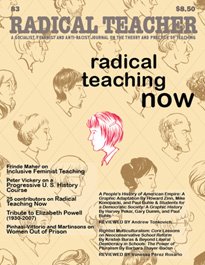
Teaching [will] need to be more boldly political than now, not less. And more seriously historical: things used to be different. They will be different again. — “Introduction Radical Teaching Now”, Radical Teacher #83

As with my internship at Northeastern (see below), I will be continuing my work as a teaching assistant for Professor Stephen Ortega in the Simmons history department this spring. Steve teaches Middle Eastern, Islamic and World history; I will be helping with the second half of the World Civilizations course we began in the fall. The autumn class ran from hunter-gatherer societies to the age of exploration (15th century), and this second semester we will pick up in the 1400s and continue on to the present day.

It was timely, therefore, to receive my most recent issue of Radical Teacher in the mail this past week, and find Peter Vickery’s essay “Progressive Pedagogy in the U.S. History Survey” inside. Vickery describes teaching a U.S. History survey course at a state college, to students for whom the class is a requirement, and many of whom are skeptical about the relevance of history — not to mention their own ability to actively participate in its creation. He writes:

In addition to skepticism, my students encounter an ongoing tension, namely the apparent contradiction between a key goal (finding out what actually happened and why) and a key lesson (history is constructed by historians). Far from being a source of despair or frustration, in my own mind the tension is integral to the joy of history. Learning and re-learning on the one hand the boundaries of possibility that inhere in the study and production of history and, on the other, the power of narrative, keeps history a stimulating field of endeavor.

Yet it can be difficult to convey the joy of that contradiction to students who are distracted and suspicious of the worth of such an open-ended quest. We’ll see what happens this spring!

Looking Back/Looking Forward: Internship

09 Friday Jan 2009

Posted by Anna Clutterbuck-Cook in library life

≈ Leave a comment

Tags

archivists, history, northeastern, simmons

As we enter 2009 — and before I get lost once again in the maze of a busy academic schedule — I thought I’d post a few items on the projects I completed this fall and the projects that are up for the spring semester.

My tenure as an intern at Northeastern University’s Archives will continue through the spring, this time as an official internship requirement for my second archives class at Simmons. Just today, I published the last finding aid for the small collections I processed this fall to make them available for research. In addition to my first, miniscule collection the Albert Hale Waite papers, I also processed the collection of Milburn Devenney, a social worker and AIDS/HIV activist from the Boston area, documents related to the history of Northeastern’s Disability Resource Center and course notes from the history department’s Western Civilization class.

Next week I will begin work on a much larger collection, the Carmen A. Pola papers. Ms. Pola is a Boston-area community activist who worked for a number of different social justice organizations such as Roxbury Unites for Families and Children and the Puerto Rican Festival. She served in the administration of Boston mayor Ray Flynn during the 1980s. We have over thirty boxes of unprocessed documents and photographs that I will be responsible for organizing so that researchers will have meaningful access to the contents of the collection. Wish me luck and watch for the results sometime this summer!

Reference 101: Source Evaluations

29 Monday Sep 2008

Posted by Anna Clutterbuck-Cook in library life

≈ Leave a comment

Tags

books, simmons

For my reference class, we’re required to review and evaluate many different types of sources throughout the semester. This week, we had a trial run: an assignment to choose a single work in the Simmons library reference collection and review it. This process is something that reference librarians do constantly, either systematically (in recommending acquisitions for reference collections) or more improvisationally (when assisting patrons in answering reference questions). At the MHS, all of us on the Reader Services Staff take our turn highlighting a reference work in our collection as part of an ongoing “reference book of the week” project. For those of you who are interested in what goes into such an evaluation, below is the assignment I did this week for class.

Walter, Lynn. The Greenwood Encyclopedia of Women’s Issues Worldwide. Westport, Conn.: Greenwood Press, 2003.

The Greenwood Encyclopedia of Women’s Issues Worldwide provides researchers with an easily-navigable overview of contemporary women’s issues across the globe. The work is organized in six volumes by geographical region (Asia and Oceania, Central and South America, Europe, The Middle East and North Africa, North America and the Caribbean, and Sub-Saharan Africa). Within each volume, the contents are arranged alphabetically by country, or group of countries, profiled. Each volume was edited by a scholar who is an authority on the region, and contributors are drawn from predominantly American universities, with a healthy representation of individuals at institutions of higher education across the globe.

Each contributor was asked to profile her or his assigned country, or group of countries, with an eye toward “locating women’s agendas,” “differences among women” within the region, and the activities of self-identified women’s movements and non-governmental organizations. Each author follows the same outline, covering uniform topics that fall under the broad categories of “education,” “employment and the economy,” “family and sexuality,” “health,” “politics and law,” “religion and spirituality,” “violence,” and “outlook for the twenty-first century.” The summary narrative is augmented by a selected bibliography and resource guide within each chapter that points the researcher to further information in suggested readings, audio-visual and Internet material, and organizations of note.

With each chapter laid out in the same basic pattern, it is fairly simple for the researcher to cross-reference subjects such as “contraception and abortion” to find out how access to birth control varies depending on whether one lives in Denmark, the United States, or South Africa. Each volume contains a subject and person index for that volume, with a comprehensive index found at the end of volume six. Maps and images are included, though not in color, and are not indicated in a separate index. Appendices in each volume provide statistical information on the education, health, economic status, and political participation of women in the region.

Reviewing the encyclopedia for Choice Reviews Online in May 2004, P. Palmer describes the work as “current, well written, and informative, providing scholarly content, useful detail, and sound documentation.” Sally Moffitt, reviewing for Reference & User Services Quarterly, highlights the ease of cross-country comparisons and points out that “it will be a matter of regret if its editors fail to bring out regularly updated editions.” Indeed, since it was published in 2003 the Encyclopedia of Women’s Issues is now five years out of date as a truly contemporary source of information on global women’s issues. However, it remains the most recently-published resource attempting this level of breadth and depth, and is a valuable tool for both entry-level students of women’s studies as well as higher-level researchers seeking comparative data the status and experience of women worldwide. The target audience is students and faculty in higher education, although high school students with a particular research need will also find it accessible and informative.

[1] P. Palmer, review of The Greenwood Encyclopedia of Women’s Issues Worldwide, by Lynn Walter, Choice Reviews Online (May 2004). Available online at http://0-www.cro2.org.library.simmons.edu/default.aspx?page=reviewdisplay&pid=2658010. Accessed 27 September 2008.

[2] Sally Moffitt, review of The Greenwood Encyclopedia of Women’s Issues Worldwide, by Lynn Walter, Reference & User Services Quarterly vol. 43, no. 4 (Summer 2004): 348-349.

The Politics of Maps

10 Wednesday Sep 2008

Posted by Anna Clutterbuck-Cook in my historian hat

≈ Leave a comment

Tags

education, history, politics, simmons, web video

God, I miss the West Wing.

I’m doing an exercise with the undergraduates in History 100 this Thursday to help them think about using maps as historical sources. As an introduction to my little preliminary talk, I plan to show them one of my favorite clips from The West Wing (Season 2; Episode 16). Thanks YouTube for having just what my geeky little heart desired!

First online finding aid!

05 Friday Sep 2008

Posted by Anna Clutterbuck-Cook in library life

≈ Leave a comment

Tags

archivists, history, northeastern, simmons


This morning I finished and published my first online archival finding aid as part of my internship at Northeastern Archives. It involved a lot of fancy footwork with Microsoft Word macros and Dreamweaver . . . but the important thing in the end was that it worked and the papers of one Albert Hale Waite (graduate of Northeastern’s School of Law, class of 1933) are now fully processed and accessible for research. You can view the finding aid for Mr. Waite here.

Grad School: Year Two Begins

02 Tuesday Sep 2008

Posted by Anna Clutterbuck-Cook in life writing

≈ Leave a comment

Tags

domesticity, simmons

Here we are again, the first week of September; this time last year I was in the midst of GSLIS orientation, still unpacking in the dorm, and figuring out where to buy groceries. Today, I’m sitting here in my flat in Allston, having just come back from a grocery run at the Harvest Co-op, planning dinner for my roommate’s return from vacation tomorrow and enjoying the creep of the afternoon sun across the hard-wood floors. Yep, a lot has happened in the past year. And now with a new semester beginning, I’m looking ahead to year two . . . the same, with changes.

Work and school will definitely keep me busy this fall. I have on the docket:

  • Classes. I am taking two classes this term, Reference Services (a library science requirement) and American Renaissance (a history seminar). I’m particularly looking forward to the history class, which focuses on the Boston-area transcendentalist set: Emerson, Alcott, Hawthorne, Mann . . . I plan to do my research paper on the trans-Atlantic exchange of ideas on pedagogy during the early 19th century.
  • Teaching Assistantship. I have been awarded a teaching assistantship with Steve Ortega, who teaches world history, and will be working with him on the World Civilizations I course for undergraduates. Simmons is a small enough school that I won’t have a class of my own to lead, but have plans in the works to run some lessons over the course of the semester, including a workshop next week on using maps as historical sources.
  • Internship. After returning to Boston from Michigan a couple of weeks ago, I started an internship at Northeastern University’s archives processing collections that have not yet been opened for research. This is something I don’t get a chance to do at my regular job at the MHS, and I’m finding I enjoy the intellectual occupation it demands.
  • I’ll also continue to work at the Mass. Historical Society part-time through the school year and look forward to occasionally taking advantage of its seminar series offerings and other events — not to mention the kick-ass Christmas party the hold every year.

On the leisure side of things, I’m a firm believer in continuing to have a life while in graduate school. Since I now have an apartment with a fully functional kitchen and a roommate, this “life” thing means cooking meals, enjoying Tuesday night British Comedies with Hanna, Sunday strolls along the Charles (as long as the weather holds), and of course Thursday night episodes of a new season of The Office! Not to mention watching the political circus in the lead-up to November’s election and posting regularly on my blog.

Happy fall, one and all . . .


Just Back from the Berks

16 Monday Jun 2008

Posted by Anna Clutterbuck-Cook in my historian hat

≈ Leave a comment

Tags

history, simmons, travel


Hi all! I flew in to Boston’s Logan airport at 12:10 this morning, after long delays in the Chicago O’Hare airport on my way home from the 14th Annual Berkshire Conference on the History of Women. The conference was at the University of Minnesota (U of M to the locals although to this Michigander that abbreviation only means one thing). It was a beautiful weekend and the campus–which spans the Mississippi River in the twin cities of Minneapolis/St. Paul–was a stunning location, particularly coming as many of us did from the first sweltering heat wave of the East Coast summer. The building on the left is the Weisman Art Museum, designed by (who would have guessed?) architect Frank Gehry, and perched on the high Eastern bank of the river.

I attended a number of awesome roundtable discussions and seminars, including one on the history of childhood and youth (“Childhood as a Useful Category of Historical Analysis”), one on 1970s popular culture and gender, and one on the history of lesbian and gay families in the 20th century. I also got a chance to catch up with my undergraduate adviser, and enjoyed dinner in Dinkytown with my current program adviser. I even managed to wedge in a visit to the campus bookstore!

The conference gave me some good ideas about possible directions in which to take my thesis research–whichever body of primary sources I end up using, I will certainly be focusing on ideas of experimental education and educational theory (pedagogy) in the mid-twentieth century (1960s and 70s). I am interested in the relationship between new educational practices and political movements such as feminism, environmentalism, peace activism, and radicalism on both the left and the right. Home education is, of course, one form of this experimental education. There are some others–including early women’s studies programs and the Oregon Extension program I attended as an undergraduate–that might also provide fruitful material to explore.

As much as I am resistant to formal academic environments, I can’t deny that it is encouraging and exciting to be around such incredible group of (largely women) scholars who are all researching thought-provoking topics in women’s and gender history. I was honored to have the opportunity to absorb their conversations and look forward to a time when I might more actively participate in the same.

Semester-in-Review: Cataloging

19 Monday May 2008

Posted by Anna Clutterbuck-Cook in library life

≈ Leave a comment

Tags

simmons

Now that the term is over and I’m starting to recover my faculties, I thought I would treat y’all to a taste of the sort of work I was doing over the term. Cataloging (officially known as “Information Organization”), taught by the legendary Candy Schwartz, was a whirlwind introduction to the principles of information organization. One of my favorite segments of the term was actually the final segment, in which we learned how to assign call numbers to books using both the Library of Congress Classification scheme (LCC) and the Dewey Decimal System.

In both systems, you have to find a single way to characterize the nature of the book as you can: what it’s about, what kind of book it is, who it’s by, and so on. In each system, there are complicated rules explaining how you locate and construct the call numbers. We had to practice on lots of pretend titles in each system, and at the very end of the assignment Candy had us assign call numbers to ourselves using both systems. I thought I would walk you through how I created these two call numbers as a way of sharing a little bit about how these systems work.

Both LCC and Dewey are subject-based classification schemes–grouping books about like subjects in the same general area. This is clearly a benefit to browsers, who most often go to the library looking for information on, say, fish breeding. So first, I had to pick a general subject area (an individual person encompasses too many subjects to be classified easily in a single area). I tried to find a subject classification that would capture the dimensions I highlight in this blog (the “feminist librarian-activist” self). In both cases, this turned out to be a women’s studies-type categorization, though the way each system broke down the idea looks a little different.

In the Library of Congress system, you search through the classification index, which is available online to subscribers, for the topic. As many of you probably already know, LC is call number that is made up of a a letter-number combination. In LCC, the “H schedules” are the social sciences, and any number beginning with “HQ” is a topic having to do with “the family, marriage, woman” (’cause, you know, women naturally belong in the same conceptual category as family and marriage). By reading down the table, we construct the following:

HQ (for The Family. Marriage. Woman)
HQ1180 (for Women’s studies. Study and teaching. Research)

Below this general category is

HQ1186.A-Z (alphabetical by region or country, A-Z)

This means we use the letter-number combination (known as a Cutter number, after librarian Charles Cutter) for the geographic region the “book” discusses. I chose the United States as a whole.

HQ1186.U6 (for United States)

Finally, I create a cutter number so that I can alphabetize the book on the shelf by author. This cutter number consists of the first letter of the last name (C), followed by a number from 2-9 that roughly corresponds with the second letter of the name (O).

HQ1186.U6 C7 (by Cook)

So I–or perhaps this blog–could be given the call number of HQ1186.U6 C7, meaning “a resource dealing with women’s studies research and teaching in the United States.”

The Dewey system is similar, but only uses numbers, rather than letter-number combinations, until one reaches the cutter number for authors (again, C7 for Cook). Dewey uses the numbers from 0-999 in groups of 100s (so we talk about “the 100s” or “the 300s” as a unit). The 300s are the social sciences:

300 (Social sciences)

Which are then broken down further,

305 (Social groups)
305.4 (Women)

In Dewey numbers, a decimal point always follows the first three numbers for readability (like the way a phone number, at least in the U.S., is always given in 3-3-4 combination).

305.42 (Social role and status of women)

Since I wanted to specify my interest in feminist history, I added the “09” designation, which is the standard number for “history and geography” that can be added to any subject classification.

305.4209 (for Feminism—history)

At this point in the number construction process, I wanted to specify that this was a book about feminism in the United States. In Dewey, you do this by adding the number for the country (73 for the United States).

305.420973 (for United States)

And finally,

305.420973 C7 (by Cook)

So 305.420973 C7 is a call number meaning “a resource on the history of feminism in the United States.”

While I’m not ready to become a professional cataloger, I have to admit there’s a great deal of satisfaction in puzzling out how to classify and order things (hey, this is the woman who has her personal library arranged by LCC call number). And now, if I ever happen to be turned into a book by a nefarious curse or inadvertent spell, I will have the call numbers to ensure I’m properly shelved.
done done done done done

10 Saturday May 2008

Posted by Anna Clutterbuck-Cook in life writing

≈ Leave a comment

Tags

simmons

So yesterday, I turned in my last paper and handed off my oral history interviews to the Oral History Archive. I’m done with the semester! Hooray! It’s hard to believe that a year ago at this time of year I was still in Holland, working at Barnes & Noble, and had three months to go before moving to Boston . . . a hell of a lot has happened in the last twelve months, and I’m looking forward to some time over the summer to sit back and take stock.

More soon.

Classification Politics

13 Thursday Mar 2008

Posted by Anna Clutterbuck-Cook in library life

≈ Leave a comment

Tags

simmons

Just before Spring Break in my Organization of Information class, which is the introduction to library cataloging and classification schemes, our professor Candy launched into the segment of the course devoted to Library of Congress Subject Headings (LCSH), which are used in many English-language libraries worldwide.

My friend Aiden has been doing research–and enthusiastically passing materials along to me–on the concept of classification as a form of oppression. The connection seems obvious: any time that you construct a schema for organizing ideas, you make choices about how to arrange those ideas, what associations to make between ideas, and how to label those ideas so that others can find them. Therefore, I was tickled when Candy just happened to illustrate her lecture on subject headings with the following example:

“United States–Annexations”
USE: “United States–Territorial Expansions”

Ah, yes. An early example of spin.

So I look forward to seeing where Aiden goes with his classification activism! If he makes any progress, I’ll let you all know :).

← Older posts
Newer posts →
"the past is a wild party; check your preconceptions at the door." ~ Emma Donoghue

Recent Posts

  • medical update 11.11.22
  • medical update 6.4.22
  • medical update 1.16.2022
  • medical update 10.13.2021
  • medical update 8.17.2021

Archives

Categories

Creative Commons License

This work by Anna J. Clutterbuck-Cook is licensed under a Creative Commons Attribution 3.0 Unported License

Meta

  • Create account
  • Log in
  • Entries feed
  • Comments feed
  • WordPress.com

Blog at WordPress.com.

  • Subscribe Subscribed
    • the feminist librarian
    • Join 37 other subscribers
    • Already have a WordPress.com account? Log in now.
    • the feminist librarian
    • Subscribe Subscribed
    • Sign up
    • Log in
    • Report this content
    • View site in Reader
    • Manage subscriptions
    • Collapse this bar