• anna j. clutterbuck-cook
  • contact
  • curriculum vitae
  • find me elsewhere
  • marilyn ross memorial book prize

the feminist librarian

the feminist librarian

Monthly Archives: May 2012

‘the act of marriage’: ch 12 ( d) none of the above)

31 Thursday May 2012

Posted by Anna Clutterbuck-Cook in book reviews

≈ Leave a comment

Tags

gender and sexuality, live-blogging, moral panic, religion

See also: intro, ch 1, ch 2-3, ch 4-5, ch 6-7, ch 8-10, ch 11.


Finally! The chapter you’ve all been waiting for (I know!): the Christian sex survey. Convinced through anecdotal evidence and a belief that believers must do it better, the LaHayes set out to gather empirical data to support their thesis.

Why do Christians do it better? I mean, we all know why feminists do it better: the less hamstrung by notions of oppositional, binary gender roles, the more real people can be. And the more real we can be with our partners — the less compelled we feel to follow a specific script for sex — the better off we’re gonna be. Less shame, more gain. But why would being a member of one religious community — particularly one which, historically-speaking, has a rocky relationship with human sexuality — lead one to better sex?

Well, the short answer is because folks like the LaHayes believe that being a Christian makes everything better. It’s sort of an exercise in circular thinking: Why does Christianity make things better? Because life is better when you’re a Christian.

The slightly longer answer is that they believe that they believe “a Christian’s relationship with God produces a greater capacity for expressing and receiving love than is possible for the non-Christian” (195). They argue that Christians, with their greater capacity for love, do not have “an obsession with sex, they do not need dirty stories*, pornography, or artificial stimuli to motivate them toward each other” (195). Basically: God gives you the capacity to love; everyone else is faking it.

To assess the state of Christian marital relations, the LaHayes asked participants in their Family Life Seminars (sexuality education for Christian adults) to fill out and return written surveys on their sexual experiences — think The Hite Report for Christian couples. They amassed 3, 377 responses (from 1,705 women and 1,672 men) and chapter twelve offers us a look at the results. In comparing their own results to that of a contemporary Redbook survey of 100,000 women they conclude that “Christians do enjoy the sublimities of the act of marriage more than others in our culture” (197).

I can’t reproduce the survey results in full, here, but a quick word about demographics and then some of the questions and responses. The couples they surveyed (and yes, they were all married) were the average age of mid-to-late thirties, had been married 7-15 years, and had 2-3 children. forty percent of the women and sixty percent of the men were graduates of four-year colleges, and nearly forty percent of the men had attended graduate school (I suspect a high proportion of seminarians). Forty percent of the wives worked part- or full-time outside the home and over sixty percent of the men were working in “professional or managerial” positions. In short, these are middle to upper-middle-class families. The survey doesn’t ask about race, but I’d say it’s safe to assume a majority white demographic.

The majority of couples married after a courtship lasting 6-12 months, but fifteen percent courted for 3-5 years before marriage. Reading was the main source of sexuality education before marriage, and while the majority approached marriage with “anticipation” of sexual activity, roughly twenty percent of both men and women were “apprehensive” about sex as they headed toward tying the knot. About a third of respondents (slightly lower for women, slightly higher for men) had engaged in “occasional” premarital intercourse, though the LaHayes are quick to point out that these numbers could include people who had “not yet received Christ as their Lord and Savior” (200). Almost forty percent of couples used birth control pills as their preferred form of contraception. While only about one quarter of wives reported having reached orgasm on their first night of lovemaking, seventy-seven percent indicated that they “regularly or always” experienced orgasm making love at the time they filled out the survey.

A few example questions, and the responses:

14. Impression of parents’ sex life:

Fulfilling… 36% (wives’ response) 36% (husbands’ response)
Casual… 28% / 34%
Cold… 28% / 20%
Other… 8% / 10%

36. Minutes from beginning of foreplay to orgasm:

Less than 10… 6% / 7%
10-20 minutes … 51% / 55%
20-30 minutes … 31% / 26%
30 or more … 12% / 12%

40. How often do you have intercourse per week:

0-2 times … 61% / 61%
3-6 times … 36% / 37%
7-9 times … 3% / 1%

41. How often do you desire intercourse per week:

0-2 times … 48% / 27 %
3-6 times … 49% / 62%
7-9 times … 3% / 11%

The rest of the chapter is taken up by graphs comparing the sexual satisfaction of Christian couples (as reported in the survey) with the sexual satisfaction of the respondents to the Redbook survey. The LaHayes do point out that there is no way of knowing what percentage of those who responded to Redbook were also Christians**, but persist anyway in arguing that Christians do it better.

Wearing my historian’s hat, I find it particularly fascinating to see certain themes emerging in these chapters which today sit front and center in the Christian arguments against non-marital sexual activities. For example, the argument that non-marital sex before marriage will be destructive to the marriage relationship: “Our survey indicates quite clearly that premarital sex is not necessary and, according to statistics, may hinder sexual adjustment” (210). They also devote a section to the notion that the practice of oral sex is on the rise, “thanks to amoral sexual education, pornography, modern sex literature, and the moral breakdown of our times” (212). While the LaHayes are not particularly censorious of oral stimulation, they take pains to encourage their readers to ensure that penis-in-vagina intercourse remains the central sexual act in their relationship. All things considered, you could set this chapter up alongside the data presented in the reactionary Premarital Sex in America and — substituting anal for oral — you’d have roughly the same arguments being made, fifty years apart.

IN SUM: Adequate Lady-Spouse Metric

It was a little difficult to come up with a way of grading myself on this chapter. So what I did was this: I completed the questionnaire myself, and then gave myself two points for every instance where my answers matched the top answer for the wives, one point if it was the second-place answer, and half a point for third-place or below.

Chapter 12:
1st place answers: 24 questions = 48/48 points
2nd place answers: 11 questions = 11/22 points
3rd or below: 11 questions = 5.5/22 points

TOTAL POINTS: 64.5/94 points = -29.5

Chapter 11: -35
Chapters 8-10: 0 (n/a)
Chapters 6-7: -62
Chapters 4-5: +30
Chapters 2-3: -33
Chapter 1: -50

Cumulative ALSM Score: -179.5


*So sad! No smutty fic!

**Note that “Christian” to folks like the LaHayes doesn’t mean “anyone who attends a Christian church and/or reads the Bible as a sacred text,” but rather anyone who has had a born-again experience and/or accepted Jesus as their Lord and Savior.

household economies [wedding post the second]

29 Tuesday May 2012

Posted by Anna Clutterbuck-Cook in our family

≈ 7 Comments

Tags

domesticity, feminism, hanna, wedding

UPDATE: Molly’s comment on this post made me realize I should make a point of saying that this post is about my own personal experiences and desires regarding shared finances, not meant to be a general statement about what “should” happen for couples, or what is morally “right” for all households, etc. Material security is a very, very personal thing. So all of the thoughts below are about me/mine — not meant as a judgment of anyone else’s life.

One of the first things Hanna and I did after we became a couple was go out and open a joint checking account.

Well, okay, it wasn’t one of the first things — but it was within a couple of months. And even though we’d been living together and sharing household expenses for a year and a half at that point, the shared account somehow seemed more possible, more right, to establish once we were in a sexually-intimate relationship.

Yeah, I know it doesn’t make any rational sense when I put it like that. But at the time, that’s how it felt. We were a couple, my logic went, and couples share material resources without keeping score. And the best, most efficient, way of doing that was an account to which we both had equal access.

And it’s worked for us since then. So much so that, as we move toward our wedding in the fall, Hanna raised the question of consolidating finances further — perhaps pooling our (frighteningly modest) savings, and more actively planning for a future down-payment or international travel. I agreed this sounded like a good move.

money love by cembas @ flickr.com

I got thinking about this last week when blogger blue milk put up a post about money and relationships, riffing on a New York Times piece on money-sharing in marriage. The comments on the blue milk post reveal a diversity of arrangements, and — to my mind — a surprising number of long-term couples whose financial resources are still fairly separate, or at least kept distinct.

It’s not that I haven’t known other options are out there for household finances, besides the single-financial-profile Hanna and I seem to be trending toward, but it’s fascinating to me how many people (women particularly?) feel strongly about maintaining their financial independence even within stable, long-term relationships.

Generally-speaking, there seems to be a lot of angst and anxiety these days about establishing household economies. Which (me being me) makes me reflect on why I don’t feel that level of angst and anxiety incorporating another person’s financial expectations and spending habits into my life (and trusting another person with my own income). Was it weird, at first? A little. It’s impossible to keep as tight a grip on the pulse of household spending when there are two of us — unless either of us were willing to spend a lot more time tracking trends (we aren’t). And I had to get used to Hanna making decisions with “my” money that I wouldn’t necessarily make vis a vis discretionary spending … but then again, she’s had to do the same. For the past three years, my paychecks have been automatically deposited into an account that Hanna has full access to, and that’s never really bothered me.

So the question becomes: Why? Why don’t I worry? 

I think it has something to do with how material resources and respect for individual decision-making and personal property (the things of our lives) were handled in my family of origin.

I grew up in a family where there was one main source of income: my father’s salary. My mother had done wage-work before we were born, and has picked up work-for-hire since we grew up and moved on, but didn’t work for pay while we were growing up. Yet regardless of the source of income, financial resources were consolidated: there was one checking account out of which bills were paid and daily expenses withdrawn. It had both my parents’ names on it. Their financial assets were theirs never “his” and “hers.”

Us kids all got spending money when we were small, and were taken to the bank to open savings accounts once we were earning pocket money (and later more significant income). So as kids, we had money that was separate from the family economy. We were also, correspondingly, expected to take responsibility for our own discretionary spending as we were able.

And I think almost more important than the specific, technical, details concerning the flow of cash, is the fact that we had confidence in one another to be financially responsible. My parents have confidence in each other as financial decision-makers, and helped us kids gain a basic understanding of our own finances so that as we moved from familial inter-dependence into adult fiscal independence (contrary to mythology, a gradual and far-from-decisive process) we were able to communicate about economic needs and desires without moral judgment. Resources were finite, true, but decisions about how to work within those material realities was always pursued collaboratively

Perhaps because of this model, I felt little discomfort in pooling our financial resources. 

Neither Hanna nor I enjoy book-keeping. So it’s way easier to have a single account for joint spending (virtually all our spending now) than it is to keep track of who’s paying what bills, buying what groceries, or who should be responsible for paying the tab for the rental car. Or, as I’ve seen some couples do, pay one another back via the monthly rent check or something similar.

OH MY GOD THAT WOULD DRIVE ME INSANE. Actually, it drove me a little bananas when we were doing that, or trying to, for the first year and a half of our relationship. The endless “Who’s turn is it to …” and “How much do I owe …” and “If I pay for, then you can get …” At which point pooling finances seemed like a simple expedient to cut out all the white noise of negotiation and haggling.

Would I worry more about protecting my financial independence if I were in a heterosexual relationship? To some extent, perhaps. Like with marriage itself, I worry less about falling into heteronormative sand traps because our relationship is by definition already non-normative. I don’t have the fear, for example, that my husband will just fall into handling the finances because social expectation and pressure encourages him to do so. In a relationship with two women, there is no “obvious” partner to coordinate the household economy. Rather than having social forces relentlessly pushing us toward integration, we have to move forward with deliberate insistence that, yes, this is what we wish to do. This is how we wish to live.

Which is not to suggest that hetero couples aren’t making deliberate decisions. Just that the social pressure to fit heteronormative marriage ideals (male breadwinner, female home-maker) isn’t applied so heavily when it comes to people who aren’t in hetero relationships. We have to argue for the chance to engage in activities straight couples are pressured to do. So the experience of choice and agency is qualitatively different there.

Is part of my ease due to the fact that I am (though by a thin margin at this point) the primary wage-earner in our household? I don’t have a complete answer to this. When I wrote in comments at blue milk about the fact that I don’t resent the inequality in wage-earning because things even out overall in terms of domestic responsibilities, another commenter got on my case about the “regressive” nature of such an arrangement. She assumed that I was somehow implying that my wage-work was more valuable than Hanna’s, when in fact I’d been trying to argue that wage- and non-wage work that contributes to the running of our household counts equally as far as I’m concerned, and as I said in my response to the critique:

With two (or more) adults in a family, you spread both wage-earning and other responsibilities around according to who is available to do what, who has what skills, and what feels fair to all people concerned. Too often, mainstream media reduces equality (and power) in household relationships to income and ignores all of the other aspects of running a household to which everyone in a family contributes.

To my mind, part of being in a marriage (or non-marital long-term relationship) is the luxury of not keeping financial score, as it were. Obviously you still keep your fingers on the pulse of basic fairness, in the sense that you speak up if it starts feeling like you always end up stopping for groceries or your partner always gets to pick the Friday-night movie. But I felt very strongly, going into our relationship, that I wanted our household to be ours not “hers” and “hers” in a nit-picky material way.

We share books, clothes, food, bath and body products, we co-care for Geraldine. Psychologically and emotionally, I didn’t want to get into a situation where I started resenting that Hanna’s physical therapy bills were a significant monthly expense, or to start stressing about whether her decision to prioritize buying a new season of Supernatural was less justified than my decision to pre-order the latest Diana Gabaldon in hardcover.

Do I catch myself doing it sometimes? Sure. I’m as fallible as the next person. But I want to work toward a place where mutual confidence and trust is so normal that it’s unremarkable — dare I say nigh invisible?

‘the act of marriage’: ch. 11 (aka "children fulfill the psychic design of your mind")

25 Friday May 2012

Posted by Anna Clutterbuck-Cook in book reviews

≈ 5 Comments

Tags

books, gender and sexuality, live-blogging, religion

See also: intro, ch 1, ch 2-3, ch 4-5, ch 6-7, ch 8-10.

If I had to pick the number-one aspect of The Act of Marriage that situated it in the 1970s, it would be the LaHaye’s attitude toward birth control and abortion. Namely, that they’re not categorically opposed to either. Let me reiterate: The best-selling protestant Christian evangelical sex manual of the 1970s was not anti-abortion or anti-birth control, even hormonal birth control (aka “The Pill”) which today has so many fundies up in arms.

Tomorrow, I’m going to be posting, verbatim, the passage in which The Act of Marriage takes up the question of abortion. I think it deserves its own post because there’s so much interesting stuff going on vis a vis contemporary abortion politics within it. But for now, we’re going to take a brief look at chapter eleven, “Sane Family Planning,” which deals exclusively with pre-conception solutions for controlling pregnancy while sexually active.

“Almost all Christians today seem to believe in limiting the size of their families” (185)

The LaHayes start out with the observation that, given the number of years the average woman is fertile, the vast majority of Christian couples are self-evidently practicing some sort of family planning strategy. And they do not disapprove — nor do they believe God disapproves. The distinction they make is not between contraception vs. no contraception, but rather between parenting and not-parenting. “Christian couples should, if at all possible, have children, they assert” (183). Intention here matters. If one is delaying childbearing, or spacing out children, or deciding that [ideal number] of children is the limit of persons your family resources can provide for, then this is an acceptable (“sane”?) orientation toward parenting.

What’s not acceptable? Deciding that your ideal number of children = 0.* Because “the chief enemy of personal happiness is self-interest” (185) I’ve honestly never understood how realizing you don’t have the resources (material, emotional, or otherwise) to be a good-enough parent is the selfish route while having little ones because they are “a tangible expression of your [marital love]” or because “children fulfill the psychic design of your mind” (I shit you not!) is the unselfish way to go (183-85). But apparently that’s the truth of things, and who am I to argue with God?**

I lose MAJOR lady-spouse points for this (I figure double ’cause I’m getting hitched to someone who’s completely comfortable with the non-parenting state of affairs. More so than I am, actually. So, you know, clearly I went the way of satanic and self-centered temptation there.

What can I say. She has a really great ass.

IN SUM: Adequate Lady-Spouse Metric Returns!

-20 –> for coming to the conclusion that the answer to the question “how many children does God want me to have?” is “Zero” and
-20 –> for getting myself hitched to a partner who believes this even more strongly than I
-20 –> plus the whole “two eggs can’t make a baby” thing, which is surely a strike against us
+15 –> still, I do agree that human being are a pretty awesome “gift of eternal creativity”
+10 –> and that even couples wanting to create babies should have access to family planning tools

Chapter 11: -35

Chapters 8-10: 0 (n/a)
Chapters 6-7: -62
Chapters 4-5: +30
Chapters 2-3: -33
Chapter 1: -50

Cumulative ALSM Score: -150


* Maths people! What would the equation for that look like … “solve for X if  x > 1”?

**See also.

@feministlib: joining the twitter bandwagon

24 Thursday May 2012

Posted by Anna Clutterbuck-Cook in admin

≈ 2 Comments

Tags

blogging, writing

So I’ve been on Twitter for a couple of years now, but in a very private-personal way. I keep my Twitter account locked down to followers who are close friends and family.

In my headspace, Twitter and email are the two online spaces where I don’t have to worry about presenting myself as I want the world as a whole to see me. I’m not a very private person — and as readers of this blog are aware, there are few topics strictly off-limits. But in spaces where the whole world (potentially) has access, I do try to turn on the Articulation Meter and the Civility Filter rather than hanging out in the Accusing Parlor or the Angry Dome.

I use Tumblr to share links of note (and pictures because what’s Tumblr without pretty things?) but when it comes to sharing my own writing on the interwebs, or quick action alerts, etc., I increasingly find myself wishing I could just make a single tweet or two “public” without losing the privacy of my locked account.

You see where this is going, don’t you?

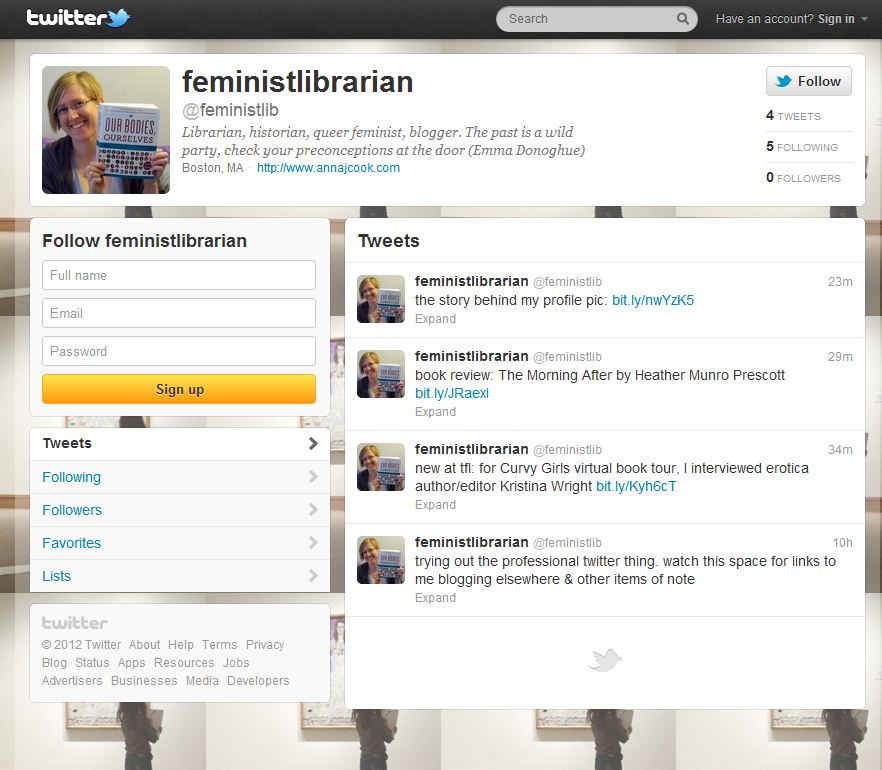
You can now find the feminist librarian on Twitter: @feministlib.

My plan is to use @feministlib primarily to share links to stuff I’ve been writing in various online spaces. I’m also going to sync it to my (heretofore moribund) Facebook status updates, so for folks whose social networking drug of choice is the Book of Faces (as my friend M. calls it), you’ll be able to find me there.

My Facebook account is closed to non-friends, but I’ll pretty much “friend” anyone who isn’t obviously schilling and/or trolling. I use my metered-filtered voice there and everything!

"curvy girls" virtual book tour: interview with kristina wright

23 Wednesday May 2012

Posted by Anna Clutterbuck-Cook in book reviews

≈ 1 Comment

Tags

gender and sexuality, interviews, smut, virtual book tours

Welcome to today’s stop on the Curvy Girls virtual book tour! I had so much fun interviewing Donna George Storey for the last virtual book tour Rachel Kramer Bussel invited me to participate in, that when she asked if I’d host a stop on the tour for her latest anthology Curvy Girls I said “yes please!” and asked if I could, again, use the event as an opportunity to interview one of the anthology contributors about writing, erotica, and all that jazz.

The contributor I immediately wanted to interview was author and editor Kristina Wright, whose story “In the Early Morning Light” is an erotic exploration of what it means to re-connect with your body and sexuality after a difficult pregnancy. I was impressed and moved by the way “Morning Light” made an emotionally-fraught and physically difficult experience incredibly porny (anyone else enjoy a little hurt/comfort and body affirmation with their tea? yes? that’s what I thought).

So I asked her to share a little bit about her process for this story particularly, and erotica writing more generally. Without further ado, here’s Kristina!


Kristina Wright (via)

1. On your website, you describe yourself as someone who has been “writing since [you] learned to read.” From the perspective of another lifelong reader/writer, I know I wasn’t particularly encouraged toward writing romance or erotica — what brought you to those genres?

I have always written what I love to read. I read a lot of Harlequin romances when I was a preteen, then I fell in love with horror. My writing interests followed my reading interests. I was a book reviewer in the mid-90s for a magazine called The Literary Times. I was reading 4 to 5 romance novels a week (everything from historical to paranormal, but nothing really erotic) and after a couple of years I decided to try to write one. I wrote one, then another– and sold the second one (Dangerous Curves, a romantic suspense). In the process of trying to sell my next romance novel, I started writing erotica. I had read a few Black Lace novels (my first introduction to erotica, other than online) and discovered erotica anthologies. The rest is history. I’ve gone from romance to erotica to a blend of both. And I love it.

2. What arrested my attention specifically about “In the Early Morning Light” (your story in Curvy Girls) is the way you incorporated painful issues of sexuality and embodiment following a difficult pregnancy into an erotic short story. Some people might think this would be a death knell to arousal, but instead the result is really hot. Can you talk a little about what inspired you to write this particular piece?

I had a baby. Ha! Actually, I had two, in December 2009 and September 2011. The story is purely fictional– my husband was deployed prior to the birth of our first baby in 2009 and was only home for two weeks before returning on deployment for another five months– but the emotions about body image, the rediscovery of sexual desire, the need for connection (and sleep!)– all of that is from experience. We live in a culture obsessed with youth and hot sex with someone new, whether it’s a hookup or a new relationship. I wanted to write a story that was not only about a committed couple, but the growth of a family and how sex– good sex!– does not end just because you have a baby.

3. In “Morning Light,” the character Carolyn initially resists her husband’s initiation of sex, but he persists and she ultimately experiences a moment of renewal and self re-discovery of her body and her sexuality post-cesarean. While I found the interaction tender and believable, it would be possible to read her husband’s persistence as pressure and emotional/physical coercion. How did you navigate the issue of enthusiastic consent in this story?

Again, I think we are culturally aware when it comes to issues of consent when it comes to being young, single and in casual sexual situations but context is everything in a scene like this. I would never write the scene this way if it were about a couple who had just met in a bar and knew nothing about each other’s needs, emotionally or sexually. But in the context of a marriage between people who have experienced all of the ups and downs that go along with a committed relationship, including childbirth, trust and faith are the foundation. Trusting that a partner has your best interests at heart, having faith that the connection that has sustained you until this point is still there even if it is dormant– that’s what this story is about. The husband’s persistence in initiating sex isn’t about his needs, it’s about her needs. And her reluctance followed by her acquiescence is about her putting her trust in him and letting go, if only for a little while. It’s this kind of connection that I crave to create when I write erotica.

4. When I write about erotica and pornography as a blogger, I often get comments asking me for reading/viewing recommendations. If you had to pick five favorite erotic stories to recommend, what would they be?

Honestly, I don’t think I could name just five stories. I probably couldn’t even name just five books! For readers who are new to erotica and maybe want some romance with their sex, I’d recommend my anthology Best Erotic Romance or Rachel Kramer Bussel’s anthology Obsessed. If you’re looking for spanking, bondage and other kinks, I love Rachel’s anthologies Yes, Ma’am and Yes, Sir and Please, Ma’am and Please, Sir or Shanna Germain’s forthcoming Bound by Lust. Alison Tyler’s Harlequin anthology With This Ring, I Thee Bed is a delicious (and big!) collection of erotic romance centered around weddings and committed, sexy couples abound! And if readers are looking for erotic fantasy, I have a new collection out called Lustfully Ever After with erotic takes on classic fairy tales.

5. Are there any particular tropes in modern erotica that you wish would just go away?

I’d be happy to never read another virgin heroine again.

6. What are some of the things you wish we would see more of in erotic writing?

I’d love to see more diverse characters. Characters that aren’t model-perfect, who are over 25 (or over 45), who are complex, who are having amazing sex in committed relationships. Stories that reflect the complex, complicated lives of characters who could be my friend or neighbor– or even me.

7. I’ve been thinking lately about the presumed audience of certain types of erotica (for example, the fact that Curvy Girls is erotica “for women”), as well as assumptions about what who would or should be interested in certain combinations of bodies (for example, people wonder whether m/m erotica written and read by women, of any orientation, constitutes appropriation). While I appreciate the appeal of themed anthologies, as a queer woman I’m often frustrated by the fact that I usually have to make a choice between an anthology of mostly heterosexual stories OR lesbian erotica OR m/m erotica, rather than enjoying the best of all three (and combinations besides!). As a writer, reader, and editor of erotic romance, do you have any thoughts about whether the market is really as segmented as the publishing industry assumes? To what extent would you say peoples’ reading taste actually mirrors their own identities, desires, and sexual activities?

I think marketing a book– any book– is important in terms of getting it in front of readers. You could slap a plain white cover on a book and put it on a bookstore shelf or the front page of Amazon, and if you don’t give readers a clue as to what it contains, the book won’t sell. So I understand the necessary evil that is the genre label. Reading tastes do seem to skew along the lines of how a particular reader identifies, though I know from experience that isn’t always true. I understand your frustration. I wish there were a better way. I think the increasing popularity of ebooks and the flexibility of the digital format may eventually alleviate some of our frustration. Now that authors and publishers are starting to offer individual stories for sale like you buy individual songs, I imagine a time in the not-so-distant future where we’ll be compiling our own personal anthologies, picking and choosing which stories we want to include from a wide variety of authors and even naming our own collections based on our current mood or interest, much like we make music playlists for parties or working out or meditation. (Remember, you heard it here first!)


CURVY GIRLS: You can read more about the Curvy Girls anthology, and find links to all the stops on this virtual book tour, at the anthology website as well as purchasing copies from a variety of online booksellers including Amazon, Powells, or Seal Press.

KRISTINA WRIGHT: Can be found online at Kristina Wright: Musings of an Insomniac Writer.

Cross-posted to The Pursuit of Harpyness.

‘the act of marriage’: ch 8-10 (when things go wrong)

21 Monday May 2012

Posted by Anna Clutterbuck-Cook in book reviews

≈ 2 Comments

Tags

gender and sexuality, live-blogging, religion, wedding

See also: intro, ch 1, ch 2-3, ch 4-5, ch 6-7.

Welcome back, folks, to the ins and outs of Christian marriage and sexytimes. We’ve reached the middle of the book and it’s time to talk about sexual dysfunction. Namely: “the unfulfilled woman” and “the impotent man.” There’s not a lot for me to rate myself on here (“frigidity” isn’t a particular problem of mine, nor is impotence), so I’m going to set aside the Adequate Lady-Spouse Metric for the next three chapters and instead just make a few more general observations about how healthy, positive sex is construed in The Act of Marriage, what major problems the LaHayes encountered in their marital counseling, and what solutions they suggest for those problems.

Overall, we continue to have a number of … I’ll call them tensions in the text between the desire to understand sexual intimacy as normal and God-given, with a number of possible paths to sexual fulfillment, and as a site for self-improvement. A sort of moral and physical proving-ground. So The Act yo-yos back and forth between encouragement (e.g. pointing out that the majority of women labeled “frigid” will respond sexually in situations where they aren’t pressured to perform in certain ways) and a fairly narrow definition of what “the act of marriage” entails (e.g. penis-in-vagina intercourse following adequate foreplay). Trying to reconcile these two goals isn’t always an easy task, and sometimes leads to baffling or conflicting advice.

Most notably, as I believe I’ve already pointed out, in the recognition that clitoral stimulation is necessary in most cases for women to experience orgasm while simultaneously holding up mutual orgasm during penetration as the sexual ideal for married couples. This, in turn, leads to a lot of paper and ink and effort spent on instructing couples how to practice just enough “foreplay” to push the woman toward orgasm while delaying male ejaculation so that (God forbid!!) he doesn’t come before penetration and/or before his partner. Because “lovemaking is impossible without an erect penis” (128).

But I don’t want to get ahead of myself. Let’s examine the main sexual woes of women and men in turn, and the solutions presented for each.

“The tragic tale of female sexual frustration winds its way through almost every tribe and people leaving literally billions of married women sexually unfulfilled” (103).

“It is safe to say that, except for Christians, the majority of women do not regularly enjoy orgasm in the act of marriage” (106).

The main sexual woe of women, according to the LaHayes, is Not Enough Orgasms. While “More Orgasms!” is a public health campaign I could totally get behind, the LaHayes give their own particular spin to the struggle of “unfulfilled” women in a couple of ways. The first, as the above quote suggests, is to try and argue that being a Christian will lead you to a better sex life. It’s unclear, as yet, why this is the case since they also illustrate this chapter with many examples drawn from pastoral counseling in which peoples’ beliefs about sexuality and Christianity are part of the problem, not the solution. But argue it they do: anorgasmia among women is at epidemic proportions, and the cure is a combination of religious faith, sexual education, and …  the all-mighty kegel.**

So, okay. Points for saying women can, and should expect to, enjoy wanted sexual intimacy. That’s the “yay for sex-positivity!” part. But then we get into the “ur doin’ it wrong” part of the section, in which women’s inability to come is largely attributed to her own moral, emotional, and physical failures. Yes, men are encouraged to slow down love-making and be attentive to their wives’ bodies (as well as to delay ejaculation; I’ll be getting back to this shortly) … but the majority of the burden falls on the wife. Which would be okay if the message was, “it’s okay to learn, and ask for, what you want in bed!” This is not what the LaHayes have in mind. Instead, they chastise women who don’t experience orgasm for experiencing negative emotions such as anger, resentment, guilt, and fear.

Reading “The Unfulfilled Woman” chapter, we learn that women who’ve experienced sexual abuse at the hands of their fathers should forgive the fathers (!!) in order to experience sexual satisfaction with their husbands. That women who are domineering (“choleric,” anachronistically enough), who feel guilty about premarital sex, who are passive, who are overweight, who are tired — all of these women may suffer from a lack of sexual fulfillment. And, basically, it’s the woman’s job to sort out her shit and get with the program.

While the kernel of truth in all of this is that each of us, individually, is responsible for exploring and communicating what we want sexually, the tone taken in The Act of Marriage is, well, preachy. And incredibly, incredibly callous toward people who have experienced sexual trauma. And in general absolve the husband of any responsibility to address relational issues (outside of the whole length of sexytimes/ejaculation thing) that might be contributing to sexual unhappiness — like, for example, a mother of young children who’s shouldering an unequal share of the parenting responsibilities, and is thus too worn out and/or alienated from her spouse to find much pleasure in sexual intimacy with same.

“After his fortieth birthday a man’s most important sex organ is his brain” (155).

“A rigid penis is absolutely essential for satisfactory consummation of the act of marriage” (157).

While the tragic dearth of lady-gasms can be cured with a combination of better sexual skill, physical self-improvement, and a judicious injection of Christian forgiveness-of-male-sins (and penitence for female ones),  the main struggle for married dudes is ejaculation: “premature,” “delayed,” or none at all. Like wives, husbands are counseled with a not-altogether-logical mix of “no matter how your body functions, you can still enjoy sex,” and “BUT YOU SHOULD REALLY BE FUNCTIONING IN THIS ONE SPECIFIC WAY.” While the LaHayes do emphasize that the majority of “impotence” issues stem from anxiety of one sort of another, rather than physical difficulties, they put men in a double-bind by basically increasing rather than decreasing, the cause for concern. To wit, in the section on the types of fear that contribute factor to impotence, they write:

(d) The fear that he will lose his erection. To a large degree, satisfying lovemaking is dependent on the husband’s ability to maintain an erection. A limp penis is unsatisfactory to both partners and humiliating to the husband (161). 

So basically, rather than offering reassurance that a “limp penis” can still experience pleasure and that partners can find alternate ways to engage in sexual intimacy, they just end up reinforcing the man’s fear that his ability to perform on cue is the linchpin of the entire experience.

Mirroring their advice in chapters seven and eight, the LaHayes concentrate narrowly on men’s sexual skills and knowledge vis a vis their wives when it comes to maintaining a sexually-satisfying marriage (e.g. remember to stimulate the clit! don’t penetrate too quickly! ohmygod don’t come before she does!!***) while it falls to women to maintain the broader emotional-relational health of the marriage. In the chapter on male impotence, for example, women are admonished not to be “nags” or be “passive,” and not to have a “sagging vagina” (get on those kegels!).

Once again, I’m left with the impression that while both partners in the marriage bear responsibility for successful marital relations, the work of women is much more nebulous and therefore potentially vast in scope — while the work of men is physical and weirdly self-absent. Where, in this landscape of orgasm/ejaculation delay and carefully-scripted lovemaking is there time for guys to just be with their partners and enjoy — without the anxiety or performance — sensual contact?

Stop back in on Friday to check out what the LaHayes have to say about family planning (I think it might surprise you)!


*For example, their claim that “until around the turn of the century, millions of women each year were cheated out of the exciting sexual climax that most men enjoy regularly” is wince-ably inaccurate. While women prior to 1900 navigated a cultural landscape that treated women’s sexual arousal as a disease to be cured, I’m pretty sure lots of them got off in creative and satisfying ways. Likewise, it’s not like twentieth-century gals had it easy in the “take my sexual desires seriously” department. If we had, terms like “sex-positive feminism” wouldn’t be tossed around with quite such frequency.

**Yep, you heard me right. The reason women’s sexual dysfunction takes two chapters and men’s only one is that women get a whole chapter on the wonders of the kegel. While I’m all behind exercising pelvic floor muscles, I’m not sure kegels have quite the transformative properties The Act of Marriage seems to ascribe them. They end up sounding like you’ll be able to jet around like the elderly kegel-practicing ninja lady from American Dad‘s Live and Let Fry.

***And what ever you do, DO NOT MASTURBATE. While it may not kill you or make you grow hair on your palms, it’s clearly contra-indicated from a Godly perspective and will probably destroy your marriage.

quick hit: "you need to show something of the sex"

18 Friday May 2012

Posted by Anna Clutterbuck-Cook in fandom

≈ Leave a comment

Tags

fanfic, sexuality, smut, television

Yesterday, while waiting to get my hair cut, I was flipping through the latest issue of The New York Review of Books and my eye happened to catch on Elaine Blair’s thoughtful review of “Girls” — the show everyone seems to be talking about these days. I haven’t seen it (we don’t get HBO) and most of the reviews haven’t really given me a reason to watch it: the fumblings of twentysomething urbanites has never been a genre that captured my attention. Blair’s review was actually the first piece I’d read that made me think the show might be worth checking out at some point — at least an episode or two.

Why? Because Blair’s essay hinges on the portrayal of sex — specifically the messy, emotionally fraught, often unsatisfying sex that I guess makes up the majority of relational sexual intimacy in the series to-date. She chooses to focus in on a specific scene in which the main character (Hannah) shows up at the apartment of her partner of the moment (Adam) for what sounds like a booty call. Adam gets off, through masturbation and fantasy, and Hannah doesn’t (not because she doesn’t want to – but because she’s not sure what she wants, and Adam isn’t present enough to pursue the question).

via

Nonetheless, Blair argues that the scene is not only insightful in its badness, in labeling it “bad” sex we may be too quick to condemn what is simply unfamiliar in our cinematic and televisual repertoire of “sex scene”:

The scene feels surprisingly frank. For one thing, though it is not particularly explicit visually (their bodies are always partly obscured), it is very explicit aurally: the sound of the condom snapping off, of Adam’s masturbatory motions, and of the changing lilt of his voice as he becomes further aroused all lend the scene a startling sense of intimacy. Even more startling is the choreography. How often, in movies or television, do you see autoeroticism incorporated into a scene of two people having sex? And then of course there is the fantasy about the young girl, articulated by a noncriminal person leading a normal life—another thing you don’t much see on television.

 Slightly later in the article she goes on to elaborate:

If all you want to do is convey an erotic tension between two people, you can leave out explicit depictions of sex acts. But if you are interested in the psychological implications of what happens between people during sex, you need to show something of the sex.

And we can find something sexy and even liberating in that sex scene in spite of our strong identification with Hannah. Hollywood sex scenes are not typically interested in even hinting at the ways that people actually reach orgasm, and this is disheartening above all for female viewers, who develop a certain melancholy by the time that they have seen their one thousandth sex scene in which it is taken for granted that by sex we mean mutually rapturous face-to-face vaginal intercourse. Even though the only person having fun in Dunham’s scene is the guy, there is nonetheless a certain joy in seeing someone get off in some other way.

Emphasis mine. You can read the entire piece here.

Since I haven’t seen the episode, I can’t speak to Blair’s interpretation of the scene. What really captured my attention, though, was the way Blair read the sex scene not simply as “good” or “bad” — and not, in a reductionist sense, as “feminist” or “not feminist” (meaning was Hannah, as the female partner, enjoying herself) — but as a human interaction that involved sexual intimacy. As a scene that we can really only make sense of by considering not only who got off but how and why — and what the meaning of such a sexual encounter is for the people involved.

This is why I read and write erotica. To learn what I want. To think about what other people want. To consider what happens when something goes wrong, and how people bounce back (or not) from “bad” sex. In our culture, we so often reduce sexually-explicit material to fuel for jerking off (which in itself dismisses the power of masturbation to help you discover what you want, how your body expresses joy, etc.). As a culture, we run squeamishly away from graphic depictions of sexual acts, believing somehow they represent some sort of one-to-one equation between what happens on screen (or in print) and the actions of readers and viewers.

But most successful erotica (in my opinion) isn’t about geometry. Isn’t about arranging, paint-by-number style, certain types of bodies in certain combinations to perform a certain pre-determined series of actions. The bodies depicted on screen (or described in text) aren’t merely amanuenses, acting like the caller at a square dance, indicating what you should be doing or thinking of next. Instead, successful erotica works because it shows us why those actions have meaning for those particular people. Such meaning-making doesn’t have to involve extensive plot development — some of the most moving slash fiction I’ve read clocks in at under a thousand words. But it all comes down to specificity, not substitution. It’s about these particular individuals in this moment of their lives having an encounter that involves sexual intimacy. And they’re inviting us in to witness and honor and be moved by it.*

Blair indicates that a lot of women are upset, uncomfortable, disappointed with the sex scene described above, in part because they identify with the character of Hannah who feels bewildered, frustrated, and ultimately un-cared for in her encounter with Adam. These are all, it sounds like, completely justifiable responses. Yet Blair also suggests that “it is safer … to criticize Adam’s insensitivity than to think of him as possessing a much clearer sense of what he wants in bed than Hannah does.”

Perhaps if we, as a culture, were more comfortable with exploring “the psychological implications of what happens between people during sex” and actually “show[ed] something of the sex” on the way by, there would be fewer Hannahs in the world, and fewer Adams as well — who might know a lot about their own bodies but, it sounds like, still have much to learn about how people can experience pleasure together.


Why don’t we go enjoy some Mulder/Scully fan fiction as an antidote:
 Waiting For Dawn | by Miss Lucy Jane @ AO3 (Explicit, 2,798 words)

*And yes, when I write “be moved by it” I do mean aroused if that’s your response.

from the neighborhood: gratuitous cat photos

16 Wednesday May 2012

Posted by Anna Clutterbuck-Cook in our family

≈ 1 Comment

Tags

cat blogging, domesticity, family, from the neighborhood, photos

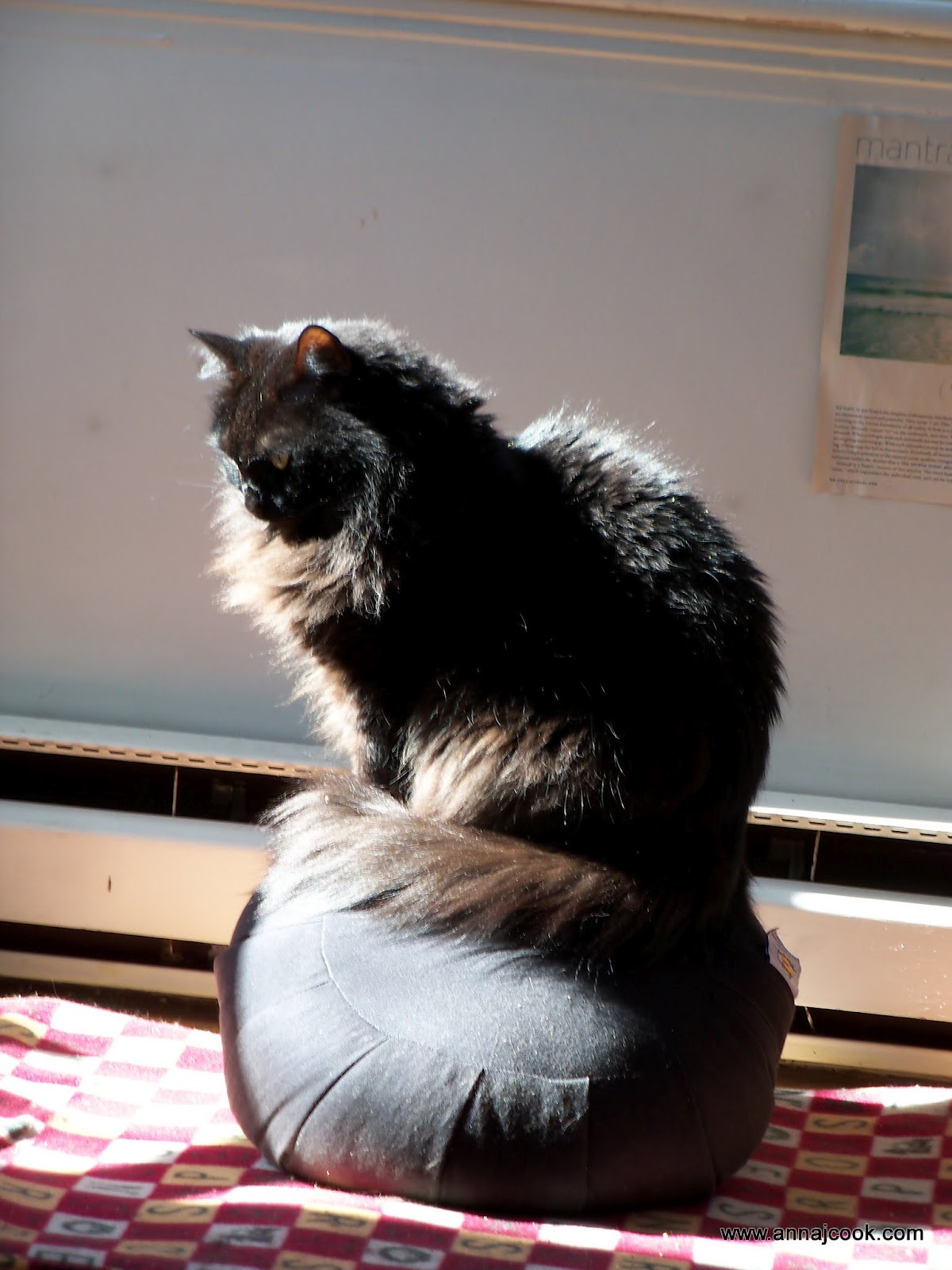
I was going to post another installment of The Act of Marriage live-blog series today, but I’m on the upswing from an epic two-day migraine and blogging didn’t happen. So instead, have some pictures of Geraldine!

she’s just discovered the back of the couch as a perch
and likes to keep an eye on us while we’re working (also steal sunshine)*
then there’s the shameless flirting with guests … 
can I haz TARDIS?
meditating cat is meditating

*Usually “keeping an eye on” translates to “sitting on the keyboard and/or page of the book the human is reading” … so in the grand scheme of things, a little hip-cuddling is very polite behavior!

‘the act of marriage’: ch. 6 and 7 (care and keeping of a wife)

14 Monday May 2012

Posted by Anna Clutterbuck-Cook in book reviews

≈ 1 Comment

Tags

gender and sexuality, live-blogging, wedding

See also: intro, ch 1, ch 2-3, ch 4-5.

Following what I’ve come to think of as the “sexuality 101” chapters come two intriguingly-titled sections, “For Men Only” and “For Women Only.” Thus I was faced with a dilemma. The “For Men Only” chapter instructs one on the care and keeping of one’s wife, while the “For Women Only” chapter instructs one how to be a wife.

Since I’ll both have  AND be, well, I decided the best  thing was to read both chapters just to be sure I had all my bases covered. I have a few overall observations about the differences between the two sections and the overall assumptions being made about what makes for positive sexual intimacy and martial relations. But first, the nitty-gritty details (you know you want them!).

Here’s what one must do in order to sustain one’s marriage:

Husbands Wives
1 Learn as much as you can.
Quote: “Since skilled lovemaking is not instinctive, a wise husband will learn as much as he can from a reliable, Christian source.” (i.e. the last two chapters of this very book!)
Adequate lady-spouse metric (8/10): I love learning about sexuality, but I can’t say I depend very heavily on “reliable, Christian source[s]” so why don’t we say five out of ten for this one.
Maintain a positive mental attitude.
Quote: “Three areas in a woman’s sexual thinking pattern are very important to her: (a) what she thinks about lovemaking; (b) what she thinks about herself; (c) what she thinks about her husband.”**
Alsm (10/10): Lovemaking = awesome, self = good enough to be getting on, wife = sexy, compassionate, smart, and kick-ass. Think we got this covered.
2 Practice self-control.
Quote: “Be careful not to overdo it, but concentrate on something that will delay your ejaculation and give your wife sufficient time for her emotional build-up.”
Alsm (2/10): I’m all for paying attention to where my partner’s at and making sure she’s enjoying  herself – but I’m not sure how that jives with delaying orgasm by thinking about football.
Relax! Relax! Relax!
Quote: “It should come as no surprise that a virgin will be rather tense in anticipation of her first intercourse.”
Alsm (5/10): While I’ve got the relaxing bit down, I think I probably lose 50% for not actually being virginal on my wedding night.
3 Concentrate on your wife’s satisfaction.
Quote: “Since a woman’s orgasm is much more complex than a man’s, it takes her longer to learn this art.”
Alsm (5/10): With two complex lady-gasms to worry about, you’d think future-wife and I would have it extra hard! Maybe that’s why the fundies are against same-sex marriage — because they worry lesbians won’t achieve enough simultaneous orgasms?
Chuck your inhibitions.
Quote: “Though modesty is an admirable virtue in a woman, it is out of place in the bedroom with her husband.”
Alsm (4/10): I’ve got the bedroom covered, but what about the living room or kitchen? And the whole we-aren’t-actually-technically-wedded-in-holy-matrimony-yet thing might move my lack of inhibitions from the “admirable quality in a wife” column to the “shameless hussy” column.
4 Remember what arouses a woman.
Quote: “Men are stimulated by sight whereas women respond more to other things — soft, loving words and tender touch.”*
Alsm (10/10): Not gonna be a problem, so much. 
Remember that men are stimulated by sight.
Quote: “The sight of a bedraggled wife may engender sympathy (though it’s doubtful) but it will rarely inspire love.”
Alsm (0/10): Oh, god, I’m always bedraggled. Future Lady Spouse despairs.
5 Protect her privacy.
Quote: “Men are far more inclined than women to be sex braggarts.”
Alsm (5/10): Since I’m a woman, you’d think I have this covered but I write a blog in which I talk about stuff like orgasms and erotica and how much I enjoy both, which probably makes me a braggart on some level.
Never nag, criticize, or ridicule.
Quote: “Nothing turns a man off faster than motherly nagging and criticism or ridicule of his manhood.”
Alsm (6/10): I agree that “ridicule” and treating one’s spouse as if they were a dependent to be controlled*** rather than a person to be respected as an equal it’s time to re-evaluate what you’re doing with this person as a spouse. But I don’t agree that avoiding confrontation, substantive argument, or asking for change is wrong.^
6 Beware of offensive odors.
Quote: “A thoughtful lover will prepare for lovemaking by taking frequent baths, using effective deodorant, and practicing good oral hygeine.”
Alsm (10/10): I have it on the authority of Future Lady Spouse that she is in favor of my odors.
Remember that you are responder.
Quote: “Except for those occasions when a wife is particularly amorous and initiates lovemaking, a husband makes the first approach most of the time.”
Alsm (0/10): We don’t have a husband, so there’s a technical difficulty here. Oops!
7 Don’t rush lovemaking.
Quote: “The time spent lovemaking varies with the culture. Researchers have indicated that the average experience runs from two minutes in some cultures to thirty minutes in others.”
Alsm (10/10): I just gotta say I find it really amusing that “more is better!” is something that has to be spelled out here.
Observe daily feminine hygiene.
Quote: “Every woman must be careful of body odors for two reasons: first, in some women the vaginal fluids … can emit a strong odor unless they bathe regularly; and second, she may become immune to her own smells.”
Alsm (8/10): While I’m a fan of the daily shower, and enjoy our wide and indulgent array of Lush products, I’m deducting points here on principle ’cause I think our ladybits smell just fine thank you.
8 Communicate freely.
Quote: “I have been appalled to learn that even well-educated people find it difficult to discuss their love lives frankly.”
Alsm (10/10): I hyperverbalize and I love sex … need I say more?
Communicate freely.
Quote: “Unless a man has read the right books or sought knowledge in the right places, much of what he knows about women is likely to be wrong when he enters marriage.”
Alsm (10/10): <– See left.
9 [I guess men aren’t responsible for prayer?] When all else fails, pray.
Quote: “I’m convinced that God never intended any Christian couple to spend a lifetime in the sexual wilderness of orgasmic malfunction.”
Alsm (5/10): While I’m all for a pro-orgasm God, I … what? (Although bonus points for phrasing!)
Okay, so … lots going on here, but a few general observations.

Notice how the instructions for men involve practical things (keeping clean, gathering information, controlling ejaculation) and are largely confined to the specific situations of sexual intimacy. Men are encouraged to slow down their love-making, learn how their lovers bodies work, respect their partner’s privacy, and to communicate with their partners about sex. So far, so good! Except for what it leaves out: men’s emotional lives. Men are assumed to want sex basically whenever their wives take their clothes off, and all of the instructions in the husband’s section are geared toward getting him to control his bestial (physical) urges and pay attention to his partner’s needs.

Now notice how much emotional work is expected from women. First on the list is the admonishment that women get into the right headspace for sex, which in the chapter involves three sub-sections worthy of discussion. Women, not men, are expected to have emotional baggage around sex being shameful, their bodies being shameful, and their partners being undesirable. In addition to basic bodily hygiene, women are expected not to look “bedraggled,” not to “nag,” and to pray (attend to the spiritual health of the couples’ relationship) when all else “fails.” Men have no analogous last-resort advice.

Finally, although none of these specific points touch on it, I want to recall from chapter five the argument that the best lover is an unselfish lover who attends to their partner’s needs and desires above their own. I think this assumption continues to play out in chapters six and seven: Husbands are instructed to subordinate their physiological response to the course of their wife’s arousal, while wives are instructed to tidy up all messy emotional and psychological issues so their husbands will be able to love them. While mutual empathy is, obviously, a major indicator of any successful relationship (sexual or otherwise), there’s a serious case to be made for the notion that selfish sex is the best kind of sex. That is, learning and owning what you enjoy, how your body responds, and how to communicate your desires, is key to pleasurable sexytimes. While focusing on your partner’s pleasure is laudable, knowing what you want and need and how to ask for it is equally important. And that’s one of the key pieces I see missing in The Act of Marriage.

IN SUM:

Ability and willingness to fulfill the duties for having a wife: 60/80 = -20
Ability and willingness to fulfill the duties of being a wife: 48/90 = -42

Chapters 6-7: -62

Chapters 4-5 score: +30
Chapters 2-3 score: -33
Chapter 1 score: -50

Cumulative ALSM Score: -115


*Having experienced first-hand what seeing my wife’s nakedness does to stimulate arousal, I’m baffled by this assertion.

**Aren’t these a good rule of thumb for anyone in sexually-intimate relationships, regardless of sex, sexual orientation, or gender?

***This isn’t the place to unpack the “motherly nagging” assumption, but if you’re treating your kid through passive-aggressive control and shaming ridicule, you’re doing it wrong.

^See also.

welcome simon!

12 Saturday May 2012

Posted by Anna Clutterbuck-Cook in our family

≈ 1 Comment

Tags

being the change, children, friends

In the wee hours of the morning, my friend Molly — after long hours of labor — gave birth to her second child, whom she, her husband Eric, and son Noah have given the name Simon.

via

Here at our house we kept Molly, Eric, Noah, the home-birth team, and as-yet-unnamed Simon in our thoughts throughout yesterday. The candle burned strong and bright from the moment I heard from Molly her labor had commenced until right about the time Simon was born.

As I said on Twitter this morning:

welcome to the strange and wonderful world, simon child of molly and eric, sibling of noah. always look for the helpers – we’ll be there!

← Older posts
"the past is a wild party; check your preconceptions at the door." ~ Emma Donoghue

Recent Posts

  • medical update 11.11.22
  • medical update 6.4.22
  • medical update 1.16.2022
  • medical update 10.13.2021
  • medical update 8.17.2021

Archives

Categories

Creative Commons License

This work by Anna J. Clutterbuck-Cook is licensed under a Creative Commons Attribution 3.0 Unported License

Meta

  • Create account
  • Log in
  • Entries feed
  • Comments feed
  • WordPress.com

Create a free website or blog at WordPress.com.

  • Subscribe Subscribed
    • the feminist librarian
    • Join 37 other subscribers
    • Already have a WordPress.com account? Log in now.
    • the feminist librarian
    • Subscribe Subscribed
    • Sign up
    • Log in
    • Report this content
    • View site in Reader
    • Manage subscriptions
    • Collapse this bar