• anna j. clutterbuck-cook
  • contact
  • curriculum vitae
  • find me elsewhere
  • marilyn ross memorial book prize

the feminist librarian

the feminist librarian

Monthly Archives: August 2015

an equidistant past [looking toward a ninth year]

29 Saturday Aug 2015

Posted by Anna Clutterbuck-Cook in life writing

≈ 2 Comments

Tags

boston

3a121-anna_threat

Selfie taken at Simmons College library (Sept 2007)

I realized on my evening commute yesterday that not only was this weekend the eighth anniversary of my arrival in Boston, but that this is the fourth anniversary I’ve celebrated since completing my graduate program at Simmons in May 2011. Which means I’ve now spent more time as a professional librarian in Boston than I did as a graduate student.

read previous anniversary posts:
year one
| year two | year three | year four
year five | year six | year seven | year eight

Thank the gods.

There were two things that almost broke me when I moved to Boston. One was the grief (still real, though muted by time) at uprooting myself from the social and physical ecology of my growing-up years and transplanting myself in a wholly new environment. It slayed me, emotionally, and was physically debilitating for most of my first year in Boston. I had panic attacks and couldn’t keep food down in the mornings, I struggled to sleep restfully without waking up in a cold sweat from inchoate nightmares.

Hanna likes to remind me on a regular basis how, during our early acquaintance, she thought I found her boring because I would fall asleep in her rooms on a regular basis when we hung out — it was one of the few places that read as “home” to my body and as a result I’d crash halfway through movie night (she still hasn’t forgiven me for snoring through the middle of Rosencrantz and Guildenstern are Dead). I know this sounds like some sort of trumped-up “soul mate” fan fiction trope but I swear that’s how it happened. I spent the next year getting up about two hours early for work so I could commute into the city with her, unable to face the task of getting from A to B without her beside me.

She found me confusing a lot. Until we figured out that kissing helping bring many things into greater clarity. But that didn’t happen until June 2009. We lived together for a year first.

Yes, our relationship did actually unfold like a story posted in response to some “last ones to figure out they’re already married” prompt.

2014-07-07 015

Selfie at the MHS with my feminist librarian’s magic wand (July 2014)

The other thing that almost brought my graduate student career to a screeching halt before it began was how much I hated being a student again. Living in a dorm was expedient, moving as I did from the Midwest without any local intelligence and few contacts. Living in the dorm, even as a graduate student, felt like a bajillion steps backward into an earlier stage of my youth instead of forward into adulthood. In short, it sucked. It sucked so much. I chaffed against being a student again even as I rejoiced at some of the new intellectual horizons opening for me.

I’m grateful for the doors graduate school opened — the opportunity to do my oral history work with the Oregon Extension, the launch of my career at the Massachusetts Historical Society, the connection I made through graduate school with Hanna (and thus the home we’ve established together), the fact that people now send me free books and occasionally pay me to review them — but yesterday when I realized I had spent more time in Boston not in graduate school than I spent as a student, it felt amazingly freeing.

I am over and done with that part of my life. I made good use of it while it lasted, and I’m glad to have moved on. I am glad to be an older adult than I was then, the same person but with an undeniably different sensibility. When I was in my late teens, early twenties, even later twenties, I used to scoff at the people who described having been a different person than they were as younger individuals (some of these people were older than I am now — thirty-four — and some of them appreciably younger). I felt a great deal of continuity with my past selves for many years, and resisted age-based narratives of change. But these days I would acknowledge that I am embodied in the world in a very different way today than I was five, ten, fifteen, twenty years ago. And I think part of my job in this coming year is to figure out what that shift in embodiment, in how I move through the world within which I am now rooted, really means and how it will shape my living in this next phase of life.

This has been your annual update. Enjoy your own autumn traditions, avoid Storrow Drive, and enjoy cider donuts from whomever your local supplier may be.
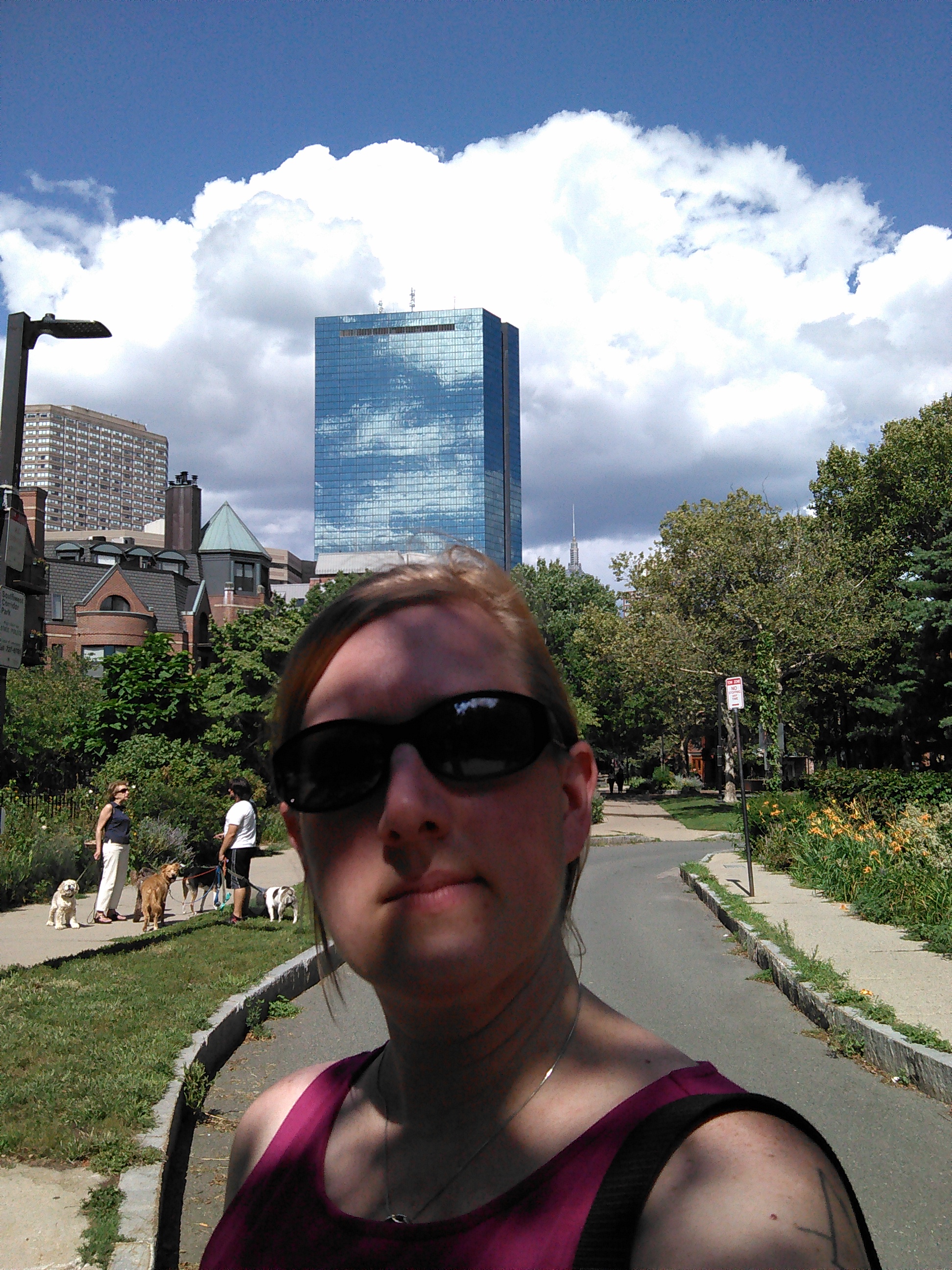
Selfie on the SW Corridor Path (August 2015)

Selfie on the SW Corridor Path (August 2015)
on being ordinary

15 Saturday Aug 2015

Posted by Anna Clutterbuck-Cook in life writing

≈ Leave a comment

Tags

family, work-life balance

I’ve been thinking this summer how grateful I am that our parents understood, and communicated to us, that we were ordinary. Unique, yes, but unique in an unexceptional way — because all human beings are unique in, well, their own unique way.

So being unique was unremarkable.

Being a special snowflake, in other words, is only “special” if there aren’t a bajillion other one-of-a-kind snowflakes on the ground alongside you. We grew up with parents confident we were … as awesome as the next person. No more, no less.

birthday138b

As a child, I probably chaffed against this. I was a seeker of adult attention. I was pleased by the fact my height often meant people overestimated my age — by my teens, in the right contexts, I was regularly mistaken for a college student and occasionally a parent rather than a babysitter. I chaffed against the limitations of youth, and to the extent that serious adult attention encouraged me to think of myself as an old soul I’m sure I chaffed against reminders that I was, indeed, pretty much the same as most other six, nine, twelve, fifteen year olds.

I started college, haphazardly, at age seventeen, although at the time I thought I would either do that or possibly pursue a career in bookselling or seek an apprenticeship in wilderness adventure tourism. I wasn’t particularly wedded to the idea of college — and, indeed, remained quasi-allergic to institutional education throughout the decade-plus span of my higher education career. But I started college, nonetheless, and by the second semester was holding my own in upper-level humanities courses with students of twenty, twenty-one. Spring of my first year I won a writing prize for an essay on erotic God language and basked in the praise of faculty impressed by my facility with words and intellectual curiosity. Throughout my college career, faculty pretty much let me run with ideas, nudging me toward graduate school, prizes, publications.

I did school well, in other words, despite my ambivalence, and got major cookies for doing so. For being an exceptional student. While I often resented and sometimes even felt nauseated by the attention, I would be lying if I said I didn’t also bask in the assurance of being able to excel by the standards of the system in which I had wandered into and chosen to remain.

Eventually, though, my gloss wore off. I was aware of it at the time: that the same independent (undeniably privileged) educational path — the one where I took more or less what I pleased and occasionally something that filled in the gaps for a degree — which has led me into college ahead of my peers also led me to graduate several years after. I went from being the youngest student in upper-level humanities courses to the oldest student (bar the rare “nontraditional” middle-aged enrollee) in a sea of first-years struggling through those skipped core requirements.

I’d gone from being read as exceptionally ahead to being worryingly behind, in terms of our cultural expectations. I was malingering in college, failing to graduate on schedule, with no clear career plan. I was not a good neoliberal student.

Even at the time I was aware that the social perception of my abilities was shifting underfoot, and felt some measure of relief. The exceptional person draws notice, expectations accrue, praise — high marks, encouragement — become ways in which admirers invest in certain outcomes. They paint a picture of you as a person which is a fantastical ideal, not a flesh and blood human, and they start speaking and acting as if you are entitled to certain things because of what they believe in you. They become invested in others seeing you through similarly rose-tinted glasses.

Again: Of course this feels good in some ways. How can it not. You really think I have a shot at …? You nominated me for …?! You think I should go for it? This socialized belief that you are exceptional also has material benefits. People who believe you are exceptional reward you with good grades, a job, a higher salary. It’s a privilege to have the story told of your life be one of success, because stories of success invite further success: doors open, invitations arrive, serendipity occurs, a cushion of self-confidence develops.

These stories may also, in part, be true — an approximation of the truth. They are true in certain details without being true in the cumulative result: I am skilled in some areas, not in others. I have strengths (as we all do) and weaknesses (as we all do). I have insightful days and days where my brain and social skills are sluggish. Parts of my body work better than others, on some days more so than on other days.

In other words, I am like every other human being.

I’ve been thinking this summer about how helpful it is to be able to return to this truth over and over again in the hyper-competitiveness of American mainstream culture — particularly around questions of work and economic success. It’s also helpful to return to in the context of adulthood in a youth-obsessed culture. As a thirty-four year old, I may or may not be part of Millennial generation but apart from definitions certainly feel less a part of that cohort than its marginal second cousin. I am not an “emerging” or “young” adult or professional at this point. I’m one of those people over thirty the young folk should always give the skeptical side-eye — and I’m actually really, really okay with that.

Why? Because I think there’s danger in thinking you’re hot shit. In thinking you’re exceptional. In thinking you deserve, that you’ve earned, the life that you’ve pieced together for yourself. We’re all in this together, and when we start imagining somehow we’re destined for greatness — or not worthy of being part of the human family — when we start worrying that we’ve missed the opportunity for some Jean Brodie act of greatness — or believing (as those who love us may be tempted to tell us) that we deserve the good things that come our way — then we will forget to pay attention to the uniqueness of those whom the world is unwilling or uninterested in treating that way, and recognizing that we walk as human beings on the earth, together.

So I’m glad to be ordinary. It’s a good kind of life.

five books

12 Wednesday Aug 2015

Posted by Anna Clutterbuck-Cook in linkspam

≈ Leave a comment

Tags

books, feminism, genre fiction, history, technology

goodreads_aug2015I can’t seem to get it together to write reviews I haven’t promised to third parties this year. So in lieu of a subject/verdict post here’s a list of five books I’m currently reading, five books I’ve read recently, and five books I cannot wait to read.

You’re also welcome to stalk me on GoodReads if that’s your kind of thing. I’m ahead on my goal for the year! That’s what reading a lot of novellas will do for you, I guess. I’m still irritated there’s no good way to count fan fiction toward the total…

currently reading

Delirium
by Lauren Oliver

The Feminist Utopias Project: Fifty-Seven Visions of a Wildly Better Future
edited by Alexandra Brodsky and Rachel Kaunder Nalebuff

Orphan Number Eight 
by Kim van Alkemade

The Red Heart of Jade
by Marjorie M. Liu

Reflections (Indexing serial #2)
by Seanan McGuire

have recently read

Everything Leads to You
by Nina LaCour

Lafayette in the Somewhat United States
by Sarah Vowell

Never After (short stories)
by Laurell K. Hamilton, Yasmine Galenorn, Marjorie M. Liu, and Sharon Shinn

This is Why We Can’t Have Nice Things: Mapping the Relationship Between Online Trolling and Mainstream Culture
by Whitney Phillips

The Thrill of the Chaste: The Allure of Amish Romance Novels
by Valerie Weaver-Zercher

cannot wait to read

Archival Desires: The Queer Historical Work of New England Regionalism (November 2015)
by J. Samaine Lockwood

Chapelwood (September 2015)
by Cherie Priest

A Red Rose Chain (September 2015)
Seanan McGuire

Reforming Sodom: Protestants and the Rise of Gay Rights (August 2015)
Heather Rachelle White

Welcome to Night Vale: A Novel (October 2015)
by Joseph Fink and Jeffrey Cranor

booknotes: the sex myth

04 Tuesday Aug 2015

Posted by Anna Clutterbuck-Cook in book reviews

≈ Leave a comment

Tags

books, gender and sexuality

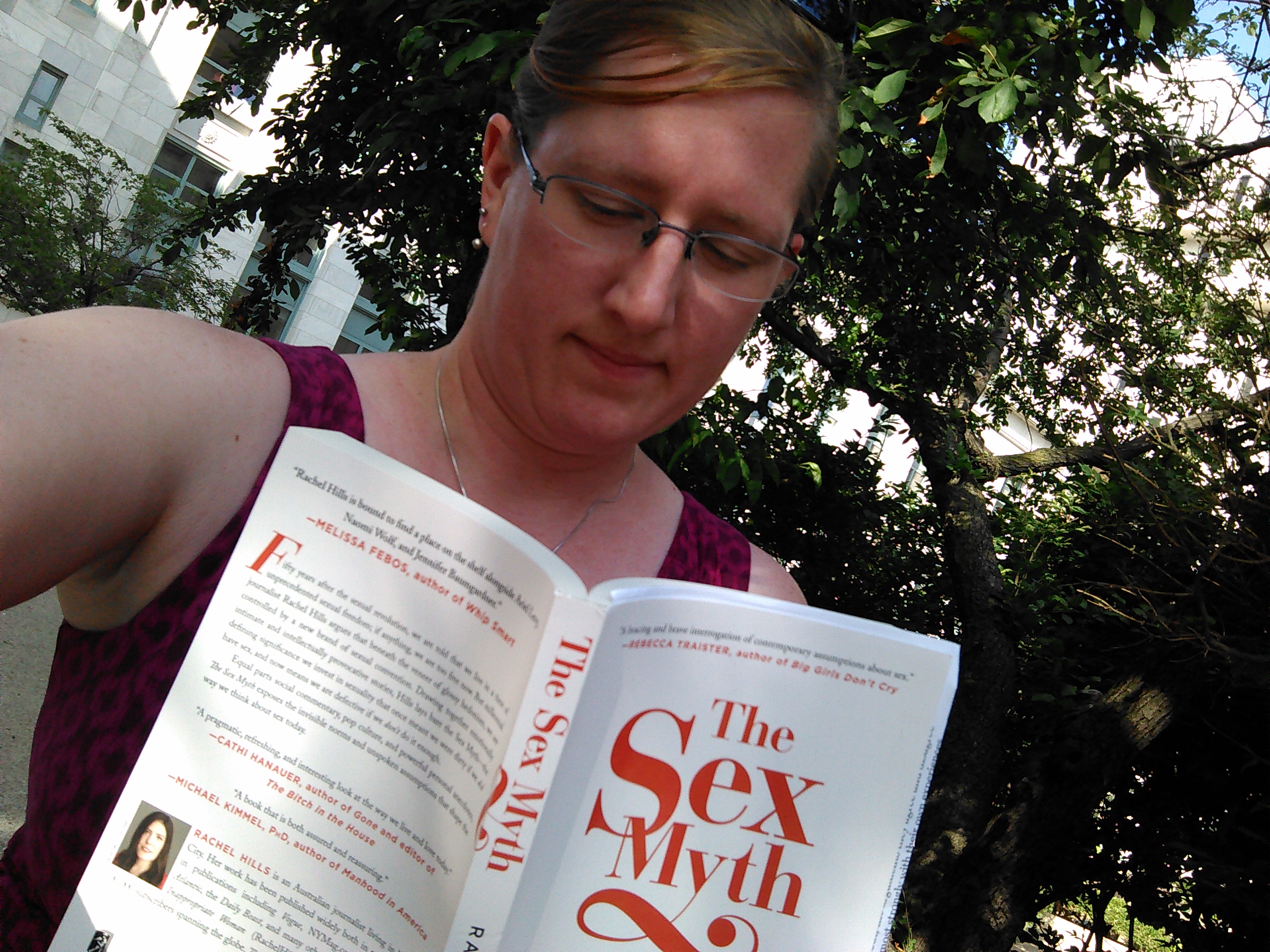
IMG_20150710_171202Rachel Hills’ The Sex Myth: The Gap Between Our Fantasies and Reality (Simon & Schuster, 2015) is released today in the U.S. I’ve had the privilege of watching this book grow into being on the Internet over the past half-dozen years and — full disclosure — in 2012 I became one of the over 200 interviewees whose stories form the backbone of Hills narrative. It was with some measure of bystander pride, therefore, that I cracked open the spine of my reviewers’ copy last month and sat down to read the final iteration of Hills’ research on the sexual cultures of our English-speaking world (primarily Australia, Britain, and the U.S.).

The Sex Myth is a book-length work of well-researched journalism, drawing from various disciplines — history, philosophy, psychology, sexology, sociology — as well as personal narratives gleaned from those one-to-one interviews to explicate what Hills refers to as The Sex Myth. Continue reading →

"the past is a wild party; check your preconceptions at the door." ~ Emma Donoghue

Recent Posts

  • medical update 11.11.22
  • medical update 6.4.22
  • medical update 1.16.2022
  • medical update 10.13.2021
  • medical update 8.17.2021

Archives

Categories

Creative Commons License

This work by Anna J. Clutterbuck-Cook is licensed under a Creative Commons Attribution 3.0 Unported License

Meta

  • Create account
  • Log in
  • Entries feed
  • Comments feed
  • WordPress.com

Create a free website or blog at WordPress.com.

  • Subscribe Subscribed
    • the feminist librarian
    • Join 37 other subscribers
    • Already have a WordPress.com account? Log in now.
    • the feminist librarian
    • Subscribe Subscribed
    • Sign up
    • Log in
    • Report this content
    • View site in Reader
    • Manage subscriptions
    • Collapse this bar
 

Loading Comments...