• anna j. clutterbuck-cook
  • contact
  • curriculum vitae
  • find me elsewhere
  • marilyn ross memorial book prize

the feminist librarian

the feminist librarian

Author Archives: Anna Clutterbuck-Cook

live-blogging ‘inspector lewis’: wild justice (5.2)

11 Sunday Sep 2011

Posted by Anna Clutterbuck-Cook in media

≈ Leave a comment

Tags

british isles, live-blogging, masterpiece, television

James Hathaway (Laurence Fox)

Welcome to another installment of live-blogging Masterpiece with Minerva, Hanna and Anna, at the particular request of our friend Lola who joins us today via Skype. Today’s Masterpiece is an episode from season five “Inspector Lewis”: “Wild Justice” (5.2).

Stay tuned for updates beginning at 9pm this evening.


Mmm. Okay. Last minute change of plans as WGBH has revised their schedule at the 11th hour and we aren’t getting “Lewis” tonight! Check back in next Sunday and we’ll try once again.

articlenote: setting the record straight

09 Friday Sep 2011

Posted by Anna Clutterbuck-Cook in think pieces

≈ Leave a comment

Tags

british isles, children, education

Thanks to a recent issue of Education Revolution E-News, I was alerted to the existence of the Journal of Unschooling and Alternative Learning, a free online resource for scholars in the field and interested others. Yay! More stuff to read! The journal has been going since 2007 and all five of the annual volumes to-date are available in HTML and PDF form. Yes: I’ll be working my way through the back catalog.

But today, I want to highlight an article from the current issue: “Setting the Record Straight: Interviews With a Hundred British Home Educating Families,” by Paula Rothermel (JUAL 5, 2011: 20-57). I was super excited when I saw this article because it sounded very much like the type of research I thought about doing back in 2006, when I applied for a Marshall scholarship to do an independent research project in England under the supervision of Professor Clive Harber. The scholarship didn’t come through (obviously), but I’ve remained interested in research on home education and Rothermel’s comprehensive study of the styles and outcomes of home-based education does keep cropping up. On my reading list is her recently-available e-book Home Education: Rationales, Practices, and Outcomes (Thesis UK, 2011), which is an in-depth exploration of home educated based on interviews done with one hundred British families who had chosen to homeschool in some way, shape, or form. “Setting the Record Straight” (html, PDF) is a summary of the findings from that project, and Rothermel makes a few really interesting initial observations. Continue reading →

30 @ 30: school [#8]

07 Wednesday Sep 2011

Posted by Anna Clutterbuck-Cook in life writing

≈ 4 Comments

Tags

children, education, family, thirty at thirty, work-life balance

When it comes to school, I did things somewhat backward. In that, as a child, I didn’t go to school … and then, as a grown-up, I spent about twelve years (give or take) in institutions of higher education. As a student.

As regular readers of this blog know, my siblings and I were home educated from birth to college (in my case) and high school (in my siblings’ cases, part-time and full-time respectively). You can read more coherently about that experience, from my perspective in an interview I gave last December. I’ll try not to repeat myself here.

What I’m going to talk about in this post, specifically, is what “school” meant to me as a child, and then what it was like to be a student as a teenager and young adult — when I hadn’t grown up learning to conceive of myself in that way. And then what it was like to graduate from college, be a not-student briefly, and then return to student life as a graduate student (briefly: fucking hard).

So to begin: When I was a child, I thought not attending school was normal. Well, no. It’s not that simple. I understood — from the questions I got from grown-ups, from the stream of children walking to the neighborhood schools (Catholic and public), from the basic fact that children in books almost unerringly attended school — that school was something many children did. But when my mother asked me, once, when I was about five how many children I thought homeschooled I told her after a moment’s reflection that “about half” seemed a likely number.

This probably, in all fairness, reflected the statistics in our immediate circle of acquaintances. But obviously was not reliable data for the population more generally.

School, to me as a child, was something that other children did. And I honestly never thought about it much as an activity I could, should — or might want to  — engage in. It sounded boring, and required getting up early leaving all the projects I had going at home in order to do other projects. That seemed inconvenient at best, and threatening at worst. I remember being pissy about the crossing guards who were stationed at the street corners in my neighborhood before and after school, and for the children going home at lunch — I used to defy their instructions on principle because I wanted them to understand they couldn’t control me because I wasn’t one of “their” kids.

I was a pain like that, growing up.

I liked being the one in charge.

So school, until I was seventeen, was this thing I didn’t do. Couldn’t possibly fit into my busy schedule, which included stuff like volunteering at the local history museum and working part-time at a children’s bookstore, writing novels and traveling with family. At the time my schooled friends were taking the SATs and applying to colleges, I was seriously on the fence about even going to college at all. I was thinking about alternatives like full-time employment and apprenticeships. But thanks to my dad’s job I was able to enroll in a first-year writing course without matriculating, and since my career options at the time included “novelist” as well as “bookshop owner” and “museum curator,” I figured that was a good a place as any to try this school business and see if there was anything to it.

I fell instantly and utterly in love. With the class, with creative writing, with my professor, with the campus events we were required to attend as part of our coursework (film series, symposia, guest speakers), with being part of a larger conversation. I loved the routine of getting up on those autumn mornings, going for a run, getting ready for work, and then walking the six blocks to campus for my 8am class before turning up for my shift at the store. Yes, I struggled over assignments. Yes, I was terrified of failing at this school thing. Yes, I inevitably came across as weird and probably more than a little threatening to my fellow first-years who turned up in their pyjama pants, bleary-eyed from late night socializing or early-morning athletics training.

But that first year of college (I took first-year college writing in the fall of 1998; Christian feminism and creative nonfiction in the spring of 1999) was also utterly exhausting. The 1998-1999 school year was a politically charged year on campus, about which I’ve written before.  I found the semester schedule a roller coaster ride of intensity and deadlines and never-enough-time-for-a-job-well-done. I couldn’t imagine how students were able to complete the work for four or five courses at a time, when the hours it took for me to complete the reading and writing for one or two courses felt like a full-time job. I hated having work graded (and actually requested that faculty refrain from marking my work with a letter grade during those early years). I hated the apathy and/or competitiveness of my peers.

College did get me to places like this
(Coniston Water, Cumbria, England, 30 March 2004)

I went back. For seven years, I went back. But while there were things I loved about college I can’t say I ever found the point of equilibrium between these two poles of ecstasy and despair. I threatened to drop out of school literally every semester I attended. All through undergrad, and then again in graduate school. It was always a deliberate decision to walk back in the door the following term.

It’s hard to talk about why the experience was so difficult for me. Yes, it got better. And yes, there were always reasons to stay: amazingly dedicated, energetic, and insightful professors; articulate, thoughtful, and generous fellow students; resources to pursue the ideas that galvanized me; opportunities to travel, to present papers, and connect with fellow scholars and like-minded folks. When I talk about the poisoned feeling in my bloodstream whenever I’m in institutional spaces of education, I know it hurts a lot of people near and dear to me, who are doing good work in those spaces, and who have found a home there — for better or worse. I’ve learned over the years to make it as personal an observation as I can, though obviously my critique of institutional schooling is broader than a simple “I don’t thrive there.” I think many people don’t thrive there, and yes, I have a problem with that. But many people do … so I don’t know what to do with that.

When I returned to grad school in 2007, after two years of incredibly freeing non-school life, I was taken aback by how much I resented the return to academia — even as I was excited about launching my library science career. My emotional, mental and physical health had almost immediately improved when I graduated from college in 2005: I’d started sleeping better, eating better, feeling more energetic and experiencing a stronger libido; my mood felt more stable and positive, even in the face of uncertain job prospects.  And my first year in graduate school (combined, to be fair, with a cross-country move) brought on nausea, shortness of breath, weight loss, and other symptoms of fairly extreme anxiety.  As early as the road trip out to Boston, I was already writing in my journal about the misgivings I had about returning to school and the feelings of claustrophobia and regression they engendered. I felt like I was returning to being a teenager again, somehow erasing the experiences of the intervening decade.

It was not a good feeling.

This was hands-down the best part of graduate school,
apart from meeting Hanna there.

I got through it. I’m not sure, yet, whether to look upon graduate school as an improvement on undergrad or vice versa. Without the economic luxury of being a full-time student (as I had been in undergrad), I was forced (and intentionally chose) to maintain a life outside of school that was ultimately much more meaningful than what happened inside the walls of Simmons, both professionally and personally. I will be forever grateful to the Simmons dual-degree program for making the space I needed to begin my research on the Oregon Extension; at the same time, the project itself was borne out of the way in which my psyche responds to institutional education — as a coping mechanism to help me exist in a hostile environment. But I left graduate school no more enamored with the structures of school than I had been in college. And while the sea-change in well-being post-graduate school hasn’t been as marked as it was after I finished my BA, I have noticed a definite turn for the better when it comes to my own emotional and mental stability, my energy level, and the juggling act of work-life balance that follows us everywhere. As the students flood back into Boston this fall and classes begin again, I am unambivalently thankful not to be in their midst. Even as I make plans to pick up my research and writing once more.

For the first seventeen years of my life, school was simply something that didn’t apply to me. For the past thirteen years, it’s been an inescapable part of where I wanted to go and how I had to get there. Now, I have the chance to exist on the outside again. I think, though, the scars will linger. And I mean that in a positive as well as negative way: scars as markers of how experience changes us. It will color how I study and think about education and learning, about schooling and unschooling. It will inform how I think about the ways in which we, as a culture, choose to organize human life and make sense of our existence.

Many people in my life maintain, with great personal conviction, that I will make my way back to the classroom again — either as a student or as a faculty member. I myself am far from sure. For the first seventeen years of my life, I explored the world without the framework of school. I’m kinda looking forward to getting back into that rhythm, seeing how the old clothes fit.

uneasy detante [photo post]

05 Monday Sep 2011

Posted by Anna Clutterbuck-Cook in our family

≈ Leave a comment

Tags

cat blogging, domesticity, hanna, holidays, photos

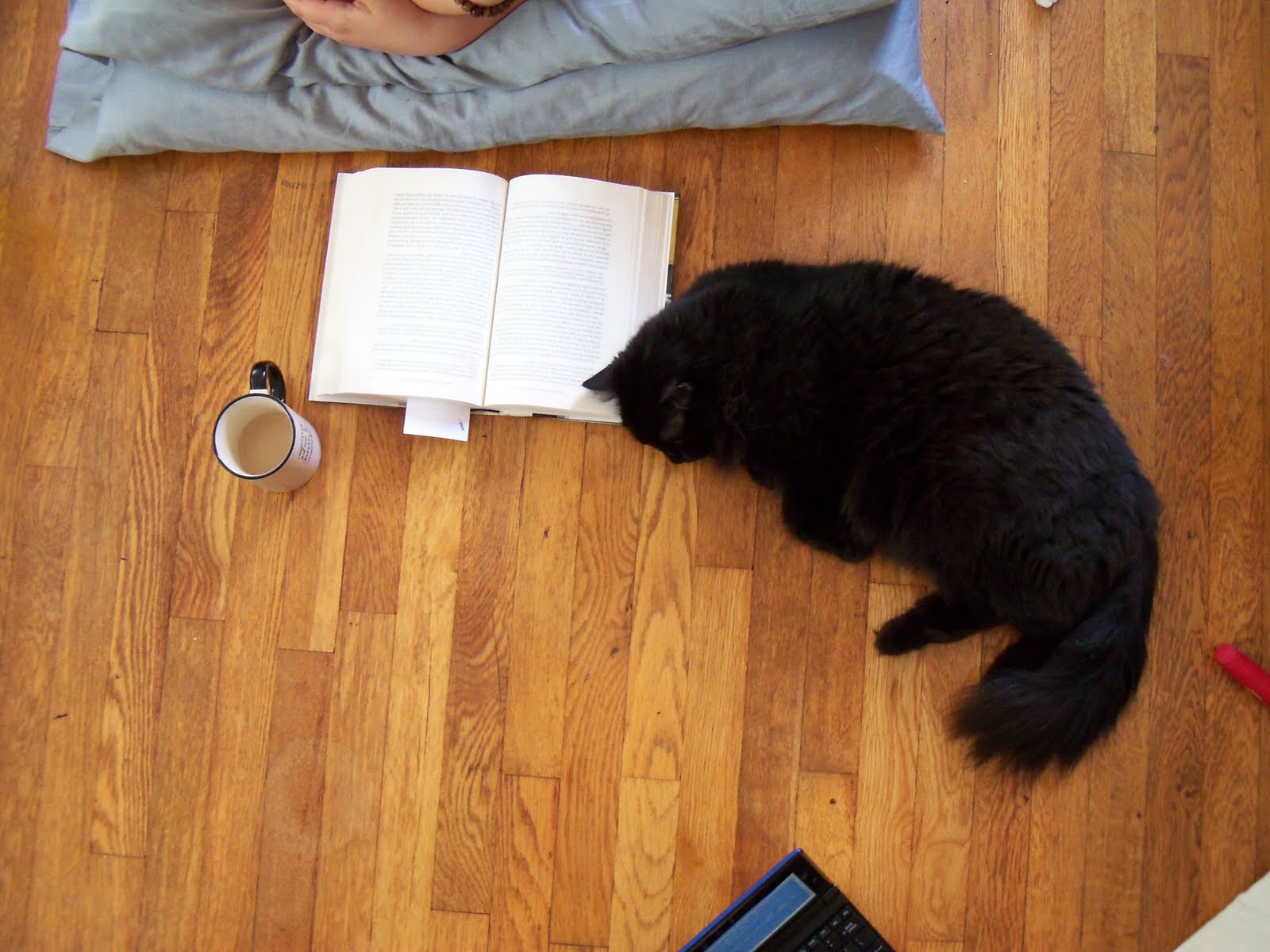
This is life in our household today. Hope yours is as relaxing!

Geraldine attempts to commune with
Bismarck: A Life by Jonathan Steinberg

~Anna and Hanna, Labor Day 2011

four years ago today: "first class, etc."

05 Monday Sep 2011

Posted by Anna Clutterbuck-Cook in life writing

≈ Leave a comment

Tags

boston, family, four years ago today, hanna, simmons

So in an exercise of sheer archivist-historian self-indulgence, I’ve decided to offer an occasional series this fall that features emails written by 2007 me about my first few months in Boston (and first semester in graduate school). I’m going to kick the series off with an email I sent out to my family on 5 September 2007, on the first day of the fall semester. It features bookstores, libraries, Hanna, classes, and more! I’ve added a few clarifying notes, deleted some individual’s names, and included links to relevent posts from back then. Other than that, it’s a gen-u-ine primary historical source!

From: Anna
To: Brian, Janet, Maggie, Mark, and Joseph
Date: Wed, Sep 5, 2007 at 9:53 PM
Subject: First class, etc.

Hiya all,

Dad wrote earlier and thanked me for keeping y’all “in the loop” about what’s going on in my new life here in Boston. Ha! That’s a losing battle :). Things are happening so swiftly right now, I’m pretty sure I can’t keep up with them myself, let alone keep everyone else up to speed . . .

But here are a few developments in the last 24 hours.

(No, you don’t all have to read ALL of it, if that’s what you’re thinking B & M . . .)

This morning I spent a couple of hours on the phone with Q, the computer magician at Lean Logistics [a company I was working for remotely], setting up the Virtual Private Network (VPN) connection with Lean Logistics. In order to do this, he set up a WebEx conference connection which (get this!) allowed me to give him a remote view of my desktop and control of the mouse on my computer! So I had the very surreal experience of watching my mouse float around doing things while Q talked in my ear, muttering to himself about what he was doing. It was quite cool, actually. And the most important thing is that it worked! So I am now back on board with the whole data entry thing, and fingers crossed it will turn out to be worth the fuss.

On the other job front, I took the Green “D” line downtown to the Prudential Center today and met R [a department manager at Barnes & Noble, where I had transferred from my previous position in Holland, Mich.]. The store is a very strange, warren-like layout, with the children’s department situated back of beyond . . . but she assured me she tries to schedule at least two people in the department at a time. The schedule sheets and “dailies” of staff assignments are intimidatingly large! She said they have about 120 people on staff (though of course not all in the store at one time). I will be starting work a week from Friday, with a 7:00am-11:00am “zoning” shift, which means shelving and so on in the early morning. The next two weeks I have no closing shifts, thankfully, so that I can get a feel for the public transit routes without worrying about returning to the dorm at midnight. There seem to be no truly straightforward ways directly from the Prudential Center to the residential campus. There is a [subway] station incorporated into the center which stops fairly near the [Simmons] teaching campus, but several blocks away from the residential campus. The alternative is to walk a few blocks from Prudential and then take the subway line that stops right next to the dorm. I will have to ask around about what’s advisable. My impulse would be to refuse to be intimidated, but I also don’t want to take foolish risks.

When I was down at the Prudential Center, I took a very pleasurable detour to the Boston Public Library and signed up for my very own library card. It made me positively giddy and possessive feeling . . . like Eva [a child my mother cared for] signing up for her first library card (well, maybe not THAT giddy). You’ve all seen pictures of the BPL before, but here’s a picture of me with my new card standing on the steps in front of the statue of Our Lady of the Libraries (or whichever muse she’s supposed to be) on Copley Square.

Boston Public Library, Copley Square (September 2007)

Meanwhile, just to add spice to my work life, my friend Hanna — a GSLIS student with whom I’ve been corresponding this past year & just met at the History reception last night — emailed me this morning to say that the archives at Northeastern University, where she works, will be starting a year-long grant project October 1st, for which they need a part-time (10-13 hours/weekly) assistant. They are digitizing records from Freedom House, a civil rights organization from the 1950s that worked to integrate (and keep integrated) neighborhoods in Boston. She is urging me to apply for the job, and her supervisor said I should put in my resume ASAP — so I don’t have a lot of time to decide. At first I was like, “gawd this is too much!” But the more I think about it, the better it sounds . . . it pays $15/hour and it looks like Barnes & Noble won’t be offering me more than around 10 hours a week, which means I lose the permanent part-time status. Without that, there really isn’t much incentive to keep the job for the long haul (aside from the employee discount & pleasure of being around, um, books, which doesn’t seem to be a problem for me!). So, I’m going to apply for the job, and if I get it probably a) restrict my hours at B&N and b) quit after Christmas. [I didn’t get hired by Northeastern at this interview, but went on to work for them first as an intern and then as a part-time archives assistant a few years later.]

My final stop of the day was the Introduction to Archives class. This is the first of the three Archives core classes, so most of the students in the class are starting their AM (archives management) focus. This can happen either after they’ve already been library science students, or (as in my case) if they come in knowing what they want to focus in, and perhaps even dual-degreeing (can that be a verb?). I don’t know if I’m unusual, but I’d say that I’m less committed to archives as a specific type of library science than I am to doing both history and library science . . . if that makes sense? I get the impression that students dual-degree because the history will be useful in their archives career, or they got into archives through their history undergrad. I wouldn’t say I thought “archives!” when I imagined becoming a librarian, though there are certainly lots of things to recommend it. I mean, it doesn’t take much to get me all enthusiastic about public history, collective memory, material culture, the democratization of access, and so on. But there are moments (like every other one) where I could just as easily become a Public Librarian in some place like . . . oh, Leland? Or drive a bookmobile through the Lake District?

That having been said, I’m sort of on syllabus high right now, which comes before syllabus shock (that sets in after all three courses have had their first days, and I start accumulating project deadlines). Next week, I’ll get to choose my top three choices for the 60-hour internship out of over 100 options Simmons lines up for us. Fingers crossed it’s something with women’s or social justice history, or education . . . it’s Boston, I’m sure I can manage something! Or perhaps something off-beat will catch my eye that I never even thought of.

And the professor, V, seems nice (if a little prone to rambling . . . really, how many profs have you met who DON’T have that tendency?) She’s enthusiastic, available, and her basic message was: plan ahead, keep me informed, and don’t panic.

Well, I should wrap this email up and hunt down my resume for a little polishing (I’m going to put off writing the cover letter until I’ve had a sobering night’s sleep behind me).

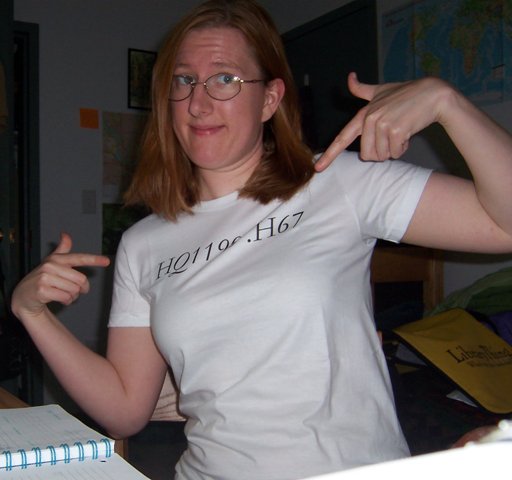
Tomorrow I get my first History Methods class — hooray! — in the afternoon. I think that’s the one that has everyone shaking in their boots (“so much reading!” is what I keep hearing . . . um, and this is a problem to us library students HOW??). That and this job application are the last big things on my list this week. Other than that, I’m going to try and finish my online technology tutorial, open my bank account, and pick up my ZipCar card and paperwork at the main office downtown. And Saturday, Hanna is taking me out to all the best used bookstores, or to a museum, and her favorite coffee shop . . . or something frivolous, geeky and fun. I finally ordered my “Feminism is for Everyone!” library call number shirt (HQ1190.H67) and am hoping I have it in time to wear on our outing.


I did wear this shirt on our Saturday outing;
To this day, Hanna remains particularly fond of it.

 Love to you all,
Anna

harpy fortnight: labor day weekend edition

04 Sunday Sep 2011

Posted by Anna Clutterbuck-Cook in linkspam

≈ Leave a comment

Tags

harpyness


why yes! I have spent the month of August reading
Dean/Cas slash. it’s all about the wing!fic people!

 Can you believe it’s September folks? Here’s what’s been happening over at Harpyness during the month of August.

As has been the case for the last several months, about half of my blogging there is taken up with the live-blogging of Jessica Yee’s anthology Feminism For Real. The installments for August were:

  • 2011-08-09: Male Feminist and Invisible Activists
  • 2011-08-18: Maybe I’m Not Class-Mobile; Maybe I’m Class-Queer
  • 2011-08-23: Sex Work and Feminism
  • 2011-08-30: No, I Would Follow the Porn Star’s Advice

There’s been some good discussion in comments (particularly the 8/18 and 8/30 installments) about academic training, marginalization, privilege, ways of knowing, and all sort of things. Be sure to check them out!

I must be thinking a lot about human sexuality and identity right now, because I wrote two posts on the subject:

  • 2011-08-11: Acting Queer: Dis-jointed Thoughts on ‘Playing Gay’
  • 2011-09-01: “I’m Not Straight, I’m Not Gay, I’m With You”: What Does Orientation Mean to YOU?

In addition to that, I cross-posted my piece on (not) being a parent and wrote in celebration of siblings. I shared a trailer for the documentary ‘Kings of Pastry’ which if you haven’t already seen should go on the list.

I also facilitated, as promised, guest blogging by Hanna (JediCrow), Minerva, and Lola. Highlights include Hanna’s posts on new series and classic Doctor Who, M’s thoughts on Star Trek and the gender binary, and Lola’s observations about the politics of DADT.

As always, if any of this interests you, please swing on by to join the conversation!

booknotes: birth matters

02 Friday Sep 2011

Posted by Anna Clutterbuck-Cook in book reviews

≈ Leave a comment

Tags

books, children, feminism, human rights, sexuality

I must have hallucinated starting the review of this book, because I have a clear memory of doing so but now cannot find the draft anywhere. Och, well. We’ll just have to begin again.

I need to admit upfront that I’m an entirely biased reviewer of anything Ina May Gaskin writes. My mother’s copy of Spiritual Midwifery was, along with Our Bodies, Ourselves, one of my adolescent introductions to feminism, as well as to female bodies and the amazing things they’re capable of. I think what Gaskin and the other midwives at The Farm have been doing for the past forty years is hands-down one of the most awesome things to come out of the 1960s, the women’s health movement, and feminist activism. So when my friend Molly offered up Ina May Gaskin’s Birth Matters: A Midwife’s Manifesta (New York: Seven Stories Press, 2011) as one of the reading options for her GoodReads reading group on feminist pregnancy, birth, and parenting, I jumped at the chance.

UPDATE: You can read Molly’s review over at first the egg.

That having been said, I also approached the Gaskin’s memoir with some trepidation: how would her work and her writing come across in a new book, one that would be impossible to read through the filter of “that’s just how they talked about things back in the 70s…”? I was a little bit worried about being let down, much in the same way one’s favorite books from childhood often feel a bit tarnished upon re-reading.

My fears, however, were (mostly) all for naught. Birth Matters is highly readable, compelling, contemporary, and unapologetically feminist in its approach to the political and cultural barriers to high-quality pregnancy, birth, and parent-and-child care in our society. “The way a culture treats women in birth is a good indicator of how well women and their contributions to society are valued and honored,” Gaskin argues in chapter one, “The Importance of Birth and Birth Stories”:

My intention in this book is not to persuade those women who want to avoid pregnancy to change their minds — far from it. But I do want to convince even women with no interest in motherhood that the right to a positive and safe birth is just as important as the right to choose whether or not to have a child (7).

She gently points out that the often bitter divisions between parents and non-parents is an unhelpful model for making our world a better place for all humanity: “It is time for feminists to realize that pitting the needs of nonmothers against those of mothers is a way of weakening — not strengthening — women. Women should not lose their human rights when they become mothers” (41). Beyond looking at women and mothers, she articulates what I think should be shouted from the rooftops by us all: that the way we welcome children into the world speaks volumes about how we value humanity — and as such, birth matters to all of us simply because we are part of that human community. The way we were welcomed into the world and cared for as infants and children is part of that story, even if we don’t ever plan on becoming parents ourselves.

Gaskin has been in the enviable (for most midwives) position of enjoying strong, positive working relationships with practicing OB/GYN physicians throughout her tenure as a midwife at The Farm, and her belief in the ability of medical doctors and lay or nurse-midwives to work together to foster positive birth experiences for families is evident throughout the book. I really appreciated the way she highlighted the work of medical doctors who trust birthing parents’ bodies and offer their expertise without trying to direct the process or fueling fear of the body’s work during pregnancy. Yes, sometimes life-threatening complications develop during pregnancy and birth — but too often in our culture we attempt medical interventions in childbirth that end up being detrimental to the health and well-being of both infants and their birth parents. Gaskin offers an alternative vision of how birth practices can be (and have for the nearly three thousand births Gaskin and her team have overseen in the forty years between 1970-2010). Indeed, it is the outcomes of Gaskin’s practice that will likely be most compelling for skeptics of out-of-hospital childbirth: of the 2,844 births attended at the Farm 94.7% were completed at home with a maternal death rate of 0% and a neonatal death rate of 1.7 deaths per 1,000 births. The Farm’s rate for c-sections stands at 1.7% which nation-wide hovers between 30-50% (far exceeding the World Health Organization’s recommendation of 5-10% of all births*).

Most of what Ina May Gaskin has to say will sound familiar to anyone who has read recent books on pregnancy and birth, particularly Born in the USA by Marsden Wagner and Pushed by Jennifer Block (I highly recommend them both). However, there is some valuable material here that even those familiar with the arguments for the midwifery model of care will likely be interested in. Interspersed throughout are birth narratives written by women who have given birth at The Farm. From my point of view, there can never be too many birth narratives out there for us to draw upon. It’s particularly useful to read how different each person’s story is, even though they have made some of the same basic choices about the type of care they want to receive. I was also glad to see a chapter on sexuality and childbirth — something I wish Gaskin had done more with. The midwives at the farm have long advocated for sexual interaction between a laboring woman and her partner(s) as a way of facilitating a less painful, more effective labor. The idea of “orgasmic childbirth” might seem obscene to some, idealistic to others, but even if you don’t want to think about childbirth itself as a sexual experience, I think Gaskin has some important points to make about the way medicalizing childbirth (treating it as an illness) has removed women’s bodies and their physical presence — sexual and otherwise — from the active birth process.

My one frustration with Birth Matters is the consistency with which Gaskin’s language choices and examples reinforce the assumption that all birthing takes place within the context of heterosexual, gender-normative lives. The birth parent is consistently a woman/mother and is never identifiably partnered with a woman, although in several stories it is unclear whether the birth parent is single or has a partner. This seemed like an odd oversight for someone who is otherwise so clearly open to the possibility that families come in many shapes and sizes. At times, Gaskin also over-simplifies the history of midwifery and falls into the trap of romanticizing the sacred feminine and female bodies — something that makes me slightly uncomfortable since I try to avoid essentializing femininity/femaleness. I’d recommend, as a supplement to reading this, the wonderful essay “The Manly Art of Pregnancy,” by j wallace (found in Gender Outlaws: The Next Generation, edited by S. Bear Bergman and Kate Bornstein, 2010) which just might be my favorite thing written about pregnancy ever. And I would hope that future editions of this work acknowledge more overtly that people with many different sex and gender identities and family contexts become pregnant and wish to give birth in supportive, low-intervention settings such as The Farm.

The final verdict: Read this book if you care about the cultural and political contexts in which we come into the world, and if you question — even a little bit — the medicalization of pregnancy and childbirth that has become the norm in our country at this point in history. Gaskin’s memoir-manifesta is a beautiful testament to how there is a different way — not just in the future, but here and now.

*See the WHO report The Global Numbers and Costs of Additionally Needed and Unnecessary Caesarean Sections Performed per Year: Overuse as a Barrier to Universal Coverage [PDF]

30 @ 30: urban living [#7]

31 Wednesday Aug 2011

Posted by Anna Clutterbuck-Cook in life writing

≈ 2 Comments

Tags

boston, maine, michigan, thirty at thirty, travel

Four years ago today, I hit the road in a rental car full of earthly possessions to drive from Holland (Mich.) to Boston (Mass.) and begin my life as a graduate student and city dweller. Starting next week, I’m tentatively planning a whole series of posts using emails and photographs from the fall of 2007, to reflect back on that transition and what that first semester at Simmons (and my first few months in Boston) were like.

In this installment of 30@30, though, I want to talk about being a city dweller more generally, and my experience of visiting and living in cities as a young person and as an adult. I want to reflect on my perceptions of urban environments and the pros and cons of living in cities versus smaller towns versus more rural spaces (all three of which I’ve experienced, to a greater or lesser extent). Becoming an urbanite has been a struggle for me, and there’s a part of me that will never quite feel at home in the city — possibly the part of me that did feel at home, during my teens, in the wilderness of Michigan’s upper peninsula or in the foothills of the Southern Oregon Cascades. (My adolescent dream of becoming a backwoods guide will be featured in an upcoming 30@30 post on camping.) At the same time, I was born and grew up in a city of not immoderate size: around 35K in the city limits, according to the 2000 census, with roughly twice that number in the surrounding metro area. I lived two blocks from the library, less than a mile from the college where my father worked, and about the same distance from the downtown that — by the time I was a teenager and these things were relevant — boasted half a dozen places for decent coffee and two well-stocked bookstores. All the necessary amenities of life.

lemonjello’s coffee shop (Holland, Mich.)
photograph by Hanna

Still, there were ways in which Holland was distinctly different from a major metropolitan area like Chicago or Boston. There was really no public transit system to speak of, meaning you pretty much needed a car to get around in a serious way — sure, I had a bike and everything, but stuff like grocery shopping for a family of five can’t really be done on a bicycle or on foot. Most of the neighborhoods I knew as a child consisted of single-family homes, duplexes, and — closer to the college — student dorms. Apartments and condos existed, but not on the scale of a place like Boston.

My hands-down favorite thing about Chicago, the first few times I visited as a child, were the escalators at the hotel and the subway. Yes, I was easy to please.

As regular readers of this blog have probably gathered (if they didn’t already know) I mostly lived in Holland until 2007, and the elsewhere places I lived were mostly more rural, not less: Lincoln, Oregon; Hawk Hill, Missouri; Crawfordsville, Indiana. Cities were places I visited for a day or two (Chicago, Seattle) or a week (San Francisco) or at most, a month (Victoria, B.C.). I associated cities with vacations and travel, with the chance to try out new cuisines, shop used bookstores, visit museums, attend the theatre. Chicago, the city we most frequently visited when I was young, was the land of the Field Museum, the Chicago Theatre, the elaborate Christmas windows along Michigan Avenue, and the fresh roasted candied almonds from street vendors. It was a magical place, one that offered a departure from normal routine.

My first foray into city life was during my year abroad in Aberdeen, Scotland (2003-2004). Aberdeen is only the twenty-fifth most populous city in the UK, coming in between Salford (near Manchester) and Dudley (in the Midlands). In 2008 it reported a population of just over 210K. True, I was living in student housing during that time, and not working since I was studying full-time and had no work visa. So life in Aberdeen was quite different from navigating urban living as a renter and young professional. But there were experiences I had there, and skills I learned, that are not entirely un-applicable to life in Boston. I learned, for example, that even in cities green spaces can be found — though sometimes it takes diligence and a willingness to use multiple forms of public transportation. I learned how different (and often faster!) navigating a city by foot can be from navigating by car or bus. I learned that, even as a student, it pays to be connected to city life outside the university — whether it’s by attending concerts and plays, becoming a subscriber at the local public library, or spending time at coffee shops not exclusively frequented by students. I learned how to read a bus timetable and how to pay for a cab. I learned to be sensible but also not to live in fear of the city streets at night simply because I was alone and female.

Seaton Park, Old Aberdeen (March 2004)
The North Sea is on the horizon.

One of the hardest lessons I learned was that some cities are just too large to know completely. There were parts of Aberdeen I simply never went to during my ten months there. There are parts of Boston I have never yet visited in the four years I’ve been here. It’s unsettling. I don’t like it. It makes me feel a bit blind — like those dreams where your vision refuses to come into focus.

I came back to the States from my year abroad certain I didn’t want to live in a city the rest of my life. Yet the rub is, of course, that most schools big enough to host graduate programs, most cities large enough to host a healthy number of libraries, most areas with a high probability of meeting someone youngish and also single who shares your interests — most of these things require a fairly dense population. So I ended up in Boston.

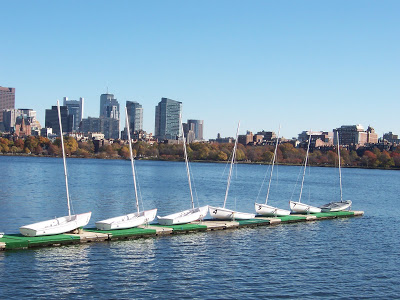
Boston skyline (November 2007)

These days I’ve made my peace with the city (see 2008, 2009, and 2010), though I can honestly say I’m not thrilled with the prospect of living here the rest of my life. Check back again in another four years and that answer might have changed.  There are days when I would rather be anywhere but here, days when I feel so claustrophobic I don’t think I’ll be able to stand it, days when I hate with a white-hot passion the freakin’ logistics of city life. There are also days when I realize how much I’ve made certain parts of Boston “home” — and that if it ever came to the point where Hanna and I were seriously considering a relocation, I would develop a hard-core case of pre-emptive nostalgia for the places we would be leaving behind.

A few weeks ago, when the T was delayed and then Red Sox fans and commuters were so packed into the subway cars that I waited over an hour for a train before just giving up and walking home in the rain, I was feeling pissy enough to come up with what I now think of as my “urban angst” list: the top five reasons why I hate city life. I’ll share them with you in a moment. The thing is, that when I had calmed down and considered the list I realized that my top five reasons why I enjoy living in Boston are actually the flip-side of the top five rather-be-anywhere-but-here items. I’m not sure what to make of that, other than simply to observe that like so many things in life, it only gets more complicated the more you think about it.


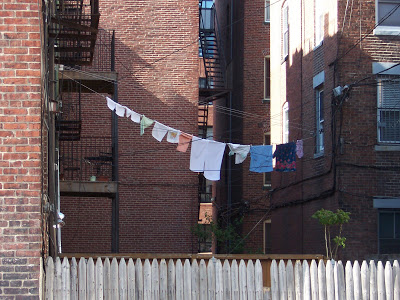
Laundry drying in the North End, Boston (May 2009)

 My urban angst list is as follows:

  • The Commute. Before Boston, I never lived more than, say, a twenty minute drive at most from where I worked or went to school. Usually it was closer to a five-minute drive, and a walk of a mile or two. These days, I live about two miles from work but the commute from door to door takes anywhere from twenty minutes (on a good day, when we walk straight onto a train) to an hour plus. I resent that I don’t have the option of skipping this part of my day. And it can make me feel trapped when the only way to get out of town is to take the train (or multiple trains) to get anywhere rural or green. Or to rent a car, which is then another additional expense.
  • Errands. Errands have never been more complicated. We have a plethora of options when it comes to buying groceries and other necessities and yes, most of them are thankfully on the walk from work to home or in the vicinity. But there’s this thing you don’t think about when you’re used to running errands in a car, and that’s how much shit you can reasonably juggle with two hands and a shoulder bag. There are weeks when I feel like my life outside of work is almost entirely dictated by the errands we need to run and the logistics of getting there and back. Rachel @ Women’s Health News has written a brilliant post on this subject recently, reflecting on the difficulty of buying groceries without a car.
  • Weather. Before moving to Boston, I had never really thought about how much more the weather matters in a big city. This might seem counter-intuitive, but when you don’t have a car and you’re either walking or taking public transit to get around you need to dress for the weather with much more care than I ever needed to back in Michigan. And you need to go out prepared for the weather to change by the end of the day, because there’s no option for running home at lunch to grab an extra sweater or your umbrella. The heat is also more intense here, and when you walk two miles to work on a humid summer day that means taking an extra change of clothes and some heavy-duty deodorant with you.
  • Apartment Living. Cities are expensive, and while Hanna and I have decent landlords, relatively quiet neighbors right now (knock on wood), and a lovely tree-shaded living room, our apartment is tiny compared to what I’m used to. Tiny and expensive. I’ll just come right out and say we pay $1250/month for our one-bedroom place, which is about par for the course in the area where we live. Hanna wishes we could have chickens, or at least room for compost. I wish we had a kitchen that more than one person could work in comfortably. And it would be nice to have storage space for things like suitcases and maybe a bike. The smallness of the space also makes entertaining more than one friend at a time difficult, which means get-togethers usually require meeting in some third space — something that inevitably costs more than hosting folks at home. I miss the days when I could have friends over to cook a meal, eat dinner at an actual table, and watch Masterpiece Theater in a room that had chairs for everyone.
  • The Illusion of Cultural Smorgasbord. Cities are full of amazing things to see and do: museums, lectures, theatre, concerts, author talks, walking tours, festivals, food and wine tasting, film series, the list could go on and on. There are specialty food shops to die for, and restaurants for every taste and occasion. The thing is, arts and culture stuff is (once again) expensive. And not only expensive, but often happens at times and/or in places that make it prohibitive to get to. Maybe there’s a lecture on women’s history that starts at 5:15pm which is technically after I get out of work, but it’s across town and there’s no way I’ll reach it unless I take a taxi for $40.00 which I simply don’t have. Those sorts of calculations. We’re no longer students, which means we aren’t eligible for any standard discounts for things like theatre or concerts, most of which are priced right out of our range. As someone who works at a non-profit cultural institution myself, I don’t necessarily think these things are overpriced — but the reality is that the cost of most of them is beyond what we can afford. So there are great things to do and see in Boston, but as people who are busy living here, there’s only so much we get to take advantage of.

My flip-side list:

  • My Job. If there’s a reason I want to stay in Boston, right now, beyond the fact that Hanna is happy here, it’s that I love my job. And a place like the MHS can really only thrive in a densely-populated urban environment, with a steady flow of graduate students and faculty, and moneyed families willing to support cultural institutions at a level of giving that most of us simply cannot afford (see “The Illusion of Cultural Smorgasbord”). As a librarian who wants to work in an independent research library or archive (i.e. not a public library and not an academic library) I only have so many options, and most of them are in urban areas — the Newberry Library in Chicago, for example, or one of the handful of LGBT archives like the Herstory Archive in New York City.
  • Public Transit. As much as depending on public transit can feel limiting (see “Commute”), I’m really glad to live in a city that offers a decent amount of service, and to live in an area where I can access it easily — both buses and subways — to get to the places I most need to go. I would not want to own or secure a car in Boston, and I’m glad Hanna and I don’t have to worry about things like car payments, insurance, and upkeep on one or two vehicles. It’s also great to live in an area that supports programs like Zipcar (car sharing) and Hubway (bicycle sharing).
  • Walking the City. The logistics of errands drive me crazy, but I do love the fact that we live in a city where walking is a feasible, even pleasant, option for many of our travels. And as much as I miss the five-minute drive to work in the morning, I enjoy being able to get in my daily exercise along with my commute, rather than having to get up at 5am to go jogging before I make my way to the train or get into the car.
  • Food Choices. If we ever more to a less urban area, I’m going to miss the plethora of options we currently have for grocery shopping and dining out. As expensive as it can sometimes be, it’s also wonderful to be able to look at pretty much any recipe and know that somewhere in Boston there’s a store that will offer the ingredients you need to make it. Part of getting to know — and feeling at home in — the city is knowing where you, personally, like to go for your favorite olives (J. Pace & Sons) or the best vanilla beans (Polcari’s). Which bakeries offer the second-day bags of bagels at $2/bag (Kupel’s), which coffee shop offers your favorite French Roast (Boston Common Coffee Co.), and the place to get baked raisin donuts on Saturday mornings (Clear Flour Bakery).
  • $1 Carts. So a lot of things are more expensive in the city — from apartments to your morning latte — but some are cheaper. Mainly I’m thinking of used books, and the fact that Boston has a strong enough used book market to support a dangerous number of used book stores many of which feature substantial $1 sections with rapid turn-over and a fairly good selection. Sure you have to be willing to browse often and buy on impulse, but who doesn’t want to do that where books are concerned!

With that, I think I’ve taken up more than enough of your time this week. I don’t have anything cogent to say about being an urbanite. It’s still a work in progress. We’ll see where the next five, ten, fifteen years takes us.

from the neighborhood: home improvement

29 Monday Aug 2011

Posted by Anna Clutterbuck-Cook in a sense of place

≈ Leave a comment

Tags

boston, domesticity, from the neighborhood, hanna

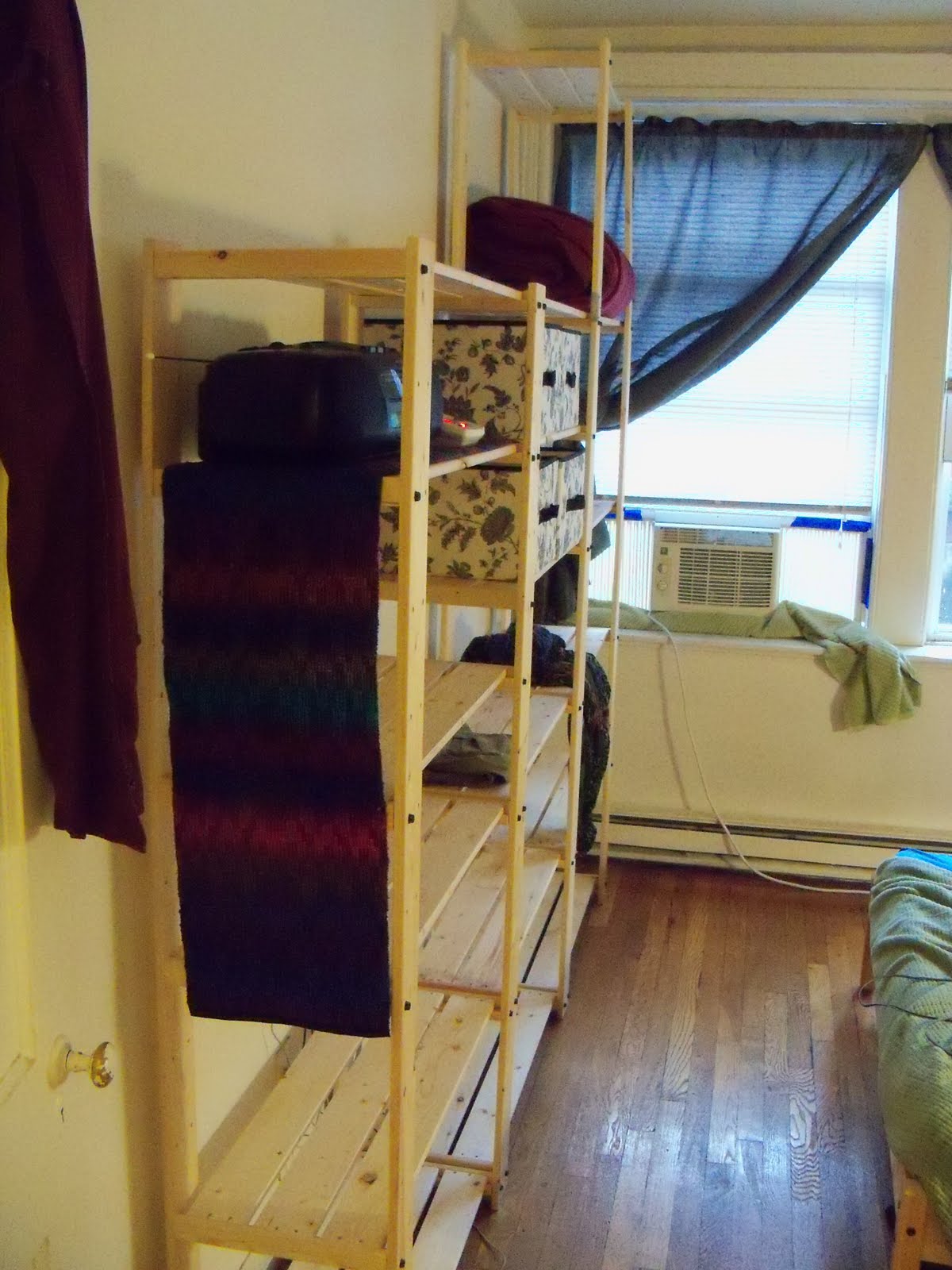
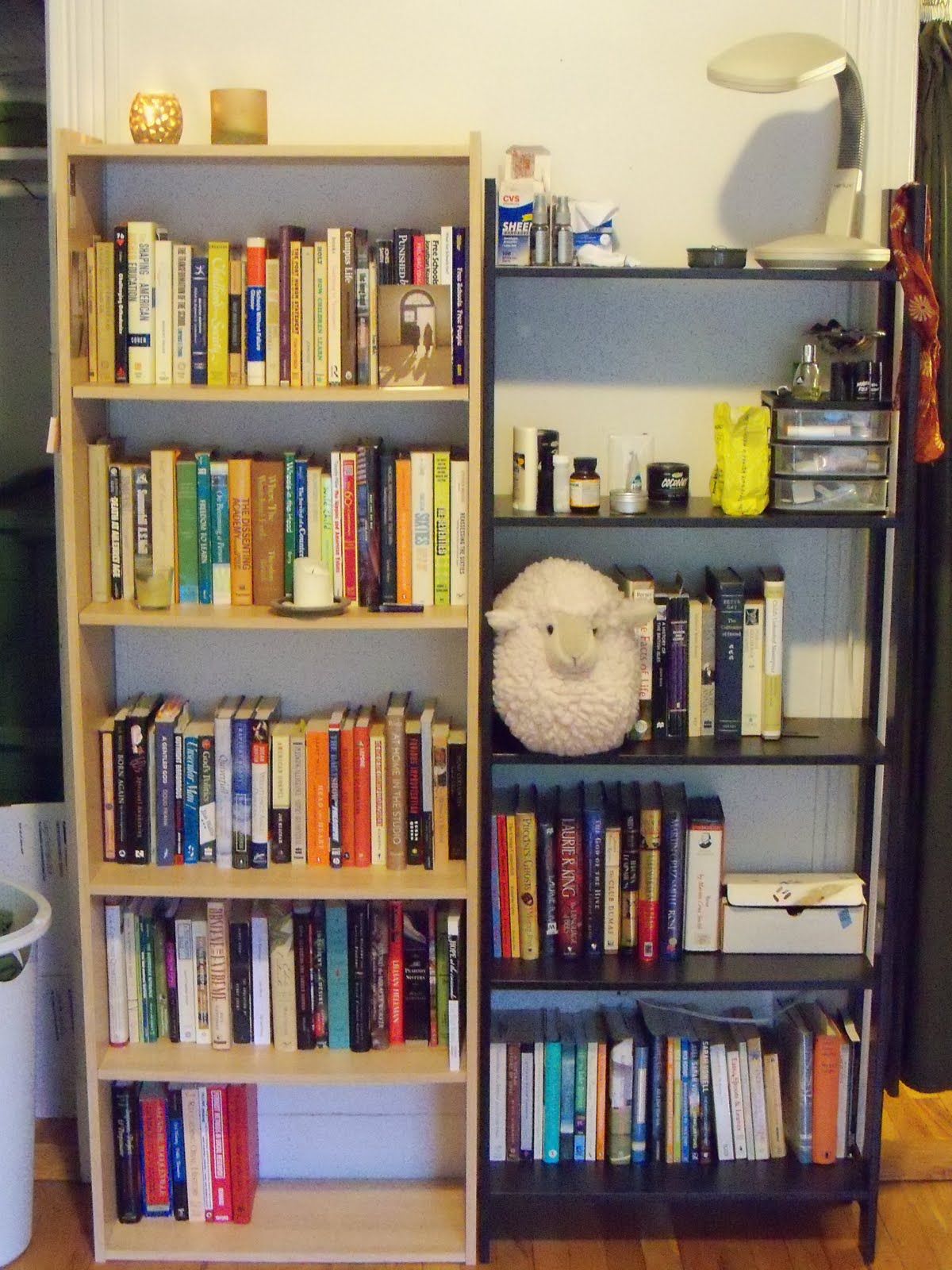
In the midst of Hurricane Irene this week, Hanna and I not only managed a trip to visit friends in Providence, RI, but also built some shelving for the bedroom in order to better organize books and clothes … the dressers we’d saved from the apartment building trash (yes, we have been known to dumpster dive) and the wine crates from the store up the street just weren’t cutting it any longer. The downside, of course, is that we had to spend yesterday evening constructing a 9′ x 7.5’x 1′ shelving unit in our tiny apartment. In tropical humidity.

Ah, the price of literacy.

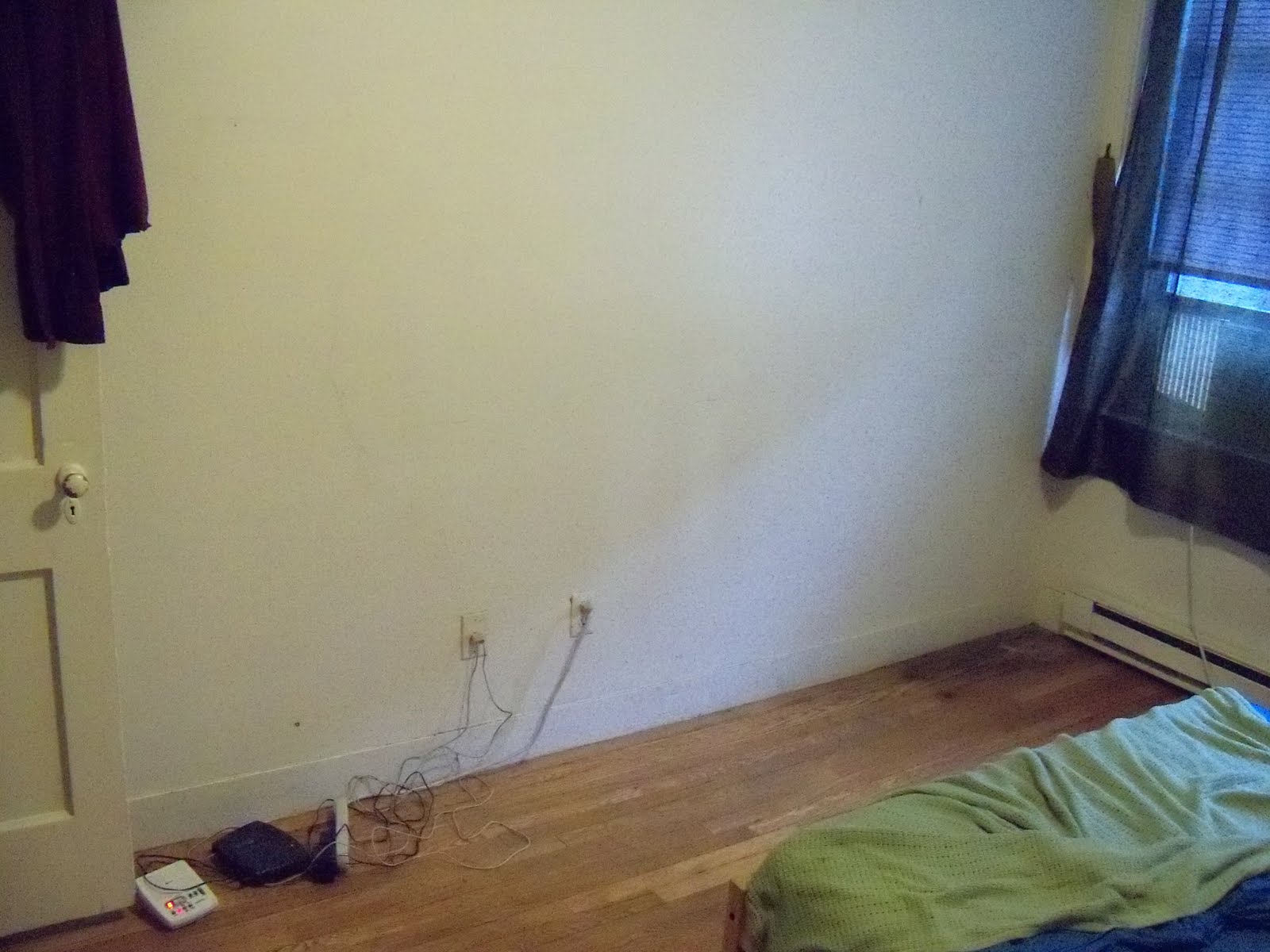
First, we had to clear a space for the new shelves.
(If only we could keep the wall empty! So restful.)
We moved one of the old bookcases into the closet to hold VHS tapes
and periodicals. Play spot the cat for extra points!
There were 72 bolts to tighten. Ouch!
Gerry supervised from her perch on the piles of books.
By 10pm we had the whole thing constructed and
called it quits for the night.
Here are the shelves mostly filled (the wine crates remained … but our
clothes are finally not buried at the back of the closet!)
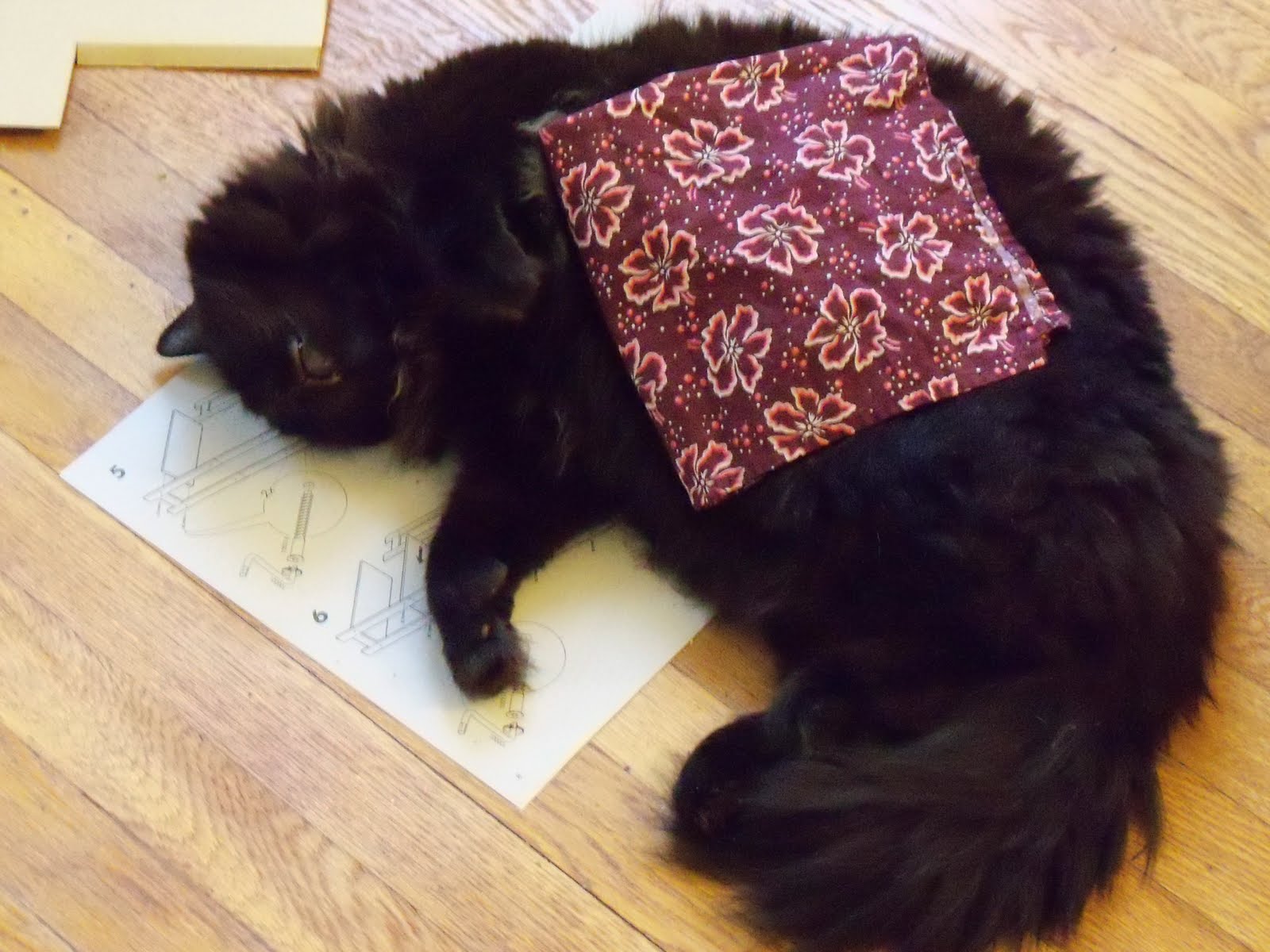
The cat’s supervisory responsibilities exhausted her.
And now we have space for more books!
This time we’ve actually interfiled our books for subject continuity!
This bookcase indicates the relationship is serious folks.

And now as I type this, Hanna is making us Tassajara whole wheat millet bread which is one of my new favorite treats! I promise a recipe one of these days. We plan to enjoy it with Magic Hat Hex and matzo-vegetable soup.

Cross-posted at …fly over me, evil angel….

booknotes: the truth about boys and girls

26 Friday Aug 2011

Posted by Anna Clutterbuck-Cook in book reviews

≈ 1 Comment

Tags

children, education, feminism, masculinity, science

I have recently discovered NetGalley, an online resource for requesting e-book versions of forthcoming titles from a wide variety of publishers. As a blogger and librarian, I was able to sign upi for an account and I’ve requested a handful of titles. It’s my first true foray into the work of e-book reading. Verdict so far: meh on e-books in general, but I’m totally down with electronic advance review copies. It makes distributing ARCs so much more cost effective for publishers, which in turn makes it much more likely they’ll be willing to share them with bloggers who might review the book but have no purchasing budget.

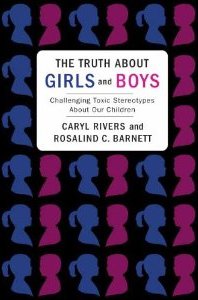
The first galley I read was The Truth About Boys and Girls: Challenging Toxic Stereotypes About Our Children (New York: Columbia University Press, 2011), by Caryl Rivers and Rosalind C. Barnett. Rivers and Barnett are the team that brought us Same Difference (2004), which tackles the work of scientists who claim that men and women are innately different in their psychological makeup. The Truth About Boys and Girls picks up this same subject, but focuses specifically on the way claims about innate gender difference are a) unsupported by rigorous scientific research, and b) continue to have potent persuasive power among parents, teachers, policymakers, and others involved in shaping the everyday life of children. This thesis is not going to be news to anyone who moves in feminist circles, so I would caution that unless you want to stay current on all the publications in this area, a quick skim of this book is likely all that is in order. Maybe I’m biased toward the overly technical and detailed, but when it comes to reviews of the relevant scientific research on this subject, I’ve found Rebecca Jordan-Young’s Brainstorm and Cordelia Fine’s Delusions of Gender to be the best critiques out there.

Still, this is a highly-readable book that might serve as an introduction to the topic, particularly those who feel at sea fairly quickly amidst scientific jargon. The chapters are arranged to take on the major areas of supposed gender difference: ability with maths, ability with language, empathy and caring, physical aggression, and several chapters at the end specifically targeted toward the rising popularity of sex-segregated classrooms (and the myth that sex-segregation enhances learning for both boys and girls).

The most frightening take-away from this book, I found, was the reminder that our world is becoming more not less invested in the idea of innate gender difference. As Barnett and Rivers point out in their introduction, “It’s ironic that as neuroscience tells us more and more about the similarity of our brains, popular culture incessantly beams the opposite message, drowning out the real story” (5). Both girls and boys are harmed by these difference stereotypes (girls consistently being told they will under-perform in math and science, for example, thus increasing the likelihood due to stereotype threat that they will meet those low expectations). However, it’s particularly striking to see how — in our current cultural climate, at least — boys are particularly vulnerable to the straightjacket of gendered expectations. Girls, at least, have alternate and fairly prominent voices advocating for them: they might get relentlessly marketed to by the Disney princess line and told they can’t do math because their brains don’t work that way … but they also (most likely) have adults in their lives who encourage them to play soccer, ride bicycles, or take on leadership roles. The “boy crisis” panic of recent years, rather than focusing on the harm that gender stereotyping does to boys has actually focused mostly on reinforcing those stereotypes in ever-more extreme ways:

Out of this crucible of alarm, a particular image of the ‘typical’ boy has emerged in many media reports: he’s unable to focus, can’t sit still, hates to read, acts up in class, loves sports and video games, and gets in trouble a lot. Indeed, such boys do exist — it has long been established that boys suffer more from attention deficit disorder than girls do — and they need all the help they can get. But research shows that this picture does not reflect the typical boy. Boys, in fact, are as different from one another as they are from girls. Nonetheless, some are advocating boys-only classrooms in which boys would be taught in boot-camp fashion (78).

And a few pages later, summarizing the recommendations of author Leonard Sax:

A boy who likes to read, who does not enjoy contact sports, and who does not have a lot of close male friends has a problem, even if he thinks he is happy (89).

Although the authors don’t overtly connect such panic about masculine behavior to homophobia, I have to say the above sentence fairly screams with “oh my god what if he has teh gay!” Later on, in the chapter about “rough and tumble” play, the authors do note that adult interpretation of children’s play as conforming to gender stereotypes might actually be subverting them or otherwise working around those expectations in interesting ways. Rough and tumble play, they suggest “gives boys an acceptable medium for being physically close in cultural or social environments that otherwise discourage such behavior” (114). Obviously this doesn’t mean that all physical closeness is homoerotic to the participants, but it does suggest that in a society that discourages boys from physical intimacy with one another and/or with girls — physical closeness that most human beings need regardless of gender — play that adults read as “masculine” and aggressive might actually be a way of meeting the human need for touch.

Like Cordelia Fine in Delusions of Gender, Rivers and Barnett emphasize the degree to which children perform gender based on the modeling and perceived expectations of the adults around them. For example, they note that the majority of research of the group behavior of children is conducted in school settings — sites where adults are constantly reminding children that they are gendered beings (from the greeting of “good morning boys and girls!” to sorting children into male and female groups for recess).  Recent research on play behavior among children has found that in spaces where gender is not brought to the fore by adults — for example in unstructured neighborhood play — children are less likely to fall into gendered patterns of behavior, and to seek playmates across gender lines.

“In short,” Barnett and Rivers write toward the end of The Truth, “the differences within each sex are greater than the differences between the sexes. It makes no sense to talk about boys and girls as if they were homogeneous groups that are different enough to warrant separate educational treatment” (180). “Not only do single-sex public schools violate constitutional principles, but they deprive our children of important learning opportunities and run the very real risk of reinforcing the toxic sex stereotypes that are rampant in our society” by encouraging children to think that boys and girls are so wholly alien from one another they can’t even learn side-by-side.

Hopefully our society will get the message sooner or later. In the meantime, I can only say that I’m glad that there are so many feminist parents out there who are encouraging their daughters and sons to carry on bravely being who they are rather than what the outside world insists they ought to become.

← Older posts
Newer posts →
"the past is a wild party; check your preconceptions at the door." ~ Emma Donoghue

Recent Posts

  • medical update 11.11.22
  • medical update 6.4.22
  • medical update 1.16.2022
  • medical update 10.13.2021
  • medical update 8.17.2021

Archives

Categories

Creative Commons License

This work by Anna J. Clutterbuck-Cook is licensed under a Creative Commons Attribution 3.0 Unported License

Meta

  • Register
  • Log in
  • Entries feed
  • Comments feed
  • WordPress.com

Blog at WordPress.com.

  • Follow Following
    • the feminist librarian
    • Join 36 other followers
    • Already have a WordPress.com account? Log in now.
    • the feminist librarian
    • Customize
    • Follow Following
    • Sign up
    • Log in
    • Report this content
    • View site in Reader
    • Manage subscriptions
    • Collapse this bar