• anna j. clutterbuck-cook
  • contact
  • curriculum vitae
  • find me elsewhere
  • marilyn ross memorial book prize

the feminist librarian

the feminist librarian

Author Archives: Anna Clutterbuck-Cook

quick hit: reality, spectacle, and medical museums

03 Wednesday Nov 2010

Posted by Anna Clutterbuck-Cook in linkspam

≈ Leave a comment

Tags

blogging, history, in love with new blogs

On Friday I posted a review of Jennifer Pozner’s new book on reality television which in turn inspired my friend Laura, at her newly-minted blog Oh, My Sainted Aunt, to muse on the relationship between reality television and our relationship to the objects in medical museums. Such is the incestuous power of the interwebs.

I’ve been thinking a lot about reality television, as it is a popular lunch topic at my new workplace and I generally listen rather than contribute, as I do not watch reality TV.  But here’s the context, ya’ll, and why I’ve been thinking about spectacle lately.

You see, I work in a medical museum, an historical collection of pathology material, which includes lots of medical oddities in jars.  The human tissue includes bits of tattooed skin, congenitally deformed fetuses, skulls, diseased tissue, and so forth.  These materials were collected over the past 150 years, some ethically, some not (and some have been repatriated, etc.), but the mission was medical and scientific advancement (insert ethics and human experimentation caveat here).  Historically, much of this material would have also made it’s way into side-shows and freak-shows, which were popular (and socially acceptable) forms of public entertainment.  Remember of course, that this was also done with real live people as well, such as in the “native” exhibits that the Colombian Exposition and World’s Fairs.  Suffice to say that we have a history of using human beings (the odd and unfamiliar) as a source of spectacle and speculation in ways that were and are profoundly dehumanizing.  (See where I’m going yet?)

Read the whole thing over at Oh, My Sainted Aunt (and then follow her blog on your reader of choice!)

tuesday morning economics: academia edition

02 Tuesday Nov 2010

Posted by Anna Clutterbuck-Cook in think pieces

≈ 2 Comments

Tags

economics, education, politics

Somewhere in me, I have a post percolating about the way my personal perspective on, and awareness of, economic issues has been subject to a steep learning curve in the last three years since I started graduate school.

In sum, while I had a fairly firm grasp on personal finance and budgeting when I entered graduate school, taking out the student loans necessary for my education, the high cost of living in the Boston metropolitan area, and the experience of bringing my material life together with that of another person for the first time raised new anxieties and questions. Additionally, attending graduate school for a professional degree — not to mention doing so in the context of a recession — means being caught up in a series of explicitly economic propositions. For the first time in my life, I have formed a relationship with education that is, in part, about economics. (More on why this is a new dynamic for me will have to wait for that later post).

I don’t have time, right now, to write at length about these personal experiences. But I do want to draw your attention to a fascinating series of posts over at (once again) Tenured Radical and Historiann about the politics and economics of academic employment.

  • Tenured Radical: Department of Economics: Observations on the Lack of Raises and Thinking Out Of the Box.
  • Historiann: Sister, Can You Spare a Dime?
  • Tenured Radical: Department of Economics II: Organize, Goddamnnit!
  • Historiann: So You Want to Get a PhD in the Humanities?
  • Tenured Radical: Department of Economics III: The Latest on Salaries and Benefits.

With good (read: lively!) comment threads on all of them for further reading. While the discussion here is primarily focused on faculty (teaching and research) positions, the economic climate of higher education inescapably touches those of us in the library field, particularly those who work at said institutions of higher education (not to mention that there are library positions with faculty status and tenure track).  In a more abstract sense, this conversation about the economics of education is a conversation about how to make a living doing intellectual work in fields that are not widely respected by the corporate sector (i.e. history! women’s and gender studies!) and are often seen as peripheral to education of “real” worth (see the catch-22? “real worth” here = financially lucrative; the market is seen as the neutral, unbiased arbiter of social as well as economic value).

So there’s your difficult-yet-worthwhile reading assignment of the week … I promise more pictures of cats and other miscellaneous fluff on Wednesday!

sunday smut: tumblr highlights (no. 6) | late-blooming lesbian edition

31 Sunday Oct 2010

Posted by Anna Clutterbuck-Cook in linkspam

≈ Leave a comment

Tags

feminism, gender and sexuality, sunday smut, tumblr

Last Friday, on tumblr, I shared a story about late-blooming lesbians by lisala @ That Gay Blog. Among other things, she wrote about the work of researcher Lisa Diamond, whose book Sexual Fluidity was instrumental in my own process of finding language to communicate the nature of my of sexual attractions. Although I don’t tend to think about myself as a “late-blooming” lesbian so much as I do a late bloomer in the relational sexuality department (I entered my first sexual relationship at age twenty-eight), I do think my sexual desires needed the catalyst of a specific person in order to really catch fire. And sans that particular person, I felt like my evidence for same-sex desire was weak. (My evidence for opposite-sex desire was similarly weak, but our culture doesn’t demand proof of heterosexuality in the same way that it demands proof of queer sexuality.) This catalyst concept was what the quote I shared on tumblr was all about:

Diamond notes often “women who may have always thought that other women were beautiful and attractive would, at some point later in life, actually fall in love with a woman, and that experience vaulted those attractions from something minor to something hugely significant.” Professor Diamond adds that “it wasn’t that they’d been repressing their true selves before; it was that without the context of an actual relationship, the little glimmers of occasional fantasies or feelings just weren’t that significant.”

Emphasis mine. Again, you can read the whole post over at That Gay Blog.

One of the lovely things about tumblr blogging, I’m finding, is that people are more likely to share (reblog) and comment upon the quotes I post there than they are (generally speaking) to come and comment on this blog. It’s fun to see, via the “like” and “reblog” options, where the stories and ideas that are meaningful to me travel through social network of tumblr followers + their followers + their followers and so on down the line.

On this post, some of the bloggers who re-blogged the Diamond quote added their own two cents:

this is kind of how i feel right now.

I find this somewhat relevant to my own sexuality. The idea that having never been in a relationship with a girl doesn’t make me “less bi” was a long time coming.

I think I might be a late-blooming lesbian. I wish I had realised this before entering a serious relationship with a man.

I can see it happening.

Omg That’s So True =O 

This quote just informed me I will become a lesbian later in life. 

oh hey, i might become a lesbian at some point. since i aesthetically find women’s bodies more attractive than men’s…that doesn’t surprise me at all actually.

 It’s a fascinating medium, to see all of the ever-so-slightly-different reactions passed along, amended, and added to.

Everyone have a great Sunday and best wishes for the week ahead.

booknotes: reality bites back

29 Friday Oct 2010

Posted by Anna Clutterbuck-Cook in book reviews

≈ 1 Comment

Tags

arts and culture, feminism

I have to begin this review with a disclaimer: I have virtually no first-hand experience with the type of reality television discussed in Jennifer Pozner’s Reality Bites Back: The Troubling Truth about Guilty Pleasure TV.  This has been through both accident and purposeful avoidance. On the accident side, I didn’t grow up with a lot of television around, and (The West Wing aside) TV has never been a very social experience for me.  Therefore my exposure to it has been primarily through advertisements, grocery-store checkout magazine headlines, second-hand reports and cultural analysis.

Why have I avoided reality television? My parents can tell you that public humiliation and social deception has always made me acutely uncomfortable: when we used to watch romantic comedies when I was younger, plot elements that revolved around social lies (Roxanne, The Truth About Cats and Dogs) — no matter how benign and ultimately happy-ending they turned out to be — sent me running to the other room in discomfort. I didn’t like the idea of even a fictional character’s emotional manipulation. So the prospect of watching any show that was actually constructed around such false social interactions involving real people had zero appeal. Add to that formula the heteronormative gender roles that are portrayed and reinforced in these shows, and my personal anti-manipulation bias was bolstered by political critique.

This is all to say that when Seal press sent me an advance review copy of Reality Bites Back last week I had a lot of pre-formed cultural skepticism and personal discomfort concerning the premise of reality television.  And I imagine this book struck me differently than it would a devotee of American Idol or The Amazing Race or come across to those of you who remember watching (for example) the first season of Survivor or The Bachelor with your buddies in high school or roommates in college. 

Jennifer Pozner is a media critic and educator specializing in media literacy.  She is the founder and executive director of Women in Media & News, which promotes the increased participation of women in media creation and analysis.  Thus, Reality Bites Back is the work of someone who is deeply immersed in media as a creator of content, a passionate consumer, and an astute critic of the ways in which media inform our political and personal lives — on both a conscious and subconscious level. In her introduction, Pozner describes the decline in media literacy and critical analysis around reality television shows that she has over the past decade, as she tours college campuses and speaks about the messages that reality television sends to viewers.  While students in the early 2000s were critically aware of the constructed nature of reality programming — a phenomenon that had only recently been widely adopted by the big networks and was getting a lot of press — young people today have grown up with much more of the genre in their media diet and (Pozner argues) their “critical responses to gendered, raced messages within media ‘texts’ … seems to have suffered as a result” (30). “The Millennial Generation,” she writes, “seems to be getting more cynical (‘Of course it’s all bullshit, but it’s funny. Whatever.’) but less skeptical. This kind of mind-set makes advertisers salivate” (31).

The goal of Reality Bites Back is, in part, to re-energize the critical faculties of reality television viewers, so that they become less susceptible to the poisonous narratives of gender, sexuality, race, and class that reality television producers are peddling.  Pozner reminds us that reality television producers — far from neutrally capturing how people interact with one another — aggressively shape the stories that are told on-screen about how human beings behave. And these stories reinforce what we already “know” about women, men, heterosexuals, queer folks, people of color, poor people, rich people, and so forth.  They are brain candy in part because they tell us familiar stories about the world, rather than challenging our pre-conceptions about how folks behave. Stories like:

  • Romance and love is exclusively the province of white heterosexuals.
  • Romance and love are signified by providing (if you’re a man) and consuming (if you’re a woman) brand-name products.
  • Single women, no matter their social and financial circumstances, are desperate for male validation and will quit their jobs, submit to public humiliation, and accept the attentions of any man they are presented with.
  • Single, married, with or without children, women are seen as selfish, controlling, untrustworthy, desperate, pathetic individuals whose only worth is derived from their ability to meet draconian expectations of physical perfection and sexual availability.
  • Men must be rich in order to be eligible for (hetero) relationships, and their wealth is the only thing that matters: criminal records, histories of domestic abuse, on-screen abuse of female cast members are rewarded.
  • Men who treat women contestants as independent persons worthy of actual human-to-human interaction are rebuked by on-screen experts.
  • Poverty is an individual, not a structural problem, best alleviated through on-screen charity and gifts of various brand-name products.

And each of these stories has numerous side-plots and context-specific iterations.

Above all, Pozner argues, reality television programs are hour-long product placement advertisements, their primary raison d’etre being the income generated by advertiser revenue. These shows are indeed market-generated, as producers would have us believe — but the “market” is not the audience who tune in to the programs, but the advertisers who pay to have their products relentlessly shilled in situations that viewers do not read as advertisements. These programs — like most advertisements — contain the not-so-sub subtext that the best way to achieve the good life in America today (understood in the context of reality television a life of wealthy, socially conservative conformity) is by maxing out your credit card and purchasing it.

As an historian, I feel compelled to point out that this permicious blend of consumerism, competition, and capitalizing on economic and social desperation is hardly new.  It’s not really within the scope of the book Pozner set out to write to provide historical analysis, so I don’t think the book is remiss in not providing it. Nontheless, I found myself thinking of potential historical comparisons and desiring some sort of historically-situated analysis that looked beyond anti-feminist backlash, media mergers, and the current recession.

One comparison that comes to mind, for example, are the Depression-era dance marathons, in which desperate couples vied for prize-money while contest sponsors walked away with the cash. As the entry at HistoryLink explains

Dance marathons opened with as great a fanfare as the promoter’s press agents could muster. Each major promoter had a stable of dancers (known as horses, since they could last the distance) he could count on to carry his event. These professionals (often out-of-work vaudevillians who could sing and banter and thus provide the evening entertainment that was a feature of most marathons) traveled at the promoter’s expense and were “in” on the performative nature of the contests (including the fact that the outcomes were usually manipulated or at least loosely fixed).

Known euphemistically as “experienced couples” (The Billboard, April 14, 1934, p. 43), professionals did their best to blend in with the hopeful (often desperate) amateurs. For all contestants, participation in a dance marathon meant a roof over their heads and plentiful food, both scarce during the 1930s. President Herbert Hoover’s promised prosperity “just around the corner” eluded most Americans, but dance marathon contestants hung their hopes on the prize money lurking at the end of the contest’s final grind.

…Medical services were available to contestants, usually within full view of the audience. Physicians tended blisters, deloused dancers, disqualified and treated any collapsed dancer, tended sprains, and so on. “Cot Nights,” in which the beds from the rest areas were pulled out into public view so the audience could watch the contestants even during their brief private moments, were also popular. The more a marathon special event allowed the audience to penetrate the contestants’ emotional experience, the larger crowd it attracted.

You can read the whole article over at HistoryLink.org.

The heady mix of consumerism, voyeurism and exploitation, in other words, is not unique to our era, nor is it an invention of reality television creators. However, the fact that exploitation and backlash is unoriginal  hardly exempts it from critical analysis — just like the fact that a show is being sold as fluffy, lighthearted “fun” escapism doesn’t mean with should turn off our critical filters.

The tie-in website for the book, RealityBitesBackBook.com, contains links to a whole series of essays and excerpts if you’re interested in checking Pozner’s work out in more detail before trotting over to your library and/or bookstore of choice and obtaining a copy to read in full.

from the archives: american medical student in germany between the wars

28 Thursday Oct 2010

Posted by Anna Clutterbuck-Cook in linkspam

≈ Leave a comment

Tags

archivists, blogging, hanna, history

My “from the archives” item this time around is actually from Hanna’s work at the Center for the History of Medicine (aka “CHOM,” the noise refined zombies make when gnawing on their prey), a special collections unit within Harvard Medical School’s Countway Library.

Hanna was asked by her supervisor to write a blog post about some of the materials in the collection she recently finished processing — the personal papers of one Dr. Hyman Morrison (1881-1963).  She chose to write about a cache of letters Dr. Morrison kept from a medical student, Lewis Chase, who was an American studying in Munich and Berlin between 1929-1934. Hanna writes:

Chase was extremely adept at recognizing and commenting on contemporary German political rhetoric and noticing the tensions and potential for tensions between native German and “foreign,” often Jewish American, students at the unversities in Berlin and Munich. In December 1930, for instance, Chase wrote of an influx of American students: “Of the newcomers to Berlin, all are Jewish, with the exception of one Harvard negro—two or three from Boston, many from New York and its immediate vicinity. … Actually there have taken place a number of disagreements, happily only verbal, among the students; a protest against the ‘incessant, loud English-speaking carried on in the Anatomy laboratories’ has already been filed by some reactionary native students.”

 You can read the rest of her blog post over at CHOM’s website. Go enjoy her stories (and help up the amount of traffic her contribution to the website receives!).

midweek calm (in pictures)

27 Wednesday Oct 2010

Posted by Anna Clutterbuck-Cook in a sense of place

≈ 1 Comment

Tags

boston, photos

Sunday Morning at Chestnut Hill Reservoir
Photograph by Anna J. Cook, 2010-10-24
 

Thanks to Hanna for letting me borrow the camera to snap this photograph. Hope y’all have a good Wednesday and have things to look forward to in the second half of the week.

monday morning madness (a few random things)

25 Monday Oct 2010

Posted by Anna Clutterbuck-Cook in our family

≈ 6 Comments

Tags

boston, domesticity, photos

Hello and welcome to the week!
Benedict Cumberbatch as Sherlock Holmes
Hanna and I were up late with friends last night drinking tea, eating biscuits, and watching the first installment of Stephen Moffet’s new venture, Sherlock. I shall resist spoilers of the plot-related sort, but would like to observe that Martin Freeman is an excellent Watson, Benedict Cumberbatch sparkles as Holmes, and Rupert Graves plays a charmingly rumpled Lestrade. And the slash is really text, not subtext. Incase the previews left you in any doubt. We’re already looking forward to the second installment (and prematurely in withdrawal following the end of the third and final episode of the season).

It was awesome and then we were up ’til after midnight talking graduate school and fan fiction. Which was delicious, and we’re already looking forward to doing it again next week. But it left something to be desired on the good-night’s-sleep front, which means we rolled out of bed feeling a little bleary-eyed.

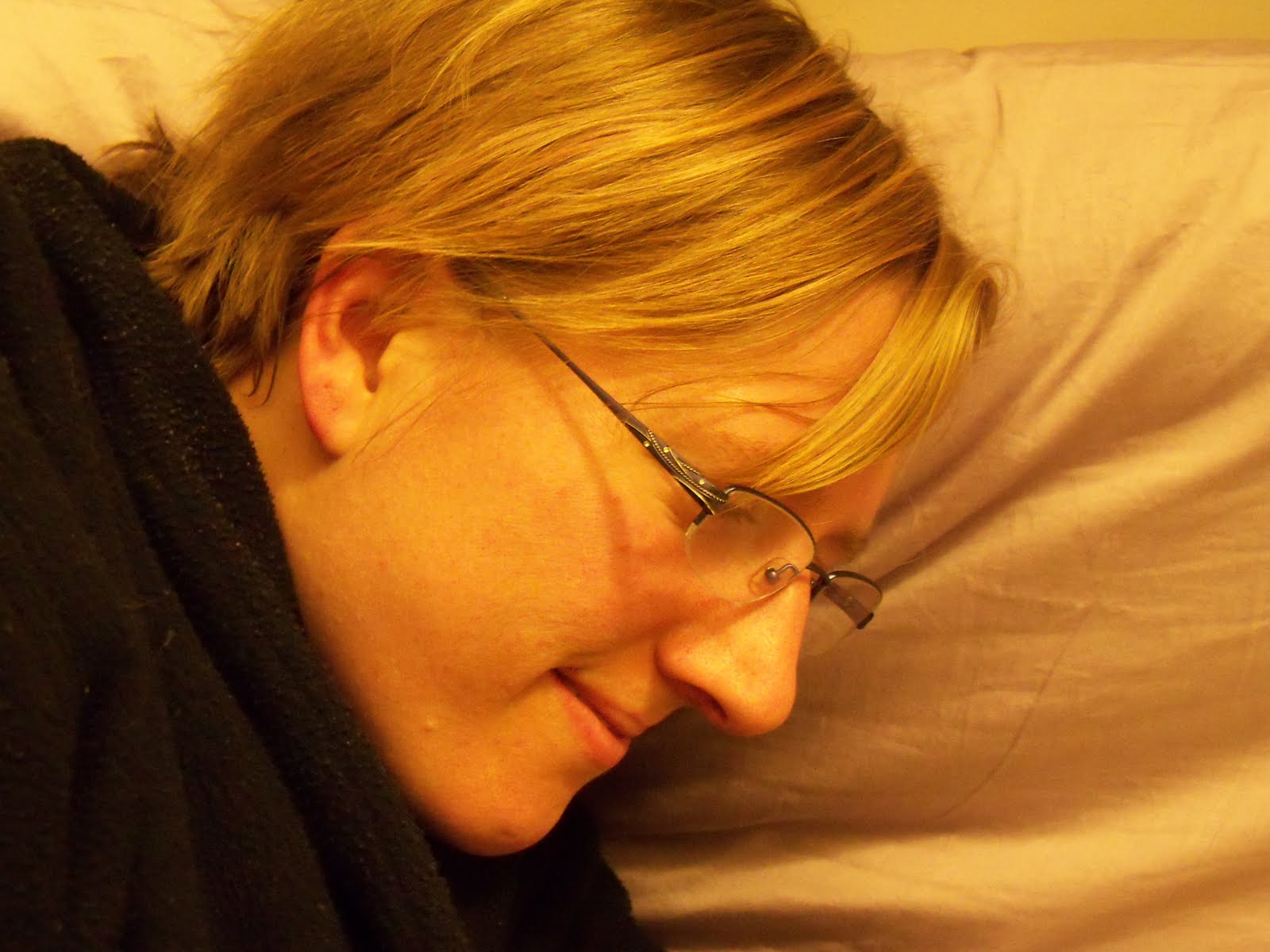
Something like this.

photograph by hanna (2010-10-24)
Although I imagine we’ll get over it with enough coffee and intellectual puzzles to occupy our minds.
The all-too-short “weekend” (which for me consist of Saturday night through Sunday morning) was spent 1) shopping for my fall wardrobe at Goodwill, 2) discovering Rosenfeld’s Bagels, 3) reading the first chapters of my ARC of Jennifer Pozner’s Reality Bites Back (booknote to follow when I’ve finished it), and of course watching Sherlock.
Rosenfeld’s is located out in Newton Center, about four miles west of where we live in Allston. We walked out there yesterday morning past Boston College, through Chestnut Hill and other old villages-cum-suburbs of Boston. Startlingly, this walk included passing the gothic-looking estate of Mary Baker Eddy’s historic home. For some lovely photographs from along the way, see Hanna’s blog post today.
The bagels were also very tasty.
We also ran into a teeny-tiny political rally outside the bagel shop; the Republican challenger to Barney Frank (who wants to dump Barney Frank?? seriously!) was on the corner in a bow tie and cream suit. I had a nearly overwhelming urge to conspicuously make out in front of them, just to be irritating. Hanna tells me this was perhaps a little mean-spirited of me. Is it really so bad that I get off on proving a point?
This has been a very eclectic post, and now I really must quit blogging and get some serious work done. Have a lovely week, everyone! Regular feminist-y blogging will resume as soon as I locate my brain.

friday fun: art deco smut

22 Friday Oct 2010

Posted by Anna Clutterbuck-Cook in media

≈ Leave a comment

Tags

fun

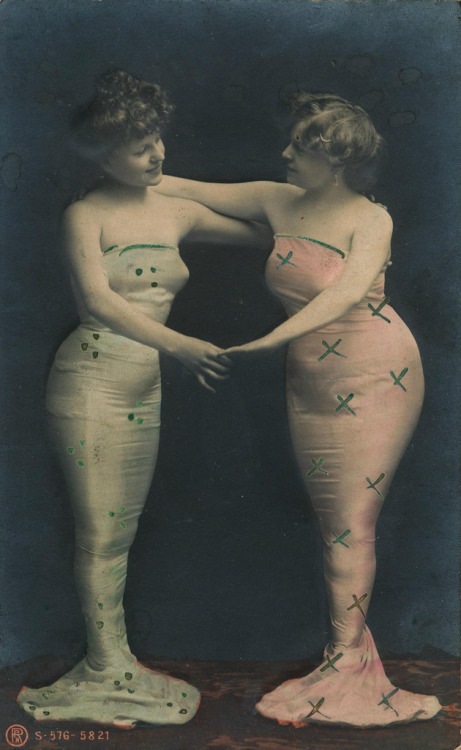
In lieu of actual words and thought today, I’m sharing silly pictures.

Via queerest of them all  via drake’s way @ tumblr.com

The weather this week has been glorious in Boston and the leaves are starting to turn brilliant autumnal colors … much like the leaves strategically adorning this naked beauty. There’s something about her insouciance that I find charming. But perhaps I simply haven’t had enough coffee yet!

Hope y’all have a lovely weekend and we’ll see about getting back to more regular blogging soon.

i promise i won’t become one of those bloggers…

20 Wednesday Oct 2010

Posted by Anna Clutterbuck-Cook in our family

≈ Leave a comment

Tags

cat blogging, domesticity, web video

…who posts incessantly about their pets.

(*kof*kof*)

But the thing is, I just discovered that Black Cat Rescue, the shelter through whom we adopted Verity Geraldine (formerly Marie), made a video of our kitty when she was a mama cat with her kittens not so long ago.

And who doesn’t need a kitten fix mid-week? I mean, really.

The folks at BCR are so happy that mama cat has finally found a home, following in the footsteps (paw-steps?) of her kittens, who were all adopted back in June.

some monday links

18 Monday Oct 2010

Posted by Anna Clutterbuck-Cook in linkspam

≈ Leave a comment

Tags

domesticity, feminism, gender and sexuality, photos

‘Cause it’s apparently one of those periods when blog posts aren’t so easy in the writing.

Hanna has some photos up from the past couple of weekends over at …fly over me, evil angel …, for those of you who follow this blog at least in part because you know us in not-net-life and would like to see what we’re up to when not blogging.


Me reading, by Hanna E. Clutterbuck, 2010-10

She also wrote a wonderful two-part post (part one, part two) on Dr. Who for a friend of mine who recently requested some good introductory episodes from the earlier incarnations of the Doctor.

If you’re on tumblr (or even if you’re not), there are some awesome blogs to follow. Namely beautiful portals if you (like me) are in to liminal spaces; fuck yeah tattoos if (like me) you are in the process of considering how to design the tattoo of your dreams — or you just like beautiful ink; and lesbian outlaw because her tagline is “separate from the government, beyond the police.” And also ’cause she posts lots of great stuff.

Via our friend Rebecca came this great illustrated explanation of the four levels of social entrapment (“This person is seemingly immune to awkwardness and once they latch onto you, you are not allowed to leave until they are done with you.”) at the blog Hyperbole and a Half.

For those of you who are at all familiar with the site Feministing and know that Jessica Valenti and her husband Andrew recently became parents through a pretty traumatic pregnancy and birth experience, I hope you’ve seen that their daughter Layla finally came home from the neonatal intensive care unit (warning: pictures of incredibly tiny baby human after the jump). I really hope they’re getting some quiet time to be together as a family.

There’s been a flurry of posts up this past week or so in the feminist blogosphere on “fucking while feminist”: what that means, exactly, and how people live out their own particular iterations. I may or may not have an actual post in my about this (I actually think being feminist in my political identity and using feminism as an analytical tool has a pretty profound effect on my sexuality and sexual related-ness … but I’m not sure how to talk about it yet). In the meantime, one of my favorite responses has been by Garland Gray guest-blogging over at Tiger Beatdown on how his feminism informs his experience of fucking other men:

Over time, I realized that if I was committed to working toward a world where gender variance was celebrated, where getting fucked wasn’t viewed as something shameful or disempowering, I was going to have to start voting with my dick.

This isn’t simply high-minded “the personal is political” sexual activism. If a dude thinks that he is powerful because he doesn’t get fucked, and you are weak and shameful for getting fucked, you really and truly don’t want to let him fuck you. Sex is about respect, and letting someone inside you without respect is a bad idea. No matter what position I am in, I follow this cardinal rule: If someone needs to be in control, it should be the person getting fucked. I fuck while feminist by insisting that there is nothing submissive about getting fucked. Accepting the standard bullshit narrative of “penetration as dominance” or “penetration as corruption” is ridiculous and arbitrary. It is just as easy to see penetration as submission. A part of your body is inside of me. If you don’t play by my rules, I MIGHT NOT GIVE IT BACK.

 And finally, Tenured Radical and Historiann had a series of thoughtful posts + comment threads up recently at their respective blogs about single-sex (women’s) colleges. I haven’t had the time nor been in the mental space recently to really sit down and digest them, but here are the links.

  • Tenured Radical: Not Equal Opportunity, But Every Opportunity: An Argument for Single-Sex Education
  • Historiann: From the Department of WTF?
  • Tenured Radical: Feminism’s Unfinished Agenda: If Women Have Equal Opportunity, Why Are the Outcomes So Very Unequal?
  • Historiann: Women’s Education, Part II
  • Tenured Radical: What Is Our Work? Towards a Feminist Future in Education
  • Historiann: Women’s Education, Part III
  • Historiann: Why Must Women’s Colleges Exist? A Personal Reflection

Thirty-second commentary: As someone who 1) worked at a men’s college for a semester, 2) attends a graduate school attached to a women-only undergraduate college, and 3) is a feminist and historian of feminist activism and education, I find the question of single-sex education incredibly complicated. There are compelling (mostly, to my mind, historical and individual) arguments for the worth of women-only space, but I can’t get away from the question of sex and gender varience, and the problem that once you start policing the boundaries of space by saying “women only” or “men only” you’re reinforcing a world in which the gender binary is a fundamental organizing principle … a principle that I believe is antithetical to the values of feminist theory and practice.

And because it’s out there and thus needs to be shared: Episcopal bishop Gene Robinson has contributed to the It Gets Better project. I’ve linked before to a lot of really good commentary on the problems with the project, but none of those problems erase the fact that people are telling their own personal stories of Growing Up While Queer, and that each individual story is a powerful testament to the infinite possibilities that exist for each of us as we grow and change.

Enjoy the week ahead!

← Older posts
Newer posts →
"the past is a wild party; check your preconceptions at the door." ~ Emma Donoghue

Recent Posts

  • medical update 11.11.22
  • medical update 6.4.22
  • medical update 1.16.2022
  • medical update 10.13.2021
  • medical update 8.17.2021

Archives

Categories

Creative Commons License

This work by Anna J. Clutterbuck-Cook is licensed under a Creative Commons Attribution 3.0 Unported License

Meta

  • Create account
  • Log in
  • Entries feed
  • Comments feed
  • WordPress.com

Blog at WordPress.com.

  • Subscribe Subscribed
    • the feminist librarian
    • Join 37 other subscribers
    • Already have a WordPress.com account? Log in now.
    • the feminist librarian
    • Subscribe Subscribed
    • Sign up
    • Log in
    • Report this content
    • View site in Reader
    • Manage subscriptions
    • Collapse this bar