• anna j. clutterbuck-cook
  • contact
  • curriculum vitae
  • find me elsewhere
  • marilyn ross memorial book prize

the feminist librarian

the feminist librarian

Category Archives: life writing

stuff that may be keeping me from blogging (as much) this summer

21 Friday Jun 2013

Posted by Anna Clutterbuck-Cook in life writing

≈ Leave a comment

Tags

being the change, blogging, domesticity, history, work-life balance

During the past few weeks, I’ve been reading stories on the internets about which I have Thoughts and Feels, but for which I have very little (if any) time or energy to blog about. Non-internet stuff has been happening, in that way that takes attention and emotional-mental-logistical energy. In that way that takes up all the brainspace and physical time/space otherwise filled up with typing words that become blog posts.

canoes on the Charles River lagoons, 2008

So blogging might be a little slower around here than it has been in the past few months. Here’s a run-down of some of the things I’ll be doing when not seen in this space:

  • I’ve been getting back into some personal (not-for-work) history research in the cracks between my other obligations. I’m on what we call in the business a “fishing expedition” looking for a project that will yield something interesting and original on the crossroads of gender, sexuality, and religion within the Christian left during the 1950s-1980s (focusing on the early 1970s). My starting point is the Methodist Student Movement publication motive magazine (1941-1972), outspoken on issues such as poverty, civil rights, and cold war politics, the staff of motive experienced a decline in denominational support when they published an issue on women’s liberation in 1969 through to the final two issues, published independent of the church, on gay men’s liberation and lesbian/feminism. My current line of questioning circles around why Christian theology provided a robust vocabulary for speaking about some leftist issues — but seems to have failed its young activists on feminist and queer issues. I’m keeping busy reading motive, some personal papers of its editors, and surveying the secondary literature … a few hours a week, stolen when I can.
  • Against my better (or perhaps simply more self-centered) judgement, I’ve been Getting Involved at work with some advocacy issues related to organizational transparency and employee benefits restructuring. As a small non-profit cultural institution (we employ a staff of about fifty) we’re facing some post-2008 financial fallout that requires reduction in benefits. Questions about how decisions have been (and will be) made, and how employees will (or will not) be involved in the process are a live concern. I’ve been tapped to be part of a staff advisory group, and volunteered to be on a retirement planning committee. If any of you have reading suggestions for good books or articles about worker advocacy in the non-profit, non-unionized workplace I’m happily taking suggestions!
  • General workplace busyness during the summer season, which is when many of our fellowship recipients make time to visit the library to conduct their research, and casual visitors in Boston on holiday make an appearance.
  • For the past two months, Hanna has been working her way through an allergy identification diet which has demanded particular attention to cooking and a lot of learning-on-the-fly about alternate ingredients. So far, the likely suspect is gluten intolerance, which will require a reorganization of the kitchen, our shopping & cooking patterns, and all that jazz. Do you know how hard it is to find non-preachy gluten-free cookery books?
  • I’ve been trying to spend more time reading offline and doing other non-internet activities, particularly on the weekend. Some of those things I’ve blogged about in my book review posts. I’m also enjoying such things as The London Review of Books, The Lesbian Connection, Bitch magazine, and back issues of our various professional journal subscriptions (The American Historical Review and Library Journal and Oral History Review and so forth). 
  • Biking means less time to read offline while commuting. As whingey as this sounds, biking more to and from work reduces my leisure reading time by as much as five hours per week — a not insubstantial amount!
  • I’ve been seeing a wonderful uptick in personal emails over the past few months, as long-distance friendships have evolved from blog-based to email-based exchanges. This is a positive development, in my personal opinion, but also means that much of my writing and discretionary intellectual energy gets pulled in the direction of one-to-one conversations rather than blog posts sent out into the aether.
  • And yep, I’m still fiction (and fan-fiction writing)! For example, the piece of erotica I submitted last weekend, and the series I’m adding to on a weekly basis over at AO3.

And finally, as a reminder, you can generally see/catch me on Twitter (@feministlib) if you’re curious about what I’ve been reading and thinking about in 140 characters per notion. Also, emails (feministlibrarian [at] gmail [dot] com) will usually rouse me (see second-to-last-bullet-point above) since I love correspondence.

In the meantime — hope y’all are doing well and have kick-ass summer plans. I’m sure we’ll see one another around!

thirty two [happy birthday to me + some photos]

30 Saturday Mar 2013

Posted by Anna Clutterbuck-Cook in life writing

≈ 3 Comments

Tags

domesticity, gender and sexuality, holidays, photos

Today’s my thirty-second birthday, in the event you didn’t already know that via all the over-helpful social media reminders!

Hanna bought me this lovely ceramic indoor water fountain as a present.

Ever since I was a small girlchild I have loved the sound of running water and used to fantasize about living in a house with a river running through its center. Short of that, I wanted to live in a cottage by the sea, on a river, or by the lake, where the sound of waves and rapids could be heard through the open windows.

Neither of these things is practical right now, but the fountain is a lovely “plan B.”

(photos by Hanna)

Making room for the fountain, despite its modest size, precipitated a major reorganization of the living room – a way of making the apartment few new and springy even though we’ve lived here nearly five years (and Hanna even longer).

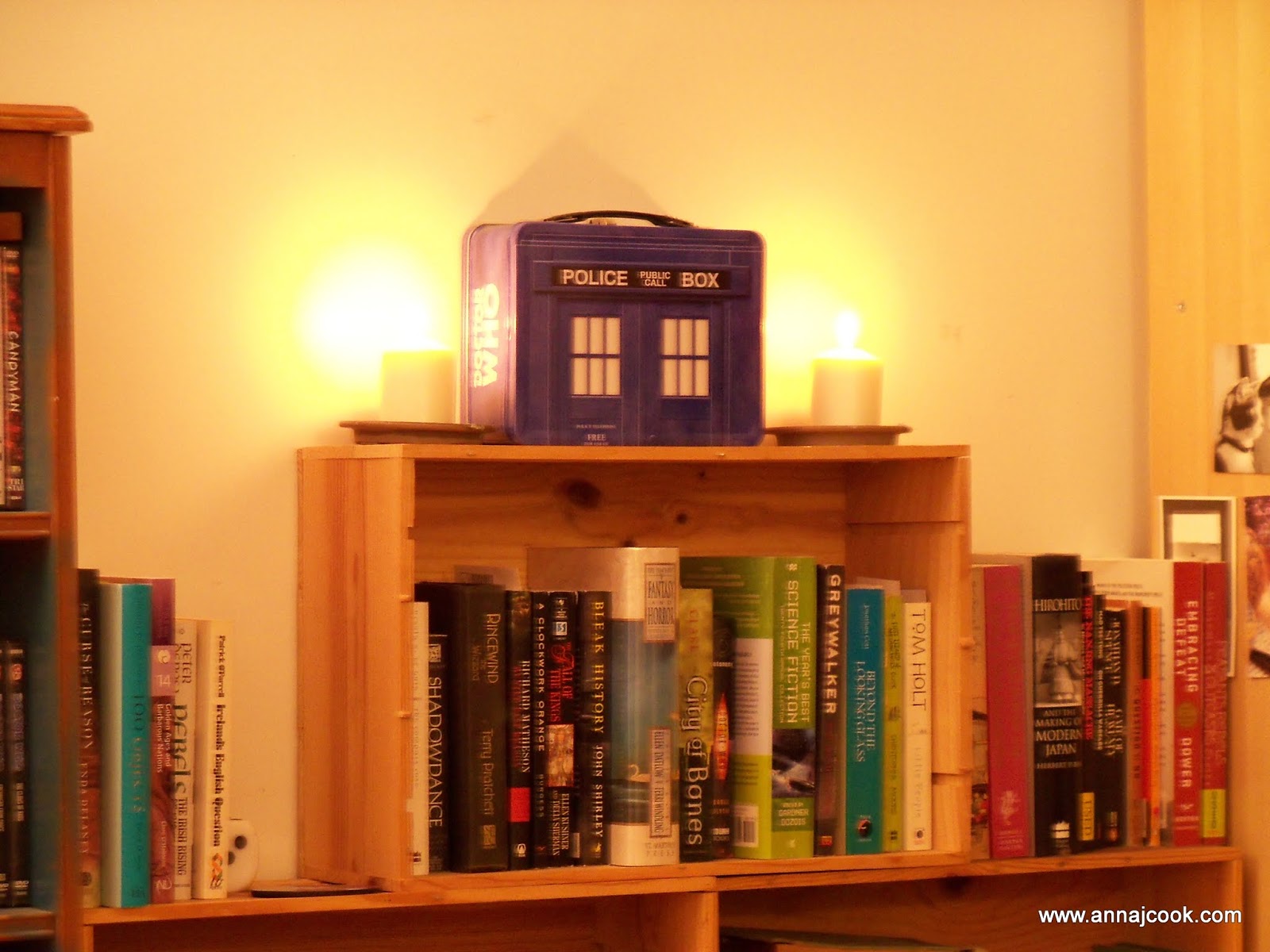
We moved the couch from the inside wall out to a spot beneath our bay windows (the element that really “makes” our living room as a space). This shift necessitated consolidation of some bookshelves into a book wall … bonus points if you spot the TARDIS shrine!

We’re enjoying natural light that now falls on the couch, making for good reading into the evening without having to turn lights on.

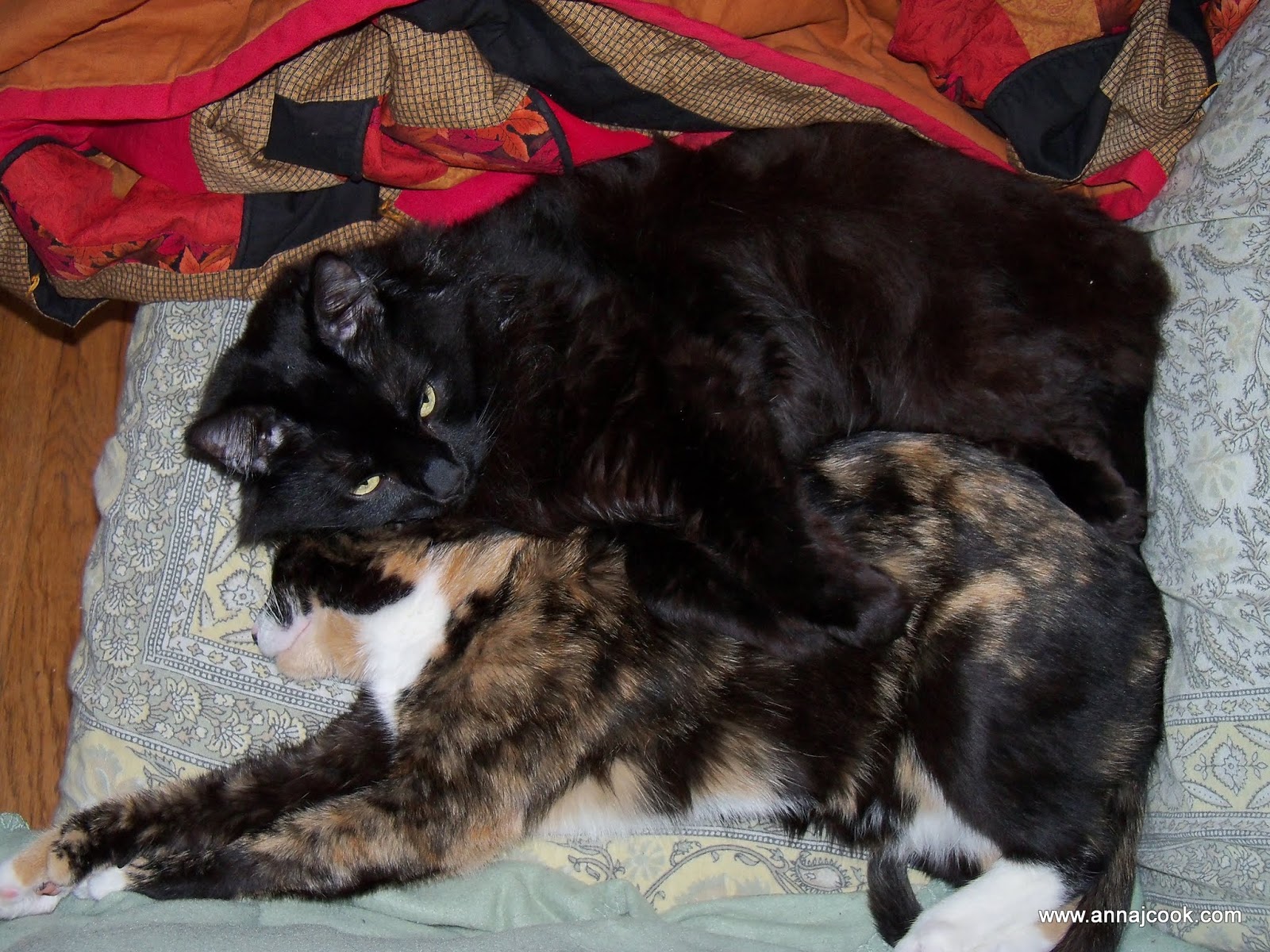
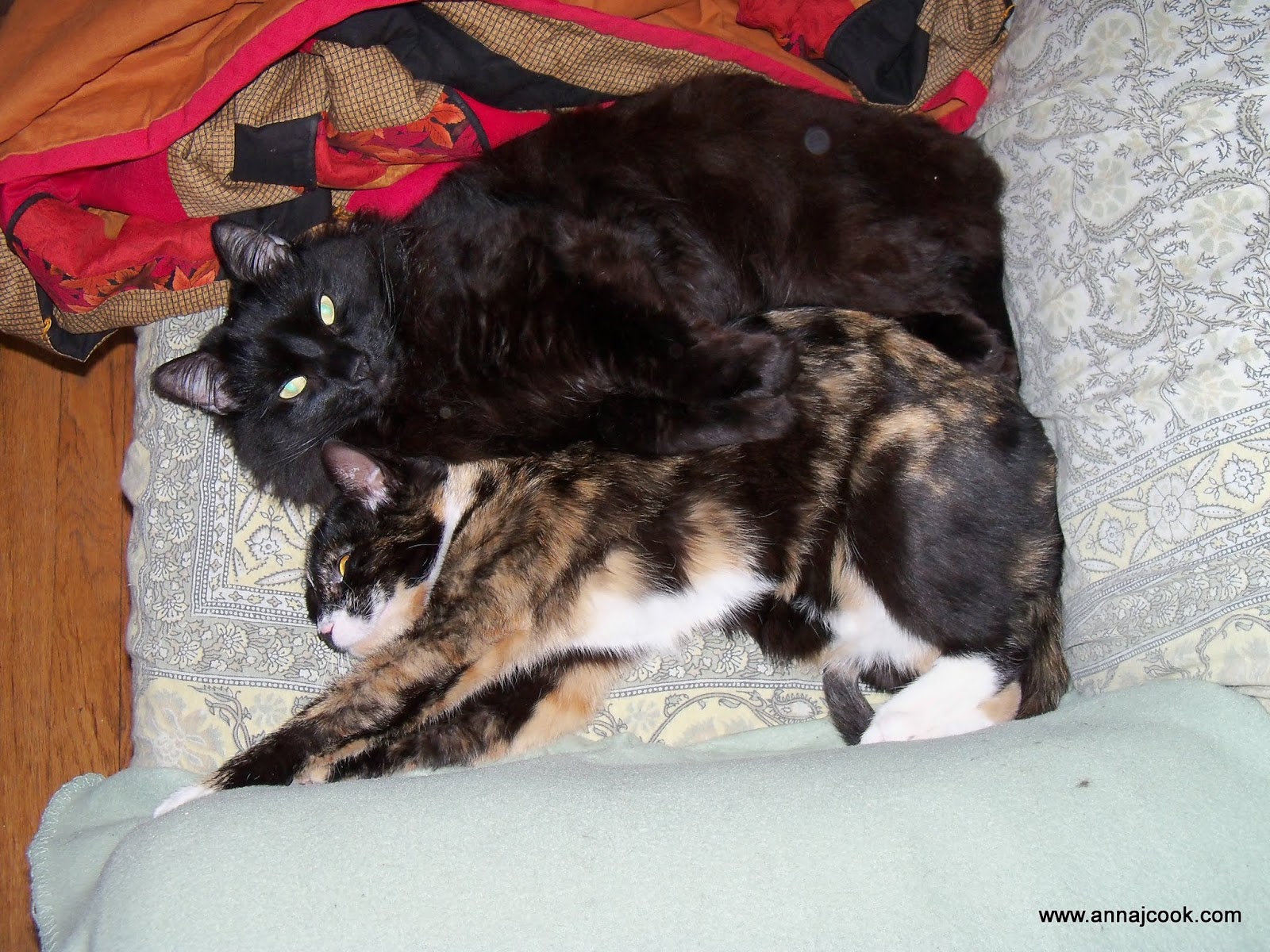
The cats continue to be unimpressed by us, though we have clearly been setting a poor example in the lewd cuddling department…

Or a good example, depending on which way you think the bread is best buttered.

Enjoy your Easter weekend, folks — spring is slowly arriving!

a few thoughts on my historically-specific perspective on getting married

08 Sunday Jul 2012

Posted by Anna Clutterbuck-Cook in life writing

≈ Leave a comment

Tags

boston, family, history, hope college, michigan, sexuality, wedding

Yesterday, I finished reading an advance review copy of Michael J. Klarman’s From the Closet to the Altar: Courts, Backlash, and the Struggle for Same-Sex Marriage (forthcoming from Oxford University Press, Oct. 2012; review to come). A legal historian, Klarman explores the history of litigation and legislation around gay and lesbian marriage from the 1970s to the present. Reading his historical account prompted me to think about the historical context in which I came of age and into my sexuality and sexual relationship, and how this colors how I think about same-sex marriage particularly, and even more specifically how my historical context shape the decisions Hanna and I have made. Here are my thoughts, in roughly reverse chronological order.

1) I’ll start with the fact that we can get legally married in the specific time (2012) and place (the Commonwealth of Massachusetts) in which we have come together. Massachusetts recognized in same-sex marriage as legal under the state constitution in 2004 (Goodridge v. Dept. of Public Health) and our ability to become, legally, wife and wife, on the state level is normal here. While DOMA still prevents us from being recognized as married nationwide, we will be treated as spouses at the state level. If I hadn’t moved to Massachusetts from Michigan, I would be unable to legally wed without traveling. And given that neither of us are involved in a religious community, we likely would not be planning a private (non-legally-binding) commitment ceremony.

2) I’ve experienced nothing but welcoming acceptance of my relationship with Hanna since we got together in the summer of 2009. The only direct bigotry I’ve encountered has been online; I’ve been comfortable being open about my relationship at work, in public, on both sides of the family, in my home town, blogging, etc. I actually dealt with more directly-homophobic statements and actions before I was visibly queer (see below) than I have in the past three years. This is in part a matter of geography, in part a matter of the circles in which I’ve been moving, and in part a macro-level cultural sea-change in which anti-gay animus is becoming less acceptable by leaps and bounds, at least in the public square.

3) Marriage equality was part of what brought me to Massachusetts. One of my first memories of driving into Boston in the summer of 2006 — when I interviewed at Simmons — was getting turned around and ending up in Harvard Square across from Zero Church Street, where they had a huge banner across the front of the First Parish Church proclaiming support for marriage equality. Even though I understood my sexuality to be primarily hetero at the time, I immediately felt a sense of expansiveness — the ability to be more at ease in the political climate here than I had felt back in Western Michigan where I was reminded daily that my views about human sexuality were at odds with the dominant culture.

lesbian recruitment party, summer 2005

4) I had long-term, same-sex relationships modeled for me. I had friends whose relatives were in same-sex relationships (some of whom had had commitment ceremonies, some who hadn’t). Through my undergrad women’s studies program (oh the irony) I was introduced to lesbians in committed partnerships and had a chance to think about what it would be like to build a life for myself with another woman. I am a person who experiences my sexuality in very contextual ways, and while I don’t discount the notion that having been born in a different time or place I might have fallen in love with a woman without such models, the fact that I knew that lasting, committed same-sex relationships were a possibility by example helped open me to an awareness, a receptivity, that it could be possible for me as well.

5) In my early twenties, I wrote letters to the local newspaper speaking out on topics like abortion and gay rights. I always got incredibly bigoted responses in print (though my friends and relations were supportive). I remember particularly writing in as “a young straight woman” in defense of the summer gathering for gay and lesbian families that happens annually in the little town of Saugatuck twelve miles south of where I grew up (in the “reddest” county in the state of Michigan). In my letter I thanked the newspaper for doing a favorable piece on the camp and preemptively addressed the haters by pointing out that same-sex parents gave me hope for the future. Again, I think it’s note-worthy that even in an incredibly conservative corner of the Midwest, I was participating as a presumptively straight person in normalizing queer families.

That is, I didn’t think “gay” and imagine that being a lesbian would mean custody battles and depression and suicidal impulses. I thought it meant family camp and lesbian communes and sprawling poly households, not unlike the life I was already starting to envision wanting for myself, even if I thought my primary partner would likely be a man.

5) My best friend came out in 2001. I’d say this moment was the start of my serious self-education on issues of human sexuality and the history of homosexuality and the modern gay rights movement. I was twenty and while he wasn’t the first queer person I knew personally, he was the first person I knew intimately and felt more for than a general political commitment in favor of equality. My sense of radical acceptance (borne out of innate stubbornness and feminist theology) and my life-long commitment to fairness had always drawn me toward LGBT rights — but suddenly it was personal. And I discovered my ability to be fiercely political.

7) Because of the college where I went to undergrad, issues of sexuality and gender were deeply intertwined, and both were morally-fraught religious concerns. This deserves its own post (or several), but suffice to say that my introduction to feminist politics as a college student came in the form of a raging controversy my first year at Hope over what and how the chapel program was teaching students about human sexuality generally and homosexuality specifically. My women’s studies faculty were committed Christians and vocal queer allies, and so my trial-by-fire education in organized protest was around these issues. I was able to think deeply about sexual morality, gender and sexual identity and expression, sexism, and homophobia in the midst of a group of LGBT-friendly Christian folk who helped me articulate passionate responses to the homophobia and hate we were experiencing in daily ways on campus.

In effect, I had a queer community around me long before I understood myself to be queer.

8) In the mid-90s, the AIDS quilt came to town. Its stop on national tour was organized, in part, by the gay deacon at my church. In appointing him to an ordained office, the church had broken with the denominational position (which remains in place today) that homosexuality is sinful. Twice during my adolescence, the church went through a contentious period of “dialogue” on the issue and members left the church in protest over the deacon’s ordination. While I don’t remember much about the AIDS epidemic, I do remember the viewing the quilt with my family and others from the church and city when the sections were on display at one of the area high schools. Rather than AIDS being interpreted to me as “the gay disease,” it was simply a deadly illness, like cancer, that killed people and left behind grieving partners, parents, siblings, children.

9) Our Bodies, Ourselves (and feminism!) contextualized being in lesbian relationships as one life path for women to pursue, both sexually and in relationship with one another. In my adolescent reading about the 70s feminist movement, I encountered primary source documents about lesbian activism, lesbianism as a political decision, and same-sex relationships. While I wasn’t politically active on these issues until college, these texts prepared the ground-work for understanding human sexuality more expansively, and lesbian relationships as a viable option, long before I was aware of resistance to homosexual identity and relationships in my community.

10) The earliest memory of I have concerning same-sex sexuality is at age eleven when two friends of mine, over for a sleepover, were giggling together over the word “gay” and I asked my mother what it meant when they refused to tell me. It was obvious from their behavior they thought the word was a naughty one (one girl was from a conservative Wesleyan household, the other a Mennonite). My mother’s factual explanation (along the lines of “someone who falls in love with a person of the same sex”) put gayness on the radar but confirmed that I need not be alarmed about it. Since there were lots of ways in which my family’s values differed from those of our friends and neighbors, I assumed this was just one more thing to add to the list!

I’m sure there are other ways in which my life has shaped how I think about lesbian relationships, lesbian identity, and the viability of marriage as an option for Hanna and I. For starters, the fact that we’ve both remained unmarried until we were over thirty, and don’t plan on having children are also deeply historically-contextual options/decisions. In the 1910s we might both have been college-educated library professionals in a “Boston marriage,” but it would not have been legible to the world at large as a marriage.

We often think of ourselves as historical actors, with the ability to defy social norms and break new ground. And we are. But they manner in which we defy society, and the norms which we are countering, are historically dependent. And self-aware historians, such as myself and my beloved, are no more exempt than anyone else.

(As usual this “few thoughts” post became much longer than I envisioned it!)

things for my thirties [happy birthday to me!]

30 Friday Mar 2012

Posted by Anna Clutterbuck-Cook in life writing

≈ 6 Comments

Tags

holidays, thirty at thirty, work-life balance, writing

So today is my 31st birthday. And to be honest, I’m quite psyched. Because I’m pretty much the age now that I’ve felt, on the inside, most of my life. And I wake up most days feeling like “fuck yeah my life!”

Which is a good, good place to be and something I will try never, ever to take for granted.

A couple of observations for today.

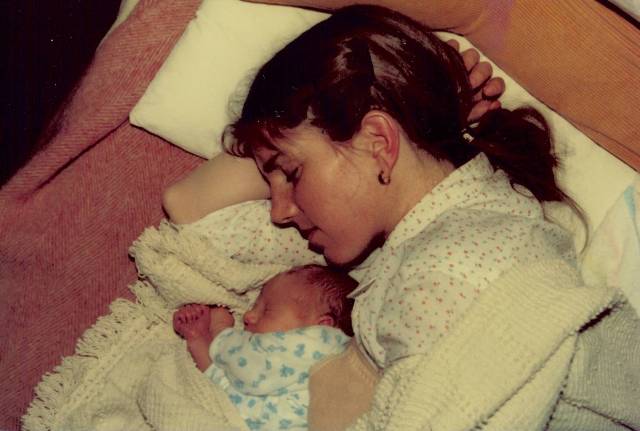
baby Anna and mother Janet, early April 1981

1. Five days after my mother turned thirty-one, she gave birth to me. So I feel like, on some level, this is the point at which my own life narrative and my mother’s life narrative diverge. Which is super-overly-simplistic, really, given that before she was thirty-one my mother did lots of other things I also haven’t done (e.g. date people, get married, get divorced, go to college for architecture, work as a waitress, and go snorkeling in the Cayman Islands). But — all judgyness about parenting/not parenting aside ’cause we don’t really do that in my family — there’s no way to get around the fact that spending your thirties as the full-time parent of three children under the age of ten is going to make for a significantly different kind of decade than the one I have stretching out before me.

Which feels a little weird. Like an opportunity, but weird. One of those moments, as a kid, when you realize your parents — however great they’ve been as models — can only model so far, and so much, before you’re on your own, inventing a life.

2. Not-library things I want to do in my thirties. So I’ve got the next decade before me, an open book. And Hanna and I are settling into life together. Which is really something rich and strange and rather unexpected (I had this notion in my head, for a long time, that I’d probably end up a spinster — in the nicest possible way! I was kinda looking forward to it. But, you know, then Hanna came along and how could I not?). So I have the luxury of thinking about what I’d like to do with myself, other than my professional and partnership activities. Here’s what I’ve come up with:

  • Travel to England, Scotland, Wales, Ireland. I mean, duh. Travel is definitely near the top of my list of things to do with discretionary income (after “buy books” and “eat good food”). 
  • Write and publish erotica. Turns out, at least in the estimation of a few friends (of a range of sexual persuasions) that I have a talent for the stuff. Who knew! But I enjoy writing it and they enjoy reading it, so it seems like it might be fun to try my hand quasi-professionally there. 
  • Find ways to be with young people and age-diverse families. So I’m not going to have children of my own, it looks like. And I’m 95% cool with that. But I’d like to use part of my time this next decade thinking about how my household of two-adults-plus-cat can be hooked into wider networks of caring that encompass families with more age diversity. None of our intimate friends or family have chosen to incorporate children into their lives yet; I’m kinda hoping a few of them do so that we have the opportunity to be kick-ass aunties.
  • Choose and/or create a home. Okay, well, yes. We obviously already have a home together, Hanna and Geraldine and I. But it’s an apartment that started out as a student space, a temporary space, and something not actually selected by both of us, as a couple. It would be nice if, in the next decade, we actually found a home-space through more deliberate selection according to our needs and desires as a family.
  • Research and writing. I have yet to publish that first scholarly monograph. Now with a thesis under my belt, I feel I can move on to other projects — so hello life-long learning! I’m really looking forward to nosing around and finding my niche as a thinker and writer. Not having this be my day job is, in some ways, even more of a blessing since it means I have free reign to explore ideas as I see fit. That was one of my goals of library school: to situate myself as an intellectual in spaces that honored intellectual endeavors, without being required to “publish or perish.” And since I’ve arrived, I’d like to make the most of it.
Happy birthday to me, and welcome to this most fine of decades. Go forth and be joyful.

four years ago today: "personal canon"

11 Sunday Dec 2011

Posted by Anna Clutterbuck-Cook in life writing

≈ Leave a comment

Tags

books, four years ago today, friends, fun

It’s been awhile since we did one of the four years ago today flashback posts. So here’s a fun one I pulled from the Gmail archive. My friend Joseph and his brother had generated lists of the top ten novels in their “personal canon” and Joseph emailed to ask what mine would be. After some thought, this is what I came up with. Looking it over today, I can’t say there are any huge revisions to this list. 


From: Anna
To: Joseph
Date: Tue, Dec 11, 2007 at 10:22 PM
Subject: Re: Personal canon of books

Hiya,

My canon is decidedly more “lowbrow” and than yours, but I am squelching my impulse to apologise for it on Nick Hornby’s firm orders (even though he loves Dickens’ and writes tedious novels about men who refuse to grow up, so I am not sure how much I trust him . . .)

I have artificially controlled against all non-fiction and children’s literature (well, below the teen level).  Not sure if that’s quite what you had in mind, but there we are.  I discover my criteria are a) enduring “good read”–something I will go back to over and over again, as well as b) things that have had deep impact on how I answer the question, “how to live?” . . . these categories don’t always overlap.  There are books that have had great impact on how I think about the world, but which I’ve only read once . . . and books that I read habitually, but that I don’t really think of as life-shaping in any explicit way.  Maybe they’re just sneaker at it? And of course these change over time . . . I was just thinking today how His Dark Materials has really grown on me over the years.  And even though I have issues with some of his didacticism, his theological imagery really speaks to me.  And, I mean, who could resist the idea of a reversal of the whole Genesis/Fall/Eve story? (Um . . . wait . . . that’s right . . . a LOT of people 😉 ).

via

That long introduction completed, here are my nominations. The top ten in a strictly alphabetical order. I figure once you make top-ten I’m not going to be judgmental. ALTHOUGH I do sometimes find myself paralyzed by the question of which book I would become if I were a character in Fahrenheit 451 . . . possibly a clear indication of how troubled I actually am :).

Top Ten:

1. E.M. Forester. A Room With a View.
2. Shirley Hazzard. The Great Fire.
3. Haven Kimmel. The Solace of Leaving Early.
4. Robin Lippincott. Our Arcadia.
5. Michelle Magorian. Not a Swan.
6. Robin McKinley. The Blue Sword, et al.
7. Audrey Niffinegger. The Time-Traveler’s Wife.
8. Dorothy Sayers. Gaudy Night.
9. Martin Cruz Smith. Rose.
10. Tom Stoppard. Arcadia.

Some possible future candidates/honorable mentions:

Isabel Allende. Daughter of Fortune & Portrait in Sepia.
Jane Austen. Persuasion.
A.S. Byatt. Possession.
Sheryl Jordan. The Raging Quiet.
Laurie R. King. The Beekeeper’s Apprentice, et al.
Barbara Kingsolver. Bean Trees.
David Levithan. The Realm of Possibility.
Gregory Maguire. Wicked, Son of a Witch
Philip Pullman. His Dark Materials.
Margaret Whelan Turner. The Thief, Queen of Attolia, King of Attolia.

Anna

third thoughts: conversations about sex + identity

04 Sunday Dec 2011

Posted by Anna Clutterbuck-Cook in life writing

≈ Leave a comment

Tags

call to participate, sexuality and gender, sociology

As promised, here are some “third thoughts” about my participation in Holly Donovan’s comparative research on social interactions between straight and non-straight folks in urban and rural areas. 


For my first thoughts and second thoughts, if you haven’t already seen them, follow the links.

To read more about participating in Holly’s research project, check out her call for participants (PDF). If you live in the Boston area and identify as queer in any way — or know someone who is and does — do check the project out; she’s still actively searching for participants. She mentioned particularly needing to hear from non-academics and people who hail from working class communities.
So. Now that the “signal boost” portion of the post is complete, on to my own further reflections.
we sat down to talk over coffee at Pavement Coffeehouse
Even though Holly indicated that the second-round interview typically lasts about thirty minutes, she and I talked for a good hour and a quarter (are you surprised? if you know me, you aren’t surprised). Here are a few things that Holly’s response to my project journal (see second thoughts) prompted in my own thinking.
Holly noted several times the way in which my journal observations “emphasized the positive.” She was actually pulling that phrase from a section in my journal where I talk about a tricky interaction with someone who was kinda luke-warm about the lesbian relationship thing.  I was describing how I chose to emphasize the positive with them, verbally pointing out the steps this person made toward acceptance and thanking them for being willing to acknowledge my relationship with Hanna. We talked quite a bit about this, both as a conscious strategy for interactions with a potentially hostile environment, and also as something that simply is for me when it comes to my queer identity.

Let me try to explain (warning: it’s a work-in-progress). As I’ve talked about in the previous posts — and as should be overwhelmingly evident from everything I write about sexuality and relationships on this blog — I experience my sexuality, sexual orientation, and sexual relationships in a really enthusiastic way. Because my sexuality is fluid in many respects, you could say that I didn’t really have a sexual orientation/identity until I was in a relationship of my choosing. A relationship which I entered as an adult who was enthusiastic about being partnered with this particular person (Hanna). Prior to that moment of becoming part of a couple, I was sort of a blank slate, socially, for other people to read whatever the hell orientation they wanted to onto me. It wasn’t an active component of my self-presentation until I wanted it to be.

So basically, by the time my sexuality became visible and people could react to it in more public settings (outside of conversation with intimate friends), I had pretty clear convictions about what was and was not out of bounds, and how I wanted to handle any resistance to who I am, who I’m with, and how I choose to enjoy my sexuality. I have two basic ground-rules for myself about handling less-than-optimal social interactions:

1. I won’t be dishonest about who I am. This is largely pragmatic, since I’m terrible at dissembling. But it’s also a decision rooted in my personal ethics. Since I can remember, the way my family (and later I, as an individual) chose to live has made some people uncomfortable — even angry. If I had grown up trying to manage other peoples’ discomfort about my non-conformity it would have been a losing battle before it began. Aside from the fact that managing other peoples’ emotions is a) doomed to fail, and b) the worst energy sink ever.  So I just won’t. I am who I am, and if that’s a problem for someone then we’re probably going to need to figure out how not to be in much contact, or simply put on our grown-up pants and deal with the fact we have differences.

2. Whenever possible ignore the negative crap and give a shit-ton of positive reinforcement for anything constructive. This strategy, too, stems from my childhood … where I realized somewhere along the line that I could use my time/energy critiquing institutional education or I could focus on the instances of high-quality mentoring and learning where and when I saw them happening. I like this approach because it doesn’t allow the opposition to frame the debate, and it allows you the freedom to focus on building the sort of future you want rather than constantly re-hashing how less-than-ideal the present it. 

“Ignoring” the negative crap doesn’t mean pretending it isn’t there, or letting it go without noting it and pointing out it’s not cool. But when it comes to people-to-people interactions, particularly, I’d rather spend my time giving positive feedback for the good and a cool reception to the bad. The less attention unhelpful interactions get, the better.

So “emphasizing the positive” is both a manifestation of the social privilege and aspects of my personality that made growing into my adult sexuality and sexual relationships overwhelmingly positive* and a conscious political choice for how I think I’ll best be able to use my limited energies and resources to effect change in less-than-optimal social situations.

Holly was interested in my reflections (which I wrote about at the end of my second thoughts post) on getting something out of living on the cultural margins. In addition to what I’d already written in that earlier post, we discussed how the experience of choice and agency which I describe for myself — of being drawn toward non-conformity — is different from the language of being “born this way,” and then pushed to the margins by others who reject who you are. I actually don’t see myself as choosing marginality (though existing on the margins feels familiar). What I experience myself choosing is the situations that will best allow me to flourish, that will best support my well-being as a person. Given the culture in which we live, I’ve discovered that these happen to be marginal spaces. It’s been an incremental journey in a lot of ways, wherein I made a series of decisions about this and not that which have led me to a place very different from the majority culture. I didn’t choose sexual fluidity and desire, didn’t choose to fall in love with another woman, but I chose to recognize and honor that sexuality, that love, and make a space in my life for those desires and that relationship. I don’t feel shoved unwillingly out of the mainstream — I feel like I chose (am in the process of choosing) the life that works best for me and my partner, and the mainstream has sort of parted ways around us. It’s not really here nor there, to me, whether or not my life path is ever “normal” or acceptable in the eyes of the majority.

Holly observed that I wrote comparatively about my experiences in Boston and in Holland, and asked how things would be different (in relation to sexual orientation) if I were living in Holland rather than Boston right now. I wrote comparatively about Holland and Boston in my journal in part because I know Holly’s study is looking at regional differences and queer-straight social interactions in urban vs. “rural” locations. So it’s not like I spend a lot of time comparing the two places specifically in relation to queer issues. But when she asked about what would be different, my first thought was It’s less tiring to be myself here. Less tiring, because less oppositional. When I lived in Holland until 2007 I wasn’t visibly queer, but I was more or less myself in politics, interests, and values. And living out those values, expressing those interests and politics, just took a lot of work. 

Or, at least, I learned to expect that when I opened my mouth (or when people with similar values opened their mouths) it would trigger the angst and the anger and the defensiveness and the soul-searching re-evaluation of values and yadda yadda yadda ad nauseum. Who I was and what I believed caused people existential angst and precipitated crises. It got really tiring. And boring.

So when I picture being in Holland now, on the one hand it would be awesome to be closer to the friends and family I know and love there. But it also just sounds like a lot of work: work to find a queer-friendly therapist, work to find a doctor who’s cool with lesbian sexuality, work to advocate for same-sex spousal benefits (which, you know, currently illegal in my home state). All of which are just givens most of the time here. And that’s on top of swimming up stream against the gender essentialism and anti-feminism and opposition to social welfare and any number of other issues that aren’t directly tied to sexuality but are nonetheless about who I am and how I want to live.

I know plenty of friends and relations who manage to live and even thrive in that environment — and part of me is envious that they’ve managed to build lives in a hostile climate. But I did that for 26 years and it’s really nice not to have to right now.

As I myself observed in second thoughts, Holly noticed how many of my intellectual and social interactions concerning sexuality center around reading and writing (on- and offline). She asked what I look for in my reading and interactions in these areas. I didn’t have any ready answer for her, other than that I’ve found the resources I do consult mostly by link-hopping and footnote following … I identify a resource I do like, and mine it for further reading in whatever way it appropriate to the medium. I follow the network, whether it’s a blogroll or a bibliography. At this point, I have enough sources of information that I can sit back fairly passively — skimming my feeds, reading book reviews, taking note of workshops and presentations — and monitor the flow of sexuality information that’s being generated and analyzed by the people whose ideas and opinions I care about.

What sort of people are these? Well, I actually think a good list of criteria can be found in a post I wrote over at Harpyness about sexuality education and things I wish I’d known when I was younger about human sexuality. Those five things are a pretty good outline of what I’m currently interested in exploring, and the sort of attitudes about human sexuality I gravitate towards. I generally look for writing on human sexuality that’s descriptive rather than prescriptive — I like reading about how humans behave and why, and what they do that fosters well-being, rather than about how we “ought” or “should” behave according to some external set of rules (religious or otherwise). I prefer research and writing on human sexuality that doesn’t presume human sex and  gender are oppositional and binary, and it’s probably redundant for someone who’s titled their blog “the feminist librarian” to say she wants her resources to demonstrate feminist awareness and to critique systems of oppression that constrain our ability as individuals to experience pleasure and wellness.

I don’t really care how the individuals behind these sources of information identify sexually. I follow blogs and read books by people whose own experience of human sexuality ranges across the queer spectrum as well as falling squarely within heteronormative boundaries. I’ll talk and think sex with people who are asexual, poly, abstinent until marriage, gay men, trans* folk, hetero married, celibate due to religious vocation, etc. At rock bottom, my only criteria are that a) you acknowledge and embrace human sexual diversity, b) believe there is no one-size-fits-all approach to sexual ethics, c) but take sexual ethics seriously as a topic of conversation; d) that human sexuality, to you, is seen as a potential source of human pleasure and connection; and obviously e) you enjoy exploring both your own experience of sexuality and the cultural narratives we’ve constructed around those personal experiences.


*I’ve been thinking since we talked about how my cisgender presentation made my smooth (sexuality/sexual identity-speaking) adolescence possible. In part because I’m reading a book right now about the lives of transgender people and the gender policing they experienced as teenagers. As a girlchild with parents who worked not to gender stereotype, I was given wide, wide latitude to be a person first and a girl/woman second. Feminism also granted me license to be myself, however I wanted that to manifest. This, in conjunction with simply taking myself out of the active dating/partnered pool, made a buffer for my sexuality to develop and space for me to discern what I wanted on my own terms. This deserves its own post … so I’ll see what I can do in the near future.

second thoughts: my "sexuality and society" journal

01 Thursday Dec 2011

Posted by Anna Clutterbuck-Cook in life writing

≈ Leave a comment

Tags

call to participate, gender and sexuality, sociology

This is the second post on my participation in a Boston University study of urban and rural queer folks and their social interactions with non-queer folks. You can read about my initial interview with researcher Holly Donovan in the first thoughts post I wrote back in October.

This past Monday I sent Holly the journal I’d been keeping since our initial meeting. I’m not going to make the journal publicly available because I wrote it for Holly’s research specifically and also because it contains details about my interactions with third parties that can be kept anonymous in the context of a PhD dissertation where I’m not identified — but not in this blog space, where I’m pretty transparently me.

Journaling. I used to do a lot of it, but the demands of the past few years and my own shifting priorities have caused me to stop keeping such a detailed and in situ account of my daily life. So it was kind of a familiar novelty (to coin a term) to find myself keeping a daily journal again. Journal writing is liberating in that the pressure to have finished and connected thoughts is erased — at least for me. In this case, I was writing on a particular theme: my social interactions and the way those interactions did or did not actively engage my gender identity and sexual orientation. Yet I still felt that I could keep notes that were in bullet-point format, with sentence fragments and open-ended observations.

via

What were some of those observations?

I spend more time thinking and talking about sexuality than I do sexual orientation. A significant portion of the notations that I made in my journal had to do with conversations I had with friends, family, my therapist, my colleagues, people online, with authors (via reading their work), about human sexuality. I spend a significant portion of my waking time thinking about human sexuality because it’s one of those things that makes me happy to ponder. I did this before I found language to articulate my own sexual identity as such, and before I was in a sexually intimate relationship with anyone. I love that I move in circles where sexuality is part of casual conversation, and that our conversations are often intellectually stimulating, enthusiastic, and joyful rather than full of shame and angst. Yes, we all have emotional and physical struggles that sometimes need conversation to work through — but I’m grateful that that is only part of the discourse surrounding sexuality that I am a part of.

I don’t feel in physical or emotional jeopardy in the spaces I live, work, and move through around Boston. This is a complicated one with lots of layers of class, race, gender presentation, and the rest tangled up in it (as I observed in my first thoughts post). But keeping my journal these past three weeks reinforced the fact that there are no spaces in my daily life where I feel the need to self-censor the fact I’m in a lesbian relationship. My colleagues know, my family knows, our friends know, our bank knows, our doctors know. We hold hands on the walk to work, we doze on each others’ shoulders on the T, kiss goodbye when parting at our favorite coffee shops. We’ve never experienced anything stronger than a glare from a random passer-by (and even then, perhaps they were just having a bad day?). I don’t know if it would be different if we lived in West Michigan. I know when we visited Holland last spring I felt comfortable behaving in public the same way we do in Boston — but Hanna points out that I have a talent for ignoring negative vibes. So perhaps if we lived there full-time, we’d have more run-ins with homophobic weirdos. Like I said, I don’t know all the factors at work here — but I’m glad that our social experience has been so positive.

A significant part of my social interactions, particularly around sexuality themes, take place through reading and blogging. There were a number of entries in my journal that began with phrases like, “Received and advance review copy of … on trans* sexuality today” or “Wrote a blog post about forthcoming collection of erotica …” or “Finished writing 3K words of lesbian erotica …”. Outside of my professional writing and reading, a significant portion of my intellectual exploration right now has to do with sexuality — and a lot of that takes place in conversation (see observation one, above) and through reading articles, books, and blog posts, listening to podcasts, and engaging in discussion in comment threads. A lot of this is mutually reinforcing, since the more I read and review work in this area the more likely I am to get offers of advance review copies, virtual book tour requests, and other quasi-professional offers in a similar vein. I welcome these engagements with open arms because it’s stuff I love to talk and think about. I do think it’s note-worthy that I feel comfortable making this a quasi-professional part of my life, and that I feel comfortable pursuing it online in ways that are tied directly and openly to my actual identity.

And, as something that came to me toward the end of my journaling (though I’ve thought about it before), I get something out of existing on the margins of heteronormative society. That is, there are material ways, obviously, that Hanna and I (and our other non-straight friends) experience discrimination based on our sexuality, or relationships, and our gender expression. And I didn’t, obviously, choose to be attracted to Hanna because being in a lesbian relationship would be transgressive. I just desired her. But I made choices about following through on that desire, about building a life with another woman, and part of the reason is that I like living on the cultural* margins. I feel comfortable and energized here. I feel less claustrophobic. I feel like choosing to live my life in some basic, categorical ways that disqualify me from the norm give me freedom from other peoples’ expectations that I will conform to mainstream expectations of femininity, or American middle-class ambition, or heterosexuality. I think (and this is a very tentative hypothesis) that perhaps growing up home-educated, in an era when that was far from mainstream, primed me for feeling most at home in spaces that folks around me considered “weird.” And so I think I gravitate toward people who are willing to think and live outside the boxes. It feels familiar and it feels good to exist in that space.

I think that’s counter-intuitive for a lot of folks, who assume that non-normative relationships and/or a “weird” sexual identity would be cause for anxiety and stress. I remember the transition being somewhat stressful — going from thinking of myself as “mostly straight” to thinking of myself as bi/fluid/lesbian/queer. But it was actually an incredible relief in a lot of ways to feel I had legitimate feelings of attraction that would support moving into queer spaces and identifying that way socially. Because those spaces called out to me as welcoming psycho-social spaces for years before I felt I had enough evidence of my own sexual desire to claim them as my own. I know this sounds kinda backward to many folks for whom sexual orientation/identity works differently or more decisively. But for me, that seems to be path I needed to take.

I meet with Holly this evening to do a follow-up interview, based on my observations in the journal. If any new insights crop up during our conversation I’ll be back with “third thoughts” on this process.


*And I choose the word “cultural” deliberately here because I realize that the aspects of my self and my values which are marginal to the mainstream are largely self-chosen rather than imposed upon me. In terms of my race, my able-bodiedness, my socioeconomic status, etc., I’m far from existing on the material margins of American society.

first thoughts: being interviewed about sexuality + society

28 Friday Oct 2011

Posted by Anna Clutterbuck-Cook in life writing

≈ 2 Comments

Tags

boston, gender and sexuality, religion

On Wednesday evening I sat down for two hours to speak with Holly Donovan, a PhD candidate in Sociology at Boston University. Holly is conducting interviews with LGBTQ-identified folks in the Boston area as part of her research on sexuality, religion, and community. If you identify as queer and live in the Boston area, check out her call for participants, which she asked me to pass along. For me, it was a unique opportunity to be on the opposite side of the microphone: usually I’m the one asking the life history questions!

tea is essential for good conversations

For the next three weeks, I’ll be completing phase two of the project — keeping a journal of observations and thoughts about my experience of being queer in Boston — but for now, I thought I’d share some initial reflections about our conversation.

Life narratives are inherently chaotic on the first go-around. Unless you’re focused on a very specific aspect of your life (and even then, as my OE oral history project shows, things can get out of hand very quickly) it’s fairly impossible to tell a linear story that encompasses all of the salient details of what goes into making a person. Even with the keywords “sexual orientation,” “religion,” and “social interactions” that’s a hell of a lot of territory to cover! I found myself skipping around a lot in time and missing stuff that was probably important. I woke up around 3am on Thursday morning and was mentally adding things to the “remember to tell her next time …” list.

My sexual orientation isn’t a primary identity category for me; being in a sexual relationship was much more of a turning point. This might seem weird, given the amount of time I spend thinking and writing about human sexuality — but I think that’s kinda the point. In my own personal life, there’s feminist politics (of which rights for non-straight folks were long a part of my political interests), there’s queer and sexual history (which I’m engaged in as a scholar), and then there’s the whole my-life-as-a-sexual-being thing. Which is awesome. But doesn’t really have so much to do with orientation as it does with physical experience, with relationships, with how I understand my sexuality as it relates to my ethics, my body, my interactions. In that space, I don’t think of myself as someone with a sexual orientation or identity — I just think of myself as (enthusiastically!!) sexual.

I don’t socialize in primarily queer spaces. Since one of Holly’s questions is about the interactions of queer-identified folks with straight-identified folks, I thought a bit before we sat down about my circles of friendship and the primary spaces where I socialize — both in person and online. Online more than in-person spaces are, I would say, “queer” (inasmuch as “queer” overlaps with “feminist,” which it sometimes does and sometimes doesn’t). But my circle of friends is pretty sexually and gender diverse, and they often overlap. That is, when Hanna and I get together with friends we don’t have our “gay” friends and then our “straight” friends. We have friends. We don’t socialize in spaces that are organized around sexual identity (i.e. gay bars or lesbian book clubs). Possibly because neither Hanna nor I were ever in search of an active dating scene? And I don’t think either of us has ever particularly yearned for the type of social solidarity of “safe” space that gay neighborhoods or social clubs might provide. The one exception to this is our health center, which we picked in part because of its history in LGBT health activism.

This isn’t exactly news, but opposition makes me feel defiant and irritable, rather than judged and cowed. When people are cranky about lesbian PDA, I have the urge to be more publicaly affectionate, not less. I’d argue that both my family background and my long-time singleness both contribute to this. By the time I entered into a relationship, I was much more confident about my presence in the world than I would have been in my teens. You don’t like what you see? Suck it up and deal.

I also don’t have reflexive fear about my physical safety, which is probably a whole tangle of social privileges I’ve experienced throughout my life: class, race, gender presentation, and so forth. Which ties into the idea of straight privilege that I’ve been turning over in my mind for a while now:

“Straight” privilege. I’ve put “straight” in quotation marks ’cause I don’t think it’s a function of being straight so much as being read as straight. Regardless of my own actual sexual desires, about which I didn’t speak about much growing up (except to very close family and friends) I was read as straight, as a single straight woman. I grew up assuming I had just as much right to be in public spaces, to be open about my relationships (sexual or otherwise), to speak up for my politics, as the next person. I think this is a function of race and class too. I’ve heard bi and fluid women talk about this in terms of their relative comfort level at being visibly queer in public relative to a partner who’s been in lesbian relationships longer — that a woman who’s moved through the world in straight relationships for a number of years has come to expect the right to openly acknowledge her partner, the right to kiss him or hold hands or cuddle in public and not only receive little negative feedback but actually get positive social responses. And therefore there’s less reflexive reserve, because they haven’t had to build up that mechanism for self-protection.

My family is awesome. Holly kept asking about negative social aspects of being out, and I couldn’t think of any. Yes, the obvious political/legal discrimination. But in terms of my family accepting my chosen partner on equal terms with my siblings’ partners — that was never a question. The fact she wondered if we were treated differently in my family actually took my by surprise. I mean, I got why she asked (I probably would have, being in her shoes), but that sort of behavior is so out of the realm of the way my family operates that I felt at a loss to explain why that just was never an issue.

My co-workers are awesome. I knew that already, but hadn’t really articulated it before talking with Holly. I’ve never felt unsafe about being openly in a lesbian relationship at work, either with my immediate colleagues or with the higher-ups in the organization. Hanna is my emergency contact, the secondary beneficiary in all my benefits paperwork, if we were married she’d be able to sign on under my health insurance plan, and so forth. People ask after Hanna and there’s no indication that they think of our relationship as any more or less significant in terms of workplace socialization than any of the straight partnerships that come up in daily conversation.

Choosing Hanna changed my relationship to West Michigan. Before Hanna and I got together, I could picture moving back to Michigan if the right job came open … I know how to survive as a political and social minority there (that was the story of my daily life as a child and young adult) but I wouldn’t ask someone else to live with that sort of hostility on a daily basis.  Well, that’s everything from my notes thus far. Now I have three weeks of journaling and a follow-up interview. I’ll be back mid-November with “second thoughts” and possibly “third thoughts” as well!

four years ago today: "something like the five stages of grief"

24 Monday Oct 2011

Posted by Anna Clutterbuck-Cook in life writing

≈ Leave a comment

Tags

four years ago today, hanna, MHS, simmons

Part of an ongoing series of posts highlighting primary source material from my first semester at Simmons during the fall of 2007.


From: Anna
To: Janet
Date: Wed, Oct 24, 2007 at 2:51 PM
Subject: Mid-week touchstone 

Dear Mum, 

I’m sitting at the Mass Historical Society desk for the afternoon. Being here reminds me of all those hours I spent in middle school doing “homework” in the Holland Museum lobby, waiting for tourists to appear :).

This is my second full day at the MHS. This morning, I was photocopying papers, I turn to the next paper, and what do I see? A letter from M. Cary Thomas — turn of the century woman scholar, educated at Johns Hopkins, founder of Bryn Mawr college — written in her own hand when she was president of Bryn Mawr! Oh. My. God. It’s so surreal just to find something like that, and know once she was holding it, and then find myself putting it on the photocopier!

at the front desk of the MHS (October 2008)

It’s strange and not at all comfortable (given my personality) to be a novice at this job. I have certain skills to draw on, of course, but there is so much to learn in terms of the conventions of an archives versus a bookstore or library or museum. Particularly, there is so much more need to monitor the documents, since they are moving around the building — rather than in stable exhibits — and are one-of-a-kind, extremely rare items. So I am learning new procedures as well as the usual learning of everyone’s names, and where the bathrooms are located, and how to use the email system, etc.

I am enjoying it, although it’s been a rough few days physically, which puts a damper on my mood. While usually my cycle isn’t particularly taxing, it can be a bad combination if I’m already weary (which is just the general state of things this fall . . . I know it will be got through, but annoying while it lasts). Headaches, which lead to Excedrin which leads to insomnia, etc. Yesterday, I intentionally drank coffee like a fiend in the afternoon to keep myself going through my book review assignment (more below), so today I’m feeling rather hung over (and it’s a long day, with class this evening from 6-9). Whine whine whine. 

I wrote this book review, which for some unknown reason (or reasons) I’ve been dragging my heels about for three weeks and absolutely panicked about finishing. I think it became a convenient locus for my anxieties. For a few days, I couldn’t even think about the project without panicking and/or falling asleep (which is my physical defense mechanism–I literally can’t stay awake). And then, it came down to last night, when I was pretty willing to just blurt on paper and print it out to turn in. I didn’t even really proof it. Oh, well. Not my finest scholarly hour, but I sort of feel like I can afford to have an off-semester as I’m getting adjusted. I can’t imagine (my own hubris, I know) that an “off” semester will be anything worse than “B” work. And I know my history class — where I put my best energy — will be a clear “A” (again, hubris) so I’m not too anxious in terms of keeping my scholarships. 

I was thinking last night (haha) that my approach to academic projects is something like the five stages of grief: (1) I have totally unrealistic self-expectations about what I can get done and what I want to get done (denial); (2) when it becomes clear that I’m not going to get my ideal project done, I start resenting the project and the professor, and castigating myself for the unrealistic expectations (anger); (3) I debate internally with myself over what sort of project that’s less-than-ideal I can get done, and maybe argue with the professor about altering the assignment (bargaining); (4) if none of these approaches work, it’s time to start despairing about the entire educational system and wondering what I’m doing there, and imagining I will never complete the assignment and probably drop out of school (depression); (5) finally, when I get tired of feeling crummy and/or it gets down to the wire, I finally give up on the ideal project altogether and just patch something together (acceptance). 

The book I had to review was actually quite interesting, so I’m not entirely clear why I got hung up about it. It was on the history of passports, and there’s lots to say about the history of identity papers, and how they relate to actual persons, and how they connect persons to governments. Part of my problem was no doubt lack of FOCUS, which is usually provided for smaller assignments by class discussion and course readings–but in this case the assignment was poorly written and I just got off on a muddled foot.

I think, in general, it’s been like pulling teeth intellectually to focus on abstract intellectual ideas right now, with so many external changes going on. I’ve never been good at focusing in the best circumstances, which for me means an utterly non-distracting environment (why I can’t study in libraries, ironically enough, since they’re not spaces I can take for granted and ignore). Well, right now, my whole world is a distracting environment! So I feel lucky when I manage to have a more or less coherent thought that’s defined enough to put into a short response paper :).

I had coffee with Hanna Monday night — her initiative!! — which was really good, I think, and have “dates” scheduled with both her and G for next week. I realized that, even though I treasure the alone-time, I can get too wrapped up in my own self-critical monologues re: my graduate work, etc., when I spend every moment I’m not in class or at work by myself. It’s easy for me to forget that fellow students can actually bolster my mood and energize me (as well as reminding me how unrealistic my expectations for my own work might be :)!) since 90% of the time, they aren’t very helpful. But a few well-chosen comrades can make a difference. 

Happily, my own well-chosen comrades (H and G) are going to be in the same history class next semester, and have convinced me to be in it as well . . . so hopefully the collaborative energy will be exponentially enhanced :). G is also taking oral history, which I will be doing as well, so I’m looking forward very much to the spring. I’ll probably panic when the time comes, and go through the predictable cycle (see above) anyway, but right now I can idealize things to my hearts content! 

I really hope you and Dad are able to make a trip to Boston in the spring. I’m already haphazardly collecting little things to do . . . eg the Wednesday morning art tour at the MHS, which I was given privately today, and very much enjoyed; and a visit to the Brookline Booksmith, my favorite independent bookstore so far . . . apart of course, from showing you my own spaces, and the museums and lovely parks that abound. Hm, and places to eat! I walked past a pub this afternoon called “The Foggy Goggle” which I think is just begging to be tried! 

I was asking Dad about filling my levothyroxin prescription online; I may at some point soon ask if you could pick up a refill at Model Drug (where my current prescription is), unless it seems easy to get a new prescription from Krayshak’s office. Dad says it shouldn’t be difficult to send it out here. And I’d reimburse you, of course. 

North Hall, Simmons Residential Campus

Tonight is the first game of the world series, so the neighborhood is going to be bustling! Since I’m on foot, I don’t anticipate much trouble, and I live just far enough away that the noise doesn’t wake me up (living on the res campus, I think, insulates me from the street just enough).

That’s about all the news around here . . . I’m going to sign off and see if I can catch up on a couple of other emails before the end of my shift, 

Love, 
Anna

30 @ 30: on vacation [#11]

19 Wednesday Oct 2011

Posted by Anna Clutterbuck-Cook in life writing

≈ Leave a comment

Tags

thirty at thirty, travel, work-life balance

So last week Hanna and I took a few days vacation around the long Columbus Day weekend. Back when I asked for the time off from work — I think sometime in mid-June — I had the vague idea we might have the energy and disposable income to spend a few days in Vermont, just the two of us. We like Vermont. But hotels are expensive, and car rentals are expensive, and someone has to look after the cat, and even if none of that had been an obstacle what it turned out we both kinda sorta really wanted to do with our five days of not working was stay at home and do nothing.

Breakfast at Crema Cafe (Harvard Square, Cambride, Mass.), July 2011,
photo by Anna.

Well, not nothing. We spent a lot of time being cosmopolitan and sitting in coffee shops reading and drinking espresso and cafe au lait and eating brioche.

We were brave and tried walking somewhere new — out to Mount Auburn Cemetery in Cambridge — which is the first landscaped cemetery in America, consecrated 1831, and had fun taking pictures of headstones.

Anna checks the map in Mt. Auburn Cemetery, October 2011,
photo by Hanna.

We read about Charles Darwin and Hillbilly Patriots and biopolitics.

We applied (and were accepted!) to become reviewers for Library Journal.

We wrote fan fiction about Dean Winchester and Castiel and about Sybil Crawley and Gwen.

We had a friend over to watch (a disappointing installment of) Inspector Lewis and baked a pumpkin pie.

Apple pie and beer, October 2011,
photo by Anna

We stayed up until midnight and slept in until quarter of nine in the morning.

We took afternoon naps on the living room couch.

When I returned to work on Thursday my colleagues asked how the vacation was and did we go to Maine. “Actually,” I confessed, “We stayed at home and made no plans and that was exactly what we needed.” My co-workers were totally on board with this idea.

What struck me last week as I was thinking about our approach to this latest vacation is how it is the complete opposite of how I understood vacations as a child. When I was young, the above activities (except for naps, since I was not a nap-taker) would basically have described my everyday life. Stay up late reading, wake up to muffins or pancakes around ten, do more reading, maybe go for a walk or a bike ride, ram around outside with siblings or friends for a few hours, go back to reading, maybe some food at some point, a trip to the library.

Pippi Longstocking and Mister Nielsen
via

There’s a great story in one of the Pippi Longstocking collections in which Pippi (in my child’s mind possibly the ur-homeschooler) becomes jealous of her friends Tommy and Annika because they get summer holidays and Christmas vacation at school. She figures if she attends school then she, too, will get the holidays that her friends seem to enjoy. Obviously her attempt to become a “normal” child is short-lived and the moral of the story is that she’s really better off living her own kind of life and doing what she wants to do rather than trying to be someone she’s not. As a kid, I thought this story was hilarious because it was obvious (to me) that not going to school meant that you could have “vacation” (that is, school-free days) all the time.

Storm clouds over the horizon (Bend, Oregon), March 2007
Photo by Anna

As a child, vacation-vacation meant travel. We went on vacation every spring to a tiny cinder block cottage on the shore of Lake Michigan, where we got to sleep in bunkbeds (!), toast marshmallows over the bonfire (!!), spend all day wet and sandy on the beach, and poke at antlion sand traps with twigs.

As a child, vacation-vacation meant flying to Bend, Oregon, for a month to stay with my grandparents and explore the high desert. It meant taking the overnight train from Bend to San Francisco to visit our aunt and ride the trolley cars. It meant my first solo trip by airplane to spend a month of summer with a friend of mine who grew up on Vancouver Island, British Columbia.

As a child, vacation meant, in the immortal words of Toad, “The open road, the dusty highway, the heath, the common, the hedgerows, the rolling downs! Camps, villages, towns, cities! Here to-day, up and off to somewhere else to-morrow! Travel, change, interest, excitement!”

Vacation sometimes still means travel, now that I’m an adult, but of course travel now requires effort in a way that it didn’t when I was small. As a child, I remember being responsible for, you know, creating a travel journal and some sort of packing list. Preparation for trips meant reading novels set in the locations where we’d be traveling, and saving up spending money for souvenirs. I didn’t have to worry about such pesky details as driving routes, airplane tickets, hotel reservations, and train schedules.

Drover’s Inn, West Highlands, Scotland, May 2004
Photo by Mark Cook

Not that trip planning can’t be fun — sometimes planning travel (as Alain de Botton once observed) is more than half the fun. I remember the thrill of being in my teens and developing enough independence that I could plan and execute solo vacations (perhaps the topic of another “thirty at thirty” post). But I find, as an adult, that travel is no longer synonymous with vacation the way it once was. Instead, the two have developed along often-overlapping yet distinct pathways in the geography of my (our) life.

Travel usually must take place during vacation, but is not the whole of it.

I think in my thirties I would like to develop more fully the art of non-travel vacation time. I don’t want to be one of those people who needs to go off to the White Mountains with no laptop or cell phone in order to stop checking my work email. And I don’t want to fight the persistent, nagging feeling that I had during graduate school that time spent not working should translate into time spent doing other “productive” activities, the sort of activities that “count” in whatever complex internal matrices of value I have constructed for myself.

I think my parents, what with the home education and through continuous personal example, have given me some good tools for this. The experience of home education really blew open the myth that unstructured time isn’t worthwhile, and similarly gave me the distance from mainstream expectations needed to respond to all assertions of value or non-value with an interrogative “why?” So doing nothing in lazy? Why? So in order to be a valuable citizen you need to be “productive”? Why? What is productive? Who says? Why should I believe them? Convince me.

Take your time off from the “have tos” of daily adult life seriously, people. I know some of us have more luxury to do this than others — believe me, I never realized how amazing paid vacation  can be until I started earning it — but I hope that everyone in our productivity-obsessed culture can learn to appreciate the art of down time a little bit more. In ourselves, and in others.

← Older posts
Newer posts →
"the past is a wild party; check your preconceptions at the door." ~ Emma Donoghue

Recent Posts

  • medical update 11.11.22
  • medical update 6.4.22
  • medical update 1.16.2022
  • medical update 10.13.2021
  • medical update 8.17.2021

Archives

Categories

Creative Commons License

This work by Anna J. Clutterbuck-Cook is licensed under a Creative Commons Attribution 3.0 Unported License

Meta

  • Create account
  • Log in
  • Entries feed
  • Comments feed
  • WordPress.com

Blog at WordPress.com.

  • Subscribe Subscribed
    • the feminist librarian
    • Join 37 other subscribers
    • Already have a WordPress.com account? Log in now.
    • the feminist librarian
    • Subscribe Subscribed
    • Sign up
    • Log in
    • Report this content
    • View site in Reader
    • Manage subscriptions
    • Collapse this bar