
• anna j. clutterbuck-cook
  • contact
  • curriculum vitae
  • find me elsewhere
  • marilyn ross memorial book prize

the feminist librarian

the feminist librarian

Category Archives: think pieces

mobility in the city [a few thoughts]

28 Sunday Oct 2012

Posted by Anna Clutterbuck-Cook in think pieces

≈ Leave a comment

Tags

being the change, bigotry, boston, children, the body, the personal is political, why be judgy?

Warning: This is a rambling post full of thoughts in progress.

My friend Molly is in the process of writing a book about parenting-while-feminist and in our little writing group, #firstthedraft, we’ve been talking about the politics of “babywearing” (carrying your infant and/or small child in a backpack or sling, etc.) versus strollers. My parents generally used packs — front and back — in the mid-80s when I was small, as well as wagons, tricycles, car seats, and various bike attachments, to tote us around. I don’t remember that we ever had a stroller per-se, but then we also lived in a small enough town that for daily getting around a car was essential and strollers were thus less so. But I do remember using strollers as a childcare provider in my teens, as a way to move toddlers I physically couldn’t carry over distances of more than a city block or two (about the distance they had the stamina to walk on their own). I never thought of child transport options as very political in nature.

Here in the city, though, I’ve learned, strollers are a Big Deal. Everyone has Feelings about them: how big they should (or shouldn’t) be, where they should (and shouldn’t) be allowed to travel, when (if ever) they are reasonable to be on public transportation. Parents and non-parents alike take all sides and sometimes blood is shed (or at the very least ill-will is fostered).

Last week, I suggested on Twitter that the whole problem might be solved if only we could create little steampunk baby carriers that were balloon or propeller-powered and could hover at about 7-8 feet from the ground. The caregiver could then walk along tugging the carrier along on a tether and strollers would take up the sidewalks and/or precious room on the T no more!

still from The Red Balloon (via)

(Though I suppose then we’d be arguing about low-hanging trees and awnings on storefronts. Sigh.)

I actually think identifying this social rough-and-tumble as one about strollers and parenting choices  says something about how we, as a society, compartmentalize parents and their (especially wee) children into the category of Other, a group of people who enter the public realm on sufferance from the rest of us — those of us who, we like to believe, only take up an “appropriate” amount of space on the T, on the sidewalk, who move at the right speed from point A to point B, and are able to time our inconvenient errands for those times when, even if we do take up more space then usual, we will somehow magically not slow down, crowd out, or inadvertently invade the personal space of our fellow city dwellers.

Those of us, in other words, who assume we have a right to be in public space when and how we need to … as opposed to those Other folks whose right to the public square only extend as far as their ability to imitate the space-taking habits of the default citizen (Us).

So what I want to talk a little bit about in this post is how, in an urban environment, especially if you do not own a car and/or are trying to get by using it a little as possible, you’re just going to get in peoples’ way. Even if you don’t have dependents to transport. Even if you don’t have serious mobility issues that require extra gear (walker, cane, chairAnd errands are going to take a lot of effort to complete. And chances are you’re going to need some sort of wheeled conveyance to get them done — unless you’re lucky enough that you don’t have a bad back or a bum wrist or weak ankle and can afford a gym membership and the time to bench press on a regular basis.

Errands in the city take much more time and planning, in my experience, than they did in the car-dependent town where I grew up (or perhaps, I should clarify, much more than they did for me and my car-owning family; for the folks in my hometown too poor to own a car, life was further complicated by a crappy-to-nonexistent public transit system). It’s something I’ve had to get used to, as a former smaller-town dweller turned urbanite. And I think perhaps this helps me see more clearly the similarities across types of transport-aides that some other people don’t — because we’re so used to tuning our brainwaves to “judge” when parents-and-children come into view.
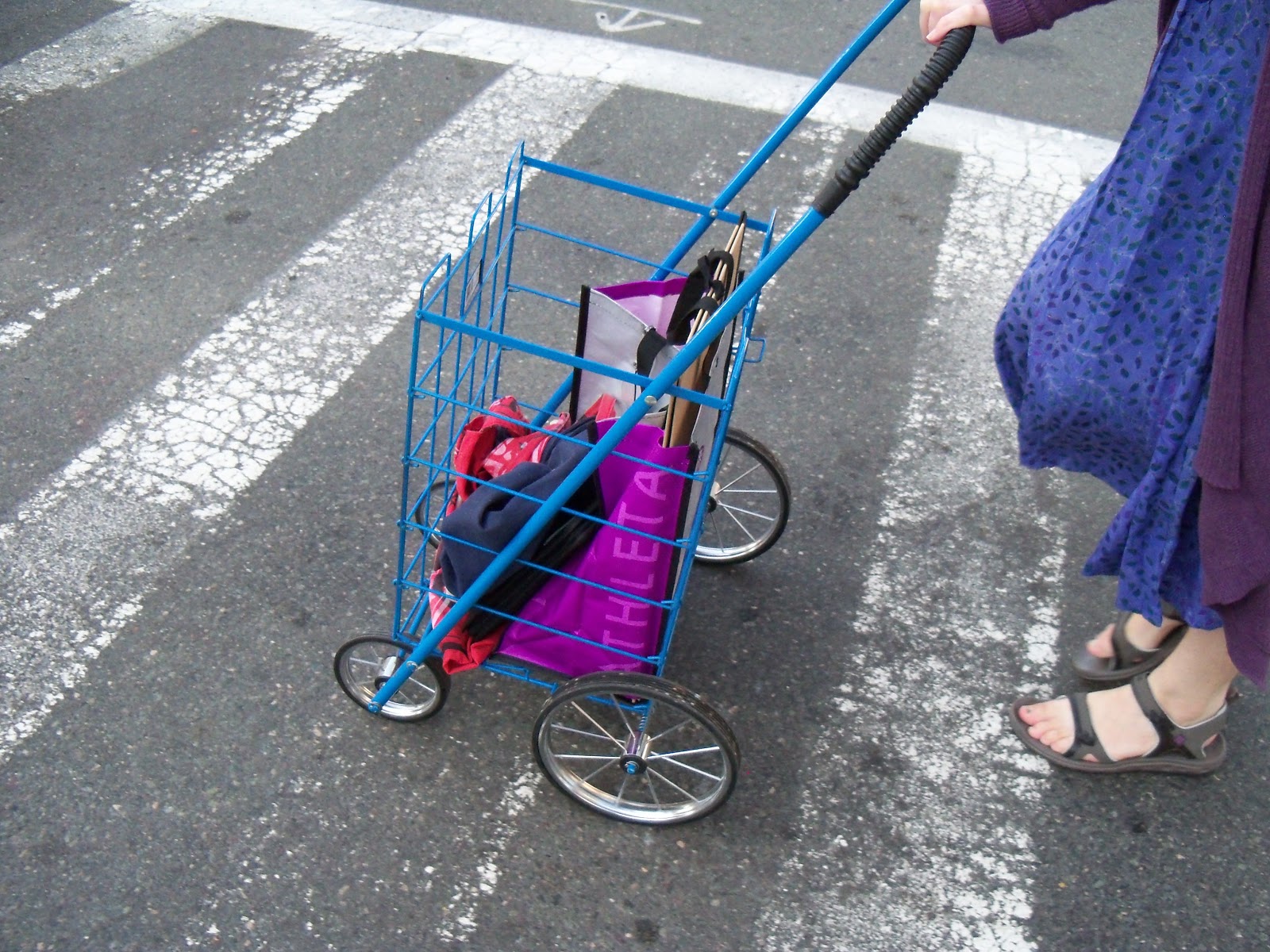
Hanna and I finally bought this shopping cart this year

I’m going to use, as an example, the errand I ran earlier this week to pick up our first monthly allotment of winter veggies from Stillman’s farm where we are CSA subscribers. Stillman’s is out near Fitchburg, Massachusetts, and drives the produce into the city to various pre-scheduled pick-up locations. The closest pick-up point for us was in downtown Boston about two miles from where I work at the MHS. The pick-up time was 2-4pm.

Setting aside, for a moment, the privilege of having a job with a) an hour-long lunch break, and b) the ability to leave on an errand and not worry about getting in trouble if the subway is delayed and I get back a bit late, this sounds like a relatively easy transaction. Take a late lunch, go down, pick up veggies, return to work, take veggies home at the end of the day. If I were living in my home town, this errand would have taken about twenty minutes, maybe, leaving 40 minutes at either end to actually eat lunch.

In Boston, this errand means the following:

1. Remember to take the wheelie-cart with me to work (which means dragging it along on our morning walk of approximately three miles) so that I will be able to transport the heavy winter vegetables on my own.

2. At 2pm, walk to the closest T stop and wait for a train that will take me the right number of stops from Hynes Convention Center to Haymarket (approx. 10 minutes)

3. Maneuver the empty cart into the T, off the T, and up the escalator at Haymarket, and two blocks to the drop point (approx. 15 minutes).

4. Transfer the vegetables from the back of the delivery truck into the cart (approx. 5 minutes).

5. Stop at a nearby sandwich shop for a sandwich and iced tea — admittedly an “optional” step, though to go without would have meant foregoing a midday meal; as it was, I didn’t have time to actually eat the sandwich until I was walking home that evening (approx 10-15 minutes).

6. Carry the cart, maybe 45 pounds fully loaded, down the stairs to Haymarket station; they have an elevator but I didn’t have time to locate it; the elevators to below-ground stops are often poorly marked. The escalators go up, but not down.

7. The first T to pull into the station was headed in the right direction, but not to the appropriate stop. I got on anyway, since I was now starting to feel anxious about getting back to work roughly on time. In order to board the train, I had to lift the cart up the stairs and maneuver it around the other passengers to a quasi-secure “parking” spot midway down the car.

8. At Copley Square I had to transfer trains, meaning I needed to maneuver around standing passengers carrying the laden cart down to the platform, and then repeat the process boarding the train again. All of these situations were made comparatively easy by a) the fact I’m physically able to lift the loaded cart for short bursts of time, b) I was traveling mid-afternoon instead of rush hour, c) I wasn’t getting hate-stares from people who automatically resent the presence of strollers in the subway. (steps 6-8 took maybe 20 minutes).

9. At Hynes, I had to disembark and haul the cart up three flights of stairs (only one of which is equipped with an up escalator) to street level, and then wheel the cart from the station to the MHS. (5 minutes)

10. At the end of the work day, I knew that rush hour on the T precluded trying to get my shopping cart on the T unless I wanted to wait for 45 minutes to an hour for any train empty enough to accommodate me. Since I am able to walk, and didn’t have to rush home for any reason, I walked home — a distance of about 3 miles — pushing the cart ahead of me.

This is the labor it takes to do one errand in the city when you’re relying on public transportation and your own two feet. I’m not writing this post in a bid for folks to pity me — we made the decision to subscribe to the CSA this winter, after all, knowing the time and effort it would take to get our fresh veggies. But I do hope that focusing in on the logistics of one errand this way points out how most of us, at one time or another, even if we are able-bodied adults sans children moving around our environment, are awkward to accommodate. And also point out how the environment is as much “at fault” as the awkward human being in question.

Rather than bitching about those of us who crowd the sidewalk with shopping carts, strollers, or walkers, we might think about the assumptions that led to sidewalks being a certain width (i.e. that all those who use the sidewalk are people who can walk unaided and unburdened with goods). While some of us might be able to carry our children (or our groceries) in wraps or packs or tote bags, others may not be strong enough to carry 45 pounds of produce (or exhausted toddler) for three miles — or time our outings before/after rush hour in order to actually fit on the T without the other passengers complaining or resenting you.

More and more, I find myself thinking about how the ideal citizen-worker in our world these days is the perfectly-able young adult without any dependents, who never gets ill, and is somehow (magically) perfectly self-sufficient. Not only do they never behave awkwardly in public, take up more space than we think they should, turn up their music louder than we’d like, lose their train of thought in the grocery aisle, or fumble with their wallet at the cash register … they manage their bodies (and those of their children) and personal belongings so that the rest of us can imagine they are not there.

Oh, I’ve been there. I’ve been annoyed and judgy and exhausted and angry and in the headspace where I just want to get home and not deal with one more stranger ever anywhere. But that’s just not the way the world works. We’re all awkward, noisy, thoughtless, slow. We all take up more space, sometimes, than others think we should.

And it seems like an important exercise or practice for each of us to — regardless of how we feel and what we think of others’ choices and presence —  realize that they’re probably just trying to get around the city like we are, and that sometimes getting from point A to B is an awkward, clumsy process. One that does, in fact, take up space in the world.

And that we all, in fact, equally entitled to be mobile, and to move around the city when and how we need to in order to live our lives.

fighting anecdata with anecdata

08 Saturday Sep 2012

Posted by Anna Clutterbuck-Cook in think pieces

≈ Leave a comment

Tags

being the change, feminism, friends, masculinity, random ranting, the personal is political

So I’m in the middle of reading a review copy of Hanna Rosin’s The End of Men and the Rise of Women, which … with a title like that, you really can’t expect much, right? And your suspicions would be confirmed. But one of the truly annoying things she’s doing is profiling hetero relationships in which everyone is miserable.

And portraying all men as dunderheaded two-year-olds.

I HATE IT WHEN JOURNALISTS DO THIS.

You’d think, reading books like this (or, ahem, The Secret Lives of Wives) that not a single happy experience was being had in the world of hetero relations since, oh, I don’t know, V-J Day. Or possibly since women got the vote. Or maybe around the time Mary Wollstonecraft penned Vindication.

So, more or less in self-defense — or, more to the point, in defense of the many awesome non-abusive, humanly-flawed-yet-engaged-with-life men I know and love — I’ve compiled a list of men in our cohort (the “end of men” cohort, in which dudes are apparently, “obsolete”) by way of giving them all a massive shout-out for general awesomeness and, well, disproving Rosin’s hysterical claims that the world is rapidly devolving into a dystopic “matriarchy” (I swear, if she makes this claim one more time in the pages of The End I may emit a tiny shriek of despair).

Aiden is a passionate social justice activist working at the Durham County Library.

Brian, my brother, a middle school art teacher, free-lance illustrator, and graduate student, married to my sister-in-law Renee, a landscape painter.

Brian, my boss’s boyfriend, who’s the IT guy for a school, is training to be a voice actor, and moonlights as a musician.

Collin, my friend Diana’s boyfriend and all-around awesome person who works in digital archives management (and in his spare time does things like cook gourmet meals, build letterpresses, and send us cute pictures of bunnies).

Dan, a former Library Assistant at the MHS was just promoted to Assistant Reference Librarian; he enjoys cycling and soccer in his free time.

Drew has spent the last ten years working in computer programming and web design.

Eric, my friend Molly’s husband, just finished his PhD while parenting full-time and is looking for professional work (also while parenting an infant and six-year-old) alongside his wife.

Erik, Hanna’s best friend from High School, became a father earlier this year; he bartends while his wife works as an accountant for the state.

Henry works in IT and in his spare time enjoys hiking and traveling with his librarian wife.

Jeremy, my former colleague at the MHS, moved on to a position at LibraryThing and handles user communications and outreach, as well as spear-heading their project cataloging famous peoples’ historical libraries.

After completing his library science degree, Jim is working as a documentary editor and considering renewing his dedication of music.

My dear friend Joseph is a plant breeder who’s just sent his first book to press and completed the first round of paperwork to begin nation-wide trials for an ornamental corn hybrid. He’s also thinking about fostering rescue kittens when he finishes the process of buying a house.

Josh, Hanna’s acupuncturist, also teaches yoga and meditation while his fiancee works in a hospital.

Patrick, husband of Bethany, is completing a PhD in Philosophy and Mathematics, after extensive graduate work in both the US and UK.

Nate currently works at CostCo while pursuing documentary film-making; his wife teaches English and is completing her first YA novel.

I’m sure I’ve left someone out, so … feel free to fill in the gaps in comments! Please. And I promise a more coherent review of Rosin’s work once I’ve actually had the patience to finish it.

in which I write letters: dear alma mater … again

06 Thursday Sep 2012

Posted by Anna Clutterbuck-Cook in think pieces

≈ 1 Comment

Tags

being the change, bigotry, education, hope college, i write letters, politics, religion

Diane De Young
Associate Director of the Hope Fund
Hope College
PO Box 9000
Holland, MI 49424-9000

4 September 2012 

Dear Ms. De Young,

Thank you for your recent letter alerting me to the upcoming Hope College Phonathon. I am writing to explain why I will not be contributing to the campaign; you are welcome to share my reasons with whomever might benefit from this information. 

As I’m sure your records indicate, I attended Hope College from 1998-2005, graduating with a BA in Women’s Studies and History (double major). During my seven years at Hope, I formed lasting relationships with my faculty mentors and received what I would consider a superior college education. While at Hope, I benefited from merit and need-based scholarships, as well as the tuition benefit awarded to children of Hope College employees (my father is Mark Cook, director of the Hope-Geneva Bookstore). The quality of my Hope College experience was part of what enabled me to make the most of my graduate education at Simmons College, where I completed an MA in History and an MS in Library Science. Today, I serve as the Reference Librarian at the Massachusetts Historical Society, and this past March I had the rewarding experience of returning to Hope College as a guest speaker at the Women’s Studies Celebration. I was recently asked to provide a letter of support for Dr. Jeanne Petit as she is considered for promotion to the rank of Full Professor, a request it was my pleasure to fulfill.

However, as a woman who will shortly be marrying my girlfriend of the past three years here in Massachusetts, I am a Hope College alumni who feels unwelcome and unloved by the institution as a whole. In April 2010, as the Board of Trustees was revisiting their support of the current Institutional Statement on Homosexuality, I wrote to then-Chairperson Joel Bowens and explained that until Hope College alters its position on human sexuality to be affirming of all a full range of human orientations, identities, and desires, I will not support the college financially. I cannot in good conscience send money to an institution that does not recognize the legitimacy of my primary relationship. I will speak up whenever given the opportunity — such as during fundraising campaigns — against the actions and words of the Board, and of Hope as an institution, that continue to create a hostile environment for faculty, staff, students, and alumni who are not straight or do not believe that non-straight sexuality is immoral.

I will continue to speak highly of the faculty who mentored me, and provide what support I can to individuals and programs that are welcoming and affirming to all (such as the Women’s Studies program). Yet I will not be participating in the Phonathon, in the Hope Fund, or any other fundraising campaigns until Hope College as an institution recognizes and affirms the lives of those of us who find joy and meaning in same-sex relationships.

I look forward to watching Hope’s progress toward a more inclusive future, and hope that someday I will be able to respond to your requests without reservation.

Sincerely,

Anna

Anna J. Cook (’05)
# Xxxxxxx Xx. Apt #
Xxxxxxx, MA
02134

in which I write letters: the problem with throwing religious home-educators under the bus

04 Tuesday Sep 2012

Posted by Anna Clutterbuck-Cook in think pieces

≈ Leave a comment

Tags

children, education, i write letters, politics, religion

Dear Claire,

I’m writing to you as a long-time reader of The Tenured Radical, as a fellow blogger, fellow leftist, and individual who spent the first seventeen years of my life learning outside of school — as did my fiancee, until she entered public high school. I wanted to respond to your post regarding home education and the religious right.

I realize that in our contemporary landscape “homeschooling” in the public eye has become virtually synonymous with conservative Christian organizations like the Home School Legal Defense Fund (which actually financed a lot of the court battles that made home education legal for families of all political persuasions), and families who take their children out of public schools for fundamentalist religious reasons. However, I find your characterization of home education “as a grassroots movement” being anti-intellectual and anti-citizenship troubling.

Yes, you are talking about a specific subset of home-educating families and philosophies, but throughout your piece you obscure the wide variety of motivations to home education and styles of learning and teaching by using “home schoolers” as a substitute for “fundamentalist-evangelical Christian conservative homeschoolers.” As a woman who grew up as part of the “grassroots” home education movement in Michigan during the 1980s and 90s, this erases my experience — and the experience of many of my contemporaries — whose home-based education expanded horizons, rather than limiting and controlling them.

You say in your post:

Public education is about putting citizens in the making in one place to talk to each other and learn together.  Is it an accident that when large numbers of voters fail to participate in a common enterprise with Americans not of their choosing that we have so little to say to each other during an election season?

I have seen a lot of anti-homeschooling liberals express similar sentiments, that home education is somehow inherently un-democratic because it removes children from the public square. This is a very limited understanding of the potential of learning outside of school, and in fact many of the progressive home-education folks I know would argue precisely the opposite: that home-based education takes children out of the age-segregated ghetto of school and brings them into the community at large.

As a home-educated child, rather than spending my days in a school building I volunteered at cultural institutions such as the public library and the local history museum, participated in community art classes and music groups, in sports activities and “field trips.” I held part-time jobs as a teenager that not only gave me excellent work experience but also further grounded me in the community. I was involved in church, another locus of social interaction and civic participation.

Obviously, this is not an automatic benefit of home-based education. But I would argue that exposure to a wide range of viewpoints, diversity, and the values of civic participation is not an automatic benefit of public education either. Public schools can be homogeneous, and educators narrow-minded, just like individual parents and families can be. My siblings both attended public high school for part of their grade-school education and benefited from that experience; my brother now teaches art in a public middle school. I am grateful that public provision of education is part of our nation’s commitment to its citizens, and feel that — like hospitals or roads! — public schools are our responsibility to fund whether or not we choose to, or need to, access those services.

Suffice to say, I believe it is a profound mis-characterization of home-education per se to suggest it is at root an anti-democratic, anti-public-spirited endeavor. Obviously, some people who make the choice to home-educate will do so for sectarian reasons, to withdraw from the society at large, because of profound disagreement with mainstream policies. There are examples to be found on the left as well as the right in this regard. But I would argue that this is a freedom-of-conscience decision. There is a long tradition in the United States of allowing parents to decide what the best method of education provision for their family is; compulsory education does not mandate form or content for good reason — local, familial, and religious priorities and needs vary. There is no “one size fits all” that would work well for the majority.

I believe that demonizing/scapegoating people who choose to home-educate for religious reasons actually threatens the freedom of all of us to form and organize our families as we see fit (see: same-sex marriage, polyamory, attachment parenting, etc.). It is certainly within our rights to point out that some forms of parenting foster us/them thinking — but home education is not the cause of that parenting outcome. It is simply the chosen method of delivery for some families. It is a tool, not a uniform ideology, and the values a family holds will shape how home education works for that family, rather than home education pre-determining an exclusionist, reactionary outcome.

In closing I want to thank you for your articulate, insightful blogging at The Chronicle; I have your blog in my Google Reader and regularly click in to read what you have to say. As a fellow blogger I realize that no one post can cover all aspects of an issue. In this instance, I just wanted to share my perspective as someone “on the ground” as a home-educated adult, who has been on the receiving end of fellow liberals’ suspicion of home-based education for many years! I think that the picture is (as always) much more complex than outsiders perceive it to be, and conflating “home education” with “reactionary conservative isolationist” does more harm than good.

Sincerely,
Anna

blogging at In Our Words: we can give them words: clearing space for children to explore gender and sexuality

14 Tuesday Aug 2012

Posted by Anna Clutterbuck-Cook in think pieces

≈ Leave a comment

Tags

blogging, children, gender and sexuality, guest post, in our words

I wrote another post for In Our Words this week on how parents (and allies) can support children in their gender independence and sexual fluidity (I’m not sure why the editors lopped “sexuality” off the title I supplied).

To begin with, don’t conflate gender expression with sexual preference. Our culture does this constantly, whether in the assumption that princess boys will grow up to be gay or that women who are butch sleep exclusively with lipstick lesbians. Some of those boys will no doubt grow up with same-sex desires, and some women who refuse to wear skirts are queer. One does not lead to the other. While grown-up queers often retroactively identify nascent gayness in childhood gender rebellion (“I was never good at sports”; “I hated playing with dolls”) and the gender police often conflate gender non-conformity with queer sexuality, they’re two different aspects of identity and experience. Children negotiate gender roles from the moment of birth, when they’re assigned a gender and adults interact with them accordingly (see Fine and Rivers & Barnett in the reading list below).

Children are also sexual beings, it’s true, but sexuality in the adult sense is something we grow into. It’s a process. And presuming adult sexual preferences for a child — whether it’s teasing them about a playground “boyfriend” or assuming their gender non-conformity will lead to same-sex desire — is unfairly boxing them into predetermined categories. We cannot know what the gender and sexuality landscape will look like as they grow into adulthood, and we cannot know what words they will choose to describe themselves. All we can do is give them a multitude of words from which to choose.

You can check out the whole piece — including my “suggested reading” list (I’m a librarian after all!) over at In Our Words.

blogging at In Our Words: holding the space: being good allies for our straight co-conspirators

01 Wednesday Aug 2012

Posted by Anna Clutterbuck-Cook in think pieces

≈ Leave a comment

Tags

gender and sexuality, guest post, in our words, politics, the personal is political

these folks desperately need allies (via)

I’m blogging at In Our Words again this week, with a post on how queer folks can be good allies for straight folks. This was a piece pitched by the blog editors that I thought was an interesting concept, and once I started thinking about it I realized I had some notions (I know, right?!) about how we might go about that. I ended up with one concept, five specific tips, and a word of caution. Here’s one of the tips:

While remembering fluidity is possible, it’s equally important to honor a person’s present self-identification. After all, we expect straight people to respect ours. Regardless of a person’s past relationship history or how they may identify in the future, it’s a basic tenet of respect to accept their self-understanding in the here and now. I’m as guilty as the next queer person when it comes to speculating who might be “on our team,” but too often attempts to uncover queer sexuality in straight-identified folks fall back on harmful stereotypes of sexuality and gender that reinforce, rather than subvert, heteronormativity (e.g. “he’s a ballet dancer, how can he expect us to think he’s straight?” or “that haircut is totally dykey”;  wink wink, nudge nudge). We need to trust straight people, as much as we trust queer people, to name their own desires as best they can.

Check out the rest at In Our Words.

If you’re a straight reader, I’d love to hear what you think queer folks can do to support your own resistance to heteronormative bullshit. And if you’re queer, I’d love to hear how you support your straight family and friends.

Share in comments, here or at IOW.

blogging at In Our Words: to be and to have (a wife)

10 Tuesday Jul 2012

Posted by Anna Clutterbuck-Cook in think pieces

≈ Leave a comment

Tags

blogging, gender and sexuality, guest post, professional gigs, wedding

lesbianweddings.tumblr.com

This week I have a guest post up at In Our Words on why I wanted to get gay-married:

I’ve learned that being public about our relationship matters to me. That naming has power. I relish naming her my girlfriend my partner my future wife in conversation with others. I want (need?) everyone to know we are a social unit, and exactly what kind of unit we are.

It matters to me that bystanders be in no doubt that we are in each other’s pants on a regular basis, thank you very much, and they will just have to deal. Because the public sphere is mine as much as theirs, and I’m not backing down from making promises to be and to have before witnesses. By just being who we are, building a life together, we change the meaning of marriage – I believe for the better. And that’s an act to be proud of.

So as a queer feminist and historian, I see marrying my fianceé as both an intensely personal act of commitment and also a deeply political act: inventing the future we’re hoping for. Becoming Future Wife’s Wife is a material statement that we have the right to act on our desires, to form families that work for us, and to name our relationships with the rich weight of history behind us, if that language feels right to us.

You can read the whole thing over at IOW. It was a surprisingly difficult piece to keep on focus with, and I’m still not entirely satisfied with the end result — but I learned some stuff about how I think and feel writing it, which is always the ultimate goal! That, and encouraging others to reflect as well. So I hope folks find it a thought-provoking read.

first thoughts: david blankenhorn’s evolving stance on marriage equality

23 Saturday Jun 2012

Posted by Anna Clutterbuck-Cook in think pieces

≈ 1 Comment

Tags

feminism, gender and sexuality, moral panic, politics, wedding

Prominent anti-marriage-equality theorist David Blankenhorn (a key expert for the supporters of Prop 8 in California, author The Future of Marriage) has recently gone public with his decision to support same-sex marriage as a way to strengthen the institution of marriage overall. He writes in his statement at The New York Times that he hopes this decision to support the right of same-sex couples to marry will re-orient the discussion away from the morality of homosexuality per se and toward question of how society provides for dependent children, and how we can best stabilize existing love relationships. He writes, in part:

I had … hoped that debating gay marriage might help to lead heterosexual America to a broader and more positive recommitment to marriage as an institution. But it hasn’t happened. With each passing year, we see higher and higher levels of unwed childbearing, nonmarital cohabitation and family fragmentation among heterosexuals. Perhaps some of this can be attributed to the reconceptualization of marriage as a private ordering that is so central to the idea of gay marriage. But either way, if fighting gay marriage was going to help marriage over all, I think we’d have seen some signs of it by now.
So my intention is to try something new. Instead of fighting gay marriage, I’d like to help build new coalitions bringing together gays who want to strengthen marriage with straight people who want to do the same. For example, once we accept gay marriage, might we also agree that marrying before having children is a vital cultural value that all of us should do more to embrace? Can we agree that, for all lovers who want their love to last, marriage is preferable to cohabitation? Can we discuss whether both gays and straight people should think twice before denying children born through artificial reproductive technology the right to know and be known by their biological parents?

There’s a lot going on in this statement and I won’t pretend my first response is comprehensive. But here are a few “first thoughts.” Continue reading →

guest post @ the last name project

11 Friday May 2012

Posted by Anna Clutterbuck-Cook in think pieces

≈ Leave a comment

Tags

blogging, family, feminism, hanna, wedding

I have a guest post up at from two to one today as part of The Last Name Project (co-hosted by Danielle of from two to one and Shannon of The Feminist Mystique). The Last Name Project profiles “an array of individuals and couples about their last name decisions upon marriage or what they expect to choose if they marry. The goal is to explore how individuals make decisions about their last name, and to highlight the many possibilities.” For my contribution, I wrote about the decision Hanna and I made to combine our middle names when we register our marriage:

This solution felt right to us because it doesn’t privilege either person’s family name. It adds to, rather than erasing any aspect of, our (linguistic) identities. As a feminist and queer woman, I think extensively about mainstream notions of marriage, family, and identity, and I knew that I wanted a way to honor my individual self and family history alongside incorporating my partner into who I am and will become. Weaving Hanna’s middle name together with mine feels like a positive way to entwine our individual selves together without losing those other strands of who we are and have been.

Check out the whole piece over at from two to one.

maurice sendak: first memories

08 Tuesday May 2012

Posted by Anna Clutterbuck-Cook in think pieces

≈ Leave a comment

Tags

books, children, family

When I got to work this morning, my Google Reader was rapidly filling with blog posts about the death of author and illustrator Maurice Sendak, at the age of 83.

I don’t have any big thoughts about Sendak and his the power for good his work was in the world, so instead I thought I’d share with you a couple of Sendak books that aren’t as well known and are, in fact, two of his works I remember best from early childhood.

Before I was born, my parents adopted a golden retriever named Satch (after jazz musician Louis Armstrong, whose nickname was “Satchmo”). This was one of the books they had in their collection of dog care manuals, and I remember really loving the comic-strip layout, as well as the adorable and mischievous pup.

This lushly-illustrated story with text by Charlotte Zolotow and illustrations by Sendak relates the quest of a child to find the perfect gift for her mother. I remember Mr. Rabbit feeling slightly threatening, even though he’s kind and helpful, perhaps because he is more adult-sized in the illustrations than child-sized. Yet overall, it’s a quiet low-key story with a sweet resolution, and a rhythmic feeling to it that was incredibly soothing when I was small.

Just looking over Sendak’s bibliography of works reminds me how much of my childhood library was touched by his work. So thanks, man, for making my world that much more vivid and Truthful.

Cross-posted at the corner of your eye.

← Older posts
Newer posts →
"the past is a wild party; check your preconceptions at the door." ~ Emma Donoghue

Recent Posts

  • medical update 11.11.22
  • medical update 6.4.22
  • medical update 1.16.2022
  • medical update 10.13.2021
  • medical update 8.17.2021

Archives

Categories

Creative Commons License

This work by Anna J. Clutterbuck-Cook is licensed under a Creative Commons Attribution 3.0 Unported License

Meta

  • Create account
  • Log in
  • Entries feed
  • Comments feed
  • WordPress.com

Create a free website or blog at WordPress.com.

  • Subscribe Subscribed
    • the feminist librarian
    • Join 37 other subscribers
    • Already have a WordPress.com account? Log in now.
    • the feminist librarian
    • Subscribe Subscribed
    • Sign up
    • Log in
    • Report this content
    • View site in Reader
    • Manage subscriptions
    • Collapse this bar