• anna j. clutterbuck-cook
  • contact
  • curriculum vitae
  • find me elsewhere
  • marilyn ross memorial book prize

the feminist librarian

the feminist librarian

Tag Archives: blogging

a word about words, unschooling edition

09 Thursday Dec 2010

Posted by Anna Clutterbuck-Cook in think pieces

≈ Leave a comment

Tags

blogging, education

After a discussion with Hanna last night about unschooling vs. homeschooling vs. home-based education (as vocabulary choices and as philosophies), I wanted to clarify a couple of things re: word choice in my blog posts about nontraditional learning.

We were talking about the language I used in my recently-published interview as a “grown unschooler.”

In my life, I tend to use all three of these terms (and variations thereof) to talk about myself and my life experience. As a child, I used “homeschooling” because that was predominantly what my parents used. As a teenager I discovered “unschooling” as a term to differentiate more child-directed forms of homeschooling from those which sought to replicate school-at-home (this usage dates back to the 1970s), and found it more usefully described my particular experience of homeschooling — particularly as a way to distinguish myself from the majority of homeschooled teenagers in my area who were politically, socially, and pedagogically conservative.

More recently, since I’ve been doing scholarly reading and writing on the subject of education, learning, schooling, and pedagogy, I’ve become more varied and more deliberate in my choice of words to describe learning and teaching experiences. In my academic writing, I tend to use the word “school” to mean formal, institution-based educational experiences specifically — while “education” means learning and teaching experiences in a broader sense. Learning, of course, can take place even when deliberately-planned educative environments and/or experiences are absent. But home-based education is, usually, planned. Even if to the extent that parents have chosen to allow their children to grow outside of the default option which, in our culture, is formal schooling (public or private).

“Unschooling.” It’s an unsatisfactory word to me for a couple of reasons. One is the prefix “un” which right away gets us into negative territory. Instead of being for something (home-based education; learner-directed education) we’re defining ourselves against something (institutional school). The second, related, issue is that it still frames learning as something to do with school — even if set up as school’s opposite.

In fact, I think — and I imagine most self-identified unschoolers would agree — that learning and education are much, much bigger than mere school or its opposite. Learning can take place in, but is not bound by, formal schooling or deliberate educational activities. So these days, I try to move away from “school” terms as much as possible when I describe my own learning background pre-college.

At the same time, I continue to use all of these words, depending on the audience, the context, and the topic. I’m happy to accept the label “unschooler” when it allows me to talk about my experience outside of school; I’ll use “homeschool” or “home-based education” when that seems like the most useful choice. At the end of the day, I believe words are what we make of them — words are tools — and the more and the more varied the words we have at our disposal to describe our experience (and, most importantly, the more willing we are to be flexible in our language use) the better-equipped I think we are to articulate our being-in-the-world in all its myriad permutations.

"you should call it the doppler effect. then people will shag you."

08 Monday Nov 2010

Posted by Anna Clutterbuck-Cook in think pieces

≈ 2 Comments

Tags

bigotry, blogging, politics

shout and scream by Mindaugas Danys
available at Flickr.com

So this past weekend I was enjoying some stimulating, thoughtful conversation over on Emily Nagoski’s blog about teaching women’s sexuality in higher education. A student in the semester-long class on the subject recently contacted Emily and suggested that the course material was “unintentionally heteronormative.” This provoked an interesting conversation on the comment thread about how to teach the biological aspects of human sexuality to students more comfortable in the world of sociocultural analysis — students who are (rightly) suspicious of simplistic truth claims from the world of hard science, but who are perhaps hastily dismissing an entire way of seeing the world that could be useful, as long as it remains one of many tools we have to increase our understanding.

I digress. If you’re interested in that conversation, you can head over to the original thread.

The thing is, a commenter jumped into the conversation and suggested this student — solely on evidence that they used the word “heteronormativity” was an “unhinged crank,” who “sees ‘heteronormativity in A/C plugs and sockets.” When Emily replied “I know with certainty they are not,” he begged to differ:

Anyone who would accuse the Emily Nagoski I know of ThoughtCrime – excuse me, “heteronormativity” – is nearing the straitjacket stage of gender politics.

The thing is — this guy obviously knows and wants to defend the thoughtfulness and openness of his friend. Both of these impulses are laudable. But I really, really wish we had a Godwin’s Law for references to ThoughtCrime, ThoughtPolice, 1984 and the derogatory use of “politically correct”  and the label of  “language police.” Attempt to invalidate someone’s argument by accusing them of being the thought police? You lose.

Like with Godwin’s Law,  the Feminist Librarian’s Law of Accusations in Place of Honest Reflection, allows that there are instances in which it is legitimate to speak out against genuine instances of attempted censorship or policing of other peoples’ life experience. I believe policing other peoples’ sexualities, identities, bodies, clothing choices, food choices, and yes, even language choices (when it comes to self-identification and description at least) is not okay. It’s their life, not yours. And unless their actions are causing you or other people demonstrable harm (for which you have to show not just claim causal effect), it’s none of your damn business. And if there were actually state-sanctioned censorship going on here, it’s legitimate to challenge it. (Although I’d suggest accusing the proponents of being the “thought police” might not be the best way to get your message concerning freedom of speech across.)

The thing is: No one in this scenario has tried to thought-police anyone.  A student in a class has raised concerns that a class on women’s sexuality is unintentionally perpetuating heteronormative culture. Heteronormativity is not a “thought crime”: it’s the accumulated effect of myriad cultural cues that suggest to us that the normal (and best) form of sexual identity and expression is one in which individuals’ gender matches their assigned sex, that gender expresses itself in only two mutually-exclusive ways (“male” and “female”) and that the most appropriate expression of human sexuality is through opposite-sex pairings.

Far from acting as the Thought Police (who, ahem, had the weight of the government behind them), the student in Emily’s class is raising a question from the margins. Our government supports heteronormativity not its opposite. One cannot literally act as the “thought police” unless one has the power of cultural, political, and/or legal authority behind them.

In my experience, the people who get most often accused of policing other peoples’ thoughts or words are people who are challenging the status quo.  People with no political authority or cultural weight behind them. While the people who respond to those challenges with accusations of language policing and characterizations of the first person’s challenge as a call for “political correctness” are defending the status quo.  They’re skeptical of the first person’s challenge, dismissive of their concerns, and all too ready (as this gentleman has) to label the challenger as a “crank” or “unhinged.”

This is not what Orwell was talking about, people. This is not censorship.  This is just, you know, people bringing up ideas that are outside your comfort zone.

And crying “thought police” just ’cause you’re a little uncomfortable is, shall we say, slightly over-egging the cake.

In my experience, the only goal of this tactic to get the challenger to shut the fuck up by telling them their question-asking is an hysterical over-reaction or a calculated power-play (probably both!). It signals to me that the accuser the doesn’t understand the crucial distinction between the exertion of power-over with the full weight of the Powers That Be behind it and the actions or speech of those who are challenging the Powers That Be the passive or active abuses the often come with those Powers.  It signals to me that the accuser does not care enough about the challenger as a person or about their ideas to give them due consideration, even if that person and their ideas make the accuser uncomfortable.  Reflexive defensiveness: Not. Cool.

Had similar experiences? Discovered ways of dealing with this sort of response effectively? Share in comments!

quick hit: reality, spectacle, and medical museums

03 Wednesday Nov 2010

Posted by Anna Clutterbuck-Cook in linkspam

≈ Leave a comment

Tags

blogging, history, in love with new blogs

On Friday I posted a review of Jennifer Pozner’s new book on reality television which in turn inspired my friend Laura, at her newly-minted blog Oh, My Sainted Aunt, to muse on the relationship between reality television and our relationship to the objects in medical museums. Such is the incestuous power of the interwebs.

I’ve been thinking a lot about reality television, as it is a popular lunch topic at my new workplace and I generally listen rather than contribute, as I do not watch reality TV.  But here’s the context, ya’ll, and why I’ve been thinking about spectacle lately.

You see, I work in a medical museum, an historical collection of pathology material, which includes lots of medical oddities in jars.  The human tissue includes bits of tattooed skin, congenitally deformed fetuses, skulls, diseased tissue, and so forth.  These materials were collected over the past 150 years, some ethically, some not (and some have been repatriated, etc.), but the mission was medical and scientific advancement (insert ethics and human experimentation caveat here).  Historically, much of this material would have also made it’s way into side-shows and freak-shows, which were popular (and socially acceptable) forms of public entertainment.  Remember of course, that this was also done with real live people as well, such as in the “native” exhibits that the Colombian Exposition and World’s Fairs.  Suffice to say that we have a history of using human beings (the odd and unfamiliar) as a source of spectacle and speculation in ways that were and are profoundly dehumanizing.  (See where I’m going yet?)

Read the whole thing over at Oh, My Sainted Aunt (and then follow her blog on your reader of choice!)

from the archives: american medical student in germany between the wars

28 Thursday Oct 2010

Posted by Anna Clutterbuck-Cook in linkspam

≈ Leave a comment

Tags

archivists, blogging, hanna, history

My “from the archives” item this time around is actually from Hanna’s work at the Center for the History of Medicine (aka “CHOM,” the noise refined zombies make when gnawing on their prey), a special collections unit within Harvard Medical School’s Countway Library.

Hanna was asked by her supervisor to write a blog post about some of the materials in the collection she recently finished processing — the personal papers of one Dr. Hyman Morrison (1881-1963).  She chose to write about a cache of letters Dr. Morrison kept from a medical student, Lewis Chase, who was an American studying in Munich and Berlin between 1929-1934. Hanna writes:

Chase was extremely adept at recognizing and commenting on contemporary German political rhetoric and noticing the tensions and potential for tensions between native German and “foreign,” often Jewish American, students at the unversities in Berlin and Munich. In December 1930, for instance, Chase wrote of an influx of American students: “Of the newcomers to Berlin, all are Jewish, with the exception of one Harvard negro—two or three from Boston, many from New York and its immediate vicinity. … Actually there have taken place a number of disagreements, happily only verbal, among the students; a protest against the ‘incessant, loud English-speaking carried on in the Anatomy laboratories’ has already been filed by some reactionary native students.”

 You can read the rest of her blog post over at CHOM’s website. Go enjoy her stories (and help up the amount of traffic her contribution to the website receives!).

no single story is everyone’s story: thoughts on the "it gets better" project

05 Tuesday Oct 2010

Posted by Anna Clutterbuck-Cook in think pieces

≈ 1 Comment

Tags

blogging, gender and sexuality, politics

There’s been buzz around the feminist/queer interwebs about the It Gets Better crowd-sourced YouTube project, in which non-straight, gender-non-conforming folks are asked to film and post their stories about coming of age and leaving shitty adolescent experiences behind for better places.  This project was started by Dan Savage and his husband Terry in response to the recent high-profile suicides by teenagers who were bullied for being, or being seen as, queer.

There have been a number of, I think, valid critiques of the project: its limitations (is “it gets better” all we can offer kids in pain??), the implicit assumptions it makes (that things will get better, that adolescence universally sucks and adulthood is inherently superior).  One of the best breakdowns I’ve seen comes from TempsContreTemps @ (femmephane). Quoting at length, from the ten reasons the project (and specifically Dan and Terry’s contribution) makes her feel uncomfortable

1. The video promotes metro-centric and anti-religious sentiment. By aligning their bullying with the religiosity and “small-town mentality,” Dan and Terry tacitly reinforce the belief (especially rampant in queer communities) that the religious and the rural are more bigoted.

2. The message is wrong. Sometimes it gets better– but a lot of times it doesn’t get any better. Emphasizing that things will improve upon graduation is misleading both to young folks struggling and also to people with privilege who are looking on (or looking away).

3. Telling people that they have to wait for their life to get amazing–to tough it out so that they can be around when life gets amazing– is a violent reassignment of guilt. Dan Savage telling kids that if they don’t survive their teenage years they’re depriving themselves? What kind of ageist garbage is that? This quietly but forcefully suggests that if you don’t survive, if you don’t make it, it’s your own fault. It blames the queer for not being strong enough to get to the rosy, privileged, fantasy.

4. Stories of how your mom finally came around, over-write the present realities of youth. Arguing that in the future, the parts that hurt will be fixed, not only suggests that folks shouldn’t actually inhabit their own suffering but it also suggests that the future is more important. For a lot of folks, it doesn’t matter if your mother might come to love you and your spouse. It matters that right now she does not love you at all.

5. The rhetoric about being accepted by family, encourages folks to come out– even when coming out isn’t a safe idea. There is no infrastructure to catch you when your family reacts poorly. There is no truly benevolent queer family, waiting to catch you, ready to sacrifice so you can thrive. For a lot of folks, coming out doesn’t only mean that your parents will promise to hate your lovers– it means violence, homelessness, abuse.

6. Bar story: vomit. It’s no coincidence that this is the first place where Dan and Terry mention queer space. Codified queer-space, restricted to 21+, w alcohol? Try again.

7. We shouldn’t be talking, we should be listening. Telling our own stories from our incredibly privileged positions, overwrites youth experience.

8. Stories of over-coming adversity: no thank you. Narratives of how life was hard and but now is good, belittle lived pain, imply that a good ending is inevitable, and also undermine the joy and happiness in even bullied kids’ lives.

9. There is actually no path to change in this vision. Promoting the illusion that things just “get better,” enables privileged folks to do nothing and just rely on the imaginary mechanics of the American Dream to fix the world. Fuck that. How can you tell kids it gets better without having the guts to say how.

10. Then we get a baby and go to Paris? WTF? This is a video for rich kids for whom the only violent part of their life is high school. It’s a video for classist, privileged gay folks who think that telling their stories is the best way to help others. Telling folks that their suffering is normal doesn’t reassure them– it homogenizes their experience. It doesn’t make them feel like part of a bigger community, it makes them feel irrelevant.

Plus three (with a little help from my friends)

1. When we treat campaigns like this like they’re revolutionary, they undermine all the really amazing work that the youth already does for itself. Too often in the LGBT world, we are asked to thank our brave queer activist ancestors who made the world safe for us. That does have its place. But queer youth take care of themselves. They nurture and organize and love in order to save themselves and each other. Making famous messages legible as THE messages makes youth-work look minor, haphazard, or unofficial.

2. Campaigns like this lump everyone together. It doesn’t honor or respect the individuals. It turns them into icons. It sends confusing messages that we only attend to folks when their dead– when giving care doesn’t actually take anything out of us.

3. Broadcasting your story into the world, or congratulating others for broadcasting theirs is an anesthetized, misguided approach to connecting. We should help folks feel seen— by trying our hardest to see them.

It has been my experience that people are ashamed to help the folks they see as destitute. They are willing to let someone crash on their sofa for a night if they know that they have a back-up bed, somewhere else. They are happy to provide dinner, so long as they know you would be eating even without their generosity. It seems that if you’ve never been homeless or lost or hungry, if you don’t know what that feels like,  is too embarrassing to give things to people who might die without them– it is humiliating to hand someone the only food they’ve had all week.

You can read the whole thing over at (femmephane).

You can also read the follow-up post there.

And thanks to taniada @ Cynical Idealism for sharing the link on Tumblr and thus bringing it to my attention.

I haven’t been at a computer where I have multimedia access long enough in recent weeks (I can’t watch videos at work; I try to limit my recreational internet time at home) so I haven’t actually watched Dan and Terry’s video.  So this post isn’t really about the project or the specific video. Instead, it’s about the responses to the video; in particular, the frustration expressed by many that this project — particularly since it has Dan Savage’s name on it — has been getting so much attention, and the implications of that attention for folks whose stories don’t fit the narrative of “it gets better.”  As TempsContreTemps writes in her follow-up post:

I wrote my piece as a response to the way that Dan and Terry’s video went viral so quickly. I was thinking about 1) why it was that THAT video was so popular and liked and 2) why the video made me and many of my friends uncomfortable. Also, I wanted to know whether those questions were related. Did it seem so painful because it was so popular? I am not capable of, nor would I want to, destroy Dan and Terry’s message. There are a multitude of ways to be queer. Dan’s isn’t the only voice… and neither is mine.

Instead, I want to complicate the dialogue.

This post illustrates for me the point that so easily gets lost in discussions about whether X or Y representation of movement Z or community Q is accurate or not, privileged or not, silencing or not, worthwhile or not, illuminating, incisive, judgmental, blind, feminist, misogynist, transphobic, racist, ageist, ableist … or not. The point that any one piece of activism can be multiple things at once.  Just as any feminist critic of popular culture knows that a song or a movie or a phenomenon can embody contradictory messages about women, so too can a single piece of activism embody contradictory messages, and cause contradictory effects.

We can (and I think should) get angry at these bits and pieces of activism for not living up to our expectations that people working for social justice be aware of, and attempt to mitigate, their personal biases and blind spots.  In scholarly research, we are (ideally!) trained to situate ourselves self-consciously in relation to our research, and be as honest as possible about the context out of which we analyze our sources, the context out of which we construct our narratives, the context out of which we formulate plans of action. There is no universal context (except for the context of being an oxygen-breathing human being, and even there you might be able to convince me otherwise …) and context matters.  People who don’t exhibit some sort of awareness of their own context in relation to others’ are bumbling at best and willfully ignorant at worst.  And they do deserve to be called on that behavior.

However, too often the echochamber of the internets, or of your given subculture of choice, seems to amplify these critiques to the point at which any meaningful, life-enhancing contribution of the originating act (in this case, the It Gets Better campaign) is denied. The act becomes shameful and the people involved are shamed, all nuance is erased and in the end — in my opinion — the potential for rich, collaborative, transformational work is often lost. All parties involved are often partially responsible for this dynamic — in my experience, it is rarely wholly caused by the critic(s) or the original actor(s) but some combination of failing to listen and failing to respect that human beings are complicated, and often contradictory, and that all of those contradictions deserve a place at the table, in all their messy glory. ‘Cause that’s what life is all about.

So I’m really thankful that TempsContraTemps raised questions about the project in this particular way, and I’m hoping the project (or counter-projects, or spin-off projects, or parallels or out-growths or alternates or reappropriations) benefits from that critique.

Maybe, when I finally have a chance to go watch some of the videos, the representative voices will be as gloriously myriad as I know the queer community to be. And hopefully, each one of those stories will speak to someone else’s heart and let them know they are not quite so alone.

reading the (lesbian) classics: hello, groin

04 Monday Oct 2010

Posted by Anna Clutterbuck-Cook in book reviews

≈ Leave a comment

Tags

blogging, guest post, reading lesbian classics

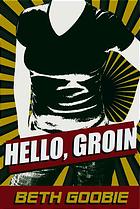
As explained in the first installment of this series, “reading the (lesbian) classics” is a monthly(ish) series of posts in which Danika Ellis of The Lesbrary and I read our way in a very haphazard manner through queer literature.  Our method is basically picking out the books that sound like a fun time and taking it from there!) and chat about it, and then post our conversations on the interwebs. For this second installment, we read another young adult novel by Canadian author Beth Goobie, Hello, Groin (2006).

This month, because of busy schedules, Danika and I exchanged our thoughts via email, rather than chat (as we did last time), so the nature of the exchange is a little more long-format rather than conversational. I color-coded our contributions in hope that it makes the reading a little easier for y’all.

Also, I don’t hide the plot spoilers on my post, so consider yourself warned if you care about that sort of thing. Danika posts our conversation with the plot spoilers obscured (unless you highlight them), so head on over to The Lesbrary if you want the “safe” version.

Danika: I guess to start off with, we could talk about the handling of teen sexuality in AOMM [Annie on My Mind] vs HG [Hello Groin]. HG doesn’t actually have any lesbian sex scenes (spoiler!), but it does have a lot of sexuality in it. I found it really interesting that Dylan is not a virgin. Neither is Joc, of course. And sex is a frequent topic of conversation and speculation. It seemed really true to the reality of teenagers at this point in time. What did you think?

Anna: Wow, so there’s a lot to unpack in your opening comment, and I’d love to tackle it all eventually! I was very struck by the fact that, despite the frank acknowledgment of sexuality in HG there was no lesbian sex (I was so disappointed!). The (mostly implied) sex is hetero sex, and masturbation, neither of which are demonized but both of which are not a substitute for same-sex love scenes, and I thought it was an interesting choice for Goobie to back away from being sexually explicit in that instance when she had not with other aspects of sex and the fact that teenagers can be sexual beings, and that this isn’t divorced from other aspects of who they are in the world.

In fact, I felt in a lot of ways that Dylan (our narrator) is a lot more uncomfortable about her same-sex desires than Liza was in AOMM. She acknowledges her discomfort directly in the book, quite early on, in chapter five when she addresses the reader and says, “The main question here, I suppose, would be, What was the big deal? Most people didn’t go into a major funk over sexual orientation anymore–a lot of lesbians and gays were out these days.”  And yet, for Dylan, it’s not so much a question of sexual desire but social identity: “I just didn’t click with them,” she says, “They were all really different than me–besides our hormones we had nothing in common.” 
To me, that’s a pretty major shift away from understanding your sexuality in terms of specific, personal desires and specific relationships in AOMM towards understanding sexual orientation as a form of group belonging in HG. And, ironically, the greater visibility of the LGBT community in Dylan’s life means that she has a much stronger sense of what it “means” to be queer. Therefore, because she can’t see herself as part of that community, this becomes a roadblock to her acknowledging, and feeling comfortable with, her desire for Joc. In AOMM, nearly the opposite is true: it is the lives of the lesbian teachers (embodied in their home and relationship) that help Annie and Liza see that being together is possible. It’s a dawning awareness that takes place almost in isolation from their peers.
What do you make of the lack of relational lesbian sex scenes in the book, and the fact that Dylan’s dawning awareness of her desire for Joc is depicted primarily in terms of solitary sex and her internal physical reactions, rather than exploration as a couple?  And (major spoiler!) I was particularly struck by Dylan’s desire to slow things down with Joc when they finally got together, rather than dive in and get to know her very willing partner on that level.  What are your thoughts?

Danika: Interesting. You know, I’ve never really considered how there is no explicit lesbian sex in HG. It seemed to fit with the models of lesbian teen books I’ve read before, like Empress of the World and Bermudez Triangle (correct me if I’m wrong; it’s been a while since I’ve read them). But you’re right: why shouldn’t these teen lesbian books include lesbian sex? After all, AOMM did (even if it was a little “off screen”), so you would think by this time we’d be more frank. When I think about it, though, I don’t know if I’ve read any teen lesbian books with actual lesbian sex scenes, even any that are comparable to AOMM.
I think the scenes of masturbation and talk about hetero sex was pretty explicit in HG. You’d be hard-pressed to find a reader who didn’t catch on that Dylan was masturbating. It’s kind of an ongoing theme at some point.
Hmm, that’s a good point. HG offers a sort of double-edged sword of queer visibility. Dylan knows what being a lesbian is, and she even personally knows lesbians. She doesn’t think they have miserable lives. But that idea of a queer community, which can be life-saving when coming out, can also seem too exclusive. If you don’t fit in in the queer community, can you really be queer? Can you be queer in a straight community? And that’s been an ongoing issue with queer activism: the “extremist” queer people want to create our own community, our own world, or at least radically reconstruct dominant society; the “moderate” queer people want to tweak dominant culture to allow us to assimilate. Even within lesbians I’ve met I’ve heard both “Why can’t I just sleep with girls without having it define me?” and “I love the lesbian community”. I think it’s really important to have both, to have a place for queers who feel displaced in straight/cis society to be around people they can relate to, as well as accommodating queer people who just want to fit into dominant society. Unfortunately, in Dylan’s case, the community was too small to really be inclusive, and the straight/cis world wasn’t going out of its way to be queer-positive.
I think we see this positive aspect of queer community/role models in AOMM and the downside in HG. I mean, if the teachers in AOMM had been people that Liza didn’t like, or didn’t relate to, would that have made it even harder for her and Annie? It’s hard that queerness has these two elements: the queer culture, with a rich history and literature and activism and entertainment and social scene, but it’s also something that is so very personal and individual, and has to do with the most private parts of ourselves.
My first instinct to respond to the lack of lesbian sex in HG is that it doesn’t fit the storyline. HG is about Dylan coming to grips with her sexuality and sexual orientation, with her desire and what that means for her identity. Getting together with Joc was really almost secondary to that. It was the final step in that journey, in that arc. The story of Joc and Dylan as a couple isn’t really included in HG. I don’t feel like you could really have them have sex after years of repressed desire and then fade to black, because it would leave too many questions. And answering those questions would require a whole other book!
That’s my first instinct, but I know that it’s really easy to dismiss these sorts of questions by saying “That’s what the story demanded”, so I’d like to look more closely at it. I really quite liked Dylan’s insistence that they move slowly. I thought the “I’m in love with this finger” line was absolutely adorable. I feel like them having sex right then would be too fast, because they had only just acknowledged their feeling for each other, their sexual orientation, and Joc hadn’t even come out to her mom yet! It would have been too many emotional experiences at once for them.
I think it’s exactly what you touch on: the “dawning” of her sexuality. The title alone implies that Dylan is only beginning to know herself. I think that the book was working up to this point, to this careful introduction to sexuality. I guess it also is in contrast to Dylan’s previous sexual encounters. She’s forced herself to have sex before, because she felt like that’s what she’s supposed to do. She’d been pressured to have sex with her boyfriend the whole book. I think maybe Dylan negotiating with Joc about sex shows her new understanding of her sexuality, her ability to not repress her desire, but also not repress her better judgment. I’m not totally satisfied by that answer, though. What do you think? Was she afraid of backlash about have lesbian sex in it? She already addressed drinking, drugs (briefly), partying, homosexuality, queer desire, teen sex, and female masturbation. It doesn’t seem likely that she thought lesbian sex was going too far. Do you have any theories?

Anna: I like you analysis of the two-edged sword of queer “communities.” In my own life,I can think of examples where the HG model has been in operation as well as examples where the AOMM experience has been really helpful.  Particularly in smaller populations (I’m thinking particularly of the insular spaces of teenage peer culture, so often segregated in schools), the “queer” community, in my experience, tends to be dominated by — as you put it — “extremist” personalities. And if you don’t see yourself mirrored in those personalities, it’s hard to see how your life is going to improve by identifying with them. Coming out, in those cases, seems ripe for being rejected by both the dominant culture (for being queer) and the queer community for not being the “right” kind of queer. As someone with more fluid sexual attractions, for example, I was timid about voicing my same-sex desires for many years because I perceived the potential for rejection by the lesbian girls I knew for not being lesbian enough, and I really didn’t see myself reflected in the lives of the few bi women I met at college. So I sympathize with Dylan’s struggles to name her desires openly, even though she knows inside herself where her attractions lie.
As someone in my late twenties, too, when reading YA literature I wonder what role my adult expectations play in the sense that there’s not “enough” sex in HG? And whether, as you say, having Dylan approach her relationship with Joc as something special, more intimate, and therefore something to approach slowly and cautiously, might be a legitimate reflection of age rather than prudishness on the part of the author? When I was Dylan’s age, would I have wanted to go from zero to sixty in a sexual relationship? I suspect with the right person, yes, given my personality :).  But I also think it’s legitimate for an author to write characters who are slower to feel sure about how they want to express their sexuality in relationships, even when they know it’s a relationship they want to be in, and be sexually active in, eventually.  An example of a similar “taking it slow” approach that is nonetheless sex-positive (and more sexually explicit) is the novel This Is All by Aiden Chambers, although I think that novel had other issues. However, the (hetero) couple at the center of the story were both very purposeful about choosing the time and place to be sexually intimate for the first time, yet also joyful in the moment as well. I rather wish HG had gotten to that point. In part because, from a political and cultural perspective, there’s such a persistent stereotype that lesbian relationships are more romantic than physical. Clearly, Dylan and Joc are both highly physical, highly sexual beings. But the fact that this grinds to a halt when the girls come together in bed was frustrating to me.
Have you read other books by Goobie and if so, how does the treatment of sexuality compare? Going back to our last conversation and the example of David Levithan, he writes romantic stories with explicit sex and without explicit sex, and I enjoy them both, so perhaps it is unfair to place the burden of expectation that this ONE novel do everything at once! I know that, as you pointed out, YA authors often have to tread a very careful line between exploring issues that they feel are relevant to teenage lives and also not being too heavy-handed with the Real Life Issues stuff. Likewise, the balance between including stuff about sex without being so controversial that young people can’t get their hands on the books!
Of course, resourceful kids (with access to a good library!) can get around this by going straight for adult lesbian literature, if they know where to look. It’s interesting to me that, with the emphasis on the library book display, that Dylan did not reference more lesbian-themed literature, or at least didn’t seem to see books as a resource the same way that Liza did in AOMM.  I know, as a teenager, that novels like Fingersmith (to give one example) were a wonderfully safe and private way to explore same-sex desire and sexual arousal. Do you have any thoughts about the role of books in HG, particularly since we discussed this as such an important element of AOMM?
Danika: Yes, again, that idea of having a shared culture is amazing when you identify with that culture, and alienating when you don’t. The queer community, like the feminist community, still has a while to go to actually be as inclusive as they claim to be. Luckily, I think that a lot of girls (not so much guys) in high school now are feeling more comfortable coming out as queer, especially as an unlabelled queer. I think, in some situations, at least, we’re seeing more acceptance of people being true to themselves without necessarily claiming a title. A lot of teens are now saying that they don’t feel the need to label their desire. Speaking of, I found it a little disconcerting that Joc uses the word “bi-curious” to describe herself, and then has her mother label her “lesbian”, and Dylan thinks that label will take a while to get used to… but that’s not Joc’s label. I mean, I think that since Joc has been attracted to Dylan for years now, she’s probably more towards bisexual than “bi-curious”, but there’s no reason to think she’s gay.
When I first read this book, I was in my late teens, and I don’t remember thinking that it lacked sex. I really liked how it handled their sexuality. But now that you mention it, I hadn’t considered how their sexuality ends when they’re in bed together. That is problematic. I keep coming back to not knowing how it could be fit into the story, though. Dylan wants to wait until they’re both more comfortable with each other, with the idea. I know that when I first realized I was attracted to girls, I didn’t immediately want to have sex with them. It was a slow process of wanting to kiss them but not anything else, and then maybe a little bit further, but not “all the way”, etc. I know when my girlfriend first started realizing she liked girls, she was first just puzzled about why she wanted to write girls poetry. And then actually doing anything with girls was a whole other process. I think I thought I was going to pass out the first time I held a girl’s hand. It’s overwhelming to begin with. (Or maybe that’s just me…) I think that Dylan and Joc would have waiting at least a month or two before having sex, which is a perfectly valid thing to do in any relationship, and I don’t know if you could really fast forward a month to the sex scene and then fade out. At the point we end the book on, Dylan and Joc are still adjusting to switching from “best friend” mode to “girlfriends” mode.
I’ve only read one other book by Beth Goobie, and that was Something Girl, which was about parental violence, so it didn’t include any sex. I’m fairly sure that this is Goobie’s only queer book, but I could be wrong.
On of the reasons I really like HG was the literature subplot (there’s even Harry Potter references!), just like I liked AOMM for that. I really like how the idea of censorship got woven into how Dylan feels like her sexual orientation is censored, but also just teen sexuality. The display really seemed to let her work through her own feeling about sexuality and censorship. There was also the reoccurring Egyptian Book of the Dead theme, which I liked, and it also let her work through her feelings. The scene with “I have not eaten my heart? […] No heaven for you then, eh Dyllie?” was haunting. I thought that was very effective.
Again, it’s funny how I never noticed that before. Dylan sort of sees Foxfire as a representation of lesbians, but it’s not explicit, and she never seeks out other books. Are there no others at the library? The librarian doesn’t seem like the type that wouldn’t stock queer books. Was Dylan not aware of them? She volunteers at the library; she should be pretty familiar with the material. How odd. I guess that Dylan really doesn’t see the books as a resource, which, now that you mention it, seems odd. She likes the library, she seems to enjoy books (she talks reverently about a shelf of books near the beginning of HG), but we don’t see her reading anything that isn’t assigned, and she never seeks out lesbian books. I think that might have been an oversight on the part of the author, because it seems like something Dylan would do, or would at least consider doing.
On another note, though, I kind of wonder about it being a sort of curse of plenty. In AOMM, it was fairly easy to know which lesbian books to read, because there weren’t very many! You could conceivably set out to read all of them in your lifetime. Now, though, there are enough lesbian books that it can be overwhelming to know where to start. I don’t think that would’ve stopped Dylan, though, so I really think that was an oversight.
Have you read Beth Goobie’s explanation of writing HG? It’s really interesting and encouraging.

Anna: Thanks for the link to Goobie’s comments. I was particularly struck by the comment that some have criticized her book for being “surrealistically positive,” since I read it as much more of a mixed bag.  Perhaps what people were reacting to is the fact that, while teenage sexuality — and coming to grips with one’s sexual desires — is central to the story, same-sex attractions aren’t presented as a problem, something to be overcome and/or something that is going to damage the character.  Until very recently, I think, literature with gay or lesbian characters presented those characters as somehow inherently tragic and wounded, whether those wounds were the result of being internally disordered somehow OR whether those wounds came as a result of living in a hostile culture.  AOMM tries not to do this, but Liza’s public acknowledgment of her relationship with Annie, and the discovery of the teachers’ lesbian relationship, is still dramatic and painful for people. 
In HG, the issue isn’t so much homosexuality but teenage sexuality. Homosexuality, as you say, isn’t being censored — teenage sexuality is being censored.  And I think that’s an interesting angle. In some ways, I agree with Goobie that this is the direction we’ve moved in — people are more willing to think about the diversity of sexual orientation, but they’re still very, very uncomfortable with teenage sexuality.
On the other hand, the recent flurry of suicides by queer students who have experienced bullying here in the US (in part because of their perceived or actual sexual orientation and/or gender expression) belie somewhat the rosy picture that Goobie’s adolescent informants painted.  I’m skeptical that the (mostly straight) students she interviewed or otherwise talked with really understand what it means to be a non-conforming teenager and all of the internal and external pressures non-straight teenagers might face to just conform already! Another example of this disconnect would be the wide-spread perception that college campuses are generally lgbt-friendly, whereas the 2010 CampusPride survey of queer faculty and students indicated an enduring pattern of harassment and hostile climate that has pushed over a third of the individuals surveyed to seriously consider leaving their place of employment/studies.
Returning to the book-and-library theme, as a librarian I was so pleased that the school librarian in HG was seen as such a supportive character! She comes across as a real advocate for the students, even if she couldn’t overrule the school administrators about Dylan’s book display.  But, as you say, the book theme doesn’t develop as much as it could, and it does seem strange the Dylan doesn’t seek out information in the library or in books that might help her make sense of her desires. Certainly, in the face of a local queer community I didn’t feel I could connect with, literature and online networks were where I was able to piece together a broader context for my own sexuality (though not until college and post-college, so perhaps I’m placing too much expectation on a high school student to have herself sorted out!).
The commentary from Goobie that you linked was interesting in that it was similar to some of the commentary in the back of my copy of AOMM, which contained an 25th anniversary interview with Nancy Garden.  It is interesting to me that Garden wrote the book very much out of her own personal experience — writing, perhaps, for the teenager she herself was.  Whereas Goobie seems to have taken a more distanced approach, interviewing teenagers and writing a story that is not so clearly connected to her own personal feelings (from the brief commentary you linked to, one gets no sense of her own orientation.  It’s not like I don’t think only queer people can write books with queer characters and/or protagonists, but I wonder how that effects the stories they tell and their narrative priorities. Do you have any thoughts about this?

Danika: It is odd that people thought it was fairytale-ish, considering how hard Dylan fought against her sexuality to begin with. I think what they were criticizing, though, was the way the parents and other students dealt with Dylan and Joc coming out. In AOMM, even if we don’t see any disowning by the parents, Liza and Annie still face huge consequences as a direct consequence of being outed, and so do their mentors. Joc and Dylan don’t see this, other than with Joc’s brother.

It is a very interesting direction to take, because in some ways, while HG is a “teen lesbian book”, it’s not about being a lesbian. It’s about being a sexual being, and it’s just that differing sexual orientations tend to be the times when we really critically look at sexuality. So the lesbian theme, though it can be seen as the major theme of the book, can also be seen as secondary to the theme of teen sexuality, and that lesbianism was just the easiest way to confront sexuality.

Aah, but you have to be very careful about that. It’s clear that definitely, a whole of teens face incredible pressure and harassment for their perceived sexual orientation. Many queer kids are disowned by their parents, a disproportionate amount commit suicide: you can’t deny that it is still nowhere near being an accepting or even safe environment for queer teens in North America as a whole. But, the cases that you are talking about are from the United States. The thing I noticed about Goobie’s commentary about HG which I really appreciated was that she was careful to set it in a very specific location and was telling a very specific story. Dylan’s story isn’t supposed to universal, it’s supposed to represent the reality for teens from Saskatoon, Saskatchewan. She didn’t interview students from all over NA, or Canada, or even Saskatchewan, but just that specific city. And that’s how students responded. So she shaped her story around what these teens represented their lives as, the stories they told, the experiences they had. She wasn’t trying to impose her own idea of what growing up queer looks like, partly, I suspect, because she didn’t. I fully agree that queer youth face a huge amount of difficulties coming out or even just appearing queer (regardless of whether it’s true), and those stories need to be told, but we don’t need that to be the only story told. I don’t think we have a lack of stories about how hard it is to be queer. I don’t think it’s a hugely underrepresented narrative, to be told that coming out means losing your friends and family. It is true in some cases, and it’s a story that deserves to be told, but it’s not every queer youth’s story, and even if it is, it’s not necessarily something you want to hear reinforced over and over. It can be heartening to read a positive portrayal of coming out, even if it’s not something to relate to.

I can attest that these students were not necessarily making it up; there’s definitely a chance that that’s just what being lesbian/gay looked like in their school. When I came out as bi, there were at least half a dozen other girls in my (small) high school who I knew also were out as bi, and those were just the ones I knew of. When I came out as gay (standard disclaimer: coming out as bi was a transitional thing for me, but it’s definitely not transitional for all or even most people), I knew of at least one other lesbian in my high school, and she was fairly popular. I was very out, and no one gave me a hard time. I never faced any harassment at all, my parents were okay with it, my friends were okay with it… I had an even easier time of it than Dylan did. (I lived on Vancouver Island in British Columbia; it’s a pretty hippie place.) I think we have to be careful not to generalize people’s experiences with being queer. Just because it’s a positive story doesn’t mean it’s unrealistic.

Yes, I definitely think that Dylan and Joc not exploring more in the library or even online is a bit of a plot problem. It seems unrealistic. Joc mentions in passing that she got the term “bi-curious” from “the net” (do teens actually say “the net”? Don’t we all say intertubes now?), but that’s as far as it goes.

I would suspect that Goobie doesn’t identify as queer, yes. I think that’s why she did the interviews; to get more of a context to what real teens’ experiences with queerness look like. I’m always happy to see more queer books, no matter what the sexual orientation or gender identification of the author is, but I do think that it’s important that queer people are able to tell their own stories. It’s fine if straight, cisgendered people are also telling queer stories, just as long as they aren’t creating the dominant narrative, because you do definitely get a more nuanced view of queerness when you live it.

Anna: I was thinking about Goobie’s non-queer identity yesterday, after I wrote you, and also about the fact that she is an established author of young adult literature, which in some ways has its own very specific conventions. If I remember, Nancy Garden wrote AOMM very early in her career — and wasn’t it her first novel for young people? Whereas Goobie set out to write a YA novel. And I think this does something to change the tenor of the book. Especially since it’s in a contemporary real-life setting, then it’s really hard not to read everything she writes into the novel as some sort of object-lesson. In part because that’s how real-life teen literature is often reviewed — on the adult perception of whether or not it’s “appropriate” and something young people can relate to. And there’s this expectation that it will have some sort of moral value. It’s very difficult to write teen fiction that is accepted as a story without some sort of message.

The issue of depicting sex falls into this category. If you’re writing science fiction, fantasy, even historical fiction or magical realism — your teenagers can be sexually active and there isn’t the expectation that you will write in stuff about safe sex, for example. Or about waiting until marriage, etc. The teenagers are just characters within these other universes. Whereas, in YA fiction in the contemporary world, there’s the expectation that it will somehow interact with all of the expectations surrounding management of teen sexuality, risk, etc., that goes on in the world around us. It’s no longer acceptable for it to be just a work of fiction.

I know from talking to my queer friends, for example, science fiction and fantasy authors like Tanith Lee and Ursula LeGuin were often where they found stories about characters and relationship models they could somehow relate to. I still remember vividly my first exposure to the modern, queer concept of polyamory being through the ElfQuest graphic novels series that my brother and I used to read (checked out from, bless them, our local library!) … the elves in that series were straight, bi, gay, and existed in a network of group marriages. It offered me a different model for intimate relationships that I could think about, but not be threatened by, because it was so clearly fantasy. It makes me wonder how large a role genre fiction plays in the queer community in positing alternative ways of being, and whether — in the end — genre fiction (not to mention the proliferation of fan fiction and slash narratives that queer mainstream television and fiction storylines) ends up being more powerful in some ways in connecting teens with their sexual selves than even the best real-world YA fiction.

And I think I’ll leave it there — feel free to add any last thoughts and I’m looking forward to doing this again at the end of November.

Danika: I think that’s probably a good place to end. I don’t think I have anything more to add. Thanks for doing this with me! 

quick hit: asexuality awareness week (a retrospective)

27 Monday Sep 2010

Posted by Anna Clutterbuck-Cook in linkspam

≈ Leave a comment

Tags

blogging, feminism, gender and sexuality

Last week, my friend Minerva over at Hypomnemata wrote a series of five delicious posts on the topic of asexuality, in honor of Asexuality Awareness Week. I wanted to give you all a taste in hope that you hop on over to check out the subject in full (along with lots of fun and informative graphics and videos!)

Asexual Awareness Week: Day 1 – What is Asexuality?

In honor of this, my first experience of this week as a completely out asexual, I’ll be posting every day on a topic relevant to asexuals and the asexual community. For this post, I’ll be focusing on the many definitions of asexuality as well as the subtle side and subgroups present within the community. Tomorrow I’ll be tackling the subject of attraction and asexuality, and you’ll just have to stay tuned to find out the rest.

Asexual Awareness Week: Day 2 – Asexual Attraction

The last sense of attraction that I’ll talk about here is a bit more personal and a bit more murky, which is why I left it for last. I’m definitely not sure how much of what I’m about to say is generalizable to the asexual community as a whole, so don’t assume so. There is a sense of attraction that I generally feel in addition to aesthetic and intellectual and emotional (personality) which I would have to admit is decidedly physical.

Asexual Awareness Week: Day 3 – Relationship vs. Friendship

Since I already established on Day 1 that asexuals experience love and can have a romantic or affectual orientation, I don’t think it’s unforeseen that some of us are going to want relationships. Personally, I’d be more than willing to give it the old college try. However, there’s an obvious question looming in the periphery of the discussion when talking about asexual relationships. How is it a relationship and not just a really close friendship?

Asexual Awareness Week: Day 4 – Asexuals and the LGBTQ Community

The question of the day: should asexuals be considered part of the LBGTQ community? Honestly, I never really thought this was an actual question to be asked in the past. It was only when I attended my first meeting of the Smith College LGBTQ group that I became aware of how narrow the definition of community can actually be. A brief synopsis of the experience follows: (N.B. I’m pretty sure the group has changed since my time. They’re probably all lovely ladies now, not that they weren’t then, just a little judgy.)

Asexual Awareness Week: Day 5 – Asexuality and Feminism

So what does all of this have to do with asexuality? If you would have asked me a year ago, I would have said nothing. I perceived no contradiction or problematic interaction between my feminism and my asexuality. I technically still don’t, by I’m not the only feminist or asexual on the block. The way I (inexpertly) see it, the problems between asexuality and feminism revolve around three main topics:

1.) Helping women to have positive images of their bodies and sexuality

2.) Helping women to take control over the expression of their sexuality

3.) Combating negative perceptions of feminism

Before I really start all of this talk about the quarrels between feminism and asexuality, I’d like to point out that there are some issues on which we agree well, like breaking down gender roles in relationships, or challenging gendered notions of intimacy. We’re not all judgy all the time.

Go forth and learn awesome new things! Happy Monday.

sunday smut: tumblr highlights (no. 3)

26 Sunday Sep 2010

Posted by Anna Clutterbuck-Cook in linkspam

≈ 2 Comments

Tags

blogging, feminism, sunday smut, tumblr

So I’m still getting used to using my tumblr account as a way to share links. It’s a really strange hybrid of Google Reader (through which I get aggregated blog stories from the various blogs I follow, can share and comment on them to friends who also use the Reader), Blogger (wherein, as now, I generate original content in the form of fully-developed blog posts) and Twitter (where thoughts, exchanges, and links are limited to 140 characters).

One of the oddest features of the tumblr interface is that when you post something to a tumblr blog, people who want to respond to what you share have only two options: to “like” the post or to “reblog” it, or quote the post in part or in full, with or without additional commentary. There is no comment feature, so conversations bounce back and forth between tumblr blogs in a very disconcerting way. At least, disconcerting for me.

An example from this past week.

Yesterday morning, I “reblogged” a post from a blogger named genderbitch about the birth rape language discussion/intra-feminist controversy and added some further thoughts of my own. genderbitch reblogged that post with comments/responses of her own, which in turn I wanted to respond to. And the only way I could respond was to reblog the post again. And again. And again. Until, I feel, the two of us got into an incredible tangle of mis-communication (about which there might be a more lengthy blog post coming next week … still not sure). This seems incredibly clunky. Tips from anyone with more tumblr experience than I are welcome … though perhaps the answer is just to limit my tumblr use to reblogging without my own added commentary!

And with that observation, here are a couple of my favorite tumblr stories from the week.

The Right to Bear

It’s not ‘babyish’ to find ways to self-soothe and to cultivate feelings of security: it’s human, and it’s smart. It’s not wrong to form attachments and dependencies and when it’s people and things that do not harm us, it’s actually desirable to do so. There is no prize for growing up the fastest, especially when growing up means shedding, or hiding, human vulnerabilities.

~Spilt Milk

Toward a Taxonomy of Homophobia

The problem, it seems to me, is that we need a more nuanced vocabulary for ‘homophobia’ (and likewise for transphobia). There is homophobia like that of Phelps, stemming from hate or deep fear, and directed with deliberate negative intent towards LGB people. There is homophobia like that of people who oppose, say, marriage equality or allowing gay men and lesbians to serve openly in the military, but who do so out of misunderstanding, not out of hate. They might vote against us, but only because they have never sat down to talk with any of us. There is homophobia like that of Rice, where LGBT-related language is used in an insensitive and thoughtless way, but is not directly aimed at LGB people.

~Dana Rudolph, Change.org’s Gay Rights Blog.

and Suffrage On Stage: Marie Jenney Howe Parodies the Opposition

My first argument against suffrage is that the women would not use it if they had it. You couldn’t drive them to the polls. My second argument is, if the women were enfranchised they would neglect their homes, desert their families, and spend all their time at the polls. You may tell me that the polls are only open once a year. But I know women. They are creatures of habit. If you let them go to the polls once a year, they will hang round the polls all the rest of the time.

~Mary Jenney Howe, “An Anti-Suffrage Monologue” (1913).

"people are DESPERATE to be told what they’re like": discuss

16 Thursday Sep 2010

Posted by Anna Clutterbuck-Cook in think pieces

≈ 3 Comments

Tags

blogging, education, feminism, gender and sexuality

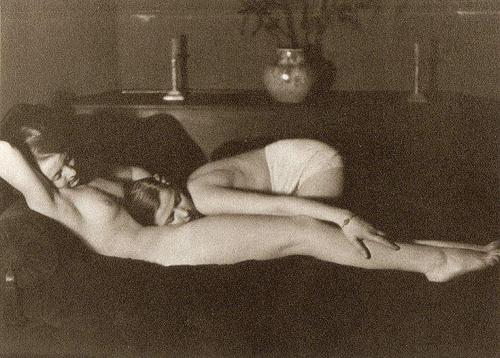
Vintage Erotic from Queerest of Them All @ Tumblr.com

Over the past couple of weeks, I’ve been having a slow conversation-in-comments with Emily Nagoski over at ::sex nerd:: about human sexuality, sex research, and the classification of human sexual experience in the two general categories of female-bodied and male-bodied individuals.

The original post Emily wrote is about the problem of asserting sameness across sex/gender identity when it comes to human sexuality. From her position as a sexuality educator, specifically working with undergraduate women at Smith College, Nagoski highlights the ways in which a narrative of sameness works culturally to erase the experience of people who have don’t have the “sexual hardware” of the default human (a man)

Treating women’s sexuality as though it’s “the same” as men’s, in the social world and in science, results in women feeling broken and ashamed.

As in: We should want sex as much as and in the same way that men do. We should be able to have orgasms the way men do – as quickly, in diverse situations, and through intercourse. Our sexual orientation should be the same. Our responsiveness should be the same. Our fantasies. Our porn. Our feelings about our bodies. I mean, where does it end? You might as well be saying women should have penises.

You can read the whole post over at Emily’s blog.

There are a lot of really awesome aspects to this argument, chief among them that asserting that different bodies respond differently to sexual stimulus is a great step away from the monoculture of “sexy” that our culture is currently saturated with. I also like the way it grounds physical sexual experience in the body, and encourages folks to learn about how their bodies work as a way of gaining a better understanding of their own sexuality.

It also pulls us away from the default understanding of sexual arousal as something that is primarily experienced by people with male bodies and hormonal profiles. It helps clear the ground for women to assert their sexuality without shame and without requiring them to mimic a type of sexuality they do not feel in order to be taken seriously as sexual subject.

From a personal perspective, I will say that one of the most valuable learning experiences in my early career as a sexual being was finding a second-hand copy of Shere Hite’s 1976 report of women’s sexuality in which she quotes long excerpts from questionnaires in which women describe in detail the diversity of their sexual desires, fantasies, physical arousal and relational experiences. Pages and pages and pages of women describing, in minute detail, how they masturbated, what sexual positions worked and didn’t work for them, what kind of touch they liked, whom they enjoyed making love with and how. Since the publication of Hite’s research, questions have been raised about the scientific rigor of her methodology — but to me the power of the book is not in its statistical validity, but in the individual voices that disseminate a type of information that is incredibly difficult, even in this era of the internet, to obtain: how actual people in the actual real world get off? what makes them horny? what fantasies do they carry in their innermost souls? what sensations push them over the edge? It seems so simple, banal almost, and yet there can be radical power in seeking the answer to those questions.

So what’s my problem with the emphasis on “difference”? It’s the fact that that human sexual difference is framed using a binary sex/gender system that simply doesn’t work for a lot of people. What about people with a “female” hormone profile who have penises? What about folks whose sexual arousal cycles seem to be spontaneous despite having a clit? And what about us cis-gendered women who, despite being accepted by the medical and social world as “female” and “feminine” just don’t see ourselves very well represented in the narratives of female sexuality that are out there? It feels to me like we’re rejecting one set of restrictive categories for another set of restrictive categories that just aren’t going to be very helpful to any of us in the long run.

We’re still going to end up feeling shamed, just for different reasons: maybe it’ll be okay not to be sexual in the same way as boys, but now we’ll feel the pressure to be sexy the same way as girls.

What gets lost is the question of how to be sexy like ourselves.

When I raised this issue in comments, Emily pointed out that scientifically-speaking, studying a species that reproduces sexually (as we do) means that it does make a certain amount of sense to examine the human population as one that is made up of two basic iterations (male and female). I get that talking scientific data is different from talking about cultural perceptions, but I also believe that the two interact in ways we often cannot even see. I also think that the language and results of scientific studies get misinterpreted by the media and the general public, and often translated into sound bites that end up supporting pre-existing notions of sex and gender difference: employed in making truth claims far beyond the scope of the original researchers’ work.

Emily also suggested that using the female/male categories as a launching-point to discuss sexual diversity is a useful educational tool.

You don’t want women to be told they’re like men, but you also don’t want them to be told they’re like women.

That’s fair enough, actually, since people just vary (though men vary around one standard and women vary, more widely, around a different one). But my experience has been that people WANT – no, they’re fuckin’ DESPERATE – to be told what they are like. They want a category. They can’t cope without one. And since we’re a sexually reproducing species with males and females, the man/woman split is a natural-seeming division. It’s a comfortable couch for radical information.

So here’s my question to y’all. Do you want a category?

I’m curious. Because, see, I really, really don’t want to be told what I’m like. I have what’s probably an unhealthy aversion to being categorized. Do I like to run into stories that mirror my experience? Yeah, sure! It was an incredible experience to read Lisa Diamond’s book on sexual fluidity and finally hear the women she interviewed putting into words thoughts and feelings and physical experiences I had known intimately but did not have the language to articulate. But for me, it is enough to know that there are other like-minded or like-experienced people out there in the world. As soon as those beings start being grouped and generalizations are made about them, I develop a twitch.

I’m curious what responses other people have to this discussion of difference and categories, the comfort of categories and the danger that categorization will lead to marginalization or erasure. What have your experiences around descriptions of “female” and “male” sexuality been? Are there particular categories that resonate particularly strongly with you, that have been of use to you in better knowing and expressing your sexuality? Have other people tried to categorize you in ways you feel are just plain wrong? What cultural and/or scientific narratives were at work creating and enforcing those categorizations?

reading the (lesbian) classics: annie on my mind

28 Saturday Aug 2010

Posted by Anna Clutterbuck-Cook in book reviews

≈ 1 Comment

Tags

blogging, gender and sexuality, guest post, reading lesbian classics

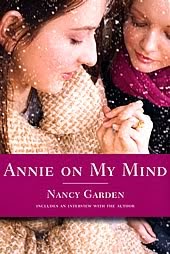
Welcome to the first installment of a new series, “reading the (lesbian) classics,” in which Danika Ellis of The Lesbrary and I read our way in a very haphazard manner through queer literature (our method is basically picking out the books that sound like a fun time and taking it from there!) and chat about it, and then post our conversations on the interwebs. So here’s the first installment. This time around, we read Annie On My Mind, by Nancy Garden, first published in 1982.

Warning! Mild plot spoilers ahead for those of you who care!

Anna: So [rubs hands together] … how shall we begin our conversation?

Danika: I’m not sure, I feel like I must have forgotten half the book… might as well start with first impressions and just see where it leads us.

Anna: [laughs] Had you ever read it before?

Danika: I have, once before. I remember when I first read AOMM I thought there was something a little bit off about their relationship. And now I think I know what bothered me. I don’t know if it’s because it’s set in the 80s, or if it’s Nancy Garden’s writing, but they both seem a lot younger than what they’re supposed to be.

Anna: Yes! They’re supposed to be, like, headed for college and they act like they’re in middle school.

Danika: I know it’s in a sort of self-conscious “girls our age aren’t supposed to do this” way, but I still liked it a lot better once I started thinking of them as 13-year-olds instead of 17-year-olds. And it’s not just them: even her little brother seems at least 4 years younger than his given age! And her classmates!

Anna: Yeah. I don’t think I noticed it so much when I was younger, because I read it when I was about thirteen myself? It was about the only lesbian YA novel my library had (early to mid-90s). To be fair, that was before the real boom in queer YA fiction. AOMM was probably one of the few available. And not a bad one to have if you’re only going to have one (no one dies!) … but yeah, I agree with you that, especially this time around I was left thinking, “wow, and these are supposed to be seniors?”

It’s not even Annie’s imaginary world … it’s more the school politics and so on. Like, no one has a real sense of a world beyond the microcosm of the prep school.

Danika: Yeah, the ear-piercing! Again, I was thinking “Well, maybe it’s just because this was 30 years ago…?” But it definitely seemed a bit off

Anna: Part of it probably is the era … and the fact that Nancy Garden was probably, on some level, harkening back to her own teen years which would have been in, what, the 1950s? 60s? When maybe ear piercing was more risque?

Danika: Aaah, yeah, that might have been part of it.
Anna: I also wondered if maybe part of it was an attempt to make the drama center around something other than the fact that Liza was discovering her sexuality? So she invented another drama about the prep school that seemed kind of forced?

Danika: Maybe, but it turns into it being about her sexuality anyway.

Anna: True.

Danika: I remember when I first read AOMM I thought the girls’ meeting seemed really forced. And I definitely agree with that the second time around. The singing, the sudden friendship… again, it’s the sort of way children interact, not teenagers.

Anna: Yeah — teenagers are more self-aware, and self … restrained? I made instant best friends with kids in art class when I was, maybe, six! Not when I was seventeen. At seventeen I was like, well, maybe going for coffee after class and see how that goes. But since NG wanted the girls not to be at the same school, she had to find a way for them to run into each other.

Danika: Still, I think she could have done better than “Don’t stop [singing]. Please.” “Oh, you startled me!” That just sounds really forced.

Anna: I’d forgotten how much class is an implicit part of the story. The way Annie comes from a “bad” part of town and everything.

Danika: I forgot that, too!

Anna: I was thinking, vis a vis reactions to queer teens, that it was interesting that Liza’s sexuality was more controversial in her upper-class world than it seems to be in Annie’s world.

Danika: Yes, because everything was controversial in Liza’s little world. The ear-piercing I guess was supposed to highlight that, but it seemed odd anyway. The only question with Annie was whether she was going to tell her family or not, so I don’t think we ever see how her school would have handled it, but presumably they have more important things to worry about.

Anna: It would have been irrelevent in Annie’s school (I’m assuming); no one cared about her there. I got the sense she was nervous about telling her parents, but her family was portrayed as fairly accepting and encouraging. I got the sense that they would have been baffled and maybe a little worried or hurt, but there wouldn’t have been all the drama that Liza had in her family and at the school.

It was interesting to me how it was almost reversed … or maybe that’s not quite what I’m thinking of. But today, we think of urban upper-middle-class folks as fairly cool about queer sexualities, etc. Whereas we think of lower-class people as reactionaries. Culturally. And in this story, the opposite was the case. I doubt those stereotypes would hold up [in real life], but it’s interesting that she chose to write it like that.

Danika: That is the framework we generally use. But Liza’s privilege paralyzed her. Her school was so caught up in itself that no one could step out of line. It was a weird relation between them.

Anna: Yeah. Maybe I’m just too midwestern to understand the world of elite prep schools!

Danika: Yes, it was really weird seeing into that strange boxed-off world.

On a slightly different note, I was writing down some thoughts as I went, and on page 49 of my version, I thought Garden was foreshadowing the reaction to her coming out. It was when the parents found out about the ear-piercing, and the mom is pretty accepting, but the dad freaks out. So it surprised me later when he was actually really great about it.

Anna: Good point. I was really intrigued by a number of the adults in the story, actually … and the way in which adults were portrayed in relation to the young people.

Danika: How so?

Anna: Well, I was impressed that the adults at the hearing were not portrayed as monoliths, as monsters, and that a couple were standing up to the schoolmistress, even if for their own reasons. And I thought it was an interesting (and positive) choice to give the girls such human mentors, themselves lesbians of an elder generation.

Danika: Yeah, that’s very true. The thing that stuck with me most about AOMM has always been the teacher couple (oops, spoilers).

Anna: (warning! warning!)

Danika: Actually, the thing that stuck with me the most was their book collection. Lesbian books inside my lesbian book! Wow! Their presence really made the story. (The teachers, not the books.)

Anna: I agree about the teachers. In contrast to the caricatured headmistress and the reactive parents, the two teachers came across really human, but also kind and supportive, generous, and sheltering without being controlling. I wondered in my notes whether this was a conscious attempt to counteract the specter of the gay/lesbian predator?

And yeah, it was fascinating to have the books play such a role in a couple of key scenes … from what I’ve heard from queer people of earlier generations, that was often the case! that they first discovered language for who they were from books … all the more reason to be a librarian-advocate for lgbtq teens!

Danika: Aaah, I hadn’t considered that! Of course! Because the lesbian teachers were fantastic teachers. If I may quote my favourite line from the dad’s reaction (though he goes on to say he doesn’t think gay people can be truly happy), “Oh, look. What difference does it make if a couple of teachers are lesbians? Those two are damn good teachers and good people, too, as far as I know.” I mean, wow! Surprise acceptance!

Anna: Hehe. Yeah, exactly. Because there’s that interesting conversation between the girls and the teachers. after the teachers have been fired. where the women acknowledge that if they don’t press charges, they should be able to get good references … because the school won’t want to admit that they fired the women for being lesbian … but they also fear for their ability to be hired if they were really out. So a real catch-22.

Since we’ve talked a lot about where the story felt kind of forced … one of the ways in which I was really impressed with it was the fact that it a) had a couple of really sweet scenes in which the girls clearly make love, even if off-screen (so to speak), and b) that this is really seen as 100% a good thing, despite what happened with their teachers. Their sexual exploration doesn’t spell doom for them as individuals or for their relationship. I don’t think many YA romances with straight couples were that whole-heartedly enthusiastic about young love back in the late 1970s … Even Judy Blume’s Forever, despite the positive sexual experience, ends with the relationship ending.

Danika: That’s true. It’s a bit of a bittersweet book, because Liza gets suspended, nearly expelled for being gay, the teachers get fired, and we know the whole time that they end up drifting apart after they leave for university. But it’s also a lot more positive than most of the queer books (YA or not) available at the time. They do end up together at the end, and there’s a lot of support of same-sex love. I also liked reading it for all the tropes and patterns that young queer love, young closeted love takes. Like how you could totally tell they were in love with each other before they knew. Like the classic game of “how much physical contact can we have before it means something?” (shoulders touching, hand holding, etc.)

Anna: Yes! Which I feel like is something that is still confusing to kids (or perhaps I only speak for myself) … since you’re trained, culturally, to expect that opposite-sex intereactions are laden, but not same-sex ones, so you aren’t so self-conscious and things kind of sneak up on you way more than with opposite-sex relationships.

Oh, and it was also nice that neither of them really “went straight”. Annie was pretty sure she was gay, and Liza wasn’t sure, but was definitely leaning towards accepting it.

Anna: I agree! That actually seemed a little dated (in a nice way?) to me, since I feel like if this book had been written today, you’d get this whole “am I bi? am I gay? am I just questioning?” thing going on. Which is absent entirely: Liza comes to the realization she’s “gay” full-stop.

Danika: That’s true, it definitely has that all-or-nothing mentality that we’ve (thankfully) shaken off a little more by now

(Oh, wait, I take it back: Annie did try to be straight! Back when she was younger. In her words: “It was ridiculous.” That made me laugh.)

They are super cute when they are together and happy.

Anna: Yeah, and as you say there was that added element of the reader being “in the know” in part because Liza’s spoilered it for us at the very beginning with the framing narrative.

What do you think of the function of the framing narrative as a literary device? Do you think it adds anything to the narrative that we kind of know it ends badly (at least in the short-term) before the story begins?

Danika: I was pondering that the whole book. I kind of get why she did it, because she needed the drama to keep the story moving through the happy couple parts, but it did add this element of doom that, frankly, no queer book really needs any more of. I guess it works overall, because we get the (spoilerspoiler) happily ever after following the long(ish) separation and we process it with Liza as she processes (and processing is a classic lesbian thing to do), but I’m a little divided on it. What did you think?

Anna: Hmm. Tough question. Retrospective narratives can sometimes work pretty well, but I agree with you that the last thing any queer teen book needs is more angst! That’s why I adore David Levithan’s work so much — his love stories are so ebullient. As a kid, I always felt like the way Liza blamed herself for the punishment exacted on the teachers (or, more accurately, for having made love in their home while she was house-sitting … what the hell was so shameful about that?) was really exaggerated. Like, shouldn’t she have been pissed at the secretary who had the vendetta? And the schoolmistress, etc.? But maybe that’s a personality thing — I always had an over-developed sense of self-righteousness as a child 🙂

Danika: Ah, I loved Boy Meets Boy for that! It’s like a combination of cotton candy and sinking into a hot tub. It’s just so refreshing to read a happy queer love story. I still want my lesbian version of that.

Anna: Totally! I feel like YA lesbian fiction is still waiting for its Daniel Levithan (if you have any recommendations, I’d love to hear them!)

Danika: I don’t know of anything quite so positive, though I have read some good ones. Hello, Groin by Beth Goobie is my favourite.

Well, I can see why they were a little ashamed. In the teachers’ bed…? That’s bad taste. What I couldn’t see, though, was why they opened the door! They didn’t have to answer! -sigh- The secretary was definitely over-the-top. The absolute poision she was spitting out was painful to read.

Anna: … I guess. I did a lot of house-sitting in high school and college and I always slept in the homeowner’s bed (clean sheets, granted) so it didn’t feel so weird to me. but that wasn’t in the deal Liza made with the teachers, so I guess that is a little different. Oh, totally with the door! [headdesk] Why oh why did she have to answer????

Danika: Especially before getting dressed!

Anna: Despite the secretary’s religiously-motivated poison, I was actually surprised by how little religious conservatives and the religious right as a force opposed to sexual expression appeared in the novel (contrasting, again, with the way it figures in some Levithan stories) … I think that’s another way this dates the story, since it was set just as that force was gathering.

Danika: True, I mean, when she faces the commitee/council/whatever that was, they basically say “Hey, this is none of our business”, which is pretty good for the circumstances.

Anna: Yeah, I think it’s interesting how the battle-lines are drawn ever-so-slightly differently than we’re used to in our generation. The religious element not quite so strong, the class element more so. Being queer still being a threat to one’s overall reputation/status even in secular society. (Not saying that’s totally gone away, but you wouldn’t think in Liza’s New York or at MIT it would be an issue!)

Danika: Hmmm, yeah, I can see that…

Honestly, I’m kind of surprised Liza wanted the school to survive. I know she has sentimental attachment to it, but even before they knew she was queer, Poindexter (go to love that name) was absolutely heinous, from the patronizing way of talking to running the meetings when Liza was supposed to be running them.

Anna: Yes. Again, another way in which they seemed young for their age. By 17, you’d think she’d have more perspective. I can see a younger child being invested in the school that had been a second home, but most seventeen-year-olds I’ve known (including myself!) are a bit more jaded!

Danika: Very true. By 17 I had distrust for all authority, definitely including my school.

I don’t know if you read my review and conversation about Well of Loneliness, but I saw a couple of comparisons between it and AOMM that surprised me.

Anna: Do tell!

Danika: Well, for one, both the protagonists were horrified at people hating them being gay, because they both felt that their love was the “best part” of themselves, or some variation on that. Also, both have a scene with the couple being happy that is described as an “illusion”. It’s just funny because WoL is mentioned in AOMM as part of the teachers’ book collection.

Anna: Yes, it was fun to see the lesbian classics appear on their shelves 🙂

Danika: Especially Patience & Sarah, because Liza and Annie read it, and this time I have, too!

Anna: I read once an essay that was talking about how generations of queer folks locate themselves in history through alternate means than family ties, since so many of them don’t come from families where the parents are themselves queer — and literature was one way.

Danika: That’s exactly why I feel that queer lit is so important. It is a foundation to the queer community.

Any last thoughts?

Anna: Not that I can think of — other than that I really enjoyed the chance to re-read this with someone else, and I’d totally be up for doing it again!

Cross-posted at: Danika @ The Lesbrary | Annie On My Mind Conversation.

Watch for the next installment in reading the (lesbian) classics sometime in late September of early October! At Danika’s suggestion, we’re reading Hello, Groin, by Beth Goobie (2006). We thought we could use the book as a chance to consider where lesbian YA fiction has come since the “early days.”

← Older posts
Newer posts →
"the past is a wild party; check your preconceptions at the door." ~ Emma Donoghue

Recent Posts

  • medical update 11.11.22
  • medical update 6.4.22
  • medical update 1.16.2022
  • medical update 10.13.2021
  • medical update 8.17.2021

Archives

Categories

Creative Commons License

This work by Anna J. Clutterbuck-Cook is licensed under a Creative Commons Attribution 3.0 Unported License

Meta

  • Create account
  • Log in
  • Entries feed
  • Comments feed
  • WordPress.com

Create a free website or blog at WordPress.com.

  • Subscribe Subscribed
    • the feminist librarian
    • Join 37 other subscribers
    • Already have a WordPress.com account? Log in now.
    • the feminist librarian
    • Subscribe Subscribed
    • Sign up
    • Log in
    • Report this content
    • View site in Reader
    • Manage subscriptions
    • Collapse this bar