• anna j. clutterbuck-cook
  • contact
  • curriculum vitae
  • find me elsewhere
  • marilyn ross memorial book prize

the feminist librarian

the feminist librarian

Tag Archives: friends

observations III

08 Thursday Mar 2012

Posted by Anna Clutterbuck-Cook in a sense of place

≈ 2 Comments

Tags

books, family, friends, michigan

1) Went to breakfast at Marie Catrib’s in Grand Rapids this morning with Hanna, my parents, and dear friend Joseph.  Their apple onion tart is to die for (seriously — I’m already hungry for seconds!) and Hanna and I discovered their Turkish coffee. *swoon*

2) At Argo’s used books and Redux Books in East Town, bought Neil Miller’s In Search of Gay America (1989) and Tim and Beverly LaHaye’s The Act of Marriage: The Beauty of Sexual Love (1976). I am taking great pleasure in stacking these one on top of each other. Hanna says she might disown me. I promise my review of the LaHaye will include the mid-70s author photo which totally rocks.

3) While Hanna got a kick-ass black & sparkle manicure (at half the Boston prices!) I read the Miller at lemonjello’s coffee shop and remembered how his Out of the Past: Gay and Lesbian History from 1869 to the Present (1995) was, along with Lillian Faderman’s Surpassing the Love of Men (1985), one of the first books on homosexuality per se I ever purchased or read. I bought them both at Powell’s in Portland (Ore.) on Thanksgiving break in 2001 while I was at the Oregon Extension. Because just that summer Joseph had confided in me he thought he might be gay. Looking back, I’m impressed one of my first impulses was to buy history books!

4) There are ways the logistics of life here feel so much simpler. I don’t mean that in a “rural life is idyllic” way, mostly because it’s not idyllic here — or rural. But in a “running errands doesn’t exhaust me here the way it does in Boston” way. Streets don’t feel crowded and hectic. Sure, the parking can be a bit frustrating, but mostly it’s free and available if you’re willing to walk a block or two. Downtown’s in walking distance. And things are restfully less expensive than in Boston. I know our jobs aren’t here, and some of our favorite book stores, libraries, and indie coffee shops … but I seriously wish there were portkey technology on the horizon, ’cause I feel like my energy level would be so much better if I could live here and work there. I’m just not psychically wired for city life.

5) Off to bake cheddar, beer and mustard pull-apart bread. Food, books, and friendship. At least I can say that our activities on vacation and in non-vacation life are mostly the same, excepting not having to get up for work. And less time spent at the computer, which is restful.

the porn debate: first thoughts

11 Saturday Feb 2012

Posted by Anna Clutterbuck-Cook in think pieces

≈ 2 Comments

Tags

being the change, education, feminism, friends, gender and sexuality, moral panic, smut, the body

but is it porn?

Last night, thanks to my friend Minerva, who is currently at the Boston University School of Public Health, I was able to attend a screening at BUSPH of The Price of Pleasure: Pornography, Sexuality, and Relationships (2008) and the subsequent Q&A-cum-debate with anti-porn activist and author Gail Dines and sexuality educator Carol Queen. Lots to process. I’ll be writing a review of the film and a more coherent summary and reaction to the debate portion of the evening once I’ve had some time to organize my thoughts. But meanwhile, are a few first responses.

  • The Price of Pleasure had an agenda which wasn’t very subtle — and that was to make porn appear monochromatic, exploitative, and seedy. This wasn’t a surprise, but I found myself fascinated by the way the construction of the film itself conveyed that narrative. More about this in the review. It was a fairly masterful piece of propaganda … if you didn’t sit there with your media literacy lenses on and go “what just a minute!” (And if anyone wonders what the scary voice man does between election cycles, he was totally hired to do the voice over in this documentary).
  • I was struck by the level of powerlessness expressed by people interviewed in the film, by Gail Dines in the Q&A, and by some of the audience members who asked questions. Commercially-produced video porn is depicted as an all-powerful, pervasive, thought-controlling medium that somehow renders consumers (and even non-consumers) incapable of imagining or practicing alternative sexualities. Since my experience has been that a) avoiding porn one doesn’t like is relatively simple, and b) finding or creating porn one does like is also pretty easy, I can’t say I understand this line of reasoning. Having just finished Amy Schalet’s new book Not Under My Roof: Parents, Teens, and the Culture of Sex (review forthcoming) I can’t help wondering if this feeling of helplessness doesn’t go back to what Schalet terms the “dramatization” (vs. normalization) of sex in American culture.
  • I understand there’s a larger argument being made about how the narratives in porn reflect and shape some of the crappy narratives of our society (for example, society is racist and sexist — surprise! porn is also racist and sexist), but I don’t understand why the solution presented is not the two-fold critique and creation solution we’d use in virtually any other field. That is, 1) encourage people to watch porn with a critical eye, much like Jenn Pozner encourages people to watch reality television with a critical eye (see Reality Bites Back), and 2) support the creation of better porn. See for example the feminist porn awards and the recent piece by Erika Christakis, Is it Time for Fair Trade Porn? For some reason, when it comes to porn, all of our usual skills for working to change culture are jettisoned out the window? That doesn’t seem right to me.
  • I continue to be frustrated by the way “porn” and even “sexually explicit material” has become short-hand for “video pornography.” I took an online survey recently designed to capture information about women’s consumption of online porn — and it became apparent almost instantly that they were assuming the porn in question was filmed live-action sequences. Why aren’t we talking about sexually explicit fiction and nonfiction, photographs, erotic audio, and other materials that depict sexual activities and are designed to elicit arousal? This isn’t to say video porn is bad either, but I feel our analysis of the genre might be more nuanced if we looked across mediums, rather than focusing just on film.
  • If Carol Queen hadn’t been there, no one in the room would have spoken to the fact that pornography is, in fact, not solely a product of the heterosexual male imagination, created for consumption by heterosexual men. The discourse about porn in the film and throughout most of the Q&A rested on the erasure of women and queer folks who create and consume erotic material without being coerced or exploited into doing so by the patriarchal overlords. Dines seems to believe that in her perfect (socialist feminist) universe, no one would make porn she didn’t like, because of course no one would voluntarily make pornography that squicks her out. I didn’t hear any evidence last night that Dines would have been able to make sense of me as a queer woman who creates and consumes erotic materials, in both solitary and relational contexts. Who has both an incredibly egalitarian, loving sexual relationship with another woman and enjoys some kinky and rough sex fantasies, which work together symbiotically to enrich my relational life. In Dines’ narrative of porn, my experience is rendered completely invisible — and while one person’s experience does not a data-set make, that dissonance makes me doubt her theory’s explanatory power.
  • Also, while we’re at it, men who enjoy sex with women are not, in fact, controlled by their dicks — and men’s penes aren’t somehow inherently threatening and oppressive to women who enjoy having sex with men. Male sexuality is not some mysterious, all-powerful, aggressive, violent, controlling force that must be contained and managed externally (i.e. “domesticated”). I believe people of all sexes, sexualities, and genders, are equally capable of exploring their sexual desires in ways that aren’t — for lack of a better word — “antisocial.”

I come to this conversation with my own experience of pornography, obviously. I’ve seen a vanishingly small amount of video porn — most of it filtered through secondary sources like documentaries or embedded within feature films (where we just call them “sex scenes”). I’ve never experienced sexually explicit materials in the context of emotional coercion or physical abuse, and have never felt the presence of sexually explicit materials compromised my intimate relationships. Aside from some early childhood peer-to-peer situations that made me passingly uncomfortable (and probably deserve a post at some point), I’ve basically felt like I had bodily autonomy and sexual self-determination. My teenage years and young adulthood were characterized by self-directed exploration of human sexuality and my own sexual desires, mostly through fiction and non-fiction, and solitary sex. When I didn’t find sexually explicit narratives that satisfied me, I decided to create my own.

Did I have sexual struggles? Certainly. I was reflexively anti-porn early on because I’d imbibed the cultural narrative of “porn” as relationship destroying, the last resort of the lonely, as anti-feminist objectification. At the same time, I was discovering that mild bondage scenarios and actual mild bondage were a huge turn-on for me. Together, these two conflicting messages me feel like a bad feminist, and made me feel overwhelmed by my own sexual desires. But if pornography hadn’t been demonized by those around me, maybe I would have realized before my mid-twenties that fantasizing about ceding control in a sexual situation isn’t the same as wanting to be literally helpless. I don’t wish my younger self hadn’t been exposed to bondage imagery or narratives — I wish I’d been given better tools with which to analyze both it and my responses to what I saw.

I just don’t experience the existence of sexually explicit materials — even if its porn I’m turned off by — as threatening to my own sexual self-determination or my ability to find, and form meaningful connection with, other sexually-compatible human beings. I don’t see “porn” as an enemy.

Overall, I wish we — as a culture — could move beyond the moral panic that sexually-explicit material seems to engender in a fairly high percentage of the population  and talk instead about all of the tools we already have at our disposal to critique unhelpful cultural narratives in porn, to advocate for workers’ rights, and to develop our own sense of sexual self-determination. I heard Carol Queen making a bid for that shift to take place last night, and I heard Gail Dines resisting it with all her rhetorical might.
Since writing this post, I’ve published a review of the film, The Price of Pleasure, and a more thorough summary and analysis of the debate itself. Finally, some thoughts on the positive potential of porn.

booknotes: clover adams

31 Tuesday Jan 2012

Posted by Anna Clutterbuck-Cook in book reviews

≈ Leave a comment

Tags

boston, feminism, friends, history, hope college, MHS


It was nearly a decade ago that I first started hearing from a former professor (turned good friend) of mine about her latest research project: the study of a set of photograph albums at an archives in Boston, albums created by a 19th century female photographer named Marian “Clover” Hooper Adams. At the time, the friend — Natalie Dykstra — was in the process of applying for an NEH fellowship to spend her sabbatical at the archives — the Massachusetts Historical Society — to work with the albums and develop a book-length project that would consider the photography of Clover Adams as autobiographical texts. Texts that might, in some way, help us to understand how Clover understood her own life, her work, her marriage to historian Henry Adams, and the factors that led to her decision to end her own life at age forty-two by drinking chemicals used in the development of her photographs.

Since then, I’ve had the privilege of drifting on the periphery of Natalie’s research and writing of the manuscript which became Clover Adams: A Gilded and Heartbreaking Life (Houghton Mifflin, 2012). It is, in part, because of her connection with the Massachusetts Historical Society that I considered relocating to Boston, that I applied to work at the MHS, and her friendship has been a sweet thread of connection between my previous life at Hope College/in Holland and my world here in Boston. Over the past four years I’ve worked with Natalie in my reference librarian hat to track down details related to Clover’s childhood and coordinated the provision of photographs by and of Clover will appear, in all their visual splendor, in the pages of her biography.

This is all by way of saying that I approach this review with a far-from objective sense of propriety when it comes to the work of a friend, and the opportunity to see the life of an overlooked female photographer — whose work is preserved at “my” library — brought into the open and shared with the world in such an eloquent way.

So, you know, take my praise for what it’s worth and form your own opinions of Natalie’s work at your leisure. But having read the advance review copy over the Christmas holidays, I do want to share a few notes on what about Natalie’s work — and Clover’s life story — particularly moved and impressed me. Because I do, in my professional historian hat, think Natalie’s done something remarkable here.

Clover Adams’ story presents a number of dilemmas for the modern biographer. In the socioeconomic sense, she was a daughter of privilege, born to a Boston family with economic resources and social and political connections. Her mother was a poet who moved in Transcendentalist circles with the likes of Margaret Fuller and the Peabody sisters. Her father’s family, the Hoopers, had made their money in business  during the previous century, and Robert Hooper (Clover’s father), with whom Clover remained close, received his medical training at Harvard and in Paris. In marrying Henry Adams, Clover became part of one of the most high-profile American families of the period; she and her husband maintained multiple residences, traveled abroad, and moved through the upper echelons of American and European society.

Yet at the same time, there were limits to what privilege could bring to Clover’s life in terms of health and well-being. Her mother died of tuberculosis when Clover was a young child, and the aunt who cared most directly for Clover thereafter eventually committed suicide. Mental health struggles seem to have haunted the Hooper family, and if read in a certain light Clover Adams appears to be one long narrative of health struggles for which contemporary late-nineteenth-century medical, religious, and philosophical frameworks had no useful remedy.

In addition, Clover contended with the fact that she was a girlchild, and later a woman, in a world that offered a limited number of options for women to craft satisfying lives for themselves. The majority of women were, of course, caught up in surviving class and race inequality. However, even those who, like Clover, didn’t face immediate material dilemmas, were nonetheless constrained by social expectation to pursue a limited number of professional and relational pathways. While Clover seems to have settled into her marriage with Henry Adams quite happily and voluntarily, her married life was colored by the couples’ inability to communicate some of their deepest needs to one another. That the two never had children also appears to have haunted Clover on some level, though I appreciated that Natalie takes note of this factor without dwelling on it extensively.

Clover’s photography, taken up in the final years of her life, remained an amateur endeavor in part because of the status of photography in the art world and in part because of the fact that Clover was a woman. Both she and Henry expressed ambivalence over her creative work and its place in their lives, and eschewed opportunities which might have brought her more attention for her work.

All of these aspects of Clover’s life — her mental health, her marriage, her work, and her place in society — are interesting to a modern audience in part because Clover’s struggles feel like very relevant in our current society, roughly a century and a quarter after Clover’s death. How we understand — and cope with — mental illness is still a live question.The benefits and limits of marriage as an institution — and as a primary relationship — are under intense discussion. The role of work and creative expression — particularly in the lives of married and mothering women — is still a subject of public debate. It would be all too easy to map our current understanding of all three of these subjects backward onto Clover’s life (what is known in the historical profession as “presentism”). We’re shown the pain of Clover’s depression without any sort of narrative pressure to diagnose cause or condition: her mental landscape is described most often in Clover’s own words. Natalie doesn’t back away from the loneliness and disconnection that, in the end, resided at the heart of the Adams marriage. Yet she manages to show Henry Adams at his most vicious (I felt real flares of anger at him while reading) without laying the blame of Clover’s suicide at the feet of her husband.

At the same time, while skillfully avoiding the trap of presentism, Natalie also refuses to absent herself — as a biographical narrator — from the storytelling endeavor. Having spent literally a decade with Clover’s story she has much to offer us in terms of synthesis and analysis. I didn’t finish the book wishing that Natalie had shown less partiality for (and more critical analysis of) her subject. She really manages to do the balancing act of letting us see Clover’s life as it was lived and understood in broader historical context, not just through Clover’s own meaning-making mechanisms.

Speaking as someone who is intensely interested in the history of feminism, gender and sexuality, I find Clover’s story compelling on a number of levels. Natalie explicitly avoids the language of gender theory in her storytelling. Which is not to say she ignores the way in which Clover’s lived experience was shaped by her womanhood — far from it. But Natalie has the grace to let Clover’s life be — as much as possible — her own. And Clover herself doesn’t seem to have understood her life through the lens of gender. Other women of her era did (though they would have used the word “sex” rather than “gender”). The years between Clover’s birth and death were active ones for women’s rights agitation, and Boston saw its fair share of feminist activism. While feminist analysis would likely not have saved Clover from the depths of despair, I found myself wondering if Clover’s ability to anchor herself — in her marriage, in her art, in her social connections — could have been aided at all by the friendship of women (or men) who outspokenly advocated for her right to be (and be seen) as an artistic individual, out beyond the confines of the domestic sphere. I found myself wondering how Clover and Henry’s expectations of the roles played by husband and wife contributed to the silences in their marriage, and whether more radical friends might have encouraged them to re-consider their assumptions and move past what seem to have been baffling obstacles to marital connection and contentment. This is something that Natalie hints at, but for the most part leaves for the reader to piece together as they will.

courtesy of the MHS

Last week, when I arrived at work, I found that the sign advertising upcoming events had been switched out to showcase the opening of our next exhibition — guest curated by Natalie — which features Clover’s own photographs. The image chosen (see right) is a striking photograph taken at Smith Point (Mass.) is a group portrait of Miriam Pratt, Alice Howe, and Alice Pratt, discussed in chapter fourteen of Clover Adams (“At Sea”). It is not, Natalie writes, “a straightforward portrait intended simply to capture the likeness of three specific women. Instead, Clover carefully stage-managed the composition, creating a mood not of friendship and connection but of lost possibility … the women are connected neither to one another nor to the sea, which might otherwise open up their visual world” (150). Despite Clover’s own ambivalence about the public exhibition of her work during her lifetime, I am proud of Natalie for bringing her photography out of the archive and into the public eye. For helping us to understand Clover’s creative work not only as the art it surely is, but also as a visual voice communicating a particular woman’s understanding of her world in a form that will long outlive its creator.

Clover Adams will go on sale on February 8th. You can pre-order it now through a variety of venues, or put it on hold at your local library.

Natalie, I’m so, so proud of you!
four years ago today: "personal canon"

11 Sunday Dec 2011

Posted by Anna Clutterbuck-Cook in life writing

≈ Leave a comment

Tags

books, four years ago today, friends, fun

It’s been awhile since we did one of the four years ago today flashback posts. So here’s a fun one I pulled from the Gmail archive. My friend Joseph and his brother had generated lists of the top ten novels in their “personal canon” and Joseph emailed to ask what mine would be. After some thought, this is what I came up with. Looking it over today, I can’t say there are any huge revisions to this list. 


From: Anna
To: Joseph
Date: Tue, Dec 11, 2007 at 10:22 PM
Subject: Re: Personal canon of books

Hiya,

My canon is decidedly more “lowbrow” and than yours, but I am squelching my impulse to apologise for it on Nick Hornby’s firm orders (even though he loves Dickens’ and writes tedious novels about men who refuse to grow up, so I am not sure how much I trust him . . .)

I have artificially controlled against all non-fiction and children’s literature (well, below the teen level).  Not sure if that’s quite what you had in mind, but there we are.  I discover my criteria are a) enduring “good read”–something I will go back to over and over again, as well as b) things that have had deep impact on how I answer the question, “how to live?” . . . these categories don’t always overlap.  There are books that have had great impact on how I think about the world, but which I’ve only read once . . . and books that I read habitually, but that I don’t really think of as life-shaping in any explicit way.  Maybe they’re just sneaker at it? And of course these change over time . . . I was just thinking today how His Dark Materials has really grown on me over the years.  And even though I have issues with some of his didacticism, his theological imagery really speaks to me.  And, I mean, who could resist the idea of a reversal of the whole Genesis/Fall/Eve story? (Um . . . wait . . . that’s right . . . a LOT of people 😉 ).

via

That long introduction completed, here are my nominations. The top ten in a strictly alphabetical order. I figure once you make top-ten I’m not going to be judgmental. ALTHOUGH I do sometimes find myself paralyzed by the question of which book I would become if I were a character in Fahrenheit 451 . . . possibly a clear indication of how troubled I actually am :).

Top Ten:

1. E.M. Forester. A Room With a View.
2. Shirley Hazzard. The Great Fire.
3. Haven Kimmel. The Solace of Leaving Early.
4. Robin Lippincott. Our Arcadia.
5. Michelle Magorian. Not a Swan.
6. Robin McKinley. The Blue Sword, et al.
7. Audrey Niffinegger. The Time-Traveler’s Wife.
8. Dorothy Sayers. Gaudy Night.
9. Martin Cruz Smith. Rose.
10. Tom Stoppard. Arcadia.

Some possible future candidates/honorable mentions:

Isabel Allende. Daughter of Fortune & Portrait in Sepia.
Jane Austen. Persuasion.
A.S. Byatt. Possession.
Sheryl Jordan. The Raging Quiet.
Laurie R. King. The Beekeeper’s Apprentice, et al.
Barbara Kingsolver. Bean Trees.
David Levithan. The Realm of Possibility.
Gregory Maguire. Wicked, Son of a Witch
Philip Pullman. His Dark Materials.
Margaret Whelan Turner. The Thief, Queen of Attolia, King of Attolia.

Anna

congratulations doctor jay!

18 Friday Nov 2011

Posted by Anna Clutterbuck-Cook in our family

≈ 1 Comment

Tags

education, friends, holidays

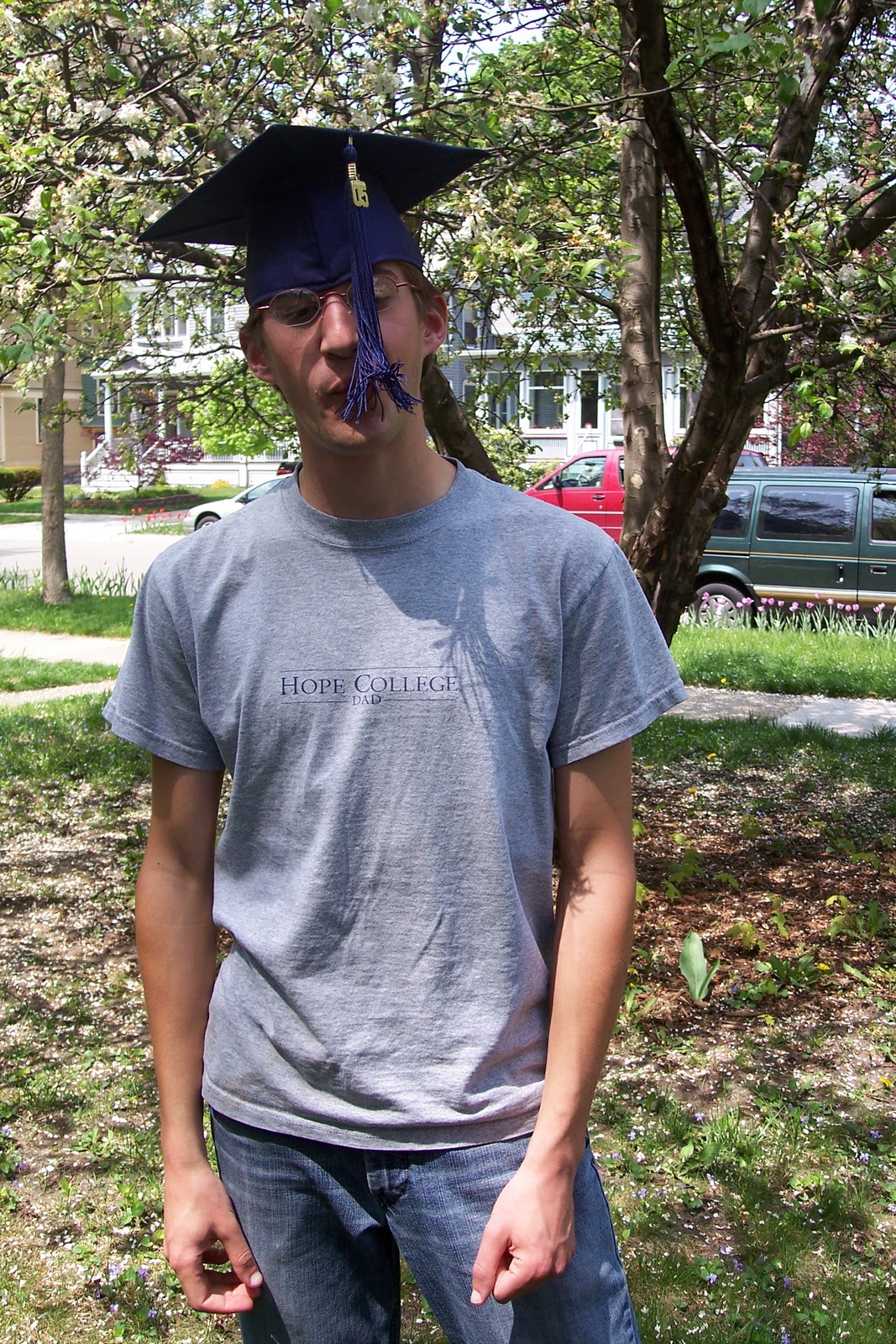
Joseph Tychonievich, Ph.D.
(taken May 2005, wearing my hat)

Earlier today, my friend Joseph successfully defended his PhD dissertation in horticulture, plant breeding, and plant genetics before his advisory committee at Michigan State University. We’re drinking a fine zinfandel tonight in his honor. Congratulations!

Verbena bonariensis with bronze fennel
photo by Joseph

sunday links list: my friends write good stuff edition

21 Sunday Nov 2010

Posted by Anna Clutterbuck-Cook in linkspam

≈ Leave a comment

Tags

friends

via Into the TARDIS

This isn’t really, properly speaking, a “Sunday smut” list, seeing as not all of my friends have a filthy mind like I do. But they’ve been writing some good stuff lately, and I thought I’d share (and hopefully encourage a little blog hopping in my readers).

Hanna @ … fly over me, evil angel … composed a two-parter on the three episodes that comprise season one of the new Sherlock: “Catch you …” and “… later.” Pay particular attention to the awesome point she makes in the second half about the character of Holmes and the elusiveness of his emotional life.

What I think is interesting in the new Sherlock is how detached Sherlock has become. The Brett Holmes was distanced, uninvolved — but never unemotional. He had a sense of humor (albeit occasionally a peculiar one), a great deal of pride in his skill and accomplishments, a keen sense of class distinction, an ear for music, and rather snobby tastes in food and wine if I remember rightly. My point here in assembling this rather mongrel list is that Holmes never came across in the original Doyle stories as suffering from any kind of psychiatric condition: yeah, he was a bit weird, but it’s mostly the kind of weird you can write off as being genuine Victorian gentleman weirdness. (This is the same kind of weirdness that comes across with the father of the family in Doctor Who‘s “Tooth and Claw” episode, written off by the Doctor with, “I just thought you were happy!”)

This Sherlock is a little bit beyond that — this is sort of like what would happen if you took Conan Doyle’s Sherlock, crossed him with Cracker, and then added some of the late Prime Suspect Jane Tennison. He is not only distant, he is actually removed. We don’t know why — I would imagine speculation runs rife in fandom — but there are, presumably, reasons.

Tasha @ Natasha Curson – a trans history) has two pieces up that I like, one on the language we use to talk about trans issues, and one on body modification surgery. From the first post:

Ultimately, we all want to be ourselves and to be able, as  far as possible, to express ourselves freely. For trans people getting to that point can be a very difficult journey. I’m still on my journey, and it took me decades just to get on the right road. Many people struggle, or don’t make it at all. So where does this leave us when it comes to labels/names/words? I think labels can empower when we use them ourselves, or when others use them about us respectfully and affirmatively. If they are used in order to limit the ambition of others, or to direct hate towards them, the effect can be incredibly powerful.

Also on the subject of personal experience and the naming thereof, Minerva @ Hypomnemata offers some thoughts on emotional and physical intimacy in a post In Which the Gloves Come Decidedly OFF!

In a way, my asexuality has only made this habit more clear.  I spend so much of my time saying what I won’t do, that I’ve lost sight of figuring out what I will do or what I do want.  It’s rather ridiculous actually, since I make it a habit of telling people not to do what I’m doing, namely self-limiting.  I’m not sure how accurate my perceptions are, but I feel like this is a trend that’s not under-represented within the asexual community.  I see a lot of blog posts about the ways in which we are different from sexuals, the ways we won’t engage in intimacy, but I haven’t heard much about the ways in which we will.  Where are the discussions about our expressions of intimacy, the concrete nitty-gritty of what asexual relationship intimacy looks (would look) like, and not just in a theoretical fashion?

Diana @ The Waki Librarian has good thoughts to share on the relationship between academic discourse and professional conversations. While she’s talking specifically about the library-and-archives field, I’d say the same balancing act can be found around any area of interest: what is the relationship, in the end, between theory and practice, and how do we — as individuals and as colleagues in a given field — understand, articulate, and utilize that relationship?

For me, yes, there are differences between academic discourse and professional discourse that occurs via social media, but that doesn’t mean that there can’t and shouldn’t be overlap between the two discourses. I’m an academic and do quite a bit of research and writing in the formal, traditional academic model. It’s a very important discourse. Research is important for producing the kind of quality evidence available to use as a basis for decision-making and to further develop theory and models in our field. It is important to be able to write your results up in an article in such a way that it withstands peer-review and can be used as a credible source. No one, I think, would deny that. But it doesn’t do one lick of good just sitting in an article that few people will ever read–especially in our field which is an applied, practical, professional field. Keeping an academic discourse cloistered is silly and inhibits good ideas from spreading. I adore the intellectual stimulation of academia (and the excuse to do research), but I really don’t enjoy the concept (and practice) of academia as a world and conversation set apart from every other conversation happening in our field.

And my friend Lola @ Oh, My Sainted Aunt (her recently-launched tumblr blog), offers this gem of people-on-the-street observations

Overheard at the Museum:

Visitor [looking at photographs from 1918 influenza pandemic]: “I didn’t know they had an influenza epidemic in the 1600s.”

Well, I didn’t know they had photography either. Everyone learned something new today

Hope you’re having a lovely weekend … I don’t know about you, but I’m psyched for a nice long Thanksgiving holiday. Hanna and I are taking Tuesday afternoon through Sunday off from work, and plan to enjoy every damn minute of it.

Newer posts →
"the past is a wild party; check your preconceptions at the door." ~ Emma Donoghue

Recent Posts

  • medical update 11.11.22
  • medical update 6.4.22
  • medical update 1.16.2022
  • medical update 10.13.2021
  • medical update 8.17.2021

Archives

Categories

Creative Commons License

This work by Anna J. Clutterbuck-Cook is licensed under a Creative Commons Attribution 3.0 Unported License

Meta

  • Create account
  • Log in
  • Entries feed
  • Comments feed
  • WordPress.com

Create a free website or blog at WordPress.com.

  • Subscribe Subscribed
    • the feminist librarian
    • Join 37 other subscribers
    • Already have a WordPress.com account? Log in now.
    • the feminist librarian
    • Subscribe Subscribed
    • Sign up
    • Log in
    • Report this content
    • View site in Reader
    • Manage subscriptions
    • Collapse this bar