• anna j. clutterbuck-cook
  • contact
  • curriculum vitae
  • find me elsewhere
  • marilyn ross memorial book prize

the feminist librarian

the feminist librarian

Tag Archives: history

quick hit: clover adams online exhibition

08 Wednesday Feb 2012

Posted by Anna Clutterbuck-Cook in library life

≈ Leave a comment

Tags

history, MHS, photos

Last week I wrote about my friend Natalie Dykstra’s new biography of Clover Adams. Today, the Massachusetts Historical Society is celebrating the book with a launch party and exhibition opening. If you’re not in the Boston area to visit the exhibition in person, you can check out our online exhibition which launched today!

pages from Clover’s photograph albums

I think our digital team has done an amazing job with the presentation of Clover’s work, which will now be available to anyone with access to the Internet, wherever in the world they happen to be.

Archivists and historians are awesome. That is all.

booknotes: clover adams

31 Tuesday Jan 2012

Posted by Anna Clutterbuck-Cook in book reviews

≈ Leave a comment

Tags

boston, feminism, friends, history, hope college, MHS


It was nearly a decade ago that I first started hearing from a former professor (turned good friend) of mine about her latest research project: the study of a set of photograph albums at an archives in Boston, albums created by a 19th century female photographer named Marian “Clover” Hooper Adams. At the time, the friend — Natalie Dykstra — was in the process of applying for an NEH fellowship to spend her sabbatical at the archives — the Massachusetts Historical Society — to work with the albums and develop a book-length project that would consider the photography of Clover Adams as autobiographical texts. Texts that might, in some way, help us to understand how Clover understood her own life, her work, her marriage to historian Henry Adams, and the factors that led to her decision to end her own life at age forty-two by drinking chemicals used in the development of her photographs.

Since then, I’ve had the privilege of drifting on the periphery of Natalie’s research and writing of the manuscript which became Clover Adams: A Gilded and Heartbreaking Life (Houghton Mifflin, 2012). It is, in part, because of her connection with the Massachusetts Historical Society that I considered relocating to Boston, that I applied to work at the MHS, and her friendship has been a sweet thread of connection between my previous life at Hope College/in Holland and my world here in Boston. Over the past four years I’ve worked with Natalie in my reference librarian hat to track down details related to Clover’s childhood and coordinated the provision of photographs by and of Clover will appear, in all their visual splendor, in the pages of her biography.

This is all by way of saying that I approach this review with a far-from objective sense of propriety when it comes to the work of a friend, and the opportunity to see the life of an overlooked female photographer — whose work is preserved at “my” library — brought into the open and shared with the world in such an eloquent way.

So, you know, take my praise for what it’s worth and form your own opinions of Natalie’s work at your leisure. But having read the advance review copy over the Christmas holidays, I do want to share a few notes on what about Natalie’s work — and Clover’s life story — particularly moved and impressed me. Because I do, in my professional historian hat, think Natalie’s done something remarkable here.

Clover Adams’ story presents a number of dilemmas for the modern biographer. In the socioeconomic sense, she was a daughter of privilege, born to a Boston family with economic resources and social and political connections. Her mother was a poet who moved in Transcendentalist circles with the likes of Margaret Fuller and the Peabody sisters. Her father’s family, the Hoopers, had made their money in business  during the previous century, and Robert Hooper (Clover’s father), with whom Clover remained close, received his medical training at Harvard and in Paris. In marrying Henry Adams, Clover became part of one of the most high-profile American families of the period; she and her husband maintained multiple residences, traveled abroad, and moved through the upper echelons of American and European society.

Yet at the same time, there were limits to what privilege could bring to Clover’s life in terms of health and well-being. Her mother died of tuberculosis when Clover was a young child, and the aunt who cared most directly for Clover thereafter eventually committed suicide. Mental health struggles seem to have haunted the Hooper family, and if read in a certain light Clover Adams appears to be one long narrative of health struggles for which contemporary late-nineteenth-century medical, religious, and philosophical frameworks had no useful remedy.

In addition, Clover contended with the fact that she was a girlchild, and later a woman, in a world that offered a limited number of options for women to craft satisfying lives for themselves. The majority of women were, of course, caught up in surviving class and race inequality. However, even those who, like Clover, didn’t face immediate material dilemmas, were nonetheless constrained by social expectation to pursue a limited number of professional and relational pathways. While Clover seems to have settled into her marriage with Henry Adams quite happily and voluntarily, her married life was colored by the couples’ inability to communicate some of their deepest needs to one another. That the two never had children also appears to have haunted Clover on some level, though I appreciated that Natalie takes note of this factor without dwelling on it extensively.

Clover’s photography, taken up in the final years of her life, remained an amateur endeavor in part because of the status of photography in the art world and in part because of the fact that Clover was a woman. Both she and Henry expressed ambivalence over her creative work and its place in their lives, and eschewed opportunities which might have brought her more attention for her work.

All of these aspects of Clover’s life — her mental health, her marriage, her work, and her place in society — are interesting to a modern audience in part because Clover’s struggles feel like very relevant in our current society, roughly a century and a quarter after Clover’s death. How we understand — and cope with — mental illness is still a live question.The benefits and limits of marriage as an institution — and as a primary relationship — are under intense discussion. The role of work and creative expression — particularly in the lives of married and mothering women — is still a subject of public debate. It would be all too easy to map our current understanding of all three of these subjects backward onto Clover’s life (what is known in the historical profession as “presentism”). We’re shown the pain of Clover’s depression without any sort of narrative pressure to diagnose cause or condition: her mental landscape is described most often in Clover’s own words. Natalie doesn’t back away from the loneliness and disconnection that, in the end, resided at the heart of the Adams marriage. Yet she manages to show Henry Adams at his most vicious (I felt real flares of anger at him while reading) without laying the blame of Clover’s suicide at the feet of her husband.

At the same time, while skillfully avoiding the trap of presentism, Natalie also refuses to absent herself — as a biographical narrator — from the storytelling endeavor. Having spent literally a decade with Clover’s story she has much to offer us in terms of synthesis and analysis. I didn’t finish the book wishing that Natalie had shown less partiality for (and more critical analysis of) her subject. She really manages to do the balancing act of letting us see Clover’s life as it was lived and understood in broader historical context, not just through Clover’s own meaning-making mechanisms.

Speaking as someone who is intensely interested in the history of feminism, gender and sexuality, I find Clover’s story compelling on a number of levels. Natalie explicitly avoids the language of gender theory in her storytelling. Which is not to say she ignores the way in which Clover’s lived experience was shaped by her womanhood — far from it. But Natalie has the grace to let Clover’s life be — as much as possible — her own. And Clover herself doesn’t seem to have understood her life through the lens of gender. Other women of her era did (though they would have used the word “sex” rather than “gender”). The years between Clover’s birth and death were active ones for women’s rights agitation, and Boston saw its fair share of feminist activism. While feminist analysis would likely not have saved Clover from the depths of despair, I found myself wondering if Clover’s ability to anchor herself — in her marriage, in her art, in her social connections — could have been aided at all by the friendship of women (or men) who outspokenly advocated for her right to be (and be seen) as an artistic individual, out beyond the confines of the domestic sphere. I found myself wondering how Clover and Henry’s expectations of the roles played by husband and wife contributed to the silences in their marriage, and whether more radical friends might have encouraged them to re-consider their assumptions and move past what seem to have been baffling obstacles to marital connection and contentment. This is something that Natalie hints at, but for the most part leaves for the reader to piece together as they will.

courtesy of the MHS

Last week, when I arrived at work, I found that the sign advertising upcoming events had been switched out to showcase the opening of our next exhibition — guest curated by Natalie — which features Clover’s own photographs. The image chosen (see right) is a striking photograph taken at Smith Point (Mass.) is a group portrait of Miriam Pratt, Alice Howe, and Alice Pratt, discussed in chapter fourteen of Clover Adams (“At Sea”). It is not, Natalie writes, “a straightforward portrait intended simply to capture the likeness of three specific women. Instead, Clover carefully stage-managed the composition, creating a mood not of friendship and connection but of lost possibility … the women are connected neither to one another nor to the sea, which might otherwise open up their visual world” (150). Despite Clover’s own ambivalence about the public exhibition of her work during her lifetime, I am proud of Natalie for bringing her photography out of the archive and into the public eye. For helping us to understand Clover’s creative work not only as the art it surely is, but also as a visual voice communicating a particular woman’s understanding of her world in a form that will long outlive its creator.

Clover Adams will go on sale on February 8th. You can pre-order it now through a variety of venues, or put it on hold at your local library.

Natalie, I’m so, so proud of you!

booknotes: post-holiday round-up

12 Thursday Jan 2012

Posted by Anna Clutterbuck-Cook in book reviews

≈ Leave a comment

Tags

gender and sexuality, history, moral panic, politics, religion

It’s that time again! Time for another round-up of books I’ve been reading that for some reason or another haven’t made it into a post-length book review. Most of these, let me be clear, deserve a full-length review. Many of them are well-researched, well-argued, or otherwise lovely reads. I just don’t have the temporal time/space to write them all up. So here’s everything that’s fallen through the cracks in the past few months.

Corey Robin | Fear: The History of a Political Idea (Oxford U.P., 2004) and The Reactionary Mind: Conservatism from Edmund Burke to Sarah Palin (Oxford U.P., 2011). I first heard of Corey Robin thanks to an episode of Amanda Marcotte’s RhRealityCheck podcast in which she interviewed Robin about The Reactionary Mind. I was impressed with what he had to say about gender and power, so I hunted up his books and got reading. Fear was the volume that came in first at the library. It’s dense political history and theory, examining the theorizing and deployment of fear in the political realm from the Thomas More to Hannah Arendt and into the twenty-first century. Robin’s core argument is that politicians (left and right) have positioned fear as an external threat to civil society and democracy and therefore obscured the way in which fear is deployed within our society to keep power hierarchies in place (e.g. in the workplace, in race and gender relations, through law enforcement, etc.). The Reactionary Mind is a collection of essays — many which began as book reviews in publications like The Nation and The London Review of Books — that explore specific reactionary thinkers. I’d recommend dipping into Robin’s work with Reactionary and then moving on to Fear if you’re really intrigued, since Reactionary is certainly the easier (though no less insightful) read. My favorite essay in Reactionary might just have been the one on Antonin Scalia in which he observes:

Scalia’s mission, by contrast, is to make everything come out wrong. A Scalia opinion, to borrow a phrase from Margaret Talbot, writing in the New Yorker, is ‘the jurisprudential equivalent of smashing a guitar on stage’. Scalia may have once declared the rule of law to be the law of rules – leading some to mistake him for a traditional conservative – but where others look for stabilising checks or reassuring supports, Scalia looks for exhilarating impediments and vertiginous barriers. Rules and laws make life harder, and harder is everything. 

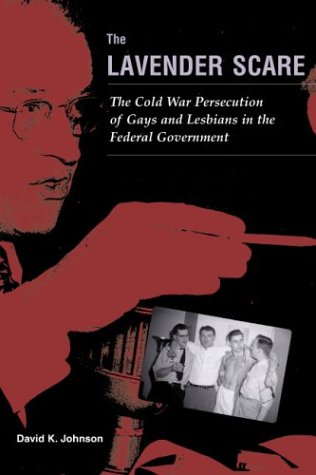
David K. Johnson | The Lavender Scare: Cold War Persecution of Gays and Lesbians in the Federal Government (Univ. of Chicago Press, 2004). Following footnotes from Corey Tobin’s Reactionary Mind, I stumbled across this detailed and well-constructed history of the McCarthy era purge of non-straight civil servants. Johnson’s book documents the way in which fears about national loyalty and psychological fitness blended together in the Cold War era and led to a mass expulsion of queer folks from the government (often destroying careers, precipitating family fissures, and causing psychological and emotional trauma on the way by). What surprised me was the relatively relaxed attitude Johnson describes toward sexual deviance immediately prior to the 1950s, when few feared loss of their job or social ostracism for homosexual identity or behavior.

Paul Russell | The Unreal Life of Sergey Nobokov (Cleis Press, 2011). Cleis Press sent me a review copy of this densely atmospheric historical novel, which attempts to reconstruct the life of Sergey Nobokov, the obscure younger brother of novelist Vladimir Nabokov of Lolita fame. I admit a certain amount of dubiousness when confronted with a historical novel that attempts to piece together the life of an actual historic person — particularly when the person in question was homosexual. The temptation for presentism (reading our own expectations onto the past) is always a danger, and often intensifies when we’re talking about the act of “recovering” queer history. The novel is also forbidding in that one anticipates, from the opening pages, Nabokov’s inevitable death at the hands of the Gestapo. To be honest, I’ve rather bogged in the middle (though I mean to go back!) just because midwinter is not really the time to be reading about the inevitable demise of a forgotten gay man under the Nazi regime.

Patricia Faith Appelbaum | Kingdom to Commune: Protestant Pacifist Culture Between World War I and the Vietnam Era (Univ. of North Carolina Press, 2009). Hanna found this one for me at the Harvard Book Store off Harvard Square. It’s a meticulously researched study of pacifism during the first half of the twentieth century, focusing — as the title suggests — on the influence of mainline protestant culture on the ways in which pacifism was articulated and enacted by women and men across the United States (and to some extent internationally as well). I’m only up to roughly the start of the Second World War thus far, but am finding it very readable history. I’m particularly interested in her focus on material and “folk” culture as a way of practicing and passing along traditions of Protestant pacifism, even in more secular pacifist communities and activism.

Joseph Cummings | Ten Tea Parties: Patriotic Protests That Time Forgot (Quirk Books, 2012). This early reviewer book from LibraryThing that is a lesson in “read more than the title when requesting your advance review copies.” I thought the book was going to be about ten unique protests that time forget; instead, it was about ten pre-revolutionary protests about tea and import taxes. Which, okay, if your thing this might be fun. Cumm ings has an engaging narrative voice and it looks like he’s done a credible amount of background research. His scant two-page bibliography is made up of secondary resources, however, and the lack of even end note citations is frustrating to those of us who like our quotations sourced!

Jeffrey Weeks | Making Sexual History (Blackwell, 2000). Following citations from Gayle Rubin’s Deviations, I tracked down this retrospective anthology of British historian and theorist of sexual politics Jeffrey Weeks’ essays on historical conceptions of human sexuality. This is a lively and articulate — if somewhat theoretically dense — collection which provides a solid picture of the work of historians of sexuality since the 1960s, and also reflects back on the work of sexologists from the 19th and early 20th centuries, and the long legacy of their contributions to research and cultural perceptions of human sexuality and how it is organized. Weeks was one of the pioneering scholars to retrieve the study of sex from the realm of nature/biology (where it was assumed to be ahistorical) and asserted the importance of understanding how human sexuality itself — not just our understanding of it — is shaped by culture.

Christopher Turner | Adventures in the Orgasmatron: How the Sexual Revolution Came to America (Farrar, Straus & Giroux, 2011). I was only able to get through about half of this ambitious history of psychoanalyist Wilhelm Reich’s work on human sexuality before the library demanded it back. However, the half that I did read was a thoroughly researched examination of Reich’s approach to psychoanalysis — one which placed orgasm at the center of both psychological and political health. Since Reich had only just arrived in America when I had to interrupt my reading, I remain dubious concerning the title’s claim (that Reich precipitated the sexual revolution in the U.S.). Nevertheless, Reich’s insistence that sexual pleasure was healthy and to be encouraged — and his placement of pleasure close to the heart of humanity’s essential character — becomes central to a number of post-WWII psychoanalytic and cultural currents that I am interested in (he was connected to, among others, A.S. Neill, Fritz Perls, and Erich Fromm).

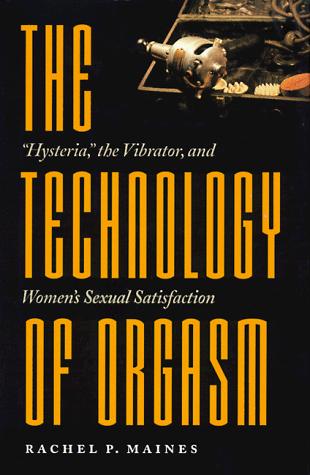
Rachel Maines | The Technology of Orgasm: “Hysteria,” the Vibrator, and Women’s Sexual Satisfaction (Johns Hopkins, 1998). Um … are you sensing a pattern in my recent reading yet? Pursuing research for an MHS “object of the month” essay, I checked out this slim volume on the medical treatment of women’s sexuality through electromechanical technology. It appears to be the only book-length work on this subject to-date, and although I found some of her arguments about male physicians and their power to be slightly simplistic, on the whole she avoids turning this into a narrative of male physicians vs. female patients, or husbands vs. wives, and instead offers a nuanced argument about the displacement of female sexual pleasure from marital intimacy to the doctor’s office due to what she terms the “androcentric model” of sex that insisted intercourse to male orgasm was sex, and women’s needs (clitoral stimulation anyone?) outside of those activities were excessive and therefore a medical issue for which one sought treatment from the professionals.

quick hit: belfast project oral history lawsuit

30 Friday Dec 2011

Posted by Anna Clutterbuck-Cook in my historian hat

≈ Leave a comment

Tags

history, human rights, npr, oral history

via

Earlier this year, the British Government requested the audio recordings and transcripts of interviews from a Boston College-based oral history project documenting the history of conflict in Northern Ireland. The oral history narrators who participated in the project originally granted interviews on the condition (agreed to in writing) that the interviews remain sealed until after their death. English officials are arguing that the interviews are required as part of an ongoing criminal investigation and claiming that the United States government is under treaty obligation to obtain the materials from BC and hand them over.

After initially resisting the request, Boston College appears to be on the brink of complying with a Judge’s order to hand over select interviews. This decision not only represents a breach of promises made to human beings whose lives (and the lives of countless others) will now be under renewed threat, but will have a widespread chilling effect on the practice of oral history in situations where, perhaps, the oral historical record is particularly vital: sites of conflict where normal modes of documentation are lost or never created.

You can listen to an interview with the former director of the Belfast Project, Ed Moloney, on WBUR’s Radio Boston.

You can read more about the lawsuit at Boston College Subpoena News (a blog set up to follow the story, which is unaffiliated with BC), as well as access many of the publicaly-available legal documents related to the case.

Neither the Oral History Association nor the American Historical Association have weighed in on this issue recently — at least that I can find — although the AHA did acknowledge back in May that the issues are “murky” and raise complex ethical questions about the practice of oral historical research.

booknotes: one and only

15 Thursday Dec 2011

Posted by Anna Clutterbuck-Cook in book reviews

≈ Leave a comment

Tags

history, oral history

Cleis Press recently sent me a review copy of One and Only: The Untold Story of On the Road and Lu Anne Henderson, The Woman Who Started Jack Kerouac and Neal Cassady on Their Journey by Gerald Nicosia and Anne Marie Santos (Berkeley, CA: Viva Editions, 2011). Here are a few thoughts.

In 1978, Beat biographer Gerald Nicosia had the opportunity to interview Lu Anne Henderson twice – once her a hospital in San Francisco, when she was recovering from surgery, and shortly after her release when she invited him to the house where she was recovering for a lengthy recording session. Over thirty years later, One and Only brings us these oral historical narratives in the form of heavily edited autobiographical vignettes. The sections of One and Only drawn directly from the interviews are framed by Nicosia’s contextual commentary and supplemented by other historical material about the Beats and their milieu – including a number of photographs and an essay by Henderson’s daughter, Anne Marie Santos.

I have, I will admit upfront, never been drawn to the Beat movement either in terms of its literary output or its place in American twentieth-century history. I have had passing acquaintance with its main personalities and the echoes of their work in 1960s and 70s cultural critiques. But I come to this work largely without preconceptions about the personalities of the individuals or the nature of the relationships between the main players. Therefore I’m not the best person to comment on the contribution this autobiographical narrative adds to the field of Beat studies. What I would like to talk about is the way in which Nicosia frames the oral history, and how one might approach reading the text with a skeptical eye — yet still gain a valuable personal perspective on some fairly iconic historical people and events.

Nicosia’s introduction does not inspire confidence in One and Only either as a work of oral historical scholarship or as a meaningful portrait of Lu Anne Henderson and her experience of mid-century American bohemia. Nicosia leans heavily on qualitative descriptions of his subject that came across  in my reading as tasteless objectification – he introduces her as “beautiful fortyish woman” who has a certain “homespun charm” and retains “touches of … charming innocence” (24; 33). Given his position as a younger (at the time) man requesting an interview about Henderson’s life and sexual relationships, I find the focus on her simultaneous sensuality and almost childishness to be a little creepy.

Nicosia walks a fine line between asking his readers to recognize Henderson’s agency – even as a fifteen-year-old teenage girl, she situates herself as a person who made choices about how to live her own life – and eliding the power dynamics borne of age and gender. While still a young man when he married Lu Anne, Cassady was in his early twenties, with more travel experience and a stint in the military under his belt. While not all such relationships need be inherently exploitative, this dynamic is never unpacked either by interviewer or interviewee. While Lu Anne’s interview emphasizes their shared youthfulness and complicity in continuing to live in or on the edge of poverty, readers can’t help but observe how Henderson is often forced into the position of providing for her husband and his friends, by hook or by crook, as in 1946 when Neal and Lu Anne, newly wed, arrive in New York City:

It was up to me to support us, so I found a job at a bakery. I had just gotten the job that morning, it was my first day, and Neal told me to steal some money! We didn’t have a penny, and Neal told me, like, ‘Bring some money home!’ Well, the woman who ran the bakery caught me [and] dismissed me. It really put me through a traumatic experience (67).

Henderson passes over these incidents with a light touch, often turning them into amusing anecdotes. Similarly, she glosses over the emotional and physical abuse threading through her relationship with Cassady and, later, Kerouac, and subsequent husbands. “Neal was not a violent person,” she observes at point point, and then immediately qualifies this by saying, “except with me. And when Neal would hit me, that was simply emotion” (87).

Nicosia acknowledges that Henderson herself had an agenda in granting him an interview, as did he in seeking her out. She was unhappy with contemporary accounts of her place in the constellation of Beat relationships, approached the interview as an opportunity to correct historical memory. He was collecting material for a biography of Kerouac eventually published in 1983 under the title Memory Babe. To a great extent, Nicosia’s focus on the high-profile male personalities in Henderson’s circle persists in One and Only. He observes with unselfconscious approval that “Unlike so many of the other women who have written about Kerouac, [Lu Anne] resists the temptation to shift the focus of the story from Jack (or in this case, Jack and Neal) to herself” (27). In the context of a biography of Kerouac or Cassady, such an on-task informant might be an asset to the researcher – in the context of a book that places Lu Anne Henderson front and center, the observation tastes a bit sour on the tongue. Really, Nicosia? You make it sounds like Henderson’s life story is only valuable to the degree she keeps herself in the background and focuses on the menfolk in her life? I really hope you didn’t mean that the way it came out.

Despite my (many!) frustrations with the framing of Lu Anne’s narrative by Nicosia, there will likely be value to Beat scholars in the publication of Henderson’s perspective on the oft-chronicled historical events that inspired On the Road and other Beat works. Until now, the interview was unavailable to the public, for reasons Nicosia doesn’t elaborate on – only hinting that he was “forced” to bring a lawsuit in order to open the archive. I certainly found Henderson’s narrative compelling, and while her portrait of life on the economic and cultural edge was at times heartbreaking, I think it’s an important antidote to those who might romanticize the outsider while forgetting the real material and social costs of socioeconomic and philosophical marginalization … even if some aspects of that marginalization are, at least partially, by choice.

I look forward to seeing what future scholars do with the published work as well as the raw interviews, which I hope will be made available to scholars and the general public for research purposes.

booknotes: when we were outlaws

08 Thursday Dec 2011

Posted by Anna Clutterbuck-Cook in book reviews

≈ Leave a comment

Tags

being the change, feminism, gender and sexuality, history, memoir, politics

In many ways, Jeanne Córdova’s memoir, When We Were Outlaws: A Memoir of Love and Revolution (Midway, Fla.: Spinster’s Ink, 2011), couldn’t be more different than the last memoir of the 70s I reviewed here at the feminist librarian: Patricia Harmon’s Arms Wide Open. Harmon’s memoir told the tale of a self-trained hippie midwife who moved with sons and male lovers through several different rural communes before entering medical school for formal nurse-midwifery training. Jeanne Córdova, by contrast, spent the 1970s in the Los Angeles area free-lancing as a journalist and activist in what were then referred to as the women’s and gay liberation movements. A self-identified butch, she came of age as part of the lesbian bar culture of the 50s and 60s, then discovered gay liberation and feminism in 70s. Córdova was the founding editor of The Lesbian Tide newsmagazine and the human rights editor of the L.A. Free Press, interviewing radicals on both the left and the right on the run from the law. As she observes in her introduction, “this memoir visits many outlaws, some freedom fighters, and a few who would be called terrorists … I needed to know and sort out these outlaws in my mind in order to discover the perimeters of my own moral compass … Outlaws takes place at the intersection of shadow and shade that differentiate between persona and principle” (vii).

Yet I found myself, while reading Outlaws, thinking often of Harmon’s memoir and the parallels between both works in scope and tone. And in the relationship (in text, at least) between the authors and their own personal and political pasts. Like Arms Wide Open, When We Were Outlaws seeks to tell a specific slice of the authors life, rather than starting with childhood and moving through the years in an orderly progression. Both authors chose, as their time-frame, the turbulent years of the 1970s when the heady, optimistic social change movements of the late 1960s led to more complicated lived realities for those who championed leftist causes and a counterculture way of life. Córdova focuses on her life and work between 1974-1975, with some flashbacks and flash forwards to help us make sense of the dense web of associations — political and personal — that characterized that time, both for Córdova specifically and her fellow activists in what was then called “the Movement” more broadly. Like Arms, Outlaws gives us an in-the-moment perspective on the life of someone struggling to live out her political convictions in her personal life. For Jeanne Córdova this means an up-close, and in many ways unshrinking, view of her involvement with lesbian separatist politics in relation to the gay liberation movement more broadly. It also means intimate portraits of her trial-and-error practice of open relationships, as she paints a portrait of her involvement with two women — the long-term relationship in which she and her partner have negotiated non-monogamy, and the quickening of an intense love affair with a fellow activist that threatens the stability of her more permanent ties.

It has become a commonplace, since almost before they began, to identify the leftist social movements of the 60s and 70s as enthusiasms of youth, as romantic idealism (or destructive self-absorption, depending on your political persuasion) that necessarily gave way to realistic politicking and material concerns. In some ways this is true. Many of the individuals who populate When We Were Outlaws are young adults in or just out of undergraduate or graduate school programs, young professionals or struggling under-employed twentysomethings. They don’t (yet) have dependents to care for, and are geographically mobile, often living on the economic edge. They’re at the point in their lives where they’re developing a sense of what kind of life they want for themselves and those they care about — what kind of work they find meaningful, what values they hold dear, what kind of relationships they want to build and maintain. Often, their answers (however tentative) to these questions are at odds with the answers their parents or the activists of the previous generations gave.

Yet despite the youth (and youthful perspective) of its protagonist, I would argue that Outlaws pushes us to re-examine our assumptions that the moral dilemmas and vision for a better future that Córdova and her cohort were immersed in are solely the province of the young — impetuosity that will necessarily give way as one grows into more seasoned adulthood. One of the most interesting narrative threads in Outlaws traces the relationship between Córdova and her political mentor/substitute parental figure Morris Kight. Kight was a mover and shaker in L.A. gay political activism, someone with whom Córdova worked closely and fell out publicly over the place of women in the gay liberation movement. Their differences aren’t so much conservative elders vs. radical youth but something more complicated — a difference in experience, of power, of privilege. In the very personal (yet also political) struggle between Kight and Córdova we can see all the complications inherent in working for social justice, complications that don’t get, well, less complicated — or less relevant — as we grow older.

Córdova reflects back on her younger self with a sometimes-critical, yet always compassionate eye. While the narrative style is “novelized memoir” (to use the author’s own choice of phrase), one nevertheless gets the sense that the author both knows well her protagonist’s faults and cares very deeply for her younger self, no matter how flawed her present self may find that person of the past. “I was not born knowing how to love,” is how she open’s her introduction. “It came to me late in life” (vii). In the pages of Outlaws we see her be cruel to lovers, ideologically ruthless, politically short-sighted, and cripplingly addicted to booze and prescription drugs. At the same time, we see a heart-breakingly young woman who’s been physically evicted from her childhood home (for bringing home a lover), is living with serious and intermittently-treated depression, experiences chronic under-employment, and who nonetheless is working hard to build a meaningful life for herself and a better future for us all. Whether you agree with the young Córdova’s means and visionary ends doesn’t necessarily detract from the import of such a closely-rendered self-portrait.

I suspect we’re only in the early years of a richly textured new wave of 70s-era autobiography which will shed new light on the particularity of growing into adulthood during a period when even the most fundamental of questions concerning how we organize our personal and political lives seemed to be in real, material flux. I am also happy (quite selfishly, I admit!) about the way these personal perspectives will provide unique, and accessible, primary source material for historians of the period, even while many historical sources remain in private hands (and therefore often invisible-to-researchers). Córdova’s memoir would provide a rich jumping-off point in a course that sought to explore this era in all its rich historical realities — and I hope it prompts many readers to re-examine what they think they know about the political contours of the decade.


This review was made possible by the generousity of Lynn Ballen at Spinster’s Ink who provided me with an advance review copy of the book. The book is available now for purchase online or at your brick-and-mortar bookstore of choice. You can read more about the memoir and its author at www.jeannecordova.com.

multimedia monday: "automobile row"

31 Monday Oct 2011

Posted by Anna Clutterbuck-Cook in media

≈ Leave a comment

Tags

boston, history, multimedia monday

Hanna and I live in the Allston neighborhood of Boston, just west of Boston University’s main campus. Commonwealth Avenue stretches from Kenmore Square (near Fenway Park) to Boston College out in Newton. We live in an apartment building sandwiched between Comm Ave to the north and the town line of Brookline to the south, and the neighborhood in this little documentary is one through which we walk and ride the “T” on a regular basis:

The Kenmore Square building that now houses Barnes & Noble at BU was home to a dealer of Peerless automobiles. The Star Market by Packard’s Corner was once a Chevrolet dealership. And in between lay more than a mile of storefronts selling cars, parts, and accessories or repairing cars. In the 1920s there were more than 100 such businesses on and near that strip of Comm Ave. Downtown Boston had its “Piano Row” and its “Newspaper Row.” This was Boston’s “Automobile Row.”

 
The article which accompanies this video is quite interesting in its own right. I’m really impressed by the research that went into making the video — obviously a few people spent some time in the BU college archives! — and the way in which the historical images were edited into the present-day footage.

from the archives: historical games of telephone

26 Wednesday Oct 2011

Posted by Anna Clutterbuck-Cook in library life

≈ Leave a comment

Tags

archivists, history, humor, MHS

I don’t have the mental oomph this week for a thirty at thirty post, so I thought instead I’d offer you a little anecdote from the Reading Room of the Massachusetts Historical Society. It’s a fascinating example of how historical sources can be unreliable, and knowledge with think we all know turns out to be factually far more complicated than it appeared at first glance.

via

Yesterday afternoon I took a call from a researcher who was looking to source a quotation about Horace Mann. The researcher gave the quote to me over the telephone as follows

Education really consists of a student on one end of a log and Horace Mann on the other end of the log.

The researcher wanted to find out who had said this. I took their contact information and this morning when I was in the Reading Room I spent some time digging around to see what I could find.


My first stop was the online version of Bartlett’s Quotations, to look up any familiar quotations with “Horace Mann” in or associated with them, since this was my one concrete lead. (The MHS does, in fact, hold a large collection of Horace Mann papers, but since this was a quotation ostensibly about Mann rather than by Mann, I set aside the possibility of wading into those waters until later. Turns out this was a good call!). Bartlett’s didn’t yield anything. So I decided to begin by verifying the wording of the quotation via that wonderfully inexact crowd-sourcing tool known as The Internet.


I navigated to Google.com and typed in “education really consists of a student on one end of a log” and hit search.


Yes, Librarians do it too, and yes sometimes it can actually be an incredibly powerful entry-point for research of this kind.


What I discovered from scanning the first page of results for this phrase was that it wasn’t Horace Mann whose name was most frequently associated with phrases along these lines, but a man named Mark Hopkins, who was the president of Williams College (Williamstown, Mass.) from 1836-1872.


Re-running my search with the “education…” phrase and “Mark Hopkins” took me to a Wikiquotes article on education, where the quotation is given as: “My definition of a University is Mark Hopkins at one end of a log and a student on the other,” and the attribution is described thus:

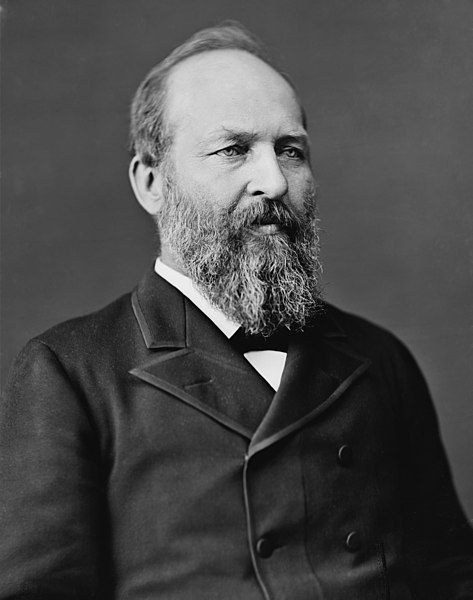
Tradition well established that James A. Garfield used the phrase at a New York Alumni Dinner in 1872. No such words are found, however. A letter of his, Jan., 1872, contains the same line of thought.

I now had a tentative identification for the individual named in the quotation as well as a possible identification for the individual who had spoken the words.

via

A search in Google Books and the Internet Archive for various combinations of keywords from the above yielded some fascinating permutations of the elusive quote on education:


The January 1902 issue of the Western Journal of Education contains an address by one E.F. Adams in which he claims, “When President Garfield said that when Horace Mann was on one end of a log and himself on the other there was a university he expressed the spirit of the old education” (p. 18).


In a 1966 issue of the education magazine Phi Delta Kappan, Arthur H. Glogau again attributed the quotation to President Garfield and writes “Garfield once said that a rotten log, with Mark Hopkins on one end of it, and himself on the other, would be a university” (Vol 48, p. 404). The date for the quotation is given in this instance as 1885.

Mark Hopkins was one-time president of Williams College and apparently a former professor of Garfield’s. In a footnote concerning Hopkins in The Collected Prose of Robert Frost, the editor formulates the quote as: “The ideal college is Mark Hopkins on one end of a log and a student at the other” (p. 266).

Since none of these sources either quote Garfield directly or provide a citation to his own writing or speeches, I turned to our own catalog, ABIGAIL, and called for a biography of Garfield from our reference collection.

Unfortunately, this didn’t exactly clear up the mystery.

Robert Granfield Caldwell’s James A Garfield: A Party Chieftain (1931), attributes the quote to another secondary source, B.A. Hinsdale’s President Garfield and Education (1882), and phrases it: “Give me a log hut, with only a simple bench, Mark Hopkins on one end and I on the other, and you may have all the buildings, apparatus and libraries without him” (p. 185). 


This citation appears to lead us back to a 4 February 1879 speech by Garfield before the National Education Association, the full text of which is reproduced in the Hinsdale publication. You can read it online at the Internet Archive. In his NEA address, Garfield articulated the idea in this way:

If I could be taken back into boyhood to-day, and had all the libraries and apparatus of a university, with ordinary routine professors, offered me on the one hand, and on the other a great, luminous, rich-souled man, such as Dr. Hopkins was twenty years ago, in a tent in the woods alone, I should say, ‘Give me Dr. Hopkins for my college course, rather than any university with only routine professors’ (338).

So now I have four dates upon which this sentiment was supposedly expressed (1871, 1872, 1879, and 1885) and as many venues (New York Alumni dinner, private correspondence, NEA address, and an unknown context for the 1885 attribution). 


What I find fascinating about all of these “quotations” is the aspects of the story that remain roughly constant: the presence of Hopkins, the image of one mentor and one student in dialogue, the language of wood: a log, a log bench, a rotten log, a tent in the woods. My speculative guess, based on the information I have in front of me, is that this was a well-worn anecdote that James Garfield told about his former professor in a number of settings, and that the image was such a striking one to his contemporaries that it was picked up and repeated over time with slight variation, like that game of telephone you’re forced to play as a child at birthday parties where you whisper a message from ear to ear around the circle and see whether the end result bears any resemblance to the original phrase.

So there you have it: an hour or two in the life of a reference librarian. 

our bodies, ourselves @ forty (+ me!)

05 Wednesday Oct 2011

Posted by Anna Clutterbuck-Cook in my historian hat

≈ 5 Comments

Tags

being the change, gender and sexuality, history, human rights, the body, whoniverse

(photo by Hanna)

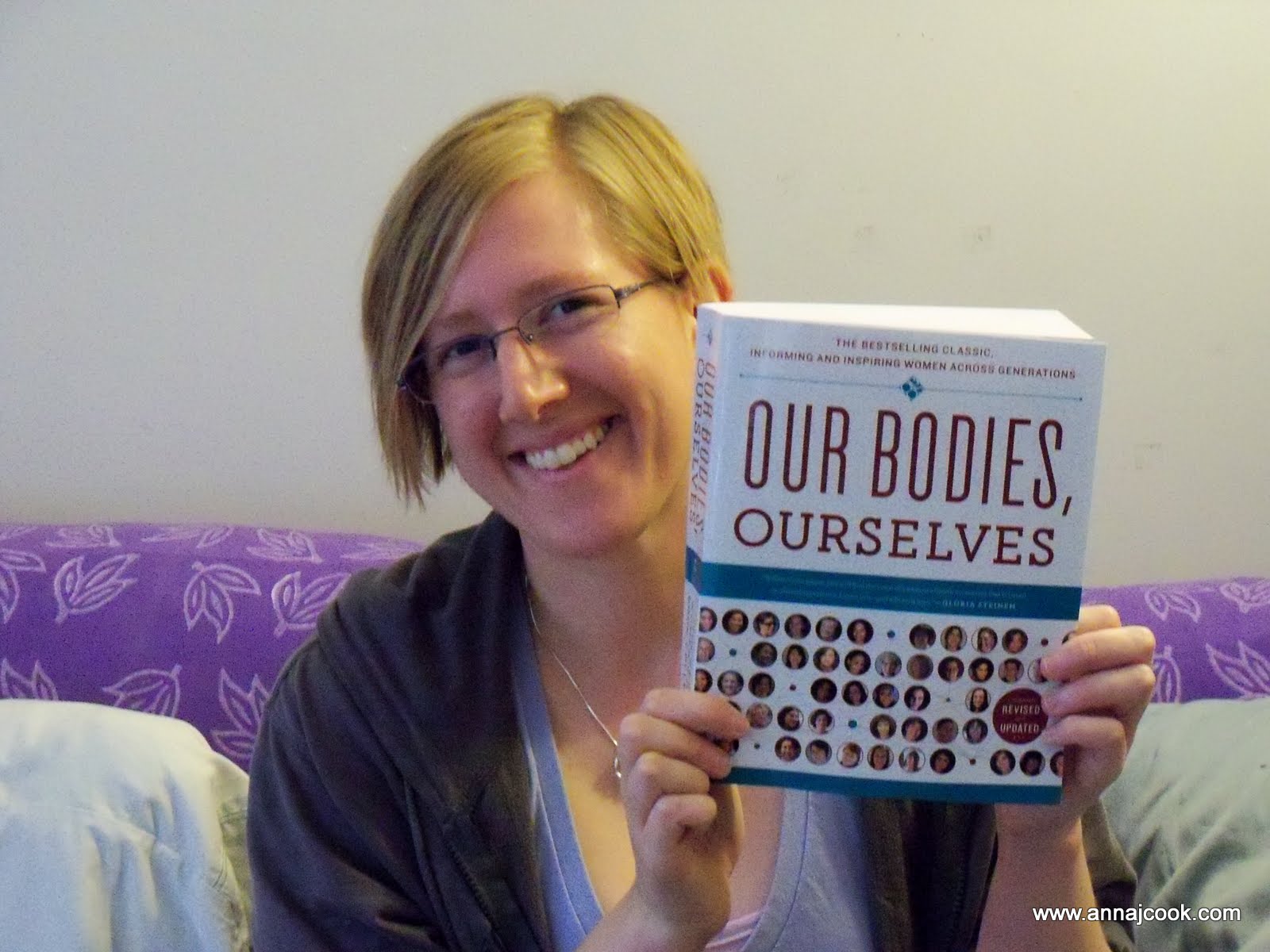
The feminist classic, Our Bodies, Ourselves, turns forty this year and has just been issued in a revised edition that was multiple years in the making. How do I know this? Because I got to be a part of the process! Long-time readers might remember when I posted a call for participants in the revision process back in January 2010. Well, in addition to broadcasting the call I also submitted my own name to the editors and was invited to join them in a virtual focus group discussion on intimate relationships. This conversation eventually turned into the “Relationships” chapter in the new edition, and many of the passages that didn’t make it into that chapter have been used in other sections — I found bits and pieces from my contributions in the chapters on sexual orientation and on sexuality, for example.*

my contributor’s copy, signed by the editorial team!
(photo by Hanna)

I don’t think I can adequately convey to you how proud I am to be a part of the OBOS project. My mother’s battered copy of Our Bodies, Ourselves was my constant companion through adolescence and, among other things, was my first exposure to explicitly feminist analysis, my first exposure to the idea of same-sex relationships, and my introduction to masturbation and how to do it. One of the first things I did when I moved out to Boston in 2007 was to visit the Schlesinger library at Radcliffe and browse the records of the Boston Women’s Health Book Collective — the group that put together the first mimeographed edition of OBOS back in 1970. It’s an incredible honor to have had the opportunity to add my perspective to the myriad other voices that have been part of this international endeavor throughout the past forty years.

It’s so strange to see your own words on the printed page…

This past Saturday, women from around the globe gathered here at Boston University for a symposium in honor of the new edition. I wasn’t able to make the gathering because of a scheduling conflict (and, frankly, because it sounded like a long day with too many new people to make small talk with!) … but I’m looking forward to checking out the web video of the talks once those go up online. If/when they become available, I’ll be sure to post a link here!

Here’s hoping that OBOS (and I!) will be around in another forty years to celebrate eighty incredible years of women teaching and learning one another about their bodies, their sexuality, their relationships, their values, and their lives.

Update: Thanks to OBOS for mentioning this post in their introduction to the Relationships chapter online! Welcome to anyone who’s come to visit the feminist librarian via their link. You are most welcome.

*It’s standard OBOS practice to keep all of the in-text quotations anonymous in order to protect contributors’ privacy. For the “Relationships” chapter we all chose pseudonyms; if you know me and you care to figure it out you’ll be able to identify me through my bio at the beginning of the chapter.

booknotes: contacts desired and recruiting young love

12 Friday Aug 2011

Posted by Anna Clutterbuck-Cook in book reviews

≈ 2 Comments

Tags

books, gender and sexuality, history, religion

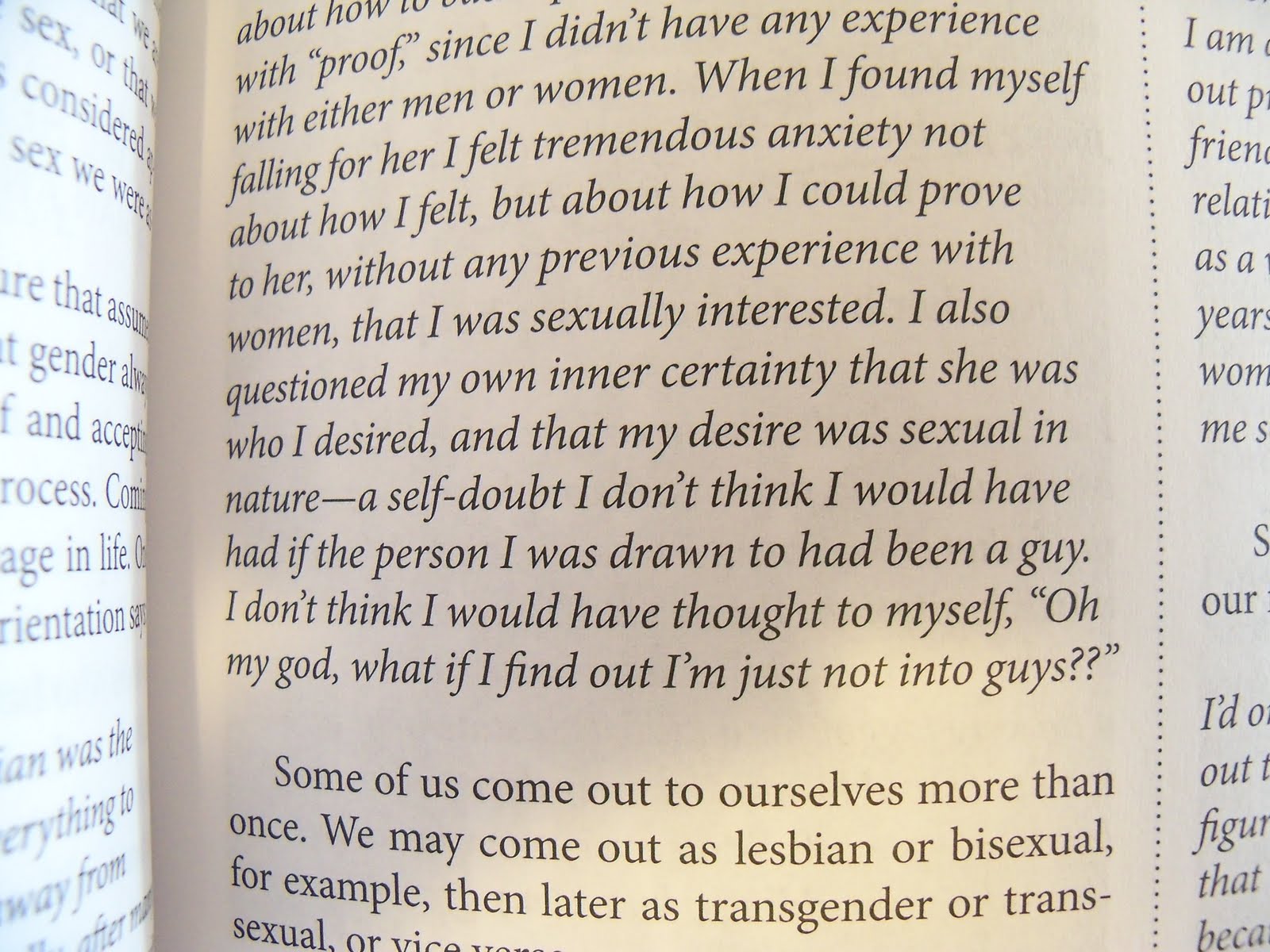
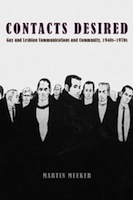
Over the past few weeks, I’ve read two interesting — if somewhat academic — books about (loosely speaking) print culture and its intersection with queer communities and discourses about non-straight sexuality. The first was Contacts Desired: Gay and Lesbian Communications and Community, 1940s-1970s by Martin Meeker (Chicago: University of Chicago Press, 2006) and the second was Recruiting Young Love: How Christians Talk About Homosexuality by Mark D. Jordan (Chicago: University of Chicago Press, 2011). While the first book dealt largely with homophile organizations and the underground publications of the gay liberation and lesbian feminist movements, the second took up the various rhetorics deployed within Christian circles to speak and write about homosexuality (mostly gay male sexuality) from the turn of the twentieth century through the ex-gay activism of the 1990s. Despite the pro/con nature of these texts, what Contacts Desired and Recruiting Young Love share is an interest in how networks of communication spread ideas and inform opinions, actions, and identities.

“Adolescence is the possibility that desire could be different.”

Recruiting Young Love by Mark D. Jordan, focuses on what he calls “rhetoric” and I might term “discourse” concerning homosexuality — mostly (and he is upfront about this) gay male sexuality — in Christian circles over the course of the twentieth century. His interest is primarily in the 1950s forward, though he does begin in the early twentieth century with the emergence of professional discussion of healthy adolescent development (think G. Stanley Hall, the YMCA, Teddy Roosevelt, etc.) by way of providing background for later debates.

As the phrase “recruiting young love” suggests, Jordan is particularly interested in the way that Christian anti-gay voices expressed anxiety about adolescent sexual identity, and the fact that even today ex-gay therapy understands heterosexual and gender-normative identity to be both the most correct expression of sexuality and the most vulnerable. Teenagers, especially, are seen as vulnerable to recruitment and seduction. The examples of Christian rhetoric concerning homosexuality, then, focus on young people and at times seem to assume that all young men are in fact potentially gay — and that this potentiality is threatening to the moral order.

Although he focuses on anti-gay voices, Jordan also touches on some examples of what he calls “camp spirituality,” or appropriated religious imagery (i.e. the Sisters of Perpetual Indulgence), and upon Christian attempts to integrate gay identity and same-sex sexuality into their sexual ethics. He cites, for example, a 1963 Quaker pamphlet, Towards a Quaker View of Sex, that used Alfred Kinsey’s model of fluid sexual practice to argue that homosexual desire and expression, while not predominant, were healthy and normal within the human community. He writes:

For this model of development, most male adolescents are having same-sex relations or thinking about them. Bit by bit, most of them shift over a decade or more to heterosexual relationships. Some do not. The process is not so much an expression of nature as of circumstance or even chance. Indeed, the Quaker pamphlet accepts more fully than any earlier church text not just Kinsey’s terminological suggestion about how to speak of homosexuality as outlet rather than ontology, but his notion that homosexual acts vary with time. To think of yourself as a homosexual should mean no more than observing where you are in the arc of your life and with whom you are now spending it (89).

I was actually quite moved by the idea that one’s sexual “identity” was actually a question of observation and regard, suggesting change over time rather than fixity — though without the sense of enforced change, or charge from “unhealthy” to “healthy” that so many ex-gay narratives imply. Once again, Quakers FTW — and in 1963 no less!

One other aspect of anti-gay Christian rhetoric that Jordan takes note of is the fact that contemporary ex-gay ministries seem to be much more preoccupied with what we would consider gender performance than actual sexual identity, desire, or activity:

Gender matters more than sex [in many ex-gay ministries]. Marriage is the highest accomplishment not because it allows you to copulate naturally, but because it gives you the best stage for performing gender correctly … Indeed, ex-gays may actually be able to use marriage better for gender performance than heterosexuals can, since they are unlikely to enter into it on account of lust … the central category of ‘sexual identity’ means in the end only ‘roles as men and women’ (165).

In this, he relies a great deal on the research and writing of Tanya Erzen, whose recent book Straight to Jesus I reviewed here last August. I’d highly recommend her text if you’re interested in exploring this aspect of the ex-gay movement in more detail.

The weakness of Jordan’s work is one that he admits up-front in the introduction: that it is not meant to be a coherent or comprehensive historical narrative, but rather a series of proffered examples or touch-points meant to give readers a sense of the variety of discourses concerning homosexuality that have existed in Christian circles over the past half century, and some rough idea of where they sprung from, their similarities and their differences. Someone hoping for a more detailed history of anti-gay activism will have to look elsewhere.

“Homosexuals are discarding their furtive ways and openly admitting, even flaunting, their deviation” (Life, 1964).

Meeker’s Contacts Desired explores the ways by which gay- and lesbian-identified people established networks of communication in the decades before, during, and immediately after what we have come to term “the sexual revolution.” As previous scholars have pointed out, identity based on sexual orientation does not bring with it an automatic community affiliation. Unlike with racial, ethnic, religious, or even class, one rarely grows up in a family that shares one’s non-straight orientation. Particularly during the mid-century in America, where queer subcultures were obscured from public view for the safety of their members, a pervasive sense of isolation was often part and parcel to becoming aware of one’s same-sex desires. Contacts, originally written as Meeker’s PhD dissertation, documents the means by which gay and lesbian individuals made contact with the sexual underground and how they situated themselves within it through text: newsletters, interviews, press releases, pamphlets, “contacts desired” ads, guidebooks, and so forth.

Contacts bears the marks of its academic origins, and I’d suggest picking it up more for targeted rather than leisure reading. Those familiar with the history of mid-twentieth-century gay and lesbian activism will find many of the usual suspects here: the Daughters of Bilitis and the Mattachine Society, lesbian pulps and journalistic (outsider) coverage of gay lives — such as the 1964 Life photographic essay on the gay male subculture, from which the quotation above, and the cover art of Contacts, are drawn.

The primary sources I found most fascinating in Meeker’s work were actually these journalistic offerings from the 1960s, since they offered up a glimpse of (and yes, I know it’s cliche) how far we actually have come in the past fifty years in terms of de-pathologizing and de-criminalizing queer sexualities — even though it’s obvious we still have work to do. Meeker discusses popular book-length treatments of queer subcultures as well as newspaper and magazine exposés. What is clear is that “sympathetic” (straight or passing) writers understood that in order to write about homosexuality for the mainstream, it needed to be treated as a psychological disorder or as antisocial behavior. Understanding homosexuality did not mean reading it as normal. The Life article makes that clear from its sensationalistic opening sentences:

These brawny young men in their leather caps, shirts, jackets and pants are practicing homosexuals, men who turn to other men for affection and sexual satisfaction. They are part of what they call the “gay world,” which is actually a sad and often sordid world. On these pages, LIFE reports on homosexuality in America, on its locale and habits and sums up what science knows and seeks to know about it.

Homosexuality shears across the spectrum of American life – the professional, the arts, business and labor. It always has. But today, especially in big cities, homosexuals are discarding their furtive ways and openly admitting, even flaunting, their deviation. Homosexuals have their own drinking places, their special assignation streets, even their own organizations. And for every obvious homosexual, there are probably nine nearly impossible to detect. This social disorder, which society tries to suppress, has forced itself into the public eye because it dos present a problem – and parents especially are concerned. The myth and misconception with which homosexuality has so long been clothed must be cleared away, not to condone it but to cope with it.

As Meeker points out, these widely-disseminated treatments of homosexuality were often read subversively by those whose desires were the topic of discussion: gay and lesbian readers of Life who might otherwise be cut off from the networks of queer communication and community were given a roadmap to (at least some of) the popular gay and lesbian gathering places or geographic locations, thus offering hope that they were not alone. Articles that claimed to “not … condone [homosexuality] but to cope with it” actually did their part to strengthen the underground networks of queer communication that took a radically different view, at least in most cases, when it came to how sad their lives actually were and the extent to which what sadness there was came as a result of their sexual desires (versus the hostile climate in which they were forced to exist).

Reading these books has inspired me to explore some of the primary source material itself, so check back next week for reviews of Patricia Highsmith’s The Price of Salt (an early lesbian novel) and Adrienne Rich’s 1977 essay “Compulsory Heterosexuality and Lesbian Existence.”

← Older posts
Newer posts →
"the past is a wild party; check your preconceptions at the door." ~ Emma Donoghue

Recent Posts

  • medical update 11.11.22
  • medical update 6.4.22
  • medical update 1.16.2022
  • medical update 10.13.2021
  • medical update 8.17.2021

Archives

Categories

Creative Commons License

This work by Anna J. Clutterbuck-Cook is licensed under a Creative Commons Attribution 3.0 Unported License

Meta

  • Create account
  • Log in
  • Entries feed
  • Comments feed
  • WordPress.com

Blog at WordPress.com.

  • Subscribe Subscribed
    • the feminist librarian
    • Join 37 other subscribers
    • Already have a WordPress.com account? Log in now.
    • the feminist librarian
    • Subscribe Subscribed
    • Sign up
    • Log in
    • Report this content
    • View site in Reader
    • Manage subscriptions
    • Collapse this bar