• anna j. clutterbuck-cook
  • contact
  • curriculum vitae
  • find me elsewhere
  • marilyn ross memorial book prize

the feminist librarian

the feminist librarian

Tag Archives: history

from the archives: american medical student in germany between the wars

28 Thursday Oct 2010

Posted by Anna Clutterbuck-Cook in linkspam

≈ Leave a comment

Tags

archivists, blogging, hanna, history

My “from the archives” item this time around is actually from Hanna’s work at the Center for the History of Medicine (aka “CHOM,” the noise refined zombies make when gnawing on their prey), a special collections unit within Harvard Medical School’s Countway Library.

Hanna was asked by her supervisor to write a blog post about some of the materials in the collection she recently finished processing — the personal papers of one Dr. Hyman Morrison (1881-1963).  She chose to write about a cache of letters Dr. Morrison kept from a medical student, Lewis Chase, who was an American studying in Munich and Berlin between 1929-1934. Hanna writes:

Chase was extremely adept at recognizing and commenting on contemporary German political rhetoric and noticing the tensions and potential for tensions between native German and “foreign,” often Jewish American, students at the unversities in Berlin and Munich. In December 1930, for instance, Chase wrote of an influx of American students: “Of the newcomers to Berlin, all are Jewish, with the exception of one Harvard negro—two or three from Boston, many from New York and its immediate vicinity. … Actually there have taken place a number of disagreements, happily only verbal, among the students; a protest against the ‘incessant, loud English-speaking carried on in the Anatomy laboratories’ has already been filed by some reactionary native students.”

 You can read the rest of her blog post over at CHOM’s website. Go enjoy her stories (and help up the amount of traffic her contribution to the website receives!).

from the archive: the "celebrated Regan Water Curtain"

12 Tuesday Oct 2010

Posted by Anna Clutterbuck-Cook in library life

≈ Leave a comment

Tags

archivists, fun, history, northeastern

I’m cataloging images from the Marjorie Bouve scrapbooks this afternoon, and ran across a theater program from Tremont Theatre (Boston, Mass), 1909, which trumpeted themselves as “the safest theatre in Boston,” being equipped with “three celebrated Regan Water Curtains which are positive in their action. Also an asbestos curtain.” Obviously, this required a thirty-second search through Google to find out what, exactly, a “water curtain” might be. The image on the right shows the water curtain in action, as pictured in Public Opinon, vol 29 (January – December 1905).

This technique of fire containment was patented by Chief Regan of the Boston fire department as a method of keeping fires from leaping from building to building and also from destabilizing the front of buildings. As the Public Opinion describes:

The fire department can cope with the average fire when it is no higher than the sixth floor, but above that all that is needed to have a second Baltimore fire is a high wind and an outbreak. Tie fire would leap from building to building, say above the sixth floor, and we should see a long row of buildings in the great financial centers, with all their tops burning and the bottom floors intact. This may be remote, or it may not be, but, as fire insurance men know, it must be figured in the table of insurance rates. The Regan water

curtain is designed to prevent flames from leaping across a street and the front of a building from warping by heat. On the eighth floor and on the fifteenth floor, on the Broadway side of the Manhattan Life Building, 3 1/2-inch pipes were connected with the city water system in the street. The nozzles of the pipe were split into three tiny slots, so that the stream spread into fine spray. This system of pipes stretched across the front wall of the building made a canopy of water, covered the front of the building, and ran off in great streams for a block up and down the curb of Broadway.

So there’s your history tidbit for the day. Don’t you feel more informed?

work+school+life: launching year four

09 Thursday Sep 2010

Posted by Anna Clutterbuck-Cook in a sense of place

≈ Leave a comment

Tags

domesticity, education, family, history, librarians, simmons

The Leonard P. Zakim Bunker Hill Memorial Bridge (Boston, MA), by garreyf.
Made available at Flickr.com.

It’s the week after Labor Day and thus that time of year again … to look back and look forward and wonder when that third year (that seemed so speedy-fast and incredibly filled with eventfulness at the same time) slid by and to wonder what the year ahead is going to bring.

Hard to believe this is the third anniversary, already, of my move to Boston. (See my post from the end of year one and from year two here). With the hectic nature of the last two weeks (punctuated by several severe migraine-grade headaches), I can’t say that I’ve had a lot of time to reflect meaningfully on the question of whether I feel more authentically “Bostonian” now than I did at this point last year, when I was still very much on the fence. But here I still am, and here Hanna and I are likely to stay for at least the medium term (job opportunities willing!). I admit, in my heart of hearts, to longing for the Pacific Northwest now and again, since it has always felt like something of my second home — and both of us have close friends and family ties there. But the possibility of such a cross-country move is in the distant world of future possibilities, alongside Hanna’s equally important lifelong desire to live, for at least a time, in England. For now, our life is here.

And a jam-packed-full life it is at the minute!

Hanna, who graduated with her MA (History) and MS (Library Science) last December, is working as a processing archivist at the Countway Medical Library at Harvard and as an archives assistant at Northeastern (a position I now share with her). She’s working on studying for her GRE, with plans to pursue her PhD in Irish History, and in her spare time can be found blogging both at …fly over me, evil angel… and her recently-created companion tumblr feed, evil angel. I suggest to any of you reading this that you check out both if what you’re looking for are all the most entertaining links on current events in Britain/Ireland, in the world of books, libraries and archives, and genre fiction/film. As she regularly points out, Hanna’s RSS feeds are way more diverse than mine, and I always end up learning the most random and interesting things!

I’m in my final semester of work for my Library Science degree, and taking two classes: one on archives management and the other on the curation of digital materials. While both classes promise to be useful for my future work as a librarian, I’m definitely ready to be finished with formal schooling. Being a student makes me claustrophobic, prone to migraines, and depressed; it also tends to sap the pleasure out of the pursuit of learning, which I adore, and on the whole seems to be an unhealthy sort of thing for me to engage in. A bad match, personality-wise, I’ve discovered. Ironically even more so when the learning is intended to be of professional use rather than something I do because I find it intrinsically valuable (as with my history research).

To celebrate the completion of my degree, I am making plans to get my first tattoo. While I have yet to settle on a design, we discovered a kick-ass artist at Chameleon when Hanna got own inaugural tattoo (a Dr. Who question mark) over the summer, a joint birthday present from me and our friend Diana. I have two or three conceptual ideas in the pipeline right now, although I think for numero uno it might be one of the boats from Swallows and Amazons. My friend Ashley counsels that tattoos should be symbolic enough to be re-interpreted over time, wise words that make me hesitate to use something so pictoral. But I’m sitting with the image for the next few months to see how it feels, and then we’ll go from there! (If it all goes well, I’ll have to start thinking about what to get when I turn in the final draft of my thesis!)

Speaking of my thesis, the draft is away in the hands of my readers and will likely not be completed until next spring, although final deadlines are still in high-level negotiations. There are some arguments for finishing it this fall, but for quality-of-life reasons, and for quality-of-thesis reasons the handwriting is on my own personal wall that this isn’t going to happen. I don’t want to be miserable and over-extended for four months, which in turn will make my girlfriend feel miserable and over-extended as she tries to mop up my tears, soothe my migraines, and manage all of the things I simply won’t have time for. So we’re shooting for May, 2011 presently. Which is actually the term I originally projected I’d graduate (I’m making progress: it took my seven years for the B.A., so four years for the double Masters’ degrees ain’t shabby!)

Meanwhile, I’m working at my beloved Massachusetts Historical Society (from whence I am writing this) and also at Northeastern, as previously mentioned, where I tag-team a position as archives assistant with Hanna. My latest project is 20.65 cubic feet of records from Northeastern University’s cooperative education program, dating from the mid-1970s to the present. Lots of folders of interdepartmental memos and committee meeting minutes, not to mention all the internal dramas to which any organization is prone. I should also (fingers crossed!) finally be wrapping up, this October, the Marjorie Bouve scrapbook digitization project. We still don’t have a firm idea for how to display the images and information for users, but as soon as we have anything up and running I’ll be sure to link it here.

That’s all going to keep me more than busy enough, although I’m definitely looking forward to an October visit from my parents, over the Columbus Day weekend, and to some new blogging projects (i.e. the continuation of reading the (lesbian) classics with Danika the Lesbrarian; my copy of Beth Goobie’s Hello Groin arrived in the post just this morning!). Meanwhile, I’m looking forward to staying in touch with y’all via the usual modes, posting here when I can, and tumblr when I can’t.

And maybe, some time later in the fall or early next spring, you’ll see that we’ve finally taken the plunge and adopted a cat like we keep talking about doing. If we do, you’ll be some of the first people to know (’cause who can resist cute cat photos; I know I can’t!)

Best wishes for a lovely early autumn to you all, wherever you may be, and you’ll be hearing from me soon enough.

Peace,
Anna

multimedia monday: the pre-roe politics of abortion

05 Monday Jul 2010

Posted by Anna Clutterbuck-Cook in media

≈ Leave a comment

Tags

feminism, history, web audio

Terry Gross and Linda Greenhouse @ Fresh Air | The Rhetoric That Shaped The Abortion Debate

To give you a taste, here’s Linda Greenhouse on the development of the rhetoric “the right to choose” and “pro-choice” for the advocates of abortion access:

Jimmye Kimmey was a young woman who was executive director of an organization called the Association for the Study of Abortion (ASA), which was one of the early reform groups and was migrating in the early 1970s from a position of reforming the existing abortion laws to the outright repeal of existing abortion laws, and she wrote a memorandum framing the issue of how the pro-repeal position should be described: ‘Right to life is short, catchy, composed of monosyllabic words — an important consideration in English. We need something comparable. Right to choose would seem to do the job. And … choice has to do with action, and it’s action that we’re concerned with.’

Introduction to book and full transcript of the show are available at the Fresh Air on website.

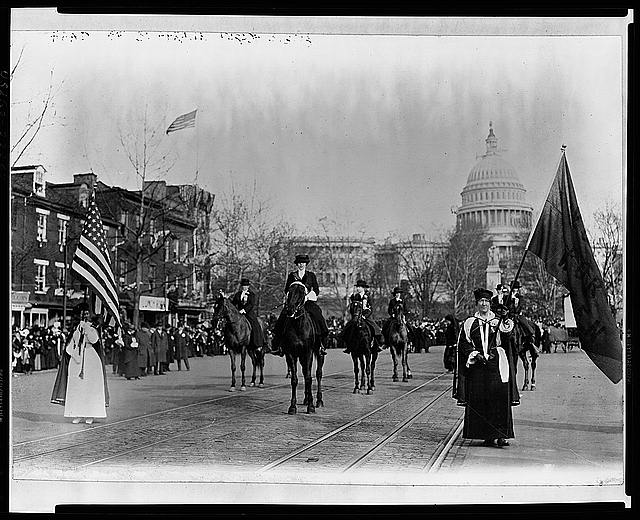
“a rash and dreadful act for a woman”: the 1915 woman suffrage parade in Boston

01 Thursday Jul 2010

Posted by Anna Clutterbuck-Cook in my historian hat

≈ Leave a comment

Tags

feminism, history, MHS


A couple of weeks ago I promised to share with all of you the July “object of the month” from the Massachusetts Historical Society, which I selected and wrote the text for. And today it goes live! The item, to refresh your memory, is a 1915 leaflet containing instructions to participants in the October 16 woman suffrage parade held here in Boston. To be entirely self-referential and quote from my own description,

In 1915, male voters in Massachusetts were asked to decide on an amendment to the Massachusetts Constitution that would strike the word “male” from the article that gave men the right to vote. In response to the upcoming vote, the Massachusetts Woman Suffrage Association organized a pro-suffrage parade on Saturday, 16 October 1915, involving some 15,000 marchers and 30 bands. The parade route began at the corner of Massachusetts Avenue and Beacon Street; marchers made their way past the Public Garden, Boston Common, and the State House before proceeding up Tremont Street and Saint James Avenue to Huntington. The parade ended at Mechanics Hall where a pro-suffrage rally was held.

You can see the digital version of the broadside and my accompanying text over at the Massachusetts Historical society website.

image credit: Suffrage parade, New York City, 6 May 1912, made available at Wikimedia Commons; image is in the public domain.

from the archive: anti-suffrage activism in Massachusetts

16 Wednesday Jun 2010

Posted by Anna Clutterbuck-Cook in my historian hat

≈ Leave a comment

Tags

feminism, history, MHS


This week, I’ve been doing some background research on a pro-suffrage parade that the Massachusetts Woman Suffrage Association organized in Boston on October 15, 1915. Here at the Massachusetts Historical Society we hold a leaflet distributed to the marchers which will be our object of the month in July (you’ll see a link here when it goes up!)

While feminism continues to be a controversial political movement these days, only rarely do you hear people voice the now radical-seeming notion that the world would be a better place if women did not have the right to elective franchise. Less than one hundred years ago, however, exactly the opposite was true: women who sought the vote were understood to be the radical troublemakers whose quest for elective franchise would bring disaster: divorce rates would rise, domestic life would become a shambles, and the twin threats of Mormonism and Socialism would converge and destroy modern civilization [1].

As the Massachusetts pro-suffage activists geared up for their parade, the “antis” (as they were known) geared up for a counter-protest. As the Boston Daily Globe reported the day before the parade

In their great “victory” parade tomorrow the Woman Suffragists of Massachusetts, who expect to march with 15,000 in line and 30 bands, must pass on their line of march no less than 100 houses decorated with red roses, the symbol of the antisuffragists, and with banners appealing to the men of the State to vote against votes for women.

Hovering about the line of March, like flying cavalry seeking an opening for flank attack on an enemy column, will be many motor cars decorated with red roses, some of them as large as cabbage heads and mounted on long staffs for stems.

In many hotels maids and matrons will sell red roses and with each will give away a red card bearing an argument against Woman Suffrage.

On the streets some hundreds of boys will sell red roses and give with each a similar card.

Among the crowds that are expected to witness the parade will be many hundreds, and it is hoped by the “antisuffs” many thousands, wearing red roses.

…This is the answer of the No Votes for Women workers among the gentler sex in Massachusetts to the suffragist bid for the ballot through a great parade.

It will constitute the only organized demonstration of the antisuffragists against their sisters of the opposite camp. No effort will be made to interrupt the parade in the smallest degree or to embarrass the paraders by any attacks, direct or indirect, except that silent protect of the blushing roses that is worn on each antisuffrage bosom, be it male or female.[2]

I am struck by the tension in this journalist’s story between portraying the anti-suffrage activists as more demur and ladylike in their approach than “their sisters of the opposite camp” and the undercurrent of threat that surfaces in the martial imagery of the motorcars festooned with red roses “hovering about the line of March, like flying cavalry seeking an opening for flank attack on an enemy column.”[3] Note how the anti-suffrage activists are described as both male and female while the suffrage activists (which included men as well as women, notably a contingent of Harvard students) are described as “woman suffragists” and “sisters.” “Maids and matrons” as well as small boys are said to be distributing protest flowers, which evokes a sense of broad cross-class participation, and the number of 15,000 marchers is contrasted with what is hoped to be 100,000 protestors (the number of roses prepared for distribution).

The referendum on woman suffrage was defeated by a 2-1 margin statewide on November 2nd that year and pro-suffrage activists turned their attention to the nation-wide struggle for the Susan B. Anthony constitutional amendment (to become the 19th amendment to the U.S. Constitution in 1919). Massachusetts was the eighth state to ratify the amendment, the state house of representatives voting by an 185 to 47 margin in support of women’s right to vote.

More to come soon with the July object of the month!

FOOTNOTES

1. Massachusetts Anti-Suffrage Committee. The case against woman suffrage: the most important question on the ballot at the state election, November 2, 1915. Boston: The Committee, 1915.

2. “ANTIS PLAN SILENT DEMONSTRATION AT SUFFRAGE PARADE TOMORROW”
Boston Daily Globe (1872-1922); Oct 15, 1915;
ProQuest Historical Newspapers Boston Globe (1872 – 1927)
pg. 1

3. Hanna points out that this makes the anti-suffrage activists sound like the female mosquito women in China Mieville’s novel The Scar (New York: Ballantine Books, 2002) who descend upon male beings and suck them dry of their vital fluids. “”Like a woman bent double and then bent again against the grain of her bones, crooked and knotted into a stance subtly wrong. Her neck twisted too far and hard, her long bony shoulders thrown back, her flesh worm-white and her huge eyes open very wide, utterly emaciated, her breasts empty skin rags, her arms outstretched like twists of wire. Her legs judder insanely fast as she runs until she falls forward but does not hit the ground, continues towards them, just above the earth, her arms and legs dangling ungainly and predatory as…wings open on her back and take her weight, giant mosquito wings, nacreous paddles shudder into motion with that sudden vibrato whine, moving so fast they cannot be seen, and the terrible woman seems borne towards them below a patch of unclear air” (p. 269).

4. image credit: Head of suffrage parade, Washington, D.C.

$1 review: portrait of a marriage

09 Wednesday Jun 2010

Posted by Anna Clutterbuck-Cook in book reviews

≈ Leave a comment

Tags

gender and sexuality, history

$1 reviews are posts about books I find (or Hanna finds for me) on the $1 used book carts at the bookstores we visit around Boston.

This past Sunday I happened, for one reason or another, to spend a lot of time in transit on the T here in Boston and anticipating this I had dropped a battered first edition of Nigel Nicholson’s Portrait of a Marriage (1973), about his parents Vita Sackville-West and Harold Nicholson. I had read it once before, a number of years ago, and have also seen the 1990 television adaptation starring Janet McTeer and David Haig (which I highly recommend). But it was fun to read the book again.

This time around, I was struck by a couple of things that I thought might interest y’all (mild historical spoilers ahead for those of you who care).

The first is that, reading with my historian’s (not to mention archivist’s) eyes, I am freshly astonished by the rich depth of the documentary record. Portrait of a Marriage, for those of you who don’t know or need a refresher, takes as its core text and autobiographical narrative written by Vita Sackville-West in her late twenties and discovered by her son, Nigel Nicholson, after her death. It tells the story of her early life, marriage to Harold Nicholson, and her tumultuous romance with Violet Trefusis that threatened to end their marriage but ended by confirming its centrality in her life. This autobiographical text, written when the crisis was still fresh in Vita’s mind, is placed in historical and biographical context by sections authored by Nigel Nicholson and drawn from a seemingly limitless supply of primary source material including family diaries, correspondence, newspaper accounts, photographs and paintings, and oral testimony. This is apparently a family that saved everything rather obsessively. I am not sure if this was because, as part of the titled classes in Britain, they felt somewhat obliged to document their private lives for the (eventually) public record, or whether Vita and Harold’s lives as writers and (in his case) a civil servant fostered the urge to record and preserve, but the Nicholson family has — in the generations since — given rise to a number of authors, many of whom have tackled autobiographical subjects and draw upon the family’s historical record. Portrait is an early example of this type of writing and I think as an example of family autobiography is a remarkable one.

My second observation, during this reading, was the way in which Vita describes her relationships with Violet and Harold, respectively, and the way they are compared within the sections written by Nigel — who is drawing heavily on family narratives concerning the events described. The marriage which this book seeks to provide a portrait of is the relationship between Harold and Vita — for it is that relationship which is seen to have endured and, in a sense, “won out” (maintained priority) in their lives in the face of competing sexual attractions: Vita’s to other men and several women, including Violet whose story is most central to this book (more below), and Harold’s relationships with men. These relationships were openly acknowledged between the couple and at times other family members, and appear to have in some measure been essential components of their shared life: some part of the glue that held them together.

The stability of this marriage — centered as it was around shared family life and a commitment to Knole and Sissinghurt Castle — is contrasted with the vicissitudes of Vita’s lesbian relationships (all comparatively short-lived), most notably her stormy relationship with Violet Trefusis whom she had known since childhood and loved passionately for a period of time in her twenties.

Vita and Violet fell deeply in love after Vita’s marriage to Harold and the birth of her children (according to Vita’s autobiography, Violet had been pursuing her since before the marriage, though Vita seems to have remained semi-oblivious, partially because she was involved in a relationship at the time with a woman named Rosamund (who was crushed when Vita announced her impending marriage). During the intense period of their relationship, Violet actively fantasized about the two going away together to the continent and living their lives together, free from Vita’s ties to family and to place and in an openly-acknowledged committed relationship. Vita, by her own account, seems to have been seduced willingly by this vision of a shared future and the couple ran off together for extended holidays on several occasions, living as a couple and ignoring the pleas of both families for them to return to England and the responsibilities that awaited them there.

It would be likely unfair to see Harold and Vita’s relationship as the key factor in putting an end to that alternate life; Violet sounds like a volatile person, impractically-minded and impatient, who tried a number of back-handed ways of separating Vita from her family life including a sham marriage to a man whom she made promise never to pressure her into sexual relations. But what I found myself wondering, as I read the story, was whether any of the players involved at the time could have imagined an end to the story that had involved Vita and Violet as the couple at the center of the tale. Whether the women, as a couple, could have — in another historical or cultural context — have been the pivotal relationship, the pairing at the center of domestic life.

As I say, it is perhaps an unfair question, given that Violet seems to have viewed Knole as a rival for Vita’s affections and had no interest herself in rural life. But aside from the specific personalities in question, I have a sense from the overarching family narrative that it never would have occurred at the time to this cast of characters (the drama played out in the late 1910s) that a solution might have been found that would not have forced Vita to make a choice between her familiar responsibilities (and, to be fair, clear desires) and her love for Violet. In another time and place it might have been more possible for the pair (and those around them) to incorporate Violet into family life rather than seeing her as a threat to it. And, too, if that had been more possible perhaps Violet would not have felt so desperate as to resort to the manipulative behavior she seems to have engaged in.

I don’t mean to belittle the love and liking that Vita and Harold clearly (through family testimony and personal correspondence) to have felt for one another — yet I mourn the fact that the love and liking of Vita and Violet faced such overwhelming odds — odds that likely contributed to its eventual unraveling.

image credit: image of Vita Sackville-West snagged from the blog Tasting Rhubarb which offers a review of a recent book on the Sissinghurst garden.

theatrical amusements, circa. 1910s

02 Wednesday Jun 2010

Posted by Anna Clutterbuck-Cook in my historian hat

≈ 2 Comments

Tags

archivists, fun, history, northeastern

So as longtime readers are aware, I’ve been working for the past year or so on a scrapbook digitization project at Northeastern University’s Archives and Special Collections. I started at Northeastern in the fall of 2008 as a processing intern and have been there in one capacity or another since (I was just recently hired as a part-time Archives Assistant, in which capacity I get paid to do reference work and processing). Anyway, the scrapbook thing has been a very very part-time gig, but lots of fun because I get to look at photographs of young women doing turn-of-the-(twentieth)-century calisthenics in woolen jumpsuits and read turn-of-the-(twentieth)-century recipes for flapjacks.

Incidentally, if anyone knows what it meant to “go fussing” in 1910s-era Boston (as in: “I went out fussing at least once this past weekend”), let me know! Thus far, my investigations in slang dictionaries have failed.

So back to the content of Marjorie Bouve’s scrapbooks. This past week, I reached a run of playbills for dramas, operas, musical comedies and other theatrical entertainments engaged at Boston theatres from during the first few years of the twentieth century. I don’t have anything particularly insightful and/or deconstructionist to say about these — not being a theatre historian — but I did want to highlight a couple of gems for your amusement.

I was attempting to catalog these playbills in the scrapbook for our online database, and ran across one with no cover, simply the cast list and synopsis of acts, which read thusly (courtesy of Google Books)

A search through Google for “spoopju land” (I mean really, how many can there be??) landed me this little gem by Mssrs. Gustav Luders and Frank Pixley, published in 1901.

With the following table of contents

The other intriguing play was one called “A Messanger from Mars,” which I happened to show to Hanna (who also works at Northeastern). She said it sounded familiar so I did a search and came up with this New York Times story covering the premier of the show in London 23 November 1899.

The London production starred the same actor, Charles Hawtrey, who performed in the touring production Marjorie Bouve saw in Boston in 1903. Hawtrey later went on to star in the 1913 silent film version, which is what was niggling at Hanna’s memory when she saw the title.

Every so often, I step back from idle exploratory searches like this — searches that took me about naught-five seconds to perform at my workstation while I was waiting for my database to back up the data I’d entered — and remember that time Before The Internets (yes, I’m definitely old enough to remember B.T.I.) when this kind of thing would have required, at bare minimum, a trip to the local public library or (in this case) upstairs to the regular research library stacks, where you’d hope they had something in a book somewhere about one of these plays. An index to twentieth-century American theater that would point you toward the writer, which in turn might (if you were lucky) point you toward the actual play. Eventually.

It’s hard to hate Google too much, despite their octopoidal presence, when they make it possible to explore these works from anywhere you have access to the world wide web.

Quick Hit: "Catholic Exodus"

21 Friday May 2010

Posted by Anna Clutterbuck-Cook in linkspam

≈ Leave a comment

Tags

blogging, boston, history, MHS

I have a lunch talk recap up over at the MHS blog (The Beehive), sharing some of the highlight’s from Alex Goldfeld‘s talk last Friday on the history of Catholics in Boston’s North End neighborhood, and specifically an 1859 incident at the Eliot School over whether Catholic students should be compelled to say Protestant prayers.

Goldfeld argues that this incident and the political rhetoric surrounding it on both sides raised questions about the place of religion in the school system and the role of public schools in the assimilation of immigrants that still have echoes in modern-day debates.

Those of you who are interested can hop on over to The Beehive to read the rest.

"i think i might be gay…now what do I do?"

29 Thursday Apr 2010

Posted by Anna Clutterbuck-Cook in my historian hat

≈ 1 Comment

Tags

gender and sexuality, history, northeastern

At one of my places of work, Northeastern University Archives & Special Collections, I’m in the early stages of processing the papers of Keri Lynn Duran (1962-1995), an AIDS activist and educator. On Tuesday, I came across two pamphlets from the mid-90s titled “I think I might be gay…now what do I do?: A Pamphlet for Young Men” and the corresponding “I think I might be lesbian…now what do I do?” (you can see updated versions of these — lesbian and gay — online at Advocates for Youth).

My reading of these was quite possibly colored by the fact I’d spent the afternoon reading literature on AIDS prevention and clinical drug trials . . . but I was struck by the muted tone of the pamphlets. They were in no way irresponsible or shaming: the text was affirming of non-straight sexuality, encouraged young people not to be pressured into settling on a single sexual identity, acknowledged the homophobia they may encounter, and provided additional resources.

But what I felt was missing was, you know, joy.

I’m far from the first person to suggest that our cultural attitudes toward the sexuality of children and young adults yo-yos back and forth from the clinical to the hysterical, from “just the facts” to “omg! think of the children!” without a lot of room left for pleasure. For embracing human sexual intimacy as one of the great joys in life. (See, for example, Jessica Fields, Judith Levine and Heather Corinna for starters.) And I understand the urge — particularly in the age of lethal sexually-transmitted diseases — to take a public health approach and deluge young people entering sexual maturity with the information to protect themselves from these infections (as well as from unintended pregnancy, physical and emotional abuse, etc.). But in dumping all of this cautionary information on top of them, while freaking out every two seconds about their sex lives (it constantly amazes me how much adults in the media enjoy speculating about the sex lives of youngsters), we somehow forget to talk about how freakin’ awesome sex is.

And I’m not talking about how “hot” or “sexy” sex is — as in “girls gone wild,” performative sex. I’m talking about, you know, why all of us everyday folks (the people who don’t look like the models in Vogue or GQ) enjoy sexual intimacy with our partners. We don’t talk about why sexual intimacy is, at the end of the day, worth pursuing if engaging in sexual activity truly entails all the risks we tell young people it entails: a broken heart, a viral infection, an unplanned pregnancy, possible death.

I believe this is because our culture views young people as sexually insatiable. We assume they’re perpetually horny. And we assume that, being horny, surrounded by other equally-horny teenagers, they automatically (magically?) know how to access all of the enthusiastic, joyful, athletic (dare we say “innovative, bordering on the avant garde”?) sex they want whenever and with whomever. We somehow (I guess?) imagine that young people have access to the language to talk about their desires, their loves, what turns them on, who turns them on, how to act on those feelings even though I doubt that picture of adolescence is one most people remember from their own teenage years.

Or possibly we don’t invoke pleasure, joy, and desire in these conversations because we often still struggle to articulate them for ourselves — let alone feel confident enough to speak of them to young people with less experience and even more questions than ourselves.

This silence makes me sad. Growing up, it seems to me, is scary enough without adults constantly taking it upon themselves to remind young people just how scary it is. Again, these pamphlets were providing encouraging information to young people they assumed were already struggling. And none of their advice seems, to me, particularly misplaced. They’re not wrong in what they do provide. But . . .

I just wish the answer to “now what do I do?” (for all teens, regardless of orientation) could be a little less like a public service announcement and a little more, well, more confident in teens ability to grow into their adult sexuality with grace — stumbling along the way, to be sure (we’re all human, after all, teenagers too) — but with generosity, tenderness, energy, creativity, passion, resilience, intelligence, and joy. Backed up by the message that we’re available in the background to listen, converse, support, and provide information and resources whenever they might need them.

But really, we shouldn’t forget to mention the joy.

← Older posts
Newer posts →
"the past is a wild party; check your preconceptions at the door." ~ Emma Donoghue

Recent Posts

  • medical update 11.11.22
  • medical update 6.4.22
  • medical update 1.16.2022
  • medical update 10.13.2021
  • medical update 8.17.2021

Archives

Categories

Creative Commons License

This work by Anna J. Clutterbuck-Cook is licensed under a Creative Commons Attribution 3.0 Unported License

Meta

  • Create account
  • Log in
  • Entries feed
  • Comments feed
  • WordPress.com

Blog at WordPress.com.

  • Subscribe Subscribed
    • the feminist librarian
    • Join 37 other subscribers
    • Already have a WordPress.com account? Log in now.
    • the feminist librarian
    • Subscribe Subscribed
    • Sign up
    • Log in
    • Report this content
    • View site in Reader
    • Manage subscriptions
    • Collapse this bar