• anna j. clutterbuck-cook
  • contact
  • curriculum vitae
  • find me elsewhere
  • marilyn ross memorial book prize

the feminist librarian

the feminist librarian

Tag Archives: michigan

baby steps by my alma mater

17 Monday Dec 2012

Posted by Anna Clutterbuck-Cook in think pieces

≈ Leave a comment

Tags

being the change, gender and sexuality, hope college, michigan, wedding

I’ve been critical of my alma mater, Hope College, here on this blog in the past — particularly when it comes to the institutional refusal to affirm the queer faculty and students on its campus. I stand firm on my pledge not to support the college financially until such time as its anti-gay policy changes.

However, I do also believe in giving shout-outs to those at the college who aren’t letting the official policy stand in the way of affirming the humanity and equality of those of us in the Hope College diaspora who happen to be queer.

In that spirit …

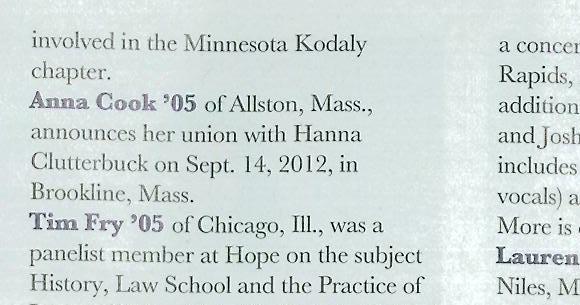
When Hanna and I sent out our wedding announcements in late September, I sent one to the Hope College alumni office; friends and family members were betting on whether or not the announcement would run in the alumni magazine’s list of news from graduates (births, deaths, marriages, advanced degrees, and so forth) that fill the back of each issue.

They had about even odds for and against running the notice at all.

But I got the latest issue of News From Hope College this weekend and there we were on page 27.

Of course, as there is a “Marriages” section of the News, the announcement would have more appropriately gone there since, you know, we got married.

But I imagine someone had to fight to put our “union” in the magazine at all, and I’m all for recognizing baby steps when they’re taken in the right direction.

So thank you, Hope College alumni office — you exceeded my fairly jaded expectations. You’re not going to single-handedly woo me back into the fold, but I do appreciate the acknowledgement that Hope alumni are here (and queer) right in the pages of the News from Hope.

placeholder post: hugh masekela’s "ooo, baby baby"

19 Thursday Jul 2012

Posted by Anna Clutterbuck-Cook in media

≈ Leave a comment

Tags

family, memories, michigan, outdoors, web audio, web video

This summer has brought back a lot of memories from the summer before my little sister was born (1987). The summer I learned to swim because we spent — at least in my child’s memory — virtually every day at the “big lake” (Lake Michigan) trying to stay cool by staying wet. The summer we had bonfires and roasted hot dogs and marshmallows on what seemed like a weekly basis, carrying coolers and beach towels up over the dunes in tatty tennis shoes to avoid burning the soles of our feet in the scorching hot sand.

My dad — who in another life must have been a DJ — was the one who provided the boom box and mix tapes (yes: tapes) for these long afternoons at the water’s edge, and this album is one that I will always associate with summertime, heat, sand, and the smell of food cooking on the grill.

Here’s one of my favorite songs from said album.

The latest heat wave broke last night and we’re supposed to have a more manageable weekend ahead of us — hopefully I’ll have enough brain cells left to complete all the half-finished book reviews I’ve got in my queue. Stay tuned!

What are your favorite songs of summer?

a few thoughts on my historically-specific perspective on getting married

08 Sunday Jul 2012

Posted by Anna Clutterbuck-Cook in life writing

≈ Leave a comment

Tags

boston, family, history, hope college, michigan, sexuality, wedding

Yesterday, I finished reading an advance review copy of Michael J. Klarman’s From the Closet to the Altar: Courts, Backlash, and the Struggle for Same-Sex Marriage (forthcoming from Oxford University Press, Oct. 2012; review to come). A legal historian, Klarman explores the history of litigation and legislation around gay and lesbian marriage from the 1970s to the present. Reading his historical account prompted me to think about the historical context in which I came of age and into my sexuality and sexual relationship, and how this colors how I think about same-sex marriage particularly, and even more specifically how my historical context shape the decisions Hanna and I have made. Here are my thoughts, in roughly reverse chronological order.

1) I’ll start with the fact that we can get legally married in the specific time (2012) and place (the Commonwealth of Massachusetts) in which we have come together. Massachusetts recognized in same-sex marriage as legal under the state constitution in 2004 (Goodridge v. Dept. of Public Health) and our ability to become, legally, wife and wife, on the state level is normal here. While DOMA still prevents us from being recognized as married nationwide, we will be treated as spouses at the state level. If I hadn’t moved to Massachusetts from Michigan, I would be unable to legally wed without traveling. And given that neither of us are involved in a religious community, we likely would not be planning a private (non-legally-binding) commitment ceremony.

2) I’ve experienced nothing but welcoming acceptance of my relationship with Hanna since we got together in the summer of 2009. The only direct bigotry I’ve encountered has been online; I’ve been comfortable being open about my relationship at work, in public, on both sides of the family, in my home town, blogging, etc. I actually dealt with more directly-homophobic statements and actions before I was visibly queer (see below) than I have in the past three years. This is in part a matter of geography, in part a matter of the circles in which I’ve been moving, and in part a macro-level cultural sea-change in which anti-gay animus is becoming less acceptable by leaps and bounds, at least in the public square.

3) Marriage equality was part of what brought me to Massachusetts. One of my first memories of driving into Boston in the summer of 2006 — when I interviewed at Simmons — was getting turned around and ending up in Harvard Square across from Zero Church Street, where they had a huge banner across the front of the First Parish Church proclaiming support for marriage equality. Even though I understood my sexuality to be primarily hetero at the time, I immediately felt a sense of expansiveness — the ability to be more at ease in the political climate here than I had felt back in Western Michigan where I was reminded daily that my views about human sexuality were at odds with the dominant culture.

lesbian recruitment party, summer 2005

4) I had long-term, same-sex relationships modeled for me. I had friends whose relatives were in same-sex relationships (some of whom had had commitment ceremonies, some who hadn’t). Through my undergrad women’s studies program (oh the irony) I was introduced to lesbians in committed partnerships and had a chance to think about what it would be like to build a life for myself with another woman. I am a person who experiences my sexuality in very contextual ways, and while I don’t discount the notion that having been born in a different time or place I might have fallen in love with a woman without such models, the fact that I knew that lasting, committed same-sex relationships were a possibility by example helped open me to an awareness, a receptivity, that it could be possible for me as well.

5) In my early twenties, I wrote letters to the local newspaper speaking out on topics like abortion and gay rights. I always got incredibly bigoted responses in print (though my friends and relations were supportive). I remember particularly writing in as “a young straight woman” in defense of the summer gathering for gay and lesbian families that happens annually in the little town of Saugatuck twelve miles south of where I grew up (in the “reddest” county in the state of Michigan). In my letter I thanked the newspaper for doing a favorable piece on the camp and preemptively addressed the haters by pointing out that same-sex parents gave me hope for the future. Again, I think it’s note-worthy that even in an incredibly conservative corner of the Midwest, I was participating as a presumptively straight person in normalizing queer families.

That is, I didn’t think “gay” and imagine that being a lesbian would mean custody battles and depression and suicidal impulses. I thought it meant family camp and lesbian communes and sprawling poly households, not unlike the life I was already starting to envision wanting for myself, even if I thought my primary partner would likely be a man.

5) My best friend came out in 2001. I’d say this moment was the start of my serious self-education on issues of human sexuality and the history of homosexuality and the modern gay rights movement. I was twenty and while he wasn’t the first queer person I knew personally, he was the first person I knew intimately and felt more for than a general political commitment in favor of equality. My sense of radical acceptance (borne out of innate stubbornness and feminist theology) and my life-long commitment to fairness had always drawn me toward LGBT rights — but suddenly it was personal. And I discovered my ability to be fiercely political.

7) Because of the college where I went to undergrad, issues of sexuality and gender were deeply intertwined, and both were morally-fraught religious concerns. This deserves its own post (or several), but suffice to say that my introduction to feminist politics as a college student came in the form of a raging controversy my first year at Hope over what and how the chapel program was teaching students about human sexuality generally and homosexuality specifically. My women’s studies faculty were committed Christians and vocal queer allies, and so my trial-by-fire education in organized protest was around these issues. I was able to think deeply about sexual morality, gender and sexual identity and expression, sexism, and homophobia in the midst of a group of LGBT-friendly Christian folk who helped me articulate passionate responses to the homophobia and hate we were experiencing in daily ways on campus.

In effect, I had a queer community around me long before I understood myself to be queer.

8) In the mid-90s, the AIDS quilt came to town. Its stop on national tour was organized, in part, by the gay deacon at my church. In appointing him to an ordained office, the church had broken with the denominational position (which remains in place today) that homosexuality is sinful. Twice during my adolescence, the church went through a contentious period of “dialogue” on the issue and members left the church in protest over the deacon’s ordination. While I don’t remember much about the AIDS epidemic, I do remember the viewing the quilt with my family and others from the church and city when the sections were on display at one of the area high schools. Rather than AIDS being interpreted to me as “the gay disease,” it was simply a deadly illness, like cancer, that killed people and left behind grieving partners, parents, siblings, children.

9) Our Bodies, Ourselves (and feminism!) contextualized being in lesbian relationships as one life path for women to pursue, both sexually and in relationship with one another. In my adolescent reading about the 70s feminist movement, I encountered primary source documents about lesbian activism, lesbianism as a political decision, and same-sex relationships. While I wasn’t politically active on these issues until college, these texts prepared the ground-work for understanding human sexuality more expansively, and lesbian relationships as a viable option, long before I was aware of resistance to homosexual identity and relationships in my community.

10) The earliest memory of I have concerning same-sex sexuality is at age eleven when two friends of mine, over for a sleepover, were giggling together over the word “gay” and I asked my mother what it meant when they refused to tell me. It was obvious from their behavior they thought the word was a naughty one (one girl was from a conservative Wesleyan household, the other a Mennonite). My mother’s factual explanation (along the lines of “someone who falls in love with a person of the same sex”) put gayness on the radar but confirmed that I need not be alarmed about it. Since there were lots of ways in which my family’s values differed from those of our friends and neighbors, I assumed this was just one more thing to add to the list!

I’m sure there are other ways in which my life has shaped how I think about lesbian relationships, lesbian identity, and the viability of marriage as an option for Hanna and I. For starters, the fact that we’ve both remained unmarried until we were over thirty, and don’t plan on having children are also deeply historically-contextual options/decisions. In the 1910s we might both have been college-educated library professionals in a “Boston marriage,” but it would not have been legible to the world at large as a marriage.

We often think of ourselves as historical actors, with the ability to defy social norms and break new ground. And we are. But they manner in which we defy society, and the norms which we are countering, are historically dependent. And self-aware historians, such as myself and my beloved, are no more exempt than anyone else.

(As usual this “few thoughts” post became much longer than I envisioned it!)

"how women’s studies mattered in my life": a panel discussion

15 Thursday Mar 2012

Posted by Anna Clutterbuck-Cook in think pieces

≈ Leave a comment

Tags

family, gender and sexuality, hope college, michigan, politics, professional gigs, work-life balance

On 6 March I participated in a panel presentation/discussion at my alma mater Hope College in celebration of twenty-plus years of women’s studies at the institution (the interdisciplinary minor was formally established in 1992; students had been forming “contract” majors and minors since the early 1980s).

I’m really hoping the college will make the panel discussion available via web video so I can share it with all of you, since the other panelists all had fascinating stories about their coming to feminism and its integration into their personal and professional lives. The questions from the audience were engaged and the panelists answers were diverse and thoughtful. I was honored to be a part of the evening.

At the beginning of the session, each panelist was asked to speak for about ten minutes on the topic “how women’s studies mattered in my life.” Here’s what I had to say.

Tonight, I’d like to share some thoughts about three aspects of my life as a feminist, and how feminism and women’s studies have affected my life. The first is how feminist ideas and politics have brought to my personal relationships, the second is how I incorporate feminist thought and practice in my intellectual and professional life, and third, some thoughts about how I’ve grown as a feminist since graduation.

I’m sure most of the people in this room have a story to tell about their coming to feminist ideas and a sense of how those ideas could help them make sense of their own lives and the world around them. In my family growing up, feminist understandings of gender equality and individual self-determination were more or less taken for granted, and I felt an affinity with feminist activists in history for as long as I can remember. My sense of contemporary, feminist political awareness — the realization that there is still feminist work to be done — came gradually as I struggled during my childhood and adolescence against prejudiced notions of what children and young people are capable of. As I grew from being understood primarily as a child to being understood as a young woman, rigid conceptions of sex, sexuality, and gender came to the fore — particularly in peer relationships and in church. I had support in my immediate family to push back against restrictive notions of gender and sexuality — but it was feminism as a philosophical framework and as a community of practice that gave me the support outside my family to articulate and honor my own experiences and desires.

Since my teens, feminism (conceptually) and feminist spaces (materially) have been a space for me to break open ‘common sense’ definitions of love, relationships, human sexuality, and community. Feminism has connected me to global, trans-historical network of people who work not to pass judgment on relationship diversity. We’re all imperfect at this, it’s true, but at least within feminist spaces there is usually a common ground to talk about how monogamy and non-monogamy, parenting and not-parenting, queer and straight relationships, long-term and more casual sexual relationships, can all be ethical, meaningful, and healthy.

Feminist spaces encouraged me to ask “does it have to be this way?” over and over and over again. Even when I didn’t think I had the right to identify as queer (more on that in a minute),  my ties to feminist and queer thinkers and activists became a way for me to explore the possibility of sexual intimacy and family formation in ways that didn’t make me feel claustrophobic or filled with rage. That instead filled me with hope and desire, with expansive generosity, with the sense that there was enough creativity in the world to ensure that everyone’s relational needs could be met — and exceeded.

Feminism encourages me to take ownership of my sexuality and learn how to take pleasure in my body in a culture that is hostile to our embodiment. Being a self-identified feminist is obviously not an instant cure for body insecurity, for fear of being the wrong size, the wrong shape, the wrong kind of beautiful. But in my experience, a feminist analysis of our culture’s narrow expectations of beauty, sexuality, and health give me an edge in asserting my right to be at home in my physical self. My knowledge and confidence about my body, and the pleasure I can experience as an embodied person, has been hard-won in a lot of ways. And wouldn’t have been as possible, or as rich a journey, without feminism in my life.

My feminism, at Hope College, wove back and forth across the boundaries of personal and academic life. On the one hand, feminist analysis was a way for me to understand the political upheaval around religion and sexuality I experienced here at Hope (in the late 90s). I was politically queer long before I was sexually active, in a same-sex relationship, or had to grapple with how to label myself in a world that demands sexual identification. By the time I entered into my first relationship — with a lover who happened to be a woman — I had a rich history of engagement with feminist and queer literature, political activism, and support networks to draw upon. That history made transition from thinking of myself as “mostly straight” to thinking of myself as someone who was in a lesbian relationship remarkably easy. And I owe the Women’s Studies program at Hope for at least some of that.

In an academic and professional sense, the exploration of gender and sexuality in historical context is at the heart of what I do as an historian. The Women’s Studies program here at Hope was my entre into thinking about women’s human rights as they are connected to broader socio-political struggles against racism, homophobia, economic inequality. Academic feminism is often criticized for being abstract, privileged, and out of touch with the urgent political engagement needed in “real” peoples lives. And I think that’s a critique worth listening to (if you haven’t already, check out the anthology Feminism For Real edited by Jessica Yee). But in my life, college classrooms became one of the places where I wrestled with notions of privilege and with the complicated histories of oppression. And in part because of that, my scholarship will never be entirely divorced from my political or personal selves.

It was through the Women’s Studies program that I became involved in my first full-scale oral history research project, published and presented original research, and began my research on the history of mid-twentieth-century countercultures — an interest I carried with me into graduate school an pursued for my Master’s thesis. While my work as a reference librarian isn’t explicitly related to feminism, gender and sexuality, or social justice issues, I went into library science because I see facilitating equitable access to information as a feminist activity. I get asked a lot whether my “dream job” would be to work at a library with collections more in my field of interest — but I actually prefer (perhaps because of my experience as a liberal growing up in West Michigan?) to work in spaces where feminist-oriented research remains, to some extent, counter-cultural, an exercise in reading against the grain of our collection strengths and thinking about how to come at things slant-wise. To find evidence of gender and the erotic in unexpected places. My years at Hope College taught me that radical ideas and non-normative experiences can be found virtually everywhere.

Political activism in the classic sense isn’t my day job — and that’s okay with me. Post college, the space for feminist thought, discussion, and networking that’s worked best for me has been the virtual world of Internet. Blogging provides me a way to interact with others over issues of gender, sexuality, and social justice in a way that help me avoid burn-out. If I’m having a shitty week, or I’m busy at work, or I can feel myself getting wound up over a really emotionally-fraught issue, I can walk away and engage in self-care — calm down, re-group, and re-engage. On my own blog, I write as much as I want about the issues I’m passionate about, and no one can dismiss me in conversation or bully me into silence by saying “oh, don’t take it so seriously!” or “you think too much.” I’m sure there are people out there who believe I do take things “too seriously” or think “too much.” But I don’t have to allow them to comment on my blog, and regardless of how loud they shout online, they don’t control my online space — I do.

Blogging has also put me in the way of opportunities to participate in feminist scholarship and activism — I’ve done author interviews, attended conferences, been a research participant for a number of studies on human sexuality — one on religion and use of sexually-explicit materials among women,  one on the personal experiences of queer individuals interacting with straight folks and mainstream culture. In 2009 I had the awesome experience of participating in the revision of the relationships chapter of the latest edition of Our Bodies, Ourselves.

Women’s Studies and feminism was a generally positive, inclusive space for me while I was at Hope. Since graduating, I’ve met a lot of folks for whom feminism and Women’s or Gender Studies programs were not welcoming. People who experienced feminist spaces as exclusionary because of their gender identity, their sexuality, their family lives, their concerns about race or class inequalities, their physical or mental health concerns … I’m sure some of you could add to this litany. My partner was told she couldn’t be a feminist because she liked the Terminator movies, and that she was a bad lesbian ‘cause her best friend was a guy.  I believe those people were wrong, but that doesn’t erase the fact that the language of feminism was used, in those instances, as the language of exclusion.

This doesn’t mean I’ve stopped identifying myself as a feminist. In fact, it’s made me more vocal about what I believe feminism is and can be. It’s made me more likely to speak up when I hear people using feminism as a tool to create and enforce us/them, insider/outsider hierarchies. At the same time, over the last ten years, I’ve had to come to terms with the fact that feminism, for some people, will never signify intellectual and emotional support for their being in the world the way it does for me. And that that’s okay. I believe feminism is — at its best — for everybody. But I also believe there are many pathways to a more loving, equitable world. As long as I see folks living out the values I name as “feminist” then I’m happy to count them as allies and co-conspirators.

Cross-posted at The Pursuit of Harpyness.

observations III

08 Thursday Mar 2012

Posted by Anna Clutterbuck-Cook in a sense of place

≈ 2 Comments

Tags

books, family, friends, michigan

1) Went to breakfast at Marie Catrib’s in Grand Rapids this morning with Hanna, my parents, and dear friend Joseph.  Their apple onion tart is to die for (seriously — I’m already hungry for seconds!) and Hanna and I discovered their Turkish coffee. *swoon*

2) At Argo’s used books and Redux Books in East Town, bought Neil Miller’s In Search of Gay America (1989) and Tim and Beverly LaHaye’s The Act of Marriage: The Beauty of Sexual Love (1976). I am taking great pleasure in stacking these one on top of each other. Hanna says she might disown me. I promise my review of the LaHaye will include the mid-70s author photo which totally rocks.

3) While Hanna got a kick-ass black & sparkle manicure (at half the Boston prices!) I read the Miller at lemonjello’s coffee shop and remembered how his Out of the Past: Gay and Lesbian History from 1869 to the Present (1995) was, along with Lillian Faderman’s Surpassing the Love of Men (1985), one of the first books on homosexuality per se I ever purchased or read. I bought them both at Powell’s in Portland (Ore.) on Thanksgiving break in 2001 while I was at the Oregon Extension. Because just that summer Joseph had confided in me he thought he might be gay. Looking back, I’m impressed one of my first impulses was to buy history books!

4) There are ways the logistics of life here feel so much simpler. I don’t mean that in a “rural life is idyllic” way, mostly because it’s not idyllic here — or rural. But in a “running errands doesn’t exhaust me here the way it does in Boston” way. Streets don’t feel crowded and hectic. Sure, the parking can be a bit frustrating, but mostly it’s free and available if you’re willing to walk a block or two. Downtown’s in walking distance. And things are restfully less expensive than in Boston. I know our jobs aren’t here, and some of our favorite book stores, libraries, and indie coffee shops … but I seriously wish there were portkey technology on the horizon, ’cause I feel like my energy level would be so much better if I could live here and work there. I’m just not psychically wired for city life.

5) Off to bake cheddar, beer and mustard pull-apart bread. Food, books, and friendship. At least I can say that our activities on vacation and in non-vacation life are mostly the same, excepting not having to get up for work. And less time spent at the computer, which is restful.

observations II

07 Wednesday Mar 2012

Posted by Anna Clutterbuck-Cook in a sense of place

≈ 1 Comment

Tags

family, feminism, hope college, michigan

1) Had a lovely evening on the Women’s Studies panel with fellow Hope College graduates Janet Swim (’83), Anne Lucas (’96), and Susan Kioko (’09). It was humbling to hear how other people have gone on to make use of their feminist coursework in fields as diverse as environmentalism, legal aid, and nursing. They filmed the discussion and I’m hoping it will be available online at some point. You’ll see it linked here if it is! I was impressed by the quality of questions from the audience, and the thoughtfulness of all the panelists’ answers.

2) While we’re on the subject … if you haven’t already signed Bridget McCarthy’s petition to the Board of Trustees regarding Hope’s institutional statement on human sexuality, stop on by Change.org and add your voice to the multitude!

3) In a post-presentation haze this morning, everything felt a bit flat — but biscuits, lemon curd and onion relish from The Biscuit restaurant helped! Also pledging to support Miriam’s Radical Doula Guide project at IndieGoGo.

4) Now time for a nap before going out to Grandma’s to watch Desk Set this evening.

observations I

06 Tuesday Mar 2012

Posted by Anna Clutterbuck-Cook in a sense of place

≈ Leave a comment

Tags

family, michigan, travel

1) In my mind’s eye, my home town is seen from the perspective of someone about three feet tall — even though I lived here for 27 years. So when I come back to visit now, the houses all seem wee and the distances so much shorter!

2) The talk I had yesterday on library science was attended about half and half by students interested in librarianship and former professors of mine who want to see what I’m up to. It’s a little fish-in-a-fishbowl feeling, but at least they all kept saying I looked happy and well! It’s humbling to have so many folks proud of me in one room.

3) It stays darker so much longer in the mornings here in Michigan than it does in Boston (damn curvature of the earth!) … I’m typing this at quarter to seven and there’s still only the barest hint of light in the sky.

4) No matter how long the visit, and how little you plan to do by way of social commitments, the time always feels too short and too crowded. Visiting like this is simply not an adequate substitute for living in proximity. I really wish someone would get on developing portkey or TARDIS technology.

5) lemonjello’s has invented a new latte with honey and vanilla which is awesome. And their honey bran muffins are still delicious.

More soon!

the feminist librarian is off to michigan!

01 Thursday Mar 2012

Posted by Anna Clutterbuck-Cook in library life

≈ Leave a comment

Tags

blogging, family, hope college, michigan, professional gigs, travel

So it’s that time of year again, and Hanna and I are off to Michigan for a week of vacation (for her) and vacation/work (for me). I’ve been invited to give a couple of presentations at my alma mater, Hope College, one on my life as a feminist and one about my life as a librarian. As my friend Molly pointed out on Twitter recently, I have a whole blog to pillage for subject matter!
lemonjellos (holland, mich.), May 2011
Seriously, though. If you’re a Hope College community member, I’ll be on campus Monday, 5 March, 4:00pm, in the Granberg Room, Van Wylen Library, to give a talk on my emerging career as a professional librarian. Then on Tuesday, 6 March, 7:00pm, I’ll be part of a panel of Women’s Studies Program graduates discussing how the program affected our lives and our work. The Tuesday event is part of a longer program celebrating the 20th anniversary of the Women’s Studies program at Hope.

that would be me on the left, circa 2005

This is my first real visit back on campus since graduating, and while I have a contentious relationship with the college as in institution, I’m looking forward to getting a sense of how current students and faculty are feeling about the direction of the college and the role of feminist thought and practice in that space.

I’ll be taking lots of notes and look forward to sharing my reflections and experiences with y’all upon my return. In the meantime, I anticipate posting will be light-ish while we’re on the road.

chai rose water cookies

19 Saturday Nov 2011

Posted by Anna Clutterbuck-Cook in our family

≈ Leave a comment

Tags

domesticity, food, michigan

Last May when Hanna and I were in Holland (Mich.) I ordered a drink at lemonjello’s that was a chai latte with a shot of rose flavoring. Heaven on earth. The problem is, rose flavoring is a rare offering at coffee shops and not the sort of thing that’s easy to find at grocery stores, even a number of our favorite specialty shops here in Boston. But this morning Hanna and I were in Harvard Square for coffee and window shopping + actual shopping and I found rose water at the fabulous Cardullo’s. So tonight we decided to make cookies using rose water, and found the following recipe on the Food Network website. We followed it with slight tweaks, so here is the altered version:

Ingredients

2 cups all-purpose flour
2 teaspoons ground ginger
2 teaspoons baking soda
3/4 teaspoon ground cardamom
3/4 teaspoon ground cinnamon
1/4 teaspoon freshly ground black pepper
1/2 teaspoon salt
1 cup packed dark brown sugar
1/2 cup (1 stick) unsalted butter, room temperature
1/4 cup canola oil
1 tablespoon rosewater

Instructions


Pre-heat oven to 350 degrees Fahrenheit

1) Combine flour and spices in a bowl and set aside.

2) Cream butter and oil and brown sugar, mix in rose water.

3) Add dry ingredients 1/2 cup at a time until fully incorporated. Cookie dough will be crumbly, like a dry pie crust dough.

4) Use hands to form walnut-sized balls of dough and place on a cookie sheet roughly 2 inches apart.

5) Bake for 15 minutes and use spatula to transfer cookies to wire rack for cooling.

Serve with warm milk and/or chai tea.

30 @ 30: urban living [#7]

31 Wednesday Aug 2011

Posted by Anna Clutterbuck-Cook in life writing

≈ 2 Comments

Tags

boston, maine, michigan, thirty at thirty, travel

Four years ago today, I hit the road in a rental car full of earthly possessions to drive from Holland (Mich.) to Boston (Mass.) and begin my life as a graduate student and city dweller. Starting next week, I’m tentatively planning a whole series of posts using emails and photographs from the fall of 2007, to reflect back on that transition and what that first semester at Simmons (and my first few months in Boston) were like.

In this installment of 30@30, though, I want to talk about being a city dweller more generally, and my experience of visiting and living in cities as a young person and as an adult. I want to reflect on my perceptions of urban environments and the pros and cons of living in cities versus smaller towns versus more rural spaces (all three of which I’ve experienced, to a greater or lesser extent). Becoming an urbanite has been a struggle for me, and there’s a part of me that will never quite feel at home in the city — possibly the part of me that did feel at home, during my teens, in the wilderness of Michigan’s upper peninsula or in the foothills of the Southern Oregon Cascades. (My adolescent dream of becoming a backwoods guide will be featured in an upcoming 30@30 post on camping.) At the same time, I was born and grew up in a city of not immoderate size: around 35K in the city limits, according to the 2000 census, with roughly twice that number in the surrounding metro area. I lived two blocks from the library, less than a mile from the college where my father worked, and about the same distance from the downtown that — by the time I was a teenager and these things were relevant — boasted half a dozen places for decent coffee and two well-stocked bookstores. All the necessary amenities of life.

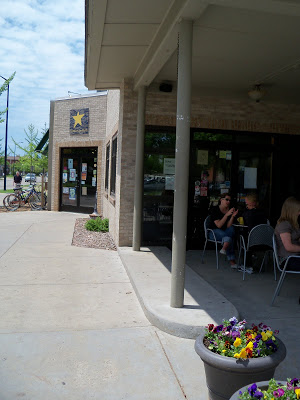
lemonjello’s coffee shop (Holland, Mich.)
photograph by Hanna

Still, there were ways in which Holland was distinctly different from a major metropolitan area like Chicago or Boston. There was really no public transit system to speak of, meaning you pretty much needed a car to get around in a serious way — sure, I had a bike and everything, but stuff like grocery shopping for a family of five can’t really be done on a bicycle or on foot. Most of the neighborhoods I knew as a child consisted of single-family homes, duplexes, and — closer to the college — student dorms. Apartments and condos existed, but not on the scale of a place like Boston.

My hands-down favorite thing about Chicago, the first few times I visited as a child, were the escalators at the hotel and the subway. Yes, I was easy to please.

As regular readers of this blog have probably gathered (if they didn’t already know) I mostly lived in Holland until 2007, and the elsewhere places I lived were mostly more rural, not less: Lincoln, Oregon; Hawk Hill, Missouri; Crawfordsville, Indiana. Cities were places I visited for a day or two (Chicago, Seattle) or a week (San Francisco) or at most, a month (Victoria, B.C.). I associated cities with vacations and travel, with the chance to try out new cuisines, shop used bookstores, visit museums, attend the theatre. Chicago, the city we most frequently visited when I was young, was the land of the Field Museum, the Chicago Theatre, the elaborate Christmas windows along Michigan Avenue, and the fresh roasted candied almonds from street vendors. It was a magical place, one that offered a departure from normal routine.

My first foray into city life was during my year abroad in Aberdeen, Scotland (2003-2004). Aberdeen is only the twenty-fifth most populous city in the UK, coming in between Salford (near Manchester) and Dudley (in the Midlands). In 2008 it reported a population of just over 210K. True, I was living in student housing during that time, and not working since I was studying full-time and had no work visa. So life in Aberdeen was quite different from navigating urban living as a renter and young professional. But there were experiences I had there, and skills I learned, that are not entirely un-applicable to life in Boston. I learned, for example, that even in cities green spaces can be found — though sometimes it takes diligence and a willingness to use multiple forms of public transportation. I learned how different (and often faster!) navigating a city by foot can be from navigating by car or bus. I learned that, even as a student, it pays to be connected to city life outside the university — whether it’s by attending concerts and plays, becoming a subscriber at the local public library, or spending time at coffee shops not exclusively frequented by students. I learned how to read a bus timetable and how to pay for a cab. I learned to be sensible but also not to live in fear of the city streets at night simply because I was alone and female.

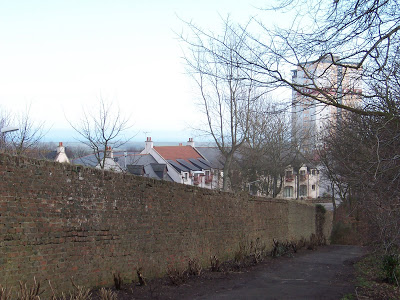
Seaton Park, Old Aberdeen (March 2004)
The North Sea is on the horizon.

One of the hardest lessons I learned was that some cities are just too large to know completely. There were parts of Aberdeen I simply never went to during my ten months there. There are parts of Boston I have never yet visited in the four years I’ve been here. It’s unsettling. I don’t like it. It makes me feel a bit blind — like those dreams where your vision refuses to come into focus.

I came back to the States from my year abroad certain I didn’t want to live in a city the rest of my life. Yet the rub is, of course, that most schools big enough to host graduate programs, most cities large enough to host a healthy number of libraries, most areas with a high probability of meeting someone youngish and also single who shares your interests — most of these things require a fairly dense population. So I ended up in Boston.

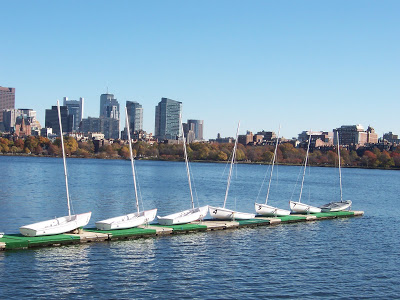
Boston skyline (November 2007)

These days I’ve made my peace with the city (see 2008, 2009, and 2010), though I can honestly say I’m not thrilled with the prospect of living here the rest of my life. Check back again in another four years and that answer might have changed.  There are days when I would rather be anywhere but here, days when I feel so claustrophobic I don’t think I’ll be able to stand it, days when I hate with a white-hot passion the freakin’ logistics of city life. There are also days when I realize how much I’ve made certain parts of Boston “home” — and that if it ever came to the point where Hanna and I were seriously considering a relocation, I would develop a hard-core case of pre-emptive nostalgia for the places we would be leaving behind.

A few weeks ago, when the T was delayed and then Red Sox fans and commuters were so packed into the subway cars that I waited over an hour for a train before just giving up and walking home in the rain, I was feeling pissy enough to come up with what I now think of as my “urban angst” list: the top five reasons why I hate city life. I’ll share them with you in a moment. The thing is, that when I had calmed down and considered the list I realized that my top five reasons why I enjoy living in Boston are actually the flip-side of the top five rather-be-anywhere-but-here items. I’m not sure what to make of that, other than simply to observe that like so many things in life, it only gets more complicated the more you think about it.


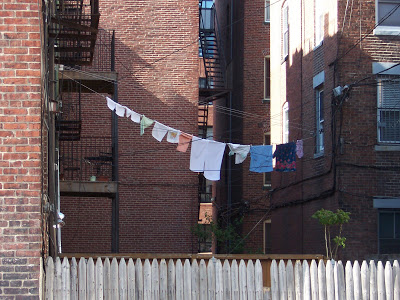
Laundry drying in the North End, Boston (May 2009)

 My urban angst list is as follows:

  • The Commute. Before Boston, I never lived more than, say, a twenty minute drive at most from where I worked or went to school. Usually it was closer to a five-minute drive, and a walk of a mile or two. These days, I live about two miles from work but the commute from door to door takes anywhere from twenty minutes (on a good day, when we walk straight onto a train) to an hour plus. I resent that I don’t have the option of skipping this part of my day. And it can make me feel trapped when the only way to get out of town is to take the train (or multiple trains) to get anywhere rural or green. Or to rent a car, which is then another additional expense.
  • Errands. Errands have never been more complicated. We have a plethora of options when it comes to buying groceries and other necessities and yes, most of them are thankfully on the walk from work to home or in the vicinity. But there’s this thing you don’t think about when you’re used to running errands in a car, and that’s how much shit you can reasonably juggle with two hands and a shoulder bag. There are weeks when I feel like my life outside of work is almost entirely dictated by the errands we need to run and the logistics of getting there and back. Rachel @ Women’s Health News has written a brilliant post on this subject recently, reflecting on the difficulty of buying groceries without a car.
  • Weather. Before moving to Boston, I had never really thought about how much more the weather matters in a big city. This might seem counter-intuitive, but when you don’t have a car and you’re either walking or taking public transit to get around you need to dress for the weather with much more care than I ever needed to back in Michigan. And you need to go out prepared for the weather to change by the end of the day, because there’s no option for running home at lunch to grab an extra sweater or your umbrella. The heat is also more intense here, and when you walk two miles to work on a humid summer day that means taking an extra change of clothes and some heavy-duty deodorant with you.
  • Apartment Living. Cities are expensive, and while Hanna and I have decent landlords, relatively quiet neighbors right now (knock on wood), and a lovely tree-shaded living room, our apartment is tiny compared to what I’m used to. Tiny and expensive. I’ll just come right out and say we pay $1250/month for our one-bedroom place, which is about par for the course in the area where we live. Hanna wishes we could have chickens, or at least room for compost. I wish we had a kitchen that more than one person could work in comfortably. And it would be nice to have storage space for things like suitcases and maybe a bike. The smallness of the space also makes entertaining more than one friend at a time difficult, which means get-togethers usually require meeting in some third space — something that inevitably costs more than hosting folks at home. I miss the days when I could have friends over to cook a meal, eat dinner at an actual table, and watch Masterpiece Theater in a room that had chairs for everyone.
  • The Illusion of Cultural Smorgasbord. Cities are full of amazing things to see and do: museums, lectures, theatre, concerts, author talks, walking tours, festivals, food and wine tasting, film series, the list could go on and on. There are specialty food shops to die for, and restaurants for every taste and occasion. The thing is, arts and culture stuff is (once again) expensive. And not only expensive, but often happens at times and/or in places that make it prohibitive to get to. Maybe there’s a lecture on women’s history that starts at 5:15pm which is technically after I get out of work, but it’s across town and there’s no way I’ll reach it unless I take a taxi for $40.00 which I simply don’t have. Those sorts of calculations. We’re no longer students, which means we aren’t eligible for any standard discounts for things like theatre or concerts, most of which are priced right out of our range. As someone who works at a non-profit cultural institution myself, I don’t necessarily think these things are overpriced — but the reality is that the cost of most of them is beyond what we can afford. So there are great things to do and see in Boston, but as people who are busy living here, there’s only so much we get to take advantage of.

My flip-side list:

  • My Job. If there’s a reason I want to stay in Boston, right now, beyond the fact that Hanna is happy here, it’s that I love my job. And a place like the MHS can really only thrive in a densely-populated urban environment, with a steady flow of graduate students and faculty, and moneyed families willing to support cultural institutions at a level of giving that most of us simply cannot afford (see “The Illusion of Cultural Smorgasbord”). As a librarian who wants to work in an independent research library or archive (i.e. not a public library and not an academic library) I only have so many options, and most of them are in urban areas — the Newberry Library in Chicago, for example, or one of the handful of LGBT archives like the Herstory Archive in New York City.
  • Public Transit. As much as depending on public transit can feel limiting (see “Commute”), I’m really glad to live in a city that offers a decent amount of service, and to live in an area where I can access it easily — both buses and subways — to get to the places I most need to go. I would not want to own or secure a car in Boston, and I’m glad Hanna and I don’t have to worry about things like car payments, insurance, and upkeep on one or two vehicles. It’s also great to live in an area that supports programs like Zipcar (car sharing) and Hubway (bicycle sharing).
  • Walking the City. The logistics of errands drive me crazy, but I do love the fact that we live in a city where walking is a feasible, even pleasant, option for many of our travels. And as much as I miss the five-minute drive to work in the morning, I enjoy being able to get in my daily exercise along with my commute, rather than having to get up at 5am to go jogging before I make my way to the train or get into the car.
  • Food Choices. If we ever more to a less urban area, I’m going to miss the plethora of options we currently have for grocery shopping and dining out. As expensive as it can sometimes be, it’s also wonderful to be able to look at pretty much any recipe and know that somewhere in Boston there’s a store that will offer the ingredients you need to make it. Part of getting to know — and feeling at home in — the city is knowing where you, personally, like to go for your favorite olives (J. Pace & Sons) or the best vanilla beans (Polcari’s). Which bakeries offer the second-day bags of bagels at $2/bag (Kupel’s), which coffee shop offers your favorite French Roast (Boston Common Coffee Co.), and the place to get baked raisin donuts on Saturday mornings (Clear Flour Bakery).
  • $1 Carts. So a lot of things are more expensive in the city — from apartments to your morning latte — but some are cheaper. Mainly I’m thinking of used books, and the fact that Boston has a strong enough used book market to support a dangerous number of used book stores many of which feature substantial $1 sections with rapid turn-over and a fairly good selection. Sure you have to be willing to browse often and buy on impulse, but who doesn’t want to do that where books are concerned!

With that, I think I’ve taken up more than enough of your time this week. I don’t have anything cogent to say about being an urbanite. It’s still a work in progress. We’ll see where the next five, ten, fifteen years takes us.

← Older posts
Newer posts →
"the past is a wild party; check your preconceptions at the door." ~ Emma Donoghue

Recent Posts

  • medical update 11.11.22
  • medical update 6.4.22
  • medical update 1.16.2022
  • medical update 10.13.2021
  • medical update 8.17.2021

Archives

Categories

Creative Commons License

This work by Anna J. Clutterbuck-Cook is licensed under a Creative Commons Attribution 3.0 Unported License

Meta

  • Create account
  • Log in
  • Entries feed
  • Comments feed
  • WordPress.com

Blog at WordPress.com.

  • Subscribe Subscribed
    • the feminist librarian
    • Join 37 other subscribers
    • Already have a WordPress.com account? Log in now.
    • the feminist librarian
    • Subscribe Subscribed
    • Sign up
    • Log in
    • Report this content
    • View site in Reader
    • Manage subscriptions
    • Collapse this bar