• anna j. clutterbuck-cook
  • contact
  • curriculum vitae
  • find me elsewhere
  • marilyn ross memorial book prize

the feminist librarian

the feminist librarian

Tag Archives: politics

wtf; or, anatomy of a blog comment thread

10 Tuesday Aug 2010

Posted by Anna Clutterbuck-Cook in think pieces

≈ 3 Comments

Tags

blogging, gender and sexuality, politics

I’ve been stewing about this comment thread over at emily nagoski :: sex nerd for about a week now, and in an effort to learn something from the process have decided to share my observations with y’all and ask for any tips you might have!

See, I generally enjoy being active in comment threads on topics that excite me. And I also try to cultivate openness to differing viewpoints and a willingness to engage in conversation with people whose beliefs are different (even diametrically opposite from!) my own. To me, conversation with people whose ideas I disagree with (and sometimes even abhor) is a way to cultivate compassion, empathy and lovingkindness. I also find it to be an interesting opportunity to people watch, and gather information on how folks interact, and particularly how they disagree, online. Hanna encourages me to save my energy for more important things than blog thread comment wars, and there are days when I completely agree with her. But I also feel like I do learn from them — even when I’m not sure what, exactly I learn. So I keep coming back to re-engage.

In this particular case, the post in question was on differential desire vis a vis sexual activity in a long-term relationship (an opposite-sex marriage). The husband had written in to a discussion forum asking for advice on how to re-open communication with his wife over relational sex — something they appear to have dramatically different levels of interest in. Emily, the blog author, pitched her response to the question of how the couple could work together to establish better channels of communication and discover where their common ground was in terms of making love. The post is a good one, and I recommend you hop on over if you want the full context of the conversation that followed.

See, the first comment out of the gate was by a man identifying himself as marriagecoach1 / John Wilder (warning: scary man profile!), in which he made the claim that “studies show that 60% of married women with children have their husbands on a starvation diet of sex once a week or less.” Which is, of course, levels of wrong. As Emily pointed out in her response, gently suggesting that “people vary too much to use national statistics to illuminate an individual case.” Girl Detective pointed out that “starvation diet” was a pretty loaded phrase. It implies a power differential in which the wife has power over the husband (the ability to put him on a diet) and also implies that sex “once a week or less” is a negative thing for all men, which — since human beings’ desire for relational sex varies widely by person and context — is a fairly irresponsible assumption to make.

If the desired end result is more pleasurable, relational sex with his wife (what the husband with the original question seemed to desire), then surely the best avenue toward that goal is making the environment as conducive to more sex as possible. Approaching the lower-desire partner with an accusation that they’re controlling their higher-desire partner with a “starvation diet” of sex: maybe not the best opening salvo. Just sayin’.

So, okay: combative commenter, a handful of measured responses. So far so good. Then Mr. Wilder returns further downthread to re-assert his position that “withholding” sex is a power grab.

You are violating marriage vows (well not if you are not married) but for marrieds, you vowed to satisfy the needs of your partner and it is considered unfaithful to those vows when you refuse.

Men get the bulk of their affectional needs met through sex with his wife. If she decides that she does not want to do that then she ought to file for divorce.

The old cliche about: “Behind every great man is a woman” implies that she keeps him centered and content by taking care of his sexual needs.

Ooooh boy. Issues just multiplied. So not only is this man approaching the question of differential desire by framing it as a question of gender (as becomes clear further downthread, he sees this as primarily a question of lower-desire women holding out on higher-desire men), he’s also framing the question as an issue of violating a clause (the “sex clause” if you will) of the heterosexual marriage contract.

This is the point at which I jumped into the frey and posed the question I saw as central to the problem with this kind of advice-giving comment. “How exactly is characterizing the wife as a manipulative bitch who’s using sex as a weapon going to help this couple?” To which he responded

Women bash men because they are not forthcoming with their feelings and yet you acknowledge that this man is really trying for which he should be commended. The wife is refusing to talk to him about it … It is frustrating to hear you women backing up the woman’s right to refuse the man like his wants and needs and desires have no concern. It is emotionally debilitating.

Since communication was Emily’s key theme in the original post … and all of the other commenters were backing her up on this point … we’re clearly having a reading comprehension issue. I also detect strong, strong whiffs of frustrated male privilege here: Mr. Wilder is pissed because he thinks he’s giving in to the “women [who] bash men” (code for “feminist”) by “really trying” to communicate, and instead of getting bountiful sex in return he’s still being told that no person is obligated to meet another person’s sexual needs.

He says “the woman’s right” but all of us were clear on this being a gender-neutral proposition. I pointed this out (“I don’t think partners of any sexual orientation, sex or gender are well served when the conversation about relational sexuality revolves around what is owed/deserved and how withholding the expected amount/type of sex is a ‘violation of marriage vows.'”) which is when the shit really hit the fan

I agree that is not necessarily men against women or women against men but a violation of the covenant of marriage. Sex is an integral part of marriage and yes it is an obligation that you incur when you take marriage vows, I don’t apoogize for that. It might not be politically correct, but I don’t hold with very many politically correct notions. To me, it is a pass on someone’s disloyal behavior.

. . . For the record, I have never had a man demand his right to refuse sex to their women, that is singularly a woman’s notion.

So in a way, it is women against men. I am not dealing with homosexual sex as that is not my area and what they do is up to them.

Religiously-grounded sexism and homophobia for the win!

*headdesk*

How to respond to this sort of comment, gentle readers? Of course (as Hanna so often reminds me!) option one is always simply not to engage. This guy has clearly made the decision to show up on a feminist-friendly, queer-friendly, sex-positive blog and promote ideas about heterosexual marriage with an authoritative air of moral righteousness. He persists on seeing the issue as a power struggle between women and men in which men (as supposedly higher-libido beings) are at the mercy of women. The posturing over not being “politically correct” signals to me that he realizes the other commenters on this blog won’t agree with him, and rather than simply persuasively advocating for his position he hides behind the pre-emptive accusation that anyone who dislikes what he has to say is being “politically correct” (a phrase that invokes, in the popular consciousness, all manner of negative imagery concerning the “thought police” and liberals elites who have the power to force people to self-censor their ideas and expressions for fear of social opprobrium).

He goes on to write

The only ones I hear demanding the right to deny their partners are feminists and so yes, I have a real problem with feminists. I believe in equality but by demanding your right to say no, you are not advocating equality but absolute dominance which makes feminists who espouse such notions rank hyypocrites.

Again: the basic argument this guy has is what I’ll call the Lysistrata gambit, the theory that differential desire in long-term sexual relationships is not a gender-neutral phenomenon with myriad causes and possible solutions, but rather that it is a systematic plot by women to gain power over men by withholding sex. Yeah, sure, once I bring it up he tosses a few sops to the queer community and admits that women may be the hornier member of a hetero couple occasionally (who still couldn’t win Mr. Wilder’s respect since they “complained louder and longer than most men”). But the through-line is clear: women have all the power and men are at their mercy — especially married men whose wives are using a bait-and-switch tactic of luring them into marriage and then changing the rules by deciding they’re no longer interested in relational sex.

In Mr. Wilder’s universe, there is no room for human beings to change, grow, or experience ups and downs in their sexual desires as in all other aspects of their lives. “Many people start out equally with sex but often the woman changes the deal after the fact. That is disnegnious.” To Mr. Wilder, this is sort of like reverse-rape.

For feminists to demand their right to deny it is as offensive to me as me suggesting that a man force a woman to have sex against her will. After all are you not forcing a man not to have sex against his will?

Because “forcing” someone not to touch you or not experience your touch is just the same as violating someone else’s bodily integrity by sexually assaulting them.

Yeah.

*headdesk*

What I finally wrote in response was this

Look, John. Here’s the thing.

You keep writing things like “you still have the obligation” like it’s a universal truth but you’re grounding it in Biblical scripture which is something not everyone in the world chooses as an authoritative text (and which not everyone interprets as you do).

If you don’t want to be in a partnership with someone who believes that partners retain the right, even within marriage, to negotiate sexual intimacy — how, when, with whom, how often, etc. — then awesome! Make that clear to your prospective partners and have that be a deal-breaker. And if your partner decides that’s not the kind of relationship they want, then you have the option of either rethinking your own position (perhaps reaching a compromise between the two of you) or walking away.

NO ONE IS FORCING YOU to be in relationship with people who don’t share your views on human sexuality, marriage, etc. What I object to is your instructional, combative tone and the way in which you are clearly laying out one set of (Biblically-based) rules for everyone.

You can read the full exchange over at ::sex nerd::.

Here’s the thing, o readers … I feel obscurely as if I’ve failed. And I know it’s not my responsibility (nor is it possible) to get this one, clearly rigidly-opinionated person in the blogosphere to suddenly go “aha! I get it! sexual relationships are complicated and there is no one-size-fits-all solution!” just because of some comment I’ve thrown into the mix.

But I find this sort of exchange extremely frustrating because I feel like I offer up these big fluffy eiderdown pillows of inclusion — no one’s saying you can’t live your life your own way! just acknowledge the glorious diversity in the world! — and this other person (Mr. Wilder is but one example of so many!) keeps coming back with what is essentially the same argument: “I will only feel good about life and safe in the world if everyone else conforms to my expectations for correct human behavior!”

Sometimes I just want to be like “grow up already!!”

Not to mention how sad it makes me that people who think this way must not find pleasure in discovering new ways of seeing the world like I do. So much of what I love about my research and about my blogging is the chance I have to experience what the world looks like from new perspectives. To greet those new perspectives not with a feeling of joy at the boundless possibilities of human existence but rather with the intense desire to change all people into replica-yous must be so limiting a life!

Anyway, this is all a very long-winded request for your own stories and tips for engaging in online conversation with people who hold rigid, conservative views. Is it even worth it? If it is, what strategies do you recommend? How do you pick your battles? When do you bow out? What mistakes have you learned from? I’d love to hear from you in comments!

quotes of the day: "the witness stand is a lonely place to lie"

09 Monday Aug 2010

Posted by Anna Clutterbuck-Cook in think pieces

≈ 2 Comments

Tags

gender and sexuality, human rights, politics

via Pam’s House Blend.

Chris Wallace [Fox News]: Where is the right to, you talk about the right to marriage, where is the right to same-sex marriage in the Constitution?

Ted Olsen: Where is the right to interracial marriage in the Constitution, Chris? The Supreme Court has said that marriage, the right to marry a person of your choice is a part of liberty, privacy, association, and spirituality guaranteed to each individual under the Constitution. When you say same-sex marriage, you’re saying a particular type of marriage, which the Supreme Court has looked at marriage and has said that the right to marriage is a fundamental right for all citizens, so you call it interracial marriage and then you can prohibit it? No, the Supreme Court said no. The same thing here. The judge, after hearing three weeks of testimony and a full day of closing arguments and listening to experts from all over the world, concluded that the denial of the right to marry to these individuals in California hurt them and did not advance the cause of opposite-sex marriage. This is what judges are expected to do. It is not judicial activism, it is judicial responsibility in its classic sense.

And

David Boies: Right. Well, it’s easy to sit around and debate and throw around opinions appear– appeal to people’s fear and prejudice, cite studies that either don’t exist or don’t say what you say they do. In a court of law you’ve got to come in and you’ve got to support those opinions. You’ve got to stand up under oath and cross-examination. And what we saw at trial is that it’s very easy for the people who want to deprive gay and lesbian citizens the right to vote, to make all sorts of statements and campaign literature or in debates where they can’t be crossexamined. But when they come into court and they have to support those opinions and they have to defend those opinions under oath and cross-examination, those opinions just melt away. And that’s what happened here. There simply wasn’t any evidence. There weren’t any of those studies. There weren’t any empirical studies. That’s just made up. That’s junk science. And it’s easy to say that on television. But the witness stand is a lonely place to lie. And when you come into court, you can’t do that. And that’s what we proved. We put fear and prejudice on trial, and fear and prejudice lost.

Happy Monday!

"the scandal of our own non-necessity"

08 Thursday Jul 2010

Posted by Anna Clutterbuck-Cook in book reviews

≈ Leave a comment

Tags

politics, religion

On Tuesday, I posted a quote from Terry Eagleton’s On Evil. To risk appearing completely enthralled by Eagleton’s prose (which I admit are difficult not to delight in), today I’m sharing a passage from Holy Terror (Oxford: Oxford U.P., 2005), which Hanna recently finished and handed off to me.

I’ve talked briefly in a couple of recent posts about the meditation practice of metta, or “lovingkindness,” the Buddhist practice of extending intentions for well-being, peace, and and end to suffering toward all beings in the world. Even beings we do not like very much (or at all). Even ourselves. A friend of mine recently suggested this is similar to the Christian practice of “radical welcome” or “radical acceptence.” Both distinguish loving beings qua beings, so to speak, from loving individual beings in a more particular sense. I believe both types of caring — the more impersonal, unconditional love extended to all, and the particular liking of certain persons — are important. But I also believe that liking people, in a genuine way, really only takes root within the more disinterested, impartial sea of radical acceptence, or radical love.

Last week, I came across a passage in Holy Terror that speaks to the power of radical love. (Eagleton speaks from his background as a Catholic Christian, though I don’t believe the ideas need to be limited to Christian theology.)

Dionysus [in Euripides’ play The Baccae] offers men and women precious time off from their burdensome existence under the political law. We have seen already that such carnivalisque interludes are in the interests of the governing powers rather than an affort to them. As Olivia observes in Twelfth Night, there is no slander in an allowed Fool, no harm in jesters so long as they are licensed. When transgression is ordained, deviancy becomes the norm and the demonic finds itself redundant. This is why the devil finds himself with empty hands in the postmodern world. If Jesus’s law is light, however, it is not only because he, too, comes to relieve the labouring poor of their afflictions, but because God commands nothing more of his people than that they should allow him to love them.* Because he is the Other who neither lacks nor desires, unlike the Lacanian variety, he needs nothing from others, and his law is consequently free of neurotic compulsion and paranoid possessiveness. Ironically, it is God’s transcendence — the fact that he [sic] is complete in himself, has no need of the world, and created it out of love rather than need — that allows him to go so easy on his creatures.

God himself has the necessity of law, in that his being is not contingent. But this law, once again, is the law of love — for since nothing apart from God needs to exist, whatever does exist does so gratuitously, as a result of his unmotivated generousity. To say that things were created out of nothing means that they did not have to come about. The did not follow inexorably from some precedent, as elements of a causal or logical chain. Creation, in Alain Badiou’s terms, is an “event,” not a dreary necessity. The cosmos could quite easily never have happened. Instead, God could have devoted his considerable talents to, say, figuring out how to create square circles …

… Since religious fundamentalism is among other things an inability to accept contingency, the universe itself is a persuasive argument against such a creed. What fundamentalism finds hard to stomach is that nothing whatsoever needs to exist, least of all ourselves. For St Augustine, the fact that human beings are “created” means their being is shot through with non-being. Like modernist works of art, we are riddled from end to end with the scandal of our own non-necessity (p. 32-33).

*All bold passages are my emphasis, rather than Eagleton’s.

I am bewitched by Eagleton’s final passage here: “we are riddled from end to end with the scandal of our own non-necessity.” Why? Because our impracticality is the foundation upon which unconditional love is built: we do not have to be useful to be loved, we simply have to be. And this, indeed, is a radical claim.

A fuller meditation on both On Evil and Holy Terror will (knock on wood) be in a forthcoming booknote.

"autobiography is an exercise in self-forgiveness"; should it always be so?

07 Wednesday Jul 2010

Posted by Anna Clutterbuck-Cook in think pieces

≈ Leave a comment

Tags

books, politics, religion

One of our post-graduation presents for Hanna, one which I also get to enjoy the benefits of, was a subscription to the London Review of Books. The most recent issue includes a review of Christopher Hitchin’s latest book, Hitch 22, a memoir. Hitchins, like other public personalities who trade in sensationalism and putting other people down, is easy to dislike for his self-absorption and snobbery. When the memoir first came out, John Crace @ The Guardian crafted a “digested read” version that played on this propensity and had Hanna and I falling off our chairs with mirth.

I find I have written nothing of my wives, save that they are fortunate to have been married to me, and nothing of my emotional life. That is because I don’t have one. The only feeling I have is of being right, and that has been with me all my life. I would also like to point out that drinking half a bottle of scotch and a bottle of wine a day does not make me an alcoholic. I drink to make other people seem less tedious; something you might consider when reading this.

David Runciman, whose review of Hitch 22 has been made available at the LRB website, offers much the same analysis — though in much more analytical a tone. He observes that Hitchins appears to have cultivated the personality of a “political romantic, as described by early-twentieth-century author Carl Schmitt.

For Schmitt, political romantics are driven not by the quest for pseudo-religious certainty, but by the search for excitement, for the romance of what he calls “the occasion”. They want something, anything, to happen, so that they can feel themselves to be at the heart of things.

The problem with this, morally speaking, is that a romantic whose raison d’etre is not his ideals but “the occasion,” the question of values is irrelavent. Say what you will about the political idealist (and, living with an historian of Northern Irish nationalism I know there’s plenty to say!), at least someone who acts violently for the sake of their convictions is a person who is clear about where they stand. They are willing to claim allegiance to a set of values, and to work (at times to the death) to see those values put into action.

Now there are (to a person of my proclivities towards nonviolent political change) better and worse ways of trying to live out one’s beliefs. But I also believe there is some intrinsic value in having beliefs: in having enough self-awareness that you feel comfortable owning your beliefs, saying “this is where I stand and why.”

You might think that a person who has written, among others, a book titled Why God is Not Great is not shy about taking a personal stand, even a highly controversial one. But being provocative, rhetorically and otherwise, is not necessarily the same thing as being self-revelatory. One can speak highly-charged words while never allowing anyone to see the emotionally-complex human being behind those words. I find other peoples’ interior lives fascinating; my obsession with understanding how other people understand the world around them — how they make meaning of their lives — is what led me to history as a scholarly pursuit. Runciman’s argument about Hitchins, however, is that he has no interior life, or at least not one of which he himself is very aware or willing to share with his readers.

It certainly sounds like it has all been a lot of fun. His has been an enviable life: not just all the drink and the sex and the travel and the comradeship and the minor fame (surely the preferable kind), but also the endless round of excitements and controversies, the feuding and falling-out and grudge-bearing and score-settling, the chat-show put-downs, the dinner party walk-outs, the stand-up rows. Christopher Hitchens has clearly had a great time being Christopher Hitchens. But – and I don’t want to sound too po-faced about this – should anyone’s life be quite so much fun, especially when it is meant to be a kind of political life? Hitchens admits to some regrets, including that he has not been a better father to his children (and by implication a better husband to his wives, though he doesn’t actually say that), but he doesn’t seem to have agonised about it much. In fact, he doesn’t seem to have agonised much about anything. He doesn’t rationalise his political shifts so much as acquiesce in them: if it feels like he has no choice, then he has no choice but to follow his feelings. He has seen his fair share of misery and despair, and may have caused a certain amount of it himself, but it is entirely unclear what this has cost him.

I believe in extending compassion and possibly forgiveness towards oneself in equal measure as toward other human beings — being kind to yourself as you are kind to others is, truly, one of the ways in which we can make the world a more kind, generous, compassionate place. Yet when “autobiography is an exercise in self-forgiveness” (to borrow a phrase Runciman quotes toward the end of his essay) while the autobiographer neglects to extend all but highly conditional forgiveness to anyone else, such self-adoration seems a shallow, fragile thing indeed.

Go enjoy the rest of Runciman’s review, It’s Been a Lot of Fun, over at the London Review.

terry eagleton on the secret lives of children

06 Tuesday Jul 2010

Posted by Anna Clutterbuck-Cook in book reviews

≈ Leave a comment

Tags

children, politics, religion

I recently picked up Terry Eagleton’s book On Evil (New Haven: Yale U.P., 2010). I might at some point write a fuller “booknote” about the volume, and a related Eagleton book, Holy Terror (2005), which I am also reading. However, in light of some of my recent posts on children as people, I thought some of my readers might enjoy the following passage from the first chapter of On Evil.

We are ready to believe all kinds of sinister things about children, since they seem like a half-alien race in our midst. Since they do not work, it is not clear what they are for. They do not have sex, although perhaps they are keeping quiet about this too. They have the uncanniness of things which resemble us in some ways but not in others. It is not hard to fantasize that they are collectively conspiring against us, in the manner of John Wyndham’s fable The Midwich Cuckoos. Because children are not fully part of the social game, they can be seen as innocent; but for just the same reason they can be regarded as the spawn of Satan (2).

Setting aside the question of whether or not what he’s describing vis a vis actual children holds true — and whether, if it does hold true, to what extent such a situation is culturally created or “natural” — I think it’s fascinating to consider how strong our cultural perception of its reality is: children are read uas “other,” whether in the Romantics innocent ur-human sense or in the sense of Golding’s barely-repressed savage, “uncivilized” amoral bestiality.

espresso AND a puppy: the consequences of free-range children?

30 Wednesday Jun 2010

Posted by Anna Clutterbuck-Cook in media

≈ 3 Comments

Tags

children, humor, politics

Via my friend Laura comes this warning from a coffee shop in L.A., posted online at The Consumerist.


I’m going to admit up front I find this funny. I think it’s a fairly light-hearted way to ask parents to be aware of their children in public, crowded spaces. And remind them not to assume that baristas and/or store clerks and/or other customers are available for free childcare. As a person who used to work at Barnes & Noble, I’ve experienced first-hand the frustration of adults who came in with the clear intention of dumping their kids in the children’s area and then going to meet their friends for an extended coffee klatch at the Starbucks across the store. It’s one thing to believe that “it takes a village to raise a child” (I do believe young people are our collective responsibility) and another thing to demand that “the village” suddenly add childcare to their list of work-related responsibilities.

There’s a big difference between asking a barista to politely take an order for chocolate milk from a three-year-old and asking them to supervise a gaggle of small people roughousing on the coffeehouse furniture. As Laura said to me in a follow-up email,

Whenever people ask me to take care of their children, I try to make it clear that they may not like the results. After thinking through this child-hate controversy for a long time (via your blog and elsewhere), I have come up with [the point that] us haters don’t actually hate children, we hate the parents. The parents who don’t respect their children or other people enough to to teach/guide/discipline their children within responsible boundaries. My own personal experience with this is primarily in stores and on the T [Boston subway], both places where it can be dangerous not to monitor children. Plus, I think most everyone could do with a teaching moment on respect, politeness, and kindness, and I think it’s a real problem that some parents think their children can’t learn it, or it will be stifling to their creative spirit to learn it. I mean, children are smart, you can teach them appropriateness in different circumstances.

To go back to the episode of My Family I wrote about for mother’s day, when Ben and Susan (the parents) are trying to speak with another couple about that couple’s son’s bullying behavior toward Ben and Susan’s youngest child. The parents of the bully are self-proclaimed advocates of “free range” children, which in their minds equates to being completely hands-off and allowing their child to run rough-shod over other young people. I have first-hand experience with this kind of parenting philosophy, which basically assumes that children should work out problems among themselves. What I find suspicious about this philosophy is that a) the parents espousing it are more often then not the parents of children who benefit from the playground hierarchy, rather than parents of victims; and b) it side-steps the question of how children are going to learn — particularly in a culture that’s so age-segregated as ours, where children spend the majority of their time with their age-mates — the skills to mediate and problem-solve. These are skills even adults with years of practice struggle with, and yet we assume children will magically acquire them?

I sense a disconnect.

Which is why I come back to observation “a”: radically hands-off parents* are more often than not bullies themselves, advantage-takers who are more than willing to step over others more vulnerable then themselves (whether it’s a polite stranger they cut in front of in the coffee line, or a colleague at work they systematically undermine, or a spouse whom they bully Hyacinthe style). They believe the world is a cut-throat, take-no-prisoners place in which their children will need to learn how to come out on top if they are to survive.

I realize I’ve wandered far away from “espresso and a puppy” here. I think what’s fascinating to me about the question of attended/unattended children in public spaces (and the related question of what type of “attending” said children require) is that rarely do we stop to assess what the stakeholders in the situation really need and how we might best arrange our public spaces in order to accommodate those needs. And I use the rather social-sciencey term “stakeholder” here as an umbrella term that encompasses all people involved: coffee shop employees, customers with children, customers without children, customers who are children … how often do we stop and ask, when there is a perception of a problem (i.e. unattended children) what the actual problem is, and how it might be fixed. It’s a possibility that rowdy, neglected children are symptomatic of something deeper, and that requiring children to be “attended” won’t necessarily fix that issue — which will manifest in some other way down the road.

Still, points to the sign-creators for naming the symptom at least — if not the cure. And doing it in a fairly benign fashion at that, with a clear sense of humor. I particularly appreciate that the consequences of the percieved problem, in this case, are couched in terms of consequences for the parents (your kid’s gonna learn the word “fuck”! and acquire a taste for coffee!) rather than abuse toward the children themselves, who are still learning, growing, and practicing what it means to be part of the social fabric of the world.

*Again, to be distinguished from parents who respect their children as human beings and care for them with unconditional love, something that is often also referred to as “free range parenting.” That’s a post for another day.

from the archive: "the librarian’s image"

28 Monday Jun 2010

Posted by Anna Clutterbuck-Cook in library life

≈ 1 Comment

Tags

archivists, humor, northeastern, politics

I’m processing a collection at Northeastern donated by Michael Meltsner, one of the faculty at the School of Law. On an op-ed page from the New York Times, 13 October 2003, I came across the following letter to the editor.

To the Editor:

Your Oct. 9 Arts pages article about the librarian action figure modeled on Nancy Pearl referred to librarians who found the figure offensive as the ”humorless reaches of librarianship.” A number of my colleagues have taken offense at being described as such. We are opposed to the action figure not because we are ”humorless” but because it perpetuates a stereotype that is demeaning to our profession.

Perhaps public librarians are not directly affected by the dowdy librarian stereotype, but as law librarians we provide library services to some of the most prestigious firms in the country and must maintain a professional image.

The librarian doll with the ”amazing push-button shushing action” damages the professional image that we have worked so hard to achieve.

TANIA DANIELSON

Port Washington, N.Y., Oct. 9, 2003

I think it’s the second to last paragraph that really takes the cake. I’m fascinated by the way it combines a total lack of willingness to enjoy the light-hearted, self-depricating humor embodied by the action figure — not to mention the way the action figure is an ironic commentary on the stereotype she’s unhappy with — and professional snobbery at the expense of public librarianship. I mean really: who in their right mind disses public librarians? I guess now we have our answer!

Given that this was a random letter to the New York Times from seven years ago, I’m not really out to slam Ms. Danielson for what I sincerely hope are now outdated sentiments! But I was really impressed by the elitism this letter was saturated with, and I’m amusing myself on this stifling hot Monday in June by re-posting it here.

multimedia monday: new economy of the poor

21 Monday Jun 2010

Posted by Anna Clutterbuck-Cook in media

≈ Leave a comment

Tags

multimedia monday, npr, politics, web audio

My audio for the week is an interview by Terry Gross of journalist Gary Rivlin, whose new book Broke USA explores the world of marginal finance.

Full transcript available at NPR.

I particularly like the way Rivlin discusses exploitation without flatting out the narrative into one of class warfare. He talks about the ways in which institutions like payday lenders and rent-to-own businesses provide services to poor neighborhoods and rural areas that are often vital and welcomed by their clientele. He doesn’t come across as shaming poor people for being dupes of predatory loan companies or (for that matter) universally condemning financial institutions for providing services that are in high demand.

quick hit: reasons to choose "queer"

15 Tuesday Jun 2010

Posted by Anna Clutterbuck-Cook in linkspam

≈ Leave a comment

Tags

gender and sexuality, politics

Via Amanda Hess @ The Sexist.

Thomas has a post up at Yes Means Yes, Would That Make Me Queer? that dovetails nicely with the post I wrote last week on the limitations of “gay” as a catch-all for non-straight sexual identities and political movements. As commenter paintedstone wrote on my earlier post

The major problem with the LGBTQIA etc. position is that it’s trying to qualitatively define a subgroup which is at its core everything *but* something else.

…Problem is that there isn’t really a term for “everything but X,” when “X” is clearly defined as “good” and “right,” that can’t easily be written off (by Westerners, at least) as “wrong” and “evil”. People like to think in dyads, as problematic as they usually are. But then, it’s usually only those on the receiving end that care about that.

Thomas, in his post, is musing about the utility of the word “queer” as a catch-all for non-privileged sexual practices and identities.

There’s a lot of weight on terms of sexual orientation. They bundle together at least four somewhat different aspects of a person: (1) sexual; (2) affectional or romantic; (3) cultural; and (4) political. (There may be other ways to typologizes this; I’d be interested to see if others break it down differently.)

The first two are often assumed to map each other, and they generally do, but not always exactly. For example, I know women who only feel romantic love for other women, but play with guys a fair amount. The sexual behavior is bi- or pan-sexual, but their hearts are lesbian. Conflating sexual and affectional orientation also erases some asexual folks, who have the ability and desire to love romantically, and often with a gender preference, but whose preferred mode of sexual interaction is none.

And that leaves out the BDSM-that-isn’t-sex stuff; lesbian women who will top men but not fuck them, gay men who occasionally bottom to women but not if the scene is sexual, etc. There’s a whole range from “it’s sex” to “it’s sexual but not sex” to “it’s sensual but not sexual” to “it has nothing to do with sex” within the BDSM community, and this is one of those areas where I just take people at their word about their experiences.

I highly recommend the whole thing.

why "gay" shouldn’t be the default term

08 Tuesday Jun 2010

Posted by Anna Clutterbuck-Cook in think pieces

≈ 4 Comments

Tags

feminism, gender and sexuality, politics


People of the non-straight variety are having some issues with the “alphabet soup” practice of labeling, as in “LGBT-friendly” or “LGBTQ activism.” In the most recent issue of Bitch magazine, R.F. McCann asks whether “lesbian” is going out of fashion

It makes sense that the straight public and mass media have latched onto “gay” as their go-to term; it’s short, largely inoffensive, and widely understood, making it ideal for headlines, soundbites, and voluble public discourse. While “homosexual” is overly formal (not to mention long) and “queer” strikes some as harsh, “gay” is perky, conveniently monosyllabic, purportedly gender-neutral, and certainly less racy-sounding than “lesbian,” with its silky “zzz” sound. But why exactly has the nonstraight population allowed “gay” to slide so comfortably into ubiquity? Surely the lesbian—scratch that—gay female community could put up a fight if it wanted to. But it doesn’t seem to want to. Are women bored with the word? Do they dislike it? Have labels simply become less relevant?

While McCann’s article is openly inquisitive, seeking to document trends in language usage John Aravosis @ AMERICAblog Gay is arguing for activists to resist inclusive acronyms such as LGBT in place of the “perky, conveniently monosyllabic” (as McCann writes) word “gay” (hat tip to Amanda Hess @ The Sexist). He writes in I’m not an ‘LGBT American’

I think LGBT is a cop out for straight people. Much easier for a politician to laud the LGBT community than the GAY community, because no one outside of the gay community knows what the LGBT community even is. I’ve seen signs at rallies proclaiming something or other about “LGBT”, and I’ll bet everyone at the rally who wasn’t gay was scratching their head. In an effort to be more inclusive, we’ve shoved ourselves back into a sort of linguistic closet.

If we’re all one community, then we don’t need to keep adding letters to divide us.

Hanna and I have this conversation occasionally. I tend to err on the side of inclusivity and trying to be as accurate as possible in naming people with the labels they wish to be named; she tends to err on the side of what’s easiest to communicate in terms of an activist message (even I can’t always remember what the Q in LGBTQ is supposed to mean…!) and also expresses frustration with the need to label ourselves in the first place.

I’m definitely with her on the “it’s clumsy to say” issue and have found myself defaulting more and more to big umbrella terms like “queer,” “non-straight” and “gender nonconforming” when talking about human rights and social justice issues that intersect with sexual orientation and gender identity. I’m also of the fluid, mix-it-up generation (as much as I resist formulaic talk of generations), and variously include myself in groups of folks who identify as “bisexual,” “lesbian,” “non-straight” and “queer,” without the sense that I’m betraying the sisterhood by acknowledging that I’m not exclusively drawn to women in my sexual desiring, or denying my solidarity with a marginalized group by switching up how I identify. (Though I realize this fluidity is easier for individuals than it is for, say, nonprofit organizations that need to choose what terms will end up in the incorporation papers, on their promotional materials and web presence).

Here’s the thing. The bone I have to pick with Aravosis.

Want to argue for inclusivity with a word that helps us avoid the alphabet soup? Totally cool by me. But the solution to the alphabet soup problem is not to revert back to the word “gay.” Gay stopped being the go-to term for a reason, in that it was challenged as being exclusionary by people who do not feel the word (with its strong associations with male-identified homosexuality) really included them. “Gay” sort of, sometimes can include lesbian women (see McCann’s article above), in the way that many male-gendered terms can include female members of the human race. But the same isn’t true for “lesbian” (we sometimes say “gay men and women” but never “lesbian women and men”). Bi folks, of course, have are not exclusively gay and trans folks can be straight or gay or bi (which, really, is true for so many of us as we move through our lives — but that’s another issue entirely).

Arguing that the defult one-word term should be “gay” makes you sound like you’re not aware of this history, and of the reasons the term caused unhappiness within the non-straight community in the first place. If you’re going to pick “gay” as the catch-all term, you need to make a good case for why that word should win out over “lesbian” or “queer” or any of the other identity-labels that make up the alphabet-soup we’re currently stuck with. Gay isn’t the obvious default option, or it shouldn’t be.

Now, of course, in the end, all of this quasi-academic debate might not matter as much as shifts in usage, as McCann points out. As I’ve written about before, the English language, despite the fear-mongering of the Right over political correctness, has no “language police,” and the evolution of language ultimately happens through what words people choose to speak every day and what they understand those words to mean. But that shouldn’t stop us from having these conversations, and thinking about the implications of one usage ultimately winning out over another.

What terms do you like and dislike when it comes to sex- and gender-based identities? Which do you wish we could jettison entirely and which do you have inordinate fondness for? What words have you used to identify yourself and your communities in the past, and have those words changed over time? Why or why not? Feel free to share in the comments!

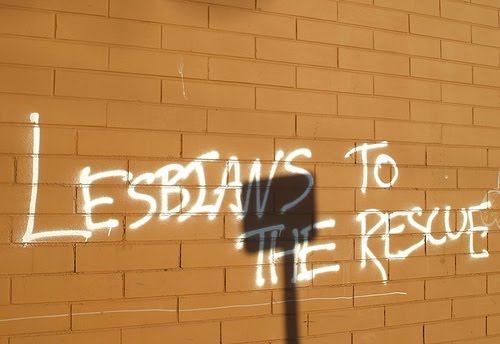
image credit: Lesbians to the Rescue by PinkMoose @ Flickr.com

← Older posts
Newer posts →
"the past is a wild party; check your preconceptions at the door." ~ Emma Donoghue

Recent Posts

  • medical update 11.11.22
  • medical update 6.4.22
  • medical update 1.16.2022
  • medical update 10.13.2021
  • medical update 8.17.2021

Archives

Categories

Creative Commons License

This work by Anna J. Clutterbuck-Cook is licensed under a Creative Commons Attribution 3.0 Unported License

Meta

  • Create account
  • Log in
  • Entries feed
  • Comments feed
  • WordPress.com

Blog at WordPress.com.

  • Subscribe Subscribed
    • the feminist librarian
    • Join 37 other subscribers
    • Already have a WordPress.com account? Log in now.
    • the feminist librarian
    • Subscribe Subscribed
    • Sign up
    • Log in
    • Report this content
    • View site in Reader
    • Manage subscriptions
    • Collapse this bar