• anna j. clutterbuck-cook
  • contact
  • curriculum vitae
  • find me elsewhere
  • marilyn ross memorial book prize

the feminist librarian

the feminist librarian

Tag Archives: politics

in which I write letters: the problem with throwing religious home-educators under the bus

04 Tuesday Sep 2012

Posted by Anna Clutterbuck-Cook in think pieces

≈ Leave a comment

Tags

children, education, i write letters, politics, religion

Dear Claire,

I’m writing to you as a long-time reader of The Tenured Radical, as a fellow blogger, fellow leftist, and individual who spent the first seventeen years of my life learning outside of school — as did my fiancee, until she entered public high school. I wanted to respond to your post regarding home education and the religious right.

I realize that in our contemporary landscape “homeschooling” in the public eye has become virtually synonymous with conservative Christian organizations like the Home School Legal Defense Fund (which actually financed a lot of the court battles that made home education legal for families of all political persuasions), and families who take their children out of public schools for fundamentalist religious reasons. However, I find your characterization of home education “as a grassroots movement” being anti-intellectual and anti-citizenship troubling.

Yes, you are talking about a specific subset of home-educating families and philosophies, but throughout your piece you obscure the wide variety of motivations to home education and styles of learning and teaching by using “home schoolers” as a substitute for “fundamentalist-evangelical Christian conservative homeschoolers.” As a woman who grew up as part of the “grassroots” home education movement in Michigan during the 1980s and 90s, this erases my experience — and the experience of many of my contemporaries — whose home-based education expanded horizons, rather than limiting and controlling them.

You say in your post:

Public education is about putting citizens in the making in one place to talk to each other and learn together.  Is it an accident that when large numbers of voters fail to participate in a common enterprise with Americans not of their choosing that we have so little to say to each other during an election season?

I have seen a lot of anti-homeschooling liberals express similar sentiments, that home education is somehow inherently un-democratic because it removes children from the public square. This is a very limited understanding of the potential of learning outside of school, and in fact many of the progressive home-education folks I know would argue precisely the opposite: that home-based education takes children out of the age-segregated ghetto of school and brings them into the community at large.

As a home-educated child, rather than spending my days in a school building I volunteered at cultural institutions such as the public library and the local history museum, participated in community art classes and music groups, in sports activities and “field trips.” I held part-time jobs as a teenager that not only gave me excellent work experience but also further grounded me in the community. I was involved in church, another locus of social interaction and civic participation.

Obviously, this is not an automatic benefit of home-based education. But I would argue that exposure to a wide range of viewpoints, diversity, and the values of civic participation is not an automatic benefit of public education either. Public schools can be homogeneous, and educators narrow-minded, just like individual parents and families can be. My siblings both attended public high school for part of their grade-school education and benefited from that experience; my brother now teaches art in a public middle school. I am grateful that public provision of education is part of our nation’s commitment to its citizens, and feel that — like hospitals or roads! — public schools are our responsibility to fund whether or not we choose to, or need to, access those services.

Suffice to say, I believe it is a profound mis-characterization of home-education per se to suggest it is at root an anti-democratic, anti-public-spirited endeavor. Obviously, some people who make the choice to home-educate will do so for sectarian reasons, to withdraw from the society at large, because of profound disagreement with mainstream policies. There are examples to be found on the left as well as the right in this regard. But I would argue that this is a freedom-of-conscience decision. There is a long tradition in the United States of allowing parents to decide what the best method of education provision for their family is; compulsory education does not mandate form or content for good reason — local, familial, and religious priorities and needs vary. There is no “one size fits all” that would work well for the majority.

I believe that demonizing/scapegoating people who choose to home-educate for religious reasons actually threatens the freedom of all of us to form and organize our families as we see fit (see: same-sex marriage, polyamory, attachment parenting, etc.). It is certainly within our rights to point out that some forms of parenting foster us/them thinking — but home education is not the cause of that parenting outcome. It is simply the chosen method of delivery for some families. It is a tool, not a uniform ideology, and the values a family holds will shape how home education works for that family, rather than home education pre-determining an exclusionist, reactionary outcome.

In closing I want to thank you for your articulate, insightful blogging at The Chronicle; I have your blog in my Google Reader and regularly click in to read what you have to say. As a fellow blogger I realize that no one post can cover all aspects of an issue. In this instance, I just wanted to share my perspective as someone “on the ground” as a home-educated adult, who has been on the receiving end of fellow liberals’ suspicion of home-based education for many years! I think that the picture is (as always) much more complex than outsiders perceive it to be, and conflating “home education” with “reactionary conservative isolationist” does more harm than good.

Sincerely,
Anna
booknotes: pray the gay away

28 Tuesday Aug 2012

Posted by Anna Clutterbuck-Cook in book reviews

≈ Leave a comment

Tags

gender and sexuality, in our words, politics, religion, sexual identity, sociology

Between the winter of 1987 and the summer of 1988, Boston-based journalist Neil Miller traveled across the United States “in search of gay America.” Though he spoke to women and men in the “well-trodden … urban gay ghettos” of Washington, D.C., New York City (the “gay metropolis”), and San Francisco, his primary purpose was to document the experience of queer folks living in what coasters refer to as “flyover” states, the “red state” regions of the American South, Great Lakes, Midwest, and Plains states. As Miller writes:

Acceptance and self-acceptance amidst the anonymity of cities like New York and Los Angeles and even Boston meant little, I was convinced. One had to travel beyond the large metropolitan areas on the two coasts to places where diversity was less acceptable, where it was harder to melt into the crowd … that was where the majority of gay people lived anyway, even if you didn’t read about them in the gay press or see them on the evening news (In Search of Gay America, 11).

What Miller found in his travels was that queer people in the heartland were often less visible than their East and West coast counterparts; they kept their heads down and their mouths shut, maybe living in a community where everyone knew they were gay but no one openly acknowledged it. Many of Miller’s interviewees talked about the social isolation, particularly if they were un-partnered; in the pre-internet era single lesbians and gay men often had to travel regularly to urban centers to meet and socialize with others like themselves.

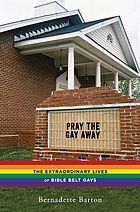
In the two decades since Miller’s travels, much has changed in the world of LGBT visibility, culture, and activism — yet our collective understanding of queer culture remains focused on urban, coastal areas as gay-friendly, while the rest of the country is dismissed (especially by those who don’t live there) as a place where “diversity is less acceptable” and life is harder for queer men and women trying to make their way in the world.  Bernadette Barton’s new study, Pray the Gay Away: The Extraordinary Lives of Bible Belt Gays (New York University Press, October 2012) both confirms and complicates this narrative.

A Massachusetts-born academic who moved with her partner to Kentucky, Barton was taken aback when a neighbor denounced homosexuality as a sin after Barton came out to him. Curious to understand how “Bible Belt gays” experienced this climate of casual anti-gay sentiment, she began interviewing gays and lesbians who grew up in what she terms the “Bible Belt panopticon,” the southern mid section of the nation in which tight-knit communities and strong evangelical, fundamentalist Christian culture come together to create and police conservative norms. When the normative culture is implicitly anti-gay, open bigotry is not needed to encourage self-policing. For example, Barton quotes an interviewee reacting to a church billboard proclaiming, “Get Right or Get Left”:

Get right means to be saved and get left means to be left behind at the Resurrection, but this also conveys the dual message of the church’s political affiliation as well. It’s very polarizing, and when I read it, it sounds like a threat.

Barton observes:

This is an example of how antigay rhetoric, especially to a Bible Belt gay, doesn’t have to say anything at all about homosexuality. It’s the associations. A Bible Belt gay knows homosexuality isn’t included in the right column.

Pray the Gay Away explores different ways in which this Bible Belt panopticon manifests, from family expectations to ex-gay ministries, gay-unfriendly workplaces and legislation to ban same-sex marriage. Throughout, the voices of Barton’s interviewees are powerful evidence in support of her thesis. One graduate student, for example, tells Barton about how his parents tried exorcism when they found out he was in a same-sex relationship. When he remained unrepentant they not only disowned him and cut all financial support, but also removed all of his belongings from his dorm room before they returned home. Through the support of his campus community, the student was able to remain in school — but the resilience of the child does nothing to redeem the horrific behavior of his parents.

I grew up in West Michigan, an area that is — though technically outside the Bible Belt proper — incredibly religiously and politically conservative. Reading Barton’s work, I found much to identify with in its descriptions of life in a community that resists difference and where anti-gay feeling is commonplace. I was particularly struck by her observation that in such communities, “gay” and “straight” are the only two categories a person can belong to. Anyone who is something other than straight is “gay.” You’re either “right,” after all, or “left.” That observation made me wonder whether it took me so long to recognize my own sexual fluidity in part because I literally had no language with which to describe myself.

Though I no longer have to live in a culture that makes it difficult (if not dangerous) to speak of my existence, I am mindful that what Barton terms the “toxic closet” effects everyone whom anti-gay bigotry touches, not just queer folk. My parents, for example, felt profoundly alienated when the city council rejected an anti-discrimination ordinance last year. And my grandmother is uncertain with whom she can safely share the joyful news of my marriage. The “Bible Belt panopticon” constrains us all.

At times, Pray the Gay Away seems to paint the Bible Belt as a monolithic culture of hate. I was pleased to see how careful Barton is to point out that she “deliberately sought out individuals who grew up in homophobic families and churches to best explore their consequences,” and that her narrative describes the normative culture of the Bible Belt, rather than attempting to describe all people therein. (For a broader examination of queer folks’ relationships with their families of origin, see the excellent Not in This Family by Heather Murray.) Barton’s conversations with gay Christians and gay-friendly church leaders, as well as her nuanced exploration of ex-gay ministries help show that even situations which appear toxic at first glance often contain more complex realities.

Yet ultimately, Barton argues that in the Bible Belt region “rampant expressions of institutional and generalized homophobic hate speech in the region bolster individually held homophobic attitudes and encourage those who have dissenting opinions to remain silent.” One lesbian student whom she interviews theorizes that it might even be accurate to identify these anti-gay attitudes and actions as “gay cultural genocide.”

I highly recommend Pray the Gay Away to anyone with an interest in contemporary queer experience, in Bible Belt Christianity, and the intersection of the two. I’d go so far as to say it’s required reading for anyone who cares about what it means to be gay in America today. Whether or not you’ve ever lived in the “toxic closet” yourself, too many of our fellow citizens still wake up there every morning. We owe it to them to listen to the stories they have so generously shared.

Cross-posted at In Our Words.

this is what (bureaucratic) gay marriage looks like [wedding post the sixth]

24 Friday Aug 2012

Posted by Anna Clutterbuck-Cook in our family

≈ 3 Comments

Tags

gender and sexuality, politics, wedding

Happy Friday y’all!

After a slight bureaucratic hiccough involving the misplacement of mothers’ maiden names by the town clerk’s office, Hanna and I finally obtained our marriage license last night, to be completed by our Justice of the Peace on September 14th. For those interested, here’s what the bureaucratic face of same-sex marriage looks like:

click image to embiggen

I will point out that ours is a mixed marriage between Archivist and Librarian (cue gasps of shock!) – likely much more threatening to this generation’s Brave New World than the fact we’re both women.

I dunno — does anyone else find themselves thinking of Hermes’ bureaucrats song from Futurama?

Comedy Central

booknotes: the radical doula guide

21 Tuesday Aug 2012

Posted by Anna Clutterbuck-Cook in book reviews

≈ Leave a comment

Tags

being the change, feminism, human rights, politics, reproductive justice

I don’t actually remember how I first happened upon Miriam Zoila Perez’ blog Radical Doula, but it must have been fairly early on in the site’s existence since she and I have been active in the feminist blogosphere for about the same amount of time (since 2007). I’ve been a virtual observer/admirer as Miriam has taken her radical doula journalism from its earliest personal musings to a much more high-profile presence in such spaces as Feministing and RhRealityCheck — although I still have particular place in my heart for her earliest, most personal, internet home.

It’s with a great deal of affection and feminist pride, then, that I’ve followed updates these past few months concerning Miriam’s first book: The Radical Doula Guide: A Political Primer (self-published, 2012). I was able to support its creation in a modest way by contributing to the kickstarter campaign at IndieGoGo which raised over $4,000 in seed money for the project, and as a thank you gift for that contribution I received an advance review copy of the finished publication in the mail last week.

\o/

And it did not disappoint. Miriam’s 52-page “political primer” discusses the political nature of what she terms “full spectrum pregnancy and childbirth support” — a concept that covers not only childbirth and postpartum doula work, but also abortion and miscarriage doula care, a relatively new service some trained doulas are offering. There are books and training workshops available for learning doula techniques, and The Radical Doula Guide doesn’t seek to replicate those resources. Instead, Miriam offers some reflections on how doula work intersects with political systems: “a starting point to understanding the social justice issues that interface with doula and birth activism” (4).

In four brief sections, Miriam acts as a tour guide through different aspects of full-spectrum doula care and brief analyses of three broad categories of intersection between pregnancy and politics: “bodies” (race, gender, sexual orientation, size, age, and HIV/AIDS), “systems” (immigration and incarceration), and “power” (class and intimate violence/abuse). Using these broad categories with the more familiar nodes of inequality as sub-categories draws our attention back from specific issues to think in more expansive terms about the ways our bodies and lives are policed within society in both informal and formal ways. And specifically, how those constraints shape the experience of pregnancy and parenting.

Miriam is particularly eloquent on the difference between politics and personal agendas. For as she points out, to practice as a doula means leaving one’s own agenda at the door — but it should not mean leaving behind one’s mindfulness of how political circumstances shape the experience of the pregnant person you’re working with. You may believe, for example, that having a C-section is unnecessary while the person you’re supporting wishes to have one. It’s not your job to convince the pregnant person not to have a Cesarean — but it is appropriate to suggest resources for informed decision-making (especially if you’re concerned about pushy medical staff).

This guide would be a great starting point for further discussion in a reading group or classroom setting; I definitely felt like the brevity — a definite strength in many respects — bordered on too brief at times. I imagine that folks new to social justice terms and concepts, or skeptics who need convincing that these issues matter might be frustrated. However, that is not Miriam’s main audience. As a “primer” pointing outward to further exploration, The Radical Doula Guide is lovingly crafted and inspirational. It’s definitely a must-have for any (personal or institutional) collection with a focus on reproductive justice issues.

The Radical Doula Guide is available to order online at WePay for $12.00 per copy (and discounted rates for orders of 10+).

blogging at In Our Words: holding the space: being good allies for our straight co-conspirators

01 Wednesday Aug 2012

Posted by Anna Clutterbuck-Cook in think pieces

≈ Leave a comment

Tags

gender and sexuality, guest post, in our words, politics, the personal is political

these folks desperately need allies (via)

I’m blogging at In Our Words again this week, with a post on how queer folks can be good allies for straight folks. This was a piece pitched by the blog editors that I thought was an interesting concept, and once I started thinking about it I realized I had some notions (I know, right?!) about how we might go about that. I ended up with one concept, five specific tips, and a word of caution. Here’s one of the tips:

While remembering fluidity is possible, it’s equally important to honor a person’s present self-identification. After all, we expect straight people to respect ours. Regardless of a person’s past relationship history or how they may identify in the future, it’s a basic tenet of respect to accept their self-understanding in the here and now. I’m as guilty as the next queer person when it comes to speculating who might be “on our team,” but too often attempts to uncover queer sexuality in straight-identified folks fall back on harmful stereotypes of sexuality and gender that reinforce, rather than subvert, heteronormativity (e.g. “he’s a ballet dancer, how can he expect us to think he’s straight?” or “that haircut is totally dykey”;  wink wink, nudge nudge). We need to trust straight people, as much as we trust queer people, to name their own desires as best they can.

Check out the rest at In Our Words.

If you’re a straight reader, I’d love to hear what you think queer folks can do to support your own resistance to heteronormative bullshit. And if you’re queer, I’d love to hear how you support your straight family and friends.

Share in comments, here or at IOW.

booknotes: confronting postmaternal thinking

31 Tuesday Jul 2012

Posted by Anna Clutterbuck-Cook in book reviews

≈ Leave a comment

Tags

being the change, children, feminism, human rights, politics

I’ve been threatening to write a review of Julie Stephens’ Confronting Postmaternal Thinking: Feminism, Memory, and Care (Columbia University Press, 2012) for over a month now but for some reason my thoughts will not gel. It’s a slim book that is trying to do lots of cultural work, pulling together threads of philosophy, political science, history, memory studies, feminism, and ethics. I had very intense reactions while I was reading it, but those reactions feel … half-digested still. In another six months or a year I may have to go back and give it another pass. A second reading might help clarify my reactions. In the meantime, here are some of my initial impressions and reactions.

  • As I said in my review of Love the Sin, Julie Stephens, in Postmaternal, is likewise critiquing our neoliberal conception of who gets to be a citizen, and who is a good citizen. She is particularly interested in the way care-giving and caregivers are tolerated only insofar as they manage to fit the norm of a citizen-worker. For example, she observes that workplace concessions to working parents — and especially working mothers — are often designed to streamline women’s return to full capacity as workers, to make invisible their care-giving responsibilities, rather than restructuring work and the workplace to accommodate care-giving cycles in family life. Her reflections on the role of  “worker” and the role of “mother” experience unstable moral and market values reminded me of Katha Pollitt’s reflections on how “stay at home mom” and “welfare queen” are two class-based conceptions of the same care-giving responsibilities, dependent on economic resources. Ultimately, care-giving in our society is an activity one only gets to perform if either a) it’s a monetized activity, or b) one’s obligations as a worker-citizen are met by one’s self or a proxy (e.g. husband). 
  • Stephens has made a deliberate choice to focus on care-giving as “women’s work,” a position that reminded me of the way in which Carol Gilliganrecognizes care and empathy as universal human abilities that have, historically, fallen to women in patriarchal culture. I was intensely uncomfortable with this choice — something I’d like to think about more deeply. While I understand her decision not to erase the way our culture genders care-giving, I’m less comfortable with the way respect for historically-feminine care-giving to an emphasis on gender difference. For example, she argues at one point that “the only way to address this failure [of neoliberal societies to account for the necessity of care] would be to reinvigorate the strands of feminism that are attuned to gender difference” (137). I can’t underscore enough how uncomfortable this makes me, and I think there are ways to address the erasure of the bodily aspects of care (e.g. breastfeeding, pregnancy and childbirth) Stephens is concerned about without gender essentialism — a type of feminism I would really rather not see revivified. Which brings me to my next point:
  • In writing about possible policy- and personal-level solutions to the modern-day marginalization of care — solutions that do not rely on the gender binary — I wish Stephens had referenced more queer activists and theorists, such as legal scholar Nancy Polikoff, whose work moved beyond the theoretical to lay out very concrete suggestions about how law and public policy could support and respect networks of care. And birth activist Miriam Perez, whose recent piece on trans birth parents suggests ways to take into account the embodied aspects of nurture without falling back on binary notions of gender.
  • I found Stephens’ use of oral history and memory studies literature an intriguing approach. In what I think is one of the strongest aspects of her analysis, Stephens examines the way mid-twentieth-century feminist activism around maternal and care-giving activities has been erased from cultural memory. She uses oral histories with “second wave” feminists as a way to recover these narratives and explore how their activism was never solely about getting ahead in a man’s world and rejecting the mother/motherhood/maternalism (as backlash culture has often argued). “[My] interviews [with “second wave” feminists] depart from culturally prevailing assumptions about work-centered feminism. Unexpectedly irreverent attitudes toward paid work are expressed,” she writes (91). I wish she had lingered a bit more on this relationship between feminist activism and how feminist activists remember their own life choices (and imagine the life choices of previous generations).
  • Building on these oral histories and the notion of a  forgotten politics of the maternal, Stephens argues that non-market relationships and care-giving are primary sites of moral and ethical development and action. Postmaternal is, in part, a call for neoliberal Western cultures (Stephens is Australian, and her sources are primarily Australian and American) to re-assert non-market values into political culture, reclaiming care as a non-marginal, legitimate activity even if it is not contributing to the national economy. As she writes,

“What a culture chooses to remember and forget has decidedly political character. In the deep discomfort surrounding the maternal in feminist reminiscence, it is possible to see a glimpse of an alternative politics where human dependency and vulnerability are imagined as the primary connection between people, not market performance” (70).

This assertion of an “alternative politics where human dependency and vulnerability are imagined as the primary connection between people,” and the connection Stephens draws between that political imagination and feminist activism is the strongest part of her argument. In revisiting/revising feminist collective memory to re-center a politics of care (which has always been present, but often actively forgotten) is what I would consider to be vitally-important work. And I hope to see her build on this aspect of her thesis — while perhaps letting go some of her reliance on gender essentialism as the path to that politics of connectivity.

I don’t think gender essentialism needed. I think we can honor the embodied experience of persons, even birth-and breast feeeding parents, without linking embodiment and the bodily aspects of care to femaleness and womanhood — at least in any more than an historical sense. I don’t believe there is anything wrong with acknowledging the historically-feminine nature of caregiving; I do believe there is something harmful about basing present-day efforts to re-center care on gendered notions of women’s particular abilities and priorities. I am hoping that we can use Postmaternal as a building block toward a more inclusive, more caring future — without relying on beliefs about gendered bodies and identities that have troubled our past.

All in all, I’m really glad I read Stephens provocative book and I’m looking forward to discussing it with friends — I’ve already promised to lend my copy to Molly (of first the egg) and I’m looking forward to what she has to say after reading it!

booknotes: love the sin

05 Thursday Jul 2012

Posted by Anna Clutterbuck-Cook in book reviews

≈ 6 Comments

Tags

books, gender and sexuality, human rights, politics

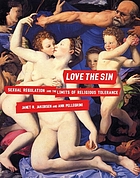
It’s frankly been awhile since I read a book on ethics or theory that expanded my brain so that it felt like it was slightly too big for my skull (aka getting intellectually hot ‘n bothered), but in the past ten days I’ve actually read two of them! The first was Janet R. Jacobsen and Ann Pellegrini’s Love the Sin: Sexual Regulation and the Limits of Religious Tolerance (New York University Press, 2003). The second was Julie Stephens’ recently-released Confronting Postmaternal Thinking: Feminism, Memory, and Care (Columbia University Press, 2012), which I’m going to review next week. Both are slim volumes that tackle complex issues of embodiment, identity, the relationship between public and private, between citizens and the state, and ultimately the way in which we understand individual persons in relation to collective cultural and political spaces.

Reading Love the Sin and Confronting Postmaternal Thinking back-to-back brought out a lot of resonances. Both books are critical of the way in which individuals have been constructed in the modern liberal democracy. They ask hard questions about who counts as a full and worthy citizen under the laws and policies of such democracies (particularly in the United States). They point to ways in which the mid-twentieth-century rights movements — especially the gay and lesbian liberation movement and mainstream feminist movement — have been undercut and co-opted by a majority hostile to their more radical re-visioning goals. This is due, both works contend, at least in part because of the narrow “rights” rhetoric these movements have depended upon. In Stephens’ work, we see how the language of feminism has been deployed in order to shore up a neoliberal notion of citizen-as-worker, while political ethics grounded in care and connectedness (“mothering”) are erased from the collective memory and public discourse. In Love the Sin, Pellegrini and Jacobsen argue that notions of liberal “tolerance” and a reliance on innate/natural (“born this way”) justifications for non-normative sexual orientation have unnecessarily compromised our ability to advocate for a robust freedom-of-practice in the public realm.

While I have persistent reservations about Stephens’ framing of the maternal (which I’ll get to in next week’s review), I was thoroughly seduced by Jacobsen and Pellegrini’s passionate and articulate advocacy of “freedom” as a more expansive, humane, way of framing the question of sexual citizenship — and other types of citizenship — than the notion of tolerance. “In a situation framed by the rhetoric of tolerance,” they write,

It becomes impossible to distinguish between the perpetrators of racism or homophobia or misogyny (this list is hardly exhaustive) and the objects of various forms of discrimination. Rather, when the situation is characterized by tolerance, the public is not expected to take a stand against injustice, but merely tolerate both sides of the “conflict,” which is supposedly between opposing groups of people who are circumscribed outside of those who constitute “the public” or “the American people” writ large (59).

Drawing on media coverage of gay and lesbian activism and of violence motivated by anti-homosexual bigotry, Jacobsen and Pellegrini persuasively show how tolerance encourages the same us/them thinking that can lead to violence, despite liberal claims that tolerance is the way out of the hate that leads to violence. For to “tolerate” those who are different from you implicitly assumes alienation, “the other,” a distance between queer folks, for example, and “the public.” The public “tolerates” the homosexual, which means the homosexual is outside of the group. Therefore, as much as we’d like to believe tolerance is our answer to violence, it offers no escape:

Tolerance disavows violence and those who commit heinous crimes, but along the way it offers no exit from the us-them logic that structures hate and tolerance in our society. It also gives us no logical exit from the mandate to tolerate those who hate. (p. 65)

Jacobsen and Pellegrini go one step further and argue that we are further hobbled by the notion that our claims to toleration of homosexuality are grounded in the fact that one’s sexual orientation is supposedly hard-wired and therefore immutable:

Characteristics that are taken to be immutable, such as skin color or sex, will be tolerated. But when traits or behaviors are taken to be discretionary and volitional, people can be asked, indeed compelled, to change their behavior and assimilate to the dominant norm … Gay identity may be protected by the courts … but ‘homosexual conduct’ certainly is not (94).

As they point out, this is hardly simply a problem for left-progressive causes, such as gender or sexuality. The notion that only immutable characteristics are protected, not behavior, means that an Orthodox Jew can be asked to cut his hair, or a Muslim woman asked to remove her headscarf, in order to keep their job. It means that Christians are not protected from being fired for refusing to work on Sunday.

How, then to get ourselves out of the (violence-enabling) cul-de-sac of identity-based tolerance? This is where Jacobsen and Pellegrini’s theorizing takes what I think is a paradigm-expanding turn. They argue that rather than a framework of “human rights,” social justice movements around sexual expression (and potentially other things) would do better to argue on the ground of religious freedom. Essentially, they argue that sexual freedom is analogous to the freedom of religion in that both are practices that express core values, and that not just beliefs but also individual expression of belief deserve protection, in public as well as private.

This shift frees us from the interminable question of what “causes” sexual variation, which — while theoretically interesting —  is actually ultimately unhelpful when it comes to determining what is lawful. Grounding rights claims on the basis of one’s inclinations being “natural” will do little to answer critics who (quite rightly) point out that human beings are not compelled to follow every inclination without thought, and that our ability to regulate impulsive behavior is, in fact, part of what makes us human. Just because something is “natural” doesn’t make it “right” in the moral sense — since morality is a human creation, and deeply embedded in time and place. As Jacobsen and Pellegrini write:

An important virtue of the paradigm shift we are advocating [from identity-based “rights” to freedom to live out ones values] is that it does not force us to finally settle the question of what ’causes’ homoesexuality. In the end it just does not — or should not — matter how an individual came to be homosexual, any more than it matters how heterosexuals became heterosexual. Rather, homosexual life and experience are to be valued, are in fact sources of value. (98).

This shift also helps us to combat arguments to the effect of, “It’s okay for homosexuals to practice their lifestyle as long as they don’t flaunt it in front of me”:

Free exercise does not depend on the boundary between public and private that protects liberal freedom. In a liberal democracy, some people are allowed to live lives freely in both public and private; others are allowed freedom only if they keep significant aspects of their lives private and privatized; and still others … are not allowed even the protections of a ‘private life.’ But if ‘free exercise’ and ‘democracy’ are to mean anything at all, everyone must have access to life both in public and in private (106).

I see productive parallels here with discussions of ability and access, about what it means to work “toward restructuring our public life so that everyone is included in categories like ‘the general public,’ ‘the public at large,’ or ‘all Americans’ ” (72). The majority culture has a strong normative power — sanctioned by the language of “tolerance” — to enforce their own notions of civility, rather than practice radical acceptance and lovingkindness toward those whose behavior as well as identity challenge their notions of propriety. The perennial (and perennially heated) “debate” about children’s behavior in public spaces comes immediately to mind for me: because children are constituted as “other” in our society (as non-workers they are understood as future/potential citizens, but not full participants in their own right), we feel entitled to ask that their behavior meet our own criteria of acceptability, rather than ask how we might re-formulate our public spaces to better serve them. The same could be said for the elderly, the non-English-speaking, the mentally- or physically struggling.

Angus Johnston has a powerful post on this subject, in which he writes:

Here’s my secret: my kid doesn’t actually behave as well as I do. Sometimes she whines. Sometimes she has to be reminded to to keep her voice down, or not to run. So yeah, when I take her to the Museum of Modern Art, we do impose on other patrons, at least a little.

And you know what? A little imposition on other patrons is okay. I’ll apologize sincerely to anyone she disturbs, but I’m not going to apologize for her presence. Because MoMA is her space as much as it is mine.

My [cognitively disabled] sister whines in public sometimes, too. Sometimes she gets overwhelmed and cries. Sometimes she raises her voice. (Running in museums is not an issue with her, I’m happy to say.) If we say that my daughter shouldn’t go to museums because she might whine or cry or raise her voice, then we have to say that my sister can’t go either — and one of the best days I ever spent with my sister was the day that we visited a MoMA exhibit of design for people with disabilities. MoMA is my sister’s space as much as it is mine.

You can (and should) read the whole piece over at Student Activism.

The basic point both Jacobsen and Pellegrini are making here is that in the framework of “tolerance,” in which we tolerate non-Christians, non-straight folks, children, the disabled, in “our” public square is that through the mechanism of toleration we are perpetuating the hierarchy in which some people are more entitled to freedom of expression than others.

“The public” — understood to be the white, male, economically self-sufficient, heterosexual Christian (I’m sure that’s not exhaustive, but you get the idea) — “tolerates” those of us who diverge from that which feels comfortable to. But that toleration is conditional on our normative behavior. Jacobsen and Pellegrini remind us that such conditional acceptance is, well, otherwise known as being an entitled asshole.

I encourage anyone who cares about effective social change toward a more egalitarian, inclusive world to read Love the Sin. Even if sexual freedom isn’t your issue, per se, the framework Jacobsen and Pellegrini lay out is an effective one for any area where the personal and political intertwine.

Related Read: If you’re psyched by the ideas Love the Sin outlines, be sure to check out Kenji Yoshino’s Covering: The Hidden Assault on Our Civil Rights (Random House, 2006) which explores the legal side of these “freedom of expression” issues.

rambling thoughts on identity, relationships, and fan fiction

28 Thursday Jun 2012

Posted by Anna Clutterbuck-Cook in fandom

≈ 2 Comments

Tags

being the change, fanfic, gender and sexuality, politics, wedding

warning: navel-gazing ahead!

For the past few weeks, I’ve been thinking a lot about how we, as a culture, conceptualize identity — particularly sexuality as part of identity — and how it relates to our real-life experiences in relationships: how our understandings of self shape the possibilities we see for relationships, how relationship experience shapes our notions of identity, and what stories we tell each other about how sexual identity and relationship inform one another.

These aren’t new thoughts for me, but being engaged to Hanna — planning our marriage, talking to other people about the cultural and personal meanings of marriage — brings me back once again to the twin topics of identity and relationship. Being engaged — actively defining our relationship to the outside world — also prompts me to notice more keenly the stories we tell, as a culture, about sexual identity and relationships. In this instance, the way in which sexual identity and relationships are theorized in erotic fan fiction (which, many of you know, I read regularly and passionately).

There’s a lot of fic out there in which character X discovers they are attracted to character Y who is of the gender they didn’t think they had the hots for and ohmygod identity crisis ensues! This is a plot/relationship narrative that — just like any other dramatic tension — can be handled really well or handled really poorly. But I’m less interested in the deftness, in this instance, than I am in the assumption that experiencing desire for someone of an unexpected [insert identity characteristic here] stops the desiring character in their tracks because their feelings of attraction don’t match up with their self-understanding.

On the one hand, I completely understand that sometimes, falling in love “against type” so to speak precipitates re-evaluation of who you thought you were or what it is you understand yourself to desire. I won’t lie: falling in love with Hanna required (or at least prompted) me to think more seriously than I had before about how my sexuality worked. I’ve written about this in the past (see here, here, and here). Sexuality is one thing in the singular, another thing in the relational.

So, yeah, there was adjustment.

But here’s the thing that I’ve been thinking about lately: my sexual identity in the abstract was most urgently important before Hanna and I were actually in a relationship. I worried about how to convince her with evidence that no, really, I thought she was hot. I worried about what might count as evidence of same-sex desires in the past (which, in turn, could be brought forth in support of a pattern into which Hanna-desires fit neatly, rather than being the exception to the rule). I worried about whether I was worrying too much about marshaling the evidence and therefore reading back into my personal history sexualized feelings that hadn’t been there at the time (“did I like her, or like- like her?”).

Basically, I worried a lot.

There was massive angst.

I wrote my own life into an angsty, identity-crisis fic to which, appropriately enough, there was ultimately a solution in the form of sexytimes.*

Here’s the “on the other hand” thing, though. The moment — and I’m talking the moment — we touched in a way that undeniably conveyed to each other “I want to get in your pants as quickly as possible”?

Worry totally gone.

In that moment, I had absolutely all the evidence I needed that whatever-and-whoever-the-hell-else I might be interested? I was interested in Hanna.

End of story.

Well, okay, not totally end of story. ‘Cause within that story I got to think a lot about what sex meant to me, and what I enjoyed, under what circumstances, the space between fantasy and real-world interaction, all of that. It’s an ongoing conversation. And a really hot one.

(Have I mentioned intellectual stimulation is a turn-on for me?)

But the question of identity became kinda … irrelevant. Actually, super-irrelevant. Because no matter what I chose to identify as, whatever I called myself, in whatever contexts I named myself, in practice I was Hanna-sexual. As in, sexually attracted to Hanna. All the other attractions I may or may not have moved into the realm of “theoretically interesting but not that practically relevant.”

Because I could have said I was doorsexual and still when I put my hands on Hanna I would have wanted her.

And in my book, experiential evidence trumps theory every time.

So when I read these fics in which character X is enjoying sex with character Y — and I mean seriously enjoying sex — yet simultaneously freaking out because this isn’t sex they should be enjoying? I think about the issues we’ve created for ourselves by imagining that sexuality and sexual identity is the quantifiable, identifiable, constant thing.

That we can, that we should, understand what we want prior to actually having it, prior to coming across it in the wild, this beautiful, breath-taking being in our path. Prior to knowing and being known, in that moment of intimacy, of home-coming (or, conversely, that moment of escape-from-the-body, of clarifying distance; sex is, after all, what we make and want of it).

What I’m saying is: Aren’t we simply what we are?

And if we stumble into love, into desire, into oh god you feel amazing under my hands and please never stop touching me there does it really matter so frickin’ much to our notion of the self whether or not the body, the person, in question is the same shape as the last body, the last person, who felt this way under, within, around us?

At what point in our history did the body of others become so central to the constitution of ourselves? Because that’s how the think of sexual identity these days — it’s about the self, yes, but it’s about the self in relation to the bodies that one finds desirable. It constitutes the self in some pretty fundamental ways but pre-emptively narrowing who we imagine ourselves capable of getting down and dirty with.

As I type this, my internal antagonists are arguing with the words on the page, pointing out how much all of this is colored by my subjective experience of fluid, person-centered sexual attractions, and my claustrophobic reaction to closing doors of possibility when there’s no imminent need to do so. So obviously this is only my own particular reaction and all, but really … why do we make it so difficult for ourselves?

Wouldn’t it just be easier if instead of an existential crisis, falling in love with an unexpected person was more like, “Oh, you mean I like this too? That’s cool.”


*Someday, maybe I’ll write it into an actual smutty fic. Hanna and I keep threatening to do this in turns, but so far neither of us has made the time to follow through and do it.

first thoughts: david blankenhorn’s evolving stance on marriage equality

23 Saturday Jun 2012

Posted by Anna Clutterbuck-Cook in think pieces

≈ 1 Comment

Tags

feminism, gender and sexuality, moral panic, politics, wedding

Prominent anti-marriage-equality theorist David Blankenhorn (a key expert for the supporters of Prop 8 in California, author The Future of Marriage) has recently gone public with his decision to support same-sex marriage as a way to strengthen the institution of marriage overall. He writes in his statement at The New York Times that he hopes this decision to support the right of same-sex couples to marry will re-orient the discussion away from the morality of homosexuality per se and toward question of how society provides for dependent children, and how we can best stabilize existing love relationships. He writes, in part:

I had … hoped that debating gay marriage might help to lead heterosexual America to a broader and more positive recommitment to marriage as an institution. But it hasn’t happened. With each passing year, we see higher and higher levels of unwed childbearing, nonmarital cohabitation and family fragmentation among heterosexuals. Perhaps some of this can be attributed to the reconceptualization of marriage as a private ordering that is so central to the idea of gay marriage. But either way, if fighting gay marriage was going to help marriage over all, I think we’d have seen some signs of it by now.
So my intention is to try something new. Instead of fighting gay marriage, I’d like to help build new coalitions bringing together gays who want to strengthen marriage with straight people who want to do the same. For example, once we accept gay marriage, might we also agree that marrying before having children is a vital cultural value that all of us should do more to embrace? Can we agree that, for all lovers who want their love to last, marriage is preferable to cohabitation? Can we discuss whether both gays and straight people should think twice before denying children born through artificial reproductive technology the right to know and be known by their biological parents?

There’s a lot going on in this statement and I won’t pretend my first response is comprehensive. But here are a few “first thoughts.” Continue reading →

‘the act of marriage’ live-blog: abortion bonus post (the end)

21 Thursday Jun 2012

Posted by Anna Clutterbuck-Cook in book reviews

≈ Leave a comment

Tags

blog for choice, gender and sexuality, live-blogging, politics, religion, wedding

See also: intro, ch 1, ch 2-3, ch 4-5, ch 6-7, ch 8-10, ch 11, ch 12, ch 13, ch 14.

As promised on Tuesday, here is the bonus post reproducing the section in The Act of Marriage which deals with abortion. It’s notable, I think, that a Christian book on sexuality deals with abortion only in the final chapter, in a question-and-answer section, rather than having either a) a chapter devoted to the subject, or b) addressing abortion in the chapter on family planning. This may seem odd to present-day readers, who are used to abortion being one of the rallying cries of the “family values” coalition. But actually, abortion did not become a major political issue for non-Catholics until the late 70s. So the way abortion is handled in The Act of Marriage is a fascinating sliver of post-Roe, pre-Operation Rescue abortion ethics for evangelicals. I’m reproducing the text here in full, with my interleaved commentary.

ABORTION: Is it ever right for a Christian woman to have an abortion?

Note immediately how the question is framed: “a Christian woman.” This phrasing pulls the question from the realm of law and politics and places it in the realm of personal, religious conscience. Since no one can be forced to be a Christian in the United States, and whatever the LaHayes say subsequently applies only to Christian women, there is no explicit coercion — no forced birth, at least in the legal sense. Obviously, a woman could be pressured and forced on a much more intimate scale by religious community, doctor, and family — but this is not being framed as a matter of law.

A crucial issue in today’s society relates to the morality of abortion. Ever since the 1973 Supreme Court ruling granted a constitutional guarantee of privacy in such matters and left the decision to the individual woman during the first six months of her pregnancy, legalized abortions have increased at a catastrophic rate. Many opponents of abortion warned that if it were made legal, it would result in promiscuity, infidelity, venereal disease, and guilt. Who can deny the accuracy of their forecast?

On the other hand, we do start out at the gate talking about Roe v. Wade. And it’s clear the LaHayes feel the decision led to general degradation. Notice what’s not listed in the results of abortion? That’s right: murder. They’re talking about sexual misbehavior, not about baby-killing. In a lot of ways, these are still the root concerns of sexual conservatives — they’ve just learned that “baby killing” is a much more effective rhetorical move. Basically, the concerns the LaHayes list here about abortion mirror the concerns they have about secular, humanistic, “un-Christian” sexual mores in general. No more, no less.

There are two kinds of abortions — natural and induced. Although medical science cannot always tell why, some women abort their pregnancies naturally, which may be nature’s way of dealing with birth defects or other prenatal complications. Induced abortions are medically simple if performed by a competent doctor in the early stages of pregnancy.  

The way miscarriage and abortion are grouped together here,  and the accurate observation that early-stage abortions are “medically simple” and can be performed safely by a trained physician, serve to reassure the reader, to normalize the idea of abortion. This is not a passage designed to frighten or shock.

There are two reasons for inducing an abortion: (1) when such action is necessary to save the life of the mother — called “therapeutic abortion”; and (2) for the convenience of the mother because she is either unmarried or does not want the child. In such cases those making such a decision must bear the moral responsibility for their actions.

So they’re creating two distinct categories here, and it looks as if category one (“therapeutic abortion”) is deemed “necessary” and not at moral issue here — and even the second category, abortion for “convenience” is not automatically decried.

Christians as a rule know that the Bible condemns murder; consequently, many use the sixth commandment as justification for condemning all forms of abortion. The problem is that the Bible is not clear as to when the fertilized egg becomes a person — at the moment of conception, or when the embryo develops into a fully formed human being at three to six months. If one regards the fertilized egg as just “a living cell” that has potential to become a human, it is easier to approve of some form of abortion than if he believes that the soul enters at conception.

Throughout The Act of Marriage the LaHayes are careful to differentiate between moral parameters they find support for in the Bible (homosexuality; adultery) and those which they don’t necessarily approve, but about which the Bible is silent (oral sex; birth control). They make no exception for abortion, suggesting that Biblical censure of abortion hinges on whether abortion equals murder — and notice that they leave that question open-ended!

We faced this problem initially when a mother of four who thought she could not have any more children became pregnant. Because of a rare blood condition, her doctor advised, “If you do not get an abortion, the birth of this child will take your life.” If we had relied only on the sixth commandment, our response would have resulted in murder either way — the mother or the unformed child. After much prayer we counseled the couple to follow their doctor’s recommendation.

The modern-day anti-choice movement rarely, if ever, places the pregnant woman’s life at the center of the story in this way — let alone articulate the notion that two lives may be at stake here: the pregnant woman as well as that (potential) life of an “unformed child.” The abortion debate has sidelined women’s lives in the interest of focusing on what happens inside the womb, as if it were somehow disembodied from the woman who must decide (or be forced) to carry the pregnancy to term inside herself.

I think it’s also notable that the example above is of a woman who is already a parent. Often, in the anti-choice rhetoric of today, women-who-have-abortions and women-who-give-birth-and-parent are imagined as two separate populations; in this instance, they are found (as they most often are) in the same person.

Another case involved an innocent fourteen-year-old rape victim. The crime occurred while she was coming home from school, and investigation disclosed she had never seen the man before.

Ah perfect-victim-stranger-rape, how we miss hearing about you … oh, wait.

We felt that she had been through enough trauma. Certainly a loving God would not require an innocent girl, victim of a man’s bestial appetite, to drop out of school, endure nine months of pregnancy, and inaugurate motherhood before her fifteenth birthday. We found that her pastor’s approval was very important for her mental and spiritual rehabilitation. To this day only about six people know of this tragedy, and now, some years later, she is a happy, well-adjusted wife and mother.

Again we see the melding of women-who-have-abortions and women-who-are-mothers. Yes, the approval of abortion as an option in this instance is predicated on the “stranger rapes innocent girl” trope, but these days many anti-choicers argue against exceptions for rape/incest and the life of the mother.

Still another case concerned a couple who had a retarded child and were expecting again. A chemical analysis indicated that their unborn child would also be malformed in some way. After much prayer and soul-searching, we advocated a therapeutic abortion. Admittedly, we may some day have to account to God for these decisions, but to our best understanding of the Bible and the peace we had in our hearts at the time, we have no regrets.

I find it fascinating that they hold up these decisions difficult, human decisions for which there may be no fully right answer. They may “some day have to account to God” for the way they counseled families to seek abortions, but they “have no regrets” about encouraging families to choose abortion, even when the life of the mother was not immediately at stake. Particularly in this last instance, their decision-making process included a much more comprehensive understanding of family well-being and caretaking capacity than is normally up for discussion in present-day anti-abortion circles.

Through these experiences we have developed the following opinion on the subject.

Once again, the distinction between Biblical truth and the LaHayes’ (albeit pastorally-authoritative) ethics.

We oppose abortion for all personal or selfish reasons, but accept therapeutic abortion in those rare cases in which a Christian doctor, minister, and the girl’s parents prayerfully agree that it is in the best interest of either the mother or the unborn child. If a girl or woman is immoral and becomes pregnant, she should bear the responsibility for her actions by giving birth to the child.

Slut shaming in all its glory!

If she is a minor, we recommend that a Christian couple who desires a child be found and the child be adopted immediately after birth; the man involved should pay all necessary expenses plus room and board for the girl during her pregnancy. We do not believe that a forced marriage is always a solution, for it depends on the two people’s ages and whether one is an unbeliever. We have observed that unless the couple is mature enough to marry, they start out with so many strikes against them that marriage becomes a tragic mistake following an unfortunate sin. Better that they confess their sin in God, then responsibly do what is best for the unborn child (235-237).

They don’t articulate it in so many words here, but I think it’s telling that — in the mid-1970s! — they’re still assuming that an underage teenager will be sent to an unwed mother’s home for the duration of her pregnancy (why else the need for “room and board”?). And while this is obviously far from a liberal-progressive position on teen pregnancy, I appreciate the changing mores that allowed the LaHayes to encourage their readers not to pressure teens into shotgun marriages before the baby was born, in fact suggesting that “what is best for the unborn child” may, in fact, not be a childhood spent in an unhappy household.

So there you have it: fundamentalist, evangelical Christian abortion ethics, circa 1976. If only we could make our way back to even that narrow window of opportunity!

← Older posts
Newer posts →
"the past is a wild party; check your preconceptions at the door." ~ Emma Donoghue

Recent Posts

  • medical update 11.11.22
  • medical update 6.4.22
  • medical update 1.16.2022
  • medical update 10.13.2021
  • medical update 8.17.2021

Archives

Categories

Creative Commons License

This work by Anna J. Clutterbuck-Cook is licensed under a Creative Commons Attribution 3.0 Unported License

Meta

  • Create account
  • Log in
  • Entries feed
  • Comments feed
  • WordPress.com

Blog at WordPress.com.

  • Subscribe Subscribed
    • the feminist librarian
    • Join 37 other subscribers
    • Already have a WordPress.com account? Log in now.
    • the feminist librarian
    • Subscribe Subscribed
    • Sign up
    • Log in
    • Report this content
    • View site in Reader
    • Manage subscriptions
    • Collapse this bar