• anna j. clutterbuck-cook
  • contact
  • curriculum vitae
  • find me elsewhere
  • marilyn ross memorial book prize

the feminist librarian

the feminist librarian

Monthly Archives: May 2012

guest post @ the last name project

11 Friday May 2012

Posted by Anna Clutterbuck-Cook in think pieces

≈ Leave a comment

Tags

blogging, family, feminism, hanna, wedding

I have a guest post up at from two to one today as part of The Last Name Project (co-hosted by Danielle of from two to one and Shannon of The Feminist Mystique). The Last Name Project profiles “an array of individuals and couples about their last name decisions upon marriage or what they expect to choose if they marry. The goal is to explore how individuals make decisions about their last name, and to highlight the many possibilities.” For my contribution, I wrote about the decision Hanna and I made to combine our middle names when we register our marriage:

This solution felt right to us because it doesn’t privilege either person’s family name. It adds to, rather than erasing any aspect of, our (linguistic) identities. As a feminist and queer woman, I think extensively about mainstream notions of marriage, family, and identity, and I knew that I wanted a way to honor my individual self and family history alongside incorporating my partner into who I am and will become. Weaving Hanna’s middle name together with mine feels like a positive way to entwine our individual selves together without losing those other strands of who we are and have been.

Check out the whole piece over at from two to one.

‘the act of marriage’: ch. 4 and 5 (how to do it 101)

10 Thursday May 2012

Posted by Anna Clutterbuck-Cook in book reviews

≈ 2 Comments

Tags

gender and sexuality, live-blogging, religion

See also: intro, ch 1, ch 2-3.

Once the LaHayes have established that sexual intimacy is God-approved (chapter 1) and that men and women both get things out of it, even if they be different things (chapters 2-3), they move on to the basics of anatomy and how-to. Chapters three and four are a really amusing mix of accurate, fairly non-judgmental sexual health information and prescriptive sexual coaching that would put a drill sergeant to shame. It follows the 90%/10% rule*: You’re reading along with a sentence and nodding and then — what the fuck?! it just takes a u-turn into not-good places.

Let me illustrate with several verbatim passages.

On sex education:

An in-depth study of sex is best pursued just prior to marriage. Let’s face it — the material is simply not that complicated. God didn’t give Adam and Eve a manual on sexual behavior; they learned by doing. We are convinced that modern Adams and Eves can do the same, provided they are unselfish enough to consider their partner’s satisfaction more than their own. A few good books on the subject, studied carefully two or three weeks before marriage, a frank discussion with their family doctor, and pastoral counseling are usually adequate preparation (45).

Continue reading →

maurice sendak: first memories

08 Tuesday May 2012

Posted by Anna Clutterbuck-Cook in think pieces

≈ Leave a comment

Tags

books, children, family

When I got to work this morning, my Google Reader was rapidly filling with blog posts about the death of author and illustrator Maurice Sendak, at the age of 83.

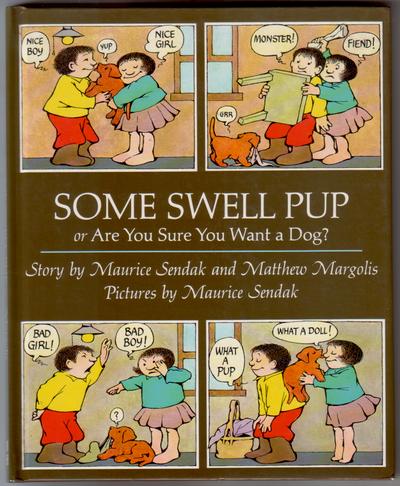
I don’t have any big thoughts about Sendak and his the power for good his work was in the world, so instead I thought I’d share with you a couple of Sendak books that aren’t as well known and are, in fact, two of his works I remember best from early childhood.

Before I was born, my parents adopted a golden retriever named Satch (after jazz musician Louis Armstrong, whose nickname was “Satchmo”). This was one of the books they had in their collection of dog care manuals, and I remember really loving the comic-strip layout, as well as the adorable and mischievous pup.

This lushly-illustrated story with text by Charlotte Zolotow and illustrations by Sendak relates the quest of a child to find the perfect gift for her mother. I remember Mr. Rabbit feeling slightly threatening, even though he’s kind and helpful, perhaps because he is more adult-sized in the illustrations than child-sized. Yet overall, it’s a quiet low-key story with a sweet resolution, and a rhythmic feeling to it that was incredibly soothing when I was small.

Just looking over Sendak’s bibliography of works reminds me how much of my childhood library was touched by his work. So thanks, man, for making my world that much more vivid and Truthful.

Cross-posted at the corner of your eye.

minimalist wedding plans [installment the first]

08 Tuesday May 2012

Posted by Anna Clutterbuck-Cook in our family

≈ Leave a comment

Tags

feminism, hanna, wedding

While I loved to dress up and play princess or flower fairy in my babysitters’ hand-me-down prom dresses as a child, I don’t remember having much of a thing for weddings. Even my princess games tended toward the “orphan princesses run away to the magic forest to set up housekeeping together in the Swiss Family Robinson treehouse” feel to them (who me, pre-adolescent passionate friendships? what?). So I can completely and entirely, without any regret, say that I’m thankful beyond belief that Hanna isn’t interested in a bells-and-whistles wedding.

About a month after we decided we were getting hitched on, like, a particular date, the major decisions have been made and the pressing details ironed out. Everything else is just icing-on-the-cake details. (Someone asked me a couple of weeks ago what kind of cake we were going to have and I was like, “Oh, that’s right! An excuse for cake!”)

For folks interested in the process of minimalist wedding planning, here’s what we’ve got sketched out so far.

1. Ceremony. It’s going to be a civil ceremony (neither of us are active in a church/religion), performed either out-of-doors or at the office of the Justice of the Peace we’ve hired for the occasion. The state of Massachusetts requires paperwork to be filed three days in advance of the license being issued, so we’ll be heading down to City Hall to do that together at some point the week before the wedding. As I mentioned already, Massachusetts is one of those easy-peasy states where the fact we’re both women is neither here nor there as far as the bureaucracy is concerned. (Thanks to GLAD for the legal overview; PDF)

The vows are still a work-in-progress, though we’re shooting for impersonal-formal without saying shit we don’t actually believe in. This is harder than you might think.

2. Witnesses. We aren’t required to have witnesses, here in the state of Massachusetts, but we’re talking about who we want in attendance. One problem is that the short list is scattered across at least four states and multiple time zones. So the question of who will be with us on the day, if anyone, is still under discussion and advisement. We do have a work-around in mind we’re pretty happy with; more on that soon.

3. Rings & Things. We’ve decided to have rings, a matching set from an artist in Spain who sells through Etsy. She’s engraving the rings with our new middle names (see below). We fussed a bit about the font for the text before deciding to supply her with the names written in our own hands.

“Sunday best” will probably be in order, just to spruce ourselves up a bit, though neither of us are inclined to spend the time or money necessary for the wedding clothes we might — in our ideal fantasy headspace — enjoy dressing up in (hint: there has, in the past, been talk of knee-high boots, corsets, and waistcoats).

4. Names. We’ve been going back and forth about this for about as long as we’ve been talking about getting married, and finally decided that since children aren’t in the picture and there’s no elegant way of combining Cook and Clutterbuck, we’d go with combining our middle names instead. Hence our new, legal, middle names: Elisabeth Jane.

5. Tattoos. Wedding tattoos, I know. But we’ve both got ink already and since my ability to wear jewelry consistently is a bit dodgy we decided ink was a more permanent way of marking the transition to being wives. Drawing on Hanna’s Buddhist practice and our English-Scottish roots we decided we wanted a knotwork design, and chose the eternal or endless knot. We’re going to have my dad work up some different options incorporating colors we’re both drawn to, including browns, purples, blues, greens, and grays.

6. Announcements. We’re asking our friend Diana to design us letterpress announcements to mail out to family and friends. Photographs of any kind are still under negotiation, but a wedding portrait of some kind may or may not be included.

7. Honeymoon. This part actually came first! Our original plan was to spend a week’s vacation on Cape Cod this fall (our first honest-to-goodness vacation that doesn’t involve travel for professional development or family visits) and it was in planning that vacation that we decided the time was ripe to get married. So we’re renting a tiny studio cottage on the ocean for a week and planning to spend lots of hours wandering around the national shoreline, hanging in coffee shops, reading, watching Supernatural and Stargate: Atlantis, cooking, wading in tidepools, and all the other things one does on a vacation-honeymoon with one’s wife.

8. Family. With my family scattered across the U.S. from Michigan to Texas to Oregon, we’re still working out the details of how to mark the occasion with family members. There’s talk of celebration dinner with the parents of the brides, or a “grand tour” to visit the siblings … basically, we’re not sure yet. Time and money being what they are, a unified family-and-friends gathering probably just isn’t in the cards.

9. Larger Meanings. Getting married. Being a wife. Having a wife. As an historian with an interest in sexuality and gender, and as a queer feminist, I’m obviously acutely aware of the historical specificity of what we’re doing here. It’s living in this time, in this place, that’s making it possible for Hanna and I to conceive of ourselves as being in a relationship that falls within the purview of marital relations — and then makes it possible for us to act on that self-understanding. Without fear of losing our jobs or being shunned by friends. Quite the opposite, in fact: our friends and family have celebrated with and for us, and when I told my colleagues about the nuptials I got a hug from my boss.

There have been other times when, there continue to be other places where, and other couples for whom, this manner of openness, legality, and celebration is not an option.

I’m also aware, and in political sympathy with, many of the people who decry the way the institution of marriage, however equal, has become the gateway to a whole host of civil rights, responsibilities, and benefits — from parental leave to retirement benefits and everything in-between. The navigation of private meaning and personal choices as they interact with and help to shape public dialogue and structural inequalities, for better or worse, is something none of us can escape. Writing about what we’re doing, and why, is part of my commitment to thinking about how the personal and political interact in myriad ways.

10. Cake! When I was a child, my default celebration cake was chocolate chip pound cake; these days I’m a fan of red velvet (is there a better mode of cream cheese frosting delivery? seriously). Clearly important decisions must be made.

I’ll keep you posted!

‘the act of marriage’: ch. 2 and 3 (his and hers)

06 Sunday May 2012

Posted by Anna Clutterbuck-Cook in book reviews

≈ 2 Comments

Tags

gender and sexuality, live-blogging, religion

See also: intro, chapter one.

We learned in chapter one that sexual intimacy between married hetero couples carries the God-seal of approval. Chapters two and three take us on a tour of “what lovemaking means to” men and women. Because men and women are different creatures, each creature gets their own chapter and hierarchy of meaning.

You see, the male creature gets five things from the act of marriage, as does the female creature. But because they are different species, what they get out of lovemaking is different in kind — and when similar in kind, different in meaning.

I offer a Handy Dandy Chart of Comparison:

Males Females
1. It satisfies his sex drive.
Translation: Dudes be horny and must have with the fucks.
It fulfills her womanhood.
Translation: How do you know you’re a girl unless a man puts his penis inside you? Also: Babies! And homemaking.
2. It fulfills his manhood.
Translation: Fucking things cures all feelings of emasculation. (aka The Magic Cock).
It reassures her of her husband’s love.*
Translation: If you don’t put out he’ll leave you. Sex is the way to a man’s heart.
3. It enhances his love for his wife. 
Actual quote: “When you have a Cadillac in the garage, how can you be tempted to steal a Volkswagen off the street?”
It satisfies her sex drive.
Actual quote: “Each thrilling lovemaking event increases her sex drive drive” (aka Married women who have good sex will become insatiable nymphos)
4. It reduces friction in the home.
I don’t think they actually meant this as a double entendre, although they do spend a lot of time on the benefits of lube later in the book.
It relaxes her nervous system.
Because suddenly we’re going to get all nineteenth-
century on your ass.
5. It provides life’s most exciting experience.
By which they mean orgasms, which I’ll be talking about later (really? the most exciting?)
The ultimate experience.
I’m struck by the slightly different wording here. Also, is there anyone else who can’t help think of Wet Hot American Summer?**

SOOOO many questions!

Why is orgasm the “most exciting” experience for men, but the “ultimate” experience for women?

Why does sex drive rank #1 for men, but #3 for women?

Why does libido come before ego in the hierarchy of needs in men? Does that mean that masculinity matters less than getting it on?

How does affirming womanhood through sex lead to marriage, a house, and babies? (I mean, besides the obvious sperm-meets-egg thing)

If you’re going to lubricate your marriage, what brand is best?

Why does sex “enhance” a man’s love of his partner, while merely “reassuring” the woman? Is love something men do and women receive?

If women want sex more after every successful instance of lovemaking, how quickly will her sexual needs spiral out of control in the average Christian marriage?

Inquiring minds wish to know!

In addition there’s an extra bonus section in the “males” chapter dealing with the issue of “mental-attitude lust” which basically instructs us that guys fantasize about hot chicks. ALL THE TIME. But they shouldn’t. So men are counseled to police their thoughts and never have sexual thoughts that don’t involve their wife. How they’re supposed to do this isn’t clear, except it’s probably the wife’s responsibility to play the role of Cadillac so her husband doesn’t turn to auto theft as a hobby.

Women don’t get the lecture on mental-attitude lust because, see, we don’t have any. “A woman does not seem so readily tempted to fantasize as does her husband.” (Let’s just say there was hysterical laughter in my house when I read that passage aloud to the almost-lady-spouse). Apparently, we’re only capable of “remember[ing] romantically those exciting experiences of the past. Consequentially each thrilling lovemaking event increases [our] sex drive” which presumably, over time, would turn us into succubi. Though he doesn’t mention that bit.

Mostly, I just love how women here are incapable of original, imaginative sexual thought and instead can only harken back to good (and bad) sexual experiences that have previously happened to them. And my use of the passive construction is deliberate here.

IN SUM: The adequate lady-spouse metric

I figure I get negative points for all the ways I experience “male” sexuality and positive points for all the ways I experience “female” sexuality.

 -15 – for being spontaneously horny but
+15 – for also being an experience-driven succubi (the more good sex I have, the more I want!)
  -5 – for not believing that a dude’s ego is lodged in his dick
+10 – because I do feel reassured of my lady-spouse love when we enjoy sexytimes but
 -2 – for not being an extrovert
  0 – for not having to train my sweetie in empathy (women automatically have “bedside manners”)
 -2 – for not being interested in white knights and angels, except in the m/m sense
 -4 – while I respond well to treats, I generally put out anyway so clearly I’m a cheap slut
   0 – while my “passion” flares with my cycle, lady-spouse would say I’m only slightly capricious.
-10 – I’m confident my lady-spouse means what she says when she says she won’t go stealing cars
+10 – and also don’t plan on car-jacking myself***
  -5 – I’m a believer in the benefits of lubrication to ease friction
 +5 – and also find sex to have a beneficial effect on my nerves (I’m in that 10-20%)
+10 – for enjoying orgasms as a “most exciting” experience but
 -10 – for not experiencing “the ultimate” (p-i-v intercourse) with actual penes
 -30 – and obviously for being full of mental-attitude lust (slash fiction anyone?)

Chapters 2-3 score: +50/-83 = -33

Chapter 1 score: +35/-85 = -50

Cumulative: -83


*Bonus: Wives need five sub-types of love. We’re just that high-maintenance. Companionable love (all women are extroverts by nature), compassionate love (sex somehow trains a man to practice empathy, a womanly virtue), romantic love (“my white knight/not a Lancelot/nor an angel with wings …”), affectionate love (women, like pets, respond well to regular treats), and passionate love (the capricious kind).

**Wet Hot American Summer:

J.J.: He gets so uncomfortable whenever we talk openly about sexual issues. You know he’s never been with a girl before.
Gary: McKinley needs to experience “The Ultimate” And I think you know what I’m talking about.
J.J.: You mean, penis-in-vagina?
Gary: No, dickhead. Sex.

***Though if we’re doing car comparisons, I expect Hanna would rather be compared to an Impala than a Cadillac.

‘the act of marriage’: ch. 1 ‘the sanctity of sex’

04 Friday May 2012

Posted by Anna Clutterbuck-Cook in book reviews

≈ Leave a comment

Tags

gender and sexuality, live-blogging, religion

See also: intro.

So one of the reasons that The Act of Marriage was such a ground-breaking text in the mid-70s was that it was one of the first modern Christian fundamentalist, evangelical books on marriage to be all “whee! sex be awesome and of the Lord!” And that’s really the message of chapter one: Good Christians can make with the sexytimes.

In “The Sanctity of Marriage” I learned that:

1. God’s okay with people married, hetero couples doin’ it.  “Some people have the strange idea that anything spiritually acceptable to God cannot be enjoyable” (15). But nope. Sexual intimacy outside of marriage is “condemned” and people who commit the “sin” of pre-marital sex will likely have to confess and receive forgiveness before they can proceed along the path of righteousness orgasms.

2. God made our bodies, and therefore our bodies are good. “God designed our sex organs for enjoyment” (11). I’m not actually going to snark about this one, because if you’re going to believe in a creator I don’t think it can hurt to believe that the creator looked upon human embodiment as something positive, rather than negative, and gave us our bits for a reason. Especially the clit. Because I’m fond of clitori.

3. “Spirited” sexytimes are all over the Bible. Old testament, new testament. Everywhere. Adam and Eve were likely getting it on in the Garden of Eden before the Fall. (For true!) All I could think about reading this section was the episode of Futurama in which Leela and Zapp Brannigan crash land on an Edenic planet and Zapp tries to convince Leela she has a duty to make it with him in order to re-populate a supposedly destroyed Earth. There are fig leaves and everything.

4. When supporting your argument that sexual intimacy is Christian, and proof-texting is the way to go. This isn’t surprising, because the cultural of evangelical fundamentalism encourages this sort of behavior. If you make an assertion, you need a bible verse to back it up.

5. Have I mentioned sex outside of marriage is a no-no? Well it totally is. In any way, shape, or form. In fact, according to the LaHayes’ interpretation of 1 Corinthians 7: 2-5,

1. Both husband and wife have sexual needs and drives that should be fulfilled in marriage.
2. When one marries, he forfeits his control of his body to his partner.
3. Both partners are forbidden to refuse the meeting of the mate’s sexual needs.
4. The act of marriage is approved by God.

I love how these four tenants are such a surreal combination of yeah, I’m down with that and ohmyGODwhatareyouTHINKING. It’s like a sandwich made with fresh-from-the-oven artisan bread and  with a filling that carries botchialism.  Both partners, male and female, have sexual needs? The act of marriage (sexytimes) comes with the God-stamp seal of approval? Well, hooray! Particularly if you’re coming from a God-saturated worldview, and from a patriarchal religious background, those things are babysteps toward a way better place. But then OH MY GOD it’s so full of NOT OKAY in the middle!!! “Forfeits control of his body”?! “Forbidden to refuse”??!

o_O

And I’m totally not distracted by the “he” and “his” pronouns here. Because (I peeked) chapters two and three are about male and female “lovemaking” needs? And men totally want more sex than women. So even though the language is neutral, paired with the universe of wrong that is gender essentialism this is about making the ladybits 25/8 accessible for the magic, randy penes.

IN SUM: The “adequate lady-spouse metric”

My friend Molly commented on the intro post that she was looking forward to learning how she measures up  as a lady-spouse. And in honor of her, I decided to give myself grades after each chapter according to how well I have/will perform as a lady-spouse myself (a girl’s gotta have something to strive for, right?). So here’s my score for chapter one:

+15 –> in agreement that mutual pleasure is key to sexual intimacy
+10 –> down with the idea that God made flesh and flesh is good
+10 –> down with the idea that, since flesh is good, sex is also good in the eyes of the Lord.
-20 –>  and yet I’m a pre-marital slut 
  -5 –> who’s not guilt-ridden about it
-30 –> and oh wait, I’m also a dyke*
  -5 –> who’s busy enjoying “spirited” “acts of marriage” with my (almost) lady-spouse**
-25 –> and plans to retain “control” over my body and right of refusal re: sexytimes post-vows


Chapter 1 score: +35/-85 = -50

Watch this space on Sunday for the gloriousness that will be a comparison (with tables!) of “What Lovemaking Means to a Man” and “What Lovemaking Means to a Woman.”
Let’s just say … I’m doing it wrong.

*Technically, I’m probably worse being bi/omni/fluid whatever. I could be making myself available to the magic penes, but I’m not ’cause my almost-lady-spouse doesn’t happen to have one.
**Does committing acts of marriage with an almost-lady-spouse technically make them “acts of pre-marriage”?

booknotes: the straight state

03 Thursday May 2012

Posted by Anna Clutterbuck-Cook in book reviews

≈ Leave a comment

Tags

gender and sexuality, history, human rights, moral panic, politics

Modern-day campaigns for civil rights and equal citizenship for queer folks tend to conjure up a progressive trajectory from exclusion to inclusion: from a dark past when the homosexual was excluded from equal citizenship (or forced to live closeted) to a not-yet-realized future in which one’s sexual identity, desires, and behaviors, do not exclude one from enjoying the rights and responsibilities of the American citizenry. The ability to apply for citizenship in the first place, the responsibility to serve in the armed forces, the personhood status to form legally-recognized kinship networks and access the welfare benefits distributed through those kinship systems. In our collective memory, we look backward in time to a period during which homosexual acts were illegal and homosexual identity stigmatized; we look forward to a period during which our bodies and relationships won’t ipso facto criminalize us (at worst) or shuffle us off as second-class or invisible citizens (still a precarious state of affairs).

Yet as Hanne Blank pointed out, in her recently-released Straight: The Surprisingly Short History of Heterosexuality, the notion of the heterosexual being (in opposition to the homosexual being) only developed in the late nineteenth century. While certain sexual activities (most obviously sodomy, commonly interpreted as anal penetration) were criminalized, the homosexual person was not constituted in either cultural or legal understanding until well into the twentieth century. In The Straight State: Sexuality and Citizenship in Twentieth-Century America (Princeton University Press, 2009), historian Margot Canaday argues, in fact, that the identity category of “homosexual” developed in symbiosis with the United States’ state-building activities to such an extent that it was, in part, the legal conception of homosexual persons that led to the mid-century emergence of our modern-day gay or queer political identities:

An increasingly invasive state would in time also help to create rights consciousness for some queer individuals who, embracing the state’s own emphasis on legal rather than medical categories, began to ask not whether they might be sick, but whether they might be citizens. They came to agree with the state’s simple common sense definition of homosexuality, then, but could see less and less that was commonsensical about its placement outside national citizenship (254).

This is a fascinating argument, well-grounded in historical evidence. Canaday’s footnotes exhaustively document the hours she spent in the National Archives reading through years worth of military court marshals, personnel files, proceedings from immigration hearings, congressional records, and Works Progress Administration memoranda. What this detailed historical research reveals is how much our “common sense definition of homosexuality” was created through a process of trial and error, through attempts to police the bodies and social lives of those individuals coded undesirable. In example, let me glean from Canaday’s evidence a few instances of such creation that I found particularly delightful and thought-provoking.

First, in her chapter on immigration and “perverse” bodies during the first quarter of the twentieth century, Canaday discovered in reading INS records that aliens were generally turned away at the border or deported not for homosexual acts but for gender non-conformity.  This is merely the most recent book in my readings on the history and politics of sex and gender that has made me think about how much policing of our sexual lives speaks to a (larger?) fear of bodies that fail to fit our ever-changing yet stubbornly dualistic notions of appropriate gender performance. As Tanya Erzen observes in her study of ex-gay conversion therapy literature, for people and institutions concerned with gender role divisions, same-sex sexual behavior becomes a marker of gender inversion or confusion, rather than something of primary concern. That is, a woman who has sex with another woman is worrying because she is becoming masculine or enacting a “male” role. Not because she’s enjoying same-sex sex in and of itself.

Along similar lines, Canaday suggests that those policing same-sex sexual acts among men in the military, particularly during the early years of the twentieth century, distinguished between men who penetrated during sex (the “male” role) and men who were — willingly or unwillingly — penetrated either orally or anally (the “female” role). Rather than imagining lovemaking as a more fluid series of encounters in which one might penetrate and be penetrated in turn, military police imagined that men’s sexual identities were constituted and static. To some extent, they were following the lead of the men whose activities they were punishing, since barracks culture appears to have encouraged the tom/bottom hierarchical dynamic. However, Canaday’s narrative suggests that the policing of same-sex sex, and the differential punishment meted out according to who fucked whom reinforced the notion that what one did somehow followed from (or led to) who one was. It made me wonder if, in these military proceedings, we were seeing the nascent beginnings of our modern-day notion (in some circles) that gay men are either “tops” or “bottoms.”

While the military was fairly clear about the illegality of same-sex acts between men (though their policing of such activity was uneven), some of the most hilarious passages in the book deal with the inability of military police to agree on what exactly women do together when making love. The perplexity with which society responds to lesbian sex never fails to amuse me. Is it really that difficult to understand? Seriously? Like — clits and tongues and fingers and natural lubricant? Hello? But apparently, for mid-century MPs, women doing it was just beyond the realm of possibility. When, in 1952, two military police on patrol happened across two women having energetic oral sex in the back of a vehicle, they were so “bewildered” by what was happening that they turned and went away in “shock.” “It was just one of those things that you read about and hear about but never see,” one of the MPs admitted during testimony when asked why the incident had gone unreported (191-192). Because of this mystification of female sexuality, Canaday demonstrates, the anti-gay purges of women in the military relied not on evidence of acts (as it did with men) but on extensive documentation of women’s homosociality, emotional ties, and gender performance. Canaday observes that, while men and women alike were harassed during the lavender scare (see David K. Johnson), discharge files for men are typically 1/4-1/2 inch thick while women’s routinely run 2-3 inches. Not a commentary on the relative suffering of men and women accused of homosexuality, this difference represents the comparable difficulty of evidence gathering when what you’re trying to document is something as nebulous as tendencies and identities rather than trying to answer the question of whether so-and-so gave John Smith a blow job.

Finally, in her two chapters on the Depression-era welfare state, Canaday explores the long-term effects of structuring the social safety net in such a way as to reinforce the heteronormative family. A precursor to the destructive obsession with marriage as an alternative to unemployment and welfare benefits, federal programs targeting the unemployed and itinerant in the 1930s, and the benefits of the G.I. Bill post-WWII, became tied to an individual’s ability and/or willingness to fulfill a role (mother, father, husband, wife, son, daughter) within the ideal “straight” family. While this had little per se to do with one’s sexual identity, it had everything to do with domesticating individual human beings whose free-floating sexual desires were closely associated with criminality. Work programs for unemployed men, for example, often included some sort of requirement that the individual’s monthly allotment be sent to a designated “dependent,” usually a family member along the order of a parent, a wife, or children (118). Some “unattached” men were able to work around this requirement by designating a male friend as their dependent, but overall the government structured twentieth-century benefits schemes to encourage hetero-familial ties and discourage both sustained single-ness and unorthodox relationships. In the postwar era, this structural dis-incentive was joined by overt discrimination as those who had been discharged from the military for homosexuality were denied veterans benefits and experienced widespread stigma and economic hardship for suspected or actual same-sex attractions, behavior, and relationships.

Overall, Canaday’s study is one of the most impressive examples of historical inquiry into sex and gender that I’ve read in recent years, and I highly recommend it to anyone interested in the historical context of our present-day notions of gender, sex, sexual orientation, and citizenship.

Cross-posted at The Pursuit of Harpyness.

live-blogging ‘the act of marriage’: part the first

02 Wednesday May 2012

Posted by Anna Clutterbuck-Cook in book reviews

≈ 2 Comments

Tags

books, gender and sexuality, live-blogging, religion, wedding

this is the cover art on my edition

When Hanna and I were on our trip to Michigan back in early March, I picked up a vintage copy of The Act of Marriage: The Beauty of Sexual Love by Tim and Beverly LaHaye (Zondervan, 1976). Y’all probably know the LaHayes for their right-wing political organizing and Tim LaHaye’s phenomenally popular Left Behind series. Bet you didn’t know the couple are responsible for one of the mid-twentieth-century’s ground-breaking Christian sex manuals.

Yeah. I’ll let that one sink in for a minute.

And of course I bought it. Duh. Because it’s a perfect confluence of all the shit I’m interested in: sex and Christian evangelical fundamentalism and heteronormativity and the 1970s and sex. All in one book.

This was before Hanna and I decided to get married, but now that we’ve set a date and all, I decided I should probably study up on my wifely duties. The introduction to The Act of Marriage specifically instructs that it “should only be read by married couples, those immediately contemplating marriage, or those who counsel married couples.” I told Hanna over coffee this morning that, since I now fall into category #2 (although does “engaged to be married” count as “contemplating marriage”?) I can safely read this book without jeopardizing my bridal purity.

She looked at me like I’d just turned into a hedgehog and went back to her Spanish latte.

I’ve only read the introduction so far, but two things:

1) Tim assures the readers of TAM that Beverly’s presence as one half of the writing team preserves the respectability of their project — and simultaneously assures his audience that Beverly herself was not harmed in the writing of this book. It’s a fascinating use of ministers wife as moral shield. Sort of like having one around is the equivalent of a personal shield emitter. Haha! You think talking about sex is dirty and un-Christian? Well, you see, I have a minister’s wife on hand to protect me!

2) The introduction puts forth the assertion that Christians have better sex than non-Christians. This is hardly the first time I’ve heard this argument made (and, to be fair, feminists also made the case for better fucking … though I doubt their definition of “better” is the same as the one at chez LaHaye). I’m promised survey data latter in the book that will support this thesis and, frankly, I can hardly wait to find out what they asked the couples they counseled and what “secular” data they compare and contrast their results with.

I’m looking forward to my lunch break so I can see what Chapter One has to offer. Stay tuned for more!

a wee bit of news we’d like to share

01 Tuesday May 2012

Posted by Anna Clutterbuck-Cook in our family

≈ 10 Comments

Tags

hanna, wedding

“Never will I take for granted in this world your generosity of exploration, how you have listened to my body and found what you could do.”
~Joan Nestle, “Our Gift of Touch,” in A Fragile Union (144).

It’s my parents’ thirty-sixth wedding anniversary today, so it seems somehow appropriate to take this moment to make this particular announcement.

Hanna and I have decided to get married. It was one of those gradual processes that doesn’t really have an event of engagement attached to it — we talked about it, and then talked about it some more, until at some point it felt true. That at some point we would be married. Eventually.

And then, back in early April, I came home late from work one night to find Hanna reading in bed.

“Hey,” I said, “I’ve brought you a present.” It was a mint chocolate chapstick I’d seen that morning at Whole Foods that had made me think of her.

“I think we should get married when we go on vacation this fall,” she answered.

I admit, this wasn’t quite the response to the mint chocolate chapstick I was anticipating, but hey! I was willing to go with it.

At which point sleepy, comfortable, familiar, probably Not Safe For Work, kissing commenced.

these two mugs are getting married!

Happily, we’re in Massachusetts where legal marriage is a boringly normal option for us. Believe me, there’s a real thrill to be had from anticipating the moment when I can say phrases including the words “my wife” and experience precisely zero negative ramifications as a result.

Or, at least, if anyone does push back we have the backing of the law to tell them where to shove it. (Yes, I get a certain satisfaction from knowing this. No, it doesn’t make me a particularly charitable person.)

We’re getting married on September 14th. Our “to do” list for the wedding currently has a decidedly underwelming nine items, including three that are more properly related to vacation planning than the wedding itself. And half of them are already taken care of! There’s a lot to be said for going the minimalist route.

What strange things we humans do. I’m sure I’ll have more thoughts as the season approaches.

Meanwhile, I am so very, very thankful, every day, that Hanna has chosen to build a life with me. There’s no one I’d rather have here, at my center-space. No one outside my family of origin who so immediately and irrevocably meant home and safe as Hanna did. I know she doesn’t fully understand why I feel this way, or always believe it to be true. Yet she’s willing to take the risk anyway — and that makes her one of the bravest people I know.

Wherever we travel from here, I’m glad we’re a team. I think we make a pretty damn good one.

Newer posts →
"the past is a wild party; check your preconceptions at the door." ~ Emma Donoghue

Recent Posts

  • medical update 11.11.22
  • medical update 6.4.22
  • medical update 1.16.2022
  • medical update 10.13.2021
  • medical update 8.17.2021

Archives

Categories

Creative Commons License

This work by Anna J. Clutterbuck-Cook is licensed under a Creative Commons Attribution 3.0 Unported License

Meta

  • Create account
  • Log in
  • Entries feed
  • Comments feed
  • WordPress.com

Create a free website or blog at WordPress.com.

  • Subscribe Subscribed
    • the feminist librarian
    • Join 37 other subscribers
    • Already have a WordPress.com account? Log in now.
    • the feminist librarian
    • Subscribe Subscribed
    • Sign up
    • Log in
    • Report this content
    • View site in Reader
    • Manage subscriptions
    • Collapse this bar