• anna j. clutterbuck-cook
  • contact
  • curriculum vitae
  • find me elsewhere
  • marilyn ross memorial book prize

the feminist librarian

the feminist librarian

Author Archives: Anna Clutterbuck-Cook

eclectic thoughts from a visit to my childhood home

02 Thursday Jan 2014

Posted by Anna Clutterbuck-Cook in a sense of place

≈ Leave a comment

Tags

boston, domesticity, family, michigan, move2014

My childhood home in Holland, Mich. (December 2013)

As this post goes live, Hanna and I will be  landing in Boston and making our way back to our current home in Allston, after having spent a week enjoying our last day with my parents in Michigan, after a United flight cancellation prolonged our stay for an extra twenty-four hours. My parents still live in the 1891 farmhouse in central Holland (a block from the public library, natch) that they purchased as a fixer-upper in 1976 and in which I grew up. It’s a home, neighborhood, and even city that I still hold a lot of respect and affection for.

So. Eclectic observations from our eight-day stay:

  • It was funny to re-adjust to a Christian week (Sunday as the day of rest) rather than secular (seven-day) and Jewish (Saturday closure) week model, which is the model in our area of Boston/Brookline. Not that Holland observes Sunday closures as rigorously as they used to when my dad was a kid, or even when I was young, but you still have to check hours before going out.
  • Everything feels so much more spacious and open here, now, with my sense accustomed to urban density. I love the wide sidewalks and set-back homes, the green spaces and big trees. These objectively have their downsides, environmental cost among them, but I also can’t stop my body from relaxing into the familiarity of room and breathing more expansively while I am here. I hold that tension in my awareness.
  • Hanna and I both miss the range of coffee shops and specialty food options here relative to Boston; you grow so used to being able to select this from shop A and that from shop B. Still, there’s something restful about going to lemonjello’s and seeing all the comfortable regulars.
  • It’s amazing how much muscle memory I have. I don’t have to think about driving directions or traffic signals most of the time. And it’s so much less stressful to not have to think about how to get from A to B, not to have to plan hour-plus windows of time to get virtually anywhere, and not to have to strategize about how to carry things (because one has the boot of a car to schlep in). 
  • It’s weird to see stuff I left behind when I moved in 2007 more or less in the same location as where I left it six years ago, albeit with shoals of other familial objects stacked up around them. My brother, sister, and all still have things semi-stored here and it’s this weird combination of echoes of occupied rooms, arranged as they were, and then stuff from various college dorm rooms and other temporary accommodations silted in. 
  • I realize when I walk around town that I’m picturing people living in homes they lived in ten years ago, when in reality at least a good third of occupants have changed up. Still, my mind-pictures go back to when I was eleven and delivering newspapers or twenty-one and house-sitting for professors.
  • The out-of-doors feels much more quiet here (fewer people, more space) while the indoors feels noisier, in mostly a good way, as family and friends come and go.
  • It’s always hard to see everyone — even the short list! — I want to see and catch up with in a week. I’m sorry to everyone around whom I seemed fatigued, and thank Goddess we can all stay in touch via Twitter and Facebook between visits. I know social media is everyone’s object of hate du jour these days, but I still feel grateful for the way it connects me to loved ones across vast geographic distances.
  • My parents have mostly had a one-income marriage, and my dad doesn’t make much more than Hanna and I do combined. I appreciate the many reasons that couples are encouraged away from the one-career model, but I also appreciate the way a one-income household can actually stay sane in ways a two-earner household cannot. My mom and Hanna’s dad (the homemaker parent in her family) do a lot of quality work in terms of home upkeep and repair, meals, maintaining friends and family relationships, and, in earlier days, childcare. Hanna and I basically have to abandon or outsource a lot of things like food preparation and home maintenance during the workweek and I’m aware of the way in which this makes our life together more expensive and rushed than either of us like. Something for us to remain mindful of in the coming decade as we make decisions about where we live and how we work.
  • I don’t miss having/driving a car as much as I used to, when I first moved to Boston. Still, there is something free-ing about being able to get in the car and run to the store in five minutes rather than the same errand taking forty-five minutes in the city. I read Triumph of the City by Edward Glaeser on the flight from Boston last week, and one of his points about urban life is that those encouraging city living need to solve the time-in-transit dilemma, because most people will opt for a fifteen minute drive over ninety minutes of multi-modal travel (foot, bus, subway) — because we all want/need more time in our day. (Some of his other points were sketchier, but I agree with this one.)
  • I don’t experience the same frustrating regression many of my peers seem to when staying with their parents, in that I don’t feel my adult, married-life self is jeopardized or erased or eclipsed by a younger self. Part of this might be because I spent my mid-twenties in and out of my childhood home, and thus established new footing for my relationship with my parents. I also have parents who are awesomely willing and able to know me as an adult person. I wonder as more and more young people share homes with their parents for economic reasons if we will see cultural narratives around parent-child relationships change in any significant way.
  • I concentrate better in my parents’ home than I do in Boston. Part of it is, of course, the false comparison of being-on-vacation vs. regular-work-schedule life, but it is also a function of the home-space my parents have provided, one which encourages both togetherness and seclusion, the ability to be alone-while-together, to focus on a book without other competing demands. A small apartment in a crowded urban environment (to some extent necessarily) makes for more distraction. A crowded physical space makes for a crowded mental one, at least for me, and that takes its toll. I don’t think we talk enough about this when we discuss urban density and the need to protect peoples’ quality of life even while working to increase affordability and environmental sustainability.
Anyway. Nothing earth-shattering, but all more food for thought as Hanna and I look toward what sort of space we want to find/create for ourselves in the coming year(s). 

in the deep midwinter, looking forward

27 Friday Dec 2013

Posted by Anna Clutterbuck-Cook in life writing

≈ Leave a comment

Tags

domesticity, hanna, holidays, move2014

Our home for the past half-decade.

Last week I wrote a bit about how 2013 treated us. Today’s post is a look at what 2014 may have in store.

In many respects, we’re hoping for a continuation of the stability that has characterized life since last December. Neither of us plan to change jobs, start a new academic program, or pursue radically different activities from this year. We’ll still be very much married (in an ever-increasing number of states in this nation!) and look forward to only completing two instead of five tax returns this year. We very much hope for no health crises in 2014 and a continued baby-step-by-baby-step improvement to Hanna’s depression and anxiety.

At the same time, we do have a few things on the horizon, so here’s what’s on our plate (at varying levels of certainty) in the months to come:

Financial Planning. Exciting, right? I guess it’s a measure of my nerdiness that I actually do find this kind of paperwork and discussion stimulating. Now that Hanna and I are a couple of years out of graduate school and our income has more or less stabilized (*knock on wood*), and we’ve got things to think about like 401(k) contributions and renting vs. owning our living space, we decided it was time to meet with a financial planner. We’ll be doing the consultation in early January, and I’m hoping she’ll be encouraging and clarifying, with perhaps some refinements but no real curve balls (unless they’re the good one — I’ll take good ones!)

Maybe Moving. As I believe I’ve detailed here before, we had a household meltdown earlier in the year that resulted in a mutual decision that it was really, honestly, absolutely, we’ve-waited-too-long time to look for a new living space. This little one-bedroom has served us incredibly well, and I will recommend our management company to anyone who asks — but we’re outgrowing what was initially rented by Hanna in 2006 as a graduate-student space, shared with a roommate. We want a bigger kitchen, more-efficiently-arranged common spaces, maybe a guest bedroom/office, and a mud room where the cats’ litter box can live. We’re ready to be in a neighborhood that isn’t dominated by students. We’ll be looking at both renting and buying (see “financial planning” above), although my suspicion is that we’re not at the buying point yet.

motive Project. For the past half-year I’ve been poking around at the intersection of queer history, history of American Christianity, and history of education with a project on the Methodist Student Movement’s motive magazine during the 1960s. I had a paper proposal accepted for Boston College’s biennial on history of religion, taking place in March, so during January and February will be working intensively on the paper. I’ll be doing a close reading of motive from 1963-1972 and thinking about how gender and sexuality are explicitly and implicitly presented within its pages. This is one small slice of a larger project that I hope will shed light on how and why left-leaning, mainline-evangelical Protestant Christians struggled with the question of homosexuality during the mid twentieth century.

Cats. Geraldine and Teazle will continue with their regime of napping, wrestling, climbing, napping some more, and demanding tuna. We also hope that, once we move into a slightly larger place, we will be able to offer our services fostering cats for our favorite local shelter, Black Cat Rescue, the group that brought us Geraldine.

Fenway Health’s Community Advisory Board. I’ve recently applied to join the community advisory board of our awesome community health center, Fenway Health. If the current membership accepts me, I’ll be serving a three-year term as part of the team of patients who support and consult with the staff on programs and services. I’m excited about this possible opportunity to give back to, and participate in, an organization that has been so good to us.

Travel? The past years have been intense travel years for us, and we learned a lot about how we do (and don’t) like to organize our traveling experiences. We’ve talked about renewing our passports this spring and planning an end-of-2014 expedition to England, but the feasibility of that will depend in some measure on how the moving project falls in place. If we don’t go to England, we’re hoping to take a just-for-us week somewhere quiet (Cape Cod maybe), during the off season, to relax and recoup.

Long-form Blogging? The words haven’t been coming easily the last six months for me; I’m not sure why. I certainly haven’t stopped having the thoughts I used to share through blog posts, or reading the books I used to review in-depth. Part of it is sheer time. Part of it has been a need to limit the amount of time I spend on the computer when not at work. Part of it has been a lower feeling of urgency when it comes to voicing my particular perspective on issues on the internet (I certainly still share my thoughts in private correspondence and conversation). I am hopeful this is just an inward-looking time that will grow into a slightly new kind of online presence. I’m just not sure what that will look like yet.

In the meantime, you’ll be getting more cat pictures and short-form book reviews! I hope you enjoy both.

Less anxiety, fear, and exhaustion. Hanna’s struggled a lot this year with overwhelming feels of the nebulous, negative variety, and we’d like to see less of that as time goes on. It’s no fun.

I look forward to following all of your own 2014 ups, downs, and in-betweens in the twelve months to come. It’s a pleasure to be here, and elsewhere, with all of you.

in the deep midwinter

24 Tuesday Dec 2013

Posted by Anna Clutterbuck-Cook in Uncategorized

≈ Leave a comment

Tags

holidays

Christmas Eve, Berne, Switzerland (December 2003)*

I hope this Christmas Eve finds all of you taking care of yourselves and finding such joy from this season as you desire.

Hanna and I will be heading off to Holland (Mich.) tomorrow to spend a week with family and friends there. If you’re waiting on an email from me, chances are I’ll be able to make some time in the next ten days to send one your way.

Peace and mindfulness as the year draws to a close and the days begin to grow longer once more.

(*I can’t believe it’s been ten years since my study-abroad year in Aberdeen, Scotland!)

a year to carry on carrying on

20 Friday Dec 2013

Posted by Anna Clutterbuck-Cook in our family

≈ Leave a comment

Tags

cat blogging, domesticity, hanna, holidays, photos

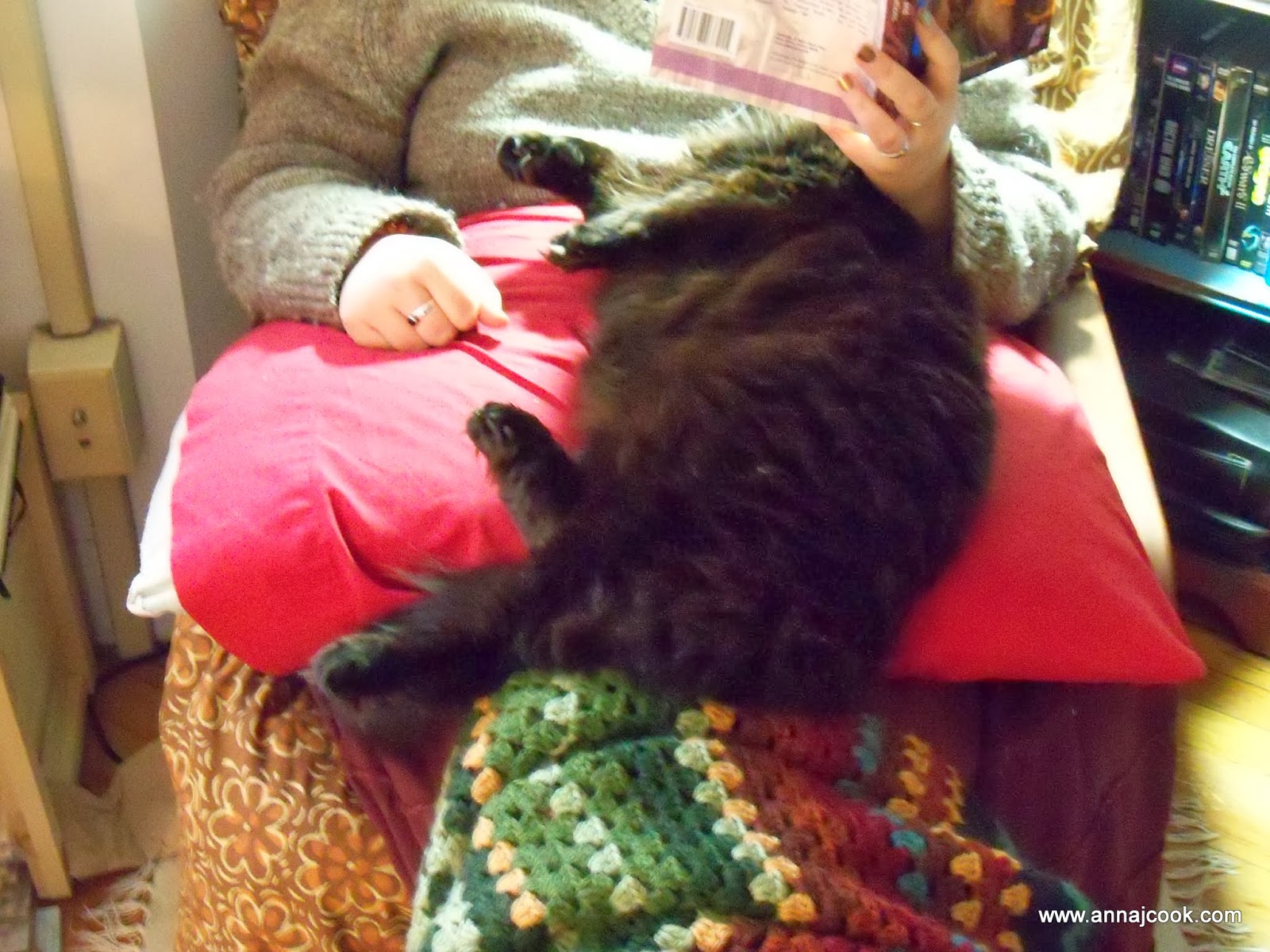
Gerry practices her balancing skillz on Hanna’s lap.
Looking back on the past year with my therapist on Thursday, I realized that this is the first year in over a decade (for both Hanna and I) in which no major life-transitions have taken place.
Neither one of us began or ended a relationship (yay 1st anniversary!).
Neither one of us began or ended a job (or moved to a different position within our workplace).
Neither one of us began or ended an academic program.
We began and ended the year in the same city, neighborhood, and apartment.
We began and ended the year with the same two companion animals.
With the exception of my grandmother, Marilyn, in June, we had no major illness or death on either side of our immediate extended family.
Cats, they give no fucks for your life accomplishments.
Of course, many other things did change in the past year. The Defense of Marriage Act was ruled unconstitutional. We got new tattoos. We witnessed the wedding of our near and dear friends Diana and Collin. Hanna delivered a conference paper at the Northeast Conference on British Studies. I briefly served as a guest blogger for Family Scholars Blog. Teazle learned to scale the drying rack; Gerry learned to be a lap cat.

But overall, this was the most uneventful year I have had since turning eighteen.

And I can’t say I’m disappointed with that.

scrabble with cats, take two [photo post]

15 Sunday Dec 2013

Posted by Anna Clutterbuck-Cook in our family

≈ 2 Comments

Tags

cat blogging, domesticity, photos

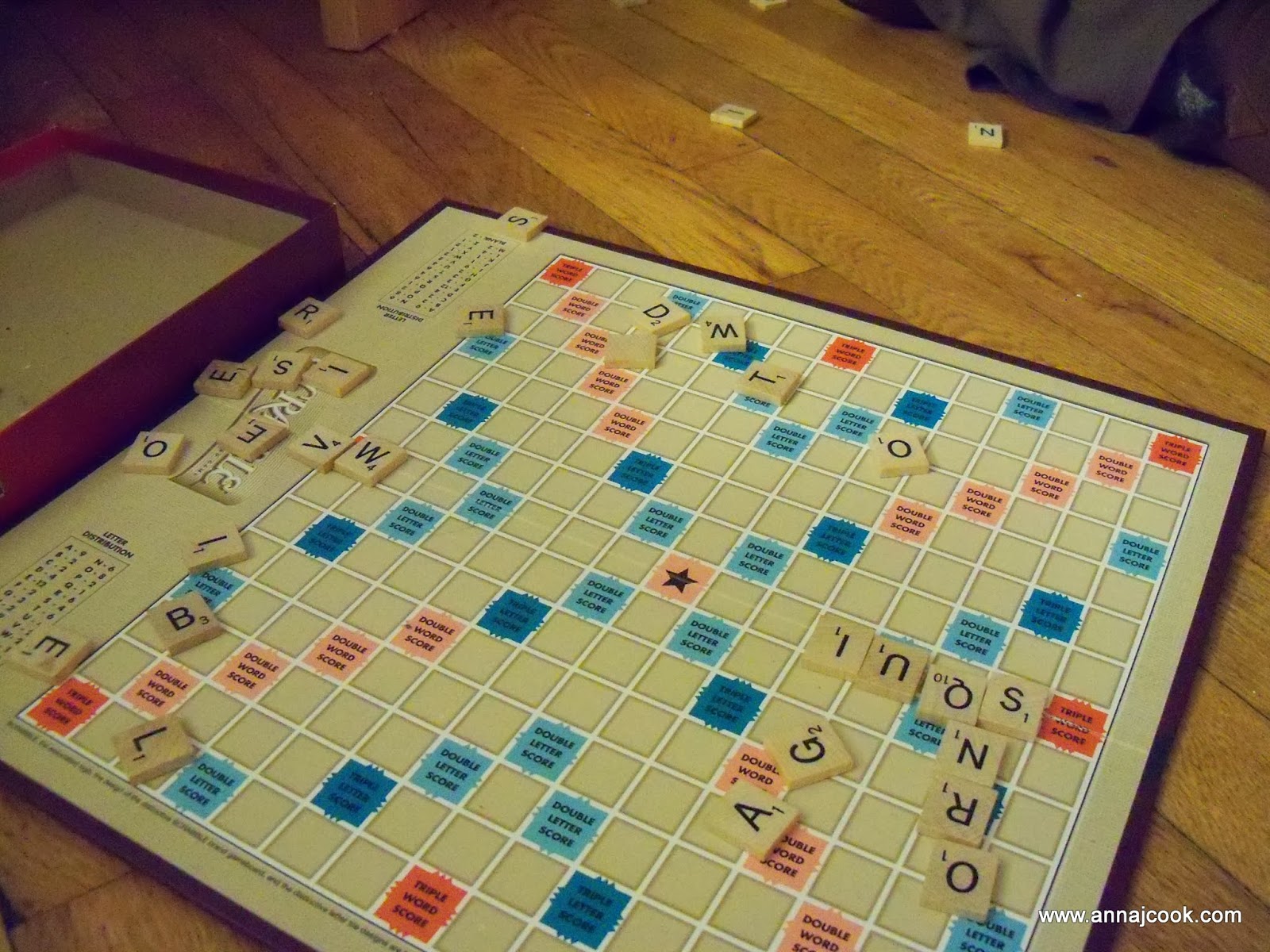
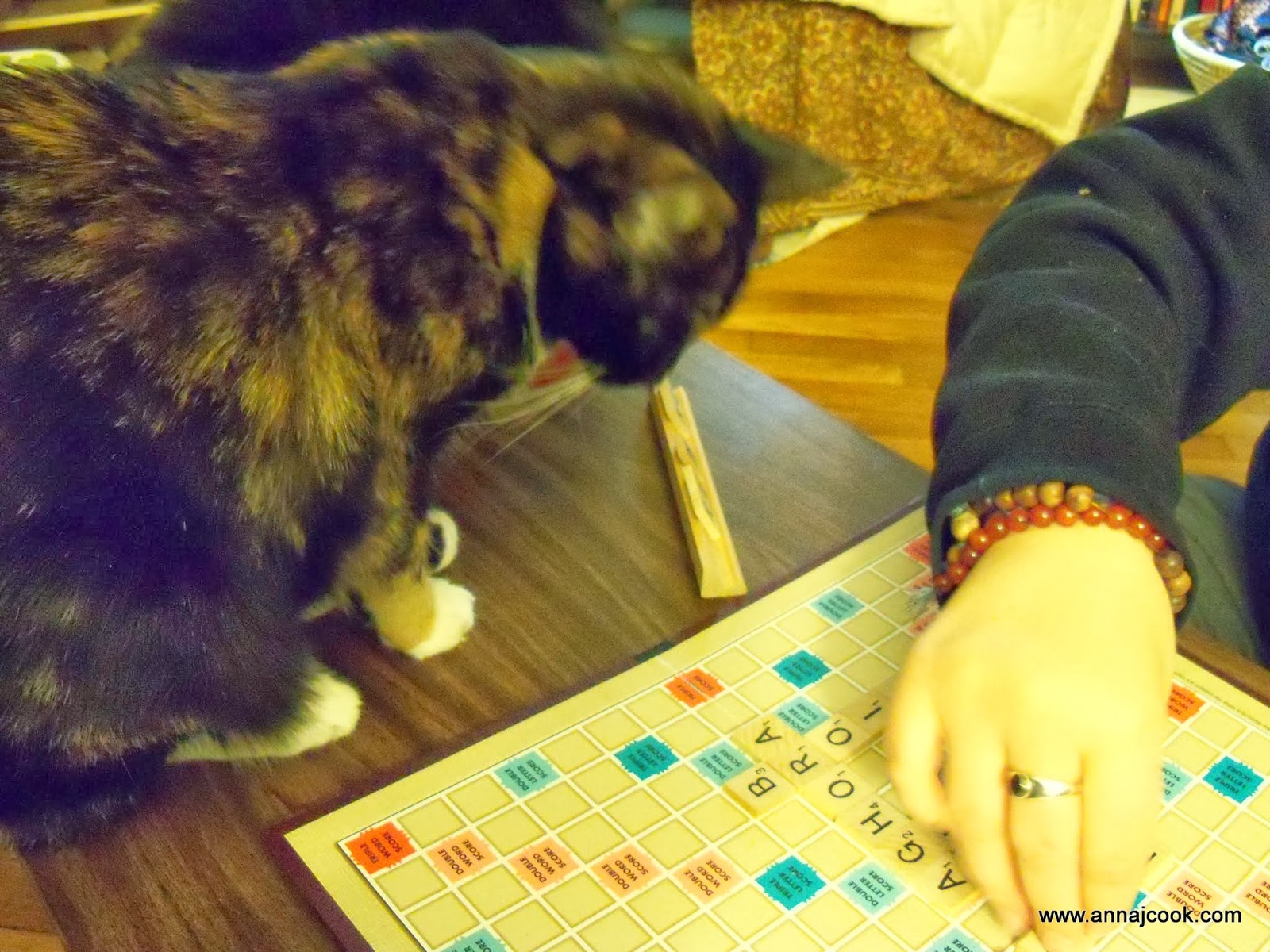
As the snow was falling thick and fast all over Corey Hill this evening, Hanna and I decided to break out the Scrabble board and play a game while we listened to the weekly news round-up hour of NPR’s On Point.

The cats, of course, had other ideas.

I hope all of you are staying warm and cozy this weekend, in your respective haunts.

from the archive: a new mother’s diary from 1910

11 Wednesday Dec 2013

Posted by Anna Clutterbuck-Cook in my historian hat

≈ Leave a comment

Tags

children, friends, history, MHS

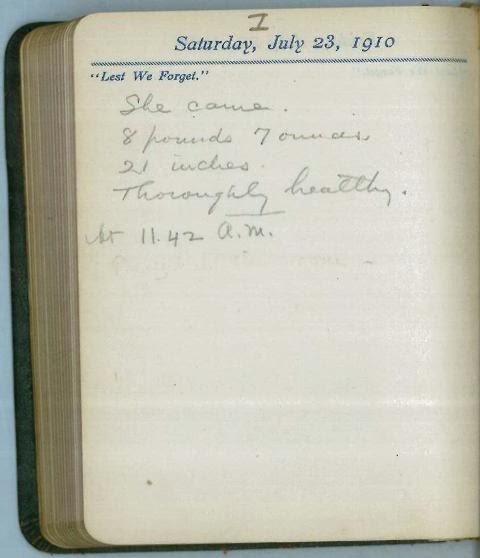
In honor of my friend and colleague supervisor Elaine who has just given birth to her first child, Sean Alexander, I put together a blog post over at The Beehive. It features the diary of Sophie French Valentine, who gave birth to her daughter in the summer of 1910 and chronicled their early weeks and months together in a page-a-day Standard Diary:

As the summer waned, Sophie recovered from her surgery and chronicled the comings and goings of her household, as well as the growth of her daughter (also christened Sophia). Several weeks after the birth, the family doctor paid a visit and pronounced “the little one…sound and vigorous.” Three days later, infant Sophie “went out in the bassinette in front of the house” for the first of what would be many afternoons in the fresh air with her mother. Sophie’s husband, a diplomat, appears to have been away during much of his wife’s convalescence, but a steady stream of female friends and relatives populate the pages of Sophie’s diary. On August 14th, for example, the day “the little one” was baptized Sophia French Valentine, she “had pictures taken with Harriet, Charles, Aunt Martha, Auntie May; and Elizabeth and Lucy,” as well as with her mother and Aunt Caroline (“who held her and talked to her lots”). Later she was visited by “Theodore, Mrs. Graves, and Auntie Beth.”

You can read the whole thing over at the MHS blog.

big book of orgasms book tour: interview with rachel kramer bussel!

06 Friday Dec 2013

Posted by Anna Clutterbuck-Cook in book reviews

≈ Leave a comment

Tags

gender and sexuality, interviews, smut

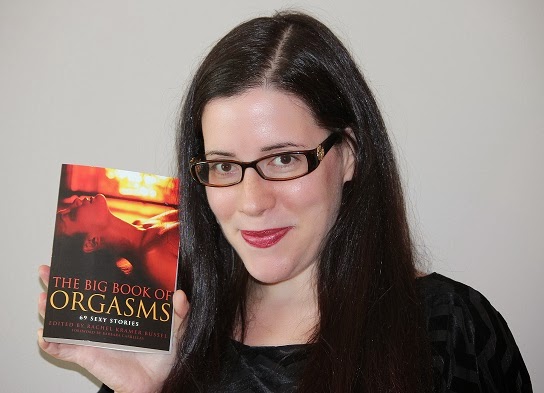
Today the feminist librarian is pleased to be hosting The Big Book of Orgasms (Cleis Press, 2013) book tour, featuring an interview with fabulous erotica anthology editor Rachel Kramer Bussel.

1. The Big Book of Orgasms is an anthology of erotic flash fiction at 1,200 words or fewer. What do you think are some of the biggest challenges and rewards of short-format erotica writing?

For some people, I think trying to tell a fully fleshed out story in 1,200 is difficult, especially if you’re used to having more room to set up the plot and develop your characters, but it’s certainly possible. For others, though, it’s a welcome challenge, and I get many more first-time authors submitting to my 69-story anthologies such as Gotta Have It and The Big Book of Orgasms than I typically do. The rewards are that you learn how to make every single word count; in my own writing, I’ve often had to pare down to get to the heart of what I want to say without giving up the heat and passion of a story. You learn how to write economically and it gives you an opportunity to write about things you may not otherwise devote time to. Flash fiction isn’t every reader’s or writer’s cup of tea, but I think it can be a good way to get yourself writing, especially if you don’t have a lot of time or are stuck agonizing over a given scene. Plus flash fiction can easily be expanded into a longer piece if that’s where the muse takes you; some of my longer stories started out with me trying to write to a shorter word count and getting sucked into the story, which is never a bad thing. As an editor, I appreciate the opportunity to publish three times as many authors’ work as I usually get, and I think it gives readers a wider range of choices.

2. I was impressed with the relative diversity of characters and story types in The Big Book. You have same-sex and different-sex couples, lesbian, gay, bisexual, and trans individuals, partnered and solitary sex scenes, and many flavors of sexual encounters. I often find erotic short-story anthologies to be fairly one-note, or featuring couples of mostly or entirely one variety (lesbian, gay male, straight, etc.), so this was a pleasant surprise. Did you make your selections with diversity in mind? Is the erotica market resistant to such “cross-genre” collections?

I definitely strive for as much diversity as I can get with each book, especially in The Big Book of Orgasms. I didn’t want readers to get bored, and I wanted to represent as broad a cross-section of what orgasms can look like and what they mean to various characters as possible. As an anthology editor I’m at the mercy of what’s in my inbox, so part of my job is making sure my public calls for submissions get spread as widely as possible and encouraging new writers to submit. In this case, there were a few elements I didn’t see as the manuscript neared completion, such a Tantric sex, that I felt were important, so I specifically asked a writer who I knew could write competently about that topic to write a story about it. In general, though, I try to create a whole that’s greater than the sum of its parts, with what I’m given. I wanted this book in particular to appeal to as many potential readers as possible, to be the one book I would recommend to new erotica readers and be the book of mine that is the most accessible, due to both the ultra short format and the breadth of it.

3. In an era when erotica is increasingly available in free or low-cost formats, what do you think readers of a print/ebook edited anthology like The Big Book of Orgasms get that they would be unable to find elsewhere?

From my job as anthology editor to Cleis Press’s ongoing commitment to publishing both highly edited and beautiful books, I think the final product is something that’s clearly been worked on with a lot of care. I love the print edition’s size for its compactness. It feels different than my books with 20 or 25 stories, and I like that it fits easily in purses and some pockets. In terms of quality, I think everyone has different tastes so I don’t necessarily think it’s a matter or choosing between cheaper books and this one, but with The Big Book of Orgasms every single story has been selected and placed with care. What readers will get out of this book is a range of voices, from vanilla to kinky, male to female, solo masturbation stories, which I don’t often get to publish, and very creative ways of looking at the topic of orgasm within an erotic framework. This is the book I’d recommend to new readers of the erotica, and to people looking for erotica to read to or with their partners, because there’s so much to choose from.

There’s room for self-published work about niche topics, as well as flash fiction and full-length works. One thing I personally love about the erotica genre, as a reader, writer and editor, is the abundance of short stories. That’s what I started out reading, in the Herotica and Best American Erotica series, and I always marveled at the authors’ ability to tell such riveting, memorable tales in a short space. The rise of e-publishing means authors can publish at varying lengths and aren’t as tied to the demands of print publishing, but because there is so much erotica out there, readers can be more discerning and demanding in terms of what they are looking for, both content-wise and style-wise. No fetish needs to go untouched or ignored.

4. Recognizing that what’s hot and sexy will always be subjective (and vary wildly among humans!), what is one theme or trope of erotica that you would be happy never to read again?

It’s hard to say because what may appeal to one person may not be my thing. I’m as fascinated as anyone else by the phenomenon of dinosaur erotica, which, if the media interviews this year are to be believed, is more popular than my books. It’s not my thing per se because I’m not usually into science fiction but I think it’s great that so many people are both writing and reading in that genre, and that the marketplace for ebooks exists to support it. I personally find the fetishization of extreme wealth of the billionaire hero, a la Fifty Shades of Grey, a bit overdone. I’m sure there are indeed billionaires out there, but it seems so over-the-top.

5. What is a theme or dynamic you would like to see writers explore more often in erotic writing?

I’d like to see more stories about couples, especially long-term couples, both having adventures and grappling with real-life sexual issues and situations. I see some of this, but I like the idea of couples exploring new things several (or many) years into their relationships. It’s hard to say what I’m looking for—part of what I love about editing anthologies is that every single time, authors manage to surprise and awe me with their creativity. I don’t like to say “I want more of X or Y” and then only get X or Y in my inbox. If I ever dare to think I’ve seen or read it all, putting out a call for writing lets me know I certainly haven’t!

6. What upcoming project(s) are you working on that you’re excited to share with your readers?

I’m teaching my first Portland, Maine erotic writing workshop at sex toy store Nomia, on December 3rd, which I’m looking forward to, then one January 17th at the New York Academy of Sex Education. Then I’m doing something I’ve never done: two three-hour workshops pre-CatalystCon on March 14th, on erotica writing and nonfiction sex writing, respectively (details are on my website). Those are more intensive courses and include individualized feedback. I’m hoping to teach more workshops as well and my upcoming erotica releases are Lust in Latex, about rubber and latex clothing, and Best Bondage Erotica 2014, both out in January from Cleis Press. I’m taking submissions through March 1st for Best Bondage Erotica 2015 and will be announcing a few more calls for submissions soon as well.

Thanks to Rachel for stopping by and taking the time to answer my questions. You can check out The Big Book of Orgasms at Amazon.com, Cleis Press, your local independent bookstore or library (if you’re lucky!), or Powell’s online.

quick hit: a must-read piece on ex-homeschool activists

04 Wednesday Dec 2013

Posted by Anna Clutterbuck-Cook in linkspam

≈ Leave a comment

Tags

children, education, politics, religion, the personal is political

The American Prospect has a most excellent article up today, The Homeschool Apostates, by Kathryn Joyce, exploring the growing visibility of young adults who are organizing and pushing back against their parents’ decision to use home education as a tool for familial control:

Even conservative Patrick Henry felt like a bright new reality. While much about the college confirmed the worldview Lauren grew up in, small freedoms like going out for an unplanned coffee came as a revelation. She describes it as “a sudden sense of being able to say yes to things, when your entire life is no.”

Family ties began to fray after she met John, a fellow student who’d had a more positive homeschooling experience growing up; he took her swing dancing and taught her how to order at Starbucks, and they fell in love. Her parents tried to break the couple up—at one point even asking the college to expel Lauren or take away her scholarship for disobeying them. Their efforts backfired; soon after her graduation, Lauren married John and entered law school.

As someone who grew up within the early unschooling wave of the modern home education movement, and thrived within it, I often find myself frustrated by most media coverage of homeschooling — it is too often simplistic, judgmental, one part awe (such well-behaved children!) one part hysteria (equating home education, per se, with child abuse). In contrast, Joyce does an excellent job of covering a specific type of homeschooling, as well as teasing out the highly gendered nature of Christian homeschooling culture. She also foregrounds the thoughtful, passionate voices of home-educated young people who look back on their childhoods and the Christian subculture they were immersed in with a critical eye.

While I don’t agree with everything these ex-homeschoolers have to say, I think their voices are crucial ones for us to listen to — particularly those of us who have benefited from the low level of state oversight that enabled our families to do our own thing while these controlling parents to did theirs. I don’t always agree with the remedies these ex-homeschoolers propose, but I do believe their experiences must be taken seriously. We can’t in good faith build a culture of learner-led education on the backs of young people who have been denied a very basic level of self-determination and autonomy.

Anyway. Go read the whole thing.

booknotes: the new soft war on women

02 Monday Dec 2013

Posted by Anna Clutterbuck-Cook in book reviews

≈ Leave a comment

Tags

economics, feminism, politics

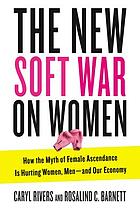
A few weeks ago, I was sent a review copy of Caryl Rivers and Rosalind Barnett’s latest collaboration, The New Soft War on Women: How the Myth of Female Ascendance is Hurting Women, Men – and Our Economy (Tarcher Penguin, 2013). I have read and appreciated the work of Rivers and Barnett before: their previous work has drawn on the latest in social science and psychological research to refute cultural narratives of gender difference that hurt us as children and as adults. This latest work treads little new ground. Rather, The New Soft War reminds us what we know (thanks to the research) about the continuing, pernicious discrimination against women in the high-powered workplace.

Such quantitative and qualitative research data run counter to recent anecdotal narratives (e.g. Hanna Rosin’s The End of Men) that predict in near-hysterical terms a present or future of gender imbalance in which domineering women run the world while emasculated men creep away into the shadows to nurse their wounds. Instead of “female ascendance,” Rivers and Burnett argue, female white-collar workers (virtually all of their examples come from the fields of business, finance, law, and corporate media, with a smattering of academics thrown in for good measure) continue to face gender stereotypes that impede their ability to succeed in their careers — while the gender stereotypes their male counterparts experience often boost their success out of proportion to their proven abilities. Individual mentoring programs and other exhortations for women to self-advocate (the “lean in” approach) fail, the authors argue, because placing the burden for change on professional women themselves ignores cultural biases and structural disadvantages that conspire to make many individual opportunities a no-win situation if the individual in question is a woman rather than a man.

The book was a useful review of what the research tells us — as far as it went. However, I found its overall narrative to be lacking in broader analysis and its ultimate conclusions (a reiteration of the need for systemic change, coupled with suggestions for how women can work within or game the current system) to be tepid. For two authors who have just spent over three hundred pages detailing how endemic sexism is in the white collar workplace, to have the final chapters focus largely on individual strategies would seem to undercut their argument for policy-level change.

I was also irritated by the focus on white collar professional women, most of whom were navigating a corporate culture I have little experience with and struggled to relate to. I would have appreciated a more class-inclusive approach: women working in less high-powered professions, including my own world of library science — not to mention women working in the service and retail industries — were barely mentioned. The focus was on women in traditionally male-dominated professions. Some of that data can no doubt be generalized to women in the workplace more generally, but I am wary of casually assuming that the experience of highly-educated (largely cis, het, white) professional-class women pulling down six-figure salaries can stand in for all of us.

Given, for example, the way recent scare stories about women dominating the new labor market often focus on working-class and poor women who are heads of household, it seems particularly important to push back against the notion that a first-generation female college graduate who earns a living wage as a pharmacist is “empowered” to the extent that she is immune from exploitation as a worker, sex discrimination as a woman, race discrimination if she is non-white, and ageism if this is a second career — the list could go on and on. Rivers and Burnett rarely complicate their picture of the ideal worker with any of these intersectional concerns … their analysis generally presumes a high-powered businesswoman who has learned (and is able) to play the corporate game, yet still finds herself passed over for a promotion, or condescended to after the birth of her first child.

In other words, a woman frustrated that all of her (acknowledged and unacknowledged) social privilege and personal gumption haven’t rewarded her as lavishly as they have rewarded the men in her graduating class at Harvard Business School. This woman’s concerns are not invalid ones — it is fair to ask why our society rewards some groups of people more lavishly than others — but the “new soft war on women” does not only affect her and her peers. It is part of an aggressive neo-capitalist campaign to dehumanize and disenfranchise employees and grant ever-more power to the plutocrat employers. Within this broader struggle between the (relatively) powerful and the (relatively) disempowered, gender discrimination is often but one of many battlegrounds. That Rivers and Burnett ignore this larger framework ultimately weakens their closing arguments for political and social change.

The kind of feminist analysis I appreciate most is the kind that does not ignore the complex differences that exist between women, but rather engages with them (even if only to say in one’s introduction that a given study out of necessity will narrow its focus to X and Y group). The New Soft War would have been a better book, in my estimation, if it had at the very least acknowledged that its study population (and intended audience) was but one specific group of upper-middle-class professional women — rather than women generally. And that its agenda for social change was one of limited reforms within the pre-existing system, rather than a more ambitious questioning of the economic status quo.

thanksgiving with cats [photo post]

29 Friday Nov 2013

Posted by Anna Clutterbuck-Cook in our family

≈ Leave a comment

Tags

cat blogging, domesticity, holidays, photos

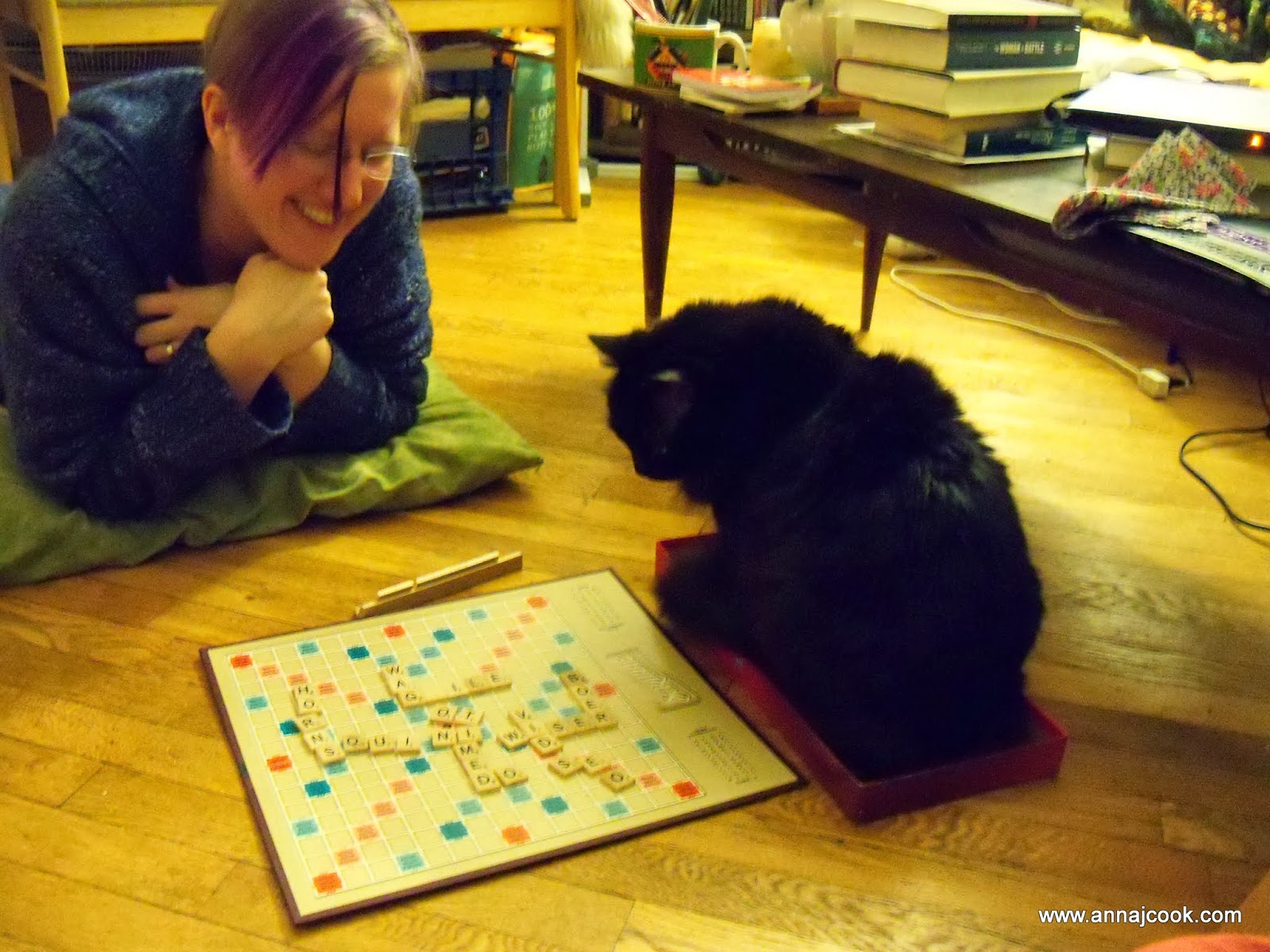
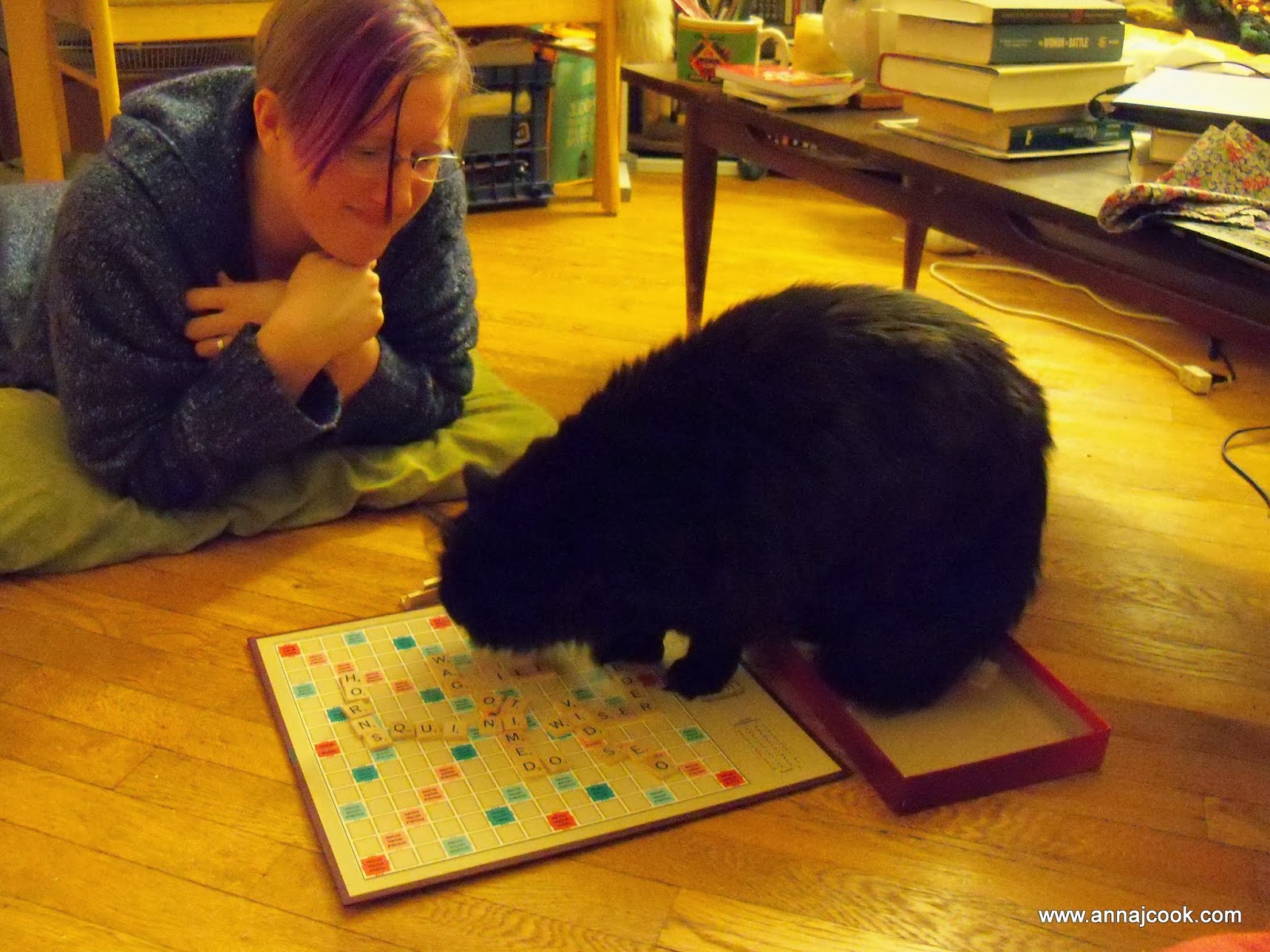
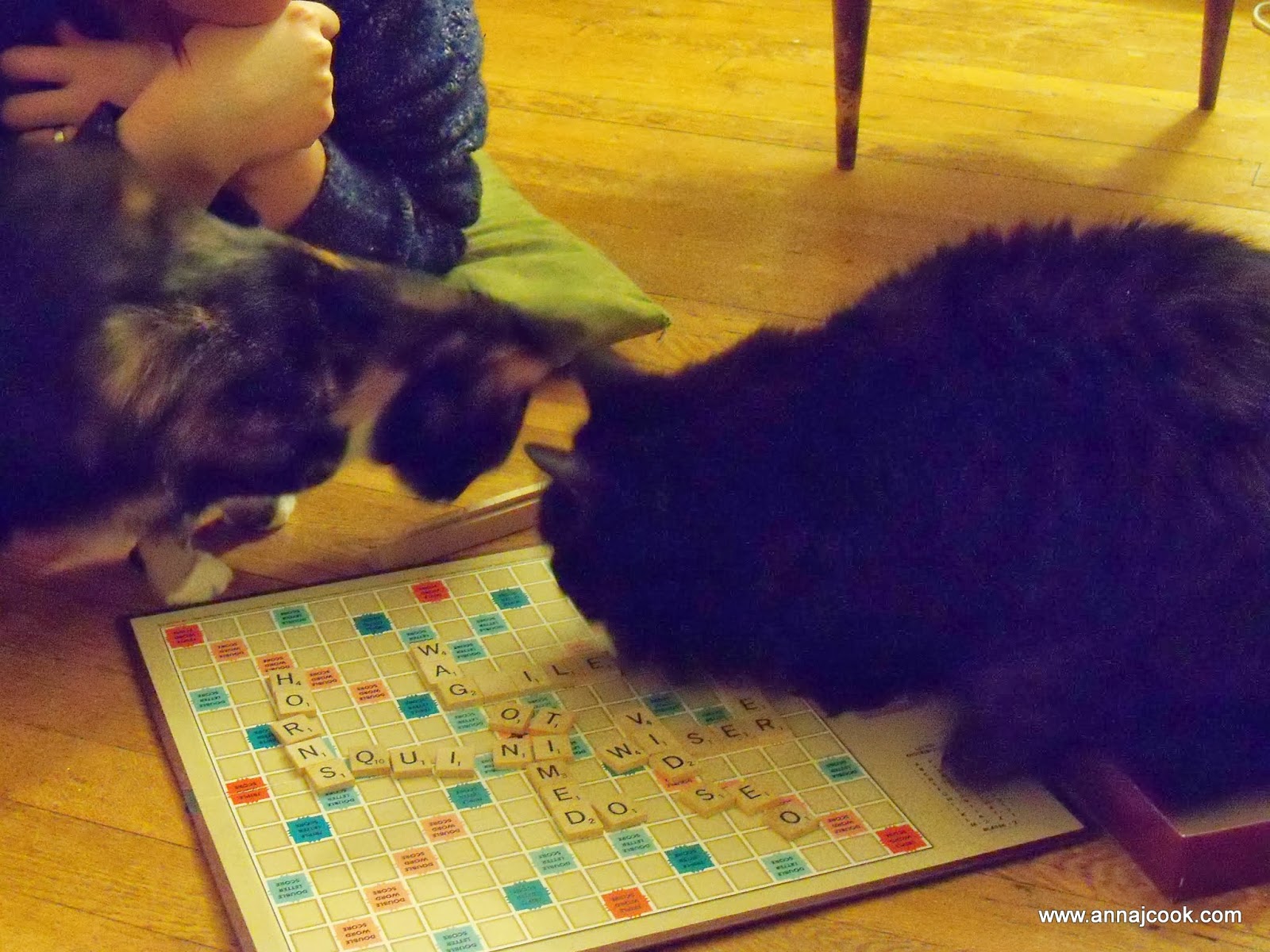
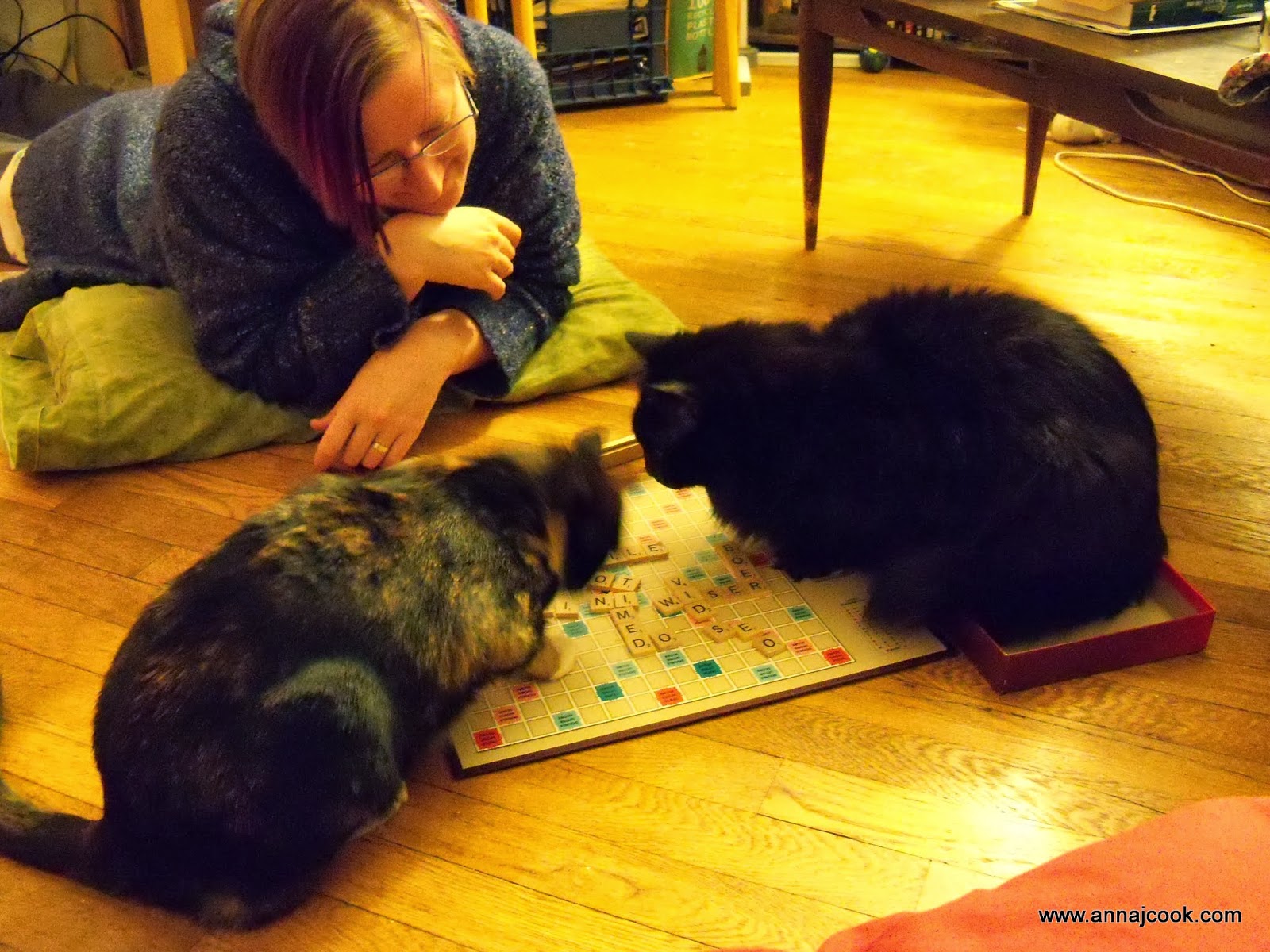
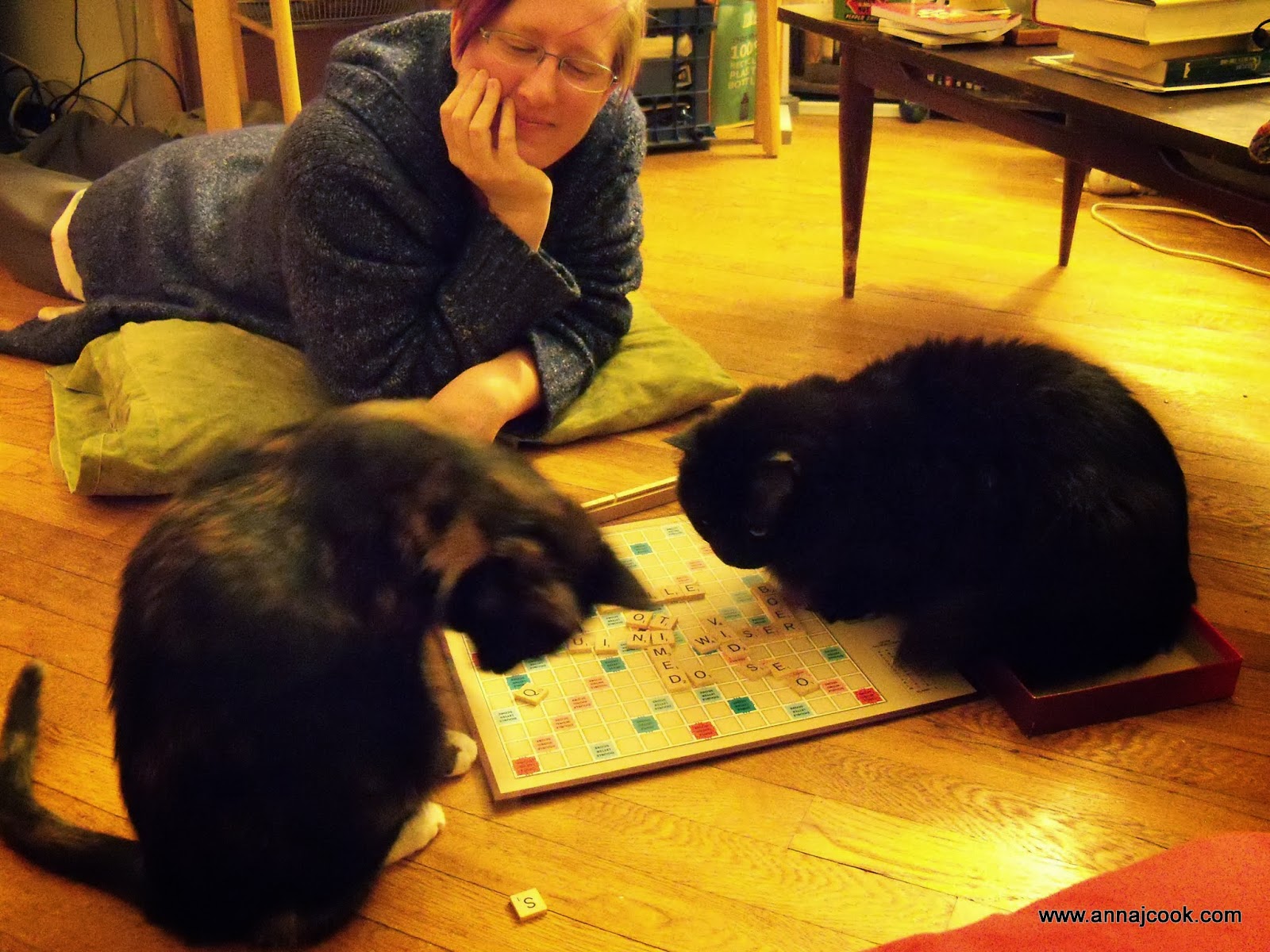
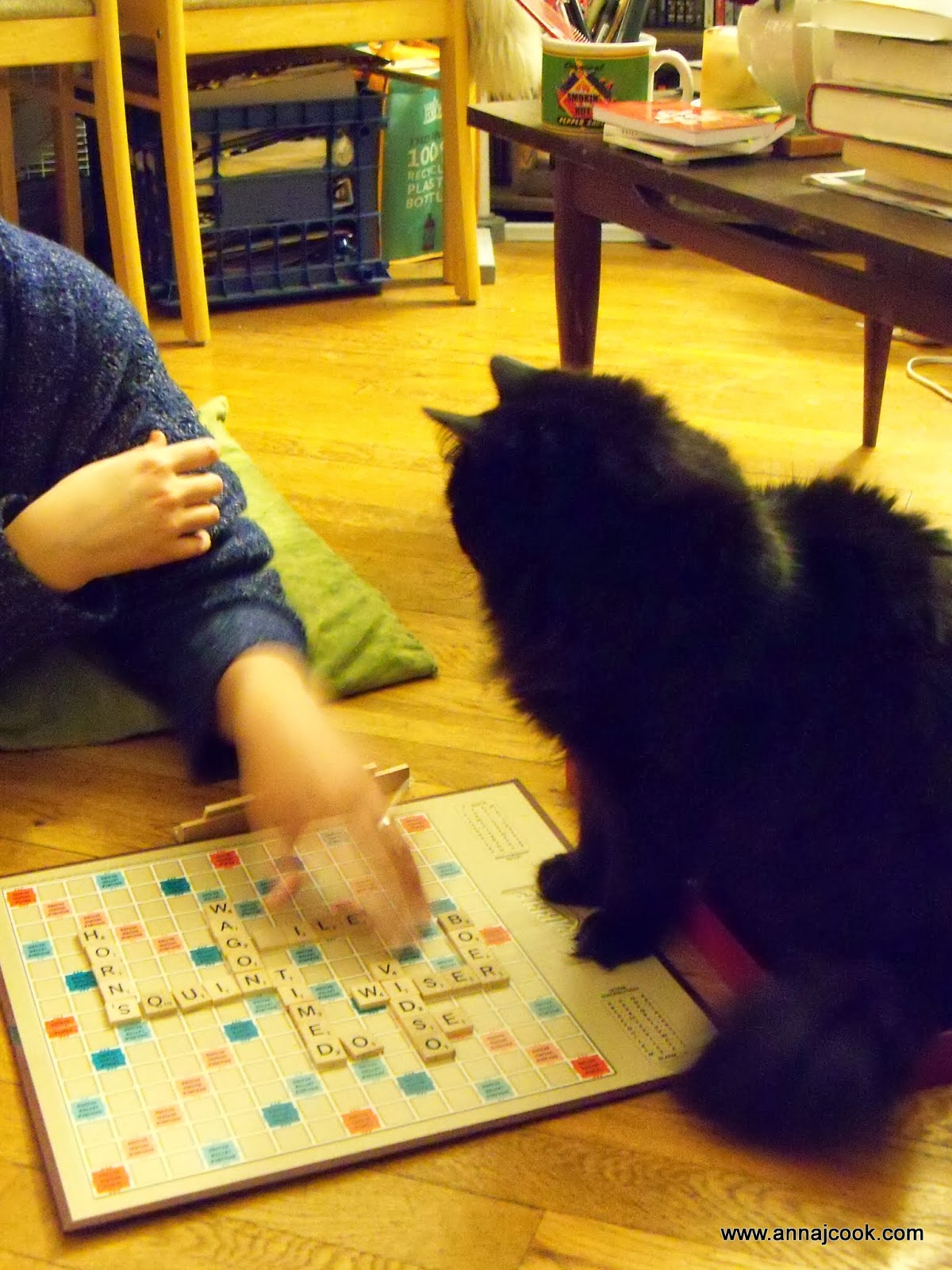
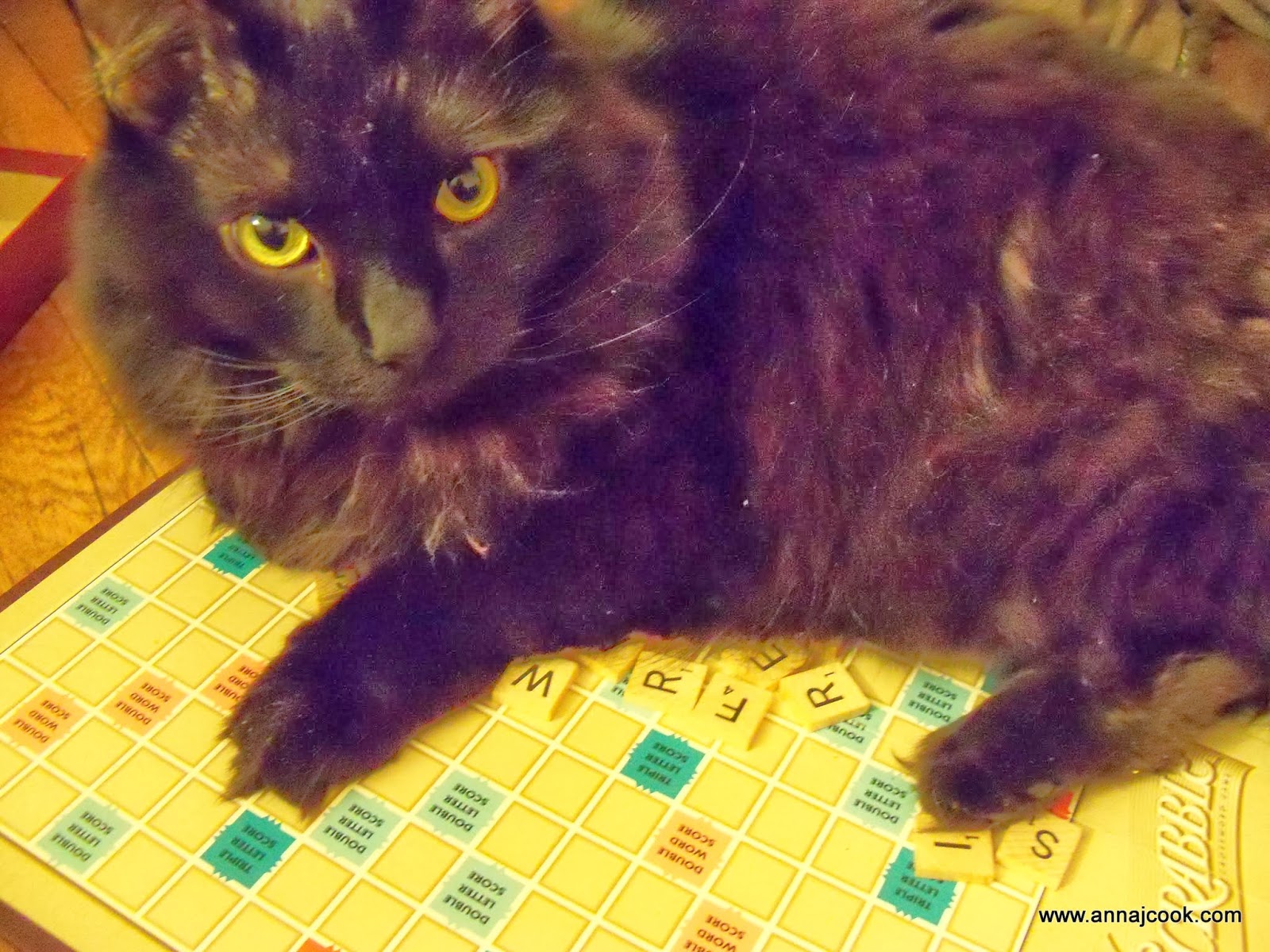
Last night, Hanna and I thought a game of Scrabble might be nice … and Teazle thought so as well!

Gerry thought she would keep watch over the tiles.

Meanwhile, Teazle helped the humans distribute the tiles properly.

I hope all of you continue to enjoy your weekends, however long or short they may be.

← Older posts
Newer posts →
"the past is a wild party; check your preconceptions at the door." ~ Emma Donoghue

Recent Posts

  • medical update 11.11.22
  • medical update 6.4.22
  • medical update 1.16.2022
  • medical update 10.13.2021
  • medical update 8.17.2021

Archives

Categories

Creative Commons License

This work by Anna J. Clutterbuck-Cook is licensed under a Creative Commons Attribution 3.0 Unported License

Meta

  • Create account
  • Log in
  • Entries feed
  • Comments feed
  • WordPress.com

Create a free website or blog at WordPress.com.

  • Subscribe Subscribed
    • the feminist librarian
    • Join 37 other subscribers
    • Already have a WordPress.com account? Log in now.
    • the feminist librarian
    • Subscribe Subscribed
    • Sign up
    • Log in
    • Report this content
    • View site in Reader
    • Manage subscriptions
    • Collapse this bar